The British Empire Exhibition of 1924–25, held in the north London suburb of Wembley, was the largest of Britain's great imperial pleasure parks, built to celebrate the empire's contributions to British war efforts and to point toward a possible imperial future.Footnote 1 The empire had seemed to rally behind Britain during the war, and now the “empire family” would celebrate victory and learn how a coordination of policies between India, Britain, and the dominions and a turn toward interimperial trade might alleviate the vexing “problems” of the interwar years.Footnote 2 The British Empire Exhibition illustrates how the 1920s was a period of imperial transitions, a web of relationships too complex to be usefully summarized as “decline,” as traditional interpretations have often done.Footnote 3 Imperial relationships might be loosening elsewhere, but intentionally didactic displays at the British Empire Exhibition advertised “empire strengthening,” “empire consolidation,” and “empire development.” These themes were connected to strengthened authoritarian control over colonial peripheries, especially the “dependent” colonies located in the tropics and crucially including British territories in West Africa. Colonial participation was nearly total, the largest ever for a British exhibition, but Britain's three largest colonies in West Africa, Nigeria, Sierra Leone, and the Gold Coast (Ghana) were especially significant.Footnote 4 The unprecedented size and lavish displays of the West African pavilion set the region's exhibits apart from those of other “dependent” territories, while cultural associations regarding West Africa and white supremacy underscored the importance of the region in the imperial imagination. A raced and gendered imperial culture advertised at Wembley represented a paradoxical modernity in which a supposedly unsullied landscape of “the primitive” would alleviate a sense of crisis regarding the direction of modern society in Britain.
I argue that at Wembley representations of West African colonialism demonstrated the importance of Africa in the reimagining of empire and domestic society in Britain during the 1920s but ultimately exposed irresolvable contradictions in relationships of power during a period characterized by an accelerating pace of modern change and expanding global communications.Footnote 5 Forces associated with industrial reorganization, new methods of administrative organization, the coordination of scientific research, and advanced technologies of communication, military weaponry, and transportation gained legitimacy at the exhibition from association with colonial peripheries. First, this article will explore how the exhibition showcased masculine claims to remake colonial territories as a project of “liberal” civilizational values, helping to restore a public faith in the direction of progress damaged by the war.Footnote 6 Second, the same technologies that made the British Empire Exhibition an unparalleled imperial broadcast mechanism also made it easier for British public audiences and visiting West Africans to negotiate and reinterpret imperial ideas on their own terms. Contradictions between liberalism, modern culture, and empire came forcefully together in public controversies surrounding British associations of West Africa, “primitiveness,” and womanhood. In the views of West African visitors, an exhibition intended to promote imperial loyalty became a metaphorical “white man's grave,” as some formerly loyal British-educated West Africans began making contact with international movements of Pan-Africanism and Garveyism, with important consequences for future relations between Britain and West Africa.Footnote 7 The histories of Africa and Britain, far from being separate, were intimately intertwined during the interwar years, as indeed they had been since the seventeenth century.Footnote 8
An exhibition whose stated goals included the claim “to make the different races of the empire better known to one another” saw record numbers of “loyal Africans” from Nigeria, Sierra Leone, and the Gold Coast arriving in London.Footnote 9 West Africans were present in many roles, as soldiers, farmers, traders, wives and husbands, students, tourists, spectators, and “native rulers,” both active subjects and dominated objects in a culture of public spectacle. About sixty Hausa, Yoruba, Mendi, Ashanti, and Fanti visitors peopled a “native village” and “native workshop,” while West African planters and British-educated West Africans stayed in private homes or London hotels. West Africans had received assurances from organizers and colonial officials that they would be treated respects represented.”Footnote 10 More than thirty-seven territories sent exhibits, and thousands of visitors arrived from overseas. West Africans were not the only colonial peoples displayed at the British Empire Exhibition, as the exhibition guidebook mentions twenty Malays, thirty Burmese, 160 Hong Kong Chinese, and three Palestinians in addition to the West Africans. Indians, Singhalese, West Indians, and indigenous peoples of British Guiana lived outside the exhibition but attended their respective pavilions daily.Footnote 11 There are similarities between the experiences of West Africans and those of other colonial groups, such as Indian loyalists who attended in large numbers, but the size of the West African exhibits and the way in which West Africans were made to illustrate changing boundaries of difference help to put the experiences of the West Africans in a category of their own.Footnote 12 While earlier exhibitions portrayed Africans as “savages” or posed Africans on an evolutionary scale between humans and animals, Wembley included pictures of “racial progress” that alleged that Africans were advancing under white rule. Nevertheless, public and journalistic responses to the West African exhibits suggest that the exhibition contributed to a growing pervasiveness, multiplicity, and arguably internationalization of languages of difference during the interwar years, with negative implications for imperial unity and, possibly, for relations among West Africans themselves.
The patronizing fiction lying behind liberal pretensions to “racial politeness” was captured in remarks made by Rudyard Kipling. Kipling had provided names for the walkways that bisected the fairgrounds and attended the exhibition several times in 1924, meeting with visiting Americans and other notables. Early in the year Kipling toured the exhibition grounds a few weeks before the formal opening and recorded his reactions to the larger exhibition and the West African exhibits in a private letter later recalled by Nigerian governor Hugh Clifford. Kipling remarked, “It's the biggest thing man ever set hand to, in design and in a certain grandiosity. … The West African building is full of the Spirit. One almost smells the nigger passing by.”Footnote 13 Kipling's remarks passed without comment by Clifford, suggestive of the way in which the “liberal” colonial discourses of the 1920s preserved older relationships of power.
Warrior manliness, white supremacy, and a patronizing “politeness” for colonized peoples were embodied in the monumental architecture of the British Empire Exhibition. In a city crowded with imperial monuments, the British Empire Exhibition could do more than hold its own. The exhibition covered 216 acres of virgin parkland, a larger site than previous London exhibitions held at the Crystal Palace or the “White City,” and one which organizers hoped would become a permanent location where similar empire exhibitions could be held periodically in the future. Visitors climbing out of the newly enlarged Wembley Park railroad station approached the exhibition on broad walkways leading between enormous white structures, “concrete buildings of Egyptian dimensions” designed by the young architectural consultant Owen Williams, awarded the K.B.E. for his exhibition work.Footnote 14 The focal point of the grounds was the Empire Stadium, later rechristened Wembley Stadium, the largest sporting facility in the world in 1924, a colossus with a capacity of 120,000. The stadium was surrounded by “palaces” of engineering, industry, and arts, by large white neoclassical structures housing the exhibits from the dominions, a fairground, and feminine colonial pavilions built to resemble temples, pagodas, a Mughal palace, and other “exotic” structures.
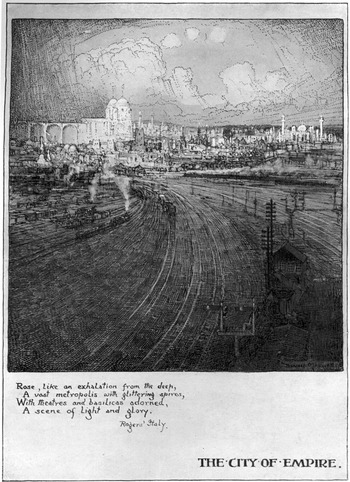
The West African building was part of a larger exhibition that, while containing many crosscurrents and contradictions, was intentionally constructed to demonstrate links between colonialism and modern science, to suggest continuities with the Victorian and Edwardian past, and to advertise changing imperial ideas of the 1920s. West Africa was made to represent an imperial politics of generation and growth encapsulated in the term “empire development” (see fig. 1).
Continuity and Change: West Africa and the “Productive” Postwar Empire
The exhibition implicitly demonstrated how Britain's enlarged postwar empire, including new territories in Africa as well as the Middle East and the Pacific, would turn from starkly masculine ideas of conquest and domination toward notions of “duty” and generative power that mixed femininity with a different kind of masculinity.Footnote 15 The exhibition reflected both the increased presence of women in the colonial sphere and a perceived need to “educate” newly enfranchised voters regarding imperial relations. The “new empire” of the 1920s would focus on “empire development” and “empire consolidation” but remained an essentially masculine enterprise, a project that connected British ideas of race with the masculine ability to command, control, and direct supposed “lesser races” in West Africa and other territories. An imperial economy of generation and reciprocity would link empire to modern culture, providing a basis for the reconstruction and moralization of British manhood, perceived as ailing from the catastrophic effects of World War I.Footnote 16
The West African pavilion is visible between the Empire Stadium and darkened railroad lines suggestive of modernity in Donald Maxwell's watercolor painting The City of Empire. The quotation from Samuel Rogers's 1854 poem “Italy” makes an explicit connection to the republican commonwealth of Venice, compared to the British Isles in The Commonwealth of Oceana by the seventeenth-century republican writer and polemicist James Harrington. Maxwell's painting appears as the frontispiece to Wembley in Colour, a popular souvenir book published in 1924.

Britain's new “productive” imperialism provided connections to a self-confident Victorian past and advertised Britain's ability to meet new challenges. The postwar empire would be linked by “empire wireless” and fleets of imperial airships, while scientific research would be directed toward the goal of “developing” the “hidden resources” of the tropics. Faster battle cruisers and the Royal Air Force would provide a more efficient method of “policing” the colonial peripheries. The West African exhibits were a showcase of new ideas of empire and scientific, technological, and political trends that promised to bring about a more “liberal” imperial unity, in harmony with the charter of the League of Nations, a series of postwar imperial conferences, and new ideas of commonwealth proposed during the 1920s.Footnote 17
The history of Britain's colonialism in tropical Africa is full of contradictions and is difficult to characterize, but visitors to Wembley could view many examples of West African “progress.” By the 1890s Ronald Ross's discovery of the link between the anopheles mosquito and malaria, the more widespread use of quinine as a prophylactic, and the deployment of new methods of segregation, sanitation, and town planning had made more regular and extensive African colonial administration possible. The growth of railroads and shipping and the cultivation of cash crops had helped to fuel a rapid expansion of imports and exports. By 1918 the application of tropical medicine and the establishment of a colonial economic base had been achieved in the coastal areas of British West Africa, and British control was rapidly expanding inland, drawing formerly independent or semi-independent groups such as the Ashanti and the Northern Territories of the Gold Coast closer to the colonial orbit. These changes made possible a large and continuing expansion of the African population, making up and surpassing the loss of population that occurred during the late nineteenth-century period of conquest and “pacification.” As A. Boahen has suggested, colonialism did have “credit and debit sides,” though on the balance the humiliation of African peoples and exploitation of resources far outweighed the incidental benefits implemented under colonialism. Nevertheless, many factors came together at the Wembley exhibition that illustrate how British colonial rulers in West Africa had acquired a new self-confidence and optimism during the 1920s.Footnote 18
Displays in the West African “walled city” showed how African labor, allegedly hamstrung by communal structures and inhibited by “backwardness,” was moving forward under the alleged moralizing discipline provided by colonial taxation and market mechanisms. “Development” in West Africa would require new harbors, schools, railroads, telegraphs, and trained personnel, all of which could be provided by Britain but which depended on a sizable increase in African trade. In the absence of an empire tariff, defeated in the election campaign of 1923, African “development” would need to be financed through a moralized private market that tempered individualism in the long-term interests of imperial unity. The “walled city” would teach industrialists, investors, and homemakers to invest in empire or to buy “empire products” even if this meant accepting higher prices or greater levels of risk.
Modern “science” would provide a rational basis for the moral economy of empire. In 1924 the anatomist Grafton Elliot Smith, a public advocate on behalf of the concept of “racial diffusion,” was near the height of his popularity.Footnote 19 While social Darwinists had portrayed “races” locked in mortal struggle, diffusionists argued that cultural advances occurred through a process of outward radiation sparked by dominant ethnic groups, “tribes,” or “races.”Footnote 20 The concept of “racial diffusion” was criticized by some scientific peers but was embraced by anthropologists, including R. S. Rattray, a key figure in the construction of the West African exhibits.Footnote 21 “Racial diffusion” seemed to move away from conquest and support new ideas of a “productive” empire in the 1920s. Public audiences could view representations of “racial diffusion” through exhibition architecture and at many other points. These included an “anthropological section” organized by the Royal Anthropological Institute (R.A.I.), which produced a pamphlet describing how anthropologists were assisting the diffusion of civilizational values in West Africa.Footnote 22 “Racial diffusion” was especially emphasized in the West African “walled city” through historical models and representations of Anglo-Saxon dominance easily conflated with a popular discourse of manly “martial races,” now organized for “productive” purposes rather than warfare.
During the 1920s constitutional advances and anticolonial nationalism had made it more difficult to build an Indian Pavilion advertising ethnographic typology or “racial diffusion,” but a colonialist view of Indian ethnography had a detectable influence in the construction of exhibits in the West African pavilion. Kano, the inspiration for Wembley's “walled city” was the seat of the Sokoto Caliphate and home to the lighter skinned, equestrian, and monotheistic Fulani, imagined as a more “advanced race” than the darker skinned Nigerians of the coastal and forest regions. The Fulani were descendants of a nomadic group who, according to the Nigerian handbook sold in the West African pavilion, had conquered more settled peoples and established their rule by virtue of martial ability and supposed superior intelligence but had fallen over time, becoming by the end of the nineteenth century a “terrible tyranny.”Footnote 23 As in British historical references to Mahmud of Ghazni, the thirteenth-century conqueror and founder of the Delhi Sultanate, or to Babur and the sixteenth-century foundations of the Mughal Empire, British rule over a foreign territory was justified by reference to past conquests by a lighter skinned monotheistic “martial race” over darker skinned polytheists. As the exhibition touted how the “British race” was no longer making war but organizing a new, “productive” imperialism, the Fulani were alleged to be responsible for an earlier transmission of civilizational ideas from North Africa through the West African region.Footnote 24 Under colonialism British governors would assert control over the Fulani in order to “guide” them and “lesser peoples” inhabiting the region.
The West African “walled city” advertised Britain's ability to enlist allies and contain potential challenges. By coincidence the opening of the exhibition coincided almost exactly with G. M. Kemal Atatürk's abolition of the caliphate, and the exhibition advertised George V as the leader of the world's largest Muslim population living inside the territories of the British Empire. In July the Fulani emir of the northern Nigerian city of Katsina arrived at Wembley, where he visited the “walled city” and was celebrated as a “progressive” ruler, having “a true sense of the advantages possessed by the British Empire over the world of independent Islam.”Footnote 25 The emir provided British audiences with a visual personification of an imperial ally, a political complement to the scholarly contributions presented to the Conference of World Religions held in conjunction with the Wembley exhibition in the fall of 1924.Footnote 26
Exhibition literature repeated earlier fictions regarding cannibalism and “savagery” among West Africa's many ethnic groups, but these ideas were pushed into the background in displays of “racial progress.” In this changing imagery, Africans no longer seemed frightening but childlike, amenable to control. J. C. Maxwell, Gold Coast Secretary of Native Affairs, sat on his colony's planning committees and wrote a section of a larger book titled Native Races of the Empire produced in conjunction with the Wembley exhibition. In Maxwell's view West Africa was home to hundreds of different “tribes,” which could be ranked according to a graded hierarchy that conflated “racial” and cultural characteristics. The West African groups chosen for representation in the “native village” and “native workshops,” presumably with Maxwell's approval, were regarded as possessing “advanced” characteristics, including martial abilities, and were seemingly well placed to assist in the spread of British civilizational values through the region. For example, the Mendi of Sierra Leone, who sent many samples of woven cloth for sale in the West African pavilion, were described by Maxwell as “a virile people” whose customs and languages were spreading “at the expense … of other tribes adjoining them,” while Hausa-speaking peoples, prominently displayed as guards and soldiers at Wembley, were regarded as “a highly intelligent people, forming well-organized communities”—“good farmers and keen traders,” long accustomed to working in a subordinated position under the Fulani.Footnote 27
Britain's new “productive” empire depended on consolidation and unity in West Africa that allegedly could not come about through the actions of Africans themselves. The displays of peoples and materials inside the West African pavilion emphasized the ethnic, linguistic, and religious diversity of the West African region. Exhibits that portrayed regional fragmentation chimed with the emphasis on Kano as a “city state” disconnected from any regional administration predating British control. These included pictures of Hausa and Yoruba “ethnographic types,” the displays of “country cloths” in the Sierra Leone pavilion, in which each pattern and design was held to represent a different “racial” group, and the displays of polyglot and religiously diverse peoples in the “native villages” and workshops, all of which sustained the impression that the only unity that existed in West Africa was the imposed unity of colonialism. As in the Indian pavilion, Wembley's “walled city” advertised a fragmented and anarchic collection of religions, languages, and ethnicities, in which “progress” was possible only from an imposed center, a Habsburg Empire of diverse and incompatible peoples thankfully governed under a benign autocracy.
Visitors to the exhibition might easily miss details but could hardly miss the larger lessons of the “productive” empire and the “scientific” and historical justifications for dominance and control. British workers, women, industrialists, investors, and others would be asked to assist in the “development” of tropical Africa through a reciprocal moral economy of regeneration and “progress.” The new imperial project in Africa would recall wartime unity, and the destructive energies of the war would be turned toward new “productive” purposes signaling the regeneration of British society and British manhood. Nevertheless, in spite of claims to command and control, British power was subject to negotiation at many levels. This fact becomes clear first with respect to the organization of the exhibits in West Africa.
Organizing the Exhibition in West Africa
Organization work carried out in West Africa from 1922 onward suggests how power might be renegotiated at the ground level in Britain's postwar empire. Decima Guggisberg, a member of both the Women's Guild of Empire and the Overseas Committee of the International Women's Suffrage Alliance, and her husband, Gold Coast governor Gordon Guggisberg, were key figures in the organization of the West African exhibits. Gordon Guggisberg symbolized a new ideal of manly colonial administrator of the interwar years. Gordon did not come from the upper-class background typical of prewar colonial administrators and represented a break with the traditional hypermasculinity of the colonial service, bringing a pragmatic and energetic focus to plans for stimulating the colonial economy. Decima Guggisberg (née Lilian Decima Moore), married to Gordon in 1905, has received considerably less attention from historians, although her contributions are also pivotal to the colonial administration of the Gold Coast in the 1920s.Footnote 28
The Guggisbergs had traveled through Nigeria before World War I and authored an account of their tours, titled We Two in West Africa, a joint production, although a note in the introduction suggests that most of the writing was done by Decima. Portions of We Two in West Africa read as a compendium of harsh colonialist assumptions: “At last I was in that strange and fascinating world—tropical Africa … the home of the original negro, fetish worship, and strange diseases. Literature is practically non-existent, art is of the crudest form, history is of the vaguest kind. Civilisation is, however, gradually spreading northwards from the Gulf of Guinea, accompanied by the inevitable black bottle, and the natives are beginning to turn the little energy they possess … to the systematic cultivation of rubber and cocoa, for which a great future seems assured.”Footnote 29
The British Empire Exhibition would serve the liberal turn of colonial discourse by attempting to shift attention away from ideas of “the primitive,” stressed in the prewar writing of the Guggisbergs, toward the “great future” promised by colonial rule. The exhibition would purport to show how, under colonialism, West Africa was being stimulated to the production of culture and revived traditional crafts, and the greater exportation of more familiar products such as palm kernels, peanuts, skins and hides, cocoa, tin, and shea nuts.
No sooner had preparations begun than word reached West Africa that the date for the opening of the exhibition had been pushed back from 1923 to 1924. The delay allowed the organizers to plan more elaborate displays; eventually the three West African colonies would spend an amount larger than the British government's proposed guarantee, funds raised primarily from import and export taxes derived from the region's burgeoning peasant economies; in effect, West African peasants paid for a portion of the British Empire Exhibition. By the early 1920s Britain's West African colonies were experiencing a period of economic contraction due to reductions in international trade and a period of consolidation, in which larger British firms acquired greater control of African markets.Footnote 30 West Africa's English-language newspaper press, under the editorship and control of British-educated West Africans, complained of unemployment and hard times as merchants and exporters felt squeezed, but expenditures for the exhibition were justified on the basis of trade.Footnote 31 The British Empire Exhibition was to be a trade show by which West Africans might attract new investments and acquire access to British markets.
In contrast to the Guggisbergs, Sir Hugh Clifford, colonial governor of the larger and more prestigious territory of Nigeria, cultivated a form of government based on charisma and a romance of male power. In the context of the British Empire Exhibition, “indirect rule” meant that British officials attempted to mobilize the peoples and resources of Nigeria through a hierarchy of “native rulers” and other African agents. The colonial government of Nigeria delayed formal announcement of participation in the British Empire Exhibition until January 1923.Footnote 32 The decision was put before the colonial legislative assembly, and though there was little consultation with Africans, organizers expressed hope for “the enthusiastic cooperation of all classes and communities.”Footnote 33 Clifford predicted that the exhibition would be “the vastest and the most representative thing of its kind that has ever been held within the Empire,” a statement backed up with an immediate allocation of £35,000, and a promise of more if necessary.Footnote 34 Major C. T. Lawrence was promoted to senior Resident and charged with organizing the colony's exhibits. Lawrence did not develop the committee structure used by the Guggisbergs, preferring instead to concentrate power among a small number of individuals and to negotiate with Chambers of Commerce located in the largest cities where commercial and industrial interests were heavily represented. The Nigerian government hired a specialist in leather preparation to travel in the company of a British business agent through northern Nigeria in order to instruct tanners in the best methods of preparing hides and skins for export to Britain. These actions, it was claimed, would address complaints of faulty workmanship made by purchasers resulting from knife cuts and inattention to proper methods of drying. On the other end, the West African pavilion at Wembley would educate the British public in the moral as well as economic value of Nigerian leatherwork in order to encourage the public to buy “empire products.”Footnote 35
Some time after Clifford's announcement, A. R. Slater made a similar announcement concerning Sierra Leone's participation.Footnote 36 Sierra Leone provided a smaller amount of funds for the exhibition, a reflection perhaps of the colony's smaller tax base.Footnote 37 Captain W. R. Stanley was placed in charge of organizing exhibits, and a committee structure was formed similar to that in the Gold Coast, although on a smaller scale. Unlike Nigeria and the Gold Coast, Slater and Stanley appointed the only African representation to serve on what remained heavily white-dominated committees. The Sierra Leone organizers made other efforts to enlist the cooperation of British-educated Africans: “It is desired to secure a number of papers for publication … at the Exhibition, on subjects of commercial and general interest, and it is hoped that a number of these papers will be written by persons of African descent,” although these efforts to secure the participation of educated Africans appear not to have borne fruit.Footnote 38
British-appointed “native rulers” lent an air of “authenticity” to the West African pavilion. The Omanhene of Ejisu sent an elaborate Ashanti silk cloth to London, the Jamestown Manche gave highly crafted specimens of African wood carving, and perhaps the most impressive of many contributions from West African rulers was a wooden gate donated by the Alafin of Oyo that contained over a hundred freehand carvings. This gate was used to mark the Nigerian entrance to Wembley's West African “walled city” and became one of the much photographed attractions of the exhibition. Though these exhibits were interpreted within a colonialist framework that credited Britain for sparking an African cultural “revival,” they nevertheless gave silent evidence of African accomplishment and artistic skill before a British public that believed Africans lacked culture.
In an exhibition that sharpened lines of difference, the modern blending of cultures represented by British-educated Africans, or Creoles, played virtually no official role. Creole communities had roots far back in the nineteenth century in the establishment of Freetown as a site for repatriated former slaves. West African Creoles had for generations spoken English, read English books, subscribed to British journals, participated in Protestant worship services, sent their children to British universities, and in the nineteenth century had served the colonial administration in many functions. They formed a small minority of West Africans and in the nineteenth century had enjoyed generally good relations with British traders, missionaries, and colonial officials. Nevertheless, by the turn of the century West African Creoles were a community under economic and political threat from an aggressive British colonialism underpinned by a stark racism. Creoles who had in the nineteenth century enjoyed professional status and posts in the colonial service were increasingly excluded from political life, relegated to token representation in colonial legislative assemblies with only consultative powers. Inspired by moderate Indian examples, by 1920 a National Congress of British West Africa (NCBWA) had been formed and began to lobby for “Home Rule.” Creoles did not envisage independence but used British strategies of petitioning, lobbying, and letter writing to campaign for their greater representation within legislative assemblies, elective municipal government in the principal cities, and an end to the “colour bar” or racial discrimination in colonial service. A delegation representing the NCBWA traveled to London 1920 but were denied an audience by the colonial office.Footnote 39
Creoles were no strangers to the world of British exhibitions. The Colonial and Indian Exhibition, held in 1886, was recent enough to have taken place within living memory of older West Africans.Footnote 40 Then Creoles had participated in planning and had traveled to London to assume official roles at the exhibition. They had been welcomed, met Queen Victoria, and received medals of honor. By 1908, increasingly excluded from official posts, Creoles used the press to criticize “native village” displays in the Franco-British Exhibition organized by the exhibition impresario Imre Kiralfy and the British Empire League and effectively prevented them from being put on. In a time of rising tensions in Lagos over issues of land tenure it had seemed inadvisable to organizers and some members of parliament to include Nigerians as a “sideshow” attraction. Kiralfy had been compelled to rely on a group of Senegalese to represent French colonialism, while exhibits of British West Africa were limited to displays of material culture.Footnote 41 From 1921 West African Creole communities found much to criticize about the British Empire Exhibition, but most were nevertheless generally supportive, agreeing that the exhibition would help trade and promote modernization, and willing to entertain promises that Africans would be treated more respectfully.
In preparation for the British Empire Exhibition, colonial officials promised West African Creoles that they would produce African displays that would educate and inform a “stay-at-home” British public about progress and the economic potential of West Africa. The Union of Students of African Descent (USAD), an alliance of West African and Afro-Caribbean students, prepared a slate of public cultural activities, including special lectures, dances, and social gatherings coinciding with the exhibition. Ladipo Solanke, a student at University College London, gave a speech titled “An Instance of Mortality” in the Yoruba language to a national radio audience in Great Britain early in 1924, part of a lecture series on African languages.Footnote 42
Contests were held and prizes awarded to spur African craft production, and colonial administrators worked in conjunction with missionary societies to secure the cooperation of West African women and men to travel to London to staff the exhibition's workshops and village. These included Prempa, the son of an Asantehene or Ashanti ruler, and Akosua Baa, the daughter of a reigning Tafohema or Queen Mother. Rattray assisted in these projects and authored A Short Manual of the Gold Coast, which included information concerning Ashanti ethnology and religious practices, and statistics about transportation, public health, and imports and exports. In the spring of 1923 the Greville Brothers finished shooting specially commissioned films of the Gold Coast and Nigeria in preparation for a special theater housed inside the “walled city,” and a series of screenings were held for the viewing of British colonial officials, although Africans appear not to have attended the screenings. The films provided a visual catalog of colonial life and presented sharply contrasting images of West Africa: “Pictures of transcendent beauty, glittering with light and animated by the characteristics of the people, pass before the eye and are succeeded by panoramic views of the brooding, sinister bush.”Footnote 43
It was not long before British officials and West African Creoles clashed. Some West Africans desired to travel to London in order to tour the exhibition with their families, and they suggested that the colonial office subsidize the travel of chiefs, crafts producers, and others without the means to travel. In addition, they wished the colonial office to help West Africans find accommodation in London. By making these requests, West African men were claiming an equality of status with white men in other parts of the empire based on cultural attainments and shared middle-class values.
Subsidies for interimperial trade had been raised during the imperial economic conference held in London in 1923 and, although controversial, were pursued afterward by an imperial committee chaired by British geographer Halford Mackinder. Suggestions to subsidize the travel of visitors to the exhibition proved even more contentious. E. A. Belcher, the exhibition's controller of general services, traveled through the Dominions in 1922 on behalf of the exhibition and raised the issue of travel subsidies with representatives of Dominion governments.Footnote 44 To Belcher's disappointment, this did not produce an imperial policy on travel, but three of the Dominions (Australia, New Zealand, and Canada) did provide subsidized travel to the exhibition for thousands of their citizens. In India, Safaat Ahmad Khan of Allahabad University argued in favor of imperial travel subsidies in a letter to The Times in 1923: “The occasion should be taken advantage of to hold a truly representative conference of Indians of all classes in London. Further, I am convinced that the Exhibition will not succeed until the Government induces the shipping companies to offer special rates to visitors from India and the Colonies.”Footnote 45
Indians also shared concerns regarding accommodations, but for African visitors the problems were more severe, and for Africans to travel in numbers to London would exacerbate tensions over the “colour bar.” Beginning in spring of 1923, the colonial government of Nigeria took out advertisements in the African press, advising Africans to secure hotel accommodations in advance either through friends or by writing an African Welfare Committee based in Nigeria. This advice seems to have been inadequate, as complaints began to appear widely: “For some of my people who propose to come here in May I have for two weeks been seeking accommodation, so far without success. Their old hotel in Kensington has changed hands, and the new rule is ‘No colour here.' Europeans are finding that most of the hotels will only book them for a stay of 10 or 14 days at the outside, for some curious reason, so what chance will Africans have?”Footnote 46
The Nigerian Pioneer printed a “London Letter” suggesting that the Elder Dempster Line should arrange for a special steamer to bring visitors from West Africa at reduced fares and then remain at Tilbury docks for two weeks in order to allow passengers to live on board.Footnote 47 These suggestions were noted by the colonial office—“There has been a good deal in West Africa lately over the lodging-for-Africans-during-the-exhibition problem”—but the colonial office did not recognize the significance of the problem and did not act on it. The problem was noted in The Times: “[a] serious difficulty has arisen with regard to obtaining rooms for coloured people. The prejudice in this respect extends even to the refusal to let furnished houses or flats, and threatens to place organizers in a quandary.”Footnote 48 W. Addison, assistant exhibition commissioner for Sierra Leone, proposed to colonial secretary J. H. Thomas that the colonial office should use the exhibition as an opportunity to provide a permanent hostel for Africans visiting London. Addison noted prophetically, “The British Empire Exhibition is an opportunity to cause a decrease in ill-feeling. … I submit most respectfully that unless something is done to educate our people—all ranks—to take a broader view of the colour question the omission may easily be attended by results fatal to the Empire's welfare.”Footnote 49
Secretary J. H. Reid politely refused Addison's suggestion. But unofficial minutes record the hostility of some within the colonial office to the presence of Africans of any background as tourists or visitors in the metropolis (as opposed to exhibits), a feeling that later also manifested itself in hostility to the West African students who lodged protests: “Mr. Addison's letter to the colonial office is one of the most silly productions I have seen in some time. If he—Mr. Addison—chooses to bring a bush native to London, it is up to him to look after the said native, and he should have thought of the difficulty before bringing him over.”Footnote 50 Some relief was provided by the Women's Section of the exhibition. Women responsible for assisting in the entertainment and welfare of overseas visitors created lists of persons willing to rent accommodations to “coloured visitors,” USAD continued to lobby for student housing, and the British Indian Union made efforts to alleviate the problem for Indians.Footnote 51
As organization for the exhibition moved forward, Creoles remained supportive, though some voiced criticism. The Gold Coast Independent protested the absence of Africans on the exhibition's local planning committee, “on the Gold Coast Committee there are no African representatives, not even the Chiefs, whose interests and cause, our Government have shown so much anxiety about recently; although £35,000 of the revenue is to be spent!”Footnote 52 An anonymous contributor to West Africa commented, “we have globular sums of money voted in West Africa [for the exhibition]. … ‘Voted', we have written, and let the word stand. But since there is, and so far as we can see must continue, an official majority in the Councils of the West African colonies, the word ‘taken’ might be used just as truthfully.”Footnote 53
Other reports were more optimistic. The London-based paper West Africa claimed, “it [is] abundantly clear that, wonderful as West Africa's record of success has been for the last twenty years, we are only at the beginning of an era in which much greater results for Africans and Europeans alike are within reach. … There is a general consensus of opinion that a new phase is dawning in its [West Africa’s] development, and from now onwards progress will be much more rapid than at any time in the history of the colonies.”Footnote 54 Similarly, Kitoyi Ajasa, editor of the Lagos journal Nigerian Pioneer, noted, “Potentially West Africa is a country of enormous wealth, but of course it is now only at the beginning of its development. Wembley I think will be an eye opener to many for we are making great preparations for having everything representatively displayed.”Footnote 55 The Sierra Leone Weekly News observed, “If the efforts of this Exhibition succeed in stimulating our trade and commerce … [we] will experience the dawn of a new era of prosperity, happiness, and progress, unprecedented and unrivalled, bringing in their [sic] train, increased revenue to the coffers of our Government, for carrying on a general work of development and the furtherance of education so much desired in our country.”Footnote 56 Nevertheless, as the exhibition unfolded, a belief in British claims to liberality, imperial citizenship, and ability to modernize West Africa would be increasingly challenged by journalists and public audiences who flocked to the West African “walled city,” among the most popular of Wembley's exhibits.
West Africa on Display
The extent and volume of press, film, and other forms of coverage of the British Empire Exhibition surpassed that of all its predecessors and arguably the large exhibitions that followed: the Glasgow Empire Exhibition (1938), the Festival of Britain (1951), and the Millennium Exhibition (1999–2000). Over 2,000 articles about the British Empire Exhibition appeared in The Times from 1923 to 1925, and similarly dense coverage occurred in many local and national newspapers. Department stores created empire displays incorporating Nigerian leather goods and other West African crafts, the London stage and concert season organized around empire themes, including performances of the West African composer Samuel Coleridge-Taylor, the exhibition grounds became a site of daily radio broadcasts, and by the end of 1923 over 500,000 official posters went up in factories, buses, trains, public buildings, and town centers. Private firms and associations issued thousands more.Footnote 57 Attendance at Wembley fell short of the organizers' expectations, but nevertheless 26 million visitors toured the grounds, a record attendance for a British exhibition. In short, the emergence of new mass media and expanded leisure opportunities in the 1920s amplified the impact of the British Empire Exhibition and helped to focus the attention of the nation on Africa and empire.
The “walled city’s” position near the stadium helped make the West African exhibits popular during sporting events; West Africa noted that on 26 April 1924, the day of a cup tie final, the pavilion was visited by a record 70,000 people. By July, H. S. Goldsmith, director of the West African group committee, could easily claim that the West African pavilion was “going great guns,” visited by half of the millions who entered the larger exhibition, while the African World claimed that 60 percent of the exhibition's visitors toured the “walled city.”Footnote 58 The next year Daily Mail reporter Ward Price wrote that the exhibition had made Kano the most recognized West African “location” for a generation of Britons. The previously obscure city became an important destination for Prince Edward during his much-publicized tour of West Africa in 1925.Footnote 59
The exhibition illustrated African “progress” through monumental architecture. The West African “walled city” was interspersed with battlements painted uneven shades of red to resemble adobe. Huge walls enclosed an exhibition space slightly larger than three acres, the fourth largest colonial pavilion after Australia, Canada, and India—a visual reminder of West Africa's growing importance within the imperial imagination. Kano was a terminal point on a railway line that began at Lagos, which had been formally opened in 1912, marking the final ending of the centuries old trans-Saharan caravan trade as northern Nigeria's complex peasant economies were linked to British commerce. To English consumers, the northern Nigerian cities of Kano, Sokoto, and Katsina represented a trade in finely crafted leather goods, formerly shipped through northern Africa and known in European markets as “Morocco leather,” while to some industrialists the region was an important source of raw materials and expanding markets. At Wembley, the “walled city” was made to represent a growth of trade and “revival” of “traditional industries” throughout Britain's West African colonies, including weaving, dying, metalworking, woodcarving, and pottery, and to advertise potential new trades in timber and agricultural products. The West African pavilion housed the largest exhibition of products, resources, information, and peoples from Britain's colonies in West Africa shown to an international audience by that time.
African and British martial abilities played leading roles in the “walled city.” The West African Frontier Force (WAFF) had figured prominently in Britain's campaigns against German colonies in Africa, including initial successes against the German colonies Togoland and Kamerun and the later war in East Africa waged to defeat German control over Tanganyika.Footnote 60 In contrast to France's colonies in West Africa, where conscription was practiced, British West Africa had remained largely quiet during the war, as British war efforts were widely supported by both British-educated West Africans and “traditional rulers” working under British authority. “Loyalty” and wartime experiences were recorded at Wembley in the desire—not to advance West Africans into meaningful positions of power—but to show how “trusteeship” and strengthened control in Britain's older colonies and new African mandates would be more productive and beneficial to Africa than German colonialism had been. Britain's own “martial abilities” were celebrated through the prominent display of members of the WAFF, as Hausa-speaking guards stood at the gates of a West African “native village” and “native workshop” kept on the exhibition grounds, suggesting how British men were reforming and modernizing alleged former “savages.”
The outdoor workshops were the most popular of the “walled city’s” attractions. J. N. Pieterse argues that during the interwar period images of industrious and polite “bourgeois savages” reflected the changing lines of class relations in European societies, a contention supported at Wembley's “walled city” as crowds stood five and six rows deep to watch West Africans, formerly viewed as “savage” and “lazy,” busily engaged in weaving, leatherworking, metalworking, and embroidering. Separate workshops representing Nigeria, Sierra Leone, and the Gold Coast attracted spectators who viewed the workers from behind a boundary enforcing a distance between Britain and Africa, “a rail has been placed five feet away from these shelters to keep at a reasonable distance the immense numbers of visitors who throng the place while the craftsmen are working.”Footnote 61 The craft workers, many of whom were members of Christian missions, were often presented as married couples, with wives “helping with nimble fingers.” Skilled weavers used traditional looms to create Ashanti cloth designs, and goldsmiths created jewelry, all of which was put up for sale. Fifty sacks of gravel had been imported from the Gold Coast diamond fields, and the public could watch African workers sift and retrieve diamonds, which were stored inside a safe house on site. African woodcarvers and potters could be seen creating decorative items.
Concern over questions of hygiene formed a major subtext at the West African “walled city.” Material and moral “progress” were linked at Wembley to a dialectic of contamination and containment, expressed in fraught discussions surrounding the “white man's grave” and alleged reciprocal “dangers” of climate and culture posed to West Africans living in England. As the sobriety of the West African exhibits and the attempts to carefully separate public audiences from the craft workers suggests, Africa had to be publicly scrubbed, certified as free of contagion, and carefully contained. Discussions of the “white man's grave” brought objections from J. B. Danquah, a university student from the Gold Coast resident in London in 1924: “This sunniest of lands, so different from the notorious English climate, this God's chosen land has been called ‘The White Man's Grave!' … The Gold Coast is no more the white man's grave than the November fogs of London are the black man's coffin.”Footnote 62
In spite of denials by Danquah and others, the designation “white man's grave” would not go away. It had originally been applied by the British to Sierra Leone and was extended over the entire region during the nineteenth century. It referred in its most literal form to the difficulties faced by European traders, missionaries, and others in West Africa's environment, where the presence of malaria, yellow fever, and plague made the region dangerous for Europeans. The historic inability of Europeans to tolerate West Africa's biological environment had been a key factor shaping relations between Europe and West Africa since the growth of the slave trade. Yet West Africa also posed alleged moral dangers to British men: a land of “primitive” sexuality and “degraded” women who might sap the will and undermine the strength of the “colonizing race.”Footnote 63 In spite of careful efforts, managing public perceptions of Africa proved difficult given the long history of Britain's relations with the African continent and in the midst of Britain's expanding culture of popular leisure during the 1920s.
Public Responses to the West African Exhibits
Displays in the “walled city” and the tropical medicine section of the exhibition's British Government pavilion advertised that advances in medicine and sanitation now allowed Europeans to live safely inside West Africa. Hygienic concerns formed an important subtext to visits made to the Gold Coast by Princess Marie Louise and especially the journey made by Prince Edward to West Africa in 1925. Edward traveled extensively through interior regions of Nigeria and the Gold Coast as a stop on the way to South Africa. His West African journey received considerable film and press attention, and Edward participated in durbars where he received oaths of loyalty and physical contact from numerous “traditional rulers” and addressed crowds numbering in the thousands. Concern about disease surfaced in the Prince's trip when his visit to Lagos coincided with an outbreak of plague in the city and resulted in changes in the Prince's schedule and a rerouting that allowed the Prince to postpone his arrival until after the plague had passed.Footnote 64
In spite of attempts to improve the hygiene, the “white man's grave” surfaced in the 1924 London production of Leon Gordon's Broadway hit, White Cargo: A Play of the Primitive. White Cargo tells the sensationalized story of four European men living deep in a West African interior, cut off from contact with other Europeans except for a “ramshackle steamer” that visits every three months. The play revolves around the character of Langford, a young colonist who first appears on stage straight off the steamer, filled with idealism for Britain's “civilizing mission.” Nevertheless, Langford has to adjust to a life marooned in the midst of a small world of wrecked British lives, as his fellow colonists include criminals and thieves, alcoholics and opium addicts. Langford tries to resist temptation but finally succumbs; he drinks and takes opium, “oscillates between tossing and listless inertia.” Langford's final undoing, however, comes in the form of a femme fatale, Tondelego, offspring of a French father and an African mother. As Roberts, the missionary comments, “It is the curse of the West Coast. It's the one thing the missionaries have to fight hardest against. … As soon as we teach a few of them to cook and sew and speak a dozen words of English, some white man turns their knowledge to his own advantage.”Footnote 65
Tondelego, the degraded offspring of an illicit union, quickly turns her sights on “sex starved” Langford and seduces the young colonist to his doom, his only remaining hope a dangerously impossible marriage: “From now on the development of Tondelego is going to be my one thought.“Footnote 66 When news of White Cargo reached West Africa, Ajasa's Nigerian Pioneer described the play as libelous, while Hugh Clifford denied that conditions described in the play were accurate.Footnote 67 But in an unusual article in West Africa, an anonymous Nigerian colonist admitted that conditions in West Africa conformed to Gordon's claims, although he viewed them as exaggerated: “We drink too much at times. … We are sometimes unvirtuous, through excess of opportunity, and we are flagrant about it; you [British men] are full of good intentions and furtive lapses.”Footnote 68
Exorcizing the demons of the “white man's grave” was a major preoccupation at the “walled city,” and care was taken to demonstrate the high professional standards of the West African colonial administration. However, care was also taken to protect the West African “primitives” from alleged “dangers” posed by British modernity; for example, minutes of the Royal Anthropological Institute show how the society's attention was directed to the need to “protect” the “natives” in the “walled city” from “harmful influence,” to draw the attention of exhibition authorities to the dangers of infectious diseases, and to stress “the need for careful supervision of the natives when allowed out on leave.”Footnote 69
West Africa and African World devoted quite a lot of column space to asserting that the African craft workers would not be exploited: “It is the desire of all concerned on the Exhibition side—and this will meet with the approval of educated Africans—that the comfort and convenience of those Africans who come shall be studied.”Footnote 70 Precautions were taken with regard to food and climate. Two tons of yams were imported from West Africa, electric heaters were installed, and coal-burning fireplaces were set up in the courtyards of the exhibition's “native villages.” Only twenty-one men and six women representing the Gold Coast braved the English climate in time for the exhibition's official opening; newspaper photographs show them wrapped in heavy winter coats, hats, scarves, and gloves as they stepped onto the pier at Liverpool early in April, a full month ahead of the more cautious contingent from Sierra Leone. Reports in West Africa noted how the craft workers frequently seemed chilled during the unusually cold and rainy summer, often abandoning their workshops and staying indoors in the “native village.” Though the exhibition ran through the start of November, the West Africans were evacuated at the end of September, in advance of the colder fall weather. For the 1925 exhibition new workshops were constructed that allowed the craft workers to pursue their trades indoors.
The craft workers were never left alone but were always chaperoned. In 1924 Rattray also lived inside the “native village” and was lionized and lampooned in the press as Britain's “leading expert on the Ashanti.” The exhibition was closed on Sundays, and the West African workers left Wembley for weekly escorted tours around London, visiting Kew Gardens, shopping at markets, boating on the Thames, visiting music halls and cinemas, and sometimes going further afield to visit the Huntley and Palmers biscuit factory, Henley Aerodrome, and historic and scenic sites. Representatives from West Africa and African World often accompanied these trips, and their reports, while noting stares from curious members of the public, never recorded public comments or interviewed any of the West Africans. Instead, the West African craft workers were often portrayed as mute but tractable children, awed by their surroundings though uncomfortable in modern Britain with its rainy climate.Footnote 71
West African journals used the occasion of the exhibition to promote good relations between Britons and Africans. For example, West Africa took pains to point out positive reactions to the displays in the “walled city”: “Visitors to Wembley have been astonished at the beautiful English spoken by the West African natives.”Footnote 72 Other reactions could not be easily ignored: “The spectators whom we saw in the ‘walled city’ were of two classes; old coasters with knowledge and experience which enabled them to interpret what they saw, and untravelled Britons vaguely amused at the ‘niggers,’ whether working in the diamond mine, acting as policemen or as craftsmen. From scattered remarks overheard it seemed that they supposed the ‘niggers’ to be ignorant of English.”Footnote 73
Colonial officials might wish to blame offensive language on British parochialism, but the exhibition also helped to stir up controversies surrounding relations between colonial officials and West Africans. For example, an anonymous British commercial agent returning from a tour of coastal cities complained in a letter to West Africa that European officials used the term “monkeys” to refer to Africans: “I was shocked to find how generally this term was applied to local Africans by local Europeans; sometimes it was used of them in their absence, sometimes it was used to them, in my presence.”Footnote 74 Colonial records suggest the commonplace, everyday quality of racial language in British West Africa, and this spilled over into the exhibit. Exhortations from liberals proved inadequate in defusing potentially explosive tensions between visiting Africans and their British hosts.
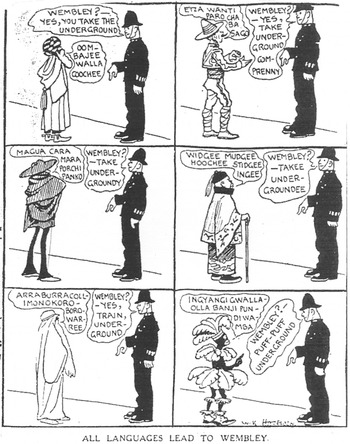
Press reports give evidence of the inability of Wembley's organizers to guarantee a “polite” reception for colonial visitors, especially in the case of visitors from Africa. For example, the Daily Mail printed a “humorous” cartoon (fig. 2), reprinted in Punch, that draws on themes found widely in popular reports. A police officer stands in the position of a Roman centurion as visitors from imperial provinces approach him for directions. The large size and solid build of the policeman confirm his masculine status with regard to diminutive colonial subjects; but in contrast, the African visitor in the last panel is infantilized and feminized, placed in a category of his own.
Events quickly came to a head after the publication of press stories of visiting African women. Publicity surrounding Akosua Baa and her standing as a member of an Ashanti royal household made her stand out in these reports. Some reports focused attention on visiting West Africans as examples of “liberated” African womanhood; for example, the Daily Telegraph published a story about the “emancipated women” of Sierra Leone who, it was claimed, enjoyed economic independence from their husbands and were formed into powerful sects such as the Bundu, which were described as wielding enormous political power.Footnote 75West Africa noted, “we remember that despite the enfranchisement and growing power of European women—they have always had ascendancy or influence—the women of Ashanti were much in advance.” The women of Ashanti had sent a Golden Stool to Queen Mary as a wedding gift, and the queen traveled to the “walled city” to see the stool and to meet with Akosua Baa, who lived in the “native village” with her husband during 1924. Rattray introduced Baa to the press. He commented in an interview that she had never left home before and carried a special charm, not to ward off evil but “because she hoped it will bring a little one.”Footnote 76 Baa became one of the sensations of the exhibition. But she was understood in the context of Rattray's Manual of the Gold Coast, distributed in the Gold Coast pavilion, which described “wife purchasing.” In a letter-writing campaign, Danquah disputed Rattray's claims to scientific accuracy. Danquah described in specific terms how Rattray had mistranslated information from indigenous languages on this and other issues and had misrepresented African marriage customs.Footnote 77
Daily Mail cartoon from 1924. Printed with permission from the Daily Mail.

A Turning toward Anticolonial Politics
In 1924 Ajasa used his weekly, the Nigerian Pioneer, to rally Nigerians behind the British Empire Exhibition. Ajasa commented, “A Gandhi, a Das from India, a Hertzog from South Africa will have very little chance here. … In the strife of ideals through which Nigeria is now passing Nigeria will come out triumphant, still willing to make her progress under the benign influence of the British Empire. And it is by cooperation that she could do this best.”Footnote 78 In spite of postwar rioting, the creation of an NCBWA and emerging international movements of Pan-Africanism and Garveyism, in 1924 most observers regarded Britain's West African colonies as unquestionably loyal.Footnote 79 Nevertheless, during the summer of 1924 London members of Union of Students of African Descent (USAD), which described itself as “apolitical,” launched a successful protest aimed at the colonial office and hosted a series of wide-ranging meetings to discuss West Africa's future. In the months that followed, new activists emerged, including the key figures Danquah and Solanke. West African students resident in London formed new groups that turned toward nationalism and Garveyism, Solanke in particular adopting Garvey's ideas of masculine “race consciousness” and a “Negro empire” in Nigeria.Footnote 80
Controversies surrounding British reactions to Akosua Baa seem to have sparked these actions. Danquah, in an editorial in the Gold Coast Leader, objected to sensationalized coverage of Baa while drawing attention to the exclusion of West African leaders and intellectuals from the exhibition: “We would have liked to be able to feel that what was desired to exhibit was more the work of the people than the types of the people. … All that we urge is that the time has gone past when the African may be exhibited as a curio.”Footnote 81
Offensive articles regarding the West African “native village” occurred in many journals, but articles appearing in the Saturday Review and the Sunday Express threw yet another spotlight on a key juncture of colonial power, the sexual exploitation of African women by British men: “One of the features of Wembley is a West African village, ruled by a native princess. Below she tells the story of love as it is made in Akropong.”Footnote 82 The Sunday Express article, handed around among West African students resident in London became a rallying point that sparked a conflict between the USAD, a group that viewed itself as primarily a social and literary group, and the colonial office. On 14 May USAD vice president A. Kasumu Soetan broke with the organization's “apolitical” leanings and sent a copy of a resolution to Colonial Secretary J. H. Thomas protesting articles and photographs ridiculing “citizens of countries whose money has been voted in large sums for the purpose of the exhibition,” and forwarded copies to Prince Edward, the West African press, colonial governors, and Lord Beaverbrook, the owner of the Sunday Express.Footnote 83
The actions taken by USAD reflected contradictions in their position; West African elites continued to depend on colonialism although they were prevented by colonialism from exerting leadership within their own territories. By rallying to protect West African womanhood and making the popular press the object of their protest (and not the colonial office itself or other offensive articles appearing in elite journals such as The Times or Punch) USAD students were staking a claim to equality of manhood and race, the ingredients of “imperial citizenship.” Thomas replied that he regretted the articles but claimed that he could do nothing to intervene in the press. More informally, anonymous colonial office minutes record, “any attention paid to this sort of letter only leads to our friends arrogating all sorts of claims to themselves and finding fancied grievances where none exist. I have something better to do than to rush round in sympathy whenever a ‘black student’ thinks his dignity is hurt.”Footnote 84
Soon the West African craft workers began to rebel. “The Africans in the living quarters in the ‘walled city' took the law into their own hands and personally threw out photographers who attempted to make pictures of them. One photographer was roughly handled.”Footnote 85 USAD could claim victory, as Gordon Guggisberg took action to bar journalists from entering the West African “native village” and to prevent visitors to the workshops from photographing the craft workers there. These actions, widely reported in West Africa, met with Ajasa's approval; the Nigerian Pioneer noted that “enterprising pressmen, eager to provide ‘copy’ for the columns of their papers, have in many instances exceeded the bounds of good taste and in order to prevent the African workers being innocently held up to ridicule, the authorities have very rightly taken action.”Footnote 86
As many West African notables had traveled to London for the exhibition, USAD hosted a series of meetings to discuss West Africa's future, in which visiting nationalist leaders such as H. R. Bankole-Bright played leading roles. In the course of the flap over the empire exhibition, Solanke began to emerge as a leading student activist. Solanke, who remained in Britain for over thirty years and who became a key anticolonial activist during the 1920s and 1930s, soon made contact with Amy Ashwood Garvey and in July founded a new group for Nigerian students, the Nigerian Progress Union, which owed much to both Amy Ashwood and Marcus Garvey's ideas.Footnote 87 In 1925 West African students after a lengthy debate supported the formation of the West African Student Union (WASU), a key group that survived for decades and from its inception looked toward nationalist and Garveyite inspirations. Danquah became WASU's first president and Solanke the group's secretary-general, and WASU provided a more “independent” political and cultural base for West African students attending London universities during the interwar years through the 1950s.Footnote 88
At the end of 1924 it was revealed that the exhibition's receipts had failed to cover expenses and that a second year would be necessary in order to recoup losses. The government of India, responding to mounting criticisms from nationalists and loyalists, refused to participate for a second year.Footnote 89 Political affairs in Britain's West African colonies were run on more authoritarian lines, and West Africa's colonial governors quickly volunteered their territories for an encore performance. A new group of craft workers was found to staff the “walled city” during the exhibition's second year. This time even more care was taken; the workshops were moved indoors, the press was excluded, more tours and excursions were arranged, and West African craft workers worked alongside diamond polishers recruited from a hospital for disabled British war veterans. Creoles were again excluded from planning committees and played no official role at the exhibition; instead, the exhibition continued to focus on white colonial officials and the “real Africa” of the interior. However, fewer West Africans paid attention to the exhibition in 1925; events had already surpassed the British Empire Exhibition. For those who were in a position to witness the exhibition fiasco firsthand, the emptiness lying behind Britain's new “polite” racial ideas had been exposed, and from 1924, some elite West Africans increasingly looked beyond Britain for inspiration.
Conclusion
The British Empire Exhibition was intended to promote imperial unity and to advertise Britain's ability to command and control new forces of science and industry in the interest of “progress” and “productivity.” West Africa played a particularly important role in this British reconstruction of power, due in part to the autocratic nature of colonial government in West Africa, claims to “liberalism,” and ideas of white supremacy that seemed to give Britain almost unlimited powers over the peoples of the region. Nevertheless, an examination of the content and construction of the exhibition reveals how imperial politics and culture were subject to negotiation at many levels, by West African Creoles, “native rulers,” public audiences in Britain, journalists, West African craft workers, and others. Organizers and colonial officials found it increasingly difficult, as the exhibition progressed, to manage all of these contradictory forces.
While West Africa's experiences suggest that the exhibition failed to promote imperial unity, the exhibition served as a marker of the power of racial ideas and imaginings about Africa in British domestic culture and the creation of new imperial ideas during the 1920s. The popularity of the West African exhibits coincided with the emergence of “blackness” and “the primitive” as powerful British cultural commodities, potent symbols of inversion, forbidden passions, the Freudian subconscious, and white megalomania, ideas with roots in African slavery and late Victorian imperialism that conflicted with Wembley's organizers' new, “polite” visions of “empire development” and “racial progress.”Footnote 90 “The primitive” was consumed by white elite and working-class audiences with increased leisure time and spending power during the 1920s in the form of jazz, blackface minstrelsy, popular fiction, films, new dance steps, and other forms; large numbers of visitors rejected colonial claims in favor of their own seemingly more potent culture.Footnote 91 In spite of strenuous efforts on the part of colonial officials, a decidedly illiberal imperial message, both modern and Victorian at the same time, was successfully communicated by public audiences at Wembley, undermining official claims to a reformed imperialism.
The increased presence of women with regard to the West African exhibits reflected a “feminization of empire” during the 1920s that saw the late nineteenth-century languages of conquest and domination replaced by new ideas of “empire development” and “empire strengthening.” Women's participation in imperial projects helped to redraw and reinforce lines of race and gender but did little to challenge the masculine character of an imperial project that continued to depend on women's subordination. Elite British women served as organizers, and attempts were made to enlist the support of female fairgoers as pro-empire voters, as supporters of eugenic projects, and as “empire shoppers” who might help construct the imperial economy through household purchases. Wembley's contradictions were summed up in the person of Akosua Baa, a powerful Ashanti ruler in her own right. Baa's own views remain unknown, but her presence served as a marker of the way in which interwar imperialism reinforced the subordination of African women and the exploitation of their labor and sexuality. African women were a potent source of anxiety for colonial authorities, but to many Creoles the mistreatment of Baa at the hands of journalists and public audiences symbolized one of the “dirty secrets” of colonialism, the sexual domination of African women at the hands of British men, a key marker of imperial power.
Given the associations made at the exhibition between masculinity and modern culture and political agency, it is perhaps unsurprising that British-educated West Africans expressed their frustrations with exclusion and disempowerment through a turning toward British notions of paternalism, seeking to “protect” Baa from British journalists via masculinist assertions to colonial authorities. Their protests to the colonial office seemed to suggest that British men could not be trusted to protect African women such as Baa; only African men could fulfill this role. For some, this led to a reworking of identity that allowed them to gain in strength through identification with newly emerging discourses of resistance, facilitating contacts between West African students resident in London and the masculine worlds of Garveyism and Pan-Africanism. This realignment of thinking on the part of West African student activists did not result in immediate calls for the end of British colonialism but laid an important part of the groundwork that bore fruit during the 1930s through 1950s through international contacts, culminating in the 1945 Manchester Pan-African Congress and the independence movements of the 1950s. In attempting to build a “united empire,” the British Empire Exhibition broadcast ideas of white racial superiority and masculine power, but these ideas sparked reactions from colonized West Africans that helped lay the groundwork for an eventual imperial breakup.