Throughout the life span, success or failure within one domain of development may have a significant impact on future development in other domains (Masten, Burt, & Coatsworth, Reference Masten, Burt, Coatsworth, Cicchetti and Cohen2015). Researchers have begun to explore these bidirectional influences and progressive effects (Masten et al., Reference Masten, Roisman, Long, Burt, Obradovic, Riley and Tellegen2005), with consequent implications for the advancement of developmental theory and prevention science (Masten et al., Reference Masten, Burt, Coatsworth, Cicchetti and Cohen2015). The consequences of interactions that spread across time and different domains of development through either direct or indirect pathways are known as “developmental cascades” (Masten & Cicchetti, Reference Masten and Cicchetti2010).
Developmental cascades research can explain how problems in one domain of functioning can spread into other areas of functioning, while also identifying the steps along that progression (Ehrlich, Miller, & Chen, Reference Ehrlich, Miller, Chen and Cicchetti2016). In recent years, there has been increasing interest in the pathways between domains of mental health and academic attainment (Bornstein, Hahn, & Suwalsky, Reference Bornstein, Hahn and Suwalsky2013; Burt & Roisman, Reference Burt and Roisman2010; Masten et al., Reference Masten, Roisman, Long, Burt, Obradovic, Riley and Tellegen2005; Moilanen, Shaw, & Maxwell, Reference Moilanen, Shaw and Maxwell2010; Vaillancourt, Brittain, McDougall, & Duku, Reference Vaillancourt, Brittain, McDougall and Duku2013). In the current study we examine these longitudinal associations during middle childhood, a critical period in which developmental and contextual changes take place that provide important foundations for adolescence and adult life (Huston & Ripke, Reference Huston, Ripke, Huston and Ripke2006). Of particular note given the focus of our paper is children's increasingly complex and differentiated sense of identity and concept of self, “a sense of who they are and where they fit in the larger scheme of things … [and the formation of] concepts of what they do well and what they do not” (Huston & Ripke, p. 9), during middle childhood. This period also marks a significantly increased emphasis (from parents, teachers, and others) on the cognitive, social, and behavioral capabilities needed for positive adaptation in the school context, and the cultural capital attributed to them. Finally, middle childhood sees the continuation and intensification of gender socialization practices. Drawing these strands together, this period is one in which we would expect to see increasing interconnectivity between children's academic performance and their mental health as their sense of self-worth becomes increasingly internalized from others’ feedback in the socializing environments of the school and home (Harter, Reference Harter1999); however, there is also good reason to expect these interconnections to vary across gender given the differential expectations that are set in relation to emotional expression, academic motivation and achievement, and other pertinent domains of development.
There are generally three substantive theories that are used to explain how academic attainment and mental health interact with one another over time. We review each briefly below, before returning to the aim of the current study.
Adjustment Erosion Hypothesis
The adjustment erosion hypothesis posits that externalizing problems and/or internalizing symptoms lead to later academic difficulties (Moilanen et al., Reference Moilanen, Shaw and Maxwell2010). For instance, externalizing problems (such as disruptive behaviors) can interfere with academic progress due to acceptance by more deviant peers (Schwartz, Gorman, Nakamoto, & McKay, Reference Schwartz, Gorman, Nakamoto and McKay2006) and/or the disruption of interpersonal relationships in the classroom (Moilanen et al., Reference Moilanen, Shaw and Maxwell2010). In a similar way, internalizing symptoms (such as anxiety and withdrawal) may impede academic achievement by interfering with classroom participation (Roeser, van der Wolf, & Strobel, Reference Roeser, van der Wolf and Strobel2001). Despite some inconsistencies in the literature (e.g., Vaillancourt et al., Reference Vaillancourt, Brittain, McDougall and Duku2013; Weeks et al., Reference Weeks, Ploubidis, Cairney, Wild, Naicker and Colman2016; Zhang, Reference Zhang2013), there is a robust body of evidence indicating that early externalizing symptoms erode later academic performance (Ansary & Luthar, Reference Ansary and Luthar2009; Burt & Roisman, Reference Burt and Roisman2010; Masten et al., Reference Masten, Roisman, Long, Burt, Obradovic, Riley and Tellegen2005; Moilanen et al., Reference Moilanen, Shaw and Maxwell2010; Obradovic, Burt, & Masten, Reference Obradovic, Burt and Masten2010; Salla et al., Reference Salla, Michel, Pingault, Lacourse, Paquin, Galera and Cote2016; Stipek & Miles, Reference Stipek and Miles2008; Weeks et al., Reference Weeks, Ploubidis, Cairney, Wild, Naicker and Colman2016; Wigelsworth, Qualter, & Humphrey, Reference Wigelsworth, Qualter and Humphrey2016). Although less well developed, a growing number of studies have also found support for the adjustment erosion hypothesis in terms of internalizing symptoms (Englund & Siebenbruner, Reference Englund and Siebenbruner2012; Grover, Ginsburg, & Ialongo, Reference Grover, Ginsburg and Ialongo2007; Obradovic et al., Reference Obradovic, Burt and Masten2010; Weeks et al., Reference Weeks, Ploubidis, Cairney, Wild, Naicker and Colman2016).
The relationship between externalizing problems and internalizing symptoms has also been of interest to researchers. Although there is sufficient evidence to suggest that these domains of development are interrelated (Bornstein et al., Reference Bornstein, Hahn and Suwalsky2013; Burt & Roisman, Reference Burt and Roisman2010; Englund & Siebenbruner, Reference Englund and Siebenbruner2012; Moilanen et al., Reference Moilanen, Shaw and Maxwell2010; Weeks et al., Reference Weeks, Ploubidis, Cairney, Wild, Naicker and Colman2016), findings from longitudinal data have been inconsistent. Some studies have found that initial externalizing problems exacerbate internalizing symptoms at later time points (Bornstein et al., Reference Bornstein, Hahn and Suwalsky2013; Capaldi, Reference Capaldi1992; Lahey, Loeber, Burke, Rathouz, & McBurnett, Reference Lahey, Loeber, Burke, Rathouz and McBurnett2002; Moilanen et al., Reference Moilanen, Shaw and Maxwell2010; Vaillancourt et al., Reference Vaillancourt, Brittain, McDougall and Duku2013). Consistent with the failure theory (Patterson & Capaldi, Reference Patterson, Capaldi, Rolf, Masten, Cicchetti, Nuechterlein and Weintraub1990) and related research (Kiesner, Reference Kiesner2002), it is possible that problematic behaviors lead to failures in personal relationships and tasks, which in turn results in the development or maintenance of internalizing problems, such as depression.
By contrast, the influence of early internalizing symptoms on later externalizing problems has been found to be “protective” (i.e., high internalizing symptoms predict lower externalizing problems) in several studies (Bornstein, Hahn, & Haynes, Reference Bornstein, Hahn and Haynes2010; Bornstein et al., Reference Bornstein, Hahn and Suwalsky2013; Englund & Siebenbruner, Reference Englund and Siebenbruner2012; Masten et al., Reference Masten, Roisman, Long, Burt, Obradovic, Riley and Tellegen2005; Mesman, Bongers, & Koot, Reference Mesman, Bongers and Koot2001; Rogosch, Oshri, & Cicchetti, Reference Rogosch, Oshri and Cicchetti2010). The experience of internalizing symptoms may interrupt the trajectories from risk to disruptive behaviors, perhaps due to the increased self-isolation and withdrawal associated with the former (Masten et al., Reference Masten, Roisman, Long, Burt, Obradovic, Riley and Tellegen2005). Children experiencing symptoms of anxiety and shyness are expected to exhibit fewer dangerous and disruptive behaviors (Mesman et al., Reference Mesman, Bongers and Koot2001).
Academic Incompetence Hypothesis
In contrast to the adjustment erosion hypothesis, the academic incompetence model claims that initial problems relating to academic performance can trigger or exacerbate internalizing symptoms and externalizing problems (Moilanen et al., Reference Moilanen, Shaw and Maxwell2010). Children and adolescents who struggle academically can experience considerable frustration and disaffection (Wigelsworth et al., Reference Wigelsworth, Qualter and Humphrey2016), while their placement in classes with other low-achieving children can expose them to social stigma and peers that may reinforce disruptive and aggressive behaviors (Masten et al., Reference Masten, Burt, Coatsworth, Cicchetti and Cohen2015).
Although findings vary across different developmental periods, there is emerging consensus that poor initial academic performance leads to elevated externalizing (Ansary & Luthar, Reference Ansary and Luthar2009; Burt & Roisman, Reference Burt and Roisman2010; Englund & Siebenbruner, Reference Englund and Siebenbruner2012; Moilanen et al., Reference Moilanen, Shaw and Maxwell2010; Morgan, Farkas, Tufis, & Sperling, Reference Morgan, Farkas, Tufis and Sperling2008; Vaillancourt et al., Reference Vaillancourt, Brittain, McDougall and Duku2013; Weeks et al., Reference Weeks, Ploubidis, Cairney, Wild, Naicker and Colman2016; Wigelsworth et al., Reference Wigelsworth, Qualter and Humphrey2016) and internalizing (Burt & Roisman, Reference Burt and Roisman2010; Englund & Siebenbruner, Reference Englund and Siebenbruner2012; Masten et al., Reference Masten, Roisman, Long, Burt, Obradovic, Riley and Tellegen2005; Morgan et al., Reference Morgan, Farkas, Tufis and Sperling2008; Obradovic et al., Reference Obradovic, Burt and Masten2010; Weeks et al., Reference Weeks, Ploubidis, Cairney, Wild, Naicker and Colman2016) symptomatology. Such findings are consistent with the notion that salient developmental domains (such as academic performance) are used to make judgments about others or oneself (Masten et al., Reference Masten, Roisman, Long, Burt, Obradovic, Riley and Tellegen2005). Therefore, failure in such domains could potentially lead to maladaptive outcomes over time.
Shared Risk Hypothesis
The shared risk hypothesis suggests that the cascading effects central to the other two models may be the product of a “third variable” that affects multiple domains of development (Moilanen et al., Reference Moilanen, Shaw and Maxwell2010). Risk factors such as low socioeconomic status, poor parenting, and low intellectual ability have been found to account for some of the associations noted above (Masten et al., Reference Masten, Roisman, Long, Burt, Obradovic, Riley and Tellegen2005; McLoyd, Reference McLoyd1998). Such factors may place the individual on a path that promotes cascading pathways between academic competence and domains of child and adolescent functioning across time (Moilanen et al., Reference Moilanen, Shaw and Maxwell2010). Several developmental cascades studies have controlled for at least some of these confounders including, but not limited to, intellectual ability, parental influences, socioeconomic status, and stressful life events (Bornstein et al., Reference Bornstein, Hahn and Suwalsky2013; Burt & Roisman, Reference Burt and Roisman2010; Englund & Siebenbruner, Reference Englund and Siebenbruner2012; Masten et al., Reference Masten, Roisman, Long, Burt, Obradovic, Riley and Tellegen2005; Moilanen et al., Reference Moilanen, Shaw and Maxwell2010; Vaillancourt et al., Reference Vaillancourt, Brittain, McDougall and Duku2013; Weeks et al., Reference Weeks, Ploubidis, Cairney, Wild, Naicker and Colman2016; Wigelsworth et al., Reference Wigelsworth, Qualter and Humphrey2016).
The Current Study
The aim of the current study was to examine the longitudinal relationships between academic attainment, externalizing problems, and internalizing symptoms during middle childhood. We set out to build upon and extend findings from existing research by addressing several important gaps, limitations, and inconsistencies in the existing developmental cascades literature. First, work examining the associations noted above has been conducted primarily with samples from North America. Cultural transferability of findings cannot be assumed (Deighton et al., Reference Deighton, Humphrey, Patalay, Belsky, Wolpert and Vostanisin press). Second, studies in the field have generally utilized relatively small sample sizes to date (often fewer than 300; e.g., see Masten et al., Reference Masten, Roisman, Long, Burt, Obradovic, Riley and Tellegen2005; Moilanen et al., Reference Moilanen, Shaw and Maxwell2010). Aside from core issues of limited representativeness and generalizability, these samples are often insufficient to accommodate the modeling complexity required in developmental cascades research, reducing the accuracy with which tests are able to detect nonzero paths (Masten et al., Reference Masten, Roisman, Long, Burt, Obradovic, Riley and Tellegen2005), and restricting researchers’ ability to incorporate additional parameters (Bornstein et al., Reference Bornstein, Hahn and Suwalsky2013), account for data nesting, or estimate correlated errors (Deighton et al., Reference Deighton, Humphrey, Patalay, Belsky, Wolpert and Vostanisin press).
Third, exploration of mediation pathways between domains across time has been limited to date. To test mediation models within developmental cascades, it is optimal to have three or more constructs measured across three or more time points (Cole & Maxwell, Reference Cole and Maxwell2003). Of the studies assessing academic attainment, externalizing problems, and internalizing symptoms across three waves, several have portrayed the pathways in terms of direct and indirect effects (Masten et al., Reference Masten, Roisman, Long, Burt, Obradovic, Riley and Tellegen2005; Weeks et al., Reference Weeks, Ploubidis, Cairney, Wild, Naicker and Colman2016), but only a couple have statistically assessed them (Moilanen et al., Reference Moilanen, Shaw and Maxwell2010; Vaillancourt et al., Reference Vaillancourt, Brittain, McDougall and Duku2013).
Fourth, the potentially critical role of gender as a moderator of developmental cascades pathways remains underexplored. This is in spite of clear evidence of gender differences in both mental health difficulties (Green, McGinnity, Meltzer, Ford, & Goodman, Reference Green, McGinnity, Meltzer, Ford and Goodman2005) and academic attainment (Department for Education, 2011). More important, from a theoretical perspective, gendered socialization practices relating to emotional expression (Chaplin, Cole, & Zahn-Waxler, Reference Chaplin, Cole and Zahn-Waxler2005), academic motivation and achievement (Leaper & Friedman, Reference Leaper, Friedman, Grusec and Hastings2007), and other pertinent domains could feasibly trigger gender-specific developmental cascade pathways, either directly or indirectly (e.g., via effects on stress response and coping mechanisms; Rosenfield & Mouzon, Reference Rosenfield, Mouzon, Aneshensel, Phelan and Bierman2013). One might also expect to see differential expression of these pathways through the course of development, as gender intensification increases (Priess & Lindberg, Reference Priess, Lindberg and Levesque2011).
Some studies sidestep this issue by focusing only on one gender (e.g., Moilanen et al., Reference Moilanen, Shaw and Maxwell2010), while others have ignored it entirely (e.g., Wigelsworth et al., Reference Wigelsworth, Qualter and Humphrey2016). Of the limited number of studies that have explicitly investigated sex differences in developmental cascades, findings have been mixed. For example, while van Lier and Koot (Reference van Lier and Koot2010) found minimal evidence that gender moderated the longitudinal relationships between peer relationships, externalizing problems, and internalizing symptoms from kindergarten to middle childhood, Deighton et al. (Reference Deighton, Humphrey, Patalay, Belsky, Wolpert and Vostanisin press) found clear evidence of sex differences in their study exploring the links between externalizing problems, internalizing symptoms, and academic attainment in their middle childhood sample. Specifically, an adjustment erosion pathway from externalizing problems to later academic attainment was found for boys only, while academic incompetence pathways varied as a function of gender (e.g., poor initial academic attainment was predictive of later internalizing symptoms in girls, and externalizing symptoms in boys).
Fifth, while several individual risk factors have been accounted for in previous studies, our understanding of the influence of cumulative risk exposure on developmental cascade pathways remains extremely limited (save for Obradovic et al., Reference Obradovic, Burt and Masten2010). Cumulative risk theory has gained attention in developmental psychopathology due to the finding that exposure to multiple sources of risk is significantly more predictive of detrimental developmental consequences than any single risk factor in isolation (Evans, Li, & Whipple, Reference Evans, Li and Whipple2013; Sameroff, Reference Sameroff, Clarke-Stewart and Dunn2006). This theory is based on the assumption that the accumulation of risk factors significantly raises the likelihood of negative outcomes through disruption of proximal developmental processes and increased allostatic load on the individual (Evans et al., Reference Evans, Li and Whipple2013). Cumulative risk research typically makes use of an index calculated by summing exposure to each factor of interest. Unlike research on individual risk factors, it captures the number of risks experienced rather than their intensity (Evans et al., Reference Evans, Li and Whipple2013). This can better conceptualize the effects of multiple adversities on development (Raviv, Taussig, Culhane, & Garrido, Reference Raviv, Taussig, Culhane and Garrido2010). Although the cumulative risk approach means that information on risk factor intensity and interactive effects among factors is lost, this method has been found to be a more powerful predictor of developmental outcomes (Evans et al., Reference Evans, Li and Whipple2013; Raviv et al., Reference Raviv, Taussig, Culhane and Garrido2010), both cross-sectionally and longitudinally (e.g., Appleyard, Egeland, van Dulmen, & Sroufe, Reference Appleyard, Egeland, van Dulmen and Sroufe2005).
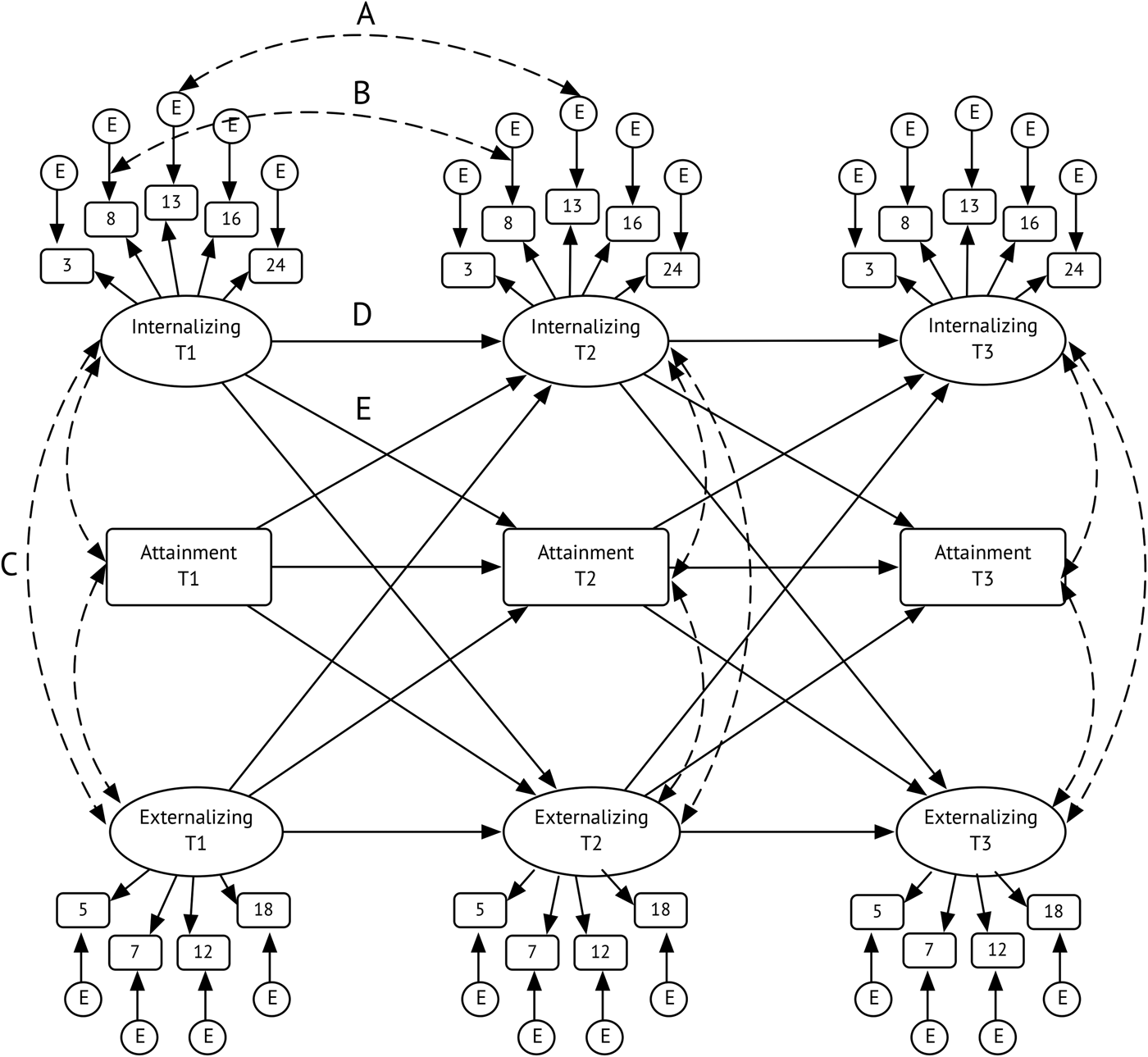
In the current study, we present a developmental cascade model of the longitudinal relationships between internalizing symptoms, externalizing problems, and academic performance in middle childhood, utilizing a large sample from the United Kingdom. We draw upon cumulative risk theory in our conceptualization of shared risk, test for evidence of mediation effects, and examine the role of gender. The conceptual developmental cascades model shown in Figure 1 is our starting point. In this model, we examine cross-lag and mediation pathways to test the three hypotheses proposed by Moilanen et al. (Reference Moilanen, Shaw and Maxwell2010), while accounting for within-time covariance, temporal stability, and data clustering, thereby increasing analytical rigor.
Conceptual developmental cascades model.

On the basis of the extant theory and research, the following predictions were made. First, consistent with the adjustment erosion model, we predicted that early externalizing problems (Hypothesis 1a) and internalizing symptoms (Hypothesis 1b) would be inversely related to later academic attainment. We also predicted that early externalizing problems would predict later internalizing symptoms (Hypothesis 1c); however, we anticipated that early internalizing symptoms would be inversely related to later externalizing problems (Hypothesis 1d). Second, in alignment with the academic incompetence model, we predicted that early academic problems would predict later internalizing symptoms (Hypothesis 2a) and externalizing problems (Hypothesis 2b). Third, given the generally inconsistent findings of studies vis-à-vis the shared risk model, we predicted that while accounting for cumulative risk exposure would significantly improve absolute model fit, it would not alter the magnitude or statistical significance of previously established cross-lag cascade pathways (Hypothesis 3). Fourth, we predicted that the developmental cascades pathways would vary across gender (Hypothesis 4). Fifth, we anticipated significant mediation effects to be evident alongside the basic cross-lag cascade pathways outlined above (Hypothesis 5).
Method
Design
A 3-year longitudinal cross-lag design was utilized, with annual (Times 1–3 [T1–T3], respectively) assessments of children's academic attainment, internalizing symptoms, and externalizing problems. Data were drawn from a major research project on school-based social and emotional learning funded by the National Institute for Health Research (Project Ref. 10/3006/01; Humphrey et al., Reference Humphrey, Barlow, Wigelsworth, Lendrum, Pert, Joyce and Turner2016).
Participants
The sample consisted of 1,771 children (908 male, 863 female) drawn from 16 mainstream primary schools in the northwest of England. Children's age ranged between 6.67 and 9.67 at T1 (M = 8.14, SD = 0.86), between 7.67 and 10.67 at T2 (M = 9.14, SD = 0.86), and between 8.67 and 11.67 at T3 (M = 10.14, SD = 0.86). In line with national averages (Department for Education, 2013), 17.5% (N = 310) were identified as having special educational needs (SEN). Deprivation levels in the current sample as measured by eligibility for free school meals (FSM; 23%) were somewhat higher than national levels (Department for Communities and Local Government, 2015; Department for Education, 2012b). In terms of ethnicity, and similar to national picture of state-funded primary schools (Department for Education, 2012b) the majority of the participants were White (N = 1,134, 64%) followed by Asian (N = 235, 13.3%), Black (N = 131, 7.4%), mixed (N = 127, 7.2%), other/unclassified (N = 55, 3.1%), and Chinese (N = 7, 0.4%). The remaining 82 (4.6%) had incomplete data.
Measures
Academic attainment
The Interactive Computerised Assessment System (InCAS; Merrell & Tymms, Reference Merrell and Tymms2007) standardized reading score was used to assess children's academic attainment. InCAS reading captures a child's ability to recognize words, to break them into sounds, and to choose the appropriate words to complete a passage (http://www.cem.org). Scores are age standardized to a mean of 100 and a standard deviation of 15. The Rasch person reliability of the different components of the InCAS reading test exceeds 0.92 in all cases, and scores are predictive of future, external assessment scores. For example, the correlation with performance indicators in primary schools reading test scores administered 12 months later is 0.72 (Centre for Evaluation and Monitoring, 2013).
Internalizing symptoms and externalizing problems
The five-item emotional symptoms and conduct problems subscales of the teacher informant-report version of the Strengths and Difficulties Questionnaire (SDQ; Goodman, Reference Goodman1997) were utilized. Respondents read a series of statements about a child (e.g., “often fights with other children” for conduct problems; “often unhappy, downhearted” for emotional symptoms) and endorse them using a 3-point scale (not true, somewhat true, certainly true). The two subscales have robust psychometric properties, with good internal consistency (conduct problems α = 0.70; emotional symptoms α = 0.73) and test–retest reliability (conduct problems r = .77; emotional symptoms r = .72), and satisfactory capacity to discriminate between children with and without psychiatric diagnoses (Stone, Otten, Engels, Vermulst, & Janssens, Reference Stone, Otten, Engels, Vermulst and Janssens2010).
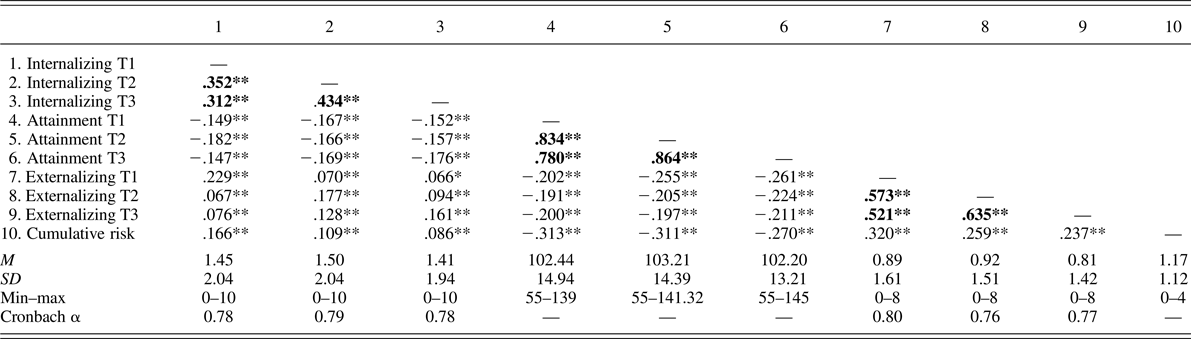
Although the internal consistency of the two scales was found to be good in the current sample (see Table 1), preliminary analyses indicated that the removal of one item (“steals from home, school, or elsewhere”) would improve the Cronbach α coefficient of the conduct problems domain at all time points. Additional analyses assessing the measurement invariance of the two subscales across gender resulted in a warning about a correlation of 1 (i.e., not statistically distinguishable) between this item and others in the bivariate table in girls, thus indicating that it should be excluded from the main analyses. It is believed that this issue was caused by the low endorsement (0.1%–1%) of response 2 (certainly true) at all time points for girls.
Study variable correlations and descriptive data

Note: The cross-domain correlations within time are in bold. T1–T3, Times 1–3.
*p < .05. **p < .01.
Cumulative risk exposure
Exposure to five distinct risk factors known to be associated to both mental health difficulties and academic attainment was assessed. Familial socioeconomic disadvantage (Department for Education, 2012a; Green et al., Reference Green, McGinnity, Meltzer, Ford and Goodman2005) was measured using FSM eligibility (0 = no, 1 = yes). Children in England are deemed eligible to receive FSM if they meet criteria set by the government relating to parental income. Neighborhood deprivation (Department for Education, 2014; Green et al., Reference Green, McGinnity, Meltzer, Ford and Goodman2005) was ascertained using Income Deprivation Affecting Children Index scores, which are based on the proportion of children under 16 in a local area who live in low-income households. SEN status (Department for Education, 2014; Green et al., Reference Green, McGinnity, Meltzer, Ford and Goodman2005) of children is reported by schools as part of their Pupil Level Annual School Census return and provides an index of whether a given child is considered to have SEN (0 = no, 1 = yes). Data pertaining to each of these first three risk factors were extracted from the National Pupil Database. This was supplemented by lack of school connectedness (Bond et al., Reference Bond, Butler, Thomas, Carlin, Glover, Bowes and Patton2007; Stewart, Reference Stewart2008) and lack of peer and social support (Bond et al., Reference Bond, Butler, Thomas, Carlin, Glover, Bowes and Patton2007; Stewart, Reference Stewart2008) derived from the corresponding subscales of the child self-report version of the KIDSCREEN-27 health-related quality of survey (Ravens-Sieberer et al., Reference Ravens-Sieberer, Auquier, Erhart, Gosch, Rajmil and Bruil2007). In each four-item subscale, children read questions (e.g., “In the last week, have you been able to rely on your friends?” [peer and social support]; “In the last week, have you enjoyed going to school?” [school environment]) and respond on a 5-point scale (never, one day, some days, most days, every day). The two subscales are psychometrically robust, with good internal consistency (peer and social support α = 0.81, school connectedness α = 0.81), test–retest reliability (peer and social support intraclass correlation coefficient = 0.61, school connectedness intraclass correlation coefficient = 0.74), and the ability to discriminate between children with good health and those with poorer physical or mental health status (as determined through external assessment; Ravens-Sieberer et al., Reference Ravens-Sieberer, Auquier, Erhart, Gosch, Rajmil and Bruil2007; Robitail et al., Reference Robitail, Ravens-Sieberer, Simeoni, Rajmil, Bruil and Power2007).
In line with standard practice in cumulative risk research, an index was calculated by summing exposure to each factor of interest (coded as 1 = exposure, 0 = no exposure).Footnote 1 Thus, every child was initially allocated a score of 0–5, with a higher score representing greater exposure to cumulative risk. Subsequently, the groups representing four and five risk factors were merged to represent 4+ factors. This was guided by preliminary risk–outcome relationship analyses that indicated stability on the outcome variables from four to five factors and due to the fact that only a small minority of participants (N = 10, 0.6%) were classified as being exposed to all five risk factors. Thus, the final cumulative risk index ranged between 0 and 4 (M = 1.17, SD = 1.11), with the largest proportion of participants not exposed to any risk factors (N = 537, 30.3%). A further 471 (26.6%) were exposed to one, 346 (19.5%) to two, and 142 (8%) to three, with only 58 (3.3%) reporting experience of four or more risk factors. The remaining 217 (12.3%) participants had incomplete data.
Statistical analysis
All models were tested by structural equation modeling (SEM) with weighted least squares with means and variance adjustment in MPlus 7.4. Weighted least squares with means and variance adjustment was used to account for the categorical nature of the indicators of the internalizing and externalizing latent factors, which can handle computationally demanding models with large sample sizes and many latent factors (Brown, Reference Brown2015). The results from an exploratory factor analysis (not presented here) confirmed the use of the externalizing and internalizing constructs as latent factors. Latent variables estimate and remove item-level measurement error, providing more accurate estimates of autoregressive and cross-lag estimates (Newsom, Reference Newsom2015).
Absolute model fit was evaluated using comparative fit index (CFI), Tucker–Lewis index (TLI), and root mean square error of approximation (RMSEA). CFI and TLI values above 0.95 and RMSEA values below 0.05 were considered to indicate good model fit (Byrne, Reference Byrne1998; Hu & Bentler, Reference Hu and Bentler1999). The chi-square statistic is reported in the results but was not used to assess model fit, given its sensitivity to sample size. The mediation analyses were conducted using 10,000 resamples. For all the indirect effects that were statistically significant, the standardized beta coefficients along with the 95% bias-corrected confidence intervals are reported. Finally, following Keith (Reference Keith2015) we set a threshold of β > 0.1 (in addition to p < .05) for individual path coefficients as being indicative of practical significance.
Measurement invariance
Establishing longitudinal measurement invariance provides empirical evidence that the meaning of the constructs has not changed across the different waves of data collection (Little, Preacher, Selig, & Card, Reference Little, Preacher, Selig and Card2007). Given that full measurement invariance frequently does not hold, partial measurement invariance was considered acceptable for proceeding to the examination of the cross-lagged models (Byrne, Shavelson, & Muthén, Reference Byrne, Shavelson and Muthén1989; Steenkamp & Baumgartner, Reference Steenkamp and Baumgartner1998). To test for measurement invariance, nested models were estimated as described by Muthén and Muthén (Reference Muthén and Muthén1998–2012), and their model fit was assessed using the chi-square difference. Based on results not presented here (but available from the authors on request), full longitudinal and gender measurement invariance was established for both latent constructs.
Gender structural invariance
Having established measurement invariance across gender, structural invariance was tested to determine whether the cross-lagged model parameters were equal across groups. To assess for gender differences, a multigroup SEM was applied. An unconstrained model (H1) in which all paths were allowed to be unequal (simultaneously freed) between boys and girls was compared to a more constrained nested model (H0) where gender equality constraints were imposed. In this case, a nonsignificant chi-square difference test would indicate invariance (i.e., the constraints did not worsen model fit).
Evaluation of developmental cascades models
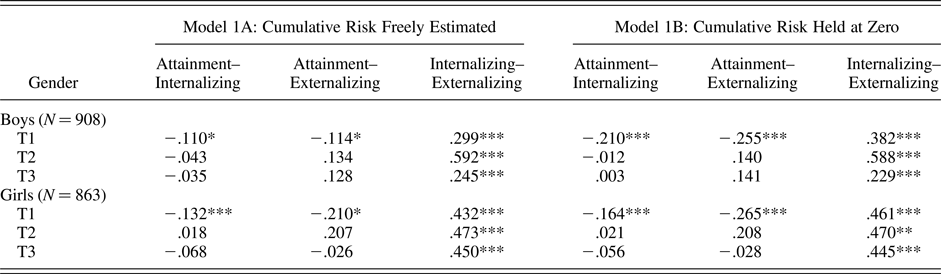
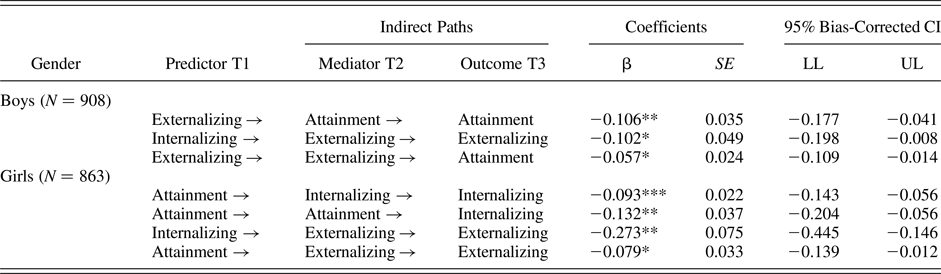
Although all cross-lag paths were estimated as shown in Figure 1, only those that were statistically significant are presented in the following figures. In addition, for simplicity, cross-domain correlations were omitted from the figures but are reported in Table 2. Factor loadings for all latent constructs are reported in the Results section. The developmental cascades models were tested through SEM, accounting for several important modeling issues related to latent variable longitudinal cross-lagged models (see Cole & Maxwell, Reference Cole and Maxwell2003; Little et al., Reference Little, Preacher, Selig and Card2007; Newsom, Reference Newsom2015). First, both internalizing and externalizing constructs were modeled as latent variables, which, as previously mentioned, enabled the estimation of autocorrelations among residual covariances (Path A in Figure 1), thus removing stable specific variance that would otherwise inflate the estimates of stability over time (Cole & Maxwell, Reference Cole and Maxwell2003; Newsom, Reference Newsom2015). Second, given that longitudinal measurement invariance was established, the factor loadings of each latent factor were constrained to be equal across time (Path B), thereby increasing the precision of the model estimates (Newsom, Reference Newsom2015). Third, the cross-lagged SEM analyses allowed for the examination of the stability of all paths, while controlling for the cross-domain associations within time (Path C) and cross-time associations within domains (temporal stability; Path D). As illustrated in the Path E example, the current cascades model took into consideration all possible cross-lag paths from each domain to others across all waves.
Within time correlations in boys and girls
Note: T1–T3, Times 1–3.
*p < .05. **p < .01. ***p < .001.
Similar to gender invariance, the effects of cumulative risk were explored through the comparison of nested models. The cumulative risk index was included in the proposed model, although all pathways from this variable were fixed to zero (model H0). Using the chi-square difference test, this model was compared against a less restrictive model (H1) where all pathways related to the cumulative risk index were allowed to be freely estimated. The effects of cumulative risk were assessed separately for boys and girls.
Results
Preliminary analysis
Missing data in the current sample (3.8%–18.4%) were attributed to school absences and error-based omission for individual survey items. Attainment data was higher (18.4%) due to testing difficulties in the administration of computer-based tasks in primary school settings. On this basis, data were assumed to be missing at random, thus enabling the use of all available information (i.e., full information). Means, standard deviations, internal consistency coefficients, and bivariate correlations among the study variables are shown in Table 1. As expected, externalizing problems and internalizing symptoms were shown to negatively correlate with academic attainment at all waves, and externalizing problems correlated positively with internalizing symptoms. Cumulative risk was found to positively correlate with internalizing symptoms and externalizing problems, while negatively correlating with academic attainment. Although it was found to have statistically significant associations with all study variables, cumulative risk had stronger correlations with constructs at T1, gradually decreasing at T2 and T3.
Gender structural invariance
The aim of the gender structural invariance analysis was to address existing gaps in the literature and assess the degree to which the proposed developmental cascades model varied across gender. An acceptable model fit for both groups should be established before proceeding to multigroup analysis; therefore, prior to the examination of gender differences, Confirmatory factor analysis was performed to assess the fit of the overall model (Figure 1), results of which indicted a good fit for both boys, χ2 (389) = 529.234, p < .001; RMSEA = 0.020, 90% CI [0.015, 0.024], p > .05; CFI = 0.971, TLI = 0.966, and girls, χ2 (389) = 519.423, p < .001; RMSEA = 0.020, 90% CI [0.015, 0.024], p > .05; CFI = 0.961, TLI = 0.954. Multigroup analysis indicated that the unconstrained model, in which all parameters were allowed to vary across gender, was found to fit the data well: χ2 (806) = 1,091.841, p < .001; RMSEA = 0.020, 90% CI [0.017, 0.023], p > .05; CFI = 0.967, TLI = 0.962, as did the constrained model, in which all parameters were held equal across gender: χ2 (848) = 1,125.626, p < .001; RMSEA = 0.019, 90% CI [0.016, 0.022], p > .05; CFI = 0.968, TLI = 0.965. In line with Hypothesis 4, a statistically significant difference in model fit, χ2 diff. (42) = 70.567, p < .01, suggested that the cross-lag model parameters varied across gender. Taking these findings into consideration, subsequent analyses were, therefore, conducted separately for boys and girls.
Developmental cascades
The factor loadings of the externalizing and internalizing latent factors were examined. Latent factors with loadings above .40 were considered to represent a meaningful construct. The results were satisfactory for both latent constructs across all waves. Factor loadings ranged between .80 and .92 in boys, and from .73 to .87 in girls for the externalizing latent factor. Similarly, high factor loadings were observed in the internalizing latent factor (boys: λ = .63–.87; girls: λ = .64–.87).
The cross-sectional correlations between the externalizing and internalizing latent variables, and academic attainment are shown in Table 2. Externalizing problems and internalizing symptoms were found to be positively associated across all time points. Academic attainment was found to have negative cross-sectional correlations with externalizing and internalizing only at T1 in both groups.
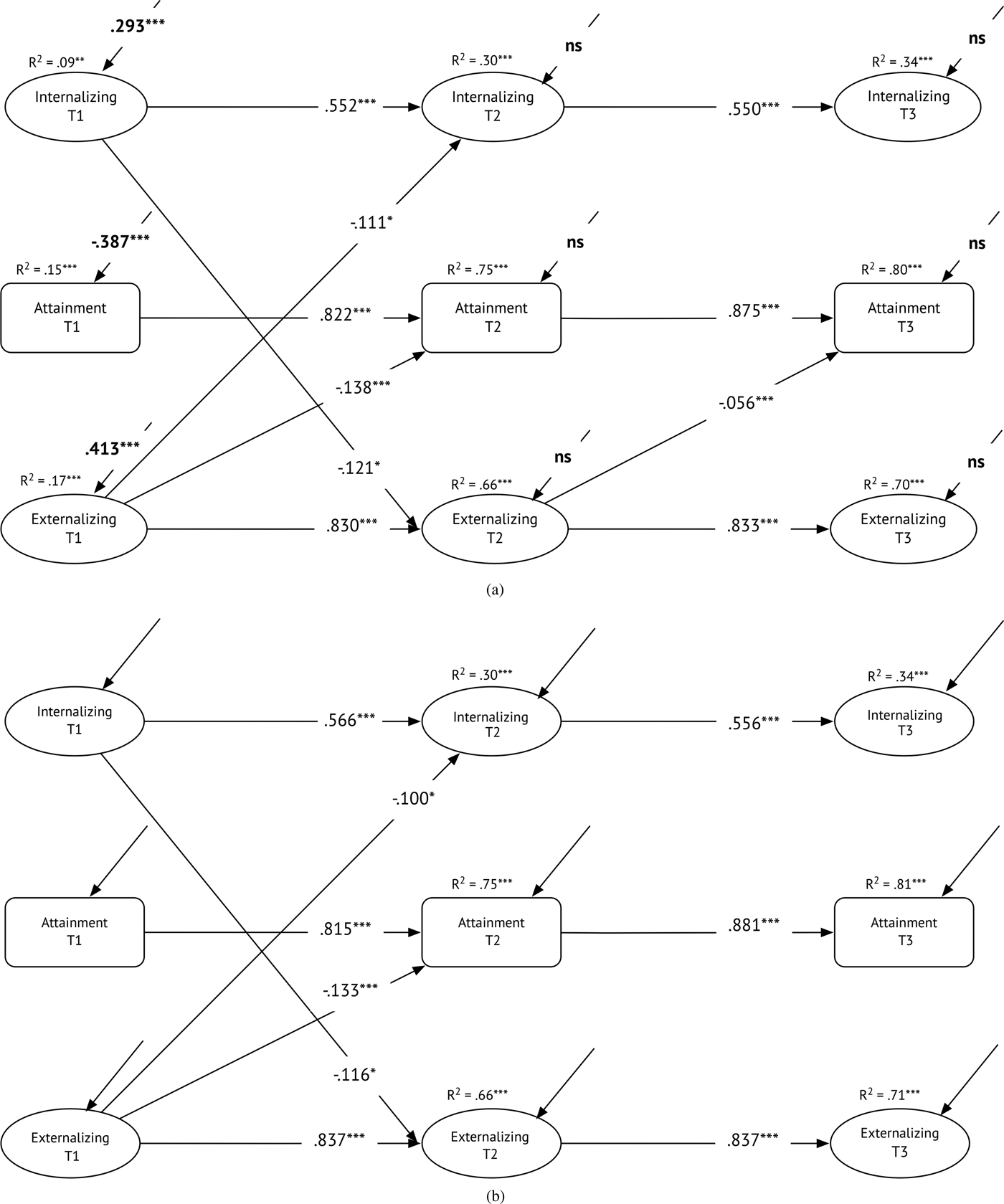
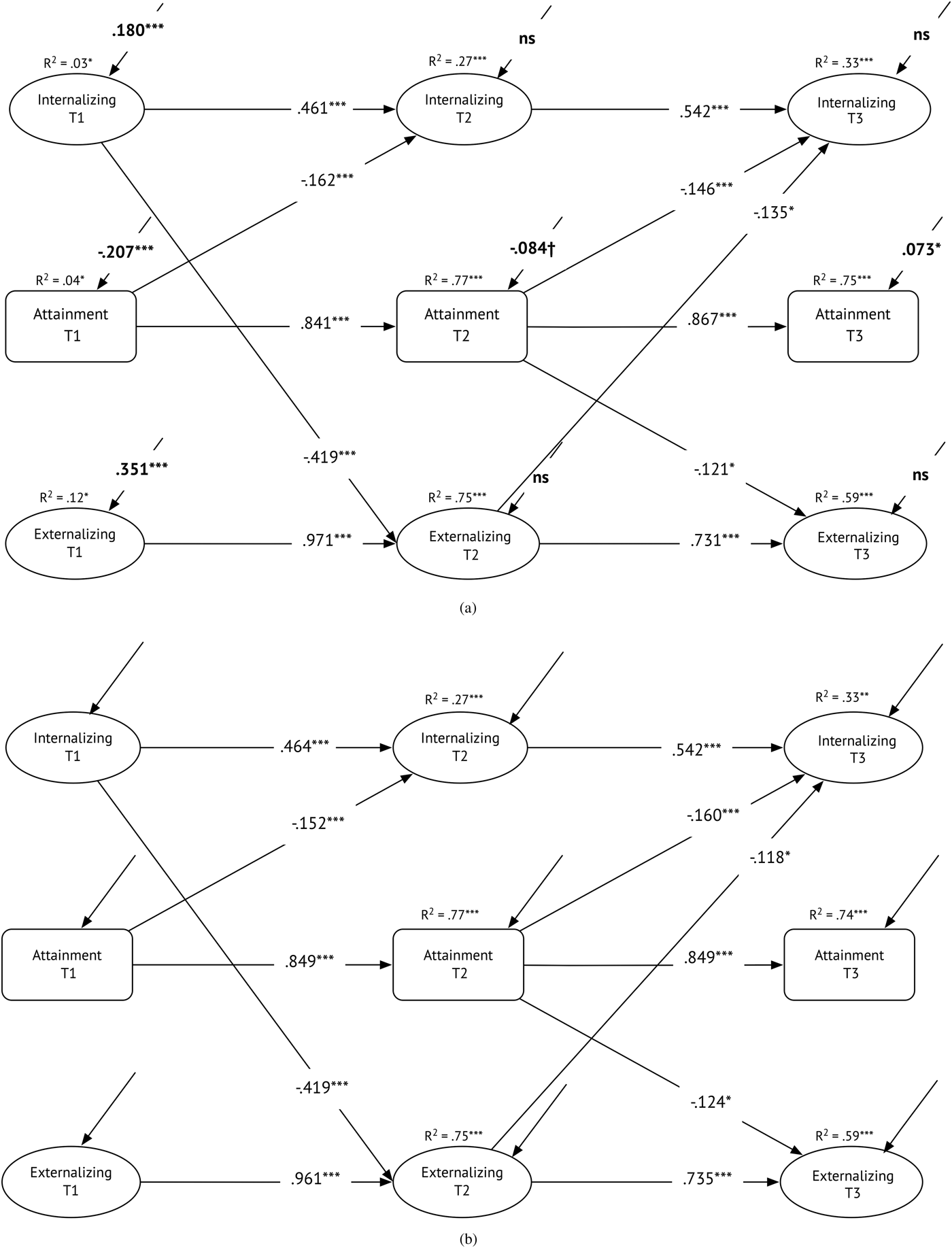
While controlling for temporal stability, cross-domain associations within time, data clustering, and the effects of cumulative risk, a number of statistically significant cascade paths were identified, results of which are shown in Figure 2a and Figure 3a for boys and girls, respectively. Consistent with previous findings, academic attainment and externalizing problems were highly stable across time (see Table 1). An evident drop in stability was, however, observed in girls from externalizing problems at T2 to T3. Internalizing symptoms were found to be stable in both groups.
Cascade model for boys: (a) Cascade model with cumulative risk freed. The effects of cumulative risk are in bold, and beta values are standardized. N = 908; χ2 (389) = 529.234, p < .001; root mean square error of approximation = 0.20, 90% confidence interval [0.015, 0.024], p > .05; comparative fit index = 0.971, Tucker–Lewis index = 0.966. *p < .05, **p < .01, ***p < .001. χ2 diff. (9) = 184.402, p < .001. (b) Cascade model with cumulative risk held at 0. Beta values are standardized. N = 979; χ2 (398) = 673.191, p < .001; root mean square error of approximation = 0.28, 90% confidence interval [0.024, 0.031], p > .05; comparative fit index = 0.945, Tucker–Lewis index = 0.936. *p < .05, **p < .01, ***p < .001.

Cascade model for girls: (a) Cascade model with cumulative risk freed. The effects of cumulative risk are in bold, and beta values are standardized. N = 863; χ2 (389) = 519.423, p < .001; root mean square error of approximation = 0.20, 90% confidence interval [0.015, 0.024], p > .05; comparative fit index = 0.961, Tucker–Lewis index = 0.954. †p = .05, *p < .05, **p < .01, ***p < .001. χ2 diff. (9) = 107.845, p < .001. (b) Cascade model with cumulative risk held at 0. Beta values are standardized. N = 863; χ2 (398) = 585.707, p < .001; root mean square error of approximation = 0.23, 90% confidence interval [0.019, 0.027], p > .05; comparative fit index = 0.945, Tucker–Lewis index = 0.935. *p < .05, **p < .01, ***p < .001.

Hypothesis 1a was supported only for boys, as higher levels of externalizing problems at T1 and T2 significantly predicted poorer academic performance at T2 and T3, respectively. It is, however, important to note the small magnitude (β = –0.056; Keith, Reference Keith2015) of the latter pathway (T2 → T3). Contrary to our expectations, initial internalizing symptoms were not found to predict later academic attainment in either girls or boys (Hypothesis 1b). In addition, despite the evident positive longitudinal relationship between externalizing problems and internalizing symptoms in the extant literature, Hypothesis 1c was not supported. Thus, higher initial levels of externalizing problems were found to lead to lower internalizing symptoms in both boys (T1 → T2) and girls (T2 → T3). However, as hypothesized (Hypothesis 1d), a significant path was observed between internalizing symptoms at T1 and externalizing problems at T2, such that higher initial internalizing symptoms lead to reduced externalizing problems later in time. This path was of greater magnitude in girls (β = –0.419) than in boys (β = –0.121). Finally, gender differences were observed regarding the academic incompetence hypothesis. It found support only in girls, such that greater academic incompetence at T1 was associated with increased internalizing symptoms at T2, while greater academic incompetence at T2 was associated with increased internalizing symptoms (Hypothesis 2a) and externalizing problems (Hypothesis 2b) at T3.
Cumulative risk analysis
The inclusion of cumulative risk in the model was shown to have a significant impact on the variables at T1 only (with the exception of T3 academic attainment in girls) in both groups. It was found to explain more variance in externalizing problems, followed by academic attainment and internalizing symptoms. In other words, there appears to be a more robust connection between multiple adversities and externalizing problems. This path (as well as that between cumulative risk and internalizing symptoms) was positive, such that increased risk exposure was associated with increased externalizing problems and internalizing symptoms. In contrast, higher risk exposure was associated with poorer academic performance.
Nested model comparisons examining the effect of cumulative risk are presented in Figures 2 and 3 for boys and girls, respectively. The full model (Figures 2a, 3a), where cumulative risk is freely estimated, was compared against a constrained model (Figures 2b, 3b), in which the paths from cumulative risk are held to zero. The full model fit the data very well for boys, χ2 (389) = 529.234, p < .001; RMSEA = 0.020, 90% CI [0.015, 0.024], p > .05; CFI = 0.971, TLI = 0.966, as well as for girls, χ2 (389) = 519.423, p < .001; RMSEA = 0.020, 90% CI [0.015, 0.024], p > .05; CFI = 0.961, TLI = 0.954. The constrained model achieved an acceptable but worse model fit than the full model in both boys, χ2 (398) = 673.191, p < .001; RMSEA = 0.028, 90% CI [0.024, 0.031], p > .05; CFI = 0.945, TLI = 0.936, and girls, χ2 (398) = 585.707, p < .001; RMSEA = 0.023, 90% CI [0.019, 0.027], p > .05; CFI = 0.945, TLI = 0.935. In alignment with Hypothesis 3, the statistically significant difference in model fit, boys χ2 diff. (9) = 184.402, p < .001; girls χ2 diff. (9) = 107.845, p < .001, indicated that the full model had a better fit and, accordingly, was chosen to be the focus of our discussion. However, the inclusion of cumulative risk did not have a substantive impact on the statistical significance, direction, or magnitude of the cascade paths. This was the case for both boys and girls, with a single exception: the path between externalizing problems at T2 and academic attainment at T3 for boys reached statistical significance only after controlling for the effects of cumulative risk.
Indirect pathways
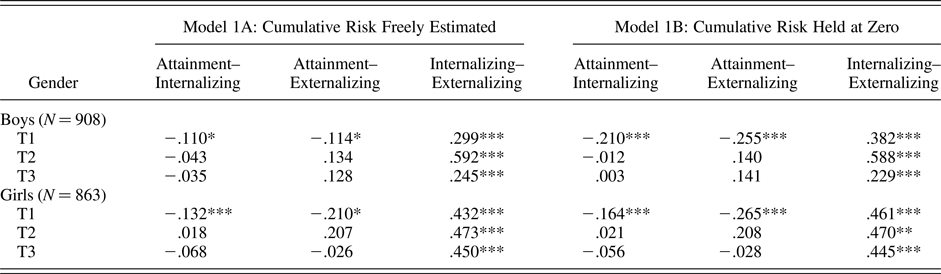
Possible indirect pathways were identified and statistically assessed in the full models (Hypothesis 5, Figures 2a, 3a). Of the 27 mediation paths tested, only a few were found to be statistically significant (see Table 3). As would be expected, statistically significant mediation paths (p < .001) were observed within variables across time in both boys and girls. For instance, internalizing symptoms at T2 were found to account for the relationship between internalizing symptoms at T1 and T3 (boys β = 0.31; girls β = 0.26). This was also the case for externalizing problems (boys β = 0.70; girls β = 0.69) and academic attainment (boys β = 0.73; girls β = 0.72). Additional findings from mediation analysis provided further confirmation of gender differences in developmental cascades (Hypothesis 4). Two of the mediation paths unique to boys had externalizing problems as their starting point. More precisely, externalizing problems were found to predict more externalizing problems as well as poorer academic performance a year later, which in turn predicted further academic incompetence (thus supporting Hypothesis 1a). In contrast, three of the paths unique to girls had academic incompetence as their starting point. Poor initial academic performance in girls was found to predict further academic incompetence, and increased internalizing symptoms a year later, which then lead to further internalizing symptoms (Hypothesis 2a). In addition, girls whose academic attainment was poor at T1 were found to report more externalizing problems at T2, which was in turn shown to predict further such problems at T3 (Hypothesis 2b). Finally, both boys and girls with initial internalizing symptoms were found to report less externalizing problems a year later, which led to an increase in externalizing problems at T3 (Hypothesis 1d).
Indirect pathways in boys and girls
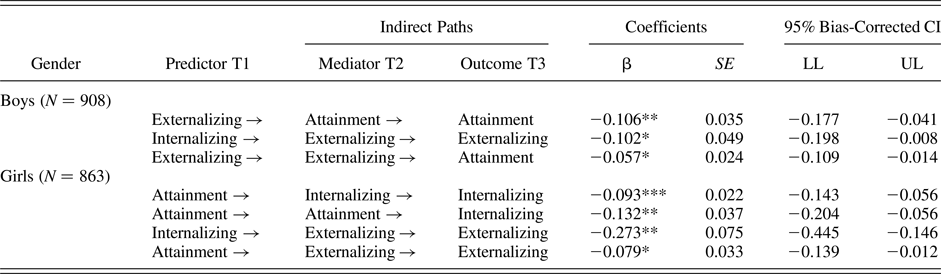
Note: T1–T3, Times 1–3; LL, lower level; UL, upper level.
*p < .05. **p < .01. ***p < .001.
Discussion
In the current study we sought to explore the developmental and reciprocal relationships between academic attainment, externalizing problems, and internalizing symptoms in middle childhood. Much of the available work on developmental cascades is limited to studies with small sample sizes and long intervals between assessments (e.g., Masten et al., Reference Masten, Roisman, Long, Burt, Obradovic, Riley and Tellegen2005; Obradovic et al., Reference Obradovic, Burt and Masten2010), which preclude firm conclusions on the exact timing and processes by which such cascades occur (Masten et al., Reference Masten, Roisman, Long, Burt, Obradovic, Riley and Tellegen2005). With a large sample and a rigorous methodology to draw on, the current study explored the longitudinal associations between these salient developmental domains, while also taking into consideration the role of gender differences and indirect effects, which to date remain largely understudied.
Expected positive cross-sectional associations between externalizing problems and internalizing symptoms were found at all time points. A negative association was found between academic attainment and both externalizing problems and internalizing symptoms, but only for T1 variables, even after accounting for cumulative risk. Adding to existing research (Englund & Siebenbruner, Reference Englund and Siebenbruner2012; Vaillancourt et al., Reference Vaillancourt, Brittain, McDougall and Duku2013), all variables exhibited high stability across time, particularly academic attainment and externalizing problems.
While accounting for within-time covariance, data nesting, and temporal stability, overall findings from the current study concur with the developmental cascades theory (Masten & Cicchetti, Reference Masten and Cicchetti2010), by which important domains of development spread into other domains across time both directly and indirectly. Consistent with the findings by Deighton et al. (Reference Deighton, Humphrey, Patalay, Belsky, Wolpert and Vostanisin press), the proposed developmental cascades model was found to vary by gender. An adjustment erosion path from early externalizing problems to later academic performance was found exclusively for boys. This was not surprising as boys tend to be more prone to externalizing problems relative to girls, who are expected to experience more internalizing symptoms (Green et al., Reference Green, McGinnity, Meltzer, Ford and Goodman2005; McCarty, Reference McCarty2008). Such differences are considered by some to be the influence of socialization pressures (Chaplin et al., Reference Chaplin, Cole and Zahn-Waxler2005). For instance, shyness and good prosocial behaviors, instead of deviant ones, are often encouraged in girls by their parents (Keenan & Shaw, Reference Keenan and Shaw1997). These findings are of utmost importance as they provide evidence for gender-specific longitudinal profiles and strongly suggest the need for further systematic exploration.
In line with the findings of previous studies (Deighton et al., Reference Deighton, Humphrey, Patalay, Belsky, Wolpert and Vostanisin press), the adjustment erosion pathway from internalizing symptoms to academic attainment was not supported. While this was unexpected, it might be due to the use of teacher-report measures for the assessment of externalizing and internalizing symptoms. It is possible that children's internalizing symptoms have been underestimated by their teachers because they are harder to observe, compared to externalizing problems (De Los Reyes et al., Reference De Los Reyes, Augenstein, Wang, Thomas, Drabick, Burgers and Rabinowitz2015). However, even in studies where youth self-report methods have been used to assess internalizing symptoms (such as Masten et al., Reference Masten, Roisman, Long, Burt, Obradovic, Riley and Tellegen2005), robust longitudinal connections to later academic attainment are not found consistently. Thus, like Masten et al. (Reference Masten, Roisman, Long, Burt, Obradovic, Riley and Tellegen2005), we are left to speculate that negative cascades in the academic domain may only be evident for subgroups that fall in the clinical range for internalizing problems.
To our surprise and in contrast with the theory underlying adjustment erosion (Moilanen et al., Reference Moilanen, Shaw and Maxwell2010), initial externalizing problems were found to predict less internalizing symptoms at later times in both boys and girls. One potential explanation for this finding is that externalizing behaviors can be associated with higher levels of self-esteem (Baumeister, Smart, & Boden, Reference Baumeister, Smart and Boden1996). Thus, students’ engagement in externalizing behaviors with delinquent peers is hypothesized to increase their sense self-worth and belonging (Kaplan, Reference Kaplan1975), thus alleviating their subsequent internalizing symptoms. One might also consider the possibility that the attention received from teachers in response to the display of externalizing behaviors may act as a protective factor.
From a methodological perspective, the aforementioned reliance on teacher-report ratings, along with the fact that these ratings came from different teachers at each time point, might have influenced the direction of the externalizing–internalizing pathways. One should also consider that the yearly time intervals of the current study might have been too small to capture the expected change in behavior (externalizing problems leading to more internalizing symptoms). High and directionally unclear within-time associations due to small time lags can obscure the direction of effects (Masten & Cicchetti, Reference Masten and Cicchetti2010). Some authors (e.g., Vaillancourt et al., Reference Vaillancourt, Brittain, McDougall and Duku2013) suggest allowing more time to elapse between waves as it may provide a more accurate representation of cascade effects. To confirm this theory, we conducted a post hoc analysis to assess the longitudinal association between externalizing problems at T1 and internalizing symptoms at T3. This analysis revealed a positive cascade effect in both boys (β = 0.418, p < .01) and girls (β = 0.228, p < .05), suggesting that initial externalizing problems predict more internalizing symptoms 2 years after. It is of note, however, that several other studies examining this particular adjustment-erosion pathway have found null results (Bornstein et al., Reference Bornstein, Hahn and Haynes2010; Burt & Roisman, Reference Burt and Roisman2010; Englund & Siebenbruner, Reference Englund and Siebenbruner2012; Masten et al., Reference Masten, Roisman, Long, Burt, Obradovic, Riley and Tellegen2005; Obradovic et al., Reference Obradovic, Burt and Masten2010; Rogosch et al., Reference Rogosch, Oshri and Cicchetti2010). Clearly, there is a need for further investigation.
In line with our hypotheses and existing findings (Bornstein et al., Reference Bornstein, Hahn and Haynes2010, Reference Bornstein, Hahn and Suwalsky2013; Englund & Siebenbruner, Reference Englund and Siebenbruner2012; Masten et al., Reference Masten, Roisman, Long, Burt, Obradovic, Riley and Tellegen2005; Mesman et al., Reference Mesman, Bongers and Koot2001; Rogosch et al., Reference Rogosch, Oshri and Cicchetti2010) the adjustment erosion cascade from internalizing symptoms to externalizing behaviors followed the expected direction. Internalizing symptoms thus appeared to act as a protective factor guarding against later externalizing problems, possibly due to the increased self-isolation and withdrawal associated with the former (Masten et al., Reference Masten, Roisman, Long, Burt, Obradovic, Riley and Tellegen2005). It is of interest that the magnitude of this path was stronger in girls, who tend to report more internalizing symptoms (McCarty, Reference McCarty2008), including withdrawal, and thus are less likely to engage in deviant behaviors at later points in time (Moilanen et al., Reference Moilanen, Shaw and Maxwell2010).
Consistent with the extant literature relating to the academic incompetence model (Moilanen et al., Reference Moilanen, Shaw and Maxwell2010; Weeks et al., Reference Weeks, Ploubidis, Cairney, Wild, Naicker and Colman2016), poor academic performance was found to exacerbate externalizing and internalizing behaviors, though only in girls. Such group differences are consistent with theories suggesting that girls tend to evaluate themselves more negatively than boys (Pomerantz, Altermatt, & Saxon, Reference Pomerantz, Altermatt and Saxon2002) and are more concerned than boys with pleasing their parents and teachers (Hoffman, Reference Hoffman1972). This may in turn lead to internalizing symptoms such as distress over possible failure, which can be intensified when failure is actually experienced (Pomerantz et al., Reference Pomerantz, Altermatt and Saxon2002). It is here where a connection between our findings and the education policy context in the United Kingdom may be made. Through successive governments, the last several years have witnessed the proliferation of “high stakes” academic testing in schools, driven by an accountability agenda (Hutchings, Reference Hutchings2015). The likely impact on children's mental health has been noted (House of Commons Education and Health Committees, 2017). Given the distinct, gender-specific pathways identified between academic performance and later internalizing symptoms in the current study, we might reasonably anticipate differential changes in the prevalence of such difficulties over time. Scrutiny of several recent longitudinal analyses supports this assertion, with significant increases in internalizing symptoms noted among early adolescent females in the last decade, in contrast to relative stability elsewhere (Bor, Dean, Najman, & Hayatbakhsh, Reference Bor, Dean, Najman and Hayatbakhsh2014; Fink et al., Reference Fink, Patalay, Sharpe, Holley, Deighton and Wolpert2015; Lessof, Ross, Brind, Bell, & Newton, Reference Lessof, Ross, Brind, Bell and Newton2016). Our findings suggest that these trends may, at least in part, be driven by increased academic pressure in schools.
Despite the clear improvement in model fit after controlling for cumulative risk, we found limited support for the shared risk hypothesis, a finding that is consistent with existing research (Deighton et al., Reference Deighton, Humphrey, Patalay, Belsky, Wolpert and Vostanisin press; Masten et al., Reference Masten, Roisman, Long, Burt, Obradovic, Riley and Tellegen2005; Moilanen et al., Reference Moilanen, Shaw and Maxwell2010; Wigelsworth et al., Reference Wigelsworth, Qualter and Humphrey2016). Only the pathway from externalizing problems at T2 to academic attainment at T3 in boys became statistically significant after accounting for cumulative risk. Our findings collectively suggest that the influence of risk factors on cascade effects, even when their cumulative influence is assessed, may be less powerful than initially hypothesized (Deighton et al., Reference Deighton, Humphrey, Patalay, Belsky, Wolpert and Vostanisin press). However, the limited variability in cumulative risk groups may have also influenced the results.
The current study is one of few (Moilanen et al., Reference Moilanen, Shaw and Maxwell2010; Vaillancourt et al., Reference Vaillancourt, Brittain, McDougall and Duku2013) to statistically explore indirect cascade pathways while accounting for cumulative risk. Irrespective of gender, internalizing symptoms at T1 were indirectly related to internalizing symptoms at T3 via prior externalizing symptoms. The same pattern was observed for academic attainment and externalizing problems, which confirms the progressive change in the developmental domains over time. Initial internalizing problems in both boys and girls were inversely related to externalizing problems at T2, which in turn predicted increased externalizing problems at T3. It is, however, worth mentioning that the magnitude of the path from T2 externalizing problems to T3 externalizing problems was found to be equal to or smaller than that of previous time points (T1 to T2), indicating the positive long-term impact of internalizing symptoms.
The findings from mediation analysis lend further support for the existence of gender differences in developmental cascades. In boys, the indirect effects observed appear to have externalizing symptoms at their starting point. More precisely, externalizing problems at T1 were found to exacerbate externalizing problems and academic problems at T2, which in turn predicted further academic incompetence at T3. All indirect pathways unique to girls had academic attainment as their starting point. Academic attainment at T1 was indirectly associated to internalizing symptoms at T3 through academic attainment and internalizing symptoms at T2. Moreover, T1 academic attainment was indirectly related to externalizing problems at T3 via prior externalizing problems.
Taken in sum, our findings are strongly suggestive of gender-specific developmental cascade profiles operating both directly and indirectly over time. We theorize that these are the result of gendered socialization practices relating to emotional expression (Chaplin et al., Reference Chaplin, Cole and Zahn-Waxler2005) and academic motivation and achievement (Leaper & Friedman, Reference Leaper, Friedman, Grusec and Hastings2007). As our analysis was limited to a single developmental phase (middle childhood), we were unable to explore whether, in line with gender intensification theory (Priess & Lindberg, Reference Priess, Lindberg and Levesque2011), there is differential expression of these pathways through the course of development. However, when contrasting our findings with, for example, those of van Lier and Koot's (Reference van Lier and Koot2010) study focusing on pathways from early to middle childhood (in which minimal gender differences were found), there is support for the notion of increasingly gendered socialization practices in key developmental contexts such as the home and school beginning to show their effects over time. Clearly, a significant line of inquiry for future research is to explore this possibility.
A number of limitations should be taken into consideration when interpreting the findings of the current study. First, although the sample was sociodemographically diverse, it was not fully representative of the population from which it was drawn (e.g., with higher levels of socioeconomic disadvantage than are seen nationally), thus limiting the generalizability of findings. Second, as previously noted, the current study relied on teacher reports for the assessment of mental health domains. Despite sufficient evidence for the robust psychometric properties of the teacher version of the SDQ (Stone et al., Reference Stone, Otten, Engels, Vermulst and Janssens2010), the degree to which it accurately captured children's internalizing symptoms is unclear. This could also explain the lower stability observed in this domain. Teachers are likely not only to report more externalizing than internalizing problems but also to do so more for boys than for girls (e.g., Winsler & Wallace, Reference Winsler and Wallace2002), which might explain the low endorsement of the SDQ item “steals from home, school, or elsewhere” in girls. Researchers are, therefore, encouraged to consider using clinical interviews and self-report measures, which are regarded to be more adequate for the assessment of internalizing symptoms in children and adolescents (Whitcomb & Merrell, Reference Whitcomb and Merrell2013). Third, although accounted for, the cluster sample size (N = 16) was slightly lower than the recommended cutoff of 20 for multilevel analysis (Snijders & Bosker, Reference Snijders and Bosker2012). Fourth, although the sample of the current study was sufficient for the number of parameters examined (>5:q ratio; Kline, Reference Kline2016), future studies should consider conducting a Monte Carlo analysis prior to the investigation of complex longitudinal models. Fifth, our cumulative risk index was not comprehensive, as it did not capture more extreme risks such as child maltreatment and parental mental illness. However, we note the ubiquity of this issue in secondary analyses of existing data sets: one can only analyze what was measured in the first place.
Sixth and finally, we should also note recent challenges to the use of cross-lagged panel models that are used in much developmental cascades research (including this paper) and contemporary developmental science more generally (see, e.g., Berry & Willoughby, Reference Berry and Willoughby2016; Hamaker, Kuiper, & Grasman, Reference Hamaker, Kuiper and Grasman2015). The principal concern raised is that such models fail to adequately disaggregate within- and between-person effects, thus failing to align with the developmental theories they are intended to test, and yielding parameter estimates are difficult to interpret in a meaningful way. These critiques suggest that future research in this area will need to adapt models to include growth factors and random intercepts.
Conclusion
The current study contributes to the growing field of developmental cascades research, providing important insights into the longitudinal associations between academic attainment, externalizing problems, and internalizing symptoms in a large sample of English children. The methodological advancements reported herein, including the use of longitudinal- and gender-invariant latent variables; the consideration of data nesting, cumulative risk, and gender differences; and the statistical exploration of indirect pathways, provide a more robust and comprehensive analysis of these important developmental processes than has been evident in much previous research. Our findings highlight that developmental cascades vary across gender in middle childhood, with consequent implications for the explanatory models outlined in our introduction. For example, externalizing-attainment adjustment erosion pathways were found only in boys, whereas attainment-internalizing (and externalizing) academic incompetence pathways were found only in girls. Further research is needed, however, to explore whether and how these gender-specific pathways intensify or attenuate through the course of development.