


From 1787 through the present, a recurring theme in the United States is the reform of political institutions to promote self-government. One recent focus of reform has been institutions of nomination. For example, in 2004, the voters of Washington State passed Initiative 872 to implement a top-two primary. The reform eliminated separate party ballots and allowed all primary voters to select candidates of any party in most county, state, and federal offices. Proponents argued the more inclusive rules would “increase participation” and allow voters to elect “people over party labels.”Footnote 1 With proponents making similar arguments, California adopted the top-two primary with Proposition 14 in 2010. In recent decades, other states have implemented nomination reforms such as blanket primaries, allowing crossover voting, or making the choice of primary ballot private to the voter.
Primary reform should increase participation and promote representation because, it is argued, primary elections with more stringent rules of participation cause fewer and different voters to participate than would a system with easier access. Voters willing to incur the costs of more stringent rules of participation are thought to be those with preferences farther from the mainstream. If a voting electorate with out-of-mainstream preferences votes for candidates with out-of-mainstream preferences, stringent rules generate candidates less representative of the electorate as a whole.
Top-two primary elections join a long list of reforms to American political institutions adopted to change representation by increasing citizen participation in and proximity to political decision-making (Cain, Reference Cain2015). The 20th Century began with progressive reforms such as the direct primary, nonpartisan elections, the initiative and recall, women's suffrage, direct election of senators, and civil service protections. Reform continued mid-century with the McGovern-Fraser Commission and suffrage for 18-year olds and closed with the Bipartisan Campaign Reform Act. Each reform was either aimed directly at weakening formal political parties and redistributing political power or did so indirectly by extending participation to erstwhile excluded groups. Similar goals underly primary reform.
Despite the momentous changes to American political institutions in the 20th Century, calls for institutional change have not abated in the 21st Century. Reformers currently target the Electoral College, term limits, districting, membership size of the House, election administration, and even plurality elections. Are political institutions less consequential than reformers and political scientists believe? Scholarly evidence on the consequences of primary election reform has not clarified our understanding of the consequences of electoral institutions. Evidence on the top-two primary finds effects on turnout and polarization that vary from modest to near-zero (e.g., Kousser, Reference Kousser2015; Hill and Kousser, Reference Hill and Kousser2016; McGhee and Shor, Reference McGhee and Shor2017; Kousser et al., Reference Kousser, Phillips and Shor2018). These variable effects are consistent with scholarship on the influence of primary election rules more broadly, which finds either politically meaningful effects of primary rules (e.g., Gerber and Morton, Reference Gerber and Morton1998; Bullock and Clinton, Reference Bullock and Clinton2011) or fails to detect much effect at all (e.g., Hirano et al., Reference Hirano, Snyder, Ansolabehere and Hansen2010; McGhee et al., Reference McGhee, Masket, Shor, Rogers and McCarty2014; Hill, Reference Hill2015).Footnote 2
One explanation for empirical evidence on institutional reforms varying across studies and data sets is that reforms can have multifaceted, sometimes countervailing consequences that vary across settings. In response to some reforms, for example, political actors negatively affected by reform may undertake actions to mitigate their losses. Because the political system allows multiple pathways of influence, reform to one pathway may lead to countervailing effort elsewhere. When alternative pathways exist, actors may make efforts of influence so that, in some settings, they are able to mitigate the consequences of reform, while in other settings they are not. This would lead to the empirical observation that reform sometimes corresponds to important political consequences but sometimes does not. The pathways of influence are not limited to political elites such as party leaders. Active citizens who are not part of the party might also sidestep reforms with actions such as campaign donations or political participation.
This argument, which I call the theory of sidestepping reform and adopt as my perspective here, may be an explanation for the variable effects measured of reforms to primary elections. The theory that political actors may sometimes circumvent or sidestep reform is echoed in the work of other scholars. Cohen et al. (Reference Cohen, Karol, Noel and Zaller2008) argue elites responded to reform of party presidential nominations by attempting to mold the field of candidates and build coalitions before the electorate becomes involved. When campaign finance is restricted, Issacharoff and Karlan (Reference Issacharoff and Karlan1999) argue donors find alternative routes for pecuniary effort (the “hydraulic principle”). In the American states, reforms aimed at limiting the power of political parties have been circumvented by extra-legislative organization, candidate recruitment, and the production and dissemination of information to influence electoral competition (Masket, Reference Masket2016).
Strong empirical evidence about sidestepping reform is somewhat limited, however, perhaps because actors are averse to having their efforts of influence observed. Some scholarship presents logical argument with descriptive evidence (Cain, Reference Cain1995; Issacharoff and Karlan, Reference Issacharoff and Karlan1999) while Cohen et al. (Reference Cohen, Karol, Noel and Zaller2008) and Masket (Reference Masket2016) draw on journalistic and historical accounts along with some quantitative analysis.
In this essay, I set out to understand the intended and unintended consequences of change to primary institutions and to provide evidence of sidestepping reform with more data and a plausible strategy of causal identification. I focus on changes to rules for sub-presidential primary elections such as open, blanket, and top-two primaries. The theory of sidestepping reform says that if more stringent primary election rules benefit certain political actors, broadening access to primary elections causes those actors to increase action in other realms. Though other realms could include a variety of pathways (such as those in Cohen et al., Reference Cohen, Karol, Noel and Zaller2008; Masket, Reference Masket2016), I consider campaign finance. Campaign finance is a natural alternative pathway of influence as donations can be quickly and flexibly made in response to reform. Imagine a primary voter whose closed primary is reformed to a top-two system. They may want to maintain support for partisan or ideological candidates like those they had supported in the closed primary and so substitute (or complement) primary turnout under the new rules with a new monetary donation. While I do not establish the mechanism conclusively, one interpretation of an increase in donations following reform is that political actors sidestep reform.
I extend the data of and use the same research design as McGhee et al. (Reference McGhee, Masket, Shor, Rogers and McCarty2014) to estimate a difference-in-differences (DID) design of the effect of changes to primary election rules. Although McGhee et al. (Reference McGhee, Masket, Shor, Rogers and McCarty2014) find that primary reforms do not lessen state legislative polarization, I show these same reforms seem to have one intended effect, increasing turnout in primary elections by 1.5–6 percentage points. Reforms also had effects in other realms of political action, however. In states where party primaries were reformed to ease access to the ballot, contributions from individuals increased per party-cycle by about $16 million relative to states without reform.
Reforms creating nonpartisan primaries (blanket or top-two) led to increases of $18 million in contributions relative to state-parties without reform. I show that contributions increased to a greater degree from citizens previously participating in closed primaries at higher rates than from those participating at lower rates. I find suggestive evidence that reform increased the share of campaign receipts collected by incumbents and winners of primary elections, which may indicate a circling of the wagons by those aggrieved by primary reform. I do not, however, find evidence that reform increased electoral competition at the primary.
An alternative theory to sidestepping reform is that institutional reforms always have distributional consequences and therefore unabated calls for reform come from those who did not benefit from previous reforms. I find two results that distinguish sidestepping from this alternative theory. I find non-institutional response to reform as actors changed behavior within the reformed institutional environment. I also find evidence that actors substitute effort across pathways of political influence. These results do not mean the aggrieved do not also work towards institutional change—for example, the state parties of California suing to stop the blanket primary—but do show that some actors take action separate from advocating institutional change.
The argument and empirical evidence in this paper speak to scholarship on primary elections, political participation, and campaign finance, lend empirical support to Madison (Reference Madison1787) that “causes of faction cannot be removed,” and explain why the net effects of institutional reforms may vary considerably across settings. Further, the evidence implies that political actors substitute effort across domains of political influence in response to institutional changes, an observation not to my knowledge before made. The results also suggest a new factor for the observed variation in levels of campaign finance. In addition to features of candidates, donors, rules, and electoral context, the evidence shows that sub-national institutions of elections have a causal influence on campaign finance.
1. Theoretical perspective: sidestepping reform
Direct primary elections were an important progressive reform aimed at reducing the power of political parties (though seen in Ware, Reference Ware2002) by allowing more of the electorate to participate in candidate nominations. The direct primary remains today an important American political institution and is one of the most common in which reformers advocate change. Recently, advocates have succeeded in reforming primaries in some states to ease access to the primary ballot. To make it easier for more voters to participate in nominations, party registration requirements have been relaxed or eliminated and ballot restrictions loosened. One goal of primary reform is to increase the representativeness of nominees by decreasing the relative influence of ideologues and partisans (see the 2004 Washington State Voters’ Pamphlet in Supplementary Appendix Figure A3).
The reasoning of advocates and scholars that easing restrictions on participation in primaries will increase participation and cause increased candidate moderation is not always clearly stated. My impression is that the theory underlying these beliefs follows from three assumptions about the dynamics of primary elections. I summarize these assumptions in Figure 1. First, that easing restrictions on which citizens are eligible to vote in primary elections should increase turnout (pathway A→B) because costs to vote deter participation. This assumption connects to reforms that relax restrictions on which party ballot voters may select (open primaries) and to reforms that allow voters to select different party candidates in different offices (nonpartisan primaries).Footnote 3
Motivation for primary reform: presumed causal pathways from reform to legislative moderation
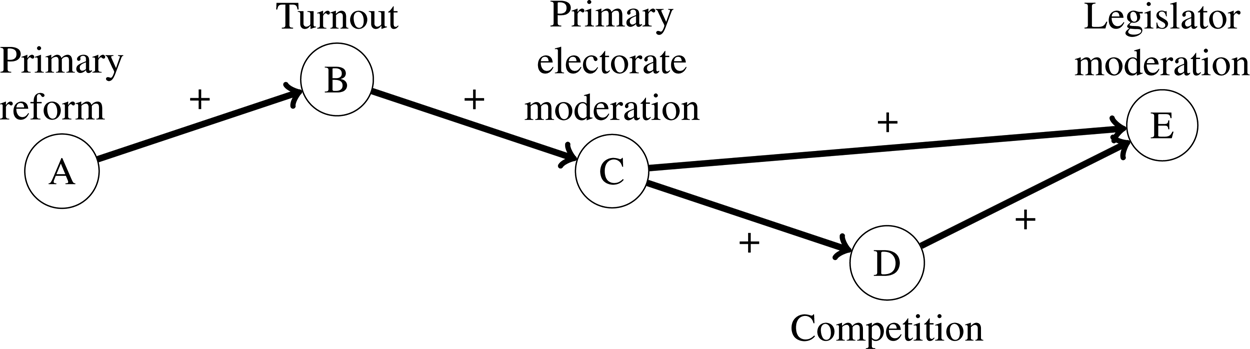
Second, it is assumed that under restrictive primary rules only the most partisan or ideological voters are willing to incur the costs of participating and of voting a full ballot. Therefore, increasing turnout leads to a more centrist primary electorate for each office on the ballot (pathway B→C). Third, with more centrist voters turning out or voting down the ballot, more centrist candidates are more likely to contest and more often win primary elections (C→E). Thus, in primaries with restrictive rules, we should expect more ideological and partisan candidates nominated. It is also sometimes suggested that a more diverse primary electorate may lead to greater competition at primary elections, which also creates a moderating influence on candidates (C→D→E).Footnote 4
Existing research has considered many of the mechanisms represented by the pathways in Figure 1. While I cannot do justice to the full literature on primary elections here, I provide an example set of findings in Table 1. The research uses a variety of designs, time periods, and legislative-electoral settings to estimate the relationships of different pathways of the theory. Reform to primary elections is the usual explanatory factor and designs often skip over intermediate edges (e.g., looking at the relationship between rules [node A] and candidate moderation [node E], skipping over B, C, and D). While some research provides empirical support to pathways of the theory, estimates are quite variable. Some find relationships of magnitudes that suggest primary rules have important political consequences, while others find magnitudes near zero suggesting rules are not particularly relevant. Galderisi et al. (Reference Galderisi, Ezra and Lyons2001) have a set of empirical chapters that find evidence sometimes in support and sometimes in contrast to that in this table. The final rows of Table 1 present the three main empirical contributions of this essay.
Sample of research findings on mechanisms and consequences of primary reform

Note: DID, difference-in-differences; CS, cross-section; PCS, pooled cross-section; IV, instrumental variables; ITS, interrupted time-series; M, matching.
Sidestepping reform: causal pathways from reform to unclear consequence
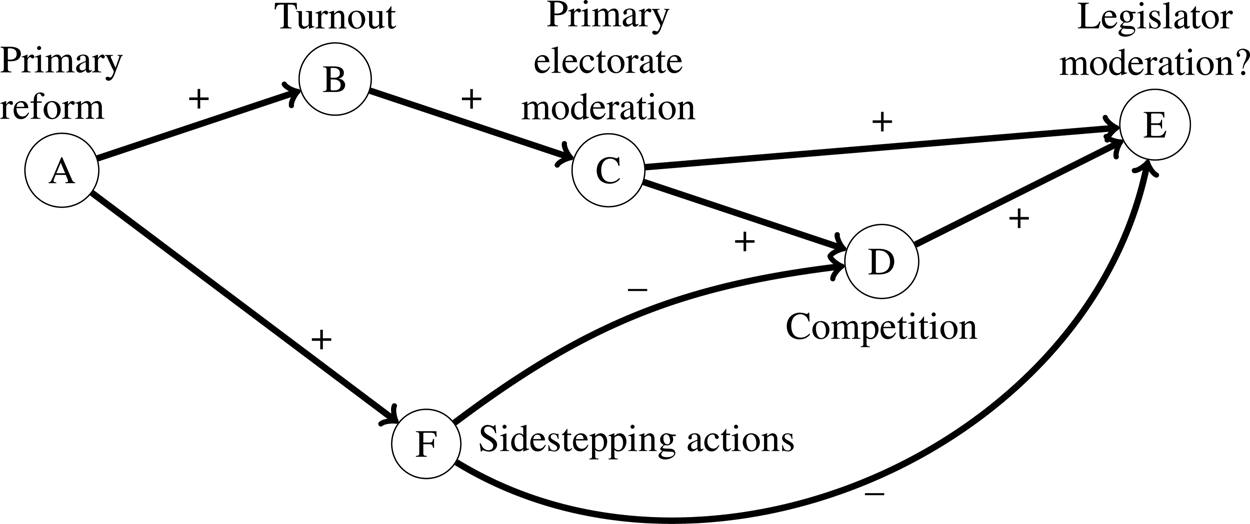
Why might primary reform have consequences that vary from politically important to null (Table 1) despite conventional understanding (Figure 1)? The theory of sidestepping reform provides an explanation. Changes to primary rules that encourage broader participation change expectations actors have about the political outcomes of the system. Change to expected outcomes may change incentives for political actors who prefer the status quo to the new system. Changed incentives can induce behavior not previously taken on other pathways of influence—effort to sidestep reform. Activists, party leaders, or power brokers who had more influence over nominations in closed primary elections or party conventions might react to reforms democratizing nominations with an effort to maintain influence (e.g., Cohen et al., Reference Cohen, Karol, Noel and Zaller2008). Campaign donors who previously made large soft-money contributions to national party committees might respond to restrictions on those direct contributions by increasing independent expenditures (Issacharoff and Karlan, Reference Issacharoff and Karlan1999). In fact, even actors silent in the previous system might become newly involved in opposition to the new status quo.Footnote 6 Others have also alluded to the possibility of sidestepping reform using different language (Issacharoff and Karlan, Reference Issacharoff and Karlan1999; Cain, Reference Cain2015).
Figure 2 adds sidestepping response to the causal pathways of primary reform. Node F might include donations, volunteering, lobbying, activism, greater coordination by party leaders, or different candidates running for office. Alternative pathways of influence allow motivated political actors to try to circumvent change to the status quo either directly or by limiting competition.
Applying Figure 2 to interpret the variable empirical evidence on the effects of primary reform from Table 1 suggests that, in some cases, effort to sidestep has been successful. Actors who anticipated the consequences of reform changed their behavior to influence outcomes away from the new status quo leading in some cases to limited or vitiated consequences of reform. However, in other settings, it may be that the consequences of reform are too large or the alternative pathways of influence too narrow to successfully sidestep. Sidestepping will not vitiate consequences of reform when the paths from F to E are smaller in magnitude than the paths from C to E.Footnote 7
2. Evidence for sidestepping reform: data, measurement, and statistical model
I turn now to evidence of sidestepping primary reform in operation. I do not prove the existence of every node in Figure 2. Rather, I use the theory to generate hypotheses about the likely consequences of primary reforms. My empirical design then tests these hypotheses and, finding evidence in support, suggests sidestepping reform a plausible theory to explain larger patterns.
A desirable design would induce institutional reforms—i.e., change expectations of the status quo—and measure changes in action taken on alternative pathways of influence. Consider campaign finance. If campaign finance is a pathway of influence, actors might substitute campaign contributions or fund-raising effort in response to reforms.Footnote 8 Campaign finance as a pathway to influence political outcomes away from the status quo could be generated by different actors. Motivated individual citizens (Brown et al., Reference Brown, Hedges and Powell1980, Reference Brown, Powell and Wilcox1995; Francia et al., Reference Francia, Green, Herrnson, Wilcox and Powell2003; Barber et al., Reference Barber, Canes-Wrone and Thrower2017; Hill and Huber, Reference Hill and Huber2017; Magleby et al., Reference Magleby, Goodliffe and Olsen2018) or Political Action Committees (PACs) who care about policy might pro-actively give without candidate solicitation. Alternatively, motivated parties or candidates who care about elections might exert new effort to raise funds, or candidates who would not otherwise run for office may enter the contest and begin to raise new money. Any or all of these actors may use campaign finance and other pathways of political influence (volunteering, production of information, lobbying, etc.) to influence post-reform outcomes.
I estimate the effect of primary reform on campaign finance. I look at changes over time in primary rules in each state and party and classify each change by the effect on costs for voter participation. If stringency of access to nominating elections has consequences as in Figure 1, sidestepping reform suggests that as state-parties move from more to less stringent rules, loss of political influence from stringent primary rules should increase the magnitude of campaign finance (Figure 2).
To measure stringency of access to primary elections, I use the McGhee et al. (Reference McGhee, Masket, Shor, Rogers and McCarty2014) compilation of state-party primary election rule changes from 1992 to 2008. I extend their time-series to 2014 through personal correspondence with the authors and with documentation of state election laws provided by the National Conference of State Legislatures.
Because I am interested in how actors respond to reforms that ease access, I categorize primary rules by considering how burdensome each rule is for individual voter participation. In my category “Costly,” voters must formally register with a party in order to participate in that party's primary, often with some level of restriction on that registration. I assign open and open-to-unaffiliated primary systems to the category “Lower Cost” as any voter may participate in any party primary without restriction but must still choose a party ballot. I classify top-two and blanket primaries “Nonpartisan” because costs to participate are ambiguous relative to open but likely less costly than the various versions of closed (see Supplementary Appendix Table A1). Readers should interpret the effects I estimate as average responses to rule changes that increase or decrease costs for voter participation in primary elections. My categories abstract away from nuances of primary election rules.Footnote 9
For turnout and political competition, I extend Hirano et al.'s (Reference Hirano, Snyder, Ansolabehere and Hansen2010) time-series of U.S. House primary election data through 2014 with results from Federal Election Commission. Turnout is measured by the number of votes cast for House candidates in each state and election, excluding votes for write-ins, divided by voting-eligible population from McDonald (Reference McDonald2019). For contribution records, I use the Database on Ideology, Money in Politics, and Elections (DIME, Bonica, Reference Bonica2013, Reference Bonica2019), which compiles individual campaign donations from state and federal campaign filings.
Because states (and sometimes parties within states) choose their own rules of primary elections, I use a two-way fixed effects difference-in-differences (DID) design to estimate causal effects of primary reform on turnout, political competition, and campaign finance. The model measures the effects of within-state(-party) changes in primary institutions over time, holding constant all time-invariant features of the state and state-party such as party balance, party organization, geography, average policy views, and legislative institutions. Effects are identified when a state-party changes its institution, which occurs in the time period of this panel with movement both into and out of less costly rules for participation.
I summarize legal and statutory changes that generate identification in Table 2. One concern with this identification strategy is that institutional change is endogenous to features of the electoral environment and thus the required DID assumption of parallel trends is violated. Table 2 presents the cause of each change, which varies across states and times from judicial rulings to legislative action to voter initiatives. That etiology varies across settings provides some comfort that there is not some single omitted factor that always causes reform and would lead to a spurious estimate of the effect of the reform. Of additional support to the causal interpretation is the section on heterogeneity in treatment effects below with empirical evidence of the causal mechanism in Figure 2. Individuals who previously participated in closed primaries at higher rates most increased their donations in response to reform.
Changes in primary institutions

That said, these statutory changes are not a large number and so readers should be cautious in the interpretation of this evidence. However, this is the set of natural experiments we have and my goal is to learn from them as much as we can. The DID design provides a plausible path for doing so. I present results applying a Conley and Taber (Reference Conley and Taber2011) correction for a small number of treated units below.
The unit of observation is the state-party-year with statistical model

where y is the outcome of interest in state i for party j in election cycle t, α is a state-party fixed effect, γ is an election cycle fixed effect, β is the coefficient of interest on x measuring a less-costly or nonpartisan primary election institution, and ɛ is a random disturbance.Footnote 10 Some models are estimated at the level of state-year, aggregating across parties. As with all DID designs, the model captures the causal effect of x on y if a parallel trends assumption holds. The variation in etiology of reform in Table 2 is my strongest evidence in support of ignorability. I present an empirical evaluation of parallel trends in Supplementary Appendix Section D.
3. Results: political consequences of primary reform
I first use the DID design to evaluate if more open rules of access to primary elections increase voter participation. The columns of Table 3 estimate the effect of primary reform on turnout in primary elections to the U.S. House aggregated to the state-election. The dependent variable in the first column is the number of votes cast in all House primary elections for each state and election cycle divided by the voting eligible population in that state and year. All standard errors are clustered on the state-party. Point estimates suggest an increase in turnout of 1.5 percentage points in open primaries and 6.1 percentage points in nonpartisan primaries. Although these estimates have large standard errors, the second magnitude is of political importance suggesting that nonpartisan primaries do serve the goal of increasing participation. The second column estimates the effect on votes cast for major party candidates only, with point estimates of 0.4 and 1.8. The third and fourth columns present effects for Democratic and Republican primary candidates separately, with little heterogeneity by the party. Table 3 in whole suggests easing restrictions on voting in primary elections increases participation in nominating contests, but uncertainty about the magnitude remains given sampling variability.
DID effects of primary reform on turnout in House primary elections, 1992–2014
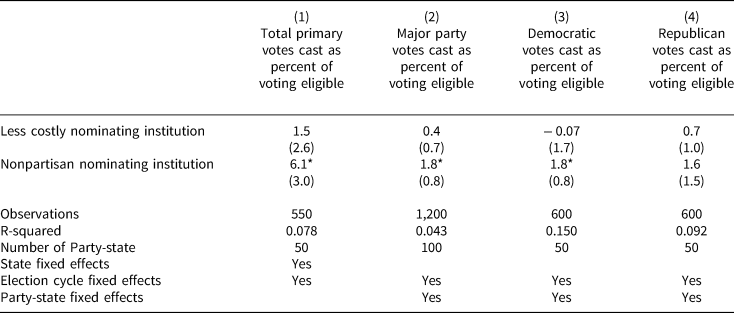
**p < 0.01, *p < 0.05
Ordinary least squares (OLS) coefficients with robust standard errors clustered on state-party in parentheses.
Excluded category is institutions most costly for individual participation.
3.1 Contributions and receipts increase with primary reform
Table 4 presents DID estimates of the effect of changing primary rules on campaign contributions from individual donors. Dependent variables sum individual contributions to recipients of the two major parties in each cycle, with each observation a state-party-cycle. I also include logged versions of each count dependent variable given the different sizes of states.
DID effects of primary reform on individual contributions, all offices
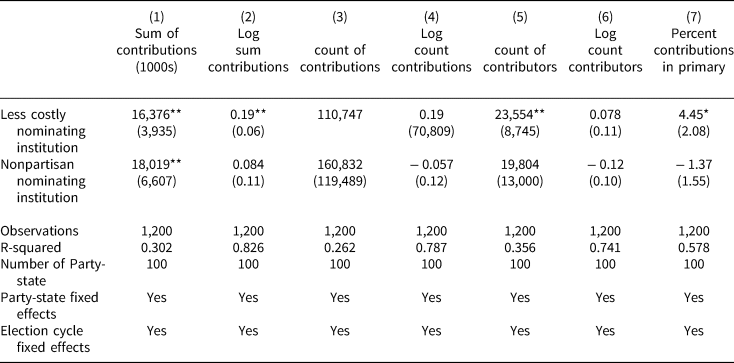
**p < 0.01, *p < 0.05
OLS coefficients with robust standard errors clustered on state-party in parentheses.
Money dependent variables in thousands of dollars.
Excluded category is the institutions most costly for individual participation.
The first column is total contributions where the best estimate is that less-costly primaries increased contributions by about $16.4 million and nonpartisan primaries by about $18 million to candidates of each party in each state with reform. The log-linear specification in column two indicates a 21 percent increase in contributions for less-costly primaries and 9 percent increase for nonpartisan.
The third and fourth columns consider the effects of reform on counts of contributions and the fifth and sixth on counts of contributors. Estimates have larger standard errors on coefficients, but point estimates suggest reform increases both the count of contributions reported and the count of unique contributors. Magnitudes are on the order of 100,000 new contributions and 20,000 new contributors with reform. The log-linear models (columns four and six) suggest − 5 (nonpartisan) to 21 (less-costly) percent increase in the number contributions but − 11 (nonpartisan) to 8 (less-costly) percent increase in the number contributors, all estimated with notable sampling variability.
The seventh column addresses the destination of increased donations. Results suggest reform increases the percentage of contributions classified for the primary election (in open primaries) by around 4.5 points, but fewer primary contributions in nonpartisan primaries relative to contributions in the general.
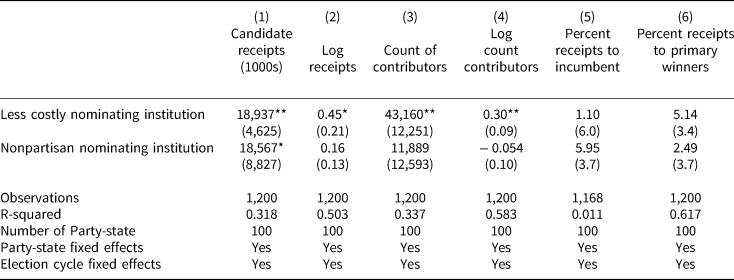
Table 4 estimates effects on individual donor actions. Table 5 presents DID effects with the dependent variable receipts for candidates of each major party, state, and election cycle. These sums differ from those in Table 4 by including contributions from non-individuals like PACs and from individual contributions not itemized (small donations).Footnote 11 The first column presents the effect of reform on candidate receipts, with estimates that moving to less-costly and nonpartisan primaries increases receipts by about $19 and $18.5 million. The log-linear model (column two) estimates increases of 56 and 17 percent. The third and fourth columns show that the count of contributors increases with less costly reform and is uncertain with nonpartisan reform.
DID effects of primary reform on candidate receipts, all offices
**p < 0.01, *p < 0.05
OLS coefficients with robust standard errors clustered on state-party in parentheses.
Money dependent variables in thousands of dollars.
Excluded category is institutions most costly for individual participation.
If primary reform increases the heterogeneity of the primary electorate, one response to reform might be for donors to increase support for status quo incumbents or parties to increase coordination on preferred candidates (Cohen et al., Reference Cohen, Karol, Noel and Zaller2008; Hassell, Reference Hassell2015). Columns five and six present suggestive evidence of both pathways. In states with reform, best estimates are that percent of all candidate receipts to incumbents (in races with an incumbent) increase between one and six points. Across all contests, percent of receipts to winners increases on the order of two to five points. These results are uncertain but suggest reform does lead to changes in which candidates obtain the larger share of donations.
In sum, primary reforms appear to increase turnout but also increase campaign donations from individuals and receipts to candidates. The magnitude of these estimates is of political importance, with turnout increases of up to six points and campaign finance increasing between 9 and 55 percent. These findings are consistent with (a) primary reforms changing the set of eligible voters who vote in primaries [the increase in turnout] as in pathway A→B from Figure 1, but (b) political actors sidestepping reform through alternative pathways of influence [the changed level and patterns of campaign finance], pathways F→D and F→E in Figure 2.
4. Are increased donations due to increased competition?
An alternative explanation of these findings is that increases in campaign finance follow from increased competition in primary elections. Indeed, competition was one of the arguments for Initiative 872 in Washington (“More competitive primaries and general elections”). This alternative mechanism, however, is inconsistent with the theory of sidestepping reform because increased competition is not an alternative pathway of political influence as clearly as is campaign finance.
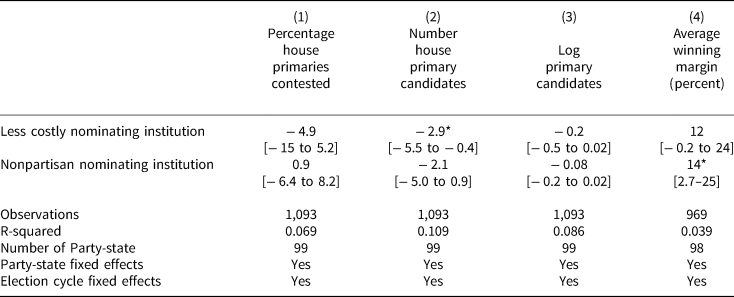
In Table 6, I present DID results on three measures of political competition. Column one estimates the effect of primary reform on the percentage of House seats for each state-party with at least two (non-write-in) candidates, i.e. a contested seat. Column two estimates the effect on the number of primary candidates, and three the log of the number candidates. Column four estimates the average margin over second place of the winning candidate. Increasing competition would suggest positive effects in columns one, two, and three, and a negative effect in column four. Point estimates in columns one, two, and three are near zero with five of six in the direction suggesting decreased competition. Confidence intervals exclude effects of reform on percent primaries contested greater than 8 percent. Coefficient estimates in column four are politically important in the wrong direction, suggesting primary reform increases the average winning margin. In total, Table 6 suggests against primary reform increasing political competition at primary elections and thus against competition as the factor driving increased donations.
DID effects of primary reform on competition in House primary elections, 1992–2014
**p < 0.01, *p < 0.05
OLS coefficients with robust 95% confidence interval clustered on state-party.
Contested primary defined as more than one non-write-in candidate.
Excluded category is institutions most costly for individual participation.
5. Heterogeneous effects by previous primary turnout
The theory of sidestepping reform suggests that when one avenue of influence is closed, actors opposed to the reform pursue alternative avenues. I have presented evidence of this phenomenon at the state-party-level in the context of loosening access to participation in primary elections. However, this state-party-level relationship may follow from different, non-sidestepping mechanisms. For example, if liberalizing access to primaries increased participation more generally, it might incidentally increase participation outside of voting, such as making donations. A general increase in participation could be an omitted variable for sidestepping reform making the evidence so far presented ambiguous relative to my theoretical argument.
An individual-level empirical implication of the argument suggests itself to evaluate the mechanism. The individuals most affected by primary reform are those who had previously been participants in closed party primaries. An avenue of influence these individuals were previously taking is closed to them. The theory suggests that these individuals should be the most responsive to reform, the most motivated to find new actions to sidestep. While the theory does not say absolutely that previous primary participants should increase their donations—there may be other avenues of influence outside of donations—finding such a pattern would reinforce the interpretation of the state-party-level relationship. If it is the actors aggrieved by the reform (previous primary voters) who respond, we should see greater increases in contributions from previous primary voters than from actors who were not previously participating in primary elections. If it is a general increase in engagement causing the increase in contributions, we should not see variation in the increase by previous primary participation.
In this section, I drill down to evaluate if primary reform prompts individuals who had previously participated at higher rates in closed primaries to increase donations more than individuals who had previously participated at lower rates. The ideal design would be to enumerate every eligible voter in each state, match them to their primary turnout history and their contribution history, and run a DID similar to that utilized above at the state level.
Unfortunately, data limitations prevent this analysis. First, state voter files generally retain only a few recent turnout histories and, in some cases, only for currently-active registrants. Using a current voter file to measure primary turnout from many years previous induces extensive missingness. Second, matching voter file records to contribution records is incredibly difficult because there is no unique identifier that matches individuals from one to the other. While both data sets have name and address, both are subject to idiosyncratic standardizations and the contribution records especially are subject to mis-reporting and entry errors. In preliminary efforts to merge between the two data sets, I found that matching on full name and zip code led to less than 25 percent success in matches.
I implement an alternative toward the ideal DID. To address the first problem of the enumeration of individual turnout histories back in time, I have personally been collecting voter file snapshots from California and Washington since 2006. These collections cover the year of reform for these two reform states, which allows me to run a two-state interrupted time-series (ITS). The DIME compilation also covers contributions in these two states for this time period.
To address the second challenge of matching individuals with poorly-recorded names and addresses, I implement a partial-aggregation procedure. I assume that surname is the data field least-likely to be recorded with error. On this assumption, I aggregate turnout histories from the voter files and individual contributions from DIME to the surname-state-year. I then merge average turnout in the most recent four primaries for individuals to sums and counts of contributions on surname, state, and election year. For example, in 2008 in California, I sum for each individual registrant turnout in the 2008 presidential, 2008 congressional, 2006 congressional, and 2004 presidential primaries and then take the average of those sums across all registrants with the same surname. From the DIME data, I sum and count contributions made in 2007 and 2008 for each surname with a reported address in California. These two records are then merged to create the combined data set.
I purge surname of all spaces and special characters, which leads to 87.8 percent of surnames in the contributor data matching a surname in the voter files. I locate at least one contribution for the surname of 82.5 percent of registrants in the voter files.
Turnout can vary by large magnitudes in primary elections, so I do not simply interact the reform indicator with average turnout. Instead, for each state-year, I classify previous primary turnout into the top quartile, third quartile, and bottom half. This categorizes state-surname-election observations into three groups, surnames that participated in the highest degree in closed primaries (top quartile), middling degree (third quartile), or lowest degree (bottom half).
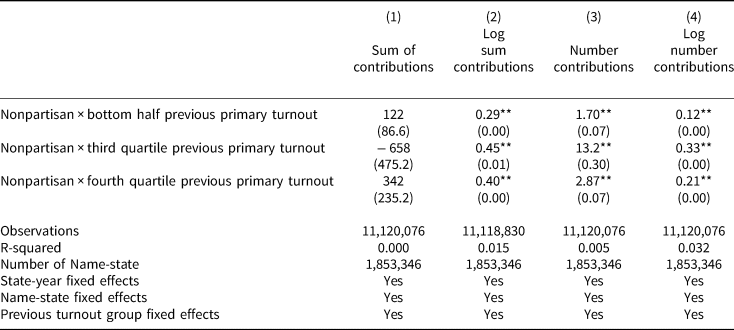
In Table 7, I present ITS models of contributions on primary reform indicators interacted with each of the previous primary turnout categories. The level of observation is the state-surname-election. Because this data set includes only California and Washington for the subset of years 2006–2016, it covers only nonpartisan reforms and there is no less costly reform category. The ITS has state-surname and election fixed effects and I also include turnout category fixed effects.
Interrupted-time-series by previous primary turnout
**p < 0.01, *p < 0.05
OLS coefficients with robust standard errors clustered on state-election in parentheses.
Excluded category is closed partisan primaries. Limited to California and Washington.
Coefficients of interest measure how contributions respond to primary reform by the previous primary turnout, holding fixed average state-surname contributions, average primary turnout group contributions, and election-specific effects on contributions. All standard errors are clustered on the state-election.
The first column presents the relationship between the sum of contributions by state-surname and nonpartisan primary reform interacted with the category of previous primary turnout. The first coefficient estimates that, among surnames with the lowest previous primary turnout, total contributions increased by an average $122 after primary reform. In the second turnout category, the coefficient indicates total contributions decreased by $658 and in the third highest-participating turnout category, increased by $342. Each of these point estimates is subject to large uncertainty such that the standard errors make uncertain whether any of the effects are greater or less than zero.
Coefficients in the remaining three columns are all estimated with greater precision, allowing us to reject a null hypothesis of an effect less than zero. Column two presents the log-linear model, where the coefficients indicate that contributions increased following reform by 34 percent for surnames in the lowest half of previous primary participation, 57 percent for surnames in the third quartile, and 49 percent for surnames in the fourth quartile.Footnote 12 A similar pattern manifests for the number of contributions and log contributions in columns three and four.
Columns two, three, and four provide evidence in support of the theory of sidestepping reform. In each case, registrants who had been previously participating in closed primaries at rates in the top half of participation increased their contributions in response to reform at higher rates than those in the bottom half of the previous turnout. Surnames with higher primary participation increased the dollar amount of contributions by 23 and 15 percentage points more than those in the lowest category, all else equal.
In sum, the partial-aggregate ITS analysis finds that individual political contributions increased more from those who were participating in closed primaries prior to reform. This provides evidence in support of a sidestepping interpretation of the state-party-level results.
6. Robustness and alternative explanations
In the Supplementary Appendix, I address robustness. Supplemenetary online appendix Section C applies a correction following Conley and Taber (Reference Conley and Taber2011) to adjust inference for a setting of a small number of treated units. Two results in Table 4 move out of statistical significance with the correction and three results move into significance. Adjusting inference for a small number of treated units does not substantively alter overall conclusions.
Supplementary Appendix Tables A5, A6, and A7 reproduce Tables 3, 4, and 5 using the original Reference McGhee, Masket, Shor, Rogers and McCartyMcGhee et al. classification of primary election types. Point estimates suggest larger effects of open and nonpartisan institutions than of semi-open and semi-closed institutions relative to the baseline category of closed. Semi-open primaries appear to generate more turnout than semi-closed primaries.
Supplementary Appendix Table A9 considers heterogeneity in the effect of reform on candidate receipts for different offices. Effects are consistent for governor, House, and Senate contests.
7. Discussion
From their inception, one goal of primary elections was to democratize candidate nominations (Merriam and Overacker, Reference Merriam and Overacker1928). Recent reforms aimed at easing access to the primary ballot have similar goals and, I estimate, have increased participation. Yet in scholarship with many research designs and varied sample populations, we have estimated inconsistent effects on legislative polarization and primary voter moderation.
The theory of sidestepping reform and evidence here explains this variability. Reforms may very well increase participation and provide moderating incentives for candidates. But reforms also influence strategic campaign donations, which compete for influence with a more inclusive primary electorate. The net effect of increased turnout and increased magnitudes of campaign finance on political outcomes then depends upon politicians’ demand for each and the mapping into their subsequent legislative behavior. In some settings, candidates may see a greater need for donations, in others, greater need for votes from the newly-participating electors, leading to the heterogeneity of the consequences of reform.
Reformers might conclude from the evidence here that institutional reforms must be multi-pronged, for example, primary reform must be paired with campaign finance reform. Perhaps so. However, the theory of sidestepping reform holds that motivated actors react to reforms by pursuing alternative pathways of influence. If nomination politics and campaign finance pathways are both limited, we should anticipate actors will find other routes. The argument in Cain (Reference Cain2015) is compelling. It may be a fool's errand to try to prevent motivated actors from influencing elections and policy. Instead, reforms ought to promote pluralism and acknowledge “the critical role that intermediaries inevitably play in any large democracy (6).” It is difficult to take the politics out of politics.
The difficulty of taking politics out of politics harkens back to perhaps the first institutionalist of political science, James Madison (see Kernell, Reference Kernell and Kernell2003), who suggested it futile to try to prevent faction and instead that “relief is only to be sought in the means of controlling its effects” (Madison, Reference Madison1787). He argued for institutions that funneled factional impulse into competition and required compromise through checks and balances. Institutions are consequential, Madison suspected, but cannot prevent political actors who desire influence from taking action.
This essay suggests new inquiries for scholars of both electoral behavior and political institutions. First is the implication that participating in institutions of political choice such as primary elections and making pecuniary donations might be substitutes for or complements to each other, rather than stand-alone acts. Time-series analysis of individual choices in both realms could enlighten the causes of participation (Leighley and Nagler, Reference Leighley and Nagler2014) and campaign donations (Brown et al., Reference Brown, Hedges and Powell1980, Reference Brown, Powell and Wilcox1995; Magleby et al., Reference Magleby, Goodliffe and Olsen2018) and, perhaps, policy consequences. The results here offer a new explanation for why some eligible citizens choose to make candidate donations while others do not.
Second, other institutional reforms not considered here seem to have had more consistent and large consequences. Abolishing cross-filing, moving to a secret ballot, and the Voting Rights Acts all had material consequences on American politics. What was it about these reforms that kept sidestepping effort, to the degree it was present, from vitiating effects of reform? Theoretical and empirical consideration on the scope of sidestepping reform and the parameters of effective institutional reform would be of great value.
Third, that candidate receipts increase following reform shows that candidates do not exhaust the pool of available campaign funds in every election. This means that candidates may be trading off time raising funds with time on other activities. Candidate choices in the allocation of effort have consequences for who gives, how much, and to what consequence (Milyo, Reference Milyo2001). Understanding of the dynamics of campaign finance would benefit from insight into how candidates make this tradeoff and how institutional reforms might influence their choices. It would be unfortunate if reforms aimed at improving representation instead caused politicians to spend more time raising money.
Finally, these results speak to the effort to understand the consequences of primary elections for party polarization. There is disagreement in the literature as to how consequential are primary reforms (e.g., Gerber and Morton, Reference Gerber and Morton1998; Hirano et al., Reference Hirano, Snyder, Ansolabehere and Hansen2010; Bullock and Clinton, Reference Bullock and Clinton2011; McGhee et al., Reference McGhee, Masket, Shor, Rogers and McCarty2014; Hill, Reference Hill2015; Kousser, Reference Kousser2015; McGhee and Shor, Reference McGhee and Shor2017; Kousser et al., Reference Kousser, Phillips and Shor2018), even if primary elections are consequential (e.g. Brady et al., Reference Brady, Han and Pope2007; Boatright, Reference Boatright2013; Hill and Tausanovitch, Reference Hill and Tausanovitch2018). The evidence of sidestepping reform here suggests that to understand party polarization and the consequences of institutional reform requires analysis of the many competing mechanisms of reform together. To the extent different causes of polarization are complements or substitutes, relating over-time or cross-sectional variation in one institution may fail to accurately characterize the consequences of reform.
This essay illustrates the interplay of the many actions available to political actors as they pursue interests within multifaceted institutional contexts. Efforts to reform one facet must consider the reaction of actors in others.
Supplementary material
The supplementary material for this article can be found at https://doi.org/10.1017/psrm.2020.42.



