Introduction
In contemporary Nigeria the signs of a crumbling social contract are there for all to see. A vast and growing informal economy supports 65 percent of the nonagricultural labor force, who get little from the state and give little in return. Poverty and resource struggles are boiling over into ethnic and religious violence in various parts of the country, as receding tensions in the Niger Delta give way to violent religious conflict in the predominantly Muslim north. The state itself seems increasingly incapable of garnering support or imposing order owing to its unpopular submission to decades of crushing market reforms and the corrosive effect on legitimacy of corruption and regionalist agendas. This noxious combination of expanding informality, intercommunal violence, and popular suspicion of the state has become particularly worrying in northern Nigeria, where mounting violence between the Muslim majority and Christian minorities has culminated in a spate of bombings and sectarian attacks by the extremist Islamic group Boko Haram in which thousands of people have been killed since 2009. Drawing on recent fieldwork in northern Nigeria, this article considers the role of the informal economy in this alarming trajectory of social disintegration. In a context of religious conflict and a delinquent state, is the informal economy part of the problem, or can it be part of the solution?
In the context of northern Nigeria, the role of informal enterprise in limiting or exacerbating conflict is shaped by local specificities of informal organization. While informal enterprise makes up the bulk of popular livelihood activities, particular activities tend to be dominated by specific religious or ethnic groups. Does this situation tend to accentuate conflict between more and less successful enterprise networks, or does it build collaborative interreligious relations through economic interdependence and familiarity among producers, traders, customers, and suppliers on different sides of the religious divide? Do informal enterprise networks on different sides of the religious divide relate to the state in the same way, or are there important differences in levels of support for and assistance from the state? Understanding the day-to-day experience of interreligious contacts and state–society relations among informal actors in areas of intensifying religious conflict can offer new lessons about the forces that exacerbate religious tensions, and the institutional resources and policy measures that may help to reduce them.
These issues are addressed in the context of fieldwork I carried out in the northern Nigerian cities of Kano and Kaduna in October and November 2011. In each city, the study focused on informal economic activities based on interreligious relations of complementarity, competition, and value conflict. Complementary activities involve cooperation between Muslims and Christians in order to earn an income; competition refers to activities in which Muslims and Christians compete for customers; and value conflicts relate to activities in which economic relations linking Muslims and Christians involve an activity that is religiously proscribed by one or the other religion. The study focused on motorcycle taxi operators, tailors, tire dealers, butchers, and pepper soup producers in beer parlors. For each activity, a combination of qualitative and quantitative methods was used to examine how conflict has affected relations across the religious divide, and how interreligious relations are shaped by wider relations with the state. Key elements in relations between informal activities and the state relate to the political mobilization of religion as well as to relations of social provisioning and taxation. These various elements were drawn together to create a picture of how informal economies shape possibilities for resilience as well as vulnerabilities to conflict.
The article is laid out as follows: after setting the scene with a consideration of key perspectives on informality, religious conflict and governance, I provide an outline of the setting and methodology of the study. Two subsequent sections undertake an analysis of interreligious relations in selected informal activities in Kano and Kaduna. This is followed by a more quantitative analysis of how interreligious relations among informal actors across the two cities are shaped by wider socioeconomic factors. A final section draws wider conclusions regarding the potential of informal economies to foster conflict resolution rather than violence. This article challenges the conventional wisdom by showing that informal economic networks in divided societies can reduce vulnerability to conflict, even where informal organization is based on religion and ethnicity. In Nigeria, as in much of West Africa, even religiously specialized informal economic networks tend to bridge communal divides rather than inflame them. Violence is not associated with religious diversity and competition between informal economic networks, but with the uneven and discriminatory character of their relations with the state.
Informality, Religious Conflict, and Governance
Since the late 1980s religious relations in northern Nigeria have been marked by intensifying conflict, involving more than ten thousand deaths as well as widespread economic disruption (Haynes Reference Haynes2009). Repeated clashes between the Muslim majority and Christian minorities have taken place in various cities across the north, ranging from the “burning of churches” in 1987, through the Zangon Kataf and Kano riots in the early 1990s, the “Miss World,” Jos, and anti-Shari’a riots in the early 2000s, the ongoing Jos crisis, and the Boko Haram attacks since 2009. These waves of religious rioting have involved Muslim attacks on settler Christian communities, Christian attacks on settler Muslim communities in Christian areas of the Nigerian Middle Belt, and retaliatory attacks by Christian or Muslim communities in response to previous clashes or perceived political threats.
Since the late 1990s there has been a tendency among economists and political theorists to associate African informal economies with greed, communal divisions, and violence (Collier & Hoeffler Reference Collier and Hoeffler2004; Duffield Reference Duffield, Berdal and Malone2000, Reference Duffield2001; Reno Reference Reno2000). Informal networks based on ethnic and religious forms of organization are viewed as mechanisms of clientism and corruption, giving rise to “violent modes of accumulation,” “war economies,” and “the criminalization of the state” (Roitman Reference Roitman1993, Reference Roitman2004; Reno Reference Reno2000; Bayart et al. 1999; Duffield Reference Duffield, Berdal and Malone2000). Repeated emphasis on the links between ethnoreligious divisions, informal economies, and mounting violence makes it easy to forget that religion and informal economic networks have historically played an integrative and developmental rather than a conflictual role in West Africa. Economic historians have documented the role of Islam in bridging ethnic divides and providing a framework for economic cooperation and trade across northern Nigeria and West Africa more broadly (Austen Reference Austen1987; Curtin Reference Curtin1975; Hopkins Reference Hopkins1973; Lovejoy Reference Lovejoy1980). The legendary efficiency of the Mouride, Hausa, and Igbo trading networks in West Africa illustrates the role of religion in fostering cross-ethnic networks of trust and solidarity, and new ethics of production and accumulation (Hashim & Meagher Reference Hashim and Meagher1999; Meagher Reference Meagher2009; Cruise O’Brien 1975; Meagher Reference Meagher2010). As Jean-Philippe Platteau (2009:679) points out, religion in African societies can be “an engine capable of driving changes in behavior that are conducive to capital accumulation and productive effort. . . . Religion thus appears to have far more influence on people’s behavior than formal rules and state institutions, providing a useful bridge between tradition and modernity.”
Understanding these contradictions requires closer attention to the varied effects of religious diversity, and to the institutional features that can create peace as well as conflict in religiously diverse societies. Measures created by Collier and Hoffler (Reference Collier and Hoeffler2004) associate religious diversity, like ethnic diversity, with an increased propensity to conflict. In more recent work, Montalvo and Reynal-Querol (Reference Montalvo and Reynal-Querol2003) argue that the issue is not religious diversity per se but religious polarization. While measures of diversity reflect the sheer heterogeneity of religious groups, polarization is greatest where two religious groups are of equal size, and it is shown to have a “negative impact on growth through its effect on investment, government expenditure and the probability of civil wars” (2003:208). However, there is a growing awareness that not all religiously diverse or even polarized societies are mired in conflict. Explaining why some diverse societies are peaceful while others are riven by violence has focused attention on how religious differences can be overcome by institutional features that diffuse political and economic tensions (Armakolas Reference Armakolas2011; Jha Reference Jha2007; Varshney Reference Varshney2001; Stewart Reference Stewart2008).
One line of research focuses on the role of integrated civil organizations and the state in maintaining peace amid diversity. In his well-known research on India, Ashutosh Varshney (Reference Varshney2001) considers the integrative role of religiously mixed organizations within civil society as a key to preventing violence in religiously diverse settings. He argues that “what matters for ethnic violence is not whether ethnic life or social capital exists but whether social and civic ties cut across ethnic groups. . . . Trust based on interethnic, not intraethnic, networks is critical” (2001:392). In the context of Bosnia, Ioannis Armakolas (2011) also highlights the importance of religiously mixed social institutions for maintaining peaceful relations, but he also draws attention to the role of the state in shoring up interethnic organization in the face of extremist pressures from “ethnic entrepreneurs.” According to Armakolas, “associational civic links are significant for opposing extremism: yet, the sustainability and success of the opposition depends crucially on the ability of the political system to ‘distance’ itself from the extremist influence. Grassroots activism may prove futile if the ‘battle’ for the political system is lost” (2011:256). In short, peaceful relations in religiously diverse societies are not just products of historical contingency, but result from interethnic organization within civil society and the commitment of the state to ensuring equitable forms of inclusion in the public realm while condemning sectarian abuses.
Others argue that markets and communal specialization rather than states and ethnoreligious integration are key to building peace amid violent communal divisions (International Alert 2006; Killick 2005; Menkhaus 2006–7; Raeymaekers et al. Reference Raeymaekers, Menkhaus and Vlassenroot2008; Jha Reference Jha2007). In fragile state environments where formal economies are weak, informal markets are said to foster interdependence among divided communities and give rise to common interests in peace and stability that override incentives for conflict. Drawing lessons from Indian economic history, Saumitra Jha shows that religiously specialized trading networks were able to create a framework for peaceful relations in a society that had suffered from religious conflict in the past:
In medieval Indian ports, Hindus and Muslims developed institutions that continue to support ethnic tolerance today. . . . Methods that have been employed in medieval ports include the encouragement of specialization within groups, the fostering of opportunities for repeated interaction in both economic and noneconomic spheres, and the creation of institutionalized mechanisms to allow the sharing of gains from trade.” (2007:8)
Ethnic specialization is said to promote complementarity, particularly where minorities have specialized skills and contacts that are costly to reproduce, and it can foster peace as long as taxation or philanthropic contributions ensure the redistribution of gains within society. A similar argument is made in contemporary DR Congo by Timothy Raeymaekers (Reference Raeymaekers2010), who maintains that efforts to tax ethnically specialized trading networks for the provision of public infrastructure and basic services have created an enclave of peace and security in the violent maelstrom of the Eastern DR Congo. Recent research on the role of taxation in state-building also suggests that taxing the informal economy improves governance and accountability in developing countries (Joshi & Ayee Reference Joshi, Ayee, Brautigam, Fjeldstad and Moore2008; Prichard et al. Reference Prichard, Joshi and Heady2012).
Four critical points come out of these considerations. The first is that religious polarization, in which two groups are more or less evenly matched, may make societies more prone to conflict than religious diversity per se. The second point is that even where religious groups are demographically polarized, integrative formal and informal institutional arrangements can promote collaboration and diffuse tensions. Third, the nature of civil society organizations is key to maintaining peace, though there is disagreement as to whether communally mixed organizations are required or if communally specialized organizations can achieve the same end. Finally, there is also some debate about whether peaceful interaction amid religious diversity is achieved through markets or if there is a need for state action to delegitimize extremist mobilization or to redistribute resources through taxation. In northern Nigeria, the interplay of religious conflict, dynamic informal economic organization, and selective relations with the state highlight the potential and the pitfalls of informal economic inclusion in divided societies.
Religious Conflict and the Informal Economy in Northern Nigeria
The issues raised above were addressed in the context of empirical research on cross-religious informal economic organization carried out in the northern Nigerian cities of Kano and Kaduna, located in Kano and Kaduna States, respectively. Both cities have large and dynamic informal economies as well as a recent history of serious religious conflict. However, the two cities also have important historical and structural differences. Kano is a centuries-old capital of the commercially dynamic Kano Emirate. A city of 2.6 million, Kano is characterized by a large Muslim majority and a small Christian minority amounting to about 15 percent of the population and made up largely of settlers from southern Nigeria. By contrast, Kaduna is a colonial city, founded by the British in 1913 as an administrative rather than a commercial center. Kaduna has a population of just under one million people, comprising large indigenous Christian as well as Muslim communities, with Christians amounting to about 40 percent of the population. While Kano lies in one of the northern states that adopted Shari’a law in 2000, Shari’a law was violently contested in Kaduna State and its adoption was ultimately abandoned.
In each of the two cities, a range of informal activities was selected to reflect distinct patterns of interreligious relations, characterized as complementarity, competition, and value conflict. In Kano, motorcycle taxi operators represent relations of complementarity; tire dealers were selected to represent competitive relations; and butchers and sellers of goat’s head pepper soup in beer parlors exemplify relations of value conflict. There was a slight variation in the activities selected in Kaduna, owing to differences in social history and informal commercial organization. The study in Kaduna focused on tailors as examples of complementarity, the religiously mixed motorcycle taxi operators as exemplifying interreligious competition, and butchers and Christian goat meat sellers (who supply meat to pepper soup producers in beer parlors) as representing relations of value conflict.
Interviews were conducted with a range of informal operators in each activity, as well as with the leadership of informal occupational associations associated with the activity. Across the two cities, fourteen interviews were conducted with leaders of key informal occupational associations, which amounted to four occupational associations in Kano and five in Kaduna. Twenty-five interviews were conducted with rank-and-file operators in the various activities, including four focus group discussions, and further interviews were held with a range of other key actors, including local government officials, state revenue officers, and officers of relevant formal-sector traders’ and labor unions. The interviews were followed up with a survey of one hundred and ten informal operators across the two cities, using stratified random sampling with quotas for each activity spread across key operating sites within each city. The survey focused on employment history, interreligious relations with fellow operators and customers, personal costs sustained as a result of religious violence, attitudes to taxation, and feelings about prospects for interreligious relations in the future. Repeated rounds of devastating religious violence have made questions about religious relations and personal experiences highly sensitive. Explicit efforts were made to ensure that questions remained agnostic in regard to the impact of violence on interreligious relations within the informal economy. With livelihoods and employment acting as key points of tension in the structurally adjusted economy of contemporary Nigeria, religiously specialized networks can easily become fault lines rather than bridges across social divides. The objective of the study was to find out which tendency prevails in which circumstances, with a view to making a contribution to more grounded theorizing about informality, conflict, and governance in Africa.
Interreligious Relations in Kano’s Informal Economy
Kano is a commercially dynamic city with well-established business groups and associations dating back centuries (Hashim & Meagher Reference Hashim and Meagher1999; Lovejoy Reference Lovejoy1980). Occupational organization among the Hausa Muslim indigenes of the city is based on a guildlike system that enjoyed strong links with the precolonial state. Colonialism led to a significant weakening of the Hausa guilds, and many have collapsed entirely. By contrast, Kano’s significant Igbo Christian community has a strong system of commercial organization, forged in the stateless context of precolonial Igbo society and tempered by the realities of a migrant commercial minority. Christianity has also given the Igbo educational advantages owing to historical factors that restricted the spread of mission-led Western education in the Muslim north of Nigeria. Across Nigeria, Igbo commercial institutions have made them particularly successful in small-scale business activities, and in Kano they tend to dominate trade in a range of modern goods such as auto parts and building materials. This has been a source of ongoing tension, but relations between Igbo Christians and Hausa Muslims in Kano have been characterized as much by cooperation as by economic conflict. The selection of informal activities to represent different forms of relations across the religious divide provided an opportunity to examine the interplay between commercial organization, informal institutional mechanisms for cooperation and conflict resolution, and the potentially corrosive effects of uneven processes of formal institutional inclusion.
Complementarity: Motorcycle Taxis
In Kano, motorcycle taxis were selected to represent relations of cooperation across the religious divide. The motorcycle taxi business, affectionately known as okada or achaba, is an overwhelmingly Muslim activity in Kano, with Muslims making up well over 90 percent of operators. However, the activity has remained dependent on good relations with Christians owing to the high share of Christian passengers and the importance of the large market in Sabon Gari, the Christian quarter of Kano, as a key point for collecting and dropping off passengers. In Kano the motorcycle taxi business has for decades absorbed a vast segment of retrenched or moonlighting employees and civil servants, failed traders, struggling pensioners, and unemployed youth and Koranic students streaming in from the rural areas. While some own their own motorcycles, a significant number are engaged in hire-purchase arrangements or simply operate the motorcycle for others to whom they must make daily returns.
While motorcycle taxis have become an important source of livelihood for those without skills or options, their operation has never been legalized as an income-generating activity, although it has been widely tolerated by officials until recently. The activity therefore remains extremely vulnerable to state crackdowns as well as to routine extortion by traffic authorities. Across Nigeria, the expanding motorcycle taxi sector has been associated with growing problems of traffic congestion, dangerous driving, and urban violence. Hospitals in many large Nigerian cities have a special ward designated for victims of motorcycle taxi accidents, known commonly as the “Okada Ward.”
In recent years, official tolerance has been withdrawn and motorcycle taxis have been explicitly banned in Jos, Maiduguri, and other cities, particularly in light of their growing association with religious violence. Bans in other northern Nigerian cities have swelled the ranks of okada operators in Kano as those from other cities seek out a large, linguistically compatible commercial center in which they can continue to ply their trade. The number of motorcycle taxi operators in Kano State was generously estimated at two million in 2010, giving Kano the dubious honor of hosting the largest motorcycle taxi sector in the country. The constant influx of motorcycle taxis from other states has added to the pressure on incomes among Kano’s motorcycle taxi operators by oversaturating the market. A dangerous cycle of poverty, frustration, and vulnerability to harassment has been exacerbated by growing official alarm over the activity’s links to religious violence, particularly in relation to the terrorist activities of the extremist Islamic group Boko Haram (Sunday Trust 2010; BBC News 2012; Time Magazine 2011).Footnote 1
Competition: Informal Tire Dealers
Kano’s informal tire dealers represent a more lucrative activity in which Muslims and Christians operate in competition with each other. Hausa Muslim inhabitants started the business in Kano in the late colonial period. Igbo settlers began entering the business a decade or so later, but they quickly surpassed their Hausa hosts owing to embedded organizational advantages of the Igbo apprenticeship system and strong occupational associations. The Igbo apprenticeship system is famous across Nigeria for its long and strict training regime, involving years of service to a “master,” which is rewarded by the provision of significant startup capital at the end of the apprenticeship—a practice known in Nigeria as “settling” an apprentice (Meagher Reference Meagher2010; Forrest 1994). The Hausa and Igbo informal tire markets have grown up in separate locations where they continue to operate according to distinct ethnic business systems. The activity remains predominantly informal in both cases; dealers are largely unregistered, and the activity has often been a target of police harassment owing to accusations that the markets are used to sell stolen tires.
Value Conflict: Goat’s Head Pepper Soup and Butchers
The preparation of goat’s head pepper soup (isi-ewu), a popular Nigerian beer snack, represents relations of value conflict. It is a Christian activity dominated by Igbo women, but it depends on butchers, who are mostly male Muslims in northern Nigeria, to supply the main input.Footnote 2 The goat’s head pepper soup business is invariably connected with the running of beer parlors—some women only prepare the pepper soup for the proprietor, but the majority also run beer parlors. As a result of the association with beer, this activity has been significantly affected by the imposition of Shari’a law in Kano State, particularly since the banning of alcohol outside Sabon Gari in 2004. This has semicriminalized all activities associated with the selling of alcohol in Kano, even within the legal boundaries of the Christian quarters, making isi-ewu producers very hesitant to be identified or counted or to grant interviews. It has also subjected isi-ewu producers to an intensification of police harassment and predatory taxation since the mid-2000s. Beer shipments are still intercepted by the Kano State Islamic security force, Hisbah, on their way to Sabon Gari, and the bottles are publicly destroyed.
While the activity is organized around a fundamental conflict of religious values, isi-ewu producers and butchers are also united by common experiences of social as well as economic exclusion. They both constitute lowly or despised elements in Hausa Islamic society: isi-ewu producers because they are involved in the selling of beer, and butchers because they are traditionally a semiservile caste within the Hausa social structure. Both groups are mutually concerned about the factors that have contributed to undermining the activity in the past few years. Some of these are structural rather than religious, particularly the poor electricity supply, which poses serious problems for keeping such a delicate type of meat fresh, and the rising cost of goats and other ingredients, which is seen to be a product of the general economic malaise in Nigeria. Religious conflict is also recognized as a problem by both sides, owing to its negative effect on the market for isi-ewu.
Associations and Relations with the State
These various informal activities have experienced differential forms of economic inclusion in terms of state recognition, inclusion in the tax net, and protection of commercial property. Motorcycle taxi operators, despite their economic marginalization, have enjoyed a high level of policy inclusion at the level of the Kano State government. In Kano they are organized under the state branch of a national association, the Amalgamated Commercial Motorcycle Owners and Riders Association of Nigeria (ACOMORAN). The Kano branch of ACOMORAN was formed in the mid-2000s with strong encouragement by the Kano State governor. Membership in a registered national association has given Kano’s motorcycle taxi operators a greater political profile, although it has not changed the fact that the activity itself remains informal and without legal standing. As is often the case in Nigeria, legal niceties are eclipsed by the realities of social problem-solving and political interests. Given that the Kano operators make up roughly one-quarter of Nigeria’s eight million motorcycle taxi operators (Vanguard 2011), the sheer size of Kano’s motorcycle taxi sector gave the Kano State branch of ACOMORAN considerable access and influence at the state and national levels (interviews, ACOMORAN officials, Sabon Gari, Oct. 18, 2011). Owing to the large nationwide constituency, and the political advantages of controlling a large and highly mobile activity, governors and even presidential candidates have taken an active interest in the leadership of the organization at the federal and state levels (This Day 2011).
In contrast to the motorcycle taxi operators, Kano’s informal tire dealers have enjoyed little inclusion in policymaking. Tire dealers in Kano have two distinct forms of organization. The Muslim Hausa dealers were organized according to the old Hausa guild system, which collapsed completely more than twenty years ago. As a result, Hausa tire dealers rely largely on personal and identity-based connections with the local government to protect their interests. By contrast, the Christian Igbo dealers have a strong association, called the Kano Tyre-Sellers Welfare Association, which provides members with business services, dispute resolution, and social welfare assistance. The association organizes extra security arrangements with the police, retains lawyers to deal collectively with accusations of stolen goods, and negotiates directly with local government revenue authorities. The Igbo tire dealers’ association is particularly effective in pooling capital for deposits on wholesale purchases, while most Hausa dealers suffer from chronic shortages of capital which severely hamper their ability to advance in the business. The embedded advantages in training and access to capital that arise from the Igbo association and business system are often perceived as excluding Hausa entrants in their own state and creating unfair competition.
Goat’s head pepper soup producers are members of a larger association of beer parlor operators called the Food and Beverage Sellers Association. The association was formed around 2009 in response to intensifying problems of taxation and police harassment arising from the banning of alcohol under Shari’a law. Proprietors complained that the standard health, sanitation, and signboard taxes were randomly supplemented by invented taxes that were threatening business survival. Police used to lock up their shops if they refused or were unable to pay, and the destruction of beer stocks by the Islamic security force, the Hisbah, was a source of grievance. The association has been relatively successful in providing a measure of protection from extreme taxation, but it is unable to confront the equally pressing problem of property violations and poor electricity supply. Most butchers are members of a well-established national association, the National Butchers Union of Nigeria. Within the union, they have their own branch specializing in goat and ram heads, called the Masu Babbaka Branch, which is printed on their ID cards. Butchers have no particular worries about taxation, as they operate in the market where tax levels are very low, but their established national union did not seem to be any more able to address the pressing problem of electricity for cold storage.
Key roles of associations across these activities relate to negotiating taxation and creating channels of access to the state for assistance and services. Kano’s largely Muslim motorcycle taxi operators have avoided inclusion in the tax net, as the activity is technically illegal and participants are seen as having fallen on hard times. Their association, ACOMORAN, is involved in creating a new system of taxation and registration and is negotiating with the state and local governments over tax levels, though this process is driven more by demands of the state and interests of the ACOMORAN executive than by rank-and-file members. While many motorcycle taxi operators indicate a willingness to pay tax if it brings protection from constant police extortion, others already facing saturated markets, rising petrol prices, and daily returns to the motorcycle owner are less enthusiastic. The relatively well-off Hausa tire dealers have no association, but are able to use personal and identity-based connections to negotiate taxation. Seen as respectable but sometimes hard-pressed indigenes, they often succeed in reducing taxes to a negligible amount and even evading them altogether—a claim made by the Hausa tire dealers themselves as well as by their Igbo counterparts. Butchers also benefit from identity-based ties and a well-established national association, and consistently expressed a lack of concern about taxation levels.
By contrast, Christian-dominated activities have required more rigorous negotiation over taxes. The Igbo tire dealers are dependent on their highly organized association to provide protection from extremely high levels of local taxation. The association has succeeded in negotiating taxes down from what were perceived as extortionate levels, as well as protecting members from “bogus” taxes, and in return it collects taxes in bulk from members to remit to the government. The Food and Beverage Sellers Association also assists goat’s head pepper soup producers by negotiating down taxes and collecting them in bulk for the government. Interviews indicated that associational intervention had reduced levels of taxation on pepper soup producers by more than 50 percent in just two years, though grievances are still expressed about the heavy taxation pressures on Christians.
Despite comparative success across these activities in negotiating over taxes, they enjoy very different levels of access to the state in ways that have as much to do with ethnoreligious identity as they do with associational organization or the nature of the activity. Until the banning of motorcycle taxis in Kano in early 2013, ACOMORAN enjoyed significant access to the state at all levels, while the highly organized Igbo tire association has been unable to get a response from local government over problems of basic service provision in Sabon Gari, or to get an audience with officials in the state government despite repeated attempts. Similarly, pepper soup producers face a number of problems that are beyond the power of their association. Access to electricity in Sabon Gari is a critical worry, both for refrigerating goat’s head and for cold beer. But their association, which is overwhelmingly female and Christian, lacks the access as well as the leverage to do anything about issues of no interest to local government and state officials. Indeed, the largely unorganized Hausa tire dealers have been more successful in reducing taxes and gaining access to relevant services than the more organized Christian-dominated businesses.
Interreligious Relations
Despite unequal forms of inclusion in formal institutional arrangements, a surprising degree of cooperation and interdependence appears to prevail between Muslim and Christian informal actors across all activities. Even in activities characterized by competition and value conflict between Muslim and Christian informal actors, the prevalence of good relations across the religious divide is demonstrated by the persistence of a range of collaborative practices, including mutual assistance, business services, and the granting of credit among business counterparts as well as customers. Muslim motorcycle taxi operators spoke of complementary relations with Igbo Christian motorcycle dealers from whom many obtain motorcycles through hire-purchase agreements. Some noted a preference for Igbo hire-purchase arrangements over hire-purchase schemes offered by the Kano State government, because the Igbo arrangements are open to anyone, while the government schemes tend to be highly selective (interview with Kofar Ruwa, Oct. 23, 2011). Hausa and Igbo tire dealers confirmed that they often extend credit between the two tire markets to dealers of the other religious persuasion. They call on dealers in the other market if they lack a brand requested by a customer, and the goods are routinely sent over on credit. Butchers also regularly extend credit to pepper soup producers, some of whom have been regular customers for years. Pepper soup producers regularly phone in orders to butchers, and the order is delivered on credit to the beer parlor. If anything, these services have increased owing to efforts by butchers to retain customers in a declining market. Butchers claimed that they have no religious concerns about selling goat’s head to pepper soup producers, since there is no prohibition against selling meat, and they have no responsibility for what people choose to drink with it.
Relations with customers across the religious divide also seemed to be resilient. Motorcycle taxi operators indicated that there is no tension between Muslim operators and Christian passengers, largely because of mutual need. The ban on carrying women passengers introduced under Shari’a was flouted by many Muslim operators, leading to embarrassing court cases and eventually a relaxation of the ban (Punch 2006). Similarly, Muslim as well as Christian tire dealers claimed to have experienced no reduction in customers across the religious divide, and no unwillingness to sell to them. A former chairman of the Igbo tire dealers’ association explained that relations with Muslim customers were strong: “My best customer is a Muslim. I can trust my credit facility to them. . . . Business is about the market. If someone starts discussing religion, I will be skeptical. Leave religion, leave tribe . . .” (interview, Sabon Gari, Oct. 25, 2011). Hausa Muslim tire dealers were similarly sanguine about their access to Christian customers. They argued that “customers respond to price not religion.” Even goat’s head pepper soup producers indicated that they still have Muslim customers, though they are increasingly being frightened away as a result of attacks on beer parlors by Boko Haram, causing a decline in sales that was as much lamented by butchers as by pepper soup producers.
A particularly fascinating development involves the tendency of Muslim Hausa and Christian Igbo tire producers to emulate each other’s business practices in response to the challenges of a changing economy. Hausa dealers show a mixture of admiration and envy of the regulatory and capital mobilizing capacity of the Igbo tire association. Recent efforts to form a cooperative within the Hausa tire market were explicitly modeled on Igbo business associations rather than on the old Hausa guild system. Conversely, Igbo tire dealers have also been taking on Hausa apprentices and “settling” them with significant startup capital, a practice traditionally reserved for relatives and townsmen. This was confirmed in interviews with Igbo masters and by former Hausa apprentices now operating in the Sabon Gari and other tire markets. Igbo Christian tire dealers have also begun to use Shari’a courts in disputes with Hausa Muslim customers or colleagues. As one Igbo dealer explained, Shari’a courts offer a number of advantages, including greater respect among Hausas for their rulings, as well as avoiding the delays of the mainstream court system: “Remand, remand. . . . the way of Magistrates Court is different from Shari’a court. We prefer Shari’a court” (interview, Sabon Gari, Oct. 27, 2011). Igbo tire dealers also engage in philanthropy to demonstrate a commitment to Kano society. The Igbo tire dealers’ association collects money from members for “public service,” involving donations to institutions caring for orphans, prisoners, and the disabled. They organize delegations to deliver their donations and often alert the media to ensure that their efforts to be helpful to the community are noticed. In their October 2011 meeting, N85,000 (U.S.$530.00, or five times the official monthly minimum wage) was collected for such donations.
Even more surprising was a sense that riots are seen more as a dangerous disruption of business than as a source of animosity. Operators in all activities indicated that riots disrupt business for a few days, but that business then returns to normal with colleagues and customers across the religious divide. Both Muslim and Christian tire producers expressed confidence that their colleagues of the opposing religion would protect them if they got caught up in a riot. A young Hausa tire dealer operating in Sabon Gari claimed that he had no reservations about continuing to work in the Christian tire market despite repeated outbreaks of religious violence. His Igbo colleagues, he said, would protect him. One motorcycle taxi operator explained that religious conflict affects Muslim and Christian alike, so it won’t divide them. Another motorcycle taxi operator told of a conversation he had with an Igbo passenger shortly after the operator was caught up in a riot and almost killed. The passenger explained that religious riots were like a fight between husband and wife. They love each other, but sometimes they fight (interview, Sabon Gari, Oct. 24, 2011).
Indeed, none of the individuals in the three categories saw religious violence as their biggest problem. In addition to constant emphasis on the fact of economic interdependence and their mutual opposition to religious conflict, all actors interviewed saw religious violence as one problem among many and secondary to the core problem of livelihoods. Motorcycle taxi operators saw the need for a proper job as primary, tire dealers emphasized lack of capital and excessive taxes, and pepper soup producers and butchers saw capital, electricity, and taxes as more pressing. While religious conflict was certainly recognized as a common problem, many saw it as a problem created from above, not as something inherent to informal organization and religious diversity.
Divisions and Signs of Stress
Despite the remarkable resilience of interreligious relations in all categories of informal activity, some cracks were beginning to show. Igbo tire dealers spoke of resentment beginning to linger more than the few days after a riot, with some dealers now taking up to a month to restore credit relations with Hausa tire dealers. Conversely, Hausa dealers noticed more open cultural stereotyping on the part of Igbo dealers. Igbo resentment over high taxation and exceptionally poor services in the Christian quarter was also palpable. The chairman of the Igbo tire dealers’ association complained that high taxes and cooperation in their collection was not matched by any improvement in services. Anyone visiting Sabon Gari will notice its distinctively filthy conditions and deplorable roads relative to surrounding Hausa communities, despite much higher levels of taxation. As one Igbo businessman put it, “Sabon Gari is the dirtiest place in Kano, yet we pay Sanitation tax. . . . Give me the service and ask me to pay and I’ll pay!” (interview with general secretary, Auto-Parts Dealers Association, Kano, Oct. 31, 2011).
Pepper soup producers were also frustrated by what they experience as excessive taxation, often involving “bogus” taxes imposed as part of routine official harassment. A mid-level producer indicated that her taxes had been N7,000 per year in 2007 until the Food and Beverage Sellers Association succeeded in clarifying tax obligations and negotiating lower rates, reducing her taxes to N3,000 in 2010. Tensions over high taxes and poor services are compounded by state complicity in the routine destruction of property resulting from the state’s prohibition on selling alcohol outside Sabon Gari. The public destruction of trailer loads of beer on their way to Sabon Gari, sometimes seized on federal highways where Shari’a law does not apply, were increasingly a source of livelihood as well as political tension. As in the case of tire dealers, however, anger directed at the Hisbah, or at the local or state government, did not seem to be souring relations with butchers or Muslim customers.
The sensitivity of information on tax payments complicated the systematic collection of quantitative evidence, but even the available evidence suggests imbalances between what is paid by Christian residents of Sabon Gari and what Muslim indigenes are obliged to pay. Igbo tire dealers and pepper soup producers required the efforts of highly organized associations to beat taxes down to manageable levels, still in the thousands of naira per year, and they remained frustrated by predatory tax regimes. The reality of high taxes and lack of state services among businesses in Sabon Gari is widely recognized in Kano. As one local leader from Sabon Gari explained in a recent newspaper report:
Despite the fact the Hisbah people dealt with Sabon Gari and destroyed our businesses worth millions of naira over the years, we are still managing. The roads, made many years ago, are in horrible state. . . . Nobody is looking after Sabon Gari anymore. . . . These people collect a lot of money from Sabon Gari as tax, but little is put back into Sabon Gari for the good of our people.” (Mgboh Reference Mgboh2012)
By contrast, Hausa Muslim tire dealers expressed no concerns about taxes despite the absence of a functioning association. Muslim butchers also said that taxes, paid in small daily market dues, posed no problem for them. Efforts in 2011 to tax Muslim-dominated motorcycle taxi operators were put on hold because of the unpopularity of the move. A large protest by motorcycle taxi operators secured the intervention of the Emir of Kano, who put pressure on the government, and taxation plans were suspended indefinitely (interview with revenue officer, Fagge local government, Oct. 26, 2011).
Among Muslim informal actors, tensions seemed to have more of a class than a religious character. For motorcycle taxi operators, the key source of stress arose from the registration drive being waged by their association, ACOMORAN, which was responding to the security and revenue concerns of the state as well as hoping to gain a share of the newly generated revenue. The increasingly coercive character of the registration drive, involving the seizing of motorcycles by police to force registration, appears to be entrenching a sense of marginalization and resentment, particularly among the young and the poor. The initiative has tended to increase rather than reduce official harassment, and despite the use of carrots as well as sticks, a campaign that started in 2010 has only managed to achieve registration levels of about 10 percent. In addition, efforts to regularize the motorcycle taxi enterprise run counter to the interests of the majority of operators, who see it less as a business than as an activity of last resort. As one operator put it bluntly, “This is not a job!” The result is a mounting sense of grievance and frustration in which motorcycle taxi operators feel they are being scapegoated for religious violence just because they are poor and Muslim, and forced into arrangements that only make things worse instead of addressing their real problems. Young motorcycle operators as well as butchers also complained that they or their friends were subject to unjustified arrest in security sweeps after riots or bombings, which serves to intensify the sense of grievance against the state among poor Muslim youth in these activities.
Interreligious Relations in Kaduna’s Informal Economy
The city of Kaduna has a shorter but more fractious history than Kano. Located at the frontier of Nigeria’s Muslim and Christian populations, Kaduna has large indigenous Christian as well as Muslim populations. The organizational culture of the city is more bureaucratic than commercial, with a strong and intermittently integrative presence of government offices, factories, and formal sector labor unions. The large population shares of indigenous Muslims and Christians entail a higher degree of religious polarization than exists in Kano, resulting in a much greater susceptibility to religious violence. Since the rise of the Shari’a law issue in northern Nigeria in 1999, Kaduna has become increasingly volatile, with devastating riots and bomb attacks leading to growing religious segregation of previously integrated communities. Muslims have been withdrawing to the Kaduna North LGA (Local Government Area), while Christians are shifting to the Kaduna South LGA.
History and Structure of Selected Informal Activities
Tailoring offers an example of complementary relations across religious lines owing to the existence of religious specialization in particular lines within the activity. In particular, the longstanding specialization of Muslim tailors in embroidery, an important element of fashion in both traditional and modern clothing, encourages symbiotic relations between Muslim and Christian tailors. Highly skilled embroiderers are concentrated in the ward of Tudun Wada, the historical settlement for migrants from other parts of northern Nigeria, which has become a regional center for high-quality embroidery. Estimates put the number of tailors in Kaduna metropolis at about twenty thousand, with a high level of female participation in the activity given a context in which men conventionally sew for men and women sew for women.
The motorcycle taxi business in Kaduna involves a mixture of Muslim and Christian operators working in competition with each other. Motorcycle taxi operators from both religions operate across all parts of the city, though the share of Muslims is noticeably higher in Kaduna North and the share of Christians higher in Kaduna South. Drawing on interviews and figures from the Kaduna State Branch of ACOMORAN, one can estimate the number of motorcycle taxi operators as 13,300 in Kaduna South and 10,100 in Kaduna North.Footnote 3 The study was restricted to these two LGAs within Kaduna, which not only contain many of the busiest motorcycle taxi points, but also reflect the impact of religious conflict particularly sharply. The composition of Kaduna okada operators differs from that in Kano, involving a high share of former company and factory workers as well as former civil servants and traders. Levels of education were noticeably higher—some were even university graduates—and many had previously held “real jobs,” which they wanted to go back to. In the face of high unemployment the activity is oversaturated, depressing incomes as growing numbers of unemployed and underpaid individuals enter the business. While many in Christian-dominated Kaduna South own their own motorcycles, operators in Muslim-dominated Kaduna North indicated that the majority do not. Their motorcycles are owned by civil servants and the wives of influential people, who lend them out and collect daily returns of N300–500 (U.S.$2.00–3.00), which can put a significant strain on incomes, especially in a context of lowered gross returns because of rising competition.
The goat’s head pepper soup business is organized slightly differently in Kaduna than in Kano. Goat meat sellers operate as intermediaries between pepper soup producers and butchers, and are therefore the focus of relations of value conflict. Goat meat sellers are also dominated by Christian Igbo migrants, though some Muslim men are moving into the activity. These intermediaries buy the goats live, hire butchers to slaughter and prepare the meat, and then sell it on to pepper soup producers and other customers. This entails Christian women spending a significant amount of time inside the abattoir working with Muslim butchers.
Associational Organization
In Kaduna the associational structures involved in negotiating terms of inclusion among informal actors are generally more formalized and less identity-based than in Kano. Of the three different tailors’ associations in Kaduna, two are large, nationally federated organizations. The first is the Kaduna State Tailors Union, which is the Kaduna branch of National Union of Tailors (NUT). The second is the tailoring branch of National Union of Tailors, Garment and Textile Workers of Nigeria (NUTGTWN), which arose from efforts to incorporate tailors into Nigeria’s formal labor union structures. And the third is a union of Muslim embroidery specialists, which has formed recently in response to what are perceived as different concerns of hand workers relative to tailors, whose work depends on machines. The first two unions are religiously mixed and have religiously mixed executives. Differences between them appear to be regional rather than religious. The Kaduna branch of the National Union of Tailors appeals more to Kaduna State indigenes, Muslim as well as Christian. The tailors’ branch of the national textile union shows a greater affinity for Christian migrants from southern Nigeria and the Middle Belt but includes southern Muslims as well. The embroiderers’ union is a Muslim union for a Muslim activity. Both of the first two unions engage in vigorous negotiation with the state over taxes, achieving a reduction of 60 percent since the early 2000s in return for collecting taxes in bulk for the state.
As in Kano, the association of motorcycle taxi operators is the state branch of the national association, ACOMORAN. The Kaduna State branch of ACOMORAN has been in operation since the mid- to late 1990s, nearly a decade earlier than the Kano branch. Both the membership and the executives are religiously mixed, though with a strong Muslim bias in the state-level executive; however, the chairman and vice chairman of the Kaduna South zonal branch are Christians. Members’ attitudes toward ACOMORAN seem more positive than in Kano. Registration levels were estimated at 60 percent in Kaduna South and 30 percent in Kaduna North. The payment of a daily N20 operating tax was well institutionalized and attracted few complaints, since most felt that the tax was manageable. In return, members receive protection from police harassment, contributions to hospital costs in the event of accidents, and support in times of bereavement, although most felt that the latter two services were nominal.
The goat meat intermediaries have an association that serves as a guarantor for credit, as well as providing standard social welfare assistance in times of bereavement. Most felt that taxation was not a major problem since they do not face the predatory taxation experienced by pepper soup producers, whose activities are more directly associated with alcohol. They only pay the goat tax for live goat purchases and the market stall fee for their place in the market. Christian women and Muslim men do not appear to belong to the same goat meat sellers’ association. Butchers are organized under the National Butchers Association of Nigeria, Kaduna State Branch. The association negotiates taxes for them, charges modest monthly dues, and also carries out the standard social welfare functions.
As in Kano, these associations show a capacity to negotiate over taxes where necessary. Once again, however, the ability of members to hold the state accountable for how taxes are used or for other matters of concern seems variable. The Kaduna branch of ACOMORAN has access to the state at all levels, but it seems more upwardly than downwardly accountable. The tailors’ unions each seem to pursue very different forms of access to the state. The Kaduna branch of NUT is more focused on developing direct ties with state officials for access to resources and influence. The head described the association as an “NGO” and himself as a “politician” (interview with chairman, Kaduna branch, Nov. 2, 2011). His considerable success in garnering resources is based on relations of patronage rather than accountability. By contrast, the tailors’ branch of NUTGTWN seemed more concerned with issues of rights and accountability via the labor unions, but sometimes seemed to reflect the political concerns of the labor unions more than the livelihood concerns of their membership.
Interreligious Relations and Signs of Stress
Kaduna represents a paradoxical situation of significant religious integration of informal activities combined with a palpable sense that interreligious cooperation is being broken down by conflict. In tailoring and motorcycle taxis, both the activities and their executives are religiously mixed, and there was no indication among the rank and file of either denomination of any sense of religious marginalization. Yet Kaduna operators were distinctly concerned about the threat of weakening interreligious relations, whereas Kano interviewees rarely expressed such concerns. There was a widespread sense in Kaduna that successive outbreaks of conflict are having a cumulative effect, leading to people’s fears of entering certain areas, residential segregation, and the attendant loss of customers and disruption of business networks. This was not understood in terms of growing religious antipathy in regard to colleagues or customers, but as the product of an environment of insecurity that makes economic interaction more difficult.
As in Kano, most operators still have many customers from the other religion and still routinely grant credit across religious lines to colleagues and customers. It was even suggested by one respondent that the religiously mixed associations in tailoring and motorcycle taxis should help to strengthen religious solidarity. This seems to be the case among motorcycle taxi operators, where there is little evidence of religious tension despite an oversaturated market in which Muslims and Christians compete with each other for customers. Motorcycle taxi operators claimed that they have no reservations about going into any area in the city by day, or about carrying any type of passenger. Muslim as well as Christian operators indicated that they would assist an operator of the opposite religion in the event of an accident, whether they were in the association or not. Indeed, the main worry related to religious conflict was its tendency to delegitimize and silence motorcycle taxi operators politically. They felt they were being unfairly criminalized by the police in the context of religious violence, which made it difficult for them to protest against threats to their livelihood, such as the removal of petrol subsidies, for fear of police shoot-to-kill orders or the possibility of protests spilling over into renewed cycles of violence.
In the case of goat meat sellers and butchers, religiously segregated forms of occupational organization have also produced relatively cooperative interreligious relations. Many goat meat sellers have been regular customers of the same butcher for years, even decades, and both sides spoke of structurally embedded credit relations between butchers and goat meat sellers. Despite being dominated by Christian women working inside the abattoir with Muslim men wielding very sharp knives, many goat meat sellers expressed confidence that butchers would protect them in times of trouble and told stories of such experiences in recent riots. However, younger Christian goat meat sellers showed more signs of unease. There was also a growing worry that repeated crises were eroding markets for goat meat as well as relations with customers across religious lines owing to the disruptive effect of residential segregation on religiously integrated business networks.
Complementary relations among tailors seem most negatively affected. A number of tailors indicated a clear weakening of subcontracting relations between Christian tailors and Muslim embroiderers. Some Christian tailors said they are no longer comfortable going into Tudun Wada, while others only send cloth for embroidery via a Muslim colleague. Tailors are also more affected by the disruption of business networks caused by religious segregation, leading to loss of customers from the opposite religion as people withdraw into more religiously segregated neighborhoods. The problem was not experienced as a rise in religious antipathy, but as the impact of insecurity on interreligious proximity and opportunities for interaction.
Despite these worries, informal operators in Kaduna also argued that religious conflict is not their biggest problem. Tailors worried most about high taxes and lack of electricity, motorcycle taxi operators were most concerned about getting a “real” job, and goat meat sellers were also concerned about rising prices and lack of electricity. Religious conflict was a pervasive concern, but as in Kano, livelihood issues were seen as a more serious threat to popular well-being, as well as an underlying cause of religious conflict.
Conflict, Informality, and Governance in Northern Nigeria
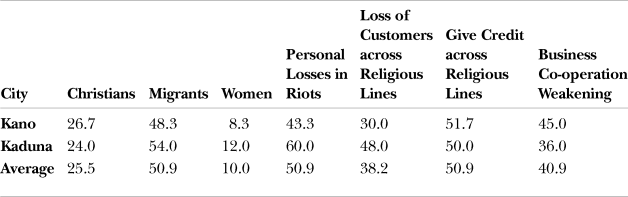
Survey evidence confirms the picture of significant interreligious cooperation among the majority of informal actors in all activity categories, even those characterized by competition and value conflicts across religious lines. Table 1 compares the social composition of activities and the effects of religious violence at the city level in Kano and Kaduna. While the shares of Christians, migrants, and women are influenced by the nature of the particular activities selected, there is a clear overrepresentation of migrants in both cities and an underrepresentation of women. Despite the inclusion of a number of activities open to women, religious conflict has been associated with a noticeable incursion of men into the previously female domains of women’s tailoring, pepper soup production, and goat meat selling, partly because operating in conflict-prone settings has intensified social constraints on women’s mobility. Despite fairly similar levels of Christian, migrant, and female participation, the effects of religious conflict are quite different between the two cities. Kaduna shows markedly higher levels of personal losses and loss of customers across the religious divide, reflecting the higher levels of religious polarization and violence in the city and the effect of intensifying religious segregation.
Characteristics of Enterprise Heads and Impact of Religious Conflict in Kano and Kaduna
(Percent of Enterprise Heads)

Source: Fieldwork
These physical risks contrast with the fact that half of operators in both cities still give credit across religious lines—which amounts to a significant majority of those who give credit at all, since motorcycle taxi operators, comprising a full third of respondents, are structurally unable to grant credit. Despite decades of religious violence in both cities, only 40 percent of informal actors feel that interreligious business cooperation is breaking down, confirming interview evidence of ongoing cooperation and economic interdependence. However, the finding that Kaduna operators are less affected by declining interreligious business cooperation seems at odds with higher levels of religious polarization and violence in that city. Contextual and interview evidence suggests that indigeneity is a key driver of a declining sense of business cooperation between religious groups. Kaduna has a lower share of indigenes in informal activities owing to its weaker commercial history. The dominance of informal activities by nonindigenes of the state, Christian as well as Muslim, contributes to a sense of resentment among indigenes, who feel that nonindigenes are dominating economic opportunities, exacerbating feelings of grievance and lack of interreligious cooperation.
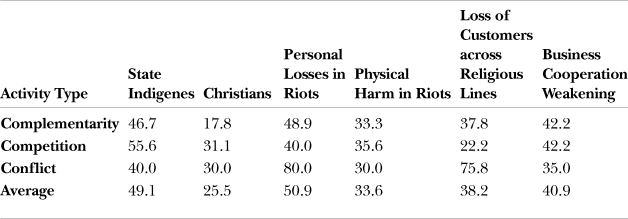
Table 2 shows the relationship between social composition and effects of religious violence in terms of activity categories rather than cities. Relative to the wider population of the state, the distribution of state indigenes across these activities is predictably low, while Christians are overrepresented in Kano and underrepresented in Kaduna—in both cases a source for religious disgruntlement among indigenes. More remarkable, however, is the inverse relationship between harm suffered and the strength of interreligious cooperation. Activities with complementary and competitive relations across the religious divide have suffered relatively comparable levels of business losses and physical harm to themselves and loved ones, and both show a comparable 42 percent concern about weakening interreligious business cooperation. However, activities experiencing value conflicts across the religious divide show by far the highest level of business losses and interreligious customer loss, but the lowest sense of weakening interreligious business cooperation. This indicates a lack of correlation between the intensity of personal experiences of violence and the unraveling of collaborative interreligious commitments. While some unraveling of these informal economic networks is clearly occurring, particularly in Kaduna, the intervening roles of informal institutions, familiarity, and mutual dependence ensure that it is neither extensive nor inevitable despite high and prolonged exposure to religious violence.
Comparison of Activity Types by Religious Interaction
(Percent of Enterprise Heads)
Source: Fieldwork
The remarkable resilience of interreligious cooperation despite religious polarization, economic competition, value conflicts, and harm suffered during religious violence gives one pause for thought. Both interview evidence and survey evidence show that religious conflict is not perceived by the majority of informal actors to be their central problem. When asked to list their three most serious challenges, religious conflict was selected as one of the top three by 62 percent of respondents, coming in second behind lack of capital for the majority. Disaggregating between Kano and Kaduna, religious conflict still came in second overall in both cities, though many ranked it third or lower. Informal actors in all activities tend to perceive religious conflict as a result of economic exclusion and political mobilization from above, rather than as something arising from social tensions internal to the informal economy. Indeed, some suggested that the government should consult informal economic actors on how to resolve religious tensions, since they have found ways to work together despite problems of conflict in the wider society.
Conclusion
The case of northern Nigeria highlights the challenges of inclusive approaches to informal economies in the context of divided societies. Three key observations stand out. The first is that economic inclusion has been driven more from below than from above. Second, the ability to foster inclusive economic relations from below is not a product of popular agency per se, but of the specific informal institutional repertoire of a particular locality. Third, formal sector efforts to incorporate the informal economy through associational linkages and taxation have tended to exacerbate social division and economic exclusion owing to opportunistic and inequitable patterns of inclusion.
In northern Nigeria, economic organization from below has played a crucial role in bridging religious divides and reactivating some sort of social contract. Initiatives to form associations, negotiate taxation, and connect with the state have often emerged from within the informal economy. In Kano these informal initiatives often involve religiously specialized networks and institutions, while in Kaduna religiously mixed associations are more common. Yet both types of informal economic organization have shown a remarkable capacity for inclusive organization and resilient interreligious relations in the face of mounting conflict in the wider society.
This connects with the second observation that the capacity of informal economies to foster inclusive religious and state–society relations does not arise from popular agency or the logic of the market as such, but from the nature of informal institutions in specific historical and regional contexts. Indeed, free market reforms have played a crucial role in creating the poverty and unemployment that are key drivers of religious conflict. The inclusive role of the informal economy is not a product of liberalization, but of embedded informal institutions. Institutionalized commercial arrangements such as interreligious credit systems, active informal associations, and mechanisms of conflict resolution do not simply spring into being when two groups come together in the market; they evolve over years and even centuries of commercial relations across ethnoreligious lines. Differing commercial histories make such informal commercial institutions more widespread in Kano than in Kaduna, and more widespread in West Africa, with its precolonial trading networks and more laissez-faire colonial states, than in central or southern Africa, where concession economies and labor reserves brutally suppressed indigenous business systems (Mkandawire Reference Mkandawire2010).
A final observation is that in Nigeria, initiatives from above to incorporate the informal economy have tended to exacerbate rather than to mitigate conflict and economic exclusion. In Kano, levers of public accountability are based more on identity and patronage than on fiscal relations and citizenship, with the result that among many informal actors those who pay the most tax have the least political voice. In Kaduna, more equitable taxation and religiously mixed informal activities are undercut by greater politicization of associations, making them equally vulnerable to divisive political mobilization and declining grassroots legitimacy. Yet as commentators on other divided societies have shown, the state can also act to diffuse conflict and promote inclusion by shoring up interreligious relations in civil society, restraining divisive political behavior, and using redistributive taxation to build social consensus. While dynamic informal economies can be part of the solution, equitable engagement on the part of the state is crucial. Inclusive efforts by trade unions may offer a way forward, but they are not without their own divisive potential. Ultimately, inclusive governance is not about whether the state engages with the informal economy, but on what terms it does so.
Acknowledgments
This article represents reflections on research conducted for the Nigeria Research Network (NRN) at the University of Oxford. I am grateful to the NRN and to the Islam Research Programme-Abuja and the Ministry of Foreign Affairs of the Kingdom of the Netherlands for the funding that made this research possible. I am also indebted to three anonymous reviewers for their helpful comments.