Creativity is a vital means by which organizations achieve innovation and obtain sustainable competitive advantages (Acar, Tarakci, & van Knippenberg, Reference Acar, Tarakci and van Knippenberg2019; Mehmood, Jian, Akram, & Tariq, Reference Mehmood, Jian, Akram and Tariq2021). Accumulated research has demonstrated that employee creative behavior, which can be generated by individuals in any job and at any level of an organization, serves as a driver of organizational growth, innovation, and long-term survival (Amabile & Pratt, Reference Amabile and Pratt2016; Liang, van Knippenberg, & Gu, Reference Liang, van Knippenberg and Gu2021). Yet, despite numerous benefits, employees frequently find it difficult to challenge the status-quo and suggest novel ideas due to the risky and effortful attributes of creative behavior (Hughes, Lee, Tian, Newman, & Legood, Reference Hughes, Lee, Tian, Newman and Legood2018). As such, it is imperative that organizations provide adequate resources and situations for individuals to take the necessary risks and engage in such taxing and stressful activity (Mehmood et al., Reference Mehmood, Jian, Akram and Tariq2021). Among various actors, supervisors could be a key actor delivering relevant knowledge or unique skills and knowhow to employees for performing creative tasks (Hughes et al., Reference Hughes, Lee, Tian, Newman and Legood2018; Zhou & Hoever, Reference Zhou and Hoever2014). In particular, supervisor knowledge sharing, which refers to voluntary individual behaviors that involve sharing task-related ideas, information, and suggestions with others (Kim, Cheong, Srivastava, Yoo, & Yun, Reference Kim, Cheong, Srivastava, Yoo and Yun2021), can be assumed to be critical to promote employee creative behavior since it provides resources and fosters creative contexts.
Prior research on creative behavior has indeed examined supervisory behaviors as the potential antecedents of creative behavior such as leadership, supervisory behaviors, or leader-member exchange (LMX) (e.g., Hughes et al., Reference Hughes, Lee, Tian, Newman and Legood2018; Liang, van Knippenberg, & Gu, Reference Liang, van Knippenberg and Gu2021). Although this line of research has contributed to our understanding of creative behavior, this literature is still limited in several ways. First, despite the close link between knowledge and creative behavior (Zhang, Sun, Lin, & Ren, Reference Zhang, Sun, Lin and Ren2020), there has been not much research focusing on knowledge sharing from supervisors as a key driver of employee creative behavior. Supervisors could be a critical provider of knowledge resource to nurture employee creative behavior because they possess necessary expertise and skills pivotal for promoting employee creative behavior (Hughes et al., Reference Hughes, Lee, Tian, Newman and Legood2018; Kim et al., Reference Kim, Cheong, Srivastava, Yoo and Yun2021). Yet, little research has been conducted to investigate the specific source of knowledge sharing and its effect on creative behavior. The creativity literature suggests that individuals with abundant task-applicable knowledge and expertise are likely to develop an in-depth understanding of a given field and thus be able to depart from preexisting cognitive sets, play with ideas, and produce creative ideas (Anderson, Potočnik, & Zhou, Reference Anderson, Potočnik and Zhou2014). Particularly, supervisors could transfer their tacit knowledge, which is rare and inimitable, to their employees through knowledge sharing process (c.f., Nonaka, Reference Nonaka1994). Knowledge has explicit and tacit components, yet it is difficult to transfer tacit knowledge despite of its competitive advantages since it is not easily codified and recorded (Chuang, Jackson, & Jiang, Reference Chuang, Jackson and Jiang2016). From this respect, supervisor knowledge sharing, which entails direct contact between employee–supervisor dyads, may represent a unique way through which the supervisors' tacit knowledge is transferred to employees and enhance their creative behavior. Our study intends to examine directly how supervisors' creativity-specific behavior such as supervisor knowledge sharing facilitates employee creative behavior.
Second, it is meaningful to apply conservation of resources (COR) theory to understand creative behavior since creative behavior requires sufficient resources or raw materials to combine ideas in new ways (Amabile & Pratt, Reference Amabile and Pratt2016). Given that knowledge is regarded as a key resource (Kim & Yun, Reference Kim and Yun2015), supervisor knowledge sharing is likely to provide necessary resources to engage in creative behavior. Moreover, engaging in creative endeavors is inherently a risky pursuit for employees because creative ideas could be turned down in organizations, resulting in occasional failures (Yu & Frenkel, Reference Yu and Frenkel2013). From this respect, employees need to perceive supportive contexts to try creative actions (Anderson, Potočnik, & Zhou, Reference Anderson, Potočnik and Zhou2014). Since knowledge is viewed as a competitive advantage of each individual (Kim et al., Reference Kim, Cheong, Srivastava, Yoo and Yun2021), employees who receive valuable knowledge from their supervisors are likely to perceive that they have adequate resources to engage in creative behavior.
Furthermore, the present research intends to find a mediating mechanism in the relationship between supervisor knowledge sharing and employee creative behavior. Specifically, we propose that supervisor knowledge sharing is likely to increase creative behavior by formulating focal employees' self-efficacy – ‘an individual's belief in one's capability to organize and execute the courses of action required to produce given attainments’ (Bandura, Reference Bandura1997: 3). Understanding the importance of resources in facilitating creative behavior, we explicate how supervisor knowledge sharing contributes to the development of key personal factor, employee self-efficacy, which further enhances creative behavior. Employee self-efficacy is a type of critical personal resource that plays a key role in individuals' adaptability, self-regulation, and work behaviors (Hobfoll, Halbesleben, Neveu, & Westman, Reference Hobfoll, Halbesleben, Neveu and Westman2018). Since creative behavior requires employees to be confident and persistent in the face of obstacles (Gong, Kim, & Liu, Reference Gong, Kim and Liu2020), the current study postulates self-efficacy as a key mediator by which supervisor knowledge sharing stimulates employee creative behavior.
Third, we draw on the work–home resources model (Ten Brummelhuis & Bakker, Reference Ten Brummelhuis and Bakker2012) built from COR theory to explain how work–family conflict could be a boundary condition that reduces the positive effect of supervisor knowledge sharing on creative behavior via self-efficacy. According to the work–home resources model (Ten Brummelhuis & Bakker, Reference Ten Brummelhuis and Bakker2012), work–family conflict as a contextual demand is likely to drain the resources, which diminish the outcomes as a result. Although work–family conflict is one of the most common and important work-related stressors in the current workplace (Masterson, Sugiyama, & Ladge, Reference Masterson, Sugiyama and Ladge2021), there is not much research exploring work–family conflict as a boundary condition of creative behavior process. Thus, applying COR theory as a major framework, it is meaningful to examine work–family conflict as a moderator that limits the positive effect of supervisor knowledge sharing on outcomes.
Moreover, it is meaningful to investigate the interaction of supervisor factor and work–family conflict on outcomes which has demonstrated the inconsistent findings (e.g., Li, McCauley, & Shaffer, Reference Li, McCauley and Shaffer2017). Given creativity and work–family conflict as important issues in these dynamic and competitive business environments, this gap needs much attention and it is critical to investigate how each factor influences each other. Although supervisor knowledge sharing is likely to be pivotal for employees' engagement in creative endeavors (Kim et al., Reference Kim, Cheong, Srivastava, Yoo and Yun2021), its influence is simultaneously contingent upon whether knowledge recipients are able to utilize these contextual resources to the task at hand. For example, employees who exhaust their personal resources in the process of juggling roles in work and family domains are known to display impaired functioning (Reichl, Leiter, & Spinath, Reference Reichl, Leiter and Spinath2014). That is, the extent to which employees' attentional and cognitive resources are deprived due to another stimulus may hinder the effective use of resources such as supervisor knowledge sharing and ultimately undermine creative behavior.
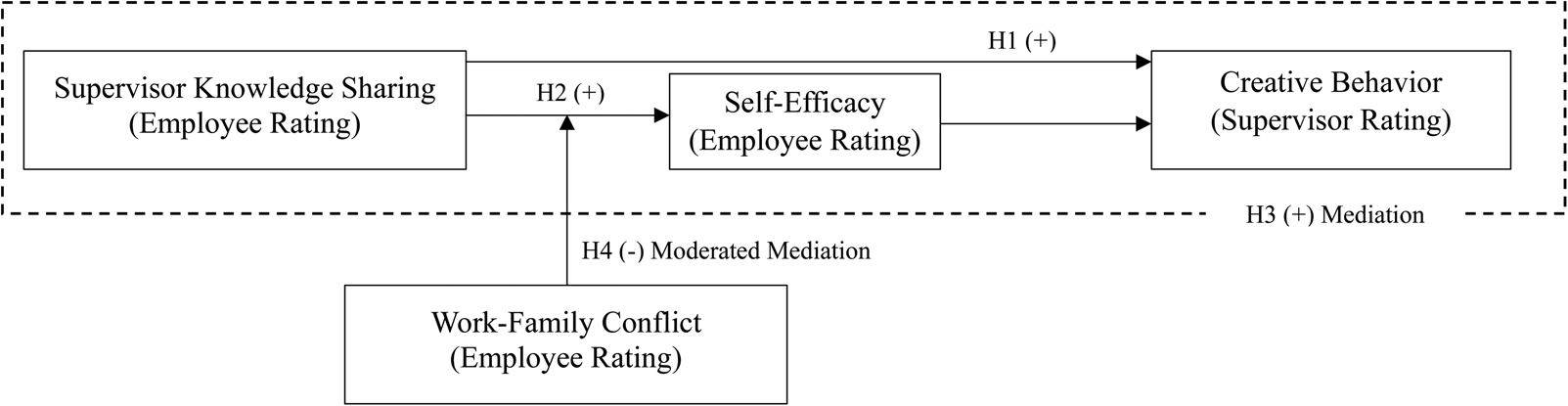
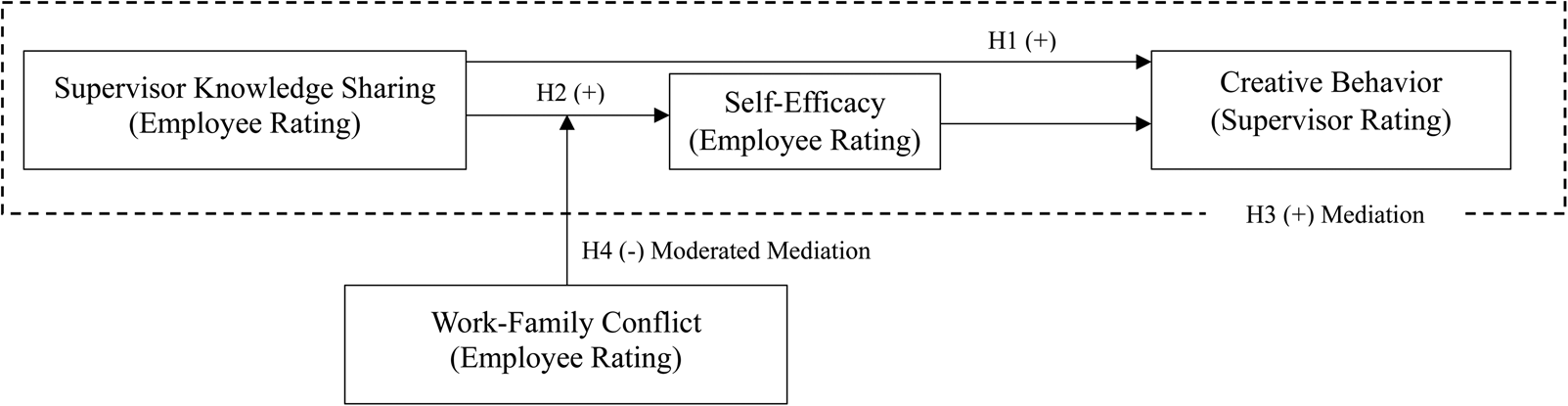
COR theory highlighted the primacy of resource loss, suggesting that ‘resource loss is disproportionally more salient that resource gain’ (Hobfoll, Reference Hobfoll2001: 343). Although supervisor knowledge sharing (i.e., resource gain) is one of the valuable resources to develop employee self-efficacy, work–family conflict (i.e., resource loss) is likely to hamper employees from fully absorbing the benefits. By integrating the work–home resources model utilized from COR theory, we take a further step to explain how work–family conflict as a contextual demand hinders the positive impact of contextual resource (i.e., supervisor knowledge sharing) on creative behavior via personal resource (i.e., self-efficacy). Specifically, we develop a moderated mediation model and propose that the positive indirect linkage between supervisor knowledge sharing and employee creative behavior via self-efficacy is weakened when the level of work–family conflict is high. Figure 1 illustrates our hypothesized model.
Hypothesized theoretical model.
Theoretical overview and hypotheses development
Supervisor knowledge sharing and employee creative behavior
Creative behavior refers to the production of ideas about products, practices, processes, or procedures that are novel and potentially useful to the organization (Amabile & Pratt, Reference Amabile and Pratt2016). Coming up with useful and original ideas demands increased cognitive resources and persistent efforts to fully identify work-related problems and translate novel ideas into viable solutions (Zhang & Bartol, Reference Zhang and Bartol2010). Despite the potential that creativity contributes to future organizational effectiveness, employee creative behavior is particularly vulnerable to disruptions and thus tends to be achieved when employees are provided with supportive and resourceful work contexts (Anderson, Potočnik, & Zhou, Reference Anderson, Potočnik and Zhou2014). Given that supervisors are influential actors who can control resources and changes to procedures, researchers have highlighted that supervisors play a key role in nourishing employee creative behavior by fostering supportive environments (Hughes et al., Reference Hughes, Lee, Tian, Newman and Legood2018; Kim et al., Reference Kim, Cheong, Srivastava, Yoo and Yun2021). Indeed, recent meta-analysis has grouped 13 leadership styles and examined how they are related to creativity (Lee, Legood, Hughes, Tian, Newman, & Knight, Reference Lee, Legood, Hughes, Tian, Newman and Knight2020). Their results demonstrated the strongest relative effects of authentic, empowering, ethical, and LMX on creative behavior. Moreover, previous research has elucidated the positive impacts of specific supervisory behaviors, including supervisory expectations for creative behavior, supervisory developmental feedback, and supervisory benevolence, on creative behavior (e.g., Anderson, Potočnik, & Zhou, Reference Anderson, Potočnik and Zhou2014). Since supervisors occupy higher hierarchy in the organization and frequently interact with other influential actors, they tend to retain a greater breadth of information and strategies that are less available to those in lower hierarchy (Cross & Cummings, Reference Cross and Cummings2004).
According to COR theory (Hobfoll, Reference Hobfoll1989), individuals have a tendency to obtain, conserve, and protect their resources including object resources, personal resources, and energy resources. As knowledge is one of the core energy resources (Hobfoll, Reference Hobfoll1989), employees who acquire valuable knowledge from their supervisor are likely to perceive resources necessary to engage in employees' creative behavior. Knowledge sharing per se is a demanding activity that requires knowledge providers to invest additional efforts and time (Kim, Lee, Park, & Yun, Reference Kim, Lee, Park and Yun2015). It is also a risky endeavor since knowledge providers may end up reducing their competitive advantage by sharing knowledge with others (Kim & Yun, Reference Kim and Yun2015). In this vein, the appreciation, caring, and respect denoted by supervisor knowledge sharing are likely to be a valuable resource that facilitates risk-taking activities such as creative behavior. Previous research suggests that employees under supportive supervisory style are likely to feel obligations and formulate an increased trust, which is positively related to trying out novel ways of doing things and suggesting new ideas (Yu & Frenkel, Reference Yu and Frenkel2013). Thus, based on COR theory, we predict that supervisor knowledge sharing is a creativity-specific form of supervisor resources that enhances employee creative behavior.
Knowledge can be generally classified into tacit and explicit knowledge. Unlike explicit knowledge that is transferrable through noninterpersonal means (e.g., organizational manual, job descriptions), tacit knowledge, which is complex and personal, requires frequent interpersonal interactions (Chuang, Jackson, & Jiang, Reference Chuang, Jackson and Jiang2016). Due to such characteristics, previous research highlighted effective delivery of tacit knowledge as a key to effective performance and competitive advantage (Kim & Yun, Reference Kim and Yun2015). Thus, it is beneficial that supervisors share their knowledge with employees since it gives an opportunity to transfer their tacit knowledge. Moreover, supervisor knowledge sharing is likely to broaden employees' knowledge assets and spark generation of novel ideas. It is also likely to enable employees to weed out creative ideas that are impractical and retain those that are useful and hold potential for validation. That is, when supervisors share their specialized know-how and strategies for problem-solving with their employees, employees can adapt to supervisors' perspective and gain a deeper understanding of which ideas are consensually more useful and promising. Thus, we suggest that employees who have access to knowledge reservoir of their supervisors are likely to achieve high creative behavior due to increased resources based on the COR theory. In sum, we suggest the following:
Hypothesis 1. Supervisor knowledge sharing is positively related to employee creative behavior.
Supervisor knowledge sharing and employee self-efficacy
Self-efficacy, the overall belief about one's capabilities to produce expected attainments, encompasses core characteristics (Bandura, Reference Bandura1997). Previous studies suggest that employee self-efficacy, one of the most studied personal factors, is a malleable self-evaluation that is susceptible to environmental stimuli, rather than a stable or fixed trait (Liao, Liu, & Lio, Reference Liao, Liu and Lio2010; Tierney & Farmer, Reference Tierney and Farmer2011). Specifically, prior research suggests that developmental processes create resource caravans, such that employees in resourceful work environment are likely to increase their beliefs in their capabilities (Sonnentag, Mojza, Demerouti, & Bakker, Reference Sonnentag, Mojza, Demerouti and Bakker2012). For instance, Xanthopoulou, Bakker, Demerouti, and Schaufeli (Reference Xanthopoulou, Bakker, Demerouti and Schaufeli2007) showed that contextual job resources (i.e., autonomy, social support, performance feedback, professional development) activate employee perceptions of generalized self-efficacy. Xanthopoulou, Bakker, Demerouti, and Schaufeli (Reference Xanthopoulou, Bakker, Demerouti and Schaufeli2009) conducted a diary study and found that day-level of specific job resources – autonomy, supervisory coaching, and team climate – had a direct, positive effect on focal employees' day-level general efficacy beliefs. Applying this argument to our study, receipt of tacit knowledge from supervisors may lead focal employees to perceive an elevated sense of resources essential for performing their work tasks, which produces a high level of self-efficacy.
Moreover, considering that knowledge is a source of competitive advantage and status in the workplace, it could be costly to individuals who share their knowledge (Kim et al., Reference Kim, Cheong, Srivastava, Yoo and Yun2021). Supervisor knowledge sharing behavior is regarded as prosocial behavior that is beneficial to knowledge recipients (Kim et al., Reference Kim, Cheong, Srivastava, Yoo and Yun2021). Thus, knowledge sharing from supervisor is likely to result in an elevated sense of emotional support or trust availability among recipient employees as well as reduce uncertainty and anxiety that may erode self-efficacy development (Liao, Liu, & Lio, Reference Liao, Liu and Lio2010). According to the COR theory, individuals who possess more resources are in a better position to acquire new resources (Hobfoll et al., Reference Hobfoll, Halbesleben, Neveu and Westman2018). Hobfoll (Reference Hobfoll2002) argues that supportive contexts could create ‘resource caravans’ which implies that resources may come in packs. Thus, the present study predicts that supervisor knowledge sharing, one of the critical factors that provides necessary resources, is likely to play a key role in formulating employees' personal resources such as self-efficacy. We predict the following:
Hypothesis 2. Supervisor knowledge sharing is positively related to focal employee's self-efficacy.
The mediating effect of self-efficacy
Apart from the direct input effects, supervisor knowledge sharing is likely to promote employee creative behavior by activating employees' self-efficacy. Previous research suggests that self-efficacy serves as the internal drive through which individuals translate opportunities stemming from a resourceful environment into work behaviors (Sonnentag et al., Reference Sonnentag, Mojza, Demerouti and Bakker2012). Specifically, recent empirical evidence demonstrates that job resources (i.e., autonomy, social support, performance feedback, and opportunities for professional development) are likely to be positively related to employee creative behavior via activating generalized self-efficacy and resiliency (Bakker & Xanthopoulou, Reference Bakker and Xanthopoulou2013). In a similar vein, employees who receive valuable resources from their supervisors are likely to build a high level of self-efficacy and these efficacious employees, in turn, are likely to overcome the challenging demands of creative behavior. Given that creative behavior requires strenuous mental energy, scholars have highlighted personal factors as a critical component that promotes individual creative behavior (Anderson, Potočnik, & Zhou, Reference Anderson, Potočnik and Zhou2014). Employees with high self-efficacy tend to set and adhere to a challenging goal and persevere in the course of actions, even in the face of adversities or failures (Downes, Crawford, Seibert, Stoverink, & Campbell, Reference Downes, Crawford, Seibert, Stoverink and Campbell2021). Prior research demonstrated that heightened self-efficacy is a sustainable force that drives individuals to initiate and keep performing creative work (Tierney & Farmer, Reference Tierney and Farmer2011).
Furthermore, employees with abundant resources such as self-efficacy are likely to be capable of taking risks since they can better deal with the strain and anxiety associated with it (Downes et al., Reference Downes, Crawford, Seibert, Stoverink and Campbell2021). In support of this rationale, empirical studies found that highly efficacious employees tend to adopt nonconforming perspectives and act without relying on social approval (Liao, Liu, & Lio, Reference Liao, Liu and Lio2010). Moreover, the work–home resources model (Ten Brummelhuis & Bakker, Reference Ten Brummelhuis and Bakker2012) applied from COR theory demonstrates how contextual resources are likely to produce personal resources which in turn lead to positive outcomes. Combining the previous arguments together, we propose that supervisor knowledge sharing as a type of contextual resources contributes to employee creative behavior since it heightens self-efficacy, a key personal resource necessary for individual creative behavior. Thus, we hypothesize the following:
Hypothesis 3. Self-efficacy mediates the positive relationship between supervisor knowledge sharing and employee creative behavior.
The moderating effect of work–family conflict
Work–family conflict commonly refers to ‘a form of inter-role conflict in which the role pressures from the work and family domains are mutually incompatible in some respect’ (Greenhaus & Beutell, Reference Greenhaus and Beutell1985: 77). Work–family conflict has been related to a wide range of deleterious outcomes including reduced job satisfaction, turnover intentions, and organizational commitment as well as heightened burnout and exhaustion (Allen, French, Dumani, & Shockley, Reference Allen, French, Dumani and Shockley2020; Reichl, Leiter, & Spinath, Reference Reichl, Leiter and Spinath2014). Moreover, recent empirical evidence suggests the interaction effects of hindrance stressor such as work–family conflict and supportive contexts on job-related performance (Kim et al., Reference Kim, Lee, Park and Yun2015). For instance, Breevaart and Bakker (Reference Breevaart and Bakker2018) have found the interaction effect of job resource such as daily transformational leadership behavior and family to work conflict on employee work engagement. Additionally, Sonnentag et al. (Reference Sonnentag, Mojza, Demerouti and Bakker2012) demonstrated that a typical hindrance stressor prevents employees from gaining full benefits from morning recovery since such constraints shift employee attention from the task. In line with previous research, this study takes the work–home resources model (Ten Brummelhuis & Bakker, Reference Ten Brummelhuis and Bakker2012) applied from COR theory and proposes that work–family conflict weakens the positive effect of supervisor knowledge sharing on creative behavior through self-efficacy.
According to the work–home resources model (Ten Brummelhuis & Bakker, Reference Ten Brummelhuis and Bakker2012), individuals who suffer from one domain are likely to drain their resources which may result in detrimental impacts in the other domain. From this respect, when employees experience resource loss caused by work–family conflict, the positive effect of resourceful work environment (i.e., supervisor knowledge sharing) is likely to be attenuated which leads to a lower level of creative behavior via reduced self-efficacy. More specifically, employees reporting a high level of work–family conflict are less likely to make an effective use of task-relevant knowledge and information since off-task demands hinder individuals from being fully immersed in work processes. Work–family conflict, a work-related stressor, is a distracting stimulus that draws employees' attention to accommodating incompatible work and family demands (Masterson, Sugiyama, & Ladge, Reference Masterson, Sugiyama and Ladge2021). Research on attentional conflict (Sanders & Baron, Reference Sanders and Baron1975) indicates that distracting stimuli such as work–family conflict have deleterious effects on employees' success in job performance, particularly those in complex tasks such as creative behavior. Given that attention is a limited resource, this distraction consumes attentional resources that employees otherwise can allocate toward their work tasks (Chen, Jiang, Tang, & Cooke, Reference Chen, Jiang, Tang and Cooke2018).
COR theory suggests that the impact of resource loss is greater than that of resource gain (Hobfoll, Reference Hobfoll2001). Individuals suffer from stress when their central or key resources are lost or threatened with loss (Hobfoll et al., Reference Hobfoll, Halbesleben, Neveu and Westman2018). Taken all, employees suffering from high work–family conflict are likely to be skeptical of their ability to mobilize the relevant resources to adequately meet situational demands (i.e., reduced self-efficacy), ultimately displaying lower level of creative behavior.
On the other hand, employees experiencing low work–family conflict may not experience resource loss or distractions stemming from work–family conflict. By fully directing their concentration and attention toward their tasks, these employees are likely to fully use and apply the resources received from their supervisor and feel confident that they can successfully manage given tasks. Accordingly, these employees are likely to gain maximum benefits from supervisor knowledge sharing and perform creative behavior via heightened self-efficacy. Thus, we suggest the following moderated mediation hypothesis based on the work–home resources model:
Hypothesis 4. Work–family conflict moderates the strength of the relationship between supervisor knowledge sharing and employee creative behavior via self-efficacy, such that the mediated relationship is weaker when work–family conflict is high rather than when it is low.
Method
Data and sample
Survey data were collected from employee–supervisor dyads recruited by MBA students at a large, public university in the Republic of Korea. Students were asked to identify unique employee–supervisor dyads (up to two) to participate in this study in exchange for course credit. To be eligible to participate, focal employees had to be working full time and have an immediate supervisor who was willing to participate in the study with them. We prepared a survey packet with two types of questionnaires, which included one for the employees and the other for their immediate supervisors. We assigned an identification number to each survey to ensure anonymity and match the dyads afterward. To maintain confidentiality of responses, participants were asked to deliver completed questionnaires in sealed envelopes. As one supervisor completed the questionnaire for only one employee, the observations were not nested. The industry sectors were primarily comprised of manufacturing, finance, and commerce industries. Furthermore, students unable to recruit eligible participants were given the option to complete an alternative assignment for same credit.
Survey packets were initially distributed to 194 employee–supervisor dyads. Of these, 153 pairs were returned, yielding a response rate of 78.9%. We matched each employee–supervisor dyad and eliminated questionnaires of which responses were incomplete. As a result, a final sample of 147 employee–supervisor dyads was used for analyses. In terms of employees' demographics, 68.7% were male, with the average age of 34.88 years (SD = 6.00). The most frequently mentioned level of education for employees (73.3%) was university. As for supervisors, 81.0% were male and their average age was 44.37 years (SD = 6.80).
Measures
All English scales used were translated into Korean following the conventional method of translation and back-translation method (Brislin, Reference Brislin, Triandis and Berry1980). Specifically, two Korean bilingual academics individually translated the measures into Korean and back-translated them again to ensure semantic equivalence. They compared their translation and found no major discrepancies in the meaning of survey items. The focal employees responded on supervisor knowledge sharing, self-efficacy, and work–family conflict. To avoid potential problems related to common method bias, supervisors were asked to evaluate the focal employees' creative behavior. All items were measured on a 7-point Likert scale ranging from ‘strongly disagree’ (1) to ‘strongly agree’ (7).
Supervisor knowledge sharing
Seven items were adopted from Srivastava, Bartol, and Locke (Reference Srivastava, Bartol and Locke2006) to measure knowledge sharing. We changed the subject from ‘managers in our team’ to ‘my supervisor’ (α = .94). A sample item reads, ‘My supervisor shares special knowledge and expertise with me.’
Self-efficacy
Eight items developed and validated by Chen, Gully, and Eden (Reference Chen, Gully and Eden2001) were used to assess employee perceptions of general self-efficacy (α = .95). An illustrative item is ‘When facing difficult tasks, I am certain that I will accomplish them.’
Work–family conflict
Netemeyer, Boles, and McMurrian's (Reference Netemeyer, Boles and McMurrian1996) 10-item scale (α = .96) was used to measure work–family conflict. Sample items include ‘The demands of my work interfere with my home and my family life’ and ‘Family-related strain interferes with my ability to perform job-related duties.’
Creative behavior
Thirteen items proposed by Zhou and George (Reference Zhou and George2001), including ‘The employee comes up with new and practical ideas to improve performance,’ were employed to measure focal employees' creative behavior. Supervisors were asked to rate the focal employee regarding these 13 items (α = .97).
Control variables
Consistent with the creativity literature, gender and education were used as a control variable (e.g., Zhang & Bartol, Reference Zhang and Bartol2010). Furthermore, we controlled for marital status, which is known to be closely related with work–family conflict (e.g., Dahm, Glomb, Manchester, & Leroy, Reference Dahm, Glomb, Manchester and Leroy2015; Kim et al., Reference Kim, Lee, Park and Yun2015). Following previous research that hierarchical level is related to creative activities (e.g., Malik, Choi, & Butt, Reference Malik, Choi and Butt2019), we also controlled for positionFootnote 1. Also, given that similarity in demographic variables such as gender plays a critical role in performance evaluations of supervisors (Turban & Jones, Reference Turban and Jones1988), we also controlled for supervisor gender.
Results
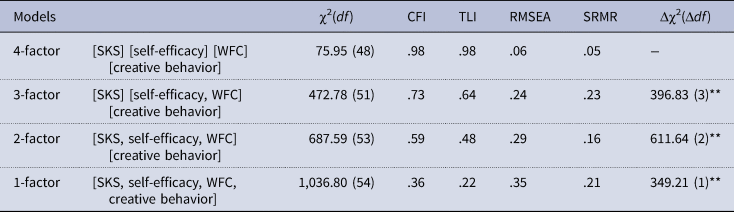
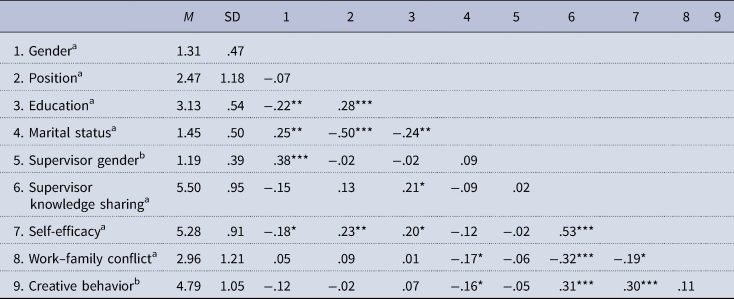
Before proceeding with our analysis, we conducted a confirmatory factor analysis (CFA) on our key variables. Given the relatively large number of estimated parameters relative to our sample size, we followed Hall, Snell, and Foust's (Reference Hall, Snell and Foust1999) recommendation to use an item-parceling approach for constructs with seven or more items. Specifically, Hall, Snell, and Foust (Reference Hall, Snell and Foust1999) recommended conducting an exploratory factor analysis for each construct and to force the extraction of the same number of factors (i.e., three) as the planned number of parcels. Next, parcels are created by grouping the highest loading items on the extracted factors. The CFA results demonstrated that the four-factor model adequately fit the data (χ2 (48) = 75.95, p < .05, CFI = .98, RMSEA = .06, SRMR = .05). To further ensure that the model fit is robust to the specific item groupings, we ran five additional CFAs – each time randomly assigning the items for each construct to parcels and the results remained comparable. As shown in Table 1, all alternative models had significantly worse fit than our hypothesized model, providing evidence that our constructs were appropriately modeled. Thus, we proceeded to test our main hypotheses. Table 2 presents means, standard deviations, and correlations for all variables.
Results of measurement model c6omparisons
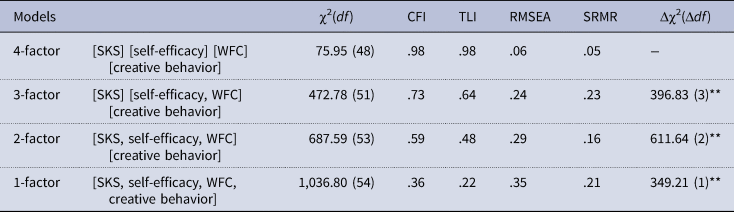
Note. The χ2 difference for each model reflects its deviation from the four-factor model.
SKS, supervisor knowledge sharing; WFC, work–family conflict. **p < .01.
Means, standard deviations, and correlations
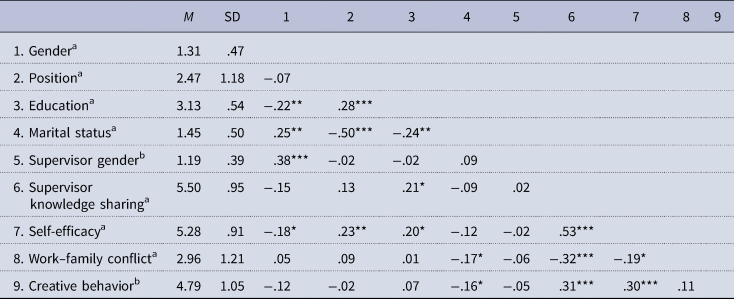
Note. N = 147.
a Self-rated.
b Supervisor-rated.
Gender: 1 = male, 2 = female. Position: 1 = entry level to 6 = executive. Education: 1 = high school to 4 = Master's degree or higher. Marital status: 1 = married, 2 = not married.
*p < .05; **p < .01; ***p < .001 (two-tailed).
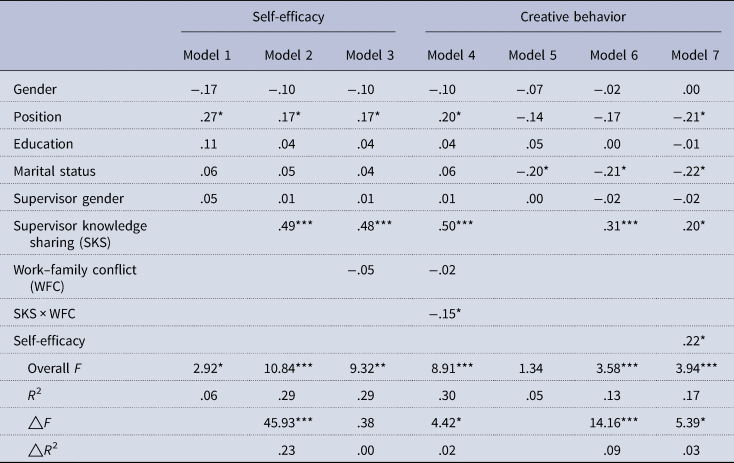
Table 3 presents the results of hierarchical regression analyses with self-efficacy and creative behavior as dependent variables. Supervisor knowledge sharing showed a positive relationship with both employee creative behavior (β = .31, p < .001, model 6) and self-efficacy (β = .49, p < .001, model 2). Thus, both Hypotheses 1 and 2 were supported.
Hierarchical regression results for moderation and mediationa
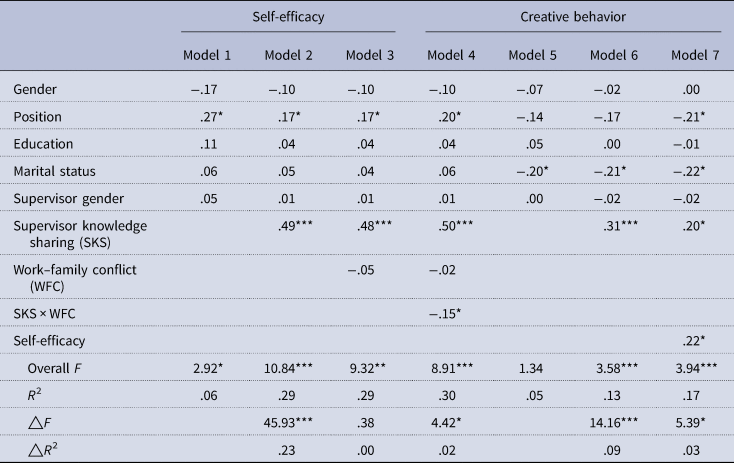
Note. N = 147.
a Entries indicate standardized regression coefficients.
*p < .05; **p < .01; ***p < .001 (two-tailed).
Hypothesis 3 proposed that self-efficacy mediates the positive association between supervisor knowledge sharing and employee creative behavior. We employed the bootstrapping approach to test the significance of indirect effects. The PROCESS analyses showed that the indirect effect of supervisor knowledge sharing on employee creative behavior via self-efficacy is positive (indirect effect = .12, SE = .05, 95% CI [.02–.23]), supporting Hypothesis 3.
Hypothesis 4 proposed that the positive relationship between supervisor knowledge sharing and employee creative behavior via self-efficacy would be weakened when work–family conflict is high. The results (model 4, Table 3) show that the interaction term of supervisor knowledge sharing and work–family conflict on self-efficacy was significant (β = −.15, p < .05, model 4). Simple slope analyses showed that supervisor knowledge sharing was positively related to self-efficacy when work–family conflict is low (b = .62, t = 5.76, p < .001) and this relationship was weaker when work–family conflict is high (b = .34, t = 4.08, p < .001). Next, to validate the moderated mediation relationship, we examined the conditional indirect effect of supervisor knowledge sharing on creative behavior via self-efficacy at two different values of work–family conflict (Preacher, Rucker, & Hayes, Reference Preacher, Rucker and Hayes2007). As shown in Table 4, conditional indirect effects were stronger and significant in low work–family conflict (conditional indirect effect = .16, 95% CI [.02–.33]), whereas weaker in high work–family conflict (conditional indirect effect = .09, 95% CI [.01–.19]). Accordingly, Hypothesis 4 received support.
Moderated mediation results

Note. N = 147.
Bootstrap sample size = 10,000.
Discussion
Our primary objective of this study was to unveil under what conditions supervisor knowledge sharing promotes employees' creative behavior based on the COR theory. Recognizing knowledge as a valuable resource pivotal for creative process, we proposed that supervisor knowledge sharing as a type of contextual resources that nurtures employee creative behavior via increasing employees' key resources such as self-efficacy. Moreover, this study investigated the boundary condition of work–family conflict in the relationship between supervisor knowledge sharing and employee creative behavior via self-efficacy. Drawing on the work–home resources model (Ten Brummelhuis & Bakker, Reference Ten Brummelhuis and Bakker2012), our results revealed that the positive impacts of supervisor knowledge sharing on creative behavior via self-efficacy are less prominent when the focal employees experience a high level of work–family conflict.
Theoretical implications
Our findings generate several theoretical contributions. First, the current study contributes to the creative behavior literature by employing COR theory as a predominant theoretical lens. Considering that employees should hold ample amount of resources to undertake creative actions, previous studies have revealed a positive link between various resources and employee creative behavior (Anderson, Potočnik, & Zhou, Reference Anderson, Potočnik and Zhou2014). For example, prior research found that perceived organizational support significantly enhanced recipients' creative behavior (Yu & Frenkel, Reference Yu and Frenkel2013). In addition, Zhang, Jex, Peng, and Wang (Reference Zhang, Jex, Peng and Wang2017) found that job autonomy serves as an important job resource that promotes work engagement and creative behavior. Zhang, Ke, Frank Wang, and Liu (Reference Zhang, Ke, Frank Wang and Liu2018) have noted the importance of resource and information to enhance creative behavior and found the mechanisms of access to resources in the relationship between empowering leadership and employee creative behavior. The current study aimed to deepen our understanding of under what conditions employees are likely to exhibit creative behavior based on the COR theory. Recognizing knowledge and expertise as raw material essential for creative outputs, this study conceptualized how supervisor knowledge sharing cultivates employee creative behavior via self-efficacy by providing necessary resources. Our findings indicate that individuals who have received unique resources from their supervisors are likely to accumulate personal resources such as self-efficacy, which leads them to achieve a high level of creative behavior as a result.
Moreover, our research further supports the creativity research stream that has highlighted a simultaneous consideration of actor and context (Zhou & Hoever, Reference Zhou and Hoever2014). Specifically, this study is in line with previous empirical studies that examined the interaction effects of supervisory behavior and personal factor. For instance, Wang and Cheng (Reference Wang and Cheng2010) demonstrated that the positive effect of benevolent leadership on follower creativity is to strengthen when creative role identity is high. Kim (Reference Kim2019) noted the interaction effect of empowering leadership and proactive personality on creativity. In this research, our results demonstrated how work–family conflict reduces the positive impacts of supervisor knowledge sharing on employee creative behavior by depleting employees' personal resources such as self-efficacy. Extending from our research, future studies can explore other interplay patterns that may predict the level of creative behavior. Given the interconnectedness of work–life domain in today's business environments, it could be beneficial to investigate how work contexts and nonwork factors (e.g., family, friends) may jointly influence employee creative behavior.
Second, our study extends knowledge sharing literature by empirically testing the direct effect of knowledge sharing from supervisors on creative behavior. Traditionally, most studies on knowledge sharing have focused on searching for factors that predict the level of knowledge sharing (e.g., Kim et al., Reference Kim, Lee, Park and Yun2015). Prior research found trust, justice, leadership, and perceived benefits as predictors of knowledge sharing (Wang & Noe, Reference Wang and Noe2010). However, few studies have investigated the effect of knowledge sharing at the individual level (Kim et al., Reference Kim, Cheong, Srivastava, Yoo and Yun2021). Furthermore, the extent to which knowledge sharing at the individual level leads to enhanced employee creative behavior remains mixed to date. For instance, Madjar (Reference Madjar2008) found that receipt of knowledge and informational resources from primary work unit significantly elevated employee creative behavior. On the contrary, Gong, Cheung, Wang, and Huang (Reference Gong, Cheung, Wang and Huang2012) reported that knowledge sharing with individuals outside and inside one's unit within the organization had no direct effect on creative behavior. In the present study, recognizing the salient value of knowledge sharing by providing resources and fostering creative contexts, we delved into the effects of supervisor knowledge sharing on self-efficacy and creative behavior based on COR theory. Extending from our current research, an important avenue for future studies would be to differentiate diverse sources of knowledge sharing in the workplace and examine their unique outcomes such as proactive behavior. Since coworkers are another major actor in today's work environment, it might be interesting to explore how and when knowledge sharing from coworkers may promote employee outcomes in future research.
Third, the present study highlights the critical role of supervisors in cultivating employee creative behavior. Given that supervisors occupy a visible and powerful position to influence employee creative behavior, numerous studies investigated the relationship between leadership and employee creativity (e.g., Hughes et al., Reference Hughes, Lee, Tian, Newman and Legood2018). Recent meta-analysis (Lee et al., Reference Lee, Legood, Hughes, Tian, Newman and Knight2020) has shown that authentic, empowering, and entrepreneurial leadership exhibited the strongest relationships with creativity compared to other leadership styles. In a meta-analysis, Chiaburu, Lorinkova, and Van Dyne (Reference Chiaburu, Lorinkova and Van Dyne2013) emphasized the strong impact of specific forms of leader support – in the form of resources – is essential to cultivate creative behavior via stimulating employee attitudes and behaviors relevant for challenging the status quo. In line with previous research, this study examined supervisor knowledge sharing as a creativity-specific form of supervisor support that promotes employee creative behavior. It might be worthwhile for future research to explore other types of specific supervisory behaviors that may have substantial impacts on employee creative behavior. For instance, supervisor boundary spanning behavior could be beneficial to enhance employee creative behavior since such behavior actively connects employees with critical external actors and provides a wide range of novel resources.
Lastly, this study contributes to the existing literature on work–home interface by providing insights on how work–family conflict interferes with employees' work process drawing from the work–home resources model. Given the increasing number of employees suffering from work–family conflict in today's business environment, accumulated research has focused on identifying the direct, negative effects of work–family conflict on various employee outcomes (Allen et al., Reference Allen, French, Dumani and Shockley2020). A majority of previous studies have investigated how juggling between work and life domains directly impedes employees' participation at work. For instance, Dahm et al. (Reference Dahm, Glomb, Manchester and Leroy2015) demonstrated that work-to-family conflict leads employees to allocate less time on work tasks that are complex or entail longer-term goals. However, the interaction of supervisor factor and work–family conflict on outcomes has shown inconsistent results (e.g., Li, McCauley, & Shaffer, Reference Li, McCauley and Shaffer2017). For example, the interaction of leader support and work–family conflict on employee well-being was significant (Lizano, Hsiao, Mor Barak, & Casper, Reference Lizano, Hsiao, Mor Barak and Casper2014), but the interaction on employee sleep quality and quantity was not significant (Crain et al., Reference Crain, Hammer, Bodner, Kossek, Moen, Lilienthal and Buxton2014). Complementing this line of research, we applied the work–home resources model (Ten Brummelhuis & Bakker, Reference Ten Brummelhuis and Bakker2012) and explored how work–family conflict could be a barrier limiting the effect of contextual resource (i.e., supervisor knowledge sharing) on creative behavior via personal resource (i.e., self-efficacy). Prior research has noted how homesickness limited the positive relationships between job resources and outcomes such as task performance and safety behavior (Du, Derks, Bakker, & Lu, Reference Du, Derks, Bakker and Lu2018). Moreover, our research is meaningful in that it is the first study to investigate how work–family conflict could attenuate the positive, indirect effects of supervisor knowledge sharing through the depletion of cognitive and attentional resources, and thus reduce employee creative behavior. We strongly recommend future studies to explore how work–family conflict may reduce the positive impacts of other types of resources on employee outcomes.
Practical implications
Our findings also offer important practical implications. First, the current investigation emphasizes supervisor knowledge sharing as an important contextual factor that influences focal employees' self-efficacy and subsequent creative behavior. In this regard, organizations may encourage supervisors to engage in knowledge sharing behavior toward employees to promote creative behavior. For instance, supervisors may need to play a role as a coach or mentor to their followers by offering specialized knowledge and skills. By serving as a coach or mentor, supervisors can help their employees develop capabilities and enhance creative behavior. At the same time, organizations should also create supportive contexts to encourage supervisors to share their know-how and expertise with employees. Knowledge sharing is a resource-demanding behavior for knowledge providers since they need to allocate extra time and efforts to share their knowledge and make it understandable to the employees (Kim et al., Reference Kim, Lee, Park and Yun2015). Accordingly, organizations should exert efforts to create favorable work environments where supervisors can hold a sufficient amount of energy and motivation to engage in knowledge sharing.
Second, given the negative influences of work–family conflict, an important element of fostering employee creative behavior could be helping employees successfully manage work–family dynamics. One way to do this is to implement support programs, such as flexible scheduling arrangements and mentoring programs, as ways to reduce work–family conflict and subsequent strain symptoms (Reichl, Leiter, & Spinath, Reference Reichl, Leiter and Spinath2014). For example, mentoring programs may provide employees with implicit knowledge about effective management of work–family interface and ways to cope with daily hassles. Therefore, it would be meaningful for human resource managers to consider these tools to help their organizational members juggle the complex demands of families and work.
Limitations and future research directions
The current study has a set of limitations. First, our cross-sectional research design precludes any causal argument (Cook & Campbell, Reference Cook and Campbell1979). Although the chance of a reverse causal relationship is unlikely, it would be beneficial to use longitudinal study designs in future research to establish the causal association between supervisor knowledge sharing and employee creative behavior. Also, it would be worthwhile to include additional control variables to find the true effect of our variables. Given its close relationship, it would be beneficial to consider creative ability and transformational leadership as additional control variables in future research. Second, common method bias might be a concern. To reduce this potential problem, we collected data from two different sources, particularly by employing supervisors' responses to measure employees' creative behavior. Furthermore, it is less likely that interaction effects are influenced by common method bias (Evans, Reference Evans1985). Despite this precaution, it would be still meaningful to take a more careful approach in the future research to avoid this problem. Third, because we tested our proposed relationships in the Republic of Korea, the findings may not be generalized across cultures. Although we took means to ensure semantic equivalence among original English items and translated Korean items (Brislin, Reference Brislin, Triandis and Berry1980), it is possible that cultural differences had an influence on the relationships tested. We thus encourage future research to test generalizability of our findings across cultures. Fourth, given our focus on individual-level relationships, our study did not include the impact of team-level constructs. Considering that individuals are each nested in a team, it is possible that the effect of supervisor knowledge sharing might be influenced by factors such as psychological safety or team knowledge sharing. Although we tried to mitigate this issue and collected data from dyads that were uniquely matched to one another, it would be interesting for future research to further consider the role of larger context in facilitating individual creative behavior. Last, the present research included only a limited number of variables. It would be worthwhile to examine the specific mechanism in the COR process. For example, future research should investigate how supervisor knowledge sharing is positively related to a resource gain or how employees experiencing work–family conflict perceive a resource loss. Our focus on work–family conflict as the boundary condition neglects other contextual factors that may alter the association between supervisor knowledge sharing and creative behavior. For instance, the strength of the aforementioned relationship could vary according to the level of burnout, group conflict, or perceived organizational politics.
Despite some limitations, the current study attempted to advance our understanding of creativity drawing on insights from COR theory. Specifically, to demonstrate how and when employees are more likely to achieve creative behavior, we selected factors pertinent to employee reservoir of resources. The present research identified supervisor knowledge sharing as an importance predictor of employee creative behavior via enhanced self-efficacy, with work–family conflict as the critical boundary condition. Taken together, this study highlights that employees may enhance their creative behavior when they hold sufficient resources. We hope that future research continues to pursue this line of research to enhance our understanding of employee creative behavior.