Introduction
Diorygma (Eschweiler Reference Eschweiler1824; Graphidaceae) is characterized by an ecorticate or pseudocorticate thallus, lirellate ascomata with a pruinose disc, an uncarbonized to sometimes carbonized, narrow exciple, a non-inspersed, typically I+ blue hymenium, laterally branched and often anastomosing paraphyses, 1–8-spored asci, and transversely septate to mostly muriform ascospores. The most common secondary compounds include norstictic, stictic and/or protocetraric acid (Kalb et al. Reference Kalb, Staiger and Elix2004; Feuerstein et al. Reference Feuerstein, Cunha-Dias, Aptroot, Eliasaro and Cáceres2014). The genus is mainly tropical to subtropical in distribution (Staiger Reference Staiger2002; Kalb et al. Reference Kalb, Staiger and Elix2004), and c. 42 species have been reported from India (Kalb et al. Reference Kalb, Staiger and Elix2004; Archer Reference Archer2006, Reference Archer2007; Cáceres Reference Cáceres2007; Archer & Elix Reference Archer and Elix2008; Makhija et al. Reference Makhija, Chitale and Sharma2009; Sharma & Makhija Reference Sharma and Makhija2009a, Reference Sharma and Makhijab; Tripp et al. Reference Tripp, Lendemer and Harris2010; Sharma & Khadilkar Reference Sharma and Khadilkar2012; Mohabe et al. Reference Mohabe, Nayaka, Reddy and Devi2015; Rashmi & Rajkumar Reference Rashmi and Rajkumar2015; Singh et al. Reference Singh, Singh and Bhatt2015; Singh & Singh Reference Singh and Singh2015, Reference Singh and Singh2017, Reference Singh and Singh2020; Sinha et al. Reference Sinha, Nayaka and Joseph2018; Nayaka et al. Reference Nayaka, Mishra and Upreti2019; Behera & Nayaka Reference Behera and Nayaka2020; Gupta et al. Reference Gupta, Randive, Nayaka, Daimari, Joseph and Janarthanam2020; Behera et al. Reference Behera, Nayaka, Upreti and Chauhan2021; Swarnalatha Reference Swarnalatha2021). A recent revision of the family Graphidaceae (Rivas Plata et al. Reference Rivas, Parnmen, Staiger, Mangold, Frisch, Weerakoon, Hernández, Cáceres, Kalb and Sipman2013) also showed that the genera Diorygma and Thalloloma are not mutually monophyletic, and this genus complex requires further study.
Materials and Methods
Sample collection
Surveys were conducted to collect Diorygma species in the Tamhini village (18°27ʹ14ʺN, 73°26ʹ04ʺE) and Thoseghar area (17°36ʹ35ʺN, 73°52ʹ147ʺE) during 2021, and 16 fresh specimens were collected. Minimalistic sampling approaches were followed to preserve the in situ diversity of the lichens. The samples were allowed to air dry and were stored in brown paper packs for further morpho-chemical studies. For molecular studies, fresh thalli were kept at 4 °C after returning to the laboratory to avoid cross-contamination from fast-growing saprotrophic fungi.
Morphology and chemical analyses
Thallus morphology of all the samples was first studied using a stereomicroscope (Olympus SZX16 with digital camera; Olympus Corporation, Japan). Hand sections through lirellae were made using a razor blade and mounted in lactic acid (with gentle heating over a flame), 10% KOH (K), water or Lugol's iodine (I); for microscopy, ascomata sections pretreated with 10% KOH were mounted in Lugol's iodine (KI). Microscopic observations were made using a Carl Zeiss Axio Imager A2 (Zeiss, Germany). Key morphological characteristics were assessed for value in species-level identification using those employed in pertinent taxonomic works (Kalb et al. Reference Kalb, Staiger and Elix2004; Archer Reference Archer2006, Reference Archer2007; Archer & Elix Reference Archer and Elix2008; Makhija et al. Reference Makhija, Chitale and Sharma2009; Sharma & Makhija Reference Sharma and Makhija2009a, Reference Sharma and Makhijab). Chemical profiles were studied using thin-layer chromatography (TLC) following standard protocols (Orange et al. Reference Orange, James and White2001), with the solvent systems toluene-dioxane-acetic acid (TDA, 180: 45: 5) and toluene-ethyl acetate-formic acid (TEF, 139: 83: 8). All collected and examined specimens are deposited in the Ajrekar Mycological Herbarium, Agharkar Research Institute, Pune, India (AMH).
DNA isolation, polymerase chain reaction and sequencing
After preliminary morphological studies, five representative specimens (different morphogroups) were selected for molecular analysis. DNA was isolated and PCR carried out using the Sigma REDExtract-N-AmpTM Seed PCR Kit, following the manufacturer's instructions, in a thermocycler ProFlexTM PCR system (Applied Biosystems, Foster City, USA). Primers used for amplification were: i) mrSSU1 and mrSSU3R for the mtSSU marker (Zoller et al. Reference Zoller, Scheidegger and Sperisen1999); ii) AL2R (Mangold et al. Reference Mangold, Martín, Lücking and Lumbsch2008) and LR6 (Vilgalys & Hester Reference Vilgalys and Hester1990) for the LSU marker; iii) GD1-RPB2-7cF and GD-RPB2-11aR (Kraichak et al. Reference Kraichak, Lücking, Aptroot, Beck, Dornes, John, Lendemer, Nelsen, Neuwirth and Nutakki2015) for the RPB2 marker. Thermal cycling parameters used for amplification were: initial denaturation at 95 °C for 5 min, followed by 30 cycles at 94 °C for 1 min and 35 cycles at 50 °C for 1 min (mtSSU), 35 cycles at 58 °C for 1 min (LSU), 35 cycles for 1 min from 57 °C to 72 °C, with an increase of 1 °C per cycle for 37 cycles (RPB2), and a final extension at 72 °C for 10 min. The PCR products were purified with FavorPrep PCR Purification Kit (Favorgen Biotech Corp., Ping-Tung, Taiwan) and sequenced with the same primers using the BigDye Terminator v. 3.1 Cycle Sequencing Kit (Applied Biosystems). The sequencing reactions were run on an ABI Prism® 3100 Genetic Analyzer (Applied Biosystems).
Phylogenetic analysis
The newly generated sequences were subjected to a BLASTn search to find the closest matches in GenBank. Based on recent studies in the family (Rivas Plata et al. Reference Rivas, Parnmen, Staiger, Mangold, Frisch, Weerakoon, Hernández, Cáceres, Kalb and Sipman2013), available sequences of mtSSU, LSU and RPB2 gene regions were retrieved from GenBank. The multiple sequence datasets (concatenated mtSSU and LSU) and individual RPB2 dataset were aligned with MAFFT v. 7 on the web server (http://mafft.cbrc.jp/alignment/server; Katoh et al. Reference Katoh, Rozewicki and Yamada2019) and manually edited in BioEdit v. 7.0.9.0 (Hall Reference Hall1999). The phylogeny tool ‘ALTER’ (Glez-Peña et al. Reference Glez-Peña, Gómez-Blanco, Reboiro-Jato, Fdez-Riverola and Posada2010) was used to transfer the alignment file into PHYLIP format for RAxML analysis. Phylogenetic analyses of the aligned data were performed under maximum likelihood (ML) and Bayesian analysis. Phylogeny was inferred using the program RAxML v. 8.1.11 (Stamatakis Reference Stamatakis2006; Stamatakis et al. Reference Stamatakis, Hoover and Rougemont2008), evaluating nodal support using 1000 bootstrap pseudoreplicates. The final Bayesian posterior probability analyses of the concatenated mtSSU and LSU and the individual RPB2 dataset were performed using MrBayes v. 3.2.7a (Ronquist et al. Reference Ronquist, Teslenko, van der Mark, Ayres, Darling, Höhna, Larget, Liu, Suchard and Huelsenbeck2012) specifying GTRGAMMA + I as the best-fitting model and allowing unlinked parameter estimation and independent rate variation. Posterior probabilities (PP) were estimated by sampling trees using a variant of the Markov chain Monte Carlo (MCMC) method. Six simultaneous Markov chains were run for 4 000 000 generations, sampling every 1000th generation (resulting in 4000 trees). The first 1000 trees, which contained the burn-in phase of the analyses, were discarded. The remaining 3000 trees were used to calculate PP in the majority-rule consensus tree. Based on the likelihood profile, the first 25% of trees was discarded as burn-in. Only clades with ML bootstrap support ≥ 50% and Bayesian probability (PP) ≥ 0.95 were considered as supported. Phylogenetic trees were visualized using the program FigTree v. 1.4.2. (Rambaut Reference Rambaut2014). Trees were edited using Microsoft PowerPoint. DNA sequences that were newly generated in this study were deposited in GenBank.
Results
Morphology
All the freshly collected specimens had an identical thallus morphology and chemistry but varied in the number of ascospores (1–2(–3) to 3–8 spores per ascus); this led to confusion and hence these could not be confidently assigned to species circumscriptions of either D. dandeliense B. O. Sharma & Khadilkar or D. karnatakense B. O. Sharma & Khadilkar.
Phylogenetic results
Based on a megaBLAST search of NCBIs GenBank nucleotide database, the closest hits for Diorygma karnatakense (AMH 21.26, AMH 21.52, AMH 21.54, AMH 21.55 and AMH 21.60) using the mtSSU were D. poitaei isolate DNA 3210 from Nicaragua (GenBank HQ639596; identities = 712/752 (95%), gaps = 24/752 (3%)), D. antillarum isolate MPN528 from El Salvador (GenBank JX046453; identities = 691/730 (95%), gaps = 20/730 (2%)), and D. antillarum isolate MPN529 from El Salvador (GenBank JX046454; identities = 691/731 (95%), gaps = 20/731 (2%)). Closest hits using the LSU sequences of Diorygma karnatakense (AMH 21.26, AMH 21.52, AMH 21.54, AMH 21.55 and AMH 21.60) were Diorygma sp. Lumbsh 20501la from Fiji (JX421478; identities = 869/908 (96%), gaps = 2/908 (0%)), D. antillarum isolate MPN322 from the USA (JX046465; identities = 861/908 (95%), gaps = 4/908 (0%)), and D. pruinosum voucher Mangold 28 g from Australia (JX421476; identities = 867/923 (94%), gaps = 2/923 (0%)). For RPB2 sequences, the closest hits were Platythecium dimorphodes isolate CHAR171 from the USA (KF875512; identities = 701/824 (85%), gaps = 1/824 (0%)) and Diorygma minisporum isolate CHAR48 from Kenya (KF875520; identities = 680/824 (83%), gaps = 1/824 (0%)).
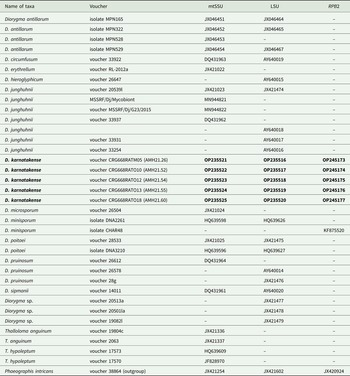
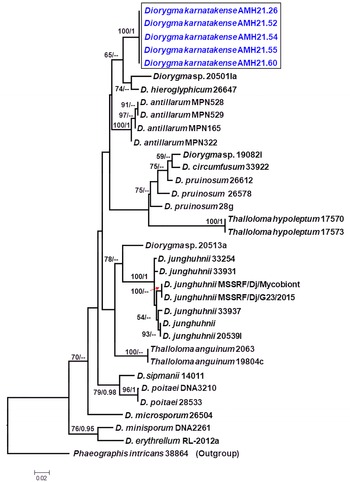
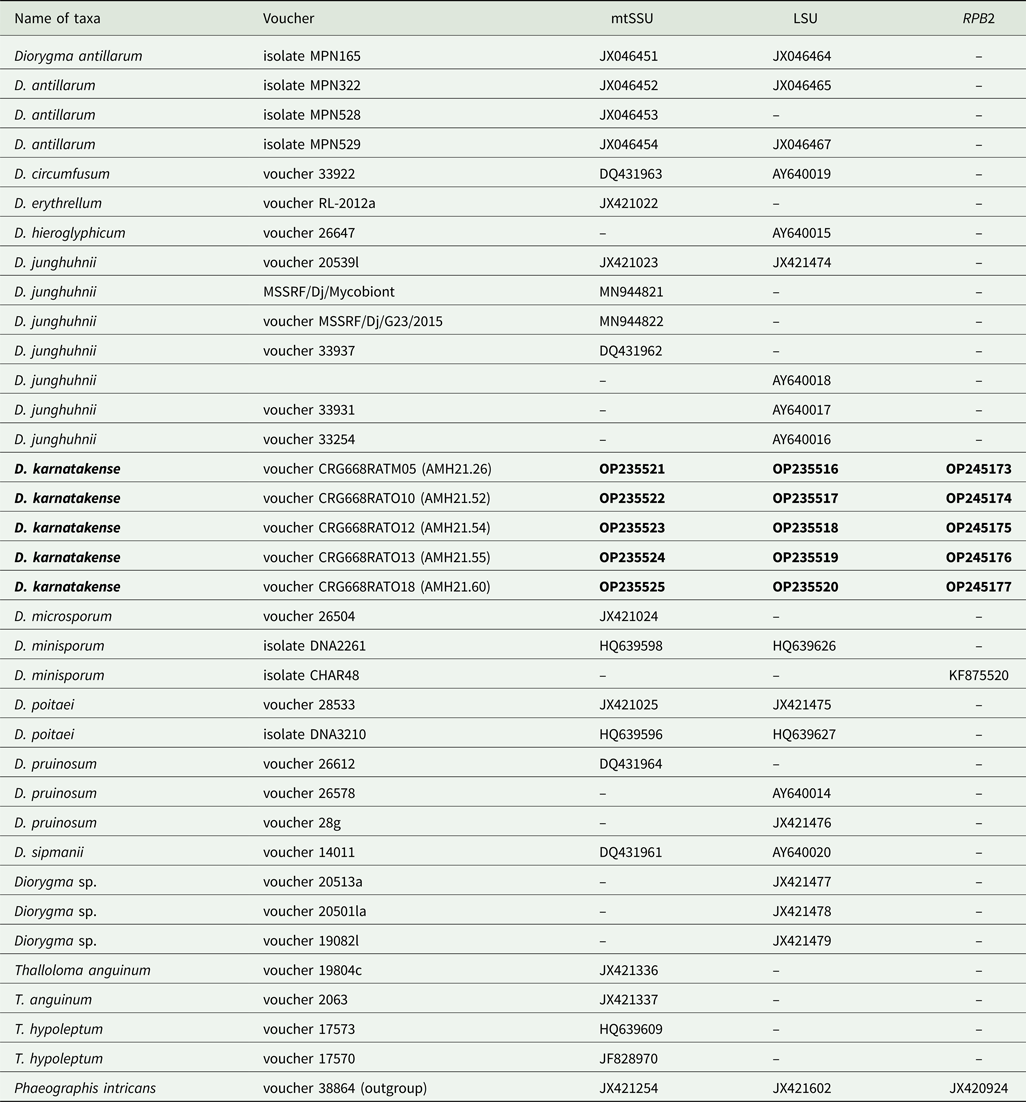
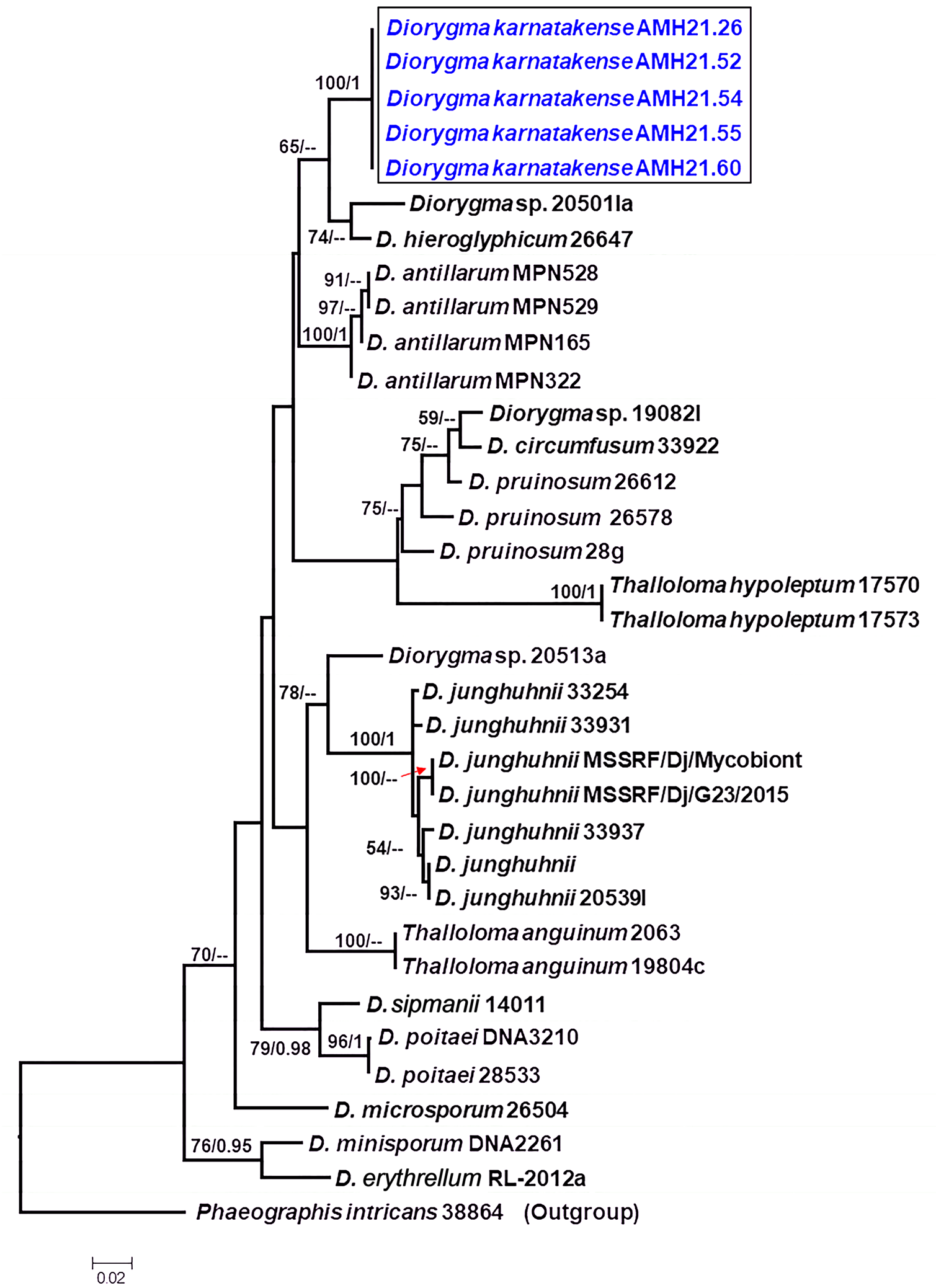
The combined sequence data of Diorygma karnatakense were analyzed together with other available sequences in the genus Diorygma in NCBI to determine the placement of the species (Table 1, Fig. 1). The tree was rooted with Phaeographis intricans (JX421254, JX421602). The analyzed dataset comprised mtSSU (823 bp) and LSU (954 bp), for a total of 1777 characters including gaps for 35 taxa. The best-scoring RAxML tree with a final likelihood value of −5729.726406 was presented. The matrix had 385 distinct alignment patterns, with 43.14% undetermined characters or gaps. Estimated base frequencies were A = 0.296892, C = 0.182606, G = 0.262160, T = 0.258342; substitution rates AC = 0.756338, AG = 2.631313, AT = 1.872160, CG = 0.728429, CT = 8.818356, GT = 1.000000; gamma distribution shape parameter α = 0.229465. Maximum likelihood and Bayesian analyses resulted in similar topologies. Diorygma karnatakense formed a well-supported monophyletic clade sister to D. antillarum and D. hieroglyphicum (Fig. 1). The concatenation of the three genes, mtSSU, LSU and RPB2, resulted in topological incongruence due to large amounts of missing data (RPB2 sequences from only two other taxa in our analysis were available for use). Hence, the RPB2 tree is produced separately (see Supplementary Material Fig. S1, available online) to assess the phylogenetic position of different accessions of D. karnatakense.
List of Diorygma species and related taxa with GenBank Accession numbers and voucher information, for the sequences used in this study. Newly generated sequences are given in bold.
Phylogram generated from RAxML analyses based on combined mtSSU and LSU sequence data for the genera Diorygma and Thalloloma (Graphidaceae). Maximum likelihood (ML) bootstrap support values ≥ 50% and Bayesian posterior probabilities (PP) ≥ 0.95 are given. The tree is rooted with Phaeographis intricans (JX421254, JX421602). The new sequences generated are shown in blue within a box. In colour online.
Taxonomy
Diorygma karnatakense B. O. Sharma & Khadilkar
Mycotaxon 119, 4 (2012); type: India, Karnataka, Dandeli forest, 2004, U. V. Makhija (AMH 04.280—holotype).
Diorygma dandeliense B. O. Sharma & Khadilkar, Mycotaxon 119, 3 (2012); type: India, Karnataka, Dandeli forest, 2004, U. V. Makhija (AMH 04.276—holotype).
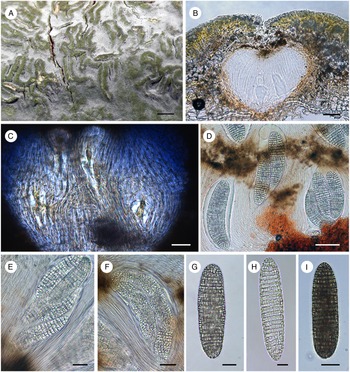
(Fig. 2)
Diorygma karnatakense (AMH 21.60). A, thallus. B, cross-section of lirellae. C, KI+ hymenium. D–F, asci showing 1–8 ascospores. G & H, ascospore. I, I+ ascospore. Scales: A = 500 μm; B–D = 50 μm; E–I = 20 μm. In colour online.
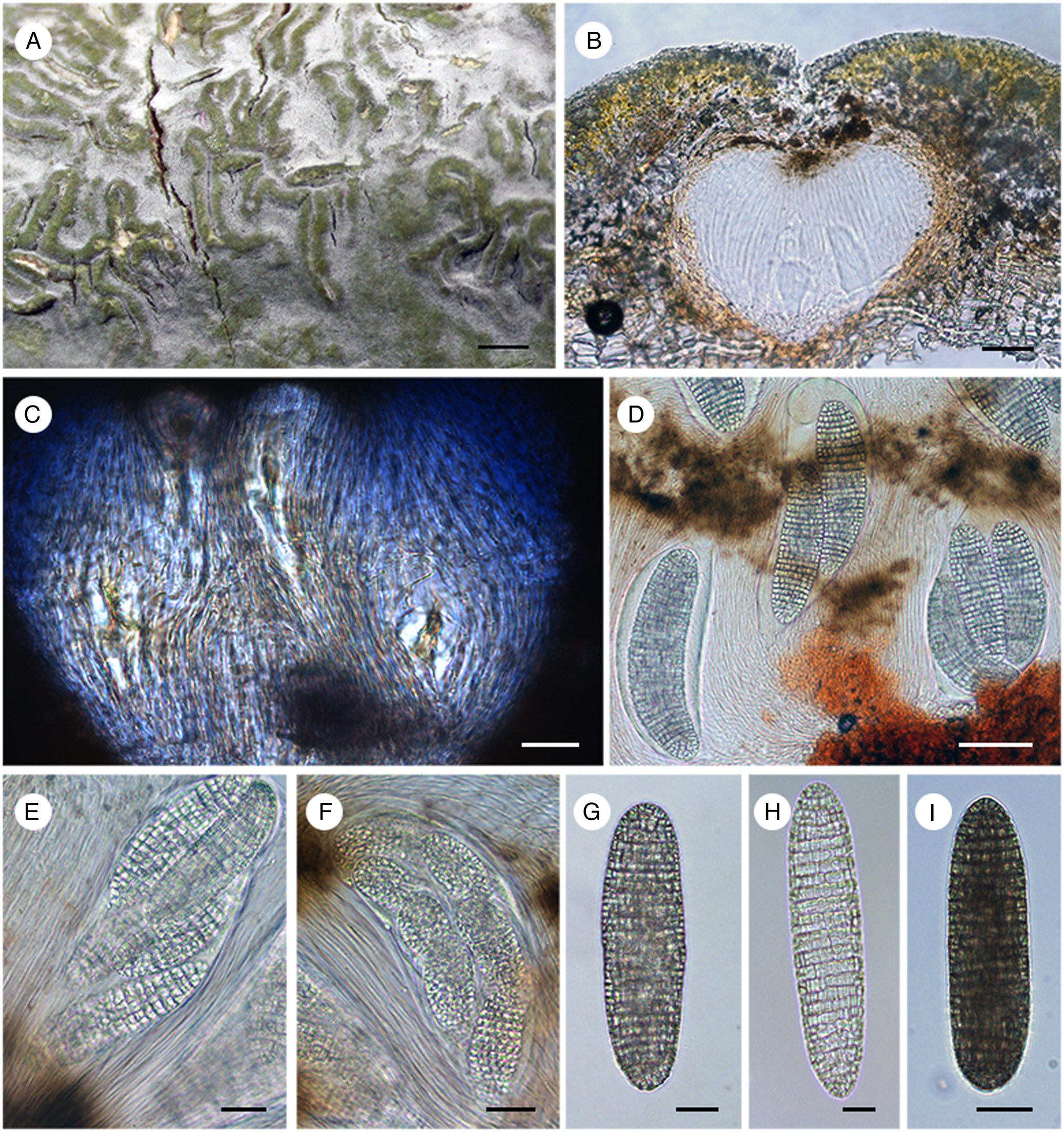
Thallus corticolous, continuous, with crystals, soredia and isidia absent; surface greyish green to greenish grey, irregular, without cortex. Thallus in section 165–257 μm thick. Algal layer 25–50 μm thick. Not delimited by a prothallus.
Ascomata lirelliform, straight to curved, simple to branched, immersed to erumpent, edges acute, 0.2–5 mm long, 0.2–0.4 mm wide, same level to slightly raised. Disc concealed, brownish black, with white pruina. Margin thick, composed of algiferous thallus and clusters of crystals. Exciple reduced, entire, convergent, non-carbonized, brown at apex, pale yellowish brown towards base. Hymenium 147–236 μm high, clear, KI+. Epithecium 8.5–10.5 μm, brown. Subhymenium 12.5–22.5 μm, hyaline. Paraphyses branched, clumped towards the apex, filiform. Periphysoids absent. Asci fusiform, 144–236 × 60–84 μm. Ascospores 1–8 per ascus, hyaline, muriform, peripheral and central locules of more or less equal size, oblong to ellipsoid, I+ blue-violet, 75–220 × 18.5–51.5 μm.
Pycnidia not observed.
Chemistry
Thallus and ascoma UV−, K+ yellow with crystals. TLC: norstictic and salazinic acids.
Remarks
Based on thallus chemistry (norstictic acid and salazinic acid) and ascospore morphology, Diorygma karnatakense is similar to D. albocinerascens Makhija et al., D. excipuloconvergentum Makhija et al., D. reniforme (Fée) Kalb et al., D. rufopruinosum (A.W. Archer) Kalb et al. and D. salvadoriense Kalb et al. However, it differs from D. reniforme, D. rufopruinosum and D. salvadoriense by having ascospores with the peripheral and central cells of the same size. Also, D. reniforme and D. salvadoriense are characterized by a basally carbonized exciple. Diorygma karnatakense is also similar to D. albocinerascens and D. excipuloconvergentum with respect to morphology and the presence of norstictic and salazinic acids; however, D. albocinerascens and D. excipuloconvergentum differ in having a distinctly striate exciple in section.
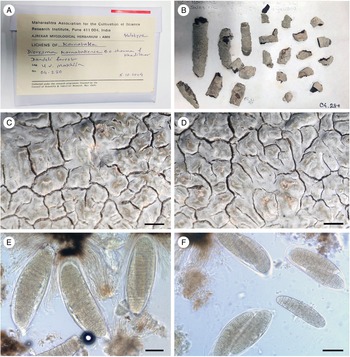
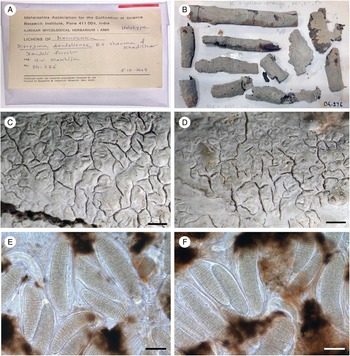
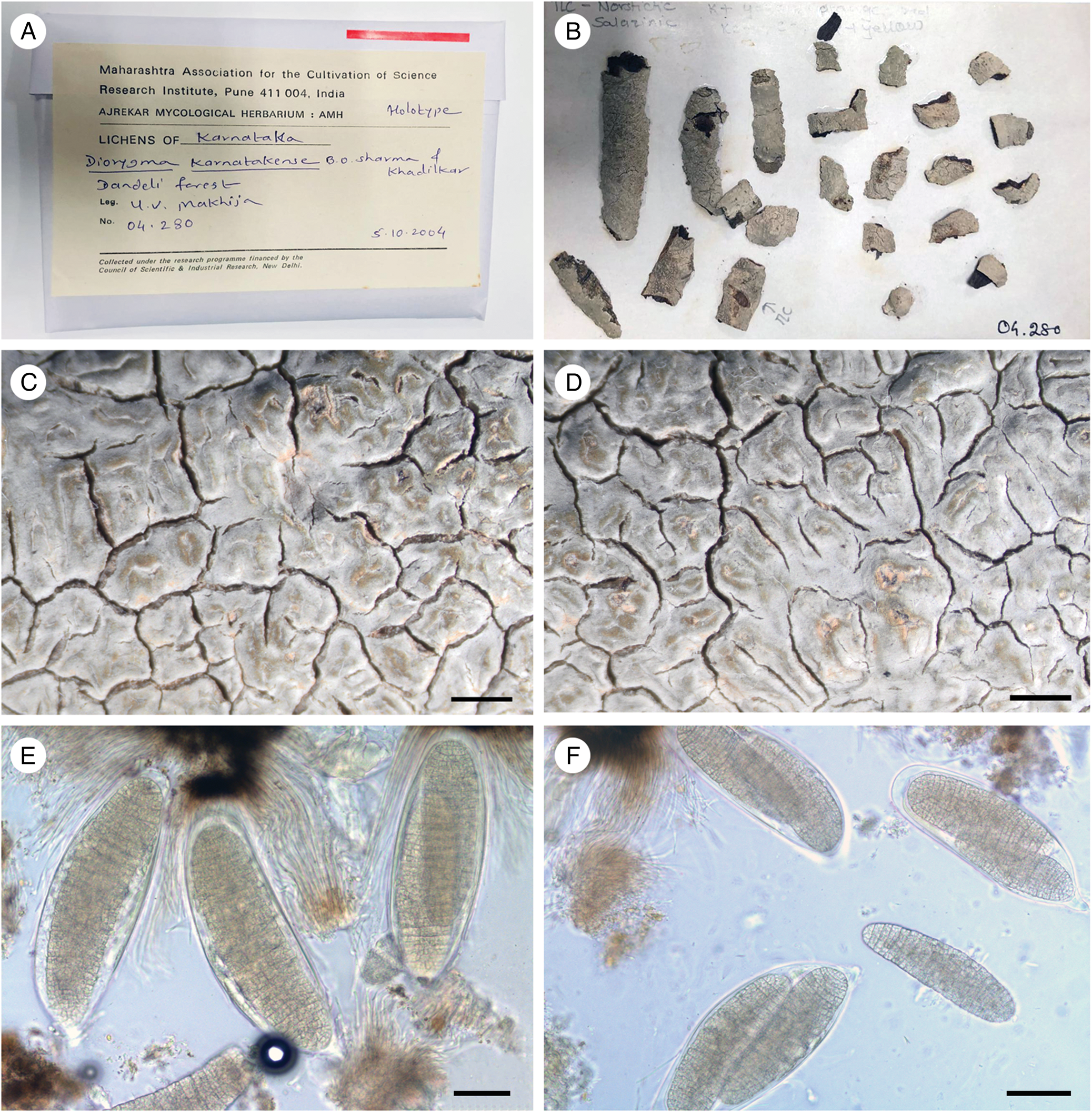
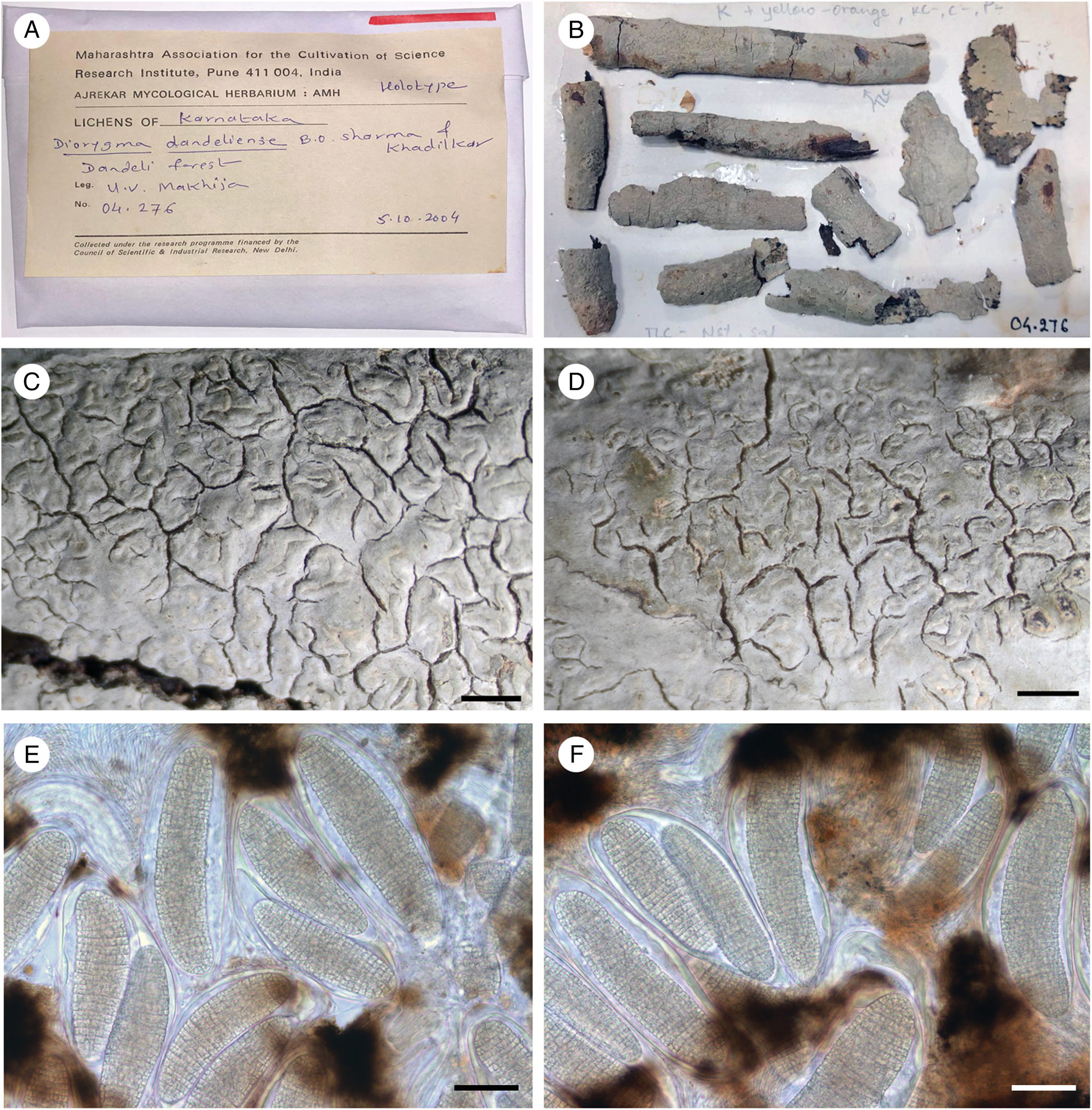
The types of D. karnatakense (Fig. 3) and D. dandeliense (Fig. 4) exhibited morphological and chemical similarities with the samples collected in the present study. Characters such as the number of spores per ascus and size of ascospores of D. karnatakense and D. dandeliense were found to be nested within the range observed in specimens collected in this study. The number of spores per ascus in the newly collected samples (1–8 spores per ascus) was found to be more comparable to the type material of D. karnatakense (1–4 spores per ascus) than to that of D. dandeliense (1 spore per ascus). Therefore, we adopt D. karnatakense as the correct name for the taxon, with D. dandeliense reduced to synonymy. Note that under Art. 11.5 of the Code (Turland et al. Reference Turland, Wiersema, Barrie, Greuter, Hawksworth, Herendeen, Knapp, Kusber, Li and Marhold2018), in cases where names have equal priority of publication (as in this case since they appeared in the same work), the first choice of name when the species are united is to be followed.
Diorygma karnatakense (holotype). A & B, holotype herbarium material. C & D, thallus. E & F, asci showing 1–2 ascospores. Scales: C & D = 1 mm; E & F = 50 μm. In colour online.
Diorygma dandeliense (holotype). A & B, holotype herbarium material. C & D, thallus. E & F, asci showing 1–2 ascospores. Scales: C & D = 1 mm; E & F = 50 μm. In colour online.
Additional specimens examined
India: Maharashtra: Thoseghar, 17°36ʹ35ʺN, 73°52ʹ47ʺE, 1064 m, 2021, P. A. Ansil & K. C. Rajeshkumar (AMH 21.52, AMH 21.54, AMH 21.55, AMH 21.60); Tamhini village, 18°27ʹ14ʺN, 73°26ʹ04ʺE, 628 m, 2021, P. A. Ansil & K. C. Rajeshkumar (AMH 21.26).
Discussion
This study is part of a modern taxonomic approach to redefine species boundaries in members of the Graphidaceae from the Western Ghats of India, an area that has proved to be especially rich in this family. While surveying the buffer and core zones of natural forests in the northern Western Ghats of Maharashtra, species of Diorygma are frequently encountered, along with several Graphis species.
Eschweiler (Reference Eschweiler1824) established the genus Diorygma to accommodate species with large muriform ascospores. Subsequently, the genus was overlooked and taxa were placed in other genera (Müller Reference Müller1880; Awasthi & Joshi Reference Awasthi and Joshi1979). Staiger (Reference Staiger2002) reintroduced the generic name, but was uncertain about its placement in the family Graphidaceae. The first phylogenetic study of Diorygma based on LSU data by Kalb et al. (Reference Kalb, Staiger and Elix2004) supported the placement of the genus in Graphidaceae.
A detailed taxonomic account of Diorygma karnatakense and D. dandeliense revealed a congruent morphology and chemistry in the freshly collected samples and the corresponding types of the two names. The types of both were found to have mostly 1–2 ascospores per ascus, contrary to the protologues (D. dandeliense 1-spored; D. karnatakense 1–4-spored). Among the freshly collected specimens, the number of ascospores varied from 1–2(–3) to 3–8 spores per ascus. Despite this variation, the phylogeny inferred from the combined mtSSU/LSU and individual RPB2 tree delineated five accessions as a single, strongly supported clade, indicating that the number of spores per ascus is not a good defining character in this case. Indeed, the number of spores in an ascus can be the result of several different phenomena, some of greater systematic importance than others (Hawksworth Reference Hawksworth, Rayner, Brasier and Moore1987). In this case, the observed variation is probably due to different numbers of ascospores maturing within individual asci, rather than more fundamental differences. A cytological study from the earliest stages of ascus formation using a Giemsa nuclear stain would be required to confirm this. Considering the observed variation, D. karnatakense is accepted as the correct name for the taxon, with D. dandeliense as a synonym.
While revising the molecular phylogeny (mtSSU, LSU and RPB2) of the family Graphidaceae, Rivas Plata et al. (Reference Rivas, Parnmen, Staiger, Mangold, Frisch, Weerakoon, Hernández, Cáceres, Kalb and Sipman2013) recovered the Diorygma-Thalloloma clade with species of the two genera intermingled. In the present study, we also recovered this topology, with T. anguinum (Mont.) Trevis. sister to D. junghuhnii (Mont. & Bosch) Kalb et al. and T. hypoleptum (Nyl.) Staiger related to the D. pruinosum/D. circumfusum clade. The association of Thalloloma and Diorygma seems to be paraphyletic and warrants a more detailed study, as mentioned by Rivas Plata et al. (Reference Rivas, Parnmen, Staiger, Mangold, Frisch, Weerakoon, Hernández, Cáceres, Kalb and Sipman2013). The two genera share a similar morphology but differ somewhat in thallus chemistry, hymenium structure and amyloidity (Staiger Reference Staiger2002; Kalb et al. Reference Kalb, Staiger and Elix2004). Thalloloma mostly lacks secondary substances and the paraphyses are straight and strongly gelatinized. Further molecular studies of Diorygma and Thalloloma are required to understand the delimitation of both genera, ideally using whole genome datasets.
Acknowledgements
KCR and BS thank SERB, Department of Science and Technology, Government of India for financial support under the project CRG/2020/000668 and the Director, ARI for providing the facility. PAA thanks CSIR-HRDG, India, for the financial support under a JRF fellowship (09/670(0093)/2021-EMR-I).
Author ORCIDs
Parayelil A. Ansil, 0000-0002-6772-7736; Kunhiraman C. Rajeshkumar, 0000-0003-0401-8294; Robert Lücking, 0000-0002-3431-4636; David L. Hawksworth, 0000-0002-9909-0776.
Competing Interests
The authors declare none.
Supplementary Material
To view Supplementary Material for this article, please visit https://doi.org/10.1017/S0024282923000087.