1 Introduction
The recent advances in parametric geometry of numbers have led to an abundance of new results concerning the spectra of various families of exponents of Diophantine approximation. We describe these notions below with a quick overview of the known results, using the formalism of parametric geometry of numbers and the notation of [Reference RoyRoy15]. Then we present new general properties of the spectra, mostly topological, and discuss a particular spectrum in detail.
Fix an integer
 $n\geqslant 2$
and a non-zero point
 $\mathbf{u}\in \mathbb{R}^{n}$
. Then consider the parametric family of convex bodies of
 $\mathbb{R}^{n}$
given by
 $$\begin{eqnarray}{\mathcal{C}}_{\mathbf{u}}(q)=\{\mathbf{x}\in \mathbb{R}^{n};\Vert \mathbf{x}\Vert \leqslant 1\text{ and }|\mathbf{x}\cdot \mathbf{u}|\leqslant e^{-q}\}\quad (q\geqslant 0),\end{eqnarray}$$
where
 $\mathbf{x}\cdot \mathbf{u}$
denotes the standard scalar product of
 $\mathbf{x}$
and
 $\mathbf{u}$
in
 $\mathbb{R}^{n}$
, and
 $\Vert \mathbf{x}\Vert =|\mathbf{x}\cdot \mathbf{x}|^{1/2}$
is the Euclidean norm of
 $\mathbf{x}$
. For each
 $i=1,\ldots ,n$
and each
 $q\geqslant 0$
, set
 $$\begin{eqnarray}L_{\mathbf{u},i}(q)=\log \unicode[STIX]{x1D706}_{i}({\mathcal{C}}_{\mathbf{u}}(q),\mathbb{Z}^{n}),\end{eqnarray}$$
where
 $\unicode[STIX]{x1D706}_{i}({\mathcal{C}}_{\mathbf{u}}(q),\mathbb{Z}^{n})$
is the
 $i$
th minimum of
 ${\mathcal{C}}_{\mathbf{u}}(q)$
with respect to the lattice
 $\mathbb{Z}^{n}$
, namely the smallest positive real number
 $\unicode[STIX]{x1D706}$
such that
 $\unicode[STIX]{x1D706}{\mathcal{C}}_{\mathbf{u}}(q)$
contains at least
 $i$
linearly independent points of
 $\mathbb{Z}^{n}$
. In 1982, using a slightly different but equivalent setting, Schmidt noted that, for the purpose of Diophantine approximation, it would be important to understand the behavior of the maps
 $\mathbf{L}_{\mathbf{u}}:[0,\infty )\rightarrow \mathbb{R}^{n}$
given by
 $$\begin{eqnarray}\mathbf{L}_{\mathbf{u}}(q)=(L_{\mathbf{u},1}(q),\ldots ,L_{\mathbf{u},n}(q))\quad (q\geqslant 0)\end{eqnarray}$$
(see [Reference SchmidtSch83]). Transposed to the present setting, his preliminary observations can be summarized as follows. We have
 $L_{\mathbf{u},1}(q)\leqslant \cdots \leqslant L_{\mathbf{u},n}(q)$
for each
 $q\geqslant 0$
and, by Minkowski’s second convex body theorem, the function
 $L_{\mathbf{u},1}(q)+\cdots +L_{\mathbf{u},n}(q)-q$
is bounded on
 $[0,\infty )$
. Moreover, each
 $L_{\mathbf{u},i}$
is a continuous piecewise linear map with slopes
 $0$
and
 $1$
. In the same paper [Reference SchmidtSch83], he also made a conjecture which was solved by Moschevitin [Reference MoshchevitinMos12a] (see also [Reference KeitaKei16]).
In [Reference Schmidt and SummererSS09, Reference Schmidt and SummererSS13a], Schmidt and Summerer established further properties of the map
 $\mathbf{L}_{\mathbf{u}}$
, which, by [Reference RoyRoy15], completely characterize these functions within the set of all functions from
 $[0,\infty )$
to
 $\mathbb{R}^{n}$
, modulo bounded functions. They also introduced the quantities
 $$\begin{eqnarray}\text{}\underline{\unicode[STIX]{x1D711}}_{i}(\mathbf{u})=\liminf _{q\rightarrow \infty }\frac{1}{q}L_{\mathbf{u},i}(q),\quad \overline{\unicode[STIX]{x1D711}}_{i}(\mathbf{u})=\limsup _{q\rightarrow \infty }\frac{1}{q}L_{\mathbf{u},i}(q)\quad (1\leqslant i\leqslant n).\end{eqnarray}$$
Revisiting work of Schmidt in [Reference SchmidtSch67], Laurent [Reference LaurentLau09b] defined additional quantities related to
 $$\begin{eqnarray}\text{}\underline{\unicode[STIX]{x1D713}}_{i}(\mathbf{u})=\liminf _{q\rightarrow \infty }\frac{1}{q}\mathop{\sum }_{j=1}^{i}L_{\boldsymbol{ u},j}(q),\quad \overline{\unicode[STIX]{x1D713}}_{i}(\mathbf{u})=\limsup _{q\rightarrow \infty }\frac{1}{q}\mathop{\sum }_{j=1}^{i}L_{\boldsymbol{ u},j}(q)\quad (1\leqslant i<n).\end{eqnarray}$$
All of these are called exponents of Diophantine approximation, because they appear as critical exponents in problems of Diophantine approximation. Of particular interest are the exponents
 $$\begin{eqnarray}\text{}\underline{\unicode[STIX]{x1D711}}_{1}=\text{}\underline{\unicode[STIX]{x1D713}}_{1},\quad \overline{\unicode[STIX]{x1D711}}_{1}=\overline{\unicode[STIX]{x1D713}}_{1},\quad \text{}\underline{\unicode[STIX]{x1D711}}_{n}=1-\overline{\unicode[STIX]{x1D713}}_{n-1}\quad \text{and}\quad \overline{\unicode[STIX]{x1D711}}_{n}=1-\text{}\underline{\unicode[STIX]{x1D713}}_{n-1}.\end{eqnarray}$$
Their spectrum is the set of all quadruples
 $(\text{}\underline{\unicode[STIX]{x1D711}}_{1}(\mathbf{u}),\overline{\unicode[STIX]{x1D711}}_{1}(\mathbf{u}),\text{}\underline{\unicode[STIX]{x1D711}}_{n}(\mathbf{u}),\overline{\unicode[STIX]{x1D711}}_{n}(\mathbf{u}))$
, where
 $\mathbf{u}$
runs through the points of
 $\mathbb{R}^{n}$
whose coordinates are linearly independent over
 $\mathbb{Q}$
. It is easily described for
 $n=2$
. For
 $n=3$
, it was determined by Laurent in [Reference LaurentLau09a]. Moreover, the spectra of the following general families are known:
-
–
 $(\text{}\underline{\unicode[STIX]{x1D711}}_{1},\overline{\unicode[STIX]{x1D711}}_{n})$
: the constraints come from Khintchine’s transference principle [Reference KhintchineKhi26a, Reference KhintchineKhi26b], and constructions of Jarník in [Reference JarníkJar35, Reference JarníkJar36] show that they are optimal;
-
–
$(\text{}\underline{\unicode[STIX]{x1D713}}_{1},\text{}\underline{\unicode[STIX]{x1D713}}_{2},\ldots ,\text{}\underline{\unicode[STIX]{x1D713}}_{n-1})$
: the constraints by Schmidt [Reference SchmidtSch67] and Laurent [Reference LaurentLau09b] describe the full spectrum [Reference RoyRoy16]; -
–
$(\overline{\unicode[STIX]{x1D711}}_{1},\text{}\underline{\unicode[STIX]{x1D711}}_{n})$
: the constraints by Jarník [Reference JarníkJar38] for
$n=3$
, and by German [Reference GermanGer12] for
$n\geqslant 4$
, are optimal (see Schmidt and Summerer [Reference Schmidt and SummererSS16]) and describe the full spectrum (see Jarník [Reference JarníkJar54] for
$n=3$
and Marnat [Reference MarnatMar15] for
$n\geqslant 4$
).


For
 $n=4$
, we also know optimal constraints on the spectrum of
 $(\text{}\underline{\unicode[STIX]{x1D711}}_{n},\overline{\unicode[STIX]{x1D711}}_{n})$
thanks to [Reference MoshchevitinMos12b] and [Reference Schmidt and SummererSS13b], as well as for the spectrum of
 $(\text{}\underline{\unicode[STIX]{x1D711}}_{1},\overline{\unicode[STIX]{x1D711}}_{1})$
thanks to [Reference Schmidt and SummererSS13b].
We propose the following notion as a general framework to study the spectra of such families of exponents of Diophantine approximation.
Definition 1.1. Let
 $T=(T_{1},\ldots ,T_{m}):\mathbb{R}^{n}\rightarrow \mathbb{R}^{m}$
be a linear map. For each non-zero point
 $\mathbf{u}\in \mathbb{R}^{n}$
, we define
 $$\begin{eqnarray}\unicode[STIX]{x1D707}_{T}(\mathbf{L}_{\mathbf{u}})=\Bigl(\liminf _{q\rightarrow \infty }q^{-1}T_{1}(\mathbf{L}_{\mathbf{u}}(q)),\ldots ,\liminf _{q\rightarrow \infty }q^{-1}T_{m}(\mathbf{L}_{\mathbf{u}}(q))\Bigr).\end{eqnarray}$$
We denote by
 $\text{Im}(\unicode[STIX]{x1D707}_{T})$
the image of
 $\unicode[STIX]{x1D707}_{T}$
, that is, the set of all
 $m$
-tuples
 $\unicode[STIX]{x1D707}_{T}(\mathbf{u})$
where
 $\mathbf{u}$
runs through the non-zero points of
 $\mathbb{R}^{n}$
. The spectrum of
 $\unicode[STIX]{x1D707}_{T}$
is its subset, denoted
 $\text{Im}^{\ast }(\unicode[STIX]{x1D707}_{T})$
, consisting of the
 $m$
-tuples
 $\unicode[STIX]{x1D707}_{T}(\mathbf{u})$
where
 $\mathbf{u}$
runs through the points of
 $\mathbb{R}^{n}$
with
 $\mathbb{Q}$
-linearly independent coordinates.
For example, the spectrum of the exponents
 $(\text{}\underline{\unicode[STIX]{x1D711}}_{1},\ldots ,\text{}\underline{\unicode[STIX]{x1D711}}_{n},\overline{\unicode[STIX]{x1D711}}_{1},\ldots ,\overline{\unicode[STIX]{x1D711}}_{n})$
, whose definition involves both inferior and superior limits, can be expressed as
 $\unicode[STIX]{x1D70E}(\text{Im}^{\ast }(\unicode[STIX]{x1D707}_{T}))$
, where
 $T:\mathbb{R}^{n}\rightarrow \mathbb{R}^{2n}$
and
 $\unicode[STIX]{x1D70E}:\mathbb{R}^{2n}\rightarrow \mathbb{R}^{2n}$
are the linear maps given by
 $T(\mathbf{x})=(\mathbf{x},-\mathbf{x})$
and
 $\unicode[STIX]{x1D70E}(\mathbf{x},\mathbf{y})=(\mathbf{x},-\mathbf{y})$
for any
 $\mathbf{x},\mathbf{y}\in \mathbb{R}^{n}$
. Our first main result below implies that it is a compact and connected subset of
 $\mathbb{R}^{2n}$
.
Theorem 1.2. Let
 $T:\mathbb{R}^{n}\rightarrow \mathbb{R}^{m}$
be a linear map. Then
 $\text{Im}^{\ast }(\unicode[STIX]{x1D707}_{T})$
is a compact connected subset of
 $\mathbb{R}^{m}$
. The set
 $\text{Im}(\unicode[STIX]{x1D707}_{T})$
is also compact but in general not connected.
As above, this implies that the spectrum of
 $(\text{}\underline{\unicode[STIX]{x1D713}}_{1},\ldots ,\text{}\underline{\unicode[STIX]{x1D713}}_{n-1},\overline{\unicode[STIX]{x1D713}}_{1},\ldots ,\overline{\unicode[STIX]{x1D713}}_{n-1})$
is compact and connected. The proof of the theorem uses the following notions.
Definition 1.3. Let
 $\mathbf{u}$
be a non-zero point of
 $\mathbb{R}^{n}$
. We denote by
 ${\mathcal{F}}(\mathbf{L}_{\mathbf{u}})$
the set of all points
 $\mathbf{x}\in \mathbb{R}^{n}$
for which there exists a strictly increasing unbounded sequence of positive real numbers
 $(q_{i})_{i\geqslant 1}$
such that
 $q_{i}^{-1}\mathbf{L}_{\mathbf{u}}(q_{i})$
converges to
 $\mathbf{x}$
as
 $i\rightarrow \infty$
. We also denote by
 ${\mathcal{K}}(\mathbf{L}_{\mathbf{u}})$
the convex hull of
 ${\mathcal{F}}(\mathbf{L}_{\mathbf{u}})$
.
So,
 ${\mathcal{F}}(\mathbf{L}_{\mathbf{u}})$
and
 ${\mathcal{K}}(\mathbf{L}_{\mathbf{u}})$
are compact subsets of
 $[0,1]^{n}$
and, in the notation of Theorem 1.2, we have
 $$\begin{eqnarray}\unicode[STIX]{x1D707}_{T}(\mathbf{L}_{\mathbf{u}})=(\inf T_{1}({\mathcal{F}}(\mathbf{L}_{\mathbf{u}})),\ldots ,\inf T_{m}({\mathcal{F}}(\mathbf{L}_{\mathbf{u}}))).\end{eqnarray}$$
To write this formula in a more compact way, we use the coordinate-wise partial ordering on
 $\mathbb{R}^{m}$
, where, for any two points
 $\mathbf{x}$
and
 $\mathbf{y}$
in
 $\mathbb{R}^{n}$
, we have
 $\mathbf{x}\leqslant \mathbf{y}$
if and only if all coordinates of
 $\mathbf{y}-\mathbf{x}$
are
 ${\geqslant}0$
. For this ordering, any bounded subset
 $F$
of
 $\mathbb{R}^{m}$
has a greatest lower bound denoted
 $\inf (F)$
. For each
 $i=1,\ldots ,m$
, its
 $i$
th coordinate is the infimum of the set of
 $i$
th coordinates of the points of
 $F$
. Then the above formula simply becomes
 $$\begin{eqnarray}\unicode[STIX]{x1D707}_{T}(\mathbf{L}_{\mathbf{u}})=\inf T({\mathcal{F}}(\mathbf{L}_{\mathbf{u}})).\end{eqnarray}$$
Moreover, the infimum of a bounded subset
 $S$
of
 $\mathbb{R}^{m}$
is the same as the infimum of the convex hull of
 $S$
, and a linear map
 $T:\mathbb{R}^{n}\rightarrow \mathbb{R}^{m}$
sends the convex hull of a bounded subset
 $F$
of
 $\mathbb{R}^{n}$
to the convex hull of
 $T(F)$
. Therefore, we also have
 $$\begin{eqnarray}\unicode[STIX]{x1D707}_{T}(\mathbf{L}_{\mathbf{u}})=\inf T({\mathcal{K}}(\mathbf{L}_{\mathbf{u}})).\end{eqnarray}$$
In the case of dimension
 $n=3$
, we obtain the following result.
Theorem 1.4. For each pair of points
 $\mathbf{v},\mathbf{w}$
in
 $\mathbb{R}^{3}$
having
 $\mathbb{Q}$
-linearly independent coordinates, there exists a point
 $\mathbf{u}$
of
 $\mathbb{R}^{3}$
which also has
 $\mathbb{Q}$
-linearly independent coordinates, such that
 ${\mathcal{K}}(\mathbf{L}_{\mathbf{u}})$
is the convex hull of
 ${\mathcal{K}}(\mathbf{L}_{\mathbf{v}})\cup {\mathcal{K}}(\mathbf{L}_{\mathbf{w}})$
.
Then, for a linear map
 $T:\mathbb{R}^{3}\rightarrow \mathbb{R}^{m}$
, we find, using (1.1), that
 $$\begin{eqnarray}\unicode[STIX]{x1D707}_{T}(\mathbf{L}_{\mathbf{u}})=\inf (T({\mathcal{K}}(\mathbf{L}_{\mathbf{v}}))\cup T({\mathcal{K}}(\mathbf{L}_{\mathbf{w}})))=\min \{\unicode[STIX]{x1D707}_{T}(\mathbf{L}_{\mathbf{v}}),\,\unicode[STIX]{x1D707}_{T}(\mathbf{L}_{\mathbf{w}})\}.\end{eqnarray}$$
This gives the following result.
Corollary 1.5. Let
 $T:\mathbb{R}^{3}\rightarrow \mathbb{R}^{m}$
be a linear map. For any
 $\mathbf{x},\mathbf{y}$
in
 $\text{Im}^{\ast }(\unicode[STIX]{x1D707}_{T})$
, the point
 $\min \{\mathbf{x},\mathbf{y}\}$
also belongs to
 $\text{Im}^{\ast }(\unicode[STIX]{x1D707}_{T})$
.
As Theorem 1.2 shows that
 $\text{Im}^{\ast }(\unicode[STIX]{x1D707}_{T})$
is compact, it follows that this spectrum contains the infimum of any of its subsets. It would be interesting to know if this property extends to the linear maps
 $T:\mathbb{R}^{n}\rightarrow \mathbb{R}^{m}$
with
 $n>3$
.
In all cases where we know the complete spectrum of a family of
 $m$
exponents of approximation, it appears to be a semi-algebraic subset of
 $\mathbb{R}^{m}$
, that is, a subset of
 $\mathbb{R}^{m}$
defined by polynomial equalities and inequalities. Here, we show that this is true of any spectrum in dimension
 $n=3$
.
Theorem 1.6. For any
 $m\geqslant 1$
and any linear map
 $T:\mathbb{R}^{3}\rightarrow \mathbb{R}^{m}$
, the spectrum
 $\text{Im}^{\ast }(\unicode[STIX]{x1D707}_{T})$
is a semi-algebraic subset of
 $\mathbb{R}^{m}$
.
Jarník showed in [Reference JarníkJar38] that, in dimension
 $n=3$
, the spectrum of
 $(\text{}\underline{\unicode[STIX]{x1D711}}_{3},\overline{\unicode[STIX]{x1D711}}_{1})$
is contained in the arc of an algebraic curve
 $$\begin{eqnarray}J=\{(x,y)\in [1/3,1/2]\times [0,1/3];(1-2x)(1-2y)=xy\}\end{eqnarray}$$
and, in [Reference JarníkJar54], that it is equal to
 $J$
. As mentioned above, this remarkable result was extended by Laurent in [Reference LaurentLau09a] to a complete description of the spectrum of
 $(\text{}\underline{\unicode[STIX]{x1D711}}_{1},\text{}\underline{\unicode[STIX]{x1D711}}_{3},\overline{\unicode[STIX]{x1D711}}_{1},\overline{\unicode[STIX]{x1D711}}_{3})$
. Our last main result deals with the full family
 $(\text{}\underline{\unicode[STIX]{x1D711}}_{1},\text{}\underline{\unicode[STIX]{x1D711}}_{2},\ldots ,\overline{\unicode[STIX]{x1D711}}_{3})$
.
Theorem 1.7. Suppose that
 $n=3$
. Then the spectrum
 ${\mathcal{S}}$
of
 $(\text{}\underline{\unicode[STIX]{x1D711}}_{1},\text{}\underline{\unicode[STIX]{x1D711}}_{2},\text{}\underline{\unicode[STIX]{x1D711}}_{3},\overline{\unicode[STIX]{x1D711}}_{1},\overline{\unicode[STIX]{x1D711}}_{2},\overline{\unicode[STIX]{x1D711}}_{3})$
is a semi-algebraic subset of
 $\mathbb{R}^{6}$
defined by polynomial inequalities with coefficients in
 $\mathbb{Q}$
within
 $\mathbb{R}^{2}\times J\times \mathbb{R}^{2}$
. It is moreover the topological closure of a non-empty open subset of
 $\mathbb{R}^{2}\times J\times \mathbb{R}^{2}$
.
Thus, the spectrum is a closed manifold of dimension
 $5$
with boundary. In § 11, we give an explicit set of inequalities describing it, some of which have been obtained independently by Schmidt and Summerer [Reference Schmidt and SummererSS17] (for more details, see the comments after the statement of Theorem 11.5 below). More precisely, we simply list half of the inequalities, because, with one exception, all others are obtained from these by a simple transformation, in agreement with a general observation of Schmidt and Summerer (see the remark after their [Reference Schmidt and SummererSS13a, Theorem 1.2] and also at the end of the introduction of [Reference Schmidt and SummererSS13b]). That transformation consists in reversing inequalities and permuting the variables representing
 $\text{}\underline{\unicode[STIX]{x1D711}}_{i}$
and
 $\overline{\unicode[STIX]{x1D711}}_{4-i}$
for each
 $i=1,2,3$
. The search for a precise formulation and a satisfactory explanation of this duality was the initial motivation for the present research, but it remains an open problem.
This paper is organized as follows. In § 3, we use results of [Reference RoyRoy15] recalled in § 2 to transpose the notion of spectrum in terms of a simple class of
 $\mathbb{R}^{n}$
-valued functions of one variable called
 $n$
-systems. In the recent papers [Reference KeitaKei16, Reference MarnatMar15, Reference RoyRoy16, Reference Schmidt and SummererSS13b, Reference Schmidt and SummererSS16], the authors exhibit points of a given spectrum by forming
 $n$
-systems whose graphs are invariant under a non-trivial homothety with center at the origin. In § 3, we show that the points of a spectrum coming from such self-similar
 $n$
-systems all belong to a single connected component of the spectrum. Using tools from §§ 4–6, we show moreover in § 7 that these points are dense in the spectrum. The latter must therefore be connected. Its compactness is proved in § 8. Thus, the whole spectrum is the topological closure of its subset of points attached to self-similar
 $n$
-systems. The last three sections treat the case of dimension
 $n=3$
, proving Theorems 1.4, 1.6 and 1.7, together with an explicit description of the spectrum of
 $(\text{}\underline{\unicode[STIX]{x1D711}}_{1},\ldots ,\overline{\unicode[STIX]{x1D711}}_{3})$
. The arguments are geometric, taking advantage of the fact that, like the sets
 ${\mathcal{F}}(\mathbf{L}_{\mathbf{u}})$
attached to points
 $\mathbf{u}\in \mathbb{R}^{3}$
, the analogous sets
 ${\mathcal{F}}(\mathbf{P})$
attached to
 $3$
-systems
 $\mathbf{P}$
(defined in § 3) are planar sets and therefore can easily be drawn on paper. More precisely, the proofs are based on a geometric description of the sets
 ${\mathcal{F}}(\mathbf{P})$
given in § 9 for self-similar
 $3$
-systems
 $\mathbf{P}$
satisfying a mild non-degeneracy condition.
2 Non-degenerate systems, rigid systems and canvases
Fix an integer
 $n$
with
 $n\geqslant 2$
and let
 $$\begin{eqnarray}\mathbf{e}_{1}=(1,0,\ldots ,0),\ldots ,\mathbf{e}_{n}=(0,\ldots ,0,1)\end{eqnarray}$$
denote the elements of the canonical basis of
 $\mathbb{R}^{n}$
. In our setting, the notion of
 $(n,0)$
-system introduced and studied by Schmidt and Summerer in [Reference Schmidt and SummererSS13a, §§ 2–3] takes the following form.
Definition 2.1. Let
 $I$
be a subinterval of
 $[0,\infty )$
with non-empty interior. An
 $n$
-system on
 $I$
is a map
 $\mathbf{P}=(P_{1},\ldots ,P_{n}):I\rightarrow \mathbb{R}^{n}$
with the property that, for any
 $q\in I$
:
- (S1)
-
$0\leqslant P_{1}(q)\leqslant \cdots \leqslant P_{n}(q)$
and
$P_{1}(q)+\cdots +P_{n}(q)=q$
;
- (S2)
-
there exist
$\unicode[STIX]{x1D716}>0$
and integers
$k,\ell \in \{1,\ldots ,n\}$
such that
$$\begin{eqnarray}\mathbf{P}(t)=\left\{\begin{array}{@{}ll@{}}\mathbf{P}(q)+(t-q)\mathbf{e}_{\ell }\quad & \text{for any }t\in I\cap [q-\unicode[STIX]{x1D716},q],\\ \mathbf{P}(q)+(t-q)\mathbf{e}_{k}\quad & \text{for any }t\in I\cap [q,q+\unicode[STIX]{x1D716}];\end{array}\right.\end{eqnarray}$$
- (S3)
-
if
$q$
is in the interior of
$I$
and if the integers
$k$
and
$\ell$
from (S2) satisfy
$k>\ell$
, then we have
$P_{\ell }(q)=\cdots =P_{k}(q)$
.


We say that such a map is proper if
 $P_{1}$
is unbounded.
In [Reference Schmidt and SummererSS13a], Schmidt and Summerer showed that the maps
 $\mathbf{L}_{\mathbf{u}}:[0,\infty )\rightarrow \mathbb{R}^{n}$
attached to non-zero points
 $\mathbf{u}$
of
 $\mathbb{R}^{n}$
satisfy similar but weaker conditions and they proposed those
 $n$
-systems as an idealized model for the former maps. By [Reference RoyRoy15, Theorems 8.1 and 8.2], the
 $n$
-systems have the following approximation property.
Theorem 2.2. For each non-zero point
 $\mathbf{u}$
in
 $\mathbb{R}^{n}$
, there exist
 $q_{0}\geqslant 0$
and an
 $n$
-system
 $\mathbf{P}$
on
 $[q_{0},\infty )$
such that
 $\mathbf{P}-\mathbf{L}_{\mathbf{u}}$
is bounded on
 $[q_{0},\infty )$
. Conversely, for any
 $q_{0}\geqslant 0$
and any
 $n$
-system
 $\mathbf{P}$
on
 $[q_{0},\infty )$
, there exists a non-zero point
 $\mathbf{u}\in \mathbb{R}^{n}$
such that
 $\mathbf{P}-\mathbf{L}_{\mathbf{u}}$
is bounded on
 $[q_{0},\infty )$
. The point
 $\mathbf{u}$
has
 $\mathbb{Q}$
-linearly independent coordinates if and only if the map
 $\mathbf{P}$
is proper.
The last assertion follows from the fact that
 $\mathbf{u}$
has
 $\mathbb{Q}$
-linearly independent coordinates if and only if the function
 $L_{\mathbf{u},1}:[0,\infty )\rightarrow \mathbb{R}$
is unbounded.
We now present several constructions related to
 $n$
-systems.
Rescaling. If
 $\mathbf{P}$
is an
 $n$
-system on some subinterval
 $I$
of
 $[0,\infty )$
, then, for each
 $\unicode[STIX]{x1D70C}>0$
, the map
 $\tilde{\mathbf{P}}:\unicode[STIX]{x1D70C}I\rightarrow \mathbb{R}^{n}$
given by
 $\tilde{\mathbf{P}}(q)=\unicode[STIX]{x1D70C}\mathbf{P}(\unicode[STIX]{x1D70C}^{-1}q)$
is also an
 $n$
-system. We say that
 $\mathbf{P}$
is self-similar if
 $I$
is unbounded and if there exists
 $\unicode[STIX]{x1D70C}>1$
such that
 $\mathbf{P}(\unicode[STIX]{x1D70C}q)=\unicode[STIX]{x1D70C}\mathbf{P}(q)$
for each
 $q\in I$
(i.e.
 $\mathbf{P}=\tilde{\mathbf{P}}$
on
 $\unicode[STIX]{x1D70C}I$
).
Gluing. As the definition shows, an
 $n$
-system
 $\mathbf{P}:I\rightarrow \mathbb{R}^{n}$
is defined by local conditions. In particular, it is a continuous map which admits a left derivative
 $\mathbf{P}^{\prime }(q^{-})\in \{\mathbf{e}_{1},\ldots ,\mathbf{e}_{n}\}$
at each point
 $q\in I$
with
 $q\neq \inf (I)$
, and a right derivative
 $\mathbf{P}^{\prime }(q^{+})\in \{\mathbf{e}_{1},\ldots ,\mathbf{e}_{n}\}$
at each point
 $q\in I$
with
 $q\neq \sup (I)$
.
Suppose that
 $\mathbf{P}$
is an
 $n$
-system on
 $[u,v]$
and
 $R$
is an
 $n$
-system on
 $[v,w]$
with
 $0\leqslant u<v<w$
. Let
 $k$
and
 $\ell$
be the integers for which
 $\mathbf{P}^{\prime }(v^{-})=\mathbf{e}_{\ell }$
and
 $\mathbf{R}^{\prime }(v^{+})=\mathbf{e}_{k}$
. If
 $\mathbf{P}(v)=\mathbf{R}(v)$
and
 $k\leqslant \ell$
, then the map
 $\mathbf{S}:[u,w]\rightarrow \mathbb{R}^{n}$
which coincides with
 $\mathbf{P}$
on
 $[u,v]$
and with
 $\mathbf{R}$
on
 $[v,w]$
is also an
 $n$
-system.
The above process of gluing
 $n$
-systems can be repeated indefinitely. For example, suppose that
 $\mathbf{P}(v)=\unicode[STIX]{x1D70C}\mathbf{P}(u)$
for some
 $\unicode[STIX]{x1D70C}>0$
. Then, by Condition (S1), we have
 $\unicode[STIX]{x1D70C}=v/u>1$
. Suppose further that the integers
 $k$
and
 $\ell$
for which
 $\mathbf{P}^{\prime }(u^{+})=\mathbf{e}_{k}$
and
 $\mathbf{P}^{\prime }(v^{-})=\mathbf{e}_{\ell }$
satisfy
 $k\leqslant \ell$
; then the map
 $\mathbf{S}:[u,\infty )\rightarrow \mathbb{R}^{n}$
given by
 $\mathbf{S}(\unicode[STIX]{x1D70C}^{i}q)=\unicode[STIX]{x1D70C}^{i}\mathbf{P}(q)$
for each
 $q\in [u,v]$
and each
 $i\geqslant 1$
is a self-similar
 $n$
-system which extends
 $\mathbf{P}$
.
Combined graph. Let
 $\mathbf{P}=(P_{1},\ldots ,P_{n}):I\rightarrow \mathbb{R}^{n}$
be an
 $n$
-system. Following the terminology of Schmidt and Summerer in [Reference Schmidt and SummererSS13a], its combined graph is the union of the graphs of its components
 $P_{1},\ldots ,P_{n}$
in
 $I\times \mathbb{R}$
. Since, by Condition (S1), the map
 $\mathbf{P}$
takes values in the set
 $$\begin{eqnarray}\unicode[STIX]{x1D6E5}_{n}=\{(x_{1},\ldots ,x_{n})\in \mathbb{R}^{n};x_{1}\leqslant \cdots \leqslant x_{n}\},\end{eqnarray}$$
this graph determines
 $\mathbf{P}$
except in some degenerate cases. A division number of
 $\mathbf{P}$
is a point of
 $I$
on the boundary of
 $I$
, or an interior point
 $q$
of
 $I$
where
 $\mathbf{P}$
is not differentiable (i.e.
 $\mathbf{P}^{\prime }(q^{-})\neq \mathbf{P}^{\prime }(q^{+})$
). The division numbers of
 $\mathbf{P}$
form a discrete subset of
 $I$
. A switch number of
 $\mathbf{P}$
is a point of
 $I$
on the boundary of
 $I$
, or an interior point
 $q$
of
 $I$
for which the integers
 $k$
and
 $\ell$
in Condition (S2) satisfy
 $k<\ell$
. Thus, the switch numbers of
 $\mathbf{P}$
are also division numbers of
 $\mathbf{P}$
. A division point (respectively switch point) of
 $\mathbf{P}$
is the value of
 $\mathbf{P}$
at a division number (respectively at a switch number).
Suppose that
 $u<v$
are points of
 $I$
with no switch number of
 $\mathbf{P}$
between them, and let
 $k$
and
 $\ell$
be the integers for which
 $\mathbf{P}^{\prime }(u^{+})=\mathbf{e}_{k}$
and
 $\mathbf{P}^{\prime }(v^{-})=\mathbf{e}_{\ell }$
. Then we have
 $$\begin{eqnarray}P_{k}(u)<P_{\ell }(v)\quad \text{and}\quad (P_{1}(u),\ldots ,\widehat{P_{k}(u)},\ldots ,P_{n}(u))=(P_{1}(v),\ldots ,\widehat{P_{\ell }(v)},\ldots ,P_{n}(v)),\end{eqnarray}$$
where the hat on a coordinate means that it is omitted. Moreover, the restriction of
 $\mathbf{P}$
to
 $[u,v]$
is given by
 $$\begin{eqnarray}\mathbf{P}(q)=\unicode[STIX]{x1D6F7}_{n}(P_{1}(u),\ldots ,\widehat{P_{k}(u)},\ldots ,P_{n}(u),P_{k}(u)+q-u)\quad (u\leqslant q\leqslant v),\end{eqnarray}$$
where
 $\unicode[STIX]{x1D6F7}_{n}:\mathbb{R}^{n}\rightarrow \unicode[STIX]{x1D6E5}_{n}$
denotes the continuous map which lists the coordinates of a point in monotone increasing order. This formula simply expresses the fact that the combined graph of
 $\mathbf{P}$
over
 $[u,v]$
consists of the horizontal line segments
 $[u,v]\times \{P_{j}(u)\}$
for
 $j=1,\ldots ,\widehat{k},\ldots ,n$
and the line segment of slope
 $1$
joining the points
 $(u,P_{k}(u))$
and
 $(v,P_{\ell }(v))$
. The
 $n$
-system
 $\mathbf{P}$
can be viewed as the result of gluing together such simpler systems, for example the restrictions of
 $\mathbf{P}$
to the closed subintervals of
 $I$
joining consecutive switch numbers of
 $\mathbf{P}$
.
Canvases and non-degenerate systems. A non-degenerate
 $n$
-system is an
 $n$
-system
 $\mathbf{P}$
defined on a closed subinterval of
 $(0,\infty )$
whose switch points all have
 $n$
distinct positive coordinates. We will need the following related notions.
A finite pre-canvas in
 $\mathbb{R}^{n}$
is a finite sequence of points
 $(\mathbf{a}^{(i)})_{1\leqslant i\leqslant s}$
in
 $\unicode[STIX]{x1D6E5}_{n}$
of cardinality
 $s\geqslant 2$
with the property that:
- (C1)
-
for each
$i=1,\ldots ,s$
, the coordinates
$(a_{1}^{(i)},\ldots ,a_{n}^{(i)})$
of
$\mathbf{a}^{(i)}$
form a strictly increasing sequence of positive real numbers; - (C2)
-
for each
$i=1,\ldots ,s-1$
, there exist integers
$k_{i}$
and
$\ell _{i+1}$
with
$1\leqslant k_{i}\leqslant \ell _{i+1}\leqslant n$
such that
$$\begin{eqnarray}a_{k_{i}}^{(i)}<a_{\ell _{i+1}}^{(i+1)}\quad \text{and}\quad (a_{1}^{(i)},\ldots ,\widehat{a_{k_{i}}^{(i)}},\ldots ,a_{n}^{(i)})=(a_{1}^{(i+1)},\ldots ,\widehat{a_{\ell _{i+1}}^{(i+1)}},\ldots ,a_{n}^{(i+1)});\end{eqnarray}$$
- (C3)
-
for each index
$i$
with
$1<i<s$
, we have
$k_{i}\leqslant \ell _{i}$
.


The pairs
 $(k_{i},\ell _{i+1})$
with
 $1\leqslant i<s$
are uniquely determined by Condition (C2). We call them the transition indices of the pre-canvas.
To a pre-canvas as above, we associate the function
 $\mathbf{P}:[q_{1},q_{s}]\rightarrow \unicode[STIX]{x1D6E5}_{n}$
given by
 $$\begin{eqnarray}\mathbf{P}(q)=\unicode[STIX]{x1D6F7}_{n}(a_{1}^{(i)},\ldots ,\widehat{a_{k_{i}}^{(i)}},\ldots ,a_{n}^{(i)},a_{k_{i}}^{(i)}+q-q_{i})\quad (1\leqslant i<s,q_{i}\leqslant q\leqslant q_{i+1}),\end{eqnarray}$$
where
 $$\begin{eqnarray}q_{i}=a_{1}^{(i)}+\cdots +a_{n}^{(i)}\quad (1\leqslant i\leqslant s).\end{eqnarray}$$
This map is an
 $n$
-system which satisfies
 $\mathbf{P}(q_{i})=\mathbf{a}^{(i)}$
for
 $i=1,\ldots ,s$
, as well as
 $\mathbf{P}^{\prime }(q_{i}^{+})=\mathbf{e}_{k_{i}}$
and
 $\mathbf{P}^{\prime }(q_{i+1}^{-})=\mathbf{e}_{\ell _{i+1}}$
for
 $i=1,\ldots ,s-1$
.
A finite canvas in
 $\mathbb{R}^{n}$
is a pre-canvas
 $(\mathbf{a}^{(i)})_{1\leqslant i\leqslant s}$
, which, instead of Condition (C3), satisfies the stronger condition
 $k_{i}<\ell _{i}$
whenever
 $1<i<s$
. Then the numbers
 $q_{1},\ldots ,q_{s}$
given by (2.2) are the switch numbers of the associated
 $n$
-system
 $\mathbf{P}:[q_{1},q_{s}]\rightarrow \unicode[STIX]{x1D6E5}_{n}$
. Since
 $\mathbf{P}(q_{i})=\mathbf{a}^{(i)}$
for each
 $i=1,\ldots ,s$
, that system is non-degenerate. We obtain in this way all non-degenerate
 $n$
-systems whose domain is a compact subinterval of
 $(0,\infty )$
.
If
 $(\mathbf{a}^{(i)})_{1\leqslant i\leqslant s}$
is a finite pre-canvas, then the subsequence obtained by deleting each point
 $\mathbf{a}^{(i)}$
with
 $1<i<s$
and
 $k_{i}=\ell _{i}$
is a canvas with the same associated
 $n$
-system. Thus, the non-degenerate
 $n$
-systems with compact domain are also the
 $n$
-systems associated to the finite pre-canvases.
An infinite pre-canvas is an infinite unbounded sequence
 $(\mathbf{a}^{(i)})_{1\leqslant i}$
such that
 $(\mathbf{a}^{(i)})_{1\leqslant i\leqslant s}$
is a pre-canvas for each integer
 $s\geqslant 2$
. Then the corresponding
 $n$
-systems given by (2.1) are the restrictions to
 $[q_{1},q_{s}]$
of a unique non-degenerate
 $n$
-system
 $\mathbf{P}:[q_{1},\infty )\rightarrow \unicode[STIX]{x1D6E5}_{n}$
. We obtain in this way all non-degenerate
 $n$
-systems with unbounded domain.
The notion of an infinite canvas is similar. The non-degenerate
 $n$
-systems associated to such canvases are those with unbounded domain and infinitely many switch numbers. This includes all proper non-degenerate
 $n$
-systems.
Rigid systems. Let
 $\unicode[STIX]{x1D6FF}>0$
. A rigid
 $n$
-system of mesh
 $\unicode[STIX]{x1D6FF}$
is a non-degenerate
 $n$
-system
 $\mathbf{P}$
whose switch points belong to
 $\unicode[STIX]{x1D6FF}\mathbb{Z}^{n}$
. By Condition (S1), the switch numbers of
 $\mathbf{P}$
are then positive multiples of
 $\unicode[STIX]{x1D6FF}$
. By the above, such a system comes from a pre-canvas, possibly infinite, contained in
 $\unicode[STIX]{x1D6FF}\mathbb{Z}^{n}$
. By [Reference RoyRoy15, Theorems 8.1 and 8.2], they have the following approximation property.
Theorem 2.3. For any
 $\unicode[STIX]{x1D6FF}>0$
and any
 $n$
-system
 $\mathbf{P}$
with unbounded domain
 $I$
, there exists a rigid
 $n$
-system
 $\mathbf{R}:[q_{0},\infty )\rightarrow \unicode[STIX]{x1D6E5}_{n}$
of mesh
 $\unicode[STIX]{x1D6FF}$
with
 $q_{0}\in I$
such that
 $\mathbf{P}-\mathbf{R}$
is bounded on
 $[q_{0},\infty )$
.
Example 2.4. For simplicity, we say that a canvas or a pre-canvas is integral if it is contained in
 $\mathbb{Z}^{n}$
. We also say that an
 $n$
-system is integral if it is rigid of mesh
 $1$
. The following sequence is an example of a finite integral canvas of cardinality
 $9$
in
 $\mathbb{R}^{3}$
:
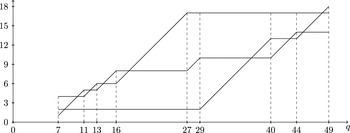
 $$\begin{eqnarray}(\text{}\underline{1},2,4),(2,\text{}\underline{4},\overline{5}),(2,\text{}\underline{5},\overline{6}),(2,\text{}\underline{6},\overline{8}),(2,\text{}\underline{8},\overline{17}),(\text{}\underline{2},\overline{10},17),(\text{}\underline{10},\overline{13},17),(\text{}\underline{13},\overline{14},17),(14,17,\overline{18}).\end{eqnarray}$$
In each triple except the last, we have underlined the coordinate which is not a coordinate of the next triple and, in the latter, we have overlined the new coordinate. In the notation of Condition (C2), the underlined coordinate of the
 $i$
th triple thus has index
 $k_{i}$
(if
 $i<9$
) and its overlined coordinate has index
 $\ell _{i}$
(if
 $i>1$
). Figure 1 shows the combined graph of the corresponding
 $3$
-system
 $\mathbf{P}:[7,49]\rightarrow \unicode[STIX]{x1D6E5}_{3}$
, with its switch numbers marked on the horizontal
 $q$
-axis.
The combined graph of the integral 3-system of Example 2.4.

3 Spectra of non-degenerate systems
Let
 $T=(T_{1},\ldots ,T_{m}):\mathbb{R}^{n}\rightarrow \mathbb{R}^{m}$
be a linear map. For each
 $n$
-system
 $\mathbf{P}$
with unbounded domain, we define
 $\unicode[STIX]{x1D707}_{T}(\mathbf{P})$
and
 ${\mathcal{F}}(\mathbf{P})$
as in Definitions 1.1 and 1.3, upon replacing everywhere the map
 $\mathbf{L}_{\mathbf{u}}$
by
 $\mathbf{P}$
. We also denote by
 ${\mathcal{K}}(\mathbf{P})$
the convex hull of
 ${\mathcal{F}}(\mathbf{P})$
. Then the same reasoning as in § 1 shows that
 $$\begin{eqnarray}\unicode[STIX]{x1D707}_{T}(\mathbf{P})=\inf T({\mathcal{F}}(\mathbf{P}))=\inf T({\mathcal{K}}(\mathbf{P})).\end{eqnarray}$$
We also note that, if
 $\mathbf{u}$
is a non-zero point of
 $\mathbb{R}^{n}$
and if
 $\mathbf{P}-\mathbf{L}_{\mathbf{u}}$
is bounded, then we have
 ${\mathcal{F}}(\mathbf{P})={\mathcal{F}}(\mathbf{L}_{\mathbf{u}})$
; thus,
 ${\mathcal{K}}(\mathbf{P})={\mathcal{K}}(\mathbf{L}_{\mathbf{u}})$
and
 $\unicode[STIX]{x1D707}_{T}(\mathbf{P})=\unicode[STIX]{x1D707}_{T}(\mathbf{L}_{\mathbf{u}})$
. In view of the approximation properties stated in Theorems 2.2 and 2.3, this yields the following alternative descriptions of the spectrum of
 $\unicode[STIX]{x1D707}_{T}$
.
Theorem 3.1. Let
 $T:\mathbb{R}^{n}\rightarrow \mathbb{R}^{m}$
be any linear map, as above. Then
 $\text{Im}(\unicode[STIX]{x1D707}_{T})$
is the set of all points
 $\unicode[STIX]{x1D707}_{T}(\mathbf{P})$
where
 $\mathbf{P}$
runs through the
 $n$
-systems with unbounded domain, while
 $\text{Im}^{\ast }(\unicode[STIX]{x1D707}_{T})$
consists of all
 $\unicode[STIX]{x1D707}_{T}(\mathbf{P})$
where
 $\mathbf{P}$
runs through the proper
 $n$
-systems. For any
 $\unicode[STIX]{x1D6FF}>0$
, this statement remains true if we restrict to rigid
 $n$
-systems of mesh
 $\unicode[STIX]{x1D6FF}$
of the same types. In particular, it remains true if we restrict to non-degenerate
 $n$
-systems of the same types.
Thus, all statements of the introduction naturally translate into statements about
 $n$
-systems, and we will prove them in this form. For that purpose, the following fact will be useful.
Proposition 3.2. Let
 $\mathbf{P}:[w_{0},\infty )\rightarrow \unicode[STIX]{x1D6E5}_{n}$
be a proper
 $n$
-system, let
 $w_{0}<w_{1}<w_{2}<\cdots \,$
be its division numbers and let
 $E$
be the set of limit points of the sequence
 $(w_{i}^{-1}\mathbf{P}(w_{i}))_{i\geqslant 1}$
. Then
 ${\mathcal{K}}(\mathbf{P})$
is the convex hull of
 $E$
.
Proof. Since
 $E$
is contained in
 ${\mathcal{F}}(\mathbf{P})$
, its convex hull is contained in
 ${\mathcal{K}}(\mathbf{P})$
. To show the converse, fix an arbitrary point
 $\mathbf{x}$
of
 ${\mathcal{F}}(\mathbf{P})$
. It remains to show that
 $\mathbf{x}$
belongs to the convex hull of
 $E$
. By definition, that point is given by
 $\mathbf{x}=\lim _{i\rightarrow \infty }t_{i}^{-1}\mathbf{P}(t_{i})$
for some unbounded sequence
 $(t_{i})_{i\geqslant 1}$
in
 $(w_{0},\infty )$
. For each
 $i\geqslant 1$
, let
 $u_{i}<v_{i}$
be the consecutive division numbers of
 $\mathbf{P}$
for which
 $t_{i}\in [u_{i},v_{i}]$
, and put
 $\unicode[STIX]{x1D706}_{i}=u_{i}(v_{i}-t_{i})/(t_{i}(v_{i}-u_{i}))\in [0,1]$
. Then we find that
 $$\begin{eqnarray}t_{i}^{-1}\mathbf{P}(t_{i})=t_{i}^{-1}\biggl(\mathbf{P}(u_{i})+\frac{t_{i}-u_{i}}{v_{i}-u_{i}}(\mathbf{P}(v_{i})-\mathbf{P}(u_{i}))\biggr)=\unicode[STIX]{x1D706}_{i}u_{i}^{-1}\mathbf{P}(u_{i})+(1-\unicode[STIX]{x1D706}_{i})v_{i}^{-1}\mathbf{P}(v_{i}),\end{eqnarray}$$
because
 $\mathbf{P}$
is affine on
 $[u_{i},v_{i}]$
. As the triples
 $(u_{i}^{-1}\mathbf{P}(u_{i}),v_{i}^{-1}\mathbf{P}(v_{i}),\unicode[STIX]{x1D706}_{i})$
with
 $i\geqslant 1$
form a sequence in
 $[0,1]^{n}\times [0,1]^{n}\times [0,1]$
, and as the latter product is compact, this sequence contains a converging subsequence whose limit is a point
 $(\mathbf{y},\mathbf{z},\unicode[STIX]{x1D706})$
in
 $E\times E\times [0,1]$
. By continuity, we conclude that
 $\mathbf{x}=\unicode[STIX]{x1D706}\mathbf{y}+(1-\unicode[STIX]{x1D706})\mathbf{z}$
, as required.◻
In the case where
 $\mathbf{P}$
is self-similar, the sequence
 $(w_{i}^{-1}\mathbf{P}(w_{i}))_{i\geqslant 1}$
is periodic and the conclusion simplifies as follows.
Corollary 3.3. Suppose moreover that
 $\mathbf{P}$
is self-similar. Let
 $\unicode[STIX]{x1D70C}>1$
be such that
 $\mathbf{P}(\unicode[STIX]{x1D70C}q)=\unicode[STIX]{x1D70C}\mathbf{P}(q)$
for each
 $q\geqslant q_{0}$
, and let
 $s\geqslant 1$
be the index for which
 $\unicode[STIX]{x1D70C}w_{1}=w_{s+1}$
. Then
 ${\mathcal{K}}(\mathbf{P})$
is the convex hull of
 $\{w_{1}^{-1}\mathbf{P}(w_{1}),\ldots ,w_{s}^{-1}\mathbf{P}(w_{s})\}$
.
The rest of this section is devoted to the following construction.
Proposition 3.4. Let
 $\unicode[STIX]{x1D708}:[0,\infty )\rightarrow [0,\infty )$
be a strictly increasing continuous function, and let
 $\mathbf{P}$
be an
 $n$
-system on a subinterval
 $I$
of
 $[0,\infty )$
. Define
 $\mathbf{a}^{\unicode[STIX]{x1D708}}=(\unicode[STIX]{x1D708}(a_{1}),\ldots ,\unicode[STIX]{x1D708}(a_{n}))$
for each point
 $\mathbf{a}=(a_{1},\ldots ,a_{n})$
in
 $[0,\infty )^{n}$
. Then there is a unique
 $n$
-system, denoted
 $\mathbf{P}^{\unicode[STIX]{x1D708}}$
, whose image is the set
 $\{\mathbf{P}(q)^{\unicode[STIX]{x1D708}};q\in I\}$
. Its switch points (respectively its division points) are the points
 $\mathbf{a}^{\unicode[STIX]{x1D708}}$
where
 $\mathbf{a}$
is a switch point (respectively a division point) of
 $\mathbf{P}$
.
Proof. Write
 $\mathbf{P}=(P_{1},\ldots ,P_{n})$
and consider the function
 $\unicode[STIX]{x1D70E}:I\rightarrow [0,\infty )$
given by
 $$\begin{eqnarray}\unicode[STIX]{x1D70E}(q)=\unicode[STIX]{x1D708}(P_{1}(q))+\cdots +\unicode[STIX]{x1D708}(P_{n}(q))\quad (q\in I).\end{eqnarray}$$
This is a continuous and strictly increasing map. So, it restricts to a homeomorphism
 $\unicode[STIX]{x1D70E}:I\rightarrow J$
where
 $J$
, the image of
 $\unicode[STIX]{x1D70E}$
, is a subinterval of
 $[0,\infty )$
. If there exists an
 $n$
-system
 $\mathbf{P}^{\unicode[STIX]{x1D708}}$
as in the statement of the proposition, then its domain is
 $J$
and it satisfies
 $$\begin{eqnarray}\mathbf{P}^{\unicode[STIX]{x1D708}}(\unicode[STIX]{x1D70E}(q))=\mathbf{P}(q)^{\unicode[STIX]{x1D708}}\quad (q\in I).\end{eqnarray}$$
We now show that the function
 $\mathbf{P}^{\unicode[STIX]{x1D708}}:J\rightarrow \mathbb{R}^{n}$
defined by the above formula is an
 $n$
-system. Fix
 $q\in I$
. Condition (S1) clearly holds for
 $\mathbf{P}^{\unicode[STIX]{x1D708}}$
at the point
 $\unicode[STIX]{x1D70E}(q)\in J$
. Since
 $\mathbf{P}$
is an
 $n$
-system, there are integers
 $k,\ell \in \{1,\ldots ,n\}$
such that, in a neighborhood
 ${\mathcal{U}}$
of
 $q$
in
 $I$
, the component
 $P_{j}$
of
 $\mathbf{P}$
is constant to the left of
 $q$
if
 $j\neq \ell$
, and constant to the right of
 $q$
if
 $j\neq k$
. Then
 $\unicode[STIX]{x1D70E}({\mathcal{U}})$
is a neighborhood
 $\unicode[STIX]{x1D70E}(q)$
in
 $J$
such that the
 $j$
th component
 $P_{j}^{\unicode[STIX]{x1D708}}$
of
 $\mathbf{P}^{\unicode[STIX]{x1D708}}$
is constant to the left of
 $\unicode[STIX]{x1D70E}(q)$
if
 $j\neq \ell$
, and constant to its right if
 $j\neq k$
. Then, because of Condition (S1), the remaining component
 $P_{\ell }^{\unicode[STIX]{x1D708}}$
(respectively
 $P_{k}^{\unicode[STIX]{x1D708}}$
) is affine of slope
 $1$
to the left (respectively right) of
 $\unicode[STIX]{x1D70E}(q)$
in
 $\unicode[STIX]{x1D70E}({\mathcal{U}})$
. Moreover, if
 $\ell <k$
, we have
 $P_{\ell }(q)=\cdots =P_{k}(q)$
and so
 $P_{\ell }^{\unicode[STIX]{x1D708}}(\unicode[STIX]{x1D70E}(q))=\cdots =P_{k}^{\unicode[STIX]{x1D708}}(\unicode[STIX]{x1D70E}(q))$
. Thus, Conditions (S2) and (S3) hold as well, showing that
 $\mathbf{P}^{\unicode[STIX]{x1D708}}$
is an
 $n$
-system. Moreover, it follows from the above that
 $\unicode[STIX]{x1D70E}(q)$
is a switch number or a division number of
 $\mathbf{P}^{\unicode[STIX]{x1D708}}$
if and only if
 $q$
is of the same type for
 $\mathbf{P}$
.◻
Corollary 3.5. Let
 $T:\mathbb{R}^{n}\rightarrow \mathbb{R}^{m}$
be a linear map. For each self-similar proper
 $n$
-system
 $\mathbf{P}$
, the point
 $\unicode[STIX]{x1D707}_{T}(\mathbf{P})$
belongs to the connected component of
 $n^{-1}T(1,\ldots ,1)$
in
 $\text{Im}^{\ast }(\unicode[STIX]{x1D707}_{T})$
.
Proof. Let
 $\mathbf{P}=(P_{1},\ldots ,P_{n}):[w_{0},\infty )\rightarrow \unicode[STIX]{x1D6E5}_{n}$
be a proper self-similar
 $n$
-system, let
 $w_{0}<w_{1}<w_{2}<\cdots \,$
be its division numbers, let
 $\unicode[STIX]{x1D70C}>1$
be such that
 $\mathbf{P}(\unicode[STIX]{x1D70C}q)=\unicode[STIX]{x1D70C}\mathbf{P}(q)$
for each
 $q\geqslant w_{0}$
and let
 $s\geqslant 1$
be the index for which
 $w_{s+1}=\unicode[STIX]{x1D70C}w_{1}$
. For each
 $\unicode[STIX]{x1D706}\in (0,1]$
, we denote by
 $\mathbf{P}^{\unicode[STIX]{x1D706}}$
, instead of
 $\mathbf{P}^{\unicode[STIX]{x1D708}_{\unicode[STIX]{x1D706}}}$
, the
 $n$
-system given by the above proposition for the map
 $\unicode[STIX]{x1D708}_{\unicode[STIX]{x1D706}}$
sending each
 $a\geqslant 0$
to
 $a^{\unicode[STIX]{x1D706}}$
. Then, for each
 $q\geqslant w_{0}$
, we have
 $$\begin{eqnarray}\mathbf{P}^{\unicode[STIX]{x1D706}}(\unicode[STIX]{x1D70E}_{\unicode[STIX]{x1D706}}(q))=(P_{1}(q)^{\unicode[STIX]{x1D706}},\ldots ,P_{n}(q)^{\unicode[STIX]{x1D706}}),\quad \text{where }\unicode[STIX]{x1D70E}_{\unicode[STIX]{x1D706}}(q)=P_{1}(q)^{\unicode[STIX]{x1D706}}+\cdots +P_{n}(q)^{\unicode[STIX]{x1D706}}.\end{eqnarray}$$
It follows that
 $\mathbf{P}^{\unicode[STIX]{x1D706}}$
is proper and self-similar with
 $\mathbf{P}^{\unicode[STIX]{x1D706}}(\unicode[STIX]{x1D70C}^{\unicode[STIX]{x1D706}}t)=\unicode[STIX]{x1D70C}^{\unicode[STIX]{x1D706}}\mathbf{P}^{\unicode[STIX]{x1D706}}(t)$
for each
 $t\geqslant \unicode[STIX]{x1D70E}_{\unicode[STIX]{x1D706}}(w_{0})$
. Its division numbers are
 $\unicode[STIX]{x1D70E}_{\unicode[STIX]{x1D706}}(w_{0})<\unicode[STIX]{x1D70E}_{\unicode[STIX]{x1D706}}(w_{1})<\unicode[STIX]{x1D70E}_{\unicode[STIX]{x1D706}}(w_{2})<\cdots \,$
and we have
 $\unicode[STIX]{x1D70E}_{\unicode[STIX]{x1D706}}(w_{s+1})=\unicode[STIX]{x1D70C}^{\unicode[STIX]{x1D706}}\unicode[STIX]{x1D70E}_{\unicode[STIX]{x1D706}}(w_{1})$
. According to Corollary 3.3, this implies that
 ${\mathcal{K}}(\mathbf{P}^{\unicode[STIX]{x1D706}})$
is the convex hull of the set
 $$\begin{eqnarray}E_{\unicode[STIX]{x1D706}}:=\{\unicode[STIX]{x1D70E}_{\unicode[STIX]{x1D706}}(w_{i})^{-1}\mathbf{P}^{\unicode[STIX]{x1D706}}(\unicode[STIX]{x1D70E}_{\unicode[STIX]{x1D706}}(w_{i}));1\leqslant i\leqslant s\}\end{eqnarray}$$
and so
 $\unicode[STIX]{x1D707}_{T}(\mathbf{P}^{\unicode[STIX]{x1D706}})=\min T(E_{\unicode[STIX]{x1D706}})$
is a continuous function of
 $\unicode[STIX]{x1D706}$
on
 $(0,1]$
. Since
 $\mathbf{P}$
is proper and self-similar, we also note that
 $P_{1}$
vanishes nowhere on
 $[w_{0},\infty )$
except possibly at
 $w_{0}$
if
 $w_{0}=0$
. Thus, as
 $\unicode[STIX]{x1D706}$
goes to
 $0$
in
 $(0,1]$
, the ratios
 $P_{j}(w_{i})^{\unicode[STIX]{x1D706}}/P_{1}(w_{i})^{\unicode[STIX]{x1D706}}$
with
 $1\leqslant i\leqslant s$
and
 $1\leqslant j\leqslant n$
all converge to
 $1$
. Consequently, the elements of
 $E_{\unicode[STIX]{x1D706}}$
converge to
 $n^{-1}\mathbf{e}$
, where
 $\mathbf{e}=(1,\ldots ,1)$
, and so
 $\unicode[STIX]{x1D707}_{T}(\mathbf{P}^{\unicode[STIX]{x1D706}})$
converges to
 $n^{-1}T(\mathbf{e})$
. Moreover, the proper
 $n$
-system
 $\mathbf{S}$
attached to the infinite canvas
 $\{(i+1,\ldots ,i+n);i\geqslant 0\}$
has
 ${\mathcal{F}}(\mathbf{S})=\{n^{-1}\mathbf{e}\}$
and so
 $\unicode[STIX]{x1D707}_{T}(\mathbf{S})=n^{-1}T(\mathbf{e})$
belongs to
 $\text{Im}^{\ast }(\unicode[STIX]{x1D707}_{T})$
. This means that the points
 $\unicode[STIX]{x1D707}_{T}(\mathbf{P})$
and
 $\unicode[STIX]{x1D707}_{T}(\mathbf{S})$
are connected by an arc in
 $\text{Im}^{\ast }(\unicode[STIX]{x1D707}_{T})$
. Thus, they belong to the same connected component of that set.◻
4 Approximation of sets
For any subsets
 $E$
and
 $F$
of
 $\mathbb{R}^{n}$
, we define
 $$\begin{eqnarray}E+F=\{\mathbf{x}+\mathbf{y};\mathbf{x}\in E\text{ and }\mathbf{y}\in F\}.\end{eqnarray}$$
When
 $E$
and
 $F$
are bounded, we define their mutual distance
 $\text{dist}(E,F)$
to be the infimum of all
 $\unicode[STIX]{x1D716}>0$
such that
 $$\begin{eqnarray}E\subseteq F+[-\unicode[STIX]{x1D716},\unicode[STIX]{x1D716}]^{n}\quad \text{and}\quad F\subseteq E+[-\unicode[STIX]{x1D716},\unicode[STIX]{x1D716}]^{n}.\end{eqnarray}$$
This function satisfies the triangle inequality:
 $$\begin{eqnarray}\text{dist}(E,G)\leqslant \text{dist}(E,F)+\text{dist}(F,G)\end{eqnarray}$$
for any bounded subsets
 $E$
,
 $F$
and
 $G$
of
 $\mathbb{R}^{n}$
. It turns the set of all compact subsets of
 $[0,1]^{n}$
into a complete metric space.
The goal of this section is the following approximation result.
Lemma 4.1. Let
 $\mathbf{R}$
be an
 $n$
-system on some unbounded closed subinterval
 $[q_{0},\infty )$
of
 $(0,\infty )$
, and let
 $\unicode[STIX]{x1D716}>0$
. Then there exists
 $u\geqslant q_{0}$
such that
 $$\begin{eqnarray}\{q^{-1}\mathbf{R}(q);q\geqslant u\}\subseteq {\mathcal{F}}(\mathbf{R})+[-\unicode[STIX]{x1D716},\unicode[STIX]{x1D716}]^{n}.\end{eqnarray}$$
Moreover, for each
 $u\geqslant q_{0}$
, there exists
 $v>u$
such that
 $$\begin{eqnarray}{\mathcal{F}}(\mathbf{R})\subseteq \{q^{-1}\mathbf{R}(q);u\leqslant q\leqslant v\}+[-\unicode[STIX]{x1D716},\unicode[STIX]{x1D716}]^{n}.\end{eqnarray}$$
Note that, if
 $u=u_{0}$
satisfies (4.1), then any choice of
 $u$
with
 $u\geqslant u_{0}$
does so. Similarly, if for a given
 $u\geqslant q_{0}$
, the choice of
 $v=v_{0}$
satisfies (4.2), then any choice of
 $v$
with
 $v\geqslant v_{0}$
does so.
Proof. Since
 ${\mathcal{F}}(\mathbf{R})\subseteq [0,1]^{n}$
, there exist finitely many points
 $\mathbf{x}_{1},\ldots ,\mathbf{x}_{N}\in {\mathcal{F}}(\mathbf{R})$
such that
 $$\begin{eqnarray}{\mathcal{F}}(\mathbf{R})\subseteq {\mathcal{O}}:=\{\mathbf{x}_{1},\ldots ,\mathbf{x}_{N}\}+(-\unicode[STIX]{x1D716}/2,\unicode[STIX]{x1D716}/2)^{n}.\end{eqnarray}$$
Since
 ${\mathcal{O}}$
is an open set, the difference
 $[0,1]^{n}\setminus {\mathcal{O}}$
is compact. By definition of
 ${\mathcal{F}}(\mathbf{R})$
, there is no unbounded sequence of real numbers
 $q_{0}<q_{1}<q_{2}<\cdots \,$
such that
 $q_{i}^{-1}\mathbf{R}(q_{i})\in [0,1]^{n}\setminus {\mathcal{O}}$
for all
 $i\geqslant 1$
(otherwise a subsequence of
 $(q_{i}^{-1}\mathbf{R}(q_{i}))_{i\geqslant 1}$
would converge to a point of
 ${\mathcal{F}}(\mathbf{R})$
in
 $[0,1]^{n}\setminus {\mathcal{O}}$
, and there is no such point). Thus, there exists
 $u\geqslant q_{0}$
such that
 $$\begin{eqnarray}\{q^{-1}\mathbf{R}(q);q\geqslant u\}\subseteq {\mathcal{O}}\subseteq {\mathcal{F}}(\mathbf{R})+(-\unicode[STIX]{x1D716}/2,\unicode[STIX]{x1D716}/2)^{n}.\end{eqnarray}$$
This proves the first assertion of the lemma. Finally, let
 $u\geqslant q_{0}$
be arbitrary. For each
 $j=1,\ldots ,N$
, there exists
 $q_{j}>u$
such that
 $\Vert \mathbf{x}_{j}-q_{j}^{-1}\mathbf{R}(q_{j})\Vert _{\infty }<\unicode[STIX]{x1D716}/2$
. Then we have
 $$\begin{eqnarray}{\mathcal{F}}(\mathbf{R})\subseteq {\mathcal{O}}\subseteq \{q_{j}^{-1}\mathbf{R}(q_{j});1\leqslant j\leqslant N\}+(-\unicode[STIX]{x1D716},\unicode[STIX]{x1D716})^{n}\end{eqnarray}$$
and so (4.2) holds with
 $v=\max \{q_{1},\ldots ,q_{N}\}$
.◻
Corollary 4.2. When
 $u$
and
 $v$
satisfy both conditions of the lemma, we have
 $$\begin{eqnarray}\text{dist}({\mathcal{F}}(\mathbf{R}),F)\leqslant \unicode[STIX]{x1D716},\quad \text{where }F=\{q^{-1}\mathbf{R}(q);u\leqslant q\leqslant v\}.\end{eqnarray}$$
5 Two types of deformations
Our next goal is to show that, for each linear map
 $T:\mathbb{R}^{n}\rightarrow \mathbb{R}^{m}$
, the associated spectrum
 $\text{Im}^{\ast }(\unicode[STIX]{x1D707}_{T})$
is a compact subset of
 $\mathbb{R}^{m}$
, and that a dense subset of that set is provided by the points
 $\unicode[STIX]{x1D707}_{T}(\mathbf{S})$
where
 $\mathbf{S}$
runs through all self-similar rigid
 $n$
-systems of a given mesh. This requires constructing new
 $n$
-systems from others by restricting them to suitable compact intervals, and then by modifying and rescaling the resulting pieces in order to glue them together. To select suitable intervals, we use Lemma 4.1 and its corollary from the previous section. Then we make two types of deformations on the pieces. The first one is provided by the following result, which allows us to modify a rigid
 $n$
-system on a compact interval near the end of that interval.
Proposition 5.1. Let
 $\unicode[STIX]{x1D6FF}>0$
, let
 $\mathbf{P}=(P_{1},\ldots ,P_{n}):[u,v]\rightarrow \unicode[STIX]{x1D6E5}_{n}$
be a rigid
 $n$
-system of mesh
 $\unicode[STIX]{x1D6FF}$
defined on a compact subinterval
 $[u,v]$
of
 $(0,\infty )$
and let
 $\mathbf{c}=(c_{1},\ldots ,c_{n})$
be a strictly increasing sequence of positive multiples of
 $\unicode[STIX]{x1D6FF}$
. Suppose that we have
 $P_{j}(v)\leqslant c_{j}$
for
 $j=1,\ldots ,n$
, and let
 $w=c_{1}+\cdots +c_{n}$
. Then there exist a rigid
 $n$
-system
 $\tilde{\mathbf{P}}=(\tilde{P}_{1},\ldots ,\tilde{P}_{n}):[u,w]\rightarrow \unicode[STIX]{x1D6E5}_{n}$
of the same mesh
 $\unicode[STIX]{x1D6FF}$
and a surjective map
 $A:[u,w]\rightarrow [u,v]$
with the following properties:
-
(i)
$\tilde{\mathbf{P}}(q)=\mathbf{P}(q)$
and
$A(q)=q$
for each
$q\in [u,v]$
such that
$P_{n}(q)<P_{n}(v)$
; -
(ii)
$\tilde{\mathbf{P}}(w)=\mathbf{c}$
; -
(iii)
$0\leqslant \tilde{P}_{j}(q)-P_{j}(A(q))\leqslant c_{j}-P_{j}(v)$
for each
$q\in [u,w]$
and each
$j=1,\ldots ,n$
.


Proof. Suppose first that there exists an index
 $m$
with
 $1\leqslant m\leqslant n$
such that
 $c_{m}>P_{m}(v)$
while
 $c_{j}=P_{j}(v)$
for any other index
 $j$
in the same range. Let
 $(\mathbf{a}^{(1)},\ldots ,\mathbf{a}^{(s)})$
be the finite canvas attached to
 $\mathbf{P}$
, and let
 $(q_{1},\ldots ,q_{s})$
be the corresponding sequence of switch numbers, so that
 $u=q_{1}$
,
 $v=q_{s}$
and
 $\mathbf{P}(q_{i})=\mathbf{a}^{(i)}$
for
 $i=1,\ldots ,s$
. For
 $i=1,\ldots ,s-1$
, we also denote by
 $(k_{i},\ell _{i+1})$
the pair of transition indices characterized by
 $P_{k_{i}}^{\prime }(q_{i}^{+})=P_{\ell _{i+1}}^{\prime }(q_{i+1}^{-})=1$
. Define
 $$\begin{eqnarray}\unicode[STIX]{x1D6FF}_{m}=c_{m}-P_{m}(v)\end{eqnarray}$$
and denote by
 $r$
the smallest index with
 $1\leqslant r\leqslant s$
such that
 $$\begin{eqnarray}a_{j}^{(r)}=\cdots =a_{j}^{(s)}\quad \text{for }j=m,\ldots ,n.\end{eqnarray}$$
Then we have
 $\ell _{i}<m$
for each
 $i$
with
 $r<i\leqslant s$
, and moreover
 $\ell _{r}\geqslant m$
if
 $r\geqslant 2$
. In the case where
 $r\geqslant 2$
and
 $\ell _{r}>m$
, we form the canvas
 $$\begin{eqnarray}(\tilde{\mathbf{a}}^{(1)},\ldots ,\tilde{\mathbf{a}}^{(s+1)})=(\mathbf{a}^{(1)},\ldots ,\mathbf{a}^{(r)},\tilde{\mathbf{a}}^{(r+1)},\ldots ,\tilde{\mathbf{a}}^{(s+1)}),\end{eqnarray}$$
where
 $\tilde{\mathbf{a}}^{(r+1)},\ldots ,\tilde{\mathbf{a}}^{(s+1)}$
are obtained respectively from
 $\mathbf{a}^{(r)},\ldots ,\mathbf{a}^{(s)}$
by replacing their
 $m$
th coordinate by
 $c_{m}$
. Its associated transition indices and switch numbers are given by
 $$\begin{eqnarray}(\tilde{k}_{i},\tilde{\ell }_{i+1})=\left\{\begin{array}{@{}ll@{}}(k_{i},\ell _{i+1})\quad & \text{if }1\leqslant i\leqslant r-1,\\ (m,m)\quad & \text{if }i=r,\\ (k_{i-1},\ell _{i})\quad & \text{if }r+1\leqslant i\leqslant s+1,\end{array}\right.\quad \tilde{q}_{i}=\left\{\begin{array}{@{}ll@{}}q_{i}\quad & \text{if }1\leqslant i\leqslant r,\\ q_{i-1}+\unicode[STIX]{x1D6FF}_{m}\quad & \text{if }r+1\leqslant i\leqslant s+1.\end{array}\right.\end{eqnarray}$$
In the complementary cases where
 $r=1$
and where
 $r\geqslant 2$
with
 $\ell _{r}=m$
, we construct a canvas
 $(\tilde{\mathbf{a}}^{(1)},\ldots ,\tilde{\mathbf{a}}^{(s)})$
directly from
 $(\mathbf{a}^{(1)},\ldots ,\mathbf{a}^{(s)})$
by replacing the
 $m$
th coordinate
 $a_{m}^{(i)}$
of
 $\mathbf{a}^{(i)}$
by
 $c_{m}$
for
 $i=r,\ldots ,s$
. Its transition indices remain the same as those of the original canvas, and its switch numbers are
 $\tilde{q}_{i}=q_{i}$
for
 $i=1,\ldots ,r-1$
and
 $\tilde{q}_{i}=q_{i}+\unicode[STIX]{x1D6FF}_{m}$
for
 $i=r,\ldots ,s$
. In all cases, the corresponding
 $n$
-system
 $\tilde{\mathbf{P}}=(\tilde{P}_{1},\ldots ,\tilde{P}_{n}):[q_{1},q_{s}+\unicode[STIX]{x1D6FF}_{m}]\rightarrow \unicode[STIX]{x1D6E5}_{n}$
satisfies
 $$\begin{eqnarray}\tilde{P}_{j}(q)=\left\{\begin{array}{@{}ll@{}}P_{j}(q)\quad & \text{if }q_{1}\leqslant q\leqslant q_{r},\\ P_{j}(q_{r})\quad & \text{if }q_{r}\leqslant q\leqslant q_{r}+\unicode[STIX]{x1D6FF}_{m}\text{ and }j\neq m,\\ P_{m}(q_{r})+q-q_{r}\quad & \text{if }q_{r}\leqslant q\leqslant q_{r}+\unicode[STIX]{x1D6FF}_{m}\text{ and }j=m,\\ P_{j}(q-\unicode[STIX]{x1D6FF}_{m})\quad & \text{if }q_{r}+\unicode[STIX]{x1D6FF}_{m}\leqslant q\leqslant q_{s}+\unicode[STIX]{x1D6FF}_{m}\text{ and }j\neq m,\\ P_{m}(q-\unicode[STIX]{x1D6FF}_{m})+\unicode[STIX]{x1D6FF}_{m}=c_{m}\quad & \text{if }q_{r}+\unicode[STIX]{x1D6FF}_{m}\leqslant q\leqslant q_{s}+\unicode[STIX]{x1D6FF}_{m}\text{ and }j=m.\end{array}\right.\end{eqnarray}$$
So, it satisfies the conditions (i)–(iii) with
 $w=q_{s}+\unicode[STIX]{x1D6FF}_{m}$
and the map
 $A:[q_{1},q_{s}+\unicode[STIX]{x1D6FF}_{m}]\rightarrow [q_{1},q_{s}]$
given by
 $$\begin{eqnarray}A(q)=\left\{\begin{array}{@{}ll@{}}q\quad & \text{if }q_{1}\leqslant q\leqslant q_{r},\\ q_{r}\quad & \text{if }q_{r}\leqslant q\leqslant q_{r}+\unicode[STIX]{x1D6FF}_{m},\\ q-\unicode[STIX]{x1D6FF}_{m}\quad & \text{if }q_{r}+\unicode[STIX]{x1D6FF}_{m}\leqslant q\leqslant q_{s}+\unicode[STIX]{x1D6FF}_{m}.\end{array}\right.\end{eqnarray}$$
This proves the proposition in the case where
 $\mathbf{c}$
and
 $\mathbf{P}(v)$
differ by at most one coordinate, because, if
 $\mathbf{c}=\mathbf{P}(v)$
, it suffices to choose
 $w=v$
,
 $\tilde{\mathbf{P}}=\mathbf{P}$
and to take for
 $A$
the identity map of
 $[u,v]$
. Moreover, for each
 $q\in [u,v]$
with
 $P_{n}(q)<P_{n}(v)$
, the constructed map
 $\tilde{\mathbf{P}}$
satisfies
 $\tilde{P}_{n}(q)<\tilde{P}_{n}(w)$
, because
 $\tilde{P}_{n}(q)=P_{n}(q)$
and
 $P_{n}(v)\leqslant c_{n}=\tilde{P}_{n}(w)$
.
For the general case, define
 $$\begin{eqnarray}\mathbf{c}^{(m)}=(P_{1}(v),\ldots ,P_{m-1}(v),c_{m},\ldots ,c_{n})\quad \text{and}\quad v^{(m)}=v+\unicode[STIX]{x1D6FF}_{m}+\cdots +\unicode[STIX]{x1D6FF}_{n}\end{eqnarray}$$
for
 $m=1,\ldots ,n+1$
, with
 $\unicode[STIX]{x1D6FF}_{m}$
given by (5.1) as above. Starting from the
 $n$
-system
 $\mathbf{P}^{(n+1)}=\mathbf{P}$
on
 $[u,v^{(n+1)}]=[u,v]$
, the special case proved above allows us to construct recursively, for each
 $m=n,\ldots ,1$
, an
 $n$
-system
 $\mathbf{P}^{(m)}$
on
 $[u,v^{(m)}]$
and a surjective map
 $A^{(m)}:[u,v^{(m)}]\rightarrow [u,v^{(m+1)}]$
such that:
-
(1)
$\mathbf{P}^{(m)}(q)=\mathbf{P}(q)$
and
$A^{(m)}(q)=q$
for each
$q\in [u,v]$
such that
$P_{n}(q)<P_{n}(v)$
; -
(2)
$\mathbf{P}^{(m)}(v^{(m)})=\mathbf{c}^{(m)}$
; -
(3)
$P_{j}^{(m)}(q)=P_{j}^{(m+1)}(A^{(m)}(q))$
for each
$q\in [u,v^{(m)}]$
and each
$j=1,\ldots ,n$
with
$j\neq m$
; -
(4)
$0\leqslant P_{m}^{(m)}(q)-P_{m}^{(m+1)}(A^{(m)}(q))\leqslant \unicode[STIX]{x1D6FF}_{m}$
for each
$q\in [u,v^{(m)}]$
.


Then the composite map
 $A=A^{(n)}\circ \cdots \circ A^{(1)}:[u,v^{(1)}]\rightarrow [u,v]$
is surjective. For that map and for the choice of
 $w=v^{(1)}$
, the
 $n$
-system
 $\tilde{\mathbf{P}}=\mathbf{P}^{(1)}$
satisfies all conditions (i)–(iii).◻
Example 5.2. To illustrate the above construction, suppose that
 $\mathbf{P}:[25,42]\rightarrow \unicode[STIX]{x1D6E5}_{4}$
is the
 $4$
-system associated with the integral canvas
 $$\begin{eqnarray}(1,3,\text{}\underline{9},12),(1,\text{}\underline{3},12,\overline{15}),(\text{}\underline{1},\overline{6},12,15),(6,\overline{9},12,15)\end{eqnarray}$$
and that
 $\mathbf{c}=(8,12,16,20)$
(using the same convention as in Example 2.4 for underlining and overlining coordinates of points in a canvas). Then, starting with
 $\mathbf{P}^{(5)}=\mathbf{P}$
, the canvases associated to
 $\mathbf{P}^{(4)},\ldots ,\mathbf{P}^{(1)}$
are respectively
 $$\begin{eqnarray}\displaystyle & & \displaystyle \mathbf{P}^{(4)}:(1,3,\text{}\underline{9},12),(1,\text{}\underline{3},12,\overline{20}),(\text{}\underline{1},\overline{6},12,20),(6,\overline{9},12,20),\nonumber\\ \displaystyle & & \displaystyle \mathbf{P}^{(3)}:(1,3,\text{}\underline{9},12),(1,3,\text{}\underline{12},\overline{20}),(1,\text{}\underline{3},\overline{16},20),(\text{}\underline{1},\overline{6},16,20),(6,\overline{9},16,20),\nonumber\\ \displaystyle & & \displaystyle \mathbf{P}^{(2)}:(1,3,\text{}\underline{9},12),(1,3,\text{}\underline{12},\overline{20}),(1,\text{}\underline{3},\overline{16},20),(\text{}\underline{1},\overline{6},16,20),(6,\overline{12},16,20),\nonumber\\ \displaystyle & & \displaystyle \mathbf{P}^{(1)}:(1,3,\text{}\underline{9},12),(1,3,\text{}\underline{12},\overline{20}),(1,\text{}\underline{3},\overline{16},20),(\text{}\underline{1},\overline{6},16,20),(\text{}\underline{6},\overline{12},16,20),(\overline{8},12,16,20).\nonumber\end{eqnarray}$$
In practice, we will use the proposition in the following form.
Corollary 5.3. With the notation and hypotheses of Proposition 5.1, suppose that
 $v>nu$
, and choose
 $\unicode[STIX]{x1D716}>0$
such that
 $c_{j}\leqslant P_{j}(v)+\unicode[STIX]{x1D716}v$
for
 $j=1,\ldots ,n$
. Then we have:
-
(i)
$\tilde{\mathbf{P}}(q)=\mathbf{P}(q)$
for each
$q\in [u,v/n)$
; -
(ii)
$\tilde{\mathbf{P}}(w)=\mathbf{c}$
; -
(iii)
$\text{dist}(E,\tilde{E})\leqslant n(n+1)\unicode[STIX]{x1D716}$
,


where
 $E=\{q^{-1}\mathbf{P}(q);u\leqslant q\leqslant v\}$
and
 $\tilde{E}=\{q^{-1}\tilde{\mathbf{P}}(q);u\leqslant q\leqslant w\}$
.
Proof. For each
 $q\in [u,v/n)$
, we have
 $$\begin{eqnarray}P_{n}(v)\geqslant \frac{1}{n}\mathop{\sum }_{j=1}^{n}P_{j}(v)=\frac{v}{n}>q=\mathop{\sum }_{j=1}^{n}P_{j}(q)\geqslant P_{n}(q)\end{eqnarray}$$
and so
 $\tilde{\mathbf{P}}(q)=\mathbf{P}(q)$
and
 $A(q)=q$
by Proposition 5.1(i). This proves part (i) of the corollary. Part (ii) needs no proof as it is the same as Proposition 5.1(ii). For each
 $q\in [v/n,w]$
, we find, by Proposition 5.1(iii), that
 $$\begin{eqnarray}0\leqslant q-A(q)=\mathop{\sum }_{j=1}^{n}(\tilde{P}_{j}(q)-P_{j}(A(q)))\leqslant \mathop{\sum }_{j=1}^{n}(c_{j}-P_{j}(v))\leqslant n\unicode[STIX]{x1D716}v\leqslant n^{2}\unicode[STIX]{x1D716}q\end{eqnarray}$$
and also
 $\Vert \tilde{\mathbf{P}}(q)-\mathbf{P}(A(q))\Vert _{\infty }\leqslant \unicode[STIX]{x1D716}v\leqslant n\unicode[STIX]{x1D716}q$
. Then, using
 $\Vert \mathbf{P}(A(q))\Vert _{\infty }\leqslant A(q)$
, we find that
 $$\begin{eqnarray}\displaystyle \Vert q^{-1}\tilde{\mathbf{P}}(q)-A(q)^{-1}\mathbf{P}(A(q))\Vert _{\infty } & {\leqslant} & \displaystyle q^{-1}\Vert \tilde{\mathbf{P}}(q)-\mathbf{P}(A(q))\Vert _{\infty }+|q^{-1}-A(q)^{-1}|\,\Vert \mathbf{P}(A(q))\Vert _{\infty }\nonumber\\ \displaystyle & {\leqslant} & \displaystyle n\unicode[STIX]{x1D716}+q^{-1}|A(q)-q|\nonumber\\ \displaystyle & {\leqslant} & \displaystyle n(n+1)\unicode[STIX]{x1D716}\nonumber\end{eqnarray}$$
for each
 $q\in [v/n,w]$
and therefore also for each
 $q\in [u,w]$
(because
 $\tilde{\mathbf{P}}(q)=\mathbf{P}(q)$
and
 $A(q)=q$
when
 $q\in [u,v/n)$
). This yields part (iii) of the corollary.◻
The other type of deformation that we need is provided by the next result, allowing us to increase by a given constant
 $b$
the components of a rigid
 $n$
-system.
Lemma 5.4. Let
 $\mathbf{R}=(R_{1},\ldots ,R_{n}):[u,v]\rightarrow \unicode[STIX]{x1D6E5}_{n}$
be a rigid
 $n$
-system of mesh
 $\unicode[STIX]{x1D6FF}$
defined on a compact subinterval
 $[u,v]$
of
 $(0,\infty )$
, and let
 $b\geqslant 0$
be a multiple of
 $\unicode[STIX]{x1D6FF}$
. Then its translation
 $\mathbf{P}:[u+nb,v+nb]\rightarrow \unicode[STIX]{x1D6E5}_{n}$
given by
 $$\begin{eqnarray}\mathbf{P}(q)=(b+R_{1}(q-nb),\ldots ,b+R_{n}(q-nb))\end{eqnarray}$$
for each
 $q\in [u+nb,v+nb]$
is also a rigid
 $n$
-system of mesh
 $\unicode[STIX]{x1D6FF}$
. Moreover, we have
 $$\begin{eqnarray}\Vert (q+nb)^{-1}\mathbf{P}(q+nb)-q^{-1}\mathbf{R}(q)\Vert _{\infty }\leqslant \frac{(n+1)b}{u+nb}\end{eqnarray}$$
for each
 $q\in [u,v]$
.
Proof. Put
 $\mathbf{b}=(b,\ldots ,b)\in \unicode[STIX]{x1D6E5}_{n}$
, and let
 $(\mathbf{a}^{(i)})_{1\leqslant i\leqslant s}$
be the canvas attached to
 $\mathbf{R}$
. Then the sequence
 $(\mathbf{b}+\mathbf{a}^{(i)})_{1\leqslant i\leqslant s}$
is a canvas of the same mesh
 $\unicode[STIX]{x1D6FF}$
, with the same pairs of transition indices, and
 $\mathbf{P}$
is the corresponding
 $n$
-system. This proves the first assertion. For the second one, fix
 $q\in [u,v]$
. Using
 $\Vert \mathbf{R}(q)\Vert _{\infty }\leqslant q$
, we find that
 $$\begin{eqnarray}\displaystyle \hspace{24.0pt}\Vert (q+nb)^{-1}\mathbf{P}(q+nb)-q^{-1}\mathbf{R}(q)\Vert _{\infty } & = & \displaystyle \Vert (q+nb)^{-1}\mathbf{b}+((q+nb)^{-1}-q^{-1})\mathbf{R}(q)\Vert _{\infty }\nonumber\\ \displaystyle & {\leqslant} & \displaystyle (q+nb)^{-1}b+|q(q+nb)^{-1}-1|=\frac{(n+1)b}{q+nb}.\hspace{24.0pt}\square\nonumber\end{eqnarray}$$
6 A refined approximation result
Recall that an
 $n$
-system
 $\mathbf{P}=(P_{1},\ldots ,P_{n})$
is proper if its first component
 $P_{1}$
is unbounded. This implies that the domain
 $I$
of
 $\mathbf{P}$
is unbounded and that there are arbitrarily large values of
 $q$
in
 $I$
for which
 $\mathbf{P}^{\prime }(q^{+})=\mathbf{e}_{1}$
(otherwise
 $P_{1}$
would be eventually constant, against the hypothesis). Then we may define a subset
 ${\mathcal{F}}(\mathbf{P},\mathbf{e}_{1})$
of
 ${\mathcal{F}}(\mathbf{P})$
as follows.
Definition 6.1. Let
 $\mathbf{P}=(P_{1},\ldots ,P_{n})$
be a proper
 $n$
-system, and let
 $I\subseteq [0,\infty )$
be its domain. We denote by
 ${\mathcal{F}}(\mathbf{P},\mathbf{e}_{1})$
the set of all points
 $\mathbf{x}\in \mathbb{R}^{n}$
for which there exists a strictly increasing unbounded sequence of positive real numbers
 $(q_{i})_{i\geqslant 1}$
in
 $I$
such that
 $\mathbf{P}^{\prime }(q_{i}^{+})=\mathbf{e}_{1}$
for each
 $i\geqslant 1$
, and
 $\lim _{i\rightarrow \infty }q_{i}^{-1}\mathbf{P}(q_{i})=\mathbf{x}$
.
Equivalently,
 ${\mathcal{F}}(\mathbf{P},\mathbf{e}_{1})$
is the set of accumulation points of the ratios
 $q^{-1}\mathbf{P}(q)\in [0,1]^{n}$
where
 $q\in I$
with
 $\mathbf{P}^{\prime }(q^{+})=\mathbf{e}_{1}$
. It is not empty since
 $[0,1]^{n}$
is compact.
We can now state the main result of this section, which refines Corollary 4.2 using the deformation process of Lemma 5.4. For the sake of compactness, we define
 $$\begin{eqnarray}\mathbf{e}=\mathbf{e}_{1}+\cdots +\mathbf{e}_{n}=(1,\ldots ,1).\end{eqnarray}$$
Proposition 6.2. Let
 $\unicode[STIX]{x1D6FF}>0$
, let
 $\mathbf{R}$
be a proper rigid
 $n$
-system of mesh
 $\unicode[STIX]{x1D6FF}$
and let
 $\mathbf{x}\in {\mathcal{F}}(\mathbf{R},\mathbf{e}_{1})$
. For any
 $\unicode[STIX]{x1D716}_{1}>0$
and any
 $\unicode[STIX]{x1D716}_{2}>0$
, there exist positive multiples
 $u$
and
 $v$
of
 $\unicode[STIX]{x1D6FF}$
with
 $u<v$
and a rigid
 $n$
-system
 $\mathbf{P}:[u,v]\rightarrow \unicode[STIX]{x1D6E5}_{n}$
of mesh
 $\unicode[STIX]{x1D6FF}$
satisfying the following properties:
-
(i)
$\mathbf{P}^{\prime }(u^{+})=\mathbf{e}_{1}$
; -
(ii)
$(1+3n\unicode[STIX]{x1D716}_{1})^{-1}(\mathbf{x}+\unicode[STIX]{x1D716}_{1}\mathbf{e})\leqslant u^{-1}\mathbf{P}(u)\leqslant \mathbf{x}+4\unicode[STIX]{x1D716}_{1}\mathbf{e}$
; -
(iii)
$\mathbf{x}-2\unicode[STIX]{x1D716}_{2}\mathbf{e}\leqslant v^{-1}\mathbf{P}(v)\leqslant \mathbf{x}+2\unicode[STIX]{x1D716}_{2}\mathbf{e}$
; -
(iv)
$\text{dist}({\mathcal{F}}(\mathbf{R}),E)\leqslant 4(n+1)\unicode[STIX]{x1D716}_{1}$
, where
$E=\{q^{-1}\mathbf{P}(q);q\in [u,v]\}$
.


Moreover, we may take
 $u$
to be arbitrarily large and, for a given appropriate choice of
 $u$
, we may take
 $v$
to be arbitrarily large.
Proof. Fix a choice of
 $\unicode[STIX]{x1D716}_{1},\unicode[STIX]{x1D716}_{2}>0$
. By definition of
 ${\mathcal{F}}(\mathbf{R},\mathbf{e}_{1})$
, there exist arbitrarily large multiples
 $u_{0}$
and
 $v_{0}$
of
 $\unicode[STIX]{x1D6FF}$
in the domain of
 $\mathbf{R}$
satisfying
 $$\begin{eqnarray}\mathbf{R}^{\prime }(u_{0}^{+})=\mathbf{e}_{1},\quad \Vert u_{0}^{-1}\mathbf{R}(u_{0})-\mathbf{x}\Vert _{\infty }\leqslant \unicode[STIX]{x1D716}_{1}\quad \text{and}\quad \Vert v_{0}^{-1}\mathbf{R}(v_{0})-\mathbf{x}\Vert _{\infty }\leqslant \unicode[STIX]{x1D716}_{2}.\end{eqnarray}$$
By Corollary 4.2, we can choose them so that
 $u_{0}<v_{0}$
and
 $$\begin{eqnarray}\text{dist}({\mathcal{F}}(\mathbf{R}),F)\leqslant \unicode[STIX]{x1D716}_{1},\quad \text{where }F=\{q^{-1}\mathbf{R}(q);u_{0}\leqslant q\leqslant v_{0}\}.\end{eqnarray}$$
More precisely, we can take for
 $u_{0}$
any sufficiently large multiple of
 $\unicode[STIX]{x1D6FF}$
satisfying the first two conditions in (6.2) and, once
 $u_{0}$
is fixed, we can take for
 $v_{0}$
any sufficiently large multiple of
 $\unicode[STIX]{x1D6FF}$
satisfying the last condition in (6.2). Put
 $$\begin{eqnarray}b=\lceil 2\unicode[STIX]{x1D716}_{1}u_{0}\unicode[STIX]{x1D6FF}^{-1}\rceil \unicode[STIX]{x1D6FF},\quad u=u_{0}+nb\quad \text{and}\quad v=v_{0}+nb\end{eqnarray}$$
and consider the map
 $\mathbf{P}:[u,v]\rightarrow \unicode[STIX]{x1D6E5}_{n}$
given by
 $\mathbf{P}(q)=\mathbf{R}(q-nb)+b\mathbf{e}$
for each
 $q\in [u,v]$
. According to Lemma 5.4, this is a rigid
 $n$
-system of mesh
 $\unicode[STIX]{x1D6FF}$
such that
 $$\begin{eqnarray}\text{dist}(F,E)\leqslant \frac{(n+1)b}{u_{0}+nb},\quad \text{where }E=\{q^{-1}\mathbf{P}(q);q\in [u,v]\}.\end{eqnarray}$$
Assuming
 $u_{0}$
large enough, we have
 $2\unicode[STIX]{x1D716}_{1}u_{0}\leqslant b\leqslant 3\unicode[STIX]{x1D716}_{1}u_{0}$
. Since
 $\Vert u_{0}^{-1}\mathbf{R}(u_{0})-\mathbf{x}\Vert _{\infty }\leqslant \unicode[STIX]{x1D716}_{1}$
, this yields
 $$\begin{eqnarray}\displaystyle u^{-1}\mathbf{P}(u) & {\geqslant} & \displaystyle (u_{0}+3n\unicode[STIX]{x1D716}_{1}u_{0})^{-1}(\mathbf{R}(u_{0})+2\unicode[STIX]{x1D716}_{1}u_{0}\mathbf{e})\geqslant (1+3n\unicode[STIX]{x1D716}_{1})^{-1}(\mathbf{x}+\unicode[STIX]{x1D716}_{1}\mathbf{e}),\nonumber\\ \displaystyle u^{-1}\mathbf{P}(u) & {\leqslant} & \displaystyle u_{0}^{-1}(\mathbf{R}(u_{0})+3\unicode[STIX]{x1D716}_{1}u_{0}\mathbf{e})\leqslant \mathbf{x}+4\unicode[STIX]{x1D716}_{1}\mathbf{e}.\nonumber\end{eqnarray}$$
Thus,
 $\mathbf{P}$
satisfies condition (ii). It also satisfies condition (i) since
 $\mathbf{P}^{\prime }(u^{+})=\mathbf{R}^{\prime }(u_{0}^{+})=\mathbf{e}_{1}$
. Assuming
 $v_{0}/u_{0}$
large enough, we also find that
 $$\begin{eqnarray}\Vert v^{-1}\mathbf{P}(v)-v_{0}^{-1}\mathbf{R}(v_{0})\Vert _{\infty }=\Vert (v_{0}+nb)^{-1}(\mathbf{R}(v_{0})+b\mathbf{e})-v_{0}^{-1}\mathbf{R}(v_{0})\Vert _{\infty }\leqslant \unicode[STIX]{x1D716}_{2}.\end{eqnarray}$$
Then condition (iii) follows as well, using (6.2). Finally, (6.3) and (6.4) yield
 $$\begin{eqnarray}\text{dist}({\mathcal{F}}(\mathbf{R}),E)\leqslant \unicode[STIX]{x1D716}_{1}+\frac{(n+1)b}{u_{0}+nb}\leqslant \unicode[STIX]{x1D716}_{1}+\frac{3(n+1)\unicode[STIX]{x1D716}_{1}u_{0}}{u_{0}}\leqslant 4(n+1)\unicode[STIX]{x1D716}_{1},\end{eqnarray}$$
as requested in condition (iv). By varying
 $u_{0}$
, we can make
 $u$
arbitrarily large and, for a fixed
 $u_{0}$
, we can make
 $v$
arbitrarily large by varying
 $v_{0}$
.◻
7 Approximation by self-similar systems
The next result corroborates the importance of self-similar systems. We use it below together with Corollary 3.5 to conclude that any spectrum of exponents of approximation (in the sense of Definition 1.1) is connected.
Theorem 7.1. Let
 $\mathbf{R}$
be a proper
 $n$
-system. For any
 $\unicode[STIX]{x1D6FF}>0$
and
 $\unicode[STIX]{x1D716}>0$
, there is a self-similar rigid
 $n$
-system
 $\mathbf{S}$
of mesh
 $\unicode[STIX]{x1D6FF}$
with
 $\text{dist}({\mathcal{F}}(\mathbf{R}),{\mathcal{F}}(\mathbf{S}))\leqslant \unicode[STIX]{x1D716}$
.
Proof. Fix
 $\unicode[STIX]{x1D6FF}>0$
and
 $\unicode[STIX]{x1D716}>0$
. By Theorem 2.3, we may assume that
 $\mathbf{R}$
is rigid of mesh
 $\unicode[STIX]{x1D6FF}$
. Choose
 $\mathbf{x}\in {\mathcal{F}}(\mathbf{R},\mathbf{e}_{1})$
and consider the
 $n$
-system
 $\mathbf{P}:[u,v]\rightarrow \unicode[STIX]{x1D6E5}_{n}$
given by Proposition 6.2 for the choice of
 $\unicode[STIX]{x1D716}_{1}=\min \{1,\unicode[STIX]{x1D716}\}/(16n^{2}(n+1))$
and
 $\unicode[STIX]{x1D716}_{2}=\unicode[STIX]{x1D716}_{1}/2$
. We take
 $v/u$
large enough with
 $v/u>n$
, so that the integer
 $m=\lceil (1+3n\unicode[STIX]{x1D716}_{1})vu^{-1}\rceil$
satisfies
 $m\leqslant (1+4n\unicode[STIX]{x1D716}_{1})vu^{-1}$
. This yields
 $$\begin{eqnarray}\displaystyle m\mathbf{P}(u) & {\geqslant} & \displaystyle (1+3n\unicode[STIX]{x1D716}_{1})vu^{-1}\mathbf{P}(u)\geqslant v(\mathbf{x}+\unicode[STIX]{x1D716}_{1}\mathbf{e})=v(\mathbf{x}+2\unicode[STIX]{x1D716}_{2}\mathbf{e})\geqslant \mathbf{P}(v),\nonumber\\ \displaystyle m\mathbf{P}(u) & {\leqslant} & \displaystyle mu(\mathbf{x}+4\unicode[STIX]{x1D716}_{1}\mathbf{e})\leqslant v(1+4n\unicode[STIX]{x1D716}_{1})(\mathbf{x}+4\unicode[STIX]{x1D716}_{1}\mathbf{e})\nonumber\\ \displaystyle & {\leqslant} & \displaystyle v(\mathbf{x}+4\unicode[STIX]{x1D716}_{1}\mathbf{e}+4n\unicode[STIX]{x1D716}_{1}(1+4\unicode[STIX]{x1D716}_{1})\mathbf{e})\leqslant v(\mathbf{x}+4\unicode[STIX]{x1D716}_{1}\mathbf{e}+5n\unicode[STIX]{x1D716}_{1}\mathbf{e})\leqslant \mathbf{P}(v)+8n\unicode[STIX]{x1D716}_{1}v\mathbf{e},\nonumber\end{eqnarray}$$
using
 $\mathbf{x}\leqslant \mathbf{e}$
,
 $\unicode[STIX]{x1D716}_{1}\leqslant 1/16$
and
 $n\geqslant 2$
, where
 $\mathbf{e}$
is given by (6.1). Then Corollary 5.3 applies to
 $\mathbf{P}$
for the choice of
 $\mathbf{c}=m\mathbf{P}(u)$
. It provides a rigid
 $n$
-system
 $\tilde{\mathbf{P}}:[u,mu]\rightarrow \unicode[STIX]{x1D6E5}_{n}$
of mesh
 $\unicode[STIX]{x1D6FF}$
such that
 $$\begin{eqnarray}\displaystyle & & \displaystyle \tilde{\mathbf{P}}(u)=\mathbf{P}(u)\quad \text{and}\quad \tilde{\mathbf{P}}^{\prime }(u^{+})=\mathbf{P}^{\prime }(u^{+})=\mathbf{e}_{1},\end{eqnarray}$$
 $$\begin{eqnarray}\displaystyle & & \displaystyle \tilde{\mathbf{P}}(mu)=m\mathbf{P}(u),\end{eqnarray}$$
 $$\begin{eqnarray}\displaystyle & & \displaystyle \text{dist}(E,\tilde{E})\leqslant 8n^{2}(n+1)\unicode[STIX]{x1D716}_{1}\leqslant \unicode[STIX]{x1D716}/2,\end{eqnarray}$$
where
 $E=\{q^{-1}\mathbf{P}(q);u\leqslant q\leqslant v\}$
and
 $\tilde{E}=\{q^{-1}\tilde{\mathbf{P}}(q);u\leqslant q\leqslant mu\}$
. By (7.1) and (7.2), the map
 $\tilde{\mathbf{P}}$
extends to a self-similar rigid
 $n$
-system
 $\mathbf{S}:[u,\infty )\rightarrow \unicode[STIX]{x1D6E5}_{n}$
of mesh
 $\unicode[STIX]{x1D6FF}$
satisfying
 $\mathbf{S}(mq)=m\mathbf{S}(q)$
for each
 $q\geqslant u$
and thus
 ${\mathcal{F}}(\mathbf{S})=\tilde{E}$
. Since we have
 $\text{dist}({\mathcal{F}}(\mathbf{R}),E)\leqslant 4(n+1)\unicode[STIX]{x1D716}_{1}$
by the choice of
 $\mathbf{P}$
, we conclude from (7.3) that
 $\text{dist}({\mathcal{F}}(\mathbf{R}),{\mathcal{F}}(\mathbf{S}))\leqslant 4(n+1)\unicode[STIX]{x1D716}_{1}+\unicode[STIX]{x1D716}/2\leqslant \unicode[STIX]{x1D716}$
.◻
Corollary 7.2. Let
 $T:\mathbb{R}^{n}\rightarrow \mathbb{R}^{m}$
be a linear map, and let
 ${\mathcal{S}}_{1}$
be the set of all points
 $\unicode[STIX]{x1D707}_{T}(\mathbf{S})$
where
 $\mathbf{S}$
is a self-similar integral
 $n$
-system. Then
 ${\mathcal{S}}_{1}$
is a dense subset of the spectrum
 $\text{Im}^{\ast }(\unicode[STIX]{x1D707}_{T})$
and that spectrum is a connected subset of
 $\mathbb{R}^{m}$
.
Recall that an integral
 $n$
-system is a rigid
 $n$
-system of mesh
 $1$
.
Proof. Choose
 $C>0$
with the property that
 $\Vert T(\mathbf{x})\Vert _{\infty }\leqslant C\Vert \mathbf{x}\Vert _{\infty }$
for each
 $\mathbf{x}\in \mathbb{R}^{n}$
. For any proper
 $n$
-system
 $\mathbf{R}$
and any
 $\unicode[STIX]{x1D716}>0$
, the preceding theorem provides a self-similar integral
 $n$
-system
 $\mathbf{S}$
with
 $\text{dist}({\mathcal{F}}(\mathbf{R}),{\mathcal{F}}(\mathbf{S}))\leqslant C^{-1}\unicode[STIX]{x1D716}$
. For this choice of
 $\mathbf{S}$
, we have
 $\text{dist}(T({\mathcal{F}}(\mathbf{R})),T({\mathcal{F}}(\mathbf{S})))\leqslant \unicode[STIX]{x1D716}$
and so
 $\Vert \unicode[STIX]{x1D707}_{T}(\mathbf{R})-\unicode[STIX]{x1D707}_{T}(\mathbf{S})\Vert _{\infty }\leqslant \unicode[STIX]{x1D716}$
. Thus,
 ${\mathcal{S}}_{1}$
is dense in
 $\text{Im}^{\ast }(\unicode[STIX]{x1D707}_{T})$
. Since Corollary 3.5 shows that
 ${\mathcal{S}}_{1}$
is contained in a single connected component of
 $\text{Im}^{\ast }(\unicode[STIX]{x1D707}_{T})$
, the latter must be connected.◻
8 Compactness of the spectra
In this section, we complete the proof of Theorem 1.2 by showing that any spectrum of exponents of approximation (as in Definition 1.1) is compact. We first establish a general result, which uses the following notation.
Definition 8.1. Let
 $(F_{i})_{i\geqslant 1}$
be a sequence of non-empty subsets of
 $\mathbb{R}^{n}$
. We define
 $\liminf _{i\rightarrow \infty }F_{i}$
to be the set of all points in
 $\mathbb{R}^{n}$
which can be written as the limit of a sequence
 $(\mathbf{x}_{i})_{i\geqslant 1}$
in
 $\prod _{i\geqslant 1}F_{i}$
, and we denote by
 $\limsup _{i\rightarrow \infty }F_{i}$
the set of all points in
 $\mathbb{R}^{n}$
which are an accumulation point of such a sequence
 $(\mathbf{x}_{i})_{i\geqslant 1}$
, that is, the limit of a subsequence of
 $(\mathbf{x}_{i})_{i\geqslant 1}$
.
Theorem 8.2. Let
 $(\mathbf{R}^{(i)})_{i\geqslant 1}$
be a sequence of proper rigid
 $n$
-systems of the same mesh
 $\unicode[STIX]{x1D6FF}$
for some
 $\unicode[STIX]{x1D6FF}>0$
. Suppose that there exists a convergent sequence
 $(\mathbf{x}^{(i)})_{i\geqslant 1}$
in
 $\prod _{i\geqslant 1}{\mathcal{F}}(\mathbf{R}^{(i)},\mathbf{e}_{1})$
. Then there is a proper rigid
 $n$
-system
 $\mathbf{R}$
of mesh
 $\unicode[STIX]{x1D6FF}$
such that
 $$\begin{eqnarray}{\mathcal{F}}(\mathbf{R})=\limsup _{i\rightarrow \infty }{\mathcal{F}}(\mathbf{R}^{(i)}).\end{eqnarray}$$
Proof. Choose a sequence of positive real numbers
 $(\unicode[STIX]{x1D716}_{i})_{i\geqslant 0}$
satisfying the conditions
 $\lim _{i\rightarrow \infty }\unicode[STIX]{x1D716}_{i}=0$
and
 $\unicode[STIX]{x1D716}_{i}\geqslant \Vert \mathbf{x}^{(i)}-\mathbf{x}^{(i+1)}\Vert _{\infty }$
for each
 $i\geqslant 1$
. We first apply Proposition 6.2 to construct, for each
 $i\geqslant 1$
, positive multiples
 $u_{i}$
and
 $v_{i}$
of
 $\unicode[STIX]{x1D6FF}$
with
 $nu_{i}<v_{i}$
and a rigid
 $n$
-system
 $\mathbf{P}^{(i)}:[u_{i},v_{i}]\rightarrow \unicode[STIX]{x1D6E5}_{n}$
of mesh
 $\unicode[STIX]{x1D6FF}$
which fulfill the following four conditions:
 $$\begin{eqnarray}\displaystyle & & \displaystyle (\mathbf{P}^{(i)})^{\prime }(u_{i}^{+})=\mathbf{e}_{1},\end{eqnarray}$$
 $$\begin{eqnarray}\displaystyle & & \displaystyle (1+9n\unicode[STIX]{x1D716}_{i-1})^{-1}(\mathbf{x}^{(i)}+3\unicode[STIX]{x1D716}_{i-1}\mathbf{e})\leqslant u_{i}^{-1}\mathbf{P}^{(i)}(u_{i})\leqslant \mathbf{x}^{(i)}+12\unicode[STIX]{x1D716}_{i-1}\mathbf{e},\end{eqnarray}$$
 $$\begin{eqnarray}\displaystyle & & \displaystyle \mathbf{x}^{(i)}-2\unicode[STIX]{x1D716}_{i}\mathbf{e}\leqslant v_{i}^{-1}\mathbf{P}^{(i)}(v_{i})\leqslant \mathbf{x}^{(i)}+2\unicode[STIX]{x1D716}_{i}\mathbf{e},\end{eqnarray}$$
 $$\begin{eqnarray}\displaystyle & & \displaystyle \text{dist}({\mathcal{F}}(\mathbf{R}^{(i)}),E^{(i)})\leqslant 12(n+1)\unicode[STIX]{x1D716}_{i-1},\quad \text{where }E^{(i)}=\{q^{-1}\mathbf{P}^{(i)}(q);q\in [u_{i},v_{i}]\},\end{eqnarray}$$
with
 $\mathbf{e}$
given by (6.1). More precisely, we start by making appropriate choices of
 $u_{1},u_{2},\ldots \,$
. Then, for each
 $i\geqslant 1$
, we select
 $v_{i}$
large enough compared to
 $u_{i+1}$
(with
 $v_{i}>nu_{i}$
) so that the integers defined recursively by
 $m_{1}=1$
and
 $m_{i+1}=\lceil (1+9n\unicode[STIX]{x1D716}_{i})m_{i}v_{i}u_{i+1}^{-1}\rceil$
, for
 $i\geqslant 1$
, satisfy
 $$\begin{eqnarray}(1+9n\unicode[STIX]{x1D716}_{i})m_{i}v_{i}\leqslant m_{i+1}u_{i+1}\leqslant (1+10n\unicode[STIX]{x1D716}_{i})m_{i}v_{i}\quad (i\geqslant 1).\end{eqnarray}$$
Since
 $\mathbf{x}^{(i+1)}-\unicode[STIX]{x1D716}_{i}\mathbf{e}\leqslant \mathbf{x}^{(i)}\leqslant \mathbf{x}^{(i+1)}+\unicode[STIX]{x1D716}_{i}\mathbf{e}$
, we deduce from (8.3)–(8.5) that
 $$\begin{eqnarray}\displaystyle m_{i}v_{i}(\mathbf{x}^{(i+1)}-3\unicode[STIX]{x1D716}_{i}\mathbf{e}) & {\leqslant} & \displaystyle m_{i}\mathbf{P}^{(i)}(v_{i})\leqslant m_{i}v_{i}(\mathbf{x}^{(i+1)}+3\unicode[STIX]{x1D716}_{i}\mathbf{e}),\nonumber\\ \displaystyle m_{i}v_{i}(\mathbf{x}^{(i+1)}+3\unicode[STIX]{x1D716}_{i}\mathbf{e}) & {\leqslant} & \displaystyle m_{i+1}\mathbf{P}^{(i+1)}(u_{i+1})\leqslant (1+10n\unicode[STIX]{x1D716}_{i})m_{i}v_{i}(\mathbf{x}^{(i+1)}+12\unicode[STIX]{x1D716}_{i}\mathbf{e})\nonumber\end{eqnarray}$$
and, therefore, using
 $\mathbf{x}^{(i+1)}\leqslant \mathbf{e}$
, we conclude that
 $$\begin{eqnarray}m_{i}\mathbf{P}^{(i)}(v_{i})\leqslant m_{i+1}\mathbf{P}^{(i+1)}(u_{i+1})\leqslant m_{i}\mathbf{P}^{(i)}(v_{i})+\unicode[STIX]{x1D716}_{i}^{\prime }m_{i}v_{i}\mathbf{e},\end{eqnarray}$$
where
 $\unicode[STIX]{x1D716}_{i}^{\prime }=\unicode[STIX]{x1D716}_{i}(10n+15+150n\unicode[STIX]{x1D716}_{i})$
. For each
 $i\geqslant 1$
, define
 $$\begin{eqnarray}\tilde{u} _{i}=m_{i}u_{i}\quad \text{and}\quad \tilde{v}_{i}=m_{i}v_{i}.\end{eqnarray}$$
By (8.6) and the fact that
 $\tilde{v}_{i}>n\tilde{u} _{i}$
, Corollary 5.3 applies to the rigid
 $n$
-system
 $\tilde{\mathbf{P}}^{(i)}:[\tilde{u} _{i},\tilde{v}_{i}]\rightarrow \unicode[STIX]{x1D6E5}_{n}$
of mesh
 $\unicode[STIX]{x1D6FF}$
given by
 $$\begin{eqnarray}\tilde{\mathbf{P}}^{(i)}(q)=m_{i}\mathbf{P}^{(i)}(m_{i}^{-1}q)\quad (q\in [\tilde{u} _{i},\tilde{v}_{i}]),\end{eqnarray}$$
with the choice of
 $\mathbf{c}=m_{i+1}\mathbf{P}^{(i+1)}(u_{i+1})$
. It provides a rigid
 $n$
-system
 $\tilde{\mathbf{R}}^{(i)}$
of mesh
 $\unicode[STIX]{x1D6FF}$
on
 $[\tilde{u} _{i},\tilde{u} _{i+1}]$
such that
 $$\begin{eqnarray}\displaystyle & & \displaystyle \tilde{\mathbf{R}}^{(i)}(\tilde{u} _{i})=m_{i}\mathbf{P}^{(i)}(u_{i})\quad \text{and}\quad (\tilde{\mathbf{R}}^{(i)})^{\prime }(\tilde{u} _{i}^{+})=(\mathbf{P}^{(i)})^{\prime }(u_{i}^{+})=\mathbf{e}_{1},\end{eqnarray}$$
 $$\begin{eqnarray}\displaystyle & & \displaystyle \tilde{\mathbf{R}}^{(i)}(\tilde{u} _{i+1})=m_{i+1}\mathbf{P}^{(i+1)}(u_{i+1}),\end{eqnarray}$$
 $$\begin{eqnarray}\displaystyle & & \displaystyle \text{dist}(E^{(i)},\tilde{E}^{(i)})\leqslant n(n+1)\unicode[STIX]{x1D716}_{i}^{\prime },\quad \text{where }\tilde{E}^{(i)}=\{q^{-1}\tilde{\mathbf{R}}^{(i)}(q);q\in [\tilde{u} _{i},\tilde{u} _{i+1}]\},\end{eqnarray}$$
the last property using the fact that
 $\{q^{-1}\tilde{\mathbf{P}}^{(i)}(q);q\in [\tilde{u} _{i},\tilde{v}_{i}]\}=E^{(i)}$
since
 $\tilde{\mathbf{P}}^{(i)}$
is obtained from
 $\mathbf{P}^{(i)}$
by rescaling. By (8.7) and (8.8), the
 $n$
-systems
 $\tilde{\mathbf{R}}^{(1)},\tilde{\mathbf{R}}^{(2)},\ldots \,$
can be pasted together to produce a rigid
 $n$
-system
 $\mathbf{R}$
of mesh
 $\unicode[STIX]{x1D6FF}$
on
 $[\tilde{u} _{1},\infty )$
whose restriction to
 $[\tilde{u} _{i},\tilde{u} _{i+1}]$
is
 $\tilde{\mathbf{R}}^{(i)}$
for each
 $i\geqslant 1$
. By (8.4) and (8.9), it satisfies
 $$\begin{eqnarray}\hspace{92.39996pt}{\mathcal{F}}(\mathbf{R})=\limsup _{i\rightarrow \infty }\tilde{E}^{(i)}=\limsup _{i\rightarrow \infty }E^{(i)}=\limsup _{i\rightarrow \infty }{\mathcal{F}}(\mathbf{R}^{(i)}).\hspace{92.39996pt}\square\end{eqnarray}$$
We note a first immediate consequence.
Corollary 8.3. Let
 $\mathbf{R}^{(1)}$
and
 $\mathbf{R}^{(2)}$
be proper rigid
 $n$
-systems of the same mesh
 $\unicode[STIX]{x1D6FF}$
. Suppose that
 ${\mathcal{F}}(\mathbf{R}^{(1)},\mathbf{e}_{1})$
and
 ${\mathcal{F}}(\mathbf{R}^{(2)},\mathbf{e}_{1})$
have at least one point
 $\mathbf{x}$
in common. Then there exists a proper rigid
 $n$
-system
 $\mathbf{R}$
of mesh
 $\unicode[STIX]{x1D6FF}$
such that
 ${\mathcal{F}}(\mathbf{R})={\mathcal{F}}(\mathbf{R}^{(1)})\cup {\mathcal{F}}(\mathbf{R}^{(2)})$
.
Proof. It suffices to apply Theorem 8.2 to the sequence
 $(\mathbf{R}^{(i)})_{i\geqslant 1}$
given by
 $\mathbf{R}^{(i)}=\mathbf{R}^{(1)}$
if
 $i$
is odd and
 $\mathbf{R}^{(i)}=\mathbf{R}^{(2)}$
if
 $i$
is even, using the constant sequence
 $\mathbf{x}^{(i)}=\mathbf{x}$
for each
 $i\geqslant 1$
. The resulting
 $n$
-system
 $\mathbf{R}$
has the required property.◻
If we drop the main assumption in the theorem, we obtain the following weaker result.
Corollary 8.4. Let
 $(\mathbf{P}^{(i)})_{i\geqslant 1}$
be a sequence of proper
 $n$
-systems. Then there is a proper
 $n$
-system
 $\mathbf{R}$
such that
 $\liminf _{i\rightarrow \infty }{\mathcal{F}}(\mathbf{P}^{(i)})\subseteq {\mathcal{F}}(\mathbf{R})\subseteq \limsup _{i\rightarrow \infty }{\mathcal{F}}(\mathbf{P}^{(i)})$
.
Proof. For each
 $i\geqslant 1$
, let
 $\mathbf{R}^{(i)}$
be an integral
 $n$
-system whose difference with
 $\mathbf{P}^{(i)}$
is bounded, and let
 $\mathbf{x}^{(i)}\in {\mathcal{F}}(\mathbf{R}^{(i)},\mathbf{e}_{1})$
. Since
 $(\mathbf{x}^{(i)})_{i\geqslant 1}$
is a sequence in the compact set
 $[0,1]^{n}$
, it contains a converging subsequence
 $(\mathbf{x}^{(i_{j})})_{j\geqslant 1}$
. Then Theorem 8.2 provides a proper integral
 $n$
-system
 $\mathbf{R}$
such that
 ${\mathcal{F}}(\mathbf{R})=\limsup _{j\rightarrow \infty }{\mathcal{F}}(\mathbf{R}^{(i_{j})})$
. Since
 ${\mathcal{F}}(\mathbf{R}^{(i)})={\mathcal{F}}(\mathbf{P}^{(i)})$
for each
 $i\geqslant 1$
, this system has the required property.◻
A similar but slightly more elaborate argument yields the compactness of the spectra.
Corollary 8.5. Let
 $T:\mathbb{R}^{n}\rightarrow \mathbb{R}^{m}$
be a linear map. Then the associated spectrum
 $\text{Im}^{\ast }(\unicode[STIX]{x1D707}_{T})$
is a compact subset of
 $\mathbb{R}^{m}$
.
Proof. Let
 $\mathbf{y}$
be a point of
 $\mathbb{R}^{m}$
in the topological closure of
 $\text{Im}^{\ast }(\unicode[STIX]{x1D707}_{T})$
. There exists a sequence of proper integral
 $n$
-systems
 $(\mathbf{R}^{(i)})_{i\geqslant 1}$
such that
 $\inf T({\mathcal{F}}(\mathbf{R}^{(i)}))$
converges to
 $\mathbf{y}$
as
 $i\rightarrow \infty$
. Choose
 $\mathbf{x}^{(i)}\in {\mathcal{F}}(\mathbf{R}^{(i)},\mathbf{e}_{1})$
for each
 $i\geqslant 1$
. By going to a subsequence if necessary, we may assume that
 $\mathbf{x}^{(i)}$
converges to a point
 $\mathbf{x}$
as
 $i\rightarrow \infty$
. Then Theorem 8.2 provides a proper integral
 $n$
-system
 $\mathbf{R}$
such that
 ${\mathcal{F}}(\mathbf{R})=\limsup _{i\rightarrow \infty }{\mathcal{F}}(\mathbf{R}^{(i)})$
. For each integer
 $j\geqslant 1$
, define
 $$\begin{eqnarray}F_{j}=\mathop{\bigcup }_{i\geqslant j}{\mathcal{F}}(\mathbf{R}^{(i)}).\end{eqnarray}$$
Since
 ${\mathcal{F}}(\mathbf{R}^{(i)})\subseteq [0,1]^{n}$
for each
 $i$
, the distance
 $\text{dist}(F_{j},{\mathcal{F}}(\mathbf{R}))$
tends to
 $0$
as
 $j\rightarrow \infty$
. Moreover, since
 $T$
is a linear map, there exists a constant
 $C>0$
such that
 $\Vert T(\mathbf{x})\Vert _{\infty }\leqslant C\Vert \mathbf{x}\Vert _{\infty }$
for each
 $\mathbf{x}\in \mathbb{R}^{n}$
. So, we find that
 $$\begin{eqnarray}\Vert \!\inf T(F_{j})-\inf T({\mathcal{F}}(\mathbf{R}))\Vert _{\infty }\leqslant \text{dist}(T(F_{j}),T({\mathcal{F}}(\mathbf{R})))\leqslant C\,\text{dist}(F_{j},{\mathcal{F}}(\mathbf{R}))\end{eqnarray}$$
also tends to
 $0$
as
 $j\rightarrow \infty$
. On the other hand, the point
 $$\begin{eqnarray}\inf T(F_{j})=\inf \{\inf T({\mathcal{F}}(\mathbf{R}^{(i)}));i\geqslant j\}\end{eqnarray}$$
converges to
 $\mathbf{y}$
as
 $j\rightarrow \infty$
. Thus,
 $\mathbf{y}=\inf T({\mathcal{F}}(\mathbf{R}))=\unicode[STIX]{x1D707}_{T}(\mathbf{R})$
belongs to
 $\text{Im}^{\ast }(\unicode[STIX]{x1D707}_{T})$
. This proves that
 $\text{Im}^{\ast }(\unicode[STIX]{x1D707}_{T})$
is a closed subset of
 $\mathbb{R}^{m}$
. It is also bounded and thus compact since, for
 $\mathbf{y}$
and
 $\mathbf{R}$
as above, we have
 ${\mathcal{F}}(\mathbf{R})\subseteq [0,1]^{n}$
and so
 $\Vert \mathbf{y}\Vert _{\infty }\leqslant C$
.◻
To complete the proof of Theorem 1.2, we use the following observation.
Lemma 8.6. Let
 $T:\mathbb{R}^{n}\rightarrow \mathbb{R}^{m}$
be a linear map, and let
 $\unicode[STIX]{x1D704}:\mathbb{R}^{n-1}\rightarrow \mathbb{R}^{n}$
be the linear map given by
 $\unicode[STIX]{x1D704}(x_{2},\ldots ,x_{n})=(0,x_{2},\ldots ,x_{n})$
for any
 $x_{2},\ldots ,x_{n}\in \mathbb{R}$
. Then we have
 $$\begin{eqnarray}\text{Im}(\unicode[STIX]{x1D707}_{T})=\left\{\begin{array}{@{}ll@{}}\text{Im}^{\ast }(\unicode[STIX]{x1D707}_{T})\cup \text{Im}(\unicode[STIX]{x1D707}_{T\circ \unicode[STIX]{x1D704}})\quad & \text{if }n\geqslant 3,\\ \text{Im}^{\ast }(\unicode[STIX]{x1D707}_{T})\cup \{T(0,1)\}\quad & \text{if }n=2.\end{array}\right.\end{eqnarray}$$
Proof. Let
 $\mathbf{P}=(P_{1},\ldots ,P_{n})$
be an arbitrary
 $n$
-system with unbounded domain
 $I$
. If
 $\mathbf{P}$
is proper, then
 $\unicode[STIX]{x1D707}_{T}(\mathbf{P})$
belongs to
 $\text{Im}^{\ast }(\unicode[STIX]{x1D707}_{T})$
. Otherwise, its component
 $P_{1}$
is bounded and thus eventually constant, so there exist
 $q_{0}\in I$
and
 $a\geqslant 0$
such that
 $P_{1}(q)=(n-1)a$
for each
 $q\in [q_{0},\infty )$
. If
 $n\geqslant 3$
, then the map
 $\mathbf{R}:[q_{0},\infty )\rightarrow \unicode[STIX]{x1D6E5}_{n-1}$
given by
 $$\begin{eqnarray}\mathbf{R}(q)=(P_{2}(q)+a,\ldots ,P_{n}(q)+a)\quad (q\geqslant q_{0})\end{eqnarray}$$
is an
 $(n-1)$
-system, and we have
 ${\mathcal{F}}(\mathbf{P})=\{0\}\times {\mathcal{F}}(\mathbf{R})$
; thus,
 $\unicode[STIX]{x1D707}_{T}(\mathbf{P})=\unicode[STIX]{x1D707}_{T\circ \unicode[STIX]{x1D704}}(\mathbf{R})$
belongs to
 $\text{Im}(\unicode[STIX]{x1D707}_{T\circ \unicode[STIX]{x1D704}})$
. If
 $n=2$
, then
 $P_{2}(q)=q-a$
for each
 $q\geqslant q_{0}$
; thus,
 ${\mathcal{F}}(\mathbf{P})=\{(0,1)\}$
and so
 $\unicode[STIX]{x1D707}_{T}(\mathbf{P})=T(0,1)$
. This shows that
 $\text{Im}(\unicode[STIX]{x1D707}_{T})$
is contained in the right-hand side of (8.10). The reverse inclusion follows from the fact that, when
 $n=2$
, the map
 $\mathbf{P}:[0,\infty )\rightarrow \unicode[STIX]{x1D6E5}_{2}$
given by
 $\mathbf{P}(q)=(0,q)$
for each
 $q\geqslant 0$
is a
 $2$
-system with
 $\unicode[STIX]{x1D707}_{T}(\mathbf{P})=T(0,1)$
, while, if
 $n\geqslant 3$
, the composite
 $\unicode[STIX]{x1D704}\circ \mathbf{R}$
is an
 $n$
-system with
 $\unicode[STIX]{x1D707}_{T}(\unicode[STIX]{x1D704}\circ \mathbf{R})=\unicode[STIX]{x1D707}_{T\circ \unicode[STIX]{x1D704}}(\mathbf{R})$
for any
 $(n-1)$
-system
 $\mathbf{R}$
with unbounded domain.◻
Proof of Theorem 1.2.
Let
 $T:\mathbb{R}^{n}\rightarrow \mathbb{R}^{m}$
be a linear map. The connectedness and the compactness of the spectrum
 $\text{Im}^{\ast }(\unicode[STIX]{x1D707}_{T})$
follow respectively from Corollaries 7.2 and 8.5. The compactness of
 $\text{Im}(\unicode[STIX]{x1D707}_{T})$
then follows, by induction on
 $n$
, from the above lemma. Finally,
 $\text{Im}(\unicode[STIX]{x1D707}_{T})$
is not connected if we take for example
 $n=2$
and
 $T:\mathbb{R}^{2}\rightarrow \mathbb{R}$
given by
 $T(x_{1},x_{2})=x_{2}$
, because, for any proper
 $2$
-system
 $\mathbf{P}=(P_{1},P_{2})$
, we have
 $P_{1}(q)=q-P_{2}(q)\leqslant P_{2}(q)$
for each
 $q$
in the domain of
 $\mathbf{P}$
, with equality for arbitrarily large values of
 $q$
; thus,
 $\unicode[STIX]{x1D707}_{T}(\mathbf{P})=1/2$
, which, by the above lemma, gives
 $\text{Im}(\unicode[STIX]{x1D707}_{T})=\{1/2,1\}$
, a non-connected set. ◻
9 Self-similar non-degenerate
$3$
-systems

In this section, we provide a complete description of the sets
 ${\mathcal{F}}(\mathbf{S})$
attached to self-similar non-degenerate
 $3$
-systems. We conclude with a proof of Theorem 1.4, which, as we saw in the introduction, implies that, in dimension
 $n=3$
, any spectrum of exponents (as in Definition 1.1) is closed under the minimum.
Let
 $\mathbf{P}=(P_{1},P_{2},P_{3}):[q_{0},\infty )\rightarrow \unicode[STIX]{x1D6E5}_{3}$
be a proper non-degenerate
 $3$
-system. For each
 $q\geqslant q_{0}$
, the point
 $q^{-1}\mathbf{P}(q)$
belongs to the triangle
 $$\begin{eqnarray}\bar{\unicode[STIX]{x1D6E5}}^{(3)}=\{(x_{1},x_{2},x_{3})\in \mathbb{R}^{3};0\leqslant x_{1}\leqslant x_{2}\leqslant x_{3}\text{ and }x_{1}+x_{2}+x_{3}=1\}\end{eqnarray}$$
with vertices
 $$\begin{eqnarray}\mathbf{f}_{1}={\textstyle \frac{1}{2}}(\mathbf{e}_{2}+\mathbf{e}_{3}),\quad \mathbf{f}_{2}={\textstyle \frac{1}{3}}(\mathbf{e}_{1}+\mathbf{e}_{2}+\mathbf{e}_{3})\quad \text{and}\quad \mathbf{f}_{3}=\mathbf{e}_{3}.\end{eqnarray}$$
So, the map
 $\unicode[STIX]{x1D711}_{\mathbf{P}}:[q_{0},\infty )\rightarrow \bar{\unicode[STIX]{x1D6E5}}^{(3)}$
given by
 $\unicode[STIX]{x1D711}_{\mathbf{P}}(q)=q^{-1}\mathbf{P}(q)$
 $(q\geqslant q_{0})$
represents a continuous path in that closed set.
When
 $q$
is a switch number of
 $\mathbf{P}$
, the coordinates of
 $\mathbf{P}(q)$
form a strictly increasing sequence of positive numbers and so
 $q^{-1}\mathbf{P}(q)$
is a point in the relative interior of
 $\bar{\unicode[STIX]{x1D6E5}}^{(3)}$
denoted
 $$\begin{eqnarray}\unicode[STIX]{x1D6E5}^{(3)}=\{(x_{1},x_{2},x_{3})\in \mathbb{R}^{3};0<x_{1}<x_{2}<x_{3}\text{ and }x_{1}+x_{2}+x_{3}=1\}.\end{eqnarray}$$
When
 $q$
is a division number of
 $\mathbf{P}$
which is not a switch number, the point
 $\mathbf{P}(q)$
is of the form
 $(a,a,b)$
or
 $(a,b,b)$
with
 $0<a<b$
and so
 $q^{-1}\mathbf{P}(q)$
belongs to one of the open line segments
 $$\begin{eqnarray}\displaystyle L & = & \displaystyle \{(x_{1},x_{2},x_{3})\in \bar{\unicode[STIX]{x1D6E5}}^{(3)};0<x_{1}=x_{2}<x_{3}\}=(\mathbf{f}_{2},\mathbf{f}_{3})\nonumber\end{eqnarray}$$
or
 $$\begin{eqnarray}\displaystyle L^{\ast } & = & \displaystyle \{(x_{1},x_{2},x_{3})\in \bar{\unicode[STIX]{x1D6E5}}^{(3)};0<x_{1}<x_{2}=x_{3}\}=(\mathbf{f}_{2},\mathbf{f}_{1}),\nonumber\end{eqnarray}$$
using
 $[\mathbf{x},\mathbf{y}]$
,
 $[\mathbf{x},\mathbf{y})$
,
 $(\mathbf{x},\mathbf{y}]$
and
 $(\mathbf{x},\mathbf{y})$
as shorthand to denote the various line segments between points
 $\mathbf{x}$
and
 $\mathbf{y}$
in
 $\mathbb{R}^{3}$
, with
 $\mathbf{x}$
and
 $\mathbf{y}$
included or not according to the same convention as for subintervals of
 $\mathbb{R}$
.
We also note that, when
 $u<v$
are consecutive division numbers of
 $\mathbf{P}$
, all components of
 $\mathbf{P}$
are constant on
 $[u,v]$
except one, say
 $P_{j}$
, which is strictly increasing. Then we have
 $$\begin{eqnarray}\unicode[STIX]{x1D711}_{\mathbf{P}}([u,v])=[u^{-1}\mathbf{P}(u),v^{-1}\mathbf{P}(v)]\subset [u^{-1}\mathbf{P}(u),\mathbf{e}_{j}).\end{eqnarray}$$
It follows from this that
 $\unicode[STIX]{x1D711}_{\mathbf{P}}$
maps any compact subinterval of
 $[q_{0},\infty )$
to a polygonal chain in
 $\bar{\unicode[STIX]{x1D6E5}}^{(3)}$
. In particular, if
 $\mathbf{P}$
is self-similar, with
 $\mathbf{P}(\unicode[STIX]{x1D70C}q)=\unicode[STIX]{x1D70C}\mathbf{P}(q)$
for each
 $q\geqslant q_{0}$
and some fixed
 $\unicode[STIX]{x1D70C}>1$
, then
 $\unicode[STIX]{x1D711}_{\mathbf{P}}(\unicode[STIX]{x1D70C}q)=\unicode[STIX]{x1D711}_{\mathbf{P}}(q)$
for each
 $q\geqslant q_{0}$
and so
 ${\mathcal{F}}(\mathbf{P})=\unicode[STIX]{x1D711}_{\mathbf{P}}([q_{0},\unicode[STIX]{x1D70C}q_{0}])$
is a closed polygonal chain. This partly explains the next result.
Proposition 9.1. The sets
 ${\mathcal{F}}(\mathbf{S})$
where
 $\mathbf{S}$
runs through the self-similar non-degenerate
 $3$
-systems are the closed chains in
 $\bar{\unicode[STIX]{x1D6E5}}^{(3)}$
defined as follows.
Definition 9.2. A simple chain in
 $\bar{\unicode[STIX]{x1D6E5}}^{(3)}$
from
 $A\in L$
to
 $A_{1}\in L$
is a polygonal chain of the form
 $$\begin{eqnarray}AA_{1}^{\ast }C_{1}^{\ast }A_{2}^{\ast }C_{2}^{\ast }\cdots A_{g}^{\ast }C_{g}^{\ast }C_{h}A_{h}\cdots C_{2}A_{2}C_{1}A_{1}\end{eqnarray}$$
for some integers
 $g,h\geqslant 1$
, where
 $$\begin{eqnarray}\displaystyle A_{1}^{\ast }\in L^{\ast }\cap [A,\mathbf{e}_{2}], & & \displaystyle \quad C_{1}^{\ast }\in \unicode[STIX]{x1D6E5}^{(3)}\cap [A_{1}^{\ast },\mathbf{e}_{3}],\nonumber\\ \displaystyle A_{i}^{\ast }\in L^{\ast }\cap [C_{i-1}^{\ast },\mathbf{e}_{2}], & & \displaystyle \quad C_{i}^{\ast }\in \unicode[STIX]{x1D6E5}^{(3)}\cap [A_{i}^{\ast },\mathbf{e}_{3}]\quad \text{for }i=2,\ldots ,g,\nonumber\\ \displaystyle C_{h}\in \unicode[STIX]{x1D6E5}^{(3)}\cap [C_{g}^{\ast },\mathbf{e}_{2}], & & \displaystyle \quad A_{h}\in L\cap [C_{h},\mathbf{e}_{1}],\nonumber\\ \displaystyle C_{i}\in \unicode[STIX]{x1D6E5}^{(3)}\cap [A_{i+1},\mathbf{e}_{2}], & & \displaystyle \quad A_{i}\in L\cap [C_{i},\mathbf{e}_{1}]\quad \text{for }i=h-1,\ldots ,1.\nonumber\end{eqnarray}$$
A closed chain in
 $\bar{\unicode[STIX]{x1D6E5}}^{(3)}$
is a closed polygonal chain which is a succession of simple chains from
 $A^{(1)}$
to
 $A^{(2)}$
,
 $A^{(2)}$
to
 $A^{(3)},\ldots ,A^{(s)}$
to
 $A^{(1)}$
for some points
 $A^{(1)},\ldots ,A^{(s)}$
of
 $L$
with
 $s\geqslant 2$
.
In both kinds of chain, any vertex, except the first, lies on the line segment joining the preceding vertex to
 $\mathbf{e}_{1}$
,
 $\mathbf{e}_{2}$
or
 $\mathbf{e}_{3}$
. Figure 2 illustrates the notion of a simple chain.
A simple chain in
 $\bar{\unicode[STIX]{x1D6E5}}^{(3)}$
.

Proof of Proposition 9.1.
Let
 $(\mathbf{a}^{(i)})_{i\geqslant 0}$
be a canvas in
 $\mathbb{R}^{3}$
whose associated
 $3$
-system
 $\mathbf{S}$
is self-similar and thus proper. For each
 $i\geqslant 0$
, let
 $(k_{i},\ell _{i+1})$
denote the pair of transition indices defined by Condition (C2) from § 2. By definition of a canvas, we have
 $k_{i}<\ell _{i}$
for each
 $i\geqslant 1$
; thus,
 $k_{i}\neq 3$
,
 $\ell _{i}\neq 1$
and so
 $$\begin{eqnarray}(k_{i},\ell _{i+1})\in \{1,2\}\times \{2,3\}=\{(1,3),\,(2,3),\,(2,2),\,(1,2)\}\quad (i\geqslant 1).\end{eqnarray}$$
The condition
 $k_{i}\leqslant \ell _{i+1}$
from (C2) is thus automatically satisfied for these pairs and so the sequence
 $((k_{i},\ell _{i+1}))_{i\geqslant 1}$
can be viewed as a walk in the following directed graph.

If there were only finitely many pairs equal to
 $(1,3)$
, then this sequence would eventually become constant and equal to
 $(2,3)$
or
 $(1,2)$
, forcing the sequence
 $(a_{1}^{(i)})_{i\geqslant 1}$
to be bounded, against the fact that
 $\mathbf{S}$
is proper. Thus, we have
 $(k_{i},\ell _{i+1})=(1,3)$
for infinitely many indices
 $i\geqslant 1$
.
Consider two consecutive occurrences of the pair
 $(1,3)$
, say
 $(k_{i},\ell _{i+1})=(k_{j},\ell _{j+1})=(1,3)$
with
 $1\leqslant i<j$
. According to the above graph (9.1), the intermediate pairs are
 $$\begin{eqnarray}(k_{i},\ell _{i+1})=(1,3),\underbrace{(2,3),\ldots ,(2,3)}_{(g-1)\text{ times}},\{(2,2)\},\underbrace{(1,2),\ldots ,(1,2)}_{(h-1)\text{ times}},(1,3)=(k_{j},\ell _{j+1})\end{eqnarray}$$
for some integers
 $g,h\geqslant 1$
, where the braces around the pair
 $(2,2)$
indicate that this pair may or may not appear in the sequence. The corresponding points of the canvas are
 $$\begin{eqnarray}\left.\begin{array}{@{}rcl@{}}\mathbf{a}^{(i)}\, & =\, & (c^{\ast },a^{\ast },b^{\ast }),(a^{\ast },b^{\ast },c_{1}^{\ast }),(a^{\ast },c_{1}^{\ast },c_{2}^{\ast }),\ldots ,(a^{\ast },c_{g-1}^{\ast },c_{g}^{\ast }=b),\\ \, & \, & (c_{h}=a^{\ast },c_{h-1},b),\ldots ,(c_{2},c_{1},b),(c_{1},a,b),(a,b,c)=\mathbf{a}^{(j+1)}\end{array}\right.\end{eqnarray}$$
for real numbers
 $$\begin{eqnarray}0<c^{\ast }<a^{\ast }=c_{h}<b^{\ast }=c_{0}^{\ast }<c_{1}^{\ast }<\cdots <c_{g-1}^{\ast }\leqslant c_{h-1}<\cdots <c_{1}<a=c_{0}<b=c_{g}^{\ast }<c\end{eqnarray}$$
with
 $c_{g-1}^{\ast }=c_{h-1}$
if there is no intermediate pair
 $(2,2)$
.
Each pair of consecutive points in (9.2) forms a canvas and its associated
 $3$
-system is the restriction of
 $\mathbf{S}$
to some compact interval
 $I$
. We describe below the corresponding polygonal chain
 $F=\unicode[STIX]{x1D711}_{\mathbf{S}}(I)=\{q^{-1}\mathbf{S}(q);q\in I\}$
for each of them.
-
– For the pair
$((c^{\ast },a^{\ast },b^{\ast }),(a^{\ast },b^{\ast },c_{1}^{\ast }))$
with transition indices
$(1,3)$
, there are two intermediate division points
$(a^{\ast },a^{\ast },b^{\ast })$
and
$(a^{\ast },b^{\ast },b^{\ast })$
, so
$F=CAA_{1}^{\ast }C_{1}^{\ast }$
, where
$C\in \unicode[STIX]{x1D6E5}^{(3)}$
,
$A\in L\cap [C,\mathbf{e}_{1}]$
,
$A_{1}^{\ast }\in L^{\ast }\cap [A,\mathbf{e}_{2}]$
and
$C_{1}^{\ast }\in \unicode[STIX]{x1D6E5}^{(3)}\cap [A_{1}^{\ast },\mathbf{e}_{3}]$
. -
– For each of the pairs
$((a^{\ast },c_{i-2}^{\ast },c_{i-1}^{\ast }),(a^{\ast },c_{i-1}^{\ast },c_{i}^{\ast }))$
$(2\leqslant i\leqslant g)$
with transition indices
$(2,3)$
, there is only one intermediate division point
$(a^{\ast },c_{i-1}^{\ast },c_{i-1}^{\ast })$
, so we have
$F=C_{i-1}^{\ast }A_{i}^{\ast }C_{i}^{\ast }$
, where
$A_{i}^{\ast }\in L^{\ast }\cap [C_{i-1}^{\ast },\mathbf{e}_{2}]$
and
$C_{i}^{\ast }\in \unicode[STIX]{x1D6E5}^{(3)}\cap [A_{i}^{\ast },\mathbf{e}_{3}]$
. -
– For the pair
$((a^{\ast },c_{g-1}^{\ast },b),(a^{\ast },c_{h-1},b))$
with transition indices
$(2,2)$
, there is no intermediate division point, so
$F=C_{g}^{\ast }C_{h}$
, where
$C_{h}\in \unicode[STIX]{x1D6E5}^{(3)}\cap [C_{g}^{\ast },\mathbf{e}_{2}]$
. -
– For each of the pairs
$((c_{i+1},c_{i},b),(c_{i},c_{i-1},b))$
$(h-1\geqslant i\geqslant 1)$
with transition indices
$(1,2)$
, there is only one intermediate division point
$(c_{i},c_{i},b)$
, so we have
$F=C_{i+1}A_{i+1}C_{i}$
, where
$A_{i+1}\in L\cap [C_{i+1},\mathbf{e}_{1}]$
and
$C_{i}\in \unicode[STIX]{x1D6E5}^{(3)}\cap [A_{i+1},\mathbf{e}_{2}]$
. -
– Finally, for the pair
$((c_{1},a,b),(a,b,c))$
with transition indices
$(1,3)$
, the situation is the same as for the first pair, so
$F=C_{1}A_{1}A^{\prime }C^{\prime }$
, where
$A_{1}\in L\cap [C_{1},\mathbf{e}_{1}]$
,
$A^{\prime }\in L^{\ast }\cap [A_{1},\mathbf{e}_{2}]$
and
$C^{\prime }\in \unicode[STIX]{x1D6E5}^{(3)}\cap [A_{1},\mathbf{e}_{3}]$
.


Thus,
 $\unicode[STIX]{x1D711}_{\mathbf{S}}([2a^{\ast }+b^{\ast },2a+b])=AA_{1}^{\ast }C_{1}^{\ast }\cdots C_{1}A_{1}$
is a simple chain in
 $\bar{\unicode[STIX]{x1D6E5}}^{(3)}$
, from
 $A$
to
 $A_{1}$
, as in Definition 9.2. Finally, since
 $\mathbf{S}$
is self-similar, finitely many of these chains suffice to cover the image of
 $\unicode[STIX]{x1D711}_{\mathbf{S}}$
and thus the set
 ${\mathcal{F}}(\mathbf{S})$
itself is a closed chain.
Conversely, suppose that
 $A_{1}A_{2}A_{3}\cdots A_{m+1}$
with
 $A_{m+1}=A_{1}$
is a closed chain in
 $\bar{\unicode[STIX]{x1D6E5}}^{(3)}$
. Then, for each
 $i=1,\ldots ,m$
, the point
 $A_{i+1}$
lies on the line segment joining
 $A_{i}$
to
 $\mathbf{e}_{j}$
for some
 $j$
. So, we can write
 $A_{i+1}=\unicode[STIX]{x1D706}_{i}A_{i}+(1-\unicode[STIX]{x1D706}_{i})\mathbf{e}_{j}$
for some
 $\unicode[STIX]{x1D706}_{i}\in (0,1)$
. Then
 $A_{i+1}$
and
 $\unicode[STIX]{x1D706}_{i}A_{i}$
have the same
 $k$
th coordinate for each index
 $k$
distinct from
 $j$
, and the sum of the coordinates of
 $A_{i+1}$
exceeds that of
 $\unicode[STIX]{x1D706}_{i}A_{i}$
. Since
 $A_{m+1}=A_{1}$
, the sequence
 $(\tilde{A}_{i})_{i\geqslant 1}$
defined recursively by
 $$\begin{eqnarray}\tilde{A}_{1}=A_{1},\quad \tilde{A}_{i+1}=(\unicode[STIX]{x1D706}_{1}\cdots \unicode[STIX]{x1D706}_{i})^{-1}A_{i+1}\quad (1\leqslant i\leqslant m),\quad \tilde{A}_{i+m}=(\unicode[STIX]{x1D706}_{1}\cdots \unicode[STIX]{x1D706}_{m})^{-1}\tilde{A}_{i}\quad (i\geqslant 1)\end{eqnarray}$$
has the property that consecutive points
 $\tilde{A}_{i},\tilde{A}_{i+1}$
share two equal coordinates with the remaining coordinate larger in
 $\tilde{A}_{i+1}$
than in
 $\tilde{A}_{i}$
. One checks that the subsequence consisting of
 $\tilde{A}_{1}$
and the points
 $\tilde{A}_{i}$
with three different coordinates (those coming from points of the open triangle
 $\unicode[STIX]{x1D6E5}^{(3)}$
) forms a canvas and that
 $(\tilde{A}_{i})_{i\geqslant 1}$
is the sequence of division points of its associated non-degenerate
 $3$
-system
 $\mathbf{S}$
. By construction, this
 $3$
-system is self-similar and
 ${\mathcal{F}}(\mathbf{S})$
coincides with the given closed chain.◻
Corollary 9.3. Let
 $\mathbf{S}^{(1)}$
and
 $\mathbf{S}^{(2)}$
be a pair of non-degenerate self-similar
 $3$
-systems. Form the set
 $F={\mathcal{F}}(\mathbf{S}^{(1)})\cup {\mathcal{F}}(\mathbf{S}^{(2)})$
and let
 $K$
denote the convex hull of
 $F$
. Then there exists a non-degenerate self-similar
 $3$
-system
 $\mathbf{S}$
with
 $F\subseteq {\mathcal{F}}(\mathbf{S})\subseteq K$
.
In particular, for such a
 $3$
-system
 $\mathbf{S}$
, we obtain that
 ${\mathcal{K}}(\mathbf{S})=K$
is also the convex hull of
 ${\mathcal{K}}(\mathbf{S}^{(1)})\cup {\mathcal{K}}(\mathbf{S}^{(2)})$
.
Proof. By the above proposition, each set
 ${\mathcal{F}}(\mathbf{S}^{(j)})$
is a closed chain
 $A_{j}A_{j}^{\ast }C_{j}^{\ast }\cdots C_{j}A_{j}$
starting with
 $A_{j}\in L$
and
 $A_{j}^{\ast }\in L^{\ast }\cap [A_{j},\mathbf{e}_{2}]$
. Without loss of generality, we may assume that
 $A_{1}\in (\mathbf{f}_{2},A_{2}]$
. Then we have
 $A_{1}^{\ast }\in (\mathbf{f}_{2},A_{2}^{\ast }]$
, as illustrated in Figure 3. Let
 $C$
and
 $C^{\ast }$
denote the points of
 $[A_{2},A_{2}^{\ast }]$
which belong respectively to the lines
 $\overleftrightarrow{\mathbf{e}_{1}A_{1}}$
and
 $\overleftrightarrow{\mathbf{e}_{3}A_{1}^{\ast }}$
. Then
 $$\begin{eqnarray}A_{1}A_{1}^{\ast }C_{1}^{\ast }\cdots C_{1}A_{1}~A_{1}^{\ast }C^{\ast }~A_{2}^{\ast }C_{2}^{\ast }\cdots C_{2}A_{2}~A_{2}^{\ast }C_{2}^{\ast }\cdots C_{2}A_{2}~CA_{1}\end{eqnarray}$$
is a closed chain containing
 $F$
. Since all its vertices belong to
 $F$
, it is also contained in
 $K$
. The conclusion follows, because, by the proposition, this closed chain is equal to
 ${\mathcal{F}}(\mathbf{S})$
for some non-degenerate self-similar
 $3$
-system
 $\mathbf{S}$
.◻
Joining two closed chains into a single one.

In view of the considerations of § 3, the next result proves Theorem 1.4.
Corollary 9.4. Let
 $\mathbf{P}^{(1)}$
and
 $\mathbf{P}^{(2)}$
be proper
 $3$
-systems. There exists a proper
 $3$
-system
 $\mathbf{P}$
such that
 ${\mathcal{K}}(\mathbf{P})$
is the convex hull of
 ${\mathcal{K}}(\mathbf{P}^{(1)})\cup {\mathcal{K}}(\mathbf{P}^{(2)})$
.
Proof. Let
 $K$
denote the convex hull of the set
 $F:={\mathcal{F}}(\mathbf{P}^{(1)})\cup {\mathcal{F}}(\mathbf{P}^{(2)})$
. Using Theorem 7.1, we choose, for each
 $j=1,2$
, a sequence
 $(\mathbf{S}^{(i,j)})_{i\geqslant 1}$
of non-degenerate self-similar
 $3$
-systems such that
 $\text{dist}({\mathcal{F}}(\mathbf{P}^{(j)}),{\mathcal{F}}(\mathbf{S}^{(i,j)}))$
tends to
 $0$
as
 $i\rightarrow \infty$
. Then, using the preceding corollary, we select, for each
 $i\geqslant 1$
, a non-degenerate self-similar
 $3$
-system
 $\mathbf{S}^{(i)}$
such that
 $$\begin{eqnarray}F_{i}\subseteq {\mathcal{F}}(\mathbf{S}^{(i)})\subseteq K_{i},\end{eqnarray}$$
where
 $K_{i}$
is the convex hull of
 $F_{i}:={\mathcal{F}}(\mathbf{S}^{(i,1)})\cup {\mathcal{F}}(\mathbf{S}^{(i,2)})$
. By Corollary 8.4, there is a proper
 $n$
-system
 $\mathbf{P}$
such that
 $$\begin{eqnarray}\liminf _{i\rightarrow \infty }{\mathcal{F}}(\mathbf{S}^{(i)})\subseteq {\mathcal{F}}(\mathbf{P})\subseteq \limsup _{i\rightarrow \infty }{\mathcal{F}}(\mathbf{S}^{(i)}).\end{eqnarray}$$
Since
 $\text{dist}(K_{i},K)\leqslant \text{dist}(F_{i},F)$
tends to
 $0$
as
 $i\rightarrow \infty$
, we also have
 $$\begin{eqnarray}F=\liminf _{i\rightarrow \infty }F_{i}\subseteq \liminf _{i\rightarrow \infty }{\mathcal{F}}(\mathbf{S}^{(i)})\quad \text{and}\quad \limsup _{i\rightarrow \infty }{\mathcal{F}}(\mathbf{S}^{(i)})\subseteq \limsup _{i\rightarrow \infty }K_{i}=K.\end{eqnarray}$$
This implies that
 $F\subseteq {\mathcal{F}}(\mathbf{P})\subseteq K$
and so
 ${\mathcal{K}}(\mathbf{P})=K$
is the convex hull of
 $F$
or, equivalently, of
 ${\mathcal{K}}(\mathbf{P}^{(1)})\cup {\mathcal{K}}(\mathbf{P}^{(2)})$
.◻
10 Semi-algebraicity of the spectra in dimension 3
In this section, we characterize the sets
 ${\mathcal{K}}(\mathbf{S})$
attached to non-degenerate self-similar
 $3$
-systems
 $\mathbf{S}$
in terms of the strict elementary paths defined below, and we use this to prove the semi-algebraicity of the spectra in dimension
 $3$
.
Definition 10.1. An elementary path in
 $\bar{\unicode[STIX]{x1D6E5}}^{(3)}$
is a polygonal chain
 $AA^{\ast }B^{\ast }C^{\ast }CBA$
with
 $$\begin{eqnarray}\displaystyle \begin{array}{@{}lll@{}}A\in \bar{L}, & A^{\ast }\in \bar{L}^{\ast }\cap [A,\mathbf{e}_{2}], & B^{\ast }\in [A^{\ast },\mathbf{f}_{1}],\\ C^{\ast }\in \bar{\unicode[STIX]{x1D6E5}}^{(3)}\cap [B^{\ast },\mathbf{e}_{3}], & C\in \bar{\unicode[STIX]{x1D6E5}}^{(3)}\cap [C^{\ast },\mathbf{e}_{2}], & B\in [A,\mathbf{e}_{3}]\cap [C,\mathbf{e}_{1}],\end{array} & & \displaystyle \nonumber\end{eqnarray}$$
where
 $\bar{L}=[\mathbf{f}_{2},\mathbf{f}_{3}]$
and
 $\bar{L}^{\ast }=[\mathbf{f}_{2},\mathbf{f}_{1}]$
denote the closures of
 $L$
and
 $L^{\ast }$
, respectively. The base of such a path is the line segment
 $[A,A^{\ast }]$
. We say that the elementary path is strict when
 $$\begin{eqnarray}A,B\in L,\quad A^{\ast },B^{\ast }\in L^{\ast }\quad \text{and}\quad C,C^{\ast }\in \unicode[STIX]{x1D6E5}^{(3)}.\end{eqnarray}$$
See Figure 4 for an illustration.
A strict elementary path in
 $\bar{\unicode[STIX]{x1D6E5}}^{(3)}$
.

We start with the following observation.
Lemma 10.2. Let
 $K$
be the convex hull of an elementary path
 ${\mathcal{E}}=AA^{\ast }B^{\ast }C^{\ast }CBA$
with base
 $AA^{\ast }$
, and let
 $V=\{A,B,C,A^{\ast },B^{\ast },C^{\ast }\}$
be the set of vertices of
 ${\mathcal{E}}$
. Then there exists a proper
 $3$
-system
 $\mathbf{P}$
such that
 $V\subseteq {\mathcal{F}}(\mathbf{P})\subseteq K$
and thus
 ${\mathcal{K}}(\mathbf{P})=K$
. If
 ${\mathcal{E}}$
is a strict elementary path, we may choose
 $\mathbf{P}$
to be self-similar and non-degenerate.
Proof. If
 ${\mathcal{E}}$
is a strict elementary path, we may insert points
 $C_{1}^{\ast },A_{2}^{\ast },\ldots ,C_{m}^{\ast }$
between
 $A^{\ast }$
and
 $B^{\ast }$
, and points
 $C_{n},A_{n-1},\ldots ,C_{1}$
between
 $B$
and
 $A$
, with
 $C_{1}^{\ast },\ldots ,C_{m}^{\ast }$
sufficiently close to
 $L^{\ast }$
and
 $C_{n},\ldots ,C_{1}$
sufficiently close to
 $L$
, to obtain a simple closed chain
 $$\begin{eqnarray}A\,A^{\ast }\,C_{1}^{\ast }\,A_{2}^{\ast }\,\cdots \,C_{m}^{\ast }\,B^{\ast }\,C^{\ast }\,C\,B\,C_{n}\,A_{n-1}\,\cdots \,C_{1}\,A\end{eqnarray}$$
whose convex hull is also
 $K$
. By Proposition 9.1, this polygonal chain coincides with the set
 ${\mathcal{F}}(\mathbf{S})$
attached to a non-degenerate self-similar
 $3$
-system
 $\mathbf{S}$
and so
 $V\subseteq {\mathcal{F}}(\mathbf{S})\subseteq K$
.
In general, there exists a sequence of strict elementary paths
 ${\mathcal{E}}_{i}=A_{i}A_{i}^{\ast }B_{i}^{\ast }C_{i}^{\ast }C_{i}B_{i}A_{i}$
(
 $i\geqslant 1$
) whose vertices
 $A_{i},\,A_{i}^{\ast },\,\ldots \,$
converge respectively to
 $A,\,A^{\ast },\,\ldots \,$
as
 $i\rightarrow \infty$
. For each
 $i\geqslant 1$
, we choose a non-degenerate self-similar
 $3$
-system
 $\mathbf{S}^{(i)}$
with
 $V_{i}\subseteq {\mathcal{F}}(\mathbf{S}^{(i)})\subseteq K_{i}$
, where
 $V_{i}$
is the set of vertices of
 ${\mathcal{E}}_{i}$
, and
 $K_{i}$
is its convex hull. Then, by Corollary 8.4, there exists a proper
 $3$
-system
 $\mathbf{P}$
such that
 ${\mathcal{F}}(\mathbf{P})$
is contained between
 $$\begin{eqnarray}V=\liminf _{i\rightarrow \infty }V_{i}\subseteq \liminf _{i\rightarrow \infty }{\mathcal{F}}(\mathbf{S}^{(i)})\quad \text{and}\quad \limsup _{i\rightarrow \infty }{\mathcal{F}}(\mathbf{S}^{(i)})\subseteq \limsup _{i\rightarrow \infty }K_{i}=K,\end{eqnarray}$$
as required. ◻
Proposition 10.3. A subset of
 $\bar{\unicode[STIX]{x1D6E5}}^{(3)}$
is equal to
 ${\mathcal{K}}(\mathbf{S})$
for some non-degenerate self-similar
 $3$
-system
 $\mathbf{S}$
if and only if it is the convex hull of a finite non-empty union of strict elementary paths in
 $\bar{\unicode[STIX]{x1D6E5}}^{(3)}$
.
Proof. If
 ${\mathcal{E}}_{1},\ldots ,{\mathcal{E}}_{s}$
are strict elementary paths, then the above lemma provides, for
 $i=1,\ldots ,s$
, a non-degenerate self-similar
 $3$
-system
 $\mathbf{S}^{(i)}$
such that
 ${\mathcal{K}}(\mathbf{S}^{(i)})$
is the convex hull
 $K_{i}$
of
 ${\mathcal{E}}_{i}$
, and Corollary 9.3 implies the existence of another non-degenerate self-similar
 $3$
-system
 $\mathbf{S}$
such that
 ${\mathcal{K}}(\mathbf{S})$
is the convex hull of
 $K_{1}\cup \cdots \cup K_{s}$
. This shows that the condition is sufficient.
Conversely, let
 $\mathbf{S}$
be any non-degenerate self-similar
 $3$
-system. By Proposition 9.1, the set
 ${\mathcal{F}}(\mathbf{S})$
is the union of finitely many simple chains
 $$\begin{eqnarray}AA_{1}^{\ast }C_{1}^{\ast }\cdots A_{g}^{\ast }C_{g}^{\ast }C_{h}A_{h}\cdots C_{1}A_{1}\end{eqnarray}$$
starting with
 $A\in L$
and
 $A_{1}^{\ast }\in L^{\ast }\cap [A,\mathbf{e}_{2}]$
. Let
 $A_{0}$
(respectively
 $A_{0}^{\ast }$
) denote the point of
 $L\cap {\mathcal{F}}(\mathbf{S})$
(respectively
 $L^{\ast }\cap {\mathcal{F}}(\mathbf{S})$
) which is closest to
 $\mathbf{f}_{2}$
. Then we have
 $A_{0}=A$
and
 $A_{0}^{\ast }=A_{1}^{\ast }$
for at least one of these simple chains and so
 $A_{0}^{\ast }\in L^{\ast }\cap [A_{0},\mathbf{e}_{2}]$
.
Now let
 $K$
be the convex hull of
 $A_{0}$
,
 $A_{0}^{\ast }$
and of one of the simple chains (10.1) composing
 ${\mathcal{F}}(\mathbf{S})$
. We prove that
 ${\mathcal{K}}(\mathbf{S})$
is the convex hull of a finite union of strict elementary paths by showing this for
 $K$
. First, we note that
 $K$
contains the strict elementary path
 ${\mathcal{E}}=A_{0}A_{0}^{\ast }A_{g}^{\ast }C_{g}^{\ast }C_{h}A_{h}A_{0}$
. Moreover, the convex hull
 $K_{0}$
of
 ${\mathcal{E}}$
contains
 $A_{0}$
,
 $A_{0}^{\ast }$
and all vertices of the given simple chain except possibly some points
 $C_{i}^{\ast }$
with
 $1\leqslant i<g$
and some points
 $C_{i}$
with
 $1\leqslant i<h$
. Suppose that
 $C_{i}^{\ast }\notin K_{0}$
for some index
 $i$
with
 $1\leqslant i<g$
. Then the line
 $\overleftrightarrow{\mathbf{e}_{1}A_{0}}$
intersects the segment
 $[C_{i}^{\ast },A_{i+1}^{\ast }]$
in a point
 $\tilde{C}_{i}$
, and we obtain a strict elementary path
 $A_{0}A_{0}^{\ast }A_{i}^{\ast }C_{i}^{\ast }\tilde{C}_{i}A_{0}$
contained in
 ${\mathcal{K}}(\mathbf{P})$
(because
 $\tilde{C}_{i}\in {\mathcal{F}}(\mathbf{P})$
) and containing
 $C_{i}^{\ast }$
(see Figure 5). Similarly, if
 $C_{i}\notin K_{0}$
for some
 $i$
with
 $1\leqslant i<h$
, then
 $\overleftrightarrow{\mathbf{e}_{3}A_{0}^{\ast }}$
intersects
 $[A_{i+1},C_{i}]$
in a point
 $\tilde{C}_{i}^{\ast }$
yielding a strict elementary path
 $A_{0}A_{0}^{\ast }\tilde{C}_{i}^{\ast }C_{i}A_{i}A_{0}$
both contained in
 ${\mathcal{K}}(\mathbf{S})$
and containing
 $C_{i}$
(see Figure 6). Thus,
 $K$
is the convex hull of a finite union of strict elementary paths.◻
We now turn to the consequences in terms of spectra.
Theorem 10.4. Let
 $T=(T_{1},\ldots ,T_{m})$
be a linear map from
 $\mathbb{R}^{3}$
to
 $\mathbb{R}^{m}$
for some integer
 $m\geqslant 1$
, and let
 $\mathbf{y}=(y_{1},\ldots ,y_{m})\in \mathbb{R}^{m}$
. Then
 $\mathbf{y}=\unicode[STIX]{x1D707}_{T}(\mathbf{S})$
for a non-degenerate self-similar
 $3$
-system
 $\mathbf{S}$
if and only if there exist strict elementary paths
 ${\mathcal{E}}_{1},\ldots ,{\mathcal{E}}_{m}$
in
 $\bar{\unicode[STIX]{x1D6E5}}^{(3)}$
such that
 $$\begin{eqnarray}y_{j}\leqslant \inf (T_{j}({\mathcal{E}}_{i}))\;(1\leqslant i,j\leqslant m)\quad \text{and}\quad y_{j}=\inf (T_{j}({\mathcal{E}}_{j}))\;(1\leqslant j\leqslant m).\end{eqnarray}$$
Moreover,
 $\mathbf{y}=\unicode[STIX]{x1D707}_{T}(\mathbf{P})$
for a proper
 $3$
-system
 $\mathbf{P}$
if and only if there exist elementary paths
 ${\mathcal{E}}_{1},\ldots ,{\mathcal{E}}_{m}$
in
 $\bar{\unicode[STIX]{x1D6E5}}^{(3)}$
with the same property.
Proof. Suppose first that the conditions (10.2) hold for a choice of elementary paths
 ${\mathcal{E}}_{1},\ldots ,{\mathcal{E}}_{m}$
. Then we have
 $\mathbf{y}=\inf T(K)$
, where
 $K$
is the convex hull of
 ${\mathcal{E}}_{1}\cup \cdots \cup {\mathcal{E}}_{m}$
. If
 ${\mathcal{E}}_{1},\ldots ,{\mathcal{E}}_{m}$
are strict, the preceding proposition gives
 $K={\mathcal{K}}(\mathbf{S})$
for a non-degenerate self-similar
 $3$
-system
 $\mathbf{S}$
and so
 $\mathbf{y}=\unicode[STIX]{x1D707}_{T}(\mathbf{S})$
. In the general case, Lemma 10.2 shows that, for
 $i=1,\ldots ,m$
, the convex hull of
 ${\mathcal{E}}_{i}$
is equal to
 ${\mathcal{K}}(\mathbf{P}_{i})$
for some proper
 $3$
-system
 $\mathbf{P}_{i}$
. By Corollary 9.4, this implies that
 $K={\mathcal{K}}(\mathbf{P})$
for a proper
 $3$
-system
 $\mathbf{P}$
and then
 $\mathbf{y}=\unicode[STIX]{x1D707}_{T}(\mathbf{P})$
.
Suppose now that
 $\mathbf{y}=\unicode[STIX]{x1D707}_{T}(\mathbf{S})$
for a non-degenerate self-similar
 $3$
-system
 $\mathbf{S}$
. By the preceding proposition,
 ${\mathcal{K}}(\mathbf{S})$
is the convex hull of a union of strict elementary paths
 $\tilde{{\mathcal{E}}}_{1},\ldots ,\tilde{{\mathcal{E}}}_{s}$
. For each
 $j=1,\ldots ,m$
, we have
 $y_{j}=\inf T_{j}(\tilde{{\mathcal{E}}}_{1}\cup \cdots \cup \tilde{{\mathcal{E}}}_{s})$
; thus,
 $y_{j}=\inf T_{j}({\mathcal{E}}_{j})$
for at least one path
 ${\mathcal{E}}_{j}$
among these. Then
 ${\mathcal{E}}_{1},\ldots ,{\mathcal{E}}_{m}$
fulfill the conditions (10.2).
A strict elementary path visiting
 $C_{i}^{\ast }$
.

A strict elementary path visiting
 $C_{i}$
.

Finally, suppose that
 $\mathbf{y}=\unicode[STIX]{x1D707}_{T}(\mathbf{P})$
for a proper
 $3$
-system
 $\mathbf{P}$
. By Corollary 7.2, we can write
 $\mathbf{y}=\lim _{\ell \rightarrow \infty }\unicode[STIX]{x1D707}_{T}(\mathbf{S}^{(\ell )})$
for a sequence of non-degenerate self-similar
 $3$
-systems
 $(\mathbf{S}^{(\ell )})_{\ell \geqslant 1}$
. By the above, for each
 $\ell \geqslant 1$
, there exist strict elementary paths
 ${\mathcal{E}}_{1}^{(\ell )},\ldots ,{\mathcal{E}}_{m}^{(\ell )}$
satisfying
 $y_{j}\leqslant \inf T_{j}({\mathcal{E}}_{i}^{(\ell )})$
for each
 $i,j=1,\ldots ,m$
, with equality when
 $i=j$
. Write
 $$\begin{eqnarray}{\mathcal{E}}_{i}^{(\ell )}=A_{i}^{(\ell )}{A_{i}^{\ast }}^{(\ell )}{B_{i}^{\ast }}^{(\ell )}{C_{i}^{\ast }}^{(\ell )}C_{i}^{(\ell )}B_{i}^{(\ell )}A_{i}^{(\ell )}\quad (1\leqslant i\leqslant m,\ell \geqslant 1).\end{eqnarray}$$
Since the vertices of the paths
 ${\mathcal{E}}_{i}^{(\ell )}$
belong to the compact set
 $\bar{\unicode[STIX]{x1D6E5}}^{(3)}$
, there is a sequence of integers
 $1\leqslant \ell _{1}<\ell _{2}<\cdots \,$
such that
 $A_{i}^{(\ell _{j})},{A_{i}^{\ast }}^{(\ell _{j})},\ldots \,$
converge respectively to points
 $A_{i},A_{i}^{\ast },\ldots \,$
in
 $\bar{\unicode[STIX]{x1D6E5}}^{(3)}$
as
 $j\rightarrow \infty$
for each
 $i=1,\ldots ,m$
. Then
 ${\mathcal{E}}_{i}=A_{i}A_{i}^{\ast }B_{i}^{\ast }C_{i}^{\ast }C_{i}B_{i}A_{i}$
(
 $1\leqslant i\leqslant m$
) are elementary paths, which, by continuity, fulfill the conditions (10.2).◻
As a consequence, we prove Theorem 1.6 in the following stronger form.
Corollary 10.5. Let
 $T=(T_{1},\ldots ,T_{m})$
be as in Theorem 10.4, and let
 ${\mathcal{S}}$
denote the set of all points
 $\unicode[STIX]{x1D707}_{T}(\mathbf{S})$
where
 $\mathbf{S}$
runs through the non-degenerate self-similar
 $3$
-systems. Then both
 $\text{Im}^{\ast }(\unicode[STIX]{x1D707}_{T})$
and
 ${\mathcal{S}}$
are semi-algebraic subsets of
 $\mathbb{R}^{m}$
.
Proof. By Theorem 10.4, a point
 $\mathbf{y}=(y_{1},\ldots ,y_{m})$
of
 $\mathbb{R}^{m}$
belongs to
 $\text{Im}^{\ast }(\unicode[STIX]{x1D707}_{T})$
(respectively
 ${\mathcal{S}}$
) if and only if, for each
 $i=1,\ldots ,m$
, there exists an elementary path (respectively a strict elementary path)
 ${\mathcal{E}}_{i}=A_{i}A_{i}^{\ast }B_{i}^{\ast }C_{i}^{\ast }C_{i}B_{i}A_{i}$
satisfying
 $$\begin{eqnarray}\max \{T_{j}(A_{i}),T_{j}(B_{i}),T_{j}(C_{i}),T_{j}(A_{i}^{\ast }),T_{j}(B_{i}^{\ast }),T_{j}(C_{i}^{\ast })\}\leqslant y_{j}\end{eqnarray}$$
for
 $j=1,\ldots ,m$
, with equality for
 $j=i$
. We view this as a system of
 $m^{2}$
inequalities in the
 $18m$
coordinates of the
 $6m$
points
 $A_{1},A_{2},\ldots ,C_{m}^{\ast }$
and in the
 $m$
numbers
 $y_{1},\ldots ,y_{m}$
. For each
 $i=1,\ldots ,m$
, the condition that
 ${\mathcal{E}}_{i}$
is an elementary path (respectively a strict elementary path) also translates into a system of inequalities for the coordinates of its vertices
 $A_{i},B_{i},\ldots ,C_{i}^{\ast }$
. All together, these conditions define a semi-algebraic subset of
 $\mathbb{R}^{19m}$
of which
 $\text{Im}^{\ast }(\unicode[STIX]{x1D707}_{T})$
(respectively
 ${\mathcal{S}}$
) is the image under the projection to the last
 $m$
coordinates. By the Tarski–Seidenberg theorem [Reference SeidenbergSei54], the latter set is therefore a semi-algebraic subset of
 $\mathbb{R}^{m}$
.◻
11 A special case
We now turn to the spectrum of the six exponents
 $\text{}\underline{\unicode[STIX]{x1D711}}_{1},\ldots ,\overline{\unicode[STIX]{x1D711}}_{3}$
in dimension
 $n=3$
. We first describe it in geometric terms, and then as a semi-algebraic subset of
 $\mathbb{R}^{6}$
. We conclude by proving its topological property stated in Theorem 1.7. For convenience, we denote by
 $$\begin{eqnarray}\unicode[STIX]{x1D70B}_{1}:\bar{\unicode[STIX]{x1D6E5}}^{(3)}\longrightarrow \bar{L}\quad \text{and}\quad \unicode[STIX]{x1D70B}_{3}:\bar{\unicode[STIX]{x1D6E5}}^{(3)}\setminus \{\mathbf{e}_{3}\}\longrightarrow \bar{L}^{\ast }\end{eqnarray}$$
the projection operators with respective centers
 $\mathbf{e}_{1}$
and
 $\mathbf{e}_{3}$
, so that we have
 $\unicode[STIX]{x1D70B}_{1}(A)\in [A,\mathbf{e}_{1}]$
and
 $A\in [\unicode[STIX]{x1D70B}_{3}(A),\mathbf{e}_{3}]$
for any point
 $A$
in the appropriate domain. We also denote by
 $x_{i}$
the
 $i$
th coordinate function for
 $i=1,2,3$
. The following geometric observation is crucial for what follows.
Lemma 11.1. Let
 ${\mathcal{E}}=AA^{\ast }B^{\ast }C^{\ast }CBA$
be an elementary path with base
 $AA^{\ast }$
in
 $\bar{\unicode[STIX]{x1D6E5}}^{(3)}$
. Then we have
 $$\begin{eqnarray}\displaystyle \inf {\mathcal{E}} & = & \displaystyle (x_{1}(C),\min \{x_{2}(C^{\ast }),x_{2}(B)\},x_{3}(A^{\ast })),\nonumber\\ \displaystyle \sup {\mathcal{E}} & = & \displaystyle (x_{1}(A),\max \{x_{2}(B^{\ast }),x_{2}(C)\},x_{3}(C^{\ast })).\nonumber\end{eqnarray}$$
Proof. The level curves of the restriction of
 $x_{1}$
to the triangle with vertices
 $\mathbf{e}_{1},\mathbf{e}_{2},\mathbf{e}_{3}$
are line segments parallel to
 $[\mathbf{e}_{2},\mathbf{e}_{3}]$
, with values increasing from
 $0$
on
 $[\mathbf{e}_{2},\mathbf{e}_{3}]$
to
 $1$
on
 $\{\mathbf{e}_{1}\}=[\mathbf{e}_{1},\mathbf{e}_{1}]$
. In view of the slopes of the edges composing
 ${\mathcal{E}}$
(see Figure 4), we find that
 $$\begin{eqnarray}x_{1}(A)\geqslant x_{1}(A^{\ast })\geqslant x_{1}(B^{\ast })\geqslant x_{1}(C^{\ast })\geqslant x_{1}(C)\quad \text{and}\quad x_{1}(A)\geqslant x_{1}(B)\geqslant x_{1}(C).\end{eqnarray}$$
So, the minimum of
 $x_{1}$
on
 ${\mathcal{E}}$
is achieved at the point
 $C$
, and its maximum at the point
 $A$
. Similarly, the minimum of
 $x_{3}$
on
 ${\mathcal{E}}$
is achieved at
 $A^{\ast }$
, and its maximum at
 $C^{\ast }$
. Finally, the minimum of
 $x_{2}$
on
 ${\mathcal{E}}$
is achieved at
 $B$
or at
 $C^{\ast }$
, and its maximum at
 $B^{\ast }$
or at
 $C$
.◻
Theorem 10.4 shows that one can realize any point in the spectrum of
 $(\text{}\underline{\unicode[STIX]{x1D711}}_{1},\ldots ,\overline{\unicode[STIX]{x1D711}}_{3})$
using six elementary paths. The next result together with its dual shows more precisely that only two elementary paths suffice.
Proposition 11.2. Let
 $(\text{}\underline{\unicode[STIX]{x1D6FC}}_{1},\text{}\underline{\unicode[STIX]{x1D6FC}}_{2},\text{}\underline{\unicode[STIX]{x1D6FC}}_{3},\overline{\unicode[STIX]{x1D6FC}}_{1},\overline{\unicode[STIX]{x1D6FC}}_{2},\overline{\unicode[STIX]{x1D6FC}}_{3})\in \mathbb{R}^{6}$
. There exists a proper
 $3$
-system
 $\mathbf{P}$
such that
 $$\begin{eqnarray}\left.\begin{array}{@{}c@{}}\overline{\unicode[STIX]{x1D711}}_{1}(\mathbf{P})=\overline{\unicode[STIX]{x1D6FC}}_{1},\quad \text{}\underline{\unicode[STIX]{x1D711}}_{3}(\mathbf{P})=\text{}\underline{\unicode[STIX]{x1D6FC}}_{3},\quad \text{}\underline{\unicode[STIX]{x1D711}}_{1}(\mathbf{P})=\text{}\underline{\unicode[STIX]{x1D6FC}}_{1},\quad \overline{\unicode[STIX]{x1D711}}_{2}(\mathbf{P})=\overline{\unicode[STIX]{x1D6FC}}_{2},\\ \text{}\underline{\unicode[STIX]{x1D711}}_{2}(\mathbf{P})\geqslant \text{}\underline{\unicode[STIX]{x1D6FC}}_{2},\quad \overline{\unicode[STIX]{x1D711}}_{3}(\mathbf{P})\leqslant \overline{\unicode[STIX]{x1D6FC}}_{3}\end{array}\right.\end{eqnarray}$$
if and only if there exists an elementary path
 ${\mathcal{E}}=AA^{\ast }B^{\ast }C^{\ast }CBA$
satisfying
 $$\begin{eqnarray}\left.\begin{array}{@{}c@{}}x_{1}(A)=\overline{\unicode[STIX]{x1D6FC}}_{1},\quad x_{3}(A^{\ast })=\text{}\underline{\unicode[STIX]{x1D6FC}}_{3},\quad x_{2}(B^{\ast })=\overline{\unicode[STIX]{x1D6FC}}_{2},\quad x_{1}(C)=\text{}\underline{\unicode[STIX]{x1D6FC}}_{1},\\ x_{2}(C)\leqslant \overline{\unicode[STIX]{x1D6FC}}_{2},\quad x_{2}(B)\geqslant \text{}\underline{\unicode[STIX]{x1D6FC}}_{2},\quad x_{2}(C^{\ast })\geqslant \text{}\underline{\unicode[STIX]{x1D6FC}}_{2},\quad x_{3}(C^{\ast })\leqslant \overline{\unicode[STIX]{x1D6FC}}_{3}\end{array}\right.\end{eqnarray}$$
and at least one of the two conditions
 $x_{2}(C)=\overline{\unicode[STIX]{x1D6FC}}_{2}$
or
 $B=A$
, and, in the case where
 $B^{\ast }=\mathbf{f}_{1}$
, the conditions
 $B=A$
and
 $C^{\ast }=C$
. Such an elementary path, when it exists, is unique.
Note that, when
 $\text{}\underline{\unicode[STIX]{x1D6FC}}_{2}=0$
and
 $\overline{\unicode[STIX]{x1D6FC}}_{3}=1$
, the last two conditions of (11.1) are automatically satisfied, as well as the last three conditions of (11.2), and the proposition yields a geometric description of the spectrum of
 $(\overline{\unicode[STIX]{x1D711}}_{1},\text{}\underline{\unicode[STIX]{x1D711}}_{3},\text{}\underline{\unicode[STIX]{x1D711}}_{1},\overline{\unicode[STIX]{x1D711}}_{2})$
. Moreover, the last assertion means that, when it exists, the elementary path constructed by the proposition is a function of
 $\overline{\unicode[STIX]{x1D6FC}}_{1},\text{}\underline{\unicode[STIX]{x1D6FC}}_{3},\text{}\underline{\unicode[STIX]{x1D6FC}}_{1},\overline{\unicode[STIX]{x1D6FC}}_{2}$
alone.
Proof of Proposition 11.2.
Suppose first that there exists an elementary path
 ${\mathcal{E}}$
satisfying the conditions (11.2). By Lemma 10.2, there is a proper
 $3$
-system
 $\mathbf{P}$
for which
 ${\mathcal{K}}(\mathbf{P})$
is the convex hull of
 ${\mathcal{E}}$
. Then
 ${\mathcal{K}}(\mathbf{P})$
has the same infimum and the same supremum as
 ${\mathcal{E}}$
, so
 $$\begin{eqnarray}\text{}\underline{\unicode[STIX]{x1D711}}_{i}(\mathbf{P})=x_{i}(\inf {\mathcal{K}}(\mathbf{P}))=x_{i}(\inf {\mathcal{E}})\quad \text{and}\quad \overline{\unicode[STIX]{x1D711}}_{i}(\mathbf{P})=x_{i}(\sup {\mathcal{K}}(\mathbf{P}))=x_{i}(\sup {\mathcal{E}})\quad (1\leqslant i\leqslant 3)\end{eqnarray}$$
and thus Lemma 11.1 yields (11.1).
Conversely, suppose that there exists a proper
 $3$
-system
 $\mathbf{P}$
satisfying (11.1). By Theorem 10.4 applied to the map
 $T:\mathbb{R}^{3}\rightarrow \mathbb{R}^{6}$
given by
 $T(\mathbf{x})=(\mathbf{x},-\mathbf{x})$
for each
 $\mathbf{x}\in \mathbb{R}^{3}$
, there exist elementary paths
 ${\mathcal{E}}_{i}=A_{i}A_{i}^{\ast }B_{i}^{\ast }C_{i}^{\ast }C_{i}B_{i}A_{i}$
for
 $i=1,\ldots ,6$
such that
 $$\begin{eqnarray}\unicode[STIX]{x1D707}_{T}(\mathbf{P})=\inf (T({\mathcal{E}}_{1}\cup \cdots \cup {\mathcal{E}}_{6})).\end{eqnarray}$$
By Lemma 11.1, this means that
 $$\begin{eqnarray}\displaystyle (\text{}\underline{\unicode[STIX]{x1D711}}_{1}(\mathbf{P}),\text{}\underline{\unicode[STIX]{x1D711}}_{2}(\mathbf{P}),\text{}\underline{\unicode[STIX]{x1D711}}_{3}(\mathbf{P})) & = & \displaystyle \min \{(x_{1}(C_{i}),\min \{x_{2}(B_{i}),x_{2}(C_{i}^{\ast })\},x_{3}(A_{i}^{\ast }));1\leqslant i\leqslant 6\},\nonumber\\ \displaystyle (\overline{\unicode[STIX]{x1D711}}_{1}(\mathbf{P}),\overline{\unicode[STIX]{x1D711}}_{2}(\mathbf{P}),\overline{\unicode[STIX]{x1D711}}_{3}(\mathbf{P})) & = & \displaystyle \max \{(x_{1}(A_{i}),\max \{x_{2}(B_{i}^{\ast }),x_{2}(C_{i})\},x_{3}(C_{i}^{\ast }));1\leqslant i\leqslant 6\}.\nonumber\end{eqnarray}$$
We choose
 $A\in \{A_{1},\ldots ,A_{6}\}$
such that
 $$\begin{eqnarray}x_{1}(A)=\max \{x_{1}(A_{1}),\ldots ,x_{1}(A_{6})\}=\overline{\unicode[STIX]{x1D711}}_{1}(\mathbf{P})=\overline{\unicode[STIX]{x1D6FC}}_{1}.\end{eqnarray}$$
Then the point
 $A^{\ast }$
on
 $[A,\mathbf{e}_{2}]\cap \bar{L}^{\ast }$
satisfies
 $$\begin{eqnarray}x_{3}(A^{\ast })=\min \{x_{3}(A_{1}),\ldots ,x_{3}(A_{6})\}=\text{}\underline{\unicode[STIX]{x1D711}}_{3}(\mathbf{P})=\text{}\underline{\unicode[STIX]{x1D6FC}}_{3}.\end{eqnarray}$$
We also choose
 $j,k\in \{1,\ldots ,6\}$
such that
 $$\begin{eqnarray}x_{1}(C_{j})=\text{}\underline{\unicode[STIX]{x1D711}}_{1}(\mathbf{P})=\text{}\underline{\unicode[STIX]{x1D6FC}}_{1}\quad \text{and}\quad \max \{x_{2}(B_{k}^{\ast }),x_{2}(C_{k})\}=\overline{\unicode[STIX]{x1D711}}_{2}(\mathbf{P})=\overline{\unicode[STIX]{x1D6FC}}_{2}.\end{eqnarray}$$
Since the plane of the equation
 $x_{1}=\text{}\underline{\unicode[STIX]{x1D6FC}}_{1}$
contains
 $C_{j}\in \bar{\unicode[STIX]{x1D6E5}}^{(3)}$
, that plane cuts
 $\bar{\unicode[STIX]{x1D6E5}}^{(3)}$
in a line segment
 $[D,D^{\ast }]$
with
 $D\in \bar{L}$
and
 $D^{\ast }\in \bar{L^{\ast }}$
, and the paths
 ${\mathcal{E}}_{1},\ldots ,{\mathcal{E}}_{6}$
are contained in the triangle
 $\mathbf{f}_{2}D^{\ast }D$
. In particular, we have
 $A\in [\mathbf{f}_{2},D]$
,
 $A^{\ast }\in [\mathbf{f}_{2},B^{\ast }]$
and so
 ${\mathcal{E}}_{1},\ldots ,{\mathcal{E}}_{6}$
are in fact contained in the convex quadrilateral
 $AA^{\ast }D^{\ast }D$
. Then, since the plane
 $x_{2}=\overline{\unicode[STIX]{x1D6FC}}_{2}$
contains the point
 $B_{k}^{\ast }$
or
 $C_{k}$
, it must cut that quadrilateral in a line segment
 $[B^{\ast },E]$
with
 $B^{\ast }\in [A^{\ast },D^{\ast }]\subseteq \bar{L}^{\ast }$
(because
 $x_{2}(A^{\ast })\leqslant \overline{\unicode[STIX]{x1D6FC}}_{2}$
) and
 $E\in [C_{j},D^{\ast }]\subseteq [D,D^{\ast }]$
. We conclude that
 ${\mathcal{E}}_{1},\ldots ,{\mathcal{E}}_{6}$
are contained in the convex polygon
 $AA^{\ast }B^{\ast }ED$
.
The case where
 $G\in (A,D]$
.

The case where
 $G\in (\mathbf{f}_{2},A]$
.

Let
 $F$
denote the unique point of
 $[D,D^{\ast }]$
with
 $\unicode[STIX]{x1D70B}_{1}(F)=A$
, and let
 $G=\unicode[STIX]{x1D70B}_{1}(E)\in [\mathbf{f}_{2},D]\subseteq \bar{L}$
. If
 $G\in (A,D]$
, we are in the situation of Figure 7. We have
 $B^{\ast }\neq \mathbf{f}_{1}$
, because else
 $B^{\ast }=E$
and thus
 $G=\mathbf{f}_{2}\in [\mathbf{f}_{2},A]$
, against the hypothesis. Then, putting
 $B=G$
and
 $C=E$
, we note that
 $[B^{\ast },\mathbf{e}_{3}]$
meets
 $[B,C]$
, so there exists
 $C^{\ast }\in \bar{\unicode[STIX]{x1D6E5}}^{(3)}$
for which
 $AA^{\ast }B^{\ast }C^{\ast }CBA$
is an elementary path. Since
 $B^{\ast }\neq \mathbf{f}_{1}$
, the choice of
 $C^{\ast }$
is unique. Otherwise, we are in the situation of Figure 8 with
 $G\in [\mathbf{f}_{2},A]$
. Then we define
 $B=A$
,
 $C=F$
and we claim again that the line segment
 $[B^{\ast },\mathbf{e}_{3}]$
meets
 $[B,C]=[A,C]$
. This is clear if
 $G=A$
, because then
 $C=F=E$
. Suppose now that
 $G\neq A$
. Then we have
 $E\in [D^{\ast },F)$
and so
 $x_{2}(C)=x_{2}(F)<x_{2}(E)=\overline{\unicode[STIX]{x1D6FC}}_{2}$
. Since
 $C_{k}$
belongs to the triangle
 $ACD$
and since
 $C$
is the point of that triangle with the largest
 $x_{2}$
-coordinate, this yields
 $x_{2}(C_{k})\leqslant x_{2}(C)<\overline{\unicode[STIX]{x1D6FC}}_{2}$
. In view of the choice of
 $k$
, this implies that
 $x_{2}(B_{k}^{\ast })=\overline{\unicode[STIX]{x1D6FC}}_{2}$
and thus
 $B^{\ast }=B_{k}^{\ast }$
. As
 $C_{k}^{\ast }$
also belongs to
 $ACD$
while
 $B_{k}^{\ast }$
belongs to
 $\bar{L}^{\ast }$
, it follows that
 $[B_{k}^{\ast },C_{k}^{\ast }]$
cuts
 $[A,C]$
. A fortiori, the longer line segment
 $[B_{k}^{\ast },\mathbf{e}_{3}]=[B^{\ast },\mathbf{e}_{3}]$
does the same. So, there is a point
 $C^{\ast }$
in
 $\bar{\unicode[STIX]{x1D6E5}}^{(3)}$
for which
 $AA^{\ast }B^{\ast }C^{\ast }CBA$
is an elementary path. If
 $B^{\ast }=\mathbf{f}_{1}$
, we simply take
 $C^{\ast }=C$
. Else, the choice of
 $C^{\ast }$
is unique.
In all cases, the triangle
 $B^{\ast }C^{\ast }\mathbf{e}_{2}$
is contained in the triangle
 $B_{j}^{\ast }C_{j}^{\ast }\mathbf{e}_{2}$
, because
 $B^{\ast }\in [B_{j}^{\ast },D^{\ast }]$
and
 $C\in [C_{j},D^{\ast }]$
, as illustrated in Figures 7 and 8. Since
 $C_{j}^{\ast }$
is the point of that triangle with the largest
 $x_{3}$
-coordinate and also the one with the smallest
 $x_{2}$
-coordinate, we deduce that
 $$\begin{eqnarray}x_{3}(C^{\ast })\leqslant x_{3}(C_{j}^{\ast })\leqslant \overline{\unicode[STIX]{x1D711}}_{3}(\mathbf{P})\quad \text{and}\quad x_{2}(C^{\ast })\geqslant x_{2}(C_{j}^{\ast })\geqslant \text{}\underline{\unicode[STIX]{x1D711}}_{2}(\mathbf{P}).\end{eqnarray}$$
Finally, we have
 $B=\unicode[STIX]{x1D70B}_{1}(C)\in \unicode[STIX]{x1D70B}_{1}([C_{j},D^{\ast }])=[B_{j},\mathbf{f}_{2}]$
and thus
 $$\begin{eqnarray}x_{2}(B)\geqslant x_{2}(B_{j})\geqslant \text{}\underline{\unicode[STIX]{x1D711}}_{2}(\mathbf{P}).\end{eqnarray}$$
So, all conditions in (11.2) are fulfilled. ◻
The next proposition is dual to the above in the sense that it is obtained from it by permuting
 $A$
and
 $A^{\ast }$
,
 $B$
and
 $B^{\ast }$
,
 $C$
and
 $C^{\ast }$
,
 $x_{1}$
and
 $x_{3}$
,
 $\text{}\underline{\unicode[STIX]{x1D711}}_{1}$
and
 $\overline{\unicode[STIX]{x1D711}}_{3}$
,
 $\text{}\underline{\unicode[STIX]{x1D711}}_{2}$
and
 $\overline{\unicode[STIX]{x1D711}}_{2}$
,
 $\text{}\underline{\unicode[STIX]{x1D711}}_{3}$
and
 $\overline{\unicode[STIX]{x1D711}}_{1}$
,
 $\text{}\underline{\unicode[STIX]{x1D6FC}}_{1}$
and
 $\overline{\unicode[STIX]{x1D6FC}}_{3}$
,
 $\text{}\underline{\unicode[STIX]{x1D6FC}}_{2}$
and
 $\overline{\unicode[STIX]{x1D6FC}}_{2}$
,
 $\text{}\underline{\unicode[STIX]{x1D6FC}}_{3}$
and
 $\overline{\unicode[STIX]{x1D6FC}}_{1}$
and by reversing inequalities. The proof is also dual in that sense, although some slight additional modifications have to be done. This is left to the reader. Note that, in that sense Lemma 11.1 is auto-dual as it stays the same under these permutations, provided that we permute as well the functions
 $\min$
and
 $\max$
,
 $\inf$
and
 $\sup$
.
Proposition 11.3. Let
 $(\text{}\underline{\unicode[STIX]{x1D6FC}}_{1},\text{}\underline{\unicode[STIX]{x1D6FC}}_{2},\text{}\underline{\unicode[STIX]{x1D6FC}}_{3},\overline{\unicode[STIX]{x1D6FC}}_{1},\overline{\unicode[STIX]{x1D6FC}}_{2},\overline{\unicode[STIX]{x1D6FC}}_{3})\in \mathbb{R}^{6}$
. There exists a proper
 $3$
-system
 $\mathbf{P}$
such that
 $$\begin{eqnarray}\left.\begin{array}{@{}c@{}}\overline{\unicode[STIX]{x1D711}}_{1}(\mathbf{P})=\overline{\unicode[STIX]{x1D6FC}}_{1},\quad \text{}\underline{\unicode[STIX]{x1D711}}_{3}(\mathbf{P})=\text{}\underline{\unicode[STIX]{x1D6FC}}_{3},\quad \text{}\underline{\unicode[STIX]{x1D711}}_{2}(\mathbf{P})=\text{}\underline{\unicode[STIX]{x1D6FC}}_{2},\quad \overline{\unicode[STIX]{x1D711}}_{3}(\mathbf{P})=\overline{\unicode[STIX]{x1D6FC}}_{3},\\ \text{}\underline{\unicode[STIX]{x1D711}}_{1}(\mathbf{P})\geqslant \text{}\underline{\unicode[STIX]{x1D6FC}}_{1},\quad \overline{\unicode[STIX]{x1D711}}_{2}(\mathbf{P})\leqslant \overline{\unicode[STIX]{x1D6FC}}_{2}\end{array}\right.\end{eqnarray}$$
if and only if there exists an elementary path
 ${\mathcal{E}}=AA^{\ast }B^{\ast }C^{\ast }CBA$
satisfying
 $$\begin{eqnarray}\left.\begin{array}{@{}c@{}}x_{1}(A)=\overline{\unicode[STIX]{x1D6FC}}_{1},\quad x_{3}(A^{\ast })=\text{}\underline{\unicode[STIX]{x1D6FC}}_{3},\quad x_{2}(B)=\text{}\underline{\unicode[STIX]{x1D6FC}}_{2},\quad x_{3}(C^{\ast })=\overline{\unicode[STIX]{x1D6FC}}_{3},\\ x_{2}(C^{\ast })\geqslant \text{}\underline{\unicode[STIX]{x1D6FC}}_{2},\quad x_{2}(B^{\ast })\leqslant \overline{\unicode[STIX]{x1D6FC}}_{2},\quad x_{2}(C)\leqslant \overline{\unicode[STIX]{x1D6FC}}_{2},\quad x_{1}(C)\geqslant \text{}\underline{\unicode[STIX]{x1D6FC}}_{1}\end{array}\right.\end{eqnarray}$$
and at least one of the two conditions
 $x_{2}(C^{\ast })=\text{}\underline{\unicode[STIX]{x1D6FC}}_{2}$
or
 $B^{\ast }=A^{\ast }$
, and, in the case where
 $B=\mathbf{f}_{3}$
, the conditions
 $B^{\ast }=A^{\ast }$
and
 $C=C^{\ast }$
. Such an elementary path, when it exists, is unique.
Again, for the choice of
 $\text{}\underline{\unicode[STIX]{x1D6FC}}_{1}=0$
and
 $\overline{\unicode[STIX]{x1D6FC}}_{2}=1$
, the last two conditions of (11.3) and the last three conditions of (11.4) are automatically satisfied, yielding a geometric description of the spectrum of
 $(\overline{\unicode[STIX]{x1D711}}_{1},\text{}\underline{\unicode[STIX]{x1D711}}_{3},\text{}\underline{\unicode[STIX]{x1D711}}_{2},\overline{\unicode[STIX]{x1D711}}_{3})$
. We also deduce that, when it exists, the elementary path constructed by the proposition is a function of
 $\overline{\unicode[STIX]{x1D6FC}}_{1},\text{}\underline{\unicode[STIX]{x1D6FC}}_{3},\text{}\underline{\unicode[STIX]{x1D6FC}}_{2},\overline{\unicode[STIX]{x1D6FC}}_{3}$
alone.
Putting the two propositions together, we obtain the following geometric description of the spectrum of the six exponents.
Corollary 11.4. A point
 $\boldsymbol{\unicode[STIX]{x1D6FC}}=(\text{}\underline{\unicode[STIX]{x1D6FC}}_{1},\text{}\underline{\unicode[STIX]{x1D6FC}}_{2},\text{}\underline{\unicode[STIX]{x1D6FC}}_{3},\overline{\unicode[STIX]{x1D6FC}}_{1},\overline{\unicode[STIX]{x1D6FC}}_{2},\overline{\unicode[STIX]{x1D6FC}}_{3})\in \mathbb{R}^{6}$
belongs to the spectrum
 ${\mathcal{S}}$
of the family
 $(\text{}\underline{\unicode[STIX]{x1D711}}_{1},\text{}\underline{\unicode[STIX]{x1D711}}_{2},\text{}\underline{\unicode[STIX]{x1D711}}_{3},\overline{\unicode[STIX]{x1D711}}_{1},\overline{\unicode[STIX]{x1D711}}_{2},\overline{\unicode[STIX]{x1D711}}_{3})$
if and only if, for the same point, there exist elementary paths
 ${\mathcal{E}}_{1}$
and
 ${\mathcal{E}}_{2}$
satisfying respectively the conditions of Propositions 11.2 and 11.3.
For the proof, recall from the introduction that
 ${\mathcal{S}}=\unicode[STIX]{x1D70E}(\text{Im}^{\ast }(\unicode[STIX]{x1D707}_{T}))$
, where
 $T:\mathbb{R}^{3}\rightarrow \mathbb{R}^{6}$
and
 $\unicode[STIX]{x1D70E}:\mathbb{R}^{6}\rightarrow \mathbb{R}^{6}$
are given by
 $T(\mathbf{x})=(\mathbf{x},-\mathbf{x})$
and
 $\unicode[STIX]{x1D70E}(\mathbf{x},\mathbf{y})=(\mathbf{x},-\mathbf{y})$
for each
 $\mathbf{x},\mathbf{y}\in \mathbb{R}^{3}$
. Since
 $\text{Im}^{\ast }(\unicode[STIX]{x1D707}_{T})$
is closed under the minimum, we deduce that, for any points
 $(\mathbf{x}_{1},\mathbf{y}_{1}),(\mathbf{x}_{2},\mathbf{y}_{2})$
of
 ${\mathcal{S}}$
, viewed as a subset of
 $\mathbb{R}^{3}\times \mathbb{R}^{3}$
, we have
 $(\min (\mathbf{x}_{1},\mathbf{x}_{2}),\max (\mathbf{y}_{1},\mathbf{y}_{2}))\in {\mathcal{S}}$
.
Proof of Corollary 11.4.
Clearly the existence of such elementary paths is necessary. Conversely, suppose the existence of such paths. Let
 $\mathbf{P}_{1}$
and
 $\mathbf{P}_{2}$
be corresponding proper
 $3$
-systems satisfying (11.1) and (11.3), respectively. Since
 $$\begin{eqnarray}\min (\text{}\underline{\unicode[STIX]{x1D711}}_{i}(\mathbf{P}_{1}),\text{}\underline{\unicode[STIX]{x1D711}}_{i}(\mathbf{P}_{2}))=\text{}\underline{\unicode[STIX]{x1D6FC}}_{i}\quad \text{and}\quad \max (\overline{\unicode[STIX]{x1D711}}_{i}(\mathbf{P}_{1}),\overline{\unicode[STIX]{x1D711}}_{i}(\mathbf{P}_{2}))=\overline{\unicode[STIX]{x1D6FC}}_{i}\quad \text{for }i=1,2,3,\end{eqnarray}$$
the remark made before the proof implies that
 $\boldsymbol{\unicode[STIX]{x1D6FC}}\in {\mathcal{S}}$
.◻
We now turn to an explicit description of the spectrum
 ${\mathcal{S}}$
as a semi-algebraic set. Although the statements of Propositions 11.2 and 11.3 suggest multiple systems of inequalities depending on the various forms of the elementary paths, we manage to construct a single set of inequalities.
Theorem 11.5. Let
 $\boldsymbol{\unicode[STIX]{x1D6FC}}=(\text{}\underline{\unicode[STIX]{x1D6FC}}_{1},\text{}\underline{\unicode[STIX]{x1D6FC}}_{2},\text{}\underline{\unicode[STIX]{x1D6FC}}_{3},\overline{\unicode[STIX]{x1D6FC}}_{1},\overline{\unicode[STIX]{x1D6FC}}_{2},\overline{\unicode[STIX]{x1D6FC}}_{3})\in \mathbb{R}^{6}$
. The point
 $\boldsymbol{\unicode[STIX]{x1D6FC}}$
satisfies the conditions of Proposition 11.2 if and only if the following hold:
 $$\begin{eqnarray}\displaystyle & & \displaystyle \text{}\underline{\unicode[STIX]{x1D6FC}}_{1}\leqslant \overline{\unicode[STIX]{x1D6FC}}_{1}\leqslant 1/3\leqslant \text{}\underline{\unicode[STIX]{x1D6FC}}_{3}\leqslant \overline{\unicode[STIX]{x1D6FC}}_{2}\leqslant (1-\text{}\underline{\unicode[STIX]{x1D6FC}}_{1})/2\leqslant x_{2}(\mathbf{f}_{1}),\end{eqnarray}$$
 $$\begin{eqnarray}\displaystyle & & \displaystyle (1-2\overline{\unicode[STIX]{x1D6FC}}_{1})(1-2\text{}\underline{\unicode[STIX]{x1D6FC}}_{3})=\overline{\unicode[STIX]{x1D6FC}}_{1}\text{}\underline{\unicode[STIX]{x1D6FC}}_{3},\end{eqnarray}$$
 $$\begin{eqnarray}\displaystyle & & \displaystyle (\text{}\underline{\unicode[STIX]{x1D6FC}}_{1}+2\overline{\unicode[STIX]{x1D6FC}}_{1}-3\text{}\underline{\unicode[STIX]{x1D6FC}}_{1}\overline{\unicode[STIX]{x1D6FC}}_{1})\overline{\unicode[STIX]{x1D6FC}}_{2}\leqslant (1-\text{}\underline{\unicode[STIX]{x1D6FC}}_{1})\overline{\unicode[STIX]{x1D6FC}}_{1},\end{eqnarray}$$
 $$\begin{eqnarray}\displaystyle & & \displaystyle \text{}\underline{\unicode[STIX]{x1D6FC}}_{2}\leqslant \overline{\unicode[STIX]{x1D6FC}}_{1},\quad (1-\text{}\underline{\unicode[STIX]{x1D6FC}}_{1}+\overline{\unicode[STIX]{x1D6FC}}_{2})\text{}\underline{\unicode[STIX]{x1D6FC}}_{2}\leqslant \overline{\unicode[STIX]{x1D6FC}}_{2},\end{eqnarray}$$
 $$\begin{eqnarray}\displaystyle & & \displaystyle \unicode[STIX]{x1D6FD}\text{}\underline{\unicode[STIX]{x1D6FC}}_{2}\leqslant \text{}\underline{\unicode[STIX]{x1D6FC}}_{1}\overline{\unicode[STIX]{x1D6FC}}_{2},\quad \unicode[STIX]{x1D6FE}\text{}\underline{\unicode[STIX]{x1D6FC}}_{2}\leqslant (1-\overline{\unicode[STIX]{x1D6FC}}_{1})\text{}\underline{\unicode[STIX]{x1D6FC}}_{1}\overline{\unicode[STIX]{x1D6FC}}_{2},\end{eqnarray}$$
 $$\begin{eqnarray}\displaystyle & & \displaystyle \unicode[STIX]{x1D6FD}\overline{\unicode[STIX]{x1D6FC}}_{3}\geqslant (1-2\overline{\unicode[STIX]{x1D6FC}}_{2})(1-\text{}\underline{\unicode[STIX]{x1D6FC}}_{1}-\overline{\unicode[STIX]{x1D6FC}}_{2}),\quad \unicode[STIX]{x1D6FE}\overline{\unicode[STIX]{x1D6FC}}_{3}\geqslant (1-\text{}\underline{\unicode[STIX]{x1D6FC}}_{1})(1-2\overline{\unicode[STIX]{x1D6FC}}_{1})(1-2\overline{\unicode[STIX]{x1D6FC}}_{2}),\end{eqnarray}$$
 $$\begin{eqnarray}\displaystyle & & \displaystyle (1-\overline{\unicode[STIX]{x1D6FC}}_{1})\overline{\unicode[STIX]{x1D6FC}}_{3}\geqslant (1-\text{}\underline{\unicode[STIX]{x1D6FC}}_{1})(1-2\overline{\unicode[STIX]{x1D6FC}}_{1}),\end{eqnarray}$$
where
 $$\begin{eqnarray}\displaystyle \unicode[STIX]{x1D6FD}=\text{}\underline{\unicode[STIX]{x1D6FC}}_{1}\overline{\unicode[STIX]{x1D6FC}}_{2}+(1-2\overline{\unicode[STIX]{x1D6FC}}_{2})(1-\overline{\unicode[STIX]{x1D6FC}}_{2}),\quad \unicode[STIX]{x1D6FE}=\text{}\underline{\unicode[STIX]{x1D6FC}}_{1}(1-\overline{\unicode[STIX]{x1D6FC}}_{1})(1-\overline{\unicode[STIX]{x1D6FC}}_{2})+(1-\text{}\underline{\unicode[STIX]{x1D6FC}}_{1})(1-2\overline{\unicode[STIX]{x1D6FC}}_{1})(1-2\overline{\unicode[STIX]{x1D6FC}}_{2}). & & \displaystyle \nonumber\end{eqnarray}$$
The same point
 $\boldsymbol{\unicode[STIX]{x1D6FC}}$
fulfills the conditions of Proposition 11.3 if and only if it satisfies
 $\text{}\underline{\unicode[STIX]{x1D6FC}}_{2}+\overline{\unicode[STIX]{x1D6FC}}_{3}\leqslant 1$
and all the dual constraints obtained from (11.5) to (11.11) by interchanging everywhere the symbols
 $\text{}\underline{\unicode[STIX]{x1D6FC}}_{1}$
and
 $\overline{\unicode[STIX]{x1D6FC}}_{3}$
,
 $\text{}\underline{\unicode[STIX]{x1D6FC}}_{2}$
and
 $\overline{\unicode[STIX]{x1D6FC}}_{2}$
,
 $\text{}\underline{\unicode[STIX]{x1D6FC}}_{3}$
and
 $\overline{\unicode[STIX]{x1D6FC}}_{1}$
, the inequality signs
 ${\leqslant}$
and
 ${\geqslant}$
and the constants
 $x_{2}(\mathbf{f}_{1})=1/2$
and
 $x_{2}(\mathbf{f}_{3})=0$
.
Finally,
 $\boldsymbol{\unicode[STIX]{x1D6FC}}$
belongs to the spectrum
 ${\mathcal{S}}$
of the six exponents if and only if it satisfies the constraints (11.5) to (11.11), the dual constraints indicated above and the additional condition
 $\text{}\underline{\unicode[STIX]{x1D6FC}}_{2}+\overline{\unicode[STIX]{x1D6FC}}_{3}\leqslant 1$
.
As a consequence, we deduce that (11.5)–(11.7) are necessary and sufficient conditions for a point
 $(\overline{\unicode[STIX]{x1D6FC}}_{1},\text{}\underline{\unicode[STIX]{x1D6FC}}_{3},\text{}\underline{\unicode[STIX]{x1D6FC}}_{1},\overline{\unicode[STIX]{x1D6FC}}_{2})$
to be in the spectrum of
 $(\overline{\unicode[STIX]{x1D711}}_{1},\text{}\underline{\unicode[STIX]{x1D711}}_{3},\text{}\underline{\unicode[STIX]{x1D711}}_{1},\overline{\unicode[STIX]{x1D711}}_{2})$
. This follows from the remark made after Proposition 11.2 upon noting that the other inequalities are satisfied when
 $\text{}\underline{\unicode[STIX]{x1D6FC}}_{2}=0$
and
 $\overline{\unicode[STIX]{x1D6FC}}_{3}=1$
. Similarly, the duals of these constraints together with
 $\text{}\underline{\unicode[STIX]{x1D6FC}}_{2}+\overline{\unicode[STIX]{x1D6FC}}_{3}\leqslant 1$
are necessary and sufficient conditions for a point
 $(\overline{\unicode[STIX]{x1D6FC}}_{1},\text{}\underline{\unicode[STIX]{x1D6FC}}_{3},\text{}\underline{\unicode[STIX]{x1D6FC}}_{2},\overline{\unicode[STIX]{x1D6FC}}_{3})$
to be in the spectrum of
 $(\overline{\unicode[STIX]{x1D711}}_{1},\text{}\underline{\unicode[STIX]{x1D711}}_{3},\text{}\underline{\unicode[STIX]{x1D711}}_{2},\overline{\unicode[STIX]{x1D711}}_{3})$
.
In [Reference LaurentLau09a], Laurent showed that the spectrum of the exponents
 $(\text{}\underline{\unicode[STIX]{x1D711}}_{1},\text{}\underline{\unicode[STIX]{x1D711}}_{3},\overline{\unicode[STIX]{x1D711}}_{1},\overline{\unicode[STIX]{x1D711}}_{3})$
consists of the points
 $(\text{}\underline{\unicode[STIX]{x1D6FC}}_{1},\text{}\underline{\unicode[STIX]{x1D6FC}}_{3},\overline{\unicode[STIX]{x1D6FC}}_{1},\overline{\unicode[STIX]{x1D6FC}}_{3})$
in
 $\mathbb{R}^{4}$
satisfying
 $0\leqslant \text{}\underline{\unicode[STIX]{x1D6FC}}_{1}\leqslant \overline{\unicode[STIX]{x1D6FC}}_{1}\leqslant 1/3$
, Jarník’s condition (11.6) as well as (11.11) and its dual. Very recently, in [Reference Schmidt and SummererSS17], Schmidt and Summerer have independently established the inequality (11.7) and its dual. However, we must warn the reader that our definition of the exponents
 $\text{}\underline{\unicode[STIX]{x1D711}}_{i}$
and
 $\overline{\unicode[STIX]{x1D711}}_{i}$
is slightly different so that, for each
 $i=1,2,3$
, what they write as
 $\text{}\underline{\unicode[STIX]{x1D711}}_{i}$
(respectively
 $\overline{\unicode[STIX]{x1D711}}_{i}$
) becomes
 $1-3\overline{\unicode[STIX]{x1D711}}_{4-i}$
(respectively
 $1-3\text{}\underline{\unicode[STIX]{x1D711}}_{4-i}$
) in our notation.
Proof of Theorem 11.5.
We first show that the conditions (11.5)–(11.11) are equivalent to the existence of an elementary path
 $AA^{\ast }B^{\ast }C^{\ast }CBA$
as in Proposition 11.2. To begin, we note that the first three conditions in (11.2) determine uniquely
 $A$
,
 $A^{\ast }$
and
 $B^{\ast }$
:
 $$\begin{eqnarray}A=(\overline{\unicode[STIX]{x1D6FC}}_{1},\overline{\unicode[STIX]{x1D6FC}}_{1},1-2\overline{\unicode[STIX]{x1D6FC}}_{1}),\quad A^{\ast }=(1-2\text{}\underline{\unicode[STIX]{x1D6FC}}_{3},\text{}\underline{\unicode[STIX]{x1D6FC}}_{3},\text{}\underline{\unicode[STIX]{x1D6FC}}_{3}),\quad B^{\ast }=(1-2\overline{\unicode[STIX]{x1D6FC}}_{2},\overline{\unicode[STIX]{x1D6FC}}_{2},\overline{\unicode[STIX]{x1D6FC}}_{2}).\end{eqnarray}$$
Then (11.5) and (11.6) simply translate the requirements that
 $$\begin{eqnarray}A\in [\mathbf{f}_{2},D]\subseteq \bar{L}=[\mathbf{f}_{2},\mathbf{f}_{3}],\quad A^{\ast }\in [\mathbf{f}_{2},B^{\ast }]\subseteq [\mathbf{f}_{2},D^{\ast }]\subseteq \bar{L}^{\ast }=[\mathbf{f}_{2},\mathbf{f}_{1}]\quad \text{and}\quad A^{\ast }\in [A,\mathbf{e}_{2}],\end{eqnarray}$$
where
 $$\begin{eqnarray}D=(\text{}\underline{\unicode[STIX]{x1D6FC}}_{1},\text{}\underline{\unicode[STIX]{x1D6FC}}_{1},1-2\text{}\underline{\unicode[STIX]{x1D6FC}}_{1})\quad \text{and}\quad D^{\ast }=(\text{}\underline{\unicode[STIX]{x1D6FC}}_{1},(1-\text{}\underline{\unicode[STIX]{x1D6FC}}_{1})/2,(1-\text{}\underline{\unicode[STIX]{x1D6FC}}_{1})/2).\end{eqnarray}$$
In particular, (11.5) implies that there exists a unique choice of points
 $E,F\in [D,D^{\ast }]$
satisfying
 $x_{2}(E)=\overline{\unicode[STIX]{x1D6FC}}_{2}$
and
 $\unicode[STIX]{x1D70B}_{1}(F)=A$
. They are given by
 $$\begin{eqnarray}E=(\text{}\underline{\unicode[STIX]{x1D6FC}}_{1},\overline{\unicode[STIX]{x1D6FC}}_{2},1-\text{}\underline{\unicode[STIX]{x1D6FC}}_{1}-\overline{\unicode[STIX]{x1D6FC}}_{2})\quad \text{and}\quad F=\biggl(\text{}\underline{\unicode[STIX]{x1D6FC}}_{1},\frac{(1-\text{}\underline{\unicode[STIX]{x1D6FC}}_{1})\overline{\unicode[STIX]{x1D6FC}}_{1}}{1-\overline{\unicode[STIX]{x1D6FC}}_{1}},\frac{(1-\text{}\underline{\unicode[STIX]{x1D6FC}}_{1})(1-2\overline{\unicode[STIX]{x1D6FC}}_{1})}{1-\overline{\unicode[STIX]{x1D6FC}}_{1}}\biggr).\end{eqnarray}$$
Since
 $E\in \bar{\unicode[STIX]{x1D6E5}}^{(3)}$
, we may also form
 $$\begin{eqnarray}G=\unicode[STIX]{x1D70B}_{1}(E)=(1-\text{}\underline{\unicode[STIX]{x1D6FC}}_{1}+\overline{\unicode[STIX]{x1D6FC}}_{2})^{-1}(\overline{\unicode[STIX]{x1D6FC}}_{2},\overline{\unicode[STIX]{x1D6FC}}_{2},1-\text{}\underline{\unicode[STIX]{x1D6FC}}_{1}-\overline{\unicode[STIX]{x1D6FC}}_{2})\in \bar{L}.\end{eqnarray}$$
Suppose first that
 $B^{\ast }\neq \mathbf{f}_{1}$
or, equivalently, that
 $\overline{\unicode[STIX]{x1D6FC}}_{2}<1/2$
. The proof of Proposition 11.2 shows that, if there exists an elementary path
 ${\mathcal{E}}=AA^{\ast }B^{\ast }C^{\ast }CBA$
with the requested properties, then the points
 $B$
,
 $C$
and
 $C^{\ast }$
are given by
 $$\begin{eqnarray}\left\{\begin{array}{@{}ll@{}}C=E,\quad B=G,\quad C^{\ast }=C_{E}^{\ast }\quad & \text{if }G\in (A,D],\quad \text{as in Figure 7},\\ C=F,\quad B=A,\quad C^{\ast }=C_{F}^{\ast }\quad & \text{if }G\in [\mathbf{f}_{2},A],\quad \text{as in Figure 8},\end{array}\right.\end{eqnarray}$$
where
 $C_{E}^{\ast }$
(respectively
 $C_{F}^{\ast }$
) denotes the point of intersection of
 $\overleftrightarrow{\mathbf{e}_{3}B^{\ast }}$
with the non-parallel line
 $\overleftrightarrow{\mathbf{e}_{2}E}$
(respectively
 $\overleftrightarrow{\mathbf{e}_{2}F}$
). We find that
 $$\begin{eqnarray}\displaystyle C_{E}^{\ast } & = & \displaystyle \unicode[STIX]{x1D6FD}^{-1}(\text{}\underline{\unicode[STIX]{x1D6FC}}_{1}(1-2\overline{\unicode[STIX]{x1D6FC}}_{2}),\text{}\underline{\unicode[STIX]{x1D6FC}}_{1}\overline{\unicode[STIX]{x1D6FC}}_{2},(1-\text{}\underline{\unicode[STIX]{x1D6FC}}_{1}-\overline{\unicode[STIX]{x1D6FC}}_{2})(1-2\overline{\unicode[STIX]{x1D6FC}}_{2})),\nonumber\\ \displaystyle C_{F}^{\ast } & = & \displaystyle \unicode[STIX]{x1D6FE}^{-1}(\text{}\underline{\unicode[STIX]{x1D6FC}}_{1}(1-\overline{\unicode[STIX]{x1D6FC}}_{1})(1-2\overline{\unicode[STIX]{x1D6FC}}_{2}),\text{}\underline{\unicode[STIX]{x1D6FC}}_{1}\overline{\unicode[STIX]{x1D6FC}}_{2}(1-\overline{\unicode[STIX]{x1D6FC}}_{1}),(1-\text{}\underline{\unicode[STIX]{x1D6FC}}_{1})(1-2\overline{\unicode[STIX]{x1D6FC}}_{1})(1-2\overline{\unicode[STIX]{x1D6FC}}_{2})),\nonumber\end{eqnarray}$$
where
 $\unicode[STIX]{x1D6FD},\unicode[STIX]{x1D6FE}>0$
are as in the statement of the proposition. In order for these points to make an elementary path, we simply need (besides (11.5) and (11.6)) that
 $C$
belongs to the triangle
 $\mathbf{e}_{3}B^{\ast }\mathbf{f}_{1}$
. Since
 $D^{\ast }$
already belongs to that triangle and since
 $C\in \{E,F\}\subset [D^{\ast },C]$
, this is equivalent to asking that both
 $E$
and
 $F$
belong to that triangle. This is automatic for
 $E$
, because of the geometry. For the point
 $F$
, this is equivalent to asking that
 $F=\mathbf{e}_{3}$
or that
 $\unicode[STIX]{x1D70B}_{3}(F)\in [B^{\ast },\mathbf{f}_{1}]$
. Since
 $$\begin{eqnarray}B^{\ast }\neq \mathbf{f}_{1}\Rightarrow A^{\ast }\neq \mathbf{f}_{1}\Rightarrow \unicode[STIX]{x1D70B}_{1}(F)=A\neq \mathbf{e}_{3}\Rightarrow F\neq \mathbf{e}_{3},\end{eqnarray}$$
this condition reduces to
 $x_{2}(B^{\ast })\leqslant x_{2}(\unicode[STIX]{x1D70B}_{3}(F))$
, which translates into (11.7). The two conditions
 $x_{1}(C)=\text{}\underline{\unicode[STIX]{x1D6FC}}_{1}$
and
 $x_{2}(C)\leqslant \overline{\unicode[STIX]{x1D6FC}}_{2}$
follow from the choice of
 $C$
. We also have
 $B\in \{A,G\}$
and
 $A,G\in [\mathbf{f}_{2},B]$
. Thus, the condition
 $x_{2}(B)\geqslant \text{}\underline{\unicode[STIX]{x1D6FC}}_{2}$
is equivalent to both
 $x_{2}(A)\geqslant \text{}\underline{\unicode[STIX]{x1D6FC}}_{2}$
and
 $x_{2}(G)\geqslant \text{}\underline{\unicode[STIX]{x1D6FC}}_{2}$
, which translate into (11.8). Similarly, we have
 $C^{\ast }\in \{C_{E}^{\ast },C_{F}^{\ast }\}$
and
 $C_{E}^{\ast },C_{F}^{\ast }\in [B^{\ast },C^{\ast }]$
, because
 $E,F\in [C,D^{\ast }]$
. Thus, the condition
 $x_{2}(C^{\ast })\geqslant \text{}\underline{\unicode[STIX]{x1D6FC}}_{2}$
is equivalent to both
 $x_{2}(C_{E}^{\ast })\geqslant \text{}\underline{\unicode[STIX]{x1D6FC}}_{2}$
and
 $x_{2}(C_{F}^{\ast })\geqslant \text{}\underline{\unicode[STIX]{x1D6FC}}_{2}$
, which is (11.9), while
 $x_{3}(C^{\ast })\leqslant \overline{\unicode[STIX]{x1D6FC}}_{3}$
is equivalent to both
 $x_{3}(C_{E}^{\ast })\leqslant \overline{\unicode[STIX]{x1D6FC}}_{3}$
and
 $x_{3}(C_{F}^{\ast })\leqslant \overline{\unicode[STIX]{x1D6FC}}_{3}$
, which is (11.10). Thus, the inequalities (11.5) to (11.10) are equivalent to the existence of an elementary path as requested in Proposition 11.2 when
 $\overline{\unicode[STIX]{x1D6FC}}_{2}\neq 1/2$
. The extra inequality (11.11) expresses the condition
 $\overline{\unicode[STIX]{x1D6FC}}_{3}\geqslant x_{3}(F)$
. It is a consequence of the previous ones, because they give
 $\overline{\unicode[STIX]{x1D6FC}}_{3}\geqslant x_{3}(C_{F}^{\ast })\geqslant x_{3}(F)$
.
Finally, if
 $\overline{\unicode[STIX]{x1D6FC}}_{2}=1/2$
, we have
 $\text{}\underline{\unicode[STIX]{x1D6FC}}_{1}=0$
, because of (11.5); thus,
 $E=B^{\ast }=\mathbf{f}_{1}$
. Then, for an elementary path
 ${\mathcal{E}}=AA^{\ast }B^{\ast }C^{\ast }CBA$
to fulfill the requested properties, we need to have
 $B=A$
and
 $C^{\ast }=C=F$
. Conversely, for this choice of points,
 ${\mathcal{E}}$
is an elementary path in
 $\bar{\unicode[STIX]{x1D6E5}}^{(3)}$
. The constraints
 $x_{1}(C)=\text{}\underline{\unicode[STIX]{x1D6FC}}_{1}=0$
and
 $x_{2}(C)\leqslant \overline{\unicode[STIX]{x1D6FC}}_{2}=1/2$
are automatically satisfied. The condition
 $x_{2}(B)\geqslant \text{}\underline{\unicode[STIX]{x1D6FC}}_{2}$
reduces to the first inequality in (11.8) and implies that
 $x_{2}(C^{\ast })\geqslant \text{}\underline{\unicode[STIX]{x1D6FC}}_{2}$
since we have
 $x_{2}(C^{\ast })=x_{2}(F)\geqslant x_{2}(A)=x_{2}(B)$
. Moreover, the condition
 $x_{3}(C^{\ast })\leqslant \overline{\unicode[STIX]{x1D6FC}}_{3}$
reduces to (11.11). The remaining inequalities (11.7), (11.9) and (11.10) are no restriction when
 $\text{}\underline{\unicode[STIX]{x1D6FC}}_{1}=0$
and
 $\overline{\unicode[STIX]{x1D6FC}}_{2}=1/2$
, while the second inequality in (11.8) reduces to
 $\text{}\underline{\unicode[STIX]{x1D6FC}}_{2}\leqslant 1/3$
, a consequence of (11.5) together with the first part of (11.8). This completes the proof of the first assertion of the theorem.
The proof of the second assertion is dual but there is a slight complication due to the fact that the boundary of
 $\bar{\unicode[STIX]{x1D6E5}}^{(3)}$
is not symmetric. The line
 $x_{3}=\overline{\unicode[STIX]{x1D6FC}}_{3}$
must cut this boundary in a point
 $D\in \bar{L}$
and a point
 $D^{\ast }\in \bar{L}^{\ast }\cup [\mathbf{f}_{1},\mathbf{f}_{3}]$
. When
 $\overline{\unicode[STIX]{x1D6FC}}_{3}\leqslant 1/2$
, we have
 $D^{\ast }\in \bar{L}^{\ast }$
and the constraint
 $\text{}\underline{\unicode[STIX]{x1D6FC}}_{2}+\overline{\unicode[STIX]{x1D6FC}}_{3}\leqslant 1$
is automatically satisfied. Otherwise, we need it in order to ensure that the point
 $E^{\ast }=(1-\text{}\underline{\unicode[STIX]{x1D6FC}}_{2}-\overline{\unicode[STIX]{x1D6FC}}_{3},\text{}\underline{\unicode[STIX]{x1D6FC}}_{2},\overline{\unicode[STIX]{x1D6FC}}_{3})$
belongs to
 $[D,D^{\ast }]$
.
The final assertion follows immediately thanks to Corollary 11.4. ◻
Proof of Theorem 1.7.
The above result shows that
 ${\mathcal{S}}$
is defined by polynomial equalities and inequalities with coefficients in
 $\mathbb{Q}$
. Moreover, (11.5) and (11.6) imply that
 ${\mathcal{S}}$
is contained in
 $\mathbb{R}^{2}\times J\times \mathbb{R}^{2}$
, where
 $J$
is the portion of the curve
 $(1-2x)(1-2y)=xy$
in
 $[1/3,1/2]\times [0,1/3]$
. This proves the first assertion of the theorem.
Denote by
 $U$
the largest open subset of
 $\mathbb{R}^{2}\times J\times \mathbb{R}^{2}$
contained in
 ${\mathcal{S}}$
. To complete the proof, it remains to show that
 $U$
is dense in
 ${\mathcal{S}}$
. To this end, fix a point
 $\boldsymbol{\unicode[STIX]{x1D6FC}}=(\text{}\underline{\unicode[STIX]{x1D6FC}}_{1},\text{}\underline{\unicode[STIX]{x1D6FC}}_{2},\text{}\underline{\unicode[STIX]{x1D6FC}}_{3},\overline{\unicode[STIX]{x1D6FC}}_{1},\overline{\unicode[STIX]{x1D6FC}}_{2},\overline{\unicode[STIX]{x1D6FC}}_{3})$
of
 ${\mathcal{S}}$
coming from an integral self-similar
 $3$
-system
 $\mathbf{S}$
. Since, by Corollary 7.2, such points are dense in
 ${\mathcal{S}}$
, it suffices to show that
 $\boldsymbol{\unicode[STIX]{x1D6FC}}$
belongs to the closure of
 $U$
.
By Proposition 10.3, the set
 ${\mathcal{K}}(\mathbf{S})$
is the convex hull of a finite union of strict elementary paths. Thus, the coordinates of
 $\boldsymbol{\unicode[STIX]{x1D6FC}}$
satisfy
 $$\begin{eqnarray}0<\text{}\underline{\unicode[STIX]{x1D6FC}}_{1}<\overline{\unicode[STIX]{x1D6FC}}_{1}<1/3<\text{}\underline{\unicode[STIX]{x1D6FC}}_{3}<\overline{\unicode[STIX]{x1D6FC}}_{3}<1\quad \text{and}\quad 0<\text{}\underline{\unicode[STIX]{x1D6FC}}_{2}<\overline{\unicode[STIX]{x1D6FC}}_{2}<1/2.\end{eqnarray}$$
Consider the elementary path attached to
 $\boldsymbol{\unicode[STIX]{x1D6FC}}$
by Proposition 11.2. Geometric considerations, based on Figures 7 and 8, show that this is a strict elementary path and that, for each
 $\unicode[STIX]{x1D716}>0$
sufficiently small, and for each
 $\unicode[STIX]{x1D6FF}_{1},\unicode[STIX]{x1D6FF}_{2}\in (-\unicode[STIX]{x1D716}^{3},\unicode[STIX]{x1D716}^{3})$
, it can be deformed into another strict elementary path
 ${\mathcal{E}}_{1}=A_{1}A_{1}^{\ast }B_{1}^{\ast }C_{1}^{\ast }C_{1}B_{1}A_{1}$
of the same type (with
 $A_{1}=B_{1}$
or
 $x_{2}(B_{1}^{\ast })=x_{2}(C_{1})$
), uniquely determined by the conditions
 $$\begin{eqnarray}x_{1}(A_{1})=\overline{\unicode[STIX]{x1D6FC}}_{1}+\unicode[STIX]{x1D716},\quad x_{2}(B_{1}^{\ast })=\overline{\unicode[STIX]{x1D6FC}}_{2}+\unicode[STIX]{x1D716}^{2}+\unicode[STIX]{x1D6FF}_{1},\quad x_{1}(C_{1})=\text{}\underline{\unicode[STIX]{x1D6FC}}_{1}-\unicode[STIX]{x1D716}^{3}+\unicode[STIX]{x1D6FF}_{2}\end{eqnarray}$$
and that, for this path, we have
 $$\begin{eqnarray}x_{2}(C_{1})\leqslant x_{2}(B_{1}^{\ast }),\quad x_{2}(B_{1})>\text{}\underline{\unicode[STIX]{x1D6FC}}_{2},\quad x_{2}(C_{1}^{\ast })>\text{}\underline{\unicode[STIX]{x1D6FC}}_{2}\quad \text{and}\quad x_{3}(C_{1}^{\ast })<\overline{\unicode[STIX]{x1D6FC}}_{3}.\end{eqnarray}$$
It should also be possible to check this directly using the inequalities of Proposition 11.5 (which by hypothesis hold true for the given choice of
 $\text{}\underline{\unicode[STIX]{x1D6FC}}_{1},\ldots ,\overline{\unicode[STIX]{x1D6FC}}_{3}$
).
Similarly, by deformation of the elementary path provided by Proposition 11.3, we find that, for each
 $\unicode[STIX]{x1D702}>0$
sufficiently small, and for each
 $\unicode[STIX]{x1D6FF}_{3},\unicode[STIX]{x1D6FF}_{4}\in (-\unicode[STIX]{x1D702}^{3},\unicode[STIX]{x1D702}^{3})$
, there exists a unique elementary path
 ${\mathcal{E}}_{2}=A_{2}A_{2}^{\ast }B_{2}^{\ast }C_{2}^{\ast }C_{2}B_{2}A_{2}$
of the same type determined by the conditions
 $$\begin{eqnarray}x_{3}(A_{2}^{\ast })=\text{}\underline{\unicode[STIX]{x1D6FC}}_{3}-\unicode[STIX]{x1D702},\quad x_{2}(B_{2})=\text{}\underline{\unicode[STIX]{x1D6FC}}_{2}-\unicode[STIX]{x1D702}^{2}-\unicode[STIX]{x1D6FF}_{3},\quad x_{3}(C_{2}^{\ast })=\overline{\unicode[STIX]{x1D6FC}}_{3}+\unicode[STIX]{x1D702}^{3}+\unicode[STIX]{x1D6FF}_{4}\end{eqnarray}$$
and that it satisfies
 $$\begin{eqnarray}x_{2}(C_{2}^{\ast })\geqslant x_{2}(B_{2}),\quad x_{1}(C_{2})>\text{}\underline{\unicode[STIX]{x1D6FC}}_{1},\quad x_{2}(C_{2})<\overline{\unicode[STIX]{x1D6FC}}_{2}\quad \text{and}\quad x_{2}(B_{2}^{\ast })<\overline{\unicode[STIX]{x1D6FC}}_{2}.\end{eqnarray}$$
As the point
 $(\text{}\underline{\unicode[STIX]{x1D6FC}}_{3},\overline{\unicode[STIX]{x1D6FC}}_{1})$
belongs to the curve
 $J$
, we can choose
 $\unicode[STIX]{x1D702}$
so that
 $(\text{}\underline{\unicode[STIX]{x1D6FC}}_{3}-\unicode[STIX]{x1D702},\overline{\unicode[STIX]{x1D6FC}}_{1}+\unicode[STIX]{x1D716})$
also belongs to
 $J$
. Then we have
 $A_{1}=A_{2}$
,
 $A_{1}^{\ast }=A_{2}^{\ast }$
and, by Corollary 11.4, we deduce that
 $$\begin{eqnarray}(\text{}\underline{\unicode[STIX]{x1D6FC}}_{1}-\unicode[STIX]{x1D716}^{3}+\unicode[STIX]{x1D6FF}_{2},\text{}\underline{\unicode[STIX]{x1D6FC}}_{2}-\unicode[STIX]{x1D702}^{2}-\unicode[STIX]{x1D6FF}_{3},\text{}\underline{\unicode[STIX]{x1D6FC}}_{3}-\unicode[STIX]{x1D702},\overline{\unicode[STIX]{x1D6FC}}_{1}+\unicode[STIX]{x1D716},\overline{\unicode[STIX]{x1D6FC}}_{2}+\unicode[STIX]{x1D716}^{2}+\unicode[STIX]{x1D6FF}_{1},\overline{\unicode[STIX]{x1D6FC}}_{3}+\unicode[STIX]{x1D702}^{3}+\unicode[STIX]{x1D6FF}_{4})\end{eqnarray}$$
belongs to
 ${\mathcal{S}}$
. By varying
 $\unicode[STIX]{x1D716},\unicode[STIX]{x1D6FF}_{1},\ldots ,\unicode[STIX]{x1D6FF}_{4}$
, these points make an open subset of
 $\mathbb{R}^{2}\times J\times \mathbb{R}^{2}$
. So, they are in fact contained in
 $U$
. The conclusion follows since they converge to
 $\boldsymbol{\unicode[STIX]{x1D6FC}}$
as
 $\unicode[STIX]{x1D716}$
goes to 0. ◻
Acknowledgement
This research is partially supported by NSERC.