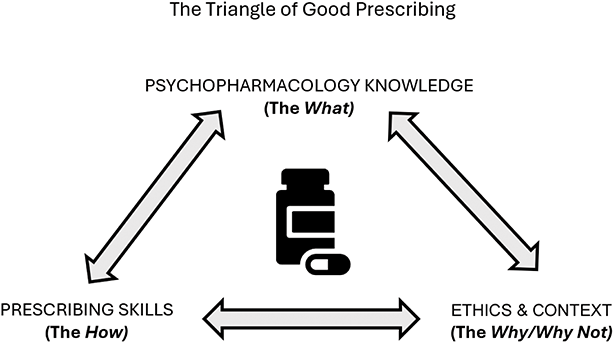


The tenet of this book is that psychiatric prescribing is done best when it is considered an integrated, multidimensional, biopsychosocial, and patient-centered intervention. The “Triangle of Good Prescribing” (Figure I.1) proposes that the best prescribing occurs when we equally engage our Knowledge of what to prescribe, our Skills in how to prescribe, and our awareness of the Context of prescribing [Reference Kavanagh, Cahill, Arbuckle, Lenet, Subramanyam and Winchel1].
Prescribing in psychiatry, when done well, is a highly integrated biopsychosocial intervention. The “Triangle of Good Prescribing” is a model proposed for learning and reflective practice, where practitioners focus equally on knowing “what” to prescribe (i.e., the medication and dose), “how” to prescribe (i.e., the skills – communication and practical – and therapeutic approach) and the “why/why not” (i.e., an ability to balance beneficence, non-maleficence, autonomy and justice – attending to issues of bias, iatrogenic harm, and structural oppression). The art and craft of prescribing is in the interactions between these components.
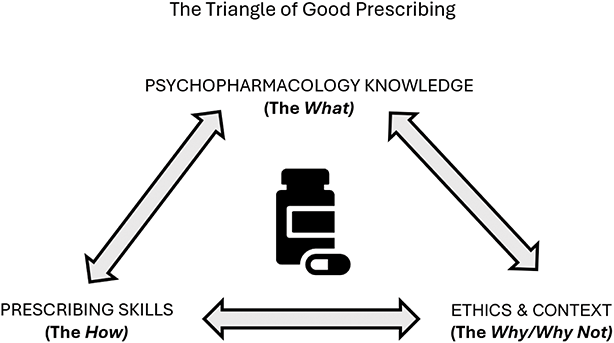
Figure 1.1 Long description
At the center of the diagram is an illustration of a pill bottle and a single pill. At the top is the text PSYCHOPHARMACOLOGICAL KNOWLEDGE (The What). At the bottom left is the text PRESCRIBING SKILLS (The How). At the bottom right is the text ETHICAL PRACTICE (The Why/Why Not). All of these texts are connected to each other by two-sided arrows.
This book is about the “how,” the “why,” and the “why not” of prescribing in psychiatry. We assume the reader has some working knowledge of psychotropics, their mechanisms, indications, and side effects. For further information, we refer the reader to the many excellent resources that speak to the “what” of prescribing (such as pharmacology texts and prescribing guidelines). For the medical management of psychotropic side effects, see Annamalai (2017) [Reference Annamalai2]. We also assume some basic competency in psychiatric interviewing, diagnosis, formulation and treatment planning. The why not refers to situations where we might wait, or not prescribe – as well as situations where discontinuation or dose reduction is indicated – that is, deprescribing. For more information on the deprescribing approach in psychiatry we refer the reader to Gupta, Miller and Cahill, 2019 [Reference Gupta, Miller and Cahill3]. For a related text in child and adolescent psychiatry, see Joshi and Martin, 2022 [Reference Joshi and Martin4]. Another special population, about whom there are few guidelines, are people with intellectual or developmental disabilities, however the interested reader might consider Singh, 2016 [Reference Singh5].
Section 1 aspires to be as practical and instructional as possible. It offers a recap of the basics of the act of prescribing in psychiatry and highlights some limitations on how it is commonly taught. We introduce the PULSE model as a tool for training, assessment, self-reflection, and ongoing professional development on this topic. The remaining chapters offer some principles and practice examples to give the reader an overall sense of the approach.
As co-authors of Section 1, we are mindful of being only two voices (and both psychiatrists); therefore, our perspective is incomplete. Section 2 is a curated compendium of essays, representing a diverse range of voices, in a range of writing styles from personal narrative to expert guidance or commentary. Our Section 2 contributors span individuals with lived expertise, academics, and providers from a range of personal and professional backgrounds (psychiatry, anthropology, psychology, social work, and nursing), career stages (trainee to emeritus professor), and practice settings (private practice, community mental health, hospital, forensics, and academic). We invited the authors to write on a set of broad topics we thought fundamental to our model, but encouraged them all to use their own voice, writing style, and focus on what they deemed most pertinent. Section 2 has practical elements but is intended primarily to cultivate reflection. The reader may work their way through these essays in order (there is a flow). Alternatively, a reader may wish to dip in and out of Section 2 when inspired to delve further into topics encountered though Section 1.
In our attempt to represent multiple perspectives, there may be elements of this work that appear to contradict one another. Some readers may find some pieces challenging to read. Some content you may choose to assimilate, whereas other content you may choose to discard. For example, where we offer specific strategies or vignettes with dialogue, we are not implying that the reader should learn verbatim or blindly adapt this into their practice. We hope that these examples, in our own voice, communicate principles and approaches to be scrutinized by the reader and assimilated into their own style, and own words, if desired. Be true to yourself, to the patient in front of you, and to the moment.
We encourage the reader to be humble and courageous in keeping an open mind and embracing the multiple perspectives represented in this book. It may emerge that ideas are not as at odds with one another as they initially appear. We believe that all the ideas expressed coalesce around a set of core common values and principles summarized here:
1. Practice “real-world” shared decision-making (i.e., neither over-idealistic nor performative).
2. Keep the patient’s experience and their strengths at the center.
3. Prescribing is best when an integrated biopsychosocial intervention (where the whole becomes greater than the sum of its parts).
4. Never prescribe out of context – think of it as “medication-assisted recovery.”
5. Psychiatry is a medical specialty – the foundations of medicine are crucial and relevant.
6. Embrace pluralism while seeking a critical, integrated, professional identity.
7. Resist the perfect becoming the enemy of the good (enough). We have a job to do.
8. Confident humility – be secure enough in what you know, so that you can admit what you do not know.
9. Think critically on our field and its history – but be proud of its successes, the good it does, and the innovation we are driving.
10. Good knowledge stewardship – Avoid “pendulum swinging” and intellectual adversarialism (for one theory or treatment to be valuable, another does not need to be debunked).
11. Sit with uncertainty, while continuing to seek to understand.
12. Just because you can, does not mean you should. There are conscious and unconscious drivers to prescribe (e.g., feeling useful, countering fear/anxiety, or role fulfillment). Regard the act of not prescribing as just as valid an option in your formulary.
13. Deprescribing should be taught, studied, and considered in practice as much as initiation and continuation of medications. Can we more often prescribe “courses” of medications?
14. Having one’s own lived experience can be very powerful, but it is neither mandatory nor sufficient to be a good provider.
15. Consider a “drug-centered” understanding opposed to the “disease-centered” [Reference Moncrieff and Steingard6]. We deal with syndromes more than diseases. Most psychiatric medications are tools that interact with a wide range of normal brain processes, rather than precisely targeting some defined pathoetiology. Is there a better way to classify psychotropics rather than their intended effect on a syndrome (e.g., antipsychotic)?
16. Develop a holistic understanding of each medication. Medications are more than their receptor profiles. It may be useful for the provider to formulate the potential effects of individual medications – in terms of their biological, psychological, and social features. Psychologically, what can it mean for patients to be taking it? Socially, for example: how and why a medication came to market, its marketing, cost, and public image.
Finally, we should speak to the terminology that features in this book. It is far from our intention to offend, alienate, dismiss, or misrepresent any group in this work; however, if we do, we sincerely apologize. Words are important and have power. Words may become politicized and weaponized. Terminology in our field is constantly evolving and a term can quickly become divisive. At times, we may collude in giving words too much power, perhaps as language can be remedied more easily that the underlying issue can be solved.
As this book is about prescribing, we have tended to refer to people engaging in treatment as “patients” and the person providing the treatment as the “provider” or “practitioner.” This is not intended to diminish the shared personhood – and inflame the inherent power dynamic in treatment. We embrace these terms to remind the provider of their duty to serve and to elevate the role of “patient” to that of a partner in the treatment relationship.
Similarly, the term “prescriber” is used by some authors within the book. This is largely matter of fact – in the context of clinical vignettes. We do not mean to infer that all psychiatric providers have to offer are prescriptions (quite the contrary). The other imperfect use of the term “prescriber” is as a shorthand within a multidisciplinary team, which regrettably remains a convention.
Some authors have used the term “psychiatrist” in their pieces. We do not intend this to be exclusionary or undervaluing of our nurse practitioner colleagues, providers from other specialties, nor other professionals who are licensed to prescribe in some jurisdictions.
Out of practicality, we use conventional drug class nomenclature (e.g., antidepressant, antipsychotic, anxiolytic). Moncrief’s “drug-centered” approach (which, in contrast to the traditional “disease-centered” approach, is not predicated on a disease that the medication targets and treats) or the neuroscience-based nomenclature offer alternatives, but have not yet gained sufficient traction.
We should consider the term prescription. We differentiate “prescription” (of a pharmaceutical or medical device) from an “alternative prescription” (e.g., of diet or exercise), without meaning to diminish the importance and value of the latter. A prescription makes a regulated drug available to a patient under a set of directions– it is implicitly accompanied by a “recommendation” for the patient to consider. We should take care when framing something as a “professional recommendation.” This is a professional service and should be framed and documented as such. This is relevant when patients may ask for information and advice around the use of dietary supplements or agents for which there is no clear evidence base or FDA approval (for any indication). Rather than being evasive or withholding, it is possible to caveat the information you provide as “not a formal recommendation” and provide the reason why (not sufficiently studied and vetted by your profession). To do otherwise risks diluting or tainting the nature of a true professional recommendation.
We no longer use the term “compliance” when it comes to a patient taking medications. An “order” is to be complied with. We do not give patients “orders,” therefore they cannot be “noncompliant.” “Medical order” is a legacy term used in coordination of care between professionals in a healthcare setting only. “Nonadherence” is a practical term to use as people can choose to adhere, or not, with a “regimen.” When we prescribe, we offer a professional recommendation related to that prescription, and the patient agrees to a “regimen.” Whether a patient agrees with your evaluation and recommendation or not may be referred to as “concordance.”
The term “deprescribing” is used throughout the book. This term has long been used in palliative care, primary care, cardiology, and neurology. It does not imply that something “bad” has happened that needs to be undone. It is not “antimedications” or “antipsychiatry.” The pragmatic point is merely that if we know how to effectively and safely start medications, we should also be skilled in how to effectively maintain minimum effective dosing and safely stop them when necessary.
The point is made in the book that neither patient nor providers “fail” if a treatment does not have the desired effect. This is inappropriate blaming, and infers an unrealistic degree of control. Neither should patients be referred to as “treatment resistant” or “treatment refractory.” An illness may be described as “refractory to treatment” or better “difficult to treat” (Chapter 22).
Finally, we will note that some of our authors use terms such as “depression” to refer to “major depressive disorder” – in all cases the intended meaning should be clear.