The election of Latin American women to high-level political offices has often been accompanied by news coverage highlighting the political family connections of those women: Cristina Fernández de Kirchner, president of Argentina from 2007 to 2015, was the wife of former president Nestor Kirchner; Mireya Moscoso, Panamanian president from 1999 to 2004, was the widow of a three-time former president; Zury Ríos, a Guatemalan congresswoman from 1996 to 2012, was the daughter of the infamous former dictator Efraín Ríos Montt; Keiko Fujimori, elected to the Peruvian Congress from 2006 to 2011, was the daughter of former president Alberto Fujimori.Footnote 1 Academic research has similarly highlighted that many women executives in Latin America have family ties to other politicians (Hinojosa Reference Hinojosa2012; Jalalzai Reference Jalalzai2004; Murray Reference Murray2010; Skard Reference Skard2015) and that these ties were highly relevant to their presidencies. In legislatures, early scholarship asserted that family ties were critical to women getting elected (Chaney Reference Chaney1979), as women often assumed seats upon the death of a husband or other relative (Hinojosa Reference Hinojosa2012), and many women legislators attributed their interest in politics to family members in politics (Saint-Germain and Metoyer Reference Saint-Germain and Metoyer2008). In recent years, too, critics of gender quotas have sometimes suggested that quotas have led to an increase in “legacy” women or “wives of” other well-known politicians in legislatures (Infobae 2017).
The attention given to women politicians’ family ties in Latin America implicitly suggests that this is something unique to women and that it has played perhaps a more important role in women's political lives than men's. Yet political dynasties have long been common in politics worldwide, and in Latin America more specifically, and little research has explored gender differences in patterns of family ties, particularly within legislatures. Where it has, the research usually focuses on only one country, giving us little sense of what gender and family ties look like regionwide. Thus, we do not know whether women in office are disproportionately more likely to have family ties compared to men. If women in legislative office in Latin America are more likely to have political family ties than men, it could have significant negative consequences on gender equality in legislative politics.
In this article, we explore whether women and men legislators in Latin America have different patterns of family ties. We study this in the context of Latin American legislatures because political family ties have long been characteristic of elites in the region and women have increasingly been elected and appointed to office in recent years. We expect that women should be just as likely as men to have family connections in Latin American legislatures today. We think this is because family ties are no longer a requisite for women to be involved in politics in Latin America. Where women might disproportionately benefit from family ties compared to men is in contexts in which women would otherwise be excluded from politics without the benefit of family ties (i.e., where family ties are a necessary condition for women's entry to the political arena). This may occur when women are not well represented among political aspirants or contenders and/or when strong party leader or voter discrimination exists against women in politics.
In most of Latin America today, however, these two conditions are not met. Women's access to the political arena has increased with greater cultural and socioeconomic equality for women, and voters and elites are more open to the inclusion of women in politics. Family ties are not necessary for women to be attractive politicians to parties or voters. Family ties may still be important in countries’ politics, but they should not provide disproportionate benefits to women compared to men. This may vary, however, across legislatures with and without gender quotas. The adoption of gender quotas has significantly increased women's presence in politics and limited the ability of party leaders and voters to discriminate against women in the candidate recruitment and selection process. Thus, where quotas are in place, family ties may provide no added benefit to women compared to men. Where quotas are not used, in contrast, women's access to the legislative arena is not mandated and discrimination against women may persist. Women may need the benefits that family ties provide to be viewed as viable contenders for office. Thus, we expect similar patterns of family ties for male and female legislators in Latin America, in general, but differences may occur in legislatures with and without gender quotas.
We examine this question empirically with data from two to six waves (running from 1998 to 2011) of the Parliamentary Elites of Latin America (PELA) survey, which asks legislators in all Latin American countries about their political family ties.Footnote 2 We test three specific hypotheses: (1) women and men should be equally likely to have family ties in politics; (2) these similarities exist across the period of the mid-1990s to the 2010s; and (3) gender quotas moderate the relationship such that no gender differences in the probability of legislators having family ties exist in quota systems, but differences exist in the absence of quotas. We find that women and men have similar patterns of family ties in Latin American legislatures and that this persists across most countries and across the entire time period. We also find some evidence that differences in family tie patterns among men and women legislators exist in countries without gender quotas but not in countries with gender quotas.
EXISTING RESEARCH ON FAMILY TIES
Existing research on the familial connections of elected officials (also called legacies in some studies) has been minimal. The research that has studied family ties has tended to study family ties among all politicians, without consideration of gender or women, or it has studied the family connections of women only, without much comparative attention to men. Some studies have highlighted the possibility for gender differences in family ties, but more as footnotes to larger studies on the career paths or political backgrounds of elected officials. Research on family ties has most often been single-country studies rather than cross-national studies, and research on women, gender, and familial connections in politics has rarely looked at legislators specifically. In sum, legislative politics research has not put sex or gender front and center in analyses of legacy patterns or considered whether, why, or where we might expect (or not expect) differences in patterns of family ties for women and men legislators.
A few studies have examined the pervasiveness of political dynasties or family legacies in politics, focusing predominantly on the United States, Mexico, or Southeast Asia (Camp Reference Camp1982; Clubok, Wilensky, and Berghorn Reference Clubok, Wilensky and Berghorn1969; Dal Bó, Dal Bó, and Snyder Reference Dal Bó, Bó and Snyder2009; Feinstein Reference Feinstein2010; Geys and Smith Reference Geys and Smith2017; Purdey Reference Purdey2016; Smith Reference Smith2018; Smith and Martin Reference Smith and Martin2017; van Coppenolle Reference van Coppenolle2017). Clubok, Wilensky, and Berghorn (Reference Clubok, Wilensky and Berghorn1969), Dal Bó, Dal Bó, and Snyder (Reference Dal Bó, Bó and Snyder2009), and Feinstein (Reference Feinstein2010) study the U.S. Congress and show that dynasties are more common in Congress than in other occupations (Dal Bó, Dal Bó, and Snyder et al. Reference Dal Bó, Bó and Snyder2009; Feinstein Reference Feinstein2010) but that the importance of dynasties declined over time in the early twentieth century (Clubok et al. Reference Clubok, Wilensky and Berghorn1969). Feinstein shows that dynastic candidates are more likely to win election to Congress than candidates not from family dynasties, but he does not explore gender differences among those candidates. Camp (Reference Camp1982, Reference Camp1995) finds that family ties have been very important for politicians of all types in Mexico but began to decline beginning in the 1980s. In the Philippines, in contrast, the importance of family dynasties has been and remains high (Purdey Reference Purdey2016; Querubin Reference Querubin2016). One cross-national study considered legacies among Latin American legislators, but the focus on legacies was one small part of a wider analysis on legislator quality in Latin America. Martínez Rosen (Reference Roson, del Mar and Alcántara Sáez2008) finds an inverse relationship between having political family ties and the experience of legislators, such that more experienced legislators have fewer family connections in Latin America.
This research, however, has not explored gender and legacies. Scholars of women and politics have emphasized the importance of family ties, particularly for women executives, suggesting that those ties may be determinants of women's accession to office (Hinojosa Reference Hinojosa2012). Jalalzai's (Reference Jalalzai2004, Reference Jalalzai2012) worldwide analyses of women prime ministers and presidents find that, particularly in Asia and Latin America, many women executives have family members who previously held political office or were involved in politics. Skard also argues that in Latin America, “all the top women were politically aligned with prominent men” (Reference Skard2015, 246), and she notes that in Asia, family ties were relevant because many of the women who became executives took over as widows for their husbands (244). Chaney (Reference Chaney1979) made a similar point about Latin America, noting in her research that women in office in the 1960s often had family members in politics. Jalalzai's analysis of family ties among women presidents in Latin America similarly reports that six of the eight women who have served as presidents in the region had family ties (approximately 75%). She argues that “women required these advantages to surmount obstacles traditionally encountered in exercising dominant executive powers, though this offered no guarantees of success” (2015, 8). Reyes-Housholder and Thomas (Reference Reyes-Housholder, Thomas and Schwindt-Bayer2018), however, dispute the importance of family ties for women presidents in Latin America and suggest that connections to family in politics among these Latin American women presidents were more distant and less important than Jalalzai and others allow.Footnote 3
This work has primarily focused on women (see, however, Baturo and Gray Reference Baturo and Gray2018; Folke, Rickne, and Smith Reference Folke, Rickne and Smith2020). Yet Jalalzai and Krook (Reference Jalalzai and Krook2010, 13) make an important point: “It is important to recognize that women are not the only ones benefiting from family connections. First, many political dynasties do not even include women. Second, in countries where women have ruled, including Nicaragua, Panama, and Sri Lanka, men family members may later come to power. Thus, while political dynasties originate with men family members, women leaders may in turn help propel members of their own immediate families into power, either directly or indirectly through the family name.” Attention to gender differences in patterns of family ties, however, has been minimal.
Escobar-Lemmon and Taylor-Robinson (Reference Escobar-Lemmon and Taylor-Robinson2016) examine gender differences in family ties across cabinet ministers in four Latin American countries and the United States. They find that only 7% of ministers hail from political families, but 14% of women did so compared to only 5% of men.Footnote 4 In contrast, Camp (Reference Camp1995, Table 6.3) reports that only 15% of women politicians (i.e., individuals in a wide range of political offices) in his data set had a relative in political office from 1934 to 1991 compared to 28% of men.Footnote 5 Beer and Camp (Reference Beer and Camp2016) update that analysis in a more recent article on gender quotas and political recruitment in Mexico for the period 1964–2012 and focus on just 541 senators (only 53 of whom were women). One part of their analysis considers differences in the family connections of senators, but they find no differences in political family ties—39% of men had family ties compared to 41.5% of women. This persisted across the period from 1964 to 2012, even when women may have needed the advantage of family ties to overcome other forms of discrimination against women candidates.
WHY FAMILY TIES MATTER
Existing work has highlighted several reasons why family ties benefit elected officials. First, family connections provide name recognition and visibility that politicians and candidates without family ties do not have, and this may provide them with an advantage at election time (Hinojosa Reference Hinojosa2012; Dal Bó, Dal Bó, and Synder Reference Dal Bó, Bó and Snyder2009; Feinstein Reference Feinstein2010; Jalalzai Reference Jalalzai2012; Smith and Martin Reference Smith and Martin2017). Family ties also work to socialize individuals into a life in politics, perhaps making them better campaigners and politicians (Beer and Camp Reference Beer and Camp2016; Hinojosa Reference Hinojosa2012). Third, family ties may provide an indication of greater trustworthiness, since politicians come from a family with extensive knowledge of and participation in the political process (Hinojosa Reference Hinojosa2012). Fourth, family dynasties have access to resources that may help put family members in a more competitive political position. Smith and Martin (Reference Smith and Martin2017), for example, find that cabinet ministers in Ireland benefit not from an “electoral advantage” associated with being in a political family but from “informational advantages” that result from being in a political dynasty. More specifically, the dynasty benefit may be an artifact of higher levels of education associated with being in an elite family or stronger networks that dynasty candidates build at elite schools.
Yet it is not clear that these benefits—name recognition, socialization, trustworthiness, education, and networks—matter more for women than men. Some studies have suggested that political family ties help women overcome discrimination in politics and the obstacles associated with getting women into office (Baturo and Gray Reference Baturo and Gray2018; Beer and Camp Reference Beer and Camp2016; Escobar-Lemmon and Taylor-Robinson Reference Escobar-Lemmon and Taylor-Robinson2016; Hinojosa Reference Hinojosa2012; Jalalzai Reference Jalalzai2015). Jalalzai (Reference Jalalzai2015), for example, argues that the office of the Latin American presidency has been so strongly gendered that family ties were a necessary condition for women winning the presidency. Baturo and Gray's (Reference Baturo and Gray2018) comparative study of women and men chief executives finds that family ties are the only background characteristic that differs for men and women, with women having more than men. This declines over time, however, as women have been in politics longer. Escobar-Lemmon and Taylor-Robinson (Reference Escobar-Lemmon and Taylor-Robinson2016, n7) find that women cabinet members may have more family ties than men, perhaps because women need the family political connections to compensate for being newcomers to the political arena and lacking political experience. But they also note that most of the women with family political connections had significant policy experience that made them qualified for the post they held, indicating that family connections were not actually a compensation tool. Beer and Camp (Reference Beer and Camp2016) argue that family ties may help women senators because of a need to overcome other forms of discrimination that might keep them out of office, although they actually find no differences for men and women. Hinojosa (Reference Hinojosa2012) points out that family ties may benefit women in getting access to party ballots where self-nomination and local power monopolies would otherwise limit their political participation.
All of this suggests that family ties serve an important purpose—they help politicians be successful. Family ties provide benefits of name recognition, socialization, increased trustworthiness, educational backgrounds and networks, and these should be important for both women and men politicians. Women should only benefit more from family ties than men when they otherwise would not be equal with men. Legislatures in which family ties might provide more benefits for women than men could be those in which political, societal, and cultural contexts create a gendered environment that disadvantages women in the political arena. This might be because socioeconomic conditions limit the number of women with typical qualifications for office and relevant political experience or extensive party leader or voter discrimination against women exists. Family ties, in these contexts, are a necessary condition for women's access to politics.
This may have described Latin America in the middle of the twentieth century, when women had only recently gotten the right to vote and run for office, when democracy was limited and rare, and when women lacked significant cultural, social, and economic equality with men. However, we do not think this describes most of Latin America today. Socioeconomic and cultural gender equality has increased, and women in Latin American politics today have backgrounds and experiences that are more similar to men (Baturo and Gray Reference Baturo and Gray2018; Escobar-Lemmon and Taylor-Robinson Reference Escobar-Lemmon and Taylor-Robinson2014; Schwindt-Bayer Reference Schwindt-Bayer2011). Citizen attitudes toward women political leaders are largely supportive of women in political office, though with variation across countries (Morgan Reference Morgan, Carlin, Singer and Zechmeister2015; Morgan and Buice Reference Morgan and Buice2013), and women are more incorporated into political parties, even serving in party leadership (Morgan and Hinojosa Reference Morgan, Hinojosa and Schwindt-Bayer2018). Female presidents have been elected in five countries over the past 20 years, several of them with weak family connections and several of them reelected (Reyes-Housholder and Thomas Reference Reyes-Housholder, Thomas and Schwindt-Bayer2018). Thus, we hypothesize that, on average, family ties are unlikely to be gendered in Latin American politics today.
One context in which we might still see a gender difference in legacies is in countries or time periods without gender quotas. In Latin America, gender quotas are legislative candidate quotas that require all political parties competing in legislative elections to include women on party ballots in each district. Quotas can vary in their design and their implementation across countries, and they have changed quite a bit over time (Piscopo Reference Piscopo2015; Schwindt-Bayer Reference Schwindt-Bayer2010). But today, nearly every country has a legislative candidate gender quota in place.Footnote 6
Where women's representation is legally mandated, the political process is more open to women and the ability of parties or voters to discriminate against women is more limited. Quotas put women and men on more equal footing in politics (Dahlerup and Freidenvall Reference Dahlerup and Freidenvall2005; Krook Reference Krook2009). Indeed, recent research emphasizes that the adoption of quotas in Latin America should be viewed as an indication of states’ commitment to gender equality and state efforts to “guarantee women's political inclusion” (Piscopo Reference Piscopo2015, 28). In quota contexts, family ties are unlikely to provide additional benefits to women than men because women are already on more equal footing with men. The legal requirements for quotas and/or the state's commitment to gender equality create that. Family ties provide little additional benefit to women compared to men.
Where quotas are not in place, however, no such protections against discrimination exist. Without gender quotas, there is no requirement for women's representation or an explicit state commitment to gender equity, such that women may be disproportionately less likely to gain access to politics than men. It is precisely in this context that women may benefit disproportionately from family ties in politics. Without quotas, women may need the name recognition, socialization, image of being trustworthy, and network advantages that family ties bring to politicians to gain equal access to the political arena. The advantages that family ties provide may, in fact, be gendered where gender quotas are absent. Therefore, we hypothesize that where quotas are in place, women and men in Latin American legislatures should be equally likely to come from political families, but where they are not, women legislators may be more likely to have political family ties than men.
In the empirical analysis, we examine (1) whether women have more family ties than men in Latin American legislatures in general, (2) whether this persists over time in recent years, and (3) whether more women have family ties than men in countries when gender quotas are not in place. We expect similar patterns in family ties across countries and over the recent time period, but we expect gender quotas to possibly moderate this relationship such that women may be more advantaged by family ties where quotas are absent and have similar legacy connections where quotas exist. We are not able to test directly how family ties affect the election of women and men candidates because we lack data on candidates’ family ties, but we are able to explore legacy patterns among elected legislators and do so across all countries in Latin America. This is important in its own right, given how often conventional wisdom suggests that legacies are something unique to women and that women are somehow less qualified than men in politics needing special treatment as a family member of a well-known politician.
AN EMPIRICAL ANALYSIS OF GENDER AND FAMILY TIES IN LATIN AMERICA
Our empirical analysis uses data from the PELA survey.Footnote 7 PELA contains answers from face-to-face survey interview with national legislators in all 18 Latin American countries starting in 1994, with one to six survey waves in each country. The number of legislators interviewed in a country depends on the size of the legislature, but response rates were often high (see Table A1 in the appendix in the supplementary materials). Our data set includes surveys from 1998 through 2011 (Waves 2 through 6).Footnote 8 The total number of surveyed legislators in our data set is 5,268, from 18 countries and a total of 59 country-survey waves.Footnote 9
Our focus is an analysis of the relationship between the gender of a legislator and whether a legislator has a family member who previously held political office. To measure family ties, we use information from two PELA survey questions. First, we examined the answers to the question: “Have any of your family members worked in politics for a living, despite no current professional political involvement?” to determine who said yes and no. Once we identified those legislators who answered affirmatively, we examined the answers to a second question, “Which position?,” to identify those legislators who mentioned a family member in a national or subnational executive or legislative branch political position.Footnote 10 We follow existing studies of legacies that focus on these types of political offices. We create a family ties variable that codes legislators with a family member in these political offices as 1 and those with no relatives in these political offices as 0.Footnote 11
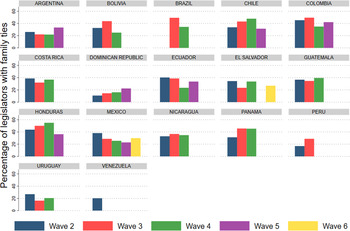
Overall, 32.6% of the surveyed legislators in our data set reported having a family member who has held a political office. Figure 1 shows the variation across countries and survey waves. Some countries clearly have more legislators with family ties than others. For example, Honduras has an average of 46.5% of its legislators having family ties (across four surveys conducted between 1998 and 2010) compared to 15.5% in the Dominican Republic (average across four surveys from 2000 to 2011). The rest of the countries fall in between these two extremes. This kind of cross-country variation is similar to what has been documented elsewhere: only 7% of U.S. members of Congress have a relative in political office (Dal Bó et al. Reference Dal Bó, Bó and Snyder2009), whereas almost half of Philippine legislators have family ties (Querubin Reference Querubin2016). The prevalence of legacies can vary within countries, too.Footnote 12 For instance, the percentage of surveyed legislators in Bolivia with family ties in politics decreased from 44% in the third wave to 25% in the fourth wave. In contrast, Panama reported an increase in the percentage of surveyed legislators with family ties from the second to the third wave, going from 31% to 46%. Other countries report almost constant percentages of legislators with family ties over time. Guatemala and Nicaragua, for example, had little change across the three survey waves conducted in those countries.
Family ties by country and survey wave.
Note: This figure shows the percentage of legislators having family members who previously held political office by country and survey wave.

A Bivariate Analysis of Gender and Family Ties
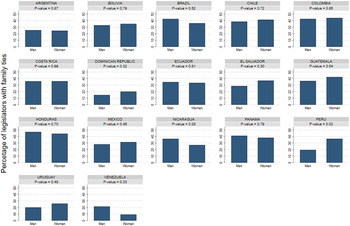
Our main hypothesis is that men and women legislators should have similar patterns of ties to family in politics. We first explore this by comparing differences in the percentages of men and women legislators with political family ties. Pooling all of the countries and survey waves together, we find that the percentage of respondents who reported having a family member previously in politics is almost identical for men and women (32.6% for men and 32.8% for women). This varies little across countries. Figure 2 shows the percentage of men and women legislators with family ties by country (pooled across survey waves). The only difference that is statistically significant is in Peru (p = .023), where 37% of women legislators declared having a family member who previously held political office compared to 19% of men legislators answering the same question. The rest of the countries show negligible differences across gender and no clear pattern across countries. This is similar to what has been observed in industrialized democracies during the last 30 years, where legacy rates between women and men legislators have practically converged (Smith Reference Smith2018).Footnote 13
Family ties by country and sex.
Note: This figure shows the percentage of legislators having family members who previously held political office by country and gender.

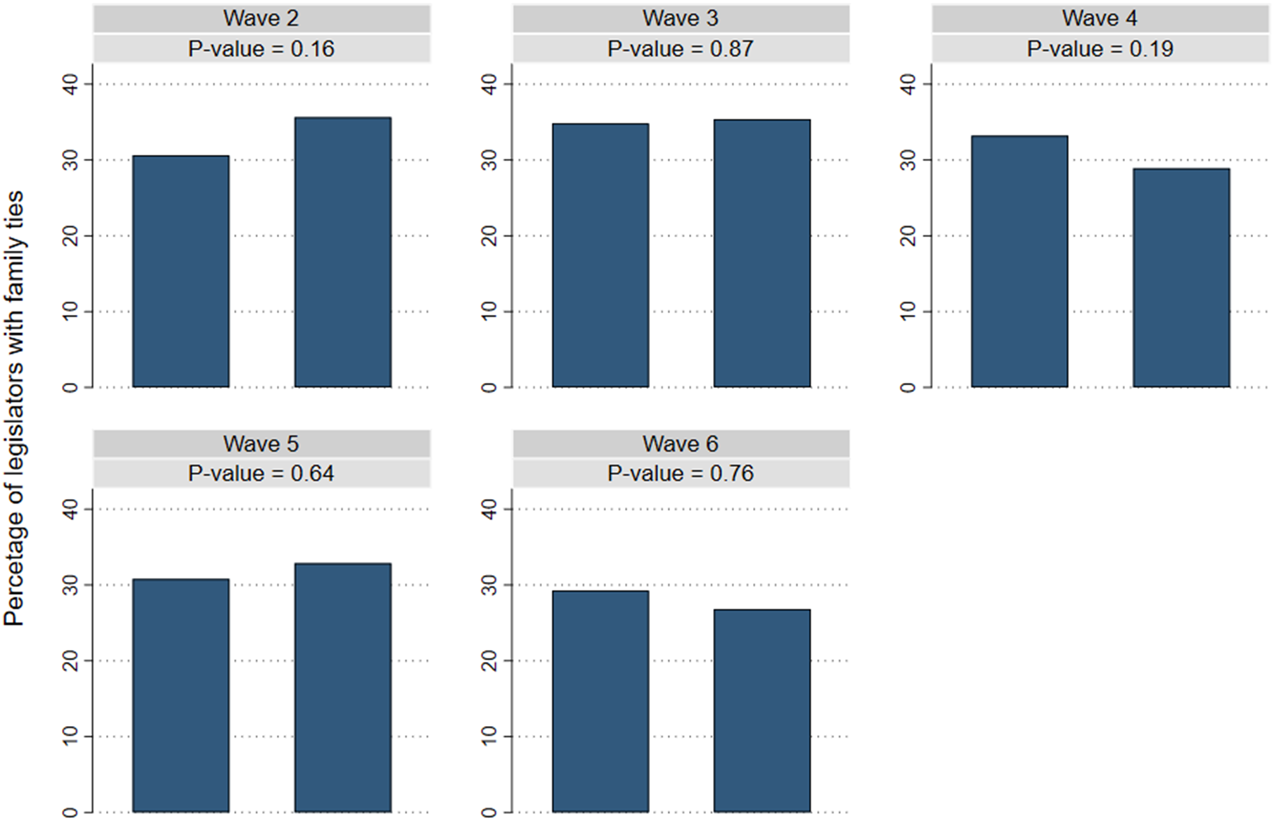
The lack of significant differences in the percentage of women and men legislators with family ties holds across survey waves as well. Figure 3 shows the percentage of men and women legislators with family ties pooled across country for each wave of the survey. The figures hover around 30% for all waves and for both men and women. The largest difference reported (5 percentage points) appears in the first wave for which we have data (Wave 2), covering 1998 to 2002. No other waves have significant differences in the percentage of men and women legislators with family ties. We can speculate that this might indicate the end of an earlier period in Latin America where family ties may have been more common for women legislators. However, since we lack data from earlier time periods, this interpretation cannot go beyond mere speculation.
Family ties by sex and survey wave.
Note: This figure shows the percentage of legislators having family members who previously held political office by survey wave and gender.

A Multivariate Analysis of Gender and Family Ties
We next explore the relationship between legislator gender and the probability of a legislator reporting having a relative in politics while controlling for potential covariates that could confound the relationship. We include a battery of control variables that account for additional legislators’ characteristics.Footnote 14 First, we consider whether more senior legislators are more likely to have family ties than junior legislators. Senior legislators may be more likely to have family ties because they entered politics earlier, and those connections may have helped them develop a political or legislative career. This could confound the relationship between gender and family ties. Because seniority comes from having previously held a seat in the legislature or having held any other political office previously, we measure seniority in two ways: first time in the legislature distinguishes those legislators who are in their first legislative period (1) from those who have been in the legislature previously (0), and previous experience in politics identifies those legislators who have previously held any elective office (1) and those who have not (0).
Next, we control for the age and education of the legislators. Legislators’ age in our sample ranges from 22 to 86 years. Legislators’ education level is coded as an ordinal variable ranging from 1 (no studies) to 6 (graduate school degree). We also control for the ideology of the legislator. Conservative legislators usually represent traditional parties and are less supportive of gender equality in politics. They often are less likely to be women. Conservative legislators are also more likely to have family ties as they tend to be wealthy elites who come from families with long political legacies. Ideology is an ordinal variable that reports the self-placement of respondents on a 1–10, left-to-right scale.
To identify the effect of gender quotas on family ties, we identify whether the legislature has adopted a legislative candidate quota. We acknowledge that the variable does not specify the different types of quotas in the region—some are parity quotas, some require only one-third of party ballots to be women, some have placement mandates, and some have stronger enforcement mechanisms that others. It only codes whether some type of quota was in place.
We also account for country and time effects. Latin American countries differ in a number of ways that could be related to women's representation in politics and legislators’ likelihood of having family ties. For example, different levels of progressive values across countries may influence politicians’ and citizens’ attitudes toward women in politics (Morgan and Buice Reference Morgan and Buice2013). Latin American countries also have varying histories with democracy and operate at varying levels of representative democracy today, which can shape patterns of gender representation in the region (Schwindt-Bayer Reference Schwindt-Bayer2018). The countries have changed over time, as well, in ways that need to be accounted for in models of gender and family ties. To ensure that institutional and temporal variations do not bias our results, we include country and survey wave fixed effects in the models.
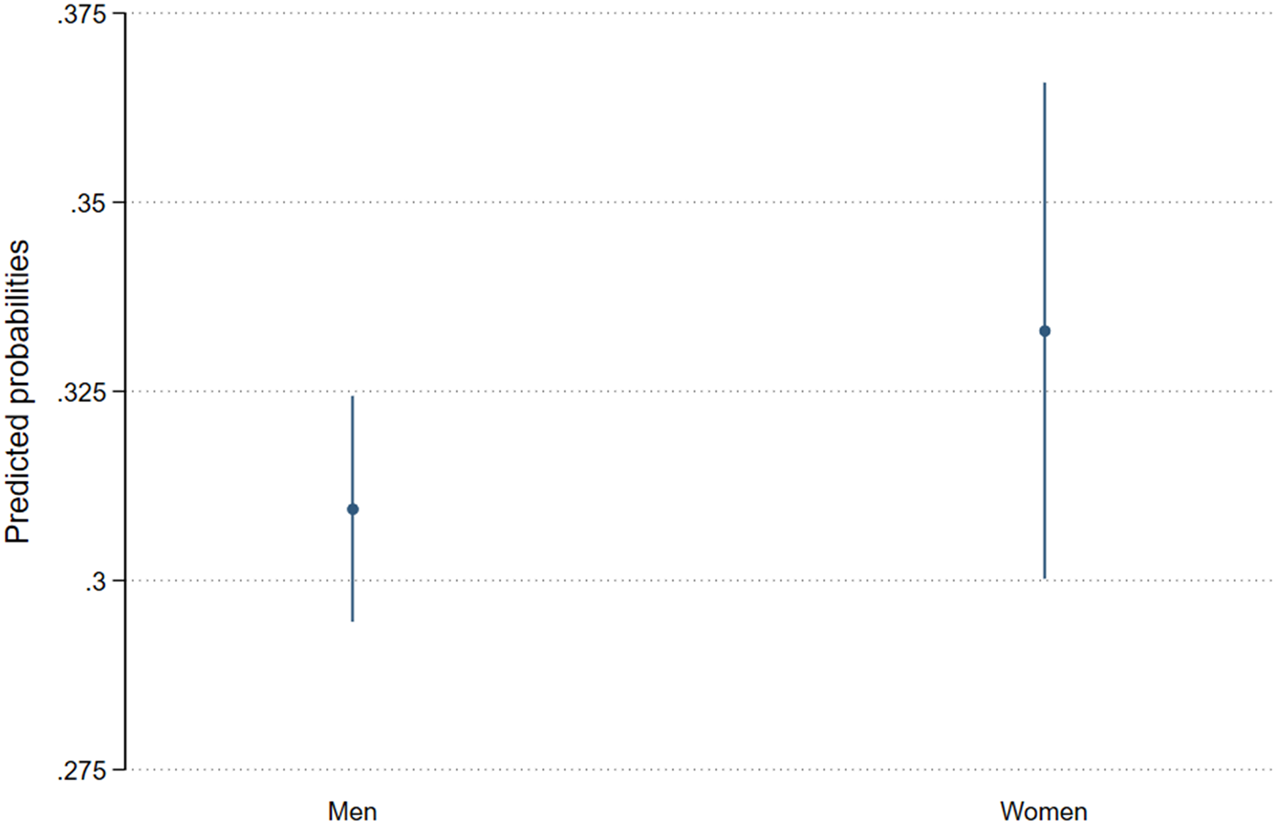
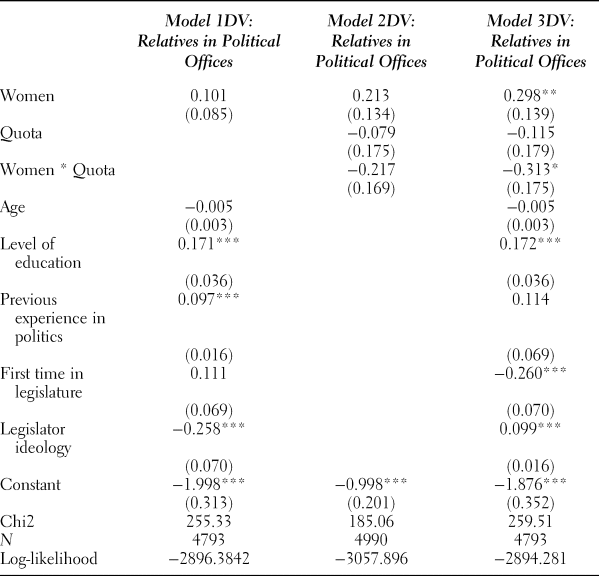
Model 1 in Table 1 presents the results of a multivariate logit model that uses whether a legislator has family ties as the dependent variable.Footnote 15 The results show meager and nonsignificant differences between women and men legislators with relatives who previously held political office. This is illustrated using predicted probabilities in Figure 4, which shows the probability of a legislator having a family tie by gender. Men's and women's probability of having family ties in politics is not significantly different—the predicted probability for men is 0.31 and it is 0.33 for women. Model 1 also shows results for the control variables. Legislator age and previous experience in any political office have no statistically significant relationship with family ties, but political family ties are more likely to exist among legislators with greater education, those with legislative seniority, and those with a self-reported ideology leaning toward the right. Legislators with more education may have greater political and social capital which could provide similar benefits to having family connections in politics. This may also be the case for legislators with more experience (seniority) and greater wealth, which tends to be associated with conservative, rightist parties. The analysis shows no significant differences in the probability of having political family ties between men and women legislators, however.
Predicted probability of having family ties for men and women (based on the results of Model 1 in Table 1).

Multivariate analysis of gender and family ties in Latin American legislatures and the moderating effect of quotas

Notes: Standard errors are in parentheses. Fixed effects for country and survey wave are included in models but not presented in table.
*** denotes significance at the 1% level; ** denotes significance at the 5% level; and * denotes significance at the 10% level.
The Moderating Effect of Quotas
We next explore whether women representatives are more likely to report having relatives in political offices, comparing quota and nonquota country waves. Quotas were implemented for the first time in Latin America in Argentina in 1991, and since then, they have been gradually adopted in all Latin American countries except Guatemala.Footnote 16 Eight countries had a quota in place across all survey waves and seven had no quota. Only in Honduras and Mexico was a quota adopted between survey waves.Footnote 17 We provide a brief discussion and further analysis of these two cases at the end of this subsection.
An initial analysis comparing the percentage of men and women legislators who report family ties suggests a difference in quota and nonquota systems. Where a quota was in place, similar percentages of men and women reported family ties—31.5% for men and 30.2% for women. Where quotas were absent, however, 34% of men reported having family ties compared to 38% of women.Footnote 18 Model 2 in Table 1 regresses family ties on the interaction of gender and quotas and its constituent variables without any control variables. The estimates of Model 2 are similar to what we just reported and are in the directions consistent with our expectation—women legislators are more likely to have family ties only in those countries with no gender quota. The estimates are not statistically different, however.
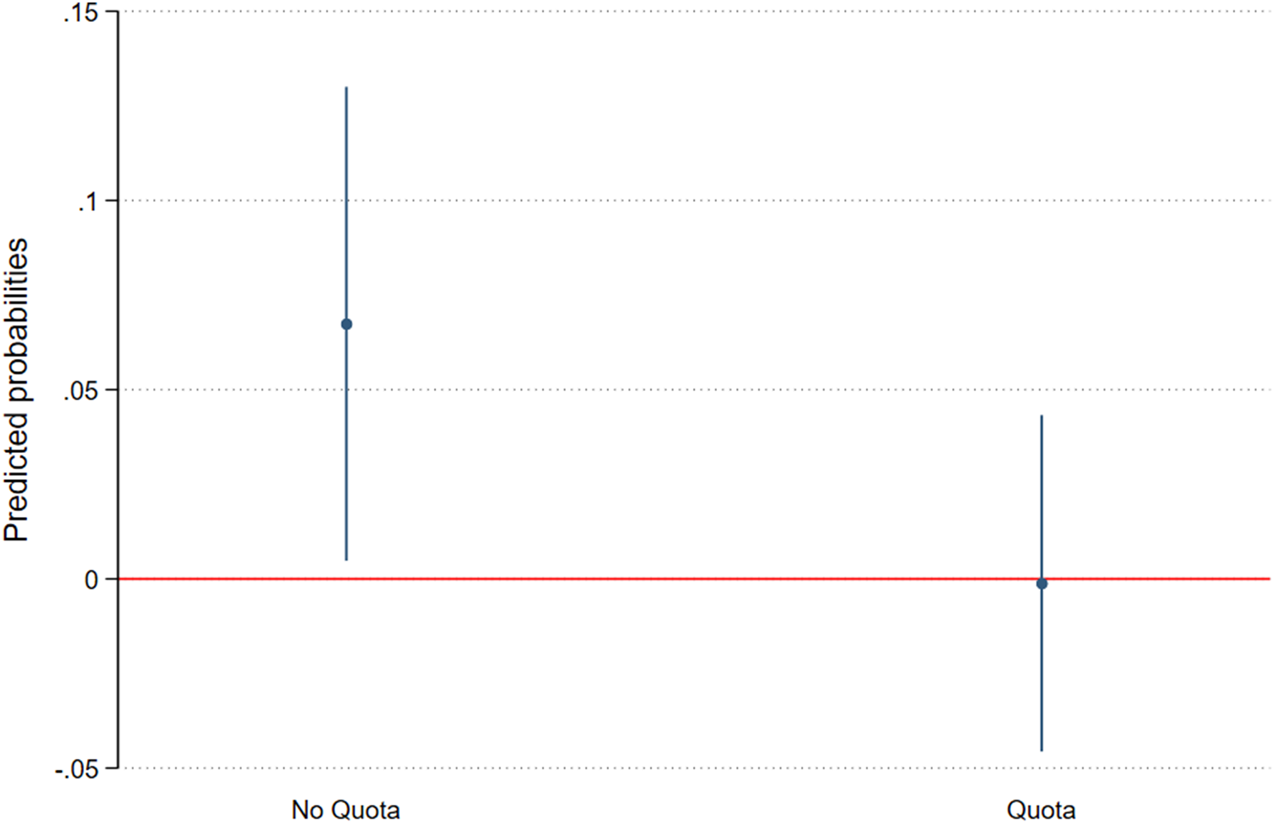
Model 3 in Table 1 reports the findings of the interaction after including legislator controls. This model tests the heart of the argument. The analysis shows that once legislator characteristics are controlled, the estimate for the interaction is statistically significant—women legislators are more likely to have political family ties than men in legislatures when quotas are absent but not when quotas are in place. This is illustrated more clearly in Figure 5, which shows the marginal difference in the predicted probability of a woman legislator having a political family tie compared to a man legislator having one in legislatures with and without quotas. In a country with no legislative quotas, the difference between women's and men's probability of having family ties is a statistically significant 0.07, with women having a higher probability than men.Footnote 19 However, this relationship vanishes in legislatures with gender quotas, where the difference between men and women legislators is negligible.Footnote 20 The results from Model 3 suggest that including legislators’ characteristics as control variables reduces the error variance between gender, legislative quotas, and family ties, producing a better estimate of the relationship.Footnote 21
Gender differences in predicted probability of having family ties in nonquota and quota systems.
Notes: This graph shows the mean difference and 95% confidence interval in the predicted probability that men and women legislators report having a family tie, holding the control variables at their sample means. A positive difference means more women than men are predicted to have family ties. The estimations are based on Model 3 of Table 1.

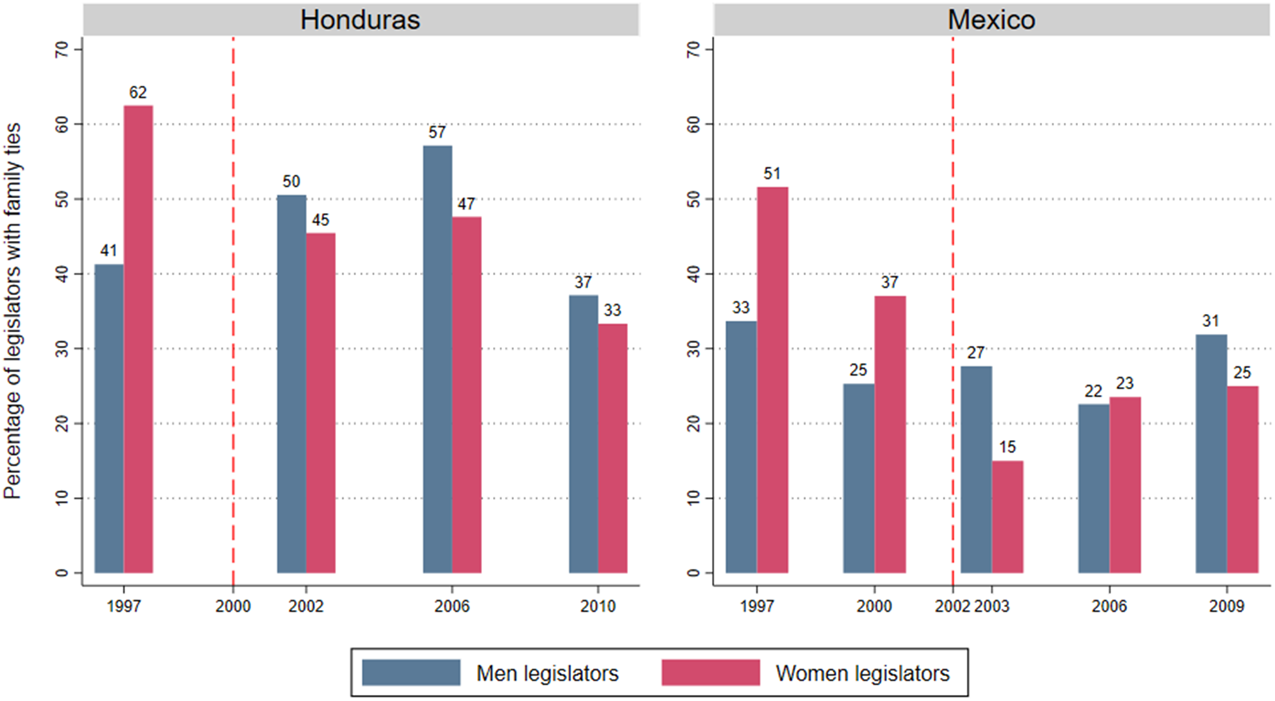
Figure 6 presents a more detailed illustration of our argument by comparing the representation of men and women respondents with family ties in Honduras and Mexico, before and after the quota. As mentioned previously, these countries are the only two cases in our data set where we can observe the pre- and post-quota adoption periods. Each bar represents the percentage of respondents with family ties by gender and legislative session, and we indicate the implementation of the gender quota with a dashed line in each case. Honduras adopted a 30% quota for women in 2000, and the first legislative election held under this new law was in 2001.Footnote 22 Legislators in Honduras were elected using closed lists before 2005 and open lists after an electoral reform enacted that year. In Mexico, a reform in 2002 required political parties to ensure that at least 30% of their candidates were women (Dahlerup et al. Reference Dahlerup, Hilal, Kalandadze and Kandawasvika-Nhundu2013).Footnote 23 Mexico has a mixed electoral system for its lower house in which 300 legislators are elected from single-member plurality districts and 200 legislators are elected through closed-list proportional representation. The quota applied to both tiers, although it did initially allow political parties that used primary elections to be excused from the quota (Baldez Reference Baldez2004).
Legislators with family ties in Honduras and Mexico pre- and post-quota, by gender
Notes: This figure shows the percentage of legislators having family members who previously held political office by gender. The year of the adoption of gender quotas (shown with dashed lines) was 2000 for Honduras and 2002 for Mexico. The x-axis years are the initial year of the legislative term in the country.

In the case of Honduras, our pre-quota data shows that 62% of women had family ties compared to 41% of men, whereas the percentage of legislator respondents with family ties after the implementation of the quota in 2000 shows the reverse pattern. For the first post-quota legislature (2002–06), 5 out of the 11 (45%) women had family connections to politicians compared to 50% of men. The 2006 election led to a larger number of women in the legislature, but the percentage of women respondents with family ties did not change much. In the 2006–10 legislature, the percentage of respondents with family ties was 47% for women and 57% for men. The percentages for both men and women dropped in the 2010–14 legislature. Thirty-seven percent of men respondents in the 2010–14 legislature reported family ties compared to 33% of women. Although the percentage of women with family ties dropped, it does not mean that the quota system diluted the advantages of family ties for women (or men) entirely. In fact, for the 2006–10 legislature, the deputy who won the largest number of votes was a woman, Lizzy Flores (Liberal Party), the daughter of the former president Carlos Flores (Taylor-Robinson Reference Taylor-Robinson2007). What the evidence may suggest, however, is that the prevalence of political legacies in the country benefits women and men in more similar ways (Freidenberg Reference Freidenberg2019, 22).
In the case of Mexico, our data set has two legislatures before the quota was adopted and three after. Before quotas were adopted, 45% of surveyed women legislators had relatives in political office compared to 30% of the men (the average of the two legislatures). In the post-quota period, 22% of women had family ties in politics compared to 27% of men (average of the three legislatures). Similar to what we observed in Honduras, this evidence suggests that while the quota system did not erode the prevalence of family ties entirely, the representation of women with family ties in politics did drop.Footnote 24 Indeed, scholarly research has pointed out that the quota system opened the door to women with no prior links to the party elite (Bruhn Reference Bruhn2003). Relatedly, Zetterberg (Reference Zetterberg2008, 450) suggests that youth and political inexperience was an electoral asset to women in Mexico rather than a liability when running for office under the new gender quota.
CONCLUSION
This study examined patterns of family ties among women and men in Latin American legislatures. Revisiting the existing arguments and evidence available on political legacies and gender representation, we argued that men and women legislators in Latin American countries today should be equally likely to have connections to family in politics, except in country years that lack gender quotas. Exploring survey responses of Latin American legislators from the 1990s and 2000s, our findings show that percentages of men and women legislators with family ties are quite similar, and no significant differences exist in the probability that men and women legislators have family connections in politics, even after accounting for other legislator characteristics. We do find, however, that gender quotas may be an important moderator in this relationship. Whereas women legislators are more likely than men legislators to report political family ties in countries or survey waves that do not have gender quotas, this difference disappears in legislatures with gender quotas. Mexico and Honduras illustrate this change quite clearly.
Political dynasties are prevalent among legislators in Latin America. Variation does exist across countries, however. More importantly for our study, the prevalence of political legacies is not gendered unless gender quotas are absent. In Latin America, where nearly all countries have gender quotas today, this generally means that women legislators are rarely more likely than men legislators to have political family ties. This is important because it contradicts a common assumption made about women who get elected to national political offices in Latin America—that having familial connections is unique and may be the reason for their political success. Yes, a political legacy may exist for women in office, but legacies are present for men, too. Our study shows that women and men are equally likely to have political family ties and thus conclusions cannot be implicitly drawn about women with legacies that are not also drawn about legacy men.
Much remains to be learned about the connection between gender and family ties (or the lack thereof) in Latin America. Our study establishes the absence of gender differences in family ties in legislatures, but it does not test empirically the mechanism that explains it. We posit that the cause could be the advantages of name recognition, socialization, trustworthiness, education, and networks that family ties provide to politicians, but we cannot test the role that these various factors might play in women's political success. We also think that greater cultural and socioeconomic equality and reduced party and voter discrimination have likely helped level the playing field for women and men in recent years, such that the benefits of family ties matter less today than in years past. But, we also cannot test which of these specific mechanisms are at work with the data we have now. Finally, part of the argument rests on these changes affecting women's access to various stages of the electoral process—getting into the candidate pool, being candidates on party ballots, and ultimately winning office—and we cannot parse out exactly where in the election process family ties are more or less beneficial because cross-country and time-series data on family ties are sparse. Thus, future research should move from the legislator level to the candidate level and explore whether women candidates with family ties have the same probability of getting elected as men candidates with family ties and whether the theoretical mechanisms we propose are the correct explanations for that. Future studies could also collect more historical data on gender and family ties to explore the change over a much longer time period.
Although further research is needed, our analysis does undermine the conventional wisdom that women in Latin American politics are somehow unique and advantaged when they are legacies. Women and men legislators are equally likely to have family ties in Latin America, except when gender quotas are not in place. Future research can expand our theories on this and explore empirically exactly how, why, and when family ties benefit women disproportionately compared to men. The lack of differences for women and men in office on its own, however, is important for understanding gender equality in Latin American legislative politics.
SUPPLEMENTARY MATERIAL
To view supplementary material for this article, please visit https://doi.org/10.1017/S1743923X20000288