





No CrossRef data available.
Article contents
- Abstract
- Initial hurdle: the desk rejection stage
- Reviewer identification: the primary Bottleneck
- Delays after reviewer assignment: a multifactorial challenge
- Strategies for enhancing efficiency
- Author’s view-point
- Enhancing peer review: strengthening standards and efficiency
- Regional considerations and structural improvements
- Conclusion
- Competing interests
- References
The long wait: unpacking the causes behind peer review delays
Published online by Cambridge University Press: 20 October 2025
Article contents
- Abstract
- Initial hurdle: the desk rejection stage
- Reviewer identification: the primary Bottleneck
- Delays after reviewer assignment: a multifactorial challenge
- Strategies for enhancing efficiency
- Author’s view-point
- Enhancing peer review: strengthening standards and efficiency
- Regional considerations and structural improvements
- Conclusion
- Competing interests
- References
Abstract
The peer review process is fundamental to academic publishing, guaranteeing the integrity and quality of the research upon which we depend. However, it is also infamous for its sluggishness—occasionally excruciatingly so. For numerous authors, the prolonged wait for feedback on their articles might seem interminable, particularly when they are enthusiastic about disseminating innovative discoveries to the public. But why exactly does peer review take so long? The reasons are complex and multifaceted, involving challenges faced by editors, reviewers, and authors alike. By understanding these challenges, we can start to see the bigger picture and work towards solutions that might speed things up.
“Patience requires knowing not just the cost of delay, but also the benefit of delay”
“The two most powerful warriors are patience and time.”-Leo Tolstoy
“Lost time is never found again.” - Benjamin Franklin
Keywords
Information
- Type
- Commentaries
- Information
- Copyright
- © The Author(s), 2025. Published by Cambridge University Press
References
Williams, MJ. The peer review process from an editor’s point of view. Small GTPases 2010; 1: 77. DOI: 10.4161/sgtp.1.2.15097.CrossRefGoogle ScholarPubMed
Ho, TBL. How to Survive Peer Review. J R Soc Med 2002; 95: 571–572, https://pmc.ncbi.nlm.nih.gov/articles/PMC1279266/.CrossRefGoogle Scholar
Lipworth, W. Beyond the consulting room: intuition and intersubjectivity in journal peer review. Australas Psychiatry 2009; 17: 331–334. DOI: 10.1080/10398560902721614.CrossRefGoogle ScholarPubMed
Lovrenčić, S, Proceedings of the 22nd Central European Conference on Information and Intelligent Systems, Varaždin, Croatia, 2011, 21-23 September 2011, https://www.researchgate.net/publication/272684945_Proceedings_of_the_22nd_Central_European_Conference_on_Information_and_Intelligent_Systems_Varazdin_Croatia_21-23_September_2011.Google Scholar
Lovejoy, TI, Revenson, TA, France, CR. Reviewing manuscripts for peer-review journals: a primer for novice and seasoned reviewers. Ann Behav Med 2011; 42: 1–13. DOI: 10.1007/s12160-011-9269-x.CrossRefGoogle ScholarPubMed
Hartley, J. Improving the clarity of journal abstracts in psychology: the case for structure. Sci Commun 2003; 24: 366–379. DOI: 10.1177/1075547002250301.CrossRefGoogle Scholar
Smith, R. Opening up BMJ peer review. BMJ 1999; 318: 4–5. DOI: 10.1136/bmj.318.7175.4.CrossRefGoogle ScholarPubMed
Editorial freedom. International Committee of Medical Journal Editors. BMJ 1988; 297: 1182. DOI: 10.1136/bmj.297.6657.1182.CrossRefGoogle Scholar
Rothwell, PM, Martyn, CN. Reproducibility of peer review in clinical neuroscience. Is agreement between reviewers any greater than would be expected by chance alone? Brain 2000; 123: 1964–1969. DOI: 10.1093/brain/123.9.1964.CrossRefGoogle ScholarPubMed
Bradley, JV, Editorial overkill. Bull Psychon Soc 1982; 19: 271–274. DOI: 10.3758/BF03330255.CrossRefGoogle Scholar
Newton, DP. Quality and peer review of research: an adjudicating role for editors. Account Res 2010; 17: 130–145. DOI: 10.1080/08989621003791945.CrossRefGoogle ScholarPubMed
Bacchetti, P. Peer review of statistics in medical research: the other problem. BMJ 2002; 324: 1271–1273. DOI: 10.1136/bmj.324.7348.1271.CrossRefGoogle ScholarPubMed
Shankar, PR. An urgent need to strengthen medical journals in South Asia. Australasian Med J 2011; 4: 628–630. DOI: 10.4066/AMJ.2011.1078.CrossRefGoogle Scholar
Drubin, DG. Any jackass can trash a manuscript, but it takes good scholarship to create one (how MBoC promotes civil and constructive peer review). Mol Biol Cell [Editorial] 2011; 22: 525–527.CrossRefGoogle ScholarPubMed
Benos, DJ, Kirk, KL, Hall, JE. How to review a paper. Adv Physiol Educ 2003; 27: 47–52. DOI: 10.1152/advan.00057.2002.CrossRefGoogle ScholarPubMed
Cornelius, JL. Reviewing the review process: identifying sources of delay. Australas Med J 2012; 5: 26–29. DOI: 10.4066/AMJ.2012.1165.Google ScholarPubMed
Winck, JC, Fonseca, JA, Azevedo, LF, Wedzicha, JA. To publish or perish: how to review a manuscript. Rev Port Pneumol 2011; 17: 96–103. DOI: 10.1016/s0873-2159(11)70022-8.CrossRefGoogle ScholarPubMed
Jiwa, M, Oberoi, D, Oberoi, E, et al. Writing for publication - raising standards at the AMJ. Australas Med J 2011; 4: 225–228. DOI: 10.4066/AMJ.2011.783.CrossRefGoogle ScholarPubMed
Fischer, C. Editor as good steward of manuscript submissions: culture, tone, and procedures |. J Scholarly Publ, 2024; 36: 34–42. DOI: 10.1353/SCP.2004.0027. https://utppublishing.com/doi/abs/10.3138/jsp.36.1.34.Google Scholar
Integranxt. The long wait: unpacking the causes behind peer review delays [Internet]. Integranxt Blog; 2023 [cited 2025 Apr 30]. Available from: https://integranxt.com/blog/the-long-wait-unpacking-the-causes-behind-peer-review-delays/.Google Scholar
Gasparyan, AY, Kitas, GD. Best peer reviewers and the quality of peer review in biomedical journals. Croat Med J 2012; 53: 386–389. DOI: 10.3325/cmj.2012.53.386.CrossRefGoogle ScholarPubMed
Leopold, SS. Editorial: peer review and the editorial process--a look behind the curtain. Clin Orthop Relat Res 2015; 473: 1–3. DOI: 10.1007/s11999-014-4031-x.CrossRefGoogle ScholarPubMed
Rosengaard, LO, Andersen, MZ, Rosenberg, J, Fonnes, S. Several methods for assessing research waste in reviews with a systematic search: a scoping review. PeerJ 2024;12: e18466. DOI: 10.7717/peerj.18466.CrossRefGoogle ScholarPubMed
Shah, PS, Acharya, G. Artificial intelligence/machine learning and journalology: challenges and opportunities. Acta Obstet Gynecol Scand 2024; 103: 196–198. DOI: 10.1111/aogs.14772.CrossRefGoogle ScholarPubMed
Doskaliuk, B, Zimba, O, Yessirkepov, M, Klishch, I, Yatsyshyn, R. Artificial intelligence in peer review: enhancing efficiency while preserving integrity. J Korean Med Sci 2025; 40: e92. DOI: 10.3346/jkms.2025.40.e92.CrossRefGoogle Scholar
Ferguson, C, Marcus, A, Oransky, I. Publishing: the peer-review scam. Nature 2014; 515: 480–482. DOI: 10.1038/515480a.CrossRefGoogle ScholarPubMed
Taylor, J, Dagan, K, Youngberg, M, Kaufman, T, Radding, J. A survey of AI tools in library tech: accelerating into and unlocking streamlined enhanced convenient empowering game-changers. Journal of Electronic Resources Librarianship 2025 1–14. DOI: 10.1080/1941126X.2025.2497738.CrossRefGoogle Scholar
Kankanhalli, A. Peer review in the age of generative AI. J Assoc Inf Syst 2024; 25: 76–84. DOI: 10.17705/1jais.00865. https://aisel.aisnet.org/jais/vol25/iss1/9
Google Scholar
Andersen, MZ, Fonnes, S, Rosenberg, J. Time from submission to publication varied widely for biomedical journals: a systematic review. Curr Med Res Opin 2021; 37: 985–993. DOI: 10.1080/03007995.2021.1905622.CrossRefGoogle ScholarPubMed
Checco, A, Bracciale, L, Loreti, P, et al. AI-assisted peer review. Humanit Soc Sci Commun 2021; 8: 25. DOI: 10.1057/s41599-020-00703-8.CrossRefGoogle Scholar
Zhao, X, Zhang, Y. Reviewer assignment algorithms for peer review automation: a survey. Inform Process Manag 2022; 59: 103028. DOI: 10.1016/j.ipm.2022.103028.CrossRefGoogle Scholar
Malički, M, Mehmani, B. Structured peer review: pilot results from 23 Elsevier journals. PeerJ 2024; 12: e17514. DOI: 10.7717/peerj.17514.CrossRefGoogle ScholarPubMed
Kusumoto, FM, Bittl, JA, Creager, MA, et al. Challenges and Controversies in Peer Review: JACC Review Topic of the Week. J Am Coll Cardiol 2023; 82: 2054–2062. DOI: 10.1016/j.jacc.2023.08.056.CrossRefGoogle Scholar

Figure 1. Causes and proposed solutions for peer review delays. Peer review delays arise from editorial bottlenecks, difficulty finding qualified reviewers, manuscript complexity, and workflow inefficiencies. Proposed solutions include expanding reviewer pools, offering recognition, using AI-assisted matching, setting clear timelines, employing structured templates, and streamlining editorial processes to ensure timely and high-quality reviews, particularly in specialised fields like paediatric cardiology.
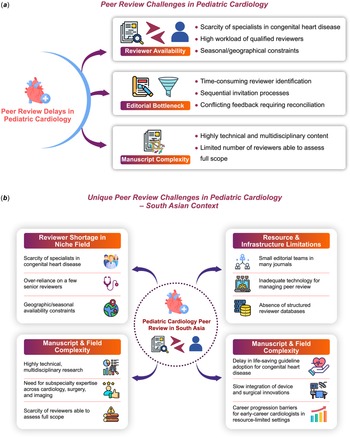
Figure 2. Peer review challenges in paediatric cardiology. (a) Outlines paediatric cardiology peer review challenges: reviewer scarcity, editorial bottlenecks, manuscript complexity, and clinical impact of delays. (b) Focuses on South Asia and highlights additional constraints, such as limited experts, inadequate editorial infrastructure, multidisciplinary demands, and delay-driven risks to patient care and career progression in resource-limited settings.
 You have
Access
- 1
- Cited by
Initial hurdle: the desk rejection stage
The review journey typically begins with an editorial screening, commonly referred to as the desk review. At this stage, editors determine whether a manuscript aligns with the journal’s thematic focus, meets minimum quality standards, and offers adequate novelty. A decision to reject at this point, though discouraging for authors, prevents unnecessary burden on peer reviewers and can expedite overall journal operations. Reference Williams1
However, this stage can itself become a source of delay. Editors are often inundated with submissions and must balance this workload with other responsibilities. Ambiguous cases, where the decision is not immediately clear-cut, may require internal consultations or multiple rounds of scrutiny, further extending response times. The establishment of transparent screening criteria and more streamlined editorial workflows may reduce delays at this phase. Reference Williams1
Reviewer identification: the primary Bottleneck
Once a manuscript passes the editorial filter, the most significant impediment often emerges identifying willing and qualified reviewers. While it may appear routine, this step is highly resource-intensive. Editors must locate experts with appropriate subject matter expertise, absence of conflicts of interest, and sufficient availability—a confluence that is increasingly rare. Reference Ho2,Reference Lipworth3
In niche disciplines, the scarcity of available reviewers is even more pronounced. Even when suitable candidates are identified, many decline due to workload saturation—balancing teaching, administrative duties, grant writing, and their own scholarly endeavours. This necessitates a cycle of invitations, follow-ups, and replacements, contributing substantially to delays. Reference Lovrenčić4–Reference Smith7
Geographic and seasonal constraints further compound the problem. Reviewer availability fluctuates during academic breaks, holidays, and peak submission seasons, resulting in asynchronous communications and deferred responses.
Delays after reviewer assignment: a multifactorial challenge
The contributing factors 8-Reference Rothwell and Martyn10
Even after securing reviewers, delays can persist due to a range of factors
• Competing priorities: reviewers frequently juggle multiple professional responsibilities, which may interfere with timely manuscript evaluation
• Reviewer fatigue: a recurring phenomenon, especially among prolific reviewers, leading to decreased motivation or outright refusal to participate
• Manuscript complexity: comprehensive or highly technical papers demand more time for thorough assessment
• Emergent conflicts of interest: occasionally identified post-assignment, necessitating reassignment, and restarting the process
• Communication gaps: non-responsiveness or inconsistent communication from reviewers can leave editors without clear timelines
• Editorial reconciliation: after review submission, editors must synthesise divergent reviewer opinions, a process that can be particularly challenging when feedback is conflicting or ambiguous. 8–Reference Rothwell and Martyn10
Strategies for enhancing efficiency
While some delays may be unavoidable, several targeted strategies can mitigate their frequency and impact.
Expanding the reviewer base
Diversifying the reviewer pool across disciplines, geographies, and academic ranks can reduce the burden on over-utilised reviewers and foster inclusivity. 9
Recognising reviewer contributions
As peer reviewing is largely unpaid, providing formal recognition—certificates, acknowledgements, or annual awards—can incentivize timely participation and promote goodwill within the academic community.
Clarifying expectations and deadlines
Clear, structured communication regarding timelines and review criteria enables reviewers to plan effectively. Automated reminder systems and calendar integrations (e.g. iCal) may also help reviewers adhere to deadlines.
Providing structured review templates
Many reviewers delay submission due to uncertainty about expectations. Offering structured templates or evaluation rubrics can enhance both the quality and speed of responses.
Leveraging automation and artificial intelligence tools
Editorial management systems that use algorithmic matching to suggest potential reviewers based on keywords and publication history can reduce the time required for reviewer identification.
Parallel review invitations
Some journals initiate reviews by contacting multiple potential reviewers simultaneously rather than sequentially, ensuring backups are available in case of non-response or decline.
Streamlined editorial processing
Post-review delays can be reduced by optimising editorial workflows, ensuring that reviewer feedback is promptly synthesised, and decisions are communicated without unnecessary lag.
Author’s view-point
Authors frequently perceive the review process as excessively prolonged, attributing this to reviewers’ preoccupation with minutiae, compelling authors to conform to their subjective perspectives, thereby stifling original thought, coercing authors into superfluous revisions, and often identifying non-existent flaws (Figure 1). Reference Bradley11–Reference Bacchetti13
At our institution, several low-cost initiatives have improved peer review engagement and efficiency. New faculty undergo structured orientation on peer review expectations, timelines, and ethical standards. A co-reviewing model pairs junior reviewers with experienced faculty, fostering mentorship while maintaining review quality. In addition, reviewer contributions are formally acknowledged during annual academic evaluations, which has measurably increased participation. These context-sensitive strategies may serve as scalable models for journals in similar academic and resource-limited settings.
Enhancing peer review: strengthening standards and efficiency
One of the key challenges in peer review is maintaining high standards while ensuring efficiency and fairness. In regions such as South Asia, there is an urgent need to strengthen medical journals through improved editorial processes and a more robust peer review system. Reference Shankar14 The quality of peer review is not solely dependent on identifying flaws but on providing constructive feedback that fosters scholarly development. A poorly structured or excessively harsh review can discourage researchers and delay the dissemination of valuable findings. Reference Drubin15 Effective peer review requires training and structured guidelines to help reviewers deliver comprehensive yet efficient evaluations. Reference Benos, Kirk and Hall16 In addition, initiatives such as expanding reviewer pools and providing recognition for reviewers’ efforts, as seen in few journals, can significantly improve participation and review timelines Reference Cornelius17,Reference Winck, Fonseca, Azevedo and Wedzicha18 Implementing best practices in academic publishing, including clear reviewer expectations and mentorship programmes for early-career researchers, can raise overall standards and expedite the review process. Reference Jiwa, Oberoi and Oberoi19 Moreover, journal editors play a crucial role in fostering a positive peer review culture. By ensuring that submissions are handled with transparency and efficiency, they can create a system that balances rigorous evaluation with timely decision-making, ultimately benefiting the broader research community. Reference Fischer20
These observations are consistent with perspectives highlighted by professionals in the publication industry, who have similarly outlined the multifaceted nature of peer review delays and proposed parallel solutions to address them. 21
In highly specialised domains such as paediatric cardiology, neurosurgical oncology, and rare genetic syndromes, the availability of qualified reviewers is particularly constrained. Establishing field-specific reviewer networks—formalised pools of experts curated by academic societies, professional bodies, or journal consortia—can streamline reviewer identification and assignment. These networks promote reviewer accountability, distribute workload equitably, and encourage inter-institutional collaboration. For instance, the creation of paediatric cardiology peer review panels within regional or global societies could ensure timely and expert-driven evaluations, especially in journals where such submissions form a niche proportion of total manuscripts. Such systems have already shown promise in other fields, such as oncology and transplant medicine, where collaborative reviewer databases have been adopted by some consortia-based journals to maintain quality while reducing turnaround time. Reference Gasparyan and Kitas22–Reference Rosengaard, Andersen, Rosenberg and Fonnes24
Recent advances in artificial intelligence have led to the development of editorial platforms that leverage natural language processing and machine learning algorithms to enhance reviewer selection. These systems analyse manuscript content (title, abstract, keywords, and full text) and automatically match them with suitable reviewers by mining databases such as PubMed, ORCID, and institutional repositories. Artificial intelligence tools such as Reviewer Finder, Paper Matcher, and Meta-Reviewer have shown improved reviewer matching accuracy, reduced editorial burden, and decreased time to decision, particularly in high-throughput journals. Reference Shah and Acharya25–Reference Ferguson, Marcus and Oransky27
Moreover, artificial intelligence models can incorporate conflict-of-interest data, historical reviewer responsiveness, and topic relevance to refine suggestions. Although these technologies are still evolving, early evidence indicates that their integration into editorial workflows may lead to measurable improvements in both efficiency and transparency of peer review. Reference Taylor, Dagan, Youngberg, Kaufman and Radding28,Reference Kankanhalli29
Regional considerations and structural improvements
In developing regions, such as South Asia, peer review systems face unique infrastructural and resource challenges. Many medical journals in these areas operate with limited editorial staff and inadequate technological support, underscoring the need for reform. Reference Shankar14 Quality peer review is not merely about identifying flaws, but about providing developmental, constructive criticism (Figure 2 (a) and (b)). Reference Drubin15,Reference Benos, Kirk and Hall16
Training programmes for reviewers, especially early-career researchers, along with editorial mentorship, can raise the quality and timeliness of manuscript evaluation Reference Cornelius17–Reference Jiwa, Oberoi and Oberoi19 Editorial leadership, when committed to transparency and prompt processing, can foster a culture of accountability and continuous improvement. Reference Fischer20
Reviewer unavailability and delayed report submission are common issues; studies indicate that over 70% of manuscripts face delays due to late reviewer responses, typically extending peer-review times beyond three weeks. Reference Cornelius17
Systematic reviews of biomedical journals show substantial variability in submission-to-publication durations, ranging widely from approximately 70 to over 550 days, emphasising the broader inefficiencies in editorial workflows. Reference Andersen, Fonnes and Rosenberg30
Emerging solutions include diversifying reviewer networks and adopting structured reviewer pools, which help reduce dependence on a limited group of frequently solicited reviewers, thereby improving the speed and efficiency of peer-review assignments. Reference Checco, Bracciale and Loreti31,Reference Zhao and Zhang32 In addition, structured reviewer recognition programmes and formal training initiatives have been proposed to enhance responsiveness and review quality, although specific regional implementations and their outcomes require further documented evaluations. Reference Malički and Mehmani33
Peer review delays can have particularly significant consequences in fields such as paediatric cardiology, where timely dissemination of research is critical for informing clinical guidelines, device innovation, and therapeutic strategies for vulnerable populations. In rapidly evolving areas like CHD management, prolonged publication timelines may delay the adoption of life-saving interventions. Moreover, early-career cardiologists—especially in resource-constrained settings—often depend on timely publications for securing fellowships, academic appointments, and research funding. Extended review cycles can therefore impede both patient-centred innovation and professional development, underscoring the need for more responsive and field-aware peer review mechanisms in paediatric cardiology. Reference Zhao and Zhang32–Reference Kusumoto, Bittl and Creager34
Conclusion
Effective communication and clear expectations are essential for streamlining the peer review process, particularly in open-access journals where early-career researchers and international contributors play a significant role. Editors must ensure that reviewers are well-informed about their responsibilities, while authors should receive guidance on how to minimise delays from the outset. Most crucially, reviewers should provide precise and actionable feedback, enabling authors to make necessary revisions efficiently. By fostering a structured and transparent review system, journals can reduce unnecessary rounds of revision and significantly accelerate the path to publication.
Causes and proposed solutions for peer review delays. Peer review delays arise from editorial bottlenecks, difficulty finding qualified reviewers, manuscript complexity, and workflow inefficiencies. Proposed solutions include expanding reviewer pools, offering recognition, using AI-assisted matching, setting clear timelines, employing structured templates, and streamlining editorial processes to ensure timely and high-quality reviews, particularly in specialised fields like paediatric cardiology.
Peer review challenges in paediatric cardiology. ( a ) Outlines paediatric cardiology peer review challenges: reviewer scarcity, editorial bottlenecks, manuscript complexity, and clinical impact of delays. ( b ) Focuses on South Asia and highlights additional constraints, such as limited experts, inadequate editorial infrastructure, multidisciplinary demands, and delay-driven risks to patient care and career progression in resource-limited settings.
Competing interests
Nil.