Force yourself to laugh at the slightest shred of whimsy, even if it's something you'd never find the least bit amusing outside of jazz. Make sure everyone thinks you're honestly deriving pleasure from listening to jazz, instead of just waiting for the moment you can go back to listening to real music with a single melody that your ears can actually differentiate. THE BASSIST PLAYED PART OF THE FLINTSTONES THEME FOR 6 SECONDS! Did you catch that? Amazing.
Hallie CantorFootnote 1In what circumstances might the reduction of labor by way of a device—the simplest promise of all technology—become regarded, even when not illusory, as a contemptible, untrustworthy, or generally negative thing?
Sianne NgaiFootnote 2In this article I explore the phenomenon of the Lick (Figure 1) in online jazz communities and its gradual transformation as a layered and repeating phrase and joke. I track the processes of the Lick's transition from joke to viral video to meme,Footnote 3 and then from meme into gimmick via exposure and repetition, which have changed the core joke's audience, function, and meaning over time.
The Lick

I do not attempt to catalogue every example of the Lick (indeed, part of the project is in noting the futility of that enterprise, and the limits of tracking sonic repetitions in a largely visual space and then again of indexing images without legible (to the computer/algorithm/search engine) texts are well known to researchers working with digital objects).Footnote 4 By selecting certain examples as representative of a broader whole or as significant moments of change, I hope an incomplete but useful picture, one that highlights key moments of transformation, is presented of the function and strangeness of this shifting object(s) and the attendant feelings and material buildup that surround it.
I begin with a brief introduction of the Lick and a discussion of the function of licks and memorization in the instruction of improvisation and jazz. This background introduces Alex Heitlinger's video of the Lick, a pivotal moment for its exposure and the shift of use and meaning.Footnote 5 From Heitlinger's video and its virality, I explore various offshoots of interaction with the Lick:
• The use of the Lick as a punch line in visual meme formats.
• The usage of the Lick as a sonic punch line in the conclusion of jazz songs.
• The continued practice of finding the Lick in existing recordings and performances.
• The usage of the Lick as a single and repeated phrase, manually and digitally, and, relatedly, the usage of the Lick as a somehow commodified or commercialized object.
The repetition of the Lick, and the way the joke adapted itself to sonic and visual, is tied to its success – the reliance of virality is in replicability and the willingness of individuals to pass it along. In this way, a relatively early internet phenomenon has stubbornly held attention for a decade and morphed – a sonic pre-meme that easily meshes with the visual and written format of online memes, made to be substituted. The Lick works as the ‘tag’ that concludes a piece, becoming the punch line that concluded the joke. But what is the joke, exactly? It remains unclear.
Licks, repetition, and jazz indoctrination
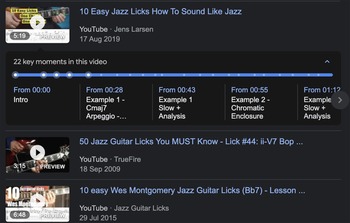
Licks, in jazz and surrounding genres, are melodic tools used to build an improvisational vocabulary. They are pre-melodies – short, stock melodic phrases that are exchangeable, and therefore mutable, which act as building blocks for a solo. Licks are generally not owned, although some are distinctive and attached to referents (think McDonald's tag or the Flintstones) – they function as a grey area between inspiration and infringement, where, short enough, in different contexts, they can be exchanged between musicians freely, fragments beyond notes that take on referentiality as they are known and exchanged. By building a vocabulary of licks through covering songs, memorizing solos, listening to performances and recordings, the improvised nature of the music is not the licks themselves, or the notes that make them up, but the combination and organization with which they are deployed – the purpose of indoctrination in oral tradition via these different memorization practices is to make them become automatic, so that they can be generated spontaneously during performance (Figure 2).Footnote 6
(Colour online) Screen shot of YouTube search results for ‘jazz lick’, exemplifying the lowercase ‘l’ ‘licks’ used to build longer melodies and improvisations.

Because of this slippery non-authorship, licks can also serve as sonic gatekeepers: knowing your history, who played what when, where the referent is from, can serve as a means of testing the ear and a common musical vocabulary. While samples and quotes can be layered and have multiple points of recognition or entry, there is usually one major identification point or beginning source. Licks, by contrast, are less individually identifiable; there are multiple possible origin points that are possible, and they are fragmented and mutable.
This improvisatory vocabulary is accompanied by a written canon of jazz standards, which are also disseminated largely through conservatory programmes: the Great American Songbook, the Real Books of the 1970s, and a list of listening repertory that varies according to the gatekeeping individual but will always include Miles Davis's Kind of Blue (1959). While this common canon facilitates cooperation between players, as Doffman notes ‘it has led to a certain ossification of the repertoire: material that is left out of Real Books is much more likely to be ignored’.Footnote 7 Similarly, conservatory programmes have valued technique over experimentation, leading to memorized solos and heads and an obsession with repeating what is already there.Footnote 8 As David Ake has explored, the college music department from the 1960s onwards has taken an active role in shaping the image of jazz as ‘technically demanding but fun “All-American music” … [that] served to marginalize some of the musics played as jazz in the outside world—that is, beyond the academy walls’.Footnote 9 This ossification and credentialism, centred around the university, has also changed the landscape of musicians: an overwhelming number are white men, or what Nate Chinen defines as the jazzbro:
A jazzbro—not to be confused with a jazzbo, its older taxonomical cousin—is a self-styled jazz aficionado, overwhelmingly male and usually a musician in training himself, who expresses a handful of determinative social behaviors. Among these are a migratory pattern from the practice room, where they often nest alone, to the jazz club, where they travel in packs; a compulsion to signal the awareness of any mildly startling musical detail, with muttered exclamations like the aforementioned ‘Woooo’; the emphatic adjectival use of the word ‘killing’, as in ‘that solo was killing’; and the exploitation of jazz knowledge as a private commodity selectively put on public display.Footnote 10
Moppa Elliot of the band Mostly Other People Do The Killing points to the genesis of the band's album Blue, a note-for-note re-creation of Miles Davis's Kind of Blue in these conservatory spaces: first at Oberlin in the context of learning a new jazz vocabulary through transcription, and later at Juilliard when the group's saxophonist, Jon Irbagon, was required to play a transcribed solo in his graduation recital:
So let's say you're doing four tunes at your recital. One of those tunes has to contain your transcription of somebody else's solo and you have to play it in context, i.e. not improvise. But that is jazz? Big question mark right there.
So we went to Jon's graduate recital, and this is Jon's subversive streak and it's funny too. For his transcription, he transcribed a 12-minute, unaccompanied Steve Lacy solo, from one of those Steve Lacy records. And it's Steve Lacy playing some little tune that he wrote, and then he blows for ten minutes, and then he plays the head. Jon played the entire transcription. Twelve minutes of recital. And we thought it was hilarious; but then it's like, well wait a minute: what is that? Is that jazz?Footnote 11
Out of this tradition of memorization, recognition, and repetition – that is, of licks – comes the Lick, the viral sound. It is one lick of many, and it is not clear when it was played for the first time, nor when it was first recognized as a repetitive fragment: the question remains, actually, whether it is actually repeated significantly more often than other licks preceding its notice or whether it is just happenstance that it was the one to move in this direction by being noticed: a Streisand effect with lasting repercussions. From a conservatory jazz tradition and its newly emerging digital outgrowth, it became known as a ‘famous jazz cliché’, first as a viral video and subsequently in different joke format iterations, emphasizing the nascent world of online jazz communities with a wide participation of the Lick as the punch line because of how often it occurs. It is unclear when it first shows up in jazz solos, and as a melody fragment it precedes them: finding and spotting the Lick became something of a game for musicians in the know about its presence.
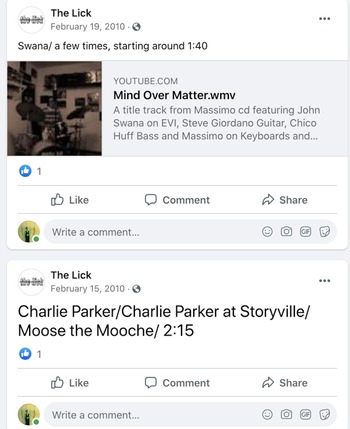
In 2010, a Facebook group called ‘The Lick’ was formed, a digital outgrowth of this lick-spotting at the New England Conservatory, that was dedicated to documenting occurrences of the Lick (usually via YouTube video with a posted timestamp) (Figure 3).Footnote 12
(Colour online) Screen shot of ‘The Lick’ facebook page, with two different examples of the Lick embedded within longer videos.

The video
One group member, Alex Heitlinger, made a mashup video of his favourite examples of the Lick as a direct back-to-back set of clips and uploaded it to YouTube, where it went viral (currently with 4.3 million views).Footnote 13 The video moves from clip to clip of the Lick, in varying keys and genres: the performers and composers that he compiled include John Coltrane, Branford Marsalis, Herbie Hancock, Keith Jarrett, Freddie Hubbard, Danilo Perez, JJ Johnson, Robin Eubanks, Igor Stravinsky, Dave Brubeck, Sam Rivers, Eric Alexander, Lee Konitz, Pat Metheny, Michael Brecker, Charles Mingus, Deangelo, Tia Fuller, Snarky Puppy, Rick Margitza, Donald Harrison, Jeff ‘Tain’ Watts, Guthrie Govan, Esperanza Spalding, Chick Corea, Player, Beyoncé, Sheena Easton, Pancho Sanchez, and Dexter Gordon. The primary genre represented can be termed ‘jazz’, but the interspersed rock, r&b, hip hop, and classical excerpts offer a timbral variation that follows alongside seamless key changes: the repeated Lick shines through as a note sequence first, with the rhythmic cadence (four swung quavers, one crotchet, and a longer note continuing into the next bar as the ‘primary expression’) more optional but often occurring. Heitlinger first became aware of the Lick while a student at the New England Conservatory (NEC) sometime between 2009 and 2011; the Facebook group was small at the time and an inside joke many people at NEC knew about and participated in. The video had initially been intended just for his friends before it took off: Questlove, NPR, and Nicholas Payton all shared the video; Jason Moran contacted Heitlinger and told him that the video was ‘a piece of art in the collage style’.Footnote 14
This viral moment changed the Lick's trajectory. The video composition that Heitlinger made worked as a joke with certain punch lines – the Firebird suite among clips from jazz musicians such as John Coltrane and Bill Evans and Player (with WorldStar Hip Hop logo included in the corner) serving to highlight the lick's far-ranging appearances, and putting them next to one another with the smooth transitions of tempo and key, a collage, highlighted the repeated phrase where previously it had just been a part of a longer musical act, sometimes plucking it out purposefully from a longer, different phrase it was embedded within. While Heitlinger treated the video as an extension of the existing joke, intending it for the appreciation of the niche Facebook group/conservatory community, this repetition and assemblage could also be seen as falling into line with practices of minimalist experimentation and avant-garde found art. It was taken seriously by others when it left its joking context, and while the repetition was funny to some, it was also intriguing, suggesting the proto-meme fragment of an intuited musical gesture in its ubiquity. The linkage of fragments by their shared tune also follows the historical practices of folksong collectors,Footnote 15 as well the more recent practices of videos that splice side-by-side comparisons of sound or image to emphasize their similar qualities.
Shortly after the video went viral, Heitlinger returned to the Lick's Facebook group, wondering whether the video's virality had compromised the joke's integrity. Would the Lick, having become a joke, have a future as a played melodic fragment? Once observed, how does the observed thing change in response? The periodic reassertion of the Lick prior to internet documentation was already an in-joke among select conservatory students and jazz aficionados, but by putting it into a YouTube format and the viral transmission that followed, the joke was opened to a wider audience, rendering the lick something that could no longer be played non-ironically in the same way. Once musicians playing the Lick were self-aware,Footnote 16 the action of playing it changed. The initial joke reading of the Lick – in the sense of the joke as an expression of the unconscious – is the suggested breaking of the improvisatory fourth wall; the accidental expression of a wholesale repeated phrase undisguised by players as individually formed but not connected to any particular referent beyond itself and with no set origin point. Self-awareness changed this self-referentiality to be intentional rather than random, deliberate rather than accidental.
Heitlinger asked:
Now that The Lick is so widely known, several philosophical questions arise: 1. Can the Lick be played non-ironically by someone who knows about the Lick? 2. If the Lick is played (either ironically or genuinely) by someone who knows about The Lick, does that really ‘count’? 3. If the answer to question 2 is no, then how can we judge that future instances of the Lick are pure and genuine? 4. Does the funniness of the Lick rest on the fact people seem unknowingly drawn to it, and if so, would a world-wide awareness of the Lick destroy its most salient quality? I'd like to hear your thoughts.Footnote 17
Outward movement
From here, the way the Lick was a joke also changed. Following Heitlinger's video came other compilations: some furthering the original premise of plucking different versions of the Lick next to one another, others taking a single instance or a few (e.g., the two different keys of John Coltrane playing the Lick back-to-back that appear in Heitlinger's video, excerpted into a single repeating loop),Footnote 18 some playing it in all twelve keysFootnote 19 or in a substitutive genre version – video-game style, Renaissance style, and more.Footnote 20 This aligns with the phenomenon Paula Harper has categorized as viral musicking:Footnote 21 a collective sonic participation where changes and additions surround the circulation of an object, but in this case the object was a split one – the viral video and the memetic quality of the Lick's repetition, which could be newly applied and spread outward.
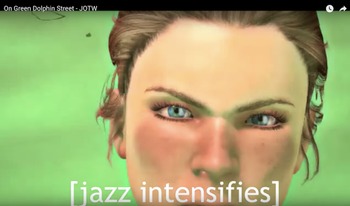
There was, alongside this interaction and riffing, also a different resurgence of the Lick as a joke, used as a punch line: both as a visual meme and as a sonic one. Two Facebook groups, Jam of the Week and The Shitposting of Jazz to Come, both show ways the Lick's virality and subsequent mimetic transmission has shifted its use and meaning. Jam of the Week, founded in 2014 and with 71,000 members, is a space where members post and comment on different solo performances they self-upload; The Shitposting of Jazz to Come (the name is a joke amalgamation of Ornette Coleman's breakthrough 1959 free jazz album The Shape of Jazz to Come and ‘shitposting’, or posting deliberately poor-quality memes and humour content) was formed in 2017 and has 29,000 members, many of them students and/or professional jazz musicians, and also operates on community-contributed content. Jam of the Week posts that include the Lick usually do so as a winking reference within a solo or the closing to the video; Simon Fransman posted an off-putting electronic version of ‘On Green Dolphin Street’Footnote 22 where, under the caption ‘[jazz intensifies]’, the lick played at hyper-speed (Figure 4); elsewhere users apologize for including it or defend their choice of doing so. Here the lick works as a tag, and when used as closer (or repeated several times to conclude) follows an ending pattern common to many jazz songs, especially those from the Great American Songbook.Footnote 23
(Colour online) Screen shot of ‘On Green Dolphin Street’ video, posted in Jam of the Week, where the Lick plays under the text ‘[jazz intensifies]’.

One user in Jam of the Week posted:
On behalf of all the beautiful music that went unwritten and the lines that went unphrased the last couple of years due to meme culture deeming them uncool, I'd like to offer some counterweight and propose we get back to using our ears and playing what sounds good, even if it is the lick or an Eb11 chord or quintuplets or anything because if following the contour of the music intuitively and organically leads you there and that's what you want to say, just say it! Substituting it to meet external expectations usually comes across as disingenuous when you don't understand those expectations beyond ‘It's a thing’. hating on that stuff has nothing to do with jazz or music theory, it's simply the pop culture of jazz and it should just be taken as a joke and a bit of fun but actually avoiding them as a rule of thumb is like saying ‘I before E except after C otherwise it's not a real word’.Footnote 24
This sentiment was echoed elsewhere: the frustration seemed to be the brushing up between ‘serious jazz’ and the Lick's refusal to just be a melody – the sticky attachments, the joke prevailing over meaning, and the social adaptation to conform to this shared meaning over the basic (‘what sounds good’). This aligns with Grundlingh's framing of memes as speech acts, serving to communicate succinctly through gesture: the Lick's embeddedness within its specific meaning was inescapable.Footnote 25
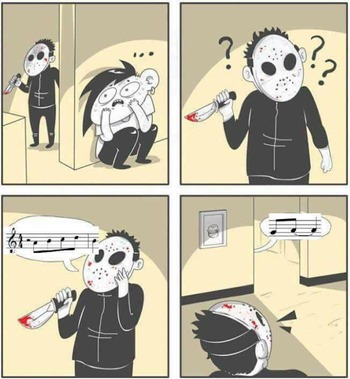
The Shitposting of Jazz to Come group, as one primarily centred around the intersection of jazz and internet humour, latched onto the Lick, with members continuing the original group's game of spotting it but also expanding beyond that practice: playing it in different styles, on instruments that were not theirs, in every key, and in various other contexts (Figure 5). Members used a visual meme template and inserted the Lick as a punch line: a murderer whistling the beginning notes to spot the victim, who is compelled to complete the ending of the phrase (Figure 6); a drug dealer opening an envelope to find the Lick inside, and other reactions from movies and television that interspersed the Lick onto other non-jazz material. This became an interesting touchstone between more traditional meme formats and the sonic meme/viral music spaces the Lick had occupied: ‘traditional’ memes, visual template altered for specificity, could easily accommodate the ‘tag’ of the lick as a punch line around which they were already in some ways designed.
(Colour online) One example of the Lick discovered ‘in the wild’ and posted to the Shitposting of Jazz to Come group, where the pattern is recognized abstractly within the melodic contour of a kyrie.

(Colour online) A meme of a murderer looking for a victim in which the lick has been used as the punch line; the murderer whistles the first five notes and the victim, compelled to finish the phrase, reveals their location.

In some cases, lick is spelled ‘licc’ rather than the ‘lick’ of the initial video: this is a reference to the word ‘thicc’ with two ‘c's, used to sexually objectify on women's bodies, the spelling a seemingly innocuous change that also signalled the male-centred perspective of the jokes being made, an implicit reminder of who was welcome in the space and in what capacity.Footnote 26 This connection was never made explicit beyond this spelling change, which could also be read as a more innocuous internet affectation, that is, ‘lolcatz’ speak, but which in conjunction with more explicitly sexist material (recurring posts about the desire for a ‘qt bebop gf’ one of the more prominent examples) the spelling had a sinister undertone, and when users expressed discomfort with the tone of the group they were met with mixed reactions.Footnote 27
Gimmickry and commodification
Adam Neely is a prominent member of the group and a professional YouTube musician who specializes in electric bass education videos. A graduate of Berklee Conservatory of Music, Neely made videos with titles such as ‘How to NOT Suck at Music’ where he critiqued submitted performances of his viewers and ‘Gig Vlogs’ documenting his live performances, offering a popular introduction to music theory meant to be accessible. His channel has garnered 1.5 million subscribers as of this writing. He was particularly interested in the Lick, and, in order to promote his YouTube channel after reaching 300,000 followers, livestreamed himself playing it for five hours straight. He went on to sell T-shirts printed with the Lick on his website and YouTube, commodifying his feat and taking something made notorious for being universal as an opportunity in personal branding.
In the subsequent Q&A video, when asked why, he noted that
the lick is not important, don't kid yourself … it's an inside joke among jazz musicians … why would I stream myself playing the lick over and over and over again? It comes down to two things, really. The first thing is that I wanted to do my version of Eric Satie's ‘Vexations’, which … has a bit of an absurdist bent, like most of Satie's work. ‘Vexations’ is a short work, but … at the top is a note advising that if one is to play it 840 times in a row you should prepare yourself with silence and grave immobilities. It's important to note that it doesn't tell you to perform the piece of music 840 times in a row, it merely just gives advice to you if you were to do such a thing. It was never performed in Satie's lifetime or published, but John Cage discovered this music … and it's been a bit of a tradition to play it live 840 times, so in doing the lick livestream, it was kind of my personal homage to ‘Vexations’ … I've always had a soft spot for this piece of music … the thing is, you probably did not listen to that much of the lick livestream. People were more curious to see if I actually did it rather than see me do it [Neely noted that people tuned in to the stream on average for a couple of minutes] … it's a technical meme, a low-quality, high-effort shitpost. The value in the content doesn't come from the experience of it, it comes from the amount of work necessary to create it.Footnote 28
What was Neely's aim? The Lick was not elevated to the status of ‘Vexations’ and he did not explain this as a motivation prior to the Lick's stream, which was presented as a novelty performance surrounding the subscriber count. Neely's participation in the Facebook groups may also have had something to do with this moment of promotion, since the Lick was successfully functioning as a multiform joke, though not usually in extended instances. Preceding Neely's livestream, however, a video came from YouTube account ‘Jish the Fish’, who excerpted the back-to-back Coltrane excerpts of Heitlinger's video and repeated them for ten hours: a low-quality, low-effort shitpost that served as a reminder that repetition, in the sphere of YouTube or any digital replication, did not require significant labour and Neely's accomplishment was meaningless; in an alternate path, one moderator of ‘The Shitposting of Jazz to Come’, Andy Brent, livestreamed himself on YouTube playing the Lick 10,000 times (taking eight and a half hours to Neely's five) to prove that the record could be beat and that the accomplishment and the joke were both meaningless and surpassable.Footnote 29
Low-quality high-effort: Neely took back the repetition of the Lick from the digital and made it mechanical again, but for no reason – no one watched it, there was no greater benefit to it (outside of maybe negligible T-shirt sales), and most people found it irritating and pointless. Unlike other avenues, where individuals took up the Lick and offered their own variation, this created a dead end: people did not watch to the end of his video, nor did it lead them to somewhere new. The Lick in these instances breaks with jazz: it is not within a broader set of phrases or an improvisation but a single repeated fragment that continues durationally for a set period.Footnote 30 In Neely's case, it is a gimmick: a stunt with no value in itself, meant to create controversy and generate attention.
Sianne Ngai, in her exploration of the gimmick, positions it as a labour-saving device, less humour than irritation because it is a visible shortcut, tiresome in its familiarity, a fetishized idea more pleasing to the creators than their audiences. The Lick functions as a labour-saving device in that it signals jazz humour and internal referentiality without the need for any actual improvisation on the part of the musician – it conveys a suggested broader knowledge both of the on- and offline jazz community and of the canon of bebop licks, solo transcription, and jazz conservatory training in which the Lick is situated, but does not require facility of the player beyond repetition, a shortcut that suggests jazz while it cuts off the real possibility of improvised music in favour of staying within the established. Similarly, its turn to gimmick comes when it exhausts the avenues of interest: when it turns into a source of frustration and the repetition ceases to contain something novel. The creator is satisfied; the audience is left wanting. The Lick becomes more of a gimmick with each digital/manual repetition, a self-indulgent joke that has overstayed its welcome, irritating listeners rather than amusing them because of the overdoneness and repetition, even as the repetition cements the point of the humour to those making the joke.
This collection of ephemera demonstrates the frustrating difficulty of gathering an archive in a scrolling universe. While certain moments remain searchable, others blend together. Authors cease to exist. Where are the people? Behind the screen some of them – Heitlinger, Neely – come forward, but others remain anonymous, and works are lost and move around, detached from their makers, traded and stolen. This loss/highlight duality is tied up in the algorithmic prioritization of certain creators and the devaluation of cultural contributions especially made by Black creators.Footnote 31 More recently Neely posted an image of the Lick with a popular ape non-fungible token (NFT) on his twitter, captioning it, ‘the lick NFT, give me money please’;Footnote 32 and while this was done ironically, previous instances of Neely's engagement with the lick have been around claiming ownership and seeking profit.
The meaning of an archive, as Hine notes, in email terms is six weeks.Footnote 33 And of course there will always be new examples of the Lick once it is heard – repetition, synchronicity, the mind gravitating towards a pattern – so that it will emerge again as a found object, culled from its contexts, spliced and presented. The joke does not end, it just radiates outward, getting tired and playing again. In the meantime, individual iterations get lost, and the final collection (tagged, labelled in a searchable way) is the skeleton archive, full of missing pieces. The internet archive, similarly, does not cache most videos or photos embedded in the sites it crawls; they are like missing teeth in the mouth, holes where the sound and moving media have to be imagined by their descriptions. Some can be recovered with further digging, some not, a graveyard of former hosting platforms. Provenance is difficult, as is pinpointing exactly where something began.
The tiresomeness makes the Lick gain appeal as a shitpost: its irritation, trolling and overuse, the unfunniness of the joke, turn into what makes the joke worth making. Neely may have killed the Lick by repeating it ad infinitum, to nod to Satie or gain notoriety or create a technical meme or for no reason at all, but the video of the Lick already relied on its overuse as the point of its notoriety. The centre around which the Lick orbits is empty. It was never truly funny and, ironically, can never lose the edge of the joke as it is played and shifted. The initial point was the way it showed up embedded in other things; when it is removed from them and left to stand on its own, the implication is that it is funny because it keeps going, continuing to repeat. Here the jazz and internet identities clash, and the internet form is the victor, with repetition edging out change. Neely's intervention is also worth noting because he adds an author back in where the meme context and joke punch line removed it: he sells T-shirts, tracks views, and commodifies the Lick when he extracts it. Unlike Heitlinger, who takes other versions and puts them together (but is known because of the collage), he is the only one playing. He is putting himself, the performer, at the centre stage; the Lick is no longer the point, rather, the point has become that he is playing it (but somehow, he is still playing it as a joke, rather than seriously).
When Neely did his livestream, another group member linked to it and posted:
Why tf cant Adam Neely move on from ‘the lick’ … stop being immature its really not funny anymore. If someone plays it in a solo, ok whatever you're improvising thats jazz. But dont waste time coming up with a new meme or something of the sort for ‘the lick’ to try and be funny because its old.
Below this, several users copypasted it, and more posted it as a unique post, making it into a ‘copypasta’ or text-based meme, and Neely copypasted the same thing in a comment on the post himself, a meta-interaction with the critique that deflected it, using the same logic that had led to him playing the Lick for five hours in the first place (Figures 7 and 8).
(Colour online) Screen shot of Neely's livestream of the Lick.

(Colour online) Screen shot of the copy pasta developed from someone's resistance to the Lick, an example of the joke's recyclable nature.

Users who used the Lick in images and uploaded videos of themselves playing it also posted about seeing it outside of the digital sphere, mentioning inserting it at church gigs or other places with unsuspecting listeners:
Volunteering at a high school jazz festival … I've heard the lick 80 times this morning alone.
Mostly trumpet players
Going to rehearsal rn, gonna play the lick in my solo
The Lick offers an example of an ephemeral digital sound archive: the musical mimicry within digital communities that proves difficult to document and identify, or to find again if it is not carefully documented, the erasure of authors and the few exceptions who claim authorship and ownership (sometimes to the extent of monetization), the difficulty of provenance, and the replacement of improvisation – that is, of difference – with repetition of the same phrase fragment. Its life in the real world, ironic and not, is even harder to pin down – who’ is playing it, and who is hearing it, in what way? It is impossible to do a sound search on the Lick and come up with everything; a text search will yield some but not all, and the expression of the Lick in notation similarly moves it into the visual and largely unsearchable; as with the original form, it still requires careful listening to spot and recognize. As with many memes, individual ownership is mostly considered unimportant – they are traded freely, understood as ephemeral and briefly attention-catching, and authors are only rarely attributed (and then, again, on the basis of attention – that is notably popular versions or creators, or the ones who work hard to identify and market themselves with their content). Because of the Lick's own repetition, it fits neatly into this practice of template that move and change but are not expected to be original. It is a musical version of the visual substituting that makes memes possible, the digital copypaste that allows for things to be easily put together and shared.
The humour of the Lick began with unexpected repetition: a break in the veil of improvisatory music, an unveiled shortcut that was wide ranging. When it was shared, the joke changed: the repetition, not the (seemingly) unknowing repetition, was the joke, an ironic layer and also a defence against death – by insisting that the repetition was what was funny, repeating back all complaints, doubling down on repeating the Lick again – its supporters and detractors fed the machine of its content production and eventual commodification. Insisting that the Lick was dead brought more attention to the Lick, a trolling sort of repetition that relished the irritation that it provoked, insisting that was the point and the goal.
Conclusion
Is the Lick dead? Was the joke only funny before it was so present? Which one of the repetitions was the last funny one, and which was the last that was unself-aware? In some way the insistence on repetition, and on claiming that repetition as authorship – the commodification of the YouTube stream and the T-shirt sale – mean that funny or not, jazz or not, music or not, serious or not, meme or not – cease to be the question. The joke is on you.
In August of 2020, the pinned post for the Shitposting of Jazz to Come group promoted for sale a face mask with the Lick printed on it, as well as mugs, shirts, and stickers: the header is another version of the Lick, matched to the group's name. Its malleability allows for its substitution anywhere: it makes itself and its continued existence the joke, and finds new forms as they arise – it adapts to both digital and physical environments as a phrase that will keep repeating, seemingly unstoppable as it shifts form and continues on.