1 Introduction
Those who in their accounts of Old and Middle English discuss orthography and vowel quantity usually claim that scribes did not pay much attention to vowel quantity and never really bothered to mark it with any regularity (e.g. Sievers Reference Sievers and Cook1887: §§8, 120; Wright & Wright Reference Wright and Wright1914: §4, Reference Wright and Wright1928: §6; Jespersen Reference Jespersen1940: §4.91; Quirk & Wrenn Reference Quirk and Wrenn1957: 9; Campbell Reference Campbell1959: §26; Strang Reference Strang1970: §159; Hogg Reference Hogg1992: §2.4; Mossé Reference Mossé and Walker1952: §14; Brunner Reference Brunner and Johnston1965: §5; Fisiak [1968] Reference Fisiak2004: §2.56). They also maintain that the orthographic notations applied by some scribes to indicate vowel length are usually extremely sporadic and that the formal status of such notations is questionable due to occasional inconsistencies in their use, especially when a given notation occurs both on long and etymologically short vowels.Footnote 1 Some scholars claim that orthographic systems of Old and Middle English manuscripts as a rule make no distinction between long and short vowels at all (e.g. Moore Reference Moore1919: §88 n.95; Kurath Reference Kurath1956: 436; McIntosh Reference McIntosh1956: 51; Hockett Reference Hockett1959: 580, 595; Kim Reference Kim1971: 94; Susuki Reference Suzuki1982: 326; Iglesias-Rábade Reference Iglesias-Rábade2003: §290; Hogg Reference Hogg2002: §1.5, Reference Hogg1992: §2.4; Minkova & Stockwell Reference Minkova and Stockwell2008: 30; Mitchell & Robinson Reference Mitchell and Robinson2011: vi).
These accounts also show that the surviving scribal evidence has been ignored in explaining the quantitative changes in Late Old and Early Middle English (see e.g. King Reference King1988; Moon Reference Moon2004: 355 n. 2). The major problem with previous explanations of the changes is that they are either purely theoretical models (e.g. Luick Reference Luick1898; Malsch Reference Malsch1976; Minkova Reference Minkova1982; Murray Reference Murray2000), which are divorced from the surviving scribal evidence, or linguistic reconstructions based on fragmentary Modern English evidence (e.g. Minkova & Stockwell Reference Minkova and Stockwell1992; Ritt Reference Ritt1994). The former are in contradiction to scribal evidence, while the latter overtly ignore lexical items that have not survived into Modern English, and therefore do not fully account for the mechanism and trajectory of the changes.
Although many attempts have been made to explain such changes as Homorganic Cluster Lengthening (HCL), Open Syllable Lengthening (OSL), Shortening before Consonant Clusters (SHOCC) and Trisyllabic Shortening (TRISH), they are unsuccessful for various reasons. In most cases the failure stems from the fact that the scholars stick to theoretical principles and do not fully consider orthographic evidence. Those who adduce empirical evidence sometimes state that it is not reliable, especially when the evidence does not support their theory, or put a new interpretation on their data, which may conflict with the adduced evidence. In this situation, further research into vowel quantity in Old and Middle English should primarily rest on the available scribal evidence rather than on theoretical models.
Unfortunately, most of the empirical research into such changes as HCL, OSL and SHOCC is based on evidence from only one source, namely, MS Junius 1 (s. xii/xiii), better known as The Ormulum. The edition prepared by Holt (Reference Holt1878) gained immense popularity in the studies on vowel quantity in Old and Middle English mainly due to its orthographic system of consonant geminate graphemes, as this is traditionally believed (e.g. Jones Reference Jones1989: 12–13) to indicate vowel shortness. However, MS Junius 1 is not the only text whose orthography can be helpful in establishing quantitative contrasts of vowels (see Mokrowiecki Reference Mokrowiecki2012). Other manuscripts have also retained instances of orthographic notations potentially pertaining to vowel quantity, although they have not received much scholarly attention. Contrary to common belief, orthographic systems of some Old and Middle English manuscripts contain valuable orthographic evidence, which should be taken into account in further research.
While not all scribes attempted to mark vowel length, some orthographic notations can be extremely helpful in decoding vowel quantity. The notations that are usually associated with vowel length are double vowel and consonant graphemes, accent marks, circumflex, curl, as well as the so-called diacritic graphemes. As these notations are found only in some manuscripts they can be perceived as idiosyncratic features of these orthographic systems. Since their function as markers of vowel quantity has been disputed on different occasions and previous studies on the use of accent marks in OE manuscripts in most cases are based on scant evidence, the primary aim of the current study is to assess the reliability of the accent marks used in two Late OE manuscripts Gg. 3.28 (Homilies of Ælfric) and William H. Scheide (The Blickling Homilies) as potential graphic indicators of vowel length.
2 Accent marks in Old English manuscripts
2.1 Origin and form
In his account of graphic diacritics, Ker (Reference Ker1957: xxxv) states that accent marks in OE manuscripts usually have the form of the acute accent, i.e. a simple (sometimes heavy) perpendicular stroke extending upwards from a vowel grapheme. However, in some manuscripts accent marks are quite similar to the Latin apex (the early precursor of the Latin acute accent), and then the diacritic consists of a line sloping up to the right adorned at the top with a distinct hook protruding to the right or downwards (see Rask Reference Rask and Thorpe1830: §§8, 10; Sweet Reference Sweet1888: §377; Hulme Reference Hulme1896: 9; Kaluza Reference Kaluza1906: §51 Anm. 3; Quirk & Wrenn Reference Quirk and Wrenn1957: 9–10; Luick [1921] Reference Luick1964: §54; Ker Reference Ker1957: xxxv; Kim Reference Kim1967: 4). The accent marks in Old and Middle English manuscripts often vary in their size, length and colour, as they can be by different hands (see Page et al. Reference Page, Bundy and Hadgraft1995: 519, 526). The diacritic occurs most frequently over vowels but there are also instances of the diacritic over consonant graphemes. The exact position of some accent marks cannot be ascertained with certainty because they start somewhere between two graphemes, which leads to ambiguity.
As examples, Ker (Reference Ker1957: xxxv) enumerates 18 manuscripts in which the diacritic occurs in the form of the acute accent, but the list is in fact much longer.Footnote 2 The diacritic was probably introduced into OE together with the Latin alphabet by Irish missionaries in the seventh century (see Bischoff Reference Bischoff, Croinín and Ganz1990: 90–5). In the orthographic system of Latin the apex and its direct descendant the acute accent are generally thought to have been used for marking long vowels (see Egbert Reference Egbert1896: 69; Keller Reference Keller1908: 118; Thompson Reference Thompson1893: 187, Reference Thompson1912: 64; Sandys Reference Sandys1913: 730, 743; Luick [1921] Reference Luick1964: §54 Anm. 1, 2; Rolfe Reference Rolfe1922: 84–98, Reference Rolfe1927: 8–9; Ward Reference Ward1962a, Reference Ward1962b: 273; Allen Reference Allen1965: 64–5; Revilo Reference Revilo1966; Kniezsa Reference Kniezsa1988: 17; Emerson Reference Emerson1997: 260; Fontaine Reference Fontaine2006: 100–8; Grotans Reference Grotans2006: 249–84).Footnote 3 Note that many scholars also emphasise that graphemes representing long vowels in Old Irish and Old Icelandic manuscripts are often additionally marked with an acute accent (see e.g. Hogan Reference Hogan1900: 1; Thurneysen Reference Thurneysen1909: §24; O’Connel Reference O’Connell1912: §5; Russel Reference Russel2005: 418; Bayldon Reference Bayldon1870: 1–4; Kahle Reference Kahle1900: §§25, 37; Noreen Reference Noreen1923: §§22, 33; Árnason Reference Árnason1980: 101; Gunnlaugsson Reference Gunnlaugsson2007: 256–8).
2.2 Early accounts of the function of the diacritic
The traditional interpretation of the accent mark in OE manuscripts is that it was primarily written to indicate long vowels. This widely held view is to a large extent based on what is said in the first scholarly accounts of OE and early studies on the use of the diacritic. It is quite surprising that the scribal evidence presented in those early studies is dismissed for no reason in subsequent studies.
For example, Rask (Reference Rask and Thorpe1830: §10) says that in OE ‘sometimes the acute, and sometimes the circumflex accent has been used to denote the long or broad sound of the vowels’. Cook's (Reference Cook1884) analysis of the first part of King Alfred's Orosius provides a list of words with accents, which in his opinion indicate long vowels. He also states that his data from the first part of Ælfric's Lives of Saints and Goodwin's Life of Saint Guthlac show that MS Bodley ‘is remarkable for its numerous instances of secondary lengthening’ (Cook Reference Cook1885: 296). Moreover, Cook (Reference Cook1886) claims that the evidence from the manuscripts of Waldere, Beowulf, Spells, Gnomic Verses, Byrhtnoth, Brunanburh, Edmund, Edgar, Alfred's Death and Edward shows that accent marks were used both on etymologically long vowels and short vowels before consonant clusters which could cause vowel lengthening. Also Sweet (Reference Sweet1888: §§377–408) claims that the use of the accent mark in OE manuscripts must have been related to vowel length. Nevertheless, he admits that ‘in some cases it seems doubtful whether the accent was not meant to indicate something else than quantity’ (Sweet Reference Sweet1888: §380). In his opinion accent marks placed on etymologically short vowels mark lengthening caused either by a single consonant or consonant groups (Sweet Reference Sweet1888: §§393–5). Similar statements can be found in Napier's (Reference Napier1889a: 221) notes on MS Cotton Cleopatra B. xiii (s. xi 3rd quarter), where on the basis of the evidence from the first part of the manuscript (i.e. fols. 1r–55v) he states that accent marks were ‘commonly used in Old-English MSS to denote vowel length’, and scribal evidence preserved in other manuscripts from the eleventh century shows that ‘they are unusually accurate, being, with but two or three exceptions, written only over vowels which were originally long, or else over such as were lengthened during the Old English period’.
The tenet that the primary function of the accent mark in OE was to indicate vowel length also perpetuates in many later accounts. Keller (Reference Keller1906: 50) supports this, saying that ‘die Länge kann durch einen Accent über dem Vokal ausgedrückt werden’, and shows that in OE manuscripts there is strong preponderance of accents on originally long vowels. Keller (Reference Keller1908: 116) also shows that the diacritic was used in words with an etymologically short vowel, especially when the root vowel could be lengthened due to the proximity of a homorganic consonant cluster. In his analysis of Bald's Leechbook from MS Royal 12 D. XVII (s. x med) Schmitt (Reference Schmitt1907: 36–7) says that the accents used in this manuscript mark etymologically long vowels, but he remarks that stress could also determine the use of the diacritic (see also Skeat Reference Skeat1892: §9). The heavy reliance of some scholars on those early accounts is also evident in Luick's ([1921] Reference Luick1964: §54) explanation, where he says that the diacritic was used most frequently in monosyllabic words with a long vowel (see also Logeman Reference Logeman1889: 239 and Brunner [1951] Reference Brunner1965: §8).
However, not all scholars accept this traditional interpretation. Quirk and Wrenn (Reference Quirk and Wrenn1957: 9–10) argue that ‘the Latin so-called apex over vowels to show length, from which the OE accents on vowels were adapted, did not regularly refer only to quantity even in Irish, and where its occurrence in OE seems to indicate a long vowel this is probably only because such vowels were often heavily stressed’, and they further claim that the only deliberate use of the diacritic was to indicate stress and intonation. Hockett (Reference Hockett1959: 595) also expressed a great deal of scepticism about the use of the diacritic as a graphic marker of long vowels, and argues that ‘the habit of marking ‘long’ nuclei with what the modern editions reproduce as an acute accent never gained much ground, and the actual occurrences of this mark do not wholly correlate with the incidence of what we should expect, on a historical basis, to be “long” syllabics’. Similarly, King (Reference King1988: 174 n.6) maintains that the acute accent in OE manuscripts was applied only for rhetorical purposes and has nothing to do with vowel length. Discussing the meanders of OE orthography, Campbell (Reference Campbell1959: §26) states that accents ‘often stand on long vowels, but by no means always; when they are over short vowels they often indicate stress’. Hogg (Reference Hogg1992: §2.5) is even more dubious about the major function of the diacritic as he states that the accent mark ‘is not normally to be taken as an indicator of vowel length’ because the diacritic served as a marker of vowel length only in monosyllabic words, where accents can also denote stress.
2.3 Scribal evidence in later accounts
A more comprehensive picture of the diacritic emerges from more recent studies aimed at explaining its function. One of the major contributions to such research is the thorough description of MSS Bodley 340 and 342 (s. xi in) published by Sisam (Reference Sisam1931, Reference Sisam1932, Reference Sisam1933). Sisam (Reference Sisam1933: 1–2) dates the accent marks in MS Bodley 342 to the year 1050 and argues that they were intended to help in reading the text out loud (see also Scragg Reference Scragg1992: 353). He states that the diacritic is applied when (1) the vowel is certainly or probably long, e.g. fótum, hǽlan, éac, wórd, ýldinge, (2) the vowel is short but occurs in a heavy syllable, e.g. stíncende, cwéartern, búrgum, (3) the vowel is short but occurs in a stressed prefix, e.g. únasecgendlice, and (4) the vowel is short but occurs in a stressed open syllable, e.g. in MS Bodley 340 wúnunge (fol. 10r), sámod (fol. 20r). Although Sisam (Reference Sisam1933: 2) gives few examples and no statistics, this seems ample for a glimpse into the scribal evidence in these two manuscripts. These observations in fact to a large extent conform to the traditional interpretation. The salient advantage of these two manuscripts is that the use of the accents can be analysed in the context of other diacritics related to vowel quantity, and Sisam (Reference Sisam1933) was probably one of the first scholars who attempted to analyse them in this way.
Gollancz's (Reference Gollancz1927: xxiv–v) claim that the accents used in MS Junius 11 (s. x/xi, xi1) were written for rhetorical or recitative purposes, was developed further by Thornley (Reference Thornley1954), who estimated that most of the 3,100 accent marks which are visible or can be inferred from the cuts on the parchment (i.e. about 75 per cent) occur over graphemes that represent originally long vowels. Thornley (Reference Thornley1954: 178) argues that the presence of the diacritic on short vowels (more than 750 instances) ‘disposes at once of the theory supported by Thorpe that the accent in this MS. signifies a long vowel’ (see Thorpe Reference Thorpe1832: xiv). The hypothesis that accents in OE manuscripts indicate metrical and rhetorical or recitative stress is more appealing to him and he points to the religious nature of the poems in the manuscript and the religious preaching practices in western Europe at that time. Thornley (Reference Thornley1954) believes that the accents were inserted to help a lector to intone or even sing the poems according to the rules of the liturgical recitative of Gregorian chant. This interpretation was also accepted by other scholars, e.g. Stevens (Reference Stevens1986). Harlow (Reference Harlow1959: 15–16) does not concur with Thornley (Reference Thornley1954) in this respect and points out that ‘some at least of the authorities on medieval music hold that punctuation marks, even in liturgical texts, are not themselves symbols of musical intonation’. Finally, Thornley (Reference Thornley1954: 182) himself admits that the ultimate solution to the problem should take into account the fact that the great majority of the accents in MS Junius 11 are on stressed syllables, usually marking etymologically long vowels, and therefore their use may have nothing to do with stress or intonation.
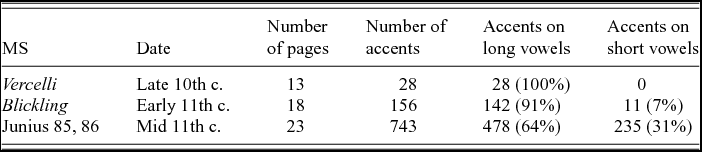
Heald (Reference Heald1965) gives a lengthy analysis of the use of accent marks in three versions of the St Martin Homily preserved in the Vercelli Book, the Blickling Homilies, and MSS Junius 85 and 86 (s. xi med.), corroborating the earlier observations by Hulme (Reference Hulme1896). Her findings can be tabulated as in table 1.
Distribution of accent marks in the three versions of the St Martin Homily
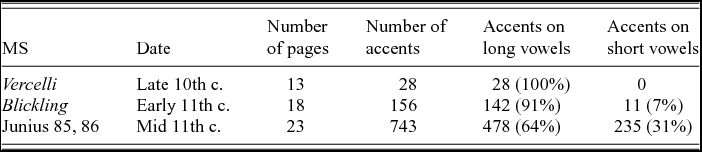
Although based on a very small corpus, Heald's (Reference Heald1965) findings are interesting. She found 927 occurrences of the diacritic. In the Vercelli version of the homily all 28 accents stand over etymologically long vowels (most of the marked words were monosyllabic). In the Blickling version, 142 accents are on etymologically long vowels. Less than half of them (i.e. 49 accents) occur in monosyllabic words. The other 11 accents are on short vowels before consonant clusters, usually consisting of a liquid or a nasal and an obstruent. Her data clearly show that the diacritic occurred most frequently over etymologically long vowels, (i.e. 478 accents). Furthermore, in MSS Junius 85, 86 there are 235 accents written on etymologically short vowels. However, 185 of them were on short vowels before consonant clusters. The other 50 appear elsewhere before different consonants. As to these words Heald (Reference Heald1965: 80) states that about 24 out of the 34 forms in which these 50 acutes occur were later lengthened in the Middle English period and ‘since all of these residues occur in the latest manuscript (Junius 85, 86) in a period of late Old English that might well be considered transitional, the presence of accents over these forms would seem to indicate that the lengthening process had begun’. Moreover, Heald (Reference Heald1965: 97–103) also enumerates those words with etymologically short vowels in which the root vowel is followed by a consonant cluster: 97 (38.1 per cent). This group contains 58 words (59.8 per cent) which meet the formal criteria of HCL. However, the phonological structure of the other 39 words (40.2 per cent) is in contradiction to the rules of the change presented in the traditional interpretation. In the final section of her study Heald (Reference Heald1965: 104–5) concludes that the high frequency of occurrence of the diacritic over long vowels indicates that all of the accents could be markers of vowel length and those over vowels before consonant clusters known as lengthening groups were applied by the scribes to ‘present a feature in the vocalic nucleus, either to indicate length or vowel plus offglide, which differentiated it from other vowels’.
The study would be more informative if she had analysed the whole manuscripts, and she gives no explanation for the use of the diacritic in 47 words (48.5 per cent) that do not satisfy the formal criteria of HCL. In his review of the study Murray (Reference Murray2002: 95–6) questions the suggestion that the accents over etymologically short vowels can mark lengthened forms, saying that ‘her assumed lengthening processes are based on entirely unacceptable assumptions regarding the environmental conditioning factors’. In Murray's (Reference Murray2002: 101) opinion the use of the acute accents in the three manuscripts analysed by Heald (Reference Heald1965) should be associated with vowel length, metrical stress and syllable weight.
Some other studies, especially those investigating grapho-phonemic correspondences, also sometimes touch upon the function of the diacritic. However, in most cases the authors restate the traditional interpretation. For example, Kim's (Reference Kim1967: 4) description of MS Hatton 20 (s. ix ex) notes that the accent mark ‘has been used in the manuscript phonemically, lexically and rhetorically’ and the phonemic function of the diacritic is to indicate vowel length. However, due to sporadic omissions of the accents over long vowels, Kim (Reference Kim1967: 4) is not sure about the primary function of the diacritic and admits that the above is only ‘partly true even of the present MS where not all phonemically long vowels have been graphically identified’. Kim (Reference Kim1967: 5) concludes that ‘the accent mark falling on a long vowel can be interpreted either as phonemic length or recitative emphasis or both at the same time’.
Krapp and Van Kirk Dobbie's (Reference Krapp and van Kirk Dobbie1931–53: xxxv) brief account of the use of accent marks in the poetry part of the Vercelli Book was probably a trigger for a number of later studies. Thus Scragg (Reference Scragg1971) aimed to supplement Krapp and Van Kirk Dobbie's (Reference Kim1931–53) list of accent marks from the poetry part with those occurring in the prose part (i.e. 23 prose homilies) of MS Vercelli CXVII (s. x2). He found the diacritic over 303 syllables. However, Scragg (Reference Scragg1971: 701) does not find the traditional interpretation convincing because ‘even within one manuscript the signification of accents varies’. In his opinion the accents in the prose texts serve at least four different functions, but he admits that the primary function of the diacritic must be related to vowel quantity because ‘the scribe seems to associate the mark with vowel length, since in distinguishing between homographs he accents the etymologically long vowel . . . and since he uses it in conjunction with doubling of the vowel symbol’. As for the 17 occurrences of the diacritic over etymologically short vowels, Scragg (Reference Scragg1971: 702) states that some of them are just mistakes, which result from the scribe's confusion of the sense of homographs, usually of those having a short vowel with that which has a long vowel by default, or due to analogy. Moreover, he claims that in a few cases the accent marks are indicators of vowel lengthening, concluding that the accent marks can be a valuable source of information, both for those who want to reconstruct vowel quantity and those who make attempts to study OE prosody (Scragg Reference Scragg1971: 706).
Jones (Reference Jones1989: 26–33) discusses orthographic notations possibly pertaining to vowel quantity, drawing attention to vowel reduplication and the acute accent marks in the OE interlinear gloss to the Lindisfarne Gospels. He discusses the use of both notations in the context of HCL and shows that some manuscripts do offer ample evidence for vowel quantity marking. According to Jones (Reference Jones1989: 30), the scribe of the gloss (added to the main text in about the tenth century) indicated vowel length primarily by means of vowel reduplication and an acute accent mark placed over a long vowel. He believes that inconsistencies is this stem either from the fact that the scribe's habits of marking vowel length were not too strong or that vowel quantity itself was an unstable or ‘patchy’ feature in the phonological system of his dialect (Jones Reference Jones1989: 30). His data come from the Index Verborum, The Anglo-Saxon Gloss, edited by Ross and Stanley (Reference Ross and Stanley1956). Many of the acute accents appear on vowels before homorganic consonant clusters such as <ld>, <mb>, <nd>, <ng>, <rn> and <rd>, but neither vowel doubling nor the accent mark is applied on vowels before <rl>. Jones (Reference Jones1989: 30–1) maintains that his findings confirm that HCL operated in northern England in the tenth century and that they show the ‘patchy’ nature of the change, concluding that the absence of double vowels and accent marks in some cases proves that the lengthening process may have been highly novel and perhaps optional at that time.
Following Jones (Reference Jones1989), Ritt (Reference Ritt2000: 498) states that ‘the distribution of accents [in the Lindisfarne Gospels] appears to be more systematically indicative of phonological vowel quantity than in most others’, and that the diacritic occurs most frequently over two sets of vowels: those that were phonologically long in West Germanic and those before consonant groups which could cause lengthening. Ritt (Reference Ritt2000: 499) claims that the diacritic serves to indicate vowel length because ‘the distribution of the acutes is not random enough to be called unsystematic and therefore dismissed as evidence, and since the main function they appear to fulfil is to serve as diacritics for phonological length, the vowels that carry them are likely to have been phonologically long’. He suggests that HCL must have started much earlier than the middle of the tenth century. Unlike Jones’ (Reference Jones1989) primary focus on the HCL, Ritt (Reference Ritt2000: 507) emphasises the evidence for OSL, saying that the ‘accents were not generally placed over phonologically long vowels, but only over those whose length could not be predicted from their (graphically represented) phonological environment anyway’ and that ‘phonologically long vowels were accented only in words whose (graphically represented) phonological structure would otherwise suggest short vowels’. Ritt (Reference Ritt2000: 509) concludes that OSL could actually operate at the same time as HCL.
Murray (Reference Murray2002) offers an explanation of diacritic function with evidence sampled from MSS Bodley 340 and 342 and MS Junius 1 using Syllable Cut Theory (SCT, see Sievers Reference Sievers1876; Trubetzkoy Reference Trubetzkoy1939), in which there is a distinction between syllables with an abrupt and a smooth cut. In abrupt cut a consonant is articulated at the energy peak of the preceding vowel and, therefore, vowels in such syllables tend to be short. In smooth cut, the energy needed to produce a vowel in the first phase of articulation is much greater than in the second, where it gradually dissipates before the onset of the following consonant. A stressed vowel in a syllable with a smooth cut usually has a long duration (see Vennemann Reference Vennemann2000: 253; Page Reference Page2006: 90–1; Mailhammer Reference Mailhammer2007: 46–9).
Following Sisam (Reference Sisam1931, Reference Sisam1932, Reference Sisam1933), Murray focuses particularly on MS Bodley 342, where there are also other diacritics such as the curl, the circumflex (which seem to serve the same function), and abnormally long macrons, which usually extend over the neighbouring character(s), arguing that they form a unique system and perform distinct functions in the orthographic system of the manuscript. Murray questions Sisam's (Reference Sisam1953: 186) interpretation that these diacritics were applied to facilitate reading the text out loud ‘since it is not at all apparent how the three-way contrast conveyed by the accents . . . would serve to facilitate the reading’ (Murray Reference Murray2002: 105). For example, for Murray the use of the curl before (geminate) consonant groups, e.g. m  nnum, m
 ntum, is entirely redundant since long vowels generally do not occur in these environments and, therefore, there is no ambiguity. He forgets, however, that some short vowels before homorganic clusters could be lengthened at the time when the diacritics were added.
Murray argues that the acute accents and curls in MS Bodley 342 were used to indicate the difference between smooth and abrupt cut in closed syllables, claiming that in open syllables the acute accent and macron mark long and short nuclei respectively. Comparing this with MS Junius 1, he points out that the former scribe makes exactly the same phonological distinctions in closed syllable environments as the scribe of The Ormulum, i.e. the use of the acute accent and curl in MS Bodley 342 is parallel to the use of single and double consonants in MS Junius 1. He also maintains that both orthographic systems distinguish long and short vowels in (smoothly cut) open syllables; in MS Bodley 342 by means of the acute accent and macron, whereas in MS Junius 1 with the acute accent and breve. Murray (Reference Murray2002: 110) further argues that the use of the acute accent suggests that the diacritic was re-introduced into the orthography of the language on different principles, retaining only some of the original rules governing the use of it. Consequently, the overlap of the old system with the requirements of the new phonological rules could sometimes cause scribal confusion. As to the accuracy of the use of the diacritic, Murray (Reference Murray2002: 110) states that ‘both the increasing use of accents and their decreasing accuracy (in reflecting the original etymological contrasts) are expected consequences of a changing (changed) phonological system’.
Most of the studies presented in this section have methodological flaws. Many studies are based on fragmentary evidence, which has been analysed with mistaken assumptions about the function of the diacritic. In this situation a thorough examination of orthographic systems followed by quantitative and qualitative analysis of the obtained evidence still seem to be in order.
3 MSS Gg. 3.28 and William H. Scheide
The first of the two manuscripts analysed in this study is MS Gg. 3.28 (s. x/xi), which contains two books of the Catholic sermons of Ælfric. Ker (Reference Ker1957: 13 no. 15) points out that this manuscript is the only copy in which both the prefaces and final prayer are well preserved and it is the only complete copy of the second series of Ælfric's homilies. The script of MS Gg. 3.28, written by a characteristic unusual forward-sloping hand, is dated to the end of the tenth or the beginning of the eleventh century (see Sisam Reference Sisam1932: 53; Ker Reference Ker1957: 13 no. 15; Godden Reference Godden1979: xliii; Clemoes Reference Clemoes1997: 24–5). Godden (Reference Godden1979: xliii) says that the copy is a work of a single scribe, though there are also occasional alterations, glosses and additions in another hand (fols. 196r–204r), which Ker (Reference Ker1957: 13 no. 15) dates (s. xi) and (s. xii). On the basis of the palaeographic features of the script, Godden (Reference Godden1979: xliii) states that the manuscript is either an original product of one of Ælfric's scriptoria or a remarkably faithful copy of an exemplar produced in such a scriptorium. Unfortunately, little is known about the exact provenance of the manuscript. However, it is assumed that it can be one of the Omeliaria uetera duo manuscripts mentioned in the Libri anglici, the twelfth-century catalogue of Durham Cathedral Priory. The additions written on some leaves, the signature of Leonard Pilkington (prebendary of Durham), and a press-mark at the top of the first page strongly suggest that MS Gg. 3.28 remained in Durham probably until the twelfth century.
The second text analysed in this study is The Blickling Homilies preserved in MS William H. Scheide (s. x/xi), which is one of the few manuscripts containing OE that have survived in American libraries. Fleming (Reference Fleming1976: 127) points out that it is probably ‘one of the most important homilaries of the Anglo-Saxon Church’. The main part of the book contains 18 homilies for Sundays and Saints’ days, arranged in the order of the Church year. In 1938 the Scheide family from Titusville in Pennsylvania bought the manuscript and since then it has been in Princeton University Library, where the whole Scheide collection is now housed (see Kelly Reference Kelly2003: xxix–xi).
Most scholars, including Ker (Reference Ker1957: 451–5, no. 382), concur that MS William H. Scheide was produced in the late tenth or early eleventh century. However, Morris (Reference Morris1880) titled his edition of the text The Blickling Homilies of the Tenth Century. The confusion stems from the fact that the manuscript has a passage with the date AD 971, though, Morris (Reference Morris1880: v) admits that this date ‘does not necessarily mark the exact point of time in which the present Homilies were composed, but may be a later insertion of the transcriber; that is to say, the date 971 only gives the age of the MS., and not that of the author or compiler’. He also says that the language of the manuscript, especially the vocabulary and syntactically complex sentences, suggest that it conforms much more to OE of the ninth century. In the most recent edition of the homilies, Kelly (Reference Kelly2003: xxix) states that much of the manuscript was written in the late tenth century. Those whose dating is based on analysis of the palaeographical evidence usually claim that the manuscript was produced between 971 and 1025. This is the reason why Ker (Reference Ker1957: 451–5, no. 382) gives the label (s. x/xi) as the presumable date of production.
The fact that MS William H. Scheide had been circulating in eastern parts of England for a long time before it landed up in Princeton University Library suggests that this is probably its place of origin. The same conclusion can be drawn from the orthographic evidence. For example, in some words there is a strong tendency for frequent substitutions of <o> for <a> (representing Gmc. */ɑ/) before nasals in stressed syllables. This means that the manuscript could be produced somewhere in the area of the east Mercian dialect, as the sound change known as Gmc */ɑ/ > EOE *[ ] or *[
 ] / __ [+nasal] probably started in the western parts of Mercia, from where it later spread to the east.
These two manuscripts were selected for three major reasons. Firstly, they belong to the group of the few manuscripts in which scribes used accent marks in their orthographic systems. Secondly, and more importantly, it is very likely that the acute accents used in these two Late OE manuscripts will serve a function similar to the original function of the diacritic attested in earlier OE manuscripts. Thirdly, the number of accent marks used in these manuscripts is probably much higher than in those produced in the Early OE period, so they can provide sufficient data for the analysis.
Since the available editions do not take the exact positioning of the accent marks used in the two manuscript into account, the data for this analysis come from facsimiles. In the case of MS Gg. 3.28 the data were collected from a greyscale microfilm reproduction of the whole manuscript produced by Cambridge University Library.Footnote 4 The data for the analysis of MS William H. Scheide come from the high-resolution colour images of the whole manuscript available online on the website of Princeton University Library.Footnote 5
4 Distribution of accent marks in MSS Gg. 3.28 and William H. Scheide
4.1 Form and positioning
One of the most striking characteristics of the orthographic system of MS Gg. 3.28 is the high number of accent marks appearing throughout the whole text. None of the descriptions of the manuscript adduced above suggests that they could be classified as later additions made by an annotator, so they were probably written by the main hand. As to their form, they all can be defined as acute accents, which means that they consist of a straight stroke going upwards with no hook at the end to mark termination. There is no apparent variation in the size or length of these diacritics, though they sometimes differ in the angle at which they were written as some of them are almost vertical.
The positioning of the acute accents in MS Gg. 3.28 is very similar to that found in other manuscripts from the Late OE period. An accent mark generally belongs to the grapheme over which it starts, and the acute accents in MS Gg. 3.28 can occur in three positions: over vowel graphemes, consonant graphemes, and in some cases somewhere between two graphemes (in such cases their exact positioning is ambiguous), e.g. <stán> (fol. 55r. 1), <Hẃi> (fol. 25r. 20), and <laˊreow> (fol. 14r. 18). The diacritic normally occurs as a single stroke, however, there are also a few instances where it is doubled, especially over digraphs, e.g. <éán> (fol. 258v. 6), <léóf> (fol. 141v. 1), <éóde> (fol. 141v. 21), <geléómode> (fol. 260v. 9). The fact that the positioning of some acute accents is ambiguous suggests that either they were added by the scribe just after having written the whole text, which earlier studies suggest was a quite common practice, or the scribe paid little attention to the correct positioning of the diacritic.
The accent marks in MS William H. Scheide also have the form of the acute accent, i.e. a sloping stroke going upwards with no hook at the end. Some of them are slightly thicker at the top, which is probably due to the pen used by the scribe or the manner in which he put those little strokes. They also differ in size as some of them are very short though there is always much space between the lines. These differences seem quite natural even in neat handwriting acquired after years of studying insular script writing. Similarly to other manuscripts with this diacritic, the acute accents in MS William H. Scheide are in poor condition as many of them are hardly legible and some of them have probably disappeared altogether.
However, those that are fully legible also occur in three positions, i.e. over vowel graphemes, over consonant graphemes, and sometimes somewhere between two graphemes. In such cases the exact positioning of the diacritic is ambiguous as it is hard to state exactly which grapheme is in fact marked. The ambiguous positioning of the acute accent is problematic especially when the diacritic appears over a vowel digraph, e.g. <hús> (p. 86.3), <gaśt> (p. 35.7), and <beˊon> (p. 64.8). The fact that the diacritic is sometimes placed over a consonant grapheme or its positioning is ambiguous also proves that the acute accents were inserted after the main text had been written. The incorrect positioning of some acute accents may stem from the carelessness of the scribe, fatigue, his poor training, or reckless haste.
That the acute accents in MS William H. Scheide were not written simultaneously with the main text is also evident in the use of the diacritic in long strings of graphemes, which sometimes form more than one word, especially when there is no space to mark the word boundaries. Regarding the highly irregular width of spaces between words in MS William H. Scheide, it is possible that in some cases the scribe applied the diacritic not only to mark the phonetic properties of the vowel, but also to distinguish the word as a separate lexical item. In such cases the diacritic could indeed graphically improve the legibility of the main text. However, taking seriously into account the great number of instances where there is no space between two words and the extremely sporadic use of the acute accent in such cases, it is very unlikely that the scribe deliberately tried to improve the legibility of the text in this way. A more probable scenario is that this improvement of the legibility of the text in such cases is a by-product of the use of the diacritic for marking phonetic properties of vowels.
4.2 Grapheme referents
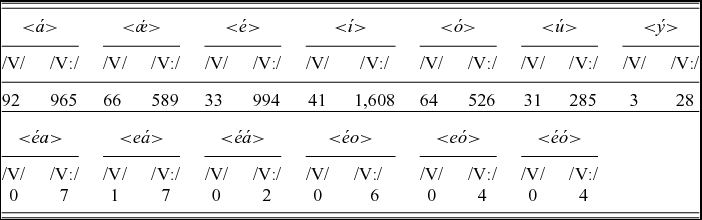
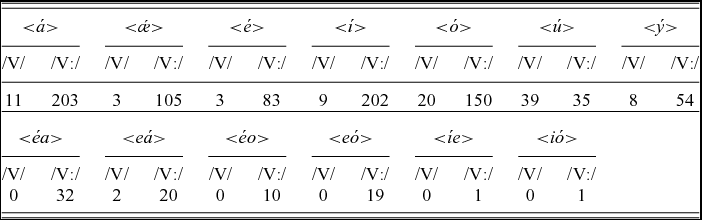
The high number of acute accents over vowel graphemes clearly shows that in MS Gg. 3.28 they were intended for vowel graphemes. Any preponderance of accent marks with incorrect positioning (i.e. ambiguous or over consonant graphemes) would suggest that the scribe wanted to mark whole words and not individual vowels. This in turn would imply that the diacritic was also used to signal prosodic features such as stress or intonation, which is not the case here. Table 2 shows that there are no restrictions on the use of the diacritic over vowel graphemes and virtually any vowel grapheme can be its referent. The acute accents occur over both vowel graphemes consisting of one element and vowel digraphs, though they are extremely rare over the latter.
Distribution of acute accents over vowel graphemes in MS Gg. 3.28

The exact total number of all acute accents in MS Gg. 3.28 will probably remain unknown because many of them have vanished due to erosion of the ink and parchment. The number of all fully legible acute accents found in the microfilm reproduction of the whole manuscript is 6,254, and this number includes all occurrences on vowel graphemes presented above (5,440 occurrences), 287 instances of the use of the diacritic over consonant graphemes, and 527 cases in which the exact positioning of the diacritic could not be established. Apart from this, there are at least 2,057 instances where the diacritic is illegible (i.e. it is extremely faint or only part of it is still legible), and therefore its referent grapheme(s) cannot be accurately identified (the positioning of the illegible acute accents in the examples adduced here is reconstructed). These numbers show that vowel graphemes are the main referents of the diacritic in the analysed text. A single vowel grapheme usually takes one acute accent, but in a few cases vowel digraphs can have two acute accents, one for each of the two segments (in such cases the diacritic is counted twice), e.g. <éán> (fol. 258v. 6), <léóf> (fol. 141v. 1), <éóde> (fol. 141v. 21), <geléómode> (fol. 260v. 9). The diacritic is also sometimes doubled when it occurs over vowel digraphs consisting of two identical items, e.g. <góódnysse> (fol. 119r. 8) and <góód> (fol. 148r. 29). The data also show that the diacritic is most frequent over <ı>, though the frequency for this grapheme does not differ much from that for <á> and <é>.
In previous studies on the use of the diacritic in Old and Middle English manuscripts, high frequency of accent marks over <ı> is usually explained by the fact that such occurrences appear most often in the neighbourhood of <m>, <n>, and <u>, where a little stroke over the grapheme <ı> was presumably intended to distinguish it from the minims of these letters (i.e. to avoid strings of <ı> sequences, such as <ıııııı> for <mín>). In this case, however, keeping the minim of <ı> distinct from the minims of <m>, <n>, and <u> seems to be a secondary function of the diacritic because out of the 1675 occurrences of <í> only 98 (5.9%) stand next to one of these graphemes (<-mí-> 13×, <-ím-> 11×, <-ní-> 10×, <-ín-> 50×, <mín-> 10×, <-íu-> 4×). The preponderance of <í> in the analysed orthographic system of MS Gg. 3.28 is partly due to the large number of the two homographic personal pronouns <hí> ‘they’ and ‘her’ (acc. sing.), where each has an etymologically long vowel, and hence in these two words the acute accents occur most frequently in the analysed text. The overall distribution of the acute accents in MS Gg. 3.28 clearly shows that the use of the diacritic in this manuscript can be associated with marking of vowels.
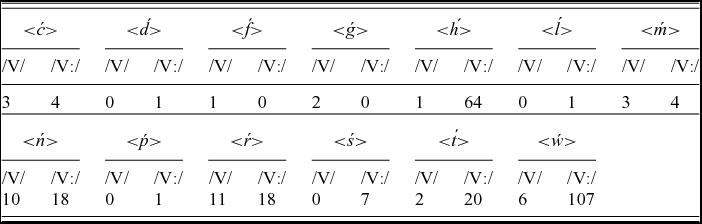
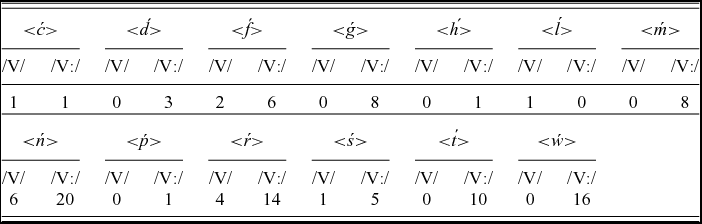
In those cases where an acute accent stands over a consonant grapheme and those in which the positioning of the diacritic is ambiguous the reasons for such aberrant positioning could be various is beyond the scope and purpose of the current analysis. Nonetheless, since the use of the diacritic on consonant graphemes (287 occurrences) can also provide valuable information about the function of the diacritic in the analysed orthographic system, table 3 shows the distribution of all legible acute accents with a consonant grapheme referent.
Distribution of acute accents over consonant graphemes in MS Gg. 3.28

It is quite evident from table 3 that the diacritic can appear almost over any of the consonant graphemes used in the analysed text. The only exceptions are <b>, <x>, <þ>, <ð>, and <k>, <z>, though the last two are extremely sporadic items. The most striking figures here are those for < >, <ń>, and <ẃ>. The distribution over consonant graphemes to some extent reflects also the frequency of the diacritic on particular lexical items. For example, the high number of occurrences over <h> stems from the fact that the acute accents are most frequent in monosyllabic words beginning with <h> like hwī, hī, hē, hwā, etc. and the majority of the shifts of the diacritic onto a consonant grapheme takes place in such words. For <ń>, the situation is slightly different because the acute can be found in any word, in the initial, medial, and final position, e.g. <cńawan> (fol. 4v. 28), <ańre> (fol. 180r. 22), <drihteń> (fol. 1v. 24). On the other hand, the high number of acute accents over <w> correlates with what has been observed for <h>, i.e. the occurrence of <ẃ> is prevalent only in certain high-frequency words, usually monosyllables such as hwī, hwā, swā, twā, hwār, hwīl, etc.
The number of acute accents with aberrant positioning is very low, which suggests that the irregularities in the positioning of some acute accents in MS Gg. 3.28 are rather accidental and they do not serve any specific function that would be different from those placed correctly. The primary grapheme referent for the acute accent mark in MS Gg. 3.28 is a vowel grapheme and the diacritic probably carries an implication about the phonetic quantity of the sound represented by the annotated grapheme rather than performs as a scribal ornamentation.
The accents in MS William H. Scheide also occur primarily over vowel graphemes and less frequently over consonant graphemes. However, in some cases when an accent starts somewhere between two graphemes, establishing the exact positioning of the diacritic is impossible. Table 4 shows that the scribe was mainly concerned with marking individual sounds rather than whole lexical items. The diacritic is written both over single graphemes and vowel digraphs.
Distribution of acute accents over vowel graphemes in MS William H. Scheide

Establishing the total number of all acute accents originally inserted by the scribe is also impossible here because many of them have probably faded away leaving an extremely faint or no trace on the vellum. The total number of all legible accents that can be seen on the high-resolution scans of MS William H. Scheide is 1,196. This number comprises the 1,020 occurrences of the diacritic over vowel graphemes presented above, 111 instances where the acute accent appears over a consonant grapheme, and 65 cases where the exact positioning of the diacritic is ambiguous. Besides the legible accents, there are also at least 281 illegible accents, whose positioning can be only reconstructed. The adduced data clearly show that vowel graphemes are the main referents of the accents in this manuscript. A single vowel grapheme usually has one accent, but in a few occurrences of the adverb ā ‘always’, ‘ever’, ‘for ever’ both the vowel grapheme and the accent over it are doubled, e.g. <áá> (p. 31.15), <˝aa> (pp. 127.2, 137.20), and sometimes only the vowel grapheme is doubled <áa> (p. 187.4), <aá> (p. 151.17). The table given above shows that any vowel grapheme could be marked with an acute accent. Although it is generally assumed that in the case of vowel digraphs the accent should be placed over the first segment, the problem is more complex than it may seem. Giving an answer to the question which of the two segments should in fact take the diacritic is probably as problematic as providing one cohesive phonemic interpretation of all Old English vowel digraphs.
Some of the scholars who have tried to explain the function of the diacritic maintain that in Late Old and Early Middle English the primary function of accent marks over <ı> was to distinguish it from the minims of <m>, <n>, and <u>. However, this does not hold true also for the orthographic system of MS William H. Scheide, where out of 213 instances of <í> only 52 (24.4%) occur in the neighbourhood of these graphemes (<mí-> 1×, <-ím> 2×, <mín(-)> 21×, <ní-> 3×, <-ín> 25×). The data show that <í> is most frequent in the possessive pronouns mīn and þīn. It is noteworthy that each of the two pronouns has long /iː/ as the root vowel. These data strongly suggest that the scribe who wrote the accents over <ı> did not care much about distinguishing it from the minims of other graphemes. If he had intended to do so, he would certainly have applied the diacritic consistently in such sequences as <eallum mınum> (p. 104. 4). The fact that the acute accents used in such environments are most frequent over long /iː/ implies that the quantity of the sound represented by <ı> was probably more important for the scribe than the orthographic environment.
Despite the fact that the diacritic is most frequent over vowel graphemes, it also appears over consonant graphemes (table 5). As has been already said, the reasons for the incorrect positioning of some acute accents in both manuscripts can be various. The total of 111 occurrences over consonant graphemes found in the latter shows that the acute accents in this position are not frequent.
Distribution of acute accents over consonant graphemes in MS William H. Scheide

Table 5 shows that also in this manuscript the acute can appear over any consonant grapheme. The distribution of the accents over consonant graphemes in MS William H. Scheide suggests that the shifts of the diacritic are accidental since it is hard to associate them with one grapheme or a group of graphemes. Moreover, in contrast to MS Gg. 3.28, here the aberrant occurrences are not preponderant in one particular group of lexical items. In MS William H. Scheide the words in which the accent is placed over a consonant grapheme do not form any homogeneous category of lexical items. Even if they did, the correlation would probably stem from the high frequency of the words and not from the fact that they belong to a particular lexical category. The data presented above show that the use of the accent over consonant graphemes in MS William H. Scheide was not intentional.
The total number of all accents over vowel graphemes shows that the primary referent for the accent in the orthographic system of MSS Gg. 3.28 and William H. Scheide is a vowel grapheme. Regardless of the reasons for the incorrect positioning of some accents, the use of the diacritic over consonant graphemes does not seem to serve any specific function in the two orthographic systems. The data clearly show that the accents in MSS Gg. 3.28 and William H. Scheide were primarily intended for vowel graphemes and their function must be related to the phonetic value of the vowel represented by the marked grapheme.
4.3 Morphological assignment
As to the morphology of the marked words, the distribution of the accents in MS Gg. 3.28 does not differ much from what has been observed in other manuscripts produced during the Late OE period. Firstly, the diacritic occurs on all lexical categories, i.e. nouns, verbs, pronouns, adjectives, prepositions and interjections, though in words from the last two groups it is extremely rare. In contrast to other texts, here the use of the accent over unstressed words is attested only in a few cases. The diacritic is most frequent on personal pronouns. Secondly, the lexical status of the marked word does not seem to determine the use of the diacritic in any way, which is also evident in the fact that it occurs both on native and foreign words. In some cases the diacritic can be found on personal names (74 occurrences), e.g. <Nóe> (fol. 5v. 7), <Adám> (fol. 38r. 17), <zacharían> (fol. 77v. 6), <María> (fol. 77v. 29), <Náámán> (fol. 87r. 19), <Abraháme> (fol. 116r. 24), <Isaác> (fol. 145v. 23), <Aáron> (fol. 175v. 20), and place names (10 occurrences), e.g. <bethleém> (fol. 7r. 28), <Sión> (fol. 45v. 18), <yŕrland> (fol. 202v. 16), <sćotland> (fol. 202v. 16–7).Footnote 6 This shows that in MS Gg. 3.28 the diacritic has very widespread lexical distribution.
Its morphological assignment within a word is more predictable. The evidence from other Old and Middle English manuscripts adduced in the first part of the study shows that accent marks occur primarily over root vowels, but also on prefixes, suffixes, and sometimes on inflexional endings. The data from MS Gg. 3.28 corroborate what has been observed in other texts from the Late OE period. The primary referent for the acute accent in Gg. 3.28 is a root vowel. But besides marking root vowels, the diacritic appears sporadically also on prefixes and suffixes. Table 6 shows that the use of accents within a word is quite consistent in the orthographic system of MS Gg. 3.28.
Morphological assignment of legible acute accents in MS Gg. 3.28

The total number of legible accents over root vowels is much higher than those on prefixes and suffixes, showing that in the majority of cases the accents were intended for a root vowel. The large number of occurrences over root vowels is partly due to the fact that the diacritic is most frequent on mono- and disyllabic words, which are not morphologically complex. The morphological structure of the marked words does not determine the use of the diacritic because the accents are applied to vowels in both monosyllabic and polysyllabic words. There are, however, also occasional occurrences of the diacritic on prefixes and suffixes. For example, the diacritic appears in <úncyste> (fol. 15r. 9), <ábutan> (fol. 16r. 10), <únlustas> (fol. 35v. 8), <áfint> (fol. 41v. 29), <únscyldigan> (fol. 51r. 26), <bígleofa> (fol. 58r. 28), <únmihtigra> (fol. 62r. 9), <bígspel> (fol. 74v. 23), <útfære> (fol. 105r. 21), <bíggenge> (fol. 117v. 24), <únmihte> (fol. 142r. 16) to name but a few. The accents were also put over vowels in some suffixes, e.g. <swicdóme> (fol. 194r. 30), <mægðháde> (fol. 13r. 29), <cildháde> (fol. 84r. 13), <Cildhád> (fol. 106r. 24), <cnihtháde> (fol. 106r. 24), <fæderlíc> (fol. 107r. 17), <ealdordóm> (fol. 107v. 1), <wifhádes> (fol. 138r. 5), etc. Despite the fact that most prefixes and suffixes are unstressed and have an etymologically short vowel, the strokes stand over both short and long vowels, e.g. <bíspellum> (fol. 151v. 15) and <áteoriað> (fol. 199r. 14). The number of instances where the prefix has an accent over an etymologically short vowel is higher than those where the referent vowel is long (i.e. 30 short and 15 long). As for suffixes, the ratio between short and long vowels is different. The accents used over vowels in suffixes in most cases mark an etymologically long vowel (i.e. 1 short and 40 long), usually in -hād and -dōm.
The same tendency can be observed in the distribution of the illegible acute accents in MS Gg. 3.28 (table 7). In most cases the reconstructed strokes are over root vowels and only sporadically on prefixes and suffixes. Moreover, there are no traces of illegible accents over inflexional endings and the ratio between short and long vowels in prefixes and suffixes in similar to that observed for fully legible accents (prefixes: 11 short and 6 long; suffixes 0 short and 12 long).
Morphological assignment of illegible acute accents in MS Gg. 3.28

The analysis of the morphological assignment of the accents has revealed that the primary referent for the accents in MS William H. Scheide are root vowels. Moreover, the diacritic occurs in all types of lexical items, including nouns, pronouns, verbs, adjectives, and prepositions. The evidence from this manuscript does not differ much from what can be found in other OE manuscripts that have the diacritic. In one case the scribe wrote an acute accent over a sign of abbreviation in the compound < gite> (p. 74.18). Besides native words, the acute accent is also sporadically applied in words of foreign origin as well as in personal and place names, e.g. <geric o> (p. 16.7), <samária> (p. 143.2), <gerusalém> (p. 155.4), and <adaḿ> (p. 30.15), <moysé> (p. 50.13), <Títus> (p. 93. 1), <nerón> (p. 215.7), <Simón> (p. 228.17), <constantínes> (p. 254.7). This shows that in MS William H. Scheide the diacritic also has a very broad lexical distribution.
Tables 8 and 9 clearly show that the accents are most frequent over root vowels. The evidence from MS William H. Scheide does not differ much in this respect from the data for MS Gg. 3.28. However, the figures for the distribution of the legible accents show that besides root vowels the diacritic is also written over prefixes, suffixes, and inflexional endings, e.g. in <únrihtum> (p. 25.3), <ábuton> (p. 6.17), <mægþhád> (p. 6.11), <geogoþhád> (p. 66.10), <læcedóm> (p. 116.11), <fredoḿ> (p. 165.21), <wisdóm> (p. 224. 5), <ðeowdóm> (p. 254.10), <cnihtháde> (p. 256.9), <bisceophád> (p. 262.20), <gesawón> (p. 14.16), <lifé> (p. 29.17), <tæcán> (p. 47.11), <isenán> (p. 48.13), <ecé> (p. 124.10), <rædés> (p. 194.8).
Morphological assignment of legible acute accents in MS William H. Scheide

Morphological assignment of illegible acute accents in MS William H. Scheide

Accents over prefixes are most frequent over the prefix un-, which has a short vowel. Sometimes, however, the marked vowel in a prefix is long, but most of them are short (43 short and 7 long). The same ratio can be observed when the diacritic is illegible (10 short and 4 long). The examples adduced above show that also in this manuscript there are no restrictions in the use of the diacritic as to the structure of the marked words, i.e. the accent is applied both in monosyllabic and polysyllabic words. The situation is slightly different in suffixes, where both legible (0 short and 8 long) and illegible accents (0 short and 1 long) occur only over etymologically long vowels, usually in the suffixes -hād and -dōm.
The six instances of accents placed over inflexional endings must be scribal errors if the diacritic is mainly intended for a stressed root vowel. The use of the diacritic in inflexional syllables can be associated neither with stress nor with the quantity of the unstressed vowels. It is quite likely that the accents over the marked inflexional endings were intended for the root vowels but due to the scribe's haste or carelessness the strokes were written incorrectly over the final syllables. Moreover, in all such cases the root vowel is etymologically long, which suggests that the accents were applied to indicate the length of the root vowel. The presence of the diacritic on prefixes is more problematic to explain. The fact that the accents are most frequent over the prefix un-, which has a negative meaning, implies that the diacritic could possibly be employed as a marker of stress or intonation. The other possibility is that the vowel in a stressed prefix is long due to the fact that stressed vowels are phonetically longer by nature.
The data for both legible and illegible accents show that the primary referents for the diacritic in the orthographic system of MSS Gg. 3.28 and William H. Scheide are root vowels. The distribution of the accents is quite consistent also at the morphological level of a lexeme, which cannot be said about all manuscripts from the Late OE period. The quantity of the vowels in suffixes and the root vowels in those words in which the diacritic occurs over the final syllable strongly suggests that the primary function of the diacritic in the analysed orthographic systems can be associated with vowel length.
4.4 Quantity of marked vowels
The first stage in this part of the analysis was to ascertain the etymological length of all vowels represented by vowel graphemes equipped with an acute accent and then to group the marked items according to the positioning and legibility of the diacritic. In the second phase of the analysis the lexical items marked with the diacritic were classified depending on the number of syllables. The third phase of the analysis focuses only on those instances where the diacritic is fully legible and has a definable grapheme referent.
The analysis of the vowel quantity of the marked items has revealed that in most cases the diacritic was intended for an etymologically long vowel. The total number of legible acute accents that mark an originally long vowel (irrespective of their exact positioning) is much higher than those written on segments with an etymologically short vowel. Table 10 shows that in MS Gg. 3.28 the diacritic was most frequently intended for an etymologically long vowel.
Etymological length of vowels in segments marked with acute accents in MS Gg. 3.28

The preponderance of acute accents over etymologically long vowels is evident for both legible (421 short and 5,743 long) and illegible acute accents (145 short and 1896 long), which is even more noticeable with percentage values (legible 6.9% short and 93.1% long; illegible 7.1% short and 92.9% long). The fact that the diacritic is most frequent on segments with an etymologically long vowel suggests that in MS Gg. 3.28 it probably still retained the original function. These data clearly show that the use of the acute accent in MS Gg. 3.28 can be associated with vowel quantity, or more precisely, with marking of long vowels.
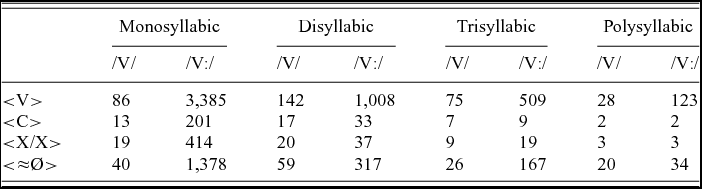
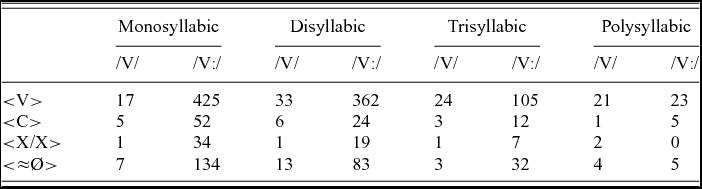
The structure of the marked items is also important here. The data presented in table 11 show that the accents are most frequent over vowel graphemes representing etymologically long vowels in monosyllabic words. The same tendency has been observed in monosyllables in which the diacritic is placed over a consonant grapheme or its positioning is ambiguous, as well as in those words where the accents are illegible. Similarly, also in disyllabic, trisyllabic, and polysyllabic words, the diacritic prevails on segments containing an etymologically long vowel. Table 11 shows that the number of syllables does not determine the use of the diacritic, meaning that the only parameter that really matters is the quantity of the marked vowel.
Number of syllables and quantity of vowels marked with acute accents in MS Gg. 3.28
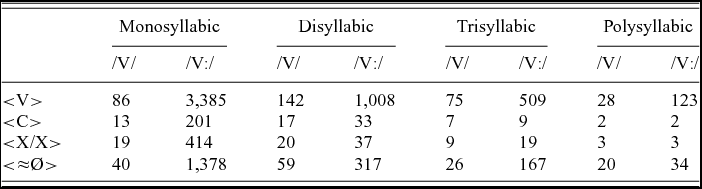
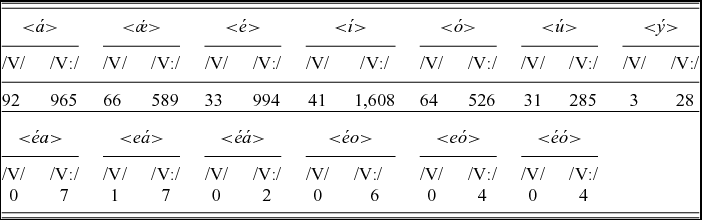
Similar results have been also obtained for the distribution of all legible accents on individual vowel and consonant graphemes. Again, tables 12 and 13 show that the diacritic is most frequent over vowel graphemes which represent etymologically long vowels. In the case of the accents placed over consonant graphemes the vowel for which they were probably intended is also usually etymologically long.
Quantity of vowels represented by vowel graphemes marked with acute accents in MS Gg. 3.28
Quantity of vowels adjacent to consonant graphemes marked with acute accents in MS Gg. 3.28
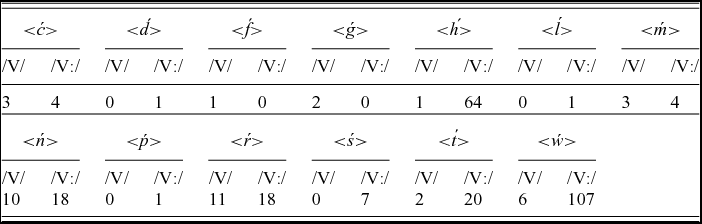
On the basis of these data a few conclusions about the use of the diacritic in MS Gg. 3.28 can be drawn. Firstly, the overall distribution of the accents in this manuscript shows that the diacritic was primarily used to mark vowels. The high consistency in the use of accents over vowel graphemes implies that the scribe wrote them to highlight phonetic properties of individual vowels. Secondly, the results of the analysis of quantity of the vowels for which the diacritic was intended clearly show that the main formal parameter which determines the use of the acute accent in MS Gg. 3.28 is vowel length, strongly suggesting that the acute accent in the orthographic system of MS Gg. 3.28 retains the original function and serves primarily as an indicator of long vowels.
The results of the analysis of quantity of the vowels marked with an acute accent in MS William H. Scheide also show that in most cases the diacritic was intended for an etymologically long vowel. The total number of all legible accents that mark originally long vowels (regardless of the positioning) is much higher than those over segments with an etymologically short vowel (table 14).
Etymological length of vowels in items marked with acute accents in MS William H. Scheide

Table 14 shows that also in this manuscript the accent is most frequent over segments with an etymologically long vowel, both when it is fully legible (115 short and 1068 long), and when its legibility is poor (27 short and 254 long). The preponderance of the acute accents over etymologically long vowels becomes even more evident when the discrepancies are expressed in percentages: legible 9.8% short and 90.2% long; illegible 9.6% short and 90.4% long. These data clearly show that the use of the accent in MS William H. Scheide can be related to the quantity of the vowels for which they were intended and that in the orthographic system of MS William H. Scheide the accent still serves the original function.
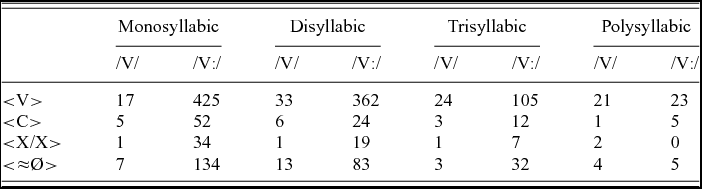
The use of the diacritic usually is not restricted by the number of syllables of the marked word. The accents used in MS William H. Scheide occur both in monosyllabic and polysyllabic words. Table 15 shows that the accents are most frequent over vowel graphemes representing etymologically long vowels in monosyllabic and disyllabic words. A similar tendency can be also observed when the diacritic is placed over a consonant grapheme or its positioning is ambiguous, as well as when the diacritic is illegible. This also shows that the use of the accent in MS William H. Scheide is determined by the quantity of the marked vowel.
Number of syllables and quantity of vowels marked with acute accents in MS William H. Scheide
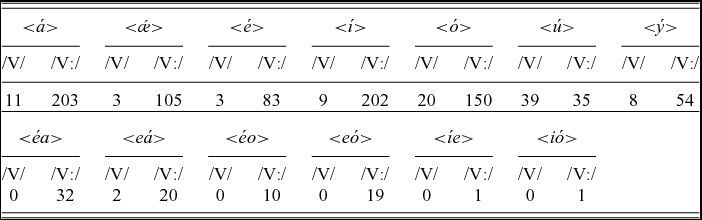
A more detailed picture of the distribution of the legible acute accents emerges when they are grouped according to the individual graphemes over which they occur. Tables 16 and 17 show that in most cases the number of etymologically long vowels marked with an accent is much higher than those that are defined as etymologically short, both when the diacritic is placed precisely over a vowel grapheme and when it is written over the adjacent consonant.
Quantity of vowels represented by vowel graphemes marked with acute accents in MS William H. Scheide
Quantity of vowels adjacent to consonant graphemes marked with acute accents in MS William H. Scheide
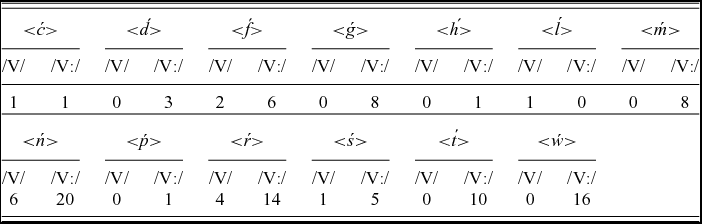
These data show that the scribe applied the diacritic most frequently when the vowel was etymologically long. However, the tables also show that the diacritic was sporadically intended for etymologically short vowels. It is very likely that at least some of these vowels were probably long due to vowel lengthening processes which probably operated at that time.
On the basis of the orthographic evidence from MS William H. Scheide one can draw the following conclusions. Firstly, despite the fact that the accent is sometimes placed incorrectly, the scribe used it primarily to mark root vowels. Secondly, the results of the analysis of the quantity of the vowels for which the acute accents were intended show that the major factor that determines the use of the diacritic is the quantity of the marked vowel. The high preponderance of the accents over etymologically long vowels shows that the diacritic still retains its original function and can be regarded as a graphic indicator of long vowels.
The analysis of the words with an etymologically short vowel marked with the diacritic will likely provide further evidence which will corroborate that this notation was mainly used to indicate long vowels. However, due to the considerable length of this discussion a thorough analysis of the items in which the acute accent was intended for an etymologically short vowel will be presented in a separate study, where the orthographic evidence will be discussed in the context of such sound changes as HCL and OSL.
5 Conclusions
The evidence adduced in both the critical review and practical part of this study shows that, contrary to common belief, vowel quantity in Old English can be reconstructed on the basis of orthographic evidence from some manuscripts, especially when the preserved orthographic system has in its inventory non-linear diacritic notations. The data presented in this study show that the acute accent mark is one of those orthographic notations that can be extremely helpful in decoding quantity of Old English vowels.
The results of the analysis presented in this study clearly show that for the scribes of the two manuscripts vowel quantity was a very important feature of the language so that they made deliberate attempts to indicate it on a larger scale with acute accent marks. None of the other formal parameters of the marked words (i.e. positioning of the diacritic, grapheme reference, and morphology of the word) seems to directly determine the use of the diacritic in the two manuscripts. The data presented in the last subsection of the article confirm that the quantity of the vowel for which the diacritic was intended is the major determining factor for the use of the acute accent mark in these two manuscripts. A secondary function that probably started to develop during the Late OE period is presumably related to marking rhetorical emphasis or sentence stress, though further evidence for this function is still necessary. Marking vowel quantity alone also seems to be a good reason for the use of this diacritic for rhetorical purposes, especially in a situation where many of the religious texts were prepared not only for silent reading but, above all, for oral delivery. In such cases notations that convey information about the quantity of vowels were probably extremely helpful in reading the text out loud, especially when a lector had to cope with frequent occurrence of homographs and minimal pairs differing only in the length of the root vowel.
The evidence presented in this discussion shows that some orthographic systems of Old English manuscripts distinguish between short and long vowels. This in turn means that reconstructing vowel quantity of Old English vowels on the basis of orthographic evidence is sometimes possible. One of the most obvious final conclusions is that future research into the early quantitative changes of vowels in the development of English should take the preserved orthographic evidence into account.