
Financial crises have become more frequent, virulent, and global. The effects of these crises on global economic activity are “breathtaking.”Footnote 1 To stem their devastating effects, policymakers implement structural reforms to bring about macroeconomic stability, and in the worst crises, they rely on large-scale financial support from the international community. Since its foundation, the International Monetary Fund (IMF) has become the cornerstone in international efforts to rescue troubled economies and to prevent regional and global contagion. The IMF pools resources from its member countries and lends it to countries that experience financial crises but lack access to international capital markets to solve their balance-of-payments difficulties. Even though the IMF has given numerous loans to countries in crisis, historically it has been underfunded and its resources have fallen woefully short of what crisis economies need to fully recover.Footnote 2
As a consequence, the IMF relies on the cooperation of other actors to bail out countries facing financial crises. When the Mexican peso suddenly deteriorated in 1994, the international financial rescue was a collaborative effort between the IMF (USD 17.8 billion), individual creditor countries (USD 22 billion), and the Bank of International Settlements (USD 10 billion). During the Asian financial crisis, Thailand received an IMF rescue package worth USD 4 billion, but also over USD 9 billion in bilateral bailouts from various countries, notably Japan and other Asian economies. In 2010, Greece received a USD 145 billion rescue package; only USD 40 billion originated from the IMF. Eurozone members provided the remaining USD 105 billion in bilateral loans. Participation in such bilateral bailouts varies considerably. Although Thailand received large bailouts from a number of Asian economies, the United States decided not to bail out the troubled Thai economy. Observers were puzzled by this decision because the massive US bailout to Mexico had been considered instrumental in allowing the Mexican economy to recover quickly.Footnote 3
Bilateral financial rescues occur frequently, are substantial in size, and can significantly contribute to the recovery of crisis economies. Yet we know very little about why and how governments bail out countries in crises. We develop and test a political economy theory of bilateral financial rescues.Footnote 4 We argue that a government's decision to bail out a crisis country is driven predominantly by strategic economic and political concerns. Creditor governments experience countervailing pressures when deciding whether or not to bail out a country (to distinguish potential bailout-providing governments from crisis governments, we refer to them as creditor governments). Creditor governments use bailouts to minimize negative externalities from the crisis country, especially if the two countries are economically or politically interdependent. If economically interlinked, creditor governments fear a decline in economic growth resulting from falling exports to the crisis country. They may also be concerned about experiencing a banking crisis if the crisis country defaults on loans provided by banks in the creditor country. To minimize economic and political instability in countries that are central to their own foreign policy or to the stability in a region, creditor governments have incentives to bail out countries of geopolitical or strategic importance.
The downside to bailouts is that they are politically costly. Media and opposition parties often portray bailouts as costly to domestic taxpayers, especially if the likelihood of a default on the loan is high. Governments do not know whether the media or the opposition will politicize a bailout, which makes them more reluctant to provide one. Creditor governments are therefore less likely to bail out crisis countries when they are electorally vulnerable or when they face other political and economic constraints at the domestic level.
We collected original data on bilateral bailouts provided by G7 countries during financial crises between 1975 and 2010 to test our theory's empirical implications. The empirical analysis supports our theoretical argument. The more exposed the creditor country is to a crisis country economically or politically, the more likely that the creditor government will provide a bailout. Creditor governments are less likely to bail out countries if they are electorally vulnerable. The effects of both economic and political exposure and domestic political constraints are robust to a number of alternative model specifications, different measures of key variables, and after addressing potential endogeneity concerns.
The findings shed light on the complex nature of international cooperation during financial crises. The resolution of financial crises involves decisions over a large number of financial instruments, including IMF and official bilateral lending, sovereign debt restructuring and rescheduling through the Paris Club, and other informal channels, swap agreements, and private-sector involvement.Footnote 5 Our analysis focuses on the dynamics of bilateral bailouts, which are a central but understudied component of international cooperation during financial crises. Governments frequently offer bilateral bailouts in conjunction with IMF lending—and our theory builds on the insights from that literature—but the dynamics of bilateral bailouts underlie decision-making processes that are different from the dynamics of IMF lending decisions.Footnote 6
Our theory acknowledges these differences and analyzes the decision-making calculus of creditor governments given the opportunities and constraints they face. With this focus, our work also contributes to scholarly work in economics. Economic analyses of bilateral bailouts focus on more narrow economic criteria that would support a bilateral bailout; strategic economic and political considerations play only a minor role in these analyses.Footnote 7 We explicitly analyze the incentives and constraints of creditor governments in a political economy model to demonstrate why such factors matter and how they matter. The empirical analysis, which relies on a unique data set of bilateral bailouts during financial crises, offers the first comparative analysis of the politics of bilateral bailouts that spans across countries and over time. The findings support a political economy explanation. They also show that such strategic considerations are often as important, if not more important, than more objective economic criteria for a bailout.
International Cooperation During Financial Crises
Throughout history, many countries have experienced boom-and-bust cycles.Footnote 8 These cycles lead to situations where the size of capital outflows and the debt that countries must service exceed their foreign reserves. This external financing gap often remains even after the government has made domestic policy adjustments.Footnote 9 The economic effects are profound. Financial crises lead to collapses in housing and equity prices, significant declines in economic output and employment, and explosions of government debt (by about 86% in some cases, typically driven by a significant decline in tax revenues). Historical crisis data indicate that unemployment rates rise by an average of 7 percent in the years following a financial crisis and economic output declines by over 9 percent.Footnote 10 Countries that experience financial crises take years to recover—years in which citizens are plagued by unemployment, declining incomes, and significant changes to their overall quality of life. Greece offers a particularly stark example. Along with a 5 percent decline in GDP growth, the Greek unemployment rate climbed from an already-high 14.1 percent in 2010 to an astounding 27.6 percent in 2013, and still lingered at 20.6 percent in early 2018. In 2017, 42.3 percent of the young active population was unemployed (easing from 47.1% in 2017). Consumer and business confidence crashed in 2009 and has still not recovered.Footnote 11
To avert the devastating effects of financial crises, countries with serious shortfalls in financial capital rely on support from international creditors to provide them with sufficient liquidity and other resources (i.e., technical assistance) to fulfill their financial obligations. The scholarly literature focuses on the IMF as the central actor in this process. The IMF attempts to provide crisis countries with liquidity to overcome balance-of-payments crises while at the same time minimizing the risk of moral hazard by limiting the size of the loans and requiring policy reforms.Footnote 12
The IMF's role is important but international cooperation in financial crisis resolution involves a large number of additional actors. IMF loans usually occur together with other forms of crisis lending, such as official bilateral lending by individual creditor countries, sovereign debt restructuring, swap agreements, and private-sector involvement. The need for additional sources of lending arises from a central dilemma of international cooperation during financial crises. While central banks frequently carry out lender-of-last resort functions when domestic banks experience serious liquidity problems, there is no international equivalent of a lender of last resort. The IMF comes closest, but it cannot provide unlimited funds.Footnote 13
By design, the IMF is slow in its response and ill-equipped to fill the external financing gap of crisis countries.Footnote 14 When the IMF does step in, the loans are typically just enough to cover “the most obvious sources of payment difficulties.”Footnote 15 In 1995, the IMF approved a loan for Mexico of up to approximately USD 17.8 billion, which was the largest-ever loan approved by the IMF at the time, both in terms of amount and overall quota (about 688.4%).Footnote 16 Still, the amount was insufficient to address Mexico's financial crisis adequately; Mexico needed other external financing to fill the gap. Similarly, in May 2010 the IMF contributed USD 30 billion to a financial rescue package for Greece. This was the biggest bailout in the IMF's history. But even with the supplementary bilateral loans that eurozone countries provided, experts doubted that the amount would be sufficient to address Greece's problems.
The Meltzer Commission, which was created by US Congress in 1999 to offer recommendations for IMF reform, was keenly aware of this problem and suggested that the IMF should provide large-scale financial support to prequalifying countries that are sound in their financial systems and fiscal affairs (essentially granting the IMF lender-of-last-resort capabilities).Footnote 17 According to the US Treasury Department, these recommendations would have implied a USD 139 billion loan to Brazil, which was significantly above Brazil's IMF quota of USD 4.5 billion (and also above its most recent IMF loan of $14.5 billion). Similarly, during the Mexican peso crisis, experts estimated that Mexico would need at least USD 50 billion, which was more than double what the IMF de facto provided.
The evidence suggests that the IMF relies on supplementary financiers to help ensure the success of its loan programs.Footnote 18 As Jacques Polak, former director of research and a former executive director of the IMF, noted early on:
Traditionally, a key component of any Fund arrangement was that the resources provided by the Fund together with those from the World Bank, aid donors, commercial banks, and other sources, would cover the country's projected balance-of-payments gap. In the absence of an integral financing package, the Fund could not be confident that the degree of adjustment negotiated with the country would be sufficient. To this end the Fund sought financial assurances from other suppliers of financial assistance.Footnote 19
While some scholars argue that an IMF agreement would automatically lead to an increase in supplementary financing (catalytic effect),Footnote 20 any supplementary financing is explicitly negotiated. In addition to the involvement of the private sector, national governments, particularly the G7 countries, have played a central role in financial crisis resolution. National governments frequently grant bilateral official loans, particularly during financial crises. Although decision makers have strategically refrained from developing any rigid rules on the participation and responsibilities of these various actors—the ambiguity serves to reduce expectations of large-scale bailouts for systemically important countries—international official loans for crisis countries are a consequence of some form of international cooperation.Footnote 21
Much ink has been spilled on the causes (and consequences) of IMF loans and conditionality,Footnote 22 and there is an increasing interest in sovereign debt restructuring and private-sector involvement.Footnote 23 However, we know surprisingly little about creditor countries’ decision-making processes despite the central role of bilateral bailouts in financial crisis resolution. During the Mexican peso crisis, the US contributed the largest share of the overall rescue package. Of the approximately USD 50 billion bailout, the US contributed USD 20 billion, the IMF USD 17.8 billion, the Bank of International Settlements (BIS) USD 10 billion, and a consortium of Latin American countries and Canada contributed USD 1 billion each.Footnote 24
The United States is not the only provider of large-scale bilateral bailouts during financial crises. Germany was by far the largest creditor to Greece in the most recent crisis, which by 2015 had received about EUR 242.9 billion (USD 271 billion) in official loans.Footnote 25 While the IMF committed about EUR 48.1 billion, eurozone governments promised Greece almost EUR 194.7 billion. Germany's exposure amounted to EUR 57.2 billion, France's to EUR 43 billion, Italy's to EUR 37.8 billion, and Spain's to EUR 25.1 billion.
Systematic data on bilateral financial rescues are not readily available from creditor countries, the IMF, or other international organizations. We compiled an original data set containing the dollar amounts (or evidence of a bailout) that the G7 countries contributed to states that experienced a financial crisis between 1975 and 2010.Footnote 26 Although this does not include the entire population of countries that have provided bilateral bailouts (for example, Russia, Poland, and the Faroe Islands bailed out Iceland in 2010), it does include most countries that have offered bilateral bailouts in the sample period; the G7 countries gave more than 75 percent of all bilateral bailouts among Organisation for Economic Co-operation and Development (OECD) countries. For crisis countries, we focus on countries experiencing a balance-of-payments crisis, currency crisis, sovereign debt crisis, or a banking crisis.Footnote 27 Our data set includes 136 financial crises.
The data set offers some evidence about the prevalence and relative importance of bilateral bailouts from G7 countries to crisis countries in the period from 1975 to 2010. The IMF gave out ninety-four financial rescue packages across these crises; creditor countries provided seventy-seven bilateral bailouts. Crisis countries often receive more than one bilateral bailout, which increases the number of bilateral bailouts. Table 1 indicates the distribution of multilateral and bilateral bailouts for the 136 financial crises in our data set. The table lends some support to the view that bilateral bailouts complement IMF loans. Only two crisis countries in our data set received at least one bilateral bailout without receiving an IMF loan. For example, Japan bailed out Malaysia in 1997; the IMF did not. Most crisis countries that received a bilateral bailout were also in an IMF agreement (twenty-four cases),Footnote 28 but bilateral bailouts do not always accompany IMF loans. About 18 percent of the IMF loans were supplemented with at least one bilateral bailout. In seventy cases, the IMF loan was not supplemented with any bilateral bailout. In forty cases, the crisis country did not receive either a bilateral or a multilateral rescue package.
Bilateral and multilateral financial rescues

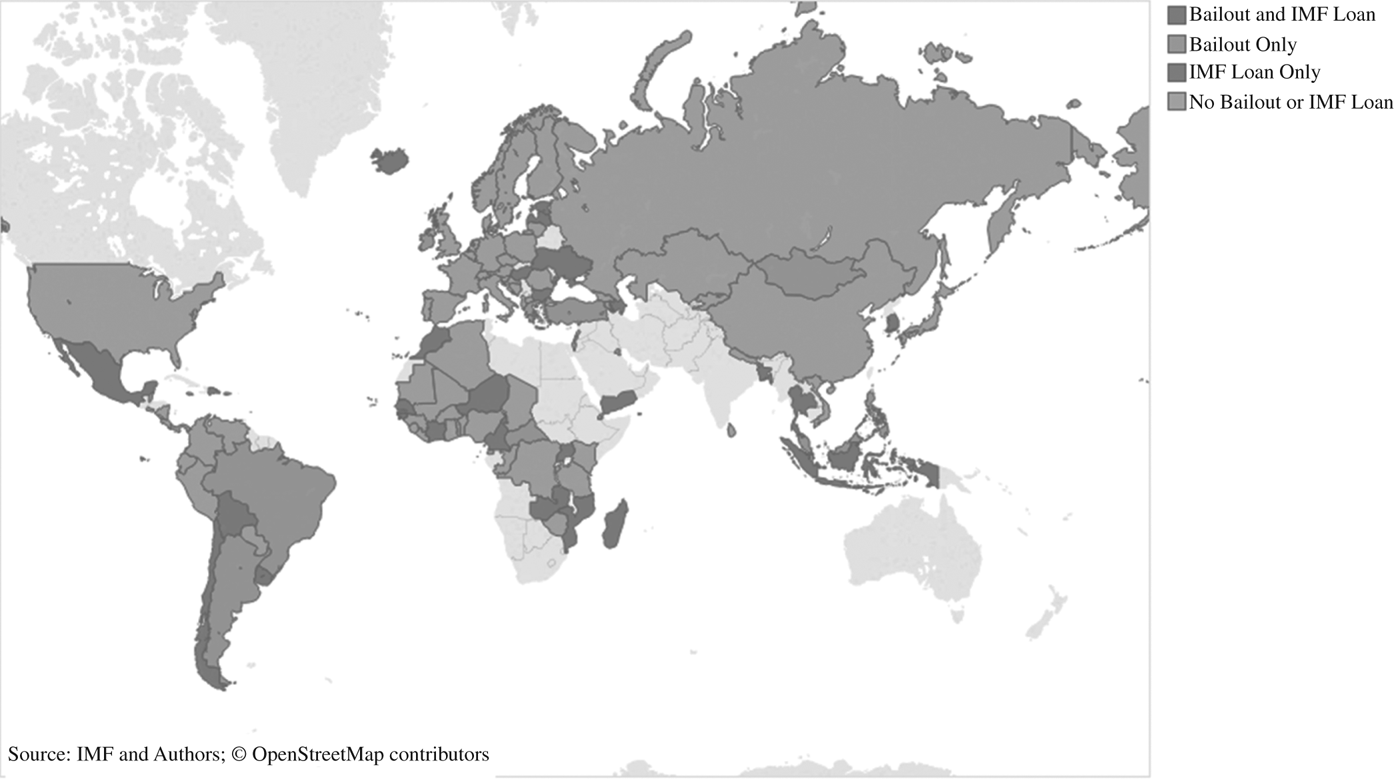
Figure 1 illustrates the importance and geographical distribution of bilateral bailouts.Footnote 29 Among all crisis countries, the darkest-colored countries in the figure received both an IMF loan and at least one bilateral bailout, the next darkest-colored countries received only an IMF loan, followed by those that received only a bilateral bailout, and the lightest-colored countries received neither an IMF loan nor a bilateral bailout. While all four possibilities are prevalent, there are not many instances in which the IMF was the sole actor in financial crisis resolution attempts (especially outside of Africa).
Regional variation in IMF loans and bilateral bailouts to countries in crisis

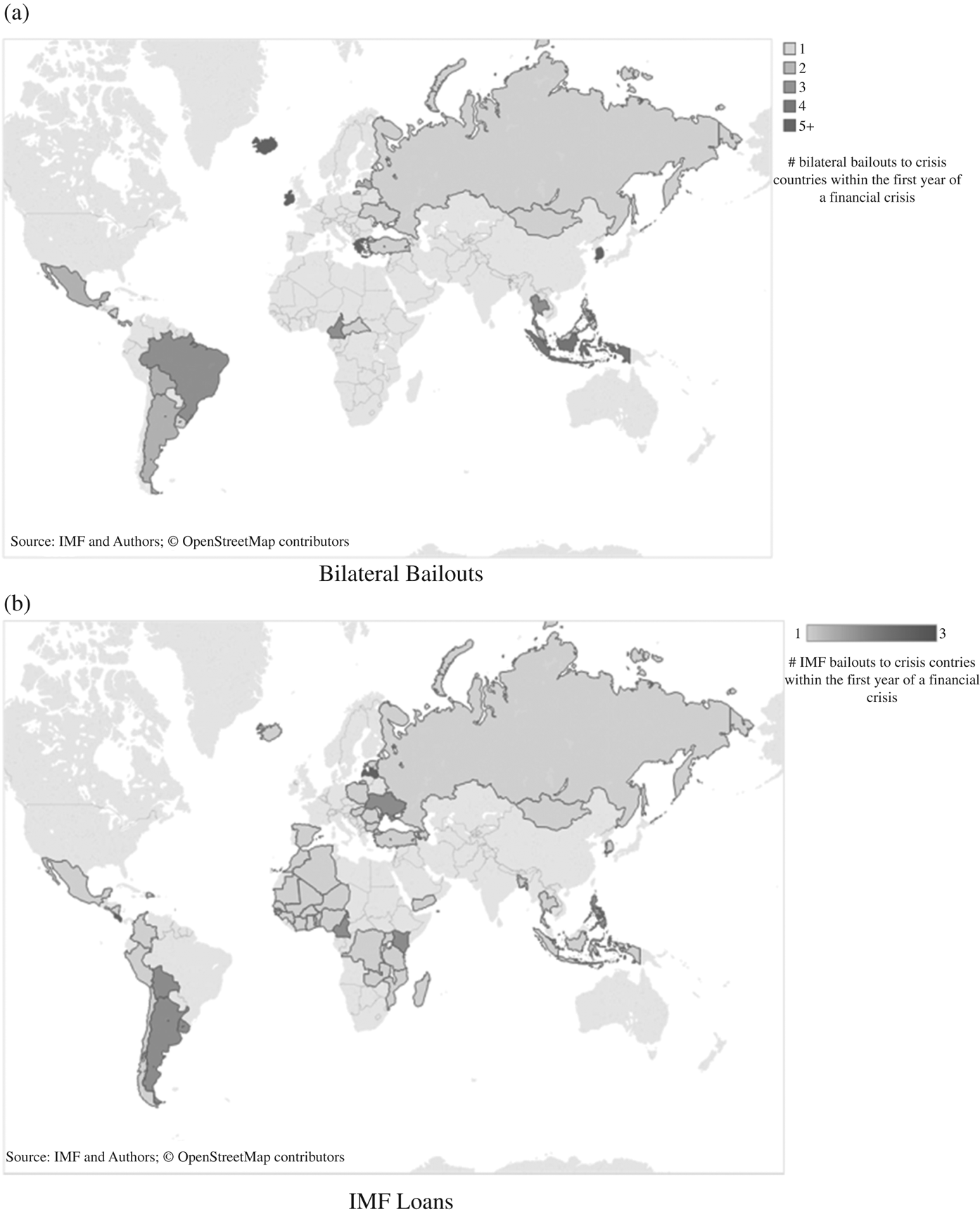
Figures 2(a) and 2(b) provide additional information on how many loans countries received during times of financial distress, both from G7 creditor nations (Figure 1a) and the IMF (Figure 1b). The figures highlight some of the regional differences and complementarities in multilateral versus bilateral bailouts, but also show the variation in the number of bailouts to crisis countries. This variation stems both from receiving multiple bailouts from different creditor countries during individual crises and from receiving repeated bailouts during multiple crises. For example, Greece received thirteen bilateral bailouts during its most recent crisis, while Argentina received a bilateral bailout from the United States in both 1980 and 2001.
Number of IMF loans and bilateral bailouts

In sum, bilateral bailouts are important and sizeable complements to IMF bailouts with significant influence on countries’ financial recovery. We observe a rather dramatic variation in the likelihood that countries in crisis receive a bilateral bailout. While creditor countries are often willing to give bailouts to countries in financial distress, not all creditor countries bail out each country during every financial crisis.
Despite their importance, bilateral bailouts have not received much scholarly attention. Aside from stressing objective economic criteria, scholars have argued that the primary rationale for bilateral bailouts is to preserve the openness of the world economy. Broz analyzes US congressional voting on the financial rescue of Mexico and several Asian economies in the 1990s and finds that members of Congress were more likely to vote in favor of an international financial rescue when they represented districts with highly skilled workers.Footnote 30
More recently, scholars started to address other economic rationales for bilateral bailouts. Lipscy argues that cross-temporal variation in the incentives to offer bailouts during the Asian financial crisis mainly depended on the importance of the crisis country's economy for the creditor country.Footnote 31 Schneider and Slantchev show that Germany's decision-making calculus during the Greek debt crisis was driven by domestic political concerns.Footnote 32 Our goal is to incorporate these qualitative findings into a general political economy theory of why creditor governments offer bilateral bailouts.
The Political Economy of Bilateral Financial Rescues
Our theory focuses on the decision-making calculus of a potential creditor country to bail out a country that experiences a financial crisis. The theory emphasizes the importance of political and economic interdependencies that can give rise to bilateral financial rescues as a strategy to minimize negative externalities. We argue that creditor governments are more likely to address the financing gap of crisis countries they are either politically or economically exposed to. Domestic political considerations mitigate the incentives to bail out countries in financial distress.
Economic Exposure and Bilateral Bailouts
In open economies, financial crises have negative externalities for individuals, companies, and political elites in other countries. Financial and economic spillovers from the crisis to the creditor country are important mechanisms through which economic exposure may matter for a creditor country. Financial crises carry the risk of a sovereign or a bank default. Defaults are problematic for foreign banks that hold the crisis country's government debt. These banks lose their foreign assets and may slide into economic difficulties, which can, in the worst-case scenario, lead to a default of the foreign bank itself.
Even if a sovereign default does not lead to defaults elsewhere, it decreases investors’ confidence in highly exposed foreign markets. For example, Japan and the EU member countries held the majority of unsecured claims against the Lehman Brothers investment bank (the US government held only about 10%). The US government's decision to allow Lehman Brothers to go bankrupt wiped out the confidence in the interbank markets of OECD countries, and was a major factor in the spread of the US banking crisis to Asian and European economies.Footnote 33 Confronted with these risks, creditor governments have strong incentives to provide the necessary liquidity to prevent a spread of the crisis. This explains why the United States was anxious to assist South Korea during the Asian Financial Crisis in the 1990s, but not Indonesia. Its American-based banks had substantial exposure to South Korea, but not to Indonesia.Footnote 34
Second, financial crises are almost always accompanied by economic recessions. Declining consumer demand affects foreign firms that operate in the crisis country as well as foreign companies that export to it. Multinational corporations can lose important markets and have to scale down production. This naturally affects the economic welfare of the companies in the creditor country with consequences for the company's profits. National firms in the creditor country that export to the crisis country have similar concerns. Their export opportunities decline if the demand for their products slows down in the crisis country, which negatively affects the export companies. These negative effects intensify if the financial crisis leads to a devaluation of the crisis country's currency. Devaluation lowers the demand in the crisis country for now costlier imports from the creditor country and increases export competition on third markets for the creditor country caused by the crisis country's ability to sell its goods for less.
Debates about the eurozone bailouts went hand in hand with discussions about the effect of these countries’ exit from the eurozone on Germany's economy. Since Germany was a main exporter to its eurozone partners (about 71% of German goods were shipped to European countries in 2011, and 59% to EU members), it expected to lose significant market share resulting from a decline in consumer demand in the crisis countries.Footnote 35 If the crisis countries were to leave the euro, and consequently experienced a depreciation of their currency against the euro, Germany would expect to lose additional market share against the new rivals.Footnote 36 The US bailout of Mexico is probably the quintessential example of how economic exposure can affect a country's decision to provide a bilateral bailout. As then-President Bill Clinton put it in his 1995 State of the Union address:
The financial crisis in Mexico is a case in point. I know it's not popular to say it tonight, but we have to act. Not for the Mexican people, but for the sake of the millions of Americans whose livelihoods are tied to Mexico's well-being. If we want to secure American jobs, preserve American exports, safeguard America's borders, then we must pass the stabilization program and help to put Mexico back on track.Footnote 37
Financial crises may exert negative externalities for other countries, and they will be felt particularly in countries that are economically and financially more exposed to the crisis country. The more interlinked the creditor country's financial and trade sectors are with the crisis economy, the greater the expectation that a worsening of the crisis will lead to negative externalities. These externalities will be felt throughout the creditor's economy: employers will experience a decline in profits and potential bankruptcies, and employees in the exposed sectors will experience greater unemployment arising from the economic hardship of their companies. Declining consumer demand may also have a negative impact on other sectors of the economy, particularly if the creditor country is sliding into crisis itself.
Since a bad economy tends to be the surest way to lose political office, creditor governments whose trade and financial sectors are exposed to negative externalities from the crisis country will work hard to prevent spillovers. The most straightforward solution is to offer the crisis country much-needed liquidity:
H1 The greater a creditor country's economic exposure to a crisis country, the more likely is a bilateral bailout, ceteris paribus.
Political Exposure and Bilateral Bailouts
Creditor governments should also have an incentive to become involved in a rescue program when they have political interests in the crisis country. Crisis countries may be systemically important for geopolitical, strategic, or military reasons. As with foreign aid, potential creditor countries may be more willing to ensure the stability of countries with similar ideological viewpoints (such as democracies), those involved in important alliances, or those with military or defense importance. The influence of political interests is already prevalent in IMF negotiations where major donors, such as the United States, time and again have biased lending decisions when they consider crisis countries as strategically important. Political concerns should be even more prevalent for bilateral bailouts for the reasons we discussed earlier.
Creditor governments should be more willing to provide additional financing during a financial crisis if they can help a “friend.” These friends are important for many reasons. They pursue policies that are in the creditor country's interest, including trade policies and military policies. Friends are more likely to lower barriers to trade; they might pursue economic and institutional reforms that are in the interest of the creditor country; and they might serve as important allies during UN negotiations or military interventions. For example, the United States offered South Korea a bailout through the Exchange Stabilization Fund (ESF) not only because American banks were exposed to Korea, but also because the US had 35,000 troops stationed there at the time and was worried about what strategies North Korea would pursue if South Korea defaulted.Footnote 38 Then-Treasury Secretary Robert Rubin pointedly remarked that “our nation's economic and national security are vitally at stake in the situation in Asia.”Footnote 39 Similarly, Thailand received a US bailout because it was the United States’ “oldest ally in Southeast Asia.”Footnote 40
The ability to secure the “right” governments in place and to contribute to regime stability generates lucrative benefits for creditor governments, ranging from political support in multilateral negotiations to the creation of profitable business opportunities for domestic companies abroad. The US bailout to Mexico during the peso crisis in the 1990s safeguarded US exporters’ interests within NAFTA, which the United States, Mexico, and Canada had signed just before the crisis hit. It also prevented the inflow of illegal immigrants from recession-ridden Mexico into the United States, with strikingly clear political implications for the Clinton administration.Footnote 41
Russian loans and foreign aid to Kyrgyzstan in the 1990s and 2000s (and the lack of similar loans from the United States) induced the Kyrgyz government to expand security cooperation with Russia while forcing the US to vacate its air base in the region.Footnote 42 If geopolitics becomes important it can, at times, override other concerns. For example, Poland received a US bailout in 1989 even though American bank claims in Poland represented little more than one-tenth of a percent of their total foreign portfolio. The main reason for the bailout was political: Poland was the first country in the Eastern bloc to hold democratic elections and its trajectory was widely seen as the linchpin for democratization efforts across the region.Footnote 43 Similarly, Treasury's assistant secretary for international affairs, David C. Mulford, defended the US bailout to Argentina in the 1980s by pointing out central political concerns: “We were motivated by our desire to support the new democratic government of Argentina and to help ensure continued and effective functioning of the international monetary system, not to help US banks avoid reporting earning losses for the first quarter of 1984.”Footnote 44 It should not be at all surprising that heads of state, national security agencies, and foreign affairs ministries in potential creditor countries get heavily involved in consultations with finance ministries about the response to financial crises.Footnote 45
A bilateral financial rescue can also ensure that crisis governments pursue policies that are in the creditor country's foreign policy interests. Financial crises have a destabilizing effect, and defaults almost certainly lead to the ousting of governments from office, sometimes forcefully.Footnote 46 If the government in the crisis country cooperates closely with the creditor government, then the creditor government should have strong incentives to prevent the removal of these politicians from office. Failing to bail out a country in a time of crisis could mean providing support to the crisis government's opposition, or potentially to a new government that would be less inclined to cooperate with the creditor government.
Brazil has always been strategically important to the United States. In the 1960s, the United States had strong incentives to secure a new military government in Brazil to foster its democratization against Communist forces. The American government even allowed Brazil to bypass the IMF, which insisted on painful austerity measures. It also acted as the largest provider of supplementary emergency loans to the country during its 1965 crisis.Footnote 47 In turn, creditor governments should have little incentive to bail out crisis governments if they are not closely allied. Donors have used foreign aid to stabilize and destabilize developing regimes that are strategically important to them in much the same way.Footnote 48
The geopolitical and strategic importance of crisis countries should play an important role in determining whether a creditor country is willing to provide a bailout:
H2 The greater a creditor country's political exposure to a crisis country, the more likely is a bilateral bailout, ceteris paribus.
Domestic Politics and Bilateral Bailouts
International exposure creates incentives for bailouts, but domestic politics often constrains governments in their room to maneuver. Governments have ideological predispositions; they may be opposed by domestic veto players; and they may face an unfavorable public.
Political parties have different predispositions toward international bailouts. While some governments believe that rescue packages are effective in resolving a financial crisis, others believe that such bailouts are counterproductive and favor strategies that involve the private sector. During the Asian Financial Crisis, many Republicans objected to the use of taxpayer money to help the troubled Asian economies. Senator Alfonse M. D'Amato, then the Republican chairman of the Senate Banking Committee, warned that we “must be vigilant and aware of what is taking place, but insist on discipline and thoughtful action before taxpayer dollars are put at risk.” Senator Lauch Faircloth, a Republican from North Carolina, took it even further and suggested that the “free market is no longer at work in the field of international finance … We have privatized the gains and socialized the losses.”Footnote 49 Another basic conflict occurs between those who emphasize the importance of stimulating the domestic economy by providing more liquidity and those who emphasize the importance of pursuing domestic macroeconomic and structural reforms. The former group is more concerned about the immediate contagion effects and economic recovery, while the latter is more concerned about moral hazard. During the Greek debt crisis, the French government, among others, favored providing more liquidity to countries in crisis, while the fiscally conservative German government favored stricter austerity measures.
Even if a creditor government wants to provide a bailout, it may be constrained by domestic veto players and institutions. US President Bill Clinton had to resort to a loophole in US law to bail out Mexico in 1995. Following the failure of Congress to pass the Mexican Stabilization Act, the Clinton administration resorted to using the Treasury's Exchange Stabilization Fund over which Congress did not have veto power. Similarly, EU member countries faced obstacles to providing bailouts because of the no-bailout clause in the EU treaties. Many European governments also had to battle against various institutional and partisan veto players. The more veto players a creditor government faces at the domestic level, and the more heterogeneous the interests of these veto players, the more difficult it is to gain approval for a bilateral bailout. In countries with many veto players, the likelihood that these proposals either get vetoed in the legislative process or blocked by domestic courts is high.
Electoral concerns can further constrain governments. Bilateral bailouts are deeply unpopular because they imply a diversion of financial resources away from the government budget. Eventually, at least unless the crisis country defaults, these loans will be repaid (with interest).Footnote 50 In the short term, the creditor government has to transfer at least some of its financial resources to the crisis country. If the crisis country defaults, or is granted debt relief, the creditor government loses these resources in the long term. In addition, if these loans are given at below market rates (which would be more likely the greater the risk of default) to accommodate the crisis country, this could further shift the burden from creditor banks to the creditor government. The eurozone crisis demonstrates that bailouts can be highly politicized in creditor countries.
Concerns about redistributional effects have led to much opposition by domestic publics in the EU. Only 3 percent of respondents in Germany strongly favored the European bailouts (24% somewhat support bailouts). Sixty-one percent, on the other hand, were either somewhat against or strongly against the bailouts.Footnote 51 Burden sharing generates much contention in public and political debates.Footnote 52 A similar politicization took place during the discussions of a US bailout to Mexico. Members of Congress from both parties felt uncomfortable approving a sizeable rescue package for Mexico when they advocated austerity measures in the United States at the very same time. A Los Angeles Times poll taken in January 1995 showed that 81 percent of Americans opposed the granting of loan guarantees to Mexico. Republican leaders were responsive to public opinion. Pat Buchanan called the loan a “daylight robbery of the nation's wealth. [It is money] the American taxpayers will never see again.”Footnote 53 Most Republicans opposed it in Congress.Footnote 54
Of course, these bailout decisions often take place out of the public eye and are not politicized. However, as the earlier examples show, opposition parties and the media can politicize the issue, which almost always means public opposition to the bailout. The incentive to politicize these issues should be most likely before elections. Opposition parties can point to costly and often unpopular bailouts to score political points, especially before an upcoming election. Because incumbent governments are uncertain whether the issue will get politicized, they should be particularly wary of committing to a bilateral bailout before elections, when electoral accountability is the greatest. The German government delayed the first bailout to Greece in 2010 because it faced important and highly competitive elections at the regional level and was worried that the strong negative public opinion toward the bailout could affect the election outcome.Footnote 55
H3 Domestic political constraints decrease the likelihood of a bilateral bailout, ceteris paribus.
Research Design
To test the empirical implications of our theoretical argument, we analyze creditor governments’ decisions to bail out countries that experienced a financial crisis between 1975 and 2010. The unit of analysis is the crisis country/creditor country dyad in the year of a financial crisis (i.e., Thailand and Germany during the Asian Financial crisis in 1997). All G7 countries are included in our analysis as creditor countries so that Thailand is also matched in dyads with the remaining six G7 countries as potential creditors in 1997. Our data are dyadic (not time series); only countries that experience a financial crisis are included in our sample in the year that their crisis began (i.e., Thailand is not in our data set in 1996 or 1998).
Variable Descriptions
Bilateral bailout is coded as 1 if a given creditor country provided a bilateral bailout to a given crisis country within two years of the start of the financial crisis, and 0 otherwise.Footnote 56
A creditor country should be more likely to bail out a crisis country when it is financially or economically exposed to that country (H1).Footnote 57 We measure financial exposure as the logged amount of crisis country debt held by creditor country banks in millions of constant US dollars. Data are from the BIS. We measure trade exposure as the logged amount of a creditor country's sum of exports to and imports from the crisis country. Data are from the OECD.
The two measures of economic exposure are highly correlated (p = 0.81). Including both simultaneously in the model would introduce multicollinearity; our coefficient estimates of both trade exposure and financial exposure would be biased. We use trade exposure in the main model because it has immediate spillover effects and fewer missing data. We also use principal component analysis (PCA) to combine the two variables into a proxy for economic exposure while retaining the variation in all of the original variables. Appendix A lists the factor loadings for the PCA. Financial exposure and trade exposure are highly correlated with the standardized factor. The economic exposure factor itself (the eigenvalue) accounts for 94 percent of the variance in financial exposure and trade exposure. The results are robust regardless of whether we use financial exposure, trade exposure, or economic exposure.
A creditor country should also want to bail out a crisis country when it is strategically important (H2). To measure political exposure, we rely on our theoretical model, the qualitative evidence from historical bailouts, and the foreign aid literature that has studied the strategic political decisions of aid donors.Footnote 58 Our first measure is a dummy variable equal to 1 if the dyad has a defense pact (alliance). Countries that hold strategic or geopolitical importance to each other often enter into alliances. Perhaps the deepest form of an alliance is a defense compact that requires states to militarily assist each other if attacked. Data are from the Correlates of War Alliances data set.
Second, creditor countries should be more willing to bail out countries of similar regime type. All potential creditor countries in the sample are democracies, so we include a dummy variable equal to 1 if the crisis country is also a democracy (democracy). Data are from Boix Miller, and Rosato.Footnote 59
Third, we include a measure for the similarity of foreign policy preferences between the crisis country and the creditor country. We use the difference in UN General Assembly ideal points that reflects the positions of the creditor and crisis countries toward the US-led liberal order. Countries with similar political ideologies should be more politically aligned. Data are from Strezhnev and Voeten.Footnote 60 As Bailey, Strezhnev, and Voeten suggest, we measure preference similarity as the negative absolute difference in the ideal points of both sides of each dyad where higher values indicate greater preference similarity.Footnote 61
A country should be less likely to bail out a crisis country when it is constrained by domestic politics (H3). First, countries are less likely to provide bailouts if elections are close. We use a dummy variable equal to 1 if a legislative election was held in the creditor country in the same year as the financial crisis (election timing). Data on elections are from the Database of Political Institutions. We use Henisz's index of political constraints to account for domestic veto players.Footnote 62 The index measures the number of veto players and their alignment across branches of government (veto players).
We also control for potential confounding factors that could influence the likelihood of a bilateral bailout. Without doubt, the IMF plays an important role in a creditor country's decision to bail out a crisis country. To control for its influence, we include the logged amount of any IMF loan.Footnote 63 In addition, the creditor country's economic status should matter. A potential creditor country that faces a period of economic downturn is less likely to bail out another country. We measure the economic well-being of the creditor country using its economic growth rate (gdp growth) and the unemployment rate (unemployment). Data are from the World Bank. We also control for the effect of a creditor country's income. Per capita gdp is measured as the per capita GDP of the creditor country in thousands of constant US dollars. While creditor countries with higher per capita income should be more likely to participate in bailouts, crisis countries with higher per capita income should be less likely to receive bailouts. Per capita gdp (crisis) is measured as the per capita GDP of the crisis country in thousands of constant US dollars. Data are from the World Bank. We also add the crisis country's current account as a percentage of GDP (current account).Footnote 64 Again, data are from the World Bank. Because geographic proximity between the creditor and crisis countries might also affect financial rescues, we include a variable that measures the logged distance (in miles) between the creditor and crisis country (distance). Data are from Gleditsch and Ward.Footnote 65
We standardize all continuous control variables to have a mean of 0 and a standard deviation of 0.5.Footnote 66 Appendix B provides summary statistics.
Model Specification
Since the creditor country's choice to initiate a bailout is a dichotomous choice, we use logistic regression. But first we address a few additional complications to our model.
The IMF's decision to bail out a crisis country is likely endogenous to a creditor's decision to bail out the same country. We use a control function approach to instrument for the possible endogeneity of the IMF loan.Footnote 67 We follow Lang and exploit exogenous variation in the IMF's financial resource liquidity over time.Footnote 68 Nunn and Qian show that exogenous variables that vary over time but not at the country level can be interacted with a time and country-varying variable that is plausibly (but not necessarily) excludable to produce an instrument that satisfies the exclusion restriction.Footnote 69 We interact the natural logarithm of the IMF's liquidity ratio (the amount of liquid resources divided by its liabilities), with a country's probability of being in an IMF program in that year (the fraction of years that a country has been under an IMF program between 1973 and that year).Footnote 70 In the first stage, we regress the IMF loan amount on the interaction of IMF liquidity with a country's probability of receiving an IMF loan (the instrument) as well as all of the control variables in our model.Footnote 71 In the second stage, we use the residuals from the first stage as well as the uninstrumented IMF loan amount in the second stage, thereby controlling for potential endogeneity.Footnote 72
Both the IMF's liquidity ratio (its cash on hand) and the probability that a country is under an IMF program are highly correlated with the amount of funding a country receives from the IMF. Its excludability is based on any possible relationship between the instrument and the probability of a bailout. The theoretical justification for the instrument is that the effect of the IMF's liquidity ratio (conditional on the number of past IMF loans) on a bilateral bailout works through the IMF loan amount conditional on the remaining variables in our model and not through any other unobserved variables. Increases (decreases) in liquidity are exogenously determined through quota reviews that follow an IMF rule agreed upon years in advance (and are not endogenously determined by potential creditors). Even if there was endogeneity between the IMF's liquidity and future bilateral bailouts, the exclusion restriction would be violated only if the unobserved variables driving this endogeneity were affecting bailouts differently in countries with different levels of IMF participation history because of the interaction.Footnote 73 This leads us to believe that this instrument passes the excludability restriction. Our F-test of excluded instruments from the first-stage regression (see Appendix E) exceeds the commonly accepted threshold for weak instruments, enabling us to conclude with some confidence that our instruments are not weak.
We also worry that a creditor government's decision to give a bailout may not be independent of the decision of other creditors. The probability of creditor country i to bail out crisis country j may depend on creditor country k's decision to bail out crisis country j.Footnote 74 Another creditor's decision could influence a creditor country's decision to bail out in a number of ways. Since the decisions of individual creditor governments appear dependent on the spatial relationship between dyads of creditor countries, we use a spatial weight (or lag) to model the possible interdependence among creditor countries. Theoretically, we would expect the decisions of other creditors to matter more if they experience similar levels of exposure to the crisis country (i.e., when they face a similar cost-benefit calculus). One way to approximate the similarity of exposure of creditor i and k is by taking into account their geographical proximity. The closer two creditor countries are located to each other, the more likely they face similar levels of exposure (countries that are closer together have a greater degree of exchange in commerce, people, and ideas). Consequently, we apply a row-standardized inverse distance matrix based on whether or not other potential creditor countries (k) gave bilateral bailouts, weighted by the (inverse) distance between the capitals of the potential creditor i and creditor k.Footnote 75 This spatial weight is measured as:Footnote 76
 $$Wy = \sum\nolimits_{k\ne i} {\omega _{ik}y_{kj}} $$
where ω ik is the weighting matrix that determines the weight creditor i places on the bailout decision of creditor k over crisis country j and y kj is the contemporaneous value of our dependent value equal to 1 if k gave a bailout to j.
Finally, we were concerned about the amount of missing data on some variables, especially financial exposure. These data are not missing completely at random: the crisis countries with missing data tend to be poorer and have weaker democratic institutions. Our coefficient estimates would likely be inefficient and biased if we utilized listwise deletion for missing data. We estimate our primary model using multiple imputation, which has emerged as one of the primary methods for dealing with missing data.Footnote 77 We replace missing values using multivariate imputation by chained equations (MICE). This allows us to use logistic regression to impute the dichotomous variables (such as democracy) and ordinary least squares to impute the continuous variables (such as trade exposure). In the main regressions, we replace missing values with five sets of simulated values.Footnote 78 We then estimate one model on each data set, adjusting the parameter estimates for missing-data uncertainty. Imputation tests show that the imputed data track the original data well and no outliers emerge from the imputation process.Footnote 79
In sum, we estimate the following logistic control function regression:
 $$\eqalign{ {\rm Pr}(Bilateral\; Bailout_{ijt}) & = 1 \vert X_{ij} \cr & = P(\beta _1Economic\; Exposure_{ij} + \beta _2Political\; Exposure_{ij} \cr & + \beta _3Domestic\; Constraints_i + \beta _4\widehat{{IMF\; Loan_j}} + \beta _5Controls_{ij} \cr & + \gamma Wy + \varepsilon _{ij})} $$
where Bilateral Bailout ij is equal to 1 if creditor country i bails out crisis country j, and 0 otherwise. Economic Exposure ij, Political Exposure ij, and Domestic Constraints i are our main explanatory variables.  $\widehat{{IMF\; Loan_J}}\; $ is the amount of the IMF loan plus the residuals from the first-stage equation to deal with endogeneity, Controls ij represents a vector of control variables, Wy is a spatial lag as described in equation (1), γ is the coefficient estimate of the lag, and εijt is the error term.Footnote 80
Empirical Findings
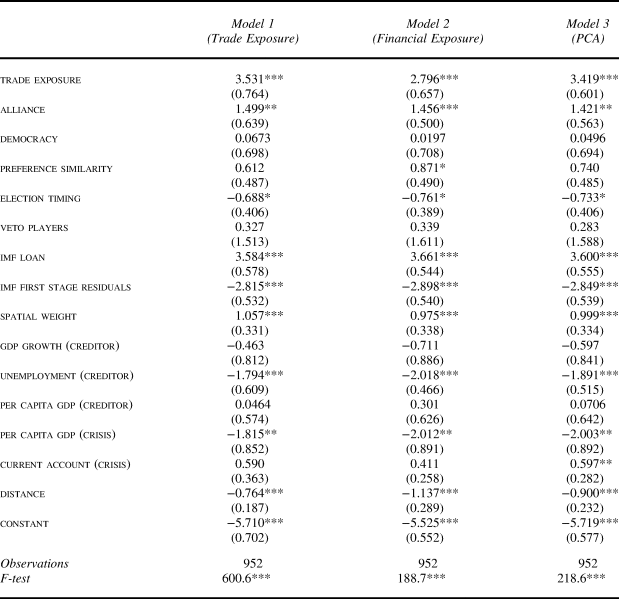
Table 2 reports the main results of our analysis. Model 1 uses trade exposure to account for economic exposure, model 2 substitutes trade exposure with financial exposure, and model 3 uses economic exposure (based on PCA). We present average marginal effects to ease interpretation. The models fit the data well. The F-statistics are statistically significant, indicating that we can reject the null hypothesis that together the independent variables have no effect on the likelihood of a bilateral bailout.
The political economy of bilateral bailouts

Notes: Marginal effects, standard errors in parentheses.
*p < .10; ** p < .05; *** p < .01.
Turning to the substantive effects, economic and political exposure are positively associated with the probability of a bilateral bailout; the effects of domestic political constraints are mixed. Supporting Hypothesis 1 (economic exposure), a half of a standard deviation increase in a creditor country's economic exposure is associated with a three- to four-percentage point increase in the probability of a bailout (depending on how we measure economic exposure), for an otherwise average country pair. Whereas the economic exposure of G7 countries only conditionally affects IMF lending decisions (i.e., when G7 countries have homogenous levels of exposure),Footnote 81 our results indicate that strategic economic factors affect bilateral bailouts directly and unconditionally.
We also find support for Hypothesis 2 (political exposure). Creditor countries that are in a defense alliance with a crisis country are nearly two percentage points more likely to offer a bailout. Democracy and preference similarity are positively associated with the probability of a bailout, but the estimates are not statistically significant at conventional levels. As we note in our sensitivity analysis, the coefficients for the political exposure variables gain significance in some specifications and lose significance in others, but they always remain positive.
Supporting Hypothesis 3 (domestic political constraints), we find that if a creditor government faces an election in the year of the financial crisis, the likelihood that it will offer a bailout decreases by nearly one percentage point. The relationship between a bilateral bailout and the number of veto players is not statistically significant.
Overall, economic and political strategic considerations play an important role in addition to the narrower economic considerations that have been attributed to bailout decisions. We also find interesting differences between economics and politics. The effects of economic exposure on the probability of a bilateral bailout are larger and more robust than the effects of some of our measures of political exposure or domestic political constraints. Even though political exposure and domestic political constraints matter, they likely play a smaller role than economic exposure in a creditor government's decision-making calculus.
Not surprisingly, whether or not the IMF bails out the crisis country is positively associated with a bilateral bailout. A half a standard deviation increase in the IMF loan leads to a more than three-percentage-point increase in the likelihood of a bailout. The spatial weight plays an important role in our analysis, without affecting the main results. This indicates that other creditors’ decisions to give a bilateral bailout influence the decision of an individual creditor to give a bailout.
Domestic economic criteria play an important role in the decision to bail out a country in financial distress. The unemployment level in the creditor country is negatively associated with the probability of a bailout, indicating that the less well off the creditor country is economically, the lower the probability that it will bail out other countries. This may offer further insights into potential domestic political constraints. When countries are not doing well economically, the government may be more concerned with public opposition to costly bailouts. The income level of the crisis country enters negatively and significantly into the main model. Distance is negatively related to the probability of a bailout, indicating that countries are more likely to bail out countries in closer geographic proximity. The remaining control variables are mainly in the expected direction, but the estimates are less precise, and the magnitude of their effects is much smaller.
Sensitivity Analysis
To test the robustness of our results, we consider changes to our estimation technique, and additional control variables. In Appendix C.1, we make a few changes to our econometric specification. In model 1, we use listwise deletion of missing observations. We lose a large number of observations, but our results remain robust. In model 2, we estimate equation (2) using ten imputations. Our results are robust to this change. In model 3, we demonstrate that the inclusion of a time trend does not affect our main results.
In Appendix C.2, we use alternative spatial weights. Model 1 estimates equation (2) without the spatial lag with little effect on the main results. Model 2 calculates the spatial weight based on the level of trade exposure between potential creditor countries i and k, rather than inverse distance. Models 3 and 4 calculate the spatial weight as the exposure of the potential creditor country k to crisis country j, and does this for both inverse distance (model 3) and trade (model 4). All spatial weights enter significantly into our models and they have little effect on our main results.
In Appendix C.3, we include additional control variables. Repeated financial crises may signal that the crisis government is not willing or able to implement the economic and financial reforms necessary for long-term stability. We use a variable that counts the number of crises in ten years prior to the financial crisis (bailout fatigue). Data are from Reinhart and Rogoff.Footnote 82 The results are presented in model 1. The type of financial crisis could determine whether or not a creditor country is willing to provide a bailout. Model 2 includes a series of (nonmutually exclusive) dummy variables for whether the crisis country is experiencing a currency crisis, balance-of-payments crisis, sovereign-debt crisis, or a banking crisis. Model 3 includes a dummy variable equal to 1 if the creditor country and the crisis country are in the same region. Finally, regional bailouts from the EU to Greece and Ireland in 2010 could skew our results. In model 4, we exclude Greece and Ireland from our analysis. None of the changes have strong impacts on our main results.
Appendix C.4 includes macroeconomic crisis country variables that the IMF literature identifies as key macroeconomic determinants of IMF loans. We include the crisis country's external debt service to exports (debt service), the ratio of short-term debt to reserves (short-term debt), and the external debt to GDP ratio (debt to gdp). We do not include these in our main regression because we focus on the creditor's decision-making process, and these variables are highly correlated with many of the variables that are theoretically important for our model. We include each variable individually in models 1 to 3 and combined in model 4. Their inclusion has little impact on our results.
The analysis supports our argument that the economic and political exposure to a country in crisis increases the probability of a bilateral bailout, while domestic political constraints decrease this probability. Governments balance various, often contradicting interests when contemplating whether or not to bail out a country in financial trouble. Although they have incentives to offer bilateral bailouts to mitigate the potential negative spillovers from financial crises in countries they are exposed to, domestic political constraints increase incentives to forgo bilateral bailouts. These considerations play an important, and often dominant role, even if we take into account more narrow economic considerations for whether a country should receive financial aid.
Conclusion
Creditor governments balance domestic and international pressures when deciding over bilateral bailouts. Greater economic and political exposure to the crisis country incentivizes them to bail out countries in financial distress. Domestic politics, however, places important constraints on creditor governments. To analyze the politics of bilateral bailouts, we collect original data on bilateral bailouts of G7 creditor countries to crisis countries between 1975 and 2010. The findings demonstrate that strategic considerations play an important role in the decisions to provide bilateral bailouts. They also shed light on the type of exposure that drives creditor governments’ decisions. Whereas both political and economic exposure matter, unsurprisingly it is economic exposure that has the largest impact on bilateral bailouts—an influence that even trumps less strategic economic considerations. Domestic politics also play an important role in constraining governments’ ability to offer bailouts, even if a bailout would be expedient for economic reasons.
Our paper provides a first step toward a theory of the political economy of bilateral bailouts. Even though economic analyses have largely focused on nonstrategic considerations, our results support the existing case studies that find that economic exposure matters. We also show that political considerations play a role for creditor governments when bailing out other countries.
The collection of a unique data set on bilateral bailouts allows us to scrutinize the causes and consequences of bilateral bailouts as well as to explore bailouts in the context of other strategies for financial rescues. First, it is important to understand the conditions under which governments choose particular financial strategies during financial crises. Our analysis offers some initial insight for such a theory. Whereas bilateral bailouts are public in the creditor countries—and therefore often influenced by electoral politics—other policies, such as currency swaps or privately financed haircuts, are either less public or less salient, and thus a potential solution when bailouts would be too costly politically. Second, whereas there is strategic ambiguity about the exact nature of international cooperation among various creditors—including the IMF, national governments, central banks, the Paris Club, and private creditors—we can assume that in most cases (but not always) bilateral bailouts occur in conjunction with other financial rescue strategies, most notably IMF rescue packages. Future analysis can use the existing findings to shed light on the negotiation dynamics between these various actors, and thereby contribute to a better understanding of international cooperation during financial crises.
Supplementary Material
Supplementary material for this article is available at <https://doi.org/10.1017/S0020818319000389>.
Acknowledgments
We thank Despina Alexiadou, Michael Bechtel, Ben Bohr, Sarah Brooks, Lawrence Broz, Marc Busch, Stephen Chaudoin, Daniela Donno, Axel Dreher, Jude Hays, Hyeran Jo, Valentin Lang, Tom Pepinsky, Dennis Quinn, Nita Rudra, Burcu Savun, James Vreeland, Stephanie Walter, Erik Wibbels, participants of the IPES conference, as well as seminar participants at the University of Pittsburgh and Georgetown University for valuable comments and suggestions on previous versions of this paper. Ben Bohr, Sasha Gallant, and Jacob Patterson-Stein provided valuable research assistance.
Funding
We gratefully acknowledge financial support from the Hellman Foundation.