Staphylococcus aureus is one of the main human pathogens, being found in close relationship with warm-blooded animals and, consequently, in the food that comes from these animals (Costa et al., Reference Costa, Belo, Costa, Andrade, Pereira, Carvalho and Santos2018). Although S. aureus has been a known pathogen for a long time, isolates of methicillin-resistant S. aureus (MRSA) have been found since the 1980s, being responsible for hospital-acquired infections and showing the capacity to resist various antimicrobials. Currently, it has become a worldwide pathogen related to the community and food transmission (Gonzalez et al., Reference Gonzalez, Marques, Gomes, Beltrão, Pinheiro, Esper, Paula, Teixeira and Aguiar-Alves2017). The antimicrobial resistance capacity of S. aureus is the result of several factors, which include the production of β-lactamases (encoded by the blaZ gene) and alteration of the binding site for β-lactam antibiotics due to the production of an additional penicillin-binding protein present in methicillin-resistant strains of S. aureus (Song et al., Reference Song, Yang, Shin, Seo, Park and Park2016; Chen et al., Reference Chen, Zhao, Guo, Li and Chen2017). Some studies demonstrate that methicillin-resistant strains of S. aureus are already a reality in the agricultural environment, especially on farms that produce dairy products, such as cheese, including the rennet type. This resistance characteristic may be the result of the presence of a gene called mecA in these microorganisms (Aragão et al., Reference Aragão, Trajano, Silva, Oliveira, Pinheiro Júnior, Peixoto and Mota2019).
‘Coalho’ cheese is a dairy food typically consumed in the Northeast region of Brazil, obtained through the coagulation of milk using rennet or other coagulating enzymes, with or without the presence of the appropriate lactic bacteria, and it is a product of medium to high humidity, with fat content ranging from 35 to 60% of its solid mass. Its production generally occurs in small and medium rural properties belonging to dairy producers, with low use of technologies and herds that comprise few animals (Brazil, 2003; Soares et al., Reference Soares, Esmerino, Ferreira, Silva, Freitas and Cruz2017).
Material and methods
Sampling
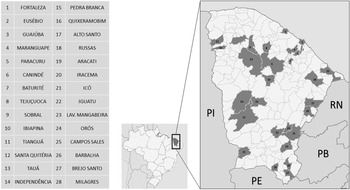
Samples of artisanal rennet cheese produced with raw milk were collected in small and medium-sized properties that produce cheese and dairy products in 28 municipalities of the state of Ceará, which were equally divided into the seven mesoregions of the State (Metropolitan Region of Fortaleza, North, Northwest, South, South-Central, ‘Sertões’ and ‘Jaguaribe’ regions) and randomly chosen, comprising 4 municipalities per mesoregion, as shown in Fig. 1. The collections took place between the months of March and December 2018, and two dairy producers were chosen in each municipality participating in the research, from which two samples were collected per dairy, totalling 56 dairy products and 112 samples. The samples acquired weighed about 500 g and were immediately packaged in sealed sterile plastic bags, identified, stored under refrigeration in isothermal boxes containing ice, and sent to the Applied Microbiology Research Laboratory of the Federal University of Ceará for microbiological and molecular analyses.
Map of Brazil, showing the location of the State of Ceará, with the distribution of the cities where the artisanal ‘coalho’ cheese samples were collected. PE, Pernambuco; PI, Piauí; PB, Paraíba; RN, Rio Grande do Norte. Adapted from Brazil Ceará location map, available at: https://pt.wikipedia.org/wiki/Ficheiro:Brazil_Ceara_location_map.svg. Accessed on 27 July 2020.

Isolation of S. aureus
For the isolation and identification of S. aureus, the methodology recommended by the Ministry of Agriculture, Livestock and Supply of Brazil was used. The calculation for counting the colony-forming units (CFUs) was performed through the observation of the number of typical and atypical colonies of the microorganism. The dilution inoculated into the culture medium used was produced using 25 ± 0.2 g of the sample in 225 ml of 0.1% peptone salt solution, obtaining a 10−1 dilution and, from this one, serial dilutions up to 1 × 10⁻⁵ were performed. The percentage of confirmed colonies and other information regarding the methodology are detailed in the online Supplementary File. In total, 306 typical colonies and 154 atypical colonies were selected, and the typical colonies were submitted to Gram stain for morphotintorial characterization.
S. aureus identification
All typical S. aureus colonies were submitted to DNA extraction and a specific region of nuc gene was amplified to confirm the S. aureus species, according to Kateete et al. (2010). Genomic DNA extraction was performed using a QIAamp DNA mini-Kit (Qiagen, Hiden, Germany), strictly following the manufacturer's guidelines, adding the Tris-EDTA and Triton X lysis buffer, 10 mg/ml lysostaphin, and 20 mg lysozyme/ml. The extracted DNA was stored in a freezer at −20°C for further tests.
The S. aureus standard strain ATCC 43300 was used as a positive control for detection of the nuc gene and microbial DNA-free water (Qiagen, Hilden, Germany) as a negative control. The mecA gene for the expression of penicillin-binding proteins, blaZ for β-lactamases, sea, seb, and sec for enterotoxins and tst1 for toxic shock syndrome toxins were also screened and the S. aureus strains ATCC 43300, ATCC 13565, ATCC 14458, ATCC 19095 and ATCC 13566 were used as positive controls, respectively, with microbial DNA-free water (Qiagen, Hilden, Germany) as a negative control for all genes. Details of the reaction are shown in the online Supplementary File and the primers used are described in online Supplementary able S1.
Oxacillin susceptibility test
For the characterization of the oxacillin susceptibility profile of the S. aureus isolates from ‘coalho’ cheese samples, each typical colony chosen was seeded on Mueller−Hinton agar (LABCLIN, Brazil) with the help of a sterile swab, after adjusting the inoculum compatible with the 0.5 density of the McFarland scale. The oxacillin discs (1 μg) were aseptically applied on Mueller−Hinton agar (LABCLIN, Brazil) and the plates were subsequently incubated in a bacteriological oven at 37°C for 24 h. After that, the inhibition zone (mm) was measured in comparison with the susceptibility zones, provided by the Clinical Laboratory Standard Institute (CLSI, 2016).
Results
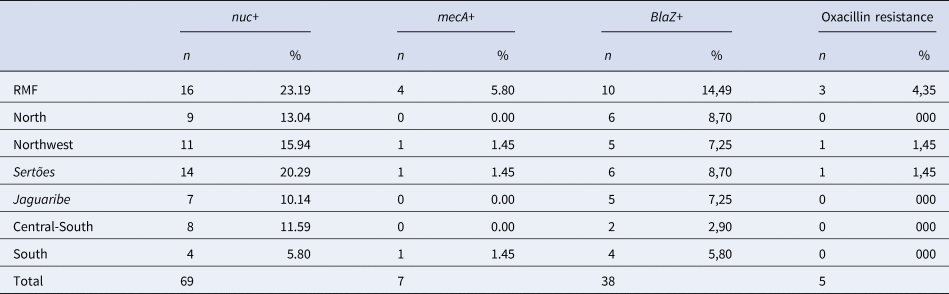
After the analysis of the samples of ‘coalho’ cheese produced with cow's milk from the 28 chosen municipalities of Ceará, microorganism growth was observed in Baird-Parker agar in 100% of the collected samples. The presence of the nuc gene was evaluated in 306 typical colonies obtained from the 112 analysed samples and, of this total, 69 colonies (22.55%) were positive (Table 1).
Number and percentage of positive S. aureus isolates for the presence of nuc, mecA, blaZ and oxacillin-resistant genes

RMF, Metropolitan Region of Fortaleza.
Of the 69 isolates of S. aureus in ‘coalho’ cheese samples, most were found in those produced in the metropolitan region of Fortaleza (RMF) (16/23.19%), followed by ‘Sertões’ (14/20.29%), Northwest (11/15.94%), North (9/13.04%), South-Central (8/11.59%), Jaguaribe (7/10.14%), and South regions (4/5.80%), as shown in online Supplementary Figure S1. Of the isolates, 7 (7.25%) demonstrated the presence of the mecA gene, determining the presence of methicillin-resistant isolates in food products, of which 4 isolates in the RMF area (5.80%), 1 (1.45%) in the Northwest, ‘Sertões’, and South regions each.
Of the 69 isolates tested for the presence of the blaZ gene, 38 (55.07%) were positive, demonstrating that more than half had the coding gene for the production of β-lactamase. It is noteworthy that all 7 isolates carrying the mecA gene also had the blaZ gene, corresponding to 18.42% of these isolates; while 31 (81.58%) carried only the blaZ gene and not the mecA gene, indicating the possibility of multiple resistance mechanisms acting in synergy in these microorganisms. Additionally, the highest frequency of positive blaZ isolates was found in the RMF area, with 10 (14.49%) isolates, followed by the North and ‘Sertões’ regions, both with 6 (8.70%) isolates; Northwest and Jaguaribe Regions had 5 (7.25%) isolates with this genotype; 4 (5.80%) isolates were found in the South; and the South-Central region had 2 (2.90%) positive blaZ isolates.
Resistance to oxacillin demonstrated through the disk-diffusion technique was found in 5 (7.25%) isolates of S. aureus, and all of them had a genotype that showed the presence of the mecA and blaZ genes; 3 isolates (4.35%) were found in the RMF area, and 1 (1.45%) in the Northwest and ‘Sertões’ regions.
We did not observe the presence of genes related to staphylococcal enterotoxins (sea, seb, and sec) in any isolate. In addition to the genes related to enterotoxins, we also evaluated the presence of the tst1 gene, indicating the toxic shock syndrome toxin (TSST), which causes the syndrome of the same name. None of the evaluated isolates showed the presence of this gene, which indicates the possible safety of the cheese produced in the State of Ceará regarding this disease, which can be fatal.
Discussion
The presence of staphylococcal isolates in foods is an important finding when listing their health-related aspects, including milk and dairy products, especially when these isolates show the presence of the mecA gene. This gene is one of those responsible for conferring the methicillin-resistance characteristic, since it encodes a penicillin-binding protein with low affinity for semi-synthetic penicillins, such as methicillin (Riva et al., Reference Riva, Borghi, Cirasola, Colmegna, Borgo, Amato, Pontello and Morace2015). Several studies demonstrate that the presence of MRSA in dairy farms is directly related to the transfer of these isolates between humans and animals, whether bovine, caprine or porcine, and they can generate infectious processes in dairy animals, such as staphylococcal mastitis, affecting the microbiological quality of the final product produced with this raw material (Costa et al., Reference Costa, Belo, Costa, Andrade, Pereira, Carvalho and Santos2018).
In a Brazilian study by Silva et al. (Reference Silva, Cidral, Soares and de Melo2015) with food handlers, the presence of staphylococcal isolates was verified in the hands and/or nose of all of them, and 75% of the isolates of S. aureus exhibited the presence of genes related to the production of enterotoxins. This presence has already been noted in other countries around the world, such as South Korea (Song et al., Reference Song, Yang, Shin, Seo, Park and Park2016), demonstrating that this presence is becoming a global health problem. Fortunately, in the present study, none of the analysed isolates showed the presence of genes related to the production of enterotoxins.
The presence of a diversified microbiota has multifactorial justifications, such as the fact that extensive and intensive livestock farming in large producing properties, whether of milk or beef, stopped being dedicated to monocultures and started sharing space with other types of livestock, such as swine, goats and sheep, favouring the transfer of microorganisms between cultures. However, the presence of pathogenic microorganisms in dairy products occurs mainly from the secretion of these microorganisms by infected animals (Costa et al., Reference Costa, Belo, Costa, Andrade, Pereira, Carvalho and Santos2018; Papadopoulos et al., Reference Papadopoulos, Papadopoulos, Angelidis, Boukouvala, Zdragas, Papa, Hadjichristodoulou and Sergelidis2018).
Studies demonstrate that the genetic element staphylococcal chromosomal cassette mec (SCCmec) and in particualr the type of this cassette is important for the microbial resistance demonstrated by MRSA isolates, including oxacillin. In some studies it was shown that SCCmec types I, IV, V VI and VII usually only favoured the resistance of the isolates to β-lactam antibiotics, while types II and III were characteristic of multidrug-resistant isolates, due to plasmids and transposons containing genes of resistance that integrated with SCCmec (McKay, Reference McKay2008). In contrast, others showed that the type of cassette did not crucially influence the characterization of the resistance profile, demonstrating that this factor is multifactorial, and it is not feasible to take this characteristic into account (Song et al., Reference Song, Yang, Shin, Seo, Park and Park2016).
Resistance to mecA has been correlated with the presence of the mecA gene for a long time. On the other hand, where resistance to oxacillin is concerned, the presence of S. aureus isolates positive for mecA but phenotypically susceptible to oxacillin (OS-MRSA) has been reported, including in Brazil (Guimarães et al., Reference Guimarães, Manzi, Joaquim, Richini-Pereira and Langoni2017; Danelli et al., Reference Danelli, Duarte, Oliveira, Silva, Alfieri, Gonçalves, Oliveira, Tavares, Yamauchi, Perugini and Yamada-Ogatta2020). These latter authors found strains of OS-MRSA in the nasal cavity of about 2000 health professionals and students from a university hospital in southern Brazil, raising an alert about the fact that these strains can be mistakenly identified as S. aureus sensitive to methicillin (MSSA) by phenotypic methods routinely used in most clinical laboratories, which would pose a threat to the treatment of staphylococcal infections. However, the concern related to the presence of OS-MRSA is not restricted, to the healthcare environment only. Corroborating what was found in the present study, where 2 mecA positive isolates were phenotypically sensitive to oxacillin, Guimarães et al. (Reference Guimarães, Manzi, Joaquim, Richini-Pereira and Langoni2017) identified the presence of OS-MRSA isolates in milk samples collected from the mammary glands of cows diagnosed with subclinical mastitis in a dairy farm located in the state of São Paulo, Brazil, demonstrating that the dairy production chain is also susceptible to this problem.
Some MRSA isolates, found in many studies that associate them to animal contamination, are known to be important causes of hospital acquired infections, often due to their ability to produce biofilms in medical and hospital devices such as catheters. This production is directly associated with the dysfunction of the agr (accessory gene regulator), present in the gene locus of the same name, and important for the regulation of the formation, development, and quorum sensing in these biofilms and other virulence factors. Therefore, it is suggested that molecular therapeutic strategies to inactivate this gene would not have the desired efficacy, since the dysfunction of this gene stimulates the production of biofilm and can be an important medical problem (Archer et al., Reference Archer, Mazaitis, Costerton, Leid, Powers and Shirtliff2011).
In conclusion, the results of the present study demonstrate a significant presence of S. aureus in ‘coalho’ cheese samples from different regions of Ceará, mainly in the metropolitan region of Fortaleza. It should be noted that, from the perspective of the relevance of microbial resistance, resistance to oxacillin was found, concomitantly with resistance to methicillin and β-lactamase production. With this information in mind, the relevance of further studies related to clinical and subclinical bovine mastitis, on the quality control of dairy products, on the health legislation in force in the country, and on the analysis of products for export is ratified.
Supplementary material
The supplementary material for this article can be found at https://doi.org/10.1017/S0022029922000073.
Acknowledgements
We would like to thank Centro Universitário Fametro and Universidade Federal do Ceará for the laboratory structure availability to carry out this research; as well as the dairy farms and producers of ‘coalho’ cheese in the State of Ceará, for providing the samples used in this study. We also thank the National Council for Technological Development (CNPq) and the Coordination for the Improvement of Higher Education Personnel (CAPES) in Brazil, for funding this research.