INTRODUCTION
The family Serranidae is divided into three subfamilies (Serraninae, Anthinae and Epinephelinae) with about 64 genera and 475 species (Heemstra et al., Reference Heemstra, Anderson, Lobel and Carpenter2003). The genus Liopropoma is a member of the subfamily Epinephelinae, proposed by Gill for Perca aberrans Poey. They are characterized by the presence of a complete lateral line, villiform teeth in the mouth, three flat spines on the opercle and absence of canine teeth (Randall & Taylor, Reference Randall and Taylor1988). There are about 27 valid species in the genus Liopropoma (Akhilesh et al., Reference Akhilesh, Bineesh and White2012). Although Liopropoma lunulatum was reported from Indian waters (CMFRI, 2009), this report had no morphometric details of the specimen landed.
The genus Plectropomus belongs to the subfamily Serraninae and are large coral-reef fish that occur in shallow tropical and subtropical waters of the Indo-Pacific (Heemstra & Randall, Reference Heemstra and Randall1993). Seven species were recognized by Randall & Hoese (Reference Randall and Hoese1986) in their revision of the genus Plectropomus of which two species have been recorded from Indian waters—Plectropomus areolatus and P. leopardus. Black saddled coral grouper Plectropomus laevis is a rare species, often with an abundance <1 individual/1000 m2 (Choat et al., Reference Choat, Liu, Craig, Yeeting and Robinson2008). This fish was listed as ‘Vulnerable (A2d + 4d)' in the 2008 IUCN Red List. It is reported to have a widespread occurrence in the Indo-Pacific from East Africa to the central and southern Pacific with reports from Zanzibar and Madagascar off eastern Africa, Maldives, Ceylon, Sumatra and the southern Pacific. There have been no reports of its occurrence in Indian waters. Samples of the above two fish were recorded during a survey of fish landing centres on the south-west coast of India; morphometric counts and description are given in the present paper.
MATERIALS AND METHODS
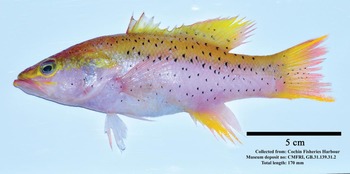
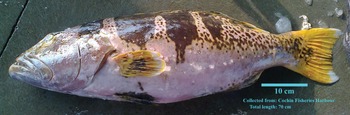
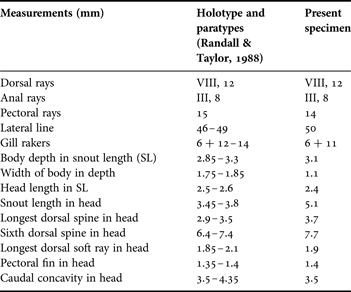
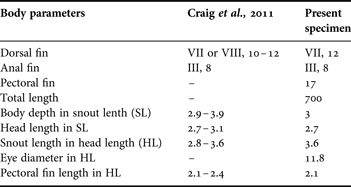
The two specimens were collected from Cochin fisheries harbour, Kerala, India (Figure 1) in March 2012. Morphometric (recorded using a digital Vernier caliper with an accuracy of 0.01 mm) and meristic data were collected based on Randall & Taylor (Reference Randall and Taylor1988) and Heemstra & Randall (Reference Heemstra and Randall1993) for identification. Specimens were photographed using a Canon Powershot A620 digital camera (7.1 megapixels). Liopropoma lunulatum (Figure 2) was deposited in the National Marine Biodiversity Referral Museum at the Central Marine Fisheries Institute, Kochi. Due to the large size and high cost of the P. laevis specimen (Figure 3), it was not collected. Morphometric and meristic data of the recorded species were compared with type specimens for L. lunulatum (Table 1) and FAO specimen (Heemstra et al., Reference Heemstra and Randall1993) for Plectropomus laevis (Table 2) respectively.
Map showing fish collection site.

Liopropoma lunulatum (Guichenot, 1863): total length, 170 mm; weight, 65 g.

Plectropomus laevis (Lacépède, 1801): total length, 700 mm.

Morphomeristic comparison of Liopropoma lunulatum (in mm) from India with the holotype and paratypes (Randall & Taylor, Reference Randall and Taylor1988).

Comparative morphometrics and meristics of Plectropomus laevis (in mm).

RESULTS
SYSTEMATICS
Order PERCIFORMES
Family SERRANIDAE Swainson 1839
Genus Liopropoma Gill, 1861
Liopropoma lunulatum (Guichenot, 1863)
(Figure 2)
MATERIAL EXAMINED
Liopropoma lunulatum (CMFRI, GB.31.139.31.2) (170 mm total length), collected from Cochin fisheries harbour, Kerala, India.
DESCRIPTION
D VIII, 12; A III, 8; P 14, C 19; Ll 51; Gr 6 + 11.
Body moderately elongated, depth 3.1 in snout length (SL); head pointed, length 2.4 in SL; dorsal profile of head slightly sloped. Snout flat, length 5.1 in head length (HL); eye moderate, diameter 5.7 in HL. Mouth large, oblique, lower jaw slightly projecting; jaws with villiform teeth; lower edge of pre-operculum slightly serrated; operculum with three broad flat spines; third dorsal spines longest, length 3.7 in HL. Dorsal soft rays longer than spines, longest ray length 1.9 in HL; longest anal soft ray length 2.08 in HL; pectoral fin length 1.4 in HL; pelvic fin small, 1.4 in pectoral fin; caudal peduncle compressed, depth 2.3 in HL; caudal fin emarginate.
COLOUR
Body pinkish yellow; upper one-third yellow, lower part pinkish white with scattered arch or ‘x’ shaped small black spots; few spots present on posterior part of head, dorsal and caudal fins. Head pinkish to white with a broad yellow band from tip of the upper lip to posterior tip of operculum, through snout and eye; another narrow band seen on upper maxilla to pre-operculum; a horse-shoe shaped yellowish blotch on nape connecting both eyes. Anterior dorsal spines reddish with interfin membranes hyaline, base yellow; anterior half of dorsal and anal soft rays yellow, margin and posterior part pinkish. Caudal fin with broad bright yellow bands at each lobe; caudal base yellow, centre and rear edges pink; paired fins pinkish white.
DISTRIBUTION
Reported earlier from Mascarene and Society Islands.
SYSTEMATICS
Order PERCIFORMES
Family SERRANIDAE Swainson 1839
Genus Plectropomus Oken, 1817
Plectropomus laevis (Lacépède, 1801)
(Figure 3)
MATERIAL EXAMINED
Plectropomus laevis (700 mm total length), collected from Cochin fisheries harbour, Kerala, India.
DESCRIPTION
Body oblong, robust, depth 3 in SL; head large, length 2.7 in SL. Snout long, flat, length 3.6 in HL; eyes small, placed higher on head, diameter 11.8 in HL; interorbital broad, flat; mouth large, lower jaw produced than upper jaw, maxillary ends on a vertical from rear end of eye; preoperculum rounded with spines on the lower edge; operculum with three flat spines. Both pectoral and pelvic fins short, not reaching anus; caudal fin emarginate.
COLOUR
Body pale white to grey with five dark brown, broad saddles on dorsal part of head and body, one above eye, second on nape, third to fifth below dorsal fin. Small dark brown edged blue spots dorsally on nape, body and caudal peduncle, dark edges sometimes connected to each other. Head and lips yellowish; body and head ventrally plain without spots; dorsal, anal and caudal fins yellowish, with scattered dark spots; pectoral and pelvic fins pale yellowish with dark blotches at centres.
DISTRIBUTION
Reported earlier from East Africa, Madagascar, Mauritius, Seychelles, Maldives, Sri Lanka, Indonesia, Philippines, Papua New Guinea, Australia, New Caledonia, Vanuatu, Tuamotu Islands, Ryukyu Islands, Taiwan, Japan, central and southern Pacific Islands (Craig et al., Reference Craig, Sadovy de Mitcheson and Heemstra2011).
REMARKS
Liopropoma lunulatum is closely related to L. aurora (Jordan & Evermann, 1903) and L. randalli Akhilesh, Bineesh & White Reference Akhilesh, Bineesh and White2012. Liopropoma aurora has a very similar colour pattern but differs from L. lunulatum in having 13 and 9 soft rays in dorsal and anal fin respectively (12 and 8 in L. lunulatum); gill rakers 5–6 + 13–14 (6 + 12 in L. lunulatum) (Randall & Taylor, Reference Randall and Taylor1988). Blackish semicircular-shaped spots on the body of L. randalli is very similar to L. lunulatum, but differ from L. lunulatum in having a blackish midlateral stripe from front of upper jaw to posterior edge of operculum (Akhilesh et al., Reference Akhilesh, Bineesh and White2012). The present specimen bears close resemblance to the paratype in its morphomeristic characters (Table 1) and is a confirmed distribution record for the species from Indian waters.
Plectropomus laevis differs from all the other serranid species of the genus by the presence of its black saddle blotches on the body. The meristic counts and morphometric measurements of the present specimen match well with that of Craig et al. (Reference Craig, Sadovy de Mitcheson and Heemstra2011) (Table 2).
The ability to detect and respond to temperature changes can lead to alterations in distribution when fish seek better environmental conditions (Claireaux et al., Reference Claireaux, Webber, Kerr and Boutilier1995). Serranids are particularly successful in extending their geographical ranges. There are cases of range expansion induced by increasing sea temperature (Epinephelus aeneus and Mycteroperca rubra) as well as occurrences far out of their range of distribution (Cephalopholis taeniops) (Dulcic & Dragicevic, Reference Dulcic and Dragicevic2013). The range extension of the serranids recorded in the present study could possibly be due to environmental changes in the Indian Ocean which lead to a rise in sea surface temperature and coral bleaching during 2004–2005 and could have caused the fish to extend their range from native habitat to the west coast of India.
ACKNOWLEDGEMENTS
The authors thank the Director, Central Marine Fisheries Research Institute, Cochin, India for the facilities provided, and the Head of Divisions of Demersal Fisheries and Fisheries Resource Assessment for their constant encouragement and support. The authors also thank the anonymous referees who have greatly contributed to the quality of this paper. The financial support from the Ministry of Environment and Forests is gratefully acknowledged.