Political protest has a long history in the repertoire of political action and the course of political development. From the French Revolution, to the Rights Movements of the 1960s in the United States, to the ‘people power’ protests of the Third Wave of democratization, popular protest has shaped political history. Protest has also become an often potent tool of public influence over government policy making and implementation. Moreover, protest activity is apparently increasing in advanced industrial democracies, as well as spreading on a global scale. Indeed, several recent studies describe protest as a nearly ubiquitous part of contemporary politics.Footnote 1
The importance of protest activity has led to a rich and varied literature on its general causes. Yet, these theories have developed independently and without systematic testing or comparison with rival theories. In addition, on an empirical level, past research has typically had a limited scope – focusing on a single region, nation or protest movement, and attempting to generalize from this experience. Most survey research has examined advanced industrial democracies where surveying is common; our knowledge of protest activity in developing nations is less extensive. The purpose of this article is to develop a more complete cross-national understanding of the general sources of protest with a systematic testing of these competing theories across a broad range of nations.
We use the 1999–2002 wave of the World Values Survey to examine protest across seventy-eight nations, representing more political and social diversity than has been possible in previous studies. Although protest in a specific political campaign or organization may be shaped by factors unique to that one example, we study the correlates of protest to determine the factors that generally encourage citizens to use this mode of political action.
On a theoretical level, we argue that individual protest is shaped by a complex interaction between the context of action (in this case, national attributes) and the characteristics of individual citizens. Scholars have long recognized the importance of both contextual and individual level factors, but this is the first study that integrates them into a single model and considers the interaction between micro and macro factors. We thus provide a more comprehensive theoretical framework of the forces shaping overall levels of protest activity.
Methodologically, we go beyond previous research by developing a hierarchical linear model (HLM) of protest behaviour. Past comparative studies of political protest have statistically mis-specified results because they analysed either micro or macro factors independently or with an inappropriate statistical model. Hierarchical linear modelling integrates macro and micro variables in a single model, and provides for a more accurate estimation of parameters at both levels.
The next section briefly reviews the macro-level theories on how the economic and political contexts may affect protest activity. Then, we review the micro-level theories of how grievances, resources and values may explain protest activity. The following section describes the cross-national levels of protest based on the 1999–2002 World Values Survey (WVS). Finally, we develop a multi-level model that combines both national and individual explanations of public protest. Our conclusion discusses the implications of these findings for our understanding of protest politics, and how protest changes because of economic and political development.
Theories Of Protest Activity
Many studies of protest and social movement activity – especially in developing nations – attempt to explain a discrete event or a series of contentious events, such as why a particular protest occurred or why a group chose the path of contentious action. Why did this protest occur, why did this group choose the path of contentious action? Our goal is broader. We want to explain how protest becomes part of the repertoire of political action for a nation or an individual. This draws our attention away from factors that might stimulate a specific protest, such as a catalysing event or the actions of a political movement. Instead, we ask what factors contribute to the general use of protest within and between nations, whether this protest involves a dramatic event such as a protest against the government in the capital, or a host of small community protests against local governments. Even though our focus is on broader and more generalizable patterns of protest activity, we draw upon the same rich and diverse literature on what might stimulate protest. This section summarizes theoretical literature on the major macro-level contextual factors that might influence protest activity, and the following section reviews micro-level theories and the interaction between macro and micro effects.
Macro-Level Context
Prior research stresses two broad contextual features of nations that may influence the aggregate level of protest in a nation. These two are the political context and the economic conditions.
The ‘Political Opportunity Structure’ (POS) approach considers whether institutional structures and political processes influence levels of political activity. Some analysts argue that relatively open institutional structures that accommodate citizen demands facilitate protest activity.Footnote 2 Political openness exists when individuals can make demands and criticize political actions without fear of reprisal; where there are viable means of political access; and where decision makers are willing to listen (and perhaps even sympathetic) to the demands of citizen groups.Footnote 3 When governments tolerate protest or even facilitate protest activity in these ways, more groups and individuals will engage in protests (and other forms of political action) since the barriers to action are lower and possibly the acceptance of public demonstrations is higher.Footnote 4 Indeed, a considerable amount of protest activity in contemporary societies is highly routinized, organized and even institutionalized – whether it is a protest in central London or Mexican peasants protesting a change in food subsidies. Thus, one aspect of POS theory suggests that as political systems become more open and democratic, protest will increase.
In contrast, other scholars argue that closed political systems are more likely to push actors outside conventional channels, thereby increasing levels of protest activity.Footnote 5 Closed systems exist when there are few channels for public input into the political process or where the government (or institutional structures) formally restricts public access through conventional channels. For instance, nations with limited civil liberties or with limited electoral democracy (or outright autocracy) have closed input structures. Consequently, with limited means of conventional political access, dissatisfaction may build until it generates extra-institutional forms of protest activity. Kitschelt made such an argument for the cross-national differences in protest activity by anti-nuclear power groups, and the same argument has applied to other social movements.Footnote 6
Yet other researchers maintain that a mixture of open and closed characteristics is most conducive to protest. For example, Eisinger finds that civil rights protests in American cities were relatively low in both open and closed systems of city government, and highest in mixed systems.Footnote 7 This curvilinear hypothesis holds that contentious protest is low in the most open societies because of the easy availability of influence through conventional channels and low in the most closed societies because these states do not accept public action or suppress such activity. Consequently, protest should be highest in countries with mid-level openness.
A second major contextual factor is the socio-economic development of a nation. Again, the literature is divided. The heart of Ted Gurr’s grievance theory argues that poverty, economic deprivation and other negative living conditions should stimulate protest activity.Footnote 8 Gurr identified a range of societal factors that might produce feelings of relative deprivation, including changes in the national economy, inflation rates and growth rates of gross national product, as well as long-term economic and social deprivation. These indicators were positively related to Gurr’s measure of turmoil, which combined demonstrations, strikes, riots and other forms of political protest and violence. Despite criticism from many scholars of collective action, many accounts of protest use grievance theory as an explanation. Moreover, several comparative studies of protest movements argue that popular dissatisfaction stimulates protest on a range of issues.Footnote 9
In contrast, a resource thesis suggests that sustained protest activity requires a resource base that facilitates mobilization by protest groups.Footnote 10 An affluent society, a highly skilled public and citizens freely engaging in voluntary associations create a resource environment that can support collective action. Extensive non-governmental organizations and other civil society groups are more likely to exist in affluent nations that have a large voluntary sector. Socio-economic development also produces dense communication structures, mass education, urbanization and high degrees of social mobility – factors that can increase the resources available to protest groups. For example, an independent mass media and access to communication networks enable groups to communicate with potential constituencies across large distances. Previous cross-national surveys and events-based analyses indicate a strong positive relationship between national affluence and protest activity.Footnote 11 Thus, this theory claims that higher levels of economic development produce the resources that facilitate political action.
In addition, other literature suggests a curvilinear model of resource effects.Footnote 12 With low levels of resources, individuals or social movement organizations may simply lack the ability to mount effective protests, and may be more susceptible to the oppressive powers of the state; so protest levels will be low. At high resource levels, individuals and groups may have ready access to conventional channels of influence, and thus protest less often because it may alienate political authorities or supporters. Consequently, these authors claim that protest may be more common with moderate levels of resources that provide a sufficient basis for political action by groups that are not accepted within the dominant political structure.
In summary, previous research offers differing views on how cross-national differences in the institutional and social contexts may affect protest activity. In part, this reflects the diversity of cases being discussed. Some studies focus on a specific protest event, in which different nations and time periods are being examined, and systematic cross-national comparisons are limited. Such diversity in cases can produce equal diversity in findings. In part, this also reflects methodological considerations. There is a wealth of empirical evidence for advanced industrial democracies. However, much of the previous research on protest in the developing world comes from a particular movement, a single campaign, or small n case studies. This research does not provide a broad, firm foundation for cross-national generalizations about the systematic effects of political structures or social conditions. Moreover, the concept ‘political opportunity’ is open to varying interpretation, and this makes it difficult to compare results across cases and reach broader, more generalized conclusions.Footnote 13
The World Values Survey provides a unique opportunity to study the influence of the political and socio-economic context because we use reports of protest activity from citizens in a broad range of nations. The large contextual differences across the nations in the WVS provide the systematic cross-national evidence that is missing from many earlier studies of protest in the developing world.Footnote 14 We use the level of democratic development to measure the openness of a political system. Democratic systems allow for a more open expression of opinion, typically have more institutionalized channels through which citizens can press their demands on government, and protect the rights of dissenters. Similarly, the wide differences in national affluence and other socio-economic conditions can test the grievance and resource hypotheses regarding the influence of context on protest activity.
Micro-Level Theories
In addition to contextual influences, personal characteristics determine which individuals are most likely to protest within a nation. There are three main individual-level theories of protest: grievances, resources and political values. In addition to summarizing the theoretical rationale for each predictor, this section also discusses how the national contextual factors may affect the influence of each predictor. This multi-level approach provides a more comprehensive theoretical framework for studying how macro and micro factors interact in shaping protest activity.
Grievance Theory
In addition to being a contextual predictor of protest activity, grievance theory is a common starting point for studies of individual protest behaviour. Protest is conceived as a response to societal problems and citizen dissatisfaction. Gurr’s Why Men Rebel argued that when changing social conditions cause people to experience ‘relative deprivation’, then the likelihood of protest and rebellion significantly increases.Footnote 15 Dissatisfaction caused by deprivation provides a general spur to action.
Studies of protest in developing nations routinely focus on examples where grievances stimulated action, such as protest movements against the construction of dams, indigenous rights movements, the Piqueteros in Argentina, and people’s power movements.Footnote 16 For instance, James Scott’s research on peasant movements stressed how grievances motivated a range of contentious actions even if the protesters had limited social and political resources.Footnote 17 However, it is equally possible that many individuals who feel intense grievances may not protest, and thus are overlooked in studies of protesters. A question is whether high levels of grievances systematically produce high levels of protest activity.
Beyond the general logic of the grievance model, the national economic and political contexts may affect the impact of grievances on protest. Most studies of political action in advanced industrialized democracies present only a weak relationship between protest activity and either personal or political dissatisfaction and protest.Footnote 18 However, several studies in developing nations find that personal or political dissatisfaction is related to protest activities.Footnote 19 In less affluent nations, personal dissatisfaction may represent severe economic deprivation or the struggles to survive.Footnote 20 These conditions more clearly reflect the deprivation logic of the grievance model. This may explain why developing nations apparently show more evidence that deprivation spurs protest.
In contrast, dissatisfaction in advanced industrial democracies may reflect a more expressive quality of life or communitarian issues.Footnote 21 Severe deprivation is less common in advanced industrial democracies and the means to address basic human needs are more extensive. Thus, some people may be dissatisfied with politics or the conditions of life, but the objective circumstances are less likely to be severe. This may explain why researchers typically find only weak relationships between dissatisfaction and protest in Western democracies. In summary, the grievance model may be more appropriate for explaining protest in low-income nations.
Political opportunity theory also suggests that the political context may affect the impact of grievances on protest.Footnote 22 In closed systems, grievances may stimulate protest because they provide the motivation to overcome the barriers to protest activity (and the threat or repression). In contrast, open political systems might transform protest into an expressive activity to generate media attention and popular support for a cause. Thus, specific grievances may have less impact in predicting protest activity in this latter context.
Our analyses will allow us to compare how personal and political dissatisfaction influence protest activity, and whether these relationships vary systematically by the level of economic and political development.
Resources
The literature on protest in advanced industrial democracies argues that the individual skills and resources that facilitate conventional action also stimulate protest activity. Verba, Schlozman and Brady, for example, highlighted the crucial role of individual resources to protest activity in America.Footnote 23 They differentiated between two types of individual resources. First, resources such as education and income provide citizens with the political skills and means that enable them to be active in politics. Secondly, organizational membership can encourage political participation. Individuals are much more likely to be recruited into political activity – both conventional and contentious activity – if they are members of social groups such as unions, churches, professional organizations and political parties.
Comparative studies of advanced industrial democracies typically find that protest is more common among the better educated; this is evidence that runs counter to the grievance theory.Footnote 24 Some research in less developed nations similarly suggests that resources are important in facilitating political protest.Footnote 25
This is another case where the economic and political context may affect the impact of individual resources on protest activity. Advanced industrial democracies have more people with the resources to participate in politics, and an infrastructure that can facilitate movement leaders in mobilizing protest.Footnote 26 In this context, the resources of an individual – their income or educational level – might be more easily translated into political action. That is, the resource-rich context of advanced industrial democracies may compound the effect that individual resource variables have on protest. Similarly, individual resources may be more strongly related to protest in open, democratic countries because the context provides more opportunities for mobilizing protest. Democratic countries, for example, often facilitate protest by providing venues and security protection for protests. The democratic legal framework, which protects democratic rights and liberties, allows citizens to more easily express their demands and concerns. Moreover, protest appears to be more socially acceptable in democratic contexts. These lower political and social constraints may enable individuals with resources to take even more advantage of the opportunities to protest in democratic countries.
In contrast, some research suggests that resources have a weaker impact in lower income and less open national contexts. Some studies in developing nations show that the wealthier and more educated individuals are less likely to protest.Footnote 27 In low-income countries, individuals with politically relevant resources may find it more difficult to translate their resources into political action, and engaging in protest may be more difficult because the organizational basis of collective action is weaker.Footnote 28 Moreover, in poor countries, those who are relatively affluent may not want to disturb the status quo with contentious protests, while the rural peasants and urban poor may see protests as a tool to improving their condition. Thus, the relationship between individual resources and protest may be weaker in low-income countries. Similarly, some case studies suggest that authoritarian states moderate participation for all groups.Footnote 29 When conventional avenues of political participation are closed, protest may become a less viable option even for those with the ability and resources to participate.
A good example of contextual effects might be the relationship between civil society involvement and protest. At the micro level, the civil society theory suggests that involvement in social groups creates networks for recruitment into political life.Footnote 30 Therefore, social group membership should increase protest activity. However, the effect of group membership may be influenced by the political context. The costs of protest – from basic organizational costs to repression – will be much lower for civil society organizations operating in open political contexts. In addition, the more pluralistic nature of established democracies encourages individuals to participate in multiple and cross-cutting organizations, again increasing citizen access to opportunities and invitations to protest. By contrast, in a less democratic society, civil society groups have less political space to challenge the government and engage in protest. In these nations, social groups may even function as agents of state control.Footnote 31 When civil society is heavily controlled by the state, protest participation is more likely to be short-lived and manifested in intermittent demonstrations supporting the existing leadership. In short, although civil society involvement may theoretically increase overall levels of protest, the effect may be far more pronounced in affluent societies and open democracies.
Political Values
Several researchers maintain that social modernization produces a political culture that emphasizes post-material or self-expressive values that encourage political participation.Footnote 32 In addition, these values prompt a questioning of authority that specifically stimulates elite-challenging behaviour. This research demonstrates a strong relationship between post-materialism and protest across a wide range of advanced industrial democracies over the past three decades.
We argue that the influence of post-material values should also interact with national context. Post-materialism should be less relevant to explaining protest outside of the advanced industrial societies. The number of post-materialists is smaller in less developed countries, and therefore individual post-materialists in these contexts are less likely to find a network of social movements and political groups that mobilize such orientations. They also may confront governments that are less acceptant of contentious political activities. For example, Dalton and Rohrschneider demonstrated that post-material values were a much stronger predictor of membership in environmental groups in affluent nations than in less developed societies.Footnote 33
Broad ideological orientations may also stimulate protest activity. Typically, protest is more common among Leftists, who are more likely to challenge the political status quo and resort to protest activities as part of their political repertoire. Indeed, there is a long tradition of Leftist support for mass protest within Western societies, which evolves from the challenging status of the groups mobilized by Leftist parties and the ideology of protest embedded within Leftist movements.Footnote 34
While the relationship between ideology and protest is well known for the advanced industrial democracies, it is unclear whether this same causal process functions in less developed and less democratic nations. Some research suggests that the intensity of ideological conflict is often greater in less developed nations, because conflicts may involve more fundamental values and more intense economic interests.Footnote 35 Therefore, ideological polarization may be a stronger influence on protest in less developed nations. In contrast, the lack of open political expression and competition in these same nations may attenuate the impact of ideological divisions. If citizens cannot mobilize and participate, then even clear ideological views may not lead to action. This latter logic suggests that the effect of ideological polarization on protest is weaker in less developed societies.
In summary, as protest has become a significant part of the repertoire of political action, research presents conflicting models of the individual sources of protest activity in broad cross-national terms. Many case studies of protest emphasize the importance of grievances, for example, but they do not examine cases where equal feelings of grievances do not lead to protest. Similarly, many previous studies have focused only on a subset of the rival causal theories presented here. In addition, there are strong reasons to expect that the political and economic context shapes the impact of individual-level predictors of protest. Our analyses systematically test these micro-level theories of protest, with an explicit focus on how these processes are shaped by the economic and political context of a nation.
Measuring Political Protest
Our empirical analysis begins by measuring the level of protest. Protest is an unconventional action, which makes it more difficult to measure than institutionalized activities such as turnout in elections or campaign activity. Also, the potential repertoire of protest activity is more varied because of its very nature. The initial survey-based studies of protest ordered activities along a continuum with several thresholds.Footnote 36 The first threshold is a transition between conventional and unconventional politics, such as signing petitions as a conventional activity and participating in lawful demonstrations as an unconventional method. The second threshold includes direct action techniques that are only semi-legal, such as boycotts. A third level involves illegal but nonviolent acts, such as unofficial strikes or peacefully occupying a building. Finally, a fourth threshold includes violent activities such as personal injury or physical damage where the action clearly exceeds what is accepted in a democracy.
The World Values Survey adopted this framework of protest activity.Footnote 37 These surveys cover nearly all advanced industrial democracies, more than a dozen states from Eastern Europe and the former Soviet Union, and an array of developing nations that are normally absent from survey research. Seventy-eight separate nations asked the battery of protest questions, and these are the basis for our analyses.
The WVS asked respondents in nationally representative samples to describe their past participation in various protest activities. The survey asked about five types of activity (excluding the fourth threshold because it is such an infrequent activity):
Now I’d like you to look at this card. I’m going to read out some different forms of political action that people can take, and I’d like you to tell me, for each one, whether you have actually done any of these things, whether you might do it or would never, under any circumstances, do it.
— Signing a petition
— Joining in boycotts
— Attending lawful demonstrations
— Joining unofficial strikes
— Occupying buildings or factories.
As a starting point, across all the nations combined (weighting each nation equally), 34 per cent of respondents say they have signed a petition, 18 per cent have participated in a legal demonstration, 10 per cent have joined a boycott, 5 per cent went on an unofficial strike and 2 per cent have occupied a building. There are other forms of activity that might be added to a list of contentious acts, but these five examples tap the most common forms of collective action. Thus, protest now involves many citizens in at least one form of protest action.
Participation in each of these five items forms a single dimension of protest politics.Footnote 38 Therefore, we combined the five items into a single index to produce a more robust measure of protest activity.Footnote 39 We counted the number of activities that respondents had actually done from among the five; this is the methodology used in most other studies.Footnote 40 Moreover, we explored alternative subsets of these five items, and concluded that the five-item index is the most valid and reliable measure of protest activity.Footnote 41
We want to note one methodological point before presenting the empirical findings. We are examining the forms of contentious political action that citizens might use while still working within the political framework of the existing state. These activities stop short of physical violence. Consequently, we are not studying actions such as coups, political violence or deaths by violence that are often examined in the political conflict literature.Footnote 42 We acknowledge that the patterns and correlates of political violence may differ from the type of contentious actions examined here. Our goal is to predict patterns of protest, demonstrations, boycotts and other contentious actions that stop short of political violence.
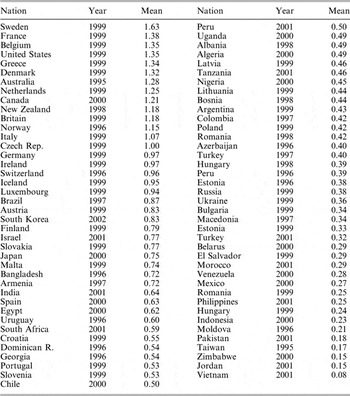
Table 1 presents the average number of protest activities for the five-item index by nation. Interpreting national levels of protest partially depends on one’s prior expectations. On average, a majority have engaged in at least one protest activity in most nations. Even if one excludes signing petitions, a large minority has participated in at least one challenging act. In a world where participation beyond voting is limited even in democracies, the frequency of protest activity is relatively common for an ‘unconventional’ action.
Mean Number of Protest Activities by Nation

Source: World Values Survey, waves 3 and 4.
Note: Table entries are mean number of protest acts in each nation using the five-item protest scale.
Table 1 also provides striking evidence that a nation’s economic and political conditions strongly influence the aggregate levels of protest. It is immediately apparent that protest is more common in advanced industrial democracies. Sweden ranks highest in protest; in fact, the ten highest-ranking nations are all advanced industrial democracies – this is hardly evidence of protest as a tool of a poor and disenfranchised public. Conversely, the lowest-ranking nations are a mixed set of Third World nations and some of the poorer nations of Eastern Europe. There is also a marked variation in protest across nations, with a 20:1 ratio in protest mean scores between the highest-ranking (Sweden) and lowest-ranking (Vietnam) nations.
Because economic and political development are so strongly correlated, it is difficult to disentangle their independent effects. The gross domestic product (GDP) per capita (at purchasing power parity, ppp) in the year of the survey is correlated at 0.80 with protest levels across the nations in Table 1. We examined other measures of national well-being that might fit the grievance thesis – such as changes in GDP or the level of income inequality – and these had weak or insignificant correlations with protest.Footnote 43
Of course, there can be more to grievances than just economic conditions. Indeed, one often hears analysts claim that national protests are stimulated by dissatisfaction with living conditions, rising inflation, falling employment or a host of other factors beyond simple national affluence. Therefore, we also sought to tap the general psychological aspect of Gurr’s grievance thesis. We compared the average life satisfaction and the percentage who say that they are happy, as measured by the WVS, with the level of protest. Both life satisfaction (r = 0.54) and national happiness (r = 0.45) are positively correlated with national levels of protest. This further questions the psychological aspect of grievance theory.
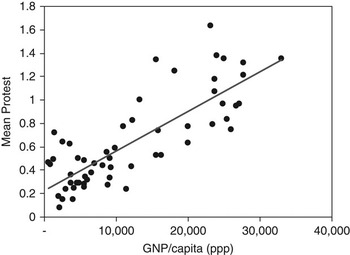
As noted above, some scholars hypothesized a curvilinear relationship between economic conditions and protest: less protest among the least and most affluent nations, with the highest protest levels among mid-income nations. Figure 1 displays the relationship between the five-item protest index and GDP per capita (ppp). These data show a strong linear relationship.Footnote 44 National levels of life satisfaction and happiness also display linear relationships. In other words, protest is most common in nations that are affluent, satisfied and happy – the direct opposite of the grievance thesis and inconsistent with the curvilinear thesis.
The aggregate relationship between GNP/capita and protest Source: GNP/capita (ppp) from World Bank for same year as World Values Survey. Protest mean from Table 1.

We also expect that national levels of political development (as an indicator of the openness of a political system) may affect levels of protest. We rely on the rule of law index from the World Bank to measure the openness and democratic development of a nation.Footnote 45 We use this indicator because it taps an institutional context that facilitates contentious politics and restricts the repression of opposition groups. The rule of law measure distinguishes whether a nation systematically and equitably enforces civil liberties and political rights, characteristics that are often vital in allowing citizens to protest against the government.
The rule of law is positively related to protest activity (r = 0.69). Moreover, the relationship is also clearly linear (data not shown), much like for national affluence in Figure 1. Other measures of democratic development display a similar pattern, such as the Freedom House scale of democracy, acceptance of voice, lack of repression, corruption or the Polity measures of regime stability.Footnote 46
These aggregate patterns, at least in part, represent the transformation of political protest in advanced industrial democracies. In these nations, protest is not primarily the tool of those ignored or oppressed by the political system. Rather, a wide section of society embraces protest politics. In addition, protest is more common in open, democratic political systems where individuals can make demands and express their opinions without fear of reprisal; and decision makers are willing to listen (and perhaps even sympathetic) to the demands made by groups. In advanced industrial democracies, the level of protest now rivals or exceeds participation in electoral campaigns (beyond the act of voting). In less developed nations, however, protest remains a relatively rare occurrence.
A Multivariate, Multi-level Model Of Protest
These macro-level patterns provide a first insight into the correlates of contemporary protest, but they do not reflect the individual-level sources of protest or the interaction between macro and micro factors. We therefore combine macro-level and micro-level predictors into a single multivariate, multi-level analysis of protest activity. This estimates the independent effects of both macro-level and micro-level factors. It also tests for cross-level interaction effects to see if national context shapes the individual sources of protest. As discussed above, previous scholarship suggests that political and economic context does shape protest behaviour – although there is little agreement on the direction of that impact.
We conducted extensive analyses at the macro and micro levels to identify potential predictors that reflected our core theoretical explanations of protest and were empirically related to protest.Footnote 47 For instance, we examined both life satisfaction and happiness as measures of personal well-being, and three different indicators of political satisfaction. From these analyses, we selected a subset of variables to minimize collinearity among multiple predictors of general theoretical concepts (see appendix for question wording and coding):
— Grievances: Life satisfaction and confidence in parliament as measures of personal and political grievances,Footnote 48
— Resources: Education and group membership as measures of resources, and
— Values: Left/Right attitudes and post-material values as cultural variables.
To estimate the independent effects of both macro- and micro-level variables, as well as cross-level interaction effects, we use a hierarchical linear model (HLM).Footnote 49 Unlike more conventional approaches, HLM explicitly models the multi-level structure of the data, and hence yields more reliable and precise parameter estimates. More conventional approaches, such as using ordinary least squares (OLS), tend to underestimate the standard errors, yielding inefficient estimates and biased measures of statistical significance.
We first estimate a baseline model for the pooled data that includes only the micro-level predictors; then we use the variance components of that model to estimate whether the effects of the micro-level predictors vary significantly across countries. If the variance component for the model intercept is statistically significant, it indicates there is systematic cross-national variance in the levels of protest activity, even after controlling for micro-level factors. If the variance component for a micro-level coefficient is significant, it indicates that the predictor’s effect varies systematically across countries. Finally, the size of a variance component measures the amount of unexplained cross-national variance. As we add macro-level variables in the subsequent models, we can see how much those variables reduce that unexplained cross-national variance. Because the effects of grievances, resources and values each may depend on the national context, we estimate the variance components for all six micro-level predictors. Thus, our baseline model includes (a) the independent effect of each micro-level predictor, (b) the variance components for these predictors, and (c) the model intercept.
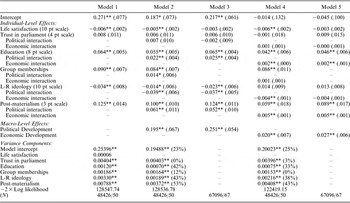
The baseline Model 1 in Table 2 while incomplete (underspecified) nonetheless gives us an initial gauge of the micro-level predictors. Overall, grievances have the weakest effects across the three general categories of predictors. Political grievances appear unrelated to protest. While life satisfaction has a statistically significant coefficient (dissatisfaction increases protest), its effect is negligible. The ten-point life satisfaction scale has a coefficient of −0.006, indicating that the least satisfied participate in only 0.06 more protest acts than the most satisfied.
Multivariate, Multi-level Model of Protest Activity

Source: World Values Survey.
Note: Reported Ns are for the micro-level and macro-level, respectively. *significant at the 0.05 level, **significant at the 0.01 level.
The lack of grievance effects may be surprising given some of the literature’s emphasis on this explanation. We do not believe grievances are unimportant; people typically do not protest to express their satisfaction with life or politics, although this does occur sometimes. At any protest, people will inevitably express their grievances, but our findings suggest that many people who hold equal grievances do not protest. Thus, other factors must be present before existing grievances are translated into action.
In contrast, resources are rather important in the model. Education and social group memberships are strong and significant predictors of protest.Footnote 50 Individuals who have the political skills and resources to engage in conventional forms of political action are also more likely to engage in protest. In addition, Left/Right position and post-material values are significantly related to protest activity. Taken together, the pattern of the micro-level coefficients is generally consistent with previous pooled analyses of the individual sources of protest across nations.Footnote 51
The lower panel of the table presents the variance components for each coefficient. The model intercept displays significant differences, which indicates that levels of protest vary significantly across nations even after considering the micro-level effects. The other variance components tell us whether the coefficients for each predictor also vary significantly across nations. Only life satisfaction, the indicator of personal grievances, does not vary significantly across nations (p = 0.17). This is significant because it demonstrates that the impact of personal grievances is not a function of economic development, the rule of law (democratic development) or other contextual differences across nations. However, the results for the other micro-level predictors indicate that their effects do vary systematically across nations – and the question is whether we can model these contextual effects.
The next step adds the macro-level variables to the model. The World Bank’s rule of law index measures the openness of the political system.Footnote 52 Economic development is measured as GDP per capita ($1,000/ppp). A series of statistical analyses found that it is difficult to separate statistically the impact of these two highly collinear variables (r = 0.80). Given that a priori we have no reason for excluding one factor over the other, we estimated separate models of interaction effects for political and economic development.
Models 2 and 3 include the micro-level predictors, the macro effect of political development, and the interactions of the micro-level predictors with the level of political development. We estimate two separate models because group membership was not asked in seventeen of the seventy countries, creating a large amount of missing data.Footnote 53 Model 2 includes the group membership variable; and Model 3 excludes this variable. The two results of the models for each macro-level factor are similar, indicating that the exclusion of the seventeen countries does not bias the general findings.
In broad terms, Models 2 and 3 show that the political context has a substantial impact on protest activity. Not only is protest more common in nations with a strong rule of law, but the political context also plays an indirect role by significantly affecting several of the micro-level predictors. Education is directly related to protest, and the strong interaction term indicates that this relationship is magnified in open political contexts. Model 2 also indicates that group memberships generally stimulate protest. However, this relationship is also stronger in more open political contexts, where there are more outlets for protest. There is a similar pattern for Left–Right attitudes with the large interaction coefficient (−0.039) implying that the effects are much greater in open political contexts. At the same time, both indicators of grievances – life satisfaction and trust in parliament – have weak effects. In general, grievances alone as a tool of political action do not appear to stimulate protest broadly.
The changes in the variance components at the bottom of the column for Model 2 confirm the importance of national context for the micro-level relationships. For instance, the nation’s rule of law score accounts for 42 per cent of the unexplained variance in the strength of the education coefficient across nations. Political context also accounts for a large percentage of the variance component for Left–Right ideology (43 per cent) and post-material values (52 per cent).
We can better illustrate the interaction of micro-level and macro-level influences by examining the influence of education graphically. Looking at Model 2, the education coefficient is 0.055, which is its effect on protest when the rule of law is coded as zero, a moderately closed system. Yet, a one unit increase in the rule of law measure strengthens this relationship by nearly half (0.021). Given that most advanced industrial democracies score around two on the scale, this means education’s effect is on average 0.097 in these countries, nearly twice as strong as in moderately closed systems. Moreover, since the standard errors of both coefficients are very small (0.004), these are highly significant effects.
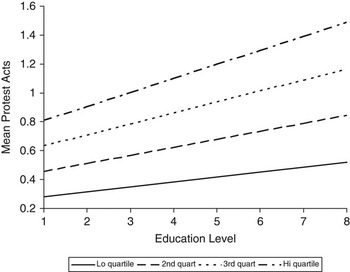
To graphically illustrate this interaction, Figure 2 plots the impact of education on protest for four levels on the rule of law scale. The bottom line in the figure corresponds to semi-closed systems (such as Russia or Nigeria). In these systems, education has a relatively modest impact on protest levels; the most educated participate in only 0.20 more protest acts than do the least educated. The slope of the relationship increases slightly for mixed open/closed and semi-open nations. Among the most open political systems, the highest quartile that includes most Western democracies, the education gap is substantially stronger (approximately 0.50). In other words, the impact of education more than doubles between the least and most open political systems.
Relationship between education and protest by political openness Source: World Values Survey 1999–2002 for protest acts and education levels; World Bank for the ‘rule of law’ measure of political openness/development. Note: each line depicts the relationship between education and protest activity for nations in each quartile of the rule of law measure.

Models 4 and 5 repeat the analyses, this time using GDP to model the economic context of the nation. The results are quite similar to the political development models. Protest is higher in more affluent nations (0.02), even controlling for the characteristics of the populations, such as educational level and social activism. Education, group membership and post-materialism also have significant individual-level effects on protest, and the interactions with national affluence are significant for each of these factors. As with political development, the coefficients are similar across the two models including and excluding group membership.
Protest As A Means Of Political Action
Since at least the writings of Marx, protest has been touted as a weapon of the weak and deprived in their battle against the privileged. This ‘underdog’ story of protest also finds considerable support in popular lore and the media, as well as a substantial part of the academic literature on protest. But this is only one theory of protest, and the goal of this article has been to test alternative micro-level and macro-level theories of protest activity. Our findings reveal a picture of contemporary citizen protest that is markedly different from the classical argument that protest reflects feelings of grievances and is the tool of the powerless.
First, while protest was once considered an unconventional political activity, it has now become a common part of the political repertoire in many nations. In several Western democracies, signing petitions and going to protests rival the level of activity in electoral campaigning or contacting politicians. Moreover, longitudinal evidence indicates that protest levels are increasing, even as nations develop economically and politically.
Secondly, on an unprecedented cross-national scale, we examined how the principal theories of protest fare across divergent economic and political contexts. The findings reveal a rather surprising and even counter-intuitive picture. Although case study evidence has long suggested that grievances drive protest, we find little empirical support that economic conditions of the nation or personal feelings of dissatisfaction generally predict levels of protest activity. Personal and political dissatisfaction are neither consistent nor strong predictors of protest activity, regardless of a nation’s level of political or economic development.
We do not doubt that those who protest hold some form of grievance as the basis of their political action, but grievances alone are not sufficient to stimulate protest as a general mode of political action; other factors must be present.Footnote 54 It is not surprising that case studies cite examples of grievances behind a specific protest or some event that increased dissatisfaction as a prelude to protest. However, such research misses the equally numerous cases where equivalent levels of personal grievances did not stimulate protest activity. In our cross-national comparisons, those who are personally or politically dissatisfied are not more likely to protest than the satisfied.
A partial explanation for the weak evidence of grievance-based protest may lie in the different nature of protest across nations. A higher percentage of protests in less developed and less democratic nations may challenge the regime in a more fundamental way than protests in advanced industrial democracies. Even if this is accurate, and the evidence on this point is ambiguous, this is at best only a partial explanation. For instance, even when we used measures of protest that excluded the most moderate form (petitions), we obtained essentially similar results. Moreover, this explanation does not address the basic inconsistency that grievances are weakly related to protest even in the least developed nations, and citizens who are better educated and more active in social groups are most likely to protest.
Rather, those who possess the political skills and resources to be active in traditional forms of political action generally protest more independent of their level of grievance. That is, the already advantaged, those with higher education or greater involvement in social groups, are more likely to use protest as a general means of political action. This contradicts the common claims that protests are primarily the tool of the disadvantaged and those without substantial political resources. In addition, political values, such as post-material values and Leftist orientations, strongly shape protest participation. These patterns suggest that protest is becoming the continuation of conventional politics by other means, among those who may already have access to conventional channels of influence.
While our analysis demonstrates the global reach of resource mobilization theory in predicting protest, we have gone beyond past individual-level studies of protest. Protest occurs within a national context, and we examined how the political-economic context affects the individual-level correlates of protest. Economic development and open democratic institutions facilitate the translation of individual resources into political action. This means that an individual with resources in a rich democratic country is significantly more likely to engage in protest activity than an individual with resources in a poorer, less-democratic country. The impact of education, for example, is significantly stronger in affluent democratic countries, where the opportunities for voicing opposition are more readily available and likely to be less costly. Similarly, the impact of ideological values – post-materialism and Left/Right attitudes – is significantly amplified in affluent democratic countries.
These findings hold important implications for contemporary politics. It is certainly true that individuals in lower income nations have greater objective grievances about their life conditions. Yet, without the resources and skills to become politically engaged, these grievances are typically not translated into political action. Even if bursts of aggressive political action or political conflict do occur in anti-government riots or economic protests, these events do not lead to sustained political action. If sustained protest did occur, the state in many less developed nations might use force to repress protest activity. Instead, resources such as education and skills developed by social engagement appear more important as a source of conventional and unconventional political action. The general pattern is clear: protest does not occur primarily because people have a grievance and are blocked from other forms of action – people protest because they can.
The evidence that resource-rich individuals generally are more likely to protest also has clear implications from the perspective of democratic theory. On the positive side, protest provides citizens another avenue through which to express their interests and demands. Rather than choosing between conventional political action and protest activity, citizens add protest to their repertoire of political action. Protest, as a mode of political action, increases opportunities for participation and therefore may encourage governments to be more responsive to organized interests and public demands. This is a positive trend from the perspective of democratic theorists who emphasize participation as essential to democracy.
However, the higher levels of protest among the socio-economically advantaged means that increased protest may infringe on another key attribute of democracy: equality. As in other forms of political participation, protest strengthens the voice of those who already have social and economic power, rather than the voice of the marginalized and disenfranchised portion of the citizenry. However, the ‘one person, one vote’ rule does not apply to protest activities. So those who protest are likely to have unequal political influence. This trade-off between increased access to participation and equality of opportunity is not easily resolved. Indeed, our analysis suggests that this tension between participation and equality exists across vastly different contexts, and is particularly apparent in more affluent and democratic societies. Thus, the expanding repertoire of political action in these nations may raise new issues of generating the equality of voice that is essential to democracy.
Appendix of Variables
Education: ‘What is the highest educational level that you have attained?’ with categories ranging from (1) less than elementary education, to (8) university degree or advanced degree.
GDP/capita ppp (Economic development): GDP per capita adjusted for purchasing power parity in the year the WVS was conducted in each country; from the World Bank Indicators.
Group membership: a count of the number of organizations to which the respondent belongs; the variable runs from (0) no organizations, to (15) all fifteen groups.
Left/Right self-placement: ‘In politics people sometimes talk of left and right. Where would you place yourself on a scale from 1 to 10, where 1 means the left and 10 means the right?’
Life satisfaction: ‘All things considered, how satisfied are you with your life as a whole these days? Please use this card to help with your answer. (1) dissatisfied, to (10) satisfied.’
Post-materialist values : are measured by the four-item values index: (1) materialist, (2) mixed, (3) post-materialist.
Protest index: a count of the number of activities done by the respondent. The index ranges from 0 to 5 activities. See fn. 39 for additional information.
Rule of law (Political development): measures the extent to which agents have confidence in and abide by the rules of society. This includes perceptions of the incidence of crime, the effectiveness and predictability of the judiciary, and the enforceability of contracts (www.worldbank.org/wbi/governance/govdata2002).
Trust in parliament: ‘I am going to name a number of organizations. For each one, could you tell me how much confidence you have in them: is it a great deal of confidence, quite a lot of confidence, not very much confidence or none at all? Parliament.’ The responses range from (1) a great deal, to (4) not at all.