Introduction
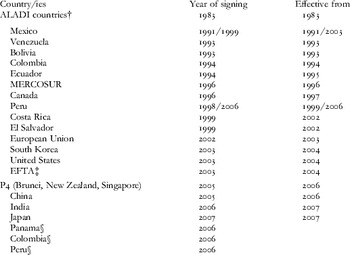
Contemporary Latin America is distinguished by a number of economic integration schemes created through bilateral, regional and multilateral agreements. Some of these aspire to liberalise trade, while others support a state-led model of integration. Chile stands out in the region due to its remarkable stability in trade policy and the rapid pace with which it has negotiated and signed free trade agreements (see Table 1).Footnote 1 The stability of Chile's neo-liberal policies have been attributed to, on the one hand, a strong pro-free trade coalition formed between public officials and business after the economic crisis of 1982–1983, and on the other hand to the influence of technocrats.Footnote 2
Overview of trade agreements signed by Chile

Source: General Directorate for International Economic Affairs (DIRECON), Ministry of Foreign Affairs, Chile.
† The members of ALADI were at this point Argentina, Bolivia, Brazil, Chile, Colombia, Mexico, Paraguay, Peru, Uruguay and Venezuela.
‡ European Free Trade Association (Iceland, Norway, Switzerland and Lichtenstein).
§ Signed, but not yet ratified.
While not rejecting the importance of these factors, it is argued here that the picture must be complemented by an understanding of the importance of technically competent business associations. The article aims to show that through the process of trade integration a close policy network has formed between governmental representatives and representatives of business associations. This is held together by shared knowledge and the gradual evolution of personal relationships of loyalty and trust across the public-private divide. It is premised on a basic consensus about the desirability of free trade policies and the existence of public bureaucracies with technical expertise on complex trade issues, but also on the existence of business associations with similar expertise – a type of expertise which is a prerequisite for meaningful participation in increasingly technically demanding trade negotiations.
The evolution of this policy network has greatly facilitated Chile's efficient negotiation of trade agreements by blurring the boundaries between public and private functions and therefore also the sharp distinction between the ‘two-levels’ of trade negotiations.Footnote 3 Furthermore, it has contributed to legitimating trade agreements and securing support for them at home. However, it has also created de-facto exclusion of several social sectors from influencing trade policy.
The article is structured as follows: the first section discusses the term policy network and its implications for the study of business participation in trade policy making. The second section describes business participation in trade negotiations in Latin America in order to locate Chile within a comparative perspective. The third section provides an introduction to Chile's trajectory of trade agreements since 1990. The fourth introduces Chilean business associations and analyses their relationship to the state. The main analytical part of the article is organised chronologically and divided into three parts, one for each of the presidencies of the centre-left coalition (Concertación) that ruled Chile between the return of democracy and 2006: Patricio Aylwin (1990–94), Eduardo Frei (1994–2000) and Ricardo Lagos (2000–2006). Each part in turn analyses changes in the organisational foundations for business participation within public administration and the business associations, the evolution of the policy network, and the consequences for trade negotiations. The final section discusses the broader implications of the policy network, arguing that it has created exclusion as well as inclusion.
The article is based on research carried out in Chile during the first half of 2006. This included approximately 60 in-depth interviews with representatives of most major business associations, public officials, labour unions and other civil society representatives.
Policy Networks and the Public-Private Divide
The introduction of market oriented reforms in Latin America has created new forms of collaboration between business and the government. Some authors have analysed this in terms of formation of coalitions,Footnote 4 whereas others have attempted to capture the more fluid, often informal processes of cooperation across the public-private divide. The term policy network has been adopted by several authors to point to the formation of important relations across distinct institutional spheres. Jörg Faust has studied Chilean policy towards East Asia and observes the emergence of a policy network, defined as an organisation located between the hierarchy of the state and the anarchy of the market in which private and state actors are connected by the exchange of goods and/or information, thereby decreasing strategic uncertainty and transactions costs.Footnote 5 While this definition captures important characteristics of policy networks, it fails to emphasise the role of personal relations. This is better captured by the definition proposed by Judith Teichman based on her study of the introduction of neo-liberal reforms in Chile and elsewhere. Teichman argues that policy networks consist of individuals who are bound together by personal relationships, particularly trust and loyalty, and are either directly involved in the formulation of market reform policy or have the opportunity to influence it in important ways.Footnote 6 Business is brought into such policy networks, either informally through lunch-time discussions and so forth, or formally through relations granted to trade associations or chambers. Such policy networks often have transnational linkages to individuals in public and private institutions abroad. Teichman emphasises the links to officials in international policy institutions. Related to trade negotiations, the links are more likely to be formed with business and public representatives of other countries.
However, the term policy network tends to describe relations between individual businessmen and governmental representatives. The process of public-private interaction related to trade negotiations indicates that personal policy networks are also prevalent amongst representatives of business associations and public officials. Indeed, whereas traditionally, individual businessmen have been considered to have most influence on public policy due to the ‘structural capital of business’; that is, its potential threat to deprive the state of a key source of investment,Footnote 7 in the current complex global economic environment, expertise may be an equally important source of influence. Trade negotiations are currently a highly complex matter. They include not only tariff reductions but also technically complex issues such as intellectual property rights, environmental protection, and labour rights, often leading towards re-regulation as well as de-regulation of the economy.Footnote 8 Meaningful participation in trade negotiation therefore demands a high level of technical expertise.
In Chile indeed, technocrats who share a technical training and a belief that many important societal problems can be resolved through technological solutions have been shown to be highly influential in economic policy making in general and trade policy making in particular. They are normally thought to be located in public bureaucracies, among key elected public officials, private think-tanks and research institutions.Footnote 9 Indeed, in Chilean trade-policy making technocrats tend to move back and forth between such institutions and public positions.Footnote 10
However, the requirement of technical expertise for meaningful participation in trade negotiations may also limit the influence of the traditional Latin American ‘tycoon’ and increase the influence of technically trained officials of business associations. Highly skilled technocrats may seek policy advice from business representatives who command significant technical competence on trade issues. This is more likely to be found in formal business associations than among individual business leaders. The shared knowledge between business associations and public officials may in turn foster the creation of close personal ties across the public-private divide. Thus, emphasising personal relations in a policy network approach is not necessarily contrary to stressing the importance of formal business associations.
Such participation differs significantly from the historical pattern of business influence on policy making in Latin America as will be discussed in the following section.
Business Participation in Trade Negotiations in Latin America
In Latin America business has traditionally been viewed as both economically and organisationally weak.Footnote 11 Its economic weakness made it prone to seek state protection for its economic activities and thus to reject free trade. Moreover, its weak organisational capacity made it incapable of defending its interests through democratic institutions and therefore a predisposed business to ally with the military and technocrats to undermine democratic governments.Footnote 12
Since the start of the neo-liberal reforms of the 1980s, Latin American business has gained strength both economically and organisationally. In several countries, local business groups – often allied with transnational capital – took advantage of privatisation schemes and market liberalisation in order to acquire wealth at home and penetrate markets abroad.Footnote 13 This had the effect of fortifying pro-free trade coalitions in many countries. It also increased the ‘structural power’ of business and in many countries its organisational capacity. Thus, business increasingly became a necessary as well as desirable conversation partner for governments in their economic policy making.Footnote 14 Business became particularly influential in demand raising, agenda setting and policy implementation, but was shown to have limited influence on policy initiation and policy formulation.Footnote 15
In the 1990s, when Latin America came to be characterised by a plethora of regional and bilateral trade negotiations, business became increasingly involved in trade negotiations, albeit in various ways and to different extents in different countries. Business is normally consulted in the process of formulating offers, and it is an important lobbyist seeking to influence those institutions charged with the task of ratifying agreements. What is new, however, is that in some cases business sectors have participated directly in trade negotiations, something that was previously primarily the domain of governments.
However, the extent, depth and form of participation by business clearly differ significantly across Latin America. What can explain these differences? Studies of business participation in trade negotiations in Latin America show that a first important prerequisite for business participation is that these sectors perceive some short and medium term benefits from participation.Footnote 16 This depends on whether it is perceived that negotiations will result in an agreement with positive or negative impacts on business interests. In Latin America, business has been more prone to participate in bilateral negotiations than in the multilateral negotiations conducted under the auspices of the World Trade Organization (WTO), as the latter have a longer horizon and their outcome is more uncertain.
A second important prerequisite is a basic consensus about the orientation of policy, or the dominance of a free-trade oriented coalition. The existence of a strong free trade coalition, or the lack of such, may to a significant extent explain the differences in business participation between, for example the negotiations for a North American Free Trade Agreement (NAFTA) and the Mercosur. The NAFTA negotiations rested on a pro-liberalisation coalition between Mexican big business and the state which was formed in the early 1980s.Footnote 17 In Brazil, by contrast, the ‘protectionist-bloc’ that used to dominate Brazilian business has lost its leading position, but the dialogue between business and the public sector still reflects the days when trade policy was largely about the protection of specific sectors and there remains no strong pro-free trade block. This also affected the MERCOSUR negotiations, which – particularly in the early years – provided a model case of business non-participation.Footnote 18
In the increasingly open world economy, the dichotomy between protectionist and free-trade oriented business has decreasing relevance; even small businesses are often entangled in a global web of production and trade and view trade barriers as a cost that may undermine their competitiveness.Footnote 19 Thus, the central question is no longer whether or not to liberalise trade, but how to liberalise trade in a given sector.Footnote 20 Consequently, we may expect increasingly strong participation of business across the board. Nevertheless, there are still strong protectionist elements in many countries and their strength may to some extent explain the varying pattern of business participation.
A third important factor is the existence of strong national business associations, particularly encompassing specific associations that can effectively channel business interests. There are several arguments in the literature about the virtues of participation of formal business associations, rather than individual businessmen, in policy making. Influence through the former is argued to be more transparent, legitimate and accountable than direct influence on policy makers. In particular, national bodies encompassing a range of associations can aggregate interests and thus mitigate divisive distributional politics based on the narrow interests of sectoral or industry-based associations.Footnote 21 Moreover, it has been argued that strong encompassing business associations ensure better informed policy advice.Footnote 22
In practice, within trade policy making in Latin America, business associations have often been by-passed by individual tycoons, and personal networks have been more important than formal channels of influence. In Argentina for example, pre-eminence is given to informal channels as vehicles to transmit ideas and to influence policy outcomes,Footnote 23 a matter which partly reflects the weakness and fragmentation of its business associations.Footnote 24 Also in Colombia, which is known for its strong and well connected business associations, prominent entrepreneurs are reported to skip easily over the positions of the business associations or the technical negotiating bodies and transmit their demands directly to the minister or vice-minister.Footnote 25 Even in Mexico, where business associations were directly and indirectly involved in NAFTA negotiations, individual businessmen enjoyed privileged access to the negotiations directly through personal networks.Footnote 26
Whether business participation is channelled through business organisations or not depends in large part on the incentives provided by government. Ben Ross Schneider has argued that state action is the most important determinant of business association in Latin America. Business not only unites in order to capture selective benefits offered by the state and defend itself against perceived threatsFootnote 27 it also unites as a response to the opening up of policy spaces. The more state actors draw business into policy making, and delegate responsibility for policy implementation to associations, the greater the incentives for business to invest in the institutional capacity of these associations.Footnote 28 When governmental technocrats regulate participation by business associations based on their expertise, business has a strong incentive for building such technical capacity.
Thus, the study of business participation in trade negotiations may illustrate how state actors continue to be relevant for the ways in which business organises in the context of a globally integrated economy and a market oriented development model. However, this will tend to be as a part of policy networks with transnational links, rather than within a nationally contained framework for business action.
Chile's Trajectory of Free Trade Negotiations
Although the roots of Chile's export-oriented strategy pre-date the dictatorship of Augusto Pinochet (1973–90), a drastic unilateral reduction in tariffs was introduced during his regime. By 1979, Chile's tariffs had been reduced to a flat ten per cent. After the return of democracy the government decided to continue the export-led strategy, but complemented unilateral liberalisation with a search for trade agreements. There were several reasons for this. First, the early 1990s saw an unprecedented upsurge of regional and bilateral free trade initiatives. Second, although tariff levels had increased after the economic crisis,Footnote 29 Chile already had an open economy and therefore had little to lose from trade agreements. Third, after 17 years of dictatorship and international isolation, Chile sought to strengthen political ties with other countries. And finally, negotiating agreements with other countries was a strategy to overcome opposition from groups likely to gain increasing influence when congress resumed its tasks, including that of endorsing trade policy.Footnote 30
Initially the Concertación government explored two main options for trade integration. The first was to seek closer association with the United States. When President George W. Bush launched the ‘Initiative for the Americas’ in 1990, Chile was among the first countries to express interest in a free trade agreement with the USA.Footnote 31 In 1994, Chile surprisingly received an invitation to become a member of NAFTA. However, due to the political costs incurred by NAFTA for the US administration, that door was closed to Chile in 1995. Instead, Chile opted for negotiations with Canada and to deepen an existing agreement with Mexico into a full Free Trade Agreement (FTA)Footnote 32, and thus enter NAFTA ‘through the back door’.Footnote 33
The second option was to seek closer integration with its neighbours. After the founding of the Mercosur (including Brazil, Argentina, Uruguay and Paraguay) in 1991, there were talks about Chile joining this block. However, Chile's very low barriers to trade and its economic strategy of trade liberalisation were incompatible with the gradual liberalisation strategy of the still protectionist Mercosur. Particularly within the Ministry of Finance, Mercosur membership was opposed and consequently Chile opted for a less encompassing Economic Complementation Agreement (ECA) with Mercosur in 1996. The next step for Chile was to sign an FTA with the five Central American countries in 1999 (of which only two have been ratified to date).
Negotiations with the USA stalled after 1995 primarily due to the failure of President Clinton to renew the trade promotion authority (TPA). In spite of this, in 2000 Chilean President elect Ricardo Lagos and Clinton agreed to start negotiations for a FTA with or without the TPA. One round of negotiations was conducted before the Clinton government left office, and the process continued under the incoming Bush government. The agreement with the United States was finally signed in 2003.
Simultaneously, Chile intensified negotiations with the European Union (EU). The contact with the European Union had already begun in the early 1990s largely for political reasons, and Chile signed a cooperation agreement with the EU countries in 1996. However, the EU has for a long time been a role model and a defender of regional integration in the South, and it was convinced that Chile should and would become a full member of Mercosur. Thus the EU started to negotiate jointly with Chile and Mercosur countries after the EU-Latin American Summit in Rio de Janeiro in 1999, resisting separate negotiations with Chile until 2001. However, at the fifth round of negotiations in Santiago held in 2001, Chile was the only country that presented concrete offers for market access and the EU acceded to direct negotiations.
In 2003, at the same time as Chile was negotiating with the two main blocks, it signed a trade agreement with European Free Trade Association (EFTA) and started to negotiate trade agreements with the Asian countries. An association agreement was signed with Korea in 2003, and in 2005 an agreement with three APEC (Asia-Pacific Economic Cooperation) countries (New Zealand, Brunei and Singapore) was signed. The latest negotiations with Asian countries have been for agreements with China, India and Japan.
By the end of the administration of Ricardo Lagos in 2006, the free trade agreements had made significant impacts on Chile. In pure trade terms, due to tariff preferences granted through trade accords, Chile's trade-weighted effective average tariff rate was around two per cent in 2004, as compared to a six per cent general tariff. Its export to GDP ratio had reached 69%, and 66% of the exports were carried out through the preferential agreements.Footnote 34 In Chile, a general consensus had emerged about the desirability of such accords. As analysed here, the process of negotiating free trade agreements had also made an impact on the relationship between the government and business associations in Chile. However, prior to examining this, the following brief introduction to the development of business associations in Chile is provided.
The State and Business Associations in Chile
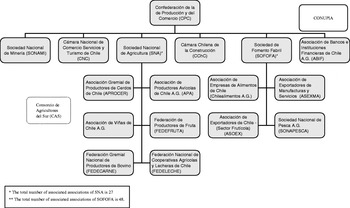
Along with Mexico and sometimes Colombia, Chile is included among the cases of relatively strong business associations, and more specifically, strong encompassing organisations in Latin America.Footnote 35 The main economy-wide business association in Chile is the Confederation of Production and Commerce (CPC) (see Figure 1). CPC encompasses six sector peak organisations, all of which were established with government encouragement;Footnote 36 the National Agricultural Association (SNA), the industrialist association the Society for Manufacturing Promotion (SOFOFA), the National Mining Association (SONAMI), the National Chamber of Commerce (CNC), the Chilean Chamber of Construction (CCCh) and the Association of Banks and Financial Institutions (ABIF).
Overview Chilean business associations mentioned in this article (names in Spanish).

Business unity in Chile has to a large extent been explained by perceived threats from the government and organised labour. The CPC was established in 1934, several decades after the SNA (1837), SOFOFA (1883) and SONAMI (1883) as a response to a stronger Chilean labour movement and an increasingly interventionist state in the 1930s.Footnote 37 CPC took on a renewed role as a locus of business opposition in the face of a second wave of state interventionism under the government of Eduardo Frei (1964–70), in spite of increasing conflicts between the SNA and SOFOFA, revolving around the government's industrial policies.Footnote 38 As is well described in the literature, under the socialist government of Salvador Allende (1970–73), business associations unified by a common desire to overthrow it.Footnote 39 The threat of a return of a socialist president kept the business community united throughout the Pinochet-period.Footnote 40 By the end of the dictatorship, Chilean business associations were able to act as a block, unified by their positive evaluation of the work of Pinochet, belief in the neo-liberal model and scepticism about state intervention.Footnote 41
However, business associations have also been affected by the opening up of policy spaces by the state, or parts of it. In the first phase of the Pinochet dictatorship (1973–1975), the regime introduced neo-liberal reform against the interests of large parts of the business community. In this period the prevailing pattern was that of direct and unmediated relations between individual business leaders and government, largely bypassing the associations. The Chicago boy technocrats who designed and implemented a more radical neo-liberal policy between 1975 and 1981 carried this out in a highly autonomous fashion. If business was consulted at all, it was primarily the leaders of large internationally competitive corporations, and possibly the CPC if it was able to present a unified view.Footnote 42 The demands of individual peak associations generally went unattended. As Eduardo Silva argues, ‘[d]uring this period most Chilean business peak associations were not so much repressed or corporatised as simply ignored’.Footnote 43
The economic collapse that Chile experienced in 1982–1983 largely eradicated several industrial sectors in Chile, but also meant the start of a revival of sectoral peak associations. In 1982 the CPC and SOFOFA elected more combative business leaders, and the military government responded by starting to negotiate policy measures with business and reincorporating representatives of business associations into various councils and commissions. This was the start of what Schneider has called ‘cooperative capitalism’.Footnote 44 From this point, some private sector representatives were also invited to participate in trade negotiations, mainly those taking place within the framework of the Latin American Integration Association (ALADI). These were normally representatives of the CPC, who often were allowed to participate directly at the negotiating table. Nevertheless, the private sector had little influence on the negotiations, mainly due to its lack of technical capacity.Footnote 45
The combination of threats, benefits and selective opening up of policy spaces by the government also affected the composition and organisation of business associations. In the early days, the sectoral peak associations were more like social and political clubs than contemporary interest groups.Footnote 46 Between 1930 and 1960 the peak organisations were transformed from being societies with a general social and political purpose, to organisations aimed at defending the interests of a specific group. By the 1960s the major sector associations had professional staffs, regular publications and high public profiles.Footnote 47 The increased governmental demand for policy advice from the business associations in the last period of the Pinochet dictatorship also led to their increased professionalisation and the strengthening of their research departments.Footnote 48
Today, technical capacity and professionalisation differ widely across associations. Most organisations have a board of elected, unpaid business representatives, and a professional technical staff. However, the size of the staff ranges from one individual in many of the smaller associations, to SOFOFA which counts on a staff of around 60 people organised in nine different departments.Footnote 49 The CPC has a relatively weak and flexible institutional structure comprising only six professionals.Footnote 50
Having been initially sidelined by the Pinochet regime, the business associations' working relations with the military government were generally good by the end of the 1980s; business associations backed Pinochet in the 1988 referendum, and his candidature in the 1989 presidential elections. Thus, although somewhat appeased by assurances that the centre-left coalition that fronted the anti-Pinochet side would not make fundamental changes to Pinochet's economic model, business deeply distrusted the new government that took office after the 1989 elections. However, this changed over the course of the next 15 years. One reason for this was the inclusion of business in trade negotiations.
Early Trade Related Rapprochement Between the State and Business Associations During the Aylwin Government
The first Concertación government, headed by the Christian Democrat Patricio Aylwin (1990–94), pursued a strategy related to business, described by a term coined by Peter Evans, as ‘embedded autonomy’,Footnote 51 which aimed at a simultaneous strengthening of state capacities and autonomy and of ties with societal sectors.Footnote 52 A part of this strategy was to strengthen links to organised business, rather than to individual businessmen. Strengthening links with business was nevertheless highly controversial within the government, as business associations had been staunch supporters of the Pinochet regime. Regarding trade negotiations there were three main obstacles to the strengthening of such links. First, there was a low level of trust between business and the government. Second, there was very little technical expertise on trade issues within the Chilean business associations. And finally, as agriculture had entered the agenda for trade negotiations, the pro-free trade coalition was threatened by opposition against free trade from traditional agricultural producers.
The government was painfully aware of Chilean business' distrust in the government, and efforts were made to improve this relationship.Footnote 53 Soon after Aylwin's inauguration, business and labour representatives were invited to discuss trade strategies. According to the then director of the trade promotion office of the Ministry of Foreign Affairs – ProChile – the worst fears and scepticism of the business community were overcome relatively quickly, primarily due to the pre-existing social contacts that existed between key governmental officials and representatives of business associations. In particular, several representatives of the Christian Democratic Party within the government had close links to business and to the social circles of the economic elites in Chile.Footnote 54
Regarding trade, the government attempted to strengthen links with business, but also to formalise and institutionalise its participation. In October 1990, it set up the Bilateral Council for Trade and Investment with participation from business and the labour unions.Footnote 55 In 1992, the Business Advisory Committee was established as a permanent consultative body to the government in trade negotiations. Representatives of business associations were also invited to participate in trade negotiations.
However, effective business participation was hampered by the second main obstacle; lack of technical expertise and capacity in the public administration as well as within the business associations. In the public sector, international trade policy was the shared responsibility of the Ministry of Finance, the Ministry of Economy and the Ministry of Foreign Relations. However, trade negotiations and trade promotion were the responsibility of two twin institutions within the Chilean Ministry of Foreign Affairs: the General Directorate for International Economic Relations (DIRECON) and ProChile, respectively. Both institutions had been weak during the dictatorship, and ProChile had been largely financed by contributions from the principal exporters. Under the Aylwin government, a group of well-educated, but generally relatively unexperienced young professionals entered DIRECON. They were primarily economists and most of them had been active in the struggle to reinstall democracy.Footnote 56
On the business side, capacity was similarly weak, a matter which greatly affected its ability to participate in policy making. The Association of Manufacture Exporters (ASEXMA) – established in 1985 – represented a partial exception to that rule. It was formed to defend the interests of a new set of medium sized export oriented manufacturing enterprises. These were companies that, having survived the economic crisis, had come to terms with the irreversibility of trade openness and sought to promote their export interests,Footnote 57 and who were becoming increasingly impatient with what they viewed as SOFOFA's reluctant support for free trade. ASEXMA was from the start a member of SOFOFA, but it had frequent clashes with the peak organisation. ASEXMA also took the initiative to create the National Corporation for Exporters (CNE), a body that included non-industrial exporters.
In all the negotiations with Latin American countries, ASEXMA attempted to reach agreements with business associations before state-to-state negotiations commenced. ASEXMA was uniquely placed to do this since it pursued offensive rather than defensive interests. Moreover, SOFOFA was still split between the traditional part of the business community loyal to Pinochet, and those that sought closer ties to the new government. As ASEXMA was more closely connected to the Christian Democrats it was better placed to represent export interests.Footnote 58 However, over the course of the 1990s, ASEXMA's leadership role was increasingly challenged by SOFOFA.
In the early 1990s, SOFOFA started to build technical expertise on trade, strengthen ties with the government and increasingly assume the role of coordinator for the entire private sector. In 1993, it hired a former director of DIRECON with long experience with trade negotiations to lead a newly formed Department of Foreign Trade, along with an expert on the WTO from the same institution. This, in turn would prove to be a useful link and provide a major foundation for the creation of a trade policy network. The department was further strengthened with two more experts, but still operated with a rather limited staff. Later SOFOFA hired a former director of ProChile as a second general manager with responsibility for strategic issues.
The CPC also perceived the need to strengthen its focus on trade. It established an International Commission on Foreign Trade and appointed SOFOFA's Department of Foreign Trade to be its technical secretariat. This was initially opposed by the SNA. However, as more and more agricultural sectors started to join SOFOFA (a process that was later strengthened, as described below), opposition was overcome and the coordinating responsibility remained within the realm of SOFOFA.
Nevertheless, business associations were generally only able to give timid support to the trade agreements they favoured in the early 1990s, and rather inefficient opposition to those that they opposed. When the Aylwin government started to explore the possibilities of negotiating a free trade agreement with the United States, the reaction of business associations was generally positive. The CPC and SOFOFA in particular voiced support for the agreement. This was not because Chilean exporters faced high tariff barriers in the United States (under the General System of Preferences (GSP) they were at between zero and four per cent), but rather because they had encountered a range of non-tariff barriers, including accusations of ‘social dumping’ due to the alleged failure to live up to international labour standards.Footnote 59 In general, an agreement with the United States was viewed as a possible boost to Chile's image as an exporter. To facilitate such an agreement, the CPC started to organise a number of working groups and, together with SOFOFA, made some efforts to lobby the US congress through personal contacts and relations with US business associations. However, the efforts were stymied by lack of experience and expertise.
The government also faced opposition to such an agreement, primarily from the SNA fearing the influx of cheap agricultural products, and some remaining voices in the business community that preferred the Pinochet strategy of unilateral liberalisation to trade agreements.Footnote 60
ASEXMA's main priority was to strengthen the ties with the other Latin American countries, and it favoured negotiations with Mercosur rather than the United States. Latin America has always been the most important market for Chilean manufactured goods. Chilean exports to Latin America had diminished over the course of the 1980s (from twenty to twelve per cent of total exports), but the increasing Chilean investments to other Latin American countries – undertaken by the larger companies and conglomerates – provided a new rationale for agreements with the neighbouring countries.Footnote 61
The first Latin American country with which Chile negotiated was Mexico. The Chilean business community demonstrated a defensive attitude towards these negotiations and attempted to exclude 30% of Mexican imports to Chile from the agreement. The subsequent negotiations with Venezuela were also opposed by business, who demanded that 60% of Venezuelan exports to Chile be excluded. In both cases, business opposition was ignored and the deals were signed.Footnote 62
Negotiations with Bolivia marked the turnaround of the traditional division between the SNA on the one hand and SOFOFA and ASEXMA on the other. Before the 1980s, large landowners dominating the SNA were most explicitly in favour of tariff reductions, followed by the CCCh and SONAMI.Footnote 63 SOFOFA's member companies were oriented towards the home market and SOFOFA jealously guarded the tariff protections benefiting their own companies, in spite of focusing increasingly on regional integration since the 1960s.Footnote 64 However, by the time of the negotiations with Bolivia, it was the SNA that voiced the main protectionist viewpoints whereas SOFOFA and ASEXMA supported trade openness.Footnote 65
In sum, during the Aylwin government the foundations were laid for the evolution of a policy network in four ways. First, the main institutional framework for government-business collaboration was formalised through the creation of the Bilateral Council for Trade and Investment, and established informally through starting the practice of bringing business associations to trade negotiations. Second, technical capacity was strengthened both on the public side in DIRECON and Pro-Chile, and on the private side, primarily in SOFOFA, but also in some of the other organisations. Third, the hiring of DIRECON officials by SOFOFA strengthened the personal links between the two institutions. Finally, the remaining anti-free trade segments in the business community were weakened, a process that would continue into the next government.
The Mercosur Negotiations and Marginalisation of Protectionist Segments under Frei
The second Concertación government, headed by the Christian Democrat Eduardo Frei (1994–2000), continued the strategy of consulting business associations. It also started to invite business representatives to join official delegations to other countries, and include them in trade negotiations. This administration negotiated several agreements with the neighbouring countries, but the most difficult were those regarding Mercosur. These would in turn be a ‘learning process’ for parts of the business community that was beneficial also in the major negotiations that would be undertaken during the subsequent presidency of Ricardo Lagos.
During the Frei period, the government and business associations continued to strengthen the organisational foundations for collaboration. On the government side, control over trade policy was centralised in DIRECON and its technical capacity was strengthened. Whereas the Ministry of Finance and the Ministry of Economy formerly had partial responsibility for trade policy, in 1994 the Ministry of Foreign Affairs, represented by DIRECON, won overall responsibility for trade negotiations. To coordinate inputs from other ministries (normally the Ministries of Agriculture, Economy and Finance, but also others when relevant), an Inter-Ministerial Committee on International Economic Relations was set up, with a Negotiating Team Committee composed of technocrats from the different ministries.Footnote 66 Key DIRECON officials and officials from other ministries participating in the Negotiating Team Committee subsequently came to form the core of the group of public officials in the trade policy network.
A further innovation made by the government was the creation of the institution of the ‘room next door’, which was initiated during the Mercosur negotiations. The government invited the CPC, peak organisations and specialised associations as well as labour representatives to follow the negotiations in the room next to the negotiations in order to receive briefings and provide advice to the government negotiators. Although some of the representatives that previously had participated in the main negotiating room in the 1980s resented being relegated to the ‘room next door,’Footnote 67 most appreciated this invitation to participate.
On the business side, there were three major developments in this period. First, internal changes occurred in the SNA that strengthened groups of producers with a different outlook to that of the peak organisation. A major division within the SNA had occurred already in the 1970s, when traditional producers of dairy, grains and cattle of southern Chile (represented by the Consortium of Agricultural Societies of the South (CAS)) opposed the Central Valley's support for tariff reductions, and were repressed by the dominant groups within the SNA. A reform in 1994 provided greater SNA unity and superceded some of the old rivalries.Footnote 68 However, at the same time the gaps between the protectionist CAS and a number of specialised producer groups – including the Chilean Associations of Poultry and Pork Producers (APA) and the Chilean Association of Pork Producers (AproCer) – increased, changing their views in favour of export promotion.
A second change was that business associations increasingly linked up with business associations in other countries. This occurred via bilateral councils such as the American Chamber of Congress (AmCham), which set up an office specifically to work towards an agreement between Chile and the United States, making visits to the US Congress in Washington and inviting US Congressmen to Chile.Footnote 69 Direct links were also established between specialised associations and their counterparts in other countries. Finally, Chilean business representatives began to participate in international councils, for example in the business advisory council (ABAC) of the APEC.Footnote 70 This was strengthened after the government, in collaboration with business, established the Chilean Pacific Foundation in 1994. This body was a public-private initiative with governmental and business representation tasked with being a key advisor to the government in issues related to Asia.
A third major change was the increasing centralisation of responsibility for business coordination in SOFOFA. Before any negotiation, the Department of Foreign Trade of SOFOFA began to ask all associations (not only formal SOFOFA associates) to provide lists of priorities and sensitive products. These were then analysed and negotiated with the different associations. Although consensus was not always achieved, the negotiated document of SOFOFA aided the government in mediating different domestic interests.Footnote 71 Thus, SOFOFA became increasingly useful to the government, and close relations formed between key SOFOFA-officials and the DIRECON negotiating team.
SOFOFA was also the trusted representative of large transnational companies and conglomerates that had few defensive interests in the trade negotiations.Footnote 72 In general, these faced few tariff barriers, but supported the trade agreements as a means of improving the ‘country image’, and pre-empting a possible reversal of the export-led model and avoid arbitrary non-tariff barriers. Instead of spending too much time in the ‘room next door’, SOFOFA was generally trusted to represent their interests.
With these organisational developments underway, the business community enthusiastically endorsed the proposed entry of Chile to NAFTA in 1994. This was led by AmCham in collaboration with SOFOFA, rather than the CPC. However, the SNA continued to caution against the possible negative impacts for Chilean agriculture. When the door to NAFTA was closed again and the government chose to start negotiations with Canada, the SNA's reaction was equally negative.Footnote 73 However, specialised producer organisations within the SNA adopted a more positive stance. For example, both poultry and pork producers are traditionally protectionist sectors in Chile, and they had reason to worry about an agreement with Canada since Canada is a significant pork producer with interests in entering the Chilean market. But instead of opposing the agreement, their strategy was to accompany the government and seek a compromise, resulting in an acceptable agreement.Footnote 74 Nevertheless, when the agreement was signed the SNA mobilised to avoid it being ratified in the Chilean congress, although it was ultimately unable to stop approval in 1996.Footnote 75
Meanwhile, the government negotiated with Mercosur; an agreement that the SNA opposed fiercely. By 1994, the Chilean balance of trade with Mercosur had improved significantly, and Chilean investments into Mercosur were on the increase. Moreover, in 1995 Mercosur was in the process of establishing a full toll union, which potentially threatened the removal of the benefits that Chilean goods had achieved within the framework of the ALADI.
Fearing this, ASEXMA and SOFOFA made strong efforts to ensure that the benefits were maintained. Within SOFOFA there were certain splits, but in general it supported an agreement if it was to contain an efficient dispute resolution mechanism. However, the SNA demanded exclusion of all the traditional agricultural products, which essentially represented the majority of Mercosur's exports to Chile.Footnote 76
As opposed to the other organisations, the SNA adopted the strategy of not participating in the negotiations, but rather protested through the press and in the street. It also lobbied congress after the agreement was signed, but could not prevent its approval by an overwhelming majority (76 against 26 votes).
Viewed with hindsight, SNA representatives believe that this strategy resulted in a worse agreement for the agricultural sector than might otherwise have been the case: it lacked mechanisms for the solution of controversies and measures to protect against macroeconomic changes, achieved little market access for Chilean agricultural products in Mercosur, but gave generous access the other way around, and did not touch agricultural subsidies in Mercosur countries. The US$500 million ‘compensatory’ fund from the Chilean government did little, in the view of the SNA, to counter those disadvantages.Footnote 77
In sum, during the Frei negotiations the foundations were laid for a policy network consisting of public officials coordinated by DIRECON, and a handful of representatives from business associations, coordinated by SOFOFA. At the same time, representatives from business associations that opposed the general trade policy strategy, and chose not to respond to the government's invitation to participate, became increasingly marginalised.
During the Lagos presidency, to the surprise of many observers, this network was consolidated, but it was also extended to include representatives of a wider set of business associations.
Negotiations with the ‘big blocks’ and Asia during the Lagos Government
The weakening of anti-free trade sentiments within the SNA and the capacity building and centralisation of coordinating powers in SOFOFA signalled that major obstacles against the development of a close policy network had been overcome. However, the inauguration of the government of Ricardo Lagos in 2000 represented the election of the first socialist president in Chile since Salvador Allende and lead to a resurgence of sentiments of distrust between business and government.Footnote 78
Lagos entered the presidency in a difficult economic period for Chile. The country had suffered in the aftermath of the Asian crisis and GDP growth slumped from between five and eight per cent in the 1990–97 period to −0.8% in 1999.Footnote 79 The top priority for Lagos was to ensure that economic growth resumed and one of his key strategies was to seal trade agreements with major partners. In order to accomplish that, he needed the collaboration of business associations. One mechanism deployed in order to facilitate trade agreements was to further strengthen DIRECON. Staff numbers were increased and personnel given opportunities to receive training abroad. By 2006 DIRECON had a staff of about 100 professionals and an annual budget of approximately US$40 million. In contrast to the rule of thumb in many other governmental departments, there had been little staff turnover during the changes of government, ensuring continuity.
In order to facilitate business input in policy making, the government established the Public-Private Council for Export Development (CPPDE) with representatives of business and several branches of the government. It also expanded its ‘room next door’ approach, which is elaborated in further detail below.
On the business association side, the reorganisation of the agricultural sector continued along with further centralisation of power in SOFOFA. In the late 1990s, several new, specialised producer associations were established that had a clear export-orientation. This included the Federation of Dairy Producers (FEDELECHE), the Federation of Fruit Producers (FEDEFRUTA), the Federation of Bovine Producers (FEDECARNE), and Chilefood (Chilealimentos). Chilealimentos emphasised the development of technical capacity and participation in export strategies and trade negotiations, and joined SOFOFA rather than the SNA. Also one of the older associations representing agricultural export sectors – the Association of Chilean Exporters (ASOEX) – joined SOFOFA.
The inclusion of these organisations in SOFOFA meant it increasingly came to coordinate the agricultural sector as well. In the process, not only the SNA but also ASEXMA was relegated to a secondary role. In 2004 the CNE, which had been established on the initiative of ASEXMA, was incorporated into SOFOFA.
At the same time that power was centralised in SOFOFA, the boundaries between SOFOFA and the government became increasingly blurred. During the Lagos presidency, the meetings of the CPPDE were held at the headquarters of SOFOFA. Moreover, SOFOFA offered an additional institutional channel for exchange of information between the government and the private sector: the Commission for International Negotiations and Export, which replaced the International Council of CPC. This commission started to meet once a month and invited the director of DIRECON for updates and exchange of viewpoints.Footnote 80 Furthermore, after having been incorporated into SOFOFA, the board of the CNE included two former DIRECON officials now employed by SOFOFA.
Negotiations with the United States and the European Union came to dominate the agenda during the Lagos presidency. The overall orientation of business associations towards an agreement with the United States was positive. However, initially SNA and ASEXMA expressed some concerns. ASEXMA warned against the introduction of similarly strict rules of origin that the United States had imposed on Mexico in NAFTA.Footnote 81 The SNA feared that the United States would demand an end to the price-bands that protected the traditional agricultural products in Chile – wheat, sugar and flour – from competition, while it had declared that it would not discuss its own agricultural subsidies. Many of the SNA's worries appeared to be justified when the United States, at the third round of negotiations, presented its offer for the limited and gradual market access of Chilean products for products that were sensitive to the US. The SNA was not alone in characterising as a ‘joke’ the first US offer of tariff free access to agricultural products. It involved, among other items, an offer of a quota of only 1,000 litres of milk, 340 tonnes of cheese and 100 kilos of peanuts to enter the United States free of tariffs annually.
However, this did not elicit significant opposition to the overall agreement within the business community. In the first rounds of negotiations, resentment was expressed at the government's unwillingness to share the documents that it exchanged with the United States, and CPC president Ricardo Aritza declared to the press that ‘we are navigating blindfolded’.Footnote 82 However, the government subsequently negotiated with increasing openness towards the business community, and when obstacles such as the disappointing agricultural offer from the United States was encountered, it initiated activity within the trade policy network with a view to find solutions.
This was largely due to the organisational changes discussed above, but also to a change of strategy within the SNA. Not only did it participate in the ‘room next door’, several of the SNA associated organisations also undertook private negotiations with their sister organisations in the United States in order to resolve specific problems. The most successful of these was APA that had feared justifiably that US poultry producers would dump chicken legs on the Chilean market, as only chicken breasts are commercially viable in the United States. In order to address this, APA negotiated an agreement with the US National Broiler Council that included a 25 per cent rise in tariffs on chicken legs and that formed the basis of the final agreement between the two governments.Footnote 83
At the same time as the government was negotiating with the United States, it also conducted negotiations with the European Union. As in the case of the US negotiations, the Chilean private sector participated actively in the ‘room next door’. The issues that provoked the highest degree of conflict were access to the European market for Chilean wines, and a European proposal to gain access to Chilean maritime zones for European fishing boats. Both issues were finally resolved and both the National Fishing Society (SONAPESCA) and the Association of Wineries were reasonably pleased with the result. In their evaluations of the process, both these organisations emphasised the role of SOFOFA in taking the lead and although they participated directly themselves in the most relevant rounds, they entrusted SOFOFA to take care of their interests in those where they were not present. They also viewed this as a major breakthrough in business-government relations.Footnote 84 Thus, at the same time as SOFOFA confirmed its leadership role, the policy network was extended to include members of specialised associations.
Towards the end of the Lagos presidency, negotiations with Asian countries dominated the agenda. The interests of the Chilean business community were split: raw material producers and services, dominated by foreign capital and large domestic groups such as those found in forestry, mining and banking, were keen to gain access to Asian markets. Some of the rising leaders of business associations and business groups in Chile (including Hernan Somerville, president of ABIF (1993–) and CPC (2005–), and Andrónico Luksic of the Luksic group) held high profiles in the ABAC and were strong promoters of closer relations with Asia.Footnote 85 Other major exporters, such as those in fisheries, fruits and wines, looked for new niche-markets in Asia, whereas SMEs within manufacturing as well as some agricultural groups saw closer ties with Asia primarily as a threat.
President Lagos afforded particular priority to strengthening the ties with Asia, and the negotiations with the Asian countries were characterised by both strong governmental leadership and business participation. Due to its own lack of experience in the region, the government depended on the expertise found in the private sector. Furthermore, the Chilean government was inspired by the fact that Asian governments always included business representatives in their diplomatic missions. Consequently, from the outset the government actively sought to include business in its policy towards Asia. Before the negotiation of each agreement, the government established a bilateral study group with strong business participation. Moreover, business associations participated closely in the negotiations, as they had done in those with the United States and the EU.
In sum, the trade policy network was further consolidated as a result of the negotiations with the big blocs and Asia. Towards the end of the process, relationships, approaching friendships, evolved between several of the key actors; not only between representatives of coordinating bodies SOFOFA and DIRECON, but also including members of specialised associations and other ministries.
The Consolidation of Policy Networks: Inclusion and Exclusion
Many business representatives and public officials involved in the trade negotiations testified to the importance of the close personal ties that evolved in the process across the public-private divide. SOFOFA was the main ‘node’ in the network and its personal contacts within public administration greatly facilitated this role. According to the head of SOFOFA's Department of Foreign Trade:
El otro tema también es que como trabajé nueve años en el gobierno conozco bien la gente que sigue en el gobierno. O sea, yo les conocía desde antes. Entones, hay un tema de amistad – que no te miento, hay amistad – y hay un tema técnico, que ellos sepa que yo se. Entonces, lo que voy a decir es que ellos confían que es correcto. Todo esto nos ha ayudado mucho en la transparencia.Footnote 86
However, SNA representatives also came to form a part of this network, in spite of the organisations' initial reluctance. As its chief negotiator recognised:
También logramos conseguir un grado de amistad muy, muy importante en este sistema de negociación; una amistad que nos permitió poner en la mesa nuestros puntos de vista, [entre] políticos que por cierto discrepaba a veces. Nos vamos empezando a conocer la familia de cada uno, entrar en el ámbito que tiene mucha importancia, [tener] el teléfono para llamar en un momento de importancia para resolver un tema, para convencer al gobierno que tenían que salir a explicar a los chilenos lo que estaba pasando. O sea en el fondo, cuando hay amistad, hay confianza, cuando hay confianza, los resultados se comparte, positivos o negativos ¿no es cierto?Footnote 87
Moreover, several leaders of specialised associations became important parts of the network, as evidenced by several of the interviews undertaken for this study and elsewhere. For example, in an interview with Juan Miguel Ovalle, President of AproCer and APA, Patricia Polizer informs:
Ovalle valora especialmente el trabajo conjunto entre empresarios y funcionarios de gobierno para negociar esos acuerdos comerciales. ‘La bancada agrícola’, dice, refiriéndose a dirigentes como Ronald Bown, Luis Schmidt, Gustavo Rojas o Federico Mekis, que estuvieron en algunos momentos álgidos en Bruselas o Washington, formaba un mismo equipo con representantes gubernamentales como Carlos Furche, Sergio Ramos, Igor Garáfulic o Camilo Navarro. ‘Ahí se pasan nervios juntos, se desarrollan amistades, se generan lazos distintos. Las posiciones políticas van quedando como la adhesión a un equipo de fútbol, o sea tú eres de la Católica y yo de la Unión Española, pero en la vida compartimos los mismos valores, los mismos intereses, las mismas preocupaciones, las mismas angustias y las mismas ilusiones’.Footnote 88
Although individual business actors also had access to governmental negotiators, it was primarily the representatives of business associations who became parts of the close policy networks. Some members of the network were salaried members of business associations, reflecting their higher degree of professionalisation in Chile. Others were elected representatives, but mainly from what has been described as a ‘new generation of business leaders’ in Chile, who tend to have a higher level of education than their predecessors and often are managers rather than owners of companies.Footnote 89
This does not mean that leaders of individual companies, conglomerates and groups have lost influence. According to the statutes of SOFOFA, both business associations and individual companies may be members, and several accounts point to the increased influence of the latter at the expense of associations representing mostly medium sized enterprises – such as the Textile Institute and the Association of the Plastic Industry. Yet, in spite of the increased influence of conglomerates, there is little evidence of the tendency observed elsewhere wherein the conglomerates bypass business associations.Footnote 90 Rather they use business associations when useful, and direct contacts with policy makers when that is more efficient.
However, other societal groups have been excluded from negotiations de facto. After the return of democracy, the government intended to institutionalise broad societal participation and particularly tripartite relations between state, business and labour, also related to trade negotiations. However, it did not succeed in this effort. The first attempts were made by President Aylwin who established the Framework Agreement to encourage tripartite relations; Frei created the tripartite Forum for Productive Development (FDP) to discuss national competitiveness and trade. But both met significant difficulties largely due to the lack of confidence between business and labour.Footnote 91 The FDP was later closed down and replaced by the aforementioned CPPDE, which had only government and business representation.
President Lagos made attempts to foster broad citizen participation, instructing all ministries to include citizen participation in their policy making processes.Footnote 92 Related to trade, he created an Advisory Council with broad participation from civil society. As negotiations with the United States, in particular, provoked an as yet unseen opposition to free trade agreements in Chile, relations between the government and social sectors intensified.Footnote 93 According to a former director of DIRECON, during the process of negotiating the agreement with the United States alone, DIRECON and the CUT had 27 joint meetings and seminars to discuss the proposals.Footnote 94 DIRECON also initiated contact with several non-governmental organisations (NGOs).
However, although it did seek advice from labour and NGOs, the Lagos government almost abandoned the idea of tripartite forums. Whereas labour had been invited to participate in the ‘room next door’ during trade negotiations, starting with the negotiations with the United States, three ‘rooms next door’ were created in the negotiations: one for organised business, one for micro industries represented by the National Confederation for medium sized, small and micro industry, service and craftsmen of Chile (CONUPIA), and one for labour unions. Attempts to incorporate all sectors into one ‘room next door’ were rejected, as their different interests meant that this would hold up the negotiations.Footnote 95 NGOs were not included as they were not viewed as directly representative of any sectors.Footnote 96
Although formally present, both various labour representatives and micro industries charged that they had little real influence on the trade negotiations. Representatives of micro industries alleged they were little more than ‘arroz graneado’ (a side dish) in the negotiations,Footnote 97 and labour unions vacillated between a desire to participate and a total rejection of the FTAs. Governmental representatives admitted that consultations with labour unions, micro industries and NGOs, with a few important exceptions, were less useful than those undertaken with business since these groups often used them to express general complaints that were not directly related to the trade agreements and contributed little to the formulation of national positions. Thus, in spite of the government's attempts to include trade unions and CONUPIA, the latter were excluded from the policy networks in the sense that they have had little influence on policy.Footnote 98
Conclusions
As a result of governmental strategies to include business in the negotiation of trade agreements, a policy network has formed between public officials and representatives in business associations which to a large extent has blurred the public-private divide and moved trade negotiations beyond the ‘two-level game’. The policy network that has formed is based on personal relationships, loyalty and trust, but it is also embedded in formal institutions. Indeed, the emergence of such close relations in trade negotiations is partly dependent on the strength and technical expertise of formal business associations as well as key governmental agencies. The important role that formal business associations play in trade negotiations in Chile contrasts with the experience of many other Latin American countries. In countries such as Colombia, Argentina and to some extent Mexico, direct unmediated interaction between business leaders and the negotiating team has been the rule rather than the exception.
The trade policy network in Chile explains the country's efficient negotiation of trade agreements and the high level of domestic legitimacy that the trade agreements enjoy. However, the trade policy network excludes interest groups that are critical towards free trade agreements. Despite governmental efforts to ensure broad societal participation, trade unions and associations representing small and micro-enterprises charge that they are excluded from the process de facto. While the latter group also has been shown to be excluded from trade negotiations in other countries in Latin America,Footnote 99 trade unions have often been more influential in other countries than in Chile. The lack of influence of Chilean labour may be explained partly by deep splits in the labour movement; indeed conflicting views on the FTA with the United States occasioned the international secretary of CUT to establish the competing labour central, the National Union of Workers (UNDT). However, it is also explained by the trade unions' lack of expertise on trade issues and their lack of resources to accompany governmental representatives around the globe.
What are the implications of this analysis of trade policy networks for the understanding of Chilean policy processes in general? Analyses of the policy making process in Chile after 1990 have emphasised how a relatively uncorrupt and efficient bureaucracy, as well as a small number of actors who interact repeatedly, have enhanced predictability of policy implementation and contributed to an explanation of the stability of Chilean policies.Footnote 100 However, authors mainly focus their explanations on the formal political system and the relationship between the executive and legislative powers. An analysis of policy networks may add to our understanding of the ways in which social forces penetrate the policy process at various points, and shed light on how formal and informal relations between governmental officials create both predictability and new tensions arising from the exclusion of other groups and policy alternatives.