Introduction
Leaf shelters constructed by herbivorous insects are found on many species of trees, shrubs, and herbs. Shelters may be formed from individually rolled, folded, or tied leaves, or may comprise two or more leaves joined together. Usually it is the larval stage of an insect that constructs the shelter, the larva binding the shelter together with silk. The majority of shelter-makers are found in the Lepidoptera, and while the shelter-making habit is most widespread in the Tortricidae, shelter makers also occur in the Gracillariidae, Gelechiidae, Coreutidae, Hesperiidae, and several other families (Triplehorn and Johnson Reference Triplehorn and Johnson2005). Shelter makers in other insect orders include the leafrolling sawflies (Hymenoptera: Pamphiliidae) and the leafrolling weevils (Coleoptera: Attelabidae) (Triplehorn and Johnson Reference Triplehorn and Johnson2005).
Shelter-making insects can be viewed as ecosystem engineers because their activities physically modify an existing habitat, the leaf, in essence creating a new habitat, the leafroll, fold, or tie. In doing so the engineering organism also affects the availability of resources for other species (Jones et al. Reference Jones, Lawton and Shachak1997). Leaf shelters are used by a variety of secondary colonists, and studies have documented increased arthropod diversity on plants with leaf shelters compared with those without shelters (Martinsen et al. Reference Martinsen, Floate, Waltz, Wimp and Whitham2000; Lill and Marquis Reference Lill and Marquis2003). The interactions among arthropods mediated by leaf shelters can be positive or negative (Nakamura and Ohgushi Reference Nakamura and Ohgushi2003), are diverse in the range of taxa involved, and complex in the mechanisms by which participating organisms interact (Fukui Reference Fukui2001).
Our interest in alder (Alnus Hill (Betulaceae)) arose from a survey of native plants in Yakima County Washington, United States of America to discover species that host high densities of leafrollers. Of particular interest were tortricid leafrollers that might serve as alternate hosts for parasitoids of orchard leafroller pests, especially the non-native wasp Colpoclypeus florus (Walker) (Hymenoptera: Eulophidae). The initial survey revealed that alder is often heavily infested by leafrolling caterpillars. In addition, we discovered that a number of predatory arthropod taxa known to be common in orchards also used alder leafrolls. Our ongoing interests in developing new approaches to conserve natural enemies in orchards (Miliczky and Horton Reference Miliczky and Horton2005, Reference Miliczky and Horton2007, Reference Miliczky and Horton2011) prompted us to explore the importance of Alnus as a resource for natural enemies.
This study had two objectives. First, we surveyed the contents of over 5000 leafrolls collected over a five-year period from three species of Alnus growing west of the fruit-producing region of Central Washington State, United States of America. We identified the Lepidoptera that constructed the shelters by rearing caterpillars to adulthood. Parasitoids emerging from caterpillars were also monitored. Secondary colonists, both phytophagous and predatory, were likewise identified, including species that we know from many years of sampling in orchards are also common residents of orchards. In our second objective, we examined the importance of leafrolls as shelters for arthropods by comparing occupancy of rolled leaves to that of roll-free leaves on the same trees. We statistically compared occupancy rates of both phytophagous and predatory arthropods between rolled versus roll-free leaves in multiple stands of Alnus within the study region.
Materials and methods
Study sites
Our study was conducted in the eastern foothills and slopes of the Cascade Mountains, primarily in Yakima and Kittitas Counties, Washington State, United States of America (Fig. 1). The majority of the sampling was conducted at 13 sites along State Highway 410 and two subsidiary roads that parallel the Naches, Little Naches, American, and Bumping rivers. Approximate site elevations ranged from 750 m (easternmost) to 1300 m (westernmost), the latter being 6.5 km (by road) west of the Chinook Pass entrance to Mount Rainier National Park. Two samples were taken in the Wenas Wildlife Area (Washington Department of Fish and Wildlife), 40 km northwest of Yakima, and one sample was collected at each of two sites along State Highway 20 (North Cascades Highway) in Skagit County. Each site was near a river or stream, or was in a locally moist locale where standing water was present until at least late spring.
Washington State, United States of America map showing locations of the 16 sampling sites. Sites include those used in the general survey (2002–2006) and in the comparison of rolled and roll-free leaves (2010, 2012).

Three species of Alnus occurred in the study areas and all three are plants of moist areas. Alnus incana (Linnaeus) Moench is a shrub that reaches 10 m in height. It was the most common alder at most sites and usually occurred in stands where it was the dominant plant species. Alnus rubra Bongard (Betulaceae) reaches a height of 25 m. It occurred as scattered trees at the two easternmost Highway 410 sites and at the Wenas Wildlife Area site. Alnus viridis (Chaix) de Candolle (Betulaceae), a shrub up to 4 m tall, occurred at the westernmost Highway 410 site and the two Highway 20 sites in dense stands where it was the dominant plant species. It was found at few of the other sites and was uncommon where it did occur.
Various other shrubs and trees occurred at the study sites, although not all occurred at each site and their abundances varied from site to site. They included Pinus ponderosa Lawson and Lawson, Pseudotsuga menziesii (Mirbel) Franco (both Pinaceae), Populus trichocarpa Torrey and Gray, Salix Linnaeus (both Salicaceae), Crataegus douglasii Lindley, Holodiscus discolor (Pursh) Maximowicz, Prunus virginiana Linnaeus, Spiraea douglasii Hooker, Rubus Linnaeus, Rosa Linnaeus (all Rosaceae), Cornus sericea Linnaeus (Cornaceae), Symphoricarpos albus (Linnaeus) Blake, Sambucus cerulea Rafinesque (both Caprifoliaceae), and Acer circinatum Pursh (Aceraceae).
Objective 1: general survey of the leafroll fauna (2002–2006)
Rolled alder leaves were removed from branches by hand or with a telescoping pole pruner, the latter allowing a maximum sampling height of about 4 m. This allowed us to reach the full height of A. viridis shrubs, about the lower half of taller A. incana shrubs, but only the lower branches of tall A. rubra trees. We used the full reach of the pole pruner, although leafrolls 1–3 m high were more heavily sampled than those above 3 m. Leafrolls were collected between May and September in 2002, 2003, 2004, and 2006. All samples were collected after flowering was complete and the leaves were well expanded. The number of rolled leaves collected at a site on a given date (hereafter a “sample”) was variable, depending in part upon leafroll abundance and ease of collection. Seventy-seven samples were collected. Only two samples consisted of fewer than 20 leafrolls while three samples contained more than 200. Fifty-one samples included 31–80 leafrolls. Generally, five or fewer leafrolls were collected per plant so that a 50-leafroll sample would have been acquired from at least 10 plants. When obtaining a sample we moved around a site so as not to confine the sample to a small part of the site. For example, the Highway 410 milepost 75 site consisted of a dense, nearly pure stand of A. viridis that ran for more than 100 m just off the shoulder of the road. A typical sample would have covered a minimum of half the length of the site with a maximum of two or three leafrolls collected from a single shrub. Not all sites were sampled on a given sample date and some sites were sampled more frequently than others, depending upon leafroll abundance and ease of collection (higher elevation sites were difficult to access early in the season). A final total of 77 samples were collected.
Samples were placed in plastic bags, housed in a cooled ice chest for transport to the laboratory, and stored under refrigeration (∼5 °C) until they were examined. Leaves were unrolled and examined under a dissecting microscope at 6.5–50x. We determined numbers of all inhabitants of a leafroll with three exceptions: phytophagous thrips, rust mites, and other mites (predominantly phytophagous species but also predators). These taxa were often difficult to count accurately because of their small size, large numbers, and tendency for concealment. Therefore, they were tabulated only as to their presence or absence in a leafroll. Immature leafrollers, spiders, and Neuroptera were reared in ventilated plastic containers to obtain adults and parasitoids. Leafrollers were supplied with fresh alder foliage until pupation or emergence of parasitoids. Spiders were provided live prey (locally collected Heteroptera and Diptera) and water until they reached adulthood. Neuroptera were maintained on field-collected aphids (Hemiptera: Aphididae).
E.L. identified the leafrollers and E.R.M. identified other insects and spiders. Predatory insect and spider identifications were made based on 15 years of experience collecting and identifying the local fauna, a reference collection of identified specimens, and published taxonomic works in the case of specimens with which we had little previous experience: Gordon (Reference Gordon1985) and Acorn (Reference Acorn2007) (Coleoptera: Coccinellidae); Mound and Kibby (Reference Mound and Kibby1998) and Hoddle et al. (Reference Hoddle, Mound and Paris2012) (Thysanoptera); Ubick et al. (Reference Ubick, Paquin, Cushing and Roth2005) and references therein (spiders). Tamera Lewis, United States Department of Agriculture-Agricultural Research Service, Yakima Agricultural Research Laboratory, Wapato, Washington, United States of America, identified the Anthocoris Fallén (Hemiptera: Anthocoridae).
Specimens taken during this study were pinned or preserved in 70% isopropyl alcohol. Voucher specimens of leafrollers are deposited in the collection of the Washington State Department of Agriculture, Olympia, Washington, United States of America. Vouchers of other insects (including leafroller parasitoids) and spiders are housed in the collection of the Yakima Agricultural Research Laboratory, Wapato, Washington, United States of America.
Objective 2: comparison of rolled versus roll-free leaves (2010, 2012)
We compared the arthropod faunas of rolled versus roll-free leaves in 2010 by collecting a rolled leaf and a randomly selected roll-free leaf of similar size growing on the same branch or on a neighbouring branch. Each leaf of a pair was gently removed from a branch to minimise disturbance to resident arthropods and quickly placed in a small, self-sealing plastic bag. Separate bags were used for each leaf of a pair. The two bags were stapled together and placed in a cooled ice chest for transport to the laboratory, where they were held in a refrigerator until examined. Six sites occurring within the general survey location were sampled. Sites were sampled in June, July, August, and September of 2010. Nineteen to 29 pairs of leaves were collected per sample. The study was repeated on a smaller scale in 2012 by collecting rolled and roll-free leaves from each of seven sites on a single date (28 August). We collected 43–96 leaves of each leaf type per site. For this study, all rolled leaves at a given site were collected directly into a single, large, self-sealing plastic bag. Unrolled leaves at the site were likewise collected into a separate bag. Samples were placed into a cooled ice chest for transport and refrigerated until examination. Methods used to tally leafroll occupants were the same as in the general survey, but certain taxa were combined into one of four categories for analysis as explained in the next section.
Statistical comparison of rolled and roll-free leaves
To statistically compare occupancy of rolled versus roll-free leaves, we determined the presence or absence of arthropods in each of the following four categories for analysis by trophic level: (1) rust mites and phytophagous insects other than thrips; (2) phytophagous thrips; (3) spider mites and predatory mites; and (4) spiders plus predatory insects. Categories (1) and (2) included entirely phytophagous arthropods. Category (3) was a mix of phytophagous and predatory mites because these two trophic levels were not counted separately when leaves were examined. The fourth category was composed entirely of predators.
We used logit analysis to determine whether probability of occupancy depended upon leaf status (with roll versus without roll). For the 2010 data, month of sample was included as an additional explanatory variable. Model fit was determined by use of a deviance χ 2 statistic, which compares the fitted main effects model to a saturated model containing the main effects terms and the leaf status × sample month interaction term. Because the six sites were not each sampled all four months (largely because of elevation effects), a separate logit analysis was done for each site. We then used the logit analyses to estimate odds ratios associated with the leaf roll factor, expressed as odds of a roll being occupied by a specified taxon relative to odds of a roll-free leaf being occupied by that taxon. Analyses were done in SAS using PROC GENMOD (SAS Institute 2010). Odds ratios and 95% confidence intervals were calculated using the “estimate” command in PROC GENMOD. A similar analysis was done for the 2012 data, except that the model did not include a month variable (because all samples were taken on a single date), and site was included as an additional explanatory variable.
Results
Objective 1: general survey of the leafroll fauna (2002–2006)
Leafrollers
A total of 5172 rolled leaves were examined. Seasonal first appearance of rolled leaves varied with year and elevation but generally occurred in May at the lower elevation sites. Mid-May visits to several sites in both 2005 and 2006 showed that alder at our lowest elevation Highway 410 site (milepost 97) was leafing out, but rolled leaves were few in number. Alder leaves were less well developed at higher elevation sites and snow remained on the ground at some. On our first 2010-sample date (15 June – see below), we were able to collect the requisite number of leafrolls only at our two lowest elevation sites, Highway 410 at mileposts 97 and 92. Percent of leafrolls occupied by the original rollmaker declined as the season progressed. In our three June samples, 41 of 148 leafrolls (27.7%) contained the rollmaker (18.3–50% per sample). More extensive sampling in July yielded 332 of 1940 leafrolls (17.1%) with the rollmaker (0–68.1% in 32 samples). Further declines were noted in August, with 187 of 2498 leafrolls (7.5%) occupied (33 samples ranging from 0% to 31.8% occupancy), and September (only one out of 586 leafrolls with the rollmaker in nine samples). The same trend was evident in our 2010 comparison of rolled and unrolled leaves (see below) with percent occupancies of 76%, 56.6%, 11.5%, and 1.6% from June to September, respectively. We did not specifically look for occupation of already constructed leafrolls by later emerging leafrollers, but it was rare to find a gracillariid leafroll occupied by a tortricid leafroller and vice-versa. By August and September many leafrolls had been colonised by small caterpillars, after the earlier development and exit of the original rollmaker, and sometimes two or three were present in a given leafroll. We were unable to successfully rear any of these larvae for identification.
Leafrollers belonged primarily to two families: Gracillariidae and Tortricidae. Gracillariid larvae are leaf blotch miners, many of which roll or fold leaves. The gracillariid Caloptilia alnicolella (Chambers) was the most common leafroller of either family and was found on all three Alnus species. Early development of C. alnicolella was not determined, but by the time the leaf was rolled the larva was feeding externally on the lower surface of the leaf leaving the upper cell layer(s) intact, its feces accumulating within the roll as a characteristic mass of fine pellets. A second species of Gracillariidae, Caloptilia alnivorella (Chambers), was far less common.
The tortricid fauna on alder was more species rich. Extensive rearings of tortricid leafrollers (∼500 larvae) during 2005 indicated that Acleris caliginosana (Walker) was the most common species, accounting for about 75% (including parasitised individuals) of successfully reared 2005 larvae. Other relatively common Tortricidae included Archips rosanus (Linnaeus), Archips argyrospilus (Walker), Pandemis pyrusana Kearfott, and Epinotia trigonella (Linnaeus). Uncommon tortricids (fewer than five specimens reared for all years of the study) included Epinotia albangulana (Walsingham), Choristoneura rosaceana (Harris), Argyrotaenia dorsalana (Dyar), Acleris braunana (McDunnough), and Sparganothis species (possibly S. senecionana). The two species of Archips, P. pyrusana, and E. trigonella were found early in the season, primarily in May and June, whereas A. caliginosana was present from the latter part of June to early August. The tortricids appeared to be univoltine, although three P. pyrusana reared from August-collected larvae suggest a possible second generation. Tortricid leafrolls tended to be more tightly rolled than those of the gracillariids and were usually separable from them, but distinguishing tortricid species based on leafrolls was not possible with certainty.
Choreutis diana (Hübner) (Lepidoptera: Choreutidae) was a fairly common insect that curled alder leaves upward along the midline but did not close the roll so that the feeding larva was visible within its shelter.
Leafroller parasitoids
Numerous parasitoids and hyperparasitoids were reared from the alder leafrollers. Hyperparasitism was determined by rearing from a primary parasitoid. Parasitoids associated with the gracillariids were taxonomically distinct from those associated with the tortricids; no parasitoid species was reared from both host families. Evidence of the rollmaker having been parasitised was found in 544 of 5172 leafrolls (10.5%).
Fifteen parasitoids and hyperparasitoids, distinguishable as morphospecies, were reared from the two gracillariid moths. Eulophidae (six morphospecies), Pteromalidae (one), Braconidae (one), Ichneumonidae (five), Bethylidae (one) (all Hymenoptera), and Tachinidae (Diptera) (one) were represented. Solitary and gregarious ectoparasitoids, solitary endoparasitoids, and apparently obligate as well as facultative hyperparasitoids were represented. Sympiesis dolichogaster Ashmead (Hymenoptera: Eulophidae) was the most frequently reared wasp. A solitary ectoparasitoid, it occasionally acted as a hyperparasitoid: four of 55 specimens of S. dolichogaster were reared from one of the Ichneumonidae species, while a fifth specimen was reared from the single species of Braconidae, in all cases emerging from the cocoon of the primary parasitoid.
Parasitoids and hyperparasitoids reared from the tortricid leafrollers included Ichneumonidae (nine morphospecies), Braconidae (two), Eulophidae (three), Pteromalidae (one), and Tachinidae (one). One eulophid and the pteromalid were hyperparasitoids. Two ichneumonids, one braconid, and the tachinid may be specific to A. caliginosana, as the specimens of each species (11–38 specimens per species) were reared only from A. caliginosana. Three additional species of Ichneumonidae and one of Braconidae were reared only from C. diana.
Herbivorous insects and mites
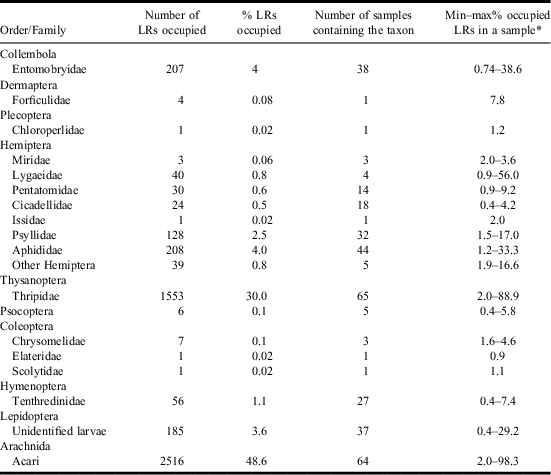
Herbivorous arthropod taxa, exclusive of the leafrollers, were represented by nine insect orders and one arachnid order (Table 1). Most common in terms of the number of individuals and the number of leafrolls occupied were thrips in the suborder Terebrantia, found in 30% of leafrolls, and spider mites (Tetranychidae), found in 48.6% of leafrolls. The most frequently found plant-feeding thrips was a species of Mycterothrips Trybom (Thysanoptera: Thripidae); Frankliniella Karny (Thysanoptera: Thripidae) species was an occasional occupant. The number of plant-feeding thrips in a leafroll occasionally exceeded 25 individuals, while the number of spider mites in a leafroll frequently exceeded this number. Rust mites (Acari: Eriophyidae) were also frequent inhabitants of leafrolls and sometimes exceeded 100 individuals per roll. Early in the study, however, rust mites were not accurately tabulated and so we do not give an overall percent of occupied leafrolls for this taxon.
Summary of the herbivorous arthropod fauna found in alder leaves rolled by Lepidoptera larvae (exclusive of the leafrollers themselves) in 2002, 2003, 2004, and 2006. 5172 total leafrolls examined in 77 samples.
*All taxa were absent from one or more samples. Min% is the lowest, non-zero value for the taxon among the 77 samples.
Three taxa of common occurrence in leafrolls (thrips, mites, and Collembola) showed different patterns of leafroll occupancy across the season (Table 2). Percentage of leafrolls occupied by thrips was highest during June and then declined thereafter. Collembola showed the opposite trend, with the lowest percent occupancy in June and the highest in September. More than 50% of leafrolls were occupied by mites in each of the four sampled months.
Leafroll occupancy by month of three herbivorous arthropod taxa commonly found in rolled alder leaves (mean % occupied leafrolls per sample [range in percent occupancy for the month]).

Predaceous insects
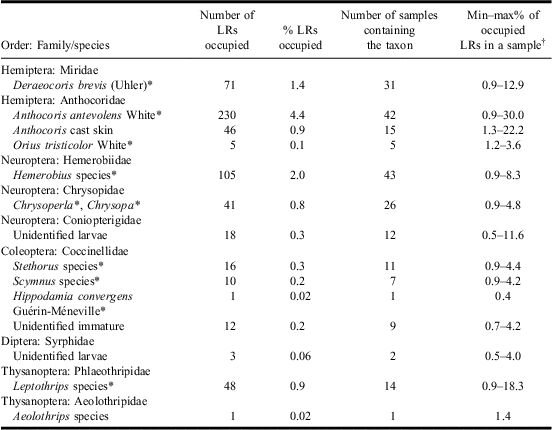
Predatory insects representing five orders and nine families were found in rolled leaves (Table 3). Many of these taxa are known components of the natural enemy community in orchards (taxa marked with asterisks in Table 3). Anthocoris antevolens White (Hemiptera: Anthocoridae) was the most common insect predator and occurred at an overall frequency of about one individual per 17 leafrolls. Both adults and nymphs were found, in some instances within the same leafroll. Cast exoskeletons in leafrolls indicated that they served as moulting sites. Gracillariid leafrolls considerably outnumbered tortricid leafrolls in most of our samples, but when similar numbers of the two types comprised a sample A. antevolens was found in both types. For example, the 17 August 2004 Quartz Creek sample had nine of 23 gracillariid leafrolls with Anthocoris and seven of 20 tortricid leafrolls. Less common predator taxa also occurred in both types of leafrolls and this sample included two gracillariid and one tortricid leafroll with dusty-wing larvae (Neuroptera: Coniopterygidae). Brown lacewings (Neuroptera: Hemerobiidae) occurred at about half the frequency of A. antevolens. Hemerobius neadelphus Gurney and Hemerobius stigma Stephens were obtained from reared larvae. Green lacewings (Neuroptera: Chrysopidae) included Chrysoperla plorabunda (Fitch), Chrysopa coloradensis Banks, and Chrysopa nigricornis Burmeister. Other predatory insect taxa found in leafrolls included Coleoptera (Coccinellidae), Diptera (Syrphidae), and Thysanoptera (Table 3).
Summary of the predaceous insect fauna found in alder leaves rolled by Lepidoptera larvae in 2002, 2003, 2004, and 2006. 5172 total leafrolls examined in 77 samples.
*Taxon known to occur in Yakima County, Washington, United States of America orchards.
†All taxa were absent from one or more samples. Min % is the lowest, non-zero value for the taxon among the 77 samples.
Spiders
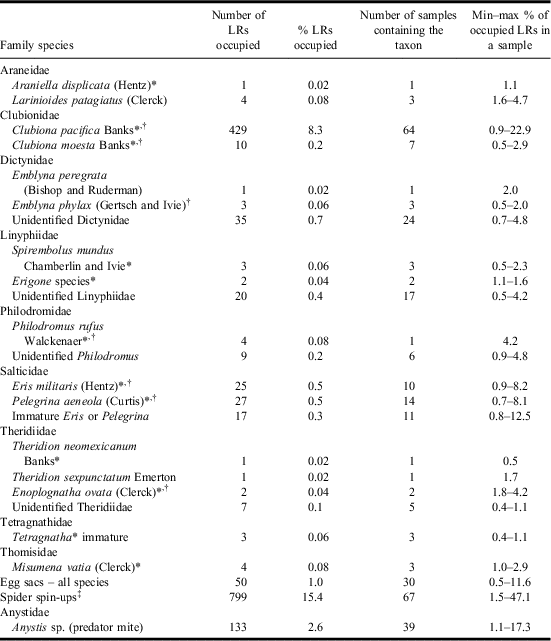
Seventeen species of spiders in nine families were found in rolled leaves, again including taxa known to occur in local orchards (Table 4). Clubiona pacifica Banks (Araneae: Clubionidae) was easily the most common species and occurred at a frequency of nearly one individual per 10 leafrolls. All life stages were represented, but first instar nymphs were the most common. In some late July and August samples C. pacifica numbers approached one per leafroll, most of which were first instars. Female C. pacifica occasionally used a rolled alder leaf for egg deposition, although they usually construct their own leaf retreats for this purpose (E.R.M., personal observation). Tubular silken spin-ups in which C. pacifica had moulted (cast skin present) or had spent an inactive period were common in rolled leaves.
Summary of the spider fauna found in alder leaves rolled by Lepidoptera larvae in 2002, 2003, 2004, and 2006.
Notes: A total of 5172 total leafrolls examined in 77 samples.
*Taxon known to occur in Yakima County, Washington, United States of America orchards.
†Includes one or more females with egg sacs.
‡Includes primarily Clubiona (many with cast skins) and a few Salticidae with cast skins.
Egg sacs of Clubiona moesta Banks (Araneae: Clubionidae), Eris militaris (Hentz) (Araneae: Salticidae), Pelegrina aeneola (Curtis) (Araneae: Salticidae), Theridion neomexicanum Banks (Araneae: Theridiidae), Enoplognatha ovata (Clerck) (Araneae: Theridiidae), and Emblyna phylax (Gertsch and Ivie) (Araneae: Dictynidae) were found in rolled leaves; an additional 36 spider egg sacs of uncertain identity were also collected. Silken spin-ups with cast salticid exoskeletons, probably from Eris Koch or Pelegrina Franganillo, were found in leafrolls indicating that these jumping spiders used rolled leaves as moulting sites. As was the case for predatory insects (see above) spiders occurred in both gracillariid and tortricid leafrolls: 11 of 23 gracillariid leafrolls in the 17 August 2004 Quartz Creek sample contained spiders or evidence of them as did eight of 20 tortricid leafrolls.
Evidence for predation on leafroller larvae by C. pacifica and C. moesta was found in a few leafrolls. In such cases a spider (often an adult female) and a dead leafroller larva were found together in a leafroll. Dead larvae were flaccid and discolored, and drops of dark liquid, possibly regurgitated by larvae as defensive responses, were present.
Objective 2: comparison of rolled versus roll-free leaves (2010, 2012)
Odds ratios and 95% confidence intervals from the logit analyses were estimated for each of our four trophic categories and each of six sites monitored in 2010 (Fig. 2; note log-scale of Y-axis). An odds ratio equal to 1.0 indicates that rolled leaves and roll-free leaves were statistically the same in proportion of leaves occupied after adjusting for sample month. Odds ratios larger than 1.0 indicate that odds of a leaf being occupied were larger for rolled leaves than roll-free leaves. The asterisk at site 6 for the herbivore data and site 5 for the mite data (Fig. 2) indicates that the logit models with main effects only provided a poor fit; i.e., effects of leaf status on probability of occupancy depended upon sample month.
Odds ratios (±95% CI) from the logit analyses summarising effects of leaf status (rolled leaves versus roll-free leaves) on occupancy by each of four arthropod taxa. Note log-scale for Y-axis. Odds ratios for the six individual sites are shown as open symbols, while filled symbols show average of the six sites. Asterisks depict samples for which the main effects only logit model provided a poor fit. A confidence interval overlapping 1.0 indicates that the odds of occupancy were the same for rolled and roll-free leaves after adjusting for month of sample. Odds ratios >1.0 indicate that the odds of occupancy was higher for rolled leaves than roll-free leaves.
Percentage of leaves occupied by herbivores increased from a low of 11% in June to a high of 65% in September (data pooled across sites and type of leaf [rolled and roll-free]). This was due in large part to the higher incidence of rust mites on leaves late in the season. Occupancy was generally independent of whether the leaf was rolled. Only at site 4 were rolled leaves more frequently inhabited than roll-free leaves (Fig. 2; P = 0.046). The odds ratio of 2.5 at that site (Fig. 2) indicates that odds of leaf occupancy by herbivores was about 2.5-fold higher for a rolled leaf than a roll-free leaf after adjusting for sample month. Averaged over the 6 sites, the mean odds ratio for herbivores was not different from one (Fig. 2: filled symbol), indicating that occupancy rates were similar between rolled and roll-free leaves.
Phytophagous thrips were substantially more likely to be present early in the season than late in the season; percent occupancy declined from a high of 63% of leaves in June to a low of 2% in September (data pooled across sites and type of leaf). At three of the six sites, rolled leaves were more likely than roll-free leaves to be occupied by phytophagous thrips (Fig. 2). At site 1 (Fig. 2), odds of a rolled leaf being occupied by phytophagous thrips was almost 10-fold higher than odds of an unrolled leaf being occupied. However, averaged over the six sites, the mean odds ratio was not significantly different from 1.0 (Fig. 2: filled symbol).
Spider mites and predatory mites were common mid-season to late-season occupants of leaves; 51–70% of leaves were occupied by mites in the August and September samples (data pooled across sites and type of leaf). Three of the six estimates of odds ratios were significantly >1.0 (Fig. 2). The mean odds ratio of 2.8 (Fig. 2: filled symbol) was also significantly >1.0, and indicated that odds of occupancy by mites was 2.8-fold higher in rolled leaves than roll-free leaves.
Probability of leaf occupancy for predatory taxa was almost always higher for rolled leaves than roll-free leaves (Fig. 2). At several sites, leaf occupancy exceeded 25% of rolled leaves, whereas occupancy rates generally were between 0% and 10% for roll-free leaves; the mean odds of occupancy for predatory taxa was almost 10-fold higher on rolled leaves than roll-free leaves (Fig. 2: filled symbol).
The 2012 comparison of rolled and roll-free leaves included only one sample month (August) at each of 7 sites. Herbivores other than thrips and spider mites actually showed higher probability of occupancy on roll-free leaves than rolled leaves (Fig. 3). This result was caused by rust mites, which were very common at most sites, and which were more likely to be associated with roll-free leaves (49–100% occupancy depending upon site) than rolled leaves (9–96% occupancy); the estimated odds ratio for rust mites was 0.13 (P < 0.0001), indicating that odds of occupancy was about 7.7-fold higher in roll-free leaves than rolled leaves. The remaining three trophic groups were more likely to be in association with rolled leaves than roll-free leaves (Fig. 3); odds ratios were between 4.5 and 11.2 for the three groups (Fig. 3). Two common predatory taxa were the spiders, with occupancy of rolled leaves between 15–44% (odds ratio = 6.8, P < 0.0001); and, A. antevolens, with occupancy of rolled leaves at 0–31% (odds ratio = 69.6, P < 0.0001).
Odds ratios (±95% CI) from the logit analyses summarising effects of leaf status (rolled leaves versus roll-free leaves) on occupancy by each of four arthropod taxa (August 2012 samples). Note log-scale for Y-axis. Models included site (n = 7) as a second explanatory variable. A confidence interval overlapping 1.0 indicates that the odds of occupancy were the same for rolled and roll-free leaves after adjusting for site. Odds ratios >1.0 indicate that the odds of occupancy was higher for rolled leaves than roll-free leaves, while an odds ratio <1.0 indicates that occupancy was more likely in roll-free leaves.
Discussion
Arthropods that construct shelters from rolled or tied leaves are found in the Lepidoptera, Hymenoptera, Coleoptera, and Acari (Martinsen et al. Reference Martinsen, Floate, Waltz, Wimp and Whitham2000; Fukui Reference Fukui2001; Fournier et al. Reference Fournier, Rosenheim, Brodeur, Laney and Johnson2003). Shelter-building Lepidoptera are often an abundant and taxonomically diverse component of the herbivore fauna attacking deciduous trees in temperate regions. Plant genera such as Salix Linnaeus (Salicaceae), Populus Linnaeus (Salicaceae), Betula Linnaeus (Betulaceae), and Quercus Linnaeus (Fagaceae) often host large numbers and high diversities of shelter-making Lepidoptera (Cappuccino and Martin Reference Cappuccino and Martin1994; Martinsen et al. Reference Martinsen, Floate, Waltz, Wimp and Whitham2000; Fukui Reference Fukui2001; Lill and Marquis Reference Lill and Marquis2003; Nakamura and Ohgushi Reference Nakamura and Ohgushi2003; Lill Reference Lill2004). In our survey of shelter-makers associated with Alnus on the eastern slopes of Washington's Cascade Range, we collected 13 species of leafrollers and leaf-tiers in three families of Lepidoptera. Tortricidae was the best represented family and included four species of generalist-feeders (Archips rosanus, Archips argyrospilus, Pandemis pyrusana, and Choristoneura rosaceana) that are also pests of rosaceous fruit crops in eastern Washington (Brunner Reference Brunner1993).
A diverse parasitoid community, including Hymenoptera and Diptera, attacked the shelter-making caterpillars on alder. Parasitoid faunas of shelter-making Lepidoptera on other host plants may likewise be diverse. The fauna associated with leafroller pests of apple, that includes the above four species also found on alder, has received considerable attention with regard to biological control (Mayer and Beirne Reference Mayer and Beirne1974; Cossentine et al. Reference Cossentine, Jensen, Deglow, Bennett, Goulet and Huber2004, Reference Cossentine, Bennett, Goulet and O'Hara2007; Wilkinson et al. Reference Wilkinson, Landis and Gut2004). Numerous parasitoid species are associated with shelter-making Lepidoptera on other plants including oak (Carroll et al. Reference Carroll, Wooster, Kearby and Allen1979) and goldenrod (Loeffler Reference Loeffler1994). Our most frequently reared parasitoid, S. dolichogaster, has a Holarctic distribution and prefers hosts that mine leaves as young larvae but roll the leaf later in development (Miller Reference Miller1970). As in our study, most hosts of S. dolichogaster are in the Gracillariidae (Miller Reference Miller1970; Burks Reference Burks1979: 970; Barry et al. Reference Barry, Rodriguez-Saona, Polk and Zhang2010) and the wasp occasionally acts as a hyperparasitoid (Ridgway and Mahr Reference Ridgway and Mahr1985; present study).
Shelter-making arthropods act as “ecological engineers” in that their activities affect availability of resources for other organisms and in effect create a novel resource (Martinsen et al. Reference Martinsen, Floate, Waltz, Wimp and Whitham2000; Fournier et al. Reference Fournier, Rosenheim, Brodeur, Laney and Johnson2003). Thus leaf shelters constructed early in the season are often colonised by other taxa later in the year (Cappuccino and Martin Reference Cappuccino and Martin1994; Lill Reference Lill2004; Lill and Marquis Reference Lill and Marquis2004). Even artificially constructed leafrolls are colonised by a variety of herbivores not themselves shelter-makers (Lill and Marquis Reference Lill and Marquis2004). Alder leafrolls were frequently colonised by non-shelter-making herbivorous arthropods (Table 1), phytophagous thrips and mites in particular occurring at high frequencies (Table 2). Rolled leaves were often several-fold more likely to be colonised by thrips and spider mites than adjacent roll-free leaves (Figs. 2, 3).
Leafrolling activities may have bottom-up effects (Fukui Reference Fukui2001) on herbivore success through improvement of the rolled leaf as a food source. Fukui et al. (Reference Fukui, Murakami, Konno, Nakamura and Ohgushi2002) found reduced leaf toughness and phenolic content, and increased nitrogen content in rolled versus unrolled Japanese lilac leaves. Shading of plant tissues induced by leafrolling activities may also have measureable benefits in reducing levels or effects of secondary plant compounds (Sandberg and Berenbaum Reference Sandberg and Berenbaum1989; Sagers Reference Sagers1992). In our study, secondary colonisation of rolled leaves by some taxa exhibited seasonal patterns possibly related to resource quality. Spider mites and Collembola tended to occur at higher frequencies in rolled leaves later in the season than early in the season (Table 2; Fig. 3). Leafroll occupancy by Collembola was highest in September (Table 2) by which time most rolled leaves had extensive feeding damage and were senescing with decay evident. Because most Collembola feed on decaying vegetable matter and fungi (Triplehorn and Johnson Reference Triplehorn and Johnson2005) it is perhaps not surprising that these arthropods were more abundant in old leafrolls.
Predatory arthropods also colonise leaf shelters (Martinsen et al. Reference Martinsen, Floate, Waltz, Wimp and Whitham2000; Fournier et al. Reference Fournier, Rosenheim, Brodeur, Laney and Johnson2003; Lill and Marquis Reference Lill and Marquis2004), likely in response to prey availability or environmental conditions or for protection from other natural enemies (Fukui Reference Fukui2001). Indeed, in this study, predatory taxa showed the most consistent response among several trophic and taxonomic groups in their preference for rolled versus roll-free leaves (Figs. 2, 3). Whether occupancy was prompted by prey availability or some other factor was not addressed. Anthocoris antevolens, which strongly preferred rolled leaves to roll-free leaves (odds ratio exceeding 60), is likely to feed extensively on small, soft-bodied prey such as thrips, mites, and aphids (Lattin Reference Lattin1999), all of which were common secondary colonists of leafrolls. Environmental factors may also have been important, especially at times that the arthropod is moulting. For example, Clubiona spiders are primarily nocturnal, spending their days in tubular silken retreats in protected locations including rolled leaves (Edwards Reference Edwards1958). Moulting takes place in these silken retreats (Richman and Ubick Reference Richman and Ubick2005). Clubiona pacifica retreats were common in rolled alder leaves, and many contained cast skins. Jumping spiders and A. antevolens also used rolled leaves for moulting (Tables 3, 4). Environmental conditions within leafrolls may be more conducive to moulting or other developmental activities than conditions in the external environment, if the higher humidity within leafrolls leads to a reduced risk of desiccation (Willmer Reference Willmer1980; Hunter and Willmer Reference Hunter and Willmer1989).
The original goal of this study was to determine if alder is colonised by a tortricid leafroller(s) that is parasitised by C. florus and that might also prove to be a suitable overwintering host for the wasp. We failed to rear C. florus from any of the alder associated tortricids, although two of the species, P. pyrusana and C. rosaceana, are pests in eastern Washington orchards and are there attacked by C. florus (Pfannenstiel et al. Reference Pfannenstiel, Mackey and Unruh2012; Unruh et al. Reference Unruh, Pfannenstiel, Peters, Brunner and Jones2012). However, because P. pyrusana and C. rosaceana overwinter as small second and third instars (Brunner Reference Brunner1993) they serve as poor overwintering hosts for C. florus, which prefers larger caterpillars for this purpose (Unruh et al. Reference Unruh, Pfannenstiel, Peters, Brunner and Jones2012). Hence our desire to find a suitable overwintering host. It may be that our study sites are beyond the current range of C. florus, whereas in areas where alders and C. florus both occur alder-associated tortricids in addition to P. pyrusana and C. rosaceana may be parasitised by the wasp. Such a possibility may be worth investigating.
The fact that alder, and especially rolled alder leaves, were attractive to a wide variety of predatory insects and spiders, many of which also occur in eastern Washington orchards, may make alder a useful plant in a conservation biocontrol program. Retention or enhancement of existing alders in orchards near riparian habitats or establishment of alder stands near orchards where the plants are not already present may benefit pest control in the orchard with the alders serving as a source of and/or a refuge for beneficial arthropods. Such potential benefits would have to be weighed against potential costs such as the fact that alder is a host for several leafroller species that can reach pest status in eastern Washington orchards. Also, alder would probably require some level of management after establishment including irrigation in the dry habitats prevalent in much of eastern Washington.
This study has shown that the arthropod fauna associated with leafrolls on alder is remarkably diverse. Occupants included the shelter-makers and their parasitoids, along with a taxonomically diverse community of arthropods that secondarily colonised the shelters, the latter presumably using the shelters as a source of food or as protected locations for molting and oviposition activities. The alder system should prove fruitful for investigations of the natural history of its many component organisms and for addressing questions related to organisms that act as ecological engineers. Finally, because many of the natural enemies found in alder leafrolls are also found in local agricultural crops, alders may have useful applications in conservation biological control.
Acknowledgements
This research was supported under an Initiative for Future Agriculture and Food Systems (IFAFS) grant and by a grant from the Washington Tree Fruit Research Commission. Merilee Bayer provided invaluable assistance in the collection and examination of leafrolls and the rearing of their contents. Tom Unruh, Bob Pfannenstiel, and three anonymous reviewers provided helpful comments on earlier versions of the manuscript.