

Part I: The history
As the first music club anywhere to devote itself almost wholly to ‘early’ music (in this case, that of the sixteenth and seventeenth centuries), the Academy of Ancient Music was one of the most interesting and important musical societies in eighteenth-century Britain. As such, its place in the history books is assured. According to Sir John Hawkins (who was himself a member), it ‘was instituted about the year 1710, by a number of Gentlemen, performers on different instruments, in conjunction with some of the most eminent masters of the time’. In actual fact, however, its inaugural meeting took place at the Crown and Anchor Tavern in the Strand on Friday, 7 January 1726, and for the first 5 years of its existence it was known as the Academy of Vocal Music.Footnote 1 Of the 13 founder members, most belonged to one or other of the Chapel Royal and St Paul’s Cathedral choirs (or both); a small group of St Paul’s choristers to provide the treble parts was also in attendance.Footnote 2 Of those who were not, the two most notable were Johann Ernst Galliard and Dr Johann Christoph Pepusch, the latter being an ardent antiquarian who, if not the initial motive force, was subsequently to become the leading light and guiding spirit of the society. By 1730, the Academy numbered some 80 members. Among them, in addition to the nucleus of adult male singers from the three main London choral foundations (Westminster Abbey now included), were Signors Bononcini, Carbonelli, Geminiani, Sammartini and Nicola Haym, with Senesino too briefly a member; also the Lords Plymouth and Paisley, Viscount Percival (later the First Earl of Egmont), the Earl of Abercorn, William Hogarth and Giuseppe Riva, the Modenese diplomatic resident in London, were among the members.Footnote 3
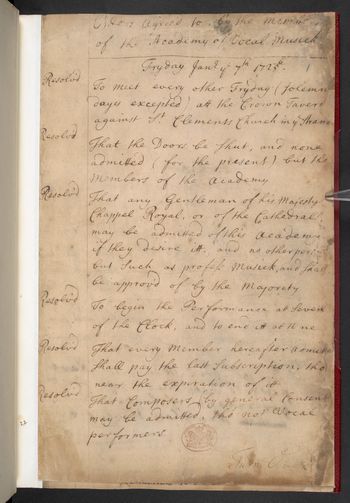
Hawkins’ Account of the Institution and Progress of the Academy of Ancient Music was published anonymously in 1770, by which time the erroneous date of inception had long since established itself in the corporate memory of the members, as is evident from the fact that it is also the date given on a memorial tablet to Pepusch placed by them in the chapel of the Charterhouse on the centenary of his birth (1767). He had been an organist there from 1737 until his death in 1752.Footnote 4 A much earlier history, commissioned, as we shall presently see, in May 1731, failed to materialize. Thus, the only documentary evidence concerning the foundation of the Academy to survive is that to be found in the British Library, Add. MS 11732.Footnote 5 This contains the minutes of the inaugural meeting and the names of those 13 men who (with ‘The Children of St. Paul’s Cathedral’) attended. Each paid 2s 6d towards the expenses of the evening, which were 2s for a coach for the children; 10s 6d for wine and bread; 5s for the use of the room, the fire and candles; and 1s for ‘the Drawer’ (i.e., the man who brought the bread and drinks). This left 14s to be carried forward against the expenses of subsequent meetings. Among other things, it was resolved that the Academy should meet every other Friday (‘solemn days excepted’) and no one should be admitted but members, and also that performances should begin at 7 p.m. and end at 9 p.m.Footnote 6 Initially, at any rate, membership was restricted to Gentlemen of the Chapel Royal or of ‘the Cathedrals’, and no other persons ‘but such as profess Musick, and shall be approv’d by the Majority’ (see Figure 1). Prospective new members might be proposed by an existing member, but a two-thirds majority in a ballot was required if they were to succeed. Obviously, singers had to be auditioned, but not composers, who, the rules say, might be admitted ‘by general Consent’. All new (and existing) members were to pay an annual subscription of one guinea (i.e., 21s) and the society was to be governed by a committee of six or seven members who were each ‘to direct the performance in their turns’.
Academy of Vocal Music: Minutes of the inaugural meeting (British Library, Add. MS 11732, folio 1). Reproduced by permission of the British Library Board.

Interestingly, although the subscription rate inevitably increased over time, the ‘managers’ (as they were called) continued to determine the music performed right down to 1802, when eventually the Academy was disbanded. In a later minute of 9 April 1730, they were authorized ‘to make such Laws for the Government of the Academy as they shall think fit’, and this too remained in force for the next 70-odd years. The large room at the Crown and Anchor in which they met evidently had a small gallery that could accommodate up to 18 auditors, and each member in order of seniority might reserve 2 places there, provided any such request was made a fortnight in advance. It would appear that female auditors were allowed in as early as December 1729, but it was not until very much later (in 1788) that they were permitted to become members. Most of the remaining pages of Add. MS 11732 (folios 2-12v) are given over to lists of subscribers from 21 January 1726 down to the eighth subscription of 9 April 1730. The 13 persons present at the inaugural meeting were Messrs. Estwick, Baker, Husband, Carleton, Hughes, Chelsum, Freeman, King, Gates, Weely, Greene, Galliard and Dr Pepusch.Footnote 7
A pair of what are described as account books covering the period 1726-27 was sold as Lot 264 in a Puttick and Simpson sale of 24-25 August 1857. The first of these must have duplicated at least some of the material in Add. MS 11732 since the latter’s entry for 21 January 1726 was quoted verbatim in the sale catalogue. And as Add. MS 11732 had already been given to the British Museum (as it then was) by Vincent Novello in 1840, they cannot have been the same. Although I initially assumed that Lot 264 must have been bought by Victor Schoelcher (1804-93), the French politician whose important book on Handel had been published earlier that year, I was wrong; Lot 264 was actually purchased by one Guillaume Libri (1802-69), a colourful rogue and fugitive from French justice who had been living in London since 1848 and happened also to be a notable scientist and bibliophile. His own collection of books and MSS, many of them stolen, ran to some 30,000 items and was dispersed at auction by Sotheby’s between 1849 and 1865.Footnote 8 A year later, in 1858, he sold it on via a Parisian auction house, and what had been Lot 264 in 1857 was acquired by the library of the Paris Conservatoire. There it remained until, almost a 100 years later, the holdings of the Conservatoire were transferred to the newly opened Music Department of the Bibliothèque Nationale, at which point it was discovered that one volume - the first - had evidently gone missing. Whether or not this was actually a volume of accounts as Puttick and Simpson had described it, we shall probably never know, but the second volume, newly re-catalogued as Rés. F. 1507, turns out to contain a hugely important listing of all the music performed by the Academy between 1768 and 1773, a full transcription of which is included here in Part II.Footnote 9
Following the eighth subscription of 9 April 1730 are a few scraps mostly relating to events that took place in the spring of the following year when, as a result of an acrimonious dispute in the ranks, the society fell apart and was reconstituted as the Academy of Ancient Music with ‘ancient’ being defined as ‘such as lived before ye end of the Sixteenth [replacing ‘fifteenth’ crossed out] Century’. The acrimonious dispute just referred to was occasioned by the performance, most probably in 1728, of a five-part Italian madrigal (‘In una siepe ombrosa’) by Antonio Lotti (c.1667-1740), then first organist of St Mark’s in Venice. It would appear to have been introduced in good faith by Maurice Greene (organist of St Paul’s and recently appointed Composer to his Majesty’s Chapel Royal) as the work of his good friend, Giovanni Bononcini, who, as we have seen, was then also a member.Footnote 10 Although Bononcini had already composed three Italian madrigals for the Academy,Footnote 11 ‘In una siepe ombrosa’ was clearly not one of them - as some member who knew the identity of the real composer was evidently quick to point out. Accused of plagiarism, Bononcini refused to withdraw. Thus the Academy, aiming to discover the truth of the matter, embarked on a series of exchanges with Lotti in Venice. The first letter, written by Hawley Bishop, is dated 5 February 1731 (Old Style, thus 1732); the last, undated but signed by all seven ‘Directors’, evidently went out some six or seven months later, and the entire correspondence was very shortly afterwards published as Letters from the Academy of Ancient Musick at London, to Sigr Antonio Lotti of Venice with his Answers and Testimonies. Footnote 12 The upshot of all this was that Maurice Greene, tarred by the brush of Bononcini’s deception, promptly resigned and, taking the boys of St Paul’s and some of the Academy’s best performers with him, set off down the Strand to establish a rival concert known as the Apollo Academy (from the name of the room at the Devil Tavern near Temple Bar in which they met).Footnote 13 This apparently gave rise to the witticism sometimes attributed to Handel (on no evidence whatsoever) that ‘Dr Greene is gone to the Devil!’Footnote 14 As for Bononcini, he left London for Paris in the summer of 1732 and did not return.
In the words of Viscount Percival (himself a member), ‘The club were astonished that so great a man as Bononcini should descend so low as to father another man’s works, and impose them on us as his own’. Faced with accusations of plagiarism, Bononcini ‘stormed and maintained the gentlemen had accused him falsely, insisting that music to be still his own; whereupon it was agreed to write to Vienna [sic] to the composer to know the truth. In the meantime, Bononcini withdrew from our Society, and many of it, who are his professed friends, taking his part, left us also’.Footnote 15 And this, he says in a further paragraph referring to a subsequent breakdown of relations with his patron, the Duchess of Marlborough, is ‘the story of this proud man, who if he had valued himself less, the world would have esteemed him more’. According to Sir John Hawkins, the affair ‘made a great noise in the musical world’.Footnote 16 There is, however, no mention of it in the newspapers.
It was at this point that the Academy of Vocal Musick became the Academy of Ancient Musick. At a meeting held on 26 May 1731, it was resolved not only that ‘the Ancients’ were to be defined as ‘such as lived before ye end of the Sixteenth [replacing fifteenth crossed out] Century’ but also ‘That Mr: Galliard & Mr Needler do make a Catalogue of all ye Musick & put the Library in order’. At the same time, the current secretary, Hawley Bishop, was ‘desir’d to write an Historical Account of the Academy & that Dr Pepusch & Mr: Galliard do supply him with Materials’, while Pepusch was additionally charged ‘to demand of Dr Green the Six Mottetts ye Bishop of Spiga sent the Academy’.Footnote 17
The Bishop of Spiga just mentioned was Agostino Steffani (1654-1728), a Roman Catholic priest and diplomat as well as a composer whose celebrated chamber duets and cantatas were widely circulated among early eighteenth-century English music lovers. Although then resident in Hanover, he was, on 1 June 1727, unanimously elected (in absentia) President of the Academy. It is not clear whether he had been proposed by Galliard (a former pupil) or by Giuseppe Riva, the Modenese envoy in London who, in a letter to Steffani dated 31 December 1726, had given him a tantalizing description of the society and, ‘in the name of the entire academy’, urged him to send them ‘something of his composition, which will be preserved like a relic with the other rare things in the musical archive’.Footnote 18 Riva also claims that Handel, like Bononcini, was a member, but this is an outright fib intended no doubt simply to whet Steffani’s interest. Oddly enough, Hawkins repeats the assertion (Account, 9) and so too have others since, but there is no reason to suppose that Handel was ever a member of the Academy, although a good many of his works were performed by them in the years after 1731. As it happens, the academicians were already familiar with Steffani’s five-part madrigal, ‘Gettano i re dal soglio’, which had been sung at their inaugural meeting on 7 January 1726, so someone, most probably Galliard, must have been in touch with the composer some time previously in order to have obtained a copy.Footnote 19 Five months later, and prior to his election as President, Steffani sent them a manuscript copy of his Sacer Ianus quadrifrons (now Lcm MS 1023), and by mid-September 1727 they also had copies of his theoretical treatise Quanta certezza (1695), another madrigal, ‘Al rigor d’un bel sembiante’, for SAT and continuo, plus a number of duets.Footnote 20 A five-part motet, ‘Qui diligit Mariam’, composed especially for the Academy followed not long afterwards.Footnote 21 His fine setting of the ‘Stabat mater’ for six voices and instruments, his last work, was completed very early in 1728, and while this is generally thought to have been intended for the Academy as well, this view of its origins has recently been seriously questioned by Colin Timms, our foremost authority on the composer.Footnote 22
Although Steffani died on 12 February 1728, it seems odd that the news apparently did not reach the Academy until about 1730, when it was ‘resolved not to elect a president for the future, but to keep that post vacant, as if there were no man living worthy to supply his place’.Footnote 23 And this, as Viscount Percival goes on to point out, ‘was a resolution insupportable to Bononcini, who had reason to expect that honour, and thereupon he cooled very much in his affection to the club’. Might it perhaps have been this apparent slight, which lay behind the scandal in which he was subsequently embroiled, and led very shortly afterwards to the breakup of the society? As their original name clearly implies, and as Riva makes plain in that letter to Steffani previously cited, the Academy was at first interested only in unaccompanied vocal music, or rather vocal music with continuo accompaniment only.Footnote 24 It was not long, however, before its chorus had been joined by a band of instrumentalists to perform such things as a Greene Te Deum and some other of his works which, said Viscount Percival, who was present on the occasion (13 February 1730), ‘show him to be a great composer and to tread in the steps of the Italian masters’.Footnote 25 Thereafter such things as odes, oratorios, and orchestrally accompanied canticles, anthems and Latin psalm settings were added to the standard bill of fare. This important change is clearly reflected in the number of instrumentalists named in the Sixth Subscription whose date in Add. MS 11732 has been obscured, but appears most likely to have been levied sometime late in 1728.
The leader of the Academy’s orchestra throughout the 1730s, 40s and 50s was Henry Needler, whose name appears for the first time as a member in the Fifth Subscription of 12 April 1728. A good amateur violinist, he is reputed to have been the first person in England to have performed Corelli’s concertos. Born most probably in 1685, he was not only a civil servant by profession - he entered the Excise Office as a young man and had become Accountant General by 1724 - but also an accomplished copyist who, in addition to his work for the Academy, left (on his death in 1760) no fewer than 27 large volumes of manuscripts, one copied from sources in the Bodleian and Christ Church libraries in Oxford, to his good friend and fellow academician, James Mathias, sometime Treasurer and ultimately President of the Academy.Footnote 26 Also hugely important as a copyist during these same early years was John Immyns (d. 1764). A failed lawyer, he became a member of the Academy in December 1728 and was described by Hawkins as someone who had a ‘cracked counter-tenor voice’ and ‘played upon the flute, viol da gamba, the violin, and the harpsichord, but on none of them well’.Footnote 27 Having taught himself the lute, he somehow managed to get himself appointed as lutenist to the Chapel Royal in 1752 and is now remembered chiefly for having founded the Madrigal Society in 1741, a body of singers still in existence today.Footnote 28 He also served as an amanuensis to Pepusch who, although never accorded the formal title of ‘President’, evidently presided over the affairs of the Academy from 1731 until his death on 20 July 1752. Quite when the office of President was revived is by no means clear but it was evidently held by James Mathias (see note 26) in 1774, when he wrote (in Latin) to the composer, David Perez (1711-78), sending him a gold medal and hoping that he, like Steffani, might deign to become a member.Footnote 29 Later, in the 1790s, it was Francis Osborne, the 5th Duke of Leeds, who appears to have served in that capacity.
Born in Berlin in 1667, Johann Christoph Pepusch (or John Christopher as he became) arrived in England late in 1697 and settled in London where he remained for the rest of his life. Having found a place as a viola player and later harpsichordist in the Drury Lane band, he joined the orchestra of the opera company in Vanbrugh’s newly built theatre in the Haymarket in January 1708 and soon found himself heavily involved in the concert life of the capital. According to Hawkins,Footnote 30 he ‘saw with concern persons who made pretensions to great skill in the science, treat with indifference and contempt the music of the preceding century; and being himself persuaded of its superior excellence, he laboured to retrieve and exhibit it to public view’. In July 1713, he took a doctorate in music (alongside William Croft) at Oxford, and the following year he returned to Drury Lane as musical director there, transferring to a similar post at Lincoln’s Inn Fields 2 years later (in 1716). Then came a spell when, as director of music to James Brydges, later the First Duke of Chandos, at Cannons, the ducal estate at Edgware in Middlesex, he was closely associated with Handel. Although Pepusch produced a number of instrumentally accompanied anthems and a Magnificat setting for the chapel there, he also remained active on the London theatre scene and is now remembered chiefly for having composed the overture to, and arranged the airs for, John Gay’s hugely successful Beggar’s Opera (first performed at Lincoln’s Inn Fields on 29 January 1728). He also wrote a great many solos, trio sonatas and concertos, and was one of the first to publish cantatas in English.Footnote 31 Among his colleagues in the Academy, he was greatly respected not only as a composer but also, and more particularly, as a learned theorist with a keen interest in the music of classical antiquity, as also the owner of a huge library upon which members might draw for repertoire. Pepusch became organist of the Charterhouse in December 1737, and, most unusually for a musician, he was elected a Fellow of the Royal Society for a paper ‘Of the various Genera and Species of Music among the Ancients’, delivered in 1745.Footnote 32 Such abstruse matters were hardly a matter of concern to the generality of the membership, but there were a very few, mostly pupils of his, whom he inspired to follow his lead, most notably John Travers, Benjamin Cooke and William Boyce; also, somewhat later (as part of his musical legacy), John Keeble and John Wall Callcott.
The year 1732 was memorable not only for the publication of the Academy’s correspondence with Antonio Lotti but also for its having assisted at the birth of English oratorio in the guise of Handel’s Esther. In the form in which we now know it, the work had its first performance on 23 February as a birthday tribute to the composer from Bernard Gates, a founder member of the Academy and successor to Croft as Master of the Children of the Chapel Royal. While the work may have been rehearsed at Gates’ own house, it was not performed there (as some, following Burney, have said) but at the Crown and Anchor Tavern in the Strand. So too was its third performance, this time for the Academy of Ancient Music on 3 March. Two years later, however, there was another falling out, this time between Gates and the Academy. Quite what lay behind this débâcle remains a matter of speculation, but Gates’ departure together with the Chapel Royal boys left the Academy trebleless. According to Hawkins,Footnote 33 ‘the experience of one season drove them to the alternative of an encreased expence [sic], or annihilation’. It was at this point, it seems, that a decision was taken to raise the subscription rate from one to one and a half guineas a year, and also to admit auditors as members.Footnote 34 It was round about the same time (March 1734) that the following remarks by one ‘Hurlothrumbo Johnson’, an ardent Handelian, appeared in a pamphlet entitled Harmony in an Uproar: A Letter to F-D-K H-D-L, Esq.
As for that indefatigable Society, the Gropers into Antique Musick, and Hummers of Madrigals, they swoon at the Sight of any Piece modern, particularly of your Composition, excepting the Performances of their venerable President [Pepusch], whose Works bear such vast Resemblance to the regular Gravity of the Antients, when dress’d up in Cobwebs, and powdered with Dust, the Philharmonick Spiders could dwell on them, and in them, to Eternity.Footnote 35
The treble problem was apparently solved by the setting up of what Hawkins describes as ‘a seminary for the instruction of youth in the principles of music, and the laws of harmony’. Although ‘invitations to parents [offering] such an education for their children, as would fit them as well for trades and businesses, as the profession of music, were given by advertisements in the public papers’, I have yet to find any evidence of these. Perhaps the message was spread mainly by word of mouth among the members. For details of the scheme, we are reliant mainly on Doane.Footnote 36 Evidently there were to be four boys educated at the expense of the Academy under the direction of Dr Pepusch, for which purpose he was allowed 50 guineas a year, £20 of which was to pay for an assistant, £8 to be allocated for their schooling, and the remaining £24 10s 0d for ‘contingent expenses’. The boys were to be instructed in English grammar, writing and arithmetic and also taught ‘to sing, accompany on the harpsichord, and to compose’. And, we may reasonably suppose that, like the boys of St Paul’s, Westminster Abbey and the Chapel Royal under their respective masters, they were to be fed, clothed and housed by Pepusch himself. Should any surplus remain (!), it was to form a fund ‘for the encouragement of such Boys as should remain 7 Years [the standard term of an eighteenth-century apprenticeship] in the Academy, and behave well’. From what Doane tells us, Pepusch ‘applied himself with great assiduity’ to the instruction of the children placed under his care, and ‘altho’ so indifferently paid, … he qualified several in succession as eminent Professors of the Science’. The two most notable of these were Benjamin Cooke (1734-93), who was destined to succeed him as director of the Academy and George Berg (1730-75), whose considerable merits as a composer have yet to be recognized.Footnote 37
It seems that, by the end of 1728, the society, which began as a private club meeting fortnightly on Fridays (‘solemn days excepted’), had decided to relax its rules sufficiently to admit a limited number of auditors to a semi-public performance the following Thursday, and it was presumably for their benefit that the Academy soon began to issue wordbooks in the form of printed programmes. Unfortunately, so few of these survive that one is left wondering if this is simply an accident of history or, more likely perhaps, that the number of these ‘Publick Nights’ was restricted in some way, most probably to one per season. Certainly this seems to have been the case during the five-year period between 1768 and 1773 when we find the society’s meetings described one week as a ‘Rehearsal Night’ and the next as an ‘Academy Night’, with only one of the latter formally designated a ‘Publick Night’. If this was the pattern earlier on, it would explain why so few printed programmes survive, and why, given their ephemeral nature, for a good many years there are none at all. The first printed programme to survive is dated 31 January 1734, but a slightly earlier newspaper advert suggests that there may once have been two or three earlier examples.
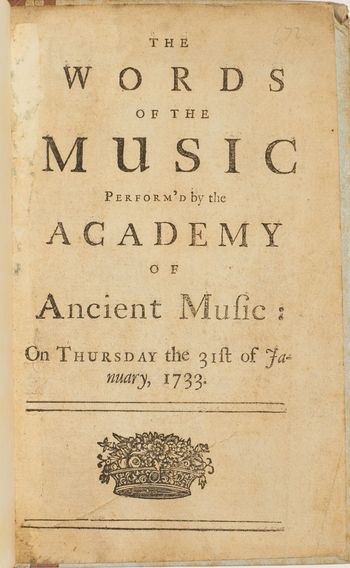
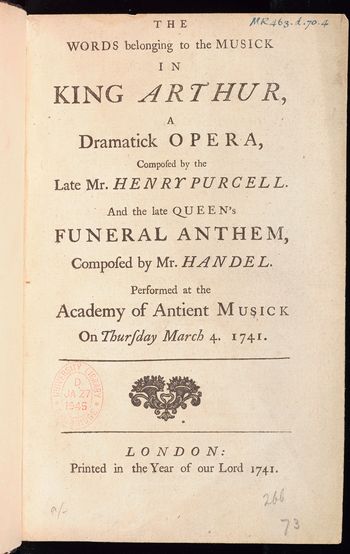
Among the memoranda of an Academy meeting held on 26 May 1731, there is one referring specifically to a ‘Publick Night’ at which ‘every Member [was entitled to] Introduce two Friends’; but, as no tickets were to be given out, ‘he must introduce them in Person’.Footnote 38 There is no suggestion, however, that there was any limit on the number of such occasions, so the frustrating problem of just how frequently they took place remains unresolved. Surviving programmes are normally octavo-sized wordbooks of between 8 and 12 pages whose contents are divided into three (later two) parts or ‘Acts’. Although these were obviously produced by a number of different printers, their format remains very much the same, with a front cover-page (dated) giving a clear indication of what lies therein, sometimes a named Handel oratorio, for example, or some catch-all title such as ‘Motets, Madrigals and Other Pieces’ (see Figures 2 and 3). And for all such miscellaneous programmes as these, the final item was invariably the three-voice canon, ‘Non nobis, Domine’, once thought to have been composed by William Byrd.Footnote 39
Academy of Ancient Music: programme of 31 January 1733/4, the first to survive. Copyright Gerald Coke Handel Foundation.

Academy of Ancient Music: programme of 4 March 1741/2 (MR463.d.70.4). Reproduced by kind permission of the Syndics of Cambridge University Library

While we have no printed programmes at all for the period between March 1767 and April 1774, a handwritten list of all the music performed by the Academy between 8 September 1768 and 30 May 1773 survives as MS Rés. F.1507 in the Bibliothèque Nationale in Paris.Footnote 40 This is an important source showing not only that weekly meetings were now held on successive Thursdays with a ‘Rehearsal Night’ 1 week followed the next by what is generally designated an ‘Academy Night’, but also that each of the two Acts was now almost always introduced by an instrumental item, generally a Handel overture at the start of Act 1, with a concerto (frequently one of Corelli’s Op. 6) at the start of Act 2. At this stage in its history, the Academy was giving between 17 and 22 concerts a year, with the season starting in September (or October) of one year and running on uninterruptedly to April or May (or, in one case, July) of the next. By 1785, however, that number had been reduced to 12, and in 1789 to 10, the start of the season now being deferred to mid-December. The following year, the number was still further reduced to eight, and then to seven in 1795. By this stage (the 1790s), it is by no means certain that all performances had the benefit of a preliminary rehearsal. The reason for this sudden decline in the fortunes of the Academy may confidently be attributed to the foundation, in 1776, of the Concerts of Ancient Music, a rival concert-giving body, which had the backing of the king (George III) and a band of blue-blooded aristocrats. Needless to say, the two have often been confused by later historians, as late even as 1980 in the first edition of New Grove.
According to Hawkins,Footnote 41 the ‘foundation’ of the Academy ‘was laid in a library, consisting of the most celebrated compositions, as well in manuscript as in print, that could be procured either at home or abroad’, and many of these items were, he says, ‘a votary donation from several of the members of the society’. As we have already seen, Messrs. Galliard and Needler were requested to produce a catalogue at that point in 1731 when the Academy of Vocal Music became the Academy of Ancient Music. At the same time, it was ordered that ‘a partition in ye Library be lock’d up by ye Secretary to keep all Original papers & letters relating to the Academy’ and also ‘that some method be thought on to Increase our correspondence abroad’. By 1784 when they moved from the Crown and Anchor to Freemasons’ Hall, the size of the library must, one imagines, have been very large indeed, and there it evidently occupied a separate room adjacent to ‘the Orchestra’.Footnote 42 Quite what happened to the library when, in 1802, the society folded is not entirely clear. Some items were sold at auction,Footnote 43 and others dispersed we know not how. By great good fortune, one fairly substantial chunk of the collection, some 60-odd manuscripts and a few prints, later found its way on to the shelves of the library at Westminster Abbey, where its connection to the Academy has only recently been recognized.Footnote 44
Bound in at end of Add. MS 11732 is a stray sheet (now folio 14) listing a number of pieces of which one or more parts were missing, and four others for which there was no score. From the fact that this sheet is undoubtedly in the hand of Maurice Greene, we may perhaps safely conclude that he was the Academy’s first librarian. Following his démarche in 1731, the post passed to Samuel Howard (1710–82), a hitherto somewhat shadowy figure in the musical history of eighteenth-century London.Footnote 45 In 1749, he was succeeded by the young Benjamin Cooke, then still a pupil of Pepusch, whose first act, in late September of that year, was to initiate a stock-taking of the library’s holdings and, on the front cover of each set of parts (or score) he examined, to record what had evidently gone missing over the years. A small number of manuscripts so marked are referred to in Appendix II of my article cited in note 44 and in a postscript published in Music & Letters 96 (2015), 159. There may well be others, as yet unnoticed, which are similarly inscribed with the date ‘26 [or 19] Septr. 1749’. As librarian, Cooke apparently gave way to Richard Bellamy in 1759, and he in turn to one William Thomson in 1770; later still, from 1790 on, the post was held by Samuel Arnold in association with Robert Smith, with Fierman Joseph Dorion (described by Doane as a tenor and music copyist) as their assistant.Footnote 46
Although we know who the early members of the academy were (see Appendix A for a list of those who subscribed in April 1730), the only later list to survive is that for the 1785–86 season, by which date most of them were, as the famous English tenor Michael Kelly tells us, ‘bankers and merchants from the city’.Footnote 47 So who then remained after Greene’s huffy exodus in 1731? Most obviously Pepusch, Galliard and the Revd Samuel Estwick among the founders, and so too (until 1734) Bernard Gates. Among the others were Henry Needler, John Immyns and Hawley Bishop, as well as Viscount Percival and possibly Francesco Geminiani, whose Op. 7 Concerti grossi (1746) are dedicated to the Academy.Footnote 48 But some such as William Croft and Nicola Haym had already joined the heavenly choir. One new member who was to become a very important figure in the life of the Academy from the early 1730s until the 50s, and whose name, rather curiously, does not appear on the earlier lists is John Travers (c.1703–58). Formally apprenticed to Maurice Greene in 1719, he attached himself very firmly to Pepusch on the expiration of his articles in 1726, in which year he was appointed organist of St Paul’s, Covent Garden. That he was already an accomplished composer is clearly evident from an orchestrally accompanied Te Deum and Jubilate of his written (he says) in 1724 and publically performed ‘with great Applause’ in 1729.Footnote 49 Under the direction of Pepusch Travers not only honed his skills as a stile antico contrapuntist but became a committed devotee of ‘ancient Musick’; his manuscript transcriptions include a host of sixteenth-century motets and madrigals and even some earlier vocal music by Cornyshe, Fayrfax and others from the Eton Choirbook.Footnote 50 He also acted as a copyist for Pepusch, and, while there is no evidence of his very distinctive hand among those Academy manuscripts now in the library of Westminster Abbey, he contributed the figuring of the bass and supplied words to the interior parts of one of the very earliest surviving scores of Steffani’s ‘Stabat mater’ (Lam MS 38).
An incomplete set of vocal parts for Steffani’s motet ‘Qui diligit Mariam’, specially written for the Academy, in the hand of the teenaged William Boyce and probably copied round about the same time, is to be found in the Fitzwilliam Museum, Cambridge, as MU MS 160. That both young men were active as copyists almost certainly prior to 1731 rather suggests that, as pupils of two of the Academy’s most prominent members, they were allowed to attend meetings without having to pay the normal half-yearly subscription of 10s 6d.Footnote 51 Unlike Travers, however, Boyce decamped to the Apollo with his master and his associates, and so composed no music for the Academy. Travers, on the other hand, wrote a very great deal for the society: motets, madrigals, anthems and canons galore, many of the latter on the Miserere (following the example of Byrd, Bull and Elway Bevin no doubt).Footnote 52 Several volumes of such pieces survive, many bearing dates in the 1730s, and some (such as Lgc MS G Mus 451) specifically headed ‘For the Academy of Ancient Music held at the Crown and Anchor in the Strand’. A Latin Te Deum headed ‘Canticum S. S. Ambrosii & Augustini, ex Meibomo … in usum Academiae Antiq. Musicae’ is dated 1742 at the end and is now in the library of Hereford Cathedral (MS 30.B.5B);Footnote 53 there is also a ‘Treatise on Harmonic Theory’, which recently passed through the London salerooms and is now MS 1407 in the Jean Gray Hargrove Music Library at Berkeley (US-BE).Footnote 54 Although Travers did not publish much, a charming set of Eighteen Canzonets for two and three voices appeared in 1746 with a dedication to Pepusch.Footnote 55 Published by subscription, the Academy took four copies and Pepusch himself six. That Greene conspicuously did not subscribe, as Travers did not to Greene’s magnum opus (Forty Select Anthems) in 1743, is a strong hint that, while the two men were by now colleagues as organists to the Chapel Royal, they were no longer intimate as friends.
When Pepusch died in July 1752, one might have thought that Travers was the obvious person to succeed him. But that was not to be. The man apparently chosen - although he was hardly yet a man - was the obviously gifted Benjamin Cooke (1734–93), the son of a London music publisher of the same name, who had, as an Academy chorister, been trained up by Pepusch himself.Footnote 56 By 1752, Cooke had already produced an organ concerto and at least the first of three instrumentally accompanied anthems, which must, we may suppose, have been heard by the Academy, although there is no evidence of this in the surviving programmes.Footnote 57 As it happens, there is some evidence bearing upon the succession bound in with the handwritten programmes now in Paris (Bibliothèque Nationale, MS Rés. F. 1507). Two sets of minutes of the ‘Committee for the Education of the Children & Management of the Academy of Antient Musick’ are worth mentioning here. On 26 October 1752, all six Managers (including Travers)Footnote 58 met to consider a matter of no particular consequence in the present context. Apparently, several persons ‘as well Professors as Students in Music’ who were not actually members had been turning up to meetings. It was thus resolved that, in future, ‘no Vocal or Instrumental Performers [should] be admitted without Application in Writing to, and leave obtain’d of the Committee’. The minutes of a meeting of the same committee 2 weeks earlier (on 12 October) are rather more relevant. These note that ‘Mr. Cooke having been appointed (on Thursday last the 5th Instant) to educate the Children in Musick for the Use of the Academy’, it was agreed ‘That He be allowed for for [sic] such Services Thirty Guineas per Ann[um]. He providing a proper Room for the Purpose[,] the said Salary to commence from the 21st Inst.’ It is clear from this that Cooke, unlike Pepusch, was not to be allowed an assistant. As a young man not yet 20, he can hardly have been expected to provide for them himself; the Academy must therefore have made some other arrangement for their domestic needs and personal welfare.
In 1761, the Academy published a small book containing The Words of such pieces as are most usually performed by the Academy of Ancient Music. A second slightly larger edition followed in 1768 and a further expanded version of the latter, not so far noticed bibliographically, came out later, most probably in 1775, in July of which year Cooke took a doctorate in music at Cambridge.Footnote 59 A corporate listing of the contents of all three editions organized alphabetically by composer forms Part III of the present work. In the meantime, Cooke had (in 1757) succeeded Gates as Master of the Choristers of Westminster Abbey, and his appointment as organist followed 5 years later on the retirement of John Robinson. Although Cooke is said by Laetitia-Matilda Hawkins, the often rather waspish daughter of Sir John, to have had ‘a taciturn disposition in general society’, he was otherwise, she claims, ‘one of the worthiest and best-tempered men that ever existed’.Footnote 60 He seems indeed to have been generally regarded as a thoroughly affable and easy-going man - too easy-going perhaps since, under his leadership, the Academy gradually lost its sense of direction and eventually to have run out of steam. One wonders if this might possibly have been one reason why, in an effort to drum up support, Hawkins was moved to publish his Account in 1770.Footnote 61 When, on a trip to London in May 1779, the retired lawyer, keen amateur musician and composer, John Marsh, paid his first visit to a meeting of the Academy, he was allowed, as a violinist, to take part in a performance of Handel’s L’Allegro. This shows that the performing membership at least was then still almost entirely amateur. The foundation of the Concerts of Ancient Music three years previously, however, changed everything. They had the means, it seems, to employ a professional choir and orchestra together with the leading solo singers of the day, and it was not long before the Academy felt obliged to follow suit. A notice printed in the Public Advertiser and some other London papers on 4 November 1780 urging subscribers to renew their subscriptions by 26 November at the latest ‘in order to ascertain what can or cannot be undertaken’ hints at something of a crisis in the Academy’s affairs.
According to Doane (80), a Committee was appointed in February 1783 ‘to examine the several Laws and regulations since the institution of the Academy, and prepare a new Code as agreeable to the original intention of its Founders as the present temper of the Times would admit’. This was put to a general meeting (and approved) the following March. Thus, from 1784 on, those who sang and played in its name were not themselves members of the Academy but employees, while those who subscribed (i.e., the official members) formed the audience. In April 1788, it was decided not only to admit women as members, but also to increase the number of subscribers to 280 and the subscription rate to five guineas. But this still did not solve the Academy’s problems. Matters came to a head in November of the following year when Dr Cooke was unceremoniously deposed and, following an election in which Thomas Dupuis was also considered, Samuel Arnold was appointed in his stead.Footnote 62 Although Cooke was clearly disinclined to contest the issue, he did not go quietly.
In a long self-justificatory address to such of the membership as cared to attend, he concludes with
cordial thanks [to the members] for having … releas’d me from a troublesome (and I must say) of late an ungrateful office: You, gents, have set me free from that chain which I wanted resolution to break, … and for this release I sincerely thank you and cheerfully acquiesce in your former decision, for tho I cannot applaud the means, I heartily rejoice in the event, and from this moment tho not before I cease to be an agent of this Society.Footnote 63
As Lot 135 in a Puttick & Simpson sale of 30 July 1873, Cooke’s ‘Protest sent to the Directors of the ‘Academy of Ancient Music’ was combined with ‘Mr. Warren’s Remarks on this shameful transaction’ and by a no means unfriendly letter from Arnold to Cooke dated 20 May 1790; also an autograph memoir, of Dr Cooke by his youngest son, Henry (1769–1840).Footnote 64
In 1873, all four documents in Leeds had belonged to ‘Mr. Warren’, i.e., Joseph Warren (1804–81), an important collector of and writer on music whose 1849 edition of Boyce’s Cathedral Music contains amplified biographies and extended work-lists of all the composers represented therein.Footnote 65 Although it is not clear exactly when Cooke delivered his address to the existing membership, the date of Arnold’s letter would suggest it must have been sometime in April or early May 1790. After 45 years devoted attention to the affairs of the society (as both man and boy), Cooke was deeply hurt by their seemingly underhand efforts to get rid of him. What would appear to have been the first sign of an impending crisis was the resignation on 24 May 1787 of the ‘Sub-Directors’ who claimed that there was ‘some Circumstance in the Course of their Management’ that had made it ‘impossible to continue any longer with Pleasure to ourselves’. Nevertheless the 1787–88 season went ahead as planned, and so too the one after that, although not without an emergency meeting being called ‘to investigate the affairs of the Concert’ whose ‘internal derangement’ and the fact that its directors, both old and new, ‘have been constantly at war with each other’ being reported in the Morning Post and General Advertiser of 13 January 1789.Footnote 66
Now regarded as a mere employee of the Academy, Benjamin Cooke evidently played no part in its management. Even so, it is difficult to imagine that he was totally unaware of, or impervious to, a general malaise among the membership. Kind-hearted and generally benevolent he may have been, but it is straining credulity to believe that he was quite so naive as to have had no inkling of what was going on behind his back. Nevertheless, the decision taken in November 1789 to reduce the number of performances and ‘to place them … more fully under the direction of a professional Gentleman of eminence’Footnote 67 evidently took him by surprise, and was the more hurtful in being conveyed to him via his eldest son Robert at a time when Cooke himself was apparently ill. In his later address to the society, he appeals - for the third time he says - for the return of certain of his own books and manuscripts; he also reveals himself to be greatly concerned for the future of the library and such instruments owned by the Academy as had earlier been placed in his care. Apropos the latter, he rather acidly remarks that if there should happen to be in his audience ‘any subscribing member, not of the musical profession who is able and willing to employ them for the general benefit, let such gentleman step forth and claim the use of them’. Although Arnold was at pains to deny any prior involvement in the affair, Cooke could not bring himself to believe that this was the case, and for some time afterwards the two men were estranged. Thus, when the ‘Graduates’ meeting designed to bring together socially all holders of B.Mus. and D.Mus. degrees resident in or near London was set up in November 1790 with Arnold as one of its founder members, Cooke refused to join.Footnote 68 But, subjected to repeated exhortations from Dr (later Sir) William Parsons, who had been one of his choristers at the Abbey, and from Arnold too it appears, Cooke eventually relented; and so, at the fifth meeting, on 22 June 1791, he too became a member, in readiness for the arrival of Haydn who, with an honorary doctorate from Oxford, was present at their eighth meeting on 26 October.
Of the final 12 years of the Academy’s history, little need be said. Although purely instrumental items had regularly found a place in their concerts from 1768 on (and possibly 1 or 2 years earlier still), the programmes of the 1780s and beyond, designed to compete with those of the Concerts of Ancient Music, became steadily more miscellaneous still and utterly dominated by the music of Handel. While odes, Te Deum settings and orchestrally accompanied anthems were normally performed complete, such extended works as Handel oratorios and Purcell masques were very rarely given in their entirety but reduced to ‘Select Parts’. Each Act opened with an overture, occasionally by Arne or Arnold but nearly always by Handel, and sometimes a symphony (or ‘Overture’) by Haydn, and each generally contained a second instrumental item placed midway through. The rest was a random selection of arias, duets, choruses and glees chosen by that member of the committee of management whose turn it was to act as ‘Director’ on the occasion and designed to please audiences whose attention span was obviously limited. Save for one or two old favourites, those madrigals and motets, like those instrumentally accompanied anthems and Latin psalm settings, which had been the Academy’s staple fare during the first 30-odd years of its existence were now a considerable rarity. Glees and songs by fashionable composers of the day were in the ascendant. Although late eighteenth-century members enjoyed the vocal talents of some of the leading singers of the day - Nancy Storace, Madame Mara, and the two Miss Abrams for example, as also Michael Kelly, plus James Bartleman and the best of the Chapel Royal men, all of whom performed at the Concerts of Ancient Music as well - the original intentions of the early academicians in respect of ‘such as lived before the end of the Sixteenth century’ had long since been forgotten. While the Academy, it appears, had every intention of carrying on, its performance on 22 April 1802 was to prove its last, and following the death of Samuel Arnold 6 months later, the committee of management must have decided to call it a day.
PART II: Surviving programmes and other references to music performed by the Academy
The Academy’s early printed programmes (the first of which to survive is dated 31 January 1734) were octavo-sized pamphlets normally containing between 8 and 12 pages of text. These were evidently issued for the benefit of the audience at what would appear to have been an annual ‘Publick Night’ held once each season, a season being the period between the autumn of one year and the late spring or early summer of the next. A printed programme apart, quite how such occasions differed from the ordering of what is normally described as an ‘Academy Night’ is by no means clear, but it seems to have been a meeting at which members might each introduce two guests. Although the size of the audience may have been somewhat larger than usual, the number of printed programmes required must still have been relatively small. Whether or not it is because so few were printed or that most of them were disposed of shortly after the event we do not know, but the number to survive is surprisingly few. By great good fortune; however, a handwritten list of all the music performed by the Academy during the 5-year period between September 1768 and May 1773 does survive as MS Rés. F. 1507 in the Bibliothèque Nationale in Paris. Printed wordbooks start to appear again in 1774 and continue sporadically thus until, some 10 years later, the Academy became a concert promoting society just like the Concert of Ancient Music (founded in 1776). The membership was now made up entirely of auditors while the performers were all paid professionals with no say in the running of the institution. From 1786, and possibly a year or two earlier, coincident with the Academy’s move from the Crown and Anchor to Freemasons’ Hall, their fortnightly concert programmes were all printed, and occasionally survive en bloc for an entire season.
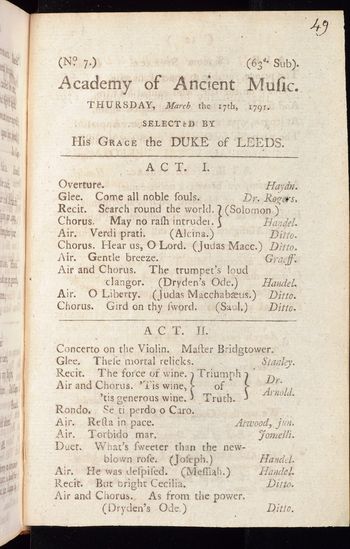
The front page of the wordbooks produced during the earlier part of the Academy’s history is always a title page which, in the case of programmes made up of a number of works of various kinds, would normally read as follows: ‘Motets, Madrigals and Other Pieces’ performed by the Academy of Ancient Music on such and such a date. But when, as on 10 May 1739, for instance, the programme was focussed on one or two works only, in this case Handel’s ‘Song of Moses’ and the Funeral Anthem for Queen Caroline, the title page would be more specific, and the same is true of those wordbooks/libretti issued for a single work, almost invariably a Handel oratorio (compare Figures 2 and 3). Later wordbooks, from the l780s on, are made up of many short items and were rather more cheaply produced; here, the front page offers no more than an abbreviated digest of the entire programme and titles, often reduced to two or three words only, have in most cases been silently expanded. Inside, from 1785 on, the names of the soloists are usually given, which is never the case with the earlier programmes; these do, however, always provide an English translation of texts originally in Latin or Italian, which the later ones do not (Figure 4). Ten years later on the format changed again, and the abbreviated digest on the front page was replaced by a list of the principal performers, not just the vocal soloists but the first desk players in the orchestra too. Towards the end of what follows, I have also included a certain amount of occasional press comment drawn from late eighteenth-century London papers.
Academy of Ancient Music: programme of 17 March 1791 (MR455.d.75.3). Reproduced by kind permission of the Syndics of Cambridge University Library.

In transcribing these programmes for publication here, spelling, punctuation and capitalization have generally been rationalized, and composers’ names are given in their usual form: thus ‘Byrd’ rather than ‘Bird’ and ‘Purcell’ with two Ls rather than one. So too with the word ‘motet’ which, in the sources, is almost invariably spelled ‘motett’. A rare exception concerns the composer Giuseppe Sammartini (1695-1750), who is nearly always referred to simply as ‘Martini’.Footnote 69 And so too with Palestrina who, in early eighteenth-century England, almost always goes under the name of ‘Prenestini’ or ‘Praenestinus’; likewise, the seventeenth-century Portuguese composer Duarte Lobo (d.1646) is generally referred to in English sources as ‘Eduardi Lupi’. For works by Handel and Purcell, HWV and Z numbers have been added in square brackets, those for Handel referring to Bernd Baselt’s great thematic catalogue of the complete works (three volumes, Leipzig, 1978–86), and those for Purcell to Franklin Zimmerman’s analytical catalogue of the composer’s music (London, 1963). All material in square brackets is editorial, and abbreviations used regularly throughout Parts II and III are as follows:
- AAM
-
Academy of Ancient Music
- Cul
-
Cambridge University Library. The pressmark of programmes formerly in the Pendlebury Library is MR455.d.75.3 and that of programmes formerly owned by Christopher Hogwood MRS.33.1
- En
-
Edinburgh, National Library of Scotland
- F-Pn
-
Paris, Bibliothèque Nationale, pressmark MS Rés. F. 1507
- Lam
-
London, Royal Academy of Music
- Lbl
-
London, British Library, pressmark 1042 i.8 (available online via ECCO)
- Lcm
-
London, Royal College of Music, pressmark XIII. A. 10
- Lfom
-
London, Foundling Museum (Gerald Coke collection)
- Lgc
-
London, Guildhall Library (Gresham collection)
- Lwa
-
London, Westminster Abbey Library
- LEc
-
Leeds Public Library, pressmark R.780.73 Ac 12
- Ob
-
Oxford, Bodleian Library
- HDJ
-
H. Diack Johnstone, ‘Westminster Abbey and the Academy of Ancient Music: A Library once Lost and now Partially Recovered’, Music & Letters, 95 (2014), 329–73.
In the following list of programmes, works marked with an asterisk (*) were included in the first (1761) edition of The Words of such pieces as are most usually performed by the Academy of Ancient Music, and those marked with a dagger (†) were added to the second (1768) edition. A later reissue of the second edition (c.1775) contains a further 30 items, 13 of which are by Benjamin Cooke (who took a doctorate in music at Cambridge that year). Copies of this later reissue, hitherto unrecognized bibliographically speaking, are very rare, and I have so far come across only two: one in the Bodleian Library, Oxford (Douce M. 640), the other in the Bibliothèque Nationale in Paris (Rés. V.S. 1423). Items peculiar to this later source are here marked with a plus sign (+). An edited transcript of all three editions, its content arranged alphabetically by composer, forms Part III of this article and the same sigla are used there too.
1726
Friday, 7 January 1726
At this, the inaugural meeting, the following pieces were performed:
-
Marenzio: Madrigal a5, ‘Dolorosi martir, fieri tormenti’*
-
Marenzio: Madrigal [a5], ‘Giunto a la tomba’
-
Morley: Motet a6, ‘De profundis’
-
Stradella: Madrigal [a5], ‘Piangete occhi dolente tanto’*
-
Steffani: Madrigal a5, ‘Gettano i re dal soglio’*
-
Stradella: Madrigal a5, ‘Clori, son fido amante’*
Source: A manuscript in the hand of the Revd Sampson Estwick, a founder member; now GB-Drc MS Mus. E. 15, folio 6
Note: A much later setting of ‘De profundis’ most probably composed for the Academy by Francesco Barsanti (1690-1772) survives as part of Lwa MS CJ 1 and was later published as no. 4 of his Sei Antifona (1760).
Friday, 30 December 1726
The madrigal ‘Gettano i re dal soglio’ by Steffani was sung three times.
Source: A letter of 31 December from Giuseppe Riva, the Modenese envoy in London (and a member of the Academy) to Steffani partially quoted by Franz Wilhelm Woker in ‘Der Tondichter Agostino Steffani’, Der Katholik, 67 (1887), and in full by Lowell Lindgren and Colin Timms in their article cited in Part I note 18. Bononcini apparently sang the bass part in the madrigal (which was, Riva says, sung three times), and Steffani’s duet ‘Saldi marmi, che coprite’ (described as ‘sublime and divine’) was also performed; so too were some unspecified madrigals by Marenzio and one by Bononcini.
1727
Friday, 28 April 1727
Robert Hassell, writing from London to Robert Cotesworth on Thursday (27th), says he is hoping to hear ‘a Dantzicker [sic] come to town that is a prodigious player of the German Flute and generally reckoned the very first man in the World at our Club tomorrow night’. A second letter of 10 May makes it clear that this was Johann Joachim Quantz (who had only recently arrived in England for a ten-week visit), and, having heard him, he reports that ‘It is impossible to tell you how I was pleased, … he outplays all other players of the German Flute as much as Robin the Piper outplays the meanest Piper in Northhumberland’.
Source: Edward Hughes, North Country Life in the Eighteenth Century, vol. 1, The North-East, 1700-50 (London, 1952), 384–5.Note: Although ‘our Club’ would seem most likely to have been the Academy, it should be noted that Hassell is not included in the list of members recorded in Lbl Add. MS 11732.
1729
Thursday, 16 January 1728/29
‘At night I went to the Crown tavern to hear the musick which the Gentlemen of the King’s Chapel have every fortnight there, being an attempt to restore ancient church musick’. This, being a Thursday, must have been what was later known as an ‘Academy’ night.Source: John Perceval, Manuscripts of the Earl of Egmont: Diary of Viscount Percival afterwards first Earl of Egmont, 3 vols. (Historical Manuscripts Commission, 63) (London, 1920-23), iii, 328.
Note: Percival was admitted a member a fortnight later, on Friday, 31 January (Diary, iii, 342). The ‘Vocal Club’, he says, ‘was composed of the Quires of St Paul’s and the King’s Chapel, with some masters of musick and gentlemen besides, who perform on musical instruments’. The presence of instrumentalists among the membership is confirmed by the names of the subscribers to the Sixth Subscription levied, almost certainly, some time towards the end of 1728.
Thursday, 4 December 1729
Mrs Delany (then Mrs Pendarves) went with Mrs Percival and Miss Donellan to hear music by Blow and Purcell at ‘the Crown in the Strand’; she was ‘very well pleased with the solemnity of it’. That the ‘vocal part’ was, she says, ‘sung ‘by the King’s choir’ suggests that at least one or two items on the programme had instrumental accompaniment.
Source: Mary Delany, Autobiography and Correspondence of Mary Granville, Mrs Delany, ed. Lady Llanover, i (1861), 228.
Note: With ladies present, it is just possible that this was one of the first ‘Publick Nights’ which appear to have taken place annually from an early date. Mrs Percival was almost certainly the wife of Philip Percival, the younger brother of Viscount Percival who became a member of the Academy in April 1728.
1730
Friday, 13 February 1730
A Te Deum and other works by Maurice Greene were rehearsed; these, said Viscount Percival, ‘show him to be a great composer, and to tread in the steps of the Italian masters’. Presumably Greene’s Te Deum was heard again at the ‘Academy Night’ the following Thursday.
Source: Manuscripts of the Earl of Egmont: Diary of Viscount Percival afterwards first Earl of Egmont, i, 46.
Note: The Te Deum is most likely to have been the setting composed to celebrate the King’s return from Hanover in October 1729 (now Ob MS Mus. d. 41). On Thursday, 9 April 1730, Viscount Percival went with his wife ‘to the vocal concert at the Crown, which much diverted her, although the best voices were absent’. He does not, however, say what music was performed. He went again on 23 April.
Thursday, 19 November 1730
Maurice Greene’s ‘Ode for St Cecilia’s Day’, written for the opening of the new Senate House in Cambridge on 6 July, had its first London performance ‘before a numerous Audience of Nobility and Gentry’ at the Crown and Anchor Tavern in the Strand. According to the papers, it was performed ‘by the best Masters from the Opera House’ together with several Gentlemen of the Chapel Royal and the choir of St Paul’s Cathedral.
Source: The Daily Post-Boy of 20 November 1730 and the next day’s London Journal (the latter by courtesy of Lowell Lindgren).
Note: Although the Academy is not actually mentioned, this (being a Thursday and only three days short of St Cecilia’s day) may have been one of its official ‘Publick Nights’. Viscount Percival, who was there, described it (Diary, i, 209) as ‘an excellent concert of music to which we invited the Duke of Loraine’.
1731
Thursday, 14 January 1731
‘at the Academy of Vocal and Instrumental Musick, Mr. Gates, Master of the Children of the Chapel Royal being Director for the Night, and a numerous Assembly of Nobility and Gentry being present) were performed, with universal Applause, the following Compositions:
-
1. A Madrigal for 5 Voices, by Abbot Stefani [sic], late President of the Academy.
-
2. A Piece of Vocal and Instrumental Musick by Sig. Faux [Fux], Chapel Master to the Emperor.
-
3. A Madrigal for 5 Voices, by Sig. Antonio Lotti, Chapel Master to the Doge of Venice.
-
4. Mr. Handell’s ‘Great [i.e., ‘Utrecht’] Te Deum and Jubilate’ [HWV 278 & 279].
Source: The Daily Journal of 16 January 1731 (and in several other London papers as well).
Note: The Steffani madrigal a5 has to have been ‘Gettano i re dal soglio’ which had been specially composed for the Academy and the Lotti ‘In una siepe ombrosa’, the latter a piece which had earlier been introduced (seemingly by Maurice Greene) as the work of Bononcini, and this may indeed have been the occasion on which the true authorship of the piece was first revealed. It was the scandal of Bononcini’s apparent plagiarism (which, having been exposed, he later refused to retract) that led to the breakup of the Academy of Vocal Music not long afterwards. Greene promptly resigned (taking the boys of St Paul’s Cathedral with him) and so too did several other of his supporters. In the words of Viscount Percival, ‘the best of our Vocal performers went off with Mr. Green the Humpback,Footnote 70 … the chief undoubtedly of our English Composers now living’. The remaining members carried on, however, and by the end of May, they had become the Academy of Ancient Music with Dr Pepusch as its moving spirit.Footnote 71 For a detailed account of the affair, see the Diary of Viscount Percival under date of 31 August 1731 (i, 201-2); also Handel Documents, ed. Donald Burrows et al., i, 459. The score of a Mass in G minor for four voices and six-part strings now part of the residue of the Academy’s library (Lwa MS CG 17) might possibly have been the piece by Fux performed on this occasion; it is no. 32 in Köchel’s thematic catalogue of the works of Fux (Vienna, 1872/R1974).
Thursday, 13 May 1731
Viscount Percival returned from his home in the country ‘to hear a public performance of the Vocal Club’ [i.e., the Academy]. He does not, however, tell us what the music was, and the same is true of nearly all the other Academy performances he attended.
Source: Diary of Viscount Percival, i, 190. When Percival refers, as usually he does, to a Thursday meeting being a ‘public night’, we take it that what he means is what was elsewhere referred to an ‘Academy Night’ as opposed to the Friday ‘Rehearsal Night’ (which was private). During the period 1768-73, one Thursday performance a year (normally an ‘Academy Night’) was officially designated a ‘Publick Night’, but whether this custom dates back to 1731 is by no means clear.
1732
Friday, 3 March 1732
Handel’s oratorio ‘Esther’ was privately performed by the Academy of Ancient Music at the Crown and Anchor Tavern in the Strand. This was only its third performance, the two earlier ones having been given there by the members of the Philharmonic Society on Wednesdays 23 February and 1 March. Its first public performance took place in the Great Room in York Buildings, Villiers Street, on Thursday, 20 April. Viscount Percival was present at the first performance on 23 February; ‘This oratoria [sic] or religious opera’, he says, ‘is exceeding fine’.
Note: For details, see O. E. Deutsch, Handel: A Documentary Biography (London, 1955), 285-6 and 288; also Winton Dean, Handel’s Dramatic Oratorios and Masques (1959), 204 and Handel Documents, ed. Donald Burrows et al., ii, 497-8.
1733
Thursday, 22 February 1733
After dining at home, Viscount Percival took five guests to ‘the vocal concert … it being a public night’. As usual, however, there is no mention of the music performed.
Source: Diary of Viscount Percival, i, 337.
1734
Thursday, 31 January 1733 [O.S., actually 1734]
First Act
-
Prenestini [Palestrina]: Psalm a4, ‘Sicut cervus’*
-
Marenzio: Madrigal a4, ‘Dissi a l’amata mia lucida stella’*
-
Colonna: Psalm a5 with instruments, ‘Domine ad adjuvandum’
Second Act
-
Petti: Madrigal a5, ‘Cruda Amarylli’
-
Colonna: Psalm a5 with instruments, ‘Lauda Jerusalem Dominum’*
-
‘Edoardi Lupi’ [Duarte Lobo]: Motet a6, ‘Audivi vocem de coelo’*
Third Act
-
Prenestini: Psalm a5, ‘Exaltabo te, Domine’*
-
Marenzio: Madrigal a5, ‘Perche di pioggia’*
-
Colonna: [Latin] Magnificat a5 with instruments
-
Byrd: [Canon a3] ‘Non nobis, Domine’*Footnote 72
Source: LEc; another copy in Lfom. This is the first of the Academy’s printed programmes to survive (see Figure 2). The copy in Lfom has a pastedown over the empty space at the foot of the last page (p. 8); this contains the words of Palestrina’s ‘Salvator mundi’ (with parallel English translation), and this it attributes to ‘J. P. A. Prænestinus’ whereas the composer of item one is named as ‘I. P. Alois. Prenestini’. The latter is here inscribed ‘Sr John says Palestrina & is very fine’ while item two (the Marenzio) is described as ‘one of his best’. Might the ‘Sr John’ referred to here be Sir John Dolben (1684–1756), an early member of the Academy whose subscription appears to have lapsed in 1728 (see Appendix A).
Note: Viscount Percival (describing this as ‘a public meeting of the Vocal Society’) was present and says the room ‘was much crowded’ (Diary, ii, 19); as usual, however, he makes no mention of the music performed. Scores of two five-part Magnificat settings by Colonna, formerly in the library of the Academy, survive in the library of Westminster Abbey (as MSS CG 65(a) and 65(d)); so too does ‘Lauda Jerusalem Dominum’ (as CG 61(a)). His ‘Domine ad adjuvandum’ (also formerly in the AAM library) is now Lwa MS 151; see HDJ for further details. A manuscript copy of ‘Dissi a l’amata’ forms part of a large collection of English and Italian madrigals copied for the Academy by Francesco Barsanti some 20 or 25 years later (Lwa MS CG 59). A much later setting of ‘Lauda Jerusalem’ composed, most probably for the Academy by Barsanti (1690-1772), forms part of Lwa MS CJ 1 and was published as no. 5 of his Sei Antifone, Op. 5 (c.1760).
Thursday, 19 December 1734
Part the First
-
Victoria: Motet a5, ‘Ascendens Christus’*
-
Marenzio: Madrigal a5, ‘Perche di pioggia’*
-
Prenestini: Motet a5, ‘Illumina oculos meos’*
-
Lorenzani: Anthem to the Virgin Mary a5 with instruments, ‘Regina caeli laetare’*
Part the Second
-
Pepusch: Motet a5, ‘Beatus vir’*
-
John Farmer: Madrigal a5, ‘Cease now thy mourning’*
-
Prenestini: Motet a5, ‘Elegerunt apostoli Stephanum levitam’*
-
Colonna: Psalm a4 with instruments, ‘Laudate pueri’
Part the Third
-
‘By an unknown Composer in Dr. Pepusch’s Library’: Motet a4, ‘Senex puerum portabat’* [Described in the 1761 wordbook as ‘An antient Riddle on St Christopher’s Day. The Author unknown’.]
-
Morley: Madrigal a3, ‘Where art thou, wanton’*
-
Prenestini: Motet a4, ‘Angelus Domini descendit’*
-
Charissimi [sic]: The Judgment of Solomon, ‘In the Manner of an Oratorio. The Interlocutory Part chiefly taken from the Third Chapter of the First Book of Kings’ [‘Judicium Salomonis’]*
-
Byrd: Canon a3, ‘Non nobis, Domine’*
Source: LEc; also a copy (ex libris Edmund Gibson, Bishop of London) formerly in Sion College Library ([P] 43.E.1.10) but transferred to Lambeth Palace Library in 1996 (see also 1 May 1735).
Note: A score of the Lorenzani ‘Regina caeli’, formerly in the library of the Academy, is now in Oxford (Ob Tenbury MS 543) while Colonna’s ‘Laudate pueri’ and Carissimi’s ‘Judicium Salomonis’, also from the AAM library, are now in the library of Westminster Abbey as MSS CG 12 and CG 10 respectively (see HDJ). The score of CG 10 is headed ‘Brought in for Dr: Pelling 1731 as manager’ and, written at the end, is ‘out of mr: Estwick’s collection with alterations’. The ‘Estwick collection’ referred to is almost certainly Ob MS Mus. c. 590, a manuscript containing not only Judicium Salomonis and Jephtha but also a Carissimi mass a4 all in Estwick’s hand. There is a copy of Palestrina’s ‘Elegerunt apostoli’ in the hand of Henry Needler in Lwa MS CG 60.
1735
Thursday, 27 February 1735
According to Viscount Percival, the programme contained ‘the famous Miserere of Allegri, forbid to be copied out or communicated to any under pain of excommunication, being reserved solely for the use of his [the Pope’s] chapel, was sung, being brought to us by the Earl of Abercorn, whose brother contrived to obtain it’. Among the performers were, he says, 19 voices, 12 violins and 5 basses.
Source: Diary of Viscount Percival, ii, 155. In a letter of 14 April 1743 to Horace Mann, Horace Walpole (who was not known for his knowledge of or interest in music) refers to ‘the Miserere of Rome’ as the ‘finest piece of vocal music in the world’.
Note: Viscount Percival attended another meeting of the Academy on Thursday, 8 May ‘where we had vocal music, and among the rest a full piece in the ancient style composed by my brother Percival’ (ibid., ii, 175). Philip Percival played the violin and viola and was something of an amateur composer as well.
Thursday, 1 May 1735
Part the First
-
Mouton: Motet a4, ‘Miseremini mei’*
-
Morley: Madrigal a3, ‘Cease mine eyes’*
-
Bassani: Litany a8: ‘Kyrie eleison’*
Part the Second
-
Sig. Anon. Lotti [who is said to be ‘a member of this Academy’]: Magnificat a4
-
Lupi [Duarte Lobo]: Motet a5, ‘Pater peccavi’*
-
Carissimi: ‘Jephthah’s vow in the manner of an Oratorio* … this piece being originally designed for voices only, the Instruments are added by Dr. Pepusch’
Part the Third
-
Marenzio: Motet a4, ‘Quem dicunt homines’*
-
Palestrina: Madrigal a5, ‘Ogni loco mi porge doglie, e pianto’*
-
Bassani: Motet a4 with Instruments, ‘Iam exulta’*
-
Byrd: Canon a3: ‘Non nobis, Domine’*
Source: Sion College Library [P] 43. E 1.11). This reference I owe to Tim Eggington. This copy [ex libris Edmund Gibson, Bishop of London] was transferred to Lambeth Palace Library in 1996; one wonders in what capacity Gibson was there, presumably as an auditor.
Note: A copy of the Bassani Litany in the hand of Mark Cottle, an early member of the Academy - he joined in April 1728 - is now Lwa MS CG 61 (b); so too (as MS CG 61 (c)) is Bassani’s ‘Iam exulta’, a set of instrumental parts for which (two violins and bass) was sold at a Sotheby sale on 3 December 2008. It must be this performance of the Bassani Litany which is referred to in an anti-Catholic diatribe published in The Old Whig or The Consistent Protestant of 13 November 1735; not only is the Academy named as having promoted this ‘great Indecency to the National Religion’ but the full text in both Latin and English is included in order to drive the point home. This reference I owe to the late Anthony Hicks. As the final resting place of a substantial chunk of the Academy’s celebrated library, Westminster Abbey also holds a copy of Pepusch’s arrangement of Carissimi’s Jephtha with instrumental parts in his hand (MS CG 29 (b)); three Magnificat settings by Lotti are also there (as MS CG 23). For details, see HDJ. A second copy of Carissimi’s Jephtha also from the library of the Academy is the first item in Lwa MS CG 63.
1736
Thursday, 22 April 1736
A programme including another performance of the Allegri ‘Miserere’.
Source: Diary of Viscount Percival, ii, 262.
Note: Although Purcell’s King Arthur was among the works ‘most usually performed’ by the Academy of Ancient Music, the performance that Thomas Gray heard on Friday, 2 January 1736, was given not by them but by the Company of Comedians at the New Theatre in Goodman’s Fields (information kindly supplied by Sandra Tuppen).
1737
Thursday, 27 January 1736 [O. S.]
Part the First
-
Praenestinus: Motet a4, ‘Magnum haereditatus’*
-
De Macque: Madrigal a5, ‘Nei vostri dolci baci’*
-
Lasso: Motet a4, ‘Parce mihi, Domine’*
-
Sigr Ruggiero Fedeli: Motet a5 with instruments, ‘Gloria in excelsis’
Part the Second
-
Praenestinus: Motet a4, ‘Salvator mundi’*
-
Ruffo: Madrigal a5, ‘Vaghe luci serene’*
-
Lasso: Motet a4, ‘Peccavi, quid faciem tibi’*
-
Pepusch: Anthem a4 with instruments, ‘O give thanks unto the Lord’*
-
Byrd: [Canon a3], ‘Non nobis, Domine’*
Source: Lcm
Note: A score of the Fedeli ‘Gloria’ formerly in the library of the Academy is now in the library of Westminster Abbey (MS CG 15) and that of the Pepusch anthem in the Bodleian Library, Oxford, as Tenbury MS 620; see HDJ for details. A copy of the Lassus motet, ‘Parce mihi’, in the hand of Henry Needler, a leading member of the Academy during this period is in Lwa MS CG 21 and both Palestrina motets are included in a large collection of mainly English and Italian madrigals copied for the Academy by Francesco Barsanti some twenty years later (MS CG 59).
Friday, 29 April 1737
A concert of music ‘Antient and Modern’ for the benefit of Dr Pepusch took place at the Crown and Anchor Tavern and was attended by Viscount Percival. There is no suggestion that it was sponsored by the Academy however, and as Percival makes no mention of ‘the club’, it seems almost certain that it was not.
Source: The London Stage, Part 3, ii, 664; see also the Diary of Viscount Percival, ii, 396.
1738
Thursday, 26 January 1738
After a meeting of the Royal Society, Viscount Percival went ‘to the Vocal Club, where I introduced Sir John Evelyn for my auditory member’ (Diary, ii, 462).
Thursday, 23 March 1737 (O. S.)
Part I
-
‘Supposed to be of Victoria’: Motet, ‘O Domine Jesu Christe’*
-
V. Ruffo: Madrigal, ‘Vaghe luci serene’*
-
[Anon.]: Motet, ‘Anima mea’* (composer ‘Unknown’)
-
Lotti: ‘Confitebor tibi, Domine’
Part II
-
Handel: Te Deum [in A, HWV 282]
-
Tallis: Lamentations [a shortened version]*
-
Stradella: Madrigal, ‘Clori, son fido amante’*
[Part III]
-
Palestrina: Motet, ‘Magnum haereditatis’*
-
Handel: Coronation Anthem, ‘Zadock the priest’ [HWV 258]*
-
Byrd: Canon [a3], ‘Non nobis, Domine’*
Source: F-Pn (Rés. V.S. 938)
Note: A score of the Lotti ‘Confitebor tibi’ formerly in the Academy’s library is now Lwa MS CG 67; see HDJ. In an early eighteenth-century MS collection of madrigals and motets also ex libris AAM (now MS CG 63), the motet ‘Anima mea liquefactus est’ is attributed to ‘Jo: Baptista’ (as it is also in Ob MS Mus. Sch. c. 9 from which it may perhaps have been copied).
1739
Thursday, 18 January 1738 [O. S.]
-
Handel: Mr. Dryden’s Ode for St Cæcilia’s Day [a.k.a. Alexander’s Feast]*
Source: En (BH Lib. 61); also F-Pn (Rés. V.S. 790)
Note: Viscount Percival was present on the occasion: ‘I went at night to a public meeting of the vocal music club at the Crown Tavern, where the famous oratorio of Hendel, called “The Feast of Alexander,” was performed by the gentlemen of our club.’ (Diary, iii, 5; see also The London Stage, Part 3, ii, 755). The wordbook is most unusual in listing two instrumental items included in the performance: a Concerto for Harp, Lute, Lyricord and other Instruments [HWV 294] after the recitative ‘Timotheus plac’d on high’ and a Concerto for two Violins, Violoncello, &c. [HWV 318] at the start of Act II. In the F-Pn copy, however, these have been crossed out in ink. Two nights earlier Viscount Percival had also been at the premiere of ‘Hendle’s [sic] new oratorio called Saul’.
Thursday, 10 May 1739
-
Handel: The Song of Moses*
-
Handel: Funeral Anthem for Queen Caroline, ‘The ways of Zion do mourn’*
Source: LEc; another copy in Lfom.
Note: The ‘Song of Moses’ forms the second part of the oratorio Israel in Eygpt (HWV 54) and the Funeral Anthem for Queen Caroline (HWV 264) was to become part one later in the year. Both are in the Academy’s 1761 wordbook, and there is a manuscript copy of the oratorio, hitherto unmentioned in print, in the hand of the Handel scribe S2 in the residue of the Academy’s library (now Lwa MS CG 49); see HDJ. It should be noted that this programme and that of 18 January are the only ones to be printed within a single season prior to the 1780s. It is just possible therefore that it was not only for the seemingly annual ‘Publick Nights’ that these printed programmes were produced.Footnote 73
Friday, 23 November 1739
-
Handel: Alexander’s Feast* [HWV 75]
Source: A lost MS Memorandum Book sold by Puttick and Simpson on 29 April 1873 (from the library of ‘A Professor recently deceased’). Being a Friday, this would have a ‘rehearsal night’ (members only).
1740
Thursday, 27 March, 10 and 24 April 1740
-
Handel: the first two acts of Saul [HWV 53]
Source: The same lost Memorandum Book as is mentioned in the entry above. A copy of the wordbook for 24 April is now in the British Library (pressmark 1344.n.14) and readily accessible on ECCO; there are other copies in En and the Folger Shakespeare Library, Washington, D.C. (161.011 q.). As Schoelcher points out (205), the 24 April libretto has seven pieces (marked with an asterisk) which were left out in the performance.Footnote 74
1742
Thursday, 4 March 1741 [O. S.]
Parts I and II
-
Purcell: King Arthur * [Z.628]
Part III
-
Handel: Funeral Anthem for Queen Caroline (‘The ways of Zion do mourn’)* [HWV 264]
Sources: Wordbooks in Cul, En, LEc and the Folger Shakespeare Library, Washington, D.C.
1743
Thursday, 24 February 1742 [O. S.]
-
Handel: Esther* [HWV 50]
Sources: Lbl 1505/685; also En and LEc. The British Library copy is available online via ECCO.
Note: This is said by Winton Dean (Handel’s Dramatic Oratorios and Masques, 205) to be the Cannons version.
Also performed some time in 1743, quite possibly by the Academy, was a Birthday Ode for the Princess of Wales (‘Hail glorious sacred happy day’) by John Travers (Lcm MS 1031).
1744
Thursday, 16 February 1743 [O. S.]
-
Handel: Messiah [HWV 56]
Source: Lfom; also in F-Pn (Rés. V.S. 941)
1745
Thursday, 17 January 1745
-
Purcell: King Arthur * [Z.628]
Source: Diary of Viscount Percival, iii, 306
Note: Presumably performed in conjunction with something else as on 4 March 1742. A MS score copied by John Travers, a prominent member during the 1730s and 40s, may well represent the version performed; it is now Ob Tenbury MS 338. Somewhat curiously perhaps Percival is still referring to the society as ‘the Vocal Academy of Music’, but the music, he says, ‘was well performed’.
Thursday, 25 April 1745
-
Defesch: Joseph. A Dramatic Oratorio
Source: The wordbook of a performance by the AAM is listed in A Catalogue of XVIIIth Century Verse compiled by Percy J. Dobell (1933); see item 3101 in catalogue no. 133. Love and Friendship, a serenata by Defesch performed at the Crown and Anchor Tavern in the Strand ‘with universal Applause to a very numerous and polite Audience’ on 21 March is, however, very unlikely to have been promoted by the Academy since this was a Wednesday. Copies of the wordbook for Joseph survive in the London Library, LEc and the New York Public Library (Drexel 5720.12).
Note: The wordbook is the only one among those of this period to have an imprint (London: Printed by W. Strahan in the Year M.DCC.XLV.) but this is simply because it was obviously printed from the same standing type as Strahan’s wordbook for the Covent Garden premiere on 25 March 1745.
1746
Thursday, 24 April 1746
Part the First
-
I. P. A. Praenestinus: Motet a5, ‘Angelus Domini descendit de coelo’*
-
Travers: Canzonet a3, ‘Old I am, yet can (I think)’
-
Purcell: The Indian Queen, Act v* [Z.630]
Part the Second
-
‘Edvardi Lupi’ [Duarte Lobo]: Motet a4, ‘Kyrie-Christe-Kyrie’*
-
Morley: Madrigal a4, ‘Say, gentle nymphs’*
-
Pepusch: Magnificat [with instruments]†
Part the Third
-
Victoria: Motet a4, ‘Quam pulchri sunt’*
-
Byrd: Madrigal a3, ‘The eagle’s force’*
-
Handel: [‘Dettingen’] Te Deum [HWV 283]
-
Byrd: Canon [a3], ‘Non nobis, Domine’*
Sources: Lbl (1042.i.8 (2)), En and F-Pn (Rés. V.S. 936)
1747
Thursday, 30 April 1747
Part the First
-
Victoria: Motet a4, ‘Quam pulchri sunt’*
-
Morley: Madrigal a3, ‘Where are thou, wanton?’*
-
Pepusch: Anthem a5 with instruments, ‘Blessed is the man that feareth the Lord’*
Part the Second
-
Handel: [extracts from] Messiah [nos. 2-5, 27-32 and 44 in the Watkins Shaw edn]
Part the Third
-
Handel: [‘Dettingen’] Te Deum [HWV 283]
-
Byrd: Canon [a3], ‘Non nobis, Domine’*
Source: F-Pn (Rés. V.S. 934)
Note: A copy of the Pepusch anthem with verbal additions in the hand of John Travers is now part of Lam MS 87.
1749
Thursday, 6 April 1749
Part the First
-
Croft: Anthem a4, ‘We will rejoice in thy salvation’*
-
Travers: Canzonet a3, ‘Soft Cupid, wanton am’rous boy’†
-
Handel: Coronation Anthem, ‘Let thy hand be strengthened’ [HWV 259]*
Part the Second
-
Lassus: Motet a4, ‘Parce mihi, Domine’*
-
Allegri: Motet a5, ‘Miserere mei, Deus’*
-
Pergolesi: Motet a5 with instruments, ‘Confitebor tibi, Domine’
Part the Third
-
Pepusch: Magnificat [with instruments]†
-
Byrd: Canon [a3], ‘Non nobis, Domine’*
Source: Lbl (1042.i.8 (3)); another copy in En
Note: A score of the Pergolesi ‘Confitebor’, formerly in the Academy’s library, is now Lwa MS CG 51; see HDJ.
1750
Thursday, 29 March 1750
Part the First
-
Motet a4 ‘From an ancient Manuscript out of Dr. Pepusch’s Library’: ‘Lauda anima mea Dominum’*
-
John Bennett: Madrigal a4, ‘When as I look’d’*
-
Pepusch: Anthem a5 with instruments, ‘O sing unto the Lord a new song’*
Part the Second
-
‘Edv. Lupi’ [Duarte Lobo]: Motet a5, ‘Pater peccavi in coelum’*
-
Travers: Anthem a4, ‘Hear my prayer, O Lord’†
-
Pergolesi: Motet a5 with instruments, ‘Confitebor tibi, Domine’
Part the Third
-
Praenestinus: Motet a5, ‘Angelus Domini’*
-
Gianetto da Palestrina: Madrigal a5, ‘Ogni loco mi porge dogli e pianto’*
-
Negri: Motet with instruments, ‘Gloria in excelsis’
-
Byrd: Canon a3, ‘Non nobis, Domine’*
Source: LEc; another copy in the National Library of Wales
Note: Although almost nothing is known of the composer, Negri’s ‘Gloria’ became hugely popular in England during the second half of the century. No fewer than 15 performances were given by the Academy between 1750 and 18 February 1790 (and almost as many by the Concerts of Ancient Music between 1776 and 1792), although latterly these tended to be of individual movements rather than the complete work. It was also turned into an orchestrally accompanied English anthem, ‘O sing praises to our God’ (with forty corresponding vocal and instrumental parts in Lbl MS RM 21. b. 53). In the Westminster Abbey residue of the AAM library, it appears (anonymously) as the second of three works bound together as MS CG 58. For further details, see HDJ. A copy of the Bennett madrigal ‘When as I look’d’ is to be found in a large volume of English and Italian madrigals copied for the Academy by Francesco Barsanti seemingly rather later than the date of this performance (Lwa MS CG 59).
1751
Thursday, 28 February 1751
Part the First
-
Praenestinus: Motet a5, ‘Exaltabo te, Domine’*
-
Handel: Te Deum [in A, HWV 282]
Part the Second
-
Travers: Canzonet a2, ‘Haste my Nanette’+
-
Pepusch: Anthem a4 with instruments, ‘Rejoice in the Lord, O ye righteous’*
Part the Third
-
Marenzio: Madrigal a4, ‘Dissi a l’amata’*
-
Pergolesi: Motet a5 with instruments, ‘Laudate pueri Dominum’
-
Byrd: Canon [a3], ‘Non nobis, Domine’*
Sources: Lbl (1042.i.8 (4)), En, LEc and F-Pn (Rés. V.S. 935)
Note: A contemporary copy of the Pepusch anthem survives as part of Lam MS 87 and a copy of the Pergolesi motet, formerly in the Academy’s library is now Lwa MS CG 60. For the latter, see HDJ.
1752
An orchestrally-accompanied anthem (‘O Lord, I will praise thee’) by Benjamin Cooke (who had just succeeded Pepusch as director of the Academy) was ‘perform’d … on two successive Thursdays in … 1752’; it was also performed in 1754 and 1755 but no more specific dates are mentioned (see copy in Lcm MS 809). Also performed in 1752 and again in 1753 was another orchestrally-accompanied anthem by Cooke in the same collection (‘I will magnify thee, O God my King’); composed in 1749 it is said to have been performed twice in that year as well.
1753
Thursday, 22 February 1753
-
Handel: Esther* [HWV 50] (as on 24 February 1743)
Source: Wordbook in En (BH Lib. 78)
1755
Thursday, 27 February 1755
Part the First
-
Anon.: Motet a4, ‘Senex puerum portabat’*
-
Marenzio: Madrigal a5, ‘Tirsi morir volea’*
-
Pergolesi: Motet for a single voice with instruments: ‘Salve Regina’*
Part the Second
-
D’Astorga: Motet a4 [with instruments], ‘Stabat mater dolorosa’*
Part the Third
-
Victoria: Motet a4, ‘Quam pulchri sunt’*
-
Stradella: Madrigal a5, ‘Clori, son fido amante’*
-
Handel: Anthem a4 with instruments, ‘My song shall be alway’* [HWV 252]
-
Byrd: Canon [a3], ‘Non nobis, Domini’*
Sources: LEc, Lfom and F-Pn (Rés. V.S. 937)
In the Paris copy, the Pergolesi is struck through, while in the Coke copy it is replaced by a printed slip on the verso of the title page reading: III.Travers: Canzonet a2, ‘Haste my Nanette’.+ In the printed wordbook, the first item in the programme is described as ‘An antient Riddle on St Christopher’s Day. The Author unknown.’ and in a blank space at the bottom of page 5 of the Coke copy are the words of a Motet a4 (‘Senex puerum portabat’ described as ‘a spiritual ænigma. (By an unknown Composer in Dr. Pepusch’s Library)’. Although numbered ‘IX’, it was placed at the end of Part I, and would appear to have been an addition to the programme as originally published.
Notes: In the Handel anthem, the STB trio ‘Thou rulest the raging of the sea’ is missing (and presumably the introductory instrumental movement also). A copy in the hand of John Travers lacking these same two movements is now Ob MS Mus. d. 46 and was formerly attributed to Maurice Greene. Might this too have once been in the Academy’s library one wonders? Two versions of the ‘Salve Regina’ by Pergolesi are known, one in A minor, the other in C minor, and both are apparently authentic.Footnote 75 It would appear to have been the C minor version for soprano and strings which was performed on this occasion. Curiously, however, neither survives in the Westminster Abbey collection of former Academy MSS, and the same is true, even more surprisingly perhaps, of the D’Astorga ‘Stabat mater’, a work, which was evidently very popular in mid-eighteenth-century England. In his article on the composer in the 1904 edition of Grove’s Dictionary of Music and Musicians, C. F. Pohl says that the Stabat mater was ‘probably composed for the Academy of Ancient Musick’; he also adds that it was performed in Oxford in 1713. There is, needless to say, no evidence for either of these statements. On stylistical grounds alone, the work cannot have been composed prior to 1730. A modern edition by Robert King has recently been published by the Oxford University Press (in 2012).
1756
Thursday, 29 April 1756
Part the First
-
Lassus: Motet a4, ‘Parce mihi, Domine’*
-
Pergolesi: Motet a5 with instruments, ‘Confitebor tibi, Domine’
Part the Second
-
Pepusch: Magnificat [with instruments]†
Part the Third
-
John Bennet: Madrigal a4, ‘Sleep, oh sleep, fond fancy’†
-
Handel: Te Deum [in A, HWV 282]
-
Byrd: Canon [a3], ‘Non nobis, Domine’*
Sources: Lbl (1042.i.8 (5)) and LEc
Note: The Bennett madrigal was copied by Francesco Barsanti for the Academy some time round about this date and is now part of Lwa MS CG 59.
1757
Thursday, 5 May 1757
Part the First
-
Lassus: Motet a4, ‘Parce mihi, Domine’*
-
Lotti: Motet a4 with instruments, ‘Confitebor tibi, Domine’
Part the Second
-
Pepusch: Motet a4, ‘Beatus vir, qui non abiit’*
-
Handel: Anthem a4 with instruments, ‘My song shall be alway’ (as on 27 February 1755 with the duet ‘The heav’ns are thine’ omitted)
Part the Third
-
Purcell: Anthem a4 [with instruments], ‘O give thanks unto the Lord’* [Z.33]
-
Negri: Motet a4 with instruments, ‘Gloria in excelsis’
-
Byrd: Canon [a3], ‘Non nobis, Domine’*
Sources: Lbl (1042.i.8 (6)), En, LEc and Lfom
1758
Thursday, 11 May 1758
-
Handel: Messiah* [HWV 56]
Sources: Lbl (1042.i.8 (7)) and En (BH Lib.104)
1759
Thursday, 1 March 1759
Part the First
-
Praenestinus: Litany a4, ‘Salvator mundi’*
-
Giovanni Pizzoni [Piccioni]: Madrigal a5, ‘Due begl’occhi lucenti’*
-
Handel: [‘Dettingen’] Anthem, The king shall rejoice’† [HWV 265]
Part the Second
-
Pepusch: Anthem a4 with Instruments, ‘O give thanks unto the Lord’*
Part the Third
-
Handel: [‘Dettingen’] Te Deum [HWV 283]
-
Byrd: Canon [a3], ‘Non nobis, Domine’*
Source: LEc
Note: A manuscript copy of Handel’s ‘Dettingen’ Te Deum and Anthem copied by Henry Needler for the AAM is now Lwa MS CG 48.
Thursday, 29 November 1759
Part the First
-
Pepusch: Magnificat [with instruments]†
Part the Second
-
Handel: [‘Dettingen’] Te Deum [HWV 283]
Part the Third
-
Purcell: Anthem a4 [with instruments], ‘O give thanks unto the Lord’* [Z.33]
-
Handel: Anthem for the Coronation, ‘Zadock the priest’* [HWV 258]
Source: LEc
1761
Thursday, 30 April 1761
Part the First
-
Pepusch: Motet a4, ‘Beatus vir, qui non abiit’*
-
Giovanni Pizzoni [sic]: Madrigal a5, ‘Due begl’occhi lucenti’*
-
Handel: Coronation Anthem, ‘My heart is inditing’* [HWV 261]
Part the Second
-
Victoria: Motet a5, ‘Ascendens Christus’*
-
Lassus: Madrigal a4, Poi che’l mio largo piano’*
-
Lotti: Motet a4 with instruments, ‘Gloria in excelsis’ [from a Mass]
Part the Third
-
Pergolesi: Motet [sic] a5 with instruments, ‘Kyrie eleison, Christe, Kyrie and Gloria in excelsis’
-
Byrd: Canon [a3], ‘Non nobis, Domine’*
Sources: Lbl (1042.i.8 (8)) and En; another copy in Aberdeen University Library (MN.14.151)
Note: The Pergolesi ‘Motet’ is presumably his Missa brevis in D, a score of which, formerly in the library of the Academy, is now Lwa MS CG 25; see HDJ. There is also a copy of the Lassus madrigal copied for the Academy by Francesco Barsanti in Lwa MS CG 59.
1763
Thursday, 15 September 1763
-
Benjamin Cooke: Christmas Ode [‘This is the month, this is the morn’]†
According to W. H. Husk (see Lcm MS 806) this was its first performance. It was done again, he says, on 22 September, also on 5 and 12 September 1765, 26 December 1771 and 2 January 1772, 22 and 29 December 1774 and in December 1784. It was also performed on 24 and 31 December 1772. It should be noted that, by this stage in its history (and quite possibly for the previous 25 years or so), both performances of the AAM (the ‘Rehearsal Night’ and the ‘Academy Night’) were scheduled to take place on successive Thursdays.
1764
Thursday, 16 February 1764
The title page reads:
The/ MASQUE in the TEMPEST,/ Set to MUSIC by/ PURCEL; [sic]/ AND/ Various other PIECES,/
Performed by the/Academy of ANCIENT MUSIC,/ On Thursday, February 16, 1764./
LONDON,/ Printed in the Year MDCCLXIV.
Part the First
-
William Jackson [of Exeter]: Elegy for Three Voices, ‘In a vale clos’d with woodland’†
-
Henry Purcell [attr.]: Masque in the Tempest [complete]
Part the Third [sic]
-
Signor [Gioacchino] Cocchi: Duetto, ‘Caro Amor, tu che lo sai’
-
Signor Pergolesi: Motet for Five Voices with instruments, ‘Kyrie & Gloria’
-
Byrd: Canon [a3], ‘Non nobis, Domine’*
Source: Birmingham Central Library (S 347.31764 Shakespeare Library)
Note: On the Masque in the Tempest, formerly attributed to Purcell, see Margaret Laurie, ‘Did Purcell set The Tempest?’, Proceedings of the Royal Musical Association 90 (1963-64), 43-57. Cocchi directed the music at the King’s Theatre in the Haymarket from 1757 until 1762 and was later associated with the subscription concerts organized by Mrs Cornelys at Carlisle House. According to New Grove he was much in demand as a singing teacher. He returned to Venice in about 1772.
1766
Thursday, 6 February 1766
Benjamin Cooke’s orchestrally accompanied anthem (‘The Lord in his wrath’) said by W. H. Husk to have been composed for the funeral of the Duke of Cumberland (who died on 31 October 1765) was performed by the Academy (see Lcm MS 806).
1767
Thursday, 26 March 1767
-
[Handel]: Alexander’s Feast: or the Power of Musick [complete: both Parts] [HWV 75]
Source: Harvard University, Houghton Library (pressmark 15435.25.13)
The next printed programme to survive is that of 21 April 1774. Fortunately, a manuscript record of all the music performed between 8 September 1768 and 29 April 1773 is extant in F-Pn MS Rés. F. 1507.Footnote 76 Although spellings etc. have been rationalized in the transcript that follows, madrigals described as glees (and vice versa) have been allowed to stand. In the manuscript, the name of the composer is always placed to the right of the title, but the layout here has been adjusted to match that of the printed wordbooks issued prior to 1768. Rehearsal nights and Academy nights took place on successive Thursdays, and one of the latter in each of five seasons is formally designated the ‘Publick Night’. Names and any supplementary material in square brackets are provided by the editor. Judging by the number of items cited, a few of the programmes listed here would appear to be incomplete and to show only some of the music performed.
1768-69 season
[Thursday] 8 September (‘Rehearsal Night’) and 15 September (‘Academy Night’)
1st Act
-
Handel: Overture Solomon [HWV 67]
-
Handel: Dettingen Te Deum [HWV 283]
2d Act
-
Geminiani: Concerto [‘Overture Avison’ crossed out]
-
Handel: ‘The King shall rejoice’*† [HWV 260 or 265?]Footnote 77
-
Handel: Coronation Anthem, ‘Zadock the Priest’* [HWV 258]
[Thursday] 22 and 29 September 1768 (‘’Rehearsal’ and ‘Academy’)
Act 1st
-
[Handel]: Anthem, ‘The King shall rejoice’*† [HWV 260 or 265?]
Act 2d
-
[Handel]: [Coronation] Anthem, ‘My heart is inditing’* [HWV 261]
-
Pergolesi: [Motet with instruments] ‘Domine ad adjuvandum’
-
[Handel: Coronation Anthem] ‘Let thy hand be strengthened’* [HWV 259]
-
Purcell: Te Deum & Jubilate [Z.232] [presumably in the version revised by William Boyce in 1755]
Thursday, 6 October 1768
Act [1]
-
Hand[el]: Overture Xerxes [HWV 40]
-
Purcell: Te Deum & Jubilate [Z.232]
Act [2]
Con[certo]
-
Boyce: Motet [not specified, but quite possibly the anthem ‘The souls of the righteous’ composed for the funeral of King George II in 1760]
-
Farne: Domine ad adjuvandum
Note: The composer of this last work has to be Francesco Maria Farnè, a little known Bologese composer active in the last years of the seventeenth century and the early years of the eighteenth. His dates of birth and death are apparently unknown, but he was admitted to the Accademia filarmonica of Bologna as a performer-member (suonatore) in 1697 and as a composer-member four years later. See Laura Callegari Hill, L’accademia filarmonica di Bologna, 1666-1800 (Bologna, 1991), 305, 103. I am indebted to Michael Talbot for this information. Farnè’s Domine ad adjuvandum appears not to have survived but there is apparently a Mass and a setting of Laudate pueri in the Santini collection in Münster (see RISM).
Thursday, 13 and 20 October 1768 (‘Academy Night’)
Act 1st
-
Handel: Overture [not specified] and Dettingen Te Deum* [HWV 283]
Act 2d
Concerto
-
Perez: ‘Kyrie eleison’
-
Farne: ‘Domine ad adjuvandum’
Thursday, 20 [sic] October [recte 27 October] 1768 (‘Rehearsal Night’)
[1st Act]
-
Handel: Overture Pastor Fido [HWV 8]
-
Pepusch: Motet, ‘Beatus vir’*
-
Pergolesi: ‘Confitebor [tibi, Domine]’
2d Act
-
Orlando [Lassus]: [Motet] ‘Parce mihi’*
-
Mr [Benjamin] Cooke: Anthem [with instruments] ‘I heard a great voice’†
-
Ferne [sic]: ‘Domine [ad] adjuvandum’
Note: A score of the Pergolesi ‘Confitebor’ formerly in the Academy’s library is now Lwa MS CG 51.
Thursday, 3 November (‘Rehearsal Night’) and 10 November 1768 (‘Academy Night’)
-
Handel: L’Allegro e[d] il Penseroso† [HWV 55]
Thursday, 17 November (‘Rehearsal Night’) and 24 November 1768 (‘Academy Night’)
[1st Act]
-
St Martini [Sammartini]: 7th Overture Op. 8th
-
[Stradella]: [Madrigal] ‘Clori, son fido [amante]’*
-
[William] Jackson [of Exeter]: [Glee] ‘Ye Woods & ye Mountains’†
-
Lorenzani: ‘Regina coeli’*
2d Act
-
Corelli: 7th Concerto [Op. 6 no. 7]
-
Prenestini: [Motet] ‘Exaltabo te, Domine’*
-
Pergolesi: ‘Kyrie eleison’
Instrumental pieces for Academy Night
-
Handel: Overture Julius Caesar [HWV 17]
-
Solo
-
Corelli: 9th Concerto [Op. 6 no. 9]
Note: A score of the Lorenzani ‘Regina coeli’ formerly in the library of the Academy is now Ob Tenbury MS 543.
Thursday, 29 December 1768 and 5 January 1769
-
Han[del]: Oratorio Mes[s]iah [HWV 56]*
To begin at 1/2 after Six
Thursday, 12 January (‘Rehearsal’) and 19 January (‘Academy night’) 1769
[Act 1]
-
Handel: Overture Ptolomy [Tolomeo, HWV 25]
-
Travers: [Canzonet a3] ‘Soft Cupid, [wanton am’rous boy]’, Trio, voices†
-
[Richard Leveridge]: Music in Macbeth*
Second Act
-
Avison: 8th Concerto
-
[William] Jackson [of Exeter]: [Elegy a3] ‘In a Vale &c.’
-
Purcell: Anthem, ‘O give thanks [unto the Lord]’* [Z.33]
-
Colonna: Magnificat
Instrumental pieces for the 19 Jan. Academy Night
-
Geminiani: 6th Concerto
-
Solo
-
Handel: Overture Tamerlane [Tamerlano, HWV 18]
Note: Two Colonna Magnificat settings formerly in the Academy’s library are now in the library of Westminster Abbey (as CG 65(a) and 65(d)). In the Academy’s Words of such pieces, the ‘Masque in Macbeth’ is wrongly attributed to Purcell.
Thursday, 26 January and 2 February 1769 (‘Publick Night’)
[1st Act]
-
Handel: Overture Richard 1st [Riccardo Primo, HWV 23]
-
Croft: [Anthem], ‘We will rejoice [in thy salvation]’*
-
Handel: Dettingen Te Deum [HWV 283]
2d Act
-
Geminiani: 1st Concerto Op. 2d
-
Stephani [sic]: [Madrigal a5], ‘Gettano i re [dal soglio]’*
-
[Carl Friedrich] Graun: Te Deum [with Instruments]†
Instrumental pieces for the Publick Night
-
Handel: Overture Esther [HWV 50]
-
Solo
-
Concerto Hautboy
Note: It is clear from this (and the four seasons following) that there is always one Thursday (normally an ‘Academy Night’) which is clearly designated the ‘Publick Night’. If we assume this to have been a long-standing tradition going back to the early 1730s, it seems highly likely that it was for these occasions only that such printed programmes as survive were produced. It was not until the late 1780s, by which time the performers had become the paid employees of an wholly auditory membership, that AAM programmes were printed fortnightly and, as for the first time in 1786-87, survive as a set for an entire season.
Thursday, 9 February [and 16 February] 1769
[1st Act]
-
Handel: Overture Occasional Oratorio [HWV 62]
-
Marenzio: [Madrigal a5], ‘Dissi [a] l’amata mia’*
-
Pergolesi: Stabat mater*
2d Act
-
Corelli: 12 Concerto [Op. 6 no. 12]
-
Jackson: [Elegy a3], ‘In a Vale &c.’†
-
Purcell [attr.]: Mask of the Tempest* [Z.631]
Instrumental pieces for Academy Night
-
Boyce: 2d Sonata [no. 2 of the set of twelve trio sonatas published in 1747]
-
Solo
Thursday, 23 February and 2 March 1769
[1st Act]
-
Handel: Overture Scipio [HWV 20]
-
[Purcell]: Mask of King Arthur* [Z.628]
2dAct
-
Martini: 3d Concerto Op. [probably Op. 6, but the no. is not clear]
Instrumental pieces [sic] for Academy Night 2 March
-
Arne: Overture Artaxerxes
Thursday, 9 and 16 March 1769
[1st Act]
-
Handel: Overture in Saul [HWV 53]
-
Byrd: [Anthem] ‘Bow thine ear, O Lord’*
-
Handel: [Cannons Anthem 8], ‘O come, let us sing unto the Lord’* [HWV 253]
2d Act
-
Geminiani: Concerto Op. 7th
-
[John] Bennett: [Madrigal], ‘I wander up and down’†
-
Carissimi: Jephtha*
Instrumental pieces for Academy Night
-
Handel: Overture Hercules [HWV 60]
-
Solo
-
Corelli: 3d Concerto [Op. 6 no. 3]
Note: A score of Carissimi’s Jephtha with string parts added by Pepusch for the AAM is now Lwa MS CG 29(b). Copied by Francesco Barsanti for the Academy, ‘I wander up and down’ is one of 17 madrigals by this composer in Lwa MS CG 59.
Thursday, 23 and 30 March 1769
[1st Act]
-
Handel: Overture Alcina [HWV 34]
-
Prenestini: [Motet] ‘Salvator mundi’*
-
Handel: ‘Have mercy [up]on me’* [Cannons Anthem 3, HWV 248]
2d Act
-
Corelli: 5th Concerto [Op. 6 no. 5]
-
Travers: [Anthem] ‘Hear my prayer [O Lord]’†
-
Perez: New Mass
Instrumental pieces for Academy Night
-
Martini: Overture
-
Solo
-
Geminiani: 5th Concerto Op. 2d
Thursday, 6 and 13 April 1769
-
Handel: Acis & Galatea* [HWV 49]
Thursday, 20 and 27 April 1769 (last Academy Night)
[1st Act]
-
Handel: Overture Judas Maccabaeus [HWV 63]
-
Lassus: [Madrigal] ‘Io vo piangendo’*
-
Handel: ‘My heart is inditing’* [Coronation Anthem, HWV 261]
2d Act
-
Corelli: 2d Concerto [Op. 6 no. 2]
-
Pitsone [Pizzoni]: ‘Due begl’occhi’*
-
Negri: Gloria in excelsis
Instrumental pieces for Academy Night
-
Handel: Overture Rodelinda [HWV 19]
-
Solo
-
Handel: 1st Grand Concerto [Op. 6 no. 1, HWV 319]
Note: An unattributed score of the Negri Gloria, formerly in the library of the Academy, is now Lwa MS CG 58; see HDJ.
Thursday, 18 May 1769
-
Croft: [Anthem] ‘O Lord, rebuke me not’*
-
Lotti: Confitebor [tibi, Domine]
-
Cooke: [Anthem] ‘Wherewithal shall a young man [cleanse his way]’†
-
Perez: Missa
Note: A score of the Lotti Confitebor, formerly in the library of the Academy, is now Lwa MS CG 67; see HDJ. Whether or not this particular Perez Mass was among the large collection of his sacred music sold by Sotheby’s on 3 December 2008 I cannot say. The material is now in private hands, and, when I examined it some months later, I could find no evidence to connect it with the AAM.
Thursday, 25 May 1769
[1st Act]
-
Croft: [Anthem] ‘O Lord, rebuke me not’*
-
Lotti: Confitebor [tibi, Domine]
2d Act
-
Cooke: [Anthem] ‘Wherewithal [shall a young man cleanse his way]’†
-
Carapella: [Motet with instruments?] Dixit Dominus
Note: Somewhat surprisingly perhaps there is no setting of this psalm by Carapella known to RISM. There is, however, a setting for SATB and strings attributed (in pencil) to Carapella in Lgc MS G Mus 350. Although there is no outward sign of this MS having belonged to the Academy, the fact that it is in the hand of someone whose work is represented in the Academy’s library strongly suggests that it too belongs. A new find, this should now be added to those listed in my 2014 Music & Letters article.
[Thursday], 1 and 8 June 1769
[Act 1st]
-
Pergolesi: Miserere
-
Lotti: Gloria in excelsis
Act 2d
-
Green[e]: [Anthem] ‘Lord, let me know mine end’*
-
Carapella: Dixit Dominus
Note: A score of the Pergolesi Miserere copied by Francesco Barsanti and formerly in the Academy’s library is now Lwa MS CG 26; see HDJ.
Thursday, 15 and 21 [sic] June 1769
1st Act]
-
Pergolesi: Miserere
2d Act
-
Lotti: Gloria in excelsis
Thursday, 22 June 1769 [is presumably the Academy Night to 15 June]
[1st Act]
-
Pergolesi: Miserere
2d Act
-
Perez: Missa
[Thursday], 6 July 1769
[1st Act]
-
[William] Hayes: [Glee] ‘Gently touch the warbling lyre’
-
[William] Hayes: [Glee] ‘Melting airs [soft joys inspire]’+
-
Fiocco: [Motet] ‘O quam serena rutelat’*
-
Green[e]: [Anthem] ‘Lord, let me know mine end’*
2d Act
-
Cooke: [Glee] ‘Up the hill [or cross the lawn]’†
-
Perez: Missa
Note: According to Simon Heighes, ‘The Life and Works of William and Philip Hayes (1708-77 and 1738-97)’ (D.Phil. thesis, University of Oxford, 1990, iii), the first of the two Hayes’ pieces is ‘a Favourite Air of Sign. Geminiani’s harmoniz’d by the Addition of three Parts’; the second gained a Catch Club prize in 1763.
Thursday, 13 and 20 July 1769 adjourned to the 14 September Next
Act 1st
-
Gasparini: [Motet with instruments] ‘Confitebor [tibi, Domine]’
-
Bassani: [Motet] ‘Gaude alma dilecta’*
[Act] 2d
-
Pergolesi: Miserere
Note: A copy of the Gasparini Confitebor formerly in the AAM library is now Lgc MS G Mus 351; 22 matching vocal and instrumental parts, seven of them in the hand of John Immyns, an important early member of the Academy, were sold at auction by Sotheby’s on 3 December 2008 and are now in private hands. The Bassani motet, ‘Gaude alma dilecta’, now part of Lwa MS CG 46, was also once part of the AAM library; see HDJ.
1769-70 season
[Thursday] 14 and 21 September 1769 First Meeting from the Adjournment
[1st Act]
-
Handel: Overture Pastor Fido [HWV 8]
-
Galliard: The Hymn of Adam & Eve
-
Gasparini: Confitebor [tibi, Domine]
2d Act
-
Clari: Laudate pueri
Note: All later performances of the Hymn of Adam & Eve (and, most likely this one too) were of a version arranged by Benjamin Cooke seemingly at the request of the Academy. In it an overture and instrumental accompaniments are added, while some movements, originally in two parts, are turned into choruses. Cooke’s version of the work was published by Welcker in 1773, and is discussed in considerable detail in Tim Eggington’s book, The Advancement of Music in Enlightenment England: Benjamin Cooke and the Academy of Ancient Music (Woodbridge, 2014), 207-25.
[Thursday] 28 September 1769
-
[Benjamin] Cooke: [Organ] Concerto
-
Gasparini: Confitebor [tibi, Domine]
-
[G. B.] Borri: Missa [in F] [Kyrie, Gloria and Credo only]
Note: A copy of the Borri Mass, evidently popular in England some seventy years earlier, is Lwa MS 28(b) and (c) and was once part of the Academy’s library. The Kyrie and Gloria are in the hand of Henry Needler, an important early member and sometime leader of the Academy’s orchestra; see HDJ.
Thursday, 5 (‘Rehearsal’) and 12 October 1769 (‘1st Academy Night’)
[1st Act]
-
[Handel]: Overture Esther [crossed out and replaced by Ætius] (‘Rehearsal Night’) Occasional Oratorio (‘Academy Night’)
-
Negri: Gloria in excelsis
2d Act
-
Concerto or Solo
-
[William] Jackson [of Exeter]: [Elegy a3] ‘In a vale clos’d with woodland’†
-
Handel: Dettingen Te Deum [HWV 283]
Thursday, 19 (‘Rehearsal’) and 26 October (‘Academy [Night]’)
-
[Handel]: [Oratorio] Esther [HWV 50]
Note: A programme for Thursday, 14 December (‘Rehearsal’) and 21 December (‘Academy’) is entered here and has subsequently been crossed out. In it, Act 1 began with Handel: Overture [Il] Pastor Fido [on the 14th] and Ptolomy [Tolomeo] [on the 21st]. This was followed by Galliard’s Hymn of Adam and Eve ‘with Choruses by Mr Cooke’Footnote 78 and, in Act 2, a Concerto (Op. 7) by Geminiani, a Solo by ‘Mr [Richard] Hay’Footnote 79 and, to conclude, a Mass by Pergolesi. A presentation set of Geminiani’s Op. 7 Concertos handsomely bound for the AAM (to whom it is dedicated) is Lwa CG 43.
Thursday, 2 and 9 November 1769
[1 Act]
-
Martini: Overture
-
Gibbons: [Anthem] ‘Hosanna [to the son of David]’*
-
Pepusch: [Anthem with instruments] ‘O give thanks [unto the Lord]’*
2 Act
-
Boyce: 4 Sonata [no. 4 of the set of twelve trio sonatas published in 1747]
-
Purcell [sic]: Music in Macbeth*
-
Pergolesi: [Motet with instruments] Domine ad adjuvandum
[Instrumental pieces for] Academy Night
-
Handel: Overture Ariadne [Arianna in Creta, HWV 32]
-
Solo
-
Avison: 3d Concerto [presumably Op. 4 no. 3 (cf. 21 December)]
Thursday, 16 and 23 November 1769
[1st Act]
-
Handel: Overture Berenice [HWV 38]
-
[William] Jackson [of Exeter]: [Glee] ‘Ye woods & ye mountains’†
-
Handel: ‘The King shall rejoice’ (not Coronation) [i.e., the ‘Dettingen’ anthem, HWV 265]†
2d Act
-
Handel: Overture in Atalanta [HWV 34]
-
Graun: Te Deum [with instruments]†
[Instrumental pieces for] Academy Night
-
Corelli: Concerto 1st [Op. 6 no. 1]
-
Solo
-
Handel: Overture Deidamia [HWV 42]
Thursday, 30 November and 7 December 1769
-
Handel: Acis and Galatea* [HWV 49]
Thursday, 14 (‘Rehearsal’) and 21 December (‘Academy’) [cf. crossed out programme for the same dates above]
1st [Act]
-
Handel: Overture Dec. 14 Pastor Fido [HWV 8] Dec. 21 Ptolomy [Tolomeo, HWV 25]
-
Galliard: Hymn of Adam & Eve with Chorusses added by Mr. Cooke
2d Act
-
Dec. 14 Geminiani: Concerto Op. 7
-
Dec. 21 Solo by Mr Hay
-
Dec. 21 Avison: Concerto 3d Op. 4ta
-
Pergolesi: Missa [presumably the Missa brevis in D, now Lwa MS CG 25]
Thursday, 28 December 1769 and 4 January 1770
-
Handel: The Messiah* [HWV56]
Thursday, 11 and 18 January 1770
[Act 1]
-
Handel: Overture Jan. 11 Samson [HWV 57] Jan. 18 1st of the Grand Concertos [Op. 6 no. 1, HWV 319]
-
Morley: Madrigal ‘Where art thou [wanton]’*
-
Handel: [Cannons] Anthem [11] ‘Let God arise’† [HWV 256]
[Act 2]
-
Corelli: Concerto Jan. 11 10th [Op. 6 no. 10] Jan. 18 Solo Mr Hay
-
Geminiani: Concerto 1 2d Op.
-
Perez: Missa 4 Voci
Thursday, 25 January and 1 February 1770
[1st Act]
-
Jan. 25 Bononcini: Overture
-
1 Feb. Arne: Overture Artaxerxes
-
Purcell [attr.]: The Tempest* [Z.631]
2d Act
-
Jan. 25 Handel: Overture Tamerlane [HWV 18] 1 Feb. Solo by Mr Hay
-
Geminiani: Concerto 2d Op. 3za
-
Pizzoni: ‘Due begl’occhi [lucenti]’*
-
Perez: Te Deum
[Thursday] 8 and 15 February 1770 ‘Music for the Publick Night’
First Act
-
[Handel]: Overture Occasional Oratorio [HWV 62] [‘Ariadne’ in smaller letters beneath]
-
Cooke: Anthem ‘Wherewithal shall a young man [cleanse his way]’†
-
[Samuel] Long: Madrigal ‘Hush, the God of Love’
-
Handel: Serenata for Queen Ann[e]’s Birthday [‘Eternal source of light divine’, HWV 74]
Second Act
-
Concerto Hautboi [Handel Op. 3?]
-
Solo Mr Hay
-
[Michael East]: Madrigal ‘How merrily we live’+
-
Negri: Gloria in excelsis
[Thursday] 22 February and 1 March 1770
-
Purcell: King Arthur* [Z.628]
-
Feb. 22 Handel: Overture Theseus [Teseo, HWV 9] Concerto 4th Geminiani Corelli [i.e., Corelli Op. 5 no. 4 arranged by Geminiani]
-
1 March Handel: Overture 2d Pastor Fido [HWV 8].
-
Solo Mr Hay
-
Handel: Overture Saul [HWV 53]
[Thursday] 8 and 15 March 1770
-
Handel: Alexander’s Feast* [HWV 75]
[Thursday] 22 and 29 [March] 1770
[1st Act]
-
[Handel]: Overture in Joseph [and his Brethren, HWV 59]
-
Pergolesi: Laudate pueri
2d Act
-
[Handel]: Overture in Julius Caesar [HWV 17]
-
Handel: Te Deum the lesser [&] Jubilate [i.e., the ‘Utrecht’ setting, HWV 278-9]
Instrumental [pieces for] ye. 29 [Academy Night]
-
Avison: Concerto 4th Opa 4to
-
Solo Mr Hay
-
Martini: Concerto 1st Opa 8va
Note: A score of the Pergolesi Laudate pueri formerly in the library of the Academy is now Lwa MS CG 6; see HDJ.
[Thursday] 5 and 12 April 1770
[1st Act]
-
[Handel]: Overture in Rodelinda [HWV 19]
-
D’Astorga: Stabat mater*
2nd Act
-
[Handel]: Overture in Siroe [HWV 24]
-
Croft: [Anthem] ‘We will rejoice [in thy salvation]’*
-
Pepusch: Magnificat [with instruments]†
Instrumental [piece for the Academy Night]
-
Martini: Overture 2d [plus one other item, seemingly by Martini, whose title (at the lower edge of the page) has been cropped.]
[Thursday] 19 and 26 [April 1770]
[First Act]
-
April 19 Handel: Overture Parnassus [Il Parnasso in festa, HWV 73]
-
26 Handel: Rhadamistus [Radamisto, HWV12]
-
Pergolesi: Miserere (with instruments)
Second Act
-
April 19 Corelli: ye 4th [Concerto] [i.e., Op. 6 no. 4]
-
26 Geminiani: 6th Concerto 2d Opa [i.e., Op. 2 no. 6]
-
Handel: Coronation Anthems [HWV 258-61]
Adjourn’d from the 26th May [sic] 1770 to the 6th of September
1770–71 season
First Meeting from the adjournment of the 26 May
[Thursday] 6 September 1770
1st Act
-
Boyce: Sonata [one of the twelve trio sonatas published in 1747]
-
Byrd: [Motet] ‘Civitas sanctitatis’*
-
Lotti: Gloria in excelsis
2d Act
-
Corelli: Sonata
-
Pergolesi: Miserere (without instruments)
-
Carapella: [Motet with instruments] Dixit Dominus
Note: A Lotti Gloria (in F), not mentioned hitherto, survives in Lgc (as MS G Mus 417(a)) and seems very likely to have been part of the Academy’s library; see HDJ.
[Thursday] 13 September 1770
[First Act]
-
Handel: Overture Pastor Fido [HWV 8]
-
Galliard: Hymn of Adam & Eve [as arranged by Benjamin Cooke]
-
Carapella: [Motet with instruments] Dixit Dominus
[Second Act]
-
Handel: Overture Hercules [HWV 60]
-
Handel: [Cannons Anthem 4] ‘O sing unto the Lord [a new song]’* [HWV 249]
[Thursday] 20 September 1770
[First Act]
-
[Handel]: Overture Alexander[’s] Feast [HWV 75]
-
Galliard: Hymn of Adam & Eve out of Milton ‘Symphonys & Chorus[es] added by Mr Cooke’
-
Handel: [Cannons] Anthem [4] ‘O sing unto the Lord’* [HWV 249]
Second Act
-
Geminiani: Concerto
-
Marcello: ‘O d’immensa pietas’ with Instruments
Note: A score of Marcello’s Miserere (with Italian words) formerly in the AAM library is now Lwa MS CG 64; see HDJ.
Crown & Anchor [Thursday], 11 October 1770 ‘first Academy Night’
[1st Act]
-
Handel: Overture in Sosarmes [HWV 30]
-
Bassani: Laudate Dominum [entered in smaller writing]
-
[Pizzoni]: ‘Due Bel Ochi’ [recte] ‘Due begl’occhi lucenti’]*
-
Pepusch: [Anthem with instruments] ‘Blessed is the man [that feareth the Lord]’*
2d Act
-
Handel: 1st Grand Concerto [Op. 6 no. 1]
-
Jackson [of Exeter]: Elegy [‘In a vale clos’d with woodland’]†
-
Perez: Mass
Note: A score of Bassani’s Laudate Dominum (with instruments) copied by Mark Cottle, an early member of the AAM, is now Lwa MS CG 45; see HDJ.
[Thursday] 18 October (‘Rehearsal Night’) and 25 October 1770 [‘Academy Night’]
[1st Act]
-
Handel: Overture in Sampson [HWV 57]
-
Pepusch: Motet ‘Beatus vir’*
-
Cooke: [Anthem] ‘Wherewithal shall a young man [cleanse his way’]†
-
[Colonna or Pergolesi?]: [Motet with instruments] Domine ad adjuvandum
2d Act
-
Avison [Martini crossed out]: Concerto
-
Palestrina: [Motet] ‘Exaltabo te, Domine’*
-
Negri: Gloria in excelsis
Instrumental Piece for Academy Night
-
Handel: Overture Ariadne 2d Act [Arianna in Creta, HWV 32] [It is not clear to what ‘2d Act’ here refers unless it is perhaps to the performance on 25 October.]
Thursday, 1 November and 8 November 1770 (‘Academy Night’)
[Act 1st]
-
Handel: Overture in Ariodante [HWV 33]
-
Gibbons: [Anthem] ‘Hosanna [to the Son of David]’*
-
Travers: [Canzonet a3] ‘Soft Cupid, [wanton am’rous boy]’†
-
Bassani: ‘Iam exulta’*
Act 2d
-
Corelli: Concerto 11th [Op. 6 no. 11]
-
Prenestini: [Motet] ‘Salvator mundi’*
-
Handel: [Anthem] ‘The King shall rejoice’ * or † [not clear whether this is HWV 260 or 265]
Instrumental pieces for Academy Night
1st Act Overture
2d Act Concerto [composers not named]
Note: A set of three instrumental parts of Bassani’s ‘Iam exalta’ formerly in the library of the AAM was sold at Sotheby’s on 3 December 2008; the corresponding score is Lwa MS CG 61(c). The parts are now in private hands.
Thursday, 15 November (‘Rehearsal’) and 22 November 1770 (‘Academy Night’)
[1st Act]
-
Martini: Overture
-
Orlando Lasso: [Motet] ‘Parce mihi, Domine’*
-
Gasparini: Confitebor [tibi, Domine]
2d Act
-
Geminiani: 4th [Concerto] Opa 4
-
[Stradella]: [Madrigal] ‘Clori, son fide amante’*
-
Bassani: Litany*
-
Handel: [Coronation Anthem] ‘My heart is inditing’* [HWV 261]
Note: On the Bassani Litany, see the note to entry for 1 May 1735 above.
Thursday, 22 November 1770
[1st Act]
-
Handel: Overture Alcina [HWV 34]
-
Lassus: [Motet] ‘Parce mihi, Domine’* [struck out and replaced by]
-
[Stradella]: [Madrigal] ‘Clori, son fido amante’*
-
Gasparini: Confitebor [tibi, Domine]
2d Act
-
Bassani: Litany with Instruments*
-
[Stradella]: ‘Clori, son fido amante’*[struck out and moved to Act 1]
-
Handel: [Coronation Anthem] ‘My heart is inditing’* [HWV 261]
Thursday, 29 November and 6 December 1770
First Act
-
Handel: Overture Radamistus [Radamisto, HWV 12]
-
Orlando di Lasso: Madrigal Oh! d’amarrise [recte ‘O d’amarissime onde’]*
-
Lorenzani: Motet with Instruments ‘Regina caeli’ [see 19 December 1734]
Second Act
-
Scarlatti: Concerto Harpsichord
-
Martini: 4th Concerto
-
Wilbye: [Madrigal] ‘Lady, when I behold’*
-
Purcell: Masque in Oedipus wth Instruments* [Z.583]
-
Negri: Laudate dominum wth Instruments [crossed out and replaced by]
-
Handel: Te Deum [? ‘Dettingen’, HWV 283]
Note: A score of the Negri Laudate Dominum formerly in the library of the AAM is now Lwa MS CJ 4(a); see HDJ. The Scarlatti Harpsichord Concerto appears likely to have been the arrangement of the Sonata in D minor (K. 41) made by Cooke in 1770; see Eggington, The Advancement of Music in Enlightenment England (2014), 279.
For Thursday, 13 and 20 December 1770
-
Handel: Alexander’s Feast* [HWV 75]
For Thursday, 27 December 1770 and 3 January 1771
First act
-
Purcell: Anthem ‘O give thanks [unto the Lord]’* [Z.33]
-
Pergolesi: Laudate pueri wth Instruments
Second act
-
Praenestini: [Motet] ‘Magnum haereditatis’*
-
Dr [Samuel] Howard: Anthem with Instruments [‘This is the day which the Lord hath made’]
Note: On Samuel Howard’s position within the Academy and this work in particular, see Alan Howard, ‘Samuel Howard and the music for the installation of the Duke of Grafton as Chancellor of Cambridge University, 1769’, Eighteenth-Century Music 14/2 (2018), 215–34.
For Thursday, 10 and 17 January 1771
First act
-
[John] Farmer: Madrigal ‘Cease now thy mourning’*
-
Negri: Beatus vir Motet with Instruments
Second act
-
Jackson: Elegy ‘In a vale [clos’d with woodland]’†
-
Graun: Te Deum with Instruments†
Thursday, 24 and 31 January 1771
First Act
-
Palestrina: [Madrigal] ‘Citta di Dio’*
-
Pergolesi: Stabat mater*
Second Act
-
Jackson [of Exeter]: ‘Thou fairest proofs of beauty’s flow’r’
-
Handel: [Coronation Anthem] ‘Let thy hand be strengthened’* [HWV 259]
-
Fiocco: [Motet] ‘O quam serena rutilat’*
Thursday, 7 and 14 February 1771
1st Act
-
Stradella: [Madrigal] ‘Piangete occhi dolente’*
-
[John] Bennet: [Madrigal] ‘When as I looked’*
-
Boyce: [Anthem with instruments] ‘By the waters of Babylon’†
2d Act
-
Croft: [Anthem] ‘We will rejoice [in thy salvation]’*
-
Handel: [Cannons Anthem 8] ‘O come let us sing unto the Lord’* [HWV 253]
Thursday, 21 and 28 February 1771
-
[Purcell]: King Arthur* [Z. 628]
Thursday, 7 and 14 March 1771
-
Handel: Acis & Galathea [sic]* [HWV 49]
Thursday, 21 and 28 March 1771 (‘Publick Night’)
1st Act
-
Byrd: [Motet] ‘Civitas sanctitatis’*
-
Travers: [Canzonet a3] ‘Soft Cupid, [wanton am’rous boy]’†
-
Handel: The Queen’s Funeral Anthem [‘The ways of Zion do mourn’, HWV 264]*
2d Act
-
Croft: [Anthem] ‘We will rejoice [in thy salvation]’*
-
Cooke: ‘Up the hill &c.’†
-
Dr Howard: Anthem [with instruments][‘This is the day which the Lord hath made’]
Thursday, 4 April and 11 1771
-
Travers: [Anthem] ‘Hear my prayer’†
-
Purcell [attr.]: Music in the Tempest* [Z.631]
Thursday, 18 and 25 April 1771
1st Act
-
Purcell: [Anthem] ‘O give thanks [unto the Lord]’* [Z.33]
-
Pepusch: [Anthem with instruments] ‘O give thanks [unto the Lord]’*
2d Act
-
Jackson [of Exeter]: ‘Ye woods & ye mountains &c.’†
-
Negri: Gloria in excelsis
Thursday, 2 and 9 May 1771 [9 crossed out and replaced by 16]
-
Handel: L’Allegro & il Penseroso† [HWV 55]
[This replaces a work whose title is comprehensively obliterated.]
Thursday, 6 June 1771
This Accademy [sic] will adjourn from the 13th of June, to Thursday the 3d of October Next.
1771–72 season
[Thursday] 3 and 10 October 1771 (‘1st Academy Night’)
[First Act]
-
[Handel]: The Overture Sosarmes [HWV 30]
-
Orlando di Lassus: Motet ‘Parce mihi, Domine’*
-
Handel: [Cannons Anthem 8] ‘O come let us sing unto the Lord’* [HWV 253]
Second Act
-
[Vincenzo Ruffo]: Madrigal ‘Prima che spunt il sol’*
-
Negri: Gloria in excelsis with Instruments
Note: Ruffo’s madrigal is one of a large collection by various composers copied for the Academy by Francesco Barsanti (Lwa MS CG 59) and is followed there by Ruffo’s ‘Ben mille notte’; both are listed in the 1761 and 1768 edns of The Words of such pieces as are most usually performed. A Ruffo motet (‘Peccantem me quotidie’) copied by Needler ‘Ex Bibliotheca Cottoniana’ (and presumably for the Academy) is now in Mp MS 470.1 Cr 74.
[Thursday] 17 and 24 October 1771
[Act 1]
-
Purcell: [Anthem] ‘O give thanks [unto the Lord]’* [Z.33]
-
Cooke: Hymn of Adam & Eve [title is crossed out: see below]
-
Pergolesi: Confitebor [tibi, Domine]
[Act 2]
-
Pizzoni: [Madrigal] ‘Due begl’occhi [lucenti]’*
-
Galliard &c.: Hymn of Adam & Eve
Thursday, 31 October and 7 November 1771
-
Handel: Acis & Galathea [sic]* [HWV 49]
[Thursday] 14 and 21 November 1771
[1 Act]
-
Perez: Mass
2 Act
-
Handel: Dettingen Te Deum [HWV 283]
Novr 14 1 Handels Grand Concto [and] 1 Concto [by] Corelli
Novr 21 1 Concto Geminiani Op 2da [and] Violin Concerto composed by Sigr Giardini
Thursday, 28 November and 5 December 1771
-
[Handel]: Alexander’s Feast* [HWV 75]
Thursday, 12 and 19 December 1771
1 Act
-
Baron D’Astorga: Stabat mater*
2 [Act]
-
Purcell [attr.]: [Music in the] Tempest* [Z.631]
Thursday, 26 December 1771 and 2 January 1772
1st Act
-
Prenestini: [Motet] ‘Dies sanctificatus’*
-
Pepu[s]ch: [Verse Anthem with instruments] ‘Rejoice in the Lord’*
2d Act
-
Travers: [Canzonet a3] ‘Soft Cupid, [wanton am’rous boy]’†
-
Cooke: Ode on Christmas Day† [see 15 September 1763]
Thursday, 9 and 16 January 1772
-
[Purcell]: King Arthur* [Z.628]
Thursday, 23 and 30 January 1772
Act 1
-
Dr Boyce: Anthem [with instruments] ‘By the waters of Babylon’†
-
Handel: [Cannons] Anthem [3] ‘Have mercy upon me’* [HWV 248]
Act 2d
-
Jackson [of Exeter]: Elegy [‘In a vale clos’d with woodland’]†
-
Graun: Te Deum [with instruments]†
Thursday, 6 and 13 February 1772
-
Boyce: The Oratorio [Serenata] of Salomon [sic]
Thursday, 20 and 27 February 1772
[1st Act]
-
Pergolesi: Miserere
2d Act
-
Handel: Funeral Anthem for Qn Caroline [‘The ways of Zion do mourn’, HWV 264]*
Thursday, 5 [and 12?] March 1772
[Act 1st]
-
Gasparini: Confitebor [tibi, Domine]
Act 2d
-
Steffani: [Motet] ‘Qui diligit [Mariam]’*
-
Perez: Te Deum
Thursday, 19 [and 26?] March 1772
[Act 1st]
-
[Pergolesi?]: Domine ad adjuvandum
-
Mr Cooke: Anthem [no title]
Act 2d
-
[Stradella]: [Madrigal] ‘Clori, son fide amante’*
-
[Lorenzani]: [Motet with instruments] ‘Regina caeli’*
Thursday, 2 and 9 April 1772
1st Act
-
Wilbye: Madrigal ‘Lady, when I behold’†
-
Colonna: Magnificat with Instruments
2d Act
-
Orlando di Lassus: Madrigal ‘O d’amarissime [onde]’*
-
Pergolesi: Kyrie eleison with Instruments
Note: Scores of two Pergolesi masses formerly in the library of the AAM survive as Lwa MSS CG 25 and CG 52; see HDJ. This is more likely perhaps to have been from the former, a Mass in D for five voices and orchestra; CG 52 is a Mass in F for double five-part choir and two orchestras.
Thursday, 16 and 23 April 1772
1 [Act]
-
Praenestini: [Motet] ‘Angelus Domini’*
-
Purcell: Te Deum & Jubilate [Z.232]
2 [Act]
-
Lupi [recte Duarte Lobo]: [Motet] ‘Audivi vocem’*
-
Pergolesi: Miserere
Thursday, 30 April and 7 May 1772 [sic] (‘Publick Night’)
1 [Act]
-
Jackson [of Exeter]: [Elegy] ‘In a vale closed [with woodland]’†
-
Galliard & Cooke: [Hymn of] Adam & Eve
2 [Act]
-
Boyce: Solomon, a Serenata
Thursday, 14 May 1772
Musick of Purcell in the Indian Queen* [Act V] [Z.630]
Thursday, 21 and 28 May 1772
-
Handel: The Allegro & Penseroso [HWV 55]
The 28 May [and] 4 June—will be the last Meeting for the Season.
1772–73 season
Thursday, 5 November 1772
[1st Act]
-
Marenzio: [Madrigal] ‘Dissi a l’amata’*
-
Cooke: [Anthem] ‘Wherewithall [sic] shall a young man [cleanse his way]’†
-
Fiocco: [Motet] ‘O quam serena rutilat’*
2d Act
-
Jackson [of Exeter]: ‘Thou to whose eyes I bend’†
-
Gibbons: [Anthem] ‘Hosanna to the Son of David’*
-
Croft: [Anthem] ‘We will rejoice [in thy salvation]’*
-
Handel: [Anthem] ‘The King shall rejoice’ [probably HWV 265† but possibly HWV 260*]
Thursday, 12 and 19 November 1772
1st Act
-
Praenestini: [Motet] ‘Sicut cervus’*
-
[Benjamin] Rogers: [Madrigal] ‘Come, come all noble souls’
-
Handel: [Cannons Anthem 4] ‘O sing unto the Lord [a new song]’* [HWV 249]
2d Act
-
Graun: Te Deum [with instruments]†
Thursday, 26 November and 3 December 1772
First Act
-
Farni [sic]: Domine ad adjuvandum with Instruments
-
[Girolamo] Converso: Madrigal ‘When all alone [my pretty Love was playing]’+
-
Colonna: Laudate dominum with Instruments
Second Act
-
Green[e]: [Anthem] ‘Lord, let me know mine end’*
-
Perez: Mass in F
Note: Two settings of ‘Laudate dominum’ by Colonna survive among the remains of the Academy’s library (Lwa MSS CG 65(e) and CG 66(d)); see HDJ. It is impossible, however, to say which of the two was performed on this occasion. Numbers set to the left of the titles suggest the order of performance was Farni, Converso and Greene in Act 1, with Colonna and Perez in Act 2.
Thursday, 10 and 17 December 1772
-
Handel: Esther [HWV 50]
Thursday, 24 and 31 December 1772
1 [Act]
-
Praenestini: [Motet] ‘Salvator mundi’*
-
Lotti: Confitebor [tibi, Domine]
2 [Act]
-
Uncertain: ‘Senex puerum [portabat]’ (see 19 December 1734)
-
Mr [Benjamin] Cooke: Christmas Ode [‘This is the month, this is the morn’]† (see 15 September 1763)
-
Perez: Te Deum
NB. 8[th] Concerto of Corelli before 2d Act [i.e., Op. 6 no. 8, the so-called Christmas Concerto]
Thursday, 7 and 14 January 1773
[1st Act]
-
Jackson [of Exeter]: [Elegy] ‘In a vale [clos’d with woodland]’†
-
D’Astorga: Stabat mater*
2d [Act]
-
Ruffo: [Madrigal] ‘Prima che spunt il sol’*
-
Handel: Dettingen Te Deum [HWV 283]
Thursday, 21 and 28 January 1773
-
Purcell: King Arthur* [Z.628]
Thursday, 4 and 11 February 1773
[1st Act]
-
Cooke: [Glee] ‘How sleep the brave’+
-
Handel: [Cannons Anthem 8] ‘O come let us sing [unto the Lord]’* [HWV 253]
2nd [Act]
-
Marenzio: [Madrigal] ‘Liquide perle’*
-
Negri: Gloria in excelsis
Note: Cooke’s ‘How sleep the brave’ had gained a Catch Club gold medal as a ‘Serious Glee’ in 1771.
Thursday, 25 February and 4 March 1773
[1st Act]
-
Lorenzani: ‘Regina caeli’ [with instruments]* [see 19 December 1734]
-
Purcell [sic]: Music in Macbeth*
2nd [Act]
-
Morley: [Madrigal] ‘Where art thou wanton’*
-
Perez: Missa
Thursday, 11 and 18 March 1773
[1st Act]
-
Converso: [Madrigal] ‘When all alone [my pretty love was playing]’+
-
Perez: Missa [crossed out and replaced by] A Service pro Defunctis ye first of 3 parts
2nd [Act]
-
Anonymous: [Madrigal] ‘Return my lovely maid’+Footnote 80
-
Dr Howard: Anthem [with instruments] [‘This is the day which the Lord hath made’]
Thursday, 25 March [Academy Night] 1773
[Act 1]
-
Rogers: [Madrigal] ‘Come, come all noble souls’
-
Lupi [recte Duarte Lobo]: [Motet] ‘Audivi vocem’*
-
Handel: ‘Blessed is he [sic] that considereth’ [recte ‘Blessed are they’] [Foundling Hospital Anthem, HWV 268]
[Act 2]
-
[Thomas] Norris: [Glee] ‘O’er William’s tomb’
-
Marcello: Miserere
-
Handel: [Coronation Anthem] ‘My heart is inditing’* [HWV 261]
Thursday, 1 and 8 April 1773 (‘Public Night’)
[1st Act]
-
Norris: [Glee] ‘O’er William’s tomb’ [replaces Stradella’s ‘Clori, son fido amante’ which is crossed out]
-
Boyce: [Anthem with instruments] ‘By the waters of Babylon’†
-
Gasparini: Confitebor [tibi, Domine]
2nd [Act]
-
Cooke: [Glee] ‘How sleep the brave’+
-
Handel: [Cannons Anthem 3] ‘Have mercy [upon me, O God]’* [HWV 248]
-
Negri: Gloria in excelsis
Thursday, 15 and 22 April 1773
[1st Act]
-
Pergolesi: Mass [could be either the Mass in D, now Lwa MS CG 25, or the huge Mass in F (MS CG 52), most probably the latter as it occupies the entire act.]
2d Act
-
Stradella: [Madrigal] ‘Clori, son fide amante’*
-
Purcell: Te Deum [with instruments] [Z.232]
Thursday, 29 April and 6 May 1773
[1st Act]
-
Purcell [attr.]: [Music in] The Tempest* [Z.631]
2d [Act]
-
[Pieter] Hellendaal: Gloria patri
-
Charissimi [sic]: Judgment of Solomon*
Note: A score of Carissimi’s Judicium Salomonis formerly in the library of the Academy (with additions presumably by Pepusch) is now Lwa MS CG 10.
Thursday, 13 and 20 May 1773
[1st Act]
-
Arne: [Glee] ‘Come shepherds, let us follow’ [actually Arne’s ‘Come shepherds, we’ll follow the hearse’ from his Elegy on the death of Mr. Shenstone.]
-
Cooke [& Galliard]: Hymn to [sic] Adam & Eve
2d Act
-
Byrd: [Motet] ‘Civitas sanctitatis’*
-
Graun: Te Deum [with instruments]†
Note: This is the last of the AAM programmes recorded in F-Pn Bibliothèque Nationale MS Rés. F. 1507. Those that follow here are all printed. Those of the 1786–87 season are in the Royal College of Music (pressmark xiii A. 10) and some, formerly in the Pendlebury Library at the Faculty of Music in Cambridge, have now been transferred to the University Library there. These include a more or less complete run of AAM programmes from January 1787 to March 1791 and they overlap (just) with an even longer run (from February 1791 to April 1797) formerly owned by the late Christopher Hogwood. The latter are now also in the Cambridge University Library. I am hugely indebted to the executors of the Hogwood estate who (with the earlier permission of the owner) allowed me to take xerox copies of them. A final group of programmes covering the period from 14 January to 22 April 1802 has only fairly recently come to light in the library of the Royal College of Music.
1774
Thursday, 21 April 1774
Part the First
-
Benjamin Cooke: Glee, ‘How sleep the brave, who sink to rest’+
-
Purcell: The Loves of Dido and Aeneas [Z.626]
-
Dr. Howard: Anthem for voices and instruments, ‘This is the day which the Lord hath made’
Part the Second
-
Benjamin Cooke: Glee, ‘In the merry month of May’+
-
Pergolesi: Kyrie, Christe, Kyrie
-
Negri: Gloria in excelsis [complete]
-
Byrd: Canon [a3], ‘Non nobis, Domine’*
Sources: Lbl, Ob (Harding D.2099); also US-NYp (Mus.Res.*MZ), US-SM (Dev 8vo. 80) and US-BAu.
Note: The Huntington copy (US-SM) is available online (ECCO) and its front cover (title page) reads: ‘The Loves of Dido and Æneas, An Opera, Written by Nahum Tate, Esq. And set to Music by Mr. Henry Purcell, Performed, with several other pieces, by the Academy of Ancient Music, On Thursday, April 21, 1774’. Cooke’s ‘How sleep the brave’ won the Catch Club’s gold medal for a serious Glee in 1771, and ‘In the merry month of May’ their gold medal for a cheerful Glee in 1773. The programme is reproduced, not entirely accurately, by Ellen Harris in her book, Henry Purcell’s Dido and Aeneas (New York, 1987, 125-6), and in the wordbook, Belinda is named ‘Anna’. An advertisement in the Public Advertiser of Wednesday, 12 October 1774 points out that the 1774–75 season will begin tomorrow (13 October).
1775–76 season
Thursday, 25 May 1775
-
[Handel: Esther*]
Source: London journal of James Harris: ‘Dined at home - in the evening at the Crown & Anchor concert, & heard Hesther’; see Music and Theatre in Handel’s World: The Family Papers of James Harris 1732–1780, ed. Donald Burrows and Rosemary Dunhill (Oxford, 2002), 833.
Note: It was the year before (in 1774) that James Mathias, then President of the AAM, wrote (in Latin) to David Perez in Naples presenting him with a gold medal and inviting him to become a member of the Academy; the letter is reproduced as Figure 3 of Tim Eggington’s book The Advancement of Music in Enlightenment England (2014), 103.
There was evidently no meeting on Thursday, 15 February 1776 (see the Public Advertiser of that date).
Thursday, 13 April 1776
Part I
-
Benjamin Cooke: Canzonet a4 (accompanied), ‘Deh! dove senza me, dolce mia vita’+
-
Handel: Anthem for Voices and Instruments, ‘Have mercy upon me, O God’* [Cannons Anthem 3, HWV 248]
-
David Perez: Motet [sic] for Two Choirs and Instruments, Sanctus, Benedictus and Agnus Dei’†
Part II
-
Hieronymo Converso: Madrigal a5, ‘When all alone my pretty Love was playing’+
-
Pergolesi: Motet [sic] a5 with Instruments: Kyrie, Christe, Kyrie and Gloria in excelsis [cf. 30 April 1761]
-
Byrd: Canon [a3], ‘Non nobis, Domine’*
Source: LEc
1776–77 season
According to the Public Advertiser, the first concert of the season took place on 5 November 1776.
Thursday, 27 March 1777
[Part 1]
-
Boyce: Solomon, A Serenata
[Part 2]
-
Wilbye: Madrigal a6, ‘Lady, when I behold’†
-
Dr. Howard: Anthem for Voices and Instruments, ‘This is the day which the Lord hath made’
-
Byrd: Canon [a3], ‘Non nobis, Domine’*
Source: Lfom
Note: A note in the Daily Advertiser of Tuesday, 22 April, points out that the meeting scheduled for 24 April meeting is postponed until 1 May.
1779
Thursday, 22 April
-
[Benjamin] Rogers: Glee for three Voices, ‘Come, come all noble souls’
-
Vincenzo Ruffo: Madrigal for Four Voices: ‘Prima che spunt’ il sol i vaghi rai’*
-
Dr. Cooke: Anthem for Voices with Instruments, ‘Behold how good and joyful a thing it is’
-
‘Benjamin Cook[e], Mus.D.’: [Glee] ‘In the merry month of May’+
-
Pergolesi: Motet for Voices with Instruments, ‘Domine ad adjuvandum’
Part the Second
-
Wilbye: Madrigal for Six Voices, ‘Lady, when I behold’†
-
Praenestini: Motet for Five Voices, ‘Exaltabo te, Domine’*
-
Graun: Te Deum [with instruments]†
-
Byrd: Canon [a3], ‘Non nobis, Domine’*
Source: US-PHu Van Pelt-Dietrich Library (PN 1493 M67 1779)
[Thursday], 13 May 1779
-
Handel: L’Allegro ed il Penseroso [HWV 55]
Source: The John Marsh Journals: The Life and Times of a Gentleman Composer (1752–1828), ed. Brian Robins (Stuyvesant, NY, 1998), 197. It appears that Marsh himself took part in the performance (as a violinist). The ‘Allegro Penseroso’ (as he refers to it) was, he says, ‘exceedingly well perform’d, the whole being conducted by Dr Cooke who sat at the harpsichord, upon w’ch he accompanied the song “Sweet Bird” in a very masterly manner…’.
1781
[Thursday], 20 December
-
Handel: Acis and Galatea* [HWV 49]
Source: The John Marsh Journals, 256. The work was, Marsh says, ‘exceedingly well perform’d’. A month earlier (on 22 November) Marsh had been to another AAM performance, but does not tell us what he heard; as a ‘stranger’, he was not admitted to the concert room itself, but had ‘to be content with gleaning what I could from the antiroom [sic] adjoining’ (254). 22 November was of course St Cecilia’s day.
1784
In September 1784 the Academy moved from the Crown and Anchor in the Strand (which had been its home since 1726) to the Freemasons’ Hall in Great Queen Street where the ‘Orchestra’ (i.e., the area occupied by the performers) was, says Doane (in his Musical Directory of 1794), much improved. From his detailed description of this space (81) a graphic seating plan has been recreated by Simon McVeigh (see his book Concert Life in London from Mozart to Haydn (Cambridge, 1993), [211]; see also McVeigh, ‘Freemasonry and Musical Life in London in the Late Eighteeenth Century’, Music in Eighteenth-Century Britain, ed. David Wyn Jones (Aldershot, 2000), 72–100, at 89. Much the most important musical event of the year, however, was the great Handel Commemoration held in Westminster Abbey and the Pantheon between 26 May and 5 June, and in which many of the Academy’s performing force (and probably some actual members too) took part.
[Thursday, 8 April 1784]
The programme does not survive, but The Public Advertiser of 13 April (under the heading ‘Musical Intelligence’) reports that ‘the last Meeting of the Academy of Ancient Music was as dull as an endless Stabat Mater - and [the] indifferent Singing of Hindle and Co. could make it’.
Thursday, 20 May 1784
Act I
-
Handel: [Part 1 of] Alexander’s Feast* [HWV 75]
Act II
-
Dr. Cook[e]: [Glee], ‘In the merry month of May’+
-
Handel: Coronation anthem, ‘The King shall rejoice’* [HWV 260]
-
Handel: Coronation anthem, ‘Zadock the priest’* [HWV 258]
Source: Indiana University, The Lilly Library (ML 52.2.A37 H13).
1784–85 season
A note in the Morning Herald and Daily Advertiser of Wednesday, 5 January 1785 points out that at the next performance (on 6 January) ‘the Gallery will be opened for such Ladies as chuse to come in hats’. Not only will care be taken to keep the Hall warm, but, ‘to prevent confusion, it is requested that ladies and gentlemen will order their coachmen to set down and take up, with their horses’ heads towards Lincolns Inn-Fields’. It was in the 1784–85 season that the Academy first began to name the soloists in their fortnightly public performances. Whether or not the music performed was still regularly rehearsed on the Thursday of the preceding week is not entirely clear, but we imagine not since all the vocal and instrumental performers involved were, by this stage, paid professionals.Footnote 81 A three-page list containing the signatures of the 119 members present on 28 April 1785 survives in the Lewis Walpole Library at Yale University (Folio LWL Mss Vol. 121) and was kindly drawn to my attention by Professor William Weber. Its purpose was to ascertain the strength of the subscription for a proposed improvement in the following season’s concerts and, at the same time, to limit the number of subscribers who, it should be noted, were none of them performers.
Thursday, 27 January 1785
The upcoming first performance by the Academy of Ancient Music of Benjamin Cooke’s setting of William Collins’ ‘Ode on the Passions’ is noted in The Morning Post of 24 January. It formed Act 2 of a benefit night for ‘Master Bartleman’, and followed a first act consisting of what was now the usual mix of solo songs or arias, glees and choruses. The principal vocal soloists on the occasion were Messrs. Harrison, Dyne, Hindle, Bellamy and Webbe, but it is not clear which of these were involved in the performance of Cooke’s Ode. For a detailed discussion of the work, see Tim Eggington, The Advancement of Music in Enlightenment England (2014), 227–49. ‘Master [James] Bartleman’ (1769–1821) was a pupil of Cooke’s who had been (and probably still was) a chorister in the Westerminster Abbey choir; he later became a celebrated bass and a notable bibliophile.
Thursday, 7 April 1785
This AAM performance was for the benefit of Mr. William Thomson, their librarian, and is advertised in the Public Advertiser and The Morning Chronicle and London Advertiser of 31 March. Tickets cost 5s and the performance was scheduled to begin at 7 p.m. According to the newspaper advertisement, the programme was as follows:
Act I
-
[Handel]: Overture and First Chorus from Acis and Galatea* [HWV 49]
-
Handel: Song (Mr. Bellamy): ‘Sorge in Fausta’ [sic] [Orlando, HWV 31]
-
Dr. Cooke: Glee [sic], ‘Deh! dove [senza me]’+
-
Handel: Song (Mr. Hindle): ‘Rendi ’l sereno al ciglio’ [Sosarme, HWV 30]
-
[Handel]: Chorus from Israel in Egypt, ‘He gave them hailstones for rain’ [HWV 54]
Act II
-
[?]: Concerto Violin (Mr. Barthélemon)Footnote 82
-
Travers: Canzonet (Master Bartleman and Mr. Bellamy), ‘Haste my Nanette’+
-
Fiocco: Motet ‘O quam serena rutilat’*
-
Handel: Song (Mr. Dyne), ‘Flowing joys doth now surround me’ [Deborah, HWV 51] To conclude with ‘a new Grand Anthem for four Choir[s] of Voices and two of Instruments’.
Note: It seems not unlikely that this ‘new Grand Anthem’ might well have been one or other of Francesco Scarlatti’s Mass or setting of ‘Dixit Dominus’ both for 16 voices, two violins and continuo, a copy of which by Fierman Joseph Dorion, soon to become an assistant librarian of the Academy, was sent by him to Philip Hayes in October 1786 and is now Ob MS Mus. c. 29.
Thursday, 14 April 1785
John Wall Callcott’s ‘Ode to Evening’, a setting of words by William Collins, was performed for the first time at a meeting of the AAM on 14 April (see Lbl Add. MS 27636).
Thursday, 28 April 1785
Act I
-
Handel: Overture Ptolemy [Tolomeo, HWV 25]
-
Dr. Cooke: [Glee] ‘As now the shades of eve imbrown’
-
[William] Jackson [of Exeter]: ‘Thou to whose eyes I bend’†
-
Geminiani: Concerto 1st Op. 2d
-
Gallupi [sic]: Song, ‘Perdona l’affetto’ [from the opera L’eroe Cinese (1766)]
-
Handel: Duet and Chorus, ‘O never, never bow we down’ [Judas Maccabaeus, HWV 63]
Act II
-
Martini: Concerto 1st Op. 8th
-
Lord Mornington: Glee, ‘Come, shepherds, come away’
-
[John] Danby: Glee, ‘Awake, awake, Aeolian lyre’
-
[Samuel] Webbe: Madrigal, ‘To love I wake the silver string’
-
Purcell: Dido and Aeneas [seemingly complete] [Z.626]
Source: Ob (Vet. A.5.d.298 (1)). The title page bears a very rare publisher’s imprint: Printed by S. Miles, No. 98, Borough, Southwark. He also printed the programme of 20 May 1784.
1785–86 season
The first concert of the season on Thursday, 8 December was reported in the General Evening Post of 8–10 December as follows:
‘Upwards of 600 [sic] Nobility and Gentry were, on Thursday night last, present at Free-Masons’-Hall, at the first performance this winter of the Members of the Academy of Ancient Music. The entertainment gave so much satisfaction, that near a hundred subscribers augmented the former list. The astonishing progress of this new and elegant species of entertainment is chiefly owing to the particular attention paid to it, since its original institution, by Earl Effingham, the Marquis of Carmarthen, James Madden, and Peter Stapel, Esquires.’ A few weeks earlier (on 21 November), the Morning Post and General Advertiser announced that ‘The Music intended for the First Performance will be rehearsed at Freemason’s-Hall on Thursday, the 24th Inst., at Seven o’clock in the evening when a General Meeting of the Subscribers is desired.’ How often rehearsals were held at this stage in the Academy’s history is by no means clear.
Thursday, 19 January 1786
Act I
-
Handel: Overture in Samson [HWV 57]
-
Jomelli [sic]: Song by Mr. Hindle, [actually a recitative and aria] ‘Dove son, dove corro’ and ‘Giacche me tremi in seno’ [from Nicolò Jommelli’s La passione del Jesù Christo]
-
Smith [John Stafford?]: Glee, ‘The Pride of ev’ry Grove
-
Handel: Song by Miss Thea. Abrams, ‘Beneath the vine or fig-tree’s shade’ [from Solomon, HWV 67]
-
Steffani: [Motet a3] ‘Qui pacem amatis’+
-
Handel: Air (‘O sweetest harmony’) and Chorus (‘O fatal day’) from Saul [HWV 53]
Act II
-
Martini: Overture 2d
-
[Stephen] Paxton: Glee, ‘O sing unto my Roundelay’
-
Fiocco: [Motet] ‘O quam serena rutilat’*
-
Smith [John Stafford?]: Song a4, ‘Too late for redress’
-
Cooke: [Anthem with instruments] ‘I heard a great voice’†
Source: LEc
Thursday, 11 May 1786
Act I
-
Boyce: Select Parts of Solomon, a Serenata
Act II
-
Handel: Overture, Berenice [HWV 38]
-
Paxton: Song and Chorus, ‘Mirth and Folly live together’ [Described as a ‘Sonnet, introduced in the 5th Act of As You Like It, when it was performed at Sir Watkin Williams Wynn’s, at Wynnstay’.]
-
Handel: Song, ‘O beauteous Queen, unclose those eyes’ [Esther, HWV 50]
-
Purcell: Trio and Chorus, ‘Fear no danger to ensue’ [Dido and Aeneas, Z.626]
-
Handel: Air (Miss Abrams), ‘Thou didst blow with the wind’ [Israel in Egypt, HWV 54]
-
Handel: Chorus, ‘How excellent thy name, O Lord’ from Saul [HWV 53]
Source: LEc; another copy in Princeton University Library (call number RH 7)
Note: A notice on the verso of the front page reads: Such Gentlemen who are desirous of continuing the Subscription of Four Guineas for the next Season, are requested to enter their Names in the Book, now lying on the Table. N.B. Such Subscribers who may wish to propose any Candidates to fill up Vacancies, which may happen, are desired to enter their Names, and places of abode, as soon as possible; they being to be balloted for in Rotation, as they appear on the List. It is particularly requested that the Ladies will in future come without Hats.
1786–87 season
A complete set of all twelve programmes for the 1786-87 season survives in the Royal College of Music, London (XIII. A. 10) and all but the first (formerly in the Pendlebury Library at the Faculty of Music in Cambridge) are now in the University Library there. The season began on 14 December 1786 and ended on 17 May 1787, and those members responsible for choosing the programme (the ‘Sub-directors’ so called) are also named; so too are the vocal soloists involved. Each programme is in the two-Act format which became standard in the early 1760s.
Thursday, 14 December 1786
Selected by Edmund Warren-Horne, Esq.
Act I
-
Arne: Overture, Artaxerxes
-
Dr. [Benjamin] Rogers: Chorus [sic], ‘Come, come all noble souls’
-
Handel: Duet (The Miss Abrams), ‘Let’s imitate their notes above’ [Alexander’s Feast, HWV 75]
-
T. Linley, Jun.: Glee, ‘Hark, hark! the birds melodious sing’
-
Pergolesi: Motet [with instruments], ‘Dixit Dominus’
Act II
-
Handel: Chorus, ‘Ye sons of Israel ev’ry tribe attend’ [Joshua, HWV 64]
-
Gluck: Song (Miss T. Abrams), ‘Rasserena il mesto ciglio’; this was a popular aria from the opera Artamene (London, 1746) kindly identified for me by Patricia Howard.
-
J. Danby: Glee, ‘The nightingale who tunes’
-
[Pietro Alessandro] Gugliemi: Duetto (The Miss Abrams), ‘Se d’amor l’antica face’
-
Handel: Dryden’s Ode [Ode for St Cecilia’s Day, HWV 76: the opening recitative and the tenor air ‘Sharp violins proclaim’ were omitted]. The soloists were Harriett and Theodosia Abrams (soprano and alto respectively), John Hindle (tenor) and John Dyne (countertenor), all four of whom sang regularly for the AAM during this period. For more on the two Miss Abrams, see New Grove ii.
Thursday, 28 December 1786
Selected by Peter Stapel, Esq.Footnote 83
Act I
-
Handel: Overture, Sosarmes [sic] [HWV 30]
-
Danby: Glee, ‘Sweet thrush’
-
Galliard: Masque in Oedipus (Soloist: Miss Abrams)
-
Cooke: Glee, ‘In paper case’+ [Epitaph on a Dormouse]
-
Carapella: Motet [with instruments], ‘Dixit Dominus’, Soloist: Miss Abrams, Duettists: Messrs. Dyne and Hindle
Act II
-
Corelli: Concerto, Eighth of [i.e., Op. 6 no. 8]
-
Lupi [recte Duarte Lobo]: Motet, Audivi vocem de coelo’*
-
[James] Kent: Anthem, ‘Hear my prayer, [O Lord]’ (The Miss Abrams)
-
Converso: Madrigal, ‘When all alone my pretty Love was playing’+
-
Negri: Motet [with instruments], ‘Gloria in excelsis’, Soloist: Mr. Hindle, Duettists: The Miss Abrams
Note: A set of manuscript parts seemingly used for this performance of the Galliard Masque in Oedipus is now Lcm MS 6861 (see HDJ, 372-3).
Thursday. 11 January 1787
Selected by John Read, Esq.
Act I
-
Handel: Overture and Chorus, ‘O the pleasure of the plains’ (Acis and Galatea)* [HWV 49] followed by Recitative and Song (Miss T. Abrams), ‘Ye verdant plains’ and ‘Hush, ye pretty warbling choirs’, then Chorus, ‘Wretched lovers’, Trio: ‘The flocks shall leave the mountains, Song (Miss T. Abrams), ‘Must I my Acis still bemoan’ and Chorus ‘Cease, Galatea, cease to grieve’
-
Marenzio: Madrigal, ‘Dissi a l’amata [mia]’*
-
Handel: [Recitative] and Song (Miss Abrams), ‘Say, my dear mother’ and ‘The smiling dawn of happy days’ (Jephtha) [HWV 70] and Chorus, ‘When his loud voice’
-
Webbe: Glee, ‘The death of fair Adonis’
-
[?] Mr. Parkinson: Concerto on the Bassoon
Act II
-
Geminiani: Concerto Sixth, Op. 2d
-
Arne and Jackson: Quartet [Glee], ‘Where the bee sucks’
-
Steffani: Motet [a3], ‘Qui pacem amatis’+
-
Dr. Boyce: Song (Mr. Sale), ‘Softly rise, O southern breeze’ and Chorus ‘Ye southern breezes gently blow’ [Solomon]
-
[Leonardo] Vinci: Song (Miss Abrams), ‘Vo solcando un mar crudele’ [from the opera Artaserse (1730)]
-
Handel: Chorus, ‘Glory be to the Father’ [last chorus of Cannons Anthem 1: ‘O be joyful in the Lord’, HWV 246]
-
[Thomas] Ravenscroft: Glee, ‘Cans’t thou love, and lie alone’
-
Handel: Grand Chorus from the Messiah, ‘Hallelujah’ [HWV 56]
Note: ‘Where the bee sucks’ must be Arne’s 1740 song setting arranged as a four-part glee by William Jackson of Exeter. This, said the Morning Chronicle and London Advertiser in a distinctly critical review published on 15 January, ‘might have passed very well if he [Jackson] had not thought proper to tack a miserable farrago to the end of it, which bore no affinity to the original composition’. The paper was similarly dismissive of the Geminiani concerto which it refers to as ‘a hard, unaffecting composition’ consisting of ‘a bustle of notes that appears to be in pursuit of some striking passage, which unfortunately does not occur’.
Thursday, 25 January 1787
Selected by Thomas Ingram, Esq.
Act I
-
Handel: Overture and March, Saul [HWV 53]
-
Webbe: Glee, ‘When Nature form’d’
-
Handel: Recitative and Song (Miss T. Abrams), ‘O worse than death indeed’ and ‘Angels ever bright and fair’ (Theodora, [HWV 68])
-
Graun: Te Deum [with instruments]† Soloists: Messrs. Hindle and Sale
Act II
-
Haydn: Overture
-
Handel: Select Parts of Joshua [HWV 64]
Recitative (Mr. Hindle) ‘Tis well’, March, Solo and Chorus: ‘Glory to God’, Recitative (Mr. Dyne) ‘Now give the army breath’, Recitative and Air (Miss Abrams) ‘Indulgent Heav’n’, Air (Miss Abrams) ‘Happy, oh thrice happy we’, Recitative (Mr. Hindle) ‘Caleb, for holy Eleazer send’, Recitative (Mr. Sale) ‘My heart is full’, Air (Mr Sale) ‘Shall I in Mamre’s fertile plain’, Chorus: ‘For all these mercies we will sing’, Recitative ‘Now hail triumphant’ [sic] and Grand Chorus: ‘Hail! mighty Joshua’
-
Gluck: Song (Miss T. Abrams) ‘Rasserena il mesto ciglio’
-
Locke [recte Richard Leveridge]: Masque in Macbeth, Soloist: Mr. Sale
-
[Lord] Mornington: Glee, ‘Here in cool grot, and mossy cell’
-
Handel: Coronation Anthem, ‘Zadock the priest’* [HWV 258]
Note: For Haydn ‘Overture’ here (and later) one ought probably to read ‘Symphony’; none however can be identified (save possibly that performed on 15 March 1792). While instrumental pieces by Haydn were played no fewer than 18 times over the next 10 years (and once again in March 1802), it should be noted that not a single note of Mozart was performed at any of the Academy’s concerts; neither was there anything by C. F. Abel to be heard, and even J. C. Bach is conspicuously absent prior to 1793.
Thursday, 8 February 1787
Selected by James Madden, Esq.
Act I
-
Dr. Arne: Overture [most probably to Artaxerxes]
-
Purcell: Select Parts of the Masque in [King] Arthur* [Z.628]
Solo and Chorus: ‘Woden, first to thee’ (Soloists: Messrs. Sale and Hindle), followed by Duet and Chorus: ‘The white horse neigh’d aloud’ (Messrs. Sale and Hindle), Solo and Chorus: ‘I call you all to Woden’s Hall’ (Mr. Dyne), Solo and Chorus: ‘Come if you dare’ (Mr. Hindle), Solo and Chorus: ‘Hither, this way, this way bend’ (Miss T. Abrams), Solo and Chorus: ‘Let not a moon-born elf mislead ye’ (Mr. Sale), Solo: ‘What ho! thou Genius of this Isle’ (Miss T. Abrams), Solo: ‘What power art thou’ (Mr. Sale), Solo: ‘Thou doting fool’ (Miss T. Abrams), Solo and Chorus: ‘’Tis I, ’tis I that have warm’d ye’ (Miss T. Abrams), Solo: ‘Ye blust’ring brethren of the skies’ (Mr. Sale), Solo: ‘Fairest Isle’ (Miss T. Abrams) and finally Solo and Chorus: Genius of England’ [sic]+
Act II
-
Haydn: Overture
-
Cooke: Glee, ‘In the merry month of May’+
-
Handel: Select Parts of Israel in Egypt [HWV 54]
Recitative: ‘Now there arose a new King’ followed by Chorus: ‘And the children of Israel sigh’d’, Recitative: ‘Then sent he Moses’, Chorus: ‘He spake the word’, Duet (Messrs. Sale and Webbe): ‘The Lord is a man of war’, Air (Miss Abrams) and Chorus: ‘Thou didst blow’ and ‘Who is like unto Thee, O Lord’, Air (Miss T. Abrams) and Chorus: ‘Thou shalt bring them in’ and ‘The Lord shall reign for ever and ever’
Note: The part of Mr. Sale and a set of string parts (3, 3, 2, 2) used in this performance of extracts from King Arthur are now Lbl MS Mus. 146. From the description of ‘Genius of England’ as a solo and chorus, we may reasonably assume that this movement was the amplified version hatched up by Benjamin Cooke in 1776 (see Lcm MS 813).
Thursday, 22 February 1787
Selected by Peter Stapel, Esq.
Act I
-
Handel: Overture, Pharamond [Faramondo, HWV 39]
-
Stradella: Madrigal, ‘Clori, son fido amante’*
-
Handel: Duet (The Miss Abrams): ‘Cease thy anguish’ (Athalia, [HWV 52])
-
Dr. Cooke: Anthem [with instruments]: ‘I heard a great voice’† Soloist: Miss Abrams
-
Danby: Glee, ‘When Sappho turn’d’
-
Pergolesi: Motet with Instruments: ‘Domine ad adjuvandum’ Soloist: Miss Abrams
Act II
-
[Charles] Avison: Concerto 3d, Op. 4ta
-
Dr. Cooke: Glee, ‘Hark! the lark at Heaven’s gate sings’
-
Purcell: Masque ‘Dido and Æneas’ [Z.626]
-
Handel: [Coronation] Anthem: ‘My heard is inditing’* [HWV 261]
Note: MS parts for this performance of Dido and Aeneas are now Lam MS 25A: see HDJ, 373. The soloists were Messrs. Dyne, Hindle and Sale plus Miss Abrams (not named). An advertisement for a forthcoming benefit concert for Miss Abrams (on 15 March) is included on the last page of the wordbook. There is another copy of this programme in Box 1 of the J. M. Ward theatre collection in the Houghton Library at Harvard, and for a facsimile of its front page, see plate 6 of Ellen Harris’ book on Purcell’s Dido and Aeneas (1987).
Thursday, 8 March 1787
Selected by Edmund Warren-Horne, Esq.
Act I
-
Handel: Overture, Admetus [Admeto, HWV 22], with the March in Richard [Riccardo I, HWV 23]
-
Handel: Song (Mr. Page), ‘Come thou Goddess’ (L’Allegro) [HWV 55]
-
Handel: Chorus, ‘From the censer curling rise’ (Solomon) [HWV 67]
-
Dr. Cooke: Glee, ‘How sleep the brave’+
-
[Antonio] Sacchini: Duetto (The Miss Abrams), ‘Gia che mia sposa sei’ [from the opera Scipione in Cartagena (1770)]
-
Pergolesi: Messa. A Due Cori. [Kyrie and Gloria only] Soloist: Miss Abrams, Duettists: Miss Abrams and Mr. Dyne
Act II
-
Handel: Organ Concerto (played by Dr. Cooke)
-
Handel: Chorus, ‘The mighty pow’r’ (Athalia) [HWV 52] plus Air (Mr. Dyne), ‘He bids the circling season shine’ and Chorus ‘Give glory to his awful name’
-
Handel: Song (Miss Abrams), ‘Verdi prati’ [Alcina, HWV 34]
-
Dr. Cooke: Glee [for two choirs], The Syren’s Song from Pope’s Homer, ‘O stay, o pride of Greece’
-
[Joseph] Schuster: Song (Miss Abrams), ‘Le donne han’ tanti’ [from the opera Il marito indolente (1782)]
-
Dr. W. Hayes: Trio (Round), ‘Wind gentle evergreen to form a shade’
-
Handel: Dettingen Anthem, ‘The King shall rejoice’† [HWV 265], Soloist: Mr. Dyne, Duettists: Messrs Dyne and Sale
Note: The phrase ‘A Due Cori’ makes it clear that this is Pergolesi’s Mass in F for double choir and two orchestras, a score of which, formerly in the Academy’s library, is now Lwa MS CG 52 (see HDJ).
Thursday, 22 March 1787
Selected by the Marquis of Carmarthen
-
Handel: Overture, Rodelinda [HWV 19]
-
Arne: Song (Miss Abrams), ‘Vain is Beauty’s gaudy flow’r’ (Judith)
-
Webbe: Glee, ‘O come, o bella’ (Terzetto e Coro: The Miss Abrams and Mr. Sale)
-
Handel: Concerto 4th, Oboe [i.e., Op. 3 no. 4, HWV 315]
-
Hasse: Song (Miss Abrams): ‘Son qual nave’ [from the opera Artaserse (1730)]
-
Arne: Chorus, ‘Prepare the genial bow’r’ (Judith). Soloist: Mr. Sale)
Act II
-
[?]: Concerto, clarinet
-
Handel: Chorus, ‘The Gods who chosen blessings shed’ (Athalia) [HWV 52]
-
Boyce: Recitative and Song (Mr. Hindle) ‘Who quits the lily’s fleecy white’ and ‘Balmy sweetness, ever flowing’ [Solomon]
-
Purcell: Te Deum [with instruments] (with Boyce’s additions) [Z.232]
-
Handel: Song, ‘To sing and dance’ and Chorus: ‘Fix’d in his everlasting seat’ (Samson) [HWV 57]
Note: Although there is no mention here of the Ladies and their hats, a note on the verso of the final page is the same as that on 11 May 1786 (see above). It also appears at the end of each of the following programmes in the 1786-87 season.
Thursday, 5 April 1787
Selected by Thomas Ingram, Esq.
Act I
-
Handel: Overture, Occasional Oratorio [HWV 62]
-
Travers: Canzonet (Miss Abrams and Mr. Sale), ‘Haste my Nanette’+
-
Handel: Song (Mr. Matthew Cooke), ‘Rendi ’l sereno al ciglio’ [Sosarme, HWV 30]
-
Handel: Chorus, ‘See the proud chief’ (Deborah) [HWV 51]
-
[Anon.]: Round (The Miss Abrams and Mr. Hindle), ‘Chi mai d’inque stella’
-
Handel: Song (Miss T. Abrams), ‘Dove sei? amato bene’ [Rodelinda, HWV 19]
-
Handel: Chorus and March etc. ‘See the conqu’ring hero comes’ and ‘Sing unto God’ (Judas Maccabaeus) [HWV 63]
Act II
-
Handel: Overture, Samson [HWV 57]
-
Purcell [attr.]: Select Parts of [the] Masque in [the] Tempest* [Z.631]
Chorus: ‘Around, around we pace’, followed by Air (Miss Abrams): ‘Come unto these yellow sands’ and Chorus: ‘Hark! hark’, Air (Miss Abrams): ‘Full fathom five’ and Chorus: ‘Sea-nymphs hourly’, Air (Miss T. Abrams): ‘Kind fortune smiles’, Chorus: ‘The Nereids and Tritons shall play’, Air (Miss Abrams): ‘Halcyon days’, Quartet (The Miss Abrams, Mr. Hindle and Mr. Sale): ‘Where the bee sucks’, Air (Mr. Sale): ‘See, see the heavens smile’, Duet (Miss Abrams and Mr. Sale) and Chorus: ‘No stars again shall hurt you’
-
Converso: Madrigal, ‘When all alone my pretty love was playing’+
-
Handel: Recitative (Mr. Dyne), ‘Jehovah crown’d’ and Chorus, ‘He comes, he comes to end our woes’ [Esther, HWV 50]
Note: On Matthew Cooke (b.?1761), known primarily as an organist and composer (and friend of the Linleys) see New Grove ii.
Thursday, 19 April 1787
Selected by John Read, Esq.
Act I
-
Handel: Overture, Ptolomy [Tolomeo, HWV 25], with the March from [?]
-
[Thomas] Weelkes: Madrigal [a6], ‘When Thoralis delights to walk’
-
[Baldassare] Galuppi: Song (Mr. Hindle), ‘Perdona l’affetto’
-
Corelli: Concerto 7th [Op. 6 no. 7]
-
Pergolesi: Motet [with instruments], ‘Dixit Dominus’
Act II
-
Geminiani: Concerto 1st, Op. 3d.
-
Webbe: Glee, ‘When winds breathe soft’
-
Handel: Duet (The Miss Abrams), ‘These labours past’ [Jephtha, HWV 70]
-
[Nicola] Porpora: Coro Nell Oratorio di Davido, ‘Nuove grazia’
-
Haydn: Symphony
-
Bononcini: Canzona, ‘Foss’io rossignuolo’
-
Handel: Chorus, ‘Theme sublime’ (Jephtha) [HWV 70]
Note: The score of the Pergolesi used on this occasion is now Cfm MU MS 169 and it has an introduction by John Wall Callcott. The Bononcini canzona was one of three Italian madrigals he composed for the Academy of Ancient Music whilst he was a member (i.e., between 1726 and 1731).
Thursday, 3 May 1787
Selected by the Marquis of Carmarthen
Act I
-
Handel: Overture, Alcina [HWV 34]
-
Boyce: Song (Miss T. Abrams), ‘Beneath his ample shade I lay’ [Solomon]
-
Handel: Chorus, ‘Venus laughing’ (Theodora) [HWV 68]
-
Avison: Concerto 4th, Op. 4th.
-
[Leonardo] Leo: Song (Miss Abrams), ‘Dirti ben mio vorrei’ [from the pasticcio Alessandro in Persia (1741)]
-
Boyce: Duet (The Miss Abrams), ‘Together let us range the fields’ [Solomon]
-
Handel: Chorus, ‘O Baal!’ (Deborah) [HWV 51]
Act II
-
Handel: Overture, Esther [HWV 50]
-
Handel: Song (Miss Abrams), ‘Hark! ’tis the linnet’ (Joshua) [HWV 64]
-
Handel: Song (Miss Abrams), ‘Tryants would in impious throngs’ and Chorus ‘Tyrants, ye in vain conspire’ (Athalia) [HWV 52]
-
Martini: Concerto 2d, Op. 8th.
-
Handel [sic]: Trio (The Miss Abrams and Mr. Hindle), ‘Like a bright cherub’ [from Gideon, a pasticcio oratorio hatched up by J. C. Smith in 1769]
-
Handel: Song (Miss T. Abrams), ‘What though I trace’ (Solomon) [HWV 67]
-
Handel: Chorus, ‘Gird on thy sword’ (Saul) [HWV 53]
Thursday, 17 May 1787
Selected by James Madden, Esq.
Act I
-
Handel: Overture, Joseph [and his Brethren, HWV 59]
-
Cooke: Glee, ‘As now the shades of eve imbrown’
-
Handel: L’Allegro [ed] il Penseroso (Part the First) [HWV 55]
-
Soloists: Mr. Hindle, Miss Abrams, Miss T. Abrams, Mr. Page, Mr. Sedgwick.
Act II
-
Haydn: Concerto [not identified]
-
Boyce: Song (Mr. Sale). ‘Softly rise, O southern breeze’ and Chorus, ‘Ye southern Breezes’ [Solomon]
-
Handel: L’Allegro [ed] il Penseroso (Part the Second) [HWV 55]
-
Soloists: Miss Abrams, Miss T. Abrams, Mr. Hindle, Mr. Dyne and Master Clarke, Duettists: Mr. Hindle and Miss Abrams
-
Handel: Gloria Patri [presumably from one of the following: Dixit Dominus (HWV 232), Laudate pueri (HWV 237) or Nisi Dominus (HWV 238)]
Note: A notice on the verso of the front page reads: ‘The Sub-directors, who have had the Honour of conducting the Academy of Ancient Music, for the last and present Season, request the Subscribers will accept their Resignation this Evening, as some Circumstances in the Course of their Management, make it impossible for them to continue any longer with Pleasure to themselves. If their Conduct has given Satisfaction to the Subscribers at large, they shall think themselves most amply compensated’.
This would appear to have been the first sign of that internal dissatisfaction that was to lead, two years later, to the ousting of Benjamin Cooke as Director and his replacement by Dr Samuel Arnold. A notice published in the Public Advertiser on 19 June 1787 gives a summary of the meeting of 24 May at which a letter from the Sub-directors ‘signifying their Resignation’ had been read, and at which it was resolved ‘That the Management of the Business of the Academy be intrusted to Mr. Innes, with the same Powers as the late Subdirectors; and that he be requested to call a Meeting of the Committee, … to regulate the Concert, and other Business of the Academy, for the ensuing Season’. Those listed as present at the meeting were Peter Stapel (President), The Right Hon. the Earl of Effingham, William Fraser, James Heseltine, Albert Innes, Robert Smith and Charles Butler, all save the Earl designated ‘Esq.’. Robert Smith was a wine merchant and well known City business man remembered by Handelians as an important collector of the composer’s music; for further details, see Lucy Roe, ‘Robert Smith, Music Collector’, The Handel Institute Newsletter 14/2 (2003) [5–8]. An ex-chorister of St Paul’s, he was a founder member of the Glee Club (in 1787); his affiliation with the AAM, however, appears hitherto to have gone unnoticed.
1787–88 season
The programmes for the 1787-88 season formerly in the Pendlebury Library at the Faculty of Music at Cambridge have been transferred to the University Library there and are the only known copies. By this stage in the Academy’s history, the performers were all paid for their services, and an ‘Account of Money paid to the Band and Singers employed for the Season 1787 & 88’ survives in the Lewis Walpole Library at Yale University (as Folio LWL Mss Vol. 121). I am grateful to William Weber for having drawn this document to my attention and for providing me with a copy of it. There is also a neat transcription of it written on the front fly-leaves of the Library of Congress copy of Hawkins’ Account of the Institution and Progress of the Academy of Ancient Music formerly owned by T. W. Taphouse. The bill for the season totals £588.10.0, a sum roughly equal to £75,000 in present-day values. Six guineas would appear to have been the standard sum paid to both rank and file singers and instrumentalists for 12 concerts. Apart from the violas (whose principal received £9 only), all first desk string players got twice that amount with the leader (François-Hippolyte Barthélemon) being paid £37.16.0. It would appear that the two Miss Abrams had £63 between them while the bass and countertenor soloists (John Sale and John Gore) were paid £19.5.0 and £21 respectively. The principal tenor (Paul Hobler) on the other hand was paid £9 only, presumably on the grounds that he was less heavily involved. The fees paid out (and signed for) vary considerably and a good many of those who did not qualify for the standard six had only four guineas instead, that is seven shillings per concert as opposed to 10s 6d. The sum of £52.10.0 paid to Benjamin Cooke as ‘Conductor’ was also intended, of course, to cover the cost of the Westminster Abbey choristers. For further details, see Appendix B.
Thursday, 29 November 1787
Selected by Albert Innes, Esq.
Act I
-
Handel: Overture, Esther [HWV 50]
-
Rogers: Madrigal, ‘Come, come all noble souls’
-
Handel: Song (Miss T. Abrams], ‘What though I trace’ [Solomon, HWV 67]
-
Cooke: Glee, ‘In paper case’+ [Epitaph on a dormouse]
-
Vinci: Song (Miss Abrams), ‘Vo solcando un mar crudele’
-
Handel: Chorus, ‘The mighty pow’r’ [Athalia, HWV 52] Soloist: Mr. Wilson
Act II
-
Handel: Eleventh Grand Concerto [Op. 6 no. 11, HWV 329]
-
Arne: Glee, ‘Come shepherds, we’ll follow the hearse’ [Elegy on the death of William Shenstone]
-
Pergolesi: Mass. Soloist: Miss Abrams, Duettists: Miss Abrams, Miss T. Abrams,
-
Quintetto: Miss Abrams, Miss T. Abrams, Mr. Gore, Mr. Hobler and Mr. Sale
-
Byrd: Canon [a3], ‘Non nobis, Domine’*
Note: The Pergolesi Mass must surely be the huge Mass in F for double choir and two orchestras; see notes to 15/22 April 1773 and 8 March 1787.
Thursday, 13 December 1787
Selected by the Marquis of Carmarthen
Act I
-
Handel: Overture, Alcina [HWV 34]
-
Arne: Song (Mr. Wilson), ‘With heroes and sages’ [Judith]
-
Handel: Duet (Mr. Sale and Mr. Bartleman), ‘The Lord is a man of war’ [Israel in Egypt, HWV 54]
-
Avison: Concerto 4th, Op. 4th.
-
Boyce: Song (Mr. Sale), ‘Softly rise, O southern breeze’ [Solomon]
-
Handel [sic]: Trio (The Miss Abrams and Mr. Hobler), ‘Like a bright cherub’ [from Gideon, a pasticcio oratorio by J. C. Smith (1769)]
-
Handel: Chorus, ‘He gave them hailstones for rain’ (Israel in Egypt, [HWV 54])
Act II
-
Handel: Second Hautboy Concerto [Op. 3 no. 2, HWV 313]
-
Boyce: Song (Mr. Gore), ‘Balmy sweetess, ever flowing’ (Solomon)
-
Handel: Trio (Miss T. Abrams, Mr. Hobler and Mr. Sale), ‘The flocks shall leave the mountains’ (Acis and Galatea, [HWV 49])
-
Corelli: Concerto 8th. [Op. 6 no. 8]
-
Handel: Song (Mr. Sale), ‘Honour and arms’ [Samson, HWV 57]
-
Hasse: Song (Miss Abrams), ‘Son qual nave’
-
Handel: Chorus, ‘How excellent thy name’ (Saul) [HWV 53]
-
Byrd: Canon [a3], ‘Non nobis, Domine’*
Thursday, 27 December 1787
Selected by Peter Stapel, Esq.
Act I
-
Handel: Overture, Atalanta [HWV 35]
-
Dr. Cooke: Canzonet for Four Voices accompanied: ‘Deh! dove senza me’+
-
[Felice] Alessandri: Song (Mr. Harrison), ‘Poveri affetti miei’ [from the opera Creso (1774)]
-
Martini: Concerto 1st, Op. 8th.
-
Weelks [sic]: Madrigal, ‘The Nightingale, [the organ of delight]’+
-
Graun: Te Deum [with instruments]† Soloists: Mr. Harrison, Miss Abrams, Mr. Sale, Miss T. Abrams, Duettists: Miss Abrams and Mr. Harrison
Act II
-
Geminiani: Concerto 1st, Op. 2d.
-
Hutchinson [sic]: Madrigal, ‘Return, my lovely maid’+
-
Sacchini: Quartetto, ‘Tacite ombre’ [chorus from the opera Il Cid (1773)]
-
Handel: Air and Chorus, ‘The smiling dawn of happy days’ (Jephtha) [HWV 70],
-
Soloist: Miss Abrams
-
Corelli: Concerto 8th [Op. 6 no. 8]
-
Handel: Song (Mr. Harrison), ‘Pleasure! my former ways resigning’ [The Triumph of Time and Truth, HWV 71]
-
Handel: Chorus, ‘Ye sons of Israel ev’ry tribe attend’ (Joshua) [HWV 64]
Note: According to James D. Brown and Stephen S. Stratton (British Musical Biography (Birmingham, 1897), 214), Dr Francis Hutcheson was a doctor of medicine who composed glees and catches under the pseudonym Francis Ireland.
Thursday, 10 January 1788
Selected by James Madden, Esq.
Act I
-
Handel: Overture, Occasional Oratorio [HWV 62]
-
Webbe: Glee, ‘O come, o Bella’
-
Sacchini: Song (Miss Abrams), ‘La prima volta e questa’
-
Jackson: Elegy, ‘In a vale clos’d with woodland’†
-
[Tommaso] Giordani: Song (Mrs Iliff), ‘Did not tyrant etc.’
-
Negri: Motet [with instruments]: ‘Gloria in excelsis’
Act II
-
Barthelemon: Overture to the Death of Abel
-
Sacchini: Song (Mrs Iliff), ‘Dolce speme’ [from the opera Rinaldo (1780)]
-
Handel: Chorus, ‘O Baal, monarch of the skies’ (Deborah) [HWV 51]
-
Handel: Song (Mr. Harrison), ‘Rendi ’l sereno al ciglio’ [Sosarme, HWV 30]
-
Handel: Dettingen Te Deum [HWV 283]
Thursday, 24 January 1788
Selected by Albert Innes, Esq.
Act I
-
Handel: Overture [and Dead March], Saul [HWV 53]
-
Handel: Song (Miss Abrams), ‘Verdi prati’ [Alcina, HWV 34]
-
Dr. Cooke: Glee, ‘In the merry month of May’+
-
[Felice] Alessandri: Song (Mr. Harrison), ‘Poveri affetti miei’ [from the opera Ezio (1767)]
-
Pergolesi: Motet [with instruments], ‘Confitebor tibi, Domine’
Act II
-
Martini: Overture 7th [Op. 8] [cf. 17/24 November 1768]
-
Handel: Air and Chorus, ‘In sweetest harmony they liv’d’ and ‘O fatal day’ [Saul, HWV 53]
-
Boyce: Anthem for Voices and Instruments, ‘By the waters of Babylon’†
-
Stephen Paxton: Song (Mr. Harrison), ‘Fain would I weave a garland fair’
-
Paxton: Mass, Kyrie eleison [and Gloria]
Note: A review published in the London Chronicle of 26 January notes that Harrison’s ‘divisions’ in the first of his two solos ‘were executed with extraordinary neatness and precision’ but contains nothing else of any interest save perhaps a recommendation to the managers that if they could devise some means of clearing the room more expeditiously the Concert ‘would be considered as one of the most desirable entertainments in the metropolis’. The Morning Chronicle and London Advertiser makes it clear, as the published programme does not, that it was the elder Miss Abrams (Theodosia) who sang ‘In sweetest harmony they liv’d’.
Thursday, 7 February 1788
Selected by the Marquis of Carmarthen
Act I
-
[Handel]: Overture and First Chorus (Acis and Galatea*) [HWV 49]
-
Webbe: Song (Mr. Harrison), ‘The mansion of peace’ [actually a Recitative (‘Soft zephyr’) and Air (‘A rose from her bosom has strayd’)]
-
Geminiani: Concerto 1st, Op. 3d
-
Handel: Trio (Miss T. Abrams, Mr. Harrison and Mr. Reynold), ‘The flocks shall leave the mountains’ [Acis and Galatea, HWV 49]
-
Handel: Recitative and Air (Miss Abrams), ‘Ye sacred priests’ and ‘Farewell, ye limpid springs’ [Jephtha, HWV 70]
-
Handel: Air and Chorus, ‘Jehovah crown’d’ and ‘He comes to end our woes’ (Esther) [HWV 50] Soloist: Mr. Wilson
Act II
-
[Anon.]: Trio, Messrs. Ashley
-
Handel: Overture, Samson [HWV 57]
-
Travers: Canzonet (with Instruments), ‘Haste my Nanette’+ (Miss Abrams and Mr. Sale)
-
Handel: Song (Miss T. Abrams), ‘Se possono tanto’ [Poro, HWV 28]
-
Handel: Chorus, ‘Venus laughing from the skies’ [Theodora, HWV 68]
-
Handel: Air and Chorus, ‘Shall I in Mamre’s fertile plain’ and ‘For all these mercies shall we sing’(Joshua) [HWV 64] Soloist: Mr. Reynold
-
Kent: Anthem (Miss Abrams and Miss T. Abrams), ‘Hear my prayer, [O Lord]’
-
Handel: Song (Mr. Harrison), ‘Cara sposa, amato bene’ [Radamisto, HWV 12]
-
Handel: Grand Chorus, ‘Hallelujah’ (Messiah) [HWV 56]
Thursday, 21 February 1788
Selected by Peter Stapel, Esq.
Act I
-
Handel: Overture, Rodelinda [HWV 19]
-
Converso: Madrigal, ‘When all alone my pretty Love was playing’+
-
[Giuseppe] Sarti: Song (Miss Abrams), ‘Tergi, o cara’
-
Arne and Jackson: Quartet, ‘Where the bee sucks’
-
Avison: Concerto 3d Op. 4th
-
F. de Majo: Song (Mr. Harrison), ‘A morir se mi condanna’ [from the opera Montezuma (1765)]
-
Gasparini: Motet (with Instruments), ‘Confitebor [tibi, Domine]’.
Act II
-
Handel: Overture, Lothario [HWV 26]
-
Handel: Song (Miss T. Abrams), ‘Dove sei, dolce mia vita’ [Ottone, HWV 15]
-
Lorenzani: Motet (with Instruments), ‘Regina caeli laetare’*
-
Callcott: Song (Mr. Sale), ‘Resound, ye hills’Corelli: Concerto 3d [Op. 6 no. 3]
-
Handel: Song (Mr. Harrison), ‘Gentle airs, melodious strains’ [Athalia, HWV 52]
-
Pergolesi: Motet (with Instruments), ‘Domine ad adjuvandum’
Thursday, 6 March 1788
Selected by James Madden, Esq.
Act I
-
Handel: Overture, Pharamond [Faramondo, HWV 39]
-
Webbe: Glee, ‘You gave me your heart’
-
Tarchi: Song (Miss T. Abrams], ‘Idol mio se voi oh’io speri’
-
Handel: ‘L’Allegro [ed] il Penseroso (Part 1st) [HWV 55] [no soloists named]
Act II
-
[Giovanni] Vanhall: Overture
-
Gluck: Song (Mr. Harrison), ‘Rasserena il mesto ciglio’
-
Sacchini: Quartetto, ‘Tacite ombre’ [from the opera Il Cid (1773)]
-
Handel: L’Allegro [ed] il Penseroso (Part 2d) [HWV 55]
-
Handel: Gloria Patri [cf. 17 May 1787]
Note: An advertisement for a forthcoming benefit concert for Miss Abrams (on 13 March) is included. There is a curiously similar aria (‘Rasserena il vago ciglio’) in the opera ‘L’Eroe Cinese’ [1770] by Rauzzini. From a review in the Morning Chronicle and London Advertiser of 10 March it is clear that the soloists in Handel’s ‘L’Allegro’ were the two Miss Abrams and Mr Harrison. The same paper claims that ‘in point of numbers’, the Academy of Ancient Music’ exceeds any other in this metropolis’; it also makes the interesting point that its performances were apparently unrehearsed.
Thursday, 20 March 1788
Selected by Albert Innes, Esq.
Act I
-
Dr. Arne: Overture, Artaxerxes
-
Dr. Boyce: Anthem, ‘If we believe that Jesus died’†
-
Callott: Song (Mr. Sale), ‘O thou sweet bard’
-
Lord Mornington: Glee, ‘Here in cool grot, and mossy cell’
-
Handel: Song (Miss T. Abrams), ‘Return, O God of hosts’ [Samson, HWV 57]
-
Handel: Anthem, ‘As pants the hart’* [Cannons Anthem 6, HWV 251c]
Act II
-
Barthelemon: [Violin] Concerto
-
[Ferdinando] Bertoni: Song (Miss Abrams), ‘Non temer bell’ idol mio’ [from the pasticcio Demofoonte (1778)]
-
Wilbye: Glee, ‘Lady, when I behold’†
-
Handel: Song (Mr. Harrison) ‘Total eclipse’ [Samson, HWV 57]
-
Perez: Mass, Kyrie eleison [and Gloria]
-
Handel: Chorus, ‘Worthy is the lamb’ [Messiah, HWV 56]
Thursday, 3 April 1788
Selected by the Marquis of Carmarthen
Act I
-
Handel: Overture, Esther [HWV 50]
-
Dr. Arne: Song (Miss Abrams), ‘Vain is beauty’s gaudy flow’r’ [Judith]
-
Dr. Boyce: Song, ‘Beneath his ample shade I lay’ [Solomon]
-
Handel: Chorus, ‘Wretched lovers’ (Acis and Galatea) [HWV 49]
-
Hasse: Song (Miss Abrams), ‘Io di mia man la fronte’ [from the opera Alcide al Brivio (1760)]
-
Martini: Overture 7th (Opera 7th)
-
Vinci: Song (Miss Abrams), ‘Vo solcando un mar crudele’
-
Handel: Chorus, ‘Oh Father, whose almighty pow’r’ [Judas Maccabaeus, HWV 63]
Act II
-
Graun: Te Deum [with instruments]† (1st Movement)
-
Purcell: Song (Miss Abrams), ‘Thou doting fool’ [King Arthur, Z.628] Handel Song (Miss T. Abrams), ‘As with rosy steps’ (Theodora) [HWV 68]
-
Marcello: Anthem, ‘O Lord our governor’†
-
Handel: Second Oboe Concerto [Op. 3 no. 2, HWV 313]
-
Handel: Duet (The Miss Abrams), ‘Caro! Bella! più amabile beltà’ [Giulio Cesare, HWV 17]
-
[Handel]: Chorus, ‘Ritorna omai nel nostro core’ [Giulio Cesare, HWV 17]
-
Handel: Gloria Patri [cf. 17 May 1787]
Thursday, 17 April 1788
Selected by Peter Stapel, Esq.
Act I
-
Handel: Overture (to the Occasional Oratorio) [HWV 62]
-
Handel: The First Part of the Oratorio of Esther [HWV 50]
Act II
-
Handel: Concerto. Organ. (Dr. Cooke)
-
Callcott: Quartetto, ‘O rimembranza atroce’
-
Handel: The Second Part of Esther [HWV 50]*
Note: No vocal soloists are named.
Thursday, 1 May 1788
Selected by James Madden, Esq.
Act I
-
Handel: Overture. (Joseph [and his Brethren]) [HWV 59]
-
Arne: Song (Miss T. Abrams), ‘Adorn’d with ev’ry matchless grace’ [Judith]
-
Cooke: Glee, ‘In the merry month of May’+
-
Boyce: Song (Mr. Harrison], ‘Balmy sweetness, ever flowing’ [and the preceding recitative, ‘Who quits the lily’s fleecy white’] [Solomon]
-
Handel: Chorus, ‘The many rend the skies’ (Alexander’s Feast) [HWV 75]
Act II
-
Handel: Concerto 5th, Opera 2d. [sic]
-
Corelli: Solo Violin (Mr. Barthelemon)
-
Handel: Select Parts of Judas Maccabaeus [HWV 63]
Note: In the wordbook proper, the Corelli solo is placed between the choruses ‘Hear us, O Lord’ and ‘Fall’n is the foe’. An advertisement for a benefit concert for Mr. Harrison (on 9 May) is included, and the entire programme too is given. Among the performers on that occasion (apart from Harrison himself) were the Miss Abrams, Mrs Billington, Messrs. Hindle, Sale and Webbe with Mr. Cramer junior (piano), Mr. Cramer [senior] (violin), and Mr. Parke (oboe). There is also included here a note from the Librarian that reads as follows:
The Committee finding, at the beginning of the present season, that, in consequence of the additional expense incurred by several new performers being engaged, they should be under the necessity of increasing the number of subscribers, several gentlemen from the list of candidates were informed of their intentions, and admitted.
The Committee, now perceiving that they cannot in future accommodate with convenience so numerous a company, have, at a meeting held on Monday the 7th instant, come to the following resolutions, which they beg to lay before the Society at large for their approbation.
By order of the Committee.
W. THOMSON, Librarian.
The Minutes of the meeting referred to then follow:
Free-Mason’s Hall, April 7, 1788.
At a meeting of the Committee of the Academy of Ancient Music,
Present,

Resolved unanimously,
That it be the opinion of the Committee that there should be rehearsals, if the subscriptions are sufficient to defray the expenses.
That the thanks of the Academy be given to the Hall-Committee for their very liberal and generous offer of the hall for rehearsals to their future performances.
That James Heseltine, Esq. be requested to take upon himself the trouble of communicating the same to the Hall-Committee.
That the Subscription be Five Guineas.
That Ladies be permitted to subscribe; and the number of Subscribers be increased to Two Hundred and Eighty.
That each Subscriber may introduce two Ladies every other night, or one Lady each night.
That none but Subscribers be admitted at the rehearsals.
That no performer who receives a salary from the Academy can be permitted to subscribe; but that Dr Cooke shall have the privilege of a Subscriber, and introduce two ladies, and, in consideration of his extra trouble of attending rehearsals, shall, if such rehearsals take place, receive a salary of 50 Guineas instead of 40.
Dr. Cooke, upon the proposal made that he shall receive Tickets equal to a Subscription, and 50 Guineas in consequence of rehearsals, did, in the most handsome and liberal manner, accept of the addition only upon these terms – that the Subscription be complete.
Resolved, That the thanks of this Committee be returned to Dr. Cooke for this fresh and immediate mark of his disinterestedness and good-will to the Academy.
That Albert Innes, Esq., the Sub-director, be requested to accept the thanks of the Committee, for his great attention to the concerns of the Concert, and for his liberal offer of continuing the management for the ensuing season.
That these resolutions be entered in the book, and laid before the Society for their concurrence on the remaining concert nights, and that they be also printed in the books of the night, and copies thereof send to each member and all the remaining candidates, desiring the favour of their answer before the 20th of May next [1788], which of the plans they will chuse to subscribe to.
1789 season
The number of concerts was reduced from 12 to 10, and programmes of all 10, formerly in the collection of the late Christopher Hogwood, are now in the Cambridge University Library (pressmark MRS.33.1); the library also holds duplicate copies of seven of these which were formerly in the Pendlebury Library at the Faculty of Music there. A list of the performers (all named) is printed on the verso of the front page of each wordbook. At the head of the list is Dr. Cooke (organ), and Mr. [François-Hippolyte] Barthelemon (first violin/leader). The ‘Principal Vocal Performers’ were Mr. Harrison, Mr Sale, Mr. Gore and the two Miss Abrams, the ‘Cantos’ Dr. Cooke’s Boys and Master Knyvett. The Chorus comprised 7 Altos, 7 Tenors and 7 Basses, and the Orchestra 13 violins, 4 violas, 4 cellos and 2 double basses plus 3 oboes, 3 bassoons, 2 trumpets, 2 horns and timpani. There were apparently no concerts in the autumn of 1788, and the next season began on 15 January 1789. The first signs of a crisis in the society’s affairs surface in the Morning Herald of 8 December 1788 when it is reported that, at a meeting of the committee held at the Crown and Anchor three days previously, an emergency meeting ‘to investigate the affairs of the Concert’ had been called for Thursday, the 11th. On 13 January 1789, the Morning Post and Daily Advertiser reported on ‘the internal degrangement of this Concert’ whose directors, both old and new, ‘have been constantly at war with each other’; while ‘pecuniary matters are now upon a better footing’, their critic points out that ‘if the Directors continue to plead the poverty of the fund, as a reason for having no rehearsals, we cannot, indeed, predict anything highly favourable’. This was, however, a false alarm. Rehearsals continued as heretofore but were now scheduled to take place at 12 noon on the preceding Thursday. The first concert, the same paper later said (26 January), ‘was delightful, chosen with much taste and excellently performed’; the old guard, had they heard, ‘would have listened their spleen away, and chagrin dissolved into cordial approbation’.
Thursday, 15 January 1789
Selected by Mr. Smith
Act I
-
[Handel]: Overture, Occasional Oratorio [HWV 62]
-
[Dr. Cooke]: Glee, ‘Hark, hark! the lark’ (Miss Abrams, Miss T. Abrams, Messrs. Hobler and Bartleman)
-
[Handel]: Song (Miss Abrams), ‘Sweet bird’ [L’Allegro, HWV 55]
-
[Handel]: Air (Mr. Sale), ‘When storms the proud’ and Chorus, ‘O Judah’ (Athalia) [HWV 52]
-
[Handel]: Song (Miss Abrams), ‘Pious orgies, pious airs’ and Chorus, ‘Fall’n is the foe’ [Occasional Oratorio, HWV 62]
-
[Danby]: Glee, ‘Sweet thrush’ (Miss Abrams, Mr. Gore, Mr. Hobler and Mr. Sale)
-
[Handel]: Recitative and Air (Mr. Harrison), ‘Comfort ye my people’ [Messiah, HWV 56]
-
[Galliard, arr. Cooke]: Chorus, ‘Join voices’ [The Hymn of Adam and Eve]
-
[Handel]: Coronation Anthem, ‘God save the king’ [Zadock the Priest, HWV 258]
Act II
-
Haydn: Overture
-
[Arne]: Song (Mr. Sale), ‘Hail, immortal Bacchus!’ (Judith)
-
[Lord Mornington]: Glee, ‘Come, shepherds, come’ (Miss Abrams, Miss T. Abrams, Mr. Harrison and Mr. Webbe)
-
[Handel]: Song [Miss T. Abrams?], ‘Verdi prati’ [Alcina, HWV 34]
-
[Handel]: Chorus, ‘Fix’d in his everlasting seat’ [Samson, HWV 57]
-
[Handel]: Duet (Miss Abrams and Miss T. Abrams), ‘My faith and truth’ [Samson, HWV 57]
-
[Handel]: Song (Mr. Harrison), ‘What though I trace’ [Solomon, HWV 67]
-
[Handel]: [Song] ‘Your voices true’ and Duet (Miss Abrams and Miss T. Abrams), ‘Let’s imitate her notes above’ [Alexander’s Feast, HWV 75]
-
[Handel]: Grand Chorus. From the Messiah, ‘Hallelujah’ [HWV 56]
Note: The World of 17 January, reporting on the first concert of the season, says it ‘was very respectably attended’ and that the performers ‘exerted themselves with their usual excellence’; there remains no doubt, it concludes, ‘but that the Society will continue to maintain the same estimation as it has hitherto held with the Public’. The Morning Post and Daily Advertiser of 22 January, however, took a very different view. The first concert of the season, it said, had ‘nothing to recommend it except the selection of the Music, and Harrison’s singing’; not only that, but the directors had ‘actually applied to the performers for a contribution towards its support, out of the pitiful stipend they derive from it by their ineffectual exertions’. Clearly the Academy was struggling to support the series, and regular rehearsals would appear to have been temporarily suspended.
Thursday, 29 January 1789
Selected by Albert Innes, Esq.
Act 1
-
Handel: Overture, Atalanta [HWV 35]
-
Dr. Cooke: Glee, ‘In the merry month of May’+ (Miss Abrams, Miss T. Abrams, Mr. Hobler and Mr. Sale)
-
Handel: Song (Miss T. Abrams), ‘Return, O God of hosts’ [Samson, HWV 57]
-
Handel: Chorus, ‘He gave them hailstones’ [Israel in Egypt, HWV 54]
-
Handel: Air (Miss Abrams), ‘In sweetest harmony’ and Chorus, ‘O fatal day!’ [Saul, HWV 53]
-
Handel: Trio, ‘The flocks shall leave the mountains’ [Acis and Galatea, HWV 49] (Miss T. Abrams, Mr. Hobler and Mr. Sale)
-
Handel: Song (Mr. Harrison), ‘Pleasure! my former ways resigning’ [The Triumph of Time and Truth, HWV 71]
-
Handel: Chorus, ‘The Lord shall reign for ever and ever’ (plus following sequence of recitative (Mr Harrison) and choruses) [Israel in Egypt, HWV 54]
Act 2
-
Handel: Overture, Esther [HWV 50]
-
Dr. Cooke: Glee, ‘In paper case’+ [Epitaph on a Dormouse] (Miss Abrams, Miss T. Abrams, Mr. Harrison and Mr. Bartleman)
-
Handel: Chorus, ‘Venus laughing from the skies’ [Theodora, HWV 68]
-
Callcott: Song (Miss T. Abrams), ‘Tell me thou fool’
-
Brewer and Paxton: Glee, ‘Turn Amaryllis’ and ‘Go, Damon, go’
-
Hasse: Duet (Miss Abrams and Miss T. Abrams), ‘O thou whose power’
-
Gluck: Song (Mr. Harrison), ‘Rasserena il mesto ciglio’
-
Sacchini: Song (Miss Abrams), ‘Resta ingrata’ [from the opera Armida (1772)]
-
Handel: Chorus, ‘Worthy is the Lamb’ [Messiah, HWV 56]
Note: The General Evening Post of 31 January reporting on the concert claims that it ‘displayed a brilliancy seldom or ever equalled in London’, while a note at the end of the programme says that there is to be a rehearsal of the music for the third concert to be held on Thursday, 5 February at noon.
Thursday, 12 February 1789
Selected by the Marquis of Carmarthen
Act 1
-
Handel: Overture and First Chorus [‘O the pleasure of the plains’], Acis and Galatea* [HWV 49]
-
Boyce: Recitative and Air (Mr. Harrison), ‘As the rich apple’ and ‘Beneath his ample shade I lay’ [Solomon]
-
[J. C.] Smith [jnr]: Air (Miss Abrams), ‘Full fathom five’ and Chorus, ‘Sea nymphs hourly’ [The Tempest]
-
Vinci: Song (Miss Abrams), ‘Vo solcando un mar crudele’
-
Haydn: Overture
-
Handel: Chorus, ‘For unto us a child is born’ [Messiah, HWV 56]
-
Kent: Anthem (Miss Abrams and Miss T. Abrams), ‘Hear my prayer, [O Lord]’`
-
Handel: Recitative (Mr. Gore), ‘Jehovah, crown’d’ and Chorus. ‘He comes to end our woes’ (Esther) [HWV 50]
Act 2
-
Graun: First movement of the Te Deum [with instruments]
-
Hasse: Song (Miss T. Abrams), ‘Io di mio man la fronte’ [from the opera Lucio Papirio (1742)]
-
Callcott: Quartetto, ‘O rimembranza atroce’ (Miss Abrams, Miss T. Abrams, Mr. Harrison and Mr. Sale)
-
Handel: Recitative (Mr. Sale), ‘Behold the nations’ and Chorus, ‘O Baal! monarch of the skies’ (plus the following recitative and chorus, ‘Lord of eternity)’ (Deborah) [HWV 51]
-
Handel [sic]: Trio (The Miss Abrams and Mr. Harrison), ‘Like a bright cherub’ [from Gideon, a pasticcio oratorio by J. C. Smith jnr (1769).]
-
Handel: Song (Mr. Harrison), ‘Caro sposa’ [Radamisto or Rinaldo?]
-
Handel: Chorus, ‘How excellent thy name, O Lord’ (Saul) [HWV 53]
Note: ‘The Music for the next Performance will be rehearsed on THURSDAY the 19th instant, at Twelve o’Clock at noon precisely’.
Thursday, 26 February 1789
Selected by Mr. Smith
Act 1
-
Handel: Overture to Ariadne [Arianna in Creta, HWV 32]
-
[Stephen] Paxton: Glee, ‘How sweet, how fresh’
-
Handel: Song (Miss T. Abrams), ‘Lord, to thee, each night and day’ [Theodora, HWV 68]
-
Handel: Chorus, ‘Tyrants would in impious throngs’ [Athalia, HWV 52]
-
Danby: Song (Mr. Harrison), ‘Stay silver moon’
-
T. S. Dupuis: Occasional Anthem [with instruments], ‘O Lord God of hosts, how long wilt thou be angry’
-
Handel: Chorus, ‘The many rend the skies’ (Alexander’s Feast) [HWV 75]
Act 2
-
Handel: Concerto, organ
-
Handel: Chorus, ‘Wretched lovers’ [Acis and Galatea, HWV 49]
-
Tarchi: Song (Miss T. Abrams), ‘Idol mio bene amato’
-
Callcott: Quintetto, ‘Immagini funesti’ (Miss Abrams, Miss T. Abrams, Mr. Harrison, Mr. Bartleman and Mr. Sale)
-
Handel: Song (Mr. Harrison), ‘Every day will I give thanks’, [Cannons Anthem 5, ‘I will magnify thee’, HWV 250a]
-
Handel [?]: Recitative, ‘Lead me’ and ‘Crystal streams’ (Miss Abrams)
-
Negri: Motet [with instruments] ‘Gloria in excelsis’. Soloists: Mr. Harrison and Mr. Sale, Duettists: The Miss Abrams
Note: Dupuis’ anthem was written for and first performed at a Chapel Royal service for the king’s recovery on 4 January 1789. The penultimate item allegedly by Handel is not in Bernd Baselt’s Thematic Catalogue of the composer’s complete works, and is likely to be from one of the several pasticcio oratorios produced in his name after his death. The following note also appears at the end of the programme: ‘The REHEARSAL in future will be on the TUESDAY preceding the Concert. To begin at 12 o’clock precisely; and each piece to be performed in the order it stands on the list’. This same notice is included in all the remaining programmes of the 1789 season.
Thursday, 12 March 1789
Selected by Albert Innes, Esq.
Act 1
-
Handel: Overture and March in Saul [HWV 53]
-
Handel: Song (Miss T. Abrams), ‘Thou shalt bring them in’ [Israel in Egypt, HWV 54 or The Occasional Oratorio, HWV 62]
-
Webbe: Glee, ‘Come live with me’
-
Handel: Recitative, ‘O worse than death’ and Song, ‘Angels ever bright and fair’ (Miss Abrams) [Theodora, HWV 68]
-
Handel: Chorus, ‘When his loud voice’, [Jephtha, HWV 70]
-
Handel: Song (Mr. Harrison), ‘Gentle airs, melodious strains’, [Athalia, HWV 52]
-
Dupuis: Thanksgiving Anthem, ‘Rejoice in the Lord’ (Composed and performed for the Peace, 1784). Duettists: Mr. Harrison and Mr. Sale; Miss Abrams and Miss T. Abrams, Solos by Mr. Gore and Mr. Sale
Act 2
-
Handel: Overture (Rodelinda) [HWV 19]
-
Callcott: Glee, Eight voices, ‘See baleful Eris’
-
Handel: Song (Mr. Harrison, ‘Oft on a plat of rising ground’ [L’Allegro, HWV 55]
-
Sacchini: Duet (The Miss Abrams), ‘Gia che mia sposa sei’
-
Handel: Dettingen Te Deum [HWV 283]
Thursday, 23 March [sic] [recte 26 March] 1789
Selected by the Marquis of Carmarthen
[and rehearsed according to the Public Advertiser on 20 March at noon]
Act 1
-
Handel: Overture and first part of Acis and Galatea* [HWV 49], Soloists: The Miss Abrams, Mr. Harrison and Mr. Sale
Act 2
-
Martini: Overture 5th (Opera 8th)
-
Handel: Second part of Acis and Galatea*
-
Dr. Cooke: Anthem [with instruments], ‘Behold how good and joyful’ (Composed for the Installation of the Knights of the Bath, 1772)
Thursday, 9 April 1789
Selected by Mr. Smith
Act 1
-
Handel: First Grand Concerto [Op. 6 no. 1, HWV 319]
-
Handel: Second Part of the Messiah * [HWV 56], Soloists: The Miss Abrams, Mr. Kelly, Mr. Gore and Mr. Sale
Act 2
-
Handel: Overture [not identified]
-
Dr. Cooke: Glee, ‘Return, gay daughter of the sky!’
-
Dr. Ayrton: Anthem [with instruments], ‘Begin unto my God’ (Performed at Great St Mary’s Church, Cambridge, as an exercise, previous to his being admitted to the degree of Doctor of Music in that university; and afterwards at St Paul’s Cathedral, London, on the 29th of July, 1784, being the day of General Thanksgiving appointed for the Peace.) [cf. Dupuis on 12 March above] Soloists: Miss Abrams, Mr. Kelly, Mr. Gore and Mr. Sale
-
Handel: Third Part of the Messiah* [HWV 56] Soloists: Miss Abrams, Miss T. Abrams, Mr. Kelly and Mr. Sale
Note: A note in the wordbook points out that the Ayrton anthem ‘in full score, will in a few days be ready for delivery to the subscribers, price half-a-guinea; to Non-subscribers, 12s’. Academy subscribers are also ‘respectfully informed’ that the next concert ‘of Ancient Music’ will be on 30 April instead of the 23rd ‘on Account of the Thanksgiving for that Day’. ‘Mr. Kelly’ was the celebrated Irish tenor, Michael Kelly, who had sung for Mozart in Vienna and whose Reminiscences (1826) are a valuable source of information on the theatrical life of London and Vienna during the latter part of the century.
Thursday, 30 April 1789
Selected by Albert Innes, Esq.
[moved because of the General Thanksgiving for the recovery of George III on 23 April (see the Times of 22 April).]
Act 1
-
Handel: Overture (Samson) [HWV 57]
-
Sarti: Song (Miss T. Abrams), ‘Ah disponi’
-
Webbe: Glee, ‘Discord, dire sister’
-
Webbe: Song (Mr. Harrison), ‘The mansion of peace’ [actually a Recitative (‘Soft zephyr’) and Air (‘A rose from her bosom has stray’d’)]
-
Dr. Cooke: Glee, ‘Return, gay daughter of the sky’
-
Sarti: Song (Miss Abrams), ‘Rendi, o cara’ [aria from the opera Olimpiade (1778)]
-
Dupuis: Thanksgiving Anthem (Composed upon his Majesty’s Recovery): ‘Sing unto the Lord and praise his name; be telling of his salvation from day to day’
Act 2
-
Handel [sic]: Overture and First Part of Redemption. An Oratorio.
[The Redemption was a pasticcio oratorio put together by Samuel Arnold and first performed on 9 March 1770.]
Note: Dupuis’ anthem was heard again after Part 1 of Messiah in a performance given in aid of the Westminster Hospital under the direction of Cooke on 27 May 1789.
Thursday, 7 May 1789
Selected by Mr. Smith
Act 1
-
[Handel]: Overture and First Part of L’Allegro [ed] il Penseroso† [HWV 55], Soloists: Miss Abrams, Miss T. Abrams, Mr. Harrison, Mr. Page and Mr. Sale
Act 2
-
Dr. Cooke: Organ Concerto
-
[Handel]: Second Part of L’Allegro [ed] il Penseroso†
-
Dr. Cooke: Occasional Glee, ‘Return, gay daughter of the skies’ [sic]
Thursday, 21 May 1789
Selected by Albert Innes, Esq.
Act I
-
Handel: Overture, Joseph [and his Brethren, HWV 59]
-
Cooke: Glee, ‘In the merry month of May’+ (Miss Abrams, Miss T. Abrams, Mr. Hobler and Mr. Sale)
-
Pepusch: Anthem [with instruments], ‘I will give thanks’ [is said to have been ‘Compiled from Dr. Pepusch and Dr. Boyce’]
-
Hasse: Song (Miss T. Abrams), ‘Palido il sole’ [from the opera Artaserse (1730)]
-
[John] Stanley: Ode, ‘Health, lovely goddess’ [does not survive and is otherwise unknown]
-
Francesco di Majo: Song (Mr. Harrison), ‘A morir se mi condanna’
-
Pergolesi: Motet [with instruments], ‘Dixit Dominus’
Act II
-
Geminiani: Concerto 1st (Op. 2d)
-
Tarchi: Song (Miss T. Abrams), ‘Ah se in vita’
-
Callcott: Quartetto, ‘O rimembranza atroce’
-
Sacchini: [Recitative, ‘Addio mia vita’] and Song, ‘Se cerca, se dice’ (Miss Abrams) [from the opera Olimpiade (1763)]
-
Cooke: Anthem [with instruments], ‘All the earth [calleth upon truth]’
-
Dr. [Philip] Hayes: Song (Mr. Harrison), ‘An Adieu to the Rocks of Lannow’
-
Handel: Hallelujah Chorus [Messiah, HWV 56]
1789–90 season
Benjamin Cooke having been unceremoniously ousted as Conductor, his place was taken by Dr Samuel Arnold who remained in charge until the Academy folded in 1802. As first violin/leader, Barthélemon was replaced by Johann Peter Salomon, and the ‘Cantos’ (formerly the choristers of Westminster Abbey) were now ‘Mr. Hudson’s Boys’, Robert Hudson being the Master of the Children at St Paul’s Cathedral. While the number of chorus altos and tenors this season increased from 7 to 8, the number of basses remained the same (7). Except for one addition to the violin section, the orchestral forces too remained unchanged. As is evident from the names of those who chose the music, the committee of management was almost entirely new. A notice alerting members to a rehearsal for the first concert of the season appeared in the papers for the first time a week earlier, and appears to have become standard practice thereafter. It would appear that the number of subscribers (all auditors since the performers were paid) was limited to 180.
Thursday, 17 December 1789
Selected by His Grace the Duke of Leeds
Act I
-
Handel: Overture, Atalanta [HWV 35]
-
Handel: Song (Miss T. Abrams), ‘With thee th’unshelter’d moor I’d tread’ [Solomon, HWV 67]
-
Brewer: Glee, ‘Turn Amarylis’ and [Paxton], ‘Go, Damon’
-
Gluck: Song (Mr. Kelly), ‘Love, thou mad’ning pow’r’
-
Handel: Chorus, ‘Fall’n is the foe’ [Judas Maccabaeus, HWV 63]
-
Ciampi: Song (Miss Abrams), ‘Di quell’ Acciaro’
-
Handel: Chorus, ‘For unto us a son is born’ [Messiah, HWV 56]
Act II
-
Handel: Two first Movements of the Te Deum [presumably the Dettingen, HWV 283]
-
Handel: Song (Master Pring), ‘Angels, ever bright and fair’ [Theodora, HWV 68]
-
[R. J. S.] Stevens: Glee, ‘Sigh no more, ladies’
-
[?]: Concerto Hautboy Mr. W. Parke
-
Handel: Song (Miss Abrams), Where’er you walk’ [Semele, HWV 58]
-
Handel: Chorus, ‘He gave them hailstones’ [Israel in Egypt, HWV 54]
-
Handel [sic]: Song (Mr. Kelly), ‘See her awful domes ascending’ [from the pasticco oratorio Israel in Babylon (1763) by Edward Toms]
-
Haydn: Song (Miss T. Abrams), ‘Ah come il core mi palpita’
-
Handel: Chorus, ‘Galatea, dry thy tears’ [Acis and Galatea, HWV 49]
Note: In The London Chronicle of 16-18 December 1790, the Duke of Leeds is described as the ‘great Patron’ of the Academy of Ancient Music and, not long after, he became its President. According to the Public Advertiser the concert was very well attended and three items (‘Sigh no more, ladies’, ‘Where’er you walk’ and ‘He gave them hailstones’) were encored. ‘Much credit is due’, it says, ‘to Mr. Hudson, who had evidently bestowed great pains on his boys, who were the Cantos’. The ‘Song’ by Haydn is an aria from his opera La fedeltà premiata (1780). My thanks to David Wyn Jones for identifying it.
Thursday, 7 January 1790
Selected by Lacey Primatt, Esq.
Act 1
-
Handel: Overture, Ariadne [Arianna in Creta, HWV 32]
-
Handel: Funeral Scene in Samson, with the dead March [HWV 57], Soloists: Miss Abrams and Mr. Sale
-
[John] Staff. Smith: Glee, ‘Return blest days’
-
Handel: Recitative, ‘My arms’ and Air ‘Sound an alarm’ (Mr. Kelly) plus Chorus, ‘We hear the pleasing, dreadful call’ (Judas Maccabaeus) [HWV 63]
-
Gluck: Song (Miss T. Abrams), ‘Rasserena il mesto ciglio’
-
Geminiani: Concerto Violin (Mr. Salomon)
-
Handel: Song (Mr. Cizo) ‘Gentle airs, melodious strains’ [Athalia, HWV 52]
-
Handel: Song (Miss Abrams), ‘Non vi piacque’ [Siroe, HWV 24]
-
Handel: Chorus, ‘Fix’d in his everlasting seat’ (Samson) [HWV 57]
Act 2
-
Handel: Overture and Chorus, ‘O the pleasure of the plains’ (Acis and Galatea)* [HWV 49]
-
Pepusch: Cantata (Miss Abrams), ‘See from the silent grove’
-
Paxton: Glee, ‘How sweet, how fresh’
-
Cimarosa [or Giordaniello?]: Song (Mr. Cizo), ‘Partirò del caro bene’ [attr. Giordaniello on 20 March 1794]
-
Handel: Chorus, ‘When his loud voice’ (Jephtha) [HWV 70]
-
Sarti: Song (Miss T. Abrams), ‘Ah disponi di mia forte’
-
Paisiello: Song (Mr. Kelly), ‘Mentre ti lascia’ [from the opera Le disfatta di Dario (1776)]
-
Handel: Chorus, ‘Worthy is the Lamb’ (Messiah) [HWV 56]
Note: Lacey Primatt was a Sub-director and Treasurer of the Academy.
Thursday, 21 January 1790
Selected by Mr. Smith
Act 1
-
Martini: Overture
-
Kent: Anthem (Duettists, The Miss Abrams), ‘Hear my prayer, [O Lord]’
-
Handel: Recitative (Mr. Gore), ‘Jehovah, crown’d with glory bright’ and Chorus ‘He comes, he comes’ (Esther) [HWV 50]
-
[John Stafford] Smith: Glee, ‘As on a summer’s day’
-
Sacchini: Duett (The Miss Abrams), ‘Già che mia sposa sei’
-
Webbe: [Song] (Mr. Cizo), ‘The mansion of peace’ [actually a Recitative (‘Soft zephyr’) and an Air (‘A rose from her bosom has stray’d’)]
-
Handel: Air (Miss T. Abrams), ‘The smiling dawn of happy days’ (Jephtha) [HWV 70]
-
Graun: 1st Chorus. Te Deum
Act 2:
-
Geminiani: Concerto
-
Handel: Chorus, ‘Venus laughing from the skies’ (Theodora) [HWV 68]
-
Vinci: Air (Miss Abrams), ‘Vo solcando un mar crudele’
-
Rev. Rt. Greville: Glee, ‘Now the bright morning star’
-
Dr. Boyce: Air (Mr. Cizo), ‘Softly rise, O southern breeze’ and Chorus, ‘Ye southern breezes gently blow’ [Solomon]
-
Handel: Air (Signora Storace), ‘The Prince unable to conceal his pain’ (Alexander’s Feast) [HWV 75]
-
[Giacomo] Rust: Air (Mr. Kelly), ‘Deh se per nel seno’
-
Handel: The Song of Moses. Israel in Egypt [HWV 54] [from the Chorus, ‘The Lord shall reign’ until the end]
Note: Signora Storace (Nancy) was the sister of the composer Stephen Storace and a close associate of Michael Kelly. She is now best remembered as the first Susanna in Mozart’s Le nozze di Figaro (Vienna, 1786).
Thursday, 4 February 1790
Selected by Mr. Livie
Act 1
-
Handel: Overture, Occasional Oratorio [HWV 62]
-
Wilbye: Madrigal, ‘Flora gave me fairest flowers’+[Josef] Misliweck [recte Myslivecek]: Song (Miss Abrams), ‘Ho perduto il mio tesoro’ [from the opera Antigono (1780)]
-
Fiocco: Motet, ‘O quam serena rutilat’
-
Avison: Fourth Concerto
-
[Alessio] Prati: Song (Mr. Cizo), ‘Infelice in tanto orrore’ [from the opera Armida abbandonato (1785)]
-
Duetto: French Horns. Messrs. Leander
-
Handel: Chorus, ‘The many rend the skies’ (Alexander’s Feast) [HWV 75]
Act 2
-
Pleyel: Quartetto
-
Pergolesi: Duetto (The Miss Abrams), ‘Ne’ giorni tuoi felici’ [from the opera L’Olimpiade (1735)]
-
Jackson [of Exeter]: Song (Mr. Cizo), ‘In vain you tell’
-
Dr. Cooke: Glee, ‘In paper case’+ [Epitaph on a Dormouse]
-
Handel: Song (Miss T. Abrams), ‘Pious orgies’ (Occasional Oratorio) [HWV 62]
-
Handel: Air (Mr. Sale), ‘Bacchus ever fair’ plus preceding recitative and following Chorus. ‘Bacchus’ blessings’ [Alexander’s Feast, HWV 75]
-
Handel: Recitative, ‘Justly these evils’ and Air, ‘Why does the God of Israel sleep?’ (Mr. Kelly) (Samson) [HWV 57]
-
Handel: Chorus, ‘Hallelujah. For the Lord God’ (Messiah) [HWV 56]
Note: An advertisement for a forthcoming benefit concert (for Mr. Cizo on 16 March) is included at the end of the wordbook.
Thursday, 18 February 1790
Selected by His Grace the Duke of Leeds
Act 1
-
Handel: Overture, Esther [HWV 50]
-
Hasse: Song (Miss Abrams), ‘Io di mia man’
-
Purcell [attr.]: Air (Miss Abrams), ‘Come unto these yellow sands’ and Chorus, ‘Hark! hark!’ plus Air (Miss T. Abrams), ‘Full fathom five’ and Chorus, ‘Sea nymphs’ (The Tempest)* [Z.631]
-
Danby: Song (Mr. Page), ‘Stay silver moon’
-
Handel [sic]: Trio (Miss Abrams, Mr. Sale and Mr. Page), ‘Like a bright cherub’ [from the pasticcio oratorio Gideon (1769) by J. C. Smith, jnr]
-
Negri: Gloria in excelsis
Act 2
-
Dr. Arnold: Overture, The Battle of Hexham
-
Handel: Song (Mr. Cizo), ‘What tho’ I trace’ (Solomon) [HWV 67]
-
Haydn: Symphony
-
Handel: Recitative, ‘O worse than death’ and Song, ‘Angels ever bright and fair’ (Miss Abrams) (Jephtha) [HWV 70]
-
Handel: Recitative (Mr. Sale), ‘Behold the nations all around’ and Chorus, ‘O Baal! monarch of the skies’ [Deborah, HWV 51]
-
Dr. Boyce: Duet (The Miss Abrams), ‘Together we will [sic] range the fields’ (Solomon)
-
Sarti: Song (Mr. Kelly), ‘Pietà nel mio nemico’
-
Handel [?]: Song (Mrs Crouch), ‘Lord, what is man’
-
Handel: Chorus, ‘Fix’d in his everlasting seat’ (Alexander’s Feast) [HWV 75]
Note: The recitative and chorus from Deborah are wrongly said to be from Athalia, and the song sung by Mrs Crouch is wrongly said to be from Semele. Might ‘Lord, what is man’ be the setting of these words by Purcell (Z.192) perhaps? When, in 1791, Mrs Crouch separated from her husband, she and Michael Kelly lived together in what is said to have been a platonic relationship. The wordbook contains a notice inviting ‘Such Gentlemen as are desirous of continuing their Subscriptions for the next Season’ to enter their names in the book, and also a reminder to those proposing candidates ‘to fill up Vacancies which may happen’ to enter their names and addresses as soon as possible. An advertisement for a forthcoming benefit concert for Miss Abrams (on 16 March at the Hanover Square Rooms) is also included.
Thursday, 4 March 1790
Selected by Mr. Primatt
Act I
-
Handel: Overture, Judas Maccabaeus [HWV 63]
-
Dr. Rogers: Glee, ‘Come, come all noble souls’
-
Handel: Recitative ‘Ye verdant plains’ and Song ‘Hush, ye pretty warbling choir’ (Miss Abrams) (Acis and Galatea) [HWV 49]
-
Purcell: Frost Scene, King Arthur* [Z.628], Soloists: Miss Abrams and Mr. Sale
-
Handel: Duet (The Miss Abrams), ‘My faith and truth’ (Samson) [HWV 57]
-
Handel: Song (Mr. Cizo), ‘Let me wander not unseen’ (L’Allegro) [HWV 55]
-
Handel: Chorus, ‘Or let the merry bells ring round’ (L’Allegro)
Act II
-
Handel: Fourth Hautboy Concerto [Op. 3 no. 4, HWV 315]
-
Handel: Song (Mr. Cizo), ‘Oft on a plat’ (L’Allegro)
-
Handel: Chorus, ‘O first created beam’ (Samson)
-
Dr. Boyce: Recitative ‘As the rich apple’ and Air ‘Beneath his ample shade I lay’ (Miss T. Abrams) (Solomon)[Violin] Concerto, Mr. Salomon
-
Handel: Recitative ‘Thus, Night, oft see me’ and Chorus ‘Populous cities please me then’ (L’Allegro)
-
Sarti: Song (Mr. Kelly), ‘[Cara] ti lascio addio’
-
Mislivick [sic]: Air (Miss Bertles), ‘In te spero, o sposo amato’ [from the opera Il Demofoonte (1761)]
-
Handel: Coronation Anthem, ‘Zadock the Priest’ [HWV 258]
Note: The words ‘Cara ti lascio addio’ were also set by Leo and Pescetti.
18 March 1790
Selected by Mr. Smith
Act I
-
Handel: Overture, Rodelinda [HWV 19]
-
Dr. Cooke: Glee, ‘How sleep the brave’
-
Handel: Song (Miss T. Abrams), ‘Pious orgies’ (Occasional Oratorio) [HWV 62]
-
Handel: Air and Chorus ‘Around let acclamations ring’ (Athalia) [HWV 52]
-
Purcell: Song (Miss Abrams), ‘Mad Bess’ [headed ‘Bess of Bedlam, a Cantata’ in the wordbook] [Z.370]
-
Handel: Song (Mr. Reinhold), ‘Tears such as tender fathers shed’ (Deborah) [HWV 51]
-
Handel: Part of [the] Dettingen Te Deum. [Solo and Chorus] ‘Thou art the king of glory’ [HWV 283]
Act II
-
Geminiani: Concerto
-
Mr. Hindle: Glee, ‘Queen of the silver bow’ [title: ‘To the Moon’]
-
Dr. Boyce: Recitative ‘Who quits the lily’s fleecy white’ and Song ‘Balmy sweetness, ever flowing’ (Mr. Cizo) (Solomon)
-
Handel: Chorus ‘Wretched lovers’ (Acis and Galatea) [HWV 49]
-
Handel: Recitative ‘I rage, I melt’ and Song ‘O ruddier than the cherry’ (Mr. Reinhold) (Acis and Galatea)
-
Handel: Recitative ‘First and chief’ and Song ‘Sweet bird’ (Miss Abrams, accompanied on the violin by Mr. Salomon) (L’Allegro) [HWV 55]
-
[Giuseppe Giordani?]: Recitative ‘E in questa forma’ and Air ‘Vanne e quell’ alma altera’ (Mr. Kelly)
-
Handel: Duet (The Miss Abrams), ‘O never, never bow we down’ and Chorus, ‘We worship God alone’ (Judas Maccabaeus [HWV63]
-
Byrd: Canon [a3], ‘Non nobis, Domine’* [listed in the wordbook only, not on the front page]
Note: The wordbook also contains a notice of Mr. Cizo’s forthcoming benefit on Tuesday, 23 March. A much longer notice of his soliciting pupils ‘as an Instructor in the French and Italian Languages’ appears in the last concert programme of the season (8 April 1790). The newspapers of 16 and 17 March advertise ‘A Grand Selection From the Works of Handel, as were Performed at the Pantheon, and Westminster-Abbey By Desire of the Directors and Subscribers to the Academy of Ancient Musick’. This was given at Drury Lane on Wednesday, 17 March, and was repeated almost exactly a week later. There is a copy of the programme in En.
Thursday, 8 April 1790
Selected by Mr. Livie
Act I
-
Martini: Overture Seventh
-
Jackson [of Exeter]: Elegy, ‘In a vale, clos’d with woodland’†
-
Pergolesi: Stabat mater* Soloists: The Miss Abrams, Mr. Cizo, Mr. Sale and Master Pring
-
Handel: Song (Miss T. Abrams), ‘Verdi prati’ [Alcina, HWV 34]
-
Purcell [attr.]: Part of the Masque in the Tempest* [Z.631] [soloists not named]
Act II
-
Geminiani: Concerto Sixth, Opera Third
-
[R. J. S.] Steevens [sic]: Glee, ‘Sigh no more ladies’
-
Purcell: First part of the Masque in the Indian Queen* [Z.630] [soloists not named]
-
Steevens: Glee, ‘O mistress mine’
-
Galliard: Recitative ‘Fairest of stars’ and Air ‘Praise him’ (Milton’s Morning Hymn [arr. Cooke]) (Miss Abrams)
-
Pergolesi: Motet [with instruments], ‘Domine ad adjuvandum’
-
Handel: Song (Mr. Cizo), ‘Cara sposa, amata bene’ [Radamisto, HWV 12]
-
[Mattia] Vento: Song (Mr. Kelly), ‘Talk not to me’
-
Handel: [Coronation] Anthem, ‘My heart is inditing’ [HWV 26]
-
Byrd: Canon [a3], ‘Non nobis, Domine’*
Note: A notice signed by Lacey Primatt as Treasurer reminds members who have not already signed up for the next season to do so this evening ‘in the Book now on the Table for that Purpose’, the Committee, assisted by Dr. Arnold, ‘being anxious to settle the Plan of the Concert … as to the engagement of Vocal and Instrumental Performers’.
1790–91 season (said to be the 63rd Subscription)
The usual listing of vocal and instrumental performers for the season names Dr Arnold as Conductor and Salomon as First Violin. The principal vocal performers were Signora Storace and the two Miss Abrams plus Messrs. Kelly, Sale, Salmon, Bartleman and Page. The Cantos were ‘The Choristers of St Paul’s’ supported by seven Altos, seven Tenors and nine Basses among whom are Bartleman and Sale (with Page also listed among the Tenors). In addition to Salomon as leader there were 14 violins, four violas, four cellos and two double basses, two oboes, three bassoons, two trumpets, two horns, two timpani and a librarian (Mr Dorion) who also sang tenor. A letter dated 28 November 1790 from Arnold to the Duke of Leeds inviting him to select the programme for the first concert of the season is among the Academy papers now held by the Bibliothèque Nationale in Paris; so too, in Arnold’s hand, and intended no doubt as printer’s copy, is a list of the performers involved.
Thursday, 16 December 1790
Selected by His Grace the Duke of Leeds
Act I
-
Arne: Overture, Artaxerxes
-
Handel: Song (Mr. Kelly) ‘Cara sposa, amato bene’ (Radamistus) [HWV 12]
-
Handel: Chorus: ‘He smote all the firstborn of Egypt’ (Israel in Egypt) [HWV 54]
-
Webbe: Glee, ‘You gave me your heart’
-
Handel: Song (Miss T. Abrams), ‘What tho’ I trace’ (Solomon) [HWV 67]
-
Handel: Recitative and Song (Sig. Storace), ‘Ye sacred priests’ and ‘Farewell ye limpid springs’ (Jephtha) [HWV 70]
-
Handel: Choruses: ‘To song and dance’ and ‘Fix’d in his everlasting seat’ (Samson) [HWV 57]
Act II
-
Handel: Overture, Esther [HWV 50]
-
Handel: Recitative and Song (Signora Storace), ‘Then I am lost’ and ‘There in myrtle shades’ [The Choice of] (Hercules) [HWV 69]
-
Handel: Song (Mr. Kelly), ‘Total eclipse’ (Samson)
-
Lord Mornington: Glee, ‘Here in cool grot, and mossy cell’
-
Handel: Introduction and Chorus: ‘Ye sons of Israel’ (Joshua) [HWV 64]
-
Arne: Song (Miss Abrams), ‘Vain is beauty’s gaudy flower’ [Judith]
-
Handel: Duett (The Miss Abrams), ‘Caro! bella!’ and Chorus: ‘Ritorni omai’ (Julius Caesar) [HWV 17]
-
Handel: Chorus: ‘Gloria patri’ ([Utrecht] Jubilate) [HWV 279]
Note: A ‘review’ of the concert appeared in the Public Advertiser of 17 December which reported that it was ‘attended by a most numerous, and elegant company, particularly of Ladies’. Among the performers, the boys of St Paul’s are especially commended.
Thursday, 6 January 1791
Selected by Lacey Primatt, Esq.
Act I
-
Handel: Overture and March (Saul) [HWV 53]
-
Boyce: Solo (Mr. Carr), ‘Softly rise’ and Chorus: ‘Ye southern breezes’ (Solomon)
-
Webbe: Glee, ‘Swiftly from the mountains brow’
-
Handel: Recitative and Song (Miss Abrams) ‘accompanied on the violin by Mr. Salomon’, ‘First and chief’ and ‘Sweet bird’ (L’Allegro) [HWV 55]
-
Handel: Chorus: ‘He gave them hailstones’ (Israel in Egypt) [HWV 54]
-
Handel: Recitative and Air (Signora Storace), ‘He chose a mournful muse’ and ‘He sung Darius’ plus Chorus: ‘Behold, Darius great and good’ (Alexander’s Feast) [HWV 75]
-
Boyce: Recitative and Air (Mr. Kelly), ‘Who quits the lily’s fleecy white’ and ‘Balmy sweetness, ever flowing’ (Solomon)
-
Handel: Air (Signora Storace), and Chorus: ‘Tyrants would in impious throngs’ (Athalia) [HWV 52]
Act II
-
Dr. Arnold: Overture, [The] Battle of Hexham
-
Vinci: Song (Signora Storace), ‘Vo solcando un mar crudele’
-
Handel: Song (Mr. Kelly), ‘Piangerò la sorte mia’ (Julius Caesar) [HWV 17: originally assigned to Cleopatra!]
-
Jackson [of Exeter]: Canzonet (The Miss Abrams), ‘Do not unkind’
-
Corelli: Concerto 8th [Op. 6 no. 8]
-
Hasse: Song (Miss T. Abrams), ‘Pallido il sole’ [from the opera Artaserse (1730)]
-
Handel: Chorus: ‘For unto us a son is born’ (Messiah) [HWV 56]
-
Bertoni: Song (Miss Abrams), ‘Non temer bell’idol mio’ [from the opera Demofoonte (1778)]
-
Handel: Air (Miss T. Abrams), ‘Pious orgies’ (Occasional Oratorio) [HWV 62]
-
Pergolesi: First chorus: ‘Gloria in excelsis Deo’ [could be either the Mass in D or the huge Mass in F for double choir and two orchestras, both in the AAM library]
Note: It would appear that the ‘grand amateur concert’ that Haydn attended (and to the aftermath of which he refers at some length in a letter of 8 January to his Viennese friend, Maria Anna von Genzinger) was that of the Academy on 6 January; see H. C. Robbins Landon, Haydn in England 1791-95 (London, 1976), 37. The next day’s Morning Chronicle reporting says ‘we saw with pleasure that this Concert has recovered all the vigor [sic] of its youth, and now displays even more than its former charms. The Subscription for the season is already complete, and the Room was last night quite full’. It makes no mention of Haydn’s presence, however, and this, together with Haydn’s account of a banquet after the event, inclines one to discount the apparent link with the AAM.
Thursday, 20 January 1791
Selected by Mr. Smith
Act I
-
Dr. Dupuis: Ode to the Genius of England Performed at Oxford, for the Exercise of Doctor in Music. [The soloists in the AAM performance were the two Miss Abrams and Signora Storace, plus Messrs. Bellamy (junior), Kelly, Page and Sale.]
Act II
-
Martini: Overture 7th
-
Handel: Recitative and Air (Mr. Kelly), ‘Comfort ye’ and ‘Ev’ry valley’ (Messiah) [HWV 56]
-
Sacchini: Air (Miss Abrams), ‘Tu serai’ (accompanied on the violin by Mr. Salomon)
-
[Dr. Arnold]: New Glee to Mirth, ‘Parent of joy! heart-easing mirth’ (The words by Dr. [Tobias] Smollett)
-
Handel: Chorus: ‘Hallelujah’ (Messiah)
-
Handel: Recitative and Air (Signora Storace), ‘Matrons and virgins’ and ‘Oh! who can tell’ (Joshua) [HWV 64]
-
Mr. Salomon: Concerto, Violin
-
Gluck: Air (Miss T. Abrams), ‘Rasserena il mesto ciglio’
-
Handel: Chorus: ‘Worthy is the Lamb’ (Messiah)
Note: Dupuis’s Ode’ is a substantial piece comprising no fewer than eleven airs, most prefaced by recitative, one duet (sung by the Miss Abrams) and a trio but, rather curiously, no chorus; the autograph survives as Lbl Add. MS 27756. The full text together with the names of the soloists was printed in The Morning Chronicle of 28 January as having been performed at the Academy of Ancient Music. Although premiered at Oxford on 25 June 1790, it appears to have been written two years earlier.
Thursday, 3 February 1791
Selected by Mr. Livie
Act I
-
Handel: Overture, Occasional Oratorio [HWV 62]
-
Purcell: Air (Miss T. Abrams), ‘Ah! my Anna [sic]’ (Dido and Aeneas) [Z.626]
-
Boyce: Recitative and Air (Miss Abrams), ‘From the mountains, lo! he comes’ and ‘Tell me, lovely shepherd’ (Solomon)
-
Dr. Hutchinson [sic]: Glee, ‘Return, my lovely maid’+
-
Handel: Air (Mr. Kelly), ‘Oft on a plat of rising ground’ (L’Allegro) [HWV 55]
-
Purcell: Solo (Master Pring), ‘By ancient prophecies’ and Duet (two boys), and Chorus: ‘If these be they’ and ‘I come to sing’ (The Indian Queen) [Z.630]
-
[Thomas] Attwood: Air (Signora Storace), ‘Serbo in petto un cor fedele’
-
[Matteo Capranica?]: Air (Mr. Kelly), ‘Luci amate a noi non chiedo’
-
Converso: Madrigal, ‘When all alone my pretty Love was playing’+
-
Handel: Chorus: ‘Fall’n is the foe’ (Judas Maccabaeus) [HWV 63]
Act II
-
Handel: Overture, Ariadne [Arianna in Creta, HWV 32]
-
Galliard [arr. Cooke]: Recitative and Air (Mr. Page), ‘Thou sun of this great world’ and ‘Sound his praise’ (Milton’s Morning Hymn)
-
Purcell: Air (Signora Storace), ‘From silent shades’ (Bess of Bedlam, a Cantata) [Z.370]
-
Handel: Air (Mr. Sale), ‘Cease to beauty to be sueing’ (Acis and Galatea) [HWV 49]
-
Kent: Anthem, ‘Hear my pray’r, [O Lord]’ (Soloists: The Miss Abrams)
-
Gibbons: Glee [sic], ‘The silver swan’
-
Carissimi: Duet (The Miss Abrams), ‘Non est ista’ (Judicium Salomonis)
-
Handel: Chorus: ‘Moses and the children of Israel’ (Israel in Egypt) [HWV 54, from the recitative ‘And Miriam the prophetess’ through to the chorus ‘The Lord shall reign’. (Solos by Mr. Page and Signora Storace)
Note: There is another copy of this programme among those in LEc. According to the Public Advertiser of 4 February, the concert was attended ‘by a most numerous and brilliant assemblage of Ladies and Gentlemen’ who evidently departed ‘expressing themselves highly enraptured by the evening’s entertainment’. As Mr. Kelly was also engaged to appear at Drury Lane the same evening, his songs were confined to Act I, while Signora Storace’s performance of Purcell’s Mad Bess was ‘executed with so much taste, expression, and discrimination, as even to leave it in doubt as to whom the greatest share of admiration was due, the Singer or Composer’. In the words of the Gazetteer and New Daily Advertiser (5 February), the meeting was ‘uncommonly splendid’ and the ‘improved state of this Concert is much indebted to the spirit and ability of its conductor, Dr. Arnold’.
Thursday, 17 February 1791
Selected by Mr. Hill
-
Act I Handel: Overture, Chorus (‘O the pleasure of the plains), Recitative and Air (Miss Abrams), ‘Ye verdant plains’ and ‘Hush, ye pretty warbling quire’ (Acis and Galatea)* [HWV 49]
-
Dr. [Philip] Hayes: Ballad (Mr. Carr), ‘Adieu to the rocks of Lannow’
-
Handel: Air (Miss T. Abrams), ‘Lord, to thee each night and day’ (Theodora) [HWV 68]
-
Handel: Air (Mr. Kelly) and Chorus: ‘Haste thee nymph’ (L’Allegro) [HWV 55]
-
Glanville: Glee, ‘Now the bright morning star’ [In the wordbook itself, the composer is named as the ‘Revd. Mr. Greville’]
-
Handel: David’s Lamentation over Saul and Jonathan (Saul) [HWV 53] Soloist: Signora Storace
-
Purcell [recte Leveridge]: Select Music in Macbeth*
Act II
-
Martini: Concerto 1st (Op. 8va)
-
Giordani: Air (Miss T. Abrams), ‘I sigh and lament me in vain’ (Queen Mary’s Lamentation)
-
Salieri: Recitative and Air/Rondò (Signora Storace) ‘Or ei con Ernestina’ and ‘Ah sia gia’ [from the opera La scuola de’ gelosi (1778)]
-
Dr. Arnold: Air (Miss Abrams), ‘What boots it where thy soldier lies’
-
Handel: Chorus: ‘Wretched lovers’, Recitative and Air (Mr. Sale), ‘I rage, I melt’ and ‘O ruddier than the cherry’, Trio ‘The flocks shall leave the mountains’, Chorus, ‘Mourn all ye muses’, Air (Miss Abrams), ‘Must I my Acis still bemoan’ and Chorus, ‘Cease Galatea, cease to grieve’, Recitative and Air (Signora Storace), ‘’Tis done’ and ‘Heart the seat of soft delight’, plus final Chorus, ‘Galatea dry thy tears (Acis and Galatea)* [HWV 49]
Note: A duplicate of this programme (now also in the Cambridge University Library) is the first in a long run of late eighteenth-century AAM programmes (lacking only that of 3 March 1791) formerly owned by the late Christopher Hogwood.
Thursday, 3 March 1791
Selected by Mr. Street
Act I
-
Handel: Overture and March (Judas Maccabaeus) [HWV 63]
-
Callcott: New Song (Mr. Page), ‘Through groves’
-
[R. J. S.] Stevens: Glee, ‘Sigh no more ladies’
-
Handel: Air (Mr. Sale), ‘Thrice happy the monarch’ (Alexander Balus) [HWV 65]
-
Sacchini: Air (Miss Abrams), ‘Resta ingrata’ [from the opera Armida (1772)]
-
Dr. Arne: Air (Mr. Kelly), ‘Where chaste Diana keeps her court’ [Eliza]
-
Pepusch: Cantata (Miss Abrams), ‘See from the silent groves’
-
Sarti: Recitative and Air (Signora Storace), ‘Numi possenti’ and ‘La dolce campagne’ [from the opera Demofoonte (1771)]
-
Handel: Duet (The Miss Abrams), ‘My faith and truth’ (Samson) [HWV 57]
-
Handel: Chorus, ‘Shake the dome’ (Solomon) [HWV 67]
Act II
-
Vanhall: Overture (42)
-
Handel: Duet (Messrs. Sale and Bartleman), ‘The Lord is a man of war’ (Israel in Eygpt) [HWV 54]
-
[Richard Clack?]: Air (Mr. Kelly), ‘Music gently soothing power
-
Dr. Arnold: Glee, Ode to Mirth, ‘Parent of joy! heart-easing mirth’ (The words by Dr. Smollett)
-
Handel: Recitative, Air (Miss Abrams) and Chorus, ‘Behold, a virgin’ and ‘O thou that tellest’ (Messiah) [HWV 56]
-
Handel: Air (Signora Storace), ‘The Prince unable to conceal his pain’ (Alexander’s Feast) [HWV 75]
-
Handel: Air (Mr. Sale), ‘Arm, arm ye brave’ (Judas Maccabaeus) [HWV 63]
-
Handel: Recitative and Air (Miss T. Abrams), ‘O worse than death indeed’ and ‘Angels ever bright and fair’ (Theodora) [HWV 68]
-
Handel: Chorus, ‘We worship God’ (Judas Maccabaeus)
Note: The bracketed numeral following the first item in Act II is obviously a reference to its place in the monthly series of ‘Periodical Overtures in 8 Parts’ published by Robert Bremner between 1763 and 1783. No. 42, issued in December 1774, is indeed by Vanhal. For more on the series, see David Wyn Jones, ‘Robert Bremner and The Periodical Overture’, Soundings vii (1978), 63–84. A notice to subcribers from Miss Abrams alerting them to her forthcoming benefit (on 24 March) is included at the end of the programme.
Thursday, 17 March 1791
Selected by His Grace the Duke of Leeds [see Part 1, Figure 4]
Act I
-
Haydn: Overture
-
Dr. Rogers: Glee, ‘Come, come all noble souls’
-
Handel: Recitative and Chorus, ‘Search round the world’ and ‘May no rash intruder’ (Solomon) HWV 67; no soloist named]
-
Handel: Air (Miss T. Abrams], ‘Verdi prati’ (Alcina) [HWV 34]
-
Handel: Chorus, ‘Hear us, O Lord’ (Judas Maccabaeus) [HWV 63]
-
Graeff: Air (Miss Abrams), ‘Gentle breeze, go seek my lover’
-
Handel: Air (Mr. Kelly) and Chorus: ‘The trumpet’s loud clangor’ (Dryden’s Ode) [HWV 76]
-
Handel: Air (Signora Storace), ‘O liberty’ (Judas Maccabaeus)
-
Handel: Chorus, ‘Gird on thy sword’ (Saul) [HWV 53]
Act II
Concerto on the Violin. Master Bridgetower.
-
Stanley [?]: Glee, ‘These mortal relicks to the grave we trust’
-
Dr. Arnold: Recitative (Mr. Kelly), ‘The force of wine’, Air and Chorus, ‘’Tis wine, ’tis generous wine’ (The Triumph of Truth) [a pasticcio oratorio first performed on 27 February 1789]
-
[Guglielmi]: Rondò (Miss Abrams), ‘Se ti perdo, o caro [recte amato] bene’ [from the opera Enea e Lavinia (1785)]
-
Atwood, jun. [sic]: Air (Signora Storace), ‘Resta in pace amato bene’
-
Jomelli [sic]: Air ‘Torbido mar che freme’ from La Passion[e] di Gesu Christo’ [singer not named]
-
Handel: Duet (The Miss Abrams), ‘What’s sweeter than the new-blown rose?’ (Joseph) [HWV 59]
-
Handel: Air (Miss Abrams), ‘He was despised’ (Messiah) [HWV 56]
-
Handel: Recitative (Signora Storace), ‘But bright Cecilia’, Air and Chorus, ‘As from the power of sacred lays’ (Dryden’s Ode) [HWV 76]
Note: John Stanley is not known to have written any glees, and no setting of these words survives among any of his vocal works. The young mulatto violinist, George Polgreen Bridgtower (b.1778), later the originally intended dedicatee of Beethoven’s ‘Kreutzer’ sonata, made his English debut on 19 February 1790. Although he is known to have played in Salomon’s concert series the following year, his appearance before the AAM has hitherto gone unnoticed. On his date of birth, family background and fascinating later history, see William Hart, ‘New light on George Bridgtower’, The Musical Times 158/4 (2017), 95–106. The usual notice about the renewing of subscriptions appears at the end of this and following programme. There is also a reminder about Miss Abrams’ forthcoming benefit (on 24 March) plus a list of those supporting artists who are to appear on the same occasion.
Thursday, 31 March 1791
Selected by Mr. Primatt
Act I
-
Handel: Overture and March (Scipio) [HWV 20]
-
Handel: Recitative and Air (Mr. Bartheleman), ‘If I give thee honours due’ and ‘Mirth admit me of thy crew’ (L’Allegro) [HWV 55]
-
Callcott: Glee, ‘Thyrsis, when he left me’
-
Handel: Air (Mr. Sale), ‘Shall I in Mamre’s fertile plain’ and Chorus, ‘For all these mercies will I sing’ (Joshua) [HWV 64]
-
[Giuseppe] Giordani: Air (Miss Abrams), ‘Caro mio ben, credi mi almen’
-
Handel: Chorus, ‘When his loud voice’ (Jephtha) [HWV 70]
-
Handel: Air (Miss T. Abrams), ‘Return, O God of hosts’ (Samson) [HWV 57]
-
Handel: Air (Signora Storace), ‘Dove sei? amato ben’ [Rodelinda, HWV 19]
-
Handel: Recitative and Air (Mr. Kelly), ‘My arms! against this Gorgias’ and ‘Sound an alarm’ plus Chorus: ‘We hear the pleasing dreadful call’ (Judas Maccabaeus) [HWV 63]
Act II
-
Haydn: Symphony
-
Handel: Recitative (Mr. Kelly), ‘Now strike the golden lyre’ and Chorus: ‘Break his bands of sleep asunder’ (Alexander’s Feast) [HWV 75]
-
Handel: Air (Miss T. Abrams), ‘Thou shalt bring them in’ [Israel in Egypt, HWV 54]
-
[Harmonized by Stephen Paxton]: Minstrell’s Song, ‘O sing unto my roundelay’
-
Handel: Chorus, ‘Venus, laughing, from the skies’ (Theodora) [HWV 68]
-
Dr. Arne: Air (Miss Abrams), ‘Water parted from the sea’ (Artaxerxes)
-
Purcell: Cantata (Signora Storace), ‘From rosy bow’rs’ [Z.578 (9a)]
-
Handel: Duet (The Miss Abrams), ‘O lovely peace’ (Judas Maccabaeus)
-
Handel: Air (Mr. Sale), ‘Rejoice, O Judah’ [HWV 63] and Chorus: ‘Hallelujah’
Note: A brief notice of this, the last concert of the season, appears in the Diary or Woodfall’s Register of 1 April 1791 but contains nothing of interest.
1792 season
There were no concerts in the autumn of 1791 and this is the first season since 1786 that the two Abrams sisters were not among the principal female soloists. They were replaced by Miss Parke (the daughter of William Parke, the distinguished oboist) and Mrs Ferguson, with Master Pring, Mr. Salmon and Mr. Dorion, Junr. added to the usual team of Messrs. Bartleman, Kelly, Page and Sale. The choral and instrumental forces remain largely unchanged, but a note added to the listing for the year says that ‘Signora Storace will attend as soon as her health will permit’. According to the papers a general rehearsal for the first concert of the season was held on Thursday, 13 December 1791.
Thursday, 5 January 1792
Selected by Mr. Primatt
Act I
-
Handel: Overture (Joseph [and his Brethren]) [HWV 59]
-
Purcell: Select Parts from King Arthur*( [Z.628]: Air (Mr. Kelly) and Chorus, ‘Come if you dare’, Solo (Master Pring), ‘What ho! thou genius of this isle’, Solo (Mr. Sale), ‘What power art thou’, Solo (Master Pring), ‘Thou doating fool’, Solo (Mr. Sale), ‘Great love, I know thee now’, Solo (Master Pring), ‘No part of my dominion’ and Chorus, ‘See, see, we assemble’
-
Dr. Arne: Catch, ‘Buzz quoth the blue-fly’ [The Fairy Prince]
-
[Bernardo] Mengozzi: Air (Mr. Kelly), ‘Donne che vuol vedere’
-
Arne: Air (Miss Hagley), ‘Love’s the tyrant of the heart’ [Alfred, Henry and Emma, and Don Saverio]
-
Handel: Chorus, ‘For unto us a son is born’ (Messiah) [HWV 56]
-
Signor Tarchi: Recitative and Air (Miss Parke), ‘Forza e ch’io ceda’ and ‘In un mar’ [from the opera Mitridate re di Ponto (1785)]
-
Handel: Chorus, ‘Hallelujah’ (Messiah) [HWV 56]
Act II
-
Handel: Overture (Atalanta) [HWV 35]
-
Dr. Arnold: Recitative and Air (Mr. Sale), ‘Lead the soothing verse along’ and ‘Down his steep and shaggy side’, plus Air (Master Pring), ‘Then smooth and clear’ (The Cure of Saul)
-
Handel: Air (Miss Parke), ‘Dove sei? amato bene’ [Rodelinda, HWV 19]
-
Dr. W. Hayes: Glee, ‘Gently touch the warbling lyre’
-
Handel: Select Parts from L’Allegro and Il Penseroso† [HWV 55]: Air (Mr. Page), ‘Come, thou goddess’, Air (Miss Hagley), ‘Come rather, goddess, sage and holy’ and Air (Mr. Kelly) ‘Haste thee, nymph’
-
Dr. Arnold: Recitative and Air (Miss Hagley), ‘Do you not allow’ and ‘On the charmer fondly gazing’ [from The Cure of Saul?]
-
Handel: Chorus, ‘Worthy is the lamb’ (Messiah)
-
[Byrd]: Canon [a3], ‘Non nobis, Domine’*
Note: Arnold was evidently indisposed and his place ‘was very ably supplied’ by Dr Dupuis (see the Diary or Woodfall’s Register of 16 January 1792). The whole was described as ‘a fine musical repast’ by their critic who did not doubt that ‘if conducted as at present’, this concert ‘will always boast a flourishing subscription’.
Thursday, 19 January 1792
Selected by Mr. Livie
Act I
-
Handel: Overture (Ariadne) [Arianna in Creta, HWV 32]
-
Webbe: Glee, ‘You gave me your heart’
-
Fiocco: Motet [with Instruments], ‘O quam serena rutilat’*
-
Sig. [Michele] Mortellari: Recitative and Air (Mrs Ferguson), ‘Infelice! ei parti’ and ‘O Dio, furor, dispetto’
-
Handel: Chorus, ‘Venus laughing from the skies’ [Theodora, HWV 68]
-
Handel: Air (Miss Parke), ‘What tho’ I trace’ [Solomon, HWV 67]
-
Galliard & Cooke: Hymn. Adam and Eve. Soloists: Miss Parke, Messrs. Page, Bartleman and Dorion (Jun.) plus Master Pring
Act II
-
Geminiani: Concerto (Op. 2d)
-
Boyce: Recitative and Air (Mr. Kelly), ‘Who quits the lily’s fleecy white’ and ‘Balmy sweetness, ever flowing’ (Solomon)
-
Handel: Recitative and Air (Miss Parke), ‘First, and chief on golden wing’ and ‘Sweet bird’ (L’Allegro) [HWV 55]
-
Kent: Anthem, ‘Hear my prayer, [O Lord]’
-
Sig. Pais[i]ello: Recitative and Air (Mrs Ferguson), ‘Crudele! Or colei’ and ‘Ho perduto il mio tesoro’ [from the opera Amor vendicato (1786)]
-
Handel: Te Deum (Dettingen) [HWV 283]
-
Byrd: Canon [a3], ‘Non nobis, Domine’*
Note: From a review of the concert (London Chronicle of 21 January 1792) it would appear that Mr Kelly’s theatrical commitments elsewhere prevented him arriving in time for the second item of Act II; it seems, however, that he was there for the Handel Te Deum which was, the paper says, ‘admirably performed’. The ‘novelty of the evening’, it says, was Mrs Ferguson, now so much improved that she is ‘very well calculated to add grace and value to concert singing’. The critic of the Diary or Woodfall’s Register (20 January) was less favourably impressed, however, while Arnold’s return was, he thought, ‘rather imprudently soon’.
Thursday, 2 February 1792
Selected by Mr. Smith
Act I
-
Handel: Overture with Dead March (Saul)* [HWV 53]
-
Chorus: ‘How excellent thy name, O Lord’, Air (Miss Parke), ‘An infant raised’, Trio: ‘Along the Monster Atheist strode’, Chorus: ‘The youth inspir’d by thee, O Lord’ and Chorus: ‘How excellent, with Hallelujah’
-
Purcell: Glee. ‘Fairest Isle’ [King Arthur, Z.628]
-
Callcott: Air (Mr. Sale), ‘Resound ye hills’
-
Handel: Song (Miss Parke), ‘Where’er you walk’ (Semele) [HWV 58]
-
Dr. Dupuis: Addison’s Ode (Mr. Dorion Jun.), ‘The spacious firmament on high’
-
Handel: Air (Miss Corri) and Duet (Miss Corri and Master Pring): ‘My faith and truth’ (Samson) [HWV 57]
-
Handel: Chorus ‘Gird on thy sword’ (Saul)
Act II
-
Handel: Overture (Samson) [HWV 57]
-
Purcell: Three Part Song. ‘May the God of wit’ [The Fairy Queen, Z.629 (8b)] Concerto. Violin. Mr Salomon
-
Handel: Air (Miss Parke), ‘O had I Jubal’s lyre’ (Joshua) [HWV 64]
-
Handel: Air (Mr. Kelly) and Chorus, ‘O thou that tellest’ (Messiah) [HWV 56]
-
Handel: Air (Miss Corri), ‘I know that my redeemer liveth’ (Messiah)
-
Handel: Chorus ‘The many rend the skies’ (Alexander’s Feast) [HWV 75]
-
Byrd: Canon [a3], ‘Non nobis, Domine’*
Thursday, 16 February 1792
Selected by Mr. Hill
Act I
-
Handel: Overture, Acis and Galatea* [HWV 49] and Chorus: ‘O the pleasure of the plains’
-
Purcell & Croft: Motet, ‘I am the resurrection and the life’ [Burial Sentences]
-
Handel: Air (Miss Parke), ‘O liberty, thou choicest treasure’ accompanied on the Violoncello by Mr. Schram (Judas Maccabaeus) [HWV 63]
-
Arne (arr. Jackson): Glee, ‘Where the bee sucks, there lurk I’
-
Callcott: Glee, ‘Peace to the souls of the heroes’
-
Luff[man] Atterbury: Air (Mr. Dorion, Jun.), ‘Mark the sweet rose-bud ere it blows’
-
J. Danby: Mass. ‘Gloria in excelsis Deo’. Soloists: Miss Poole and Messrs. Bartleman, Guichard and Page
Act II
-
Dr. Arnold: Overture (The Battle of Hexham)
-
Purcell: Select Parts of the Music in Bonduca [Z.574] Chorus, ‘Hear us, great Rugwith, hear’ Air (Mr Sale), ‘Hear, ye Gods of Britain’ Duet and Chorus, ‘To arms your ensigns straight display’
-
Kelfe [recte John Relfe]: Ballad, Mary’s Dream (Miss Poole), ‘The moon had climb’d the highest hill’
-
Handel: Recitative and Air (Mr. Sale), ‘It must be so’ and ‘Pour forth no more’ (Jephtha) [HWV 70]
-
Dr. Arne: Song, ‘Sweet echo, sweetest nymph’ [Comus] (Miss Parke, accompanied on the Hautboy by Mr. Parke)
-
Dr. Arnold: Recitative (Mr. Kelly), ‘The force of wine’ plus Air and Chorus, ‘’Tis wine, ’tis gen’rous wine’ (The Triumph of Truth)
-
Handel: Fire and Water Music [HWV 351 and 348-50]
-
Handel: Chorus, ‘Moses and Children of Israel’ (Israel in Egypt)* [HWV 54] Recitative (Mr. Kelly), ‘And Miriam the Prophet’, Solo (Miss Poole), ‘Sing ye to the Lord’, and Chorus, ‘The Lord shall reign for ever and ever’
-
Byrd: Canon [a3], ‘Non nobis, Domine’*
Thursday, 1 March 1792
The programme is missing in MRS. 33.1 (ex Hogwood collection), but John Marsh was there in the company of two friends (Messrs. Griffith and Trenoweth) who were both subscribers; he does not tell us what music he heard, but he was, he says, ‘very well entertained, the concert being very good & the audience genteel & numerous’.
Thursday, 15 March 1792
Selected by Mr. Street
Act I
-
Haydn: New Overture
-
Handel: Air (Mr. Sale), ‘Shall I in Mamre’s fertile plain’ and Chorus, ‘For all these mercies will I sing’ (Joshua) [HWV 64]
-
Handel: Recitative (Miss Parke), ‘Ye verdant plains’ and Air, ‘Hush ye pretty warbling choir’ (Acis and Galatea) [HWV 49]
-
Callcott: Quartetto, ‘O rimembranza atroce’ Sung by the Misses Parke and Poole and Messrs. Page and Sale
-
Handel: Air (Mr. Nield), ‘Where’er you walk’ (Semele) [HWV 58]
-
Handel: Air (Miss Poole) and Chorus, ‘In sweetest harmony they liv’d’ (Saul) [HWV 53]
-
Martini: Overture
-
Handel: Duet (Mr. Nield and Miss Parke), ‘Oh, never, never bow we down’ (Judas Maccabaeus) [HWV 63]
Act II
-
Handel: Overture (Judas Maccabaeus)
-
Handel: Air (Miss Poole), ‘Hark! ’tis the linnet and the thrush’ (Joshua) [HWV 64]
-
J. Staff. Smith: Glee, ‘While fools their time in stormy strife employ’ (Messrs. Salmon, Hobler, Nield and Sale)
-
Concerto. German Flute. Mr. Hartman. ‘(First Time)’ [i.e., début]
-
Sarti [or Cimarosa?]: Air (Mr. Nield), ‘Odi grand ombra e placati’ [attr. Cimarosa on 14 March 1793 & 10 April 1794]
-
Handel: Recitative (Miss Parke), ‘O worse than death indeed’ and Air, ‘Angels ever bright and fair’ (Theodora) [HWV 68]
-
Handel: Duet (Mr. Bellamy and Miss Poole), ‘What’s sweeter than the new-blown rose?’ (Joseph) [HWV 59]
-
Handel: Air (Mr. Kelly) and Chorus, ‘The trumpet’s loud clangor’ (Dryden’s Ode) [Ode for St Cecilia’s Day, HWV 76]
-
Handel: Chorus, ‘When his loud voice in thunder spoke’ (Jephtha) [HWV 70]
-
Byrd: Canon [a3], ‘Non nobis, Domine’*
Note: David Wyn Jones kindly informs me that the ‘New Overture’ by Haydn is most likely to have been
his Symphony no. 98 in B flat, first performed at Salomon’s concert on 2 March and heard again a week later on the 9th. Its finale however contains prominent violin and harpsichord solos (originally played by Salomon and Haydn himself) which may rule it out for another performance by the AAM on the 15th.
Thursday, 29 March 1792
Selected by His Grace the Duke of Leeds
Act I
-
Handel: Overture and March (Richard) [Riccardo Primo] [HWV 23]
-
Dr Arne: Song (Miss Poole), ‘Vain is beauty’s gaudy flow’r’ [Judith]
-
Handel: Song (Mr. Nield), ‘Gentle airs, melodious strains’ (Athalia) [HWV 52]
-
Graun: Song (Miss Parke), ‘Al mio dolor tiranno’ [from the opera Semiramide (1754)]
-
Negri: Chorus, ‘Gloria in excelsis’ [first two movements only]
-
Handel: Recitative (Mr. Kelly), ‘O filial piety’ and Air, ‘No, cruel father, no’ (Saul) [HWV 53]
-
Handel: Hautboy Concerto, 2d. [Op. 3 no. 2, HWV 313]
-
Dr. Arne: Duet (Miss Parke and Miss Poole), ‘Fair Aurora prithee stay!’ [Artaxerxes]
-
Handel: Chorus, ‘Love and Hymen’ ([The Choice of] Hercules) [HWV 69]
Act II
-
Avison: Concerto, 4th.
-
Sarti: Song (Mr. Kelly), ‘Ti lascio al ben che adori’ [from the opera Medonte re di Empiro (1777)]
-
Handel: Trio (Miss Parke, Miss Poole and Mr. Kelly), ‘Non è amor, nè gelosia’ (Alcina) [HWV 34]
-
Webbe: Recitative, ‘Soft zephyr on thy balmy wing’ and Air, ‘A rose from her bosom has stray’d’ (Miss Parke)
-
Handel: Recitative (Mr. Sale), ‘Behold the nations all around’ and Chorus, ‘O Baal! monarch of the skies’ (Deborah) [HWV 51]
-
[Carlo] Ricciotti: Concerto, 2d. [from his VI Concerto armonici first published at the Hague (c.1730), but also attributed to Pergolesi (see New Grove ii).
-
Graun: Song (Miss Poole), ‘Caro sposa!’ [from the opera Ifigenia in Aulide (1748)]
-
[Gaetano] Andreozzi: Recitative, ‘In mezzo al’armi’ and Aria, ‘Ah quell anima che sdenga’ (Mr. Nield)
-
Handel: Chorus, ‘From the censer curling rise’ (Solomon) [HWV 67]
-
Byrd: Canon [a3], ‘Non nobis, Domine’*
Note: A note on the final page of the wordbook informs us that the concert on 19 April will be the last of the season; also that, among other performers, Signora Storace and Mr. Nield have been engaged for the next season.
Thursday, 19 April 1792
Selected by Lacy Primatt, Esq.
Act I
-
Handel: Overture (Berenice) [HWV 38]
-
Dr. Boyce: Air (Mr. Nield) and Chorus, ‘Softly rise, O southern breeze’ (Solomon)
-
[Niccolò] Piccin[n]i: Aria (Miss Leary), ‘Se il ciel mi divide’ [from the opera Alessandro nell’ Indie (1774)]
-
Dr. Arnold: Ballad (Miss Poole), ‘What boots it where thy soldier lies’
-
Handel: Solo (Mr. Sale) and Chorus, ‘Populous cities please us then’ (L’Allegro) [HWV 55]
-
Rust: Air (Mr. Kelly), ‘Deh se per me nel seno’
-
Dr. Cooke: Glee, ‘In the merry month of May’+
-
Giordani: Air (Miss Parke), Queen Mary’s Lamentation ‘I sigh and lament me in vain’
-
Graun: Part of Te Deum Laudamus†
Act II
-
Corelli: Concerto, 8th. [Op. 6 no. 8]
-
Dr. Arnold: New Air (Mr. Kelly), ‘Where is my love?’
-
Dr. Arnold: Chorus, ‘Sound in solemn strains and slow’ and Dirge, ‘Peace to the heroes’ (The Surrender of Calais)
-
Handel: Air (Miss Parke), ‘Let the bright seraphim’ (Samson) [HWV 57]
-
Handel: Chorus, ‘The mighty pow’r in whom we trust’ (Athalia) [HWV 52]
-
Handel: Recitative, ‘Ye sacred priests’ and Air, ‘Farewell, ye limpid springs’ (Jephtha) [HWV 70] (Miss Poole)
-
Rimondi: Concertante
-
Sarti: Recitative, ‘Non dubitar verro’ and Aria ‘La tu vedrai chi sono’ (Mr. Nield) [from the opera Giulio Sabino (1781)]
-
Handel: Solo (Miss Parke) and Chorus, ‘As from the pow’r of sacred lays’ (Dryden’s Ode) [Ode for St Cecilia’s Day, HWV 76]
-
Byrd: Canon [a3], ‘Non nobis, Domine’*
1793 season
Once again, there were no concerts during the autumn of 1792. In the list of performers, Salomon is replaced as leader by Mr. Cramer, and the boys of St Paul’s by ‘The Young Gentlemen of his Majesty’s Chapel’. The Principal Vocal Performers were Signora Storace. Miss Poole, Miss Leake ‘(being her first Time of appearing in Public)’, Miss Parke and Messrs. Nield, Sale and Bellamy jun. Save for the fact that the oboists and flautists (two of each) are here for the first time separately named, the choral and orchestral forces remain substantially the same. Of the up-coming season of ‘Winter Musicals’ the Morning Post of 1 January observes: ‘The Academy of Ancient Music retains Doctor Arnold as conductor, and a better it cannot have; in addition is that incomparable leader, Cramer. Miss Leake, whose vocal skill is rare for her experience, assists as the pupil of the Conductor’. In the programmes that follow, her surname is as often as not spelt ‘Leak’, and her first appearance here (on 17 January) anticipates that listed in the Biographical Dictionary of Actors, Actresses, Musicians … & Other Stage Personnel, ed. Highfill, Kalman and Langhans, 16 volumes (Carbondale, 1973-93).
Thursday, 17 January 1793
Selected by Mr. Street
Act I
-
Handel: Coronation Anthem. ‘God save the King’ [Zadock the Priest, HWV 258]*
-
Handel: Duet (Messrs. Sale and Bellamy jun.), ‘The Lord is a man of war’ [Israel in Egypt, HWV 54]
-
T[homas] Smart: Glee, ‘With my jug in one hand, and my pipe in the other’
-
Dr. Boyce: Duet (Miss Poole and Miss Leake), ‘Together let us range the fields’ (Solomon)
-
Dr. Arnold: Recitative, ‘Do you not allow’ and Air, ‘On the charmer fondly gazing’ (Miss Parke, accompanied on the Violoncello by Mr. Smith)
-
Concerto. (Violin) Mr. Cramer
-
Handel: Air (Mr. Nield), ‘Oft on a plat of rising ground’ [L’Allegro, HWV 55]
-
Sarti: Recitative, ‘Non dubiter verro’ and Aria, ‘La tu vedrai chi sono’ (Miss Poole)
-
Handel: Air (Signora Storace), ‘Pious orgies, pious airs’ [Occasional Oratorio, HWV 62]§
-
Dr. Arne: Duet (Miss Parke and Miss Leake), ‘Whilst all the air shall ring’ and Chorus, ‘God save the King’ [The Fairy Prince]
§‘In consequence of the late indisposition of Signora Storare, it is requested she may be permitted to retire from the Orchestra after each of her Songs’. [See also the review of the next concert on 31 January and note to the last concert of the season (25 April 1793).]
Act II
-
Vanhall: Overture (42d.) [see 3 March 1791]
-
Handel: Duet (Miss Parke and Mr. Bellamy), ‘What’s sweeter than the new-blown rose?’ [Joseph, HWV 59]
-
Handel: Air (Miss Leake), ‘O magnify the Lord’ [Cannons Anthem 8, HWV 253]
-
Handel: Chorus, ‘He gave them hailstones for rain’ [Israel in Egypt, HWV 54]
-
Handel: Air, ‘What passion cannot music raise and quell!’ [Ode for St Cecilia’s Day, HWV 76] (Miss Poole, accompanied on the Violoncello by Mr. Smith)
-
Handel: Air (Signora Storace), ‘The prince, unable to conceal his pain’ [Alexander’s Feast, HWV 75]
-
Handel: Song (Mr. Nield), ‘Rendi il sereno al ciglio’ [Sosarme, HWV 30]
-
Handel: Recitative, ‘First and chief, on golden wing’ and Air, ‘Sweet bird, that shun’st the noise of folly’ [L’Allegro, HWV 55: soloist not named]
-
Handel: Grand Chorus, ‘Hallelujah’ [Messiah, HWV 56]
-
Byrd: Canon [a3], ‘Non nobis, Domine’*
Note: According to the Diary or Woodfall’s Register of 18 January there was also a Harp Concerto played by Mons. Eloi (presumably in Act II); there is, however, no mention of this in the published programme and it evidently failed to impress.
Thursday, 31 January 1793
Selected by Mr. Livie
Act I
-
Handel: Overture (Esther) [HWV 50]
-
Handel: Air (Miss Parke), ‘What tho’ I trace each herb and flower’ [Solomon, HWV 67]
-
Gia. [Girolamo] Converso: Madrigal, ‘When all alone my pretty Love was playing’+
-
Handel: Duet (Miss Leake and Miss Poole), ‘My faith and truth’ [Samson, HWV 57]
-
Handel: Recitative, ‘Thrice happy Israel’ [?] and Air, ‘When the sun o’er yonder hills’ (Miss Poole) [Solomon, HWV 67]
-
Dr. Boyce: Recitative, ‘Who quits the lilly’s fleecy white’ and Air, ‘Balmy sweetness ever flowing’ (Mr. Nield) [Solomon]
-
Handel: Recitative, ‘’Tis done’ and Air, ‘Heart, thou [sic] seat of soft delight’ (Signora Storace) [Acis and Galatea, HWV 49]
-
Negri: Motet, ‘Gloria in excelsis’ [complete] Soloists: Miss Poole, Miss Leake, Mr. Bellamy, Jun. and Mr. Nield
Act II
-
Geminiani: Concerto
-
Vinci: Air (Miss Poole), ‘Vo solcando un mar crudele’
-
Purcell [attr.]: Part of the Mask in the Tempest* [Z.631] Solo (Miss Leake), ‘Come unto this yellow sands’ and Chorus: ‘Hark! hark! the watch dogs bark’, Air (Miss Leake), ‘Full fathom five’ and Chorus: ‘Sea-nymphs hourly ring his knell’
-
Handel: Air (Signora Storace), ‘Lord! what is man’ [?]
-
[J. C.] Bach: Air (Mr. Nield), ‘Non so d’onde viene’ [from the opera Alessandro nell’ Indie (1762)]
-
Handel: Air (Miss Parke), ‘Let the bright Seraphim’ [Samson, HWV 57]
-
Handel: [Coronation] Anthem. ‘My heart is inditing’* [HWV 261]
Note: Neither of the two movements marked ‘[?]’ above is included in the first-line index of Bernd Baselt’s catalogue of the complete works of Handel. The first may well be from one of the four pasticcio oratorios hatched up by Arnold in the 1760s and 70s, but second is conceivably by Purcell [Z.192]. The concert is reviewed in the Public Advertiser and also The World of 1 February, the former tartly observing that ‘there appears more parade than necessary in ushering Madame Storace to and fro at every song’. Of Miss Leake it says that ‘when she becomes totally divested of that trepidation incident to a first appearance in public, will, we doubt not, make good what at present a pretty voice and neat execution give much promises of’. There is also a review in the Diary or Woodfall’s Register of 4 February which notes that ‘the room was as usual graced by a large and elegant company’.
Thursday, 14 February 1793
Selected by His Grace the Duke of Leeds
Act I
-
Dr. Arne: Overture (Artaxerxes)
-
Handel: Recitative, ‘O filial piety’ and Air, ‘No cruel father’ [Saul, HWV 53] (Mr. Nield)
-
Bertoni: Song, ‘Non temer bell idol mio’ (Miss Leake)
-
Handel: Air, ‘Dryads, Sylvans’ (Miss Parke) and Chorus, ‘Lo! we all attend on Flora’ [The Triumph of Time and Truth, HWV 71]
-
Dr. Arnold: Overture (Surrender of Calais)
-
Handel: Song, ‘Awful pleasing being say’ [Joshua, HWV 64] (Signora Storace)
-
Hasse: Air, ‘Se pieta da voi non trovo’ (Miss Poole) [from the opera Ipermestra (1744)]
-
Handel: Chorus, ‘Gird on thy sword’ [Saul]
Act II
-
Haydn: Overture
-
Handel: Air, ‘Cara sposa, amata bene’ [Radamisto, HWV 12] (Mr. Nield, accompanied on the Violoncello by Mr. Smith)
-
D’Astorga: Chorus, ‘Christe, cum fitiam exire’ [Stabat mater] (last chorus)
-
Dr. Arne: Trio, ‘Hither turn thee, gentle swain’ [The Judgment of Paris] (Miss Parke, Miss Poole, and Miss Leake)
-
Corelli: Concerto 5th [Op. 6 no. 5]
-
Dr. Arne: Song, ‘The soldier tir’d of wars alarms’ [Artaxerxes] (Signora Storace)
-
Graun: Duet, ‘Te ergo quaesumus’ (Miss Parke and Mr. Nield) [a movement from the Te Deum]
-
Hasse: Air, ‘Sorprender mi vorresti’ (Miss Poole) [from the opera Romolo ed Ersilea (1765)]
-
Dr. Arnold: Air and Chorus (with new accompaniments), ‘God save great George our King’
Note: The words of D’Astorga’s final chorus are actually ‘Christe, quum sit hinc exire’.
Thursday, 28 February 1793
Selected by Lacey Primatt, Esq.
Act I
-
Handel: Overture (Acis and Galatea* [HWV 49]), Chorus, ‘O the pleasure of the plains’ and Recitative, ‘Ye verdant plains’ and Air, ‘Hush ye pretty warbling choir’ (Miss Parke)
-
Purcell: Song and Chorus, ‘Fairest Isle’ [King Arthur, Z.628] (Miss Leake)
-
Handel: Air (Mr. Bellamy, Sen.), ‘Arm, arm ye brave’ and Chorus, ‘We come in bright array’ (Judas Maccabaeus) [HWV 63]
-
Purcell: Air, ‘Genius of England’+ [Z.578 (7b)] (Miss Poole Acc. with the Trumpet by Mr. Sergeant)
-
W. Jackson [of Exeter]: Glee, ‘Go gentle gales, and bear my sighs away’
-
Handel: Air (Signora Storace) and Chorus, ‘In sweetest harmony’ [Saul, HWV 53]
-
De Maio [sic]: Air, ‘La dolce compagna’ (Mr. Nield) [from the opera Demofoonte (1764)]
-
Handel: Arioso, ‘Jehovah crown’d’ (Mr. Bellamy, Sen.) and Chorus ‘He comes to end our woes’ [Esther, HWV 50]
Act II
-
Corelli: Concerto (8th) [Op. 6 no. 8]
-
Dr. Boyce: Air and Chorus ‘Softly rise, [O southern breeze]’ (Solomon), (Mr. Nield)
-
Dr. Arnold: Ode to Mirth, ‘Parent of joy! heart-easing mirth’, The words by Dr. Smollett. (Miss Poole, Miss Leake, and Signora Storace)
-
Mr. [Stephen] Storace: Ballad, ‘See! Austria’s Daughter! Gallia’s Queen’ (Signora Storace) (Supposed to be sung by the unfortunate Maria Antoinette, in the Tower of the Temple)
-
Handel: Chorus, ‘Lift up your heads’ (Messiah) [HWV 56]
-
Ballad, ‘Dear is my little native vale’ ‘Composed by a young Lady’ (Miss Poole)
-
Purcell: Cantata, ‘From rosy bowers’ [Z.578 (9a)] (Miss Parke)
-
Dr. Arnold: Air and Chorus (with new accompaniments), ‘God save great George our King’
Note: In the Diary or Woodfall’s Register of 29 February both words and music of the anonymous ballad ‘Dear is my little native vale’ are said to have been composed by Miss Poole whose performance was duly encored.
Thursday, 14 March 1793
Selected by Mr. Smith
Act I
-
Handel: Overture (Otho) [Ottone, HWV 15]
-
[R. J. S.] Stevens: Air, ‘Wake, sons of Odin!’ (Mr. Leete)
-
Handel: Air, ‘The smiling dawn of happy days’ [Jephtha, HWV 70] (Miss Leake)
-
Handel: Recitative, ‘To Heav’ns Almighty King we kneel’ and Air, ‘O Liberty, thou choicest treasure’) (Mr. Nield, accompanied on the Violoncello by Mr. Smith) (Judas Maccabaeus) [HWV 63]
-
Morley: Madrigal, ‘Shoot false love, I care not’ (Miss Poole, Miss Leake and Messrs. Walker, Nield and Roberts)
-
Handel [?]: Air, ‘Holy Lord God Almighty’ (Miss Parke) [There is no setting by Handel of these words which continue: ‘who was, and is, and is to come’.]
-
Tallis [?]: Motet, ‘My soul, inspir’d with sacred love’
-
Handel: Recitative, ‘O let eternal honours’ and Air, ‘From mighty kings’ (Judas Maccabaeus) (Miss Poole)
-
Sarti: Recitative (accomp.), ‘Non dubitar verro’ and Aria, ‘La tu vedrai chi sono’ (Signora Storace)
-
Purcell: Duet, ‘To arms, to arms’ (Messrs. Nield and Bellamy) and Chorus, ‘Britons strike home’ [Bonduca, Z.574]
Act II
-
Dr. Arnold: Overture (Battle of Hexham)
-
Handel: Recitative and Air, ‘Mirth admit me of thy crew’ (L’Allegro) [HWV 55] (Mr. Leete)
-
Handel: Air, ‘O had I Jubal’s lyre’ [Joshua, HWV 64] (Miss Leake)
-
Corelli: Concerto [Op. 6]
-
Purcell: Cantata, Mad Bess: ‘From silent shades’ [Z.370] (Signora Storace)
-
Webbe: Recitative, ‘Soft zephyr on thy balmy wing’ and Air, ‘A rose from her bosom has stray’d’ (Miss Parke)
-
Cimarosa [or Sarti?]: Air ‘Odi grand ombra’ (Mr. Nield, accompanied on the Bassoon by Mr. Holmes) [attr. Sarti on 15 March 1792]
-
Guillelmi [Guglielmi, Pietro Alessandro]: Air, ‘Se ti perdo, o caro bene’ (Miss Poole)
-
Handel: Coronation Anthem, ‘Zadock the priest’* [HWV 258]
-
Byrd: Canon [a3], ‘Non nobis, Domine’*
Thursday, 28 March 1793
Selected by Mr. Hill
Act I
-
Handel: Overture (Messiah)* [HWV 56]
+ 15 movements into the middle of which a Recitative, ‘The people of Jerusalem’ and Song, ‘He was brought as a lamb’ from Arnold’s oratorio, Redemption, are interposed. The soloists involved were Miss Parke, Miss Poole and Miss Leake plus Messrs. Nield and Sale.
Act II
-
Dr. Arnold: Overture (The Resurrection)
Recitative, ‘Seek ye not the living’ (Mr. Nield), Recitative (accomp.), ‘O God, when thou wentest forth’, Air, ‘Let God arise’ (Mr. Bellamy) and Chorus, ‘This is the day which the Lord hath made’
-
Steffani: Motet, ‘Qui diligit Mariam’*
-
Handel: Recitative (accomp.), ‘Ye sacred priests’ and Song, ‘Farewell ye limpid springs’ [Jephtha, HWV 70] (Miss Poole)
-
Song, ‘How beautiful are the feet’ [Messiah] (Miss Parke)
-
Dr. Arnold: Recitative (accomp.), ‘Behold, the Lord’s Arm’ and Air, ‘Lo! this is our God’ (Miss Leake) (The Resurrection) [named on the front cover but not in the wordbook itself]
-
Allegri: Motet, ‘Miserere’ [seemingly not performed since 6 April 1749]
-
Handel: Chorus, ‘The Lord shall reign’, Recitative, ‘And Miriam the prophetess’ (Mr. Nield), Solo (Miss Parke) and Chorus, ‘Sing ye to the Lord’ (Israel in Egypt) [HWV 54]
Thursday, 11 April 1793
Selected by His Grace the Duke of Leeds
Act I
-
Martini: Overture
-
Dr. Arnold: Air, ‘How cheerful along the gay mead’ (Miss Leake)
-
Handel: Recitative, ‘Now strike the golden lyre’ (Mr. Nield) and Chorus, ‘Break his bands of sleep asunder’ [Alexander’s Feast, HWV 75] Recitative (accomp.), ‘Hark, the horrid sounds’ (Mr. Nield) and Air, ‘Revenge, Timotheus cries’ (Mr. Bellamy, jun.) [Alexander’s Feast] Air, ‘Ye men of Gaza, hither bring’ (Miss Parke) [Samson, HWV 57] Air, ‘Softly sweet in Lydian measures’ (Mr. Nield, accompanied on the Violoncello by Mr. Smith) [Alexander’s Feast]
-
Sacchini: Air, ‘Hear me, and comfort shall your steps attend’ (Miss Dall)
-
Handel: Air, ‘Wise men flatt’ring’ (Miss Poole) [Belshazzar, HWV 61]Chorus, ‘The many rend the skies’ [Alexander’s Feast]
Act II
-
Haydn: Overture
-
Dr. Arne: Cantata, Bacchus and Ariadne (Mr. Nield)
-
Kelfe [recte Relfe]: Ballad, Mary’s Dream [3 pp. missing in the only copy of the wordbook]
-
Handel: Recitative, ‘Search round the world’ and Chorus, ‘May no rash intruder’ (Solomon) [HWV 67]
-
Handel: Recitative, ‘Oh Joachim’ and Duet, ‘When thou art nigh’ (Miss Dall and Miss Leake) (Susanna) [HWV 66]
-
Handel: Air, ‘O magnify the Lord’ (Miss Parke) [Cannons Anthem 8, ‘O come let us sing unto the Lord’, HWV 253]
-
[William] Shield: Air, ‘As burns the charger’ (Mr. Leete)
-
Handel: Chorus, ‘When his loud voice in thunder spoke’ [Jephtha, HWV 70]
Note: The concert is reviewed in the Morning Herald of Saturday, 13 April. The ‘novelty of the evening’, it says, ‘was Miss Dall, who, when she gets more used to the Public, and totally divests herself of her fears, will unquestionably be ranked among their first Performers’. It also refers to a forthcoming benefit for Dr. Arnold under the patronage of the Academy to be held on 2 May. A detailed programme (and the names of the performers) is given in the Morning Chronicle of 27 April.
Thursday, 25 April 1793
Selected by Mr. Street
Act I
-
Handel: Overture, with Dead March (Saul) [HWV 53]
-
Handel: Recitative, ‘Now give the army breath’ and Air, ‘Heroes, when with glory burning’ (Joshua) [HWV 64] (Miss Leake)
-
Handel: Air, ‘O come let us worship and fall down’ (Mr. Nield) [Cannons Anthem 8, ‘O come let us sing unto the Lord’, HWV 253]
-
Lord Mornington: Glee, ‘Here in cool grot, and mossy cell’ (Messrs. Walker, Pring, Bellamy and Miss Poole)
-
[Anon.]: Recitative, ‘O had we in our great prosperity’ and Air, ‘Humble, patient, bear the rod’ (Miss Poole)
-
Paisiello: Air, ‘Mentre ti lascio’ (Mr. Nield) [from the opera La disfatta di Dario (1777)]
-
Cimarosa: Recitative, ‘Infelice ch’ io sono’ and Aria, ‘Il mio cor’ (Miss Parke) [from the opera I due baroni di Rocco Azzurra (1783)]
-
Handel: Duet, ‘O lovely peace, with plenty crown’d’ (Miss Leake and Miss Poole) [Judas Maccabaeus, HWV 63]
-
Handel: Chorus, ‘Gird on thy sword, thou man of might’ [Saul, HWV 53]
Act II
-
Pleyel: Concertante
-
Linley: Ballad, Fair Rosale: ‘On that lone bank’ (Miss Parke)
-
Dr. Arnold: New Quartet and Chorus, ‘While pleasure delights’ (Miss Parke, Miss Leake, Mr. Leete and Mr. Walker)
-
Dr. Arnold: Recitative (accomp.), ‘Hark! in a more exalted strain’ and Air, ‘Sacred truth! my song inspire’ (Miss Poole)
-
Dr. Pepusch: Cantata, ‘See! from the silent grove Alexis flies’ (Miss Leake)
-
[Anon.]: Glee and Chorus, ‘How great is the pleasure’
-
Handel: Recitative, ‘Your voices tune’ (Miss Leake); Duet, ‘Let’s imitate her notes above’ (Miss Leake and Miss Parke) and Chorus, ‘Your voices tune’ [Alexander’s Feast, HWV 75]
Note: A note prefacing this programme reads ‘The Committee beg leave to inform the Subscribers, that Signora Storace has by Letter to them declined her Engagement for the remainder of the Season, conceiving herself to have been ill treated at the last Concert; her agreement with Dr. Arnold being, not to remain in the Orchestra, except during her performance, which the Committee acceded to, on account of the ill state of her Health at that period’. The ‘last Concert’ to which the letter refers must have been that of 14 March. A further note on the final page informs subscribers of a forthcoming benefit concert for Miss Parke on 16 May.
1794 season
Salomon returns as leader of the band (replacing William Cramer), and Madame Mara appears for the first time as one of the two female vocal soloists (the other being Miss Leake). The male soloists were Messrs. Sale, Bellamy jun., Leete, Nield, Bartleman and, making his debut, Mr. Florio jun., the son of the celebrated flautist, Pietro Florio. Also appearing for the first time (on 13 February) were Mr. Hill and Master Walsh, while a Signor Trisorio made a single appearance on 10 April. The Cantos remained ‘The Young Gentlemen of his Majesty’s Chapel’, with the choral and orchestral forces at the same strength as usual. According to the True Briton of 19 November 1793 it had yet to be decided whether the Concerts of Ancient Music [sic] were to be continued this season or not; the Academy, on the other hand, was ‘still to proceed, and with redoubled ardour’. Curiously, the World of 21 December 1793 claims the musical season to have begun on Thursday evening last (19 December) and, in its notice, it describes the Academy as ‘the oldest Concert we have’ which, under its present management, ‘has been in an increasing state of celebrity for some years past’.
Thursday, 16 January 1794
Selected by Mr. Primatt
Act I
-
Handel: Overture (Occasional Oratorio) [HWV 62]
-
Dr. Rogers: Madrigal, ‘Come, come all noble souls’
-
[R. J. S.] Stevens: Song, ‘Wake, sons of Odin!’ (Mr. Leete)
-
Dr. Cooke: Glee, ‘In paper case’+ [Epitaph on a Dormouse]
-
Dr. Arnold: Cantata: Recitative, ‘Oh! Phoebus’ and Air, ‘Come gentle eve’ (Miss Leake)
-
Geminiani: Concerto
-
Handel: Recitative (accomp.), ‘Ye sacred priests’ and Air, ‘Farewell ye limpid springs’ (Madame Mara) [Jephtha, HWV 70]
-
Handel: Chorus, ‘Venus laughing from the skies’ [Theodora, HWV 68]
-
[Anon.]: Scena e Duetto (Madame Mara and Mr. Florio): opens with a Recitative (accomp.) ‘Chiara fonti, ombre grati’ followed by a Cavatina, Recitative and concluding Duet (‘Nume amore’)
-
Handel: Air, ‘Jehovah, crown’d with glory bright’ [Esther, HWV 50] (Mr. Sale)
-
Handel: Chorus, ‘He comes to end our woes’ [Esther, HWV 50]]
Act II
-
Dr. Arnold: Overture (Surrender of Calais)
-
Handel: Air, ‘Nasce al bosco in rozza cuna’ [Ezio, HWV 29] (Mr. Bartleman)
-
Webbe: Glee, ‘When winds breathe soft’
-
Handel: Air, ‘Gentle airs’ [Athalia, HWV 52] (Mr. Florio jun., accompanied on the Violoncello by Mr Mara)
-
Avison: Concerto (Mr. Salomon)
-
Callcott: Air, ‘Resound, ye hills’ [singer not named]
-
Danby: Round, ‘O let the merry peal go on’
-
[Pasquale] Anfossi: Recitative (accomp.) ‘Al amor mio’ and Air, ‘Non temer, fra pochi istanti’ (Madame Mara) [from the opera Zenobia di Palmira (1789)]
-
Handel: Chorus, ‘The many rend the skies’ [Alexander’s Feast, HWV 75]
Thursday, 30 January 1794
Selected by Mr. Street
Act I
-
Handel: Overture (Acis and Galatea)* [HWV 49] followed by Chorus, ‘Wretched lovers’, Recitative, ‘I rage, I melt, I burn’, Air, ‘O ruddier than the cherry’, Trio, ‘The flocks shall leave the mountains’, Air, ‘Must I my Acis still bemoan’ and Chorus, ‘Cease, Galatea, cease to grieve’.
-
Soloists: Mr. Bartleman, Miss Leake, Mr. Nield, and Mr. Sale
-
Corelli: Concerto [Op. 6]
-
Handel: Air, ‘O come, let us worship’ [Cannons Anthem 8, ‘O come let us sing unto the Lord’, HWV 253] (Mr. Nield)
-
Dr. Arnold: Glee, ‘While pleasure delights’ (Miss Leake, Master Evans, Mr. Guichard and Mr. Leete)
-
Handel: Air, ‘Pleasure, my former ways’ [The Triumph of Time and Truth, HWV 71] (Mr. Florio)
-
Anfossi: Air, ‘Già trionfar tù credi’ (Madame Mara) [from the opera Zenobia di Palmira (1789)]
-
Handel: Chorus, ‘When his loud voice in thunder spoke’ [Jephtha, HWV 70]
Act II
-
Handel: Overture and March (Scipio) [HWV 20]
-
Handel: Air, ‘Thrice happy the monarch’ [Alexander Balus, HWV 65] (Mr. Bellamy)
-
Brewer: Glee, ‘Turn, Amaryllis, to thy swain’
-
Paxton: [Glee], ‘Go, Damon, go, Amaryllis bids adieu’
-
Handel: Air, ‘Rendi ’l sereno al ciglio’ [Sosarme, HWV 30]
-
Handel: Recitative, ‘Behold a virgin shall conceive’, Air and Chorus, ‘O thou that tellest good tidings to Zion (Messiah) [HWV 56] (Miss Leake)
-
Handel: Recitative, ‘O worse than death’ and Air, ‘Angels, ever bright and fair’ (Theodora) [HWV 68] (Madame Mara)
-
Handel: Recitative, ‘If I give thee’ and Air, ‘Mirth admit me of thy crew’ (L’Allegro) [HWV 55] (Mr Bartleman)
-
[Anon.]: Scena and Duetto (Madame Mara and Mr. Florio) [see 16 January]
-
Handel: Chorus: ‘For unto us a child is born’ [Messiah, HWV 56]
Thursday, 15 [recte 13] February 1794
Selected by His Grace the Duke of Leeds
Act I
-
Handel: Overture (Esther) [HWV 50]
-
Negri: Chorus, ‘Gloria in excelsis’
-
Handel: Recitative, ‘O let eternal honours’ and Air, ‘From mighty kings’ (Judas Maccabaeus) [HWV 63] (Miss Leake)
-
Handel: Chorus, ‘He spake the word’ (Israel in Egypt) [HWV 54]
-
Hasse: Air, ‘Così stupisce, e cade’ (Mr. Nield) [from the opera Artaserse (1730)]
-
Corelli: Concerto (12th) [Op. 6 no. 12]
-
[Pietro] Guglielmi: Recitative (accomp.) ‘Oh quale orror’ and Cavatina, ‘Se mi lascia il caro bene’ (Madame Mara) [from the opera Enea e Lavinia (1785)]
-
D’Astorga: Chorus, ‘Christe, cum sitiam exire’ [Stabat mater, last chorus]
Act II
-
Martini: Concerto 1st (Op. 8)
-
Handel: Air, ‘Loud as the thunder’s awful voice’ [Samson, HWV 57] (Master Walsh, First appearance)
-
Handel: Chorus, ‘Oh Father, whose almighty power’ [Judas Maccabaeus]
-
Handel: Concerto (2d Hautboys) [Op. 3 no. 2]
-
Handel: Recitative (accomp.) ‘Comfort ye’ and Air, ‘Every valley’ (Messiah) [HWV 56] (Mr. Hill, First appearance)
-
Graun: Duet, ‘Te ergo quaesumus’ (Te Deum) (Mr. Nield and Master Walsh)
-
Handel: Chorus, ‘He gave them hailstones for rain’ (Israel in Egypt) [HWV 54]
-
Handel: Airs, ‘Let me wander, not unseen’ and ‘Or let the merry bells ring round’ (Madame Mara); and Chorus, ‘And young and old come forth to play’ (L’Allegro)† [HWV 55]
-
Handel: Air, ‘Dove sei? amato ben’ [Rodelinda, HWV 19] (Mr. Florio jun.)
-
Handel: Chorus, ‘Hallelujah’ (Messiah)
Note: Of Master Walsh’s debut, the Sun of 14 February says he sang ‘with such taste and elegance’ that he was ‘loudly encored’, while Madame Mara performed ‘with all that sweetness and impression so peculiarly her own’. Miss Leake and Mr Florio also ‘acquitted themselves with great applause’. According to the Morning Post (15 February), the concert ‘was attended by a numerous and splendid Auditory’; Mara was ‘in charming voice’ while young Walsh performed his solo ‘with infinite taste and execution’. ‘This surprizing child’, it says, ‘has improved in an astonishing degree, since he has been placed under the tuition of Dr. Arnold, and is a valuable acquisition to the Concert’.
Thursday, 27 February 1794
Selected by Mr. Livie
Act I
-
Handel: Overture (Ariadne) [Arianna in Creta, HWV 32]
-
Handel: Song, ‘Bacchus, ever fair and young’ (Mr. Leete, accompanied on the French Horn by Messrs. Leander) and Chorus, ‘Bacchus’ blessings are a treasure’ (Alexander’s Feast) [HWV 75]
-
[Joseph] Baildon: Glee, ‘Adieu to the village delights’ (Miss Leake, Master Walsh and Mr. Hobbs)
-
Handel: Arioso, ‘Turn not, O Queen’ (Mr. Leete) and Air, ‘Flattering tongue, no more I’ll hear thee’ (Mr. Nield) (Esther) [HWV 50]
-
Handel: Recitative, ‘Who trust in God’ and Air, ‘Prophetic visions strike my eye’ (Occasional Oratorio) [HWV 62] (Master Walsh)
-
Dr. Cooke: Anthem [with instruments], ‘I heard a great voice’
-
Handel: Air, ‘Pious orgies’ [Occasional Oratorio] (Madame Mara)
-
Handel: Chorus, ‘Fall’n is the foe’ (Judas Maccabaeus) [HWV 63]
Act II
-
Handel: Introduction and Chorus, ‘Ye sons of Israel’ (Joshua) [HWV 64]
-
[Gaetano] Andreossi [sic]: Recitative (accomp.), ‘In mezzo al armi’ and Air ‘Ah, quell anima’ (Mr Nield)
-
Kent: Anthem, ‘Hear my prayer, O God’ [sic] (Miss Leake and Master Walsh)
-
Cherubini: Rondò, ‘Quanto è fiero il mio tormento’ (Mr. Florio) [from the opera Alessandro nell’ Indie (1784)]
-
Geminiani: Concerto [1st] (Op. 3) [attributed to Martini in the wordbook itself]
-
Jackson [of Exeter]: Elegy, ‘In a vale, clos’d with woodland’† (Messrs. Nield, Vincent and Leete)
-
[Anon.]: Aria, ‘La speranza m’abbandona’ (Madame Mara)
-
Handel: Chorus, ‘The Lord shall reign for ever and ever’ (Israel in Egypt) [HWV 54] + Recitative, ‘For the horse of Pharoah’ (Mr. Nield) and Chorus ‘The Lord shall reign’, Recitative, ‘And Miriam the prophetess’ (Mr. Nield) and Chorus ‘Sing ye to the Lord’
Note: A notice printed at the end of the wordbook reads: ‘In consequence of many of the old Subscribers declining, who did not signify their intentions, nor have returned their Tickets, the Committee, therefore, inform the Subscribers, that there are vacancies in the Academy; and that they have resolved to receive recommendations for the remaining four Concerts, at two guineas and an half, with two Ladies’ Tickets for each night’. Attendances were clearly falling off, and an identical notice appears in the Morning Post of 28 February and several other London papers in early March.
Thursday, 13 March 1794
Selected by Mr. Smith,
Act I
-
Handel: Overture (Otho) [Ottone, HWV 15]
-
Handel: 7 movements from Alexander’s Feast* [HWV 75] Recitative, ‘Now strike the golden lyre’ (Mr Nield), Chorus, ‘Break his bands of sleep asunder’, Recitative (accomp.), ‘Hark! hark! the horrid sound’ (Mr. Nield), Air, ‘Revenge, revenge, Timotheus cries’ (Mr. Leete), Recitative, ‘Your voices tune’ (Miss Leake), Duet, ‘Let’s imitate her notes above’ (Miss Leake and Master Walsh) and Chorus, ‘Your voices tune, and raise them high’
-
Handel: Air, ‘Oft on a plat of rising ground’ [L’Allegro, HWV 55] (Mr. Nield)
-
[R. J. S.] Stevens: Glee, ‘Ye spotted snakes’ (Messrs. Nield, Vincent, Leete and Miss Leake)
-
Handel: Air, ‘With thee th’unshelter’d moor I’d tread’ [Solomon, HWV 67] (Mr. Florio)
-
Handel: ‘Pious orgies, pious airs’ [Occasional Oratorio, HWV 62] (Madame Mara)
-
Handel: Coronation Anthem, ‘Zadock the priest’ [HWV 258]
Act II
-
Haydn: Overture
-
Handel: Recitative, ‘I feel the deity within’ and Air, ‘Arm, arm ye brave’ (Mr. Leete), and Chorus, ‘We come in bright array’ (Judas Maccabaeus) [HWV 63]
-
Handel: Air, ‘O sleep! why dost thou leave me?’ [Semele, HWV 58] (Mr. Florio, accompanied on the Violoncello by Mr. Mara)
-
Handel: Air, ‘O magnify the Lord, and worship him’ [Cannons Anthem 8, ‘O come let us sing unto the Lord’, HWV 253] (Miss Leake)
-
Handel: Concerto (Grand) [Op. 6 no. ?]
-
Dr. Dupuis: New Ballad, ‘When the sails catch the breeze’ (Master Walsh)
-
Cimarosa: Song, ‘D’alma grande e il piu bel vanto’ (Mr. Nield)
-
[R. S. J.] Stevens: Glee, ‘Sigh no more ladies’
-
[Anon.]: Aria, ‘La speranza m’abbandona’ (Madame Mara) [see 27 February]
-
Handel: Chorus, ‘Worthy is the lamb’ (Messiah) [HWV 56]
-
Byrd: Canon [a3], ‘Non nobis, Domine’*
Thursday, 27 March 1794
Selected by Mr. Hill
Act I
-
Handel: Overture (Sosarmes) [HWV 30]
-
Handel: [Select parts of L’Allegro† HWV 55, nos. 1-7 & 10-12]
Recitative, ‘Hence! loathed melancholy’ (Mr. Nield), Recitative, ‘Hence! vain deluding joys’ (Miss Leake), Air, ‘Come thou goddess’ (Mr. Nield), Air, ‘Come rather, goddess, sage and holy’ (Miss Leake), Air (Mr. Nield) and Chorus, ‘Haste thee, nymph, and bring with thee’, Air (Master Walsh) and Chorus, ‘Come and trip it as you go’, Recitative, ‘Hence, loathed melancholy’ and Air, ‘Mirth, admit me of thy crew’ (Miss Leake), Recitative, ‘First, and chief’ and Air, ‘Sweet bird’ (Master Walsh)
-
Dr. Boyce: Air and Chorus, ‘Softly rise, O southern breeze’ (Solomon) (Mr. Nield)
-
Dr. Cooke: Glee, ‘Hark! hark! the lark at heav’n gate sings’
-
Handel: Air, ‘Sin not, O king, against the youth’ [Saul, HWV 53] (Mr. Florio)
-
Giordaniello [or Cimarosa]?: Aria, ‘Partirò del cara bene’ (Madame Mara) [attr. Cimarosa on 7 January 1790]
-
Handel: Chorus, ‘For unto us a child is born’ (Messiah) [HWV 56]
Act II
-
Dr. Arnold: Overture (Battle of Hexham)
-
Purcell: A select Part of the Masque in King Arthur* [Z.628]
Air and Chorus, ‘Woden first to thee’ (Mr. Leete), Air and Chorus, ‘Let our next oblation be’ (Mr. Nield), Air and Chorus, ‘A third (of Friesland breed was he’) (Mr. Leete), Duet, ‘The white horse neigh’d aloud’ (Messrs. Vincent and Nield), Solo, ‘The lot is cast’ (Miss Leake) and Chorus, ‘Brave souls to be renown’d in story’
-
A Scotch Air (harmonized by [Joseph] Corfe): ‘Down the bourn and thro’ the mead’ (Messrs. Walsh, Vincent, Leete and Dorion)
-
Handel: Air, ‘Shall I in Mamre’s fertile plain’ (Mr. Leete) and Chorus. ‘For all these mercies we will sing’ (Joshua) [HWV 64]
-
Jackson [of Exeter]: Duet, ‘Time has not thin’d my flowing hair’ (Miss Leake and Mr. Leete)
-
Handel: Chorus, ‘See the proud chief advances now’ (Deborah) [HWV 51]
-
[Anon.]: Air, ‘Fain would I weave a garland fair’ (Mr. Florio)
-
Giordani: Ballad, ‘I sign and lament me in vain’ (Miss Leake)
-
Pleyel: Quartet
-
Handel: Air and Chorus, ‘In sweetest harmony they liv’d’ (Saul) [HWV 53] (Madame Mara) plus the Dead March
-
Handel: Introduction and Chorus, ‘Glory to God! the strong cemented walls’ (Joshua) [HWV 64]
Thursday, 10 April 1794
Act I
Selected by His Grace the Duke of Leeds
Act I
-
Handel: Overture (Samson) [HWV 57]
-
Handel: Recitative, ‘His hideous love’ and Air, ‘Love sounds th’alarm’ (Acis and Galatea) [HWV 49] (Mr. Hill)
-
Handel: Recitative, ‘Search round the world’ and Chorus, ‘May no rash intruder’ (Solomon) [HWV 67]
-
Handel: Air, ‘His mighty arm’ (Jephtha) [HWV 70] (Mr. Nield)
-
Geminiani: Concerto, 1st (Op. 3)
-
Vinci: Air, ‘Vo solcando un mar crudele’ (Miss Poole)
-
[Anon.]: Recitative, ‘Misero in quale stato’ and Aria, ‘Nasce l’uom de mali in seno’ (Signor Trisorio)
-
Handel [?]: Air, ‘Holy Lord God Almighty’ (Madame Mara) [see 14 March 1793]
-
Handel: Chorus, ‘Immortal Lord of earth and skies’ (Deborah) [HWV 51]
Act II
-
Handel: Overture (Alcina) [HWV 34]
-
Handel: Air, ‘Shall I in Mamre’s fertile plain’ (Mr. Leete) and Chorus, ‘For all these mercies’ (Joshua) [HWV 64]
-
Cimarosa: Air, ‘Odi grand ombra e placati’ (Mr. Nield, accompanied on the Bassoon by Mr. Holmes) [attr. Sarti on 15 March 1792]
-
Handel: Chorus, ‘Galatea, dry thy tears’ (Acis and Galatea) [HWV 49]
-
Dr. Arnold: Cantata, ‘Balmy hope, queen of smiles’ (Miss Leake)
-
Corelli: Concerto, 10th [Op. 6 no. 10]
-
Dr. Boyce: Duet, ‘Together let us range the fields’ (Solomon) (Mr. Hill and Miss Leake)
-
Gresnich [sic]: Scena, ‘Artemisa, tu mi lasciasti?’ and Aria, ‘Dove sei bell’ idol mio’ (Madame Mara)
-
Handel: Chorus, ‘Glory be to the father’ ([Utrecht] Jubilate) [HWV 279]
Note: The Air ‘Holy Lord God Almighty’ is here said to be from Rodelinda [HWV 19]. Can it be perhaps that this is an aria from that work to which a sacred English text has been fitted?
Thursday, 24 April 1794
Selected by Mr. Primatt
Act I
-
Handel: Overture (Atalanta) [HWV 35]
-
Purcell [attr.]: Air, ‘Come unto these yellow sands’ (Miss Leake) and Chorus, ‘Hark! the watch dogs bark’, Air, ‘Full fathom five’ (Miss Leake) and Chorus, ‘Sea nymphs hourly ring his knell’ (The Tempest) [Z.631]
-
Sarti: Recitative, ‘Non dubitar verro’ and Air, ‘La tu vedrai chi sono’ (Mr. Nield)
-
R. J. S. Stevens: Glee, ‘From Oberon, in fairy land’
-
Handel: Concerto (4th Hautboys) [Op. 3 no. 4, HWV 315]
-
[Anon.]: The Maid of the Rock, ‘I set out one eve’ (Mr. Florio)
-
Handel: Duet, ‘The Lord is a man of war’ (Israel in Egypt) [HWV 54] (Messrs. Sale and Bartleman)
-
Caruso: Aria, ‘So che dovrei godere’ (Madame Mara)
-
Handel: Air and Chorus, ‘Sing unto God, with high affections raise’ (Judas Maccabaeus) [HWV 63]
Act II
-
Haydn: Overture
-
Dr. Cooke: Glee, ‘In paper case’ [Epitaph on a Dormouse]+
-
Cherubini: Rondò, ‘Quanto è fiero il mio tormento’ (Mr. Florio)
-
J. W. Callcott: Glee, ‘Father of heroes’ (Messrs. Bellamy, Nield, Pring, Bartleman and Sale)
-
Handel: Recitative, ‘O grant it, heaven’ and Air, ‘So shall the lute’ (Judas Maccabaeus) (Miss Leake)
-
Handel: Chorus, ‘Populous cities please us then’ (L’Allegro) [HWV 55]
-
Handel: Air, ‘Cara sposa, amato bene’ (Radamisto) [HWV 12] (Mr. Nield)
-
Handel: Recitative (accomp.), ‘O worse than death’ and Air, ‘Angels ever bright and fair’ [Theodora, HWV 68] (Madame Mara)
-
Handel: Air, ‘Rejoice, O Judah’ and Chorus, ‘Hallelujah’ (Judas Maccabaeus)
1795 season
Due no doubt to the declining number of subscribers (see the note attached to the programme for 27 February 1794 above) and financial constraints thus imposed, the number of concerts was reduced from eight to seven per season; the wordbooks of 1795 and beyond are nearly all shorter than before and no longer provide a resumé of the entire programme on the front cover; neither is there a detailed listing of the names of all the choral and orchestral performers. From this point on, only the principal vocal soloists together with the conductor, leader, and first desk players of each section are named. Presumably because they were no longer able to afford his fee, J. P. Salomon was replaced as leader by Mr. Hindmarsh in 1795, and the programmes were now printed by a different firm using a rather smaller type face.
Thursday, 29 January 1795
Selected by His Grace the Duke of Leeds
Part First
-
Handel: Overture, Esther [HWV 50]
-
Handel: Recitative, ‘If I give thee honour due’ and Air, ‘Mirth, admit me of thy crew’ [L’Allegro, HWV 55] (Mr. Leete)
-
Handel: Air, ‘O magnify the Lord’ [Cannons Anthem 8, ‘O come let us sing unto the Lord’, HWV 253] (Miss Leake)
-
Handel: Chorus, ‘O Father, whose almighty power’ (Judas Maccabaeus) [HWV 63]
-
Handel: Recitative, ‘The mighty master smil’d to see’ and Air, ‘Softly sweet in Lydian measures’ [Alexander’s Feast, HWV 75] (Mr. Nield, accompanied on the Violoncello by Mr. Smith)
-
Martini: Grand Concerto (Mr. Hindmarsh)
-
Dr. Haydn: Canzonet, ‘Now the dancing sun-beams play’ (Miss Poole) [originally published in June 1794 under the title of ‘The Mermaid’s Song’]
-
Handel: Chorus, ‘When his loud voice’ (Jephtha) [HWV 70]
Part Second
-
Dr. Arne: Overture, Artaxerxes + Duo, ‘Fair Aurora, prithee stay’ [Artaxerxes] (Miss Poole and Miss Leake)
-
Tarchi: Recitative, ‘La reggia’ and Aria, ‘Ti lascio al ben che adori’ (Mr. Nield)
-
Handel: Recitative, ‘Behold, the nations all around’, Chorus, ‘O Baal! monarch of the skies’ and Air, ‘Tears, such as tender fathers shed’ (Deborah) [HWV 51] (Mr. Sale)
-
Nasolini: Cavatina, ‘Ciel pietoso vil [ciel] elemente’ (Miss Poole) [from the opera La morte di Semiramide (1790)]
-
Avison: Concerto
-
Dr. Arnold: New Air, ‘Hope, thou balm and source of pleasure’ (Miss Leake)
-
Handel: Air, ‘Rejoice, oh Judah!’ (Judas Maccabaeus) (Mr. Sale)
-
Handel: Chorus, ‘Hallelujah! Amen’ [Judas Maccabaeus]
Thursday, 12 February, 1795
Selected by Mr. Street
Act First
-
Handel: Overture, Ariadne [Arianna in Creta, HWV 32]
-
[Anon.]: Glee a4 Voc. Harmonized by [Joseph] Corfe: ‘Down the bourn, and thro’ the mead’
-
Handel: L’Allegro, ed il Penseroso† [HWV 55], most of Part I as follows: Recitative, ‘Hence! loathed melancholy’ (Mr. Nield) Recitative, ‘Hence! vain deluding joys’ (Miss Leake) + nos. 3-8, 10-12 and 14 then Chorus, ‘And young and old come forth to play’
Act Second
-
Haydn: Overture
-
[R. J. S.] Stevens: Glee, 4 Voc.: ‘Ye spotted snakes’
-
Callcott: Song, ‘Resound ye hills, my mournful lay’ (Mr. Leete)
-
Purcell: Air and Chorus, ‘Fairest isle’ [King Arthur, Z.628]
-
Concerto, Viola (Mr. Hindmarsh)
-
Purcell: Cantata, ‘From rosy bow’rs’ [Z.578 (9a)] (Miss Poole)
-
Scotch Air, Harmonized by Dr. Arnold: ‘Here awa, there awa, here awa Willie’
-
Dr. Arnold: New Ballad, ‘When Miss goes to school’ (Miss Leake)
-
Handel: Song, ‘Rendi il sereno al ciglio’ [Sosarme, HWV 30]
-
Handel: Chorus, ‘Hallelujah!’ [Messiah, HWV 56]
Thursday, 26 February 1795
Selected by Mr. Livie
Part First
-
Handel: Overture, Occasional Oratorio [HWV 62]
-
Dr. Cooke: Glee, ‘In paper case’+ [Epitaph on a Dormouse]
-
Giordani: Air, ‘I sigh and lament me in vain’ (Miss Leake)
-
Handel: Recitative (accomp.), ‘O filial piety’ and Air, ‘No, cruel father, no’ [Saul, HWV 53] (Mr. Nield)
-
Handel: Chorus, ‘Venus laughing from the skies’ [Theodora, HWV 68]
-
Vinci: Air, ‘Vo solcando, un mar crudele’ (Miss Poole)
-
Handel: [Cannons] Anthem [4], ‘O sing unto the Lord a new song’* [HWV 249]
Part Second
-
Geminiani: 1st Concerto Oper. 2d. [sic]
-
Handel: Air and Chorus, ‘Bacchus, ever fair and young’ [Alexander’s Feast, HWV 75] (Mr. Leete)
-
Handel: Duet, ‘From this dread scene’ (Judas Maccabaeus) [HWV 63] (Miss Poole and Miss Leake)
-
Negri: Motet, ‘Gloria in excelsis’ [the entire work (seven movements)]; soloists: Miss Poole, Miss Leake, Mr. Leete and Mr. Nield
Thursday, 12 March 1795
Selected by Mr. Primatt
Part First
-
[Handel]: Overture, Pharamond [Faramondo, HWV 39]
-
Dr. Hutchinson [sic]: Madrigal, ‘Return, return, my lovely maid’+]
-
[Reginald] Spofforth: Song, ‘Oft let me wander at the break of day’ (Mr. Leete)
-
Handel [?]: Song, ‘Holy, Holy, Holy, Lord God Almighty’ (Miss Leake) [from a pasticcio by Arnold?]
-
Handel: Dryden’s Ode [Ode for St Cecilia’s Day, HWV 76] (soloists: Miss Leake, Miss Poole, Messrs. Nield and Page)
Act Second
-
Haydn: Overture
-
Graun: Part of his Te Deum† [first chorus]
-
Handel: Song, O come let us worship and fall down’, Anthem, ‘O come let us sing unto the Lord’ [Cannons Anthem 8, HWV 253] (Mr. Nield)
-
Avison: Concerto
-
Guilelmi [sic]: Air, ‘Se ti perdo, o caro bene’ (Miss Poole)
-
[R. J. S.] Stevens: Madrigal, ‘From Oberon in Fairy land’
-
Boyce: Duet, ‘Together let us range the fields’ [Solomon] (Miss Poole and Mr. Nield)
-
[Handel]: Coronation Anthem, ‘Zadock the priest’* [HWV 258]
Thursday, 26 March 1795
Selected by Mr. Smith
Part First
-
[Handel]: Overture, Samson [HWV 57] followed by the opening recitative, then nos. 1-3, 8, 10, and 27 (as a solo with flute obbligato) with soloists, Mr. Nield and Miss Leake, followed by Recitative, ‘O worse than death indeed’ and Air, ‘Angels ever bright and fair’ [Theodora, HWV 68] (Mrs Hindmarsh) and finally a return to Samson with the Air, ‘Let the bright Seraphim; (Miss Poole) and Chorus, ‘Fix’d in his everlasting seat’
Act Second
-
[J. C.] Bach: Overture
-
[Handel]: Duet, ‘Come, ever smiling liberty’ [Judas Maccabaeus, HWV 63] (Miss Poole and Miss Leake)
-
Dr. Arne: Air, ‘Sweet echo, sweetest nymph’ [Comus] (Miss Leake, accompanied on the Hautboy by Mr. Winter)
-
Concerto Violin (Mr. Hindmarsh)
-
Handel: Recitative (accomp.), ‘Ye sacred priests’ and Air, ‘Farewell, ye limpid springs’ [Jephtha, HWV 70] (Miss Poole)
-
Handel: Chorus, ‘Hear us, O Lord, on thee we call’ (Judas Maccabaeus) [HWV 63]
-
Handel [sic]: Recitative, ‘And Jesus went about doing good’ and Air, ‘He was eyes unto the blind’ (Mr. Nield) [? Arnold pasticcio oratorio]
-
Cimarosa: Rondò, ‘Ah serena, il mesto ciglio’ (Mrs Hindmarsh) [from the opera Volodimiro (1787)]
-
Handel: Chorus, ‘Gird on thy sword, thou man of might’ (Saul, [HWV 53])
Thursday, 9 April 1795
-
Handel: Overture, Acis and Galatea* [HWV 49]
followed by Chorus, ‘O the pleasure of the plains’ and nos. 3, 4, 6-9, 14-17, 20-21, 23-25 and 27-30; soloists: Miss Poole, Miss Leake and Messrs. Kelly and Leete
Act Second
-
Handel: Overture. Ariadne [Arianna in Creta, HWV32]
-
Dr. Arnold: Part of the Resurrection
Chorus, This is the day which the Lord hath made Recitative, ‘The kings of the earth’ and Air, ‘O worship the Lord’ (Miss Leake), and Chorus, ‘All nations whom thou hast made’
-
Handel: Recitative (accomp.), ‘Deeper and deeper still’ and Air, ‘Waft her, angels, through the skies’ (Jephtha) [HWV 70] (Mr. Kelly)
-
Scotch Air (harmonized by Corfe): ‘What beauties does Flora disclose’ (Miss Leake and Messrs. Vincent, Dorion and Leete)
-
Kelfe [recte Relfe]: Ballad, [Mary’s Dream] ‘The moon had climb’d the highest hill’ (Miss Poole)
-
Handel: [extracts from] Saul* [HWV 53]: David’s Lamentation for Saul and Jonathan Air, ‘In sweetest harmony’ (Miss Leake), Chorus, ‘O fatal day!’, Air, ‘For thee, my brother’ and Chorus, ‘O fatal day!’ plus the Dead March
-
Handel: Song, ‘Honor and arms’ (Samson) [HWV 57] (Mr. Leete)
-
Dr. Arnold: Last Chorus, ‘All flesh is grass’ [The Resurrection]
23 April 1795
Selected by His Grace the Duke of Leeds
Part First
-
Handel: Overture, Semele [HWV 68]
-
Handel: Song, ‘Behold the monstrous human beast’ [Belshazzar, HWV 61] (Mr. Leate)
-
Handel: Chorus, ‘Sing, O ye heavens’ (Belshazzar)
-
Paesiello [sic]: Song, ‘Are ye fair, like opening roses’ (Miss Leake)
-
Dr. Arnold: Recitative, ‘Now Heaven in all her glory shone’ and [Aria] ‘Let us now make man in our own image’ (Miss Poole)
-
Handel [sic]: Air, ‘Lord, what is man that thou art mindful of him’ (Miss Poole)
-
Pleyel: Concertantes [sic] (Messrs. Hindmarsh, Harrington, Smart and Smith)
-
[Handel]: Anthem, Performed at the Chapel Royal on the Marriage of their Royal Highnesses the Prince and Princess of Wales, ‘Sing unto God, ye kingdoms of the earth’† [HWV 263]. The soloists were Miss Leake, Messrs. Leete and Nield, plus Masters Cooke and Evans.
Act Second
-
Handel: Grand Concerto [Op. 6 no. ?]
-
[R. J. S.] Stevens: Glee, ‘Sigh no more ladies’
-
Fritta: Air, ‘Cari oggetti del mio core’ (Mr. Nield)
-
Dr. Arnold: New Ballad, ‘Near yonder hamlet, in the vale’ (Miss Leake)
-
Handel: Chorus, ‘Immortal Lord of earth and skies’ (Deborah, [HWV 51]
-
Dr. Arne: Song, ‘The soldier, tir’d of war’s alarms’ (Artaxerxes) (Miss Poole)
-
Handel: Duet, ‘As steals the morn upon the night’ (Joseph [and his Brethren]) [HWV 59] (Miss Leake and Mr. Nield)
-
Handel: Chorus, ‘Hallelujah! Amen’ (Judas Maccabaeus) [HWV 63]
Note: The anthem performed at the end of Act I was an expanded and rescored version of the original 1736 setting hatched up by Samuel Arnold for a ‘Concerto Spirituale’ given, seemingly in memory of the Dowager Duchess of Wales (who had died on 8 February 1772), on 3 March 1773. It was revived for the wedding of HRH George, Prince of Wales and HRH Caroline, Duchess of Brunswick, on 5 March 1795, and, in this version, published by Arnold in his would-be complete edition of the works of Handel. For further details, see my essay, ‘Revamped Handel: the content and context of his so-called “Miserere”’ in an as yet untitled festschrift for Donald Burrows (forthcoming). Although attributed here to Handel, the setting of ‘Lord, what is man’ must surely be that by Purcell (Z.192).
1796 season
Two new singers, Miss Andrews and Mr. Asker, made their first appearance this season; otherwise there are no significant changes. Mr. Hindmarsh remains leader of the orchestra. Although it was in 1796 that the Academy left the Freemasons’ Hall in Great Queen Street and returned to its ancestral home, the Crown and Anchor Tavern in the Strand, there is, rather curiously perhaps, no mention of this in any of the printed programmes.
Thursday, 28 January 1796
Selected by His Grace the Duke of Leeds
Act First
-
[Handel]: Overture and Dead March (Saul) [HWV 53]
-
Dr. Rogers: Glee, ‘Come, come all noble souls’
-
Dr. Arne: Air, ‘Soft pleasing pains unknown before’ [To Delia] (Mr. Asker)
-
Dr. Arnold: New Trio, ‘Softly blow the evening breezes’ (Miss Leake, Miss Andrews and Mr. Leete) ‘From the Spanish. A Moorish Tale’
-
Handel: Chorus, ‘Ye tutelary gods of our empire’ (Belshazzar) [HWV 61]
-
Handel: Hautboy Concerto [Op. 3 no. ?]
-
[Handel]: Air, ‘Come, ever smiling liberty’ [Judas Maccabaeus, HWV 63] (Miss Andrews) and Duet, ‘Come, ever smiling liberty’ (Miss Leake and Miss Andrews)
-
Sarti: Aria, ‘Partiro mio caro bene’ (Miss Leake) [from the opera Medonte re di Epiro (1777)]
-
Handel: Air (Miss Leake) and Chorus, ‘Tyrants would in impious throngs’ (Athalia) [HWV 52]
Act Second
-
[Arne]: Overture. Artaxerxes
-
Handel: Air, ‘Sin not, O king, against the youth’ [Saul, HWV 53] (Mr. Asker)
-
Dr. Arnold: New Quartetto, ‘We Fays and Fairies live unseen’ (Miss Leake, Miss Andrews, Messrs. Vincent and Leete)
-
Avison: Concerto
-
Handel: Chorus, ‘She delivered the poor that cried’ [Funeral Anthem for Queen Caroline, ‘The ways of Zion do mourn’, HWV 264]
-
[R. J. S.] Stevens: New Song, ‘Sweet, more sweet, the violet blows’ (Mr. Leete)
-
Dr. Arnold: Ballad, ‘A poor little gypsy, I wander forlorn’ (Miss Leake)
-
[Handel]: Chorus, ‘Fix’d in his everlasting seat’ (Judas Maccabaeus) [HWV 63]
Thursday, 25 February 1796
Selected by Mr. Street
-
[Handel]: Overture. Ariadne [Arianna in Creta, HWV 32]
-
Dr. Arne: Air, ‘Genius of Britannia’s isle’ [Alfred] (Mr. Asker)
-
Lord Mornington: Glee, ‘Here in cool grot, and mossy cell’
-
Handel: Recitative, ‘Search round the world’ and Chorus, ‘May no rash intruder’ [Solomon, HWV 67]
-
Vinci: Air, ‘Vo solcando un mar crudele’ (Miss Leake)
-
Concerto Hautboy (Mr. Ling)
-
Handel: Recitative, ‘Now persecution shall lay by her iron rod’, and Air, ‘Tune your harps to cheerful strains’ (Esther) [HWV 50] (Miss Andrews)
-
Purcell [attr.]: Music from the Tempest* [Z.631]
Solo, ‘Come unto these yellow sands’ (Miss Leake), and Chorus, ‘Hark! hark!’, Solo, ‘Full fathom five’ (Miss Leake) and Chorus, ‘Sea nymphs hourly ring his knell’
Act Second
-
Haydn: Symphonie [sic]
-
Handel: Air, ‘Honour and arms’ [Samson, HWV 57] (Mr. Leete)
-
Dr. Arnold: New Glee, ‘Contentment, rosy dimpl’d fair’
-
Handel: Chorus, ‘For unto us a child is born’ (Messiah) [HWV 56]
-
Dr. Arnold: Recitative, ‘Is not the king most mighty?’ and Air, ‘On the Charmer fondly gazing’ [pasticcio] (The Triumph of Truth) (Miss Leake)
-
[Arnold?]: Quartetto. Glee, ‘Now the bright morning star, day’s harbinger’
-
Handel: Air, ‘Let the bright seraphim’ (Miss Andrews) and Chorus, ‘Let their celestial concerts all unite’ (Samson) [HWV 57]
Thursday, 10 March 1796
Selected by Mr. Primatt
Act First
-
[Handel]: Overture, with the March. Ptolemy. [Tolomeo, HWV 25]
-
[Dr. Arnold?]: Chorus, ‘Ye Gods, who chosen blessings shed’, Recitative, ‘Tempt me no more’ and Air, ‘Sharp thorns despising’ (Miss Andrews) [These two movements are said to be from ‘Time and Truth’ [sic] but only the Air is by Handel (from HWV 71)]
-
Negri: Chorus, ‘Gloria in excelsis’ [first movement only]
-
Dr. Arnold: New Duo, ‘In search of pleasure, music rang’d’ (Miss Leake and Miss Andrews)
-
Geminiani: Concerto
-
Dr. Arnold: Air, ‘Hope, thou balm and source of pleasure’ (Miss Leake)
-
Boyce: Air and Chorus, ‘Softly rise, O southern breeze’ (Mr. Leete)
Act Second
-
Haydn: Symphonie [sic]
-
Purcell: Air and Chorus, ‘Fairest Isle’ [King Arthur, Z.628] (Miss Leake)
-
Matthew Locke [recte Leveridge]: Music in Macbeth*
-
[Boyce]: Duo, ‘Together let us range the fields’ [Solomon] (Miss Andrews and Mr. Leete)
-
Dr. Arnold: New Quartetto, ‘Sweet harbinger of happiness and truth’
-
Zigarelli: Scena, ‘Saprai chi sono audace’ (Signora Salvini)
-
Handel: Chorus, ‘The mighty power in whom we trust’ [Athalia, HWV 52]
Thursday, 17 March 1796
Selected by Mr. Livie
Act First
Handel: Overture. Occasional Oratorio [HWV 62]
-
Dr. Cooke: Glee, ‘Hark, the lark at heaven’s gate sings’
-
Fiocco: Motet, 4 Voc., ‘O quam serena rutilat’*
-
Relfe: Ballad, [Mary’s Dream] ‘The moon had climb’d the highest hill’ (Miss Andrews)
-
Handel: Recitative, ‘The mighty master smil’d to see’ and Air, ‘Softly sweet in Lydian measure’ [Alexander’s Feast, HWV 75] (Miss Leake, accompanied on the Violoncello by Mr. Smith)
-
Handel: extracts from L’Allegro† [HWV 55]
Song and Chorus, ‘Haste thee, nymph, and bring with thee’ (Mr. Page),
Air and Chorus, ‘Come and trip it as you go’ (Miss Andrews),
Recitative, ‘Hence, loathed melancholy’ and Air, ‘Mirth, admit me of thy crew’ (Miss Leake),
Recitative, ‘If I give thee honour due’ and Air, ‘Let me wander not unseen’ (Miss Andrews) and Chorus, ‘And young and old come out to play’
Act Second
-
Geminiani: Concerto, Opera 1st.
-
Dr. Cooke: Glee, ‘In paper case’+ [Epitaph on a dormouse]
-
Handel: Chorus, ‘Venus laughing from the skies’ [Theodora, HWV 68]
-
Kent: Anthem, ‘Hear my prayer, O Lord’ (Miss Leake and Miss Andrews)
-
Negri: ‘Gloria in excelsis’ [complete]
Thursday, 31 March 1796
Selected by Mr. Hill
Act First
-
[Handel]: Overture. Acis and Galatea* [HWV 49] and Chorus, ‘O the pleasure of the plains’
-
[Handel]: Air, ‘The smiling dawn of happy days’ [Jephtha, HWV 70] (Miss Andrews)
-
[R. J. S.] Stevens: Glee 5 Voc. ‘Some of my heroes are low’
-
[Handel]: Air, ‘Where is this stupendous stranger’ (Miss Leake) [seemingly to the music of ‘Verdi prati’ from Alcina, HWV 34]
-
[Handel]: Recitative, ‘Comfort ye’ and Air, ‘Every valley’ [Messiah, HWV 56] (Mr. Printer, first appearance) plus Chorus, ‘And the glory of the Lord shall be revealed’
-
[Reginald] Spofforth: Song, ‘Oft let me wander at the dawn of day’ (Mr. Leete)
-
[Handel]: Recitative, ‘But bright Cecilia’ and Chorus, ‘As from the power of sacred lays’ (Miss Leake) [Ode for St Cecilia’s Day, HWV 76]
Act Second
-
Handel: Overture. Esther [HWV 50]
-
[Handel]: Air, ‘Shall I in Mamre’s fertile plain’ [Joshua, HWV 64] (Mr. Leete)
-
[Dr. Arnold]: Serious Glee, 3 Voc.: ‘Poor melancholy bird, that all night long’ [To the Nightingale; composer’s name added in MS]
-
[Handel]: Recitative, ‘His hideous love provokes my rage’ and Air, ‘Love sounds the alarm’ [Acis and Galatea, HWV 49] (Mr. Printer)
-
[Handel]: Chorus, ‘Venus laughing from the skies’, Recitative, ‘O worse than death indeed’ and Air, ‘Angels ever bright and fair’ [Theodora, HWV 68] (Miss Leake)
-
Fiocco: Motet 4 Voc. By particular Desire: ‘O quam serena rutilat’*
-
[Handel]: Air, ‘How beautiful are the feet’ (Miss Andrews) and Grand Chorus, ‘Worthy is the Lamb’ [Messiah, HWV 56]
Thursday, 14 April 1796
Selected by Mr. Smith
Act First
-
Handel: Overture and First Part of Alexander’s Feast† [HWV 75]; includes all but nos. 15-17, soloists not named.
Act Second
-
Corelli: 8 Concerto [Op. 6 no. 8]
-
Handel: Alexander’s Feast: Recitative, ‘Now strike the golden Lyre again’ and Chorus, ‘Break his bands of sleep asunder’, Air, ‘Revenge Timotheus cries’
-
Dr. Arnold: New Duo, ‘In search of pleasure Music rang’d’ (Miss Leake and Miss Andrews)
-
Arne: Air, ‘Nymphs and shepherds come away’ [Alfred]
-
[?]: Verse and Chorus, ‘My soul praise the Lord’
-
Bertoni: Air, ‘Non temer, bel idol mio’ (Miss Leake)
-
Webbe: Ode on St Cecilia, ‘Cecilia, more than all the Muses skilled’
-
[Byrd]: [Canon a3], ‘Non nobis, Domine’*
Thursday, 28 April 1796
Selected by His Grace the Duke of Leeds
Act First
-
Handel: Overture, Semele [HWV 58]
-
[Handel]: Duet, ‘The Lord is a man of war’ [Israel in Egypt, HWV 54] (Messrs. Leete and Bacon) [Bacon’s first appearance]
-
[Handel]: Two first movements of [the] Dettingen Te Deum [HWV 283]
-
[Handel: Air, ‘Oh had I Jubal’s lyre’ [Joshua, HWV 64] (Miss Andrews)
-
Dr. Arne: Symphony. King Arthur
-
Travers: Duo, [Canzonet] ‘Haste my Nanette’+ (Miss Leake and Mr. Leete)
-
[Handel]: Air and Chorus, Come live with Pleasure’, [The Triumph of] (Time and Truth) [HWV 71] (Miss Andrews)
-
[Handel/?Arnold]: Air, ‘Holy, Lord God Almighty’ (Miss Leake)
-
[Handel]: Chorus, ‘Glory be to the Father’ [Cannons Anthem 1, ‘O be joyful in the Lord’, HWV 246]
Act Second
-
[Handel]: Overture, Judas Maccabaeus, with the March [HWV 63] and Chorus: ‘Mourn ye afflicted children’
-
[Handel]: Recitative, ‘A father offering up his only child’ and Air, ‘Waft her, angels, to the skies’ (Jephtha) [HWV 70] (Mr. Page)
-
[Handel]: Duet, Two Boys: ‘Lo! children are an heritage and gift’ (Wedding Anthem). [This is from the expanded and rescored version of the anthem, ‘Sing unto God, ye kingdoms of the earth’ [HWV 263] made by Samuel Arnold in 1773 and performed at the wedding of HRH George, Prince of Wales and HRH Caroline, Princess of Brunswick in 1795. See note under 23 April 1795 above.]
-
Dr. Arne: Air, ‘Conquest is not to bestow’ [Judith] (Mr. Leete)
-
[?] Concertante
-
Sarti: Air, ‘Se costante per te moro’` (Miss Leake)
-
[Handel]: Chorus, ‘Fall’n is the foe’ and Duet, ‘Oh never, never bow we down’ (Miss Leake and Miss Andrews) plus Chorus, ‘We never, never will bow down’ (Judas Maccabaeus) [HWV 63]
1797 season
Mr. Hindmarsh is replaced as leader by François-Hippolyte Barthélemon, and, the First Violin apart, the front page no longer names the chief instrumentalists, only the ‘Principal Vocal Performers’. The first concert of the season took place on a Tuesday, but whether this represents a temporary change or not, we do not know, for no further programmes survive until 14 January 1802, the first concert of the Academy’s final season when all performances took place, as usual, on a Thursday. Although a translation of ‘The Stabat Mater of Pergolesi, and the Adeste Fideles’ as performed by the Academy of Ancient Music on 27 March 1800 was printed (copy in Ob), no actual programme as such survives. The ‘Adeste Fideles’ is said elsewhere to be a ‘Portugueze Hymn’ arranged for the society by Dr Arnold (see the programme for 28 January 1802).
Tuesday, 4 April 1797
Who selected the programme is not named.
Act First
-
Handel: Overture, Acis and Galatea* [HWV 49] and Chorus, ‘O the pleasure of the plains’ plus Solo, ‘For us the zephyr blows’ (Miss Poole)
-
Callcott: Air, ‘Resound ye hills, my mournful lay’ (Mr. Leete)
-
Relfe: Ballad, [Mary’s Dream] ‘The moon had climb’d the highest hill’ (Miss Andrews)
-
Purcell [attr.]: Air and Chorus from the Tempest* [Z.631], ‘Come unto these yellow sands’ and ‘Hark! hark! the watch dogs bark’, ‘Full fathom five’ and ‘See nymphs hourly ring his knell’
-
Handel: Song, ‘Oft on a plat of rising ground’ [L’Allegro, HWV 55] (Mr. Nield)
-
Handel: Funeral Anthem [for Queen Caroline, HWV 264] Quartetto, ‘When the ear heard her’ and Chorus, ‘She delivered the poor’
-
Sarti: Air, ‘Se costante per te moro’ (Miss Leake)
-
[Handel]: Recitative (accomp.), ‘Ye sacred priests’, and Air, ‘Farewell, ye limpid springs’ [Jephtha, HWV 70] (Miss Poole)
-
Handel: Chorus, ‘Unto us a child is born’ (Messiah) [HWV 56]
Act Second
-
Negri: Chorus, ‘Gloria in excelsis’ [first chorus only]
-
Boyce: Air and Chorus, ‘Softly rise, O southern breeze’ [Solomon] ((Mr. Nield))
-
Handel: Air, ‘What tho’ I trace each herb and flow’r’ [Solomon. HWV 67] (Miss Leake)
-
Handel: Air (Miss Andrews) and Chorus, ‘Tyrants would in impious throngs’ (Athalia) [HWV 52]
-
Geminiani: Concerto
-
Handel: Trio, ‘Disdainful of danger’ [Judas Maccabaeus, HWV 63]
-
Cimarosa: Air, ‘Ah fa t’amo se l’adoro’ (Miss Poole)
-
Handel: Duo (Miss Leake and Miss Andrews), ‘Let’s imitate her notes above’ and Chorus, ‘Your voices tune’ [Alexander’s Feast, HWV 75]
Thursday, 24 January 1799
No programme survives, but the True Briton of 30 January refers to a Miss Jackson who made her debut at the Academy last week. Although she is described as a ‘very accomplished young Lady’, the paper nevertheless goes on to say ‘it is very probable, when the diffidence is removed which at present restrains her powers, that she will be a distinguished ornament of the musical world’. One wonders of how many female singers who sang for the Academy towards the end of the century this was said (see 31 January and 11 April 1793)!
1802
Programmes are now printed on both sides of a single quarto sheet by J. Smeeton, Printer, 148, St Martin’s Lane, Charing Cross.
Thursday, 14 January 1802 at the Crown and Anchor, Strand
Selected by J. W. Street, Esq.
Act First
-
[?]: Overture
-
[Dr. Rogers]: Glee, ‘Come, come, all noble souls’
-
Handel: Overture, Chorus and Solo: ‘O the pleasure of the plains’ (Miss Tennant) [Acis and Galatea, HWV 49]*
-
[Handel]: Recitative, ‘O filial piety’ and Song, ‘No, no, cruel father, no’ (Saul) [HWV 53] (Mr. Vaughan)
-
Handel [?]: Song, ‘Holy! Lord God Almighty’ [pasticcio by Arnold?] (Mrs Second)
-
Danby: Glee, ‘Sweet thrush that makes the vernal year’ (Miss Tennant and Messrs. Vaughan, Gore and Leete)
-
[Boyce]: Song and Chorus, ‘Softly rise, O southern breeze’ [Solomon] (Mr. Harrison; Bassoon Obligato [sic], Mr. Holmes)
-
Handel: Chorus, ‘Populous cities please me then’ [L’Allegro, HWV 55]
Act Second
-
Dr. Arnold: Overture, The Battle of Hexham
-
Handel: Recitative, ‘Now give the army breath’ and Air, ‘Heroes when with glory burning’ [Joshua, HWV 64] (Mr. Vaughan)
-
Handel: Recitative, ‘Again to earth, let gratitude descend’ and Duo, ‘O lovely peace with plenty crown’d’ [Judas Maccabaeus, HWV 63] (Miss Tennant and Master Smith)
-
Handel: Chorus, ‘Venus laughing from the skies’ [Theodora, HWV 68]
-
Handel [sic]: Canzonetta (M.S.), ‘Solitario bosco ombrosa’ (Mr. Harrison, accompanied on the Violoncello by Mr. Lindley) [composer unknown]
-
[?]: Trio, Two Violins and Violoncello (not performed these Twenty Years) (Messrs. Shaw, H. Smart and Lindley)
-
Webbe: Glee, ‘When winds breathe soft’ (Master Smith and Messrs. Vaughan, Gore, Page and Sale)
-
Handel: Song, ‘Let the bright seraphim’ [Samson, HWV 57] (Mrs Second)
-
Handel: Chorus, ‘May no rash intruder disturb their soft hours’ [Solomon, HWV 67]
Thursday, 28 January 1802
Selected by R. Smith, Esq.
Act First
-
Handel: Overture, Esther [HWV 50]
-
Handel: Dettingen Te Deum [HWV 283, first two movements only]
-
Dr. Crotch: Motet[sic], ‘Methinks I hear the full celestial choir’ (Master Smith and Messrs. Sale, Gore, Page and Leete)
-
Vinci: Song, ‘Vo solcando un mar crudele’ (Miss Tennant)
-
Handel: Recitative, ‘My cup is full’ and Song, ‘Shall I in Mamre’s fertile plain’ (Mr. Sale) plus Chorus, ‘For all these mercies I will sing’ (Joshua) [HWV 64]
-
Corelli: Concerto (Eighth) [Op. 6 no. 8]
-
Handel: Recitative, ‘Ye sacred priests’ and Song, ‘Farewell, ye limpid springs’ (Jephtha) [HWV 70] (Mrs Second)
-
Dr. Stevenson: Round, ‘Come buy my cherries, beauteous lasses’
-
Rauzzini: Song, ‘O Cynthia! ev’ry joy was mine’ (Mr. Harrison)
-
Graun: Te Deum† [three movements: ‘Te Deum laudamus’, Solo: Tibi omnes angeli’ and Chorus: ‘Sanctus, sanctus, Dominus’]
Act Second
-
Handel: Overture, Rodelinda [HWV 19]
-
Webbe: Glee, ‘Great Apollo, strike the lyre’ (Miss Tennant, Master Smith, Mr. Gore and Mr. Leete)
-
Handel: Song (from his Anthems), ‘Every day will I give thanks unto thee’ [‘I will magnify thee, HWV 250a] (Mr. Vaughan)
-
Handel: Song, ‘Tyrants would in impious throngs’ (Miss Tennant) and Chorus, ‘Tyrants, ye in vain conspire’ (Athalia) [HWV 52]
-
Handel: Song, ‘Gentle airs, melodious strains’ [Athalia] (Mr. Harrison, accompanied on the Violoncello by Mr. Lindley)
-
[William] Horsley: Glee (M.S.), ‘Glide soft, ye silver floods’ (Messrs. Vaughan, Gore, Page and Leete)
-
Corelli: First Concerto [Op. 6 no. 1]
-
[?]: Portugueze [sic] Hymn Arranged for these Concerts by Dr. Arnold, ‘Adeste fideles’ (soloists: Miss Tennant, Master Smith, Mr. Page and Mr. Sale)
-
Mahon [Sarah]: Song (M.S.), ‘Ah, wretched maid, where shall I rove’ (Mrs Second [née Mahon])
-
Handel: Chorus, ‘The many rend the skies’ (Alexander’s Feast) [HWV 75]
Thursday, 18 February 1802
Selected by Lacey Primatt, Esq.
Act First
-
Handel: Overture, Occasional [Oratorio, HWV 62]
-
Handel, adapted by Dr. Arnold: OEtius [not in New Grove Arnold worklist] Recitative, ‘He measured the waters’ and Song, ‘He layeth the beams of his chambers’ (Mr. Leete)
-
Handel: Recitative, ‘Ye verdant plains’ and Song ‘Hush, ye pretty warbling choirs’ (Acis and Galatea) [HWV 49] (Miss Tennant, accompanied on the Flageolet by Mr. Ling)
-
Geminiani: Concerto
-
Handel: Quartet, From his Anthem on the Death of Queen Caroline [HWV 264], ‘When the ear heard her’ (Master Smith and Messrs. Gore, Vaughan and Sale), and Chorus, ‘She delivered the poor that cried’
-
Handel: Duet, ‘My faith and truth’ (Samson) [HWV 57] (Miss Tennant and Miss Capper)
-
Dr. Arne: Song (by particular Desire), ‘The soldier, tir’d of war’s alarms’ [Artaxerxes] (Mrs Second, accompanied on the Trumpet by Mr. Woodham)
-
Handel: Song, ‘Total eclipse, no sun, no moon!’ (Mr. Vaughan) and Chorus, ‘O first created beam’ (Samson) [HWV 57]
Act Second
-
Handel: Overture, Saul [HWV 53]
-
Handel: Song, ‘Come ever smiling liberty’ (Judas Maccabaeus) [HWV 63] (Miss Capper)
-
Handel: Recitative, ‘The mighty master smil’d to see’ and Air, ‘Softly, sweet, in Lydian measure’ (Alexander’s Feast) [HWV 75] (Mr. Vaughan, accompanied on the Violoncello by Mr. Lindley)
-
Sacchini: Song, ‘Resta ingrata, io parto, addio’ (Miss Tennant) [not Sacchini but by Bertoni, from the opera Armide abbandonata (1780)?]
-
Martini: Concerto
-
Handel: Recitative, ‘O worse than death’ and Song, ‘Angels ever bright and fair’ (Theodora) [HWV 68] (Mrs Second)
-
Purcell [attr.]: Extracts from The Tempest* [Z.631] Song, ‘Halcyon days’ (Miss Tennant), Song, ‘See the heav’ns smile’ (Mr. Sale), Duet and Chorus, ‘No stars again shall hurt you’ (Miss Tennant and Mr. Leete)
Thursday, 18 March 1802
Selected by Stephen Groombridge, Esq.
Act First
-
Haydn: Symphony
-
Handel: Song, ‘Pleasure! my former ways resigning’ [The Triumph of] (Time and Truth) [HWV 71] (Mr. Vaughan)
-
M. Converso, 1580: Madrigal, ‘When all alone my pretty Love was playing’ (Miss Tennant and Messrs. Vaughan, Gore, Smith and Leete)
-
Handel: Air, ‘In sweetest harmony’ (Miss Tennant) and Chorus, ‘O fatal day!’ (Saul) [HWV 53]
-
Handel: Concerto for Two Violins Obligato [sic] (From Select Harmony) (Messrs. Shaw and H. Smart)
-
Handel: Duet, ‘Caro!/Bella!’ (Julius Caesar) [HWV 17] (Miss Capper and Master Smith)
-
Handel: Song, ‘What passion cannot Music raise and quell?’ (Dryden’s Ode) [HWV 76] (Mrs Second, accompanied on the Violoncello by Mr. Lindley)
-
Handel: Song, ‘Oft on a plat of rising ground’ (Il Pensieroso [sic]) [HWV 55] (Mr. Nield]
-
Handel: Chorus, ‘He gave them hailstones for rain’ (Israel in Egypt) [HWV 54]
Act Second
-
Handel: Introduction and Chorus, ‘Ye sons of Israel’ (Joshua) [HWV 64]
-
Handel: Song, ‘Why does the God of Israel sleep?’ (Samson) [HWV 57] (Mr. Vaughan)
-
Dr. Callcott: Glee, ‘Thyrsis, when he left me, swore’ (Master Smith and Messrs. Gore, Vaughan and Sale)
-
[J. C.] Bach: Song, ‘Midst silent shades and purling streams’ (Miss Tennant) [from Bach’s Third Collection of Favorite Songs Sung at Vauxhall (1771)]
-
Negri: Chorus, ‘Gloria in excelsis’ [first movement only]
-
Lindley: Trio, Concertante for a Tenor [i.e., viola], Bassoon, and Violoncello (Messrs. H. Smart, Holmes and Lindley)
-
Handel: Song (from his Anthems), ‘O magnify the Lord’ [Cannons Anthem 8, ‘O come let us sing unto the Lord’, HWV 253] (Miss Capper)
-
Handel: Trio, ‘The flocks shall leave the mountains’ (Acis and Galatea) [HWV 49] (Miss Tennant, Messrs. Vaughan and Sale)
-
S. Mahon: Song, ‘Come, smiling Hope, dispel each gloomy fear’ (Mrs Second, accompanied on the Clarionet [sic] by Mr. W. Mahon
-
Handel: Chorus, ‘How excellent thy name, O Lord’ (Saul) [HWV 53]
Note: Select Harmony (published by Walsh in 1740) was one of four sets of favourite concertos by Handel, Vivaldi, Geminiani, Albinoni and others. From its description here, we may perhaps guess that this was the Concerto in C (HWV 318), the so-called ‘Concerto in Alexander’s Feast’. Mrs Second (who sang several times for the AAM in this, their final season) was the married name of Sarah Mahon who was accompanied here by her brother William, the well-known clarinettist.
Thursday, 1 April 1802
Selected by Doctor Arnold
Act First
-
Handel: Overture, Judas Maccabaeus with the March [HWV 63]
-
Handel: Song and Chorus, ‘These delights if thou can’st give’ (L’Allegro) [HWV 55] (Mr. Vaughan)
-
[Dr. Arnold?]: Song (MS), ‘Rosa sat sighing beside the clear brook’ (Miss Tennant)
-
Sonata on the Pedal Harp (Mr. Adams)
-
Handel: Chorus, ‘O Father, whose almighty pow’r’ (Judas Maccabaeus) [HWV 63]
-
Handel: Song (by Desire), ‘Let the bright seraphim’ [Samson, HWV 57] (Mrs Second, accompanied on the Trumpet by Mr. Woodham)
-
[Purcell attr.]: Glee (5 Voc.) Harmonized by Dr. Arnold, ‘Full fathom five’ (Miss Tennant, Master Smith, and Messrs. Page, Gore and Leete)
-
Handel: Duet and Chorus, ‘O never, never bow we down’ (Judas Maccabaeus) (Miss Tennant and Master Smith)
Act Second
-
Pleyel: Concertante (Messrs. Shaw, Lindley, H. Smart and R. Lindley)
-
Handel: Song and Chorus, ‘Haste thee nymph’ [L’Allegro, HWV 55] (Mr. Page)
-
[Handel]: Solo (Anthems), ‘O come let us worship and fall down’ [HWV 253] (Mr. Vaughan)
-
Handel: Song, ‘Rejoice greatly’ (Messiah) [HWV 56] (Miss Tennant)
-
[A Scotch Air]: Glee, harmonized by Mr. Corfe, ‘Down the bourn, and through the mead’ (Mrs Second and Messrs. Vaughan, Gore and Leete)
-
Handel: Chorus, ‘Gird on thy sword, thou man of might’ (Saul) [HWV 53]
-
[Michele] Mortellari: Song, ‘Dove son! Dove corro!’ (Mrs Second)
-
Dr. Boyce: Duet, ‘Together let us range the fields’ [Solomon] (Miss Tennant and Mr. Vaughan)
-
Handel: Song, ‘Rejoice, O Judah!’ (Judas Maccabaeus) (Mr. Sale)
-
[Handel]: Chorus, ‘Hallelujah! Amen!’ [Judas Maccabaeus, HWV 63]
Thursday, 22 April 1802
Selected by the Professional Committee
Act First
-
Corelli: Concerto [Op. 6]
-
Webbe: Glee, Three Voices and Chorus, ‘Glorious Apollo’
-
Dr. Callcott: Glee, ‘Father of heroes’
-
Handel: Duet, ‘What’s sweeter than the new-blown rose’ (Joseph [and his Brethren, HWV 59] (Miss Tennant and Master Smith)
-
[R. J. S.] Stevens: Glee, ‘Ye spotted snakes’
-
Vanhall: Quartett for Violin, Oboe, Tenor and Violoncello Obligato [sic] (Messrs. Shaw, H. Smart, Ling and R. Lindley)
-
Horsley: Glee, ‘Mine be a cot beside a hill’
-
Handel: Song, ‘O had I Jubal’s lyre’ (Joshua) [HWV 64] (Miss Tennant)
-
Lord Mornington: Glee, ‘Come, fairest nymph, resume thy reign’
Act Second
-
Dr. Callcott: Glee, ‘Hail, happy Albion, queen of isles’
-
C. H. Florio: Song in the Egyptian Festival, ‘Calm as the bosom of the main’ (Miss Tennant)
-
Webbe: Catch, ‘Would you know my Celia’s charms’
-
Geminiani: Concerto Grosso
-
Dr. Arnold: Glee, ‘In summer’s cool shade’
-
Handel: Song, ‘Consider, fond shepherd’ (Acis and Galatea) [HWV 49] (Mr. Vaughan)
-
Stafford Smith: Glee, ‘Blest pair of sirens, pledges of Heav’n’s joy’
-
Dr. Cooke: Glee, ‘In the merry month of May’+
-
Handel: Duet and Chorus, ‘Let’s imitate her notes above’ (Alexander’s Feast) [HWV 75] (Miss Tennant and Master Smith)
Part III: The works most usually performed
The first (1761) edition of The Words of such Pieces As are most usually performed by The Academy of Ancient Music is a modest octavo-size volume of viii + 166 pages, 12 cm wide and 20 cm tall. On its title page is a quotation from Act 2 Scene 4 of Shakespeare’s Twelfth Night and, on the verso, an ‘advertisement’ that reads: ‘This collection contains such pieces as are MOST USUALLY performed by the academy. The words of every piece in the academy’s catalogue, would have made a volume too large to be useful; yet it must sometimes happen, that a piece to be performed may not be found in any smaller collection: It is hoped that, IN GENERAL, this will answer the purposes for which it was undertaken’. An alphabetical index of first lines (or titles) follows (pp. iii–viii), and the rest of volume is comprised of texts arranged by genre as Motets, Latin Pieces with Instruments, English Pieces with Instruments, English Motets; or, Anthems without Instruments, English Madrigals, Italian Madrigals, and then a final section of Masques and Oratorios taking up half the book, the former by Purcell, the latter by Handell [sic]. Tacked on at the very end are the words of an Anthem (‘O give thanks unto the Lord’) by Pepusch, an Anthem for the Funeral of his late Majesty [George II] (‘The souls of the righteous’) by Boyce, the text of the Gloria Patri and the three-voice canon, which was generally the final item at each of the society’s meetings: ‘Non nobis, Domine’, then thought to be by William Byrd.
The second edition, newly set, was published in 1768. It is of the same size, but with an additional 38 pieces added now, it runs to viii + 187 pages; a colophon names the printer as J. Dixwell in St. Martin’s Lane, near Charing Cross, but the advertisement on the verso of the title page no longer appears. Copies of both editions are readily available online (ECCO/ESTC). In some copies of the second edition, however, there is an additional 15-page Appendix (189–204) bound in.Footnote 84 Hitherto unnoticed, bibliographically speaking, this adds another 30 pieces to the collection, and although the Appendix is undated, it cannot be earlier than 1775, since almost half its contents are accredited to Dr Benjamin Cooke who took his doctorate of music at Cambridge on 7 July of that year. Of the 13 pieces by Cooke included here, 5 were evidently composed in 1773 and another 2 in 1774.Footnote 85 Among the former is a setting of David Garrick’s epitaph on an obscure Yorkshire clergyman, Bryan Allott: ‘More with the love than with the fear of God’. Following page 204 is a four-page supplement whose printed page numbers (1–4) have been altered by hand to 205–208. Included here are the words of Galliard’s ‘Morning Hymn from Milton’s Paradise Lost’ as altered and added to by Cooke in 1773, Benjamin Rogers’ madrigal ‘Come, come all noble souls’, Arne’s Elegy on the death of Shenstone, ‘Come, shepherds, we’ll follow the hearse’ and finally Thomas Morley’s ‘Fair Phillis I saw sitting all alone’ (whose words already appear on page 192 of the Appendix). A further group of four pages, the first of which has been numbered ‘209’, provides the text of what is undoubtedly Cooke’s finest work, his 1784 setting of William Collins’ ode ‘The Passions’.
In the full List of Contents reproduced here, items from the 1775 Appendix are distinguished (as they are in the surviving programmes of Part II) by the addition of a + sign to their titles; similarly, those items peculiar to the second edition have a dagger (†) appended. All other titles may be assumed to be common to both the 1761 and 1768 editions. Surveying the programmes tabled in Part II, however, there are a number of works that did not make it into The Words of such pieces as are most usually performed but whose frequency of performance would appear to justify their addition to what follows here, and all such additions can easily be identified by their inclusion within curly brackets. The dates of known performances are presented en bloc and in the abbreviated form to the right of the work’s title. Months are shown as small roman numerals and actual dates and years are in Arabic form; thus, 22.xi.79 represents St Cecilia’s day (22 November) in the year 1779. In the original index (pp. i–iv), there are a number of items for which no composer is named, or which exist in multiple settings generally referred to in the main text simply as ‘Unknown’, ‘Various’ or ‘Various composers’. A few are motets, but mostly they are settings of popular Latin psalm texts and canticles whose attributions are reproduced verbatim in Column 2 of the transcription that follows here. Additional text and other matter in square brackets have been added editorially.
Composers unspecified

The words of such pieces as were most usually performed are arranged here alphabetically by composerFootnote 95

Acknowledgements
I am particularly grateful to Colin Timms who kindly read and commented helpfully on an early draft of Part I; also to Michael Talbot who did the same with a later version and contributed substantially to the identification of several early members of the Academy in Appendix A. Thanks are also due to Tim Eggington for reading a more or less final version of Part I.
Note on contributor
H. Diack Johnstone, now retired, is Emeritus Reader in Music at St Anne’s College, Oxford. He has published many articles on, and editions of, eighteenth-century English music; he was also co-editor of, and a major contributor to, volume 4 (The Eighteenth Century) of the Blackwell History of Music in Britain (Oxford, 1990). Since 2002, he has been General Editor of the distinguished scholarly series, Musica Britannica, to which he has contributed two volumes of music by Greene, one by Croft and, with Richard Platt, a volume containing the complete keyboard works of Thomas Roseingrave. A volume containing Greene’s complete harpsichord music is forthcoming (also in Musica Britannica).
APPENDIX A
List of AAM members at it stood on 9 April 1730
Of the 13 founder members present on 7 January 1726, all but 2 were still members on 9 April 1730 (the last such list we have), and their names are marked by an asterisk in the list which follows. Over the intervening four and a bit years, the society had grown steadily and the membership now stood at just over eighty. Although it was still called the Academy of Vocal Music, it had clearly moved away from the purely a cappella vocal ensemble (supported by a continuo instrument or instruments) of the initial group and had become a more interesting and flexible body comprising singers and instrumentalists too. The decision to admit instrumentalists seems to have taken place towards the end of 1728, and may well have been prompted by the receipt of Agostino Steffani’s Stabat mater, their President’s final work, scored for six voices and six strings (including three violas). Certainly, it was not long after this that accompanied Latin psalm settings and English anthems and canticle settings too were added to the Academy’s original diet of unaccompanied madrigals and motets.
During the first 5 years of the Academy’s existence death claimed two prominent members: Dr William Croft who died in August 1727 and his colleague, the Revd Luke Flintoft, a Minor Canon of Westminster Abbey, who followed at the beginning of November. But much more important in the Academy’s affairs was Nicola Francesco Haym who joined on 1 March 1726 and, as secretary to the membership, was in correspondence with Steffani shortly before his death at the end of July 1729. As cellist, composer, secretary to the Royal Academy of Music (from 1722) and librettist of several Handel operas, he was also a noted scholar, bibliophile and numismatist whose first publication, Il tesoro britannico, 2 vols. (1719–20), is a richly illustrated catalogue (with drawings by himself) of a large collection of Greek and Roman coins and medals to be found in British collections. He also issued proposals for the printing by subscription of ‘The Whole History of Musick, from its Original to the present Time’; although this was reportedly finished by March 1729, no evidence for this now survives, save for a single engraved plate featuring the heads of Byrd and Tallis. Copies of the sale catalogue of his books and music do survive, however, and give a clear indication of the wide-ranging interests of this remarkable man.Footnote 113 Also dead by the summer of 1730 was the ecclesiastical administrator John Ecton. Described in the Oxford Dictionary of National Biography as ‘a good antiquary and musician’, he was only briefly a member, but he left his collection of music and musical instruments to James Kent, a pupil of Croft and protégé of Sir John Dolben (of whom more shortly).
Among several notable musicians who became temporary members during this same 5-year period was the aged Pier Francesco Tosi (c.1653–1732), a famous teacher of singing now remembered chiefly for his book Opinioni de’ cantori antichi e moderni (1723), which Galliard later translated as Observations on the Florid Song (1742). He is recorded as having paid his half-yearly subscription of 10/6 in November 1726 shortly before retiring to Italy. Another even more famous castrato only briefly associated with the Academy was ‘Sigr. Francesco Bernardi detto il Senesino’ (d. 1759). He became a member together with his London agent, Giuseppe Riva, the envoy of the Duke of Modena, in the second half of 1726 but appears to have left the following spring, shortly before the election of Steffani as President. Although Haym too had been in correspondence with Steffani, it seems that Riva was the Academy’s chief link with the composer until he himself was recalled in 1729.
Two notable French musicians were also briefly members. One was ‘Mr. Dieu’Part’ whom I take to be the composer and eminent harpsichordist Charles Dieupart (d. c.1740) whose name appears only once under date of 26 October 1727 – which is strange considering that he was active mainly in London and had been so for more than 20 years. The other was ‘Mr. Lulliet’, who must be Jean-Baptiste (John) Loeillet (1680–1730) who settled here in 1705 and shortly afterwards became principal oboist (and flautist) in the opera orchestra at the Queen’s Theatre in the Haymarket. He too was a celebrated master and teacher of the harpsichord who, in 1710, promoted a series of weekly concerts in his own home. As an early member of the Academy of Vocal Music, he paid his dues only twice, in the second and third subscriptions of 12 May 1726 and 26 January 1727, but not thereafter. One remains curious to know why.
Temporarily resident in London at much the same time (late 1726–27) was the Italian composer Fortunato Chelleri (d.1757) who had come hoping to gain an operatic commission. Although he was unsuccessful in this, his main aim, he wrote an interesting stile antico setting of the Credo, tailor made for the Academy, which he joined in November 1726. A copy (not in his hand) survives among the residue of the Academy’s library as MS CG 20 in the library of Westminster Abbey where it is attributed to (and catalogued as the work of) ‘Mr. Keller’, the Germanic ancestral form of his surname which he did sometimes use, even though to his colleagues he was known as ‘Sigr Fortunato Chelleri’.Footnote 114 Among the other early members, the most notable perhaps was the Revd Sir John Dolben, Bart. (1684–1756). A former Sub-Dean of the Chapel Royal (until 1718), he was passionate about music and had for some years been a patron of William Croft and the latter’s star pupil, James Kent. He was also a considerable collector of music,Footnote 115 and though he held a canonry in Durham, he spent little time there, preferring instead to live further south as vicar of Finedon in Northamptonshire. Having commissioned Christopher Shrider to build an organ for its parish church (St Mary’s) in 1717, he appointed Kent as its first organist. We do not know how frequently he was able to attend meetings in London, but he remained a member continuously from May 1726 until the fifth subscription of 12 April 1728. Whether this had anything to do with Croft’s death nine months earlier or his own recurrent health problems remains unclear; in any event he chose to retire from the Academy just at the point at which numbers began to increase significantly. By the eighth subscription of 9 April 1730, the last one to survive, the 69 names listed in May 1729 had grown to 81. A diplomatic transcription together with short biographical notes on those whose names are known reads as follows:
The Eighth Subscription April ye. 9th. 1730
* The Revd. Mr Estwick 0: 10: 6
Revd Sampson Estwick (c.1656–1739), cathedral singer and composer; admitted a minor canon of St Paul’s Cathedral (1691) and was later appointed succentor there. He was also vicar of St Helen’s, Bishopsgate (1701–13) and St Michael’s, Queenhithe (1712–39).
The Revd. Dr. Pelling 0: 10: 6
Revd Dr John Pelling (d.1750): Rector of St Anne’s, Soho, from 1703 until his death; also a prebendary of St Paul’s Cathedral, a royal chaplain, and sometime canon of St George’s, Windsor. He presented a copy of Carissimi’s Judicium Salomonis (now Lwa MS CG 10) to the library in 1731 and is named as one of the six ‘Directors’ who, in 1732, signed the last of the letters to Lotti. He became a member in November 1726.
* Mr. Mau: Greene 0: 10: 6
Maurice Greene (1696–1755): Organist of St Paul’s Cathedral (1718); Organist and Composer of H. M. Chapels Royal (1727); Mus. Doc. (Cantab.) and Honorary Professor of Music, University of Cambridge (July, 1730); subsequently Master of the King’s Music (1735). Founder of the splinter group, the Apollo Academy, in 1732.
* Mr. Galliard 0: 10: 6
John Ernest (Johann Ernst) Galliard (c.1687–1747): German composer, oboist and pupil of Steffani; arrived in London in 1706 as court musician to Prince George of Denmark, the consort of Queen Anne. He was author (?) of A Critical Discourse upon Operas in England (n.d.) and translator of P. F. Tosi, Opinioni de’cantori antiche, e moderni (Bologna,1723); also sometime secretary of the Academy.
* Dr. Pepusch 0: 10: 6
John Christopher (Johann Christoph) Pepusch (1667–1752): German composer and theorist; arrived in London c.1704. Together with Croft, he took a D.Mus. (Oxon.) in 1713, and later served as music director to James Brydges (first Duke of Chandos) at Cannons (Edgeware), where for a time he was closely associated with Handel. He was also active in the London theatre world, firstly at Drury Lane and then at Lincoln’s Inn Fields where he was responsible for the music of The Beggar’s Opera (1728). A leading figure in the early history of the Academy, and quite possibly the person whose original idea it was, he became Organist of the Charterhouse in 1737 and an F.R.S. in 1746.
Mr. Holcome 0: 10: 6
Henry Holcombe (1693?–1750): English singer and composer who, as a boy, sang in many operatic productions of the early eighteenth century. He then (says Hawkins) ‘took to the profession of harpsichord master, and taught in the families of some of the chief citizens of London’. He joined the Academy in May 1726.
The Lord Peaisley 0: 10: 6
James Hamilton, 7th Earl of Abercorn (1686–1744), F.R.S. He was closely associated with (and possibly a pupil of) Pepusch whose Treatise on Harmony he may have helped to write. The work was published anonymously in 1730, seemingly at his instigation, but without Pepusch’s approval. A Scottish peer, he joined in December 1728, as also did the Lords Plymouth and Percival.
Mr. Freke 0: 10: 6
John Freke (1688–1756): Surgeon at St Barthomew’s Hospital and a friend of Greene and Hogarth.
Mr. Needler 0: 10: 6
Henry Needler (?1685–1760): a high-ranking civil servant by profession, he became accountant general of the Excise Office in 1724 and joined the Academy in December 1728. A fine amateur violinist, he soon became the leader of its orchestra, and a regular member of the band that played for Viscount Percival’s private concerts in the early 1730s. He was also an important copyist, of early music in particular. Works by him in the surviving residue of the Academy’s library include Handel’s ‘Dettingen’ Te Deum (HWV 283) and anthem ‘The King shall rejoice’ (HWV 265), a volume of nine motets by Lassus, another containing six offertories a5 by Palestrina, and a Neapolitan Mass in F by Giovanni Battista Borri which appears to have been particularly popular in early eighteenth-century England.
* Mr. Freeman 0: 10: 6
John Freeman (1665/6–1736): a well-known theatre singer (high tenor) in the 1690s, he joined the Chapel Royal choir in December 1700 and became a Vicar Choral at St Paul’s Cathedral in January 1702; also a Lay Vicar of Westminster Abbey in 1715. As a soloist he sang for Purcell, Croft and for Handel (at the 1727 coronation); he also composed songs and taught singing.
*The Revd. Mr. Carleton 0: 10: 6
Revd George Carleton (1685-1746): Minor canon, St Paul’s Cathedral, 1706-29; a priest of the Chapel Royal, 1713, and later Sub-Dean, 1732; appointed a minor canon of Westminster Abbey, in 1727 and chanter a year later; he was the brother-in-law of Maurice Greene. In 1736 he edited a collection of anthems (words only) for the use of the Chapel.
* Mr. Gates 0: 10: 6
Bernard Gates (1686-1773): bass singer, appointed a Gentleman of the Chapel Royal in 1708; Lay Vicar of Westminster Abbey from 1711, he succeeded Croft as the Master of the Children there in 1727 and resigned in 1757. He sang regularly for Handel and, in February 1732, he was responsible for the first public performance of Esther, thus inaugurating what was soon to become a tradition of performing oratorios in Lent. For reasons unknown, he resigned from the Academy, taking the Westminster choristers with him, in 1734.
Mr. Theed 0: 10: 6
William Teede (d. 1777) was an oboist who played for Handel and was married to a daughter of his amanuensis, John Christopher Smith. He took part in the first Foundling Hospital performance of Messiah in 1754, and according to Hawkins (General History, 302 n.) Teede was for many years a member of the Academy of Ancient Music and ‘very skilled in the science’. Like Mr. Peacock (see below), he subscribed to John Francis de Lafond’s A New System of Music both Theoretical and Practical and yet not Mathematical published in 1725.
Mr. Halsted 0: 10: 6
Mr. Percival 0: 10: 6
Philip Percival (c.1686–1748): younger brother of John Percival, later 1st Earl of Egmont, was a keen amateur musician and something of a composer himself; as a violinist (and occasional viola player) he took part with Needler and other members of the AAM in the private concerts promoted by his brother in the early 1730s.
Capt. Cornwall
Captain James Cornewall (1698–1744) was a naval officer and occasional politician who became a national hero following his death at the Battle of Toulon in 1744. His memorial in Westminster Abbey was the first ever erected by Parliament at public expense. He had been a member of the AAM since December 1728 and was presumably at sea when the eighth subscription was levied in April 1730. For the information in this paragraph (and that on his half-brother Colonel Henry Cornewall: see below) I am indebted to Michael Talbot. As a fiddler, he appears to have taken part in one of Viscount Percival’s private concerts on 5 April 1734.
Mr. George 0: 10: 6
Though there is no mention of his ecclesiastical title (Revd Dr) here, he seems very likely to have been William George (1697–1756), Headmaster of Eton from 1728 until 1743; he then became Provost of King’s College, Cambridge and ended his career as Dean of Lincoln Cathedral. Another possible candidate is the ‘Mr. John George’ who subscribed to Castiglione’s Il Cortegiano, or The Courtier in 1727.
Mr. Milan 0: 10: 6
Giuseppe Sammartini (1695-1750): Italian oboist and composer; he arrived in London in 1728, accompanied Greene to Cambridge when he took his doctorate in 1730, and later became music master to the children of Frederick, Prince of Wales. His music does not figure in AAM programmes prior to 1768 when he is referred to initially as St. Martini and later simply as Martini.
Mr. Porter 0: 10: 6
The Lord Plimouth 0: 10: 6
Other Windsor, 3rd Earl of Plymouth (1707-32); a keen amateur musician, he joined the Academy in December 1728.
Mr. Birch Wyrley 0: 10: 6
Born in 1707, Humphrey Wyrley Birch was, Hawkins tells us, ‘a gentleman of good estate, and a lawyer by profession’. A great admirer of Dr William Croft, he paid for the monument erected to him in Westminster Abbey. According to Hawkins, ‘he chiefly affected [music] which had a tendency to draw tears’, particularly the funeral sentences as set by Purcell and Croft. He had been an auditor member since the fifth subscription of 12 April 1728.
Mr. Bishop 0: 10: 6
Hawley Bishop, sometime secretary of the Academy. A lawyer by profession, he wrote the first of the Academy’s letters to Lotti on 5 February 1731/2 and four months later (on 31 May) he was asked by Pepusch and Galliard to write a history of the Academy (which never appeared).
Mr. Lock 0: 10: 6
Is probably the William Lock, Esq. who later subscribed to Henry Carey’s The Musical Century (2nd edn of vol. 1 in 1740) and his Dramatic Works (1743); this reference I owe to Olive Baldwin and Thelma Wilson; he also subscribed to J. E. Galliard’s The Hymn of Adam and Eve (1728), and to the 2nd edn of William Thomson’s Orpheus Caledonius (1733).
* Mr. King 0: 10: 6
Charles King (1687–1748); cathedral musician and composer, especially of church music, service settings in particular. He was appointed almoner and Master of the Choristers of St Paul’s Cathedral in succession to Jeremiah Clarke in 1707 and a Vicar Choral there in 1730. He was also organist of St Benet Fink in the City (from 1708), and Maurice Greene was one of his many pupils.
Mr. John Greene 0: 10: 6
John Greene (1695?–1752): barrister, unmarried cousin of Maurice Greene from whom, in 1752, the composer inherited the ancestral home, Bois Hall, in Knavestock, Essex. He seems also to have been an employee of the East India company to whom, in 1741, Maurice Greene wrote requesting that they appoint him a factor at Fort Marlborough in the light of his linguistic abilities in the Malay language and his work in that settlement (Lbl MS OR/E/1/30 at folio 524).
* Mr. Weely 0: 10: 6
Samuel Weely (d.1743): bass singer and teacher of singing. He was appointed a Gentleman of the Chapel Royal in 1709 and a Vicar Choral of St Paul’s a year later (on probation until formally admitted in 1718). He sang regularly for Handel, and newspaper reports at the time of his death list him as a member of the choir of Westminster Abbey also.
Mr. Carbonell 0: 10: 6
Giovanni Stefano Carbonelli (1694-1773): Italian violinist composer who arrived in London probably in 1719, converted to Anglicanism and became a British citizen in 1735. He led the orchestra at the Royal Academy of Music until 1725, and then at Drury Lane before becoming freelance. He later enjoyed a second career as a vintner: see Michael Talbot, ‘From Giovanni Stefano Carbonelli to John Stephen Carbonell: A Violinist Turned Vintner in Handel’s London’, Göttinger Händel-Beiträge 14 (2012), 265–99.
The Lord Percivall 0: 10: 6
John Percival (1683–1748) became 1st Earl of Egmont in 1733; politician (M.P. from 1727), diarist, Irish landowner and an F.R.S. who was not only keenly interested in music and a member of more than one London music club, but actively involved in the founding of the American colony of Georgia. During the early 1730s, he promoted a series of private concerts at his London home, and these involved Needler and five other string players who were members of the AAM. (see The Diary of Viscount Percival, (Historical Manuscripts Commission, 63), 3 vols. (London, 1920–23). He joined the Academy in December 1728 as also did his younger brother, Philip.
Mr. Whichello 0: 10: 6
Abiell Whichello (b. late 17th century-1747): organist and composer. He was appointed organist of St Edmund the King and Martyr in 1712 and, according to Hawkins (History), he ‘taught the harpsichord in some of the best families in the City’. An able performer, he also took part in the earlier concerts of Tom Britton, the famous musical smallcoal man.
Mr. Bird 0: 10: 6
Almost certainly Francis Bird (1667–1731), the leading English figurative sculptor of the period 1710–20; he was responsible for much of the external carving on St Paul’s Cathedral, the original statue of Queen Anne that stands before the west front, and many monuments in Westminster Abbey and elsewhere.
Mr. Dobson 0: 10: 6
Was a cellist and bass viol player who, with Messrs. Needler, Bagnall, Mulso, Pratt and Payne, took part in private concerts given by Viscount Percival in his London home during the early 1730s.
Dr. Coningham 0: 10: 6
John Coningham (d. 1749) was physician to the London Infirmary, and sometime Censor of the College of Physicians.
Col: Blathwait
John Blathwayt (1690–1754): according to Hawkins (General History) he had been something of a child prodigy on the harpsichord. Whilst on the Grand Tour with his elder brother (in 1705–8) he had lessons with Pasquini in Rome and met Corelli. In 1712 his father (a former secretary-at-war to William III) bought him a commission in the 1st Troop of Horse Guards; he was also (from November 1719) a governor of the Royal Academy of Music, and in 1721 he subscribed for five copies of Bononcini’s Cantate e duetti. For more on Blathwayt’s continuing musical interests see Elizabeth Gibson, The Royal Academy of Music (1719-1728): The Institution and its Directors (New York, 1989), 53–61; also, for his experiences abroad, Nora Hardwick (ed. and transl.), The Grand Tour: William and John Blathwayt of Dyrham Park 1705-1708 (Bristol, 1985). He was later (in 1740) the dedicatee of Charles Avison’s first set of Six Concertos, op. 2. A portrait of Blathwayt as a child seated at the harpsichord currently hangs in the Faculty of Music at Oxford and is said to have been given to the university by Blathwayt himself.
Col: Cornwall 0: 10: 6
Henry Cornewall (1685–1756) was an army officer and half brother to James Cornewall (see above). After service with the 2nd Troop of Horse Guards he was colonel of the 7th Regiment of Marines (1740–48) and a Member of Parliament from 1747 to 1754; he was also Governor of Londonderry from 1749 until his death. Both men became members of the Academy in December 1728. In the early 1730s, Henry was an occasional guest at Viscount Percival’s private concerts.
Capt. Bagnall 0: 10: 6
Captain Lieutenant Thomas Bagnall was promoted to Colonel of the 1st Regiment of Foot Guards in January 1730. In the sixth and seventh subscriptions he is listed simply as ‘Mr. Bagnall’. As a friend of Viscount Percival he regularly took part (as a harpsichordist) in the private concerts given by Percival in his London home during the early 1730s; so too among other AAM members did ‘Mr. Mulso’ (see below). Having married the widow of Sir David Arthur, a rich Irish merchant, sometime prior to 1728, he came by a large collection of hugely valuable paintings by Van Dyke, Rubens, Bruegel, Michelangelo, Caravaggio, Tintoretto, Veronese etc., some of which, it appears, he was aiming to sell. For a work by Bernabei ‘Brought in for Mr. Bagnall [in] 1731 as Manager’, see Part III, note 96.
Sign. Bononcini 0: 10: 6
Giovanni Bononcini (1670–1747). With Francesco Geminiani, Bononcini was much the most distinguished composer among the Italian members of the Academy. Both joined on 1 March 1726, but Geminiani’s travels abroad forced him to retire two subscriptions later. Bononcini, however, remained a member until 1732 when, in disgrace, he retired to the continent in the wake of his exposure as a plagiarist. In 1746 Geminiani dedicated his Op. 7 set of Concerti Grossi to the ‘Celebre Accademia della buona ed Antica Musica’, and there is a presentation set of parts handsomely bound in the library of Westminster Abbey (Lwa CG 43).
Mr. Barnard 0: 10: 6
? John Barnard (d.1767): a member of the King’s Band.
Mr. Young 0: 10: 6
May have been one of the brothers Anthony or Charles Young, both of whom were organists in the City, but is more likely to have been Talbot Young (1699-1758), organist of All Hallows, Bread Street; also a violinist in the King’s Band, and a singer in the Chapel Royal, St Paul’s Cathedral and Westminster Abbey choirs, A close friend of Maurice Greene, he led the band at the Castle Society concerts (founded in 1724).
Mr. Fauquier 0: 10: 6
The Huguenot Francis Fauquier (1703–68) was a Director of the South Sea Company and a member of the Academy from 1728. Also a Fellow of the Royal Society, he was appointed Governor of Virginia in 1753. A friend of Jefferson, he held weekly music meetings in Williamsburg (where he died). He also subscribed to at least a dozen musical publications prior to 1753.
Dr. Rutty M: E:
William Rutty (1687–1730) was an eminent London physician (F.R.S., 1720) and second secretary of the Royal Society from 1727 until his death in June 1730.
Mr. Row 0: 10: 6
Francis Rowe (c.1689–1755) was a tenor Lay Vicar of Westminster Abbey (from autumn 1721), a Gentleman of the Chapel Royal (1736) and a Vicar Choral of St Paul’s Cathedral (1741). He had been a member of the Academy from the second subscription (12 May 1726).
Mr. Hughes 0: 10: 6
Francis Hughes (d.1744) was the leading alto in London after the death of Richard Elford in 1714, and as such he sang many times for Handel. He held places in the Chapel Royal (from 1708), St Paul’s Cathedral (1710) and Westminster Abbey (1715).
Mr. Merle 0: 10: 6
Michael Talbot has suggested to me that our ‘Mr. Merle’ may be John Anthony Merle (originally Jean Antoine Merle) born in Montpellier around 1700. Probably a Huguenot, he married at St Mary, Whitechapel, in 1721, and died in 1776. At the time of his death, he was a director of the Hudson’s Bay Company and also of the London Bridge Water Works. While we do not know that he was interested in music, the profile certainly fits.
Mr. Robinson 0: 10: 6
John Robinson (c.1682–1762) was organist of Westminster Abbey (appointed 1727 in succession to William Croft whose assistant he had been); he held the post in conjunction with that at St Lawrence Jewry (1710). As organist of St Magnus the Martyr, London Bridge (from 1712), he played on the first organ in England equipped with a swell division. According to Hawkins (General History) he was ‘a very florid and elegant performer on the organ’ and as a harpsichordist he had ‘a greater number of scholars than any one of his time’.
Mr. Randall 0: 10: 6
Peter Randall (d.1746): like Talbot Young (s.v.) he was a member of the King’s Band (from 1712) and a Gentleman of the Chapel Royal (1717).
Mr. Hussey 0: 10: 6
Matthew Hussey (d.1766) was a former St Paul’s chorister who became organist of St Alban, Wood Street, in 1736; he was also a member of the Parish Clerks’ Company.
The Revd. Mr. Bolton 0: 10: 6
Revd Robert Bolton (1697–1763): he was ordained deacon at St Paul’s Cathedral in December 1719 and priested two years later. In 1722 he joined Dulwich College where he served very briefly as first fellow (or preacher). Having private means, he resigned his fellowship in May 1725, but was nominated by the Master of the Rolls as preacher at the Rolls Chapel four years later; six years later still (in 1735) he was appointed Dean of Carlisle, a post he held in conjunction with that of Vicar of St Mary’s, Reading, from 1738 until his death.
Mr. Cottle 0: 10: 6
Became a member of the Academy in December 1728, and was an important early copyist. Almost nothing is known of him beyond the fact that he was the eldest son of John Cottle, a Doctor of Proctors’ Commons and a Justice of the Peace for Greenwich. He was sworn in as Clerk of the [City of London] Market just three months earlier, and may well have been the ‘—Cottle. Esq; deceased’ whose death as Master of the Affidavits in the Court of Chancery is reported in March 1766. Five works by Colonna copied by him survive in the residue of the Academy’s library now in the Library of Westminster Abbey; these include his ‘Dixit Dominus’ and ‘Laudate Dominum’ (MS CG 66 (a & d)), his settings of ‘Beatus vir’ (MS CG 13),‘Lauda Jerusalem’ (MS CG 61 (a)), and ‘Laetatus sum’ (MS CG 47), plus two Bassani settings, one of the ‘Litanie’ (MS CG 61 (b)), the other of ‘Laudate Dominum’ (MS CG 45). A Borri Mass in F (now Lcm MS 1063) is also in his hand.
*Mr. Chelsum 0: 10: 6
James Chelsum (d.1743): a tenor who became a Gentleman of the Chapel Royal in 1718; he also served as a Chapel Royal copyist from 1734 to 1741.
Mr. Wheeler 0: 10: 6
Possibly the Mr Charles Wheeler who subscribed to the 3rd edition of Henry Carey’s Poems in 1727 and his Dramatic Works in 1743; this reference I owe to Olive Baldwin and Thelma Wilson.
Mr. Myer
Peter Meyer (d. 1758), son of Sir Peter Meyer, a merchant banker and a leading City of London merchant in the West Indies trade who was born in Hamburg; he settled in London, became an English citizen in 1691 and was knighted in 1714. The son too was a City merchant who traded mainly with Hamburg. Why he failed to pay his subscription in 1730 we do not know, but he had been a member since December 1728 (where he is listed as ‘Mr. Myars’). His identification as Peter Meyer I owe to Michael Talbot.
Mr. Godscall 0: 10: 6
Mr. Godschall is almost certainly one or other of two brothers, Nicholas (1686-1748) and Robert (1691–1742). Of Huguenot descent, they were both City merchants. Nicholas dealt mainly in carpets and woollen goods trading with the Levant, while Robert was a wine merchant and Director of the Royal Exchange from 1729 until his death. Robert was much the more distinguished of the two. As Alderman (and later Sheriff) of the Bishopsgate Ward (1732, 1736), he eventually became Lord Mayor of London and a Tory Member of Parliament for the City in 1741. For the information in this entry, I am hugely indebted to Michael Talbot. Whichever of the two brothers it was, he became a member of the Academy in December 1727.
Mr. Peacock 0: 10: 6
May possibly have been the Richard Peacock who, in 1725, subscribed to John Francis de Lafond’s A New System of Music both Theoretical and Practical and yet not Mathematical.
Mr. Immins 0: 10: 6
John Immyns (d. 1764), now remembered chiefly as the founder of the Madrigal Society in 1741, had been a member of the Academy since December 1728; as amanuensis to Pepusch, he served the Academy as a copyist during the 1730s and possibly later; a dozen works in his hand are among those now in the library of Westminster Abbey (see HDJ for details). A failed lawyer, he had (says Hawkins) a ‘cracked counter-tenor voice, and played upon the flute, the viol da gamba, the violin and the harpsichord, but on none of them well’. He also taught himself the lute and, on John Shore’s death in 1752, he managed to get himself appointed as lutenist to the Chapel Royal. He was the last person to hold that office.
Mr. Payne 0: 10: 6
A violinist and cellist who, together with Messrs. Needler, Bagnall, Mulso, Dobson and Pratt, took part in private concerts given by Viscount Percival in the early 1730s. He may well be the William Payne who, as a Chapel Royal chorister, was pensioned off with the usual allowance of £20 in December 1714.
Mr. Pettiward 0: 10: 6
May possibly have been Walter Pettiward (1692-1749) who matriculated at Oxford in 1709 and took his M.A. in 1716, or his elder brother Daniel who, on his death in 1746, left him the family property in Enfield, then a small village to the north of London.
Mr. Beckingham 0: 10: 6
May have been Charles Beckingham, the poet and dramatist (1699–1731).
Sr. Gilbert Pickering 0: 10: 6
First Baronet (d. 1736); described in an obituary notice as ‘a Gentlemen of fine Parts and great Accomplishments’; he had been an M.P. in the time of Queen Anne and was appointed a Gentleman of the Privy Chamber in November 1714. For more on Pickering, see William Weber, The Rise of Musical Classics in Eighteenth-Century England: A Study in Canon, Ritual, and Ideology (Oxford, 1992), 68–9.
Mr. Festin 0: 10: 6
Michael Christian Festing (1705–52): violinist and composer; a leading figure on the London musical scene, he was a close friend and associate (later brother-in-law) of Maurice Greene. By 1727 he was a member of Handel’s opera orchestra in the Haymarket and also in the royal band (which subsequently he led); for ten years (from its opening in 1742) he was director of music at Ranelagh Gardens, but is now best remembered for his key role in the setting up, in April 1738, of a ‘Fund for the Support of Decay’d Musicians or their Families’ (later the Royal Society of Musicians).
Mr. Newburg 0: 10: 6
Thomas Newburgh (c.1692/3-1776) became a member of the Academy in May 1729 and subscribed to Michael Festing’s Twelve Sonata’s in three parts, Op. 2 in 1731. He was also a poet and (Protestant) Irish landowner who, on his father’s death in 1741, returned to manage the family estates at Ballyhaise in Co. Cavan. A graduate of Trinity College, Dublin, he later the same year (1714) was admitted as an articled clerk at the Inner Temple in London; admission to the Middle Temple followed in December 1716, but no more is heard of him until June 1725 when he was called to the English bar. It is possible that he spent some of the intervening time abroad on the Grand Tour. A call to the Irish bar followed in 1727, but Newburgh, rather curiously perhaps, never formally practised as an attorney. In 1769 he published anonymously a collection of Essays Poetical, Moral and Critical containing a poem ‘To the late Mr. Handel on the Loss of his Sight’, a shorter and variant version of which had first appeared in January 1755 (see Otto Erich Deutsch, Handel. A Documentary Biography, 758). In a short passage of prose appended to the 1769 version he expresses the wish ‘that some Standard cou’d be settl’d for adjusting the Taste of true Compositions in Music as well as for other Arts’. Citing the names of several universally admired masters of poetry, painting, sculpture and architecture, he wonders why the works of Palestrina, Corelli, Pergolesi, Handel and Geminiani should not ‘with equal Justice and Propriety be allow’d to settle those of Music’, a sentiment no doubt shared with many of his fellow Academicians. For the identification of ‘Mr. Newburg’ I am indebted once again to Michael Talbot whose article, ‘Thomas Newburgh and His Poem on Handel’s Blindness’, appears in The Handel Institute Newsletter, vol. 29 no. 2 (Autumn, 2018), [7–10].
Mr. Hankey 0: 10: 6
Joseph Hankey was an eminent City banker with premises in Fenchurch Street. Like his father before him, he became an Alderman in 1737 and was knighted some months later. He appears to have been a patron and close friend of Michael Christian Festing who, in his will, left him the manuscripts of all his concertos, sonatas and solos.
Mr. Monk 0: 10: 6
May possibly have been William Monk, a rich City businessman and Common Councillor for the Bassingshaw Ward whose death on 17 January 1734 is reported in the papers.
Mr. Birch 0: 10: 6
The Revd Thomas Birch (1705–66), a noted historian; later a Fellow of the Society of Antiquaries and of the Royal Society. He became a member of the Academy in May 1729, but in April 1730 he had not yet been ordained. It is a note on p. 207 of Hawkins’ 1787 biography of Samuel Johnson that identifies him as a member of the Academy. In 1752 he served not only on its committee of Management but also on one ‘for the Education of the Children). As a voluminous writer, he left his books and manuscripts to the British Museum (now Library).
Mr. Popple
Either William Popple (1701–64), a government official and writer (playwright and co-editor of The Prompter) who became Governor of Bermuda in 1745 or, just possibly, one ‘Alured Popple, Esq.’ who subscribed to several musical publications of the period.
Mr. Wachster 0: 10: 6
Mr. Hogarth 0: 10: 6
William Hogarth (1697–1764): painter and engraver, who was soon to become famous as the finest English artist of his generation. Since he himself had no great interest in music, one suspects he was merely an auditor member, persuaded to join by his friends William Huggins and Maurice Greene.
The Revd. Mr. Pordage 0: 10: 6
Edward Pordage (d. 1751): appointed a priest of the Chapel Royal in 1728 and Sub-Dean on the death of George Carleton in 1746.
Mr. Mulso 0: 10: 6
Someone of this name is said by Laetitia Hawkins (writing in 1822) to have been ‘of the Chapel- Royal’, but exactly when or in what capacity is not known. She may well be confusing him with Edmund Mulso who was President of the Anacreontic Society in the late eighteenth century, but a much more likely candidate is the barrister Thomas Mulso (b. 1695) whose father was Treasurer of the Middle Temple in 1720. He was admitted in April 1711 and called to the bar in October 1718. He was also a violinist who, like Mr. Bagnall above, regularly played for Viscount Percival in private concerts given in his London home during the early 1730s. Both joined the Academy at the Sixth Subscription of December, 1728).
The Revd. Mr. Morrison 0: 10: 6
Revd Thomas Morrison was curate of Poplar chapel, Stepney in 1729; now deconsecrated, it was later known as St Matthias.
The Revd. Mr. Abbot 0: 10: 6
Revd John Abbot (c.1706–44), who became a member of the Academy in April 1730 was a very recently appointed Chapel Royal priest and bass singer who was soon to become a Minor Canon of St Paul’s and a Lay Vicar (and later a Minor Canon) of Westminster Abbey; he also sang for Handel.
Mr. Weideman 0: 10: 6
Carl Friedrich Weideman (d. 1782) was a German flautist and composer who spent the greater part of his career in England; having arrived by spring 1725 he quickly established himself as one of London’s leading flautists, and was a co-founder with Festing and others of the ‘Fund for the Support of Decayed Musicians or their Families’ (1738), later the Royal Society of Musicians.
Mr. Huggins for 7th. & 8th. Sub:s 1: 1: 0
William Huggins (bapt. 1696, d. 1761): a lawyer by profession, he was also a translator and close friend of William Hogarth; he joined the Academy in 1728 and wrote the libretto for Willem Defesch’s oratorio Judith (1733). For more on Huggins’ relations with Hogarth, see Ronald Paulson, Hogarth: His Life, Art, and Times, 2nd edn, 2 vols. (New Haven, 1991).
Mr. Pratt 0: 10: 6
Mr Pratt (Christian name unknown) was a violinist whom Viscount Percival sometimes engaged to play in his private concert series.
Mr. Cope 0: 10: 6
Might this have been John Cope (1673-1749), later Sir John, 6th Bart.? It is not clear whether this is the same ‘Sir Jonathan Cope, Bart.’ who subscribed to the 2nd edn of William Thomson’s Orpheus Caledonius in 1733. ‘Anthony Cope, Esq.’ who subscribed to Festing’s 12 trio sonatas Op. 2 in 1731 is another possible candidate.
Mr. Stanley 0: 10: 6
This is almost certainly the blind teenage organist John Stanley (1712-86) who had been a pupil of Maurice Greene and was currently organist of St Andrew’s, Holborn (appointed 1726).
Mr. Pepy’s 0: 10: 6
Seems likely to have been William, the eldest son of William Pepys (d. 1743), a banker in Lombard Street.
Mr. Kallaway 0: 10: 6
Joseph Kelway (c.1702–82): this brilliant young harpsichordist was soon to become organist of St Martin’s-in-the-Fields (1736), and the teacher of Handel’s friend, Mrs Delany; twenty-five years later he also became music master to Queen Charlotte.
Mr. Beake for ye 7 & 8th. 1: 1: 0
Michael Talbot has suggested that this may possibly have been Thomas Beake who, at the time of his death (on 17 March 1733) was Underkeeper of the Privy Council Records and Agent for St Christopher’s (i.e., St Kitt’s) to the Council of Trade and Plantations.
Mr. Tillott 0: 10: 6
Mr. Newnham 0: 10: 6
Was possibly Nathaniel Newnham, a citizen and member of the Mercers’ Company who, in July 1734, paid the appropriate fine in order to be excused serving as Sheriff.
Mr. Marshall 0: 10: 6
May well have been the Michael Marshall who is listed as a chorister of the Chapel Royal in the 1700 edition of Chamberlayne’s Angliae Notitiae.
Dr. Taylor for ye 7th. & 8th. 1: 1: 0
Brook Taylor (1685–1731) was a distinguished mathematician (F. R. S., 1712) and an accomplished amateur musician and artist; sometime Secretary of the Royal Society, he joined the Academy in 1728.
How many members followed Greene and Festing when, in the aftermath of l’affaire Bononcini, they decamped to the Devil Tavern and set up a rival society, the Apollo Academy, we do not know, but this must certainly have split the ranks of the academicians and divided loyalties. From that point on and until his death in 1752, it was Pepusch who became the presiding genius and de facto director of the Academy of Ancient Music as it was now officially called.
APPENDIX B
Account of Money paid to the Band and Singers for the Season 1787 & 8
The original version of this document, first drawn to my notice by Professor William Weber, is to be found in the Lewis Walpole Library at Yale University (pressmark Folio LWL Mss Vol. 121) where it is pasted, back to back, with a list of subscribers (i.e., auditors rather than performers) for the season of 1785–86.Footnote 116 As set out there (in columns), the Account first lists the instruments and voice types under the heading ‘Qualities’, then there is a column headed ‘N. of Nights’ (where only two players are noted as having taken part in only 11 concerts that season). Next comes a column showing the amounts paid plus another showing the date on which payments were made. Most collected the money owed them on 13 May 1788, 12 days after the last concert of the season, but there were a few stragglers who were paid a week or so later, and 2 or 3 who left it later still. The final column headed ‘Names’ tells us who played or sang what and provides signatures for most of the performers involved. The chronological layout (by date of payment), however, serves only to obscure the overall picture of who sang or played what part. Thus, the material as presented here has been reorganized in such a way as to make things clearer: voices are grouped together (with soloists preceding members of the chorus); instruments then follow with ripieno strings (designated ‘Rep’) following the first desk player of each section, then winds in the usual order: oboes, bassoons, horns, trumpets and drums (with oboes presumably doubling flutes as and when required).Footnote 117 Almost all those listed here are also to be found in Joseph Doane’s A Musical Directory For the Year 1794, which not only gives their names and vocal designation and/or the instruments they played, but also indicates the various musical societies to which they were affiliated and, in most cases, their place of residence as well. Curiously, their vocal designations and/or instruments played as listed by Doane do not in every case match those given in the Academy’s account for the 1787–88 season.

The total sum paid out was £588.10.0, the current equivalent of which is in the region of £75,000.