


Antimicrobial-resistant infections affect nearly 3 million Americans annually, causing some 35,000 deaths each year.1 Antimicrobial resistance is the inevitable result of antibiotic use, and it is exacerbated by overuse and inappropriate use of antibiotics. Some 50% of antibiotics prescribed in the outpatient setting for acute respiratory infections (ARIs) are superfluous,Reference Fleming-Dutra, Hersh and Shapiro2 and the Department of Veterans’ Affairs estimate that >75% of outpatient antibiotic prescriptions are inappropriately prescribed.Reference Shively, Buehrle, Clancy and Decker3 Skin and soft-tissue infections (SSTIs) are frequently overtreated. One study showed that 85% of inpatient and 48% of outpatient nonpurulent cellulitis cases received unneeded antimethicillin-resistant Staphylococcus aureus (MRSA) therapy.Reference Jenkins, Sabel, Sarcone, Price, Mehler and Burman4 This unnecessary antibiotic use has financial implications: 59% of antibiotic expenditures (or $33.2 billion) occur in the outpatient setting, and $28.7 billion of prescriptions are dispensed in community pharmacies.Reference Suda, Hicks, Roberts, Hunkler, Matusiak and Schumock5
Despite much published data on antimicrobial stewardship in the acute-care setting, the right formula for outpatient antimicrobial stewardship is not well defined. Prior studies have focused on improving prescriber practices, raising patient and public awareness, or leveraging diagnostic stewardship to reduce inappropriate antibiotic prescribing.Reference Drekonja, Filice and Greer6,Reference Zetts, Stoesz, Smith and Hyun7 Although these approaches have had varying degrees of success, uncertainty remains about how to reduce inappropriate prescribing. The first executive order of the National Action Plan for Combating Antibiotic Resistant Bacteria was to reduce inappropriate outpatient antibiotic prescribing by 50% by the year 2020.8 Unfortunately, there has been little progress toward this goal; prescribing trends have remained largely unchanged over the last several years.Reference Durkin, Jafarzadeh and Hsueh9
In this review, we summarize current literature regarding outpatient antimicrobial stewardship, and we provide a concept map for developing antimicrobial stewardship strategies in the outpatient setting. We focus on primary care practices; discussion of antimicrobial stewardship in other outpatient settings is outside the scope of this review. However, consideration of antimicrobial stewardship in dental offices, retail stores, the urgent care setting, and telemedicine practices is also important.
Reasons for antibiotic misuse
Patient expectations
Patient expectations (or clinician perception of their expectations) may impact antibiotic prescribing.Reference Kohut, Keller and Linder10 In a recent study, only 19% of patients with ARI symptoms contacted their doctors, but more than half of these patients expected antibiotics.Reference McNulty, Nichols, French, Joshi and Butler11 Unfortunately, clinicians generally do not have a good sense of when these expectations are present. In a study of 287 outpatient visits for ARIs, parents and clinicians completed questionnaires that assessed expectations for antibiotics. Physicians initiated a discussion about antibiotics in 74% of encounters. Parents did so only 8% of the time, with mostly indirect mentions rather than requests for antibiotics. Nevertheless, physicians thought that parents expected antibiotics in these encounters, so they prescribed antibiotics 48% of the time (compared to 10% of the time if they perceived no expectations; P < .001).Reference Mangione-Smith, McGlynn, Elliott, McDonald, Franz and Kravitz12 Interestingly, parents who expected antibiotics but did not receive them had much higher satisfaction scores if the physician provided a contingency plan (eg, what to do if symptoms do not improve and promise of re-evaluation). In short, patients rarely ask for or expect antibiotics, but physicians think they do and are likely to prescribe them. Therefore adjusting communication strategies regarding antibiotics may have significant impact on antibiotic prescribing and patient satisfaction.
Risks of illness versus risk of antibiotic treatment
Clinician prescribing practices may depend more on the effect they believe antibiotics will have on their patients’ health than on their awareness of appropriate antibiotic indications. One study demonstrated that if emergency department clinicians believed the risk of antibiotic adverse effects were negligible, and there was even a slight possibility that antibiotics would make their patients feel better (i.e., “Why not take a risk?”), they were more likely to prescribe non–guideline-concordant antibiotics (odds ratio [OR], 1.28; 95% confidence interval [CI], 1.06–1.54).Reference Klein, Martinez, May, Saheed, Reyna and Broniatowski13 In contrast, clinicians who believed that antibiotics produce a small risk of harm to the patient (i.e., “antibiotics may be harmful”) were less likely to prescribe inappropriately (OR, 0.81; 95% CI, 0.67–0.98).Reference Klein, Martinez, May, Saheed, Reyna and Broniatowski13 These findings demonstrate why antimicrobial stewardship strategies should emphasize the potential harms of antibiotics to patients, especially where there is no benefit (eg, bronchitis or viral upper respiratory infection) or the benefit is slight (eg, sinusitis). Furthermore, despite fewer concerns about antimicrobial resistance, patients and parents of patients still have valid concerns about adverse drug effects and may actually prefer to avoid unnecessary antibiotic use.Reference Szymczak, Klieger, Miller, Fiks and Gerber14 Therefore, notwithstanding perceptions of their expectations, primary care clinicians should partner with patients and parents in shared decision making about appropriate antibiotic use as part of their antimicrobial stewardship efforts.
Health disparities in prescribing practices
Adults older than 65 years are more likely to be prescribed antibiotics than any other group of adults,Reference Hicks, Bartoces and Roberts15 and the highest prescribing rate for adults occurs in those older than 75 years.Reference Kabbani, Palms, Bartoces, Stone and Hicks16 These patients are more likely to receive fluoroquinolone antibiotics, despite mounting evidence of their adverse effects.17 The southeastern and south-central United States are traditionally the most affected by healthcare disparities, and several studies have demonstrated higher antibiotic prescribing rates in these regions.Reference Hicks, Bartoces and Roberts15,Reference Kabbani, Palms, Bartoces, Stone and Hicks16,Reference Hersh, Shapiro, Pavia, Fleming-Dutra and Hicks18 Earlier studies also showed more inappropriate antibiotic prescribing for patients in lower poverty quartiles, those with lower rates of college education, those who are uninsured, and those who smoke cigarettes.Reference Barlam, Soria-Saucedo, Cabral and Kazis19,Reference Barlam, Morgan, Wetzler, Christiansen and Drainoni20 These findings suggest that local strategies that consider the local race and ethnicity, socioeconomic status, and insurance status may be more helpful in addressing inappropriate prescribing than blanket national programs.
Developing an outpatient antimicrobial stewardship program with currently available resources
The Society for Healthcare Epidemiologists of America (SHEA) and Infectious Diseases Society of America (IDSA) collaborated to create guidelines for implementing an antimicrobial stewardship program (ASP). Many of their general recommendations are applicable to outpatient antimicrobial stewardship.Reference Barlam, Cosgrove and Abbo21 In 2016, the Centers for Disease Control and Prevention (CDC) released its “Core Elements of Outpatient Antibiotic Stewardship,” in which they outlined a framework for ASPs in the outpatient setting.Reference Sanchez, Roberts and Hicks22 In this document, the CDC recommends that healthcare organizations do the following:
-
1. Commit to a program to improve appropriate antibiotic use
-
2. Create and implement at least 1 policy or practice to achieve this goal
-
3. Track and report antibiotic prescribing rates to clinicians
-
4. Provide education to clinicians prescribing and patients receiving antibiotics
More recently, the Joint Commission announced, “Effective January 1, 2020, new antimicrobial stewardship requirements will be applicable to Joint Commission-accredited ambulatory health care organizations.”23 In their reports, the CDC and Joint Commission ask healthcare organizations to think about how to reduce inappropriate outpatient antibiotic prescribing, how to put a plan into action, and how to be accountable for that plan.
Review of outpatient antimicrobial stewardship within a proposed framework
The first steps toward antimicrobial stewardship in an organization are (1) to identify a leader or leaders for the program and (2) to allocate sufficient administrative support for the ASP. The most successful work in quality improvement is often performed by teams rather than individuals. Infectious diseases (ID) physiciansReference Ostrowsky, Banerjee and Bonomo24,Reference Day, Smith, Harris, Cox and Mathers25 and ID pharmacistsReference Essack, Bell and Shephard26-Reference Blanchette, Gauthier and Heil28 are highly trained and have the antibiotic expertise required for co-leadership roles in these efforts. Outpatient facilities without specific ID clinicians may consider regional consultation or teleconsultation services to access this expertise. Experts should engage with clinic leadership because local engagement in improvement efforts is essential to success. Leaders should also collaborate with clinicians from other outpatient specialties, nurses, microbiologists, clinic managers, and administrative personnel. This collaboration should lead to brainstorming on specific problems and designing appropriate interventions, followed by evaluation, re-evaluation, and further collaboration. Figure 1 shows a proposed framework for outpatient antimicrobial stewardship efforts entitled C-DIFF (Collaboration/Communication, Data, Interventions, Feedback, and Follow-up), which is reviewed in the following sections.
C-DIFF (Collaboration/Communication, Data, Interventions, Feedback, and Follow-up): a proposed framework for an outpatient antimicrobial stewardship program.

Collaboration/Communication
Role of pharmacists in outpatient antimicrobial stewardship
Given that >90% of Americans live within 5 miles of a pharmacy,Reference Klepser, Adams and Klepser29 pharmacists may be the most accessible healthcare professionals in the community. Numerous opportunities exist for pharmacists to improve antibiotic prescribing. The Society of Infectious Diseases Pharmacists recently outlined a number of potential pharmacist-led outpatient antimicrobial stewardship initiatives including antibiotic prescription reviews, patient counseling, and prescriber education, as well as more innovative initiatives such as point-of-care testing and initiation of treatment based on a physician–pharmacist collaborative practice agreement.Reference Blanchette, Gauthier and Heil28 A randomized pilot study demonstrated increases in guideline-concordant antibiotic prescribing and use of less costly antibiotic therapy by general practitioners after a 15-minute academic detailing visit by a clinical pharmacist that included antibiotic prescribing best practices, the distribution of laminated treatment recommendation charts, and encouraging prescribers to resist patient pressure.Reference Ilett, Johnson and Greenhill30 Similarly, a meta-analysis found that involvement of pharmacists in antibiotic stewardship interventions led to a significant reduction in antibiotic prescribing (OR, 0.86; 95% CI, 0.78–0.95) and improvement in the rate of antibiotic prescribing adherence (OR, 1.96; 95% CI, 1.56–2.45) by general practitioners.Reference Saha, Hawes and Mazza31 Pharmacist roles in these interventions included facilitating clinician huddles, creating workshops with clinicians, development and delivery of educational materials, and audit and feedback.Reference Saha, Hawes and Mazza31
Pharmacists have also been engaged in developing treatment guidance for outpatient clinicians. A multidisciplinary team that included a pharmacist designed a clinical decision support tool to guide management of uncomplicated urinary tract infections.Reference Eudaley, Mihm, Higdon, Jeter and Chamberlin32 This collaboration led to significant reductions in the use of fluoroquinolone (27%) and trimethoprim/sulfamethoxazole (20%), and increases in nitrofurantoin use for cystitis (31%) and guideline-directed duration of therapy (32%).Reference Eudaley, Mihm, Higdon, Jeter and Chamberlin32 A multistate evaluation of a collaborative practice agreement between physicians and free-standing pharmacies found that pharmacists were able to accurately triage and manage patients presenting with influenza-like illness.Reference Klepser, Klepser, Dering-Anderson, Morse, Smith and Klepser33 In this study, 35% of patients had no primary care physician and 39% visited outside of normal clinic hours; these findings demonstrate the potential value of care using this model.
Role of nurses in outpatient antimicrobial stewardship
Because they function in multiple roles in outpatient settings and communicate with both patients and clinicians, numerous possibilities exist for nurses to affect antimicrobial use. For instance, nurse managers and nurse educators supported implementation of ASPs in 6 outpatient dialysis facilities, resulting in significant decreases in monthly antimicrobial doses while the rate of hospital admissions remained unchanged.Reference D’Agata, Lindberg and Lindberg34 In another study, a urine culture follow-up program was implemented in a pediatric urgent care network in which a nurse reviewed urine culture results, forwarded negative results from patients who received empiric antibiotics to clinicians for review, and notified patients or caregivers of plans to discontinue therapy.Reference Saha, Patel, Buckingham, Thornton, Barber and Watson35 This program resulted in an increase in antibiotic discontinuation from 4% to 84%, resulting in >3,000 antibiotic days avoided.Reference Saha, Patel, Buckingham, Thornton, Barber and Watson35
Other potential areas of nurse involvement in outpatient antimicrobial stewardship include taking accurate antimicrobial allergy histories, instructing patients on how to provide appropriate specimens for culture, and providing patient education about antibiotics.36
Data
Once the collaborative team is established, the next step is to evaluate what data are available to be analyzed and acted upon. Prescriber attribution may be relatively easy to assign in a nonacademic setting in which the individual who signs the antibiotic prescription is generally the treating clinician, but in clinics with a training model, trainees may order antibiotics that may be attributed to themselves or to their supervisors. Obtaining data on antibiotic prescribing practices in the outpatient setting may be difficult because care episodes are shorter, prescriptions are dispensed outside the clinic, and some prescribing may be delayed and asynchronous to a visit. Although indication data may not be available because it is not required in most practices, it can often be attributed using visit coding data. International Classification of Disease (ICD) codes for indications are typically extractable from the electronic medical record; however, these codes do not always reflect the actual clinical diagnosis.Reference Livorsi, Linn, Alexander, Heintz, Tubbs and Perencevich37 Despite this lack of fidelity, a clinician’s volume-adjusted prescribing rate has been shown to correlate with their rate of inappropriate prescribing.Reference Livorsi, Linn, Alexander, Heintz, Tubbs and Perencevich37
Identifying high-priority conditions
The CDC recommends that programs identify high-priority conditions to focus on, and the new Joint Commission standards require that at least 1 annual goal must be identified. This section describes suggestions for high-priority conditions that could be targeted.
Acute respiratory infections
Antibiotic prescribing in the outpatient setting generally follows seasonal patterns, and more antibiotics are prescribed in the fall and winter seasons during the respiratory viral season.Reference Durkin, Jafarzadeh and Hsueh9 During the 2013–2014 and 2014–2015 influenza seasons, 41% of all patients presenting to outpatient clinics with ARI were prescribed antibiotics.Reference Havers, Hicks and Chung38 Based on the documented diagnoses, 41% of all antibiotics were not indicated.Reference Havers, Hicks and Chung38 Within that same cohort, of 440 patients who were prescribed antibiotics for pharyngitis, 38% had negative group A streptococcal testing, and 38% were prescribed antibiotics for acute sinusitis that were not indicated.Reference Havers, Hicks and Chung38 Numerous opportunities exist to both prevent unneeded antibiotic prescribing and to improve the use of guideline-compliant antibiotics.
Urinary tract infections
Urinary tract infections (UTIs) are another common indication for outpatient prescribing. Durkin et alReference Durkin, Keller and Butler39 used a commercial insurance database to retrospectively evaluate outpatient management of UTIs in nonpregnant young women before and after the release of an IDSA clinical practice guideline. A slight decrease in inappropriate antibiotic utilization was observed in the postguideline period. The guideline recommended avoidance of fluoroquinolones as first-line therapy, but their use decreased only minimally in the postintervention period (44.04% vs 41.71%; P < .001), and they continued to be prescribed inappropriately (49.78% vs 47.85%; P < .001), with >75% prescribed for inappropriate durations.Reference Durkin, Keller and Butler39
Skin and soft-tissue infections
Skin and soft-tissue infections (SSTIs) are another clinical syndrome in which antibiotics are often utilized. In a study of outpatient pediatric practices, 77% of antibiotics prescribed for SSTIs were for a duration of >7 days, and 10% of antibiotics prescribed were not first-line agents.Reference Jaggi, Wang, Gleeson, Moore-Clingenpeel and Watson40 Furthermore, compared with emergency medicine and family medicine clinicians, pediatricians in that study were more likely to prescribe first-line antibiotics for longer than necessary.Reference Jaggi, Wang, Gleeson, Moore-Clingenpeel and Watson40
Interventions to reduce inappropriate antibiotic prescribing
Outpatient clinics present a challenge to antimicrobial stewardship efforts because they may be spread out across large geographic areas. Additionally, pharmacy dispensing occurs in different locations than prescribing, and the patients and clinicians are less readily available. Interventions to reduce inappropriate antibiotic prescribing in the outpatient setting are often multifaceted, making assessment of individual components of interventions difficult.Reference Drekonja, Filice and Greer41
Behavioral interventions
Evidence shows that social and behavioral interventions can influence prescribing practices. For example, individuals are more likely to follow through with specific actions if they have publicly declared those intentions. Publicly displayed posters with physician signatures committing to responsible antibiotic prescribing led to a 19.7% reduction in prescribing rates.Reference Meeker, Knight and Friedberg42 One medical group created a patient wellness bag containing tissues, cough drops, hand sanitizer, and patient education materials that was distributed to patients with symptoms of bronchitis. This decreased inappropriate antibiotic prescribing from 84% to 8% in primary care clinics and from 67% to 54% in the emergency room.43 Interventions in SSTI might include clinician education of guideline-concordant prescribing coupled with clinical decision support to limit the type and duration of antibiotics prescribed. Similar interventions have shown significant improvement in prescribing.Reference Jenkins, Knepper and Sabel44
Other efforts include “accountable justification” in the electronic medical record (EMR), whereby the prescriber was prompted to justify antibiotic prescription out of guidelines; “suggested alternatives” where an EMR flag based on ARI diagnosis coding displayed treatment alternatives based on diagnosis coding; or “peer comparison” where clinicians who were not in the top decile of appropriate prescribers received an email telling them they were “not a top performer,” along with their rates compared to top performers.Reference Meeker, Linder and Fox45 A study comparing these 3 approaches found that mean antibiotic prescribing rates decreased by 5% (95% CI, 7.8%–0.1%; P = .66) for suggested alternatives, decreased by 7% (95% CI, 9.1%–2.9%; P < .001) for accountable justification, and decreased by 5.2% (95% CI, 6.9%–1.6%; P < .001) for peer comparison.Reference Meeker, Linder and Fox45 Furthermore, after discontinuing the behavioral interventions, only the prescribers in the peer comparison group demonstrated lasting decreases in inappropriate antibiotic prescribing.Reference Linder, Meeker and Fox46 All 3 behavioral interventions required minimal change in prescriber workflow with no diagnosis shifting or documented harm. Another study focused on antibiotic prescribing in pediatric practices and, utilizing education and peer comparison, these researchers demonstrated significant improvements in appropriate antibiotic prescribing for URI, acute bacterial sinusitis, and acute otitis media. However, in this study, the authors suggested that some diagnosis shifting may have occurred.Reference Clegg, Bean, Ezzo, Hoth, Sheedy and Anderson47
Financial incentives
Pay-for-performance initiatives are sometimes used to drive better outcomes from best practices.48 In the United Kingdom, the National Health Services (NHS) Quality Premium program provided a 10% quality premium reward to clinical commissioning groups (comprising local general practitioners, and responsible for commissioning healthcare for the community), thereby incentivizing “improved antibiotic prescribing (ie, fewer total prescriptions, fewer broad-spectrum antibiotics, and better prescription data validation) in primary and secondary care.”49 Balinskaite et alReference Balinskaite, Johnson, Holmes and Aylin50 evaluated antibiotic prescribing before and after this incentive program and found that financial incentives were associated with decreased overall and broad-spectrum antibiotic prescribing rates, with no adverse effects to patients or community.Reference Balinskaite, Bou-Antoun, Johnson, Holmes and Aylin51
Laboratory testing-guided stewardship
C-reactive protein (CRP) has been associated with the prediction of bacterial pneumonia, and Cals et alReference Cals, Butler, Hopstaken, Hood and Dinant52,Reference Cals, Schot, de Jong, Dinant and Hopstaken53 trained physicians in the use of CRP to predict pneumonia in respiratory illnesses, resulting in a 20% reduction of antibiotic prescribing rates. A multinational European trial randomized practices to receive training in the use of point-of-care CRP testing in respiratory illnesses, or enhanced communication training, or both.Reference Little, Stuart and Francis54 The combination of CRP training and enhanced communication training resulted in the highest reduction in antibiotic use compared with either alone. Procalcitonin may be used to guide prescribing for acute respiratory syndromes. One study randomized a group of physician practices to procalcitonin-guided antibiotic prescribing and usual care; the group with procalcitonin-guided treatment had a 72% reduction in antibiotic prescribing compared to the usual care group.Reference Briel, Schuetz and Mueller55 However, this approach required procalcitonin measurements during the visit and within 24 hours after the visit and close follow-up, which may not be practical in practice settings in the United States where the no-show rate is very high.
Laboratory testing-guided stewardship is also another area where pharmacists can have an impact. Previously mentioned pharmacist collaborations involved clinical decision support and triaging that resulted in improved stewardship outcomes for UTIReference Eudaley, Mihm, Higdon, Jeter and Chamberlin32 and influenza-like illness.Reference Klepser, Klepser, Dering-Anderson, Morse, Smith and Klepser33 Pharmacist prospective review of cultures (predominantly urine) whenever outpatient oral antibiotics were prescribed in a New York Veterans’ Affairs system found that ~20% of prescription encounters with cultures resulted in pharmacist intervention and that 74% of interventions required a change in the antibiotic regimen.Reference Wattengel, Sellick and Mergenhagen56 Pharmacist interventions led to reduced rates of 30-day treatment failure (5.4% vs 28.3%; P < .0001) or 30-day hospital admission (0.7% vs 10.9%; P = .0005), when their interventions were accepted.Reference Wattengel, Sellick and Mergenhagen56
Feedback
Clinician feedback on prescribing is essential for assessment and adjustment of prescribing practices. The audit and feedback method is used frequently in the hospital but has not been widely adopted in the outpatient setting. However, a study of pediatric practices showed that when coupled with intensive clinician education on guideline-concordant antibiotic prescribing, an audit-and-feedback intervention reduced guideline-discordant prescribing for bacterial pneumonia by 10% compared with controls.Reference Gerber, Prasad and Fiks57 However, in the practices studied, the EMR was set up so that antibiotic prescribing required an indication, and just this process detail alone could have reduced rates of inappropriate antibiotic prescribing.
Peer comparison, described earlier in this review, is another method of feedback that can influence prescribing. The UK clinicians who overprescribed antibiotics received a letter from England’s chief medical officer explaining that they prescribe more antibiotics than 80% of their peer practitioners. This intervention was associated with a small but significant reduction in antibiotic prescribing suggesting that both the message and method of feedback may influence its effectiveness.Reference Hallsworth, Chadborn and Sallis58
Follow-up and reassessment
Similar to any other quality improvement initiative, effective ASPs should have built-in accommodations for follow-up and reassessment. Intensive interventions can result in a significant decrease in inappropriate antibiotic prescribing, but these may not persist over time. For instance, an intervention in which intensive clinical education was combined with audit and feedback successful decreased antibiotic use but 18 months after discontinuation of audit and feedback, the rates of broad-spectrum antibiotic prescribing had increased to 11.2% above the preintervention baseline.Reference Gerber, Prasad and Fiks59 Therefore, success requires active implementation of control measures to ensure ongoing improvement. This reassessment can lead to new collaboration and communication to address deficiencies and further improve antimicrobial prescribing.
Key resources and future needs
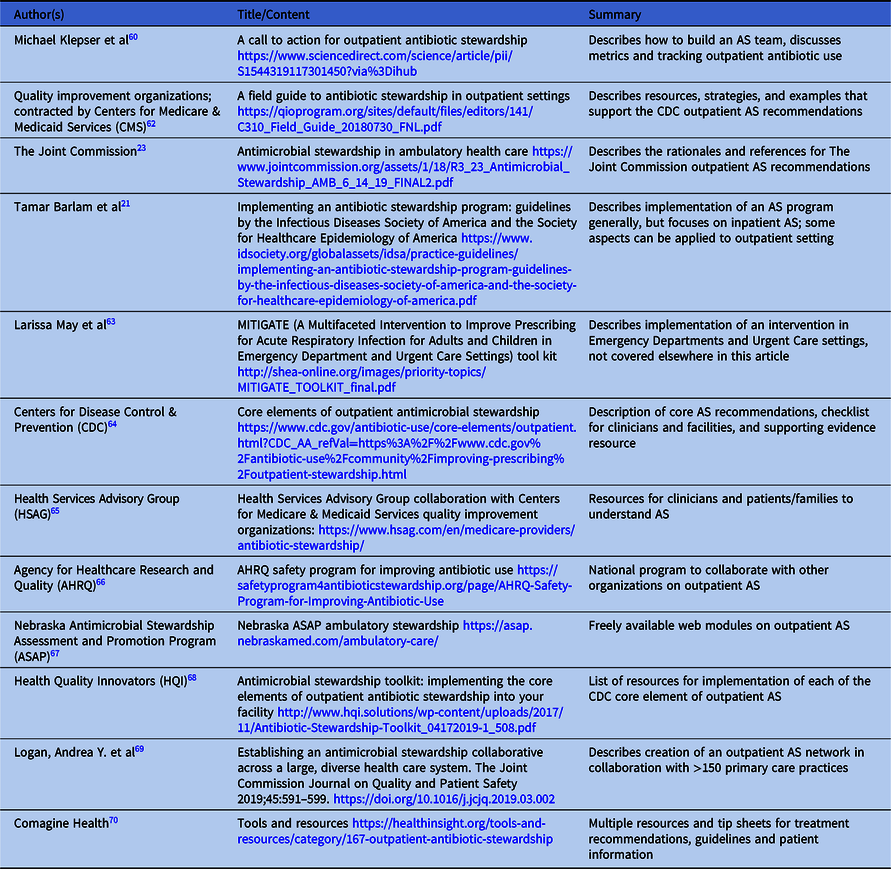
A multidisciplinary approach to outpatient antimicrobial stewardship is often most successful.Reference Klepser, Dobson and Pogue60 Various resources highlighted in Table 1 discuss how to build an antimicrobial stewardship team, track outpatient antibiotic use, implement CDC best practices, and utilize them in various outpatient settings.
Selected Key Resources Compiled to Help Guide the Creation and Successful Implementation of an Outpatient Antimicrobial Stewardship Program
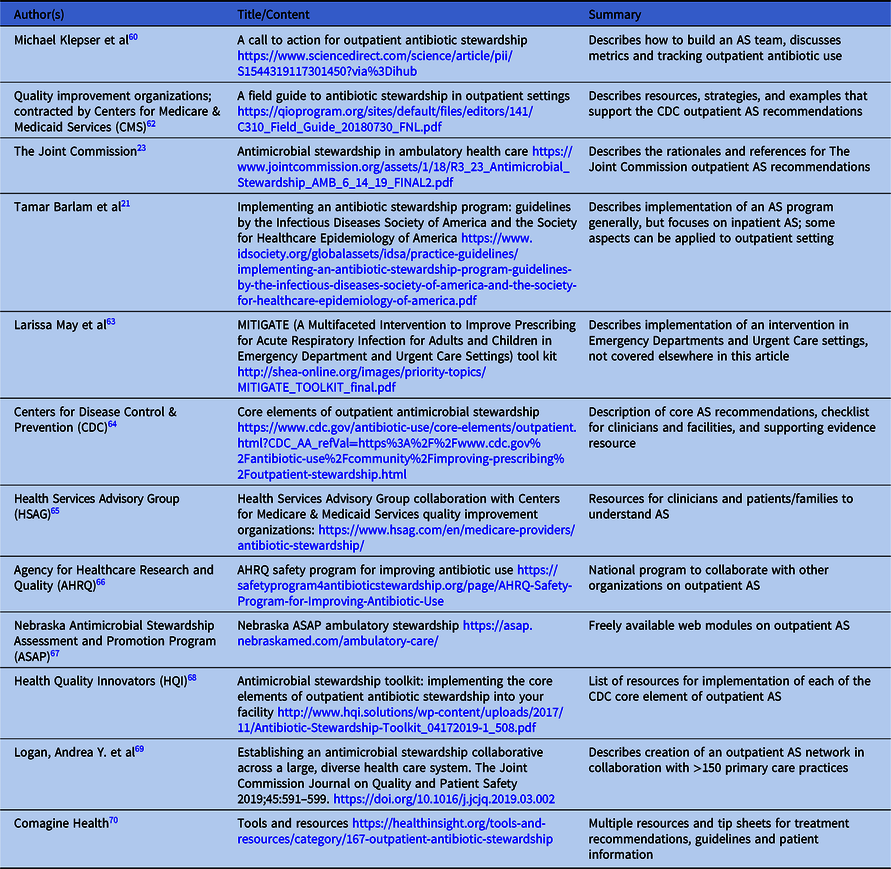
Note. AS, antimicrobial stewardship; CDC, Centers for Disease Control and Prevention.
The C-DIFF framework described here was developed to provide a systematic approach to addressing outpatient antimicrobial stewardship goals. Areas for which more data are needed include the following:
-
1. Patient engagement: Numerous patient resources are available to assist clinician discussions, but new approaches are needed to engage the community and develop partnerships in antimicrobial stewardship. Furthermore, focusing on improving health literacy and clearer communication strategies between clinicians and patients will be beneficial in strengthening those partnerships.Reference Hermsen, MacGeorge, Andresen, Myers, Lillis and Rosof61
-
2. Clinician engagement: Similarly, numerous tools exist for clinician education on appropriate antibiotic use but a better understanding of why clinicians prescribe inappropriately is needed, followed by strategies to address these behaviors.
-
3. Data collection: Amassing data in the outpatient setting remains challenging and could be improved with a national database of antibiotic prescribing with required indication.
-
4. Impacts of outpatient stewardship: After implementation of outpatient antimicrobial stewardship initiatives it would be useful to measure impacts on antimicrobial resistance. However, local and state public health departments may not have the resources do this. Additionally, the fact that most outpatient visits do not result in routine clinical culture makes this challenging. Effects of stewardship efforts on long-term patient outcomes, healthcare utilization, and patient satisfaction have been poorly explored.
-
5. Engagement with clinicians in non–primary care settings: Dental offices, urgent care settings, and telehealth settings can track antibiotic use and implement plans to reduce inappropriate prescribing.
-
6. Providing more data: Information about adverse events associated with antibiotic overprescribing can highlight the risk of prescribing these medications.
In conclusion, antimicrobial overuse and inappropriate use remains a significant problem. Antimicrobial stewardship is needed in the outpatient setting to achieve reduced antibiotic prescribing and to limit antibiotic resistance. Novel approaches are required so that we never return to the pre-Fleming, pre-penicillin era, when infections were a major cause of death.
Acknowledgments
The authors thank Catherine Hiller for her assistance with manuscript preparation.
Financial support
No financial support was provided relevant to this article.
Conflicts of interest
All authors report no conflicts of interest relevant to this article.