


Introduction
Mongolia presents a compelling case study for institutional transitions in post-communist contexts. Positioned between Russia and China, the nation transitioned from heavy reliance on the Soviet Union to becoming a ‘democratic outlier’ in post-communist Inner Asia. Despite possessing vast deposits of copper, coal, and gold, Mongolia struggles to translate this mineral wealth into significantly improved living standards. Instead, the exploitation of natural resources has triggered a complex array of social, environmental, and political challenges. Over the past decade, the extractive sector has consistently accounted for roughly a quarter of GDP and more than 80% of exports, creating a structural dependency on global commodity prices and on a single dominant trading partner – China, which received 89% of Mongolian exports in 2025 (NSOM, 2026). In parallel, the political system has shown a progressive narrowing of democratic contestation over extractive policy, even as the formal institutions of multiparty democracy have remained in place.
This article examines the evolution of Mongolia’s limited access order (LAO), organized around successive transformations of the mining-rent structure that have reconfigured the dominant coalition across three stages of post-communist development. It argues that the key to explaining the dynamics of natural resource exploitation in Mongolia lies in understanding the conflicts over the rents generated by extractive industries. To analyse how economic policies shaped the country’s institutional evolution, this study adopts the framework developed by D.C. North, J.J. Wallis, and B.R. Weingast (Reference North, Wallis and Weingast2009 hereafter NWW). Their theory of limited-access orders offers a functional, non-normative explanation of how rent-seeking stabilizes elite cooperation and how political and economic systems co-evolve through a double balance. The framework is complemented by the socio-legal concept of transnational legal ordering (TLO), which Lander (Reference Lander2019) applies to the Mongolian case to show how global norms and investment treaties depoliticize the extractive sector by displacing domestic legal contestation.
The main argument is that rapid economic liberalization, promoted by international financial institutions (IFIs), combined with the structural power of foreign capital, produced a persistent imbalance between Mongolia’s political and economic systems. To resolve this tension, the dominant coalition has progressively narrowed the space for democratic contestation while preserving formal electoral procedures. The article contributes to current debates on development by testing the analytical reach of the NWW framework in a globally embedded context, where rent-creating and rent-eroding effects of foreign direct investment (FDI) (Kluge, Reference Kluge2017) and the transnational character of legal regimes shape outcomes that nationally bounded institutional analysis cannot fully capture.
The main argument unfolds across three distinct stages of Mongolia’s post-communist institutional evolution. During the first stage (1990–1997), the old socialist coalition dissolved, giving way to a new hybrid coalition centred on emerging sources of rent: foreign aid, privatized assets, and prospective revenues from an extractive sector liberalized by the 1997 Minerals Law. The second stage (1998–2012) was marked by intense contestation over mining rents through civil society mobilization and electoral pressure, which forced the revision of the most liberal regulations even as FDI surged to a peak in 2011. The third stage (2013–present) saw institutional rebalancing following an investment crisis and International Monetary Fund (IMF) intervention: the dominant coalition consolidated investor-protection arrangements while progressively narrowing the space for democratic contestation over extractive policy.
The paper is organized as follows. The first section discusses the North, Wallis, and Weingast framework and its applicability to globally embedded resource-rich states and yields three structured research questions that guide the empirical analysis. The second section presents the case study, examining the evolution of Mongolia’s social order across the three stages introduced above. The third section discusses the implications of the Mongolian case for the limited-access-order framework and for development debates.
Limited access orders, rents, and the global political economy of extractive industries
The impact of natural wealth on economic development remains one of the most extensively debated paradoxes in economics. Empirical work since Sachs and Warner (Reference Sachs and Warner1995) has shown that resource-rich economies often grow more slowly than resource-poor ones, generating a vast resource curse literature (Bebbington et al., Reference Bebbington, Abdulai, Humphreys Bebbington, Hinfelaar and Sanborn2018; Ross, Reference Ross2014). While early explanations emphasized purely economic channels, consensus has since shifted toward political and institutional factors – such as government quality, the rule of law, corruption, democratic stability, and rent management – as the primary mechanisms shaping developmental outcomes (Barma et al., Reference Barma, Kaiser, Le and Viñuela2012; Collier, Reference Collier2010; Mehlum et al., Reference Mehlum, Moene and Torvik2006).
Institutional analyses of resource-rich states frequently overlook a critical external dimension: the influence of IFIs and foreign investors on the rent structures of extractive industries (Campbell, Reference Campbell2004, Reference Campbell and Campbell2009; Hatcher, Reference Hatcher2014, Reference Hatcher, Carroll, Hameiri and Jones2020; Szablowski, Reference Szablowski2007). Even as international organizations shifted to emphasize governance and institutional quality, these reforms continued to be imposed under significant power asymmetry, binding Global South states to capital-friendly rules and provoking opposition often dismissed as populism (Campbell and Hatcher, Reference Campbell and Hatcher2019; Hatcher, Reference Hatcher, Carroll, Hameiri and Jones2020; Lander, Reference Lander2019).
Prompted by the failures of free-market reforms, the Post-Washington Consensus shifted focus toward internal governance and institutional quality, drawing heavily on Douglass North’s work (Reference North1990, Reference North, Harriss, Hunter and Lewis1997, Reference North2005).Footnote 1 While proponents separate North’s theoretical insights from their policy applications (Dellepiane-Avellaneda, Reference Dellepiane-Avellaneda2012; Ménard and Shirley, Reference Ménard, Shirley, Sened and Galiani2014), these institutional applications face ongoing criticism (Chang, Reference Chang2011; Gray, Reference Gray2018; Khan, Reference Khan, Harriss, Hunter and Lewis1995). In response to the underwhelming results of these institutional reforms, North et al. (Reference North, Wallis and Weingast2009) developed a comprehensive theoretical framework that, while explicitly intended to interpret all of recorded human history, provides a crucial conceptual lens for capturing the specific logic of development in non-Western societies (North et al., Reference North, Wallis, Webb and Weingast2007).
North et al. (Reference North, Wallis and Weingast2009) distinguish two ideal-typical social orders in modern societies. The open access order (OAO), characteristic of mature Western democracies, sustains stability through impersonal competition in political and economic markets and through perpetually lived organizations open to all qualified entrants. The LAO, characteristic of most contemporary societies, sustains stability by restricting access to valuable economic and political functions to a dominant coalition of elites. The rents thereby generated incentivize elites to cooperate rather than fight over the means of violence. Crucially, NWW reject the conventional treatment of rent-seeking as unequivocally harmful (Krueger, Reference Krueger1974): in an LAO, rents perform a stabilizing function, and the wholesale elimination of rent sources, as attempted under shock-therapy reforms, can produce disorder rather than competitive markets (North et al., Reference North, Wallis, Webb and Weingast2012). The framework has been extended to the post-communist experience, where the development of social order and successive transitions from limited to open-access orders have been analysed across Central and Eastern Europe (Connolly, Reference Connolly2013; Legiedz, Reference Legiedz2019); Mongolia, analysed here, is a post-communist case in which that movement stalled.
Natural resources in the LAO are an essential source of rents that shape the composition and evolution of the dominant elite coalition (see the case studies in North et al., Reference North, Wallis, Webb and Weingast2012; see also Bomsel, Reference Bomsel2018; Yakovlev, Reference Yakovlev2021). The magnitude of available rents is decisive; where resource wealth is substantial, the shock of new rents can reshape the coalition even in otherwise stable LAOs, as elite groups compete to appropriate the new pool of rents. Typically, according to the LAO’s logic, the dominant coalition will profit from the extraction at the expense of broader social welfare.
The interdependence between political and economic systems is captured by NWW’s concept of the double balance: a society remains stable only when the distributions of political power and economic privileges are mutually consistent (North et al., Reference North, Wallis and Weingast2009). The double balance concerns substantive openness in both spheres – the impersonal competition characteristic of an OAO – rather than the formal institutional repertoire alone. This distinction matters analytically for the Mongolian case. As the empirical analysis below shows, formal political openness can persist for an extended period alongside substantive economic closure, but the resulting configuration is structurally unsustainable. The accumulated imbalance generates pressure for adjustment that is eventually resolved through movement in one domain or the other – substantive economic opening or substantive political closure. To avoid relying on aggregate indices of democracy, which often measure formal rather than substantive institutions, this article assesses the relative level of substantive openness across periods through a specific, observable proxy: the structural capacity of non-elite actors (civil society, local communities, and non-coalition voters) to successfully contest and influence the distribution of mining rents and economic policy. This proxy deliberately captures substantive openness in the domain most relevant to the double balance – contestation over the distribution of rents – rather than serving as a general measure of political openness. Tracing the evolution of this capacity makes the three stages directly comparable. NWW also identify three doorstep conditions for transition to an OAO: rule of law for elites, perpetually lived organizations, and consolidated political control of the military. In this article, they are treated as a heuristic horizon rather than as criteria to be systematically tested, because the empirical question is not whether Mongolia is at the doorstep but how the dominant coalition has reconfigured itself within the LAO.
Despite its strengths, the NWW framework has a recognized limitation: it is largely silent on the international dimension of institutional evolution. Grimmer-Solem (Reference Grimmer-Solem2015) argues persuasively that NWW’s doorstep conditions are derived from the historical experience of a few Western states, that the framework was developed to analyse non-Western societies but using Western historical raw material, and that this combination creates a genuine blind spot rather than a logical contradiction. When LAOs become integrated into the global economy, external forces – IFIs, FDI, transnational legal regimes – do not automatically catalyse transition to openness. They can instead reinforce LAO logic by supplying the dominant coalition with new sources of rents and new instruments for managing internal dissent. The application of NWW to Mongolia, therefore, extends the framework rather than contradicting it. By showing how international integration interacts with the double balance, this article contributes to the broader programme of refining NWW to analyse globally embedded resource-rich states.
The first international mechanism that warrants explicit theoretical treatment is FDI and the role of multinational enterprises. Mairoce et al. (Reference Mairoce, Silberberger and Zweynert2021) show, in a case study of Mozambique, that large FDI inflows can produce a toxic mix: when external rents are appropriated asymmetrically by one faction of the dominant coalition (typically the governing party), the elite bargain is destabilized, opposition is marginalized, and the system drifts toward authoritarian consolidation or, in extreme cases, organized violence. Kluge (Reference Kluge2017) develops a complementary distinction between the rent-creating and rent-eroding effects of FDI in an LAO: foreign investment initially enlarges the rent pool and reinforces the existing coalition, but as foreign firms begin to displace domestic incumbents, elites typically respond not by competing on market terms but by mobilizing regulatory and political instruments – capturing licensing regimes, renegotiating contracts, and exploiting state-owned enterprises – to defend their position. This sequence offers a precise analytical lens for reading Mongolia’s three-stage trajectory: rent creation in the 1990s, rent contestation in the 2000s, and coalition rebalancing in the 2010s and 2020s. The Mongolian case, however, pushes these frameworks to their boundary conditions: unlike the single-digit GDP shares analysed by Kluge (Reference Kluge2017) and Mairoce et al. (Reference Mairoce, Silberberger and Zweynert2021), Mongolia’s extractive sector dominates GDP and exports, so rent dynamics in one project, Oyu Tolgoi (OT),Footnote 2 reshape the trajectory of the entire dominant coalition rather than only one faction within it.
The second international mechanism is legal rather than financial. Drawing on the socio-legal scholarship of Lander (Reference Lander2019, Reference Lander2022), Hatcher (Reference Hatcher2014), and Bhatt (Reference Bhatt2020), this article integrates the concept of TLO: the process by which the state internalizes global norms, investment treaties, and contractual instruments and comes to displace national law in strategic sectors. In Mongolia, this is most visible in the legal architecture surrounding flagship projects such as OT, where investment agreements, international arbitration, and lender covenants have created a parallel legal order largely insulated from domestic democratic contestation.
TLO and NWW operate at different levels of analysis: TLO describes the mechanism through which the extractive economy is depoliticized, while NWW supplies the systemic logic explaining why elites in an LAO have an interest in such depoliticization. North et al., (Reference North, Wallis, Webb and Weingast2012) acknowledge the limits of imported Western-style reforms in developing countries but do not theorize the legal mechanisms through which such imports operate – a gap that TLO directly fills. These three international mechanisms – IFIs, FDI, and transnational legal ordering – typically operate in sequence rather than simultaneously. IFI-led reforms set the basic institutional architecture during the post-socialist transition, calibrating fiscal regimes, ownership rules, and mining codes to attract global capital. FDI inflows then occupy that architecture, enlarging the rent pool but also reshaping coalition incentives as foreign firms become structurally embedded. TLO becomes salient once coalition–investor disputes reach a level at which their resolution is shifted to international arbitration and to contractual self-binding. The Mongolian three-stage trajectory analysed below, comprising adjustment (1990–1997), institutional settlements (1998–2012), and democratic backsliding (2013–present), closely tracks this sequence. These theoretical commitments translate into three analytical questions that structure the empirical analysis. First (Q1), how did the composition of the dominant coalition (political parties, business conglomerates, and patronage and personal networks) evolve across the three identifiable stages of post-communist institutional development in Mongolia? Second (Q2), how did the three international mechanisms (IFI-led institutional design, FDI, and transnational legal ordering) reshape the structure of rents and, in turn, the double balance between political and economic openness across the three stages? Third (Q3), why has the institutional rebalancing of the past decade favoured substantive political closure over substantive economic opening?
A brief methodological note is in order. Because limited access orders conduct distributive bargaining outside public view, decisions through which the dominant coalition allocates rents typically leave only indirect traces in the public record. Following the process-tracing strategy adopted by Kluge (Reference Kluge2017) and Mairoce et al. (Reference Mairoce, Silberberger and Zweynert2021), this analysis triangulates observable outcomes, tracking the timing of regulatory changes, the trajectory of foreign investment, the reconfiguration of property rights, and episodes of public scandal, drawing predominantly on the ethnographic and investigative literature on Mongolia’s post-1990 political economy.
The evolution of the social order in Mongolia
The logic of limited access in the Mongolian context
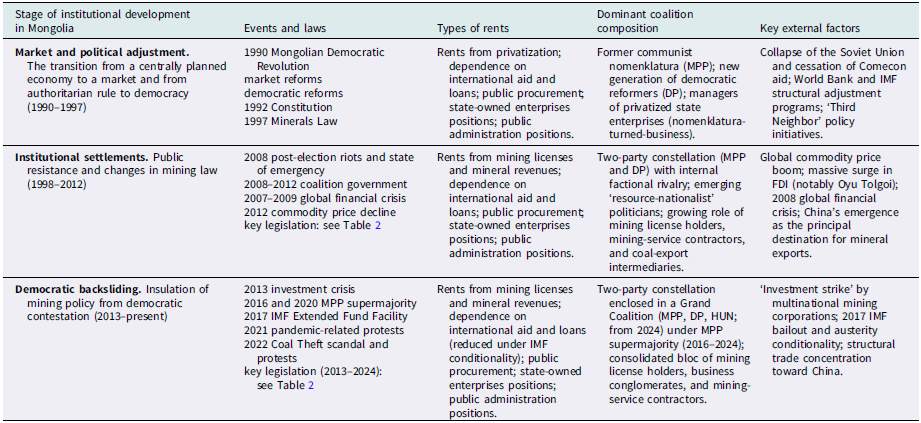
Although Mongolia is frequently cited as a democratic outlier in post-communist Inner Asia, applying the NWW framework reveals that its institutional architecture functions primarily as an LAO. Mongolia has adopted the formal institutional repertoire associated with an open-access order – multi-party elections, a constitutional guarantee of civil liberties, and an independent judiciary on paper – yet the underlying logic of social organization remains rooted in the personal relationships of the dominant coalition and in restricting economic access to secure political stability. Table 1 summarizes Mongolia’s institutional trajectory across the three stages, breaking down each stage by the events and laws that define it, the structure of rents that sustained the dominant coalition, the composition of that coalition, and the international factors shaping its environment. The empirical analysis below proceeds stage by stage along this structure, tracing how successive transformations of the rent pool reconfigured the coalition without dislodging the limited-access logic.
The evolution of Mongolia’s limited access order across three post-communist stages

Table 1. Long description
A table with four columns and four rows, detailing Mongolia’s institutional trajectory across three post-communist stages. The columns are labeled Stage of institutional development in Mongolia, Events and laws, Types of rents, Dominant coalition composition, and Key external factors. The rows are labeled Market and political adjustment, Institutional settlements, and Democratic backsliding. Each row provides specific details for each stage. Row 1: Market and political adjustment. The transition from a centrally planned economy to a market and from authoritarian rule to democracy (1990-1997). Events and laws: 1990 Mongolian Democratic Revolution, market reforms, democratic reforms 1992. Types of rents: Constitution 1990, 1997 Minerals Law. Dominant coalition composition: Rents from privatization; dependence on international aid and loans; public procurement; state-owned enterprises positions; public administration positions. Key external factors: Former communist nomenklatura (MPP); new generation of democratic reformers (DP); managers of privatized state enterprises (nomenklatura-turned-business). Row 2: Institutional settlements. Public resistance and changes in mining law (1998-2012). Events and laws: Collapse of the Soviet Union and cessation of Comecon aid; World Bank and IMF structural adjustment programs; Third Neighbor policy initiatives. Types of rents: government 2007-2009 global financial crisis 2012 commodity price decline state of emergency 2008-2012 coalition. Dominant coalition composition: Rents from mining licenses and mineral revenues; dependence on international aid and loans; public procurement; state-owned enterprises positions; public administration positions. Key external factors: Two-party constellation (MPP and DP) with internal factional rivalry; emerging resource-nationalist politicians; growing role of mining license holders, mining-service contractors, and coal-export intermediaries. Row 3: Democratic backsliding. Insulation of mining policy from democratic contestation (2013-present). Events and laws: 2013 investment crisis 2017 IMF Extended Fund Facility 2021 pandemic-related protests 2022 Coal Theft scandal and protests 2016 and 2020 MPP key legislation (2013-2024): see Table 2. Types of rents: supermajority. Dominant coalition composition: Rents from mining licenses and mineral revenues; dependence on international aid and loans (reduced under IMF conditionality); public procurement; state-owned enterprises positions; public administration positions. Key external factors: Two-party constellation enclosed in a Grand Coalition (MPP, DP, HUN); from 2024) under MPP supermajority; consolidated bloc of mining license holders, business conglomerates, and mining-service contractors.
Source: Own study.
The composition of Mongolia’s dominant coalition reflects a hybrid genealogy. Its core was formed in the early 1990s by the conversion of the former socialist nomenklatura and managerial cadre into what Munkh-Erdene (Reference Munkh-Erdene, Knauft and Taupier2012: 65) describes as an oligarchic plutocracy. Drawing on their knowledge of central-planning networks and insider access to privatized state assets, these actors translated political position into economic ownership during a transition period when formal rules were weak. New entrants soon joined this core. These included leaders of the 1989–1990 democratic movement, as well as outsiders with backgrounds in informal trade or wrestling, most prominently Bayarkhuu of the Monsonic Group and the future president Battulga (Sneath, Reference Sneath2018a: 478). Through alliances with political patrons and foreign business interests, these actors built conglomerates on a scale unattainable under impersonal market competition (Munkherdene, Reference Munkherdene2018; Sneath, Reference Sneath2018a). Over the past decade, the coalition has visibly tightened: estimates of the number of ‘super-elite’ families holding effective control over wealth and policy have fallen from approximately 200 to around 30. The corresponding concentration of capital is striking – roughly 99.6% of the shares listed on the Mongolian Stock Exchange are held by about 5% of shareholders, and one thousand individuals control 60% of all listed shares (Sneath, Reference Sneath2018a: 477).
The internal coordination of this coalition is captured by the local term MANAN – an acronym fusing the Mongolian People‘s Party (Mongol Ardyn Nam, MAN) and the Democratic Party (Ardchilsan Nam, AN), which together form the Mongolian word for ‘fog’ (Plueckhahn and Bumochir, Reference Plueckhahn and Bumochir2018: 353). MANAN denotes a recurrent pattern in which the two formally competing parties cooperate behind the scenes to divide rents from state-controlled assets while preserving the appearance of electoral rivalry. The phenomenon resonates with the indigenous concept ediin zasag – the standard Mongolian term for ‘economy’, whose literal meaning is closer to ‘governing property’ – which captures the way economic and political authority are treated, in everyday discourse and practice, as inseparable (Plueckhahn and Bumochir, Reference Plueckhahn and Bumochir2018: 346). In NWW terms, MANAN is precisely the kind of informal accommodation through which a dominant coalition manages access to rents without resorting to open conflict.
The personalist character of the coalition is reinforced by routine practices documented in recent ethnographic work (Bonilla and Shagdar, Reference Bonilla and Shagdar2018; Chuluunbat and Empson, Reference Chuluunbat and Empson2018; Damdinsuren et al., Reference Damdinsuren, Dierkes, Luguusharav, Peters, Kim and Knox2023). Electoral gifting – the distribution of cash, food, and calendars by parliamentary candidates – is locally understood not as vote-buying but as the enactment of the ‘big person’ (tom hün) role: an expected performance of generosity through which a candidate affirms his standing within his homeland territory (nutag). This personal-relational logic extends throughout the economy, from informal business networks (tanil tal), to patronage ties between politicians and large business (Damdinsuren et al., Reference Damdinsuren, Dierkes, Luguusharav, Peters, Kim and Knox2023).
The Mongolian state inherited a fully developed coercive apparatus from its socialist predecessor and, in the narrow Weberian sense, retains a physical monopoly on the legitimate use of force. There is no rival armed faction, and the army and police function under unified command. What is missing is an impersonal, rule-bound monopoly, a feature that the NWW framework treats as constitutive of an LAO. In its absence, the legitimate use of state coercion is distributed among factions of the dominant coalition through patronage ties and selectively enforced rules. This is most evident in the operation of the Office for Combating Corruption (Avligatai Temtseh Gazar), which has been repeatedly used as a factional weapon by whichever oligarchic grouping is in office, most prominently in the prosecution of former president Enkhbayar (Sneath, Reference Sneath2018a: 478). Episodes of collective protest, the post-election riots of 2008, which prompted a state of emergency and resulted in fatalities, and the 2021 and 2022 demonstrations triggered by pandemic management and the Coal Theft scandal, show that the potential for organized public violence remains a recurrent constraint on elite arrangements, even when it does not erupt into civil conflict. Coalition stability depends on managing this potential through a combination of rent-sharing, selective coercion, and electoral concessions.
Taken together, these features place Mongolia within the NWW typology as an LAO rather than a polity in transition toward open access. The dominant coalition restricts access to the most valuable economic functions (mining licences, public procurement contracts, banking concessions, land rights, and public-sector jobs) to its own members and uses the rents thereby generated to incentivize cooperation rather than conflict among elite factions. The formal openness of the political system, in this reading, does not contradict the LAO classification but rather provides the institutional theatre within which the coalition manages its internal balance and its relationship with a public whose potential for mobilization must be regularly accommodated.
The empirical analysis that follows traces this LAO trajectory across three stages, whose boundaries are defined by structural turning points in the rent structure sustaining the dominant coalition. Stage 1 (1990–1997) opens with the collapse of Soviet aid and closes with the 1997 Minerals Law, which adds mining licenses and mineral revenues to the rent pool. Stage 2 (1998–2012) opens with the consolidation of this new rent layer and the social contestation it provokes, and closes with the 2012 Strategic Entities Foreign Investment Law (SEFIL) and the 2013 investment crisis, when the coalition’s structural dependence on FDI inverts the dynamic. Stage 3 (2013–present) opens with the IMF intervention and the legislative sequence of investor-protection laws and continues to the 2024 Grand Coalition. Each stage is analyzed along the dimensions summarized in Table 1, with particular attention among the key external factors to the dominant international mechanism – IFI-led institutional design in Stage 1, FDI in Stage 2, and TLO in Stage 3. The three analytical questions stated at the end of the previous section structure the analysis: the first analytical question (Q1: evolution of the dominant coalition) is developed across all three stages; the second (Q2: the three international mechanisms and their impact on rent structures and the double balance) is articulated stage by stage; and the third (Q3: why the recent rebalancing has favoured substantive political closure over substantive economic opening) is answered in the Discussion based on the empirical findings of Stage 3.
Market and political adjustment – towards a market economy and democracy
Stage 1 covers the dissolution of the old socialist coalition and the formation of a new hybrid coalition around the rents that emerged from the post-socialist transition. The dominant international mechanism in this stage is IFI-led institutional design. The narrative below moves through the structural shock of 1990, the two waves of privatization, the role of foreign aid as a new source of rents, and the 1997 Minerals Law that initiates the mining-rent layer on which subsequent stages will build.
Socialist Mongolia, though relatively poor, provided social welfare and public services with minimal poverty and unemployment (Erdenekhuu, Reference Erdenekhuu2016: 273; Hatcher, Reference Hatcher2014: 104). However, it heavily depended on Soviet economic aid, with USSR capital inflows accounting for up to 30% of GDP (World Bank, 1992: 4). While the collapse of the Soviet Union and the sudden cessation of aid created a severe structural shock, the transition to a market economy was not merely an external imposition; powerful domestic forces also drove it. The democratic protests of 1989–1990, led by a new generation of reformers, signalled a strong internal demand for dismantling the authoritarian system and the command economy (Rossabi, Reference Rossabi2005).
Following the Washington Consensus, international organizations conditioned aid on ‘shock therapy’ reforms: rapid liberalization, deregulation, and mass privatization (Munkh-Erdene, Reference Munkh-Erdene, Knauft and Taupier2012; Reinert, Reference Reinert and Reinert2007; Rossabi, Reference Rossabi2005: 43). The Mongolian elite’s enthusiasm for these reforms stemmed from both the assimilation of neoliberal ideology and the prospect of rapid enrichment (Lander, Reference Lander2019; Munkherdene, Reference Munkherdene2018). When USSR economic aid ended, the source of rents that had sustained the previous dominant coalition was abruptly depleted. The reforms were also motivated by a desire to align with the West as an alternative to Russia and China (Bumochir, Reference Bumochir2018; Wachman, Reference Wachman2010). With the USSR’s collapse, China was perceived as the primary threat to Mongolian sovereignty and culture (Bulag, Reference Bulag1998; Jackson and Dear, Reference Jackson and Dear2016; Wachman, Reference Wachman2010), and the ‘Third Neighbor’ policy of market reform and democratic institutions was framed as a means to maintain independence from it.
During Mongolia’s transition to a market economy, the rapid and chaotic implementation of reforms created opportunities for quick wealth accumulation, mainly through mass privatization. The mechanism of redistribution unfolded in two waves, combining formal egalitarianism with substantive concentration. The first wave (1991–1993) was a voucher-based mass privatization: the government issued tradable vouchers to all Mongolian citizens, redeemable for shares in former state enterprises through the newly established Mongolian Stock Exchange (Korsun and Murrell, Reference Korsun and Murrell1995; Marshall et al., Reference Marshall, Nixson and Walters2007; Sneath, Reference Sneath2018b). In principle, the design broadly distributed claims on national wealth. In practice, three features of the wider transition channelled most of the resulting wealth to a narrow circle. First, citizen voucher-holders lacked information about the underlying assets, whereas former state managers and nomenklatura officials possessed both inside knowledge and access to corporate networks. Second, the severe macroeconomic environment of the early 1990s, marked by three-digit inflation and a roughly 50% decline in real incomes (Rossabi, Reference Rossabi2005: 50–51; Sneath, Reference Sneath2018a: 476), pushed many voucher-holders into distress sales. Finally, formal rules permitted insider-led asset transfers, further consolidating ownership. The result was an opportunistic and at times chaotic process whose pattern was consistent: a smaller set of insiders accumulated the bulk of the new private wealth (Casals & Associates, 2005: 44; Munkh-Erdene, Reference Munkh-Erdene, Knauft and Taupier2012: 65; Rossabi, Reference Rossabi2005; Sneath, Reference Sneath2018a). The second wave (1996–2000) then sold the most valuable remaining state assets directly to private investors through auctions, completing the concentration process. The local term shudarga bus ömch khuv’chlal, ‘the dishonest/unjust privatization of property’, captures the popular reception of this trajectory (Sneath, Reference Sneath2018a: 476–478).
In parallel, the agricultural sector underwent its own privatization. The collective farms (negdels) were dissolved, but the process was repeatedly marked by abuse: former managers and their associates claimed disproportionate herds, and formal allocation rules were applied selectively (Cooper, Reference Cooper1993: 13; Korsun and Murrell, Reference Korsun and Murrell1995: 481; Mearns, Reference Mearns1993: 16; Rossabi, Reference Rossabi2005: 120–121). Together with asset privatization, this transferred control of the most valuable productive assets to a hybrid set of insiders and left a significant portion of the population materially worse off than under the socialist economy.
Foreign aid was itself a significant new source of rents for the emerging elite. Between 1991 and 2002, this aid amounted to $2.9 billion in grants and loans, which accounted for 30% of GDP in 2002. These funds were channeled through intermediaries such as Golomt Bank with weak oversight, which charged high fees and interest rates (Rossabi, Reference Rossabi2005: 104). The reforms primarily benefited the urban elite and the emerging urban middle class, while the rural population faced significant adjustment costs during the transition (Bruun, Reference Bruun2006: 170).
Mongolia’s economic transition led to a significant decline in the quality of life for many citizens, marked by increased poverty, reduced access to essential services, and growing income inequality (Humphrey and Sneath, Reference Humphrey and Sneath1999: 56; Sneath, Reference Sneath2018a: 476–477; World Bank, 1996: 52–63). Following standard World Bank strategies for resource-led growth (Campbell, Reference Campbell and Campbell2009; Hatcher, Reference Hatcher2014; Szablowski, Reference Szablowski2007), it was assumed that Mongolia’s extractive sector required a framework prioritizing investor security and low royalties over social and environmental concerns (World Bank, 2008). Consequently, Mongolia adopted one of Asia’s most liberal mining laws in 1997, triggering an FDI surge with contested social benefits (Campbell and Hatcher, Reference Campbell and Hatcher2019; Hatcher, Reference Hatcher2014).
In contrast to the disappointing economic outcomes, Mongolia’s political reforms have been comparatively successful (Fish and Seeberg, Reference Fish and Seeberg2017). The peaceful 1989–1990 demonstrations, the absence of a dominant authoritarian leader, the country’s independent statehood, and the pragmatic decision of the communist elite (the former Mongolian People’s Party, MPP) to share power with the opposition produced an early democratic settlement. A robust civil society and relatively free press supported transparency and public engagement. When the Democratic Union Coalition won the 1996 parliamentary elections, economic reforms accelerated, culminating in the 1997 Minerals Law and the broader package regulating the extraction of Mongolia’s mineral wealth.
By the end of Stage 1, the answer to Q1 is that the socialist nomenklatura had transitioned into a hybrid coalition composed of former state managers, democratic reformers (DP), and outsiders whose enrichment derived from insider access during the privatization era. The answer-in-progress to Q2 is that IFI-led shock therapy had constructed the rent architecture – privatization revenues, foreign aid, and the 1997 Minerals Law – on which the subsequent stages would build. In terms of the formal/substantive distinction, political openness in this stage was real but limited. While formal electoral competition produced genuine alternation (most visibly the Democratic Union Coalition’s 1996 victory), the relative level of substantive openness remained low because non-elite actors lacked the capacity to contest economic policy. The redistribution of wealth through asset privatization was captured almost entirely by post-nomenklatura networks and insiders, with minimal societal input or resistance.
The institutional settlements – public resistance and changes in mining law
Stage 2 covers the political contestation of mining rents and the legislative response to it. The dominant international mechanism at this stage is FDI, which reshapes intra-coalition incentives by enlarging the rent pool. The narrative below moves through the post-1997 phase of unregulated mining expansion, the social mobilization that follows, the 2005–2012 legislative sequence of resource-nationalist reforms (Table 2), and the 2013 OT renegotiation that triggers the investment crisis.
Evolution of the social order and the main types of rents in Mongolia after the transition

Table 2. Long description
The table presents the evolution of Mongolia’s social order and the main types of rents after the transition from a centrally planned economy to a market economy and from authoritarian rule to democracy. It is organized into three stages of institutional development: Market and Political Adjustment (1990-1997), Institutional Settlements (1998-2012), and Democratic Backsliding (2013-present). Each stage lists key events and laws, types of rents, dominant coalition composition, and key external factors. The table has four columns: Stage of institutional development in Mongolia, Events and laws, Types of rents, and Dominant coalition composition. Key external factors are also listed. The table includes specific years and events such as the 1990 Mongolian Democratic Revolution, the 1992 Constitution, the 1997 Minerals Law, the 2008 post-election riots, the 2007-2009 global financial crisis, the 2012 commodity price decline, the 2013 investment crisis, the 2016 and 2020 MPP supermajority, the 2017 IMF Extended Fund Facility, the 2021 pandemic-related protests, and the 2022 Coal Theft scandal and protests. Types of rents include rents from privatization, mining licenses, mineral revenues, dependence on international aid and loans, public procurement, state-owned enterprises positions, and public administration positions. The dominant coalition composition includes former communist nomenklatura, new generation of democratic reformers, managers of privatized state enterprises, resource-nationalist politicians, mining license holders, mining-service contractors, and coal-export intermediaries. Key external factors include the collapse of the Soviet Union, World Bank and IMF structural adjustment programs, Third Neighbour policy initiatives, global commodity price boom, massive surge in FDI, Chinas emergence as the principal destination for mineral exports, investment strike by multinational mining corporations, and IMF bailout and austerity conditionality.
Source: Own study.
With the enactment of the 1997 Minerals Law, the structure of rents available to the dominant coalition was substantively reweighted. Before 1997, the principal rents had flowed through the control of the state apparatus itself: public procurement, appointments to state-owned enterprises, and posts in a public administration that absorbed much of the country’s stable, well-paid employment, supplemented by the windfalls of voucher and auction privatizations. The Minerals Law added a substantial new layer of mining licenses and mineral revenues, progressively intensifying intra-coalition competition over the state institutions through which these new rents would be allocated. Many new concessions were granted under the highly liberal regime. However, the law failed to safeguard people and the environment from the detrimental impacts of extraction, fuelling a rapid surge in public discontent.Footnote 3
Because semi-nomadic herders cannot easily relocate to already occupied pastures (Hatcher, Reference Hatcher2014; Jargalsaikhan, Reference Jargalsaikhan, Junker and Farah2021), mining-related displacement fundamentally threatens their livelihoods. Consequently, the development of the extractive sector has effectively transferred land rights from pastoralists to mining corporations (Hatcher, Reference Hatcher2014; Lander, Reference Lander2019). By 2004, mining and exploration licenses covered approximately 26% of Mongolian territory, half of which was held by just seven companies – the four largest foreign-owned; by 2009, the share had risen to roughly 45% (Husband and Songwe, Reference Husband and Songwe2006: 7; Suzuki, Reference Suzuki, Yamamura, Fujita and Maekawa2013: 277). Formal mining licenses, issued centrally, supersede the customary grazing rights of local herders, which lack robust statutory recognition, leaving local governments with limited enforcement capacity to protect access to pasture.
There have been increasing claims that a small group of the wealthiest is benefiting from the development of the mining industry. However, Mongolia’s first civil society mobilization against mining policy centred on environmental concerns. One of the initial issues that mobilized grassroots movements was the protection of the Ongi River (Byambajav, Reference Byambajav2015; Campbell and Hatcher, Reference Campbell and Hatcher2019; Fish and Seeberg, Reference Fish and Seeberg2017).
Public discontent in this period was also driven by anxieties over Mongolia’s deepening trade dependence on China, which had grown structurally rather than by policy design as trade liberalization aligned Mongolian exports with Chinese demand (see Introduction). Among Mongolian elites and the wider public, this reorientation was widely interpreted as a threat to national sovereignty (Bulag, Reference Bulag1998; Bumochir, Reference Bumochir2018; Jackson and Dear, Reference Jackson and Dear2016), and the growing presence of Chinese companies, workers, and contractors gave these anxieties a tangible focus that segments of the political elite could mobilize as a political resource. Social mobilization led to substantive changes in mining law during 2005–2012 (as detailed in Table 2). The state progressively revised the most liberal regulations by introducing windfall taxes, environmental protections, and foreign ownership restrictions, while earmarking new revenues for social programs (Yeung and Howes, Reference Yeung and Howes2015: 10–14; Campbell and Hatcher, Reference Campbell and Hatcher2019: 648). These reforms were enacted in the run-up to the 2012 parliamentary elections, in which ‘resource nationalists’ won approximately one-quarter of seats (Campbell and Hatcher, Reference Campbell and Hatcher2019: 648).
In 2013, the government attempted to renegotiate the investment agreement of the OT mining project, the most significant investment in Mongolia’s history. The move escalated into a severe conflict over the distribution of mining rents. The tax authority’s claim of unpaid taxes was, formally, a legitimate exercise of fiscal enforcement. However, it formed part of a broader political-economic effort to recapture a larger share of mining revenues – and, in NWW terms, to enlarge the rent pool available to the dominant coalition. As Lander (Reference Lander2019) describes, this clash highlighted the tension between the state’s assertion of fiscal sovereignty and the legal protections afforded to foreign capital. The consequences were significant: Rio Tinto froze development of the mine’s underground phase, FDI declined sharply, and Mongolia was eventually brought into international arbitration (United Nations Commission on International Trade Law). These outcomes revealed the structural asymmetry between a resource-rich state pursuing fiscal sovereignty and the global corporate actors protected by investment treaties.
Public discontent with the original 1997 mining laws was thus translated into political power that drove the revision of these statutes and related policies. The first adjustments occurred during a period of record-high global commodity prices, which provided segments of the dominant coalition with both an electoral incentive – to channel popular dissatisfaction into resource-nationalist platforms – and a fiscal incentive: higher tax rates and larger state shares in new investments increased budgetary revenues and, in NWW terms, expanded the rent pool available to the coalition. Over the course of this stage, the coalition widened to incorporate the actors generated by the extractive boom – owners and operators of mining licenses, mining-service contractors, coal-export intermediaries (Table 1).
By the end of Stage 2, the answer to Q1 has widened: the coalition has absorbed the mining-rent stakeholders generated by the FDI boom, namely mining-license holders, mining-service contractors, and coal-export intermediaries. The answer to Q2 has advanced: FDI is now the dominant international mechanism, both enlarging the rent pool (rent-creating, in Kluge’s terms) and reshaping intra-coalition incentives through electoral and resource-nationalist pressures. This stage marks the highest relative level of substantive political openness in the post-1990 trajectory, as reflected in the structural impact of non-elite actors on the distribution of rents. Civil-society mobilization, including hunger strikes and protests in Sukhbaatar Square, together with competitive electoral pressure, proved structurally effective. Unlike in Stage 1, these non-elite actors successfully compelled the dominant coalition to absorb resource-nationalist demands through tangible legislative concessions (e.g., the windfall tax and environmental protections) rather than suppress them. The FDI boom had not yet generated the structural leverage to do otherwise.
The democratic backsliding
Stage 3 covers the institutional rebalancing triggered by the 2013 investment crisis and the 2017 IMF intervention. The dominant international mechanism in this stage is transnational legal ordering. The narrative below traces the FDI collapse and IMF bailout, the legislative sequence of investor-protection laws (2013–2017), the 2019 constitutional amendments that combine anti-populist provisions with the re-politicization of natural resources, and the 2024 Grand Coalition that formally consolidates the configuration established in Stage 2.
Liberal mining regulations and the 2009 Oyu Tolgoi Investment Agreement (Table 2) catalysed a massive surge in FDI, which rose from 8.8% of GDP in 2007 to a peak of 43.9% in 2011 (Figure 1; World Bank, 2025), positioning international investors as pivotal socioeconomic actors. When public pressure compelled legislative tightening or contract renegotiation, investors and international agencies countered by labelling state actions as ‘resource nationalism’ or ‘populism’ (Campbell and Hatcher, Reference Campbell and Hatcher2019; Hatcher and Lander Reference Hatcher and Lander2023; Jackson and Dear, Reference Jackson and Dear2016). It is important, however, to recognize that Mongolia’s governance framework accommodates a complex interplay between legitimate state imperatives and structural opportunities for elite enrichment. On the one hand, the state has a legitimate mandate to control resources for national development and environmental protection. On the other hand, the very instruments established to regulate the sector – discretionary licensing regimes, management of state-owned enterprises, the negotiation of stability agreements – create entry points for the dominant coalition to consolidate its share of mining rents. In an LAO, these two motives are not separable but constitutive of the same institutional logic: regulation generates the rents that sustain the coalition, while simultaneously creating the discretionary space within which those rents can be selectively distributed.
FDI net inflows (% of GDP) vs. extractive industry regulatory timeline.
Source: Own study and World Bank (2025).

This dynamic was made unusually visible by the ‘Coal Theft’ scandal that erupted in late 2022 (Dashpurev, Reference Dashpurev2024). Public protests paralysed Ulaanbaatar following allegations of large-scale discrepancies in coal export data. The scandal exposed the core mechanics of rent extraction in Mongolia’s LAO. The controversy centred on the state-owned Erdenes Tavan Tolgoi and on opaque ‘off-take contracts’ that bypassed parliamentary oversight and channelled revenue to politically connected elites and logistics companies. The 2022 Mining Products Exchange Law (Table 2) responded by banning off-exchange contracts and mandating open electronic auctions on the Mongolian Stock Exchange. Beyond its legislative consequences, the episode is analytically significant: by forcing contractual and logistical infrastructure into the open, it provided a rare public window into rent-capture mechanisms that LAOs inherently keep invisible and that institutional analysis can otherwise only triangulate from downstream effects.
The Mongolian government’s clash with foreign investors exposed a significant power asymmetry. International mining companies possess ‘structural power’ derived from their ability to withhold capital (Lander, Reference Lander2019). In response to the increasingly resource-nationalist legal framework and renegotiation attempts, foreign capital effectively staged an ‘investment strike’: FDI plummeted from $4.5 billion in 2011 to $94 million in 2015 and further collapsed to –$4.156 billion in 2016 (World Bank, 2025). Since Mongolia’s economy had become structurally dependent on the mineral sector for growth and export revenue, capital flight, combined with falling commodity prices, left the state with little leverage, forcing a return to the negotiating table on terms more favourable to capital. In 2017, the IMF Extended Fund Facility provided a bailout to address external debt of $26 billion – more than twice GDP – and required stringent austerity measures (Campbell and Hatcher, Reference Campbell and Hatcher2019: 649). This was a turning point at which the dominant coalition recognized that prioritizing a stable institutional environment was essential for its long-term viability.
Persistent social discontent arising from extractive industries threatened the government’s pursuit of a stable investment climate. Lander (Reference Lander2019: 198) identifies this period as driven by a ‘stabilization impetus’, a coordinated effort by central ministries and international financial organizations to insulate the mineral sector from democratic volatility, explicitly targeting local governments, civil society organizations, and opposition parties. The resulting political narrative delegitimized these challenges: central opponents were labelled ‘populists’, local critics dismissed as ‘corrupt’, and resistance was stigmatized or criminalized, with environmental activists occasionally charged with ‘eco-terrorism’. Although the government adopted global norms for managing social conflict, these primarily enhanced mining safety for investors without addressing underlying social grievances, leading some international donors to withdraw support from NGOs (Lander, Reference Lander2019; see also Myadar and Jackson, Reference Myadar and Jackson2019).
The drive to stabilize the investment environment translated into a coordinated legislative sequence (see Table 2): most consequentially, the 2013 Investment Law repealed SEFIL, granted foreign investors access to international arbitration, and (through Article 6.10) protected itself from amendment by ordinary majority, requiring a two-thirds parliamentary vote to revise its provisions (Lander, Reference Lander2019: 127). Subsequent measures (2014–2016) reduced the state’s role to that of a tax collector and institutionalized fast-track review of investor complaints, while environmental and social safeguards from the previous decade were systematically weakened and legislative competence over mining shifted towards executive discretion (Lander, Reference Lander2019: 175–185, 194–195).
This investor-protection track did not preclude legislation oriented towards public legitimation. The 2019 constitutional amendments, passed under the MPP’s supermajority, combined anti-populist provisions (Berkofsky, Reference Berkofsky2021; Odonkhuu, Reference Odonkhuu2020) with a re-politicization of natural resources as ‘state public property’ subject to fair distribution of revenues (Table 2). Following the 2021 pandemic-related and 2022 coal-related protests, the constitutional and electoral framework was modified to facilitate the election of MPs from outside the two dominant parties. In the 2024 elections, the MPP nonetheless secured an absolute majority in the expanded 126-seat parliament and, despite this mandate, formed a ‘Grand Coalition’ with the Democratic and HUN Parties. The 2024 Sovereign Wealth Fund Law, which channels up to 34% of dividends from strategic mining deposits into individual citizen accounts (Table 2), gave the redistributive dimension of the 2019 amendments a concrete institutional form.
The Grand Coalition can be read in two ways. It could represent a self-binding commitment by the MPP – a voluntary constraint on its own discretion intended to secure credible policy continuity. The broader pattern, however, points more clearly towards limited-access-order rebalancing: investor-protection legislation 2013–2017, constitutional insulation against ‘populist’ contestation, electoral reforms that formally opened the field while leaving the dominant coalition intact, and redistributive instruments such as the Sovereign Wealth Fund that legitimize the arrangement before a broader public. By co-opting the opposition rather than competing with it, the MPP simultaneously signalled to international capital that the rules of the game would remain stable and to the domestic public that the political system retained a pluralistic form. The 2024 Grand Coalition can be read, in this light, less as a recomposition of the dominant coalition than as its formal consolidation: the three parliamentary parties enclose, rather than reshape, the underlying configuration of mining-rent stakeholders established in Stage 2 (Table 1).
By the end of Stage 3, all three analytical questions have received their structural answers. Q1: The coalition has consolidated around a stable configuration of mining-rent stakeholders enclosed in a Grand Coalition. Q2: The three international mechanisms have operated in sequence – IFI-led design in Stage 1, FDI in Stage 2, TLO in Stage 3 – each progressively narrowing the space within which the double balance could be restored through substantive economic opening. Q3 is taken up in the Discussion below. Substantive political openness has been progressively narrowed across this stage. This narrowing is evidenced by the systematic insulation of economic policy from societal contestation. The MPP’s 2024 absolute majority reflects not a collapse of formal electoral procedures but a rebalancing in which co-optation replaces competition: by forming a Grand Coalition rather than governing alone, the MPP enclosed the opposition within its own rent-distribution arrangement, converting formal pluralism into managed consolidation. The relative level of substantive openness is at its lowest because transnational legal instruments, supermajority requirements for investment laws, and the co-optation of opposition parties have rendered grassroots mobilization and civil society pressure largely without legislative effect. The result is a configuration in which formal openness is preserved while substantive contestation over extractive policy is structurally foreclosed. Whereas in Stage 1, non-elite influence was weak because organized contestation had not yet formed, in Stage 3, an already mobilized civil society was actively neutralized – a deeper, deliberately engineered closure.
Discussion and implications
Understanding the conflict over rents is essential for explaining Mongolia’s economic development over the last three decades. Read together, the three stages form a single limited-access-order dynamic organized around successive transformations of the rent structure that sustains the dominant coalition. In Kluge’s (Reference Kluge2017) terms, Stages 1 and 2 constituted a rent-creating phase: foreign aid, privatized assets, and the post-1997 mining boom enlarged the pool available to the coalition, while the formal opening of the political system provided a peaceful succession mechanism rather than a path to open access. This phase reached its apex in 2011, when FDI peaked even as civil-society mobilization and electoral pressure compelled redistributive and resource-nationalist concessions (Table 2) – the most substantively open moment of the post-1990 trajectory. Stage 3 inverted this dynamic: the very legislative adjustments that had recaptured rents for the domestic coalition triggered an investment strike (Figure 1) and the 2017 IMF intervention, opening a rent-eroding phase in which the coalition had to choose between the redistributive bargain of Stage 2 and the foreign-capital flows on which it had become structurally dependent. It chose the latter, and the institutional rebalancing documented above – investor-protection legislation, the 2019 constitutional re-politicization of resources, and the 2024 Grand Coalition – represents its attempt to restore stability while preserving public legitimacy.
The fundamental conflict in Mongolia stems from a specific imbalance between its political and economic systems. While the political sphere adopted the formal institutions of an open-access order, the economic sphere remained organized along limited-access lines despite rapid deregulation in the 1990s. State withdrawal facilitated rent capture by a narrow coalition rather than creating markets based on impersonal exchange, while widespread wealth concentration inhibited effective public participation. This imbalance generated deep structural instability, as the open political system permitted social discontent to threaten elite economic privileges. By the logic of the double balance, the system had to seek resolution in one direction or the other. In Mongolia, this resolution came not through the substantive opening of the economy, but through the progressive closure of the political system. The reasons for this asymmetry – providing the structural answer to Q3 – are threefold. First, the dominant coalition retained personalized control over its core rent sources, such as mining licenses, public procurement, and state-owned enterprises, making their substantive opening politically prohibitive. Second, the architecture of foreign investment protection, consolidated under TLO, insulated the economic sphere from democratic contestation rather than opening it up. Finally, the state capacity needed to convert formal deregulation into substantive open access had itself been weakened by the rapid liberalization of the 1990s. Under these conditions, narrowing the space for democratic contestation over extractive policy offered the lowest-cost path for the coalition. The dual track of Stage 3 – which combines investor-protection legislation with redistributive instruments like the Sovereign Wealth Fund – does not contradict this diagnosis but refines it. The coalition manages the imbalance not by eliminating it, but by stabilizing it under the guise of formal democracy. Tracking the capacity of civil society and non-elite actors to influence rent distribution reveals a clear trajectory of substantive openness: from near-exclusion during the 1990s privatization (Stage 1), to peak societal influence over mining legislation in the 2000s (Stage 2), to the current phase where transnational legal structures and coalition consolidation have systematically insulated economic policy from democratic pressure (Stage 3).
The mechanism through which the imbalance is reproduced has been documented in the socio-legal literature on extractive industries: governance reforms in Mongolia operate not as technical improvements but as political projects that depoliticize the economy by shifting decisions regarding extractive industries from the democratic sphere into the technocratic and legal realm, which Lander (Reference Lander2019) analyses as transnational legal ordering in the Mongolian extractive context. Bhatt (Reference Bhatt2020), in a detailed study of the OT case, shows how private financial mechanisms and contractual covenants can effectively displace national law, creating a parallel legal reality in which local communities’ rights depend more on corporate discretion than on state guarantees. The result is what Lander (Reference Lander2022) terms ‘constitutional risk’. By prioritizing the legal security of foreign investments over domestic social contracts, the state risks eroding its own constitutional legitimacy. Consequently, the burden of investment risk is shifted from private corporations onto the public and the state itself. This is not a story of state weakening but of sovereignty reconfiguration: the state’s institutional capacity is repurposed to protect transnational capital rather than to mediate domestic social demands, generating a permanent tension between international investment commitments and democratic accountability.
This analysis engages with several recent contributions to the Journal of Institutional Economics. Bavel et al. (Reference Bavel, Ansink and Besouw2017) examine internal incentive structures through which dominant coalitions allocate rents; the Mongolian case illustrates a configuration in which these structures are anchored in a globally embedded extractive sector, with the boundaries of the coalition continually renegotiated under transnational legal pressure. While Murphy (Reference Murphy2023) develops measurement strategies for OAOs, the Mongolian trajectory suggests that aggregate openness indices should be interpreted with caution: substantive economic openness, defined as access through impersonal exchange, is non-monotonic, shaped as much by external capital flows as by domestic institutional reform. Mairoce et al. (Reference Mairoce, Silberberger and Zweynert2021) identify a toxic mix in which asymmetric appropriation of FDI rents by one faction destabilizes political competition; Mongolia offers a complementary case in which the imbalance was resolved through institutional rebalancing rather than factional violence.
The Mongolian case also advances two specific streams of literature. Within the resource curse debate, the claim is specific: developmental failure operates not primarily through the economic channels emphasized in early work (Dutch disease, price volatility) but institutionally, as mineral rents obstruct development by entrenching, rather than dissolving, limited-access logic. The mechanism is sequenced: IFI-led liberalization constructs a rent architecture without opening access; FDI enlarges that rent pool while incentivizing redistribution over impersonal competition (Kluge, Reference Kluge2017); and TLO insulates the arrangement from democratic renegotiation (Lander, Reference Lander2019), complementing the socio-legal analyses of Campbell and Hatcher (Reference Campbell and Hatcher2019) and Hatcher (Reference Hatcher2014) with an explicit LAO framework. Within the literature on the NWW framework’s silence regarding external actors in LAO dynamics, the article does not fully close this gap. However, it moves beyond identifying it (Grimmer-Solem, Reference Grimmer-Solem2015) toward specifying a mechanism: by tracing how IFIs, FDI, and TLO each reshape the double balance at distinct stages, external integration is shown to reconfigure the logic of dominant-coalition management itself, not merely the pace of an internally driven trajectory.
The contribution of this article is threefold. First, empirically, it offers a fine-grained, three-stage analysis of Mongolia’s post-1990 institutional trajectory (Figure 1; Table 2). Second, theoretically, it extends the analytical reach of the NWW framework to a globally embedded context, in line with a broader line of work that adapts NWW for non-Western and globally integrated settings (Grimmer-Solem, Reference Grimmer-Solem2015; Mairoce et al., Reference Mairoce, Silberberger and Zweynert2021), showing that international integration generates institutional dynamics that its original formulation does not fully anticipate. Finally, methodologically, the analysis suggests that aggregate indices of political and economic openness should be interpreted alongside a qualitative reading of coalition structure, rent flows, and international actors – particularly in resource-dependent LAOs, where formal openness can mask substantive closure, as illustrated by Mongolia’s persistent imbalance between high political openness and concentrated economic control.
Mongolia’s experience illuminates why economic liberalization in resource-rich states often fails to produce open access. Where liberalization is rapid, state capacity is fragile, and the extractive sector remains the principal source of rents, deregulation does not generate competitive markets. Instead, it transfers the rent structure to a narrower set of insiders and embeds the state in transnational legal arrangements that constrain its responsiveness to democratic demands. In Mongolia, this tension has so far been resolved through an institutional rebalancing that protects investor interests while preserving formal democratic procedures – a configuration that, within the NWW framework, can be described as an LAO under transnational legal pressure. The broader implication for development policy is clear: substantive economic openness cannot be achieved through deregulation alone. It requires parallel investment in state capacity, transparent rent management, and the constitutional protection of democratic contestation over resources.
Acknowledgements
Artificial intelligence tools were used in the preparation of this article: to translate selected passages from Polish into English and to assist with language editing (copyediting, clarity, and readability). The tools used were Claude Opus 4.8, Claude Sonnet 4.6, Gemini 3.1 Pro, and Grammarly 1.2. All substantive content, analysis, and conclusions are the author’s own, and the author takes full responsibility for the final text.
Funding statement
This research received no specific grant from any funding agency in the commercial or not-for-profit sectors. The author declares no financial or non-financial competing interests.


 Open access

