The most important aspect of the acute rheumatic fever is the cardiac involvement, and it is responsible from the long-term sequels. The valvular involvement in acute period may regress and even may disappear during follow-up.Reference Carapetis, Mc Donald and Wilson1 To our knowledge, there is not enough study about the mid-term fate of the valvular lesions in children diagnosed after updated Jones criteria. In present study, we aimed to evaluate the changes in valvular regurgitations in mid-term follow-up of children with first attack acute rheumatic fever diagnosed after updated Jones criteria.
Materials and methods
The medical records of the children diagnosed with acute rheumatic fever between June 2015 and November 2018 were evaluated retrospectively. Only the patients with the first attack of acute rheumatic fever were included. The demographic features of the patients, the clinical and echocardiographic findings, and the last echocardiographic data before June 2019 were recorded. The changes in valvular regurgitations were analysed. The diagnosis of acute rheumatic fever was done by using the updated Jones criteria in 2015, and the criteria settled for the populations with moderate to high risk of acute rheumatic fever were used.Reference Gewitz, Baltimore and Tani2 The criteria were strictly followed in order to prevent over- and underdiagnosis, and patients with a follow-up period of <3 months were excluded. When compared to the findings during diagnosis, the changes in the degree of valvular regurgitation in the last visit were coded as same, regressed, or disappeared. Persisting regurgitations with the echocardiographic features of physiological valvular regurgitation at the last visit were coded as disappeared.
Results
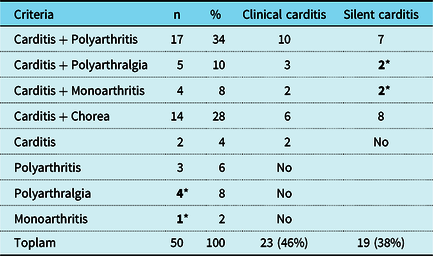
A total of 50 children were diagnosed with the first attack of acute rheumatic fever between the noted dates. Twenty-two (44%) of them were male. Female:male ratio was 1.27:1. Mean age of the patients was 13.5 ± 3.3 years. The associations of the major criteria detected during the diagnosis are given in Table 1.
The associations of the major criteria detected during the diagnosis

* Patients diagnosed depending only to the new criteria.
A total of 42 (84%) patients had carditis, and it was clinical carditis in 23 (54%); mitral regurgitation = 20, aortic regurgitation = 1, and mitral regurgitation + aortic regurgitation = 2. The number of patients with isolated silent carditis was 19 (46%); mitral regurgitation = 14, aortic regurgitation = 1, and mitral regurgitation + aortic regurgitation = 4.
Of the patients with clinical mitral regurgitation, nine (41.6%) had silent aortic regurgitation. So, a total of 57 valvular involvements were detected in 42 patients.
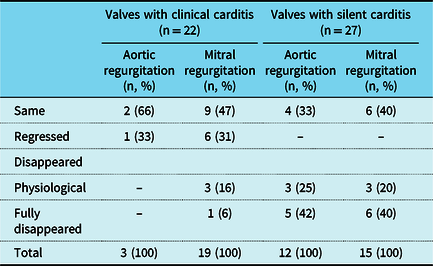
Seven patients (eight valves) with carditis were out of follow-up before completion of treatment. In the remaining 35 patients (49 valves), the median follow-up period was 11.7 ± 3.3 months (range 3–35 months). All patients were compatible with secondary prophylaxis. The progress of valvular lesions in these patients is depicted in Table 2. Three clinical valve regurgitations and six silent valve regurgitations regressed to physiological features. Thus in 18.4% of the patients, valve regurgitations were continued with physiological degree.
Progress of valvular lesions in patients with follow-up

Chi-square analysis revealed that the ratio of disappeared lesions was significantly higher among valves with silent involvement (63%) when compared to valves with clinical involvement (18%) (Chi-square = 6.31, p = 0.03).
Discussion
Acute rheumatic fever is a non-supurative complication of group A beta hemolytic streptococcal pharyngitis. In many developing countries, it is the reason of 50% of all cardiovascular diseases and the hospitalizations due to the cardiac disorders. Almost 15–16 million patients with rheumatic heart disease are living in the world, and approximately 233,000 patients died due to the rheumatic heart diseases every year.Reference Gewitz, Baltimore and Tani2
The only problem responsible from long-term complications is the carditis.Reference Carapetis, Mc Donald and Wilson1 It is the most important major criteria as it can cause heart failure in acute period and rheumatic heart disease in chronic period. Carditis results in valvulitis by causing inflammation in valvular endocard. Recurrent attacks may significantly worsen the valvular functions. This indicates the importance of secondary prophylaxis.
There is not a unique criterion for setting the diagnosis, and the diagnosis is based on the Jones criteria defined in 1944 first. In following years (1965, 1984, 1992, and last in 2015), the criteria were updated.Reference Dajani, Ayooub and Bierman3
In last update, the populations were divided as the populations with low risk and with moderate–high risk in terms of ARF, and different criteria are offered for this population.Reference Gewitz, Baltimore and Tani2 For Turkey, there is not a universal study revealing the incidence of acute rheumatic fever in Turkey. Present data depend on local studies. In a recent study, the incidence of the disease is reported as 37/100.000 for 1980–1989, 60/100.000 for 1990–1999, and 21/100.000 for 2000–2009.Reference Orün, Ceylan and Bilici4 In a preliminary study performed in whole country, Turkish Pediatric Cardiology and Heart Surgery Association found the incidence as 9/100.000 among 5–15-year-old children (unpublished data, 2017). Despite the decreasing ratio, Turkey is still among the countries with moderate–high risk.
The updated guideline offers the silent carditis, polyarthralgia, and monoarthritis as major criteria for populations with moderate–high risk of acute rheumatic fever.Reference Gewitz, Baltimore and Tani2 Previous studies report the ratio of carditis between 54 and 85%.Reference Licciardi, Scaioli and Mulatero5–Reference Chockalingam, Gnanavelu and Elangovan7 Because of the changes in the diagnostic criteria, the ratio of valvular involvement should increase in following reports.
The number of studies reporting the clinical features of the acute rheumatic fever patients diagnosed depending on the updated guideline are low yet,Reference Pirinççioğlu, Alyan and Kanğın8 and we are unaware of a study from our country.
Depending on the updated criteria, a total of 18 patients (36%) included into the carditis group. Nine patients (18%) were diagnosed depending on the new criteria; silent carditis + polyarthralgia = 2, silent carditis + monoarthritis = 2, polyarthralgia = 4, and monoarthritis = 1. A recent study from Italy reported a similar (20.7%) ratio. These results indicate that the last update will decrease the underdiagnoses in populations with a moderate to high incidence of acute rheumatic fever.
It is known that the valvular problems improve frequently in patients with a high compliance to secondary prophylaxis. In a study, it is reported that the 42.5% of the silent carditis disappears in about 18 months.Reference Özkutlu, Hallioglu and Ayabakan9 Some studies indicate a similar survey in the silent and clinical valvar lesions.Reference Figueroa, Fernández and Valdés10,Reference Lanna, Tonelli and Barros11 In our study, the valvar lesions continued in 82% of patients with clinical carditis at the end of the first year, and the degree of valvular regurgitation decreased in 39% of them. Despite of this, in a significantly higher (p = 0.031) ratio of patients with silent carditis (41%), valvar lesions disappeared in the same follow-up period.
Physiological valvular regurgitation (mitral and/or aortic) in normal people is a known entity.12 Some echocardiographic criteria have been offered for differentiation of physiological from pathological valvular regurgitation in patients with suspected acute rheumatic fever.Reference Gewitz, Baltimore and Tani2 These criteria should be strictly followed in order to prevent overdiagnosis. In the present study, an important finding is the transformation of pathological valvular regurgitions to physiological form in a group of acute rheumatic fever patients with definite diagnosis of the first attack acute rheumatic fever. Such a transformation had not been reported previously.
In conclusion; our results indicate that the updated Jones criteria make it possible to diagnose a significant number of patients, and the ratio of complete recovery among patients with silent valvulitis is significantly higher. Also, we can speculate that the children in whom a physiological mitral regurgitation is detected should be followed in terms of rheumatic heart disease.
Study Limitations
The relatively low number of patients and the short follow-up period are the limitations of the study. The results can be verified in a larger patient group with longer follow-up.
Acknowledgments
None.
Financial Support
This research received no specific grant from any funding agency, commercial, or not-for-profit sectors.
Conflicts of Interest
None.
Ethical Standards
The study is approved by the Atatürk University ethical committee for clinical researches (30.05.2019/22/4).