Bill was a good child with bad luck. His mother Elaine's “frightfully” difficult labor, “continuing in agony 36 hours” had required the use of forceps and left Bill “born seemingly dead.” But since that perilous entrance into the world, he had developed into a “well-mannered, affectionate, obedient, trusting and truthful boy.” According to Elaine, he loved music—especially the “pathetic” songs, and dancing, which he did “beautifully.” Bill also liked sports. Like any child, he had also had his trips and falls, and suffered bouts of illness, but also faced more unfortunate challenges. A cleft palate on “what would have been a handsome face” required the boy to endure “awful agony” in corrective surgery. He had at some point also fallen and hit his head, suffered the measles and whooping cough, and “when very ill laid in a stupor [for] three days [that was] induced by cholera infantum.”Footnote 1
Some time after his second fall, Elaine began to suspect that the falls had left her son “unable to learn as other children.” Other than his cleft palate he had no other obvious physical deformity or limitation, but Bill struggled to pronounce K and H sounds. The fifteen-year-old boy could count; he knew his colors, shapes, and alphabet; but he could not read well. On cognitive tasks, Elaine noted that Bill seemed quick to tire.
Near the end of September 1898, Elaine—widowed for five years—brought her son to the Pennsylvania Training School (at the time colloquially and now formally known as Elwyn, after one of its early sponsors) where, she hoped, a formal education would provide “a chance to develop the latent good qualities as well as machine talents and musical love in this lad.” The medical director and superintendent of the school, Dr. Martin Barr, was a prominent national leader in the field of intellectual disability—and an advocate for eugenic sterilization of the supposedly unfit.Footnote 2 Belying the mother's earnest hopes, he tersely deemed the boy “somewhat improvable.”Footnote 3
This case is unusual perhaps in the parent's comprehensive, even eloquent reporting of her son's condition, but in other ways it serves quite well as a representation of several prominent concerns that surrounded intellectual disability, education, institutionalization, and productivity in late nineteenth-century America. How common or atypical were this mother and son's experience of living with intellectual disability? Why did Barr dismiss the mother's claims in his evaluation of the child's capacity to learn? Were Barr and the mother talking past each other in their understanding of the child's intellectual capacity? Elwyn's records and especially the history of its two most prominent superintendents—Drs. Isaac Kerlin and Martin Barr—have often been consulted by historians of disability, most notably by James Trent in Inventing the Feeble Mind. But recent and ongoing efforts to organize and properly archive the school's rich institutional record allow such questions to be explored in greater qualitative depth and with more advanced quantitative tools. While descriptive statistics of dependent and “deviant” populations are commonplace, seldom have historians—or in our case, a historian and psychologist—had the opportunity to work with such comprehensive and detailed institutional records, or use them to produce both both descriptive and analytical statistical evidence.Footnote 4
The Medical Model, Education, and Improvement: The Elwyn Data's Fit Within Historical Literature
Before the advent of disability studies, historians generally approached the subject of intellectual disability with an organizational, state, or institutional point of view that implicitly assumed the viewpoint of its administrators and institutional leaders: that disabilities were medical conditions to be treated.Footnote 5 Disability scholars have upended this approach in favor of a social constructivist viewpoint, as they “emphasize the experiences of the disabled themselves and describe the ways impairments become disabilities.” This approach is premised on the recognition that “impairments do not disable people; society, culture, economics, politics, and law create the category of people known as the disabled.”Footnote 6 Much historical attention has been given to the role of institutional superintendents in the creation of categories of disability. In our examination of Elwyn's records, we further clarify how physicians who sought greater professional control over the education of people with intellectual disability helped turn disability into medical conditions to be treated under their expert aegis. We do so first by reviewing the descriptive statistics compiled from preadmission forms, then through analytical statistics that indicate the physical and cognitive markers that signified to Dr. Barr whether or not a person with intellectual disability might be improved by education. Finally, we use these forms to examine parents’ perspectives on the causes of disability and their understanding and assessment of educational improvement.
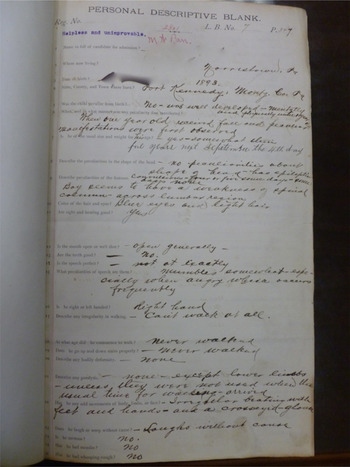
In the first section of our findings, we review the demographic profile of applicants. How old were they? What was their sex ratio? How often had they been sick? On what issues do these forms remain silent? Concerning Elwyn and similar facilities, historian Margaret Winzer has noted that “Determining the specific clientele of these early institutions for children with intellectual disabilities … is somewhat troubling. The early literature is unclear about just who was served.”Footnote 7 The volumes at Elwyn allow us to build a detailed profile of who sought out help at such institutions. Every candidate for admission submitted two forms to Elwyn kept for the inspection of the Elwyn staff: a “Personal Descriptive Blank” consisting of 102 biographical questions, and a 32-question etiological history. The forms offered both open-ended questions such as “Describe peculiarities in the shape of the head. Describe peculiarities of the features. What correction, if any, is used at home? What do you expect from a course of training?” Yes/no questions such as “Does he read? Does he count? Does he sing? Can he commit the words of a song or hymn? Can he throw a ball? Can he catch a ball? Can he tie a shoe string? Can he dress himself? Can he wash himself? Can he write or draw? Can he do housework?” and demographic information such as “date of birth.”
Parents and guardians responded sometimes in terse “yes” and “no” answers and sometimes in pages of detailed narratives. In this article we select from the approximately 20,000 data points we have to date collected from two volumes of the Personal Descriptive Blanks that address unanswered historical questions about the demographic profile of children believed to have intellectual disability.
The compilation of biographical data on candidates for admission at Elwyn enables our second set of findings, a data-driven analysis of superintendent Dr. Martin Barr's diagnostic criteria for determining who might be educationally improved at Elwyn. As Philip Ferguson observed, superintendents’ “concern with professional legitimacy and therapeutic skill” left them “vulnerable to the professional need to demonstrate special expertise and discernment in the treatment of their residents.” This required careful distinguishing between the “truly custodial” and “those who could be somewhat useful and amendable to improvement.”Footnote 8 Tyor and Bell similarly noted that classifying persons by their capacity to learn “was considered vital to any nineteenth-century asylum, and it was believed particularly important in facilities for the retarded because of the highly imitative nature of the pupils. It was feared that the well-trained or advanced students would relapse into poor habits if they were kept in close contact with less able residents.” Such internal segregation of students was much more plausible at institutions with lots of available space, like Elwyn.Footnote 9
But how did physicians evaluate the likelihood of educational improvement for a person with supposed intellectual disability in the years before 1905, when the Vineland Training School brought Alfred Binet's work to America and began developing what became the first IQ tests? Barr, who thought physicians’ diagnoses should drive pedagogical decisions in the education of children with intellectual disability, marked each preadmission form with an initial assessment of the applicant's expected capacity for learning. Which questions on the form guided his pedagogical judgment?Footnote 10 Barr associated the prospect for improvability with a child's age, gender, physical markers of disability, and several simple measures of social and cognitive function. In our analysis of the descriptive and inferential statistics, a picture emerges of Barr advancing his professional agenda of applying medical expertise to pedagogical judgments, defining the “improvable” and “unimprovable.”
First page of Personal Descriptive Blank for Case File # 2801

Barr's use of these records speaks to a broader and often-noted shift in the thinking of Americans in the Gilded Age concerning the potential productivity of persons with intellectual disability—from thinking of productivity in the context of the greater community, to thinking of it in terms of the institutional community. Shifts in the nature of institutionalization necessitated this change of thinking, as superintendents faced the challenge of increasing requests for admissions, longer institutional stays, and rising costs. With this turn toward custodialism and institutional efficiency came new pressures to classify and segregate people by ability. Classifying candidates for admission based on their prospects for educational improvement signaled scientific and professional legitimacy for institutional superintendents. As Ferguson argued, “finding gradations and categories of idiocy where none had been found before … became … a key indication of specialized knowledge.”Footnote 11 Those classifications along a continuum of improvability also offered an explanation for why education sometimes failed: it was not due to a failure in teaching, but a failure in classification, mistaking an “unimprovable” child for an “improvable” one.Footnote 12 Superintendents thus “assumed power over ability and disability, over trainability and untrainability, and over productivity and lack of productivity.”Footnote 13 Our research also reinforces an observation first made by Nicole Rafter, that superintendents’ move toward large-scale custodial care brought with it a transition from Edouard Seguin's preference for lively, spirited children, in favor of routinization and regimentation, “flattening institutional idiosyncrasies and burying diversity.”Footnote 14 Barr's marginalia on the preadmissions forms attest to this, and the resolution of Bill's stay at Elwyn and subsequent post-Elwyn life, we will see, vividly portray institution superintendents’ transition away from preferring the lively, spirited child.
The preadmission forms also permit us the opportunity to better understand the experiences of people with disabilities and their families. In our third, concluding section, we examine these themes from parents’ perspectives, offering an at-times surprisingly intimate look at their hopes for their children and frustrations with the state of public education for children in need of special accommodation. The extension of public education in America resulted in states claiming “more and more supervisory responsibility over not just the schools themselves but also the children who were expected to attend them.”Footnote 15 In most states this meant the creation of state Boards of Education with varying powers to investigate and regulate public education. Historian Robert Osgood summarized the challenge facing these schools:
The nation's schoolhouses … had to take the lead in guiding children from all kinds of backgrounds down paths that ensured public safety, economic stability, and cultural integrity. Moreover, the changing face of the nation required purposeful, publicly supported policies and initiatives that would ensure its future and protect its people. Significantly, the presence of persons with disability in society—a presence viewed as growing larger and more dangerous as time went on—drew the attention of those promoting and making such policies …Footnote 16
These concerns for the nation's schools and the place of children with intellectual disability within them occurred at the same moment that schools turned to more structured, standardized, homogenized approaches, designed to better integrate urban children into the new American industrial economy. This made intellectual disability all the more problematic, for “as schools became more rigid, abnormal student performance and behavior stood out. Teachers and administrators now saw conditions among children that previously went unnoticed or that had been managed with greater flexibility. … Thus by 1900, disability had become a key construct and target for progressive reformers.”Footnote 17 As the mood among reformers toward all sorts of human difference darkened in the late 1800s, urban schools moved to place students with academic or behavioral challenges into isolated classrooms—a solution generally unavailable to rural schools with more limited resources. There, such students simply did not attend or struggled to get by as best they could.Footnote 18
Special education classes protected the “normal” school children from children with disabilities, prioritizing the educational improvement of some students by removing others. The responses found in the Elwyn preadmission forms reveal parents’ appreciation for the bleak outlook their children faced in public schooling; and their hopes, fears, disappointments, and little victories in handling the challenges of their children's educational and medical environment. Allison Carey and Lucy Gu summarize the research on the role of parents as advocates for children with disabilities as either casting them “as early advocates who still today fight selflessly for the rights and needs of their children” or as “a barrier to social change, especially insofar as they espouse models of disability rooted in tragedy, medical narratives, and paternalism.”Footnote 19 Parents’ responses in the Elwyn volumes suggest the presence of both types, sometimes even in the same admission form. Generally, as Bill's case indicates, they pursued more education and practical training for their children, sometimes in tension with physicians and superintendents who increasingly focused on custodial care and maintaining the institutional hierarchy.
Our interest, however, is more with understanding the assumptions that parents brought into their initial communication with Elwyn. We find that parents struggled to make sense of their child's disability and prospect for improvement at a historical moment where asylum superintendents, physicians, and social reformers were keen to claim professional expertise based on esoteric knowledge that parents lacked. Parents adopted a mish-mash of explanations for the origin of disability, alternating between quite idiosyncratic environmental and social explanations of disability and attempting to adopt the detached, systematic medical language and perspective that they must have assumed the Elwyn superintendent would expect to hear. Who really knew more about a child with intellectual disability, the superintendent physicians or the parent? Barr, in his claims to expertise, sought to render parents’ knowledge of their children as less reliable than his own supposedly more objective judgment. Here too we witness the tension between parents’ assessments and aspirations for what their children might gain from the Training School, and those held by the Elwyn staff.
Findings: 1: Who was served? A Demographic Profile
With over 6000 applications to Elwyn available for examination, for our initial efforts we narrowed our focus to the physiological and biographical histories found in the Personal Descriptive Blanks of two volumes. We selected volume one, which covers entries from 1878 and extends through 1880, due to its status as the first volume in the series. We selected the twenty-eighth volume from 1898 for several reasons. The entries are comprehensive and exceed the often terse and incomplete answers in volume one. As discussed elsewhere in this article, Barr reported to the Journal of the American Medical Association on some of his initial findings from these preadmission forms in 1898. It is also the year that The State Institution for Feeble-minded of Western Pennsylvania opened in Polk, Pennsylvania. This was the first state-operated institution for people with intellectual disability in Pennsylvania and was intentionally located in the western part of the state to complement Elwyn's suburban Philadelphia location. As the state-run institutional system expanded, this soon gave Elwyn, a private school supported primarily with public funds, more discretion in whom it accepted. Finally, within the broader context of Pennsylvania's history of social welfare, 1898 marked the end of the economic depression of the mid-1890s, which historians frequently note for its importance in affecting American opinions regarding social welfare.Footnote 20
Selecting volumes one and twenty-eight also recognizes that while the forms were first implemented and emphasized by Dr. Isaac Kerlin, it was Barr, Kerlin's assistant who in 1893 assumed Kerlin's role as superintendent, who did the most significant work with them. Between them, Kerlin and Barr brought Elwyn to national prominence in the study, training, and treatment of children and adults with intellectual disability and helped construct the “medical model” of intellectual disability. This model rested on the presumption of absolute authority of the superintendents, who advanced the claim that their work was a branch of professional medicine. Kerlin and Barr's work at Elwyn brought them considerable influence in their time, and subsequent attention from historians.Footnote 21
Both men took these preadmission records as a matter of supreme administrative importance, and as a data source that, once compiled, would advance physicians’ understanding of the causes of intellectual disability and thereby inform educational and medical responses. In an internal memo from 1891, Kerlin advised “the assistant superintendents (Barr and Dr. A. W. Wilmarth), matrons and office clerks, any one of whom may meet parents or guardians seeking admission for their children” that “it is proper to gather from such applicants a brief statement in writing of the physical and mental condition of the child.” He admonished them, “Do not forget to present the descriptive and etiological blanks to be filled in behalf of the case.”Footnote 22 Both men, but Barr in particular, saw in these blanks the potential to aid in their pursuit of bringing the study and treatment of intellectual disability into the fold of medical science.
These two volumes represent the histories of 207 individuals—133 males and 74 females. Volume one contains forms for 107 individuals—74 males and 33 females—while volume twenty-eight contains information for 100 people, 59 males and 41 females. While historians of eugenics, progressivism, and intellectual disability frequently note the period's concern for unregulated female sexuality among the “unfit” as a motive for institutionalization, the gender breakdown at Elwyn suggests a different motive. As Kim Neilsen observes, legally and popularly, disability often was defined in physical terms, as an “incapacity to perform manual labor.” This meant that “women's lives did not easily mesh with the definition of disability as an inability to labor.”Footnote 23 As our analysis of Barr and the parents demonstrates, stakeholders at Elwyn often described and evaluated intellectual disability in reference to physical disability and the prospect of developing greater economic productivity, perhaps even self-sufficiency. This gendered reading of intellectual disability as tied to productivity likely informs the greater frequency with which boys were reviewed for admission. It also is likely that as boys matured, they were less apt to be physically controlled at home and therefore more apt to be referred for institutional placement—several preadmissions forms note the failure of corporal punishment to correct children's misbehavior. Finally, although Kerlin and Barr could not have known this, it is important to note the greater overall prevalence of intellectual disability among males, in general, primarily due to x-linked chromosome disorders. For all these reasons, although this gender imbalance lessened over Kerlin and Barr's administrations, it did not disappear.
The Elwyn forms do not contain an entry to signify an applicant's racial identity. We know, however, that Kerlin and Barr admitted a small number African Americans to Elwyn before the 1900s. Photographic records reveal both adults and children who presumably would have been classified by the superintendents as black, and with great infrequency a remark in the admission records might note the applicant's race. Given both the infrequency of these observations and their unsystematic nature, we cannot say much about how race affected the superintendents’ assessments, or how race affected individuals’ experiences upon admission to Elwyn.
There similarly is no entry blank that allows for a reliable analysis of applicants’ socioeconomic status. Elwyn and Vineland were distinctive for being private facilities larger than their public counterparts, but, like other private facilities, in addition to state funding, they charged tuition, with room to negotiate expenses based on a family's ability to pay.Footnote 24 Barr's correspondences with parents are filled with such negotiations: $225 per year for all expenses other than clothes seems to have been the standard best-deal offer Barr could make to families with an ability to pay.Footnote 25 By the 1870s, “public institutions were becoming facilities for the children and siblings of America's working class, poor, and immigrants.”Footnote 26 Kerlin was very cognizant of not letting the mix of uneducable overtake that of the educable. He feared that this would undermine his concept of the asylum village, and worried that Elwyn would become totally custodial as the numbers of uneducable increased. Remarks from guardians, parents, physicians, and charity workers indicate a perhaps surprising amount of diversity in circumstances, ranging from wealthy families seeking state-of-the-art private care for a family member; to orphaned children, children who had been removed from their parents’ custody, and children of families whose reporting indicates severe economic distress. In other words, of the standard demographic markers found in the late 1890s, the only ones amenable to quantification are sex and birth year.
While sex ratios basically held stable, the age range of persons referred to Elwyn changed notably, as Elwyn expanded to serve both children and adults. Birth year, when indicated (n = 152), ranged from 1858 through 1895 (Book 1: n = 56, range = 1858–1874; Book 28: n = 96, range = 1861–1895). The average age in years across both volumes (n = 97) was 12.77 (SD = 6.01). An independent-samples t-test was conducted to compare age in years across volumes. This revealed a significant difference in age between the two volumes. The average age for the forty-three persons with an entry for birth date and date of submission of the forms in volume one is 11.36 years (SD = 3.53) and for the fifty-four persons in volume twenty-eight, the average age 13.89 years (SD = 7.26); t(95) = 2.09, p = .039. This indicates that during the roughly twenty years that separates the two volumes, referral patterns changed to include young adults. This is best reflected in the age ranges of referrals with book one ranging from 3.5 to 21.7 years and book twenty-eight from 3.7 to 37 years. The school had transformed from a primarily children's educational facility to a facility for both children and adults, and confirms previous findings concerning the increase in age of residents at facilities for persons with intellectual disability across the Gilded Age and Progressive Era. It also likely reflects the period's growing anxiety to sequester women with intellectual disability during their reproductive years.Footnote 27
Findings: 1b: Health profile of applicants
Barr explained in a brief report to JAMA in 1898 that he and Kerlin had “intent of reducing to tabulated form … those diseases most common to the feeble-minded” by use of records spanning, at the time, twenty-five years and 3000 cases.Footnote 28 In a follow-up report from 1930, Barr summarized results from what was, by then, 5000 surveyed case files. We do not have Barr's notes from which he came to these figures, but Barr claimed that they revealed three primary causes of “mental deficiency.” “Accident or injury at birth” was the “direct cause” Barr identified in 6% of cases. “Parental idiocy or imbecility” caused 25% of cases of mental deficiency; and, topping the list at 28%, were the cases “attributable to acute illnesses or severe injuries of early infancy and childhood.”Footnote 29 Given Barr's status as a prominent proponent of eugenics, this is an easily overlooked point: Barr thought his data suggested environmental factors caused more feeble-mindedness than heredity did. Like all pre-Mendelian eugenicists, he did not conceive of heredity and environment as clearly distinct and separate categories.
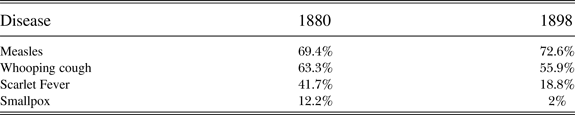
How did Barr draw these conclusions from his records? Does the demographic profile from this sampling of his records suggest such conclusions? See Table 1. Of the 207 total cases analyzed in the two selected volumes, intelligible responses were offered between 68.6 and 71% of the time to questions about the child's history with measles, whooping cough, scarlet fever, and smallpox. A question on whether the child had been vaccinated for smallpox received a 72% response rate. In each instance, the 1898 volume showed far better response rates than the 1880 volume. The most common childhood illness among those tabulated, measles shows a slight uptick in frequency from 69.4% to 72.6% among all respondents. Whooping cough drops modestly from 63.3% to 55.9%, while scarlet fever and smallpox show more dramatic fall-offs, from 41.7% to 18.8% and from 12.2% to 2%, respectively. None of this helps determine how Barr came up with his assessment, and while the filers are asked their judgment on the matter, nowhere on the form do we see a place where Barr or another examiner is asked to make a final determination of the cause of intellectual disability. The records, then, are quite helpful in picturing childhood disease frequencies and suggest that the persons seeking admission at Elwyn likely suffered from at least one serious childhood illness. They cannot, however, offer much guidance to Barr's decision-making process in assigning causes to intellectual disability or the actual causes themselves.
Percentage of respondents who indicated a childhood disease, V. 1 and V. 28

Seizure disorders were of special interest to both Barr and Kerlin, as physicians often took epilepsy as a sign of some greater hereditary failing and often, insanity.Footnote 30 From the 107 entries in volume one, 19 of the biographical forms indicate the child had experienced an epileptic episode, 35 had not, and 53 did not indicate a response—most likely indicating some combination of not knowing, or that the child had no such episode. In volume twenty-eight, 32 forms indicated that a seizure occurred, 64 indicated no seizures, and no forms lacked a response. Seizure onset ranged from birth to 12.8 years (n = 44, M = 3.84, SD = 3.38), and generally come with descriptions ranging from “worms and fever” to the more clinical explanation filled out by a physician, “at intervals of 2 to 7 days she has slight attacks resembling petit mal … [when she] has them the eyes are fixed the limbs rigid. … not epilepsy.”Footnote 31
Such answers are equal parts historically rich and beguiling. They also show the disconnect between Kerlin and Barr's vision of disability as a medical condition both analogous to and often caused by disease; and parents’ more idiosyncratic, social, environmental, and often more nuanced perspective of their children's health. How do we assess cases like those where the guardians each indicate that the child has no history of epilepsy, but then state things like “convulsions at 3 months” and “spasms at onset of smallpox” and “heard had when baby, none since”?Footnote 32 Does that constitute proof that the child did not have epilepsy, or did? Do we privilege the assessment of the person who filled out the form, or presume, in lieu of evidence, that Kerlin and Barr must have interpreted such remarks as proof of epilepsy?
Because epilepsy figured prominently in Kerlin and Barr's diagnostic description of “feeblemindedness” and because professionals viewed it as a manifestation of mental defectiveness caused by the same “bad heredity,” it is disappointing to concede that we are not confident in our ability to categorize the epilepsy entry in any way that would be amenable to statistical analysis. What we can say qualitatively, however, is that admitting persons with epilepsy had implications for Elwyn's self-contained “asylum village” model of treatment. Viewed with greater distance and detachment, with his broader conception of “idiocy” and “feeblemindedness” that included epilepsy and the “moral imbecile,” Kerlin intended for persons who today would not meet the diagnostic criteria for intellectual disability to be removed from the larger community and trained to labor in service of the needs of all who resided in the “asylum village.” Under first Kerlin and then Barr, doing so provided Elwyn a workforce without intellectual disability to assist in maintaining the facility and caring for those less able to care for themselves. This also satisfied the greater social concern to protect the world outside from the supposed threat of the persons within Elwyn.Footnote 33
Findings: 2: Defining and Categorizing Improvement and Productivity at Elwyn
The shift in the state-sanctioned care of persons with intellectual disability occurred in conjunction with broader shifts in American attitudes about economic dependence and independence, and individual self-reliance and productivity.
Late nineteenth-century leaders in the custodial care and education of children with intellectual disability were co-travelers with and often came out of the ranks of the “scientific charity” movement crusaders who sought to identify and put to purposeful work all capable private charity recipients. This background and philosophical commitment to the therapeutic and moral value of labor to dependent persons informed asylum work. Few exemplified the professional cross-over from charity to asylum work as well as Alexander Johnson. Before being brought on to The New Jersey Home for the Education and Care of Feebleminded Children at Vineland, New Jersey, Johnson first made a name for himself as one of the foremost advocates for clamping down on charitable applicants.Footnote 34 This concern that someone somewhere might be shirking labor informed Johnson's goal of making the “institutionalized feeble-minded” more productive. As reformers increasingly described intellectual disability in hard hereditarian terms, as an atavistic, retrograde expression of evolution, pessimism that such people could ever leave an institution grew.Footnote 35 Johnson thought that, at most, 15% could ever return to the community, but perhaps 75% could provide enough labor when in custodial care at an institutional home to be economically neutral to the bottom line.Footnote 36 This labor generally involved taking care of younger and less able residents as well as maintaining buildings, working in the kitchen, the laundry, and maintenance departments. Economic pressure to maximize institutional productivity intermingled with professional aspirations to demonstrate the physician's exclusive claim to being able to educate and train students with intellectual disability. As a private institution, Elwyn had some discretion in whom to admit; a guardian's desire to institutionalize a particular child did not necessarily mean Elwyn had any desire to accept a child unlikely to benefit or be benefited by the institution. This required categorizing applicants based on their likelihood of improvement, and Barr was up to the task.
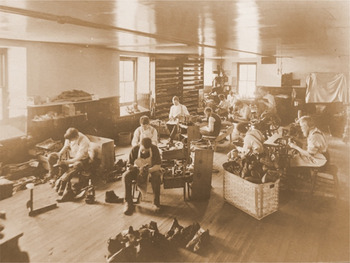
The Pennsylvania Training School's cobblery. From Box 61 in the Elwyn archives.

Barr entered remarks, generally in purple type, at the top of the “Personal Descriptive Blank” form for 99 of the 100 cases documented in the 1898 volume. These typically were terse assessments of an applicant's likelihood of improving from Elwyn's care, in the sense of coming closer to maximizing the person's intellectual potential, or “mental limit” as Barr often called it. These assessments sometimes are intermingled with a declaration of whether or not the applicant could be admitted at all. Typical of Barr's remarks, he described applicants as “but slightly improvable” or “an improvable case” or “unsuitable,” though occasionally they also reveal some insight into the criteria by which he rejected appeals: several were noted as being too old to improve, in spite of the previously noted expansion in age ranges served at Elwyn. Two were too young, and another was disqualified due to blindness.Footnote 37 A child whose representative hoped he wouldn't be overly taxed, Barr found “somewhat improvable, although he has nearly reached his mental limit.”Footnote 38 A girl who was a purported “man-lover” Barr deemed “but slightly improvable” even though there was “no room at present for such a case.”Footnote 39
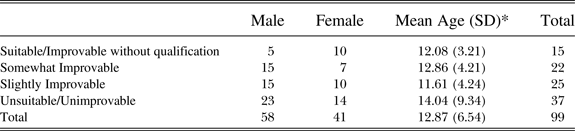
Table 2 presents basic demographics for Barr's assessments for each person in volume twenty-eight. He rejected outright thirty-seven cases as either “unsuitable” or “unimprovable,” and gave specific reasons for eleven of them, such as being too young or old, being partially blind or having epilepsy. The remaining twenty-six such cases make broader references to being a “moral imbecile” or “low grade” or might just declare a person “helpless and unimprovable.” On the other end of the spectrum, fifteen applicants received unconditionally favorable assessments, almost always using the phrase “improvable case” (thirteen times) with “improvable. suitable case,” and “Very bright and improvable. Suitable for admission” each appearing once.Footnote 40
Volume 28 Applicant Demographics and Barr Assessment

* June 30th assumed for date of exam to calculate age when day and month of exam missing.
For purposes of our quantitative analysis, we grouped the remaining cases from volume twenty-eight into two other categories: the twenty-five cases where Barr used terminology indicating some slight hope for improvement, typically a variant of “but slightly improvable”; and the twenty-two cases where he gave more sanguine phrases like “somewhat,” or “probably,” or “fairly improvable.” We categorized as “Somewhat improvable” the sixteen cases where Barr used that exact term, as well as the cases marked “probably improvable” (four) and “fairly improvable” (one). The only case that proved problematic to classify was an applicant Barr deemed “Has probably reached mental limit; but might make a good worker.”Footnote 41 We grouped that person in this “somewhat improvable” category because the remarks still suggest greater optimism about the person's potential than those in the “slightly improvable” group. The twenty-five “slightly improvable” cases included twenty-one cases using that exact term, and individual cases judged “little hope, low-grade,” “low-grade imbecile,” “has reached mental limit, and but small hope of any improvement” and “rather low grade case. Can hope for but little improvement.” These categories are perhaps less elastic and more ontologically “real” to Barr than what a reader might suspect. In an era where social reformers found no problem drawing sharp categorical lines between the worthy and unworthy poor and where Barr could successfully promote a new classification scheme and terminology for intellectual disability, it should be no surprise that Barr also thought he could make meaningful, categorical distinctions between the slightly improvable and the somewhat improvable.
What particular circumstances inform Barr's categorization scheme of improvability? What features distinguish the negative assessments from the more positive ones? Even though there were only forty-one women to fifty-eight men in volume twenty-eight, they represented ten of the fifteen improvable cases. The age difference between children at the two extremes of his “improvable” spectrum also is telling, especially given Barr's interest in the idea of a hard “mental limit,” a term he used in fourteen of ninety-nine cases in the volume. Of six cases where Barr judged the child suitable or improvable without qualification, and where we know both the child's age and the date the guardian completed the admission form, the average age was a little more than thirteen years. Of the fifteen children for whom we know the age and whom Barr judged entirely unimprovable, the average age was just under eighteen years old. If we take the remaining cases for which we know the child's birthdate but do not know the date the form was completed, and postulate that each form was completed on June 30th, the midpoint of the year, then the mean age of the thirty-seven unimprovable cases is slightly over fourteen, while the mean age of the fifteen improvable cases is just over twelve, as shown in Table 2. In other words, the closer a child got to maturity, the more pessimistic Barr's assessment grew.
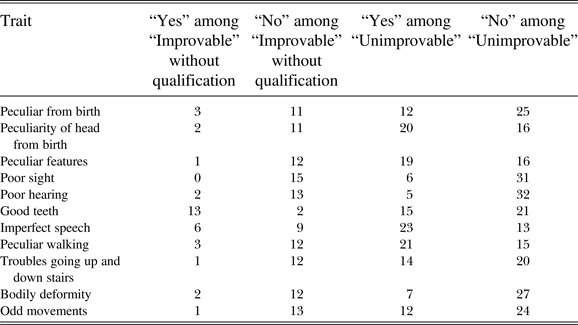
Similar to how age seems to have factored into Barr's sorting of children, at least among those he deemed entirely suitable or unsuitable, physical markers of disability also appear to have informed Barr's categorization of the most and least improvable children. As documented in Table 3, of the fourteen cases where Barr both judged a child improvable without qualification and where we have a response to the question, only three indicate that the child was “peculiar from birth.” For the “unimprovable” group it is twelve out of thirty-seven so judged. Eleven of thirteen improvable cases indicated there was no peculiarity of the head at birth, where twenty of thirty-six unimprovable cases indicated such peculiarity. For peculiar features, only one out of thirteen improvable cases that gave a response said the child looked peculiar, whereas nineteen out of thirty-five respondents whose children were marked “unimprovable” noted such features. Not one of fifteen improvable cases said the child's sight was not good, compared to six of thirty-seven cases among supposedly unimprovable children. For poor hearing, the ratios are two out of fifteen compared to five out of thirty-seven. Teeth were considered “good” in thirteen out of fifteen improvable cases, but just fifteen in thirty-six unimprovable ones. Six of fifteen favorably evaluated children had imperfect speech, while twenty-three of thirty-six negatively evaluated children did. Three of fifteen improvable cases noted a “walking peculiarity” and one of thirteen noted troubles walking up and down stairs, compared to twenty-one of thirty-six and fourteen of thirty-four, respectively, among unimprovable cases. Two out of fourteen and one out of fourteen indicated a “bodily deformity” or “odd movements,” respectively, compared to seven out of thirty-four and twelve out of thirty-six, respectively, among unimprovable cases.
Physical attributes identified in Volume 28

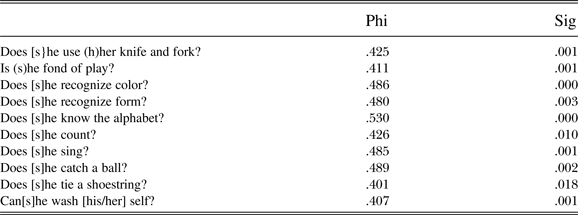
These data are suggestive, but deeper statistical inquiry further illustrates the extent to which Barr used simple cognitive and physical markers to evaluate a child's likely improvability. For every question on the Personal Descriptive Blank phrased so as to elicit yes/no answers and Barr's four assessment categories, we conducted chi-square analyses. A phi (φ) coefficient, which is a measure of association between categorical variables, was computed for each of these yes/no questions that resulted in a significant (p < .05) chi square. Given the exploratory nature of this study, predictive value was ascribed to those questions with a moderate or greater phi coefficient (φ > .4). Table 4 presents those questions that reached the phi coefficient criterion and their corresponding phi and significance level.
Questions That Best Predict Barr Assessment (n=98, φ > .400)

On first inspection, it might seem odd that a person's ability to catch a ball tells more about how Barr evaluated their fit for Elwyn than some of the yes/no questions that showed weaker coefficients, like the question concerning a propensity for starting fires. Indeed, it likely did not matter how encouraging the rest of the reports were regarding prospects for improvement; a known fire-starter simply was not going to be admitted to a private institution dependent on collecting tuition. Given the small number of entries that acknowledge a history with fire and the uniformity of Barr's decision on those cases, it does not compare in analytical utility to, for instance, a child's ability to recognize color. There, all fourteen “improvable” children could do so; only nineteen of thirty-five “unimprovable” children could do the same.
Barr's four-part gradation of children's suitability for Elwyn is surprisingly durable, and because his notations are so uniform, quantification can help us better ascertain patterns in Barr's assessment of children's likelihood to improve, revealing the likely influence of age, gender, physical markers, and the simple cognitive and physical tasks documented in Table 3. This is not to ignore the limits of such an approach. Although Barr's judgments about improvability likely correlate very closely with his determination of whether or not to admit a child to Elwyn, we know that at least some children judged improvable were nonetheless turned away.
The best illustration of where our quantitative approach reaches its limit is in the case of Joan. In Barr's most revealing statement from volume 28, he dismissed the fifteen year-old girl from Philadelphia as “Somewhat improvable, but no room for such a case at the present time. Unsuitable in every way. A most pernicious element to introduce among our girls.”Footnote 42 This is the only instance we have found so far where someone marked “improvable,” even with qualifications, was also judged “unsuitable.” No other case shows any such indication of overlap or fuzziness between categories. What made the somewhat improvable girl so unsuitable and pernicious? Although Barr offers no set of reasons, the preadmission records suggest any number of possible combinations. According to the family physician's answers, Joan “Never could tell the truth, as soon as she talked she lied about everything. She has also manifested a suicidal tendency on 2 or 3 occasions.” She laughed and wept without cause, was nervous, had measles and whooping cough, and one epileptic fit four months before applying to Elwyn, though the entry describes it as “doubtful” and that the “mother says she never had a spasm.” Asked if she was indolent or active, the parents tell of Joan being “active at times, when feeling good. When not, impossible to make her do anything.” Similarly, she would not obey a command “unless feeling very well.” The “trustful and truthful” question was answered no, the “obstinate and passionate” question answered in the affirmative. “Yes” also was the response for questions about being destructive, stealthy, vulgar, straying from home, being heedless of danger, being dangerous with fire, destroying clothing or furniture, and soiling or wetting the bed. Questions on the “power of attention” power of imitation” and “power of memory” all rated Joan as “poor.” In the etiological history form, the doctor opined that the cause was “congenital” due to a stroke that had left the mother “unconscious for about ½ an hour when about 4 mos. pregnant.” Unlike Barr, the physician deemed Joan “suitable for a course of moral training, such as could be given only in an institution such as yours.” It would be better, at least, than her time at home where “She was rapidly following a downward course and becoming harder to control,” to the point where she was staying at the Midnight Mission, “a most unsuitable residence for her.”Footnote 43
Gendered expectations about appropriate female sexuality almost certainly informed the physician's concern for Joan's “downward course” and “unsuitable” stay at the Midnight Mission. Although an applicant's sex and associated gendered concerns about promiscuity in “high-grade” girls with intellectual disability almost certainly factored into Barr's assessments, analyses have not revealed as much about the place of gender in Barr's reasoning as one might hope. For the 1898 volume, the mean ages of the males and females that Barr evaluated as “unsuitable” are 14.14 (n = 23, sd = 10.12) and 13.87 (n = 14, sd = 8.29) years of age, respectively. The “improvable” men and women showed an equally small difference in mean age, 12.03 (n = 5, SD = 3.97) and 12.11 (n = 10, SD = 3.01) years, respectively. In addition to the individual's age, other questions that we might expect to produce gendered differences in how Barr assessed applicants also fail to show a discernable pattern. For instance, Kerlin and Barr almost certainly intended for the question about whether the individual engaged in “unfortunate habits” to imply masturbation or other behaviors deemed sexually unacceptable. Joan's physician likely understood it as such when he answered “yes.” In the 1898 volume, filers gave affirmative answers to ten male and seven female cases. At least some filers, though, interpreted unfortunate habits to mean other undesired traits, including habits of swearing, needing to wear a diaper, “talking to her self,” “biting his fingers,” and “he slobbers.”Footnote 44 Among the few instances where the filer gave an answer clearly specifying that the individual had unfortunate sexual habits, Barr evaluated males and females alike as both improvable and unimprovable.
Findings: 3: Parents’ Educational Goals, Frustrations
Barr wanted children who had not yet reached their mental limit, could be improved through training, and thus serve Elwyn's economic desire to reduce expenses through the labor of residents while advancing physicians’ professional authority in the realm of intellectual disability. Parents, guardians, and other representatives of the children seeking admission to Elwyn generally shared Barr's interest in educational improvement and economic productivity, but often conceived of it differently.Footnote 45 Several of the children's guardians made note of their dissatisfaction with the resources available in their public school and thought that life at Elwyn would create opportunities for the child that were lacking in the broader society. A mother's entry in the first volume noted that her daughter needed to “improve in school training,” since younger children had surpassed her; another hoped her son would “benefit … by such training as he would receive at your Inst., as he cannot be taught in schools” because of his epilepsy. The situation had little changed for one mother in 1898, who hoped for her son “an education which he cannot gain at public schools.”Footnote 46
These parents and representatives pursued their children's education interests, however, in the same period of time when leaders in the field of intellectual disability redefined their work away from solely an educational pursuit and more toward a medical model. Coupled with an early association with eugenics and a failure to reintegrate adults into society, this led to a narrower view concerning who could be improved, and the feasibility—and advisability—of integrating people with intellectual disability into society. The institutional leaders in the nascent field of Intellectual Disability turned toward the goal of a self-sufficient institution where instructors delivered practical training to residents, so that they might maintain the institution and provide custodial care to those less capable.Footnote 47 By the 1890s, “Decades of experience with the residents of their facilities had convinced most of [the institutional superintendents] that emphasis on academic instruction and intentions to “graduate” many of these children back into society were misplaced. Administrators reserved “school work” for only the most capable of the children. The individuals who were capable spent their time maintaining the institution's physical plant and working to generate income or save money for the institution.” At Elwyn, such tasks might include net-making, cobblery, or taking in the laundry.Footnote 48 This left these facilities a long way from the practices of early institutional leaders like Samuel Gridley Howe, James B. Richards, and Edouard Seguin, who focused their attention on students capable of improvement and moving them back into the community.Footnote 49
Much of the material in the case records involves representatives’ assessments of the child's potential to lead a productive life. Answers to the question of what the respondent hoped for from a course of training at Elwyn range from “we do not expect very much” to “cure his physical and mental afflictions.”Footnote 50 In general, three groups of answers emerge from the responses. First, there are those who wish the child to receive a practical education allowing the child to be economically productive and improve his “efficiency,” one of the great buzzwords of the time period. As one parent said, “The boy is sufficiently intelligent, I conjecture, to acquire a mechanical skill. I do expect that he will be able to do much work.”Footnote 51 A mother wrote, “All we hope to do is to teach him a trade” while a father envisioned his son “learning a trade whereby he can in some way support himself.”Footnote 52
Second, parents remained keenly aware of public schools’ limited resources or even awareness for handling students with special needs, but believed their children could and should receive a thorough education. These include answers such as “To teach him the knowledge of being good and to read and write and to tell numbers and to take care of himself” and to gain “an education which he cannot gain at public schools.”Footnote 53 Another couple explained their hope that “We can give her advantages that her condition deprives her of at public schools. We hope for [the] brain's expansion and improvement mentally.”Footnote 54 One family confidently explained, “We expect much: I feel as if he will be one of the brightest pupils at the school” while another optimistically declared that “the boy by proper training such as he will get at “Elwyn” will make quite a man.”Footnote 55 These answers almost always presume that the objective of training at Elwyn ultimately involved reintegration with society outside of the school.
Finally, and in contrast to the first two categories, we see parents and representatives who mostly wish for their children to receive decent custodial care. On one end of the spectrum of such responses, a representative for an orphaned child hoped that life at Elwyn would offer “A good home, where he would be kindly treated, carefully looked after, not over-taxed with work or studies; [I] would like him to learn to read and write a little better if possible and later on a little musical training.”Footnote 56 On the other end, a father requesting admission for his daughter complained “I have gave her a course of training and she did not do as I expected. She turned out to be a man-lover.”Footnote 57 Another representative of an orphan cryptically remarked that the goal of a stay at Elwyn would be “to keep her out,” presumably, of society.Footnote 58
The data concerning children's biological and etiological histories and our data-driven suppositions about how that data correlate to Barr's assessments of a child's mental capacity notwithstanding, the parents’ and representatives’ explanations of children's disabilities are the richest sources of information about living with and understanding disability in the late nineteenth century. These beliefs emerge from several places in the admissions forms, but especially from the last question on the form described as the “Physiological History” form in 1880, relabeled the “Etiological History” form well before 1898. The question asks the filer to add “any other facts which in your judgment may seem to have a bearing, in this particular case, on the important subject of causation.” At risk of understatement, these answers represent a wide range of possibilities. Consider the handwritten letter attached to an entry from the first volume from 1880. The letter explains of the family:
As far as I know the two brothers of Phil Stevens are as smart and inteligent [sic] as the majority of children born from the 4th or 5th class of parents. The oldest boy the mother told me is illegitimate. The Father was a man from good birth and a practicing Christian in Wyoming Co. PA until his death: But took to drinking whiskey: … The third youngest I don't think is a Stevens—Don't know who the Father is. The second one Phil is all Stevens if I can judge right. [The filer goes on to note that the father has been a public charge, for the last several years] The [other]Boy … was born after the Father had the Paralasis [sic]or Palsy: You can account for the feeble mind. As far as giving you a correct history of birth of Father[,] mother is impossible. They are of that class of poor whites that they have in the Southern states.
The filer then relates how the grandfather had tried to steal butter from a store by hiding it in his hat. The alert storeowner supposedly sat him down by a fire to chat, until the melting butter exposed the would-be thief. Continuing the explanation of the family's hereditary legacy in the space provided for the question on causation, he adds:
My knowledge of the parents of this child and the grandparents on the mother's side induce me to say that aside from any accidental causation it would not be illogical to attribute this unfortunate boys condition to congenital causes. The grandmother on the mother's side was always considered sane but she was not considered very firm or stabled in sense.
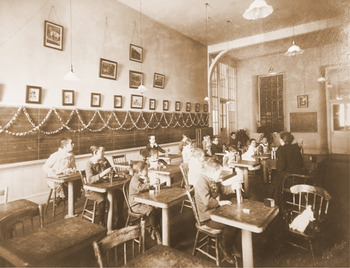
Classroom instruction at the Pennsylvania Training School. Box 61 in the Elwyn archives.

The mother of this boy is not considered “quite square” she is a great talker and uses her tongue freely, but in her “Idle gossip” very seldom does any one any great harm.
She is in fact weakminded in its ordinary sense but [illegible] a good, kind + careful mother. The general record of the family + its ancestry for [illegible] is that while they are an all + have all been reasonably good citizens, others affairs, either public or private, would not be enhanced any by being left to their management.Footnote 59
Many records read similarly, if less candidly: matters of family gossip and stories of the moral failings of others abound in these reports, all of which in some way indicate popular attitudes about how the interaction of a family's hereditary predisposition with a poor living environment creates a situation conducive to a variety of related moral and physical pathologies.
Many of the explanations indicate the popular belief that both prenatal and postnatal stresses and emotional disturbances experienced by the mother would be imprinted on the child. The etiological survey asks, “was either parent subjected to any special overtax of mind or body immediately prior to the conception of this child?” and “Was the mother during this pregnancy subjected to any continuous anxiety or hardship, or exposed to any shock, accident, or specially painful emotion? If so, particularize, and the period of gestation when such disturbance occurred.” Mothers and physicians often could identify with confidence the specific, shocking event that imprinted upon the fetus. A mother from the 1880 volume explained that while pregnant, a monkey had jumped on her shoulder and scared her, which she supposed caused her daughter's impairment.Footnote 60 Another mother identified fainting at the sight of a snake when she went blackberry picking while pregnant.Footnote 61
More common than disability caused by frights from animals, several filers reported tragic stories of desperate and despairing mothers whose emotional pains, they feared, had affected the child's development. One particularly evocative answer describes how the filer in conversation with the mother
could perceive that the mother was harassed by unusual exertion of body + sadness from want of the tender love + sympathy which I know her nature yearned for. The father was a man exceedingly upright + just, but having little intercourse with the other sex + having had to make his own way in life, he could not appreciate the longing for sympathy + tender love which was so necessary to his wife; so during the first part of her married life, among strangers “rough + ready farmers” + obliged to assist her husband in teaching she had a dreary + often a hard lot. Besides the father being hasty + determined I think she must frequently have felt his displeasure.
I have always thought this had much to do with Kent's condition, for with firm kind words, he was always tractable but the least irritation immediately aroused a similar disturbance in him which could not be allayed by the one causing it + that person generally remained an object of dislike + one to be avoided.Footnote 62
Several records attest to the unfortunate lives of mothers neglected, abused, or abandoned by their husbands; and left to raise children whose disabilities, the mothers often believed, were due to the emotional suffering caused by unfortunate family life. A woman in 1880 shared of her “great trouble” with a wayward brother and a sister's “unfortunate marriage.” Just two entries later, the filer on behalf of a mother explains how the night before her son's birth, “his Father went home drunk, kicked the table over and smashed things. His mother in spasms. … His Father was at one time a very respectable man and in good circumstances. … Drinks made him crazy.” A few entries later, a Philadelphia woman confided, “During pregnancy I was very much worried, left alone all night, no attention or care was given me, such as generally is allowed to women carrying a child. I cried more during the 9 months I was pregnant with her than I ever did before or after.” Finally, a filer explains that a mother's distress at a poor marriage might be the cause of her children's difficulties, as “She married her husband against her will, + says that at this time their life caused her to be miserable, + at this time she dispised [sic] her husband”.Footnote 63
POST-SCRIPT: A FOLLOW-UP ON BILL, NEXT STEPS, AND CONCLUSIONS
While many guardians, physicians, or others who held no familial relation to the child they represented were quick to identify inheritance or some other “congenital” cause to disability, parents, understandably, were not inclined to think about their children in terms of biological or eugenic fitness. To return to Bill with whom this paper started: Perhaps indicative of his parents’ status-consciousness, Elaine's answers to the etiological history form simply state “no not inherited” when asked if her son's condition was congenital. She similarly underlined her insistence that neither parent had been addicted to alcohol, tobacco, or opium, though in answer to the follow-up question about her grandparents, it “grieved” her to report her father had been addicted to alcohol. Elaine had been “very much worried” and had experienced a “dreadful scare” during pregnancy, but at the time had not considered it significant. To her, the cause remained the “heavy fall on his head” at age two.Footnote 64
Recently, interns in the process of creating a detailed archival finding aid at Elwyn greatly advanced our work by cracking the administrative coding that Barr used to link the Personal Descriptive Blanks and Etiological Histories to the corresponding notes in the volumes that contain medical records, physical examinations, school progress reports, and admission and discharge records. Further analysis will allow us to more precisely determine not just who was deemed improvable, but who then was admitted, and how their subsequent medical and educational documentation does or does not corroborate the superintendents’ initial assessments. Again, Bill's case suggests the richness of opportunity for qualitative and quantitative study. From the corresponding notes in the medical record volume, we now know that Barr's educational assessment of “slightly improvable” corresponded to his medical classification of Bill as a “moral imbecile, middle grade.” The medical notes also indicate that he found Bill “depraved and hard to manage” even though he “made marked improvement in school during [his] short stay.”Footnote 65 Barr's first entry in the school progress report similarly concentrates as much or more on behavioral problems than educational results, with Barr adding that Bill was “rather an unpleasant looking boy with deep-set eyes and forbidding expression. Is utterly utterly undisciplined. … Is sly and generally manages to have his own way.” The follow-up report by a teacher penned a month later tells quite a different story. In it, Bill is a “very quiet boy trying hard to read and spell, and really has improved a great deal.” A final note Barr crammed against the book spine observes, “Depraved, hard to manage,” yet even Barr had corrected his initial educational assessment, and conceded that Bill had “made marked improvement in school during [his] short stay.”Footnote 66
The conclusion of Bill's unusually brief stay at Elwyn gives one final insight into the mother's experience trying to find the best educational environment for her son. Bill returned from a weekend home visit on Saturday, January 7th, 1899, and the next day a nurse caught him smoking. When confronted with the matter by a physician, Bill became “very impertinent and rebellious and refused to allow the doctor to examine him.” The matter escalated, and Bill reportedly attacked the attending nurse, “blackening her eye.” When a search revealed tobacco and “explosive matches” in Bill's pockets, he was sent to “The Quiet”—for a structured time out in another building—for three days. Barr noted that Bill was “much ashamed of himself and seems to be repentant.” Yet nine days after his release from “The Quiet,” the school records note that Bill “Ran away.”Footnote 67 Three days after his escape, Barr explained in a letter to the charity that had served as an intermediary for Elaine to get him into Elwyn, that Bill had “eloped from our institution. Since then we have been diligently searching for him, but without avail until this morning a letter from his mother announces his safe arrival [home]. [The mother] desires Bill's effects to be sent her as she does not wish him to return.”Footnote 68 Only after having received the mother's letter that Bill had arrived at home did Barr contact her. He explained that the “hasty flight was not altogether a surprise to us, and he had hardly time to get off the grounds before an effort was made to find him.” Barr insisted they “were ready to telegraph you when your letter arrived” and would be sure to return his banjo and clothes, as she requested. Barr concluded the affair by noting that he would “ask that his name be stricken from our books” since “we feel now after these experiences that he is beyond our control.”Footnote 69
Census and draft registration records, meanwhile, indicate that Bill went on to live a more economically productive and socially refined life than either his mother or Barr could have hoped for. By 1918 at the latest, Bill was working as a contractor. By 1942 he was sole proprietor of an electrical company, an interesting development when considering his mother's observation in 1898 of his “machine talents.” He seems to have done well in his occupation, as a local paper notes his involvement in a yacht club. His skills as an electrician achieved some measure of local fame for designing his town's toy village Christmas display and lighting the town's Christmas Tree, earning him the nickname “Santa.” One wonders how his stay at Elwyn over the 1898 holiday season may have affected his enthusiasm for the holidays. He married, but had no children. Considering that about 270 sterilizations with parental consent occurred at Elwyn by its own estimate between 1892 and 1931, we also conjectured that his childless life may be connected to Bill's three-day stay in “The Quiet.” There is however no evidence of any sterilization procedure in his medical record nor discussions of sterilization between Barr and Bill's mother.Footnote 70
In our study, we have attempted to address the questions of what “improvement” meant for people with intellectual disability; and how Barr, a prominent physician intent on medicalizing the profession of asylum superintendent and expanding medicine's reach to encompass pedagogical judgments, determined gradations of improvability. We have determined as best as the forms allow the demographic, biographical, and medical characteristics were of persons, mostly children, evaluated for admission at Elwyn, and how Barr's assessments and objectives concerning children's improvement compare to those of parents and guardians. The preadmissions surveys allow us to address these questions through several approaches: through descriptive and inferential statistics, Kerlin's and especially Barr's commentaries, and the commentaries of parents and guardians.
Collectively, the review of the preadmission forms suggests that the superintendents designed instruments with the expressed purpose of standardizing the medical diagnosis, pedagogical categorization, and subsequent treatment of large numbers of children in order to advance their claims to specialized, medical expertise that superseded the judgment of parents and guardians. It suggests that Barr's assessments of improvability were linked to considerations of gender, age, physical markers of disability, and basic cognitive and social-functioning tasks like knowing the alphabet or being fond of play. Finally, the long-form entries suggest a diminishing influence of parents and guardians over the medical and educational decisions made concerning their children. The medical experts thought doctor, not mother, knew best. What parents took as opportunities to share their unique insights into the lives of their children in order to pursue improvement, Kerlin and especially Barr used to advance their pursuit of a system for identifying children who could or could not be improved through education, based on an unassailable professional assessment of their improvability. You can almost feel parents, after having answered dozens of detailed, particular medical and biographical questions, trying to squeeze their frustrations, fears, hopes, and hypotheses concerning their children into the precious few open-ended questions at the end of the forms. The parental affection for children is, in most cases, unmistakable. It is equally easy to envision Barr, perhaps personally sympathetic to a mother's story about her frightfully difficult labor or her child's love of the pathetic songs, setting them aside as immaterial, just as he set aside the need to immediately telegraph her about her son's escape.