Introduction
The co-occurrence of diabetes and depression has been well established with the odds of depression in those with diabetes being approximately twice that of patients without diabetes (Anderson et al. Reference Anderson, Freedland, Clouse and Lustman2001). The increased prevalence of depression has been reported in both type 1 (Gendelman et al. Reference Gendelman, Snell-Bergeon, McFann, Kinney, Paul Wadwa, Bishop, Rewers and Maahs2009) and type 2 diabetes (Ali et al. Reference Ali, Stone, Peters, Davies and Khunti2006) and depression has been linked with poor glycemic control (Lustman et al. Reference Lustman, Anderson, Freedland, de Groot, Carney and Clouse2000; Kendzor et al. Reference Kendzor, Chen, Reininger, Businelle, Stewart, Fisher-Hoch, Rentfro, Wetter and McCormick2014) and diabetes complications (de Groot et al. Reference de Groot, Anderson, Freedland, Clouse and Lustman2001). Potential explanatory models underlying the link between depression and diabetes have included lifestyle changes and stress associated with having diabetes (Dziemidok et al. Reference Dziemidok, Makara-Studzinska and Jarosz2011). Other potential contributors to this link include hypothalamic pituitary axis axis abnormalities (Gragnoli, Reference Gragnoli2012), and mechanisms suggesting the effect of stress on insulin resistance through inflammation, stress hormones, the rennin-angiotensin system, endothelial cells, adipocytes and the liver (Black, Reference Black2006).
Recent studies, however, draw into question the strength of the physiological effects of diabetes as mediating factors towards depression. A longitudinal 3-year study of patients with type 2 diabetes, found the incidence of depressive symptoms was elevated only in subjects undergoing treatment for diabetes compared to subjects with impaired fasting glucose, those with normal fasting glucose, and those with untreated type 2 diabetes (Golden et al. Reference Golden, Lazo, Carnethon, Bertoni, Schreiner, Diez Roux, Lee and Lyketsos2008). Moreover subjects with impaired fasting glucose actually had a lower risk of depression compared to subjects with normal fasting glucose, and those with untreated type 2 diabetes had similar risk compared to those with normal fasting glucose (Golden et al. Reference Golden, Lazo, Carnethon, Bertoni, Schreiner, Diez Roux, Lee and Lyketsos2008). Along these lines, a recent meta-analysis noted the risk for depression was increased in individuals previously diagnosed with type 2 diabetes compared to subjects with undiagnosed diabetes and impaired glucose metabolism (Nouwen et al. Reference Nouwen, Nefs, Caramlau, Connock, Winkley, Lloyd, Peyrot and Pouwer2011), furthermore the risk for depression did not differ in subjects with impaired glucose metabolism compared to those with undiagnosed diabetes (Nouwen et al. Reference Nouwen, Nefs, Caramlau, Connock, Winkley, Lloyd, Peyrot and Pouwer2011). Similarly data from the National Health and Nutrition Examination Study (NHANES) revealed clinically identified type 2 diabetes was associated with an increase odds ratio of depression, but undiagnosed diabetes was not (Mezuk et al. Reference Mezuk, Johnson-Lawrence, Lee, Rafferty, Abdou, Uzogara and Jackson2013). These studies suggest that ‘knowing that one is ill’ and being in treatment may be keys for becoming depressed in those with diabetes.
The consequences of depression and diabetes may have major public health implications for Mexican Americans. Existing studies note that diabetes is highly prevalent in Mexican American populations with approximately 25% meeting the World Health Organization's (WHO) definition for diabetes (Quinones et al. Reference Quinones, Liang and Ye2013) and depression is the most common mental illness in Mexican American subjects (Alegria et al. Reference Alegria, Mulvaney-Day, Torres, Polo, Cao and Canino2007). Our own work has found that 29% of Mexican Americans in South Texas suffer from depression (Olvera et al. Reference Olvera, Williamson, Fisher-Hoch, Vatcheva and McCormickin press) and about one-third also suffer from diabetes (Fisher-Hoch et al. Reference Fisher-Hoch, Vatcheva, Rahbar and McCormick2015). Herein we examine the prevalence of depression in subjects with diagnosed diabetes as well as subjects with undiagnosed diabetes and subjects without evidence of diabetes from a randomly selected population-based cohort of Mexican Americans living on the US–Mexico border.
Method
Sample
Participants in this study were recruited between the years 2004–2013, into the Cameron County Hispanic Cohort (CCHC; Fisher-Hoch et al. Reference Fisher-Hoch, Rentfro, Salinas, Perez, Brown, Reininger, Restrepo, Wilson, Hossain, Rahbar, Hanis and McCormick2010). Households were randomly selected based on the 2000 census tract data in the city of Brownsville, Texas, situated on the US–Mexico border. All selected households were visited, and all occupants over the age of 18 years invited to participate. This cohort is predominantly Mexican American (>98%). Willing participants completed comprehensive questionnaires regarding basic demographic information, medical history, medication use, and social and family history as described previously (Fisher-Hoch et al. Reference Fisher-Hoch, Rentfro, Salinas, Perez, Brown, Reininger, Restrepo, Wilson, Hossain, Rahbar, Hanis and McCormick2010). All participants provided written informed consent and this study has been approved by the Institutional Review Board of the University of Texas Health Science Center at Houston.
Measures
Based on self-reported medical history, we categorized our subjects (n = 2081) into three groups: (1) ‘Diagnosed diabetes’ (DD, n = 335) based on the subject being previously informed by a health professional that they had diabetes and meeting the 2010 American Diabetes Association (ADA) and WHO definitions of diabetes. (2) ‘Undiagnosed diabetes’ (UD, n = 227) were those who denied being diagnosed with diabetes and were not on appropriate treatment, but who on testing met the 2010 ADA/WHO definitions of diabetes. (3) ‘No diabetes’ (ND, n = 1519) were those who denied having received a diagnosis of diabetes, were not on appropriate treatment, and did not meet the ADA/WHO criteria for the diagnosis at the time of the visit. The 2010 ADA/WHO definitions of diabetes is: a mean fasting blood glucose (FBG) >126 mg/dl on two consecutive visits, and/or a glycosylated hemoglobin (HbA1c) of >6.5% (ADA, 2010).
Depression was measured using the Center for Epidemiological Studies – Depression (CES-D) a 20-item scale developed for epidemiologic studies of depressive symptoms in the general population (Radloff, Reference Radloff1977) with extensive use in epidemiological samples (Sayetta & Johnson, Reference Sayetta and Johnson1980). A Spanish version has been used with Mexican Americans, with good reliability with Cronbach's α = 0.88 and Spearman–Brown split-half = 0.91 (Roberts, Reference Roberts1980). Further studies with Spanish versions of the CES-D have also noted good validity (Ring & Marquis, Reference Ring and Marquis1991; Ruiz-Grosso et al. Reference Ruiz-Grosso, Loret de Mola, Vega-Dienstmaier, Arevalo, Chavez, Vilela, Lazo and Huapaya2012) and diagnostic accuracy in Spanish-speaking populations (Reuland et al. Reference Reuland, Cherrington, Watkins, Bradford, Blanco and Gaynes2009). Our own sample is consistent with other studies as the CES-D for the Spanish respondents (n = 1530) has a Cronbach's α = 0.89 with a Spearman–Brown split-half = 0.83, in the English respondents (n = 551) Cronbach's α = 0.91 with Spearman–Brown split-half = 0.88 and for the total sample Cronbach's α = 0.90 with Spearman–Brown split-half = 0.89. Consistent with prior studies (Zich et al. Reference Zich, Attkisson and Greenfield1990), we classified individuals as non-depressed if their CES-D score was <16, and depressed if their score was ⩾16. Although an acculturation scale was not used we measured preferred language, country of birth, time lived in the United States, and scores on language ability in Spanish measured by the Word Accentuation Test (Del Ser et al. Reference Del Ser, Gonzalez-Montalvo, Martinez-Espinosa, Delgado-Villapalos and Bermejo1997) and English measured by the reading portion of the Wide Range Achievement Test 3 (WRAT-3; Wilkinson, Reference Wilkinson1993).
Anthropometric measures were taken as described previously (Fisher-Hoch et al. Reference Fisher-Hoch, Rentfro, Salinas, Perez, Brown, Reininger, Restrepo, Wilson, Hossain, Rahbar, Hanis and McCormick2010). Blood specimens were taken and aliquots immediately stored at −70 °C for a range of clinical and experimental assays. Blood glucose measurement was performed on site, HbA1c was measured by high-performance liquid chromatography and stored specimens were sent in batches to a Clinical Laboratory Improvement Amendments (CLIA)-approved clinical laboratory for clinical chemistries.
Statistical analysis
This is a nested cohort of n = 2081 with complete data taken from the CCHC (n = 3500). These 2081 subjects did not differ from the entire cohort in terms of age and gender status. We report results at the participant level. Our sample is 67% female therefore we incorporated sampling weights into our analysis as fully described previously to enhance generalizability (Fisher-Hoch et al. Reference Fisher-Hoch, Rentfro, Salinas, Perez, Brown, Reininger, Restrepo, Wilson, Hossain, Rahbar, Hanis and McCormick2010). In the survey data analysis, taking into consideration of the complex sampling design, we also accounted for the potential clustering effect among participants from the same household. All analyses were performed using SAS v. 9.1 (SAS Institute Inc., USA) and Stata 10 SE (StataCorp LP, USA). For descriptive purposes, categorical variables for demographic and clinical characteristics were summarized in unweighted frequencies and weighted percentages. The Rao–Scott design-adjusted χ2 test was used to test for equality of proportions across the diabetes status groups. Continuous variables for demographic and clinical characteristics were summarized using weighted means and their standard errors. To assess independent effects of the multiple factors on the CES-D score, a multivariable weighted linear regression model for depression was performed with Wald's F tests to assess interactions. We assessed the overall effect of diabetes status on depression score in bivariate regression using design-based Wald F tests. Post-hoc pairwise comparisons of the means were assessed for significance using a Tukey–Kramer adjustment to correct for the multiple comparisons. In both linear and bivariate regression analyses a step wise strategy was performed to test for potential confounders. We only retained variables whose presence altered the estimated coefficients of other variables in the model by more than 10%. A variance inflation factor (VIF) indicated that there was not problematic multicollinearity among the independent variables included in the regression models (VIF < 1.5). Post-hoc analyses using t tests were performed comparing depression scores within subjects diagnosed with diabetes divided into those with and without reported medical complications. A post-hoc analysis of variance (ANOVA) was used to compare depression scores between the three groups after removing subjects with skin ulcers.
Results
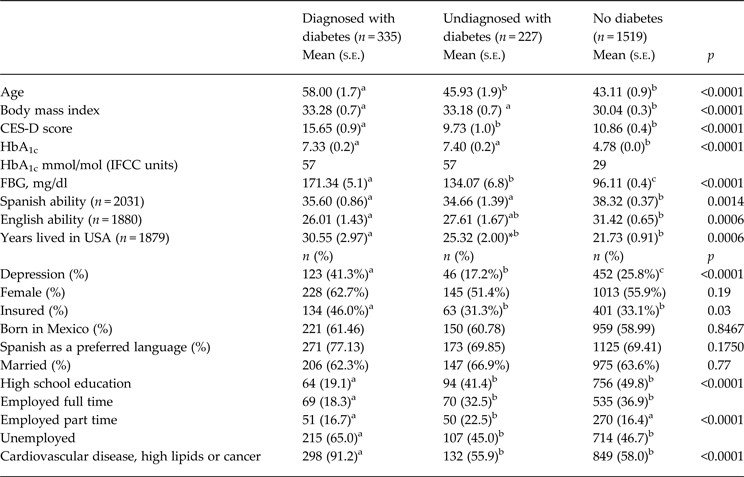
We found the DD participants had significantly higher depression scores than both the UD and ND groups (p ⩽ 0.001) and the UD and ND groups did not significantly differ from each other on CES-D scores (see Table 1, Fig. 1). The DD group was significantly older than the UD and ND groups (p < 0.0001) and both the DD and UD groups had significantly higher body mass index (BMI) than the ND group (p < 0.001) (see Table 1). Repeating the analyses including age, gender and BMI in the model, the difference between groups on CES-D depression scores remained significant (p < 0.001) with the DD subjects having significantly higher scores than the both the UD and ND groups, respectively, on pairwise comparisons (p < 0.001), with no significant difference between the UD and ND subjects. This model revealed a significant main effect for gender (p < 0.001) with females having significantly higher depression scores than males (p < 0.001) across all groups, without an interaction effect for gender.
Center for Epidemiological Studies – Depression (CES-D) scores by diagnostic groups. DD, Diagnosed with diabetes; ND, no diabetes; UD, undiagnosed diabetes.

Demographic and clinical variables: weighted means and percentages

CES-D, Center for Epidemiological Studies – Depression; s.e., standard error; n, frequency IFCC, International Federation of Clinical Chemistry; FBG, fasting blood glucose.
Different superscript letters (a, b, c) denote significantly different pairwise comparisons p < 0.05.
Frequencies are unweighted. Percentages use weighted data. Means and standard errors (s.e.) are weighted.
Using the CES-D established cut-off score of ⩾16 as suggestive of depression 41% of DD subjects qualified as depressed whereas 26% of ND subjects and only 17% of UD subjects were depressed (χ2 = 19.57, df2, p < 0.001). The increased percentage of DD subjects meeting the cut-off for depression was significant compared to UD subjects (χ2 = 21.03, df1, p < 0.001) and the ND group (χ2 = 10.52, df1, p = 0.001), respectively. In addition there was a significant difference between the ND and UD groups (χ2 = 4.65, df1, p = 0.003).
On laboratory measures the DD and UD subjects did not differ from each other in terms of HbA1c; however, the DD subjects did have significantly higher FBG levels than UD subjects (p < 0.001). As anticipated both the DD and UD subjects had significantly higher HbA1c and FBG levels than the ND group (p < 0.001), respectively. HbA1c and FBG were highly correlated (r = 0.66, p < 0.0001) and since these variables are used to define the presence of diabetes, we did not attempt to covary for their effects on depression. Within the total sample only FBG (not HbA1c) was modestly correlated (r = 0.074, p = 0.001) with depression scores; however, within each group (DD, UD, ND) neither HbA1c nor FBG were significantly correlated with depression scores.
Examining socio-demographic variables, revealed the DD subjects scored lowest on both Spanish- and English-language tests compared to the ND group, and were least likely to have finished high school and had the highest levels of unemployment compared to both of the other groups (Table 1). The DD subjects also had lived the longest in the United States but there was no difference between groups on the percent born in Mexico or Spanish preference (Table 1).
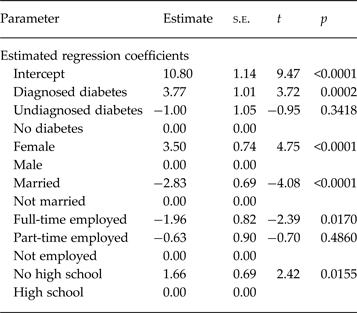
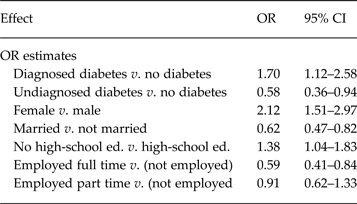
We then explored the effects of potential confounding variables such as gender, marital status, employment and education in both linear (Table 2) and logistic (Table 3) regression models to examine depression scores as dimensional and categorical outcomes respectively. In the linear model the socio-demographic variable regression estimates were in the anticipated direction as female gender, and lacking a high-school diploma were predictive of higher depression scores whereas being married and in full-time employment were significant for predicting lower depression scores. Notably, even with these socio-demographic variables in the model the DD group still was significantly higher on CES-D depression scores compared to ND subjects whereas the UD and ND groups did not significantly differ from each other (Table 2). Likewise, using the CES-D cut-off score in a logistic regression model, the DD group had a significantly higher odds ratio for depression compared to the ND group, whereas being UD was protective for depression even with other variables in the model (see Table 3). Similar to the linear model, being female and lacking a high-school degree increased the risk for depression and being married and having full-time employment were protective (See Table 3). Potential acculturation factors: English and Spanish ability, preferred language, country of birth and years lived in United States did not significantly contribute to these models nor were they significant for depression.
Linear regression model for CES-D depression score controlling for socio-demographic variables a

CES-D, Center for Epidemiological Studies – Depression.
a All listed variables included in the model.
Logistic regression model for categorical (CES-D⩾16) depression by socio-demographic variables a

CES-D, Center for Epidemiological Studies – Depression; OR, odds ratio; CI, confidence interval.
a All listed variables included in the model.
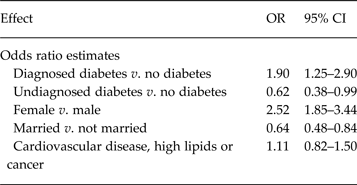
When we included the presence of additional medical conditions (cardiovascular disease, high blood pressure, high lipids, and cancer) in a logistic regression model with other significant socio-demographic variables, our main findings remained unchanged as the DD group remained at higher risk of depression and the UD subjects were at lower risk compared to the ND group (Table 4). In a post-hoc analysis we attempted to examine potential diabetes-related medical complications within the DD group (the other groups denied such complications). Within the DD group n = 37 (11%) reported retinopathy, n = 19 (6%) reported ketoacidosis, n = 4 (1%) reported needing dialyses and 24 (7%) reported having skin ulcers. Within this group only the presence of a skin ulcer was predictive of increased depression scores, as those with ulcers had a mean CES-D of 22.21 (s.e. = 3.68) compared to those without (14.44, s.e. = 0.73, p = 0.003). Removing the 24 subjects with skin ulcers did not alter our main findings as the DD group still had significantly higher CES-D scores compared to the UD (p < 0.001) and ND (p = 0.002) subjects. Within the DD group we had data on duration of diabetes in a subset (n = 164) with a mean duration of 10.82 years (s.e. = 0.63). We did not find a significant difference in the mean duration of diabetes in depressed (10.00 years, s.e. = 1.06) compared to non-depressed (11.29 years, s.e. = 0.79) (p = 0.33) subjects. Along these lines there was not a significant correlation between depression scores and illness duration (r = −0.09, p = 0.27).
Logistic regression model for categorical (CES-D⩾16) by socio-demographic variables a and medical illness

CES-D, Center for Epidemiological Studies – Depression; OR, odds ratio; CI, confidence interval.
a All listed variables included in the model.
Discussion
Our main findings were that subjects with DD had higher depression scores and a higher prevalence of depression compared to UD and those with ND. What is noteworthy is that participants with UD despite having obesity, and elevated HbA1c and FBG, reported the lowest depressive symptoms and when using dichotomized depression cut-offs, even had a lower odds ratio for depression relative to those in the ND group. As in other studies (Fisher et al. Reference Fisher, Chesla, Mullan, Skaff and Kanter2001; Egede & Zheng, Reference Egede and Zheng2003) we found significant effects for potential socio-demographic confounders such as female gender, low education and unemployment for depression. However, even when we included these variables in our models, the main effect of diabetes diagnostic status remained significant.
Our findings suggest that ‘knowing that one is ill’ and being in treatment could be major contributors to depression in persons with diabetes. A systematic review of the responses to being diagnosed with diabetes revealed up to one half of newly diagnosed patients reporting negative emotions; however, there was great variability in the emotional cognitive and behavioral responses (Thoolen et al. Reference Thoolen, de Ridder, Bensing, Gorter and Rutten2006). Many newly diagnosed patients initially downplay the seriousness of their illness (Thoolen et al. Reference Thoolen, de Ridder, Bensing, Gorter and Rutten2006) and full understanding of the implications of illness may take years (Lawson et al. Reference Lawson, Bundy and Harvey2008). Individual factors that influence the emotional response of diabetic patients to receiving the diagnosis include personality traits (Lyness et al. Reference Lyness, Duberstein, King, Cox and Caine1998), perceptions of illness, coping mechanisms (Duangdao & Roesch, Reference Duangdao and Roesch2008; Bazzazian & Besharat, Reference Bazzazian and Besharat2012) and severity of symptoms (Thoolen et al. Reference Thoolen, de Ridder, Bensing, Gorter and Rutten2006). An example of the complexity of this issues is the personality trait of ‘neuroticism’ that is defined by sub-domains of worry and self-consciousness (Lane et al. Reference Lane, McCaskill, Williams, Parekh, Feinglos and Surwit2000). In some instances neuroticism may be protective in diabetes; providing the vigilance needed for good glycemic control (Lane et al. Reference Lane, McCaskill, Williams, Parekh, Feinglos and Surwit2000). However, subjects with high neuroticism may also be at greater risk for depression (Fanous et al. Reference Fanous, Gardner, Prescott, Cancro and Kendler2002) especially when exposed to increased illness burden (Lyness et al. Reference Lyness, Duberstein, King, Cox and Caine1998). Furthermore, the ‘Burden of Illness’ i.e. worries about complications has been associated with depression in patients with diabetes (Karlson & Agardh, Reference Karlson and Agardh1997) suggesting there may be a tipping point where the propensity to worry combined with diabetes becomes deleterious. These concepts may account for our findings where within those diagnosed with diabetes, the presence of ulcerations, an obvious physical symptom, was significantly associated with increased CES-D scores. This suggests that there may be a certain threshold (i.e. a notable clinical manifestation of illness) that cannot be readily ignored that leads to the emergence of mood symptoms. Once the threshold is reached then a vicious cycle may occur as depression can hamper self-care and the ability to follow healthy diet and exercise (Katon et al. Reference Katon, Russo, Heckbert, Lin, Ciechanowski, Ludman, Young and Von Korff2010b ). In Mexican Americans with diabetes, this synergy between depression and diabetes has been documented where the presence of depression and diabetes predicted earlier mortality, and multiple complications that affected daily living (Black et al. Reference Black, Markides and Ray2003).
Given the negative impact from having both depression and diabetes there has been added attention to addressing the emotional response to living with this serious chronic illness as part of the overall treatment. In addition the importance of considering family dynamics has been demonstrated as families with high conflict have poorer diabetic control (Miller-Johnson et al. Reference Miller-Johnson, Emery, Marvin, Clarke, Lovinger and Martin1994; Fisher et al. Reference Fisher, Chesla, Skaff, Gilliss, Mullan, Bartz, Kanter and Lutz2000) and depression (Fisher et al. Reference Fisher, Chesla, Mullan, Skaff and Kanter2001). With such issues in mind psychosocial support is recommended as a standard of care by the American Diabetes Association (ADA, 2014); however, it is only as a category ‘C’ as the findings are considered relatively weak with conflicting empirical evidence. The evidence does note benefits from psychological and pharmacological interventions in terms of depressive symptoms but there have been mixed results for glycemic control (Markowitz et al. Reference Markowitz, Gonzalez, Wilkinson and Safren2011; Baumeister et al. Reference Baumeister, Hutter and Bengel2012, Reference Baumeister, Hutter and Bengel2014). A collaborative care model that included pharmacotherapy, individualized goals, medication adherence monitoring, motivational coaching and self-care guide resulted in improvement across multiple domains including depression scores, glycemic control, and reports of quality of life and satisfaction compared to non-intervention controls (Katon et al. Reference Katon, Lin, Von Korff, Ciechanowski, Ludman, Young, Peterson, Rutter, McGregor and McCulloch2010a ). The collaborative care intervention models’ benefits for depressive symptoms and adherence have been replicated, however, the beneficial effects of this intervention on glycemic control have not been consistent (Huang et al. Reference Huang, Wei, Wu, Chen and Guo2013).
In regards to Mexican American populations, numerous individual and cultural factors have been found to impact the management of diabetes (Brown & Hanis, Reference Brown and Hanis2014). For example, even though lifestyle changes such a healthy diet and increased physical activity are the accepted interventions for controlling type 2 diabetes (Tuomilehto et al. Reference Tuomilehto, Lindstrom, Eriksson, Valle, Hamalainen, Ilanne-Parikka, Keinanen-Kiukaanniemi, Laakso, Louheranta, Rastas, Salminen and Uusitupa2001), these dietary and behavioral changes, if perceived as ‘restrictions’, have actually been associated with increased depression in some subjects with diabetes (Karlson & Agardh, Reference Karlson and Agardh1997). Focus groups with Mexican Americans with diabetes found they did not want to participate in weight loss focused outcomes in particular those that with an emphasis on ‘diet’ but were highly motivated by a concern for the welfare of their children and other family members (Brown & Hanis, Reference Brown and Hanis2014). Other issues that may be particularly salient to Mexican Americans include beliefs that being heavyset represents health (Stern et al. Reference Stern, Pugh, Gaskill and Hazuda1982; Diaz et al. Reference Diaz, Mainous and Pope2007), food as a representation of love (Allan, Reference Allan1998) or food security as a symbol of socio-economic status (Kumanyika, Reference Kumanyika2008) may magnify the negative perception to dietary restrictions. However culturally sensitive interventions that include family involvement and that incorporate cultural foods have been successful in better glycemic control in Mexican Americans from the Texas–Mexico border (Brown et al. Reference Brown, Garcia, Kouzekanani and Hanis2002).
Even though we did not use an acculturation scale, we were able to examine English and Spanish ability, preferred language, country of birth and years lived in the United States, and such items have been reliable measures of acculturation (Marin et al. Reference Marin, Sabogal, Marin, Oterosabogal and Perezstable1987; Wallen et al. Reference Wallen, Feldman and Anliker2002). As noted, we did not find a significant association between any of these measure and depression but it is interesting to note that the ND subjects had spent the fewest years living in the United States. Foreign-born immigrant status and longer duration in the United States have been associated with increased obesity (Kaplan et al. Reference Kaplan, Huguet, Newsom and McFarland2004) and greater acculturation may also lead to poorer dietary practices (Neuhouser et al. Reference Neuhouser, Thompson and Solomon2004; Montez & Eschbach, Reference Montez and Eschbach2008). However, the ND group also scored the highest on tests of language, were the most likely to finish high school and had the highest levels of employment which suggests the ND subjects have overall better function. Of note both of language tests used: the Word Accentuation Test and the reading portion of the WRAT-3 have been associated with levels of intelligence (Del Ser et al. Reference Del Ser, Gonzalez-Montalvo, Martinez-Espinosa, Delgado-Villapalos and Bermejo1997; Griffin et al. Reference Griffin, Mindt, Rankin, Ritchie and Scott2002). Higher intelligence may account for better function across multiple domains and better health outcomes (Gottfredson & Deary, Reference Gottfredson and Deary2004; Batty et al. Reference Batty, Deary and Gottfredson2007). As our study is cross sectional we cannot conclude if this better function is part of why they are free of diabetes or whether the differences between groups are due to the detrimental effects of diabetes and associated conditions. It might seem paradoxical that the ND group scored highest on both English and Spanish but many border residents are bilingual and bicultural. Given the proximity to Mexico, the ability to access services across the border, and the potential social and employment advantages to remaining bicultural on the border (Crouch, Reference Crouch2004), the effects of acculturation toward US cultural norms on our outcomes may have been diminished.
While there are numerous strengths of our population-based randomly recruited sample of Mexican Americans living on the US–Mexico border, there are several limitations to bear in mind when evaluating our results. First, this was a cross-sectional study and therefore cannot establish causality as we did not prospectively follow them in time after receiving their diabetes diagnosis. It is possible that those with depression were more likely to receive the diagnosis of diabetes as much as it is possible that having the diagnosis of diabetes increased the risk for depression. Only a longitudinal study could disentangle these two possibilities. Second, although the CES-D is a well-accepted measure of depressive symptoms in a population (Radloff, Reference Radloff1977; Lewinsohn et al. Reference Lewinsohn, Seeley, Roberts and Allen1997), it does not follow strict DSM criteria, cannot establish chronicity and number of episodes and does not account for confounding or co-morbid or pre-existing psychiatric conditions which may play a role in depression in diabetic patients (Bot et al. Reference Bot, Pouwer, Ormel, Slaets and de Jonge2010). Despite these limitations the breadth and sample size of this study allow for exploration based diabetic status, knowledge of illness and multiple established risk factors. In addition the randomized, population-based recruitment strategy used allows us to extrapolate to the community. Furthermore, even though our sample was Mexican American our findings are identical to a large (n > 5000) longitudinal study (Golden et al. Reference Golden, Lazo, Carnethon, Bertoni, Schreiner, Diez Roux, Lee and Lyketsos2008) a meta-analysis of 13 studies comprising n = 1483 cases (Nouwen et al. Reference Nouwen, Nefs, Caramlau, Connock, Winkley, Lloyd, Peyrot and Pouwer2011) and to a nationally representative cross-sectional survey (NHANES) n = 3183 (Mezuk et al. Reference Mezuk, Johnson-Lawrence, Lee, Rafferty, Abdou, Uzogara and Jackson2013) confirming findings from samples of different racial and ethnic make-up. These findings dispute the notion that major depressive disorder results directly from diabetes in favor of a multidimensional approach including consideration of biological and psychosocial factors (Talbot & Nouwen, Reference Talbot and Nouwen2000) that appear to accompany being diagnosed with diabetes. Hispanics now comprise the largest ethnic minority group residing in the United States accounting for 15% of the population; and Mexican Americans are the single largest Hispanic subgroup and number over 46 million people (Ennis et al. Reference Ennis, Rios-Vargas and Albert2011). The consequences of depression and diabetes in this population have major public health implications with the need for individualized culturally sensitive personalized treatment that includes both medical and psycho-social considerations (Brown et al. Reference Brown, Garcia, Kouzekanani and Hanis2002; Dziemidok et al. Reference Dziemidok, Makara-Studzinska and Jarosz2011).
Acknowledgements
This work was supported by MD000170 P20 funded from the National Center on Minority Health and Health disparities (NCMHD), and the Centers for Clinical and Translational Science Award UL1 TR000371 from the National Center for Research Resources (NCRR). We thank our support team for cohort recruitment database management and administrative support. We thank Valley Baptist Medical Center, Brownsville for providing us space for our Center for Clinical and Translational Science Clinical Research Unit. We finally thank the community of Brownsville and the participants who so willingly participated in this study in their city.
Declaration of Interest
None.