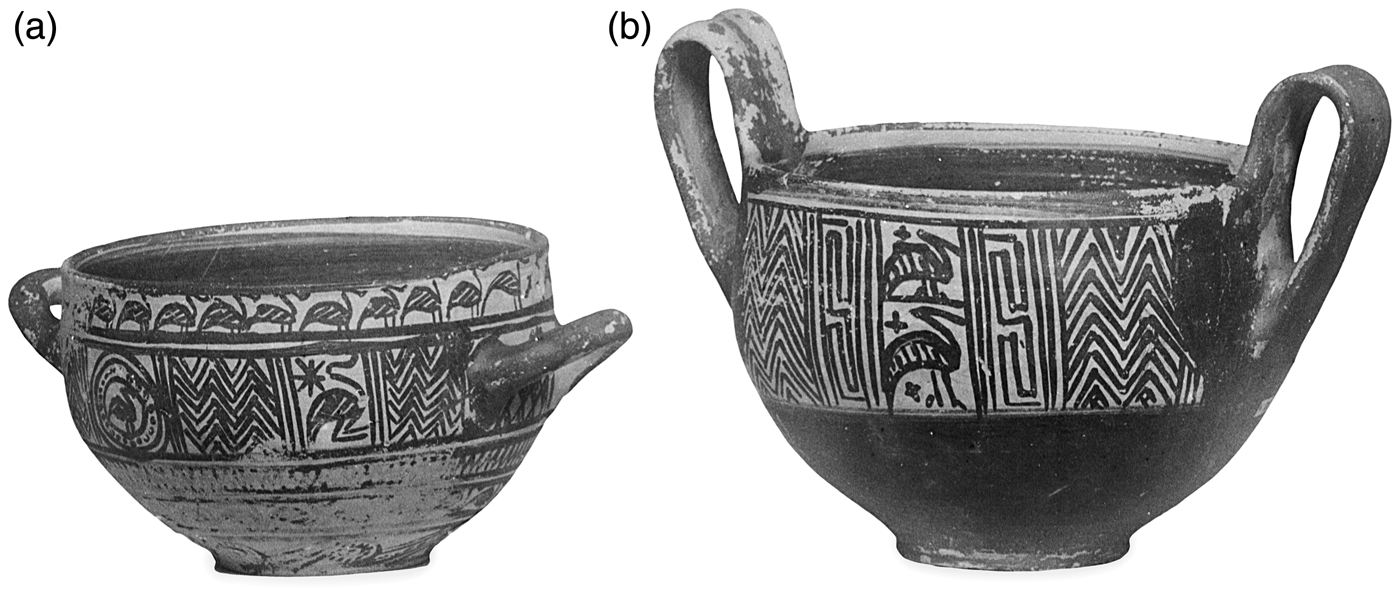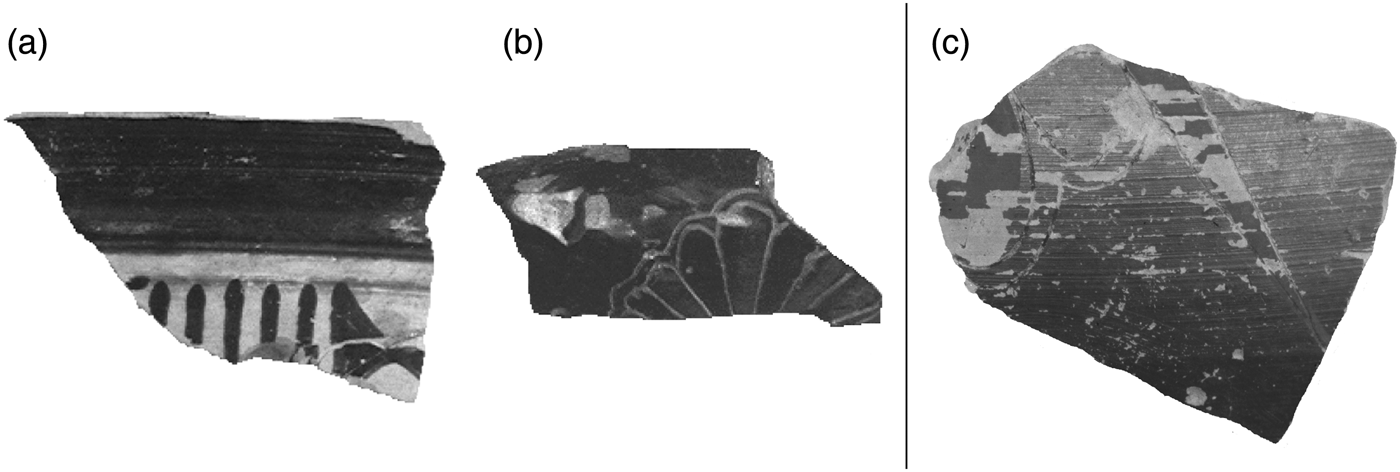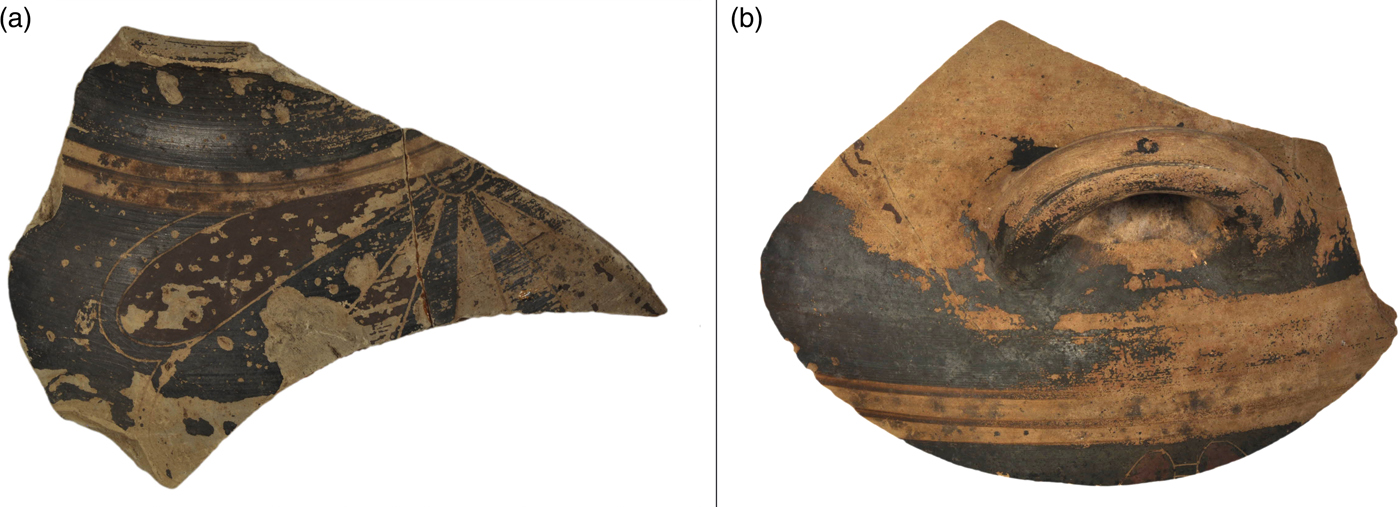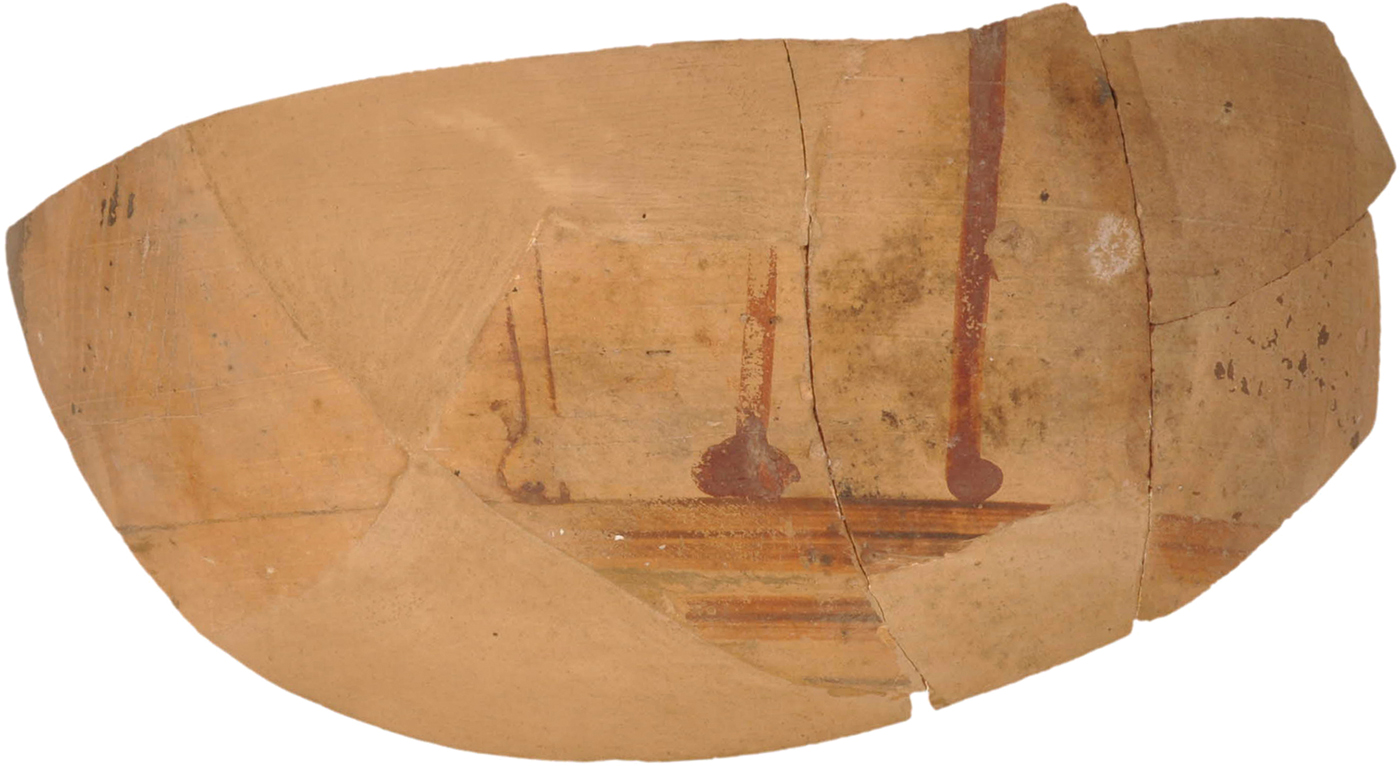


INTRODUCTION
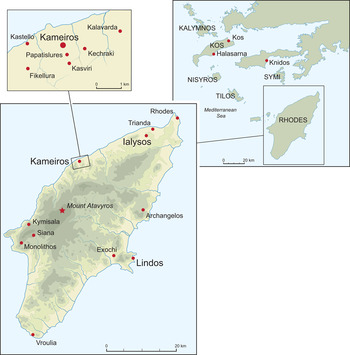
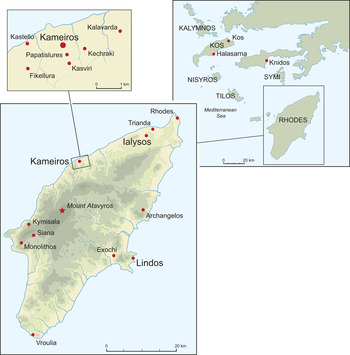
One area of the Greek world in which pottery production of the Archaic period has long been poorly understood is the Dorian region of the south-western Aegean (Fig. 1). According to Herodotos (Histories 1.144), it was home to the Dorian Hexapolis, a federation of six cities of Dorian foundation comprising Lindos, Ialysos and Kameiros on Rhodes, Kos on the homonymous island and Knidos and Halikarnassos in Caria, on the mainland opposite. To modern students of Archaic Greek pottery the Dodekanesian islands and adjacent coastal areas are commonly known as ‘East Doris’, believed to share, to some extent, an ‘East Dorian’ style of material culture (Craik Reference Craik1980). Previous commentators have attributed East Dorian pottery to different production places in the region on grounds of provenance, style, fabric and in some cases scientific analysis, with Rhodes long considered the creative hub and most prolific centre of manufacture. Indeed, the designation ‘Rhodian’ was long nearly synonymous with Archaic East Greek pottery production. But with the advent of scientific pottery-provenancing and increased archaeological work in Ionia, Rhodes lost its status of being considered the major production and export centre of Archaic painted wares. The fine and widely distributed output of the Bird Kotyle / Bird Bowl workshops once thought to be Rhodian is now conclusively attributed to Teos, putting paid to the notion of a flourishing and widely exporting Late Geometric and seventh-century bc Rhodian pottery industry (neutron activation analysis [NAA] Group TeosB [formerly B]: M. Kerschner in Akurgal et al. Reference Akurgal, Kerschner, Mommsen and Niemeier2002, 63–72; cf. Coldstream Reference Coldstream2008, 279, 380, 478–9). Into the sixth century bc, Teos emerges ever more clearly as one of the most important, prolific and widely exported North Ionian producers of Wild Goat-style and black-figure finewares (Kadioǧlu et al. Reference Kadioǧlu, Özbil, Kerschner, Mommsen, Yalçin and Bienert2015; Kerschner and Mommsen Reference Kerschner, Mommsen, Santos Retolaza and Tsetskhladzeforthcoming), on a par with Miletos, whose dominant role in the production and export of South Ionian Wild Goat and Fikellura pottery has been recognised for some time (Schlotzhauer Reference Schlotzhauer2012; Mommsen et al. Reference Mommsen, Schlotzhauer, Villing and Weber2012; Coulié Reference Coulié2014; Reference Coulié2015). As more and more painted East Greek wares recovered from the tombs of Kameiros and Ialysos and other Rhodian sites are revealed as imports from the main pottery-producing centres of the Ionian mainland, what is left for Rhodes and its East Dorian neighbours?
Map of Rhodes and the East Dorian region, with main sites mentioned in the article (drawing Kate Morton, © Trustees of the British Museum).
The present contribution aims to reassess and redefine the place of the East Dorian region in East Greek pottery production with the help of archaeometric analyses. It publishes the results of new neutron activation analyses (NAA) of one clay sample and 19 vessels and terracotta figures dating from the eighth to the sixth centuries bc found on Rhodes or otherwise linked with the East Dorian region, and places them in the wider context of past and present archaeometric and archaeological research, including previously unpublished historic data (Appendix 1 by Richard Jones). A range of methodological approaches, from chemical to petrographic (Appendix 2 by Michela Spataro), are applied and considered, with the aim to both review and advance current knowledge. At the beginning of the investigation stands one of the masterpieces of Archaic Greek draughtsmanship, the Euphorbos plate, a piece that has long puzzled scholars with regard to its place of production, being ping-ponged from Rhodes to Knidos, Kos, Kalymnos, Miletos and Argos. Our new analyses resolve the long debate by providing evidence for the place of production not just of this, but also of numerous other ‘East Dorian’ plates. It is hoped that the new data, alongside other recent work,Footnote 1 will help provide a foundation for a better understanding of Rhodian, Koan and other ‘East Dorian’ pottery production, trade and consumption and stimulate further research in the region and its material culture.
SAMPLE CHOICE AND NAA METHOD
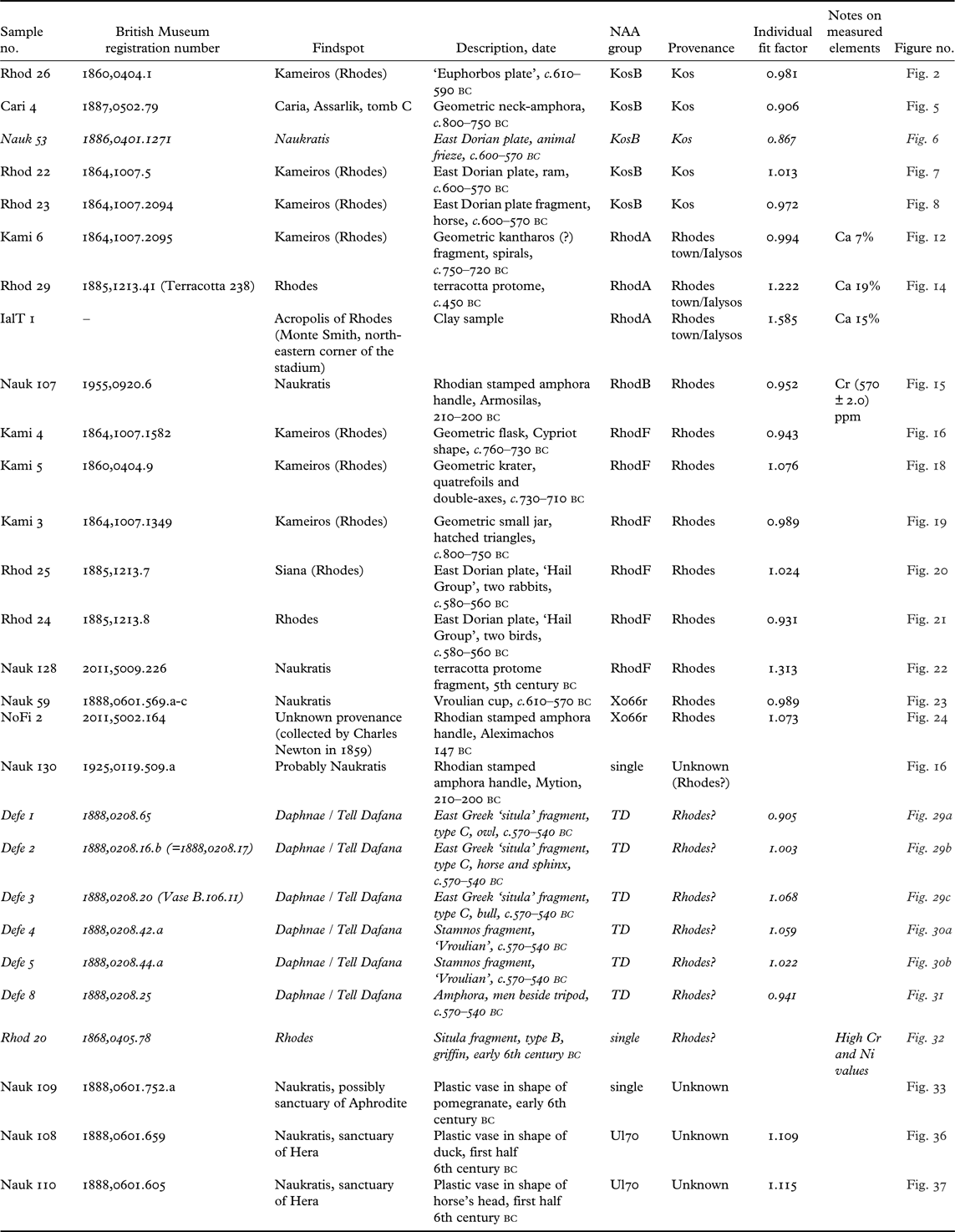
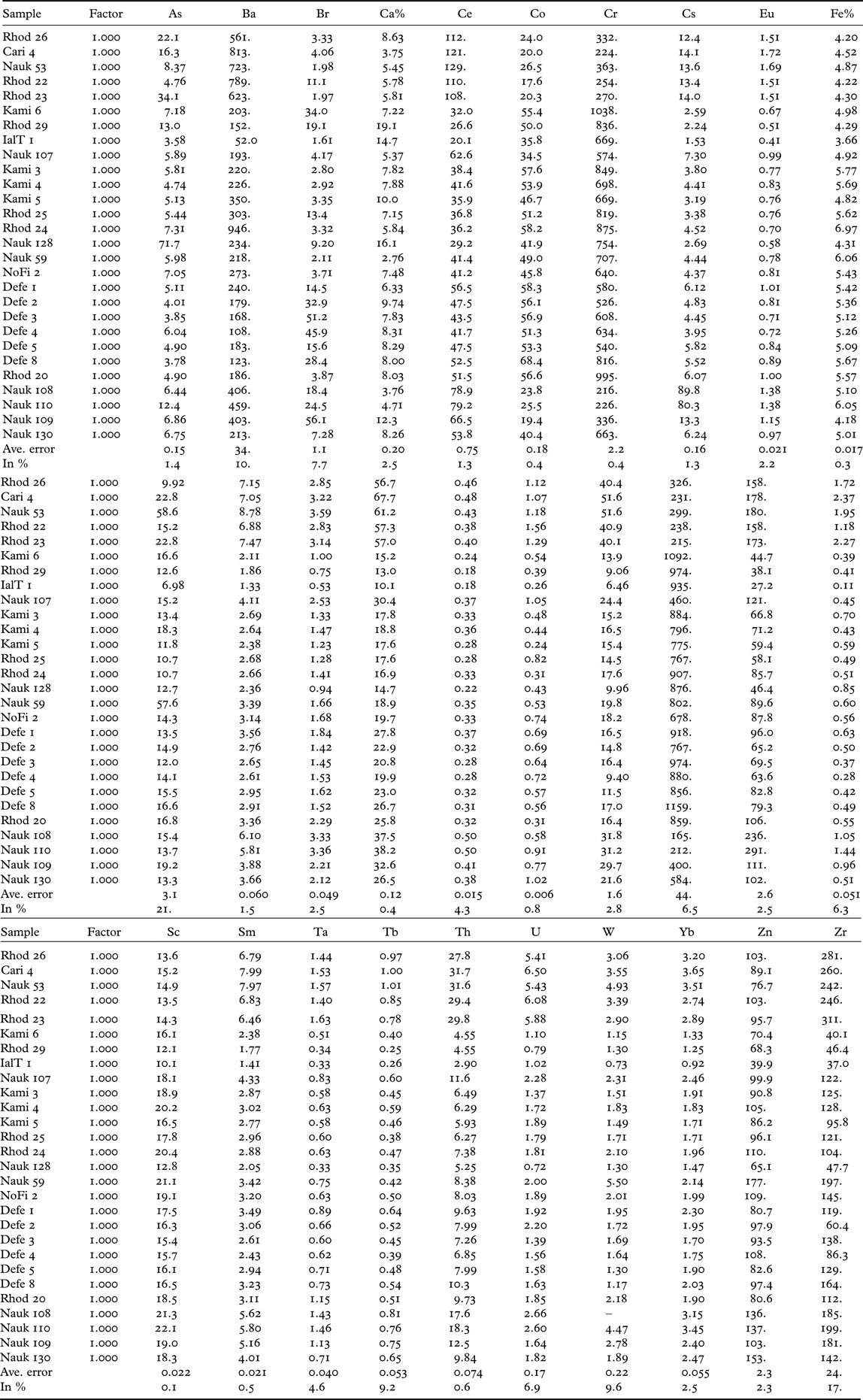
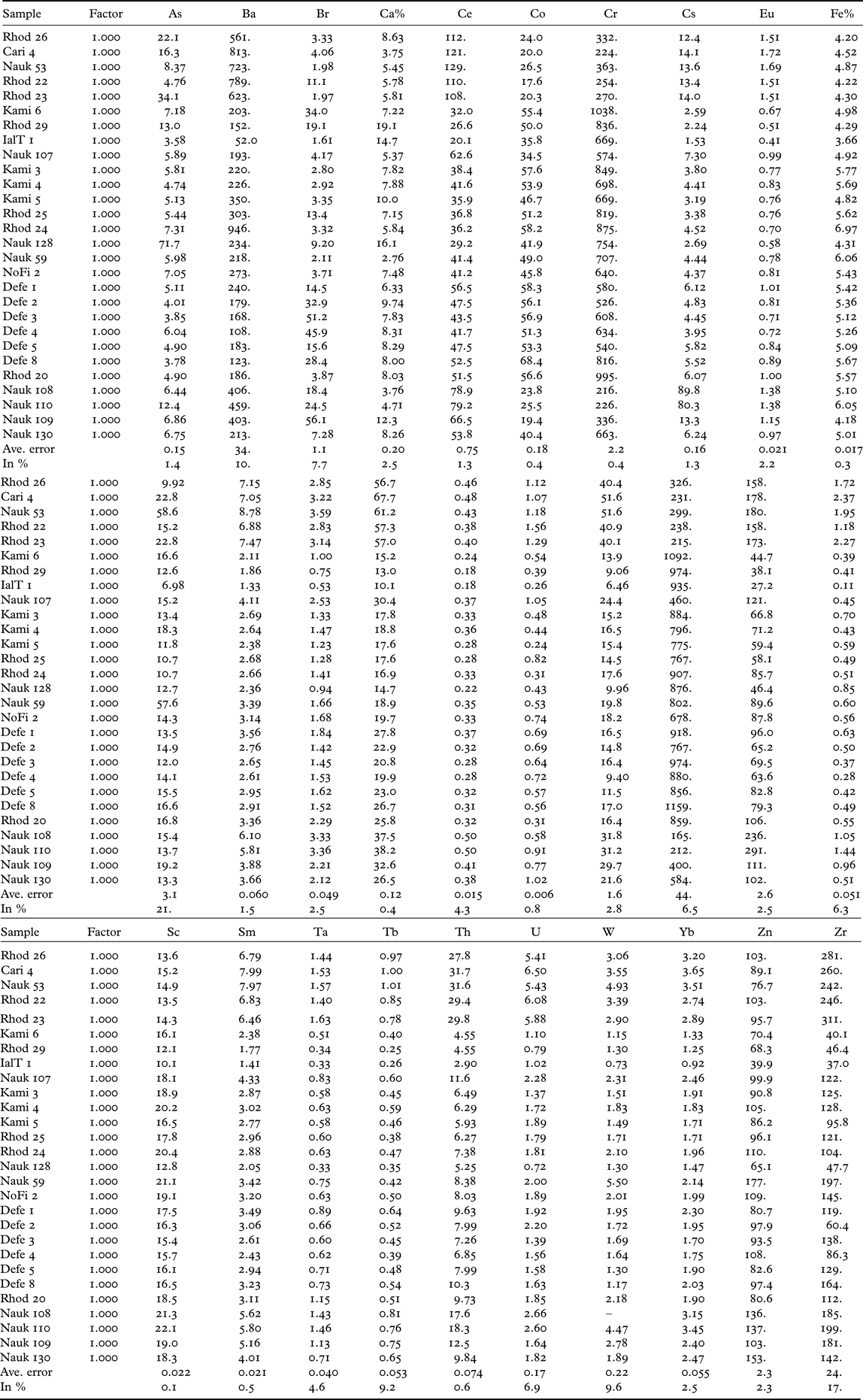
As part of a long-running collaborative programme of pottery and clay analysis for provenancing pottery in the eastern Mediterranean,Footnote 2 two sets of vessels from the British Museum's collections were chosen specifically in order to provide new data on Rhodian and East Dorian pottery production: five East Dorian plates found on Rhodes, including the best-known example, the Euphorbos plate; and four examples of Geometric pottery found on Rhodes. They are complemented by new analyses of nine further objects in the British Museum and one clay sample, as well as by other recent data deriving from our own and collaborative work on objects such as situlae, stamnoi, amphorae and Vroulian cups from Tell Dafana and Naukratis, pottery found in Caria, East Greek plastic vases, stamped amphora handles, and terracotta protomes from Rhodes and Naukratis (some results previously published in Mommsen et al. Reference Mommsen, with Cowell, Fletcher, Hook, Schlotzhauer, Villing, Weber and Williams2006; Schlotzhauer and Villing Reference Schlotzhauer and Villing2006; Weber Reference Weber2006; Mommsen et al. Reference Mommsen, Schlotzhauer, Villing and Weber2012). The large body of existing comparative data in the Bonn database (including analyses of stamped amphora handles from Miletos: Jöhrens Reference Jöhrens2009; Mommsen, Haugwitz and Jöhrens Reference Mommsen, Haugwitz and Jöhrens2010) provided the essential framework for assessing our chemical groupings and supplied vital information for linking them with likely production places. A list of the 20 new samples and of eight previously published relevant samples, included and reassessed because of their direct relevance, and their analytical raw data is given in Tables 1 and 2.Footnote 3 As several NAA groups can now be confidently linked with specific production places/regions, they were renamed from their original ‘working titles’ so as to reflect their geographical origin and thus provide more clarity in future scholarly dialogue.Footnote 4 Additional objects and data are referred to in the discussion.
List of samples analysed, together with each sample's findspot and description, assignment to a chemical group, provenance, individual fit factor (= dilution factor with respect to its group) and figure number in this article. Three groups had previously been published under different names: KosB (formerly RHc1), RhodA (formerly RHa1) and RhodB (formerly RHb2). Previously published samples are indicated in italics.
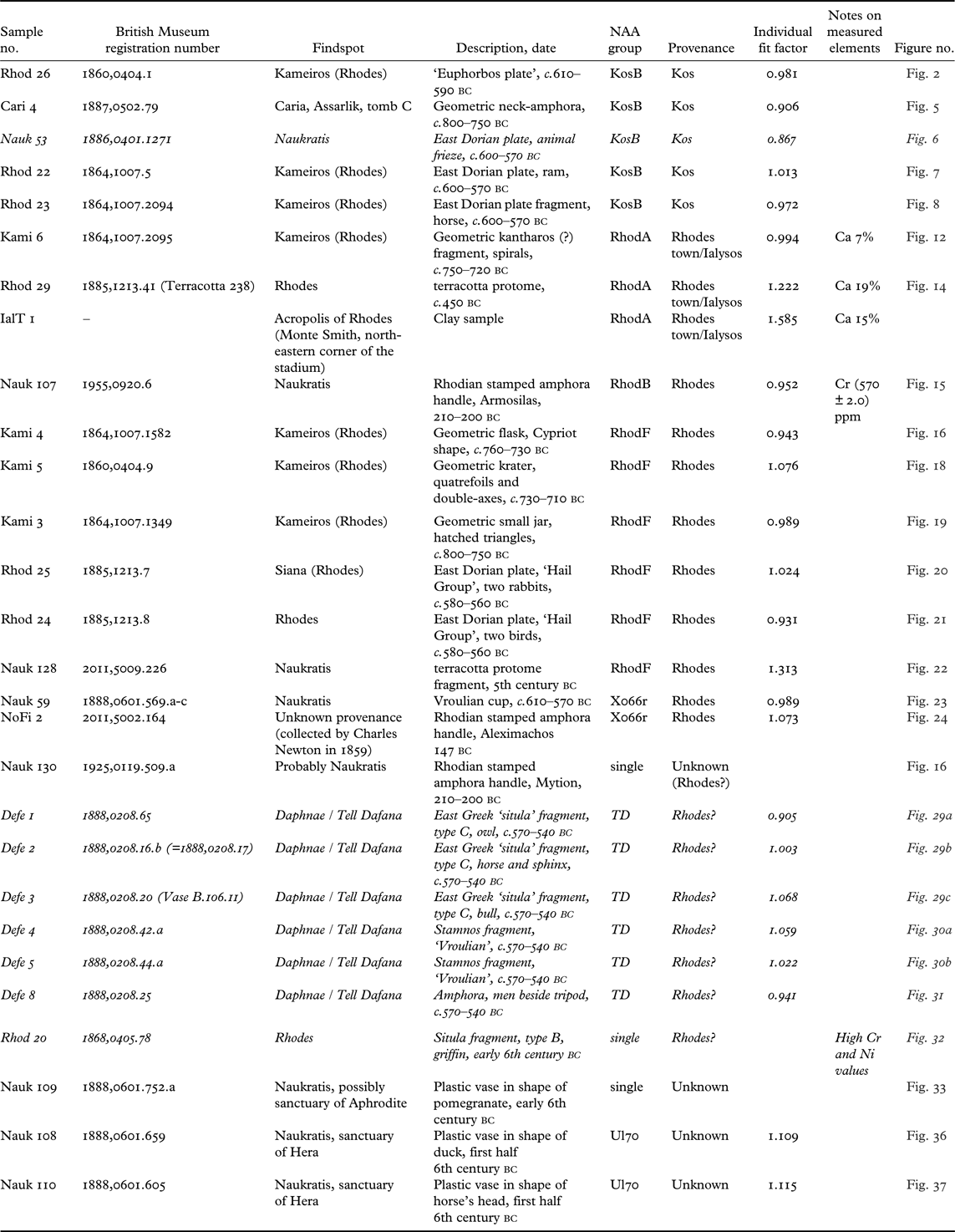
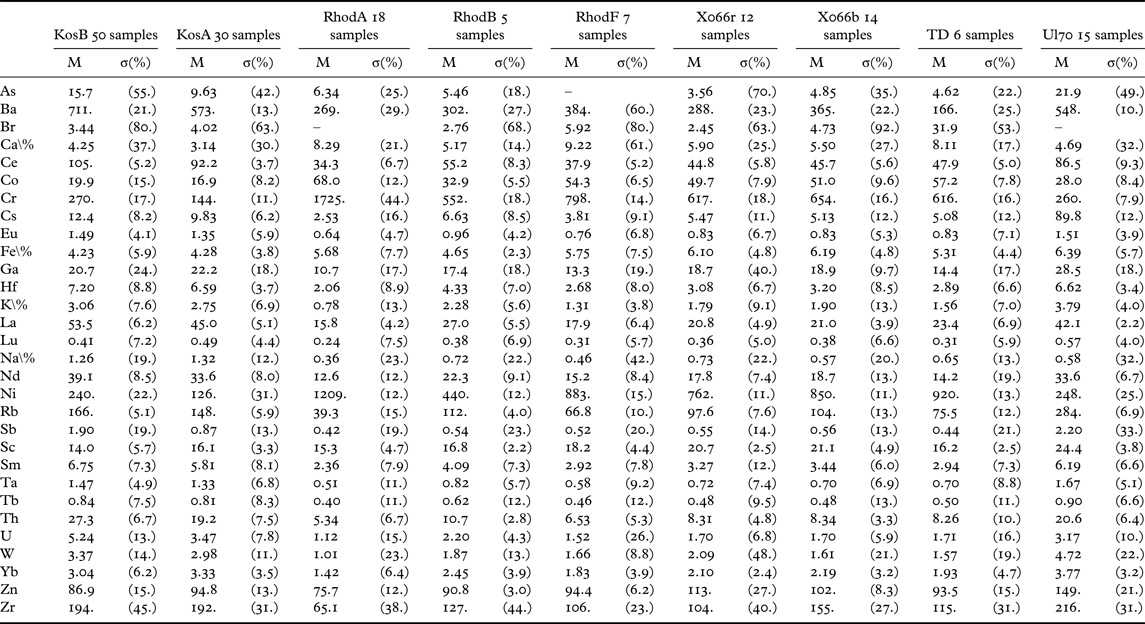
Raw concentrations C of 30 elements in μg/g (ppm), if not indicated otherwise, of the samples given in Table 1 and, below, the average experimental uncertainties (statistical counting errors only), also in % of C, included so as to give a hint of the general reproducibility of the NAA method in Bonn for this element.
The analytical method applied is Neutron Activation Analysis. It has been conducted routinely in Bonn for more than 25 years. About 30 trace and minor elemental concentrations, if present above the detection limit, can be determined. The measured elemental compositions are thought to be characteristic for the clay paste prepared by ancient potters in workshops close to the geographical location of the clay beds exploited. The high number of elements of the characteristic pattern and the good precision of the NAA for many elements, even for trace elements, support the assumption that each pattern is unique and points with high probability to only one site of production. But it is not entirely impossible that in some rare cases a similarity of patterns can be detected in vessels from different production regions. Such a case is encountered here for a pattern of Rhodes and a pattern of Boeotia (see below). For NAA, powdered samples of pottery of about only 80 mg are sufficient: these are usually obtained by drilling with a corundum (pure aluminium oxide) drill bit. Absolute concentrations are obtained by using the Bonn pottery standard (Mommsen and Sjöberg Reference Mommsen and Sjöberg2007, 360, table 1, composition given), which has been calibrated with the Berkeley standard (Perlman and Asaro Reference Perlman and Asaro1969); therefore, concentration data of the Berkeley (and Jerusalem) NAA laboratories are directly comparable with our data. The experimental procedure was first published at length in 1991 (Mommsen et al. Reference Mommsen, Kreuser, Lewandowski, Weber, Hughes, Cowell and Hook1991), and was updated in 2015 (Jung, Mommsen and Paciarelli Reference Jung, Mommsen and Paciarelli2015; Demakopoulou et al. Reference Demakopoulou, Divari-Valakou, Maran, Mommsen, Prillwitz and Walbergforthcoming). Samples having the same composition are assembled in groups according to a statistical uni- or multivariate filter procedure developed in Bonn (Mommsen, Kreuser and Weber Reference Mommsen, Kreuser and Weber1988; Beier and Mommsen Reference Beier and Mommsen1994a; Reference Beier and Mommsen1994b). This has the advantage that experimental uncertainties can be considered. In addition, dilution effects of the clay paste due to varying amounts of tempering material (such as sand or calcite), or so-called technical dilutions like neutron flux inhomogeneities or sample weighing errors, can be corrected (Mommsen and Sjöberg Reference Mommsen and Sjöberg2007).
The newly published samples have been measured in different irradiation runs at dates in December 2002 (the clay sample IalT 1), May 2004 (Nauk 59), June 2007 (Cari 4, Kami 3–6), July 2012 (Rhod 29, Nauk 128) and the remaining samples in November 2011 at the nuclear research reactors in Geesthacht before 2010 and later in Delft.
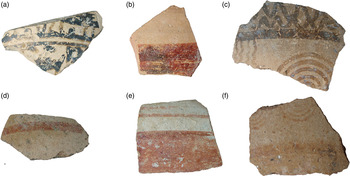
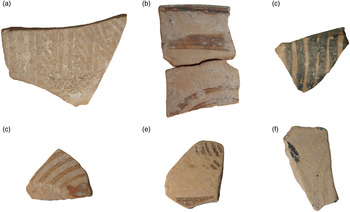
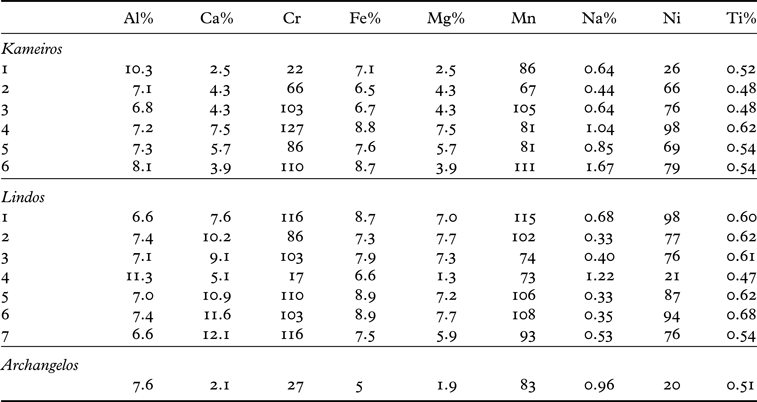
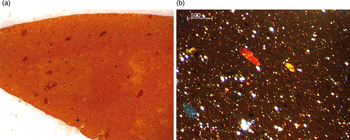
As far as possible we have aimed to place the results of our analyses in the wider context of scholarly research, including scientific analyses from other laboratories, even if achieved with different methods. Their results are included in the discussion only as far as groupings and conclusions are concerned.Footnote 5 This applies in particular to the work of Richard Jones and Pierre Dupont and most recently Anne Bouquillon at the Centre de Recherche et de Restauration des Musées de France (C2RMF) in Paris (Jones Reference Jones1986; Jones and Mee Reference Jones and Mee1978; Dupont Reference Dupont1983; Dupont and Thomas Reference Dupont and Thomas2006; Coulié Reference Coulié2014; Coulié Reference Coulié2015; Coulié and Villing Reference Coulié and Villing2014; Villing and Bouquillon Reference Villing and Bouquillonin preparation). It has to be borne in mind that their measured data are not directly compatible with ours and that, especially in cases where different or only a limited number of elements were measured, groupings and attributions will be based on different parameters from ours. In addition, different statistical evaluation methods of grouping employed may yield different results. Nonetheless, the observations of other scholars complement and enrich the picture resulting from our work, and the decision to include them (wherever possible with pictures of the analysed objects) was deliberately taken so as to ensure that as wide a range of material and interpretations as possible forms part of scholarly discourse. We therefore also include previously unpublished optical emission spectroscopy (OES) analyses conducted in the 1970s by Richard Jones at the Fitch laboratory on sherds from Rhodes in the British School at Athens (Appendix 1). A second appendix, by Michela Spataro, reports the results of petrographic and elemental analysis (SEM-EDX) of one of the pieces analysed by us with NAA, carried out so as to provide more detailed insights into Rhodian clay fabric (Appendix 2).
THE EUPHORBOS PLATE AND THE POTTERY PRODUCTION OF ARCHAIC KOS: NAA GROUP KOSB
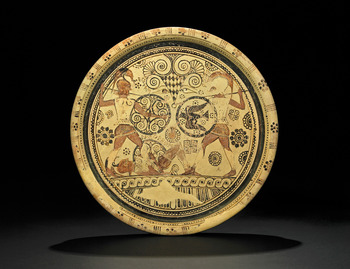
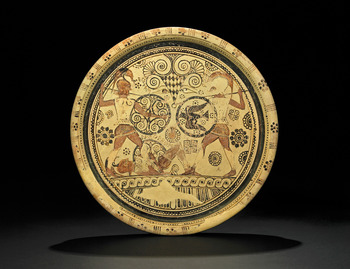
The Euphorbos plate (Rhod 26, Fig. 2), excavated in 1860 in a tomb at Kameiros on Rhodes, has long attracted scholars’ attention for its intricate polychrome decoration and intriguing iconography (A. Villing, in Coulié and Filimonos-Tsopotou Reference Coulié and Filimonos-Tsopotou2014, 124–5 no. 3.1, with references; Coulié Reference Coulié2015, 1324–6). The Spartan king Menelaos has just killed the Trojan Euphorbos, who lies dead on the ground, and is now being attacked by Hektor – an episode already referred to in the Iliad (17.70–89), even if no actual battle is described there. Painted inscriptions name all three figures, using Doric name forms (Menelas) and an Argive alphabet. Chronologically the plate is not far removed from the Late Protocorinthian style, with some of its filling ornaments reminiscent of South Ionian vase-painting of the early sixth century bc.Footnote 6 Distinct cutting marks on the plate's painted surface are a feature that is rare (though not unparalleled – cf. below on Fig. 11) on plates of the group and suggest that the Euphorbos plate may have been used for cutting food; one might speculate about a sacrificial meal at the funeral feast. At the same time, pre-firing holes that are discreetly pierced into the plate's back, as also on most other plates of the group, indicate that such plates were meant to be suspended.
‘Euphorbos plate’, c.610–590 bc, from Kameiros (sample Rhod 26, NAA group KosB: Kos). British Museum 1860,0404.1 (photograph © Trustees of the British Museum).
Together with the Gorgon plate (British Museum 1860,0404.2; see A. Villing, in Aruz, Graff and Rakic Reference Aruz, Graff and Rakic2014, 271, no. 143), the Euphorbos plate exemplifies an early phase in the production of what is commonly termed ‘East Dorian plates’.Footnote 7 In terms of shape they are characterised by a flat base, sometimes featuring groups of concentric shallow grooves, and a moderately sized outcurving ‘sofa’ rim. Their fabric is most commonly buff to light orange-brown, relatively fine with varying amounts of ‘gold’ mica and lime inclusions. Mica is mostly visible only in moderate amounts, though a few plates have a highly micaceous fabric (an example is British Museum 1860,0404.4, featuring a running dog, from the same workshop as Louvre A 304: Coulié Reference Coulié2014, 184 no. 52). Painted decoration fills the whole tondo, generally consisting of figured decoration above an exergue of variable size filled with ornaments. Mythological motifs are rare and are especially found early on; most common is a large animal (or two) in a ‘Wild Goat’ style, usually with reserved details and only rarely black-figure incision. Found primarily, though not exclusively, on Rhodes and other Dodekanesian islands, alongside similarly decorated vessels of other shapes, notably oinochoai and kraters, they form a stylistic group that has been termed a ‘provincial variant of the South Ionian Middle style’ by Cook (in Cook and Dupont Reference Cook and Dupont1998, 61–3).
The provenance of ‘East Dorian’ plates has long been a bone of contention. Especially for the Euphorbos plate, scholarship has long struggled to reconcile style and decoration with the unusual form of its inscription; Argos, Rhodes, Knidos, Kos, Kalymnos and Miletos have all been suggested as possible places of production. Despite the frequency of such plates on Rhodes, many scholars were doubtful about Rhodes as a main production centre of the group (Cook and Dupont 1988, 61–3; Coulié Reference Coulié2014, 184–5). This is supported by our NAA data, which shows the chemical composition of the clay paste of the Euphorbos plate, as well as that of numerous other related plates, to be identical to the elemental pattern KosB (formerly labelled RHc1), thus confirming an attribution to Kos, as had already been argued in 1968 by Hans Walter (Reference Walter1968, 79). Since this pattern also characterises Hellenistic stamped amphorae that can be attributed to Koan production with a very high degree of likelihood (Mommsen, Haugwitz and Jöhrens Reference Mommsen, Haugwitz and Jöhrens2010; Jöhrens Reference Jöhrens2009), Kos is firmly established as the provenance for this group.Footnote 8
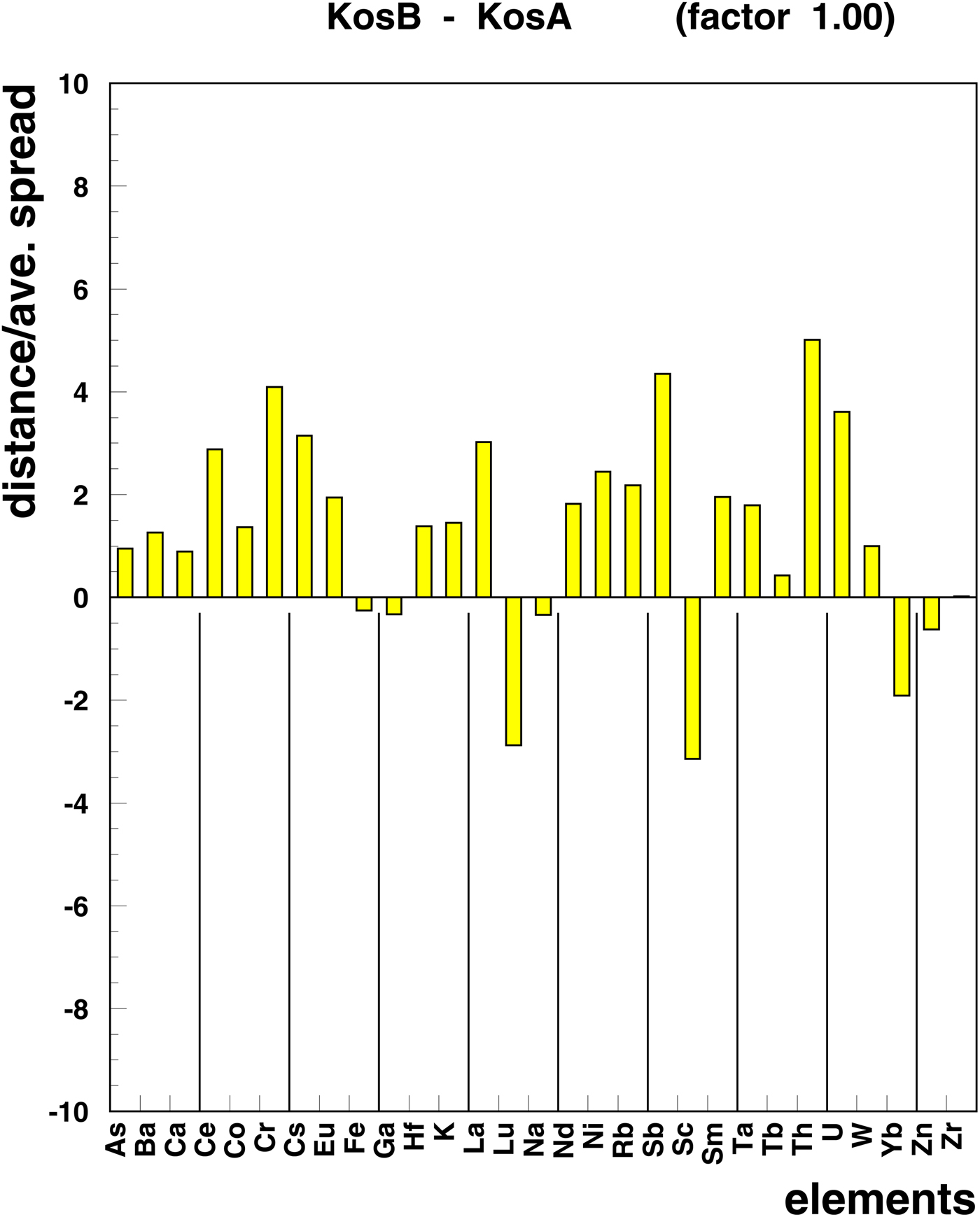
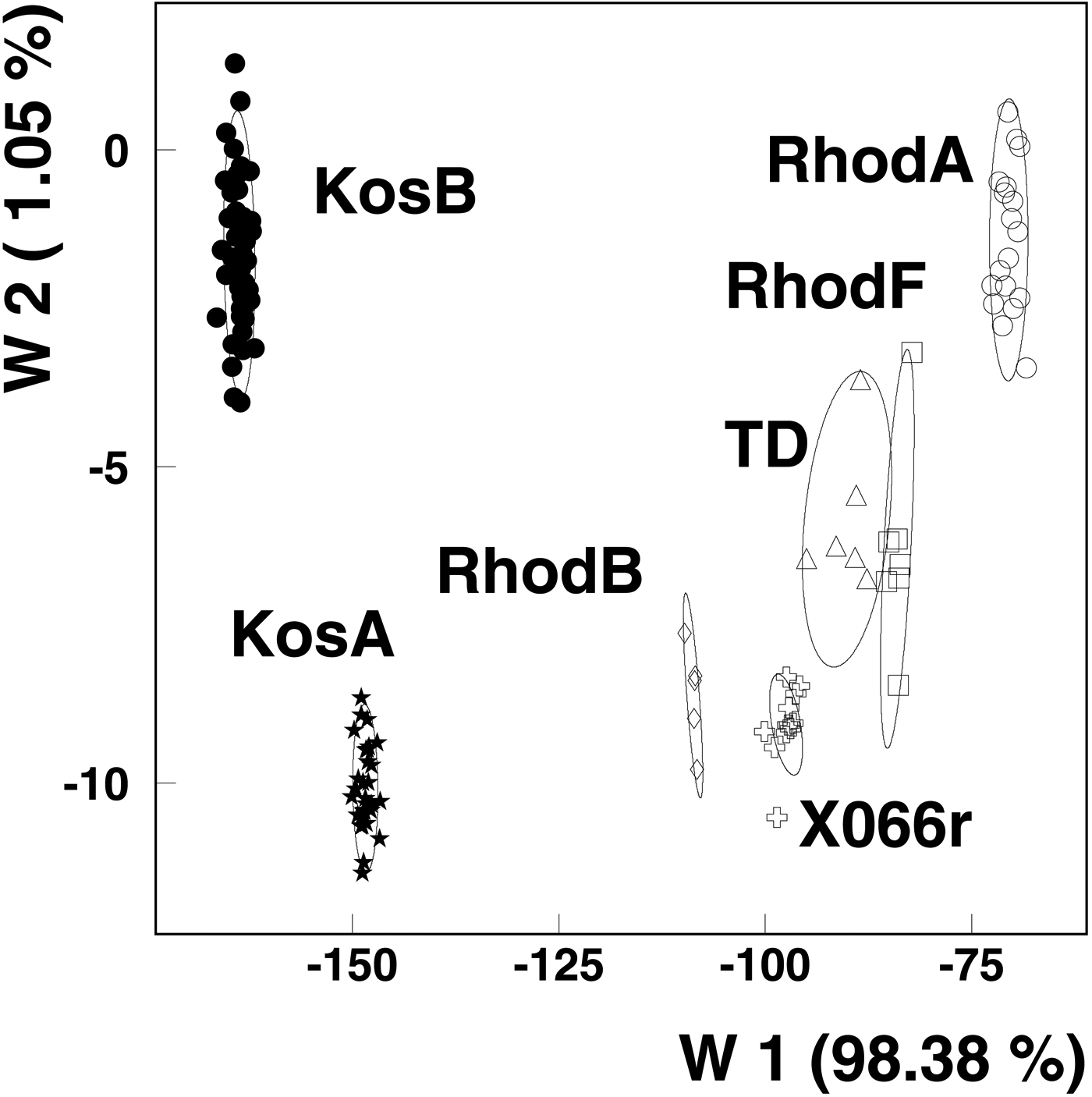
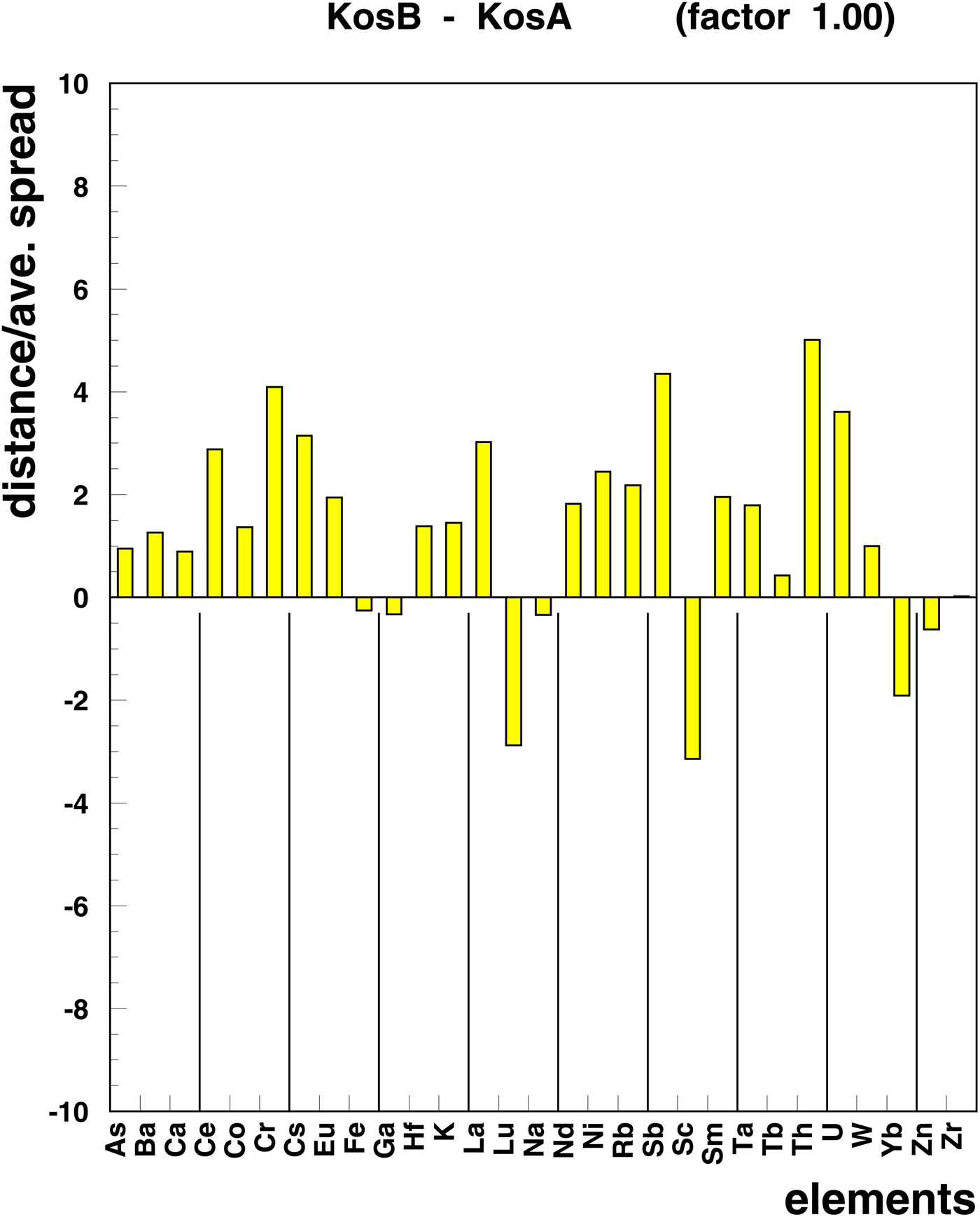
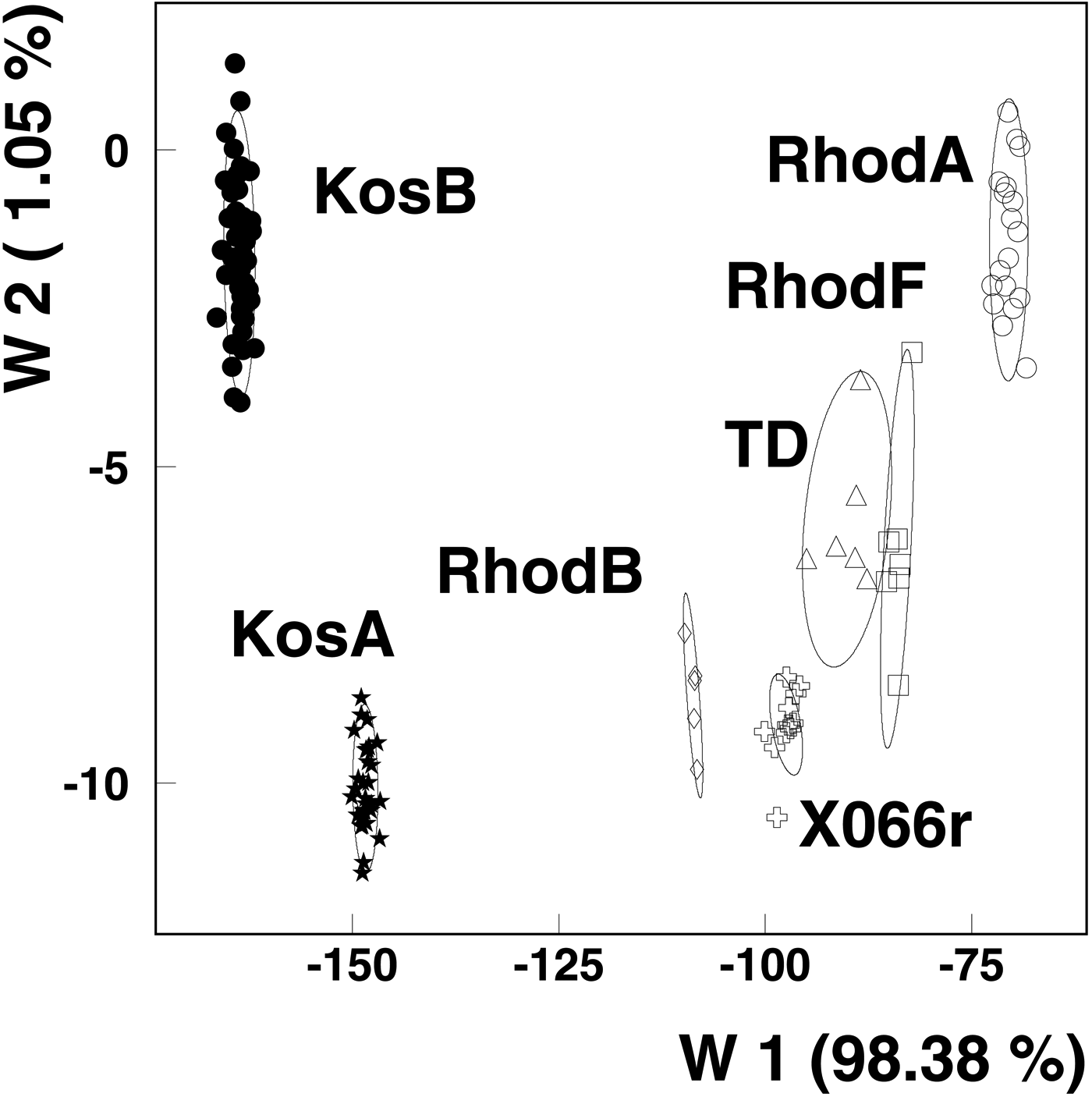
Among the compositional characteristics of KosB is an unusually high concentration of the element Th and the rare earths Ce, Eu, La and Nd. The same high concentrations also characterise another NAA group, KosA, also attributed to Kos. The members of this group are samples of amphorae from Rhodes and have been analysed at the Bonn Laboratory, featuring a fabric described as light orange or dark reddish-purple with flecks of golden mica (Marketou et al. Reference Marketou, Karantzali, Mommsen, Zacharias, Kilikoglou and Schwedt2006, 25, 32; Mommsen, Haugwitz and Jöhrens Reference Mommsen, Haugwitz and Jöhrens2010, 49–50). In Fig. 3 a graphical comparison of the concentration values for these two groups is shown for the measured elements. Values of the normalised distances below about 2 are statistically similar. Most elements shown have clearly higher concentrations in KosB than in KosA except for Lu, Sc, and Yb; therefore both patterns are well distinguished, as can also be seen directly from the average data shown in Table 2. This difference, and also, importantly, the dissimilarity from all the other groups in our databank is demonstrated e.g. in a discriminant analysis depicted in Fig. 4. This includes a marked dissimilarity to all known Rhodian or likely Rhodian clays, as discussed further below. A NAA pattern named A assigned to Halasarna on the south coast of Kos near modern Kardamena is very similar to pattern KosB (Hein et al. Reference Hein, Georgopoulou, Nodarou and Kilikoglou2008, 1053 table 1 group A; Hf diverges most, but is still quite similar), if the values are adjusted according to the inter-calibration of the two laboratories mentioned above (Hein et al. Reference Hein, Tsolakidou, Iliopoulos, Mommsen, Buxeda i Garrigos, Montana and Kilikoglou2002, 551 table 5). The origin of samples with pattern KosB is therefore very probably workshops in the region of Halasarna.
Graphical comparison of chemical compositions of Koan groups KosB and KosA. Plotted are the distances (differences) of the concentration values normalised by the average standard deviations (spreads). The concentration patterns differ strongly in most of the measured elements.
Result of a discriminant analysis of 128 samples in our databank, all members of the groups shown, corrected for dilution with respect to the average grouping values, assuming 7 clusters and using all elements given in Table 2 except As, Ba, Br, and Na. Plotted are the discriminant functions W1 and W2, which cover 98.4% and 1.1% of the between-group variance. The ellipses drawn are the 2σ boundaries of the groups. Pieces produced on Kos (KosA and KosB) are shown as filled symbols. The other groups are assigned to workshops on Rhodes, TD with a question mark (see text), and well separated.
Both KosA and KosB are encountered in some quantity in pottery from the Late Bronze Age settlement of Ialysos, Trianda, thus attesting a long-term pattern of imports from Kos to Rhodes (Marketou et al. Reference Marketou, Karantzali, Mommsen, Zacharias, Kilikoglou and Schwedt2006, 5; the suggested three subgroups RHc1, ~2, and ~3 are now merged into only one group KosB from Kos because of the increased number of group members). But Koan wares are also found spread more widely: as well as on Rhodes, the pattern KosB has been detected in our analyses in a Geometric amphora of c.800–750 bc from tomb C in Assarlik in Caria (Cari 4, Fig. 5).Footnote 9 It has also been observed in Bronze Age pottery from Troy (Mountjoy and Mommsen Reference Mountjoy and Mommsen2006), Tarsus (Mommsen, Mountjoy and Özyar Reference Mommsen, Mountjoy and Özyar2011, 911: NAA sample Tars 19 = Mountjoy Reference Mountjoy and Özyar2005, cat. 133, a krater sherd depicting a bird with dot-fringed body and a fish with a fabric described as containing gold mica), Bademgediği /Metropolis (both KosA and KosB are attested in unpublished results from a project with P. Mountjoy) and Enkomi (unpublished project with I. Hein and M. Artzy, bichrome wheelmade ware LCI, Enk 2376 [sample Enko 53] and Enk 1804/26 [sample Enko 54], Museum Larnaka), Archaic pottery from Sicily (Lentini Reference Lentini2008, 26: samples Gela 1, 3, 4, 6, Seli 3) and Naukratis in Egypt (see below), as well as unpublished finds from Miletos, Ephesos, Phokaia and Kandia (Argolid).
Geometric neck-amphora, c.800–750 bc, from Assarlik (Caria), tomb C (sample Cari 4, NAA group KosB: Kos). British Museum 1887,0502.79 (photograph © Trustees of the British Museum).

A fragment of a Dorian plate from Naukratis (Nauk 53, Fig. 6) has already been published by us with chemical pattern KosB, then still called RHc1 (Schlotzhauer and Villing Reference Schlotzhauer and Villing2006, 60 fig. 25; Mommsen et al. Reference Mommsen, with Cowell, Fletcher, Hook, Schlotzhauer, Villing, Weber and Williams2006, 71). It is stylistically closely related to a plate also in group KosB from the Bitalemi sanctuary at Gela, dated to c.600–575 bc (Gela, Museo Archeologico Regionale, inv. 31378, Lentini Reference Lentini2008, 118 no. 51 [Gela 1]). Both represent a version of East Dorian plates in which the tondo is decorated with a large animal figure above an exergue and surrounded by an animal frieze. A second piece from Bitalemi with the pattern KosB displays the same decorative scheme, featuring a frieze of running dogs and a spotted leopard in the tondo (Syracuse, Museo Archeologico Regionale ‘Paolo Orsi’ inv. 21507D, c.600–575 bc, Lentini Reference Lentini2008, 118 no. 50 [Gela 6]). On Nisyros a tondo surrounded by a lotus frieze is also common (see below).
East Dorian plate with animal frieze, c.600–570 bc, from Naukratis (sample Nauk 53, NAA group KosB: Kos). British Museum 1886,0401.1271 (photograph © Trustees of the British Museum).
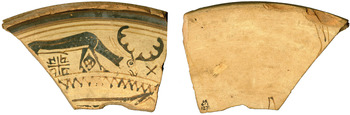
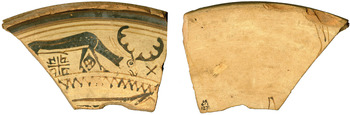
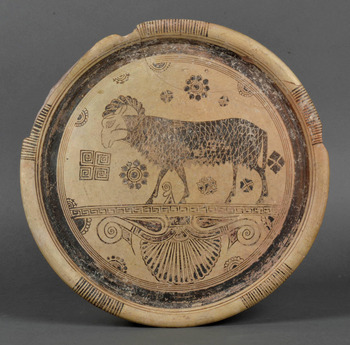
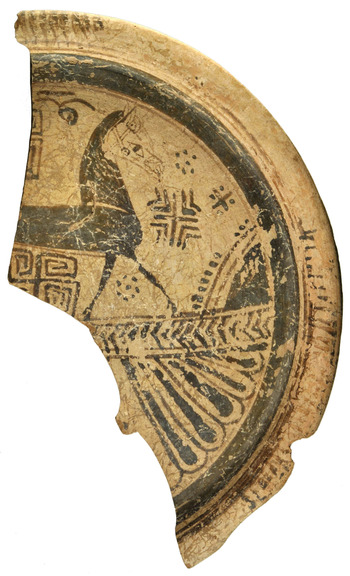
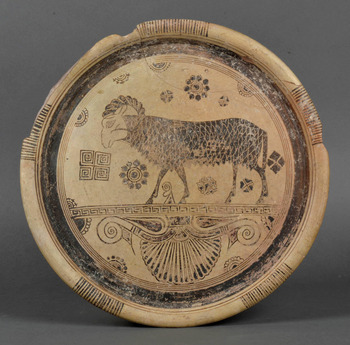
More frequent in East Dorian pottery are segment plates without a frieze, as exemplified by the Euphorbos plate (Rhod 26, Fig. 2). In addition to the latter, two further plates of this type from Kameiros in the British Museum were found to fall into NAA group KosB: a fine plate with a ram above a segment with a hanging palmette (Rhod 22, Fig. 7; Walter-Karydi Reference Walter-Karydi1973, 94, 111 n. 268, 149 no. 1071, pl. 132, with further literature) and a plate fragment with an unusual drawing of a horse above a segment filled with radiating tongues (Rhod 23, Fig. 8; Walter-Karydi Reference Walter-Karydi1973, 93, 150 no. 1091). Several related plates from Sicily have also been found to belong to KosB or KosA, in addition to a sherd from a krater (?) of the same style in KosB.Footnote 10 The latter features the characteristic dotted outline of a sphinx's (?) leg that is also found on many other vessels of this group.
East Dorian plate with ram on segment, c.600–570 bc, from Kameiros (sample Rhod 22, NAA group KosB: Kos). British Museum 1864,1007.5 (photograph © Trustees of the British Museum).
East Dorian plate fragment, horse on segment, c.600–570 bc, from Kameiros (sample Rhod 23, NAA group KosB: Kos). British Museum 1864,1007.2094 (photograph © Trustees of the British Museum).
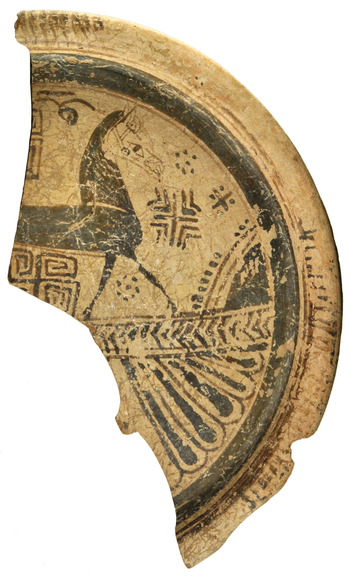
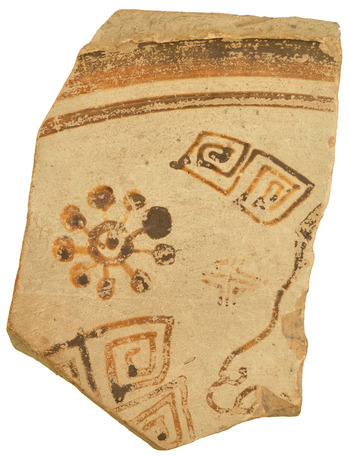
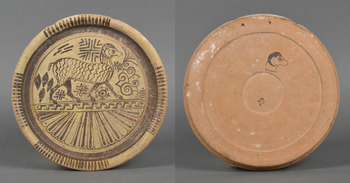
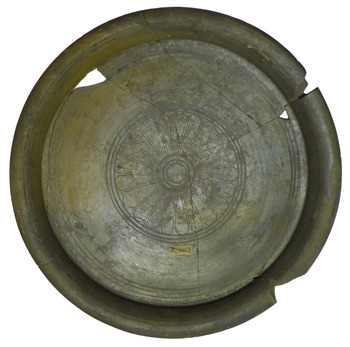
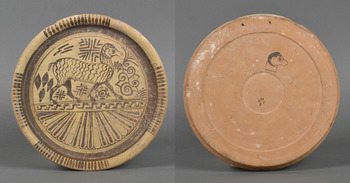
The new results complement and clarify work done by other scholars on East Dorian material. Already Pierre Dupont had noticed that East Dorian plates in the LouvreFootnote 11 and a fragment of a segment plate from Naukratis in the Museum of Classical Archaeology in Cambridge (inv. NA45, Fig. 9; Dupont and Thomas Reference Dupont and Thomas2006, 78–80, 82–4, fig. 4 [Nau 53]) had a composition unknown on Rhodes and in Ionian centres. This observation has recently been confirmed in a new series of PIXE (Particle induced X-ray emission) analyses on the East Dorian plates in the Louvre by Anne Bouquillon with Anne Coulié (Coulié Reference Coulié2014, 42–3, 47–8, 182–91, nos. 50–55, cf. also Coulié and Villing Reference Coulié and Villing2014). Dupont had suggested a provenance on the Dorian mainland,Footnote 12 but as our analyses show, it was Kos (or more specifically the region of Halasarna) that was the key production centre of pottery in ‘East Dorian’ style, responsible for the majority of East Dorian plates found on Rhodes and elsewhere. The pieces sharing our pattern KosB highlight the stylistic range and geographic spread of pottery in this group. Comprising exports to Rhodes as well as Sicily, they represent some of the most common as well as more unusual types of ‘East Dorian’ Wild Goat-style pottery. Interestingly, the exported pieces display a considerable range in quality: not only masterpieces such as the Euphorbos plate (Fig. 2), but also more unusual or artistically less accomplished works clearly found a market outside of Kos, such as the horse plate (Fig. 8). In addition, many further pieces can now be recognised as Koan on the basis of similarity in fabric and style to analysed pieces; they include a plate decorated with a hastily drawn ram and a rare ‘doodle’ of a ram's head on its underside (Fig. 10)Footnote 13 and an unusual plate with an incised central rosette reminiscent of Ionian designs and technique, but clearly Koan in shape and (macroscopically observed) fabric (Fig. 11).Footnote 14
East Dorian segment plate, goat(?), c.600–570 bc, from Naukratis, analysed by P. Dupont (‘Dorian region’). Museum of Classical Archaeology in Cambridge NA45 (photograph © Museum of Classical Archaeology, Cambridge).

East Dorian plate, ram on segment, ram's head on underside, early 6th century bc, from Kameiros. British Museum 1864,1007.6 (photographs © Trustees of the British Museum).
East Dorian plate, incised central rosette, early 6th century bc, from Kameiros, Papatisloures tomb 8, British Museum 1864,1007.132 (photograph © Trustees of the British Museum).
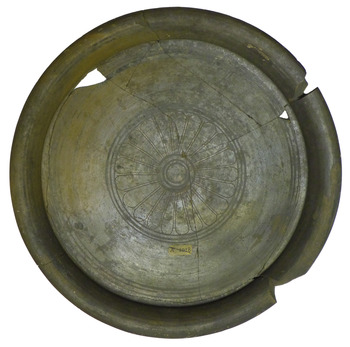
With little Archaic pottery from Kos published so far, examples of the ware remain elusive on the island itself, though one example of the group, a decorated plate, has been found in recent excavations at the sanctuary at Halasarna (Kardamaina).Footnote 15 This scarcity may be due to the chances of excavation and publication, though production targeted especially at export might also be a factor. In contrast, on neighbouring Nisyros an Archaic necropolis has yielded numerous examples of East Dorian plates, some of them with distinctive elements of style and motifs, leading to the suggestion of a local ‘Nisyros workshop’ (M. Filimonos-Tsopotou in Stampolidis, Tassoulas and Filimonos-Tsopotou Reference Stampolidis, Tassoulas and Filimonos-Tsopotou2011, 367–70 nos 47–50, 373 no. 56, 375 no. 60; see also Walter-Karydi Reference Walter-Karydi1973, 89–95; R.M. Cook in Cook and Dupont Reference Cook and Dupont1998, 63). Fundamentally different in both style and subject matter – a preference for ships stands out – are the (often small-scale) plates from Knidos, for which a distinctive local elemental NAA pattern, EmeB, has been established in past analyses (Attula Reference Attula2006; Mommsen, Schwedt and Attula Reference Mommsen, Schwedt, Attula and Berges2006). Further archaeological, archaeometric and stylistic research would undoubtedly make it possible to grasp more clearly the local and regional patterns involved in the production, trade and consumption of Koan and related wares.
RHODIAN POTTERY, GEOMETRIC TO ARCHAIC: NAA GROUPS RHODA, RHODF AND RHODB
Flooded by a large amount of imported painted pottery from numerous different centres – including, as we now know, Kos – Rhodes in the Archaic period increasingly emerges as more of a consumer, rather than producer, of pottery. What is left for the island itself in terms of production?
Neutron Activation Analysis over the past years has already established chemical fingerprints for a range of Bronze Age and later pottery assigned to a Rhodian or presumably Rhodian production; these include groups RhodA (formerly RHa1, linked with Rhodes though a kiln waster), RhodB (formerly RHb2, now including a Rhodian stamped amphora handle), and the likely Rhodian group TD, discussed below (Marketou et al. Reference Marketou, Karantzali, Mommsen, Zacharias, Kilikoglou and Schwedt2006). As is set out in this and the following section, our latest analyses of Geometric and later wares further enhance our understanding of these groups and substantiate their link with Rhodes, as well as contributing two new Rhodian groups, RhodF and X066r (see the discriminant analysis in Fig. 4).
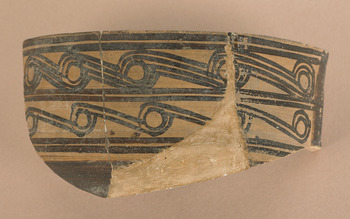
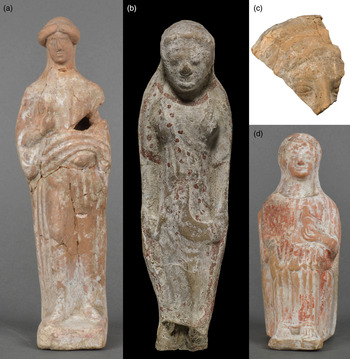
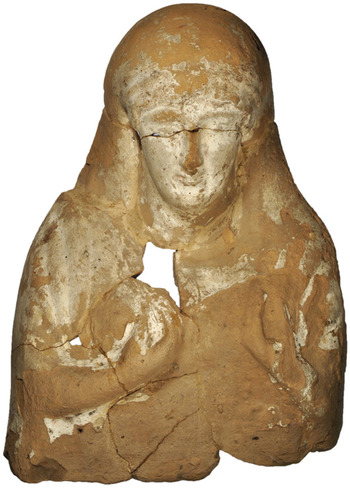
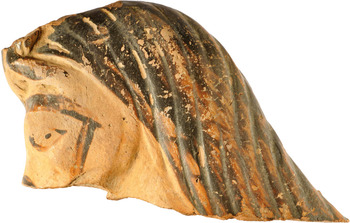
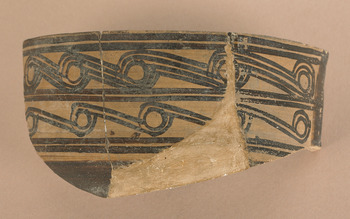
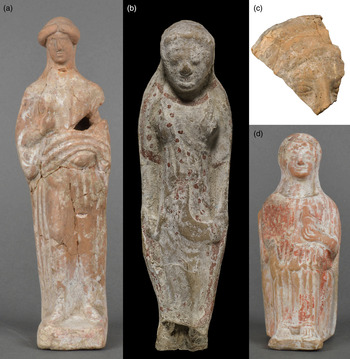
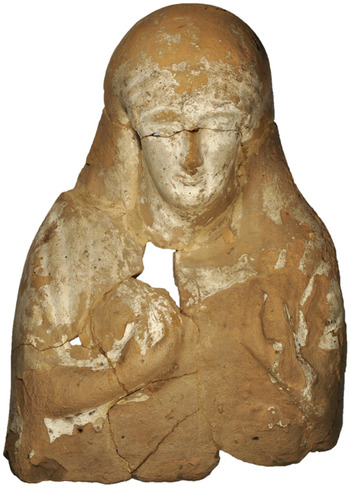
A fragment from the rim of a kantharos from Kameiros with multiple running spirals (Kami 6, Fig. 12; cf. Coldstream Reference Coldstream2010, 59 no. 197, pl. 85) falls into a chemical group RhodA. As Matteo D'Acunto kindly informs us, the same decoration occurs on a kantharos from tomb 4a at Laghos/Ialysos (Grigoriadou, Iannikouri and Marketou, Reference Grigoriadou, Iannikouri and Marketou2001, 382–3, fig. 16:b) as well as on a krater from tomb CC.2 at Kechraki/Kamiros (Jacopi Reference Jacopi1931–9, 345 fig. 381); both can be dated by context to Late Geometric I, c.750–720 bc, thus suggesting that our piece is also earlier than the early seventh-century bc date suggested by Coldstream (Reference Coldstream2010, 59 no. 197). The chemical pattern RhodA was first identified among Mycenaean samples from Ialysos; the fact that these included a plain LH IIIA2 / III B1 jug found in the interior of a kiln was taken as an indication that the group represents local production in the region of Ialysos (Marketou et al. Reference Marketou, Karantzali, Mommsen, Zacharias, Kilikoglou and Schwedt2006, 4, 7,20, 50–1; the jug is sample no. 232). More recently, a modern clay sample, IalT 1, taken from the acropolis of Rhodes town, also displayed pattern RhodA, thus further corroborating the assignment of this pattern to one or several workshops close to Rhodes town and Ialysos. Yet craftsmen in the area did not only make vessels; that Rhodes was a prolific producer of terracotta figurines has long been recognised, not only from finds of moulds (Coulié and Filimonos-Tsopotou Reference Coulié and Filimonos-Tsopotou2014, 319 no. 189:1) but also from elemental analyses. Some decades ago, Richard Jones’ analyses of terracotta figurines from Rhodes in the collections of the British Museum (Fig. 13 a–d )Footnote 16 and the Ashmolean Museum revealed a chemical pattern (group C) he associated with Rhodes (Jones Reference Jones1986, 668 table 8:8). More recently, our own analyses have included a Classical terracotta protome from Rhodes (Rhod 29, Fig. 14, cf. Higgins Reference Higgins1954, 89 no. 238, pl. 43; Thomas Reference Thomas, Villing, Bergeron, Bourogiannis, Johnston, Leclère, Masson and Thomas2013–15, 8; Coulié and Villing Reference Coulié and Villing2014, 118, fig. 64), which was found to have the same elemental pattern RhodA as the vases just discussed. A small fragment of another female protome, found at Naukratis in Egypt (Nauk 12, see below on Fig. 22), has a different Rhodian pattern, RhodF, discussed below. The analysis supports the archaeological assessment that many of the Classical female terracotta protomes dedicated at Naukratis, a site known to have had close links with Rhodes, were brought from the island.Footnote 17
Geometric kantharos fragment, spirals, c.750–720 bc, from Kameiros (sample Kami 6, NAA group RhodA: Rhodes town/Ialysos). British Museum 1864,1007.2095 (photograph © Trustees of the British Museum).
Terracotta figurines from Rhodes analysed by R. Jones (‘group C: Rhodes’): (a) standing female, c.450 bc, from Kameiros, British Museum 1863,0330.15 (Terracotta 211); (b) standing female, early 5th century bc, from Kameiros, British Museum 1864,1007.12 (Terracotta 117); (c) female protome, c.480–450 bc, from Fikellura, British Museum 1951,0307.2 (Terracotta 145); (d) seated female, early fifth century bc, from Fikellura, British Museum 1864,1007.1291 (Terracotta 129) (photographs © Trustees of the British Museum).
Terracotta protome, from Rhodes, c.450 bc (sample Rhod 29, NAA group RhodA: Rhodes town/Ialysos). British Museum 1885,1213.41 (Terracotta 238) (photograph © Trustees of the British Museum).
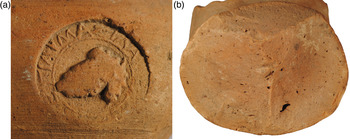
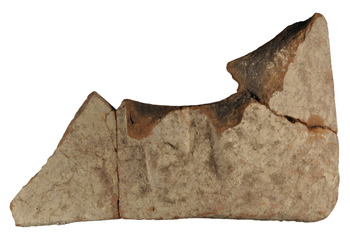
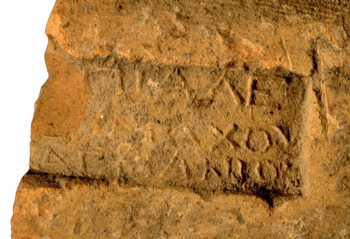
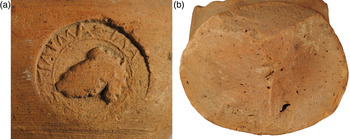
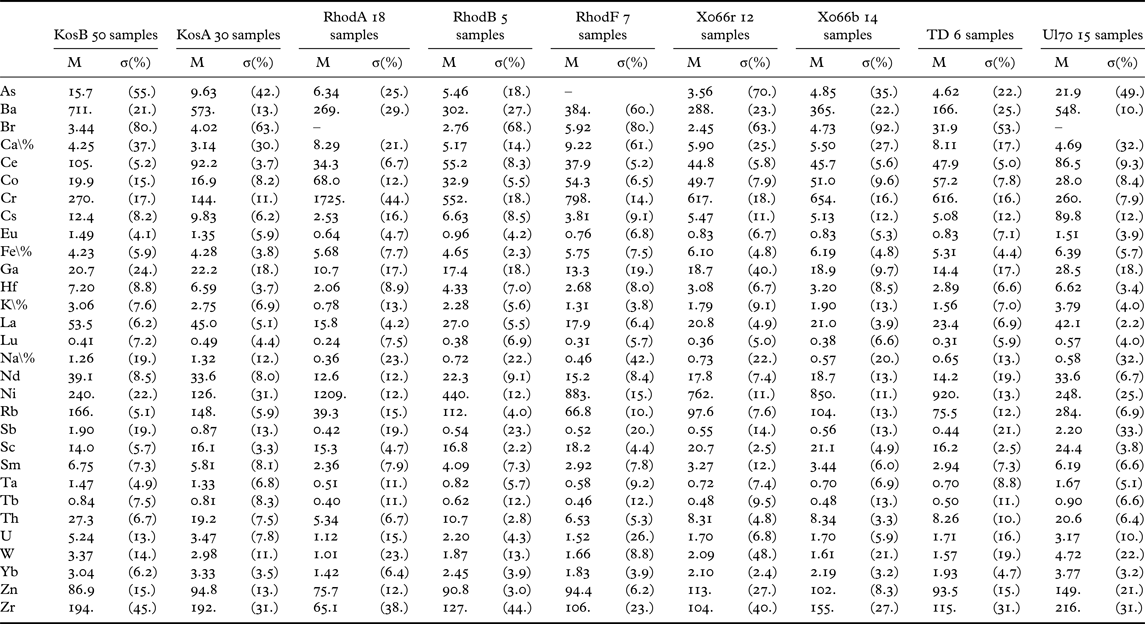
NAA group RhodA is characterised by very high and variable Co, Cr and Ni concentrations, with the Cr probably deriving from Cr-bearing grains in the clay, with varying numbers in the sample explaining the large scatter of the Cr concentrations (Table 3; cf. also Appendix 2). Elevated levels of Cr and Ni are found also in several other Rhodian groups, confirming observations previously made by other scholars,Footnote 18 though not always as high as in RhodA. This is true especially for another group observed among Mycenaean finds at Ialysos, RhodB (Marketou et al. Reference Marketou, Karantzali, Mommsen, Zacharias, Kilikoglou and Schwedt2006), which can now be more firmly linked to Rhodes since a newly-analysed Rhodian stamped amphora, made during the priesthood of Armosilas (c.210–200 bc), shares the same chemical composition (Nauk 107, Fig. 15).
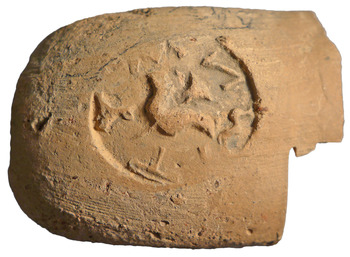
Rhodian stamped amphora handle, Armosilas, 210–200 bc, from Naukratis (sample Nauk 107, NAA group RhodB: Rhodes), British Museum 1955,0920.6: (a) view of stamp; (b) close-up of fabric on broken and cut edges (images © Trustees of the British Museum).
Average concentration values M in μg/g (ppm), if not indicated otherwise, of the groups of samples attributed to Kos (KosB, KosA) and Rhodes (RhodA, RhodB, RhodF, X066r and TD). Also given are the average values of a group of unknown origin (Ul70) and of a group of samples from Boeotia/Locris (X066b) similar in composition to the Rhodes group X066r (see text). σ is the standard deviation (root mean square deviation) in %. The individual samples have been corrected with a best relative fit factor (given in Table 1) with respect to the grouping values.
In addition to our NAA, a sample of this amphora handle was subjected to in-depth analysis with petrographic and scanning electron microscopy with energy-dispersive X-ray spectroscopy (SEM-EDX) (Appendix 2). The aim of this work, carried out by Michela Spataro at the British Museum, was to gain better insights into the factors underlying the elemental composition of Rhodian clay fabrics, including the role of natural and/or human agency. As a single case study its results, of course, cannot be generalised but they are nonetheless instructive. They confirm that serpentine, a common inclusion in Rhodian fabrics (Whitbread Reference Whitbread1995, 53–67), is one of the carriers of both Mg and Cr, occurring alongside scattered chromium-rich minerals. The likelihood of these inclusions being naturally present in the clay, and the fact that the clay itself carries Mg, suggest that high readings for these elements in chemical analyses are not just resulting from (though possibly influenced by) potters’ recipes or choice of temper, and can be expected even of relatively fine fabrics such as our amphora handle. In addition, the analysis corroborates the existence of fine mica (muscovite), thus further disproving assumptions of Rhodian clays categorically lacking mica. Even though it is true that mica is often (seemingly) absent in Rhodian wares, at least to the naked eye,Footnote 19 small inclusions that appear to be mica can be observed macroscopically also in a number of other vessels and figurines analysed by us, such as the terracotta protomes discussed earlier.
Nauk 107 is one of three Rhodian stamped amphorae that were analysed by us as a Rhodian control group; the second of these handles (NoFi 2, see below on Fig. 24) could also be linked with a Rhodian NAA pattern, albeit a different one, namely NAA Group X066r, discussed below. The third sample, Nauk 130 (Fig. 16), probably from Naukratis, dating from the priesthood of Mytion (c.210–200 bc) and previously assigned by Whitbread (Reference Whitbread1995, 63–5) to his dominant fabric class of Rhodian amphorae, was classified as a chemical loner. Its composition, however, shows some similarities with a Rhodian stamped amphora handle found at the site of Golubickaja 2 on the Black Sea coast (sample Golu 19, analysed in Bonn in the context of a still unpublished project in collaboration with U. Schlotzhauer, cf. Attula et al. Reference Attula, Dally, Huy, Larenok, Mommsen, Schlotzhauer, Žuravlev and Povalahev2014). As archaeological research has identified workshops for Hellenistic stamped amphorae at different sites on Rhodes as well as in the Rhodian peraia (Empereur and Picon Reference Empereur, Picon, Empereur and Garlan1986; Lund Reference Lund, Archibald, Davies and Gabrielsen2011, 283), variations between amphora fabrics are to be expected; future research, we hope, will be able to link fabric groups with specific workshops.
Rhodian stamped amphora handle, Mytion, 210–200 bc, probably from Naukratis (sample Nauk 130, NAA: single, Rhodes?). British Museum 1925,0119.509.a (photograph © Trustees of the British Museum).
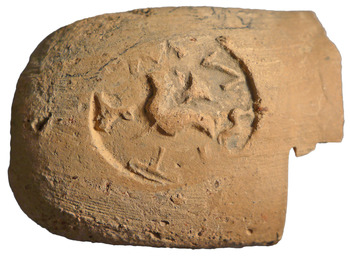
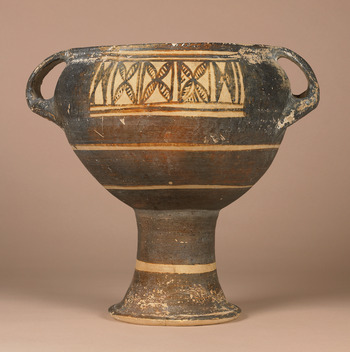
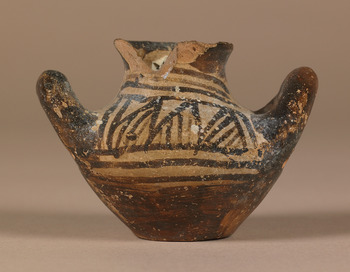
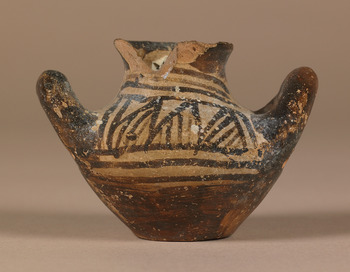
Of special interest is a new chemical group, RhodF, that has emerged in our most recent work. It comprises three Geometric vessels excavated at Kameiros (Kami 4, Kami 5, Kami 3, Figs 17, 18, 19) as well as two painted Archaic plates (Rhod 25, Fig. 20, discussed briefly in Coulié and Villing Reference Coulié and Villing2014, and Rhod 24, Fig. 21). The fifth-century bc East Greek female terracotta protome from Naukratis mentioned above, Nauk 128 (Fig. 22, cf. Thomas Reference Thomas, Villing, Bergeron, Bourogiannis, Johnston, Leclère, Masson and Thomas2013–15, 4 fig. 6) is also a member of this new group. While the group lacks wasters or clay samples to link it with Rhodes, a localisation on the island is highly likely for a number of reasons. Not only does it show similarity with the other patterns assigned to Rhodes (see Fig. 3), including high Cr and Ni levels, which match what has been observed at the laboratory in Bonn and in analyses by other scholars for Rhodian clays (Marketou et al. Reference Marketou, Karantzali, Mommsen, Zacharias, Kilikoglou and Schwedt2006; Mommsen et al. in Weber Reference Weber2006, 154 n. 104; Jones Reference Jones1986, 669–70; Leonard et al. Reference Leonard, Hughes, Middleton and Schofield1993, 118 with n. 36), but it also comprises Middle and Late Geometric vessel types considered typical of Rhodian (Kameirian) production on grounds of shape and style. The two-handled flask, dating to c.760–730 bc and decorated with bands of hatched lozenges (Kami 4, Fig. 17),Footnote 20 is a shape based on Cypriot Black-on-Red vessels characteristic of the Cypriot influence on Rhodian wares in the Geometric period (Farmakidou Reference Farmakidou, Karagheorghis and Kouka2009; Bourogiannis Reference Bourogiannis, Stampolidis, Kanta and Iannikouri2012; Reference Bourogiannis2014a; D'Acunto Reference D'Acunto, Mazarakis-Ainian, Alexandridou and Charalambidouforthcoming); a further vessel of this type was analysed by Bouquillon and found to be Rhodian (Coulié and Filimonos-Tsopotou Reference Coulié and Filimonos-Tsopotou2014, 300–1, no. 167; Coulié and Villing Reference Coulié and Villing2014, 117 fig. 63). The pedestalled krater with quatrefoils and double-axes of similar date (Kami 5, Fig. 18, Coldstream Reference Coldstream2010, 59 no. 194, pl. 85; Coulié and Villing Reference Coulié and Villing2014, 119 fig. 65) represents an Atticising strand in Rhodian pottery (Bourogiannis Reference Bourogiannis2014a; Coldstream Reference Coldstream2008, 272), while the hatched triangles on the small jar dated to c.800–750 bc (Kami 3, Fig. 19, Coldstream Reference Coldstream2010, 58 no. 191, pl. 83) are a common feature on Rhodian Middle Geometric small vessels.
Geometric flask of Cypriot shape, c.760–730 bc, from Kameiros (sample Kami 4, NAA group RhodF: Rhodes). British Museum 1864,1007.1582 (photograph © Trustees of the British Museum).

Geometric krater, quatrefoils and double-axes, c.730–710 bc, from Kameiros (sample Kami 5, NAA group RhodF: Rhodes). British Museum 1860,0404.9 (photograph © Trustees of the British Museum).
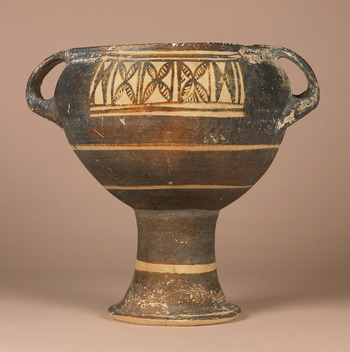
Geometric small jar, hatched triangles, c.800–750 bc, from Kameiros (sample Kami 3, NAA group RhodF: Rhodes). British Museum 1864,1007.1349 (photograph © Trustees of the British Museum).
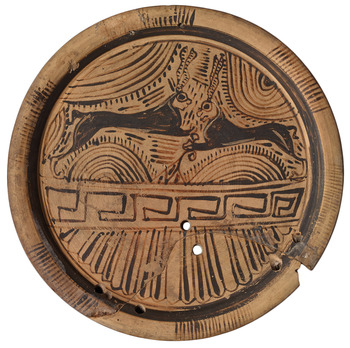
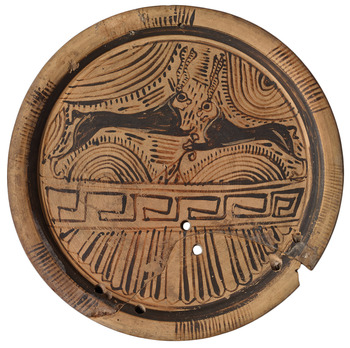
East Dorian plate of the ‘Hail Group’, two rabbits on segment, c.580–560 bc, from Rhodes (sample Rhod 25, NAA group RhodF: Rhodes). British Museum 1885,1213.7 (photograph © Trustees of the British Museum).
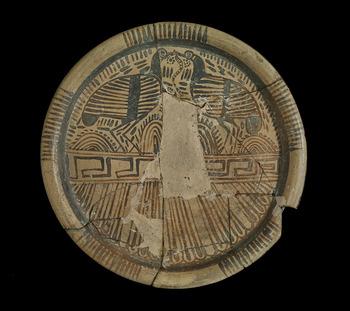
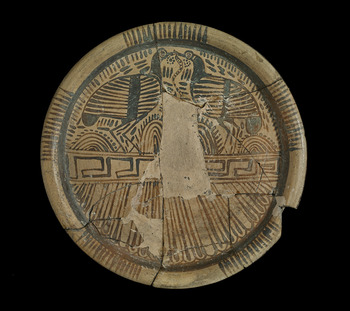
East Dorian plate of the ‘Hail Group’, two birds on segment, c.580–560 bc, from Rhodes (sample Rhod 24, NAA group RhodF: Rhodes). British Museum 1885,1213.8 (photograph © Trustees of the British Museum).
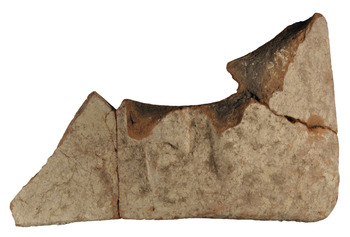
East Greek female terracotta protome fragment, 5th century bc, from Naukratis (sample Nauk 128, NAA group RhodF: Rhodes). British Museum, 2011,5009.226 (photograph © Trustees of the British Museum).
Remarkably, our analyses revealed as a further member of this group a sixth-century bc plate of East Dorian style featuring two antithetical hares and two large ancient repair holes (Rhod 25, Fig. 20).Footnote 21 With its lack of a slip, freely and expansively drawn figures and crowded, linear filling ornaments it forms part of a group of East Dorian pottery christened the ‘Hail Group’ by Kardara (Reference Kardara1963, 290–2; cf. R.M. Cook in Cook and Dupont Reference Cook and Dupont1998, 62). A plate with representations of two birds in identical style was undoubtedly made in the same workshop (Rhod 24, Fig. 21, Dümmler Reference Dümmler1891, 269–70; Kardara Reference Kardara1963, 291 no. 3, citing an incorrect registration number). The identification of the birds is difficult; their overall shape suggests quails or partridges, though the way the feathered wings are represented is more characteristic of images of ducks or geese in East Greek vase-painting. At least two further plates of the same style from Rhodes are known: one from Lindos (Blinkenberg Reference Blinkenberg1931, 282 no. 983, pl. 46.983) and the other from Kastello (Copenhagen, National Museum of Denmark, inv. 5611, acquired in 1903: CVA Copenhagen 2, 57 no. 4, pl. 76:4a–b), the latter again featuring a large bird. Kardara links them with a number of further pieces painted in a clumsy style, but these appear at best distantly related (Kardara Reference Kardara1963, 291 no. 1 and 292 no. 1; cf. also Walter-Karydi Reference Walter-Karydi1973, pl. 135:1111), while a fragment in Cambridge (Kardara Reference Kardara1963, 292 no. 5; our Fig. 9) is entirely different and indeed not Rhodian but almost certainly of Koan production.
The results for NAA group RhodF thus confirm with high probability the existence of a Rhodian production of ‘East Dorian’ plates. Interestingly, in the relatively small sample tested so far, the single Rhodian example is rather sloppy and derivative. It may well be that this picture will be adjusted somewhat as research progresses.Footnote 22 So far, however, the pattern that seems to be emerging is one of Kos leading the production in terms of quality and quantity, and Rhodes following.
In general, our analyses indicate that a range of different elemental patterns were at home on the island, some of them spanning substantial periods of time. Thus, in the Geometric period at least two patterns, RhodF and RhodA, coexisted, as already in the Bronze Age (Marketou et al. Reference Marketou, Karantzali, Mommsen, Zacharias, Kilikoglou and Schwedt2006). Several likely Rhodian patterns also existed among Archaic pottery, as will be discussed further below. This variety, also noted by other scholars among Mycenaean and later pottery from Rhodes (Coulié Reference Coulié2015; cf. Coulié and Villing Reference Coulié and Villing2014, 117 fig. 63; Jones and Mee Reference Jones and Mee1978), might reflect different regional workshops, though analyses elsewhere have shown that a single city too can display different patterns, as is the case, for example, with Miletos (NAA groups MilA and MilD, see the discriminant analysis below on Fig. 38; cf. Schlotzhauer Reference Schlotzhauer2012); in such cases the exploitation of different clay beds, but also different fabric preparations, may account for different compositional patterns.
The question whether different Rhodian production centres displayed different chemical fingerprints had already driven Richard Jones’ early analyses of pottery found (though of course not necessarily produced) at various Rhodian sites. He concluded that the composition of sherds collected at Kameiros and Lindos largely fell within the same ‘canonical Rhodian’ range that he had also observed in sherds from Ialysos (Appendix 1; Jones Reference Jones1986, 295–7), thus suggesting a broadly uniform chemical composition of clays across large parts of Rhodes, though more subtle differences may not have been readily apparent in the limited number of elements analysed and the relatively low precision of OES data. For our own NAA groups, we have seen that there is evidence to link RhodA with workshops close to Rhodes town and Ialysos. One is tempted to associate pattern RhodF with Kameiros since it was observed in several Geometric vessels found at this site that display the characteristic features of vessels from Kameiros, such as firing spots of the paint, more or less lustrous paint and pink clay colour (M. D'Acunto, pers. comm.); in this case Kameiros might also be the home of the Archaic ‘Hail Group’. Caution is, however, advisable, as examples of the Hail Group are also attested at Kastello, Siana and Lindos. Clearly, just as all over the island Rhodians consumed imports from many areas of the Greek world and beyond, they also consumed wares from a variety of different Rhodian workshops. The sixth-century bc NAA groups discussed in the following section may represent yet further regional centres, perhaps located more towards the island's south, but without actual evidence linking groups to production centres any such suggestions have to remain speculative.Footnote 23
VROULIAN CUPS AND SITULAE: NAA GROUPS X066R AND TD
Black-glazed pottery known as ‘Vroulian’, with decoration consisting of large incised ornaments – primarily palmettes and lotus flowers – partly filled with red paint, has long been assumed to be a Rhodian product primarily of the sixth century bc (R.M. Cook in Cook and Dupont Reference Cook and Dupont1998, 114–15). This assessment is supported by archaeometric data.
Vroulian ware is named after the settlement of Vroulia in southern Rhodes that yielded many examples of this ware, but has been found also at other sites on Rhodes and beyond. It is best known from the characteristic fine-walled cups known as Vroulian cups that in form resemble Ionian cups but carry a distinctive, expansive pattern of decoration that appears to betray the influence of metalwork; the shape may have developed out of earlier cups with simpler (Sub-) Geometric decoration (Coulié Reference Coulié2015, 1336). Outside Rhodes such cups have been found at, for example, Naukratis, Cyrene, Mersin and Tell Sukas. Yet Vroulian decoration also appears on other shapes, such as stamnoi, amphorae or oinochoai. In the same tradition but more loosely related are a series of biconical or ovoid lekythoi, glazed and with painted tongues on the shoulder, as well as phialai mesomphaloi in the same style, dating from the early part of the sixth century bc; the phialai share their rim pattern with Vroulian cups, while the painted tongues recur on oinochoai, sometimes beside typical ‘Vroulian’ incised floral patterns.Footnote 24 The most remarkable shapes in the group are large bag-shaped storage jars commonly termed ‘situlae’ that often feature painted figured scenes in addition to floral decoration. They are best represented at Daphnae / Tell Dafana in Egypt; stamnoi, too, have been found at Daphnae and as far north as Berezan on the Black Sea (Posamentir and Solovyov Reference Posamentir and Solovyov2007, 202–3 fig. 7.2; see also below), and a likely amphora at Naukratis (British Museum 1886,0401.1050).
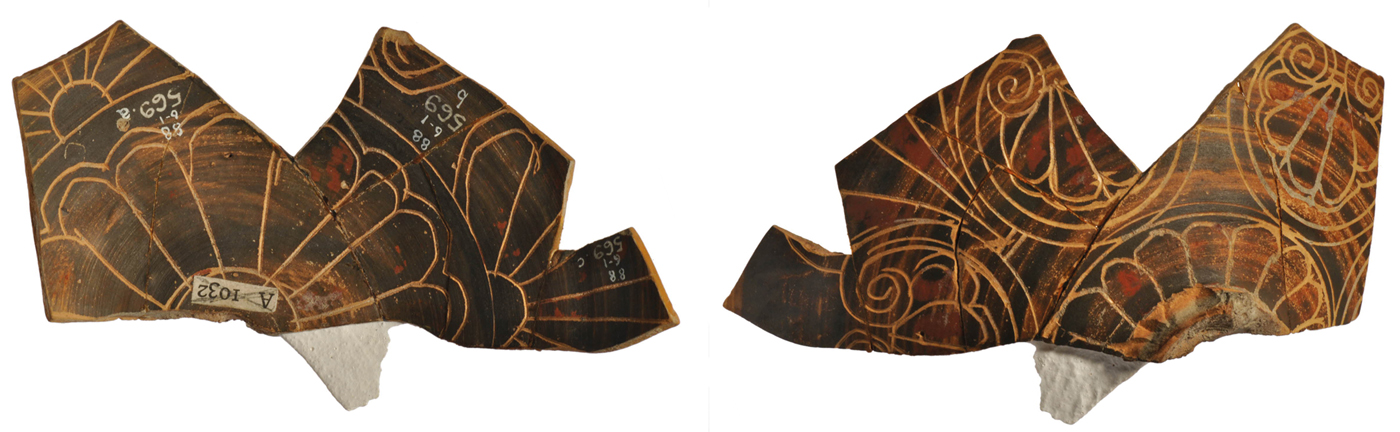
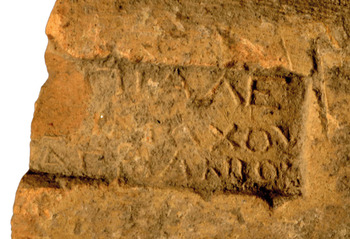
As part of an earlier programme focusing on East Greek pottery from Naukratis, a Vroulian cup (Nauk 59, Fig. 23) had been analysed in Bonn and found to be a chemical loner.Footnote 25 When reconsidered in the light of the new data deriving from our current programme of analyses, the cup's chemical composition showed considerable similarities with a newly formed group X066 with 26 members. The fact that this group includes a Hellenistic Rhodian amphora handle of c.147 bc (NoFi 2, Fig. 24) suggests a probable Rhodian origin for the group; the stamp on the handle, collected by Charles Newton in 1859 at an unknown site, reads ‘in the priesthood of Aleximachos, month Agrianios’. The assignment to Rhodes is further corroborated by a NAA study of Hellenistic and Roman Rhodian stamped handles (seven from Jerusalem, nine from Tell Akko and five as reference from Rhodes) where the average pattern shown by these 21 samplesFootnote 26 is very similar to our group X066.
Vroulian cup fragment, c.610–570 bc, from Naukratis (sample Nauk 59, NAA group X066: Rhodes). British Museum 1888,0601.569.a–c (photograph © Trustees of the British Museum).
Rhodian stamped amphora handle, Aleximachos, c.147 bc (sample NoFi 2, NAA group X066: Rhodes). British Museum 2011,5002.164 (photograph © Trustees of the British Museum).
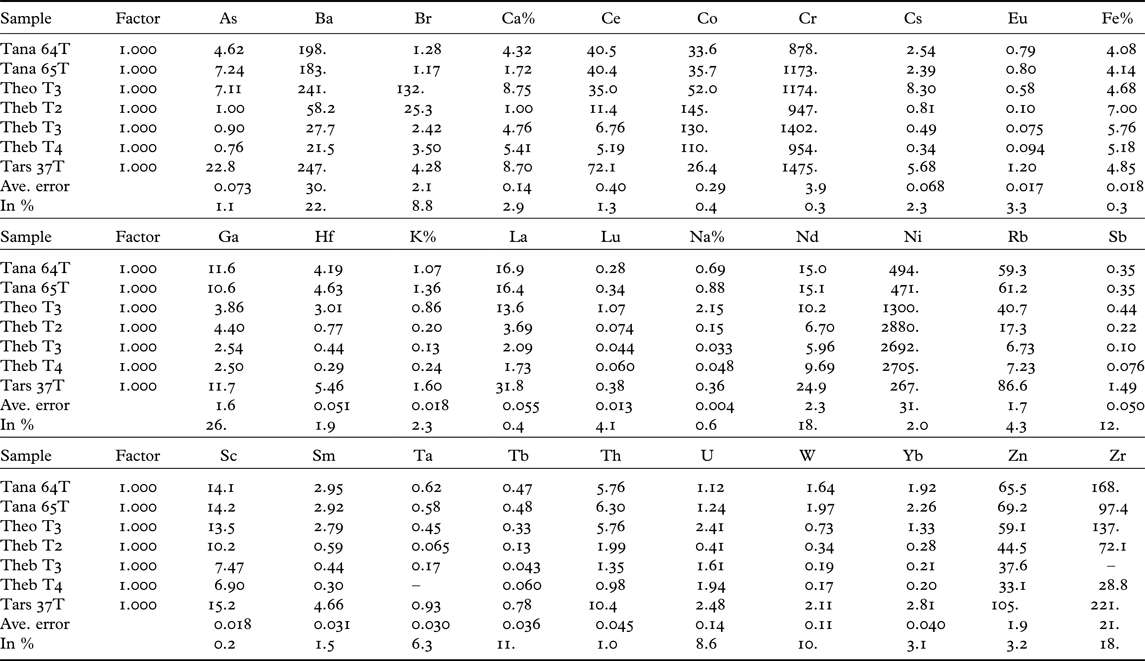
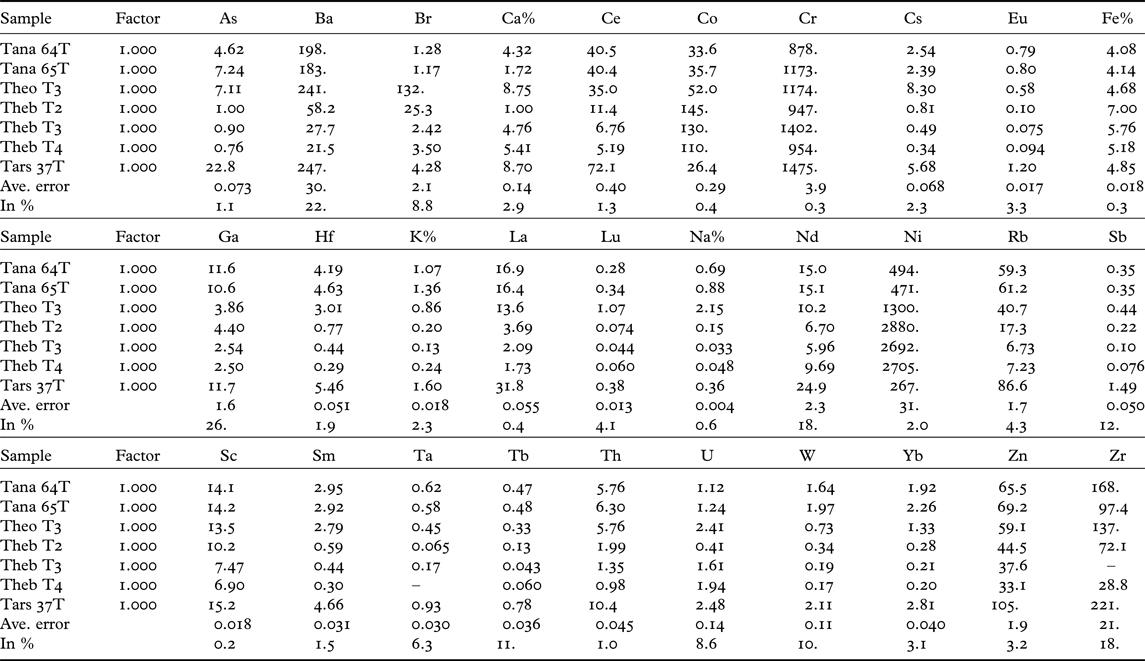
At the same time, however, group X066 is also a good example of the potential – if rare – pitfalls of relying on elemental characteristics alone without (archaeological) checks and balances, and therefore warrants a closer look. In addition to our Rhodian amphora handle and eight samples of Bronze Age pottery from Rhodes, mostly Ialysos, 14 members of the new group X066 come from Boeotia and Locris. This group of 14 Mycenaean samples from Boeotia was named Thej when first published in 2002 (Mommsen et al. Reference Mommsen, Andrikou, Aravantinos, Maran, Jerem and Biro2002, 609; Thej is the fifth pattern in table 1; headline with the names of the groups is missing) and was assumed to originate from Boeotia, Euboea, or Locris. Its existence had been the reason that the Ialysos pieces matching the old group Thej had originally been published as imports probably from Central Greece (Marketou et al. Reference Marketou, Karantzali, Mommsen, Zacharias, Kilikoglou and Schwedt2006, table 2: group Thej). Now the probability is high that these pieces and other samples from Rhodes of this group have to be reassigned to a Rhodian origin (the old Thej samples Ialy 163, 164, 203, 217, 218 and the singles Ialy 189 and 202 are now members of X066r). Moreover, a LHIIIB2 skyphos, on archaeological grounds assumed to be Rhodian but published as probably originating from Locris because it showed pattern Thej (Pilz, Mommsen and Schwedt Reference Pilz, Mommsen and Schwedt2003, sample Jena 2) probably needs to be reassigned to Rhodes. On the other hand, the Boeotian and Locrian sherds of the old group Thej, now X066b, are highly unlikely on archaeological grounds to be imports from Rhodes, and one has to accept that NAA is not able to distinguish between samples with pattern X066 originating from Central Greece and Rhodes. To demonstrate the similarity of the samples from Rhodes (X066r) and from Boeotia/Locris (X066b), the patterns of both datasets are shown in Table 3. Both have similar high Cr and Ni values. Other Boeotian groups also have high Cr values: compare group Thef, five samples (Mommsen et al. Reference Mommsen, Andrikou, Aravantinos, Maran, Jerem and Biro2002, 609; Thef is the fifth pattern in table 1; headline with the names of the groups is missing), later called F, 11 samples (Schwedt et al. Reference Schwedt, Aravantinos, Harami, Kilikoglou, Kylafi, Mommsen and Zacharias2006, 1070, table 2, pattern F and M), assigned to Thebes, or group M, assigned to Tanagra. Several clay samples, although not good members of the Boeotian groups, support the assumption that, as well as on Rhodes, high Cr concentrations occur also in Boeotia and Locris. They were collected at Thebes (Theb-T2: south side of the Kolonaki hill, 38° 18′ 51″ N, 23° 19′ 04″ E; Theb-T3 and Theb T4: Kastelli hill, stratigraphic section east of the entrance to the large chambered tomb), at sites near Tanagra (Tana 64 T, Tana 65 T: clays from a kiln excavation at Tanagra 2005, supplied by N. Zacharias on 27 July 2005) and at the coastline of the bay of Theologos near Malesina, Locris (sample Theo T3). These clays show similar high Cr and Ni values to the Rhodian clays. Unusually high Cr values have also been observed elsewhere, e.g. at Tarsus (clay sample Tars 37 T taken from the clay source of a modern potter south of Tarsus Gözlükule), on Cyprus (Robinson Reference Robinson and Pilides1994) in Handmade Burnished Wares (HBW), and at Tell Abu Hawam (unpublished samples in collaboration with M. Artzy), again in HBW, which are usually locally produced. The raw data for the Boeotian and other clay samples in our databank are given in Table 4.
Raw concentrations C of 30 elements in μg/g (ppm), if not indicated otherwise, of the clay samples described in the text and, below, the average experimental uncertainties (statistical counting errors), also in % of C.
Michela Spataro's analysis (Appendix 2) has shown that high Mg, Cr and Ni values in Rhodian fabric can in part be linked to fabric inclusions such as serpentine, yet such minerals are not unique to Rhodes but also present in the geology of Cyprus as well as other regions (cf. also Whitbread Reference Whitbread1995, 53–67). With similar geological constellations potentially, if very rarely, resulting in near-identical chemical fingerprints, stylistic and technological assessment thus has an important role to play besides the measuring of elemental compositions.
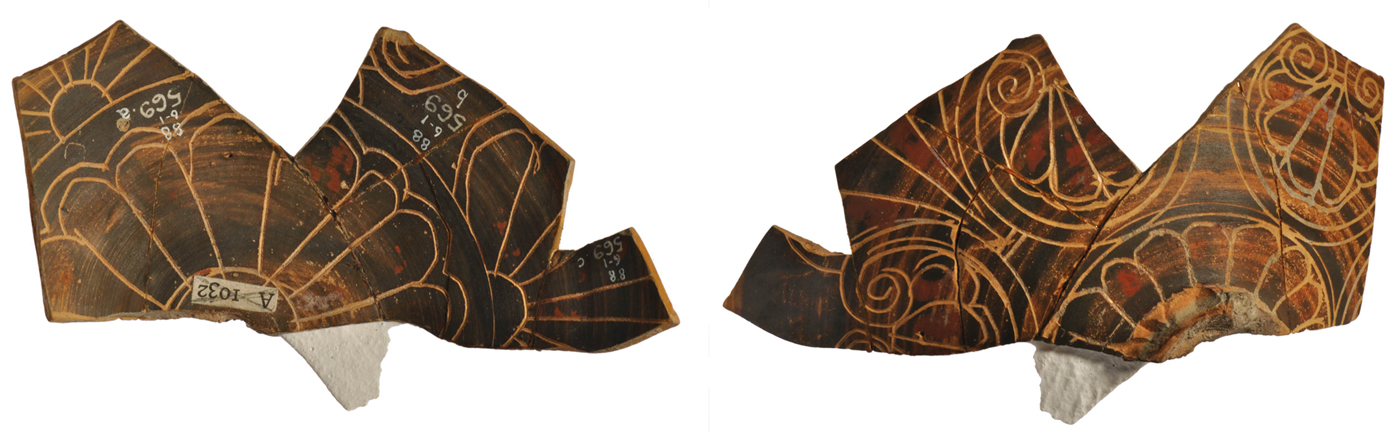
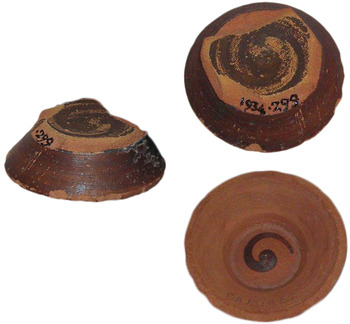
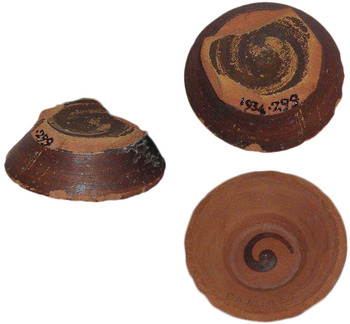
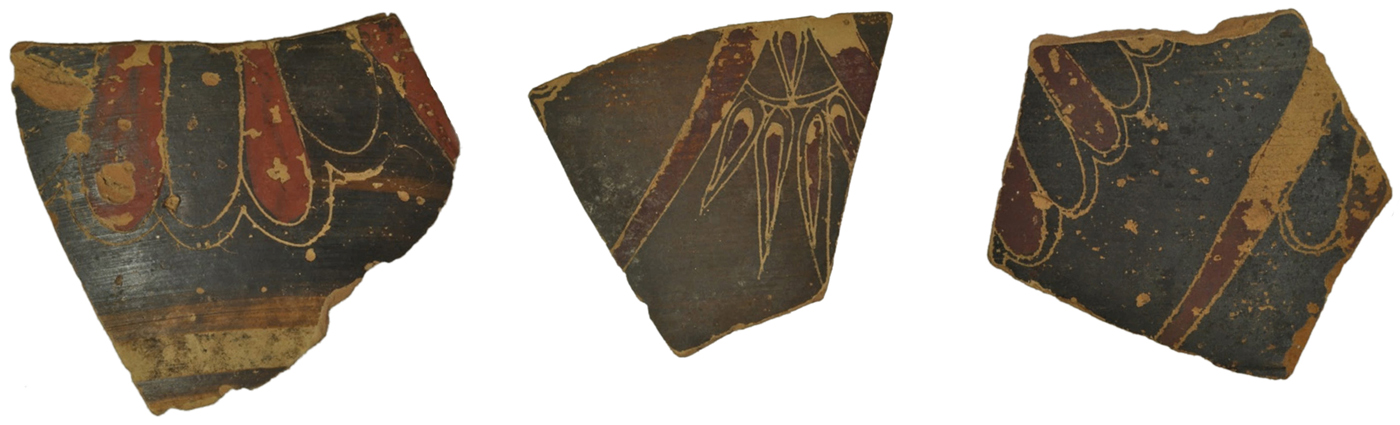
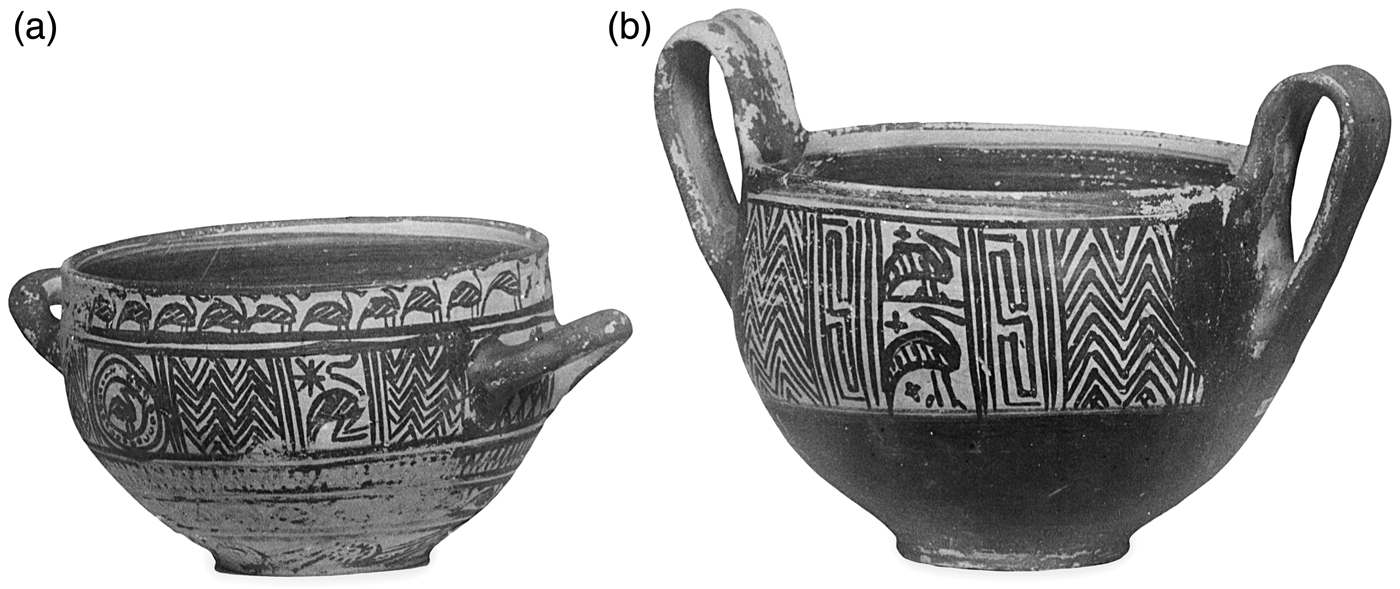
Returning to Vroulian wares: that our Vroulian cup Nauk 59 is indeed Rhodian, and that alongside Vroulian a range of other cups were also produced on Rhodes, is further supported by the analytical work of other scholars. Richard Jones had already examined the fragment of an early sixth-century bc cup from Kameiros (Fig. 25, Oxford, Ashmolean Museum AN1934.299: Jones Reference Jones1986, 668 table 8:8 no. 15) that features a painted spiral underneath the foot, a decorative element that has long been recognised as a characteristic ‘trademark’ of one or several Rhodian workshops.Footnote 27 It fell in his ‘Group C’, which also comprised sherds of situlae (or stamnoi) (Fig. 26),Footnote 28 a bowl from Kameiros, terracotta figures from Fikellura and Kameiros (above, Fig. 13), and Rhodian Geometric pottery, including two pieces from Siana attributed to the Late Geometric Bird-and-Zigzag Painter (Fig. 27 a–b ).Footnote 29
Fragment of cup, early 6th century bc, from Kameiros. Oxford, Ashmolean Museum AN1934.299 (photograph © Ashmolean Museum, University of Oxford).
Three fragments of East Greek ‘situlae’ (or stamnoi) from Daphnae / Tell Dafana, first half 6th century bc, analysed by R. Jones (‘Group C: Rhodian’). Ashmolean Museum AN1925.608a (photographs A. Villing © Ashmolean Museum, University of Oxford).
Geometric vessels from Siana, analysed by R. Jones (‘Group C: Rhodian’): (a) skyphos by the ‘Bird-and-Zigzag Painter’, second half 8th century bc, Oxford, Ashmolean Museum AN1885.622; (b) kantharos by the ‘Bird-and-Zigzag Painter’, second half 8th century bc, Oxford, Ashmolean Museum, AN1885.621 (photographs © Ashmolean Museum, University of Oxford).
Pierre Dupont (Reference Dupont1983, 28–9), too, has reported that WD-XRF (wave-length dispersive X-ray fluorescence) analyses carried out in Lyon of Vroulian cups and cups of ‘Ionian’ shape, primarily from Lindos and some with the characteristic ‘Rhodian’ underfoot spiral, detected unusually high Mg content as characteristic of (many) Rhodian clays. According to Dupont, some examples belonged to Kinch's ‘jaunes et brunes’ type (Kinch Reference Kinch1914, pl. 27:4, 18–19). If this identification is correct (the analysed pieces were not identified or published, so that the classification cannot be verified), then this special East Dorian version of Ionian cup with a sharp carination on the shoulder, found at various sites in Rhodes, may have been produced not only on the Knidian peninsula, where our own analyses have confirmed manufacture (NAA group EmeB: Schlotzhauer and Villing Reference Schlotzhauer and Villing2006, 60–1 fig. 24), but also on Rhodes. High Mg was noted, moreover, in Dupont's analyses of Vroulian cups from Naukratis and a fragment of a situla from Daphnae / Tell Dafana (Fig. 28 a, b, c, Dupont and Thomas Reference Dupont and Thomas2006, 79–80, figs 5–6, samples Nau 58, Nau 59 and Def 1) as well as more recently by Bouquillon and Coulié in analyses of various Rhodian wares, including a Vroulian cup and two cup-kraters of related shape with Sub-Geometric decoration, all of which they identified as Rhodian.Footnote 30
Sherds analysed by P. Dupont (‘Rhodian’): (a, b) Vroulian cup fragments from Naukratis, first half sixth century bc; (c) fragment of situla from Daphnae / Tell Dafana, c.570–540 bc (after Dupont and Thomas Reference Dupont and Thomas2006, 79, figs 5–6).
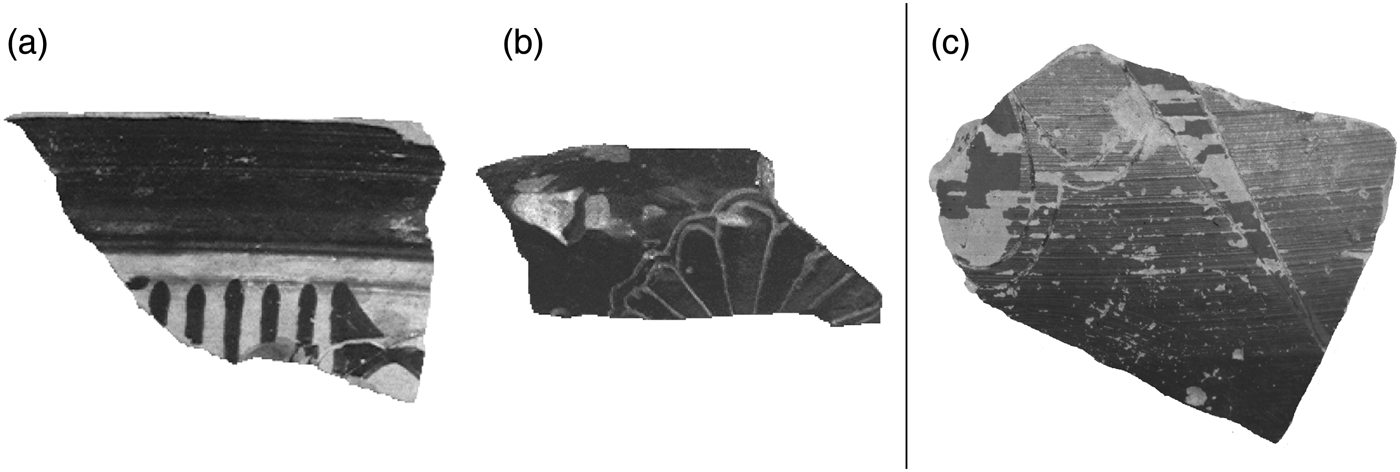
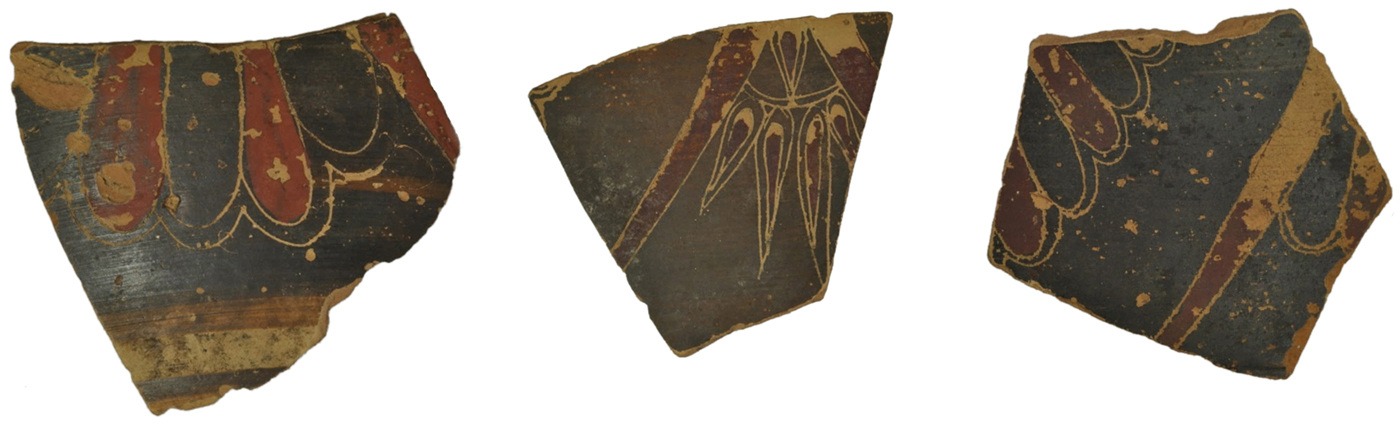
Besides cups, situlae and stamnoi (surveyed in detail by Weber Reference Weber2006) are thus another group of sixth-century bc vessels linked with Rhodian production in past archaeometric analyses. Most known examples of situlae come from Daphnae / Tell Dafana in Egypt, but some were also found on Rhodes itself. The samples analysed by Jones (Fig. 25) and Dupont (Fig. 28 c) all come from vessels of Cook's class C, considered the latest of his three sub-classes (A, B and C), and are characterised by decoration of Vroulian style. In the course of our own collaborative work on Greek–Egyptian exchange some ten years ago, situlae of classes B and C were sampled to further clarify the picture of their provenance, alongside sherds of Vroulian stamnoi and a related amphora with figured decoration. The results from this study, instigated by Sabine Weber, were discussed by her in detail in 2006 (Weber Reference Weber2006, 149–50, figs 18–23; Appendix by Mommsen et al. in Weber Reference Weber2006, 151–2). Three ‘situlae’ of class C (Defe 1, 2, 3, Fig. 29a , b , c ), the two stamnoid vessels (Defe 4, 5, Fig. 30a, b ) and the amphora fragment (Defe 8, Fig. 31) were found to share an elemental composition we termed TD. Though different from other elemental patterns and lacking any members that could corroborate attribution to a particular region, the group's high Ni and high Cr levels would be consistent with Rhodian production (see the Appendix by Mommsen et al. in Weber Reference Weber2006, 152; the similarity of TD to the small also unlocated group EmeD mentioned there is weak and cannot help with localising group TD). Interestingly, a further fragment of Vroulian style, possibly a stamnos, found at Berezan and analysed as part of a different project (Posamentir and Solovyov Reference Posamentir and Solovyov2007, 202–3 fig. 7.2, sample Bere 207, here identified as from an oinochoe and still a chemical loner), is chemically associated to group TD with high Co, Fe, and Cr values, but also to Rhodian group RhodA (high K and Rb). Featuring the characteristic large pendant lotus flowers and palmettes with incised outlines and added red paint of Vroulian pottery, the piece is a rare example of the distribution of this ware to the Black Sea region.
East Greek ‘situla’ (type C) fragments, c.570–540 bc, from Daphnae / Tell Dafana: (a) owl (sample Defe 1, NAA group TD: Rhodes?), British Museum 1888,0208.65 (Vase B106.19); (b) horse and sphinx (sample Defe 2, NAA group TD: Rhodes?), British Museum 1888,0208.16.b and 1888,0208.17 (Vase B106.12 and 13); (c) bull (sample Defe 3, NAA group TD: Rhodes?), British Museum 1888,0208.20 (Vase B.106.11) (photographs © Trustees of the British Museum).

Stamnos fragments with ‘Vroulian’ decoration similar to type C situlae, c.570–540 bc, from Daphnae / Tell Dafana: (a) neck and shoulder (sample Defe 4, NAA group TD: Rhodes?), British Museum 1888,0208.42.a; (b) body and handle (sample Defe 5, NAA group TD: Rhodes?), British Museum 1888,0208.44.a (photographs © Trustees of the British Museum).
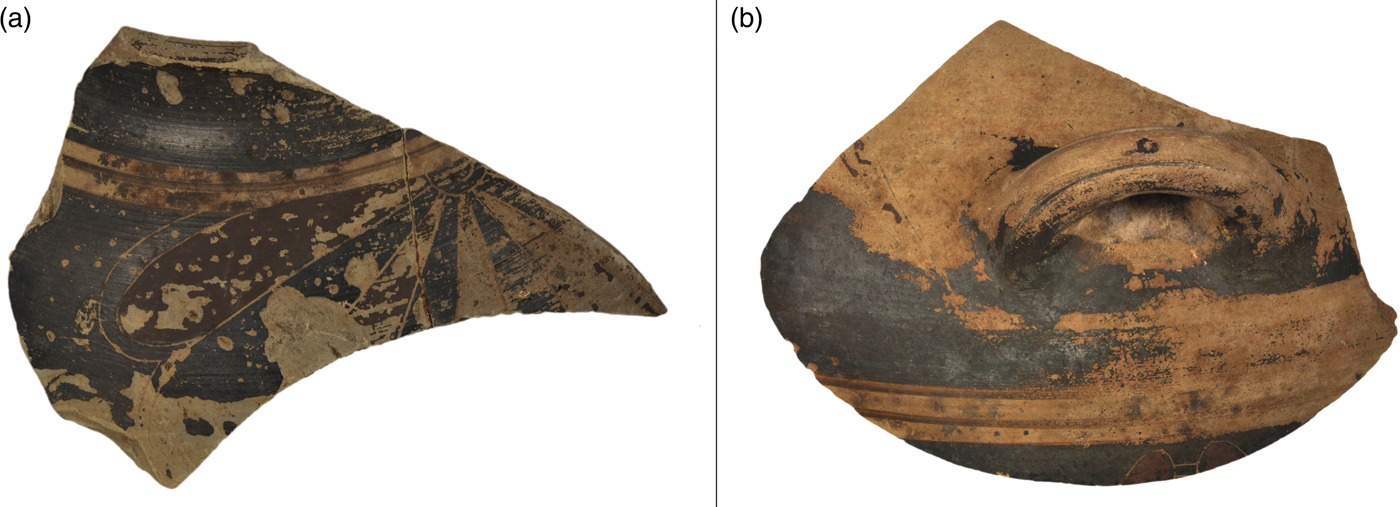
Amphora fragment showing figures beside a tripod, c.570–540 bc, from Daphnae / Tell Dafana (sample Defe 8, TD, Rhodes?). British Museum 1888,0208.25 (Vase B106.15) (photograph © Trustees of the British Museum).
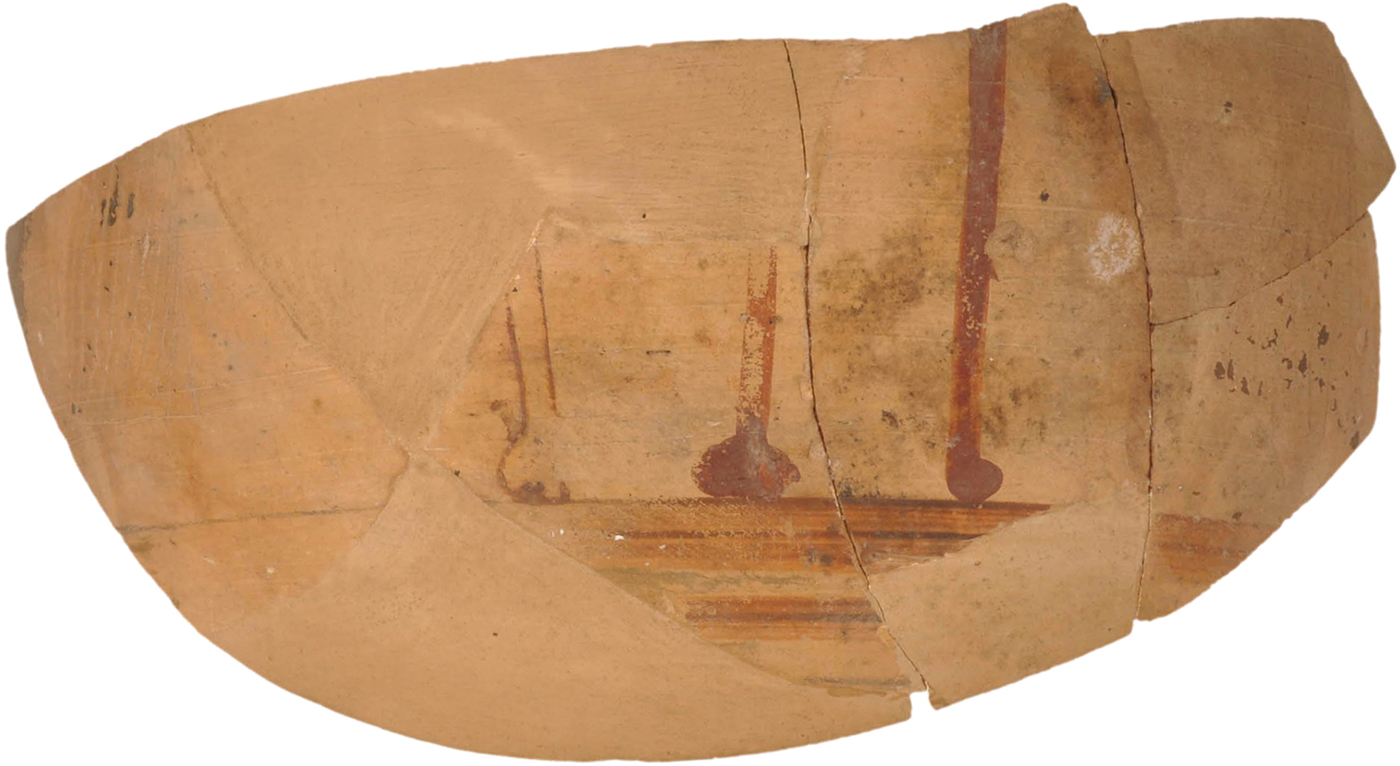
Only a single example of a situla of class B (with a black-banded body without additional incised and painted decoration) was analysed, a small fragment featuring a griffin found on Rhodes itself (Rhod20, Fig. 32). It emerged as a chemical loner, though the high Cr and Ni values again point to Rhodes as a likely production centre.Footnote 31 With the group of the Vroulian cups and situlae, then, Rhodes in the sixth century bc clearly possessed accomplished potters’ and painters’ workshops whose products found a certain distribution also abroad, even if their output of figured wares – though including pieces of high quality – appears to have been limited. Where precisely these workshops were located remains unknown; Coulié (Reference Coulié2015, 1336–7) hypothetically proposed a location in the south of the island, in the territory of Lindos, but we still lack firm evidence to substantiate the hypothesis.
Situla (type B) fragment decorated with a griffin, early 6th century bc, from Rhodes (sample Rhod 20, NAA single: Rhodes?). British Museum 1868,0405.78 (photograph © Trustees of the British Museum).
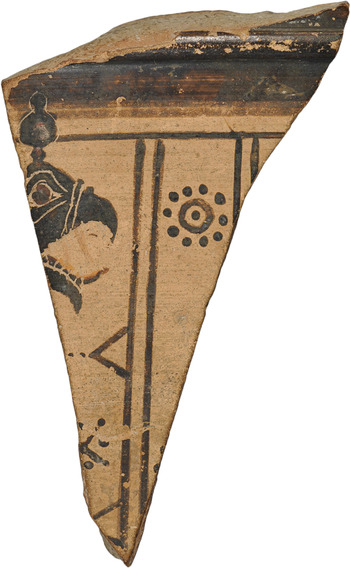
RHODIAN PLASTIC VASES: PHANTOM OR REALITY?
It is important to note in this archaeometric survey of Rhodian pottery not just presences but also absences. Among the more unexpected observations in this respect is the fact that so far none of the finely modelled plastic vases of the sixth century bc that served as ointment or perfume containers and that are widely distributed in the East Greek world and beyond (Ducat Reference Ducat1963 and 1966; Biers Reference Biers1989) could be identified as Rhodian. Comprising a range of stylistically different groups, their production place(s) has long been disputed. To Higgins (Reference Higgins1959) and Ducat (Reference Ducat1963; Reference Ducat1966), Rhodes was the main source for the East Greek variety of these vessels, and still today the island is widely regarded as one of several key production centres (e.g. Böhm Reference Böhm2014). Richard Jones, however, could not attribute any of the figure vases he analysed to Rhodian production, and this lacuna is confirmed by us as well as by Bouquillon.
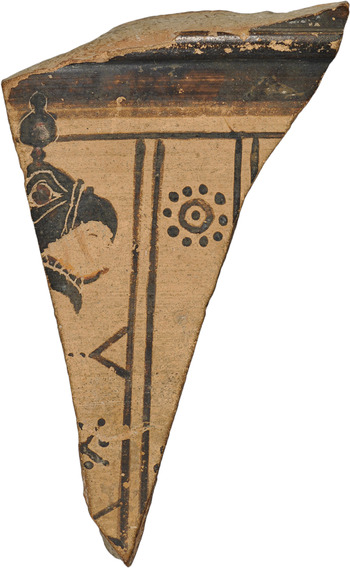
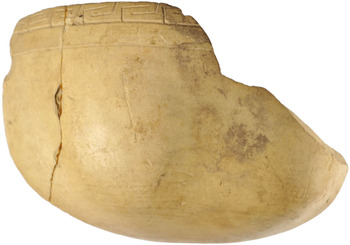
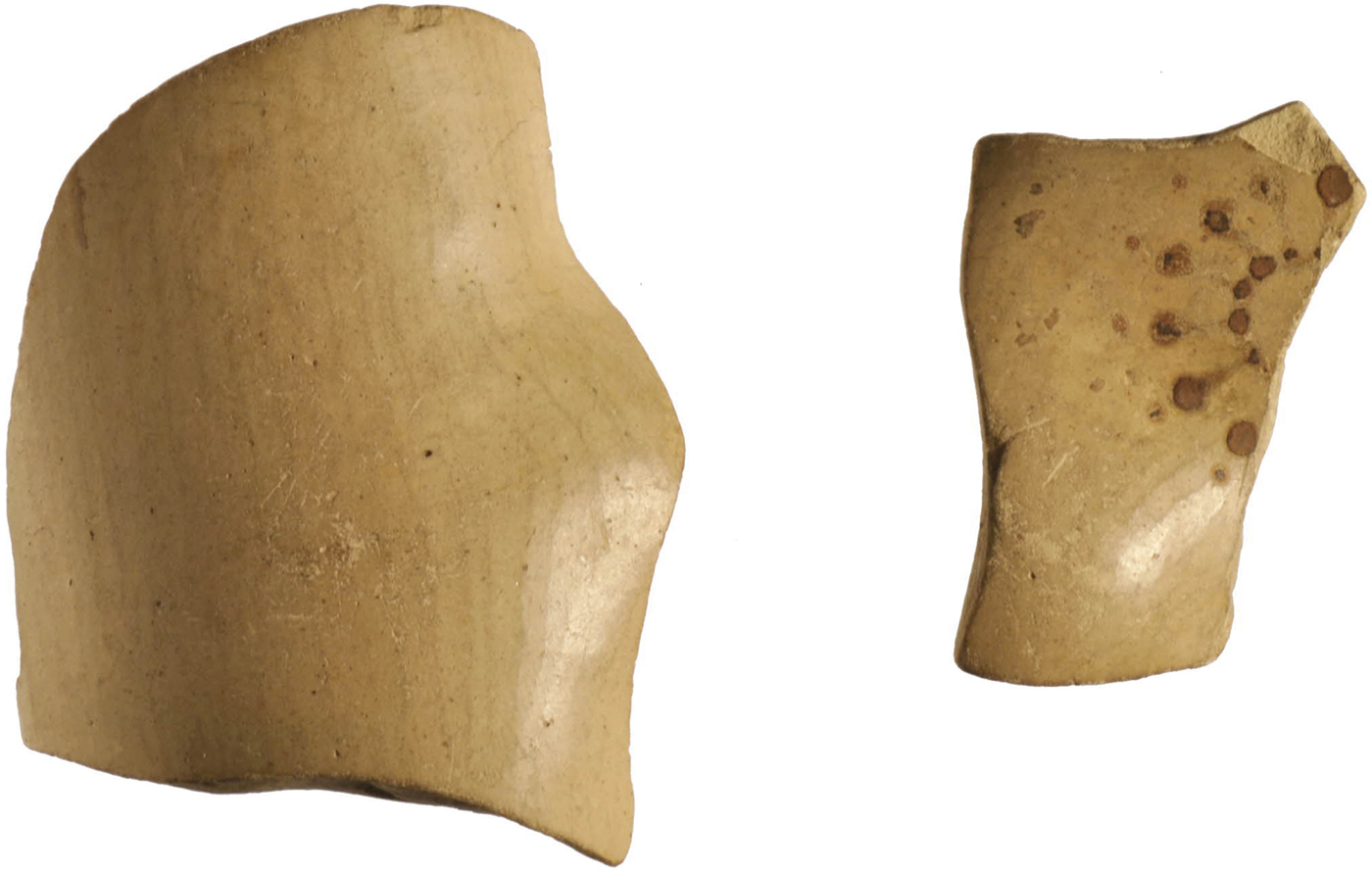
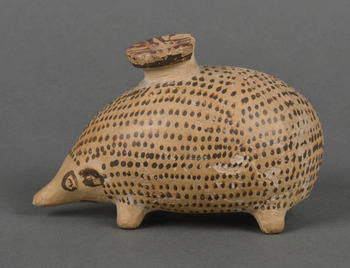
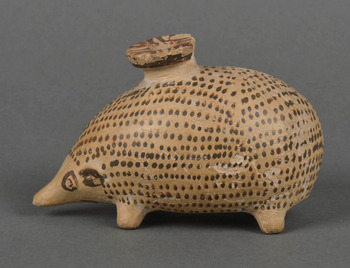
Our own programme of analyses included three examples of such plastic vases imported into Naukratis, the composition of which was clearly different from (known or suspected) Rhodian, but also from Corinthian fabrics, despite the superficial similarity of the very fine, pale-yellow clay to Corinthian pottery. One vessel in the shape of a pomegranate (Nauk 109, Fig. 33, Higgins Reference Higgins1959, 31, no. 1654, pl. 19), a well-known type that shares a similar fabric and decoration with a class of leg-shaped perfume vessels, remained a chemical loner. A fragment of near-identical fabric, perhaps from a figure vessel (Fig. 34), had been previously analysed by Richard Jones, falling into his group Ionian B, along with, among other things, a hedgehog aryballos (Fig. 35) in the British Museum.Footnote 32 More recently, a leg-shaped vessel of the same group in the Louvre was analysed by Bouquillon and found to be clearly different from Rhodian clays (Coulié Reference Coulié2015, 1329–30). Even if Jones’ group Ionian B remains problematic (Kerschner in Akurgal et al. Reference Akurgal, Kerschner, Mommsen and Niemeier2002, 34–6), his results corroborate the notion of an East Greek origin that has long been assumed by scholars – yet where in East Greece?Footnote 33 A Rhodian origin had been proposed, especially for the pomegranate- and leg-shaped vessels based on similarities of their decoration to Vroulian cups, but our NAA results, as also the analyses of Jones and Bouquillon, well separate the vessels from known Rhodian groups, including also Vroulian cups, and moreover show none of the Rhodian ‘hallmarks’ of elevated Cr, Ni or Mg. While the possibility that certain clay beds on Rhodes had an entirely different elemental profile cannot be excluded entirely, such a scenario seems unlikely; among probable or definite Rhodian products, only a pot from a modern potter's workshop at Archangelos has so far been found to deviate substantially from Rhodian patterns (Appendix 1). The evidence at present thus cannot support a Rhodian origin for this as yet unlocated group.
Plastic vase in shape of pomegranate, early 6th century bc, from Naukratis (sample Nauk 109, NAA single). British Museum 1888,0601.752.a (Terracotta 1654) (photograph © Trustees of the British Museum).
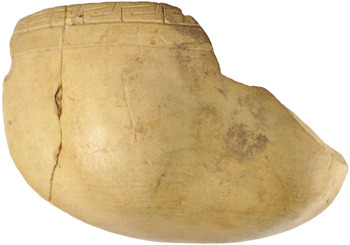
Plastic vase fragments (figure vessel?), early 6th century bc, from Naukratis, sanctuary of Aphrodite, analysed by R. Jones (‘Ionian B’). British Museum 1888,0601.752.b and c (photograph © Trustees of the British Museum).
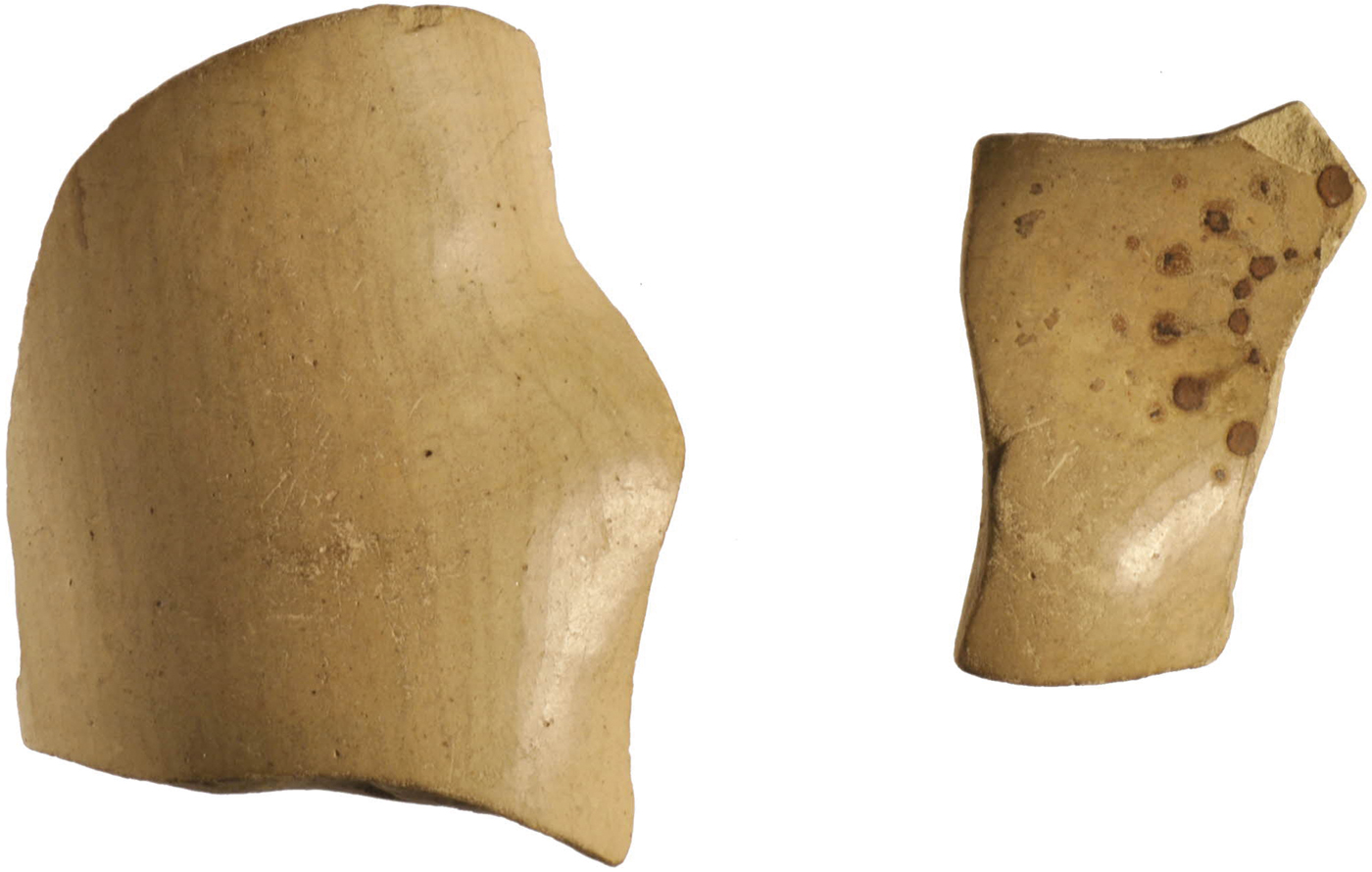
Plastic vase in the shape of a hedgehog, from Kameiros, early 6th century bc, analysed by R. Jones (‘Ionian B’). British Museum 1860,0404.34 (Terracotta 1641) (photograph © Trustees of the British Museum).
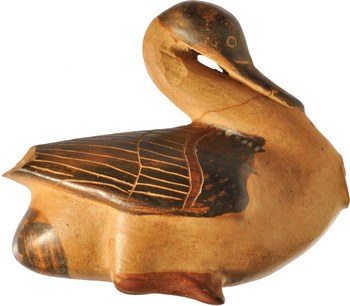
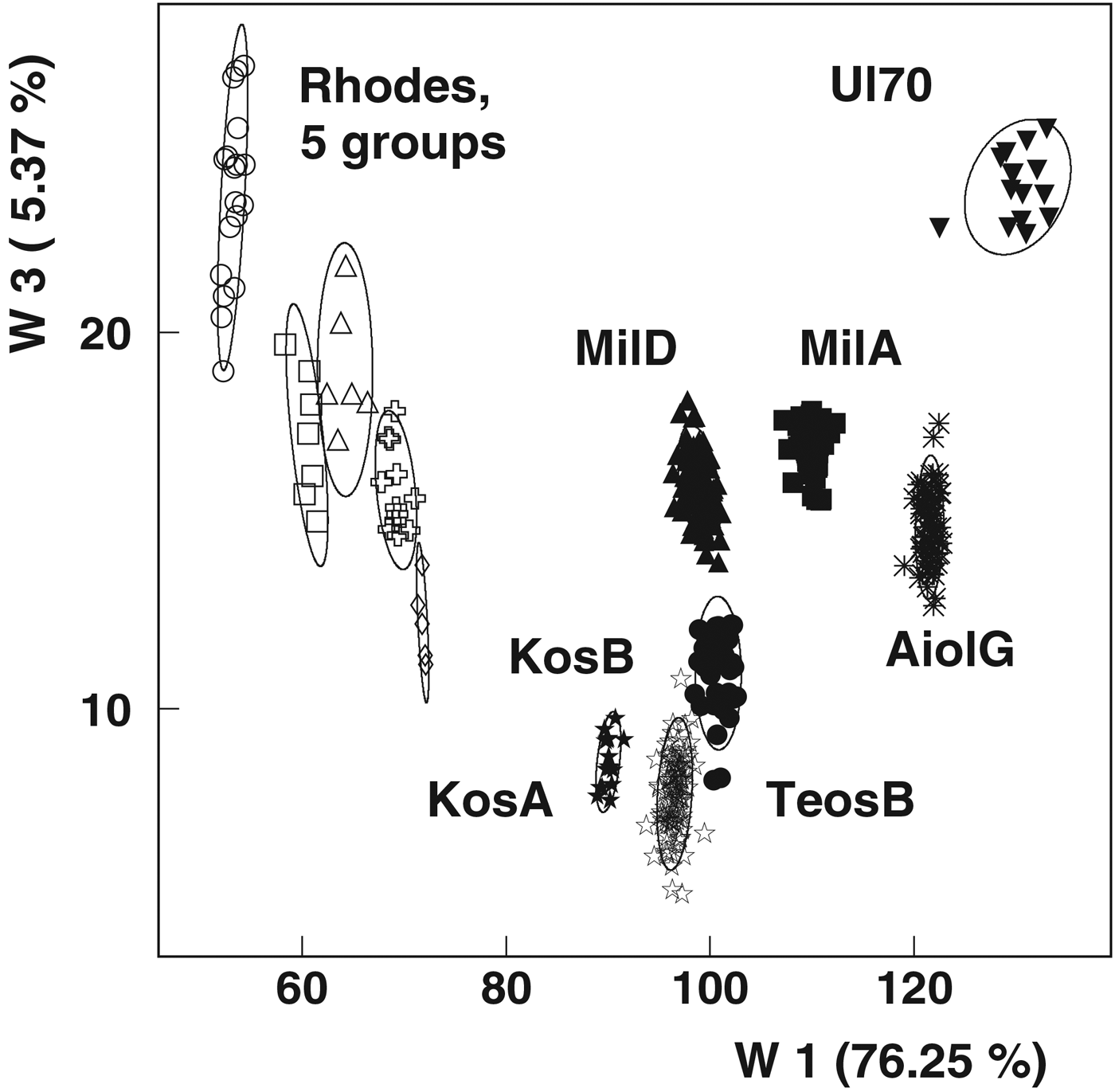
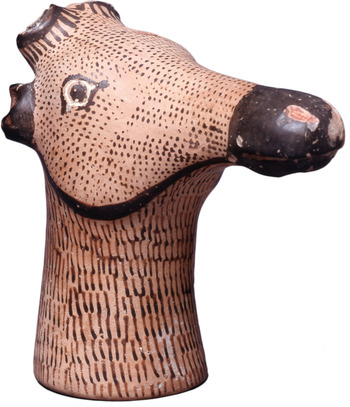
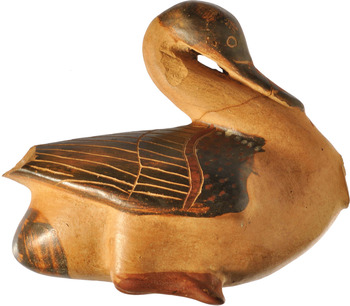
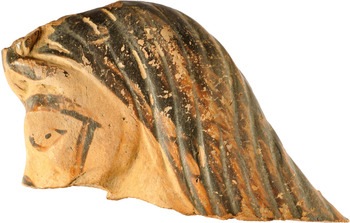
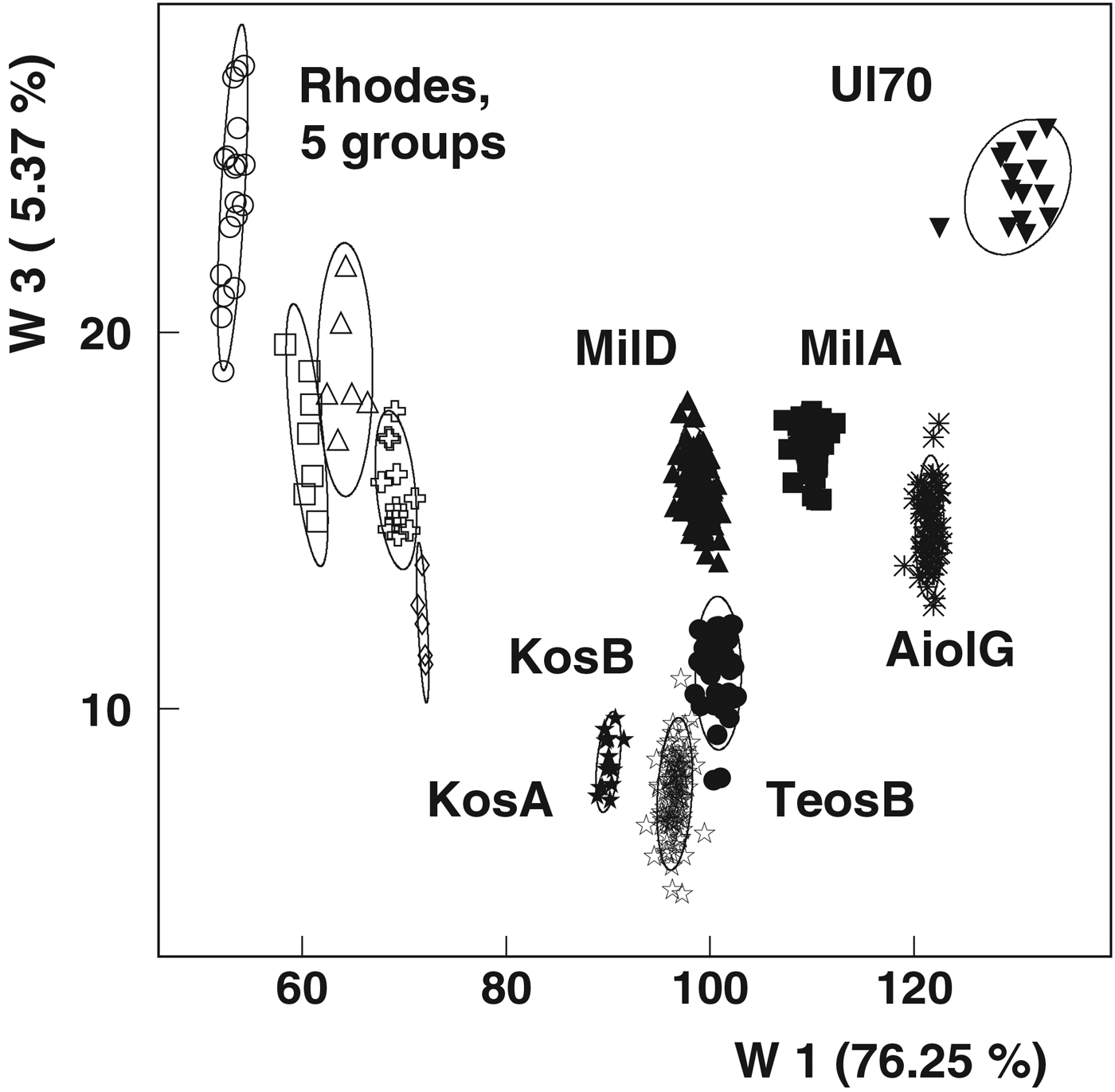
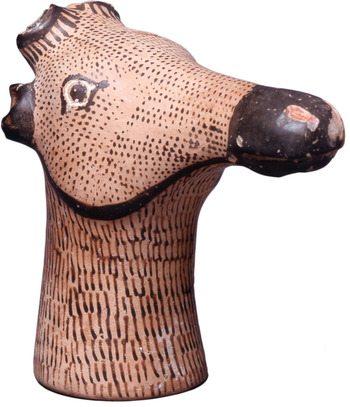
The other two plastic vases analysed by us, one in the shape of a duck (Nauk 108, Fig. 36, Higgins Reference Higgins1959, 35, no. 1662, pl. 24) and another in the shape of a horse's head (Nauk 110, Fig. 37, Higgins Reference Higgins1959, 25 no. 1638, pl. 16), both excavated at Naukratis, were found to form part of a known elemental pattern, Ul70. This as yet unlocated group is chemically different from all other groups but, judging from its other members, is likely to belong in the (South) Ionian region.Footnote 34 Fig. 38 shows the result of a discriminant analysis where group Ul70 is well separated from the Rhodian groups but also from the main groups known from Ionia. One of the pieces analysed by us, the duck flask (Fig. 36), had also been analysed by Richard Jones and formed a tight group, different from his Ionian B, with two other figured vases in the British Museum, the head of an antelope (Fig. 39) and a phallos vase (Fig. 40).Footnote 35 Visual examination of these pieces alongside those analysed by us shows that they all indeed share a macroscopically similar fabric, characterised by a very fine, hard, light-brown matrix with moderate amounts of mostly very small silver mica. It thus differs significantly from the fabric of the pomegranate vase and hedgehog aryballos, yet would not be out of place among the finer fabrics found in the Ionian region.
Plastic vase in shape of duck, first half 6th century bc, from Naukratis (sample Nauk 110, NAA group Ul70: unlocated). British Museum 1888,0601.659 (Terracotta 1662) (photograph © Trustees of the British Museum).
Plastic vase in the shape of a horse's head, first half 6th century bc, from Naukratis (sample Nauk 108, NAA group Ul70: unlocated). British Museum, 1888,0601.605 (Terracotta 1638) (photograph © Trustees of the British Museum).
Result of a discriminant analysis of 459 samples from the eastern Aegean, corrected for dilution with respect to the average grouping values and using all elements given in Table 3 except As, Ba, Br, and Na, assuming 12 clusters: MilA (formerly A): Kalabaktepe workshops, Miletos; MilD (formerly D): also Miletos; TeosB (formerly B): Teos, bird bowl workshops; AiolG (formerly G): workshops in Aiolis (cf. Mommsen and Kerschner Reference Mommsen and Kerschner2006); KosA and KosB (formerly RHc1): Kos; Ul70: unlocated pattern. Plotted are the discriminant functions W1 and W3, which cover 76.3% and 5.4% of the between-group variance. The ellipses drawn are the 2σ boundaries of the groups. Samples assigned to a Rhodian origin are shown as open symbols (exception TeosB) and form 5 groups (see Fig. 3). The different groups are well separated.
Plastic vase in the shape of an antelope's head, said to be from Italy, early 6th century bc, analysed by R. Jones. British Museum 1847,1127.10 (Terracotta1660) (photograph © Trustees of the British Museum).
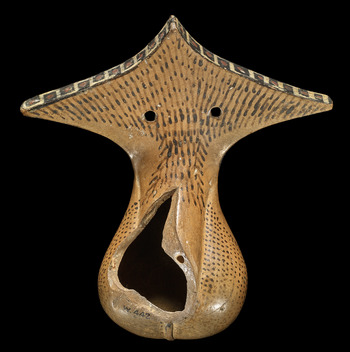
Plastic vase in the shape of male genitals, unknown provenance, first half 6th century bc, analysed by R. Jones. British Museum W.442 (Terracotta 1659) (photograph © Trustees of the British Museum).
THE POTTERY OF RHODES AND KOS: CONCLUDING THOUGHTS
The results from our series of analyses, set into the wider picture of past and present scholarship, help to clarify the picture of pottery production in the East Dorian region of the eighth–sixth century bc, but they also raise new questions and point the way for future research.
Solving a long-standing scholarly conundrum, the Euphorbos plate and two other ‘Wild Goat-style’ segment plates found at Kameiros, besides related finds from other sites, could be shown to belong to an elemental group (KosB) securely linked with the island of Kos, more specifically the region of Halasarna on the south coast of Kos. Based on this result, numerous ‘East Dorian’ plates found on Rhodes and across the Mediterranean world can now be shown to be Koan. The analyses also identified a Koan Late Geometric amphora that had been exported to Caria. The recognition of Kos as a leading producer and exporter of pottery in the Late Geometric and Archaic periods, and as the leading producer of pottery, notably plates, in the Archaic ‘East Dorian’ style in particular, provides a new basis for evaluating the role of Kos in the artistic landscapes of East Greece and its place in regional and international networks.
Regarding Rhodes, the picture that emerges from our new work is complex. In the Geometric period, four eighth-century bc vessels found at Kameiros fell into two different chemical groups. One, RhodA, is well attested also in Mycenaean pottery from Ialysos and can now be firmly linked with that region via a clay sample. The other, RhodF, is a new and as yet unlocated Rhodian group that also includes two Archaic segment plates; on archaeological grounds a link with Kameiros for this group might be considered. Among its members is a local Geometric imitation of a Cypriot shape, reflecting the close links Rhodes entertained with the Levantine world. Together with the work by other scholars, our results further confirm the healthy state of Rhodian painted pottery production in the later Geometric period as well as long-term continuity in the exploitation of local clay beds.
Changes come, however, in the course of the seventh century bc, a turning-point in the history of Rhodian pottery in many ways, including among other things an intensification of Phoenician links with, and presence in, Rhodes in the period 700 to 680 bc (Bourogiannis Reference Bourogiannis2013, 161–73). While the early years of the century still see ambitious figured painting in a Sub-Geometric / Early Orientalising style (cf. Villing and Bouquillon Reference Villing and Bouquillonin preparation), there is little of note being produced in the subsequent Wild Goat style. Local production now appears to be limited in quality and distribution, in part conservative and indebted to Sub-Geometric traditions, in part absorbing influences from different, mostly Greek, regions, yet seemingly without much ambition to compete with the best of the (now plentiful) imports from Ionia and Corinth or later Athens. The readiness to absorb and imitate is of course already visible in the Geometric period in the impact of Cypriot and Phoenician models; their influence continues into the Archaic period, as for example in the case of bird vases, probably based on Cypriot models.Footnote 36 From the seventh century bc, however, it is Corinthian and various East Greek styles that are imported in numbers and that provide inspiration for local workshops.
Observations of style and fabric have pinpointed a number of cases of imitations as well as more distinctive local traditions. Research by Archontidou (Reference Archontidou1977) confirmed an observation previously made by Blinkenberg (Reference Blinkenberg1931, esp. 292–9) on finds from Lindos by demonstrating the existence of Rhodian imitations of Corinthian alabastra and aryballoi among finds made at Monolithos near Siana in the south of the island. Examples are found from the late seventh – first half of the sixth century bc, in a Sub-Geometric (Sub-Protocorinthian) and Early Corinthian style but incorporating East Greek Orientalising elements, with some examples bearing the hallmark ‘Rhodian’ spiral or circle under the foot. Ring aryballoi, too, appear to have been made locally through the seventh and into the early sixth century bc, including, for example, early seventh-century bc specimens from Exochi and Vroulia (Coulié and Filimonos-Tsopotou Reference Coulié and Filimonos-Tsopotou2014, 167 no. 13:3) and early sixth-century bc examples from Monolithos (Archontidou Reference Archontidou1977). Archontidou (Reference Archontidou1977, 272–3, pl. 90) also attributed several Melian-style plates to a local workshop. Besides such imitations there is a tradition of more distinctively local, though usually not very elaborate, products. They include skyphoi with rows of birds, geometric and floral motifs and (especially) hatched triangles from sites such as Vroulia (e.g. Kinch Reference Kinch1914, 162–8, pls 23:4, 32:bb1–2, 36:35, 39) and Monolithos (Archontidou Reference Archontidou1977, 274–5, pl. 93) and a variety of cups with everted rim that are local versions of ‘Ionian cups’ (e.g. Kinch Reference Kinch1914, 142–4, pls 27:2–3; 32:f1, f3). As noted earlier, some examples were confirmed as Rhodian in the analyses by Dupont and Jones. From the seventh through the fifth century bc and beyond, local workshops moreover are likely to have produced a range of glazed, semi-glazed or banded wares, including olpai, oinochoai, stamnoi, lekythoi and other shapes (e.g. Filimonos-Tsopotou and Marketou Reference Filimonos-Tsopotou and Marketou2014, 70; Kinch Reference Kinch1914, pl. 26:1, 5, 14, 16; Blinkenberg Reference Blinkenberg1931, pl. 52), some of them bearing the characteristic underfoot spiral (e.g. Kinch Reference Kinch1914, 167–8, pls 26.15 and 44:32:1) as well as, possibly, vessels in a grey ware, such as the small ribbed aryballoi found at various sites (Archontidou Reference Archontidou1983, 27; 1977, 277–8).
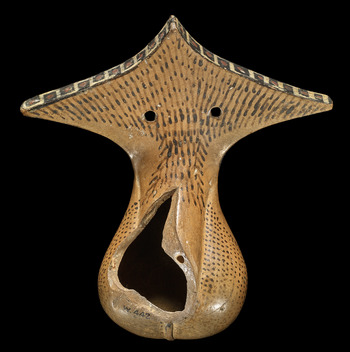
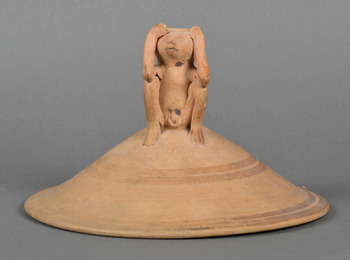
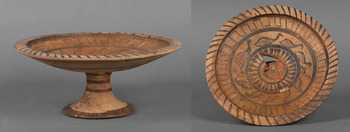
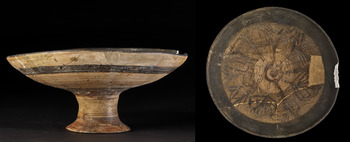
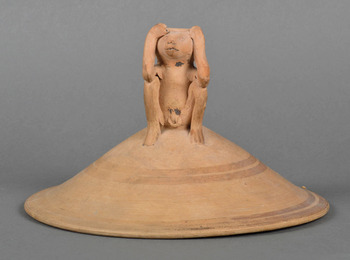
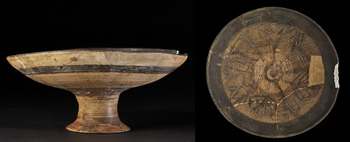
A number of additional insights now come from archaeometry. For the latter part of the seventh and the early sixth century bc our own work confirms a local, albeit somewhat free and careless, production of East Dorian plates featuring representations of animals such as hares or birds (NAA group RhodF). Analyses by Bouquillon and Coulié suggest that at the same time also simply decorated stemmed plates of Ionian inspiration were produced (Coulié Reference Coulié2015, 1332–5; Coulié Reference Coulié2014, 181 no. 49). Based on observations of high levels of magnesium they have also identified as local a peculiar lid topped by a monkey dated to around the mid-seventh century bc,Footnote 37 a close cousin of a piece from Kameiros in the British Museum (1864,1007.7, Fig. 41), as well as two distinctive types of perfume bottle regularly encountered in Archaic Rhodian tombs and sanctuaries: burnished bottles with a bent neckFootnote 38 and the peculiar, sometimes very large faience-glazed pointed alabastra with geometric decoration (illustrated here by an example from Kameiros, British Museum 1865,1214.50, Fig. 42).Footnote 39 The new results encourage us to consider Rhodian manufacture also for a number of other ceramic products with simple, non-figured decoration, notably plates and other shapes that are clearly neither Ionian nor Koan in fabric or style, yet display certain similarities to vessels now determined as Rhodian. Candidates for such attribution include small flat plates with bands and rows of dots,Footnote 40 stemmed plates with linear ornaments and ‘windswept’ birds (Fig. 43),Footnote 41 and also an unusual plate with floral decoration (British Museum 1909,0409.1, Fig. 44). The latter is reminiscent of the lotus-flower and -bud ‘wheels’ found on Vroulian cups (Jacopi Reference Jacopi1929, 28–9 fig. 11) but may also derive some of its inspiration from North Ionian stemmed plates imported to Rhodes (e.g. Kinch Reference Kinch1914, pls 5:1, 6:1; Walter-Karydi Reference Walter-Karydi1973, pl. 122:991; for a South Ionian example, see Schlotzhauer Reference Schlotzhauer, Cobet, Graeve, Niemeier and Zimmermann2007, 271 fig.1); the exuberant style of the Rhodian example is close in spirit to the Egyptian faience bowls that are the motif's early ancestors.Footnote 42
Lid with knob in the shape of a monkey, mid-7th century bc, from Kameiros. British Museum 1864,1007.7 (photograph © Trustees of the British Museum).
Faience-glazed large pointed aryballos with geometric decoration, late 7th – early 6th century bc, from Kameiros. British Museum 1865,1214.50 (photograph © Trustees of the British Museum).

Stemmed plate, linear ornaments and birds, first half 6th century bc, from Kameiros. British Museum 1864,1007.131 (photograph © Trustees of the British Museum).
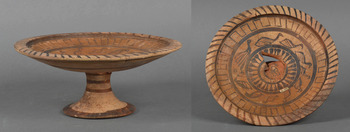
Stemmed plate, floral decoration, first half 6th century bc, from Rhodes. British Museum 1909,0409.1 (photograph © Trustees of the British Museum).
A remarkable development occurs around or perhaps shortly before 600 bc, when we witness the appearance of high-quality and distinctive forms of ‘Vroulian’ style and black-figure pottery. Even if we are not yet able to assign the NAA patterns we have observed in them to Rhodes with absolute certainty, both their chemical and stylistic characteristics suggest a Rhodian origin. They include cups and other shapes in the Vroulian style (NAA group X066r) as well as related situlae, stamnoi and other shapes with similar banded or floral decoration and sometimes black-figured narrative scenes (NAA group TD and chemical loners displaying Rhodian characteristics).
For later periods, two shapes in particular stand out among local products: epinetra deriving from Attic models, and stamnoid pyxides with vertical handles, presumably originally modelled on Corinthian shapes. Both were popular as grave gifts related to the female sphere and were produced from the late sixth / early fifth century bc through the Classical period, in some instances sharing the same characteristically eclectic and in part archaising style (Heinrich Reference Heinrich2006, 145–59). Long recognised as likely local products, chemical analyses of a typical Classical stamnoid pyxis in the Louvre, decorated with birds, now confirms their Rhodian provenance (Coulié Reference Coulié2015, 1338 n. 70).
What more can our analyses tell us about the pottery workshops of Rhodes? The different chemical groups in Rhodian Geometric and Archaic wares, representing a range of shapes and styles of decoration, mirror the diversity that has been previously noted for Mycenaean pottery from Ialysos (groups RhodA, RhodB, and X066r: Marketou et al. Reference Marketou, Karantzali, Mommsen, Zacharias, Kilikoglou and Schwedt2006). In principle they could reflect different fabric recipes and/or clay beds used by workshops in a single place, or they might be indicative of workshops in different places. Both Rhodes and Kos are large islands with different geological zones, and regional patterns with a range of local workshops are likely. Only one pattern so far can be confidently linked with a particular region of production: RhodA, which includes a clay sample from the area of Rhodes town and a find from a Mycenaean kiln at Ialysos, and which attests the long-term exploitation of clay beds in the territory of ancient Ialysos. For other patterns any speculation about regions of origin – such as a possible link of RhodF with Kameiros – has to await confirmation from future archaeological and archaeometric work, which should allow us to grasp the landscape of the island's craft production and patterns distribution more securely. Besides pottery, the new analyses confirm the existence of a long coroplastic tradition on the island that has also been noted by earlier scholars. One Early Classical terracotta protome shares an elemental composition with Mycenaean and Geometric vessels linked to the region of Ialysos (NAA group RhodA); another was found to be related to Geometric and Archaic pottery found at Kameiros and Siana (NAA group RhodF).
Perhaps one of the most surprising overall results is that from the latter part of the seventh through the sixth century bc the island of Rhodes – large, wealthy and internationally important – was not also more of a leading centre of painted pottery production; this is all the more surprising given its not insignificant output of (seemingly regionally diversified) painted wares in the eighth century bc and earlier periods. In contrast to the preceding periods, in Archaic times the islanders’ demand for high-quality painted pottery appears to have been fulfilled primarily by imported wares from the leading centres of the Aegean world; supply would have been facilitated by Rhodes’ position at the centre of extensive Mediterranean trade networks. Rhodian potters instead seem to have focused on different, especially plainer, wares such as local versions of Ionian drinking cups, plates and dishes partly inspired by the output of leading East Dorian (Kos) and Ionian (Miletos, Teos) centres. The production of small perfume flasks on Rhodes, perhaps linked to a local perfume industry and seemingly centred on Ialysos, had a long tradition (Bourogiannis Reference Bourogiannis2014b) and included the famous ‘spaghetti’ jars, the plain bottles with bent neck and the faience-glazed pointed aryballoi mentioned earlier. By the sixth century bc, the focus may, however, have been on faience (and later glass) vessels rather than pottery, if indeed it is true that Rhodes was home to major faience workshops; although no workshops have as yet been excavated, Rhodian production of ‘Greek-style’ faience perfume vessels, many of which have been found on the island, seems likely (Triantafyllidis Reference Triantafyllidis2014). Among potters, special effort appears to have been reserved for the production of the massive pithoi with geometric decoration (Simantoni-Bournia Reference Simantoni-Bournia2004, 49–62), which required considerable technical expertise and must have been high-value vessels, and for a few specific lines of fineware that served particular demands either at home (e.g. pyxides) or in the context of the island's international networks: vessels such as situlae, many probably specially commissioned for use in Egypt (Weber Reference Weber2012, 275–81) or high-quality thin-walled drinking cups known as Vroulian cups, which resemble metalware and which gained a place among the high-status drinking wares circulating in East Greek maritime trade networks (Coulié and Villing Reference Coulié and Villing2014, 116–17; Kourou Reference Kourou2014, 83–8). The quality of potting and painting of some of these local wares indicates access to a considerable degree of artistic ability and technical skill, even if the workshops’ output, as well as impact, remained limited.
In the present state of knowledge, then, the production of fine painted pottery on Rhodes, after the early seventh century bc, remained restricted in range and quality, overshadowed by a wide variety and large number of imports, including painted plates from Kos. Did local elites prefer, and could they afford, (prestigious) imports and expensive metalware, and was this a reason for local craftsmen to concentrate less on perfecting local painted pottery, and more on other lines of work? In order to confidently answer such questions, further archaeological and archaeometric work is necessary to advance our understanding of East Dorian craft production and its role in networks of exchange, and to elucidate the social and economic dynamics that lie behind the phenomena visible in the material culture record.
ACKNOWLEDGEMENTS
We are grateful to the staff of the research reactors of the GKSS in Geesthacht and of the Reactor Institute Delft, Delft University of Technology, for their technical support irradiating the NAA samples; to Michela Spataro and Richard Jones for helpful discussion and for contributing the results of their work to the present article; to Anne Coulié and Anne Bouquillon for discussing and sharing data from their recent analyses; to Udo Schlotzhauer for information on a stamped amphora handle and for permission to mention it here; to Alan Johnston, Ross Thomas, Alexander Herda, Matteo D'Acunto, Michael Kerschner, Penelope Mountjoy, Maria Effinger, Noémi Müller and Nick Salmon for help and fruitful discussion; to Alan Johnston for assessment of the stamped amphora handles included in our analyses, as part of his ongoing work on the catalogue of stamped amphorae in the British Museum; to Giorgos Bourigiannis for translating the abstract; to Kate Morton for creating the maps in Fig. 1; to the Director and staff of the British School at Athens for access to Rhodian material in the School's sherd collection and for permission to include it in this article; to Marianne Bergeron, Helen Hovey, Alice Howard, Peter Stewart and Paul Roberts for information and photographs for objects in the Ashmolean Museum in Oxford; to Stine Schierup for information on objects in the National Museum in Copenhagen; to the two anonymous referees for their helpful comments and suggestions; and to the editor and copy-editor for their help and careful work.
APPENDIX 1: ANALYSIS OF A GROUP OF SHERDS FROM KAMEIROS AND LINDOS (1978)
Richard Jones
The decorated sherds of mainly Mycenaean to Geometric date from Kameiros (Fig. A1:1) and Lindos (Fig. A1:2), which are described below, were analysed chemically by optical emission spectroscopy (OES) following procedures described by the writer.Footnote 43 In the summary presentation of their compositions (here Table A1:1) the writer found that all but two of the compositions are recognisably Rhodian, having high Mg, Fe, very high Cr and Ni and low Al contents.Footnote 44 The two that stand apart are not from the same source; Kameiros 1 (Fig. A1:1a ) shows reasonable resemblance with, but is less calcareous than, a fourth-century bc amphora-type fabric reference group for Corinth.Footnote 45 Lindos 4 (Fig. A1:2c ), on the other hand, has a lower Mg and higher Al content but in other respects has an uninformative composition.
Sherds from Kameiros, British School at Athens sherd collection: (a) C1–78, small closed vessel, Corinthian?; (b) C2–78, closed vessel, Mycenaean?; (c) C3–78, closed vessel, Late Geometric (c.720–690 bc), influenced by the Rhodian Spaghetti style; (d) C4–78, closed vessel, Mycenaean; (e) C5–78 closed vessel, Mycenaean?; (f) C6–78, closed vessel, Late/Sub-Geometric (reproduced with the permission of the British School at Athens).
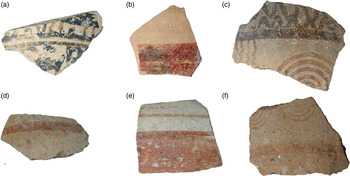
Sherds from Lindos, British School at Athens sherd collection: (a) C1–78, closed vessel, Geometric; (b) C2–78 and C3–78, two joining sherds (body and rim) of bowl, Late Helladic IIIA2–B?; (c) C4–78 skyphos or carinated cup, Geometric–Archaic; (d) C5–78, large open vessel (krater?), Protogeometric–Geometric; (e) C6–78, cup, Protogeometric–Geometric; (f) C7–78, cup, Late Helladic IIIA2–B or Protogeometric (reproduced with the permission of the British School at Athens).
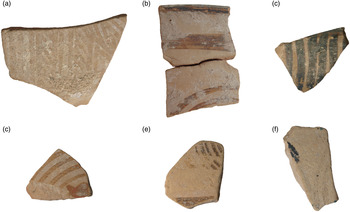
The compositions of sherds from Kameiros and Lindos and a modern pot from Archangelos, expressed as % element (Al, Ca, Fe, Mg, Na and Ti) and ppm element (Cr, Mn and Ni).
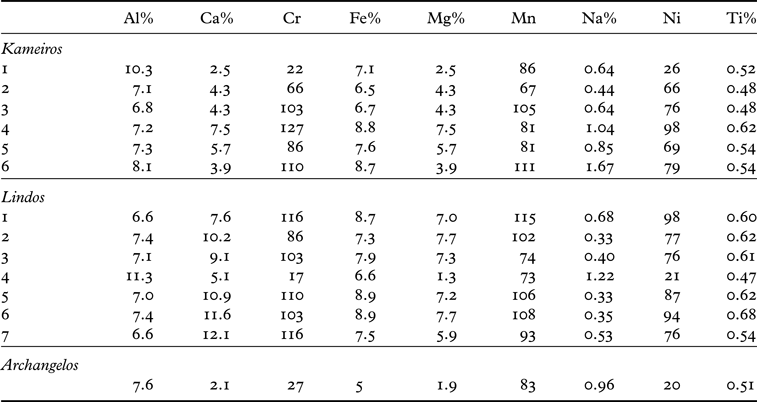
Further inspection of the data indicates that the Kameiros group, leaving aside Kameiros 1, displays some variability, especially in Cr; this observation potentially accords with the likely coexistence of two types, RhodA and RhodF, identified in the NAA compositions of decorated pottery found at Kameiros (see above, especially Tables 1 and 3). Direct comparison between the OES and NAA data sets is of limited value, but it is nevertheless noted that, whereas OES determinations of one of the main discriminatory elements, Cr, have consistently overestimated this element by comparison with the corresponding NAA determination,Footnote 46 the Cr contents at Kameiros and Lindos are significantly lower than in the main NAA Rhodes group, RhodA, as well as in the smaller ones, RhodB and RhodF. The same remarks apply equally to the Ni determinations.
The only remaining comment to make is the apparent contrast between the range of ‘typical’ Rhodian compositions consistently encountered in ancient pottery from different parts of the island and that of a single example of pottery from the modern potting village of Archangelos and its environs (Table A1:1).Footnote 47 The latter has low Ca, Mg, Cr and Ni contents. Bearing in mind one of the interesting features of the practices of at least some of the potters working during the last century at ArchangelosFootnote 48 – they used no less than five clays from the nearby hills and fields to create their mix – the writer explained the chemical discrepancy in terms of the removal of calcite and serpentiniferous inclusions at the clays’ levigation stage. However, this would now seem contradicted by observations made by Spataro (Appendix 2) on a stamped amphora handle where high levels of Mg, but to some extent also Cr, can be largely integral to Rhodian clays and would thus merit further investigation with petrographic analysis.
List of analysed objects, British School at Athens sherd collection (Box V 44)Footnote 49
Kameiros
-
1. C1–78. Curved shoulder fragment of small closed vessel with painted black decoration, fine yellow clay, hard fired, no mica visible. Archaic Corinthian? W.4.3 cm, L.2.8 cm, Th. 0.4 cm; marked ‘Kameiros 1’. Fig. A1:1a .
-
2. C2–78. Body fragment (from lower body?) of closed vessel, beige-orange clay with some small lime and black inclusion and some very small mica (gold?) (fabric similar to C4–78 and C5–78). Mycenaean? W.3 cm, L.3 cm, Th. 0.4 cm; marked in pencil ‘2’. Fig. A1:1b .
-
3. C3–78. Curved shoulder fragment of closed vessel, coarse brown-grey clay with some large lime, grey and brown inclusions and small silver (?) mica (fabric similar to C6–78 but more micaceous). Brown-reddish paint, zone of horizontal wavy lines above (or below?) zone with multiple concentric circles divided by sets of vertical wavy lines. Late/Sub-Geometric (Rhodian ‘spaghetti group’).Footnote 50 W.3.5 cm, L.3.2 cm, Th. 0.3 cm; marked ‘Kameiros 5’ and in pencil ‘3’. Fig. A1:1c .
-
4. C4–78. Shoulder or lower body fragment of closed vessel (fabric similar to C2–78 and C5–78). Smoothed surface, red horizontal line. Mycenaean? W.4 cm, L.2 cm, Th. 0.4 cm; marked in pencil ‘4’. Fig. A1:1d .
-
5. C5–78. Lower (?) body fragment of closed vessel (fabric similar to C2–78 and C4–78). Light-coloured wash, red paint: broad horizontal zone and two thin horizontal lines. Mycenaean? W.3.7 cm, L.3.1 cm, Th. 0.45 cm; marked in pencil ‘5’. Fig. A1:1e .
-
6. C6–78. Lower (?) body fragment of closed vessel, coarse brown-orange clay with lime and other inclusions, some small mica (fabric similar to C3–78 but less micaceous). Broad horizontal band, two small sets of concentric circles. Middle–Late Geometric. W.4.3 cm, L.3.4 cm, Th. 0.5–0.6 cm; marked ‘Kameiros 3’. Fig. A1:1f .
Lindos
-
1. C1–78. Body fragment of closed vessel, fine light-brown clay with few voids and some very small silver mica. Brown painted decoration, triangles with hatching on horizontal ground line, inside unglazed. Geometric. W.5.3 cm, L.4 cm, Th. 0.7 cm. Fig. A1:2a .
-
2. –3. C2–78 and C3–78. Two joining sherds (body and rim) of bowl, fine slightly porous light-brown clay, some very small silver mica. Painted black-brown decoration: outside, horizontal bands on rim and below rim, large concentric circles below; inside, horizontal band on rim, reserved zone, below which glazed. Late Helladic IIIA2–B? W.2.9 cm, L.2.2 cm, Th. 0.4–0.5 cm (body), W.3.1 cm, L.2.3 cm, rim diam. c.19 cm, Th. 0.5 cm (rim). Fig. A1:2b .
-
4. C4–78. Body sherd of skyphos or carinated cup, horizontal black line on carination and vertical black strokes below, black-glazed inside; fine, dense and hard light-brown clay, no mica visible. Outside, black-brown horizontal line on carination, below which group of vertical strokes; inside black-glazed. Geometric–Archaic. W.3 cm, L.2.6 cm, Th. 0.3–0.4 cm. Fig. A1:2c .
-
5. C5–78. Body fragment of large open vessel (krater?), fine beige-brown clay with some very small mica (fabric as C2–78 and C3–78). Brown-red paint, concentric circles with sail pattern at centre, inside unglazed. Geometric. W.2.5 cm, L.1.9 cm, Th. 0.6–0.8 cm. Fig. A1:2d .
-
6. C6–78. Body fragment of cup, curved profile, beige, fairly soft clay, no mica visible. Red-brown paint, outside, horizontal line above which multiple concentric circles (pendant semicircles?); inside glazed. Protogeometric–Geometric. W.2.3 cm, L.2.9 cm, Th. 0.5 cm. Fig. A1:2e .
-
7. C7–78. Body fragment of cup, fairly straight wall, beige, fairly soft clay with some lime inclusions and little very small mica. Late Helladic IIIA2–B or Protogeometric? W.2.1 cm, L.3.4 cm, Th. 0.4–0.6 cm. Fig. A1:2f .
APPENDIX 2: ANALYSIS OF A RHODIAN AMPHORA
Michela Spataro
A polished thin section of a Hellenistic Rhodian amphora handle (sample 7449–13 [ = NAA sample Nauk 107, Fig. 15 above]) was analysed by petrographic polarised light microscopy and scanning electron microscopy with energy-dispersive X-ray spectroscopy (SEM-EDX).
The thin-section analysis by polarised microscopy revealed a red, very fine, slightly calcareous clay (confirmed by EDX [CaO 6.4%; see table below]), with fine and well-sorted quartz (15%; typical size 0.02 × 0.02 mm), very fine and occasional muscovite, occasional feldspar, pyroxene (1%), some iron oxides, serpentine scattered throughout the fabric (>3%; it is present in variable sizes between 0.01 and 0.4 mm) (Fig. A2:1a – b ). It is likely that these were all naturally present in the clay.
Rhodian amphora sample 7449–13 (British Museum 1955,0920.6 [NAA sample Nauk 107]): (a) optical microscope image (taken at ×8); (b) microphotograph showing some fine quartz and serpentine fragments (red, in the centre), cross polarised light (photographs M. Spataro © Trustees of the British Museum).
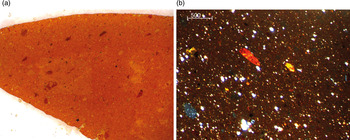
The SEM images (Fig. A2:2a – b ) show initial stages of vitrification of the clay, suggesting a firing temperature of 800–850 °C (e.g. see Tite and Maniatis Reference Tite and Maniatis1975a and Reference Tite and Maniatisb). SEM-EDX analysis (Table A2:1; see Spataro Reference Spataro2011 for details of the method) shows high magnesia content (>8%), a feature of Rhodian clay noted also in analyses by other scholars such as Jones and Dupont and more recently Bouquillon, as discussed above. The abundance of magnesia in the fabric is due not only to the scattered and recurrent serpentine (clearly visible in Fig A2:2b), but also to the clay itself, confirmed by high magnification analyses of the fired clay (between ×1.0k [c.0.124 × 0.091 mm] and ×2.0k [c.0.062 × 0.045 mm]). In addition to magnesia, serpentine fragments contain high levels of chromium oxide (Cr2O3, up to 27%), which NAA also revealed to be relatively abundant. Nickel oxide at trace levels was found to be associated with the serpentine fragments. Fine scattered chromium-magnesium-iron-rich mineral inclusions (20–40 µm; some measuring over 40% Cr2O3) were also detected elsewhere in the matrix by SEM-EDX.
SEM backscattered electron images of Rhodian amphora sample 7449–13 (British Museum 1955,0920.6 [NAA sample Nauk 107]): (a) at ×2.0 K showing initial vitrification between clay particles; (b) at ×55 showing a fine matrix and some scattered serpentine fragments (coarser inclusions) with chromium-rich phases (brighter areas in the coarse fragment) (photographs M. Spataro © Trustees of the British Museum).
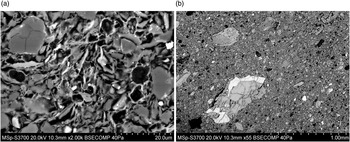
SEM-EDX compositional results: mean of four bulk analyses and standard deviation (s.d.) on sample 7449.13 (at ×100 each = c.1.5 × 2.0 mm). Results are reported as normalised % oxides. The SEM-EDX detection limits for different oxides are variable but are typically 0.1–0.2%.