


Nearly every legislative body funds both particularistic and collective goods programs. Collective goods are essential for promoting the general welfare, and particularistic goods are essential for reelection (Mayhew 1974). How do legislators respond to these competing objectives? One view is that spending on collective and particularistic goods is a monotonic function of legislators' valuations for each type of spending. When legislators value collective programs more, spending on collective programs should increase; and when legislators value particularistic programs more, spending on particularistic goods should increase. This monotonic view has been used to explain how particularistic and collective spending choices in the U.S. states reflect public opinion and interest group pressures (Jacoby and Schneider 2001). It has also been used to explain how partisan cleavages resulted in the development, growth, and crises of the welfare state across advanced industrial democracies (Huber and Stephens 2001).
In addition, the monotonic view of collective versus particularistic spending has motivated a host of legislative reforms over the years. Reformers typically believe that by increasing or decreasing legislators' incentives or opportunities to engage in one type of spending or the other, predictable policy outcomes will follow. Yet reforms often do not work as expected. Why, for example, despite reforms in such areas as civil service requirements, direct election of senators, the rise and fall of the line-item veto, campaign finance restrictions, and term limits for committee chairs, has the U.S. Congress produced particularistic or “pork barrel” projects at about the same rate over time?1
Mayhew's (1991) list of landmark postwar enactments contains numerous examples that support this argument. For instance, during the Truman Administration, the 80th Congress passed the Marshall Plan (arguably collective interest) while at the same time passing the Hope-Aiken Agricultural Act, which provided for massive crop subsidies. Under Johnson, the 88th Congress passed the Food Stamp Act of 1964, making the food stamp program permanent, while at the same time passing the Appalachian Regional Development Act of 1965, which provided $1 billion for a 12-state region. And during the Reagan Administration, the 98th Congress passed an anti-narcotics measure that provided $1.7 billion for general enforcement, education, and treatment purposes, while at the same time passing the Food Security Act of 1986 with $52 billion in commodity subsidies.
Unfortunately, the dominant theoretical approaches to studying legislative policymaking cannot answer these questions. Most existing approaches focus on either particularistic spending or collective spending decisions, but not on both.2
Focusing on only one type of policymaking seems particularly curious in light of the large and growing body of empirical scholarship (e.g., Arnold 1990; Evans 1994, 2004; Lee 2000) that considers how coalition leaders use particularistic policies as currency, with which to persuade members to vote for collective-welfare legislation.
Substantial literatures have developed around each of these approaches, but because they focus on only collective or particularistic policymaking, they do not offer predictions about how legislatures allocate resources between public and private goods.3
Variations in the amount of particularistic spending can be examined by simultaneously modeling both pork-barrel programs and taxation (Baron 1991); but such approaches cannot capture relative spending across both private and public goods.
MODELS OF PARTICULARISTIC AND COLLECTIVE GOODS
As noted earlier, the dominant theoretical approaches have focused on either particularistic or collective spending choices in isolation. Nevertheless, a small body of scholarship has begun to combine some aspects of particularistic and collective spending models. One such approach is developed by Banks and Duggan (2000, 2005) who provide a flexible framework encompassing a broad array of legislative policymaking models, including simultaneous spending choices across different types of goods. They establish the generic existence of equilibria in such settings. Beyond existence results, the most common technique used to incorporate private and public goods into a single model is the hybrid approach of adding a distributive (or side payment) component to spatial voting models (e.g., Austen-Smith and Banks 1988, Baron and Diermeier 2001, Crombez 1996, Jackson and Moselle 2002). Such works identify how legislators offer packages of particularistic goods that correspond to spatial policy positions, yet they do not consider the provision of different types of policies coming from the same finite resource pool. Hence, they do not capture the explicit tradeoff that more collective spending leaves fewer available revenues for particularistic goods.
Recent scholarship has begun to address this tradeoff between collective and particularistic spending. LeBlanc, Snyder, and Tripathi (2000), for example, analyze bargaining wherein legislators decide how much to consume in particularistic goods and how much to devote to public investment, which influences the budget available for possible future consumption. Lizzeri and Persico (2001) model an election in which candidates commit ex ante to the production of a public good or to a menu of particularistic transfers among voters. Battaglini and Coate (2005) develop a model of legislative bargaining in which a legislature allocates resources between collective and particularistic goods and chooses an endogenous tax rate that determines the available budget in future periods. These works are valuable in establishing how majoritarian bargaining can limit public investment (LeBlanc, Snyder, and Tripathi), how coalition building through transfers may be more politically expedient than public good provision (Lizzeri and Persico), and how tax rates vary from the social optimum given incentives to provide particularistic goods (Battaglini and Coate).
Our model differs from these works in a number of ways. First, unlike LeBlanc, Snyder, and Tripathi (2000), we treat collective spending as beneficial in its own right, rather than as a means to future particularistic benefits. Second, unlike Lizzeri and Persico (2001), we explore legislative bargaining in the absence of ex ante spending commitments. Third, we model legislative decision-making under closed amendment rules in a simpler manner than in these other works, which yields more transparent findings regarding how modeling assumptions map into predictions. Fourth, we move beyond the baseline models considered in these works to address various extensions such as legislative bargaining under an open rule and among legislators with diverse preferences. Such extensions allow us to identify several useful findings, such as conditions under which legislatures will ex ante prefer open, rather than closed, amendment procedures. Fifth and most fundamentally, our model characterizes not only the stark distinction between when only public or private goods are provided, but also what combination of public and private goods is produced through legislative bargaining. In so doing, we uncover a nonmonotonic relationship between preferences and policy outcomes, which helps us to better understand limitations of the representative nature of legislative politics.
THE BASELINE MODEL
We present a model in which a legislator builds a coalition around a fixed budget comprised of collective and particularistic spending. An attractive policy proposal will receive broad support. An unattractive proposal will be voted down, allowing another member of the legislature an opportunity to make a proposal. Proposals are more or less attractive depending on members' relative valuations of collective and particularistic spending. If legislators place little value on particularistic goods, the proposer spends only on collective goods, making all legislators happy. Alternatively, if legislators place enormous value on particularistic goods, the proposer builds a minimum winning coalition by distributing particularistic benefits, with an especially large share kept for herself.
Most interestingly, when both particularistic and collective goods are valued moderately, the proposer can offer a level of collective spending sufficient to receive broad legislative support, while securing particularistic goods for herself from the remaining budget. What is most curious about this result is the amount of collective spending needed to gain majority support. The proposer must offer a sufficient level of collective goods to make legislators prefer her proposal over the chance that they will be the next proposer, following the rejection of the current proposal and a delay. The less legislators value collective goods, and the more they value the particularistic benefits from being the proposer, the more likely they are to vote down the current proposal. To prevent this, the proposer must offer greater spending on collective goods when collective goods are valued less or particularistic goods are valued more. This surprising result sheds light on why reform proposals altering the incentives of legislators may actually yield perverse effects.
In this section we formalize the model and fully characterize its equilibrium. We then extend the model to analyze how different voting rules and divergent preferences among legislators affect the equilibrium. We begin by assuming that a legislature consists of n members from different legislative districts who are deciding how to divide a resource among them. Without loss of generality, we assume that the resource considered for division is equal to one dollar, and that legislators' preferences are defined over how much of the dollar they receive in particularistic goods and how much of the dollar goes to a collective good. Particularistic goods only benefit those specific legislators who receive the goods, and might be interpreted as district-specific projects. In contrast, collective goods are enjoyed by the entire legislature. Hence, we are considering a world in which a dollar is allocated between purely private and purely public goods.
Formally, we assume that legislator i's utility can be represented as Ui=αxi+q y, where xi≥0 is the amount of particularistic good that legislator i receives, y≥ 0 is the amount spent on the collective good, α is the value that legislators place on particularistic goods relative to collective goods, and q is the realized return on collective good investments.4
The q term might be interpreted as a reduced-form representation of a constant stream of (discounted) future payoffs from investing a portion of the dollar in a collective good that continues to exist in future sessions (e.g., social security programs), rather than a particularistic policy that is consumed at the conclusion of the session (e.g., a crop subsidy).
.
We assume that the legislature is governed by a neutral recognition rule. In other words, each member has an equal chance of being recognized to offer a legislative proposal, where legislator i's proposal consists of an offer for dividing the dollar between bundles of particularistic and collective goods,
. The status quo policy corresponds to none of the dollar going to either particularistic or collective goods.5
Because the equilibrium derived below is based on generating indifference between the current proposal and the prospects of a future proposal, this status quo assumption is not particularly strong and is not a binding constraint in the construction of the equilibrium. A broad array of fairly unattractive status quo policies yields identical equilibria.
In the baseline model, the legislature operates under a closed rule, where the proposer's motion is compared against the status quo and voted up or down without amendment. If the motion receives the support of at least a majority of members, the dollar is divided as prescribed by the proposal; if the motion fails, the game begins again, with each member having an equal probability of recognition to offer a new motion for division of the dollar. The legislative process thus mimics that of Baron and Ferejohn (1989).
Legislators have a common discount factor on payoffs, 0≤δ≤1, which is realized each time the legislature goes to a new round of bargaining without having divided the dollar. Specifically, the dollar's value is discounted to δ times its previous value if a proposal fails and a new proposal is made. Low values of δ may therefore be interpreted as legislators being impatient, legislators placing a low value on the future, or coalition formation being difficult.6
Discounting in this fashion is equivalent to assuming that, with a certain probability, legislators lack the time or resources necessary to reach an agreement, and thus maintain the status quo.
We characterize the stationary equilibrium to this game. Stationarity is defined by identical continuation values for each structurally equivalent subgame. Under stationarity, the equilibrium strategy of the initial proposer is the same as that of future proposers facing the same game structure. Without this stationarity assumption, an infinite number of strategies could be sustained in equilibrium under various punishment strategies, whereas employing this assumption makes it fairly straightforward to characterize the unique subgame perfect equilibrium.
Closed Rule Equilibrium: For all δ∈ [0, 1] a configuration of pure strategies is a stationary subgame-perfect equilibrium in an infinite round, majority rule, n-member (n odd) legislature governed by closed rule if and only if it has the following form of collective, mixed, and particularistic divisions of the dollar:
- If α∈[0, αCM), a member recognized offers to contribute the entire dollar toward the collective good, y=1. Each member votes for any proposal in which he receives utility at least equal to δq, and the first proposal receives unanimous support;
- If α∈[αCM, αMP), a member recognized offers to keep for herself, place in the collective good, and give no other portion of the dollar in particularistic goods to other members of the legislature. Each member votes for any proposal in which he receives utility at least equal to , and the first proposal receives unanimous support;
- If α≥αMP, a member recognized offers to members of the legislature selected at random, and proposes to keep for herself. Each member votes for any proposal in which he realizes utility at least equal to , and the first proposal receives majority support;
where αCM=q,
.
Derivations for all equilibria are given in the Appendix.
Hence, in equilibrium, one of three different scenarios may occur, as illustrated in Figure 1. First, where legislators highly value collective goods relative to particularistic goods (α low), a collective equilibrium will ensue, in which the entire dollar is put toward the collective good, and nothing is given to individual legislators in the form of particularistic goods. Second, for high values of α, a particularistic equilibrium ensues, which is identical to the closed-rule divide-the-dollar equilibrium characterized in Baron and Ferejohn (1989). A minimal-winning coalition of legislators is offered just enough to entice them to accept the proposal. The proposer keeps what is left of the dollar after securing the votes of
random members. Finally, for intermediate values of α, a mixed equilibrium ensues, in which the proposer puts enough into the collective good to gain the support of the other legislators and keeps the rest for herself in particularistic goods.7
It should be noted that we refer to this proposal as “mixed,” because it includes a mix of both collective and particularistic goods. It should not be confused as a mixed-strategy equilibrium, as we only focus on pure strategy equilibria. As noted in the Appendix, there is no equilibrium in this baseline model in which there is a mix of positive collective goods spending and particularistic spending going to members other than the proposer.

Closed-Rule Equilibrium
These equilibrium regions can be compared to an optimal, or socially efficient, division of the budget. If the dollar is spent only on collective goods, the cumulative utility to all legislators is qn. If the dollar is instead spent only on particularistic goods in any distribution among members, the legislators' cumulative utility is α. Thus the optimal policy proposal features only collective goods for α<q n and only particularistic goods for α>qn. Given that αMP<qn (as noted in Figure 1), it is clear that the political equilibrium derived here is only efficient for very large and very small values of α relative to other parameters; and it is inefficient for the entire mixed region and part of the particularistic spending region.
In other words, when legislators value both collective and particularistic goods moderately (q<α<qn, politics interferes with optimal social spending, as the proposer diverts collective spending, which is good for the legislature as a whole, into particularistic spending for her own district. Moreover, over part of this region (αMP<α<qn), the proposer finds it cheaper to build a minimum winning coalition through particularistic spending, allowing her to keep even more private benefits for herself. Such inefficient proposals are nevertheless accepted by coalition members because they realize that proposals with higher collective spending are not forthcoming. Rather, future proposals will be identical in content to what is currently on the table, following a delay.
Although not always socially optimal, these three types of policy proposals—collective, mixed, and particularistic—yield predictions about when collective goods are provided, how much is spent on collective goods, and the types of coalitions formed in equilibrium. The following subsections and propositions characterize these relationships.
Collective Good Provision
As noted in the equilibrium description and on Figure 1, collective goods are provided in the baseline model for α less than αMP. Comparative statics analyses reveal the following relationships.
Proposition 1
All else equal, collective goods are provided in equilibrium when: (a) legislators place a high relative value on collective goods (α low), (b) the return on collective goods is substantial (q high), (c) legislators are impatient or coalition formation is difficult (δ low), and (d) the legislature is large (n high).
Proofs of all propositions are given in the Appendix.
Parts (a) and (b) of Proposition 1 are intuitive. Where collective goods have a substantial return on their investment and legislators place a high value on them, they will be provided in equilibrium. Indeed, where legislators value collective goods very highly, the proposer may even forgo taking particularistic goods for herself to allocate more of the budget to collective spending. The rest of the proposition is less intuitive, at first blush. Where legislators are patient (δ high), coalition members are more willing to turn down the present offer and take their chances at being the proposer in the next round. This is a risky gamble in the particularistic part of the equilibrium, as coalition members might be excluded from a future coalition. The mixed part, however, presents less of a gamble, as coalition members know they will receive the same proportion of spending on the collective good as they do presently. For high values of δ, therefore, the proposer in the mixed part has to concede more to gain support than she does in the particularistic part. The mixed part, which includes spending on collective goods, is consequently more attractive to the proposer when the discount rate is small, as indicated in part (c) of the proposition. As δ increases, less of the dollar is kept by the proposer in this mixed part, culminating in all collective spending for δ=1.
Part (d) of Proposition 1 has to do with the size of the legislature. In the particularistic part of the equilibrium, support must be gained one legislator at a time. In the mixed and collective parts, contributing to the collective good simultaneously attracts all legislators to the coalition. For a sufficiently large legislature, the strategy of building a coalition via collective good provision becomes much more attractive, yielding both collective and particularistic benefits to the proposer.8
The intuition discussed throughout is based on the legislature size being determined by the number of districts into which the polity is divided. As currently specified, this formulation has the admittedly problematic interpretation that as n increases, aggregate utility increases. If, instead, one were to conceive of more districts resulting in a larger budget, equilibria could be derived for a resource of size n dollars. Such an alternative yields very similar propositions and comparative statics to those presented here, with results only differing for the relationships dealing with n directly.
It is worth noting that the equilibrium of the baseline model shares qualitative features with the results of existing models. Similar to one of Battaglini and Coate's (2005) equilibrium types, pork-barrel spending depends on the value of the public good, with pork-barrel projects being passed when public goods are of low value. This equilibrium is also similar to Lizerri and Persico's (2001) finding, in that particularistic and collective goods will be provided for low and high values of collective goods, respectively.9
In Lizerri and Persico's (2001) baseline model, candidates play a mixed-strategy equilibrium composed of either collective or particularistic announcements when the public good is of intermediate value.
Proposition 2
In the mixed part of the equilibrium, investment in the collective good is greater when: (a) legislators place a high relative value on particularistic goods (α high), (b) the return on collective good investments is small (q low), (c) legislators are patient or coalition formation is easy (δ high), and (d) the legislature is small (n low).
In the collective part of the equilibrium, the entire dollar is spent on collective goods; in the particularistic part, the entire dollar is spent on particularistic goods. These results match our intuition, with each type of spending being dominant when it is much more highly valued than the other. The counterintuitive case is the mixed part of the equilibrium, where, as characterized by Proposition 2, less is spent on the collective good when it is valued more highly. In particular, where collective goods are highly valued and where they present sizable returns, coalition members are pleased with spending on collective goods. Hence, the proposer can give coalition partners a little less in collective spending, taking a larger portion of the dollar for herself in particularistic spending, while still maintaining coalitional support for her proposal. Similarly, when particularistic spending is highly valued in the legislature, the value of being the proposer increases, and potential coalition partners need to be compensated in the current period with a higher level of collective goods to induce them to forgo the possibility of becoming proposers later. This logic implies that where collective goods are highly valued they will be provided in smaller quantities.
Together, Propositions 1 and 2 yield interesting nonmonotonic relationships regarding collective goods spending, as illustrated in Figure 2. These relationships arise because changes in parameter values may affect both the amount of collective spending and whether collective goods are provided at all. For example, as legislators value particularistic goods more highly, collective goods provision diminishes with the movement from the collective part of the equilibrium to the mixed part to the particularistic part. Yet, within the mixed part, increases in the value of particularistic goods yield greater levels of collective spending. Similarly, smaller values of δ and larger values of n make collective provision more likely (Propositions 1c and 1d), but also are associated with smaller levels of collective provision (Propositions 2c and 2d).

Collective Spending as a Function of α
The more complex, nonmonotonic relationships uncovered here may help political scientists understand why some political reforms designed to affect public or private spending may be doomed to failure, while others succeed. Consider reforms such as legislative term limits or lobbying and gift restrictions intended to reduce incentives for legislators to favor special interests. On the one hand, such reforms could successfully facilitate a shift from purely pork-barrel spending to collective spending with some earmarks attached—that is, a shift from the particularistic-only to the mixed part of the model's equilibrium. On the other hand, these reforms could actually increase the amount spent on earmarks, crowding out collective good spending. Consider, for example, the possibility that legislation had previously contained a mix of collective and particularistic goods. Prior to reforms, the proposing legislator's behavior would have been constrained by the threat of defection from her coalition partners, causing her to provide substantial collective goods and few private benefits. Providing ample collective goods would ensure that the other legislators would not vote down her proposal in order to get their own chance to formulate policy directing private spending to their own favorite causes. However, with the reforms making collective spending relatively more attractive, the proposer is not as constrained to provide substantial collective spending. Coalition members are hesitant to vote down the valuable collective goods of the proposal, and thus they perversely allow policy proposers more leeway to advance their own particularistic interests. Hence, greater pork-barrel spending may arise from exactly the types of reforms designed to reduce such spending.
Coalition Size
The baseline model also helps explain variation in coalition sizes. Perhaps unsurprisingly, models featuring only particularistic or only collective spending offer different predictions about coalition formation, from Riker's (1962) characterization of minimum winning coalitions to more recent work hypothesizing different conditions under which oversized coalitions will form. For example, in the spatial (collective goods) setting of government formation, Axelrod (1970) predicts oversized coalitions when they are needed to produce “minimal connected coalitions.” For particularistic benefits, Carrubba and Volden (2000) predict oversized coalitions when the number of legislators is large or legislators are impatient. In their hybrid model of spatial policy choice with side payments, Baron and Diermeier (2001) predict oversized coalitions when status quo policies are spatially extreme. Our model also provides testable hypotheses about conditions under which supermajorities will occur. Specifically, in the particularistic part of the equilibrium the coalition size is minimal winning, whereas in the collective and mixed parts an oversized (universal) coalition emerges. Because these regions are defined by the cutpoint αMP, comparative statics analyses yield the following proposition, which closely mimics Proposition 1.
Proposition 3
Oversized coalitions are chosen when legislators place a high relative value on collective goods (α low), the return on collective goods is substantial (q high), legislators are impatient or coalition formation is difficult (δ low), and the legislature is large (n high).
Interestingly, the conditions of Proposition 3 are remarkably consistent with the empirical findings of Volden and Carrubba (2004) in their analysis of coalition formation in 24 parliamentary democracies between 1955 and 1998. They interpret the findings of oversized coalitions under larger legislatures, more difficult bill passage, and more costly particularistic logrolls to be evidence in support of the Carrubba and Volden (2000) model. However, such results are also consistent with the predictions of the model advanced here, providing prima facie support for this approach as well.10
This modeling framework can also provide some insight about the disproportionate benefits that accrue to the proposer, in comparison to the rest of the legislature. Additional analysis, omitted here due to space considerations, reveals that benefits from being the proposer vary greatly by the type of proposal being presented. In the collective part of the equilibrium, no additional benefits are gained from being the proposer. In the particularistic part, the proposer advantage increases with the relative value of the particularistic good (α), decreases with legislative patience (δ), and increases with the size of the legislature (n). In the mixed part, additional benefits from being the proposer increase with the return on the collective investment (q), decrease with legislative patience (δ), and increase with the size of the legislature (n). Such results provide an alternative perspective on the ongoing debate over the plausible scope of the formateur effect in legislative bargaining (e.g., Ansolabehere et al. 2005).
In sum, results from our baseline model provide insights into when legislatures will provide collective or particularistic goods, why altering legislator incentives may not yield desired effects, and which legislative coalitions form under various conditions. In the next two sections, we establish that these findings hold for policy formation under an open rule and within a diverse legislature, and offer further predictions regarding voting rule choice and coalition formation.
EXTENSION: THE OPEN RULE GAME
Our analysis to this point has assumed a closed rule, but closed rules do not always reflect real-world legislative politics. A reasonable concern, therefore, is that the nonmonotonic relationships we have discovered are a result of unrealistic proposal power. To address this concern, we consider an extension to the model where amendments are permissible. Specifically, following an initial proposal, another member of the legislature is recognized to offer either an amendment or a motion to bring about an up-or-down vote on the original proposal. As we shall see, this possibility of amendment somewhat restricts the amount of private goods that the proposer secures for herself. However, as in the closed-rule case, the proposer can once again exploit the incentives of the other legislators to build a coalition based on collective goods coupled with earmarks for her own particular causes. As before, this will be a more attractive strategy when neither collective nor particularistic spending clearly dominates the other. And, once again, nonmonotonic relationships emerge in how preferences over public and private goods translate into spending.
We formalize this open-rule setting by following Baron and Ferejohn (1989) in assuming that, after a proposal by member i, another member of the legislature, j(j ≠ i), is recognized with probability
and either offers an alternative proposal or moves the previous question, bringing the initial proposal to an up-or-down vote. If the recognized member offers an amendment rather than move the previous question, then the alternative proposal is paired against the initial proposal for a vote. The winner becomes the new proposal, which can then be moved or amended by the next randomly recognized member. The process repeats itself until a division of the dollar is proposed that passes with the votes of at least a majority of the legislature. Consistent with discounting in the closed-rule model, discounting in the open-rule model occurs on the defeat of a proposal or when an amendment is made. Again, we establish a stationary equilibrium.11
The particularistic-only part of this equilibrium follows Baron and Ferejohn (1989). As Primo (N.d.) notes, this equilibrium is not unique, with other equilibria resulting from the amender forming a coalition with alternative ratios of legislators included in, or excluded from, the initially proposed coalition. Such alternatives do not substantively alter our results. Therefore, in line with building upon the Baron and Ferejohn model, we characterize only the equilibrium found in their original article.
Open Rule Equilibrium: For all δ∈ [0, 1] a configuration of pure strategies is a stationary subgame-perfect equilibrium in an infinite round, majority rule, n-member (n odd) legislature governed by open rule if it has the following form of collective, mixed, and particularistic divisions of the dollar:
- If α∈[0, αCM), a member recognized offers to contribute the entire dollar towards the collective good, y=1. Each member votes for any proposal in which he receives utility at least equal to δq, and the first proposal receives unanimous support;
- If α∈[αCM, αMPo), a member recognized offers to keep for herself and place the remaining in the collective good. Each member votes for any proposal in which he receives utility at least equal to , and the first proposal receives unanimous support;
- If α≥αMPo, a member recognized offers in particularistic goods to k(δ, n) members of the legislature selected at random, keeps for herself, and spends nothing on collective goods. Each member votes for any proposal in which he realizes utility at least equal to . The game ends when one of the k coalition members is recognized. That member moves the previous question, and the proposal receives the support of the proposer and the k coalition members;
where
, and
and k(δ, n) are as defined in the Appendix following Baron and Ferejohn's (1989) Proposition 4.
Similar to the closed-rule equilibrium illustrated in Figure 1, the open-rule equilibrium consists of three parts. As before, when legislators' relative values over particularistic and collective goods are quite divergent, only the highly preferred good is selected. However, where public and private goods are of fairly equal value, the proposer keeps a portion of the dollar for herself in particularistic goods, spending the remainder on collective goods. As with the closed-rule case, the collective and mixed parts of the equilibrium feature proposals that receive immediate unanimous support. For the particularistic part, in certain circumstances an oversized, or even universal, coalition is chosen by the proposer, unlike in the closed-rule case where only minimum-winning coalitions pass purely particularistic proposals. Forming an oversized coalition increases the odds that the legislator recognized next will be part of the proposed coalition and will therefore move the previous question, rather than offer an amendment.
Due to the complicated nature of the particularistic part of the open-rule equilibrium, generating comparative statics is somewhat cumbersome; hence we followed a two-part strategy. First, we derived comparative statics for the special case of n=3 that yielded identical signs for all relationships in Propositions 1 and 2, with the exception of legislative size, which is held constant at three.12
Solutions for this special case are available from the authors on request.
, and
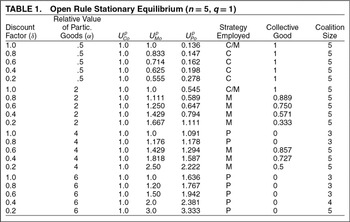
reflect the expected utility of the game for the proposer upon offering the optimal collective, mixed, and particularistic policy proposal, respectively. The “strategy employed” column identifies the equilibrium proposal type, “collective good” indicates the portion of the dollar that goes to the collective, and “coalition size” indicates the number of legislators that vote for the proposal in equilibrium.

These results illustrate once again the nonmonotonic relationship between preferences and outcomes that are so striking in the baseline model. At the top of the table, where particularistic goods are of little value, the entire budget is spent on collective goods, whereas the reverse holds for the bottom of the table, where only particularistic goods are provided due to their immense value. In between, however, collective spending increases when it is of relatively lower value. For example, where δ=0.4, collective provision falls from 1 to 0.571 as the relative value of particularistic goods rises from 0.5 to 2. Yet collective provision rises to 0.727 with a further increase in α, before falling to zero in the particularistic-only case.13
Further nonmonotonicities arise for other parameters as well, as illustrated in Table 1 for δ increasing in the case of α=4.
Put simply, whether in the open-rule or closed-rule setting, the proposer has an incentive to attach particularistic benefits for herself to an otherwise collective piece of legislation, and she can extract more benefits when the collective good is of greater relative value compared to particularistic goods. Because other legislators are reticent to vote down, or even amend, such a proposal given the high relative value they place on such collective spending, the proposer exploits this reticence, leading to lower collective spending precisely when such public goods are more highly valued.
Choice of Amendment Rules
In addition to showing the previous results to be robust across different voting rules, this extension provides further insight into another important question for legislative scholars—when will a legislature choose, ex ante, to operate under open or closed rules? Previous models of purely particularistic and purely collective legislation have given disparate results. For example, in the absence of collective good provision, Baron and Ferejohn (1989) note that legislatures will ex ante prefer closed rules to avoid the costly delay possible under an open rule.14
Baron (1991) demonstrates that, given particularistic bargaining with taxation, the legislature prefers open to closed rules, because they ensure that more efficient programs are passed.
Our results, which take into account both particularistic and collective goods, predict both open and closed rules. Like Baron and Ferejohn (1989), in the purely particularistic part of the equilibrium, we find that closed rules are preferred in order to avoid costly delay. In the purely collective part, however, legislators are ex ante indifferent in their rule choice, as either rule yields the same immediately adopted budget.
Finally, where there is a mixture of collective and particularistic spending, the open rule is preferred over the closed rule.15
There is also a small range of parameter values for which the mixed part of the equilibrium holds under the open rule but the particularistic part holds under the closed rule. Which of these is preferred depends on the size of the legislature and the other parameters of the model.
Proposition 4
Open rules are preferred by the legislature when legislators place a high relative value on collective goods (α low), the return on collective goods is substantial (q high), legislators are impatient or coalition formation is difficult (δ low), and the legislature is large (n high).
In short, our model of collective and particularistic goods paints a much more realistic picture of when legislatures will choose open or closed rules than do models of collective or particularistic goods alone. Most legislatures employ both types of rules, and our analysis suggests that the choice of rules depends on the types of goods being allocated. Future empirical work exploring rule choice in legislatures would therefore benefit from an examination of collective and particularistic spending in addition to such factors as informational and committee expertise (Krehbiel 1991).
EXTENSION: A DIVERSE LEGISLATURE
In the final extension of our baseline model, we relax the assumption that all legislators have identical preferences. In reality, legislators have different preferences for collective and particularistic spending, depending on the types of constituencies they represent, whether they are up for reelection, whether they are term-limited, and so forth. We capture some of this diversity by extending our model to include two types of legislators—those who prefer collective spending and those who prefer particularistic spending. The results offer further support for the main propositions of the baseline model, but they also yield intriguing findings about when different types of coalitions form.
In this more realistic setting, the nature of selected coalitions and spending on public and private goods depends on three factors: (1) what proportion of the chamber is predisposed toward collective over particularistic goods, (2) who is recognized as proposer, and (3) who the proposer wishes to include in her coalition. If a majority of the legislature prefers collective spending, then a proposer who prefers collective spending will spend only on collective goods, while a particularistic proposer will spend only enough on collective goods to secure a majority and then keep the rest for herself. Where a majority of the legislature prefers particularistic spending, however, coalition formation becomes more complicated. A collective-leaning proposer would like to spend the whole budget on public goods but will need to attach particularistic earmarks to gain majority support when particularistic-leaning members place a very low relative value on collective spending. A particularistic-leaning proposer has three coalition-building options: she can offer sufficient collective spending so that all legislators support her proposal; she can offer enough collective spending to gain the support of all collective-leaning legislators and then round out her coalition with particularistic benefits for a few particularistic-leaning legislators; or she can build a particularistic-only coalition. The option she chooses depends on the preferences and patience of legislators.
Formalizing this extension to our baseline model, we return to the closed-rule setting, but now introduce two types of legislators, where a type refers to whether the member is particularistic-leaning (meaning α=αH) or collective-leaning (meaning α=αL), where αL<q≤αH. Hence, a particularistic-leaning legislator receives utility equal to Ui=αHxi+q y for any division of the dollar between particularistic and collective goods; and a collective-leaning legislator receives Ui=αLxi+q y. We assume there are m collective-leaning legislators, where 1≤m≤n−1.
The stationary equilibrium is formally stated in the appendix and, as illustrated in Figure 3, consists of five subcases as described informally earlier. In Case I, a majority of the legislators prefer collective spending over particularistic spending. All proposals must therefore win the support of these collective-leaning members, which is easily done for a collective-leaning proposer, who puts the entire dollar into the collective. A particularistic-leaning proposer, however, will only put the minimal amount into the collective that makes the collective-leaning members indifferent between supporting and opposing the proposal. This strategy allows the proposer to retain significant particularistic benefits for herself.

Equilibrium as Function of m and αH
Case II is divided into four subcases by the coalition-formation decisions of the two types of proposers. Cases IIa–IIc are distinguished from Case IId, based on the proposal of a collective-leaning proposer, who wishes to build a coalition by spending the whole budget on collective goods. Such a proposal is universally accepted when the particularistic-leaning members place a low relative value on particularistic goods (
). When they highly value particularistic spending, however, the proposer must individually win the support of enough particularistic-leaning legislators to amass a winning coalition in conjunction with the collective-leaning legislators. This is done by attaching private goods to an otherwise public-good-oriented bill.
Cases IIa–IIc are distinguished from one another based on the coalition proposal of a particularistic-leaning proposer. Case IIa is quite similar to the mixed part of the baseline model equilibrium, with enough collective goods spending to secure unanimous support, allowing the remaining budget to be seized by the proposer. When the particularistic-leaning legislators place a higher value on private goods (
), however, such a large portion of the dollar would need to be spent on collective goods to secure unanimous support that the proposer is no longer drawn to such a coalition-formation strategy. Instead, she spends just enough on collective goods to win over the collective-leaning members, and rounds out her minimum winning coalition with particularistic spending for a sufficient number of particularistic-leaning legislators. Finally, for an even-higher value of particularistic goods (
), the particularistic-leaning proposer forms a coalition based only on particularistic spending. Such a strategy is attractive because, first, she does not value collective spending much herself, and second, coalition members' votes can be secured at a low cost due to their high demand for particularistic benefits. In all of these cases, a significant portion of the budget is kept by the particularistic proposer.
Revisiting results from the baseline model, Proposition 1 established that collective goods are provided when legislators place a high value on collective spending, when the returns on collective good investments are substantial, when legislators are impatient, and when the legislature is large. This proposition still holds when the legislature is diverse. Consistent with Proposition 1a, collective spending is found in equilibrium whenever a majority prefers collective spending over particularistic spending and whenever the proposer prefers collective spending over particularistic. Moreover, all parts of Proposition 1 govern the proposal of a particularistic-leaning member in a majority particularistic-leaning legislature.
Proposition 2 stated that the amount spent on collective goods in the mixed part of the equilibrium of the baseline model is greater when legislators place a high value on particularistic goods, when the return on collective goods investment is small, when legislators are patient, and when the legislature is small. Once again, all of these relationships hold in the mixed spending proposal of the particularistic-leaning proposer in Case IIa. For example, as in the baseline model, patient coalition partners can demand greater public goods spending, even to the point of dedicating the whole dollar to collective goods when δ=1. Beyond reaffirmation of Proposition 2, it is interesting to note how the relative value of particularistic goods for particularistic-leaning legislators (αH) affects spending choices in the different parts of the equilibrium. In particular, changes in this parameter have no effect on collective goods provision in the mixed-spending equilibrium of Cases I and IIb because that collective spending level is only chosen to gain the support of collective-leaning members. Moreover, the mixed-spending equilibrium of Case IId features greater particularistic benefits to coalition members as αH increases in order to induce particularistic-leaning coalition members to accept the proposal rather than seek a particularistic-only proposal of their own.
Taken together, these results reaffirm the logic of the baseline model as it pertains to reforms designed to affect legislators' incentives. Some proposals limiting the value of particularistic goods will be effective. For example, reforms that shift legislators' incentives from right to left across the cases in Figure 3 will allow the passage of public goods with fewer and smaller earmarks. However, other shifts, such as changes within Case IIb or IIc, will have no effect; and still others, such as shifts within Case IIa, will have unintended and adverse consequences. The logic behind these unintended consequences is the same as that in the baseline model. Because coalition members place a higher value on collective goods, their support can be gained with only a small amount of collective spending, leaving a substantial part of the budget for the proposer's pet projects.
Coalition Composition
In addition to reinforcing the logic of the baseline model, our extension to diverse preferences sheds new light on the size and nature of legislative coalitions. In Proposition 3 above, it was noted that oversized coalitions are more likely in larger legislatures (n high), where coalition formation is difficult (δ low), and where particularistic spending is relatively less attractive (α low and q high). These conditions are all substantiated in the diverse legislature extension, based on comparative statics over the cutpoint
shown in Figure 3, with oversized coalitions possible in every case other than Case IId.
Moreover, the nature of the winning coalitions formed in this diverse legislature is quite fascinating. Three features of coalition formation are worth noting. First, unlike models in which coalitions are comprised of like-minded members (typically those on the same side of the ideological continuum), our model gives rise to instances where coalitions cut across preference lines. There are still cases where particularistic-leaning proposers only include their particularistic-leaning brethren (Cases IIc and IId), and likewise for collective-leaning proposers (part of Case I), but this is far from a consistent rule.
A second interesting aspect of coalition formation in our extension is that proposers who are in the minority are able to formulate successful coalitions. In Case I, for example, a particularistic-leaning proposer invests heavily in the collective to secure support of the majority and spends nothing on particularistic goods other than what she keeps for herself. Likewise, throughout Case II, the collective-leaning proposer is careful to include particularistic-leaning members in her coalition, even to the extent of offering them particularistic goods in Case IId. What is surprising here is not the need to focus on members of the majority type, as nothing can pass without a majority; rather, the surprise is that minority members can themselves formulate successful policy proposals. Even if a like-minded majority might wish to hold together to defeat proposals by minority members, their individual incentives are to go along with these proposals, which are formulated to capture their support. This logic helps explain how U.S. Senators up for reelection can advance their short-term interests despite comprising only a third of the Senate, or how Southern Democrats could promote their agricultural interests by coupling crop subsidies with food stamp legislation (Ferejohn 1986).
Finally, a third noteworthy feature of coalition formation in a diverse legislature, unlike in the baseline case, is that coalitions form in which substantial public good provision is coupled with sufficient private good earmarks to secure a majority. This is what Evans (2004) calls the politics of greasing the wheels. Such was President Clinton's strategy for building support across the partisan aisle on the North American Free Trade Agreement, where free-trade Republicans formed the core of the coalition and additional members were promised perks to gain their support. The interesting addition arising from our model is the fact that such coalitions are built by both collective-leaning and particularistic-leaning proposers. When the legislature is comprised of a majority of legislators who place a very high value on particularistic goods (Case IId), a collective-leaning proposer can only secure her public goods bill by attaching a number of pork barrel projects to it. However, when legislators place a significantly lower value on particularistic goods (Case IIb), a similar style of coalition forms, but under a completely different logic. Here, the proposer's goal is greater spending on her district, and the public goods legislation is simply a vehicle to secure a quick base of support before adding on the pork projects needed for a majority and the substantial projects for her own constituency.
IMPLICATIONS AND CONCLUSIONS
Our model, in which legislators face explicit tradeoffs between particularistic and collective spending, draws together two disjointed strands of the literature on legislative bargaining. By combining public and private spending in a single model, we answer the question of when legislators will set aside their parochial interests to promote the general welfare, and we resolve the puzzle of why legislative reforms intended to produce less special interest legislation sometimes fail. In particular, we find that reforms to discourage particularistic spending can succeed either when legislators value particularistic goods much more than collective goods, or when they value collective goods much more than particularistic goods. However, when legislative preferences for both collective and particularistic spending are moderate, reforms are unlikely to succeed.
In such circumstances, reforms that increase legislators' relative valuation of collective over particularistic spending simply allow proposers to maintain the support of coalition members with less collective spending. This, in turn, allows proposers to divert more revenue to their own favored projects, thus undermining the purpose of the reforms. Such a perverse reaction occurs under both closed- and open-amendment rules and in both homogeneous and heterogeneous legislatures.
Our model also reveals further relationships that are theoretically interesting and ripe for empirical testing, but which were masked by models studying collective or particularistic goods separately. Specifically, we find that open rules are preferred in large legislatures, when coalition formation is difficult, and when collective goods are highly valued. We also predict oversized coalitions in similar circumstances. Moreover, we establish conditions under which proposers seek out coalition partners with divergent preferences from their own; we show that members of the minority can fashion successful proposals with majority members as coalition partners; and we uncover the circumstances in which both private-goods-focused and public-goods-focused political entrepreneurs will advance their own interests by attaching pork-barrel projects to otherwise collective-goods-oriented legislation.
APPENDIX
Baseline Closed Rule Case
Collective: The collective part of the equilibrium takes the form that the proposer puts the whole dollar into the collective good. Because collective spending is preferred over particularistic spending in this region, the proposal gains unanimous support. The proposer's utility is
.
Mixed: The mixed part takes the form that the proposer keeps
for herself, and puts the remaining
in the collective.16
It is trivial to show that no proposal giving a nonzero amount to nonproposers, to the proposer, and to the collective is sustained in equilibrium.
, against the expected utility from having a new proposer selected following a delay,
.
Thus nonproposers vote for the proposal iff
. To maximize her utility, the proposer sets
, putting
in the collective. This proposal is accepted by all legislators. The proposer's utility is
.
Particularistic: The particularistic part of the equilibrium takes the form that the proposer gives
to
other legislators, and keeps
for herself. At the critical voting stage, nonproposing coalition members weigh their utility from the current proposal,
, against the expected utility from having a new proposer selected following a delay,
. Assuming acceptance when indifferent, the proposer sets
, leaving
. This proposal is accepted by the proposer and the
other coalition members. The proposer's utility is
.
Choice among Proposal Types
The proposer selects whichever of these three types gives her the highest utility. Specifically, the mixed case is preferred over the collective case, where

The particularistic case is preferred over the mixed case, where

And the particularistic case is preferred over the collective case, where

Because αCM≤αCP≤αMP for all parameters of interest, the collective case occurs, where 0≤α<αCM; the mixed case, where αCM≤α<αMP; and the particularistic case, where
.
Comparative Statics for Propositions 1, 2, and 3
For the cutpoints of interest,
For the size of the collective good in the mixed case,
.
Open Rule Extension
Collective: The collective part of the equilibrium takes the form that the proposer puts the whole dollar on the collective good. The proposer's utility is
.
Mixed: The mixed part takes the form that the proposer keeps
for herself and puts the remaining
in the collective. At the critical moving-the-previous-question stage, the newly recognized member weighs his utility from the current proposal,
, against his expected utility from being the new proposer whose proposal will be accepted following a delay,
.
Thus the new proposer moves the previous question and votes for the proposal iff

To maximize her utility, the proposer sets
, putting
in the collective. This proposal is accepted by all legislators. The proposer's utility is
.
Particularistic: The particularistic part of the equilibrium takes the form shown in Baron and Ferejohn (1989, 1196). For space considerations, we do not re-derive this equilibrium, but simply restate it here. The number of coalition members other than the proposer (k) is a function of the other parameters. Specifically:
, where

The proposer sets
, giving
to each of the k coalition partners. If one of these members is next recognized, he moves the previous question, and all members in the coalition vote for the proposal. If one of the n−k−1 noncoalition members is next recognized, that member becomes the new proposer, making a proposal similar to the one above. The proposer's utility is
.
As in the closed-rule case, a comparison of the proposer's utility across these three types leads to three regions: collective where 0≤α<αCM=q, particularistic, where
; and mixed, where αCM ≤α < αMPo.
Proof of Proposition 4
Follows directly from comparative statics over αMP derived for Proposition 1.
Diverse Legislature Extension—Formal Equilibrium
For all δ∈ [0, 1] a configuration of pure strategies is a stationary subgame-perfect equilibrium in an infinite round, majority rule, n-member (n odd) legislature with m collective-leaning members (1≤m≤n−1) governed by closed rule if and only if it has the following divisions of the dollar:
- If , a collective-leaning member recognized offers to contribute the entire dollar toward the collective, y=1; a particularistic member recognized offers to keep for herself and to place the remaining in the collective good. Each collective-leaning member votes for any proposal in which he receives utility at least equal to , and the first proposal receives at least majority support;
- If and , a collective-leaning member recognized offers to contribute the entire dollar toward the collective, y=1; a particularistic member recognized offers to keep for herself and to place the remaining in the collective good. Each particularistic-leaning member votes for any proposal in which he receives utility at least equal to , and the first proposal receives unanimous support;
- If and , a collective-leaning member recognized offers to contribute the entire dollar toward the collective, y=1; a particularistic member recognized offers to keep for herself, place in the collective good, and give in particularistic goods to other particularistic-leaning members of the legislature selected at random. Each collective-leaning member votes for any proposal in which he receives utility at least equal to . Each particularistic-leaning member votes for any proposal in which he receives utility at least equal to . The first proposal receives unanimous support if made by the collective-leaning type and minimal-winning majority support if made by the particularistic-leaning type;
- If and , a collective-leaning member recognized offers to contribute the entire dollar toward the collective, y=1; a particularistic member recognized offers to keep for herself, place 0 in the collective good, and give in particularistic goods to other particularistic-leaning members of the legislature selected at random. Each collective-leaning member votes for any proposal in which he receives utility at least equal to . Each particularistic-leaning member votes for any proposal in which he receives utility at least equal to . The first proposal receives unanimous support if made by the collective-leaning type and minimal-winning majority support if made by the particularistic-leaning type;
- If and , a collective-leaning member recognized offers to place yIId in the collective good and give in particularistic goods to particularistic-leaning members of the legislature selected at random; a particularistic member recognized offers to keep for herself, place 0 in the collective good, and give in particularistic goods to other particularistic-leaning members of the legislature selected at random. Each collective-leaning member votes for any proposal in which he receives utility at least equal to . Each particularistic-leaning member votes for any proposal in which he receives utility at least equal to . The first proposal receives minimal-winning majority support;17
The quantities yIId,
, and
are based on solving this constrained optimization problem. Due to space considerations, their closed-form solutions are omitted here.
where
and
.
Comparative statics analyses for this equilibrium are given in the supplemental Appendix, available at http://psweb.sbs.ohio-state.edu/faculty/awiseman/publications.htm.
We thank David Baron, Cliff Carrubba, Massimo Morelli, Rebecca Morton, Roger Myerson, John Patty, David Primo, Sebastian Saiegh, Lee Sigelman, Michael Ting, Jack Wright, anonymous reviewers, and seminar participants at the Stanford GSB Political Economy Seminar and the University of Pittsburgh Political Science Department for helpful comments on earlier drafts of this manuscript, and Roman Ivanchenko for valuable research assistance. Earlier versions of this article were presented at the 2004 Annual Meetings of the American Political Science Association and the 2005 Annual Meetings of the Southern Political Science Association.






Comments
No Comments have been published for this article.