Implications
High rates of still born piglets and early post-natal piglet deaths continue to limit productivity of pig production. Previously, maternal caffeine supplementation before farrowing reduced stillbirth rates, and oral progesterone (regumate) at the end of gestation preventing early farrowing and, thus, reduced stillbirths. However, the current data demonstrated that supplementary caffeine in conjunction with regumate at the end of gestation increased piglet mortality during, and after, farrowing. It is concluded that these two compounds should not be used together.
Introduction
High incidences of piglet mortality, either during parturition or before weaning, continue to limit the efficiency and profitability of pig production, and represent a welfare concern. Intra-partum hypoxia is the primary cause of still born piglets, and is responsible for reduced viability, survival and subsequent growth of a significant portion of live-born piglets (Herpin et al., Reference Herpin, Damon and Le Dividich1996 and Reference Herpin, Dividich, Hulin, Fillaut, De Marco and Bertin2002). It is, therefore, logical to assume that protecting the piglet from the negative effects of oxygen deprivation during parturition will increase piglet viability and reduce incidences of pre-weaning mortality. One compound with neuroprotective properties, as well as the capacity to stimulate respiration in newborns, is caffeine. In sows, maternal caffeine supplementation on the day before an induced parturition (Superchi et al., Reference Superchi, Saleri, Farina, Cavalli, Riccardi and Sabbiono2016), or for 3 to 4 days before natural farrowing (Dearlove et al., Reference Dearlove, Kind and van Wettere2015) significantly reduced incidences of stillbirths. Maternal caffeine supplementation also improved piglet thermoregulation (Superchi et al., Reference Superchi, Mazzoni, Zanardelli, Piancastelli, Zambini, Beretti and Sabbiono2013; Dearlove et al., Reference Dearlove, Kind and van Wettere2015), and increased gestation length by 1.1 days (Dearlove B, et al., unpublished data).
The capacity of maternal caffeine supplementation to delay the onset of parturition is of particular interest. Short gestation lengths are associated with increased stillbirths and pre-weaning mortality (Vanderhaeghe et al., Reference Vanderhaeghe, Dewulf, Jourquin, De Kruif and Maes2011), reflecting reduced piglet maturity at onset of parturition (Zaleski and Hacker, Reference Zaleski and Hacker1993) and longer farrowing durations (van Dijk et al., Reference van Dijk, van Rens, van der Lende and Taverne2005). Subsequently, both Vanderhaeghe et al. (Reference Vanderhaeghe, Dewulf, Jourquin, De Kruif and Maes2011) and Gaggini et al. (Reference Gaggini, Perin, Arend, Bernardi, Wentz and Bortolozzo2013) demonstrated that oral progesterone at the end of gestation is an effective and safe strategy to prevent early farrowing. However, newborn piglets may still have reduced vitality at birth following maternal progesterone treatment before farrowing and therefore we hypothesized that the addition of caffeine at the end of gestation would improve newborn piglet vitality and reduce neonatal mortality. The effect of combining caffeine and regumate on gestation length and farrowing outcomes has not been reported in the literature. The aim of the current study was, therefore, to determine the effect of oral supplementation of sows with regumate and caffeine at the end of gestation on gestation length, farrowing duration, stillbirth rates and pre-weaning growth and survival of live born pigs.
Material and methods
Animals
This experiment was conducted at the University of Leed’s Research Piggery during autumn 2016 (October/November). In all, 20 Large White pregnant sows (parity 3.0±0.45 (mean±SEM); range 1 to 8) were moved to farrowing crates 7.1±0.34 days (range 6to 11 days) before predicted farrowing date (gestation day 115). From days 111 to 113 of gestation, all sows received 5 ml of Regumate Porcine (0.4 w/v oral solution; MSD Animal Health) daily on top of their morning ration. Sows were stratified according to parity and predicted farrowing date, and allocated at random to receive a diet supplemented with either 0 g caffeine/kg diet (CONT) or 2.4 g of caffeine/kg diet (CAFF) from day 113 of gestation until parturition (n=10 sows/treatment). As per routine husbandry at the Leeds piggery, sows were fed 2.0 kg/day of gestation diets (12.5 MJ kg/digestible Energy; 11.64% protein; 4% fiber; 0.45% total lysine) from farrowing crate entry until day 3 post-farrowing. Caffeine dose was, therefore, 4.8 g/sow per day.
Experimental measures
The total number of piglets born, born alive and dead, and the number of mummified fetuses produced were recorded for all sows. Using installed video cameras, the following measures were also collected; duration of farrowing and inter-piglet birth intervals. The start of parturition was defined as the expulsion of the first piglet, and the end of parturition defined as the time at which placental tissue was expelled. Piglets born alive and dead were weighed on the day of birth (birthweight; BW). Piglets were weighed individually on day 5.2±0.39 postpartum and at weaning (25.2±0.39 days postpartum). Piglet mortality was recorded throughout lactation. Cross-fostering only occurred after birthweights had been taken and piglets identified, and was kept to a minimum and within treatment.
Statistical analyses
Data is expressed as mean±SEM (unless otherwise stated). All data were analyzed as a randomized complete block design, with individual sow as the experimental unit. The effect of pre-farrowing dietary treatment on all measures was determined using a one‐way ANOVA (Genstat version 15; VSN International Ltd, Hemel Hempstead, UK), with sow parity included as a co-variate. Total litter size was also added to the model, as a co-variate, when determining treatment effects on piglet weight, growth, farrowing duration and inter-piglet birth interval. A χ 2 analysis was used to determine treatment effects on the distribution of piglets within four BW categories (<1.0 kg, 1.01 to 1.2 kg, 1.21 to 1.6 kg, >1.6 kg), as well as the survival of the piglets within BW category. Treatment means were statistically separated using the LSD option, with P⩽0.05 indicating a difference and P⩽0.10 indicative of a trend/tendency.
Results
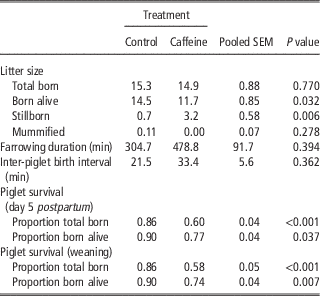
Farrowing duration and inter-piglet birth interval were similar for the CONT and CAFF treatment groups (Table 1). Gestation length was unaffected by treatment (115.8±0.23 days). The total number of piglets born was unaffected by treatment. The number of still born piglets was lower (P<0.05) and the number of live born piglets higher (P=0.054) for CONT compared with CAFF sows (Table 1). There were no treatment effects (CONT v. CAFF) on piglet BW: mean (1.52±0.07 and 1.37±0.06 kg; P=0.124); minimum (1.03±0.10 and 0.80±0.09 kg; P=0.107) or maximum (1.89±0.08 and 1.80±0.10 kg; P=0.399). CONT litters contained a lower proportion of piglets with a BW<1 kg (0.05±0.02 v. 0.16±0.05; P=0.072). There was a tendency for CONT piglets to be heavier on day 5 postpartum (P=0.063) and at weaning (P=0.098) (2.17±0.11 v. 1.96±0.13 kg and 6.98±0.31 v. 6.01±0.56 kg, respectively). However, piglet growth rate from birth to weaning was similar (P=0.118) for CONT and CAFF litters (0.218±0.01 and 0.183±0.02 kg/day).
Effect of maternal diet (control (CONT) v. caffeine (CAFF)) on litter characteristics, farrowing duration, interpiglet birth interval and piglet survival

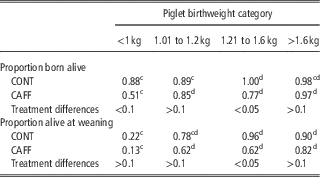
Piglet survival to day 5 postpartum (% total born and % live born piglets) was higher (P<0.05) for the CONT compared with CAFF treatment (Table 1). CONT sows weaned more piglets than CAFF sows (12.9±0.53 v. 8.7±0.96, and piglet survival to weaning (% total born and % live born piglets) was higher (P<0.05) for the CONT compared with CAFF treatment (Table 1). Treatment (CONT v. CAFF) increased the proportion of <1.0 kg BW piglets alive at birth (0.88 v. 0.51; P<0.1) but not at weaning (Table 2). The proportion of 1.21 to 1.60 kg BW piglets alive at birth and at weaning was higher for the CONT v. CAFF treatments (Table 2).
Effect of piglet birthweight category and maternal diet (caffeine (CAFF) v. control (CONT) on the proportion of piglets born alive and the proportion of piglets alive at weaning (calculated a proportion of total born)

c,dWithin row, different superscripts indicate differences (P<0.05).
Discussion
The current data demonstrated that oral caffeine supplementation at the end of gestation increased piglet mortality, both during and soon after parturition, when provided to sows receiving progesterone to prevent premature farrowing. This finding differs from previous studies in which the effects of caffeine supplementation or progesterone supplementation at the end of gestation were investigated separately. Previous data indicated lower still births, and improved piglet thermoregulation, following maternal supplementation with caffeine for 1 (Superchi et al., Reference Superchi, Saleri, Farina, Cavalli, Riccardi and Sabbiono2016) and 3 (Dearlove et al., Reference Dearlove, Kind and van Wettere2015) days before farrowing. Using the same protocol as the current study, oral progesterone prevented premature farrowings and the associated impairment of piglet survival and growth (Vanderhaeghe et al., Reference Vanderhaeghe, Dewulf, Jourquin, De Kruif and Maes2011; Gaggini et al., Reference Gaggini, Perin, Arend, Bernardi, Wentz and Bortolozzo2013).
The mechanisms responsible for the negative effect of caffeine, concurrent with and after, progesterone supplementation, on peri-parturient piglet survival cannot be established from the current data. Previous reports of lower stillbirth rates following maternal caffeine supplementation (Dearlove et al., Reference Dearlove, Kind and van Wettere2015; Superchi et al., Reference Superchi, Saleri, Farina, Cavalli, Riccardi and Sabbiono2016), have been attributed to increased uterine contractility, and therefore a more rapid birth process (Superchi et al., Reference Superchi, Saleri, Farina, Cavalli, Riccardi and Sabbiono2016). However, the potent inhibitory effects of caffeine on myometrial contractility have been demonstrated consistently in uterine tissue of pregnant rats (Martin et al., Reference Martin, Dacquet, Mironneau and Mironneau1989; Savineau and Mironneau Reference Savineau and Mironneau1990; Apaydin et al., Reference Apaydin, Gonen and Guven1998; Martin et al., Reference Martin, Hyvelin, Chapman, Marthan, Ashley and Savineau1999). Support for the notion that the currently observed increase in still births reflected an inhibitory effect of caffeine on uterine contractility was provided by the numerical, albeit non-significant, increase in both total farrowing duration and inter-piglet birth intervals. Previous studies report no impact of caffeine on farrowing duration (Dearlove et al., Reference Dearlove, Kind and van Wettere2015; Superchi et al., Reference Superchi, Saleri, Farina, Cavalli, Riccardi and Sabbiono2016) or inter-piglet birth interval (Dearlove et al., unpublished data), suggesting an interactive effect between progesterone and caffeine was responsible for the apparent extension of parturition in the current study. Kirkwood et al. (Reference Kirkwood, Moller, Smith, Lapwood and Garrick1985) concluded that oral progesterone supplementation prevents parturition by inhibiting myometrial contractions. It is, therefore, plausible that supplementation with two inhibitors of uterine contractility in close succession was responsible for the current extension of parturition and increase in piglet mortality.
Caffeine supplementation (4.8 g/sow per day) increased the proportion of piglets in the litter with very low (<1 kg) birthweights. Mean birthweight was unaffected which agrees with previous evidence that 3 days of caffeine supplementation (6 g/day) before farrowing did not alter birthweight (Dearlove et al., unpublished data). However, 1 day of caffeine supplementation (~6.4 g/sow) on the day of farrowing induction tended to reduce piglet weight at birth and day 5 postpartum (Superchi et al., Reference Superchi, Mazzoni, Zanardelli, Piancastelli, Zambini, Beretti and Sabbiono2013), and high caffeine intakes in pregnancy are associated with reduced fetal growth and low birthweights in humans (Hoyt et al., 2014; Partosch et al., Reference Partosch, Mielke, Hahlmann and Gundert-Remy2015). Caffeine crosses the human placenta (Partosch et al., Reference Partosch, Mielke, Hahlmann and Gundert-Remy2015), and maternal caffeine supplementation increased plasma levels in newborn piglets (van Wettere WHEJ and Dean A, unpublished data). In humans, caffeine cannot be metabolized by the placenta or fetus (Grosso et al., Reference Grosso, Triche, Belanger, Benowitz, Holford and Bracken2006), and prolonged periods of maternal caffeine intake expose the fetus to increasing levels of caffeine (Partosch et al., Reference Partosch, Mielke, Hahlmann and Gundert-Remy2015). Oral contraceptive pills inhibit caffeine metabolism, potentially explaining the reduced caffeine metabolism observed during the third trimester in women (Balogh et al., Reference Balogh, Klinger, Henschel, Börner, Vollanth and Kuhnz1995; Partosch et al., Reference Partosch, Mielke, Hahlmann and Gundert-Remy2015). It is, therefore, suggested that the increased incidence of low birthweight piglets observed in the current study reflects alterations in fetal growth in response to caffeine. Furthermore, it is possible that orally dosing sows with progesterone in the current study further inhibited maternal caffeine metabolism and clearance. As a result, fetuses were exposed to higher levels of caffeine than in previous studies (Superchi et al., Reference Superchi, Mazzoni, Zanardelli, Piancastelli, Zambini, Beretti and Sabbiono2013; Dearlove et al., Reference Dearlove, Kind and van Wettere2015), potentially explaining the increased incidence of low birthweight piglets and contributing to increased preweaning mortality.
In conclusion, regardless of the mechanisms responsible, the current data provides what is, to the best of our knowledge, the first evidence that using progesterone in combination with caffeine at the end of gestation has negative outcomes for the piglet. This is an important finding for two reasons; one, it will prevent producers from combining these two substances; and two, it demonstrates the importance of understanding how caffeine affects neonatal piglet growth, the progression of parturition and piglet viability before recommendations are made for its commercial use.
Acknowledgments
The authors would like to acknowledge Primary Diets for kindly providing the diets which were used in this study.