Introduction
Horseweed, a fall- or spring-germinating Asteraceae species found throughout Canada and the United States, exhibits a highly competitive and adaptable growth pattern (Buhler and Owen Reference Buhler and Owen1997; Weaver Reference Weaver2001). Horseweed’s high fecundity and ability to germinate on the soil surface make it a highly successful weed in agroecosystems and particularly adaptable to no-tillage crop production systems (Davis et al. Reference Davis, Gibson, Bauman, Weller and Johnson2009; Main et al. Reference Main, Steckel, Hayes and Mueller2006; Weaver Reference Weaver2001). Horseweed seed production is relative to plant height; a plant 1.5 m tall can produce in excess of 230,000 small, wind-blown seeds, which can be dispersed over 500 km from the mother plant (Shields et al. Reference Shields, Dauer, VanGessel and Neumann2006; Weaver Reference Weaver2001). These biological characteristics contribute to rapid and widespread geographical expansion of horseweed and complicate its management.
Glyphosate-resistant (GR) biotypes of horseweed were first reported in 2001 in Delaware and have been subsequently documented throughout much of the United States and Ontario, Canada (Budd et al. Reference Budd, Soltani, Robinson, Hooker, Miller and Sikkema2018; Ge et al. Reference Ge, d’Avignon, Ackerman and Sammons2010; VanGessel Reference VanGessel2001). GR horseweed is present in 30 counties in Ontario, with several populations also exhibiting multiple resistance to cloransulam-methyl, an acetolactate synthase (ALS)–inhibiting herbicide (Budd et al. Reference Budd, Soltani, Robinson, Hooker, Miller and Sikkema2018). A common management strategy implemented by growers for control of GR horseweed is the use of herbicides with alternative modes of action (Scott and VanGessel Reference Scott and VanGessel2007). In Ontario, several soil-applied residual herbicides controlled GR horseweed >90% in corn (Brown et al. Reference Brown, Shropshire and Sikkema2016; Ford et al. Reference Ford, Soltani, Robinson, Nurse, McFadden and Sikkema2014); however, POST applied herbicide options for control of multiple-resistant (MR) biotypes in corn are limited (Mahoney et al. Reference Mahoney, Shropshire and Sikkema2017). In Ontario studies, only dicamba, dicamba:diflufenzopyr, dicamba:atrazine, and bromoxynil + atrazine applied POST provided >90% control of this species in corn, representing just four herbicide sites of action (Mahoney et al. Reference Mahoney, Shropshire and Sikkema2017). Interference from GR horseweed in corn caused up to 69% grain yield loss in Ontario studies (Ford et al. Reference Ford, Soltani, Robinson, Nurse, McFadden and Sikkema2014), underlining the importance of effective management of this species.
Herbicides that inhibit 4-hydroxyphenylpyruvate dioxygenase (HPPD) impede biosynthesis of plastoquinone (PQ) and α-tocopherols in susceptible plants through competitive inhibition of the enzyme HPPD, inhibiting carotenoid biosynthesis and fostering light-induced generation of reactive oxygen species and triplet chlorophyll (Ahrens et al. Reference Ahrens, Lange, Mueller, Rosinger, Willms and Almsick2013; Hawkes Reference Hawkes2012). Several HPPD-inhibiting herbicides such as triketones, isoxazoles, and pyrazolones are used in field corn; each is unique in the spectrum of weeds controlled. HPPD-inhibiting herbicides are commonly applied to corn in tank mixtures with photosystem II (PSII) inhibitors such as atrazine, which improves herbicide efficacy and broadens the weed control spectrum (Abendroth et al. Reference Abendroth, Martin and Roeth2006; Armel et al. Reference Armel, Hall, Wilson and Cullen2005, Reference Armel, Rardon, McComrick and Ferry2007; Kim et al. Reference Kim, Jung, Hwang and Cho1999; Kohrt and Sprague Reference Kohrt and Sprague2017; Metzger et al. Reference Metzger, Soltani, Raeder, Hooker, Robinson and Sikkema2018a, Reference Metzger, Soltani, Raeder, Hooker, Robinson and Sikkema2018b). PSII inhibitors disrupt electron flow through PSII by competing with PQ for the binding pocket on the D1 protein (Hess Reference Hess2000). Herbicides that inhibit HPPD are presumed to improve the efficiency of atrazine binding by limiting PQ biosynthesis and concurrently intensify subsequent lipid peroxidation by impeding the biosynthesis of carotenoids and tocopherols (Armel et al. Reference Armel, Hall, Wilson and Cullen2005). Therefore, HPPD inhibitors are believed to exhibit a mode of action that is complementary to that of PSII inhibitors (Kim et al. Reference Kim, Jung, Hwang and Cho1999).
Control of GR horseweed with HPPD-inhibiting herbicides has been variable. Mesotrione + atrazine provided 88% to 97% control of GR horseweed applied PRE (Armel et al. Reference Armel, Richardson, Wilson and Hines2009; Brown et al. Reference Brown, Shropshire and Sikkema2016). In contrast, mesotrione + atrazine applied POST provided only 76% control (Mahoney et al. Reference Mahoney, Shropshire and Sikkema2017). Similarly, topramezone +atrazine applied POST provided only 67% control of GR horseweed (Mahoney et al. Reference Mahoney, Shropshire and Sikkema2017).
Tolpyralate, a new pyrazolone herbicide for POST use in corn, was registered in Canada and the United States in 2017 (Anonymous 2017a, 2017b). The biologically effective dose of tolpyralate for 90% control of common lambsquarters (Chenopodium album L.), common ragweed (Ambrosia artemisiifolia L.), green foxtail [Setaria viridis (L.) P.Beauv], Powell amaranth (Amaranthus powellii S. Watson), redroot pigweed (Amaranthus retroflexus L.), and velvetleaf (Abutilon theophrasti Medik.) was determined to be ≤15.5 g ai ha–1; however, not all species could be controlled with tolpyralate alone (Metzger et al. Reference Metzger, Soltani, Raeder, Hooker, Robinson and Sikkema2018a). The addition of atrazine to tolpyralate application at a 1:33.3 tank-mix ratio was found to increase weed control efficacy in some species and also provide control of additional weed species, such as ladysthumb (Persicaria maculosa Gray) and wild mustard (Sinapis arvensis L.), which were not controlled with tolpyralate applied alone (Metzger et al. Reference Metzger, Soltani, Raeder, Hooker, Robinson and Sikkema2018b).
Little published information is available regarding the biological activity of tolpyralate or tolpyralate + atrazine mixtures on MR horseweed. The commercial label for tolpyralate in the USA lists “partial control” of horseweed when applied alone (30–40 g ha–1) or with atrazine (≥560 g ai ha–1) (Anonymous 2017a), whereas horseweed is not included on the Canadian label (Anonymous 2017b). Therefore, the objectives of this study were to determine the biologically effective dose of tolpyralate alone and tolpyralate + atrazine in MR horseweed, and to compare the efficacy of tolpyralate applied at the lowest current labeled rate with and without atrazine to current herbicide standards for POST control of GR/MR horseweed in corn.
Materials and methods
Experimental methods
Six no-till field experiments were conducted in 2017 and 2018 near Mull (42.41°N, 81.58°W), Ridgetown (42.50°N, 81.54°W), Harrow (42.01°N, 82.56°W), and Thamesville (42.53°N, 81.54°W), Ontario, Canada that had populations of horseweed previously confirmed as resistant to glyphosate and partially resistant to cloransulam-methyl. At each location, plots consisted of three rows of DKC46-82RIB corn (Monsanto Company, St. Louis, MO) seeded 4 cm deep, on 76-cm row-spacing. Each field experiment was organized as a randomized complete block with four replications. Trial sites were fertilized according to soil test results and Ontario Ministry of Agriculture, Food and Rural Affairs (OMAFRA) recommendations for field corn. Table 1 lists soil characteristics, planting dates, harvest dates, spray dates, corn growth stage, and horseweed size and density at the times of application.
Soil characteristics, planting dates, harvest dates, spray dates, corn growth stage, and horseweed size and density for field trials near Mull, Ridgetown, Thamesville, and Harrow, ON, in 2017 and 2018.

a Abbreviation: OM, organic matter.
b Size measured as height of bolting plants or rosettes. Mean of eight measurements per trial at time of application.
c Mean density based on two stand counts per block within each trial.
d Not harvested.
e Treatments applied prior to crop emergence as dictated by when horseweed reached 10 cm.
Prior to treatment application, glyphosate (900 g ae ha–1) was applied to the entire trial area using a tractor-mounted sprayer to remove all other competing weed species. Nontreated weedy control plots received only this glyphosate application. Weed-free control plots were treated with dimethenamid-P:saflufenacil (735 g ai ha–1) PRE, followed by dicamba:atrazine (1,500 g ai ha–1) POST, and subsequently maintained by hand-weeding as needed. All herbicide applications were made using a CO2-pressurized backpack sprayer calibrated to deliver 187 L ha–1 at 240 kPa through four Hypro ULD12002 nozzles (Pentair; New Brighton, MN) spaced 50 cm apart. Herbicide treatments were applied when horseweed plants reached an average of 10 cm in height. Due to the potential for horseweed to germinate in the spring or autumn, corn stage at time of application varied from PRE to POST (VE up to V4), depending on field location (Table 1). Horseweed populations at Ridgetown and Thamesville were predominantly fall-germinated, whereas populations at Mull and Harrow were predominantly spring-germinated; however, because horseweed exhibits an extended emergence pattern, all populations consisted of a mixture of rosettes and bolting plants. Treatments to determine the biologically effective dose were a titration of tolpyralate at 3.75, 7.5, 15, 30, 60, and 120 g ai ha–1, and a titration of tolpyralate +atrazine, tank-mixed at a 1:33.3 ratio, at 3.75 + 125, 7.5 + 250, 15 + 500, 30 + 1,000, 60 + 2,000, and 120 + 4,000 g ai ha–1, respectively. This tank-mix ratio was chosen with consideration of a previous dose–response study with tolpyralate + atrazine on glyphosate-susceptible (GS) weeds (Metzger et al. Reference Metzger, Soltani, Raeder, Hooker, Robinson and Sikkema2018a). Methylated seed oil (MSO Concentrate®; Loveland Products Inc., Loveland, CO) at 0.50% (v/v) and 28% N urea ammonium nitrate at 2.50% (v/v) were included with tolpyralate applications in accordance with herbicide label recommendations (Anonymous 2017a). Dicamba:atrazine (Marksman®; BASF Canada Inc., Mississauga, ON) (1,500 g ai ha–1) and bromoxynil + atrazine (280 + 1,500 g ai ha–1) treatments were included to represent the current standard herbicide treatments for POST control of MR horseweed in corn (Mahoney et al. Reference Mahoney, Shropshire and Sikkema2017).
Visible estimates of crop injury 1, 2, and 4 wk after application (WAA), and visible estimates of MR horseweed control 2, 4, and 8 WAA were assessed on a percent scale (0 to 100) relative to the nontreated control. Horseweed density and biomass were determined 8 WAA by counting and cutting plants contained in a 0.25-m–2 quadrat placed randomly at two locations front and back in the center space of each plot. Harvested horseweed plants were placed into labeled paper bags, dried at 60 C, weighed and recorded as g dry matter (DM) m–2. Corn grain yield was determined at the end of each season by harvesting the center two rows of each plot with a small-plot combine. Grain moisture and weight per plot (yield) was recorded, and grain yield was adjusted to 15.5% moisture.
Statistical analysis
Nonlinear regression—log-logistic dose–response. Visible horseweed control 2, 4, and 8 WAA, and corn grain yield expressed as a percent of the weed-free control plot within replications, were regressed against tolpyralate or tolpyralate + atrazine dose by specifying a four-parameter log-logistic model (Equation 1) within PROC NLIN in SAS v. 9.4 (SAS Institute, Cary, NC). Horseweed density (plants m–2) and dry biomass (g m–2) were each regressed against tolpyralate dose or tolpyralate + atrazine dose using an inverse exponential equation (Equation 2). Parameters generated from each regression analysis were used to compute the effective dose (R50, R80, R95) of tolpyralate or tolpyralate + atrazine combined, required to give 50%, 80%, and 95% control, reduction in density and DM, and corn grain yield relative to the weed-free control plots within each replication. When the predicted dose for any parameter was outside of the range of doses used in this study or could not be computed by the model, it was expressed as “Non-est.” in Tables and Figures, as extrapolation beyond the parameters of this study would be improper.
Equation 1 – Log-logistic dose-response model
 $$y = C+(D - C)/[1+{e^{( - b*(log(dose) - log({I_{50}})))}}]$$
where y is the response parameter, C is the lower asymptote, D is the upper asymptote, I50 is the dose eliciting a response equidistant between C and D, and b is the slope about I50.
Equation 2 – Inverse exponential
 $$y = e+{f^{( - g*dose)}}$$
where y is the response parameter, e is the lower asymptote, f is the reduction in y from intercept to asymptote, and g is the slope.
Least-square means comparisons. A mixed-model variance analysis was carried out on each response parameter using PROC GLIMMIX in SAS v. 9.4 (SAS Institute, Cary, NC). Data were combined across years and locations (collectively termed ‘environment’) for analysis. Variance was partitioned into the fixed effect of herbicide treatment and the random effects of environment, replication within environment, and the treatment-by-environment interaction. Statistical significance (α = 0.05 for all tests) of the fixed effect was determined using an F-test, whereas statistical significance of the random effects was determined using the log-likelihood ratio test. An appropriate distribution and link for each parameter that met assumptions that residuals were homogeneous, had means equal to zero, and were normally distributed was selected based on a Shapiro-Wilk test of normality, together with scatterplots of studentized residuals. Visible control estimates 2 and 8 WAA were assigned a normal distribution with identity link; visible control 4 WAA was assigned a beta distribution with a cumulative complementary log-link. Density and biomass data were each modeled using a lognormal distribution with an identity link. Least-square means of tolpyralate alone, tolpyralate + atrazine, dicamba:atrazine, and bromoxynil + atrazine were computed for each parameter on the analysis scale, and converted to the data scale using the ilink option in PROC GLIMMIX where appropriate. Where a lognormal distribution was specified, the omega method for back-transformation was used within the GLIMMIX procedure (M. Edwards, OAC Statistician, University of Guelph, personal communication). Least-square means were compared using Tukey-Kramer’s multiple-range test, and letter codes were assigned to illustrate statistically significant differences using the lines option in SAS.
Results and discussion
Crop injury
No treatment caused injury >10% on average; however, injury varied across experiments, with the highest rate of tolpyralate + atrazine (120 + 4,000 g ha–1) causing up to 40% injury 1 WAA at one location in 2017 (data not shown). Injury consisted of transient white/yellow bleaching and dissipated to <10% by 4 WAA. Temperature during application was moderate (20 C), although crop stage may have influenced the level of injury observed at this site, with corn at the V1 (two-leaf) stage at the time of application (Table 1). Previous studies have reported greater crop injury when nicosulfuron + bromoxynil were applied to corn prior to the three-leaf stage (Carey and Kells Reference Carey and Kells1995) and when mesotrione was applied at V3 compared to later timings (Johnson et al. Reference Johnson, Young and Matthews2002), possibly because younger corn plants have a thinner, less developed leaf cuticle.
Tolpyralate/tolpyralate plus atrazine dose–response
Tolpyralate induced white bleaching, chlorosis, and necrosis of MR horseweed plants within 10 d of application, with greater necrosis observed with increasing tolpyralate rate or with the addition of atrazine. These symptoms were similar to those observed in several annual weed species (Metzger et al. Reference Metzger, Soltani, Raeder, Hooker, Robinson and Sikkema2018a). Based on regression analysis, at 2 WAA, 50% and 80% control of MR horseweed could be achieved with 1.5 and 16 g ha–1 tolpyralate, respectively; however, no dose ≤120 g ha–1 provided 95% control at this timing (Table 2). In contrast, tolpyralate + atrazine at 18.5 + 616.6 g ha–1 controlled MR horseweed 95%, representing 0.6 times the lowest label rate of tolpyralate (30 g ai ha–1). Similarly, when tolpyralate + atrazine were applied in combination, 50% and 80% control of MR horseweed could be achieved 2 WAA with 1.5 + 50.8 and 4.9 + 164.5 g ha–1 tolpyralate + atrazine, respectively. Similar results were reported by Metzger et al. (Reference Metzger, Soltani, Raeder, Hooker, Robinson and Sikkema2018a) in dose–response studies on a range of GS weed species (Amaranthus spp., common lambsquarters, common ragweed, green foxtail, and velvetleaf), in which the addition of atrazine to tolpyralate improved control at early assessments. At 2 WAA, the addition of atrazine to tolpyralate allowed for a reduction in the tolpyralate rate of approximately 70% for 80% control of MR horseweed, whereas similar rates of tolpyralate were required for 50% control whether atrazine was included or not.
Regression parameters and predicted effective dose of tolpyralate and tolpyralate + atrazine for 50%, 80%, and 95% visible control of multiple-resistant horseweed 2, 4, and 8 wk after application (WAA) and to achieve 50%, 80%, and 95% of the yield obtained in weed-free control plots based on the log-logistic dose–response equation (Equation 1).

a Regression parameters: C = lower asymptote, D = upper asymptote, b = slope about I50, I50 = effective dose to elicit a 50% response, Rn, effective dose to elicit response level n.
b Expressed as percent of yield in weed-free control plots within replications.
c Abbreviation: Non-est., predicted dose for any parameter was outside of the range of doses used in this study or could not be computed by the model.
Control of MR horseweed generally improved from 2 to 4 WAA. When tolpyralate was applied alone, 50%, 80%, and 95% control could be achieved with 3.3, 17.5, and 116.1 g ha–1, respectively (Table 2). Kikugawa et al. (Reference Kikugawa, Satake, Tonks, Grove, Nagayama and Tsukamoto2015) reported 98% control of GR horseweed with tolpyralate alone (30 g ha–1); however, these results were obtained from a greenhouse experiment where applications were made to plants approximately 50% of the size of those used in this study. Similar to 2 WAA, the addition of atrazine facilitated a reduction in the required tolpyralate dose for each level of control. When mixed, 2.1 + 69.9 and 5.7 g ha–1 + 189.9 g ha–1 tolpyralate + atrazine provided 50% and 80% control, respectively, whereas 95% control was obtained with 17.6 g ha–1 + 587.9 g ha–1, representing approximately 0.6 times the lowest labeled tolpyralate rate (30 g ai ha–1).
Despite the extended emergence pattern of horseweed in Ontario (Weaver Reference Weaver2001) and reports of tolpyralate having limited PRE residual activity (Anonymous 2017a), few late-emerging MR horseweed plants were observed in plots treated with tolpyralate (≥30 g ha–1) 8 WAA. However, regrowth of some MR horseweed plants, particularly those that were fall-germinated, was observed where tolpyralate was applied alone. To achieve 50% and 80% control 8 WAA, 4.8 and 22.6 g ha–1 of tolpyralate was required, respectively, but no dose could provide 95% control (Table 2). The addition of atrazine to tolpyralate provided 95% control of MR horseweed with rates of 22.3 + 741.7 g ha–1 tolpyralate + atrazine. Similar to previous assessment timings, applying atrazine in combination with tolpyralate facilitated a reduction in the rate of tolpyralate required for 50%, 80%, and 95% control of MR horseweed. This trend was consistent with Metzger et al. (Reference Metzger, Soltani, Raeder, Hooker, Robinson and Sikkema2018a) for the biologically effective dose of tolpyralate alone or with atrazine in GS summer annual weed species including Amaranthus spp., barnyardgrass [Echinochloa crus-galli (L.) P.Beauv.], common ragweed, common lambsquarters, green foxtail, and velvetleaf, 8 WAA.
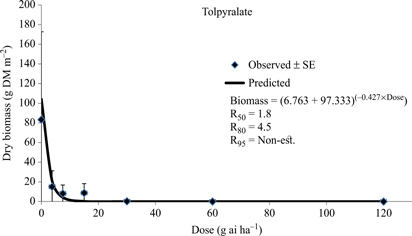
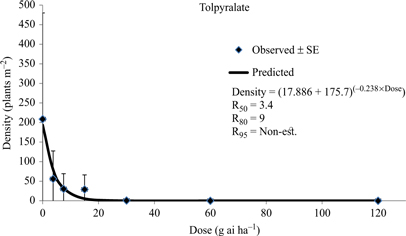
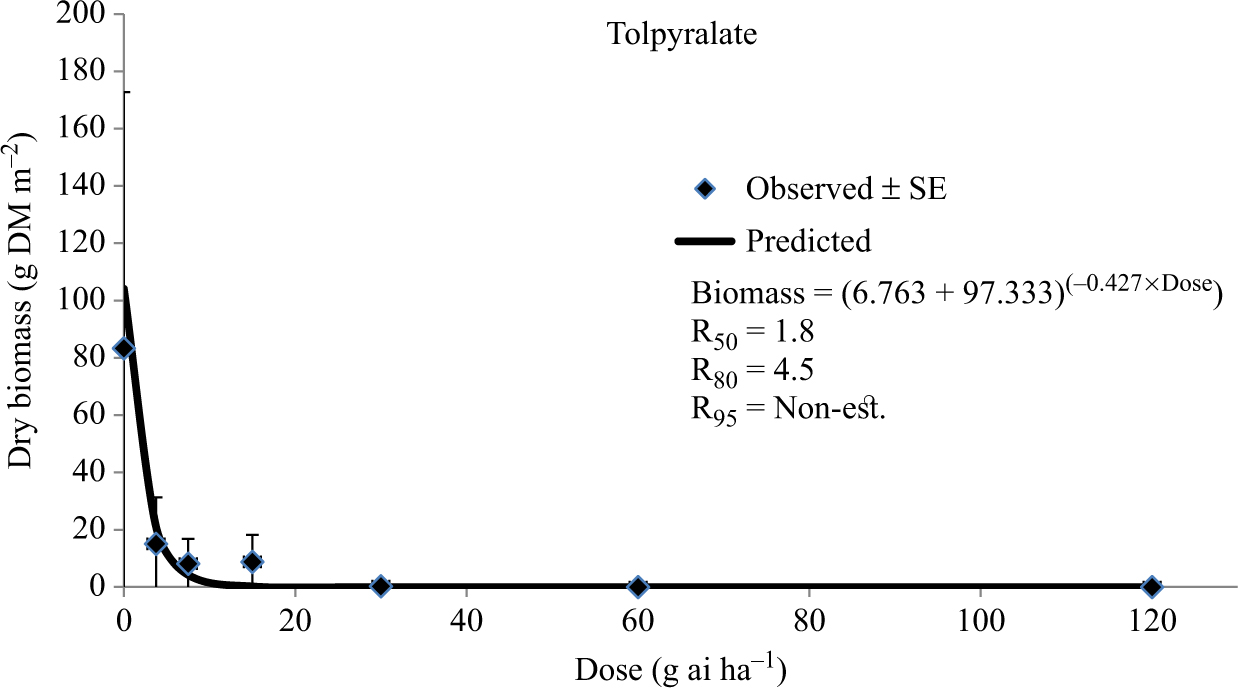
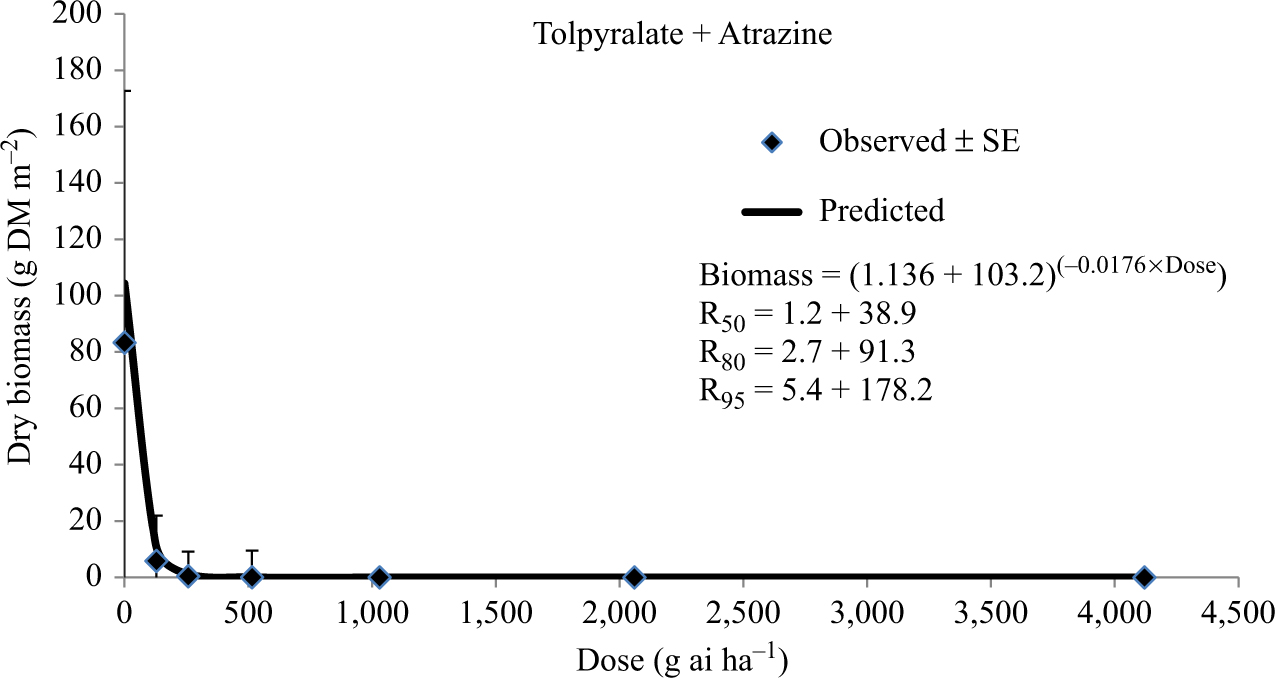
Density and DM data followed similar trends to visible control data 8 WAA based on regression analysis using Equation 2 (Figures 1–4). A comparatively higher dose of tolpyralate was required for a 50%, 80%, or 95% reduction in MR horseweed density compared to DM, as a result of incomplete horseweed control in plots with predominantly fall-germinated horseweed plants. Many of these plants were severely injured, stunted, or necrotic 8 WAA, so they contributed little to total-plot DM assessments. Tolpyralate alone reduced MR horseweed DM 50% and 80% compared to the nontreated control at 1.8 and 4.5 g ha–1, respectively (Figure 1); however, 3.4 and 9 g ha–1 were required for an equivalent reduction in density (Figure 3). Similarly, 1.2 + 38.9 and 2.7 + 91.3 g ha–1 tolpyralate + atrazine were required for a 50% and 80% reduction in MR horseweed DM, respectively, but 1.7 + 55.2 and 3.9 + 129.7 g ha–1 were required for equivalent reductions in density. None of the doses of tolpyralate alone used in this study (≤120 g ha–1) provided a 95% reduction in either DM or density of MR horseweed 8 WAA based on the regression analysis. In contrast, with the addition of atrazine, a 95% reduction in MR horseweed DM and density could be achieved with 5.4 + 178.2 and 7.6 + 253.9 g ha–1, respectively (Figures 2 and 4). These rates represent approximately 0.2 and 0.3 times the lowest labeled rate and contrast with the commercial label for tolpyralate, which claims only partial control of horseweed with 30 to 40 g ha–1 plus >560 g ha−1 atrazine (Anonymous 2017b).
Inverse exponential function (Equation 2) and predicted effective dose of tolpyralate for a 50%, 80%, and 95% reduction in multiple-resistant horseweed dry biomass, based on six field experiments conducted in Ontario, Canada in 2017 and 2018.
Inverse exponential function (Equation 2) and predicted effective dose of tolpyralate + atrazine for a 50%, 80%, and 95% reduction in multiple-resistant horseweed dry biomass, based on six field experiments conducted in Ontario, Canada in 2017 and 2018.
Inverse exponential function (Equation 2) and predicted effective dose of tolpyralate for a 50%, 80%, and 95% reduction in multiple-resistant horseweed density, based on six field experiments conducted in Ontario, Canada in 2017 and 2018.

Inverse exponential function (Equation 2) and predicted effective dose of tolpyralate plus atrazine for a 50%, 80%, and 95% reduction in multiple-resistant horseweed density, based on six field experiments conducted in Ontario, Canada in 2017 and 2018.

Tolpyralate and herbicide standards
Least-square means for each control parameter were compared for four treatments applied at label rates: tolpyralate alone (30 g ha–1), tolpyralate + atrazine (30 + 1,000 g ha–1), dicamba:atrazine (500:1,000 g ha–1), and bromoxynil + atrazine (280 + 1,500 g ha–1) (Table 3). Dicamba:atrazine and bromoxynil + atrazine treatments were included in this study based on Mahoney et al. (Reference Mahoney, Shropshire and Sikkema2017), who observed 96% and 93% control of GR horseweed 8 WAA, respectively, with these treatments. At 2 WAA, tolpyralate + atrazine and bromoxynil + atrazine provided similar control of MR horseweed, and both provided higher control (≥96%) than tolpyralate alone (85%) or dicamba:atrazine (79%). These results are consistent with the Mahoney et al. (Reference Mahoney, Shropshire and Sikkema2017) study, in which dicamba-based herbicides gave poorer control of GR horseweed than bromoxynil + atrazine at earlier assessment timings, with control improving by 8 WAA. At 4 WAA, tolpyralate + atrazine and bromoxynil + atrazine provided 99% and 97% control of MR horseweed, whereas tolpyralate alone and dicamba:atrazine provided 86% and 88% control, respectively. At 8 WAA, the addition of atrazine to tolpyralate increased control of MR horseweed by 15%. Across all assessment timings and parameters, the addition of atrazine improved MR horseweed control. Despite poor control of GR horseweed with atrazine (1,000 g ha–1) alone (Mahoney et al. Reference Mahoney, Shropshire and Sikkema2017), similar results were reported with another HPPD inhibitor by Armel et al. (Reference Armel, Richardson, Wilson and Hines2009), who found that the addition of atrazine (280 g ha–1) to mesotrione (160 g ha–1) increased control of GS horseweed from 37% to 88%, 3 WAA. At 8 WAA, bromoxynil + atrazine and dicamba:atrazine provided 94% and 87% control, respectively, which was similar to tolpyralate alone and tolpyralate + atrazine. In previous studies on these and other populations of MR horseweed in Ontario, dicamba:atrazine and other herbicides that include dicamba provided >90% control (Byker et al. Reference Byker, Soltani, Robinson, Tardif, Lawton and Sikkema2013; Mahoney et al. Reference Mahoney, Shropshire and Sikkema2017). However, in this study, MR horseweed plants were observed within dicamba:atrazine plots that exhibited substantial branching from axillary buds by 8 WAA. Flessner et al. (Reference Flessner, McElroy, McCurdy, Toombs, Wehtje, Burmester, Price and Ducar2015) reported similar findings with dicamba applied to GR horseweed at low rates. Hedges et al. (Reference Hedges, Soltani, Hooker, Robinson and Sikkema2018) found that glyphosate:dicamba (2:1 ratio) at 900 and 1,800 g ae ha–1 controlled GR horseweed 76% and 92%, respectively. Therefore, it can be postulated that the rate of dicamba used in our experiments (500 g ha–1) may be insufficient to provide complete control of MR horseweed in some environments.
Visible estimates of multiple-resistant horseweed control 2, 4, and 8 wk after application (WAA) and reduction in plant density and dry biomass (DM) 8 WAA provided by commercial rates of tolpyralate, tolpyralate + atrazine, dicamba:atrazine, and bromoxynil + atrazine applied POST in field studies conducted in Ontario, Canada in 2017 and 2018a.

a Means followed by the same letter within columns do not significantly differ from one another according to Tukey-Kramer’s multiple range test α=0.05.
b Nontreated control plots received only glyphosate (900 g ae ha–1).
When compared to the nontreated control plots, all treatments with the exception of dicamba:atrazine provided a significant reduction in MR horseweed DM and density (Table 3). It is likely that natural population variability within trial sites and replications contributed to the result that dicamba:atrazine was not statistically different from the nontreated control; however, the large numerical difference in both density and DM gives reason to consider the biological significance of control provided by dicamba:atrazine. Tolpyralate alone provided a similar reduction in MR horseweed DM and density compared to dicamba:atrazine, whereas tolpyralate + atrazine and bromoxyil + atrazine provided a greater reduction in both parameters.
Corn grain yield
Corn grain yield varied by site relative to MR horseweed density and DM but was generally reflective of overall weed control. Yields were reduced nearly 47% relative to the weed-free control where MR horseweed was left uncontrolled for the entire season (Table 3). Previously, Ford et al. (Reference Ford, Soltani, Robinson, Nurse, McFadden and Sikkema2014) reported a 69% grain yield reduction with GR horseweed left uncontrolled in corn. As yields were not reduced by 50% or greater as a result of MR horseweed interference in this study, R50 doses for tolpyralate alone or with atrazine could not be computed with the regression model (Table 2). When applied alone, 1.2 g ha–1 of tolpyralate was sufficient to maintain 80% of the yield obtained in weed-free control plots, whereas 4.0 g ha–1 provided yields equivalent to 95% of that obtained in weed-free control plots. Similarly, when applied in conjunction with atrazine, 80% yield potential could be achieved with 1.6 + 54.7 g ha–1, whereas 2.4 + 80.9 g ha–1 was sufficient to avoid yield loss greater than 5% relative to weed-free control plots. These R80 and R95 values are comparatively lower than those calculated for 80% and 95% visible control, indicating that although low rates of tolpyralate and tolpyralate + atrazine maintained corn grain yield, weed escapes were present, and could have contributed to the soil seed bank despite not affecting yield.
Each of the four commercial treatments provided control of MR horseweed that was sufficient to maintain corn grain yield equivalent to the weed-free control (Table 3). No yield differences existed where tolpyralate, tolpyralate + atrazine, dicamba:atrazine, or bromoxynil + atrazine were applied, with each treatment resulting in yield that was 46% to 48% higher than that obtained in the nontreated control.
In conclusion, tolpyralate applied POST at 22.6 g ha–1 controlled MR horseweed 80%, whereas the 30 g ha–1 label rate only improved control 3% to 83% at 8 WAA. These results are in contrast to the current information listed on the commercial labels for tolpyralate, which state only partial control or do not include horseweed (Anonymous 2017a, 2017b). Although atrazine (1,000 g ha–1) has been shown to provide only 37% control of GR horseweed POST (Mahoney et al. Reference Mahoney, Shropshire and Sikkema2017), adding atrazine to tolpyralate at a 1:33.3 ratio provided >95% control of MR horseweed 2, 4, and 8 WAA. At 8 WAA, 22.3 + 741.7 g ha–1 provided 95% control of MR horseweed based on regression analysis. Applied at the low label rate, tolpyralate + atrazine provided 98% control of MR horseweed 8 WAA, which was similar to the control provided by bromoxynil + atrazine and dicamba:atrazine. Similarly, tolpyralate, tolpyralate + atrazine, and each industry standard treatment resulted in corn grain yields that were equivalent to those obtained in weed-free control plots. Overall, the results of this study highlight the efficacy of tolpyralate + atrazine tank mixtures on MR horseweed; applying a tank mixture of at least two effective herbicide modes of action is prudent to reduce selection pressure on any single mode of action. The judicious use of this treatment in rotation with additional/alternative herbicide modes of action and in combination with biological, cultural, and mechanical weed management strategies will help to preserve its long-term utility as an effective option for control of MR horseweed in corn.
Author ORCIDs
Nader Soltani https://orcid.org/0000-0001-8687-4371
Acknowledgments
The authors thank Chris Kramer for his technical contributions to this research. Funding for this project was provided in part by the Grain Farmers of Ontario and through the Growing Forward (GF 2) program administered by the Agricultural Adaptation Council (AAC) and by ISK Biosciences, Inc. No conflicts of interest have been declared.