Introduction
The importance of accountability is that in the absence of it ministers misuse their executive authority, government policies do not always achieve their objectives, and public servants fail to serve properly, which are traits of poor governance. In fact, accountability has become the core element of good governance. Aucoin and Jarvis (Reference Aucoin and Jarvis2005: 11) argue that strengthening the accountability of the government and public service requires enhancement of Parliament's capacity to hold ministers and civil servants to account. Parliamentary accountability is said to be the bedrock of good governance in democratic systems (WB 1996: XXii). Since 1991, when the country re-introduced parliamentary democracy, Bangladesh has seen completion of three parliaments – Fifth (1991–1996), Seventh (1996–2001), and Eighth (2001–2006). This paper evaluates the role of these parliaments in promoting accountability and good governance and proposes policy recommendations to increase the effectiveness of Bangladesh's parliament.Footnote 1 The paper primarily argues that Bangladesh vested excessive powers in the hands of the executive branch, and, therefore, lacks the proper checks and balances a strong parliament should provide.
Definition of good governance and accountability
Good governance
The term, ‘good governance’, first made its appearance in development circles in a much quoted paragraph of the World Bank's 1989 report: Sub-Saharan Africa: From Crisis to Sustainable Growth. A Long-Term Perspective Study (WB 1989). Though good governance is a much discussed issue, it lacks a clear definition. Many approaches to good governance, e.g. Stoker (Reference Stoker1998: 23), Rhodes (Reference Rhodes1997: 5), Pierre and Peters (Reference Pierre and Peters2000: 67), Hirst (Reference Hirst and Pierre2000: 14), Leftwich (Reference Leftwich1993: 611), Nanda (Reference Nanda2006: 269–83), World Bank (1992: 610), and United Nations Development Programme (1997: 5), emphasize accountability in the government and in the public sector. In a study released in May 2005, the World Bank (WB) presented the latest updates of its aggregate governance indicators for 2004 for 209 countries and territories, designed to measure the following six dimensions of good governance – voice and accountability, political stability and violence, government effectiveness, regulatory quality, rule of law, and control of corruption (Kaufman, Kraay, and Mastruzzi 2005). The definition of good governance used in this study is borrowed from A. Leftwich, who wrote:
From a narrow administrative point of view, good governance means an efficient, open, accountable, and audited public service which has the bureaucratic competence to help design and implement appropriate policies and manage whatever public sector there is. (Leftwich Reference Leftwich1993: 611)
Accountability
Simply stated, accountability is the responsibility to account for and/or explain actions undertaken. Based on this, it can be argued that ‘government's accountability’ is where the government has to account to the electorate or the wider public for a decision on policy or for actions involving the expenditure of public funds. Two dominant notions of accountability are: accountability as responsibility (Thynne and Goldring Reference Thynne and Goldring1987: 8; Chowdhury Reference Chowdhury2001: 1) and accountability as answerability (Harmon Reference Harmon1995: 25; Romzek and Dubnick Reference Romzek and Dubnick1987: 228). There may be a plausible argument that both responsibility and answerability emanate from government's explanation about its deeds and actions. Along this line, this paper explores the notion of accountability as explanation by government and notes that explanation may take various forms: responding to criticisms of proposed legislation, explaining and defending a broader policy as a part of debate initiated by MPs, especially from the opposition; or giving a detailed account of its actions to parliament or parliamentary committees (Rogers and Walters Reference Rogers and Walters2004:85).
Theoretical potential of Parliament to hold government accountable
In addition to its legislative function, one of parliament's main roles is to ensure government's accountability (Norton Reference Norton1993: 203; Packenham Reference Packenham, Kornberg and Musolf1970). In political systems (especially in the Westminster system), where the executive branch is collectively responsible before parliament, parliamentarians can bring about the government's dismissal through the approval of a motion of censure (also called a motion of no confidence) in which parliamentarians express their opinion that a particular government should no longer govern. There are certain other devices through which parliament can keep the government in check. Questions, interpellations, and adjournment motions have emerged as vital tools in most of the Westminster types of parliament. It is in parliament where issues concerning the arbitrariness and unresponsiveness of an administration, administrative compliance with statutory intent, minister's assurances are routinely discussed and questioned. Moreover, parliamentary committees have been accepted as an effective instrument for ensuring government's accountability in most democratic countries (Kesavan Reference Kesavan and Kesavan2003:1).
The philosophy behind parliamentary accountability is that, in a democratic system, people are the main source of power and it is the moral obligation and occupational responsibility of people's representatives to watch whether public opinion and desires are being reflected in the day -to-day activities of the government (Khan, Rahaman and Ahmed Reference Ahmed, Norton and Ahmed1999:73). Rockman said, ‘The principal value of justifying “Legislative monitoring” of the executive is to ensure the triumph of representative government by lines of accountability running through the organ that embodies popular sovereignty’ (Rockman Reference Rockman1984: 414).
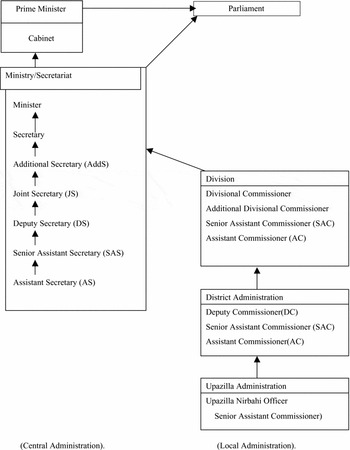
Of note, parliament can have control over both politics and bureaucracy. Constitutionally, the executive body, which is the part of politics, is liable to the legislature. Another explanation is that ministers must take responsibility for whatever happens inside their ministries and subordinate departments. Government officials are accountable to ministers through the departmental hierarchy, who, in turn, are responsible to parliament (Aucoin and Jarvis Reference Aucoin and Jarvis2005: 58). This can be understood from Figure 1, which shows how government officials in Bangladesh are accountable to parliament through ministers.
Hierarchical accountability in Bangladesh
Source: The figure has been developed by the author.

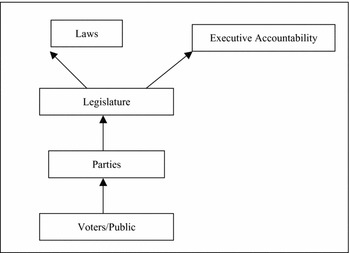
Accountability is central to representative democracy, in which the public deserve democratic control over the government and public servants. From the above discussion, it is evident that both ministers and civil servants come under the scrutiny of a vigilant parliament and, through parliament, the electorate. As seen in Figure 2, voters are entrusted with electing MPs through election. MPs discharge law-making and accountability functions in the House as public representatives, and, in this way, government comes under the influence of the public/voters. MPs receive feedback from the public on their performance in elections. Especially, parliamentarian's drive to be reelected establishes the relationship of accountability between the politician and the electorate.
Electoral accountability
Source: The figure has been developed by the author.

Aucoin and Jarvis argue that parliament's ability to hold the government and the public servants accountable mostly depends on its political capacity, which is determined largely by the extent to which the government dominates parliament (Aucoin and Jarvis Reference Aucoin and Jarvis2005: 9–10). In a single-party majority government, where party discipline is high and party leadership structure gives the Prime Minister considerable dominance in his/her party, parliament losses its capacity to hold government accountable to it. The important questions when exploring the impact of the party on the legislature's autonomy and viscosity are: (a) How organized are parties in parliament and how much freedom do they permit in relation to voting and speaking? (b) If they do not conform to the party line, are they punished? (c) Are MPs allowed to cross the floor? Are parties controlled by leaders who manipulate the actions of party rank and file? (d) How do party leaders control the agenda of the House? One may find the answers to the questions by examining the electoral politics and party organization of a country.
Electoral politics, party organization, and parliamentary behavior in Bangladesh
A close look at the electoral process and political system prevalent in Bangladesh would reveal some major cleavages. Power structure dominates the country's electoral politics and major political parties. Electoral contests are generally won with the influence of money. As per election rules a candidate cannot spend more than TK (Bangladesh's currency) 500,000 ($1 = 68 TK. approx.) in a parliamentary election. Dr Abul Barkat, a respected economist in Bangladesh, said that in the last general election, 75% of the candidates spent huge sums of money, ranging from Tk 1 crore (or about US $ 1.5 million) to Tk 28 crore (or about US $ 42 million) to win the election (or 20 times the limits established by the election rule) (Daily Star, 30 May 2005).
From the British experience, Cox has said, ‘Electoral organization is dominated by the parties rather than by individual candidates, and it is for parties rather than individual candidates that British voters are generally thought to vote’ (Cox Reference Cox1987: 3). Mayhew (Reference Mayhew1974: 18) also argues that parties are the prime movers in electoral politics. Elections in Bangladesh are highly party-centric. The author's survey on voting behavior of people in rural areas prior to the 1996 parliamentary elections found that a great majority of voters had little information about the candidates beyond their names and party affiliation. In many cases, they could not even name the candidates and decided to vote for either of the two biggest parties. Theoretically, in a more party-oriented electorate, party cohesion becomes apparent in parliament (Cox Reference Cox1987: 143). If party cohesion dominates the legislature for an extensive period of time, the House and its committees may become extraordinarily weak (Shaw Reference Shaw, Lees and Shaw1979:247).
Bangladesh is the most extreme case where, constitutionally, MPs have been placed under all-pervasive party control. They cross floor or go against party decision in the House only by risking their membership in the House. Article 70 of the Constitution states: ‘A person elected as a Member of Parliament at an election at which he was nominated as a candidate by a political party shall vacate his seat if he resigns from that party or votes in Parliament against the party’ (GPRB 1996).
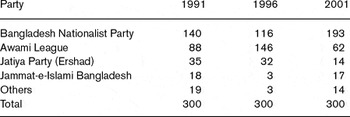
The results of the previous three parliaments (Table 1) indicate that the Bangladesh Nationalist Party (BNP), Awami League (AL), Jatiya Party (Ershad), and Jamat-e-Islami Bangladesh (JIB) are the major parliamentary parties. However, of the four parties, BNP (1991–96, 2001–06) and AL (1996–2001) have ruled the country since 1991. The last BNP government maintained a coalition with JIB, even though it had an absolute majority. There is a serious lack of democracy inside party politics. As a survey conducted by ORG-Quest Research shows, 71% people believe that political parties in Bangladesh lack democratic practices (Prothom Alo, 14 July 2006). Party decisions are highly centralized and the leadership has been manipulated by the party leader. For example, after the death of Sheikh Mujibur Rahman (one of the founders of AL) Sheikh Hasina became the leader of the AL, and after the death of Ziaur Rahman (the founder of BNP) Khaleda Zia became leader and still holds the position. Ahmed said, ‘These two leaders are not always elected by their party's rank and file, nor do they owe any responsibility to them. Both appear to function outside of the control of their parties; the lack of internal democracy seems to have granted them a power close to omnipotence . . . everyone is expected to follow the lead of the supreme leader without seeking any clarification. Those who refuse to abide by the despotic decisions of the leadership risk suspension or expulsion and, in extreme cases, may lose their membership in the parliament’ (Ahmed Reference Ahmed2003a: 72).
Positions of parties in the House (1991, 1996, and 2001)

Source: Election Commission Secretariat, Dhaka, 2001. Calculations have been made by author.
As party leaders, they have considerable control over the party's decisions and nominations of candidates in parliamentary elections (Bowler, Farrell and Katz 1999: 11). As per Carey and Shugart's (Reference Carey and Shugart1995: 420–423) electoral formulas party leaders control nominations, leaders have maximum control over ballots, and voters choose among parties rather than individual candidates. The nominations in Bangladesh are decided in the central committees of the parties where the leaders play the most influential role, even though these days constituency opinion is taken into account. Thus, through the nomination process, central leadership exerts control over candidates. Voters cast a single vote for one party. As Bangladesh follows a single seat system, theoretically voters should vote for the person and not the party, but they vote for party and rarely opt for individual candidate. In this situation, party reputation is high and a candidate generally adheres to his/her party's election manifesto. For all practical purposes, without party endorsement, an individual's chances of winning an election as an independent is almost negligible, which greatly puts supporters under strong party influence.
Party members, who aspire to contest for parliament elections must stick to party decisions. Moreover, for career advancement, they also have to be loyal to the party leadership who distribute the central party posts, and, when in power, decide cabinet members. The organizational hierarchy of the major political parties parallels the administrative hierarchy of the government-division, district and thana levels. Central leadership controls the rank and file politicians through this hierarchical channel. Nevertheless, as party decisions are highly centralized and local and national party associations are loyal to the central leadership, the leadership acquires effective control over their MPs and rank and file politicians.
The strong influence of Party Leaders over their MPs in Bangladesh has been strengthened further by the constitutional arrangements and the Rules of Procedure of Parliament (hereafter, the Rules). The Speaker is the chief man in agenda setting in the House following the Rules. In many established democracies, the Speaker resigns from the party after being elected Speaker and thus maintains neutrality. In Bangladesh, he is very loyal to the ruling party as he has been elected from that party and retains his membership even after he assumes office. Thus, party/party leader can control the agenda of the House through him. Opposition parties in Bangladesh regularly complain that the Speaker is not neutral and acts as a member of the ruling party. Constitutionally, the Prime Minister of Bangladesh is both the head of the respective party and parliamentary leader in the House. Using this dual power, the Prime Minister of Bangladesh exerts all pervasive control over his/her party politicians and MPs. To reiterate, the Prime Minister decides on the cabinet; the tenure of a cabinet member solely depends on his/her wish. Thus, the constitution of Bangladesh has put excessive power in the hands of the executive. Rahaman (Reference Rahaman2006–07: 21) suggests that following the British parliamentary system, the Prime Minister of Bangladesh should leave either party presidency or House leadership.
Bangladesh opted for parliamentary democracy at its independence in 1972. A new constitution for Bangladesh came into effect on 16 December 1972, which provided for a 300- member unicameral parliament, known as Jatiya Sangsad (JS). However, in January 1975 the ruling AL replaced the multiparty parliamentary system by a one–party presidential system amending the constitution through a fourth amendment. The amendment threatened the interests of all articulate segments of the country, including opposition politicians, journalists, and civil society etc. (Hakim Reference Hakim2000: 44). In a nutshell, the amendment had the following consequences on the growth of parliamentary democracy: (1) the JS was marginalized by a totalitarian semblance; (2) the president became all powerful; (3) the judiciary fell short of independence; and (4) single party rule was established. In fact it was an attempt by the AL to handle the opposition systematically (Hasanuzzaman Reference Hasanuzzaman1999: 55). Sheikh Mujibur Rahman, then president, was assassinated in the same year and the country experienced autocratic military rule until 1991, when it re-introduced parliamentary democracy through mass revolution and by the enactment of the twelfth constitutional amendment. It is noteworthy that all the political parties agreed to adopt the parliamentary system of government.
One may wonder why the system is organized the way it is and who benefits from it. Historically, the people of Bangladesh were in favor of democracy. They supported movements for democracy during British and Pakistan periods. The leaders of the newly independent country had no alternative but to opt for parliamentary democracy, as this was the peoples’ desire, and was reflected in the 1970s national and provincial parliamentary elections. Ahmed observed, ‘Although Bangladesh experimented with other systems of government in the past, none could attract public and political affection to the extent that the Westminster system has’ (Ahmed Reference Ahmed, Norton and Ahmed1999: 40). It was hoped that parliament would become the centre for administering state affairs. The Constitution declared that all power in the Republic belongs to the people (GPRB 1996). So, the core argument for organizing the system was that people would have ownership. Hence, the government would be accountable to the people. As it adopted the single seat system, the people would have the opportunity to evaluate the role of MPs. Parliament would be the prime state organ to build a bridge of accountability between the electorate and the government.
Disappointingly, the people's desires have not been reflected in parliamentary behavior. Mayhew (Reference Mayhew1974: 17) argues that public representatives use their power, not for the advantage of the community, but for their own advantage. Congressmen in America, for example, he argued, engage in three kinds of electoral activities – advertising, credit claiming, and position taking. Similarly, Downs (Reference Downs1957: 28) said that party members act to attain the income, prestige, and power that come from being in office. Bangladeshi representatives also demonstrated the same behavior, where MPs engaged in business and attempted to reap benefits from the state whenever they could. ‘I never thought how profitable being an MP was’Footnote 2. He further added that politicians in Bangladesh have a tendency to achieve lifetime earnings in one parliamentary term (five years). Under this situation one can easily imagine that MPs rather than people, benefit from the system.
However, in recent years, growing debate on corruption in the public sector and on administrative lapses has been visible. On 8 June 2006, parliament heatedly discussed corruption in the Education Ministry (Ittefaq, 6 June 2006) and witnessed a commensurately lively debate on a recent published draft voter list when opposition lawmakers demanded cancellation of the fake list (Daily Star, 9 May 2006). Different parliamentary standing committees have raised allegations of irregularities and corruption in the activities of at least 20 out of the 39 ministries (Daily Star, 8 November 2003). These can be seen as important developments in parliamentary accountability.
Enforcing parliamentary accountability
Like many parliaments adopting the Westminster system, the Rules include various parliamentary devices, known as ‘techniques’, to check government activities. These techniques can be divided into two categories, individual techniques and collective techniques. This section deals with individual techniques of parliamentary accountability.
Individual techniques
The Rules (41–71) describe various individual techniques that include: questions, short notice questions, half-an-hour discussion, motion for adjournment on a matter of public importance, short discussion, and call attention motion (BJS 2001: 15–24). Generally the first hour of every sitting is available for asking and answering questions, provided that there shall be no question hour on the day the budget is presented. Rule 60 provides MPs with the opportunity to ask for a half-hour discussion on a matter of public importance, which has been the subject of a recent question, and the answer to which needs clarification on a matter of fact. Provisions also exist (Rule 61–67) for a motion of adjournment of the business of the House for the purpose of discussing a definite matter of recent and urgent public importance with the consent of the Speaker. However, Rule 63 prevents dealing with any matter that is under adjucation by a Court of Law and on the conduct of the President and Judge of a Supreme Court. Rule 68–70 provided for discussion on matters of urgent public importance for a short duration, the time for discussion to be determined by the Speaker. According to Rule 71, any MP may, with the previous permission of the Speaker, call the attention of a Minister to any matter of urgent public importance and the Minister may make a brief statement or ask for time to make a statement at a later hour or date, provided that no member shall give more than one such notice for any one sitting.
Impact of individual techniques
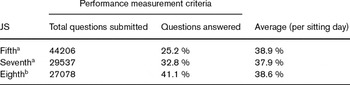
In practice however, these various devices do not appear to be sufficient to ensure responsible government. Table 2 presents the performance of questions in different parliaments of Bangladesh since 1991. The table shows that only 25.2%, 32.8%, and 41.1% of questions were answered in the Fifth, Seventh, and Eighth JS respectively. Alternatively, a large portion of the questions were lapsed/rejected/returned/withdrawn. However, the percentage of answered questions increased gradually, and more questions were answered in the Eighth JS (41.1) than the Fifth (25.2) and Seventh (32.8) JS. The quality of the questions, however, is unsatisfactory. Lawmakers ask questions mostly concerning their respective constituencies.
Comparative performance of JS: parliamentary questions

Sources:aAhmed Reference Ahmed2003, p.112, 114.
bBJS (Bangladesh Jatiya Sangsad), Law Section-1 (October 2001–June 2005). Dhaka: Parliament Secretariat 2006. Calculations have been made by the author.
Table 3 categorizes the questions asked in the Eighth JS. The highest numbers of (40.77%) questions were asked of matters relating to the MP's constituency. Although the second highest number (39) of questions concerned national issues, no questions were found seeking clarification on administrative lapses. On the other hand, 29.23% of the questions were placed in the House to inquire about government steps on different issues. These were instrumental in opening up the government, though not much.
Classification of questions in the present JSa

Note: aBased on 130 sample questions.
Source: BJS (January 29 2006–January 31 2006), Dhaka: Parliament Secretariat 2006. Calculations have been made by the author.
Referring to the questions, Aminuzzaman (Reference Aminuzzaman1996: 17) observes that they are not often directed at the critical issues and problems that affect public life. He argues that the modes of parliamentary questions are merely informative and explanatory – that they overlook the critical dimensions of organization, management and behavior of the public administration system in Bangladesh.
There is a debate over the issue of question's effectiveness. From the British context, Brazier said, ‘Question time is however, more of an entertaining diversion than a method of parliamentary control of or influence over the government’ (Brazier Reference Brazier1994: 214). Conversely, Ahmed (Reference Ahmed2000: 21) argues that questions have relatively more prominence than other individual parliamentary devices. From the Canadian perspective, Aucoin (Reference Aucoin2006: 21) stated that the Canadian system of accountability has some real strengths: an effectively designed Question Period is one of them. Wiberg (Reference Wiberg and Doring1995: 180) mentioned that questions to ministers is a means of eliciting information about matters within their official responsibility and is one of the celebrated functions of parliaments. In Bangladesh, traditionally, MPs seek information from the government on various issues through their questions. So, the method is still important. The best use of this parliamentary method depends on the expertise of MPs. It should be noted here that the parliamentarians of Bangladesh have been seriously handicapped due to the shortfall of materials (office, logistics for example computer, and modern research library) and in human resources (research aids). As a result, they find it difficult to use the parliamentary methods of accountability effectively.
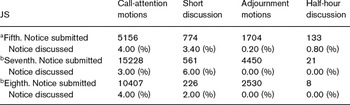
Through their motions, MPs seek clarification on administrative failures/policy lapses (if any). Table 4 shows the status of motions since 1991. Most disappointingly, no adjournment motions were accepted and half-hour discussion took place in the Seventh and Eighth JS, which indicates a real failure in the methods. Discussion on call-attention motion and short discussion were also very marginal. Ahmed observes that one reason for not accepting the motions may be that the government probably does not want to expose weakness to parliament and the public (Ahmed Reference Ahmed2003b: 117).
Status of motions: comparative performance

Sources: aAhmed Reference Ahmed2003, pp.112–13.
bBJS, Law Section-1 (Dhaka: Parliament Secretariat 2006). Calculations have been made by the author.
Questions and motions, however, face constraints that originate from the Rules. Motions have to satisfy a number of conditions before being accepted. All the motions must meet the Speaker's satisfaction and consent before their placement before the House for discussion (BJS 2001: 21). Most importantly, there is no provision to compel a minister to answer a question. The ultimate fate of a question depends greatly on both the Speaker's satisfaction and the minister's consent to address it.
To sum up, individual methods are seemingly ineffectual with respect to parliamentary surveillance over administration, and will only be useful when their acceptance rate is increased and MPs use them efficiently.
The role of parliamentary committees in enforcing accountability
Today, it is widely agreed that the impact a legislature has is crucially dependent on its committee arrangements (Shaw Reference Shaw1998: 229; Blondel Reference Blondel1990: 249). Thomas Brackett Reed, the then minority leader of the US House of Representatives, referred to the House committees as, ‘the eye, the hand and very often the brain of the House’ (Shepsle and Weingast Reference Shepsle, Weingast and Philip1998: 233). This section gives an idea about the formal structure, power, and functions of parliamentary committees in Bangladesh, and tries to assess their role in enforcing accountability.
Committee system in Bangladesh
In Bangladesh, parliamentary committees are derived from two sources: the Constitution of the People's Republic of Bangladesh and the Rules. In the JS, there are three types of committees: standing committees, special committees, and select committees. While standing committees are permanent, special and select committee are temporary. The number of general standing committees, eight, and financial committees, three, are fixed by the Rules but the number of Standing Committees on Ministries (SMCs) differs from time to time. The Eighth JS had 37 such committees, whereas the Fifth and Seventh had only 35.
Generally speaking, the number of members of the different committees in Bangladesh varies. With the exception of the Business Advisory Committee (15 members), Committee on Government Assurance (eight members), and Public Accounts Committee (PAC) (15 members), every SMC, two financial committees – Estimate Committee (EC) and Public Undertaking Committee (PUC) – consist of not more than ten members, including the chairman. Members, including the chairman, are appointed by the House, provided that a minister is not the chairman of the committee (Rule 247 (2)). If a member, after being elected as chairman under sub rule (2), is appointed as minister, he shall cease to be the chairman of the committee from the date of such appointment (Rule 247 (3)). On the other hand, the house decides on the number of members to be appointed to a select committee. Experience shows that the membership of committees in Bangladesh is generally distributed among different parties in proportion to their strength in the parliament, and the ruling party has traditionally claimed the chairmanship of the different committees.
A committee has the power to send for persons, papers, and records, if it deems necessary. It is empowered to take evidence. SMCs have vast powers to examine and inquire into irregularity and serious complaints with respect to the ministries, and to make suggestions on improving them. The PAC is empowered to examine the accounts and show the income and expenditure of autonomous and semi-autonomous bodies. It can also report to parliament on the irregularities and lapses of different institutions of government with recommendations for remedial measures (Rule 233). The EC plays a role in this respect by examining whether the money is appropriated within the limits of the policy implied in the estimates (Rule 237). The PUC can examine whether the affairs of the public undertakings are being managed in accordance with sound business principles and prudent commercial practices and report to parliament on the irregularities and lapses of the public undertaking and recommend measures to free the institutions of corruption (Rule 238 (C)).
Measuring committee activism
There are several ways of measuring committee activism. Some of the more important measures in this regard are: the frequency at which committee meetings are held; the regularity of members’ attendance; the number of hours spent on deliberation (Ahmed Reference Ahmed1997–98: 31); the permanency of the committees (Mezey and Olson Reference Mezey and Olson1991: 15); the committee system structure in relation to government departments; committee jurisdiction; power of committees to set agendas, take evidence, hold hearings, and summon witnesses (Wang Reference Wang2005: 10; Norton and Ahmed Reference Ahmed, Norton and Ahmed1999: 7); and the resources of committees in terms of staff, funds, facilities, official and other instruments (Wang Reference Wang2005: 10; Baerwald Reference Baerwald1986: 97; Norton and Ahmed Reference Ahmed, Norton and Ahmed1999: 7).
Formally, committees in the JS have power to take evidence but rarely employ this power. To reiterate, they have no research support, computer, photocopying machine, printer, etc., which limits their efficacy. Committee jurisdiction is important in the sense that an overlap may create confusion and lead to responsibilities being ignored. Committee functions have been prescribed by the Rules; hence, there is a little scope for overlap of jurisdiction. Agenda setting power of the committees is also a crucial issue of committee activism. In theory, a committee has the power to set its own agenda, regulate its own procedures, and raise any question in line with democratic norms, but practical experience shows a different scenario. Due to the majoritarian system and strong party control, the ruling party controls the agenda and decisions of the committee. The committee chairmen, as a rule, belongs to the ruling party; hence, the party leader has strong influence and control over his/her actions within the committee. The SMC on the Ministry of Communication is a good example of this, and is elaborated upon later. Moreover, party leadership assigns members to different committees and decides who will speak in debates (Norton and Ahmed Reference Ahmed, Norton and Ahmed1999: 51). Sometimes ministers disrupt the committee agenda considerably. For example, the SMC on the Ministry of Agriculture of the Seventh Parliament was once scheduled to discuss the problems and prospects of agricultural education in Bangladesh but the chairman dropped the issue from the agenda later, due to pressure from the minister concerned (Ahmed Reference Ahmed2003b: 156).
It should be taken into account whether the organizational structure of the committee system mirrors that of the cabinet departments. The standing committees on ministries in the Bangladesh parliament exactly parallel different ministries. The underlying reason for establishing these committees was so that they could work as watchdog bodies for the ministries. With a view to enhancing the leverage of these committees, provision was made through the revision of the Rules in June 1997 that ministers should not be chairmen of the committees. It is noteworthy that committees were previously headed by ministers. Empirical evidence showed that the ministers’ presence as chairmen of these committees seriously limited the committees’ role as watchdogs. The reform, however, proves useless today because of the nature of party politics in the House and majoritarian rule. This paper argues that transparency of the committees must have a far-reaching impact on committee activities. There is a serious lack of transparency in committee activities in Bangladesh. As per the Rules, committee sittings must be held in private (Rule 199). As a result, people do not know what is going on in the committees. Also, reports of the committees are not easily accessible to the public.
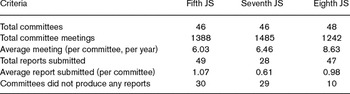
Where committees are permanent, they have better chance to develop expertise. All the standing committees in Bangladesh, which are entrusted with enforcing accountability, are permanent in nature, but are not expert enough to grip the governmental irregularities owing to the irregularities in conducting meetings and not enough time being devoted to them. Table 5 shows that committees in the Fifth, Seventh, and Eighth JS hold on average 6.03, 6.46, and 8.63 meetings a year (per committee). But the Rules require that committees meet at least once a month. An irregular committee cannot be presumed to be an effective tool of parliamentary oversight.
Performance of the standing committees in the Fifth, Seventh, and Eighth JS

Source: BJS, committee Section 2 (Dhaka, Parliament Secretariat 2006). Calculations has been made by the author.
Committees show even worse performance in submitting reports. On average, committees submitted 1.07, 0.61, and 0.98 reports during their tenure of office of the Fifth, Seventh, and Eighth JS and consecutively 30, 29, and 10 committees did not produce any reports. It is unacceptable and undesirable that a committee spends taxpayers’ money but produces no results. Moreover, members show insincerity and reluctance to attend committee meetings. For example, on average about 55% of members attended the committees in the Eighth JS.Footnote 3
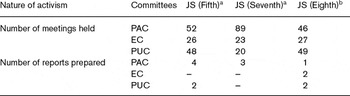
Performance of financial committees is also gloomy (Table 6). There is a feeling of regret that the EC did not prepare any reports in the Fifth and Seventh JS. The PUC also failed to prepare any reports in the Seventh JS.
Performance of the FCs in the Fifth, Seventh, and Eighth JS

Sources: aWB 2000, p.18.
b BJS, Committee Section-2, (Dhaka: Parliament Secretariat, 2006). Calculations have been made by the author.
Impact of committees: a case study on the Fifth, Seventh, and Eighth JS
Although committees do not meet on a monthly basis, submit reports to the house, or regularly hold meetings, this does not necessarily mean that the committees are unimportant. The study found that committee activism is full of successes and failures, which have been described in this section, although the list is not exhaustive.
Fifth Parliament (1991–1996)
Success case The PAC identified a huge gap between budget expenditure and actual expenditure in almost every organization (Ahmed Reference Ahmed2003b: 149). It found that almost all organizations spent more than the amount originally approved by Parliament. It also disclosed a total of 1,159 audit objections (Ahmed Reference Ahmed2000: 90).
Seventh Parliament (1996–2001)
Success cases Following the recommendation of the PAC, 2.3 billion taka (about $41 million) has been recovered to the exchequer, and 9.3 billion taka (about $169 million) has been adjusted (BJS: 2001: 19). The PEC identified large-scale corruption and embezzlement of funds in the execution of a 1.23 billion taka ($22 million approx.) Environmental Development Project (EDP) undertaken by Dhaka City Corporation (DCC) (WB 2000: 21). Another success of the committee was the decision of the Titas Gas Transmission System to make gas connections in 15 days in response to the recommendation of the PUC (Rashid Reference Rashid2003: 11). Previously it used to take at least six months to have gas connected without a bribe.
The Health Committee (HC) accused civil surgeons (CSs), who were in charge of procuring medical accessories, furniture, and fittings for hospitals, of misappropriating Tk. 20 crore in buying medical and surgical equipment. Following the recommendations of the HC, a number of civil surgeons were removed (WB 2000: 23, 29).
Failure cases The SMC on the Ministry of Posts and Telecommunication (P&TC) alleged irregularities in awarding contracts for the installation of 189,000 digital telephone lines. Some committee members suggested suspending the project work until committee deliberation over this issue. Due to the concerned minister's reluctance, the committee failed to take any decisions over the issue (WB 2000: 24). The PEC identified gross irregularities in accepting a Tk. 1 billion tender by the Health Ministry. A three-member subcommittee headed by the State Minister for Health recommended canceling the tender order and re-tendering it. Surprisingly, defying the recommendation, the Health Ministry authorized the original bidder (Ahmed Reference Ahmed2003b: 157).
The SMC on the Defense Ministry identified a serious irregularity in the purchase of a number of MIG-29s by the Air Force from Russia. The opposition party members of the committee were serious on the issue but failed to deal with the irregularity.
Eighth Parliament (2001–2006)
Success cases The Energy, Power, and Mineral Resources Ministry decided to give a work order to an American company to implement the Meghnaghat-3 electricity production project. The SMC on the ministry discussed the matter seriously and recommended implementing the project through open tender. Iqbal Hasan Mahmood, State Minister for the ministry, agreed to implement the committee recommendation as the committee members unanimously pressed the Minister (Jugantor, April 26 2005).
The PAC disposed of 149 audit objections raised against 15 ministry/departments in its first 25 committee meetings and due to committee pressure Taka 63.77 crore has been recovered to the exchequer and 61.66 crore have been adjusted ((BJS 2005: 5).
Failure cases The SMC on the Ministry of Communication discussed allegations of corruption in imports and distribution of Comprised Natural Gas (CNG) auto rickshaws. The committee took a tough stance on the issue and formed a four-member subcommittee. The subcommittee was given one month to submit its report. Unfortunately, it failed to submit a report by the end of the Eighth JS (BJS 2006a).
From the above case studies, it is evident that the PAC appeared to be active in enforcing parliamentary accountability. One of the opposition MPs referred to the presence of skilled parliamentarians as members of the PAC and the good understanding between them as one of the most important reasons for its success (Khaliquzzaman Reference Khaliquzzaman1999: 47). As a senior and skilled parliamentarian, the chairman of the committee in one meeting succinctly remarked, ‘We won't compromise with corruption’ (BJS 2005: 5). Moreover, in the audit reports, indisputable irregularities were found. Hence, the committee attacked the defaulters easily.
Generally speaking, committees achieved success in those cases where committee members worked assiduously for the sake of committee effectiveness, independent of party politics. The success case of the Eighth Parliament (in regard to SMC on the Ministry of Energy, Power, and Mineral Resources) is a good example in this respect. Sheikh Fazlul Karim Selim, who belonged to AL (opposition party), first raised complaints against the implementation process of the Meghnaghat-3 electricity production project. Ilias Ali and Md. Nazim Uddin Alam, who belonged to the BNP (ruling party) supported him. Because of the harmony among opposition and ruling party members, the committee was seen to effectively discharge its assigned mandate. State minister's sober mentality to respect the committee recommendation was also important for this success.
Conversely, committees failed in those cases where party politics played the dominant role. For example, it seemed that upon the insistence of the chief whiff (an important figure of the ruling party in the House), the chairman of the SMC on the Ministry of Defense of the Seventh JS withdrew the issue of MIG-29 (Ahmed Reference Ahmed2003b: 155). Similarly, in the case of the SMC on the Ministry of Communication of the Eighth JS, the chairman of the committee was reportedly criticized at the highest level of the ruling party for playing an active role in the matter (Jugantor, 2 April 2006).Footnote 4
A committee's ultimate success lies in the implementation of its recommendations. Successes of the PUC and the HC of the Seventh JS are the best examples of giving due care and caution to committee proposals by the concerned authorities. Careful observation of these cases further reveals that the results of the committees’ decisions neither went against party politics nor any high profile party politician. This was one of the most important factors for which concerned authorities implemented the recommendations. Both Post and Telecommunication (P&TC) and PEC of the Seventh JS failed because of the defiance of its recommendation by the concerned minister and the ministry respectively.
However, considering these facts as well as the author's observations, this paper lists a number of factors that hinder parliamentary oversight activities in Bangladesh that have been discussed categorically in the following section.
Factors affecting parliament's accountability function
Lack of political commitment
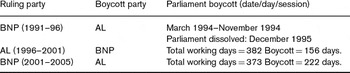
Lack of political commitment is the prime cause of parliamentary failure in ensuring the accountability of the government. Since the re-inception of parliamentary democracy in 1991, a political culture born of the opposition's boycotting of parliament (Table 7) has created a serious obstacle in making parliament effective. In turn, this has made the government basically uncontrolled and unresponsive. Conventionally, it is the opposition that has the incentive to oversee the government. The more government incompetence and corruption is revealed by the opposition, the better their chances of winning in the next election.

Nonetheless, to play an active role, opposition needs both scope and be willing to use the opportunity. Regrettably, oppositions’ amendment proposals are rarely honored and they are given little time to speak in the House. For example, no opposition amendment proposals were accepted in 2004 (TIB 2005). Ahmed observes, ‘Unlike other democratic systems, where the opposition is at least listened to, if not always consulted, the government in Bangladesh generally looked upon the opposition with suspicion’ (Ahemd Reference Ahmed1997: 90). Opposition is also responsible as for this situation as it does not criticize the government constructively.
Nevertheless, MPs are not regular in parliamentary sittings and in committee meetings. For example, the Eighth JS witnessed a severe quorum (presence of at least 60 lawmakers in the House) crisis almost every day in 2004. Of the total 43 working days of the House in 2004, only three began on time (Daily Star, February 24 2005). Irked by the absence of the party lawmakers in the House, the then Prime Minister at a meeting of the BNP parliamentary party threatened her party lawmakers with dissolution of the parliament if they did not attend the sessions regularly.
Constitutional provision and party control
As mentioned earlier, Article 70 of the constitution actually prevents MPs from voting against the party and defying party directives. The members are expected simply to listen to what is discussed in committee rooms and to follow their party's direction. The reality is that unless parties allow members to regulate their behavior to a certain extent (permitting to engage a free discussion and criticism of government/their respective party decision, voting in accordance with their choice except floor crossing), the House and its committees are unlikely to be very successful.
Non-cooperation of ministers
This is a serious obstacle to committee success. If a minister absents himself, boycotts the committee meetings, or opposes any policy or issue of a committee, the committee can rarely do anything about it. For example, the chairman of the committee on the Ministry of Power, Energy, and Mineral Resource noted that as the parliamentary committees play an important role in ensuring the transparency and accountability of the government, the presence of the minister is necessary. He lamented on the absence of the concerned state minister in one of the committee meetings (BJS 2006b: 34). The SMC on the Ministry of Communication of the Eighth JS showed a reluctance to deal with a corruption issue due to minister's threat of boycotting committee meetings.Footnote 5
Non-cooperation of ministry/bureaucrats
It is a common claim against ministries that they do not always make available important documents. For example, the Energy and Mineral Resources Committee in its first meeting, directed officials of the ministry to produce by the next meeting copies of all production sharing contracts (PSCs) for the exploration of natural resources, yet the officials did not respond favorably to its directives (Ahmed Reference Ahmed2003b: 154).
In one committee meeting, the chairman of the committee on the Ministry of Science, and Information Technology of the Eighth JS mentioned that the ministry took two months writing a letter on anti-corruption to the bureau seeking some documents, even though the secretary pledged that it would collect documents within 15 days (BJS 2006c: 43).
Lack of recommendation enforcing power
While most democracies usually honor committee recommendations, Bangladesh does not give due consideration to them. In India, for example, according to one estimate, nearly three-fourths of the recommendations are generally accepted and implemented. Similar situations also exist in Australia and Canada (Ahmed Reference Ahmed2004: 4–5). Abdul Mannan MP, chairman of the SMC on Agriculture of the Eighth JS, mentioned that ministers do not take the recommendations of the committees seriously; instead, he insists, they show some kind step-motherly or step-brotherly attitude (Mannan Reference Mannan2004: 9). This happens due to the fact that committees lack any formal authority to enforce their recommendations.
Lack of necessary resources
MPs have neither staff support not adequate logistics. Committees are also seriously handicapped due to the shortfall of resources. The committee wing of the Bangladesh Parliament Secretariat is divided into 15 sections. Each section is composed of one Assistant Secretary/Committee Officer and four other personnel who work under the supervision of a Joint Secretary/Additional Secretary through four deputy secretaries (DS) of the wing. Therefore, it is evident that committees have no research staff or policy aides. Interviews with some committee officers noted that they lack furniture, fax machines, computers, printers, etc. In the Eighth JS, however, some materials – for example, for each section, two almirah, and for each DS office one almirah photocopying machine and a fax machine have been provided from the Strengthening Parliamentary Democracy (SPD) project. One committee officer succinctly mentioned that the SPD equipped the office of the committee chairman, but committee sections were more important because that is where the real work is done.
Absence of provisions for follow-up discussions
The ministers in India submit action-taken reports to parliament, providing details of the progress of implementation of the recommendations of various DPCs, and explaining the reasons for delay or rejection if any. This action shows the real accountability of the executive to the parliament (Ramacharyulu 2003: 148). Bangladesh has no such practice.
Limits of budgetary control
One of the important ways of enforcing accountability is to oversee the way government raises and spends public money. Budget is the prime source of government's financial policy. While in many countries, for example New Zealand, Nepal, Japan, and Germany, budgets are scrutinized by committees, Bangladesh defies such established norms. The budget process in Bangladesh does not allow any parliamentary scrutiny of financial/expenditure proposals before these are actually passed, thus limiting parliament's ability to exercise accountability in fiscal matters.
Policy recommendations
Considering the above-mentioned factors, this paper puts forward the following policy proposals for making parliament in Bangladesh more effective in discharging its duties:
(1) Rules of Procedure of Parliament must be changed to upgrade the rights and status of the opposition parties in the House.
(2) There should be some guidelines so that the Speaker of the House may not be able to reject adjournment motions frequently, as currently is the case. One day in every 15 should be set aside to debate issues raised by opposition members.
(3) Provisions should be made requiring that ministers must reply in good faith to the questions raised by MPs. There may be a rule that ministers can be questioned without prior notice as in Australia and Canada.
(4) Article 70 needs to be declared null and void or at least needs revision with a view to lessening tight party control over MPs by their respective parties.
(5) Committees should have the power to ensure a level of compliance with their recommendations. Rules may be added requiring that government must respond to committee recommendations within a specific time limit, following Australia. A system of evaluating the level of compliance and the status of recommendations should be implemented.
(6) Following examples in the USA, Japan, and India, the Rules need to be amended requiring that the House and committee review and scrutinize budget proposals and financial bills.
(7) Following Britain, Japan, Germany, and India, rules should be made providing for the appointment of a chairman in at least some financial and oversight committees from the opposition MPs.
(8) Ministers’ should be excluded from the meetings. If the committee deems it necessary for the sake of investigation or any other purposes, ministers could be present in the committee upon the request of the committee. Japan is a good example in this regard.
(9) As MPs and committee members lack adequate research and other support, each MP should be given an office, a computer, a member of staff with computer literacy, and a small fund to collect information and prepare briefs for facilitating the discharge of his/her responsibilities. Each parliamentary committee should have adequate equipment and funds for secretarial support and study relating to its responsibilities.
(10) Committee meetings should be broadcast for the public. A data bank, publicly accessible, for evaluating the level of compliance and the status of recommendations should be developed.
(11) Following the example of Japan, public hearings should be made compulsory.
Conclusion
The assessment of the role of the Bangladesh JS in promoting good governance shows considerable discrepancies between its expected role and practical performances. Between individual and collective techniques, the latter performed better than the individual. The reasons for this, the study found, are mainly the following: first, committees have the built-in advantage of being smaller bodies with greater time available to them to examine an issue in detail; second, committees are occasionally able to operate on a non-partisan basis, although this has not yet become the norm; and third, very few motions are moved and discussed in the House.
It is apparent that committees achieved success in some cases when high profile policy makers were not involved. Nonetheless, committees were in a more difficult situation when dealing with corruption cases where powerful persons were involved. In fact, electoral politics and party system hinge upon the parliamentary behavior. The manipulation of party power by the top leadership has made parliament weak and fragile, which, in turn, strengthened the hands of executive body. As the government dominates over the JS, it, therefore, lacks the proper checks and balances a strong parliament could provide. There must be a balance of power between these two organs for accountability to be effective.