INTRODUCTION
The family Carcharhinidae comprises at least 56 described species (Ebert et al., Reference Ebert, Fowler and Dando2013), of which 26 have been confirmed from Indian waters (Akhilesh et al., Reference Akhilesh, Bineesh, Gopalakrishnan, Jena, Basheer and Pillai2014). The sandbar shark, Carcharhinus plumbeus (Nardo, 1827), is a wide-ranging large coastal shark found in warm and temperate seas and inhabiting continental and insular shelves, as well as deep waters adjacent to them (Compagno, Reference Compagno1984). The sandbar shark is usually common in the areas where it occurs (McElroy et al., Reference McElroy, Wetherbee, Mostello, Lowe, Crow and Wass2006; Ellis & Musick, Reference Ellis and Musick2007), often found in coastal waters, and utilizing bays, estuaries and shallow near-shore habitats as nursery areas during the first few years of its life (Compagno, Reference Compagno1984; National Marine Fisheries Service, 1991). Some populations of sandbar sharks across the world have shown significant declines due to fishing pressures and their conservative life history traits (slow growth, late maturity and low fecundity) (Musick et al., Reference Musick, Stevens, Baum, Bradai, Clò, Fergusson, Grubbs, Soldo, Vacchi and Vooren2009). Therefore, this species is categorized as Vulnerable globally based on the IUCN Red List of Threatened Species criteria (Musick et al., Reference Musick, Stevens, Baum, Bradai, Clò, Fergusson, Grubbs, Soldo, Vacchi and Vooren2009).
Recent studies investigating shark diversity in the Arabian Sea and adjacent waters have confirmed the occurrence of C. plumbeus from the Red Sea, northern Arabian Sea, Gulf of Oman and Arabian/Persian Gulf (Henderson et al., Reference Henderson, Al-Oufi and McIlwain2008; Jabado et al., Reference Jabado, Al Ghais, Hamza, Henderson and Shivji2014b, Reference Jabado, Al Ghais, Hamza, Henderson, Spaet, Shivji and Hanner2015; Spaet & Berumen, Reference Spaet and Berumen2015). Records from the Saudi Arabian Red Sea coast indicate that this species is landed but represents less than 1% of sampled landings (Spaet & Berumen, Reference Spaet and Berumen2015). Market surveys along the coast of Oman only documented a 940 mm immature female from Dibba in early winter (Henderson et al., Reference Henderson, Al-Oufi and McIlwain2008). Furthermore, a longlining project captured a pregnant female measuring 2020 mm in total length (TL) and a mature male of 1730 mm TL in Muscat at a depth of 120 m in late spring (Henderson et al., Reference Henderson, Al-Oufi and McIlwain2008). Intensive landing site surveys in the United Arab Emirates (UAE) only recorded 13 C. plumbeus (Jabado et al., Reference Jabado, Al Ghais, Hamza, Henderson and Shivji2014b) while fishery independent surveys captured one female measuring 1800 mm TL along the coast of Dubai at a depth of 20 m (Jabado, unpublished data). Data from the trade in shark species undertaken through the UAE indicates that over 3% of species traded originate from C. plumbeus captured in Arabian Seas and Gulf of Oman waters (Jabado et al., Reference Jabado, Al Ghais, Hamza, Henderson, Spaet, Shivji and Hanner2015). Although the abundance of sandbar sharks in these waters seems to be relatively low compared to other species, specimens of various life history stages are reported throughout the year from the region.
Only one reference to the occurrence of C. plumbeus in Indian waters exists in the published literature on Indian elasmobranchs, with the authors suggesting it appears in pelagic shark catches of tuna longline vessels in offshore waters of the Arabian Sea, but with no further details provided (Pillai & Parakkal, Reference Pillai and Parakkal2000). Yet, in a recent comprehensive review of chondrichthyan diversity in Indian waters, this species was not reported (Akhilesh et al., Reference Akhilesh, Bineesh, Gopalakrishnan, Jena, Basheer and Pillai2014). Here, we present the first evidence of the occurrence of C. plumbeus off western India.
MATERIALS AND METHODS
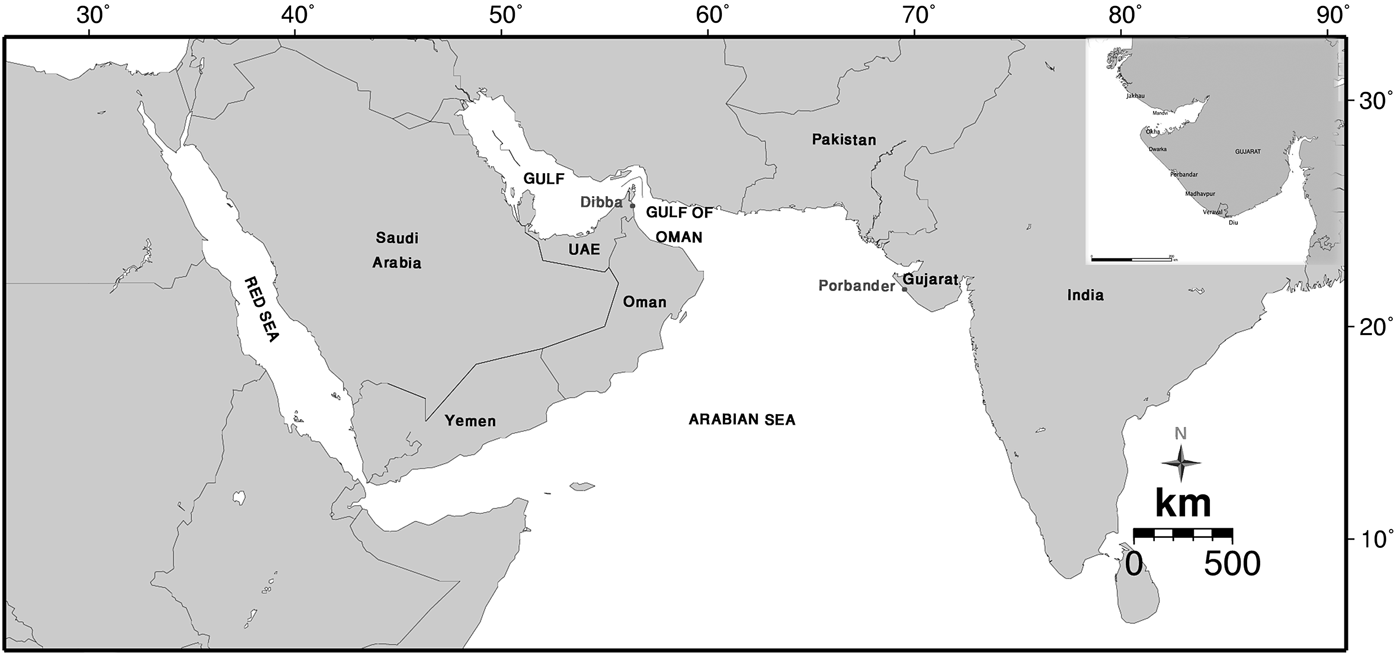
On 23 October 2014, two sandbar sharks, Carcharhinus plumbeus, were landed at the fishing port of Porbander in Gujarat, India (Figure 1). The specimens were caught by a trawl vessel that was out fishing for two weeks, initially operating within a 40 m depth while traveling north, and then in deeper waters west of Dwarka and Jakhau at depths of 80–100 m. The TL (mm) was measured to the nearest centimetre using a measuring tape along the stretched body of the specimen (Compagno, Reference Compagno1984). Sex was determined by the presence or absence of claspers, but no observations were made of the internal organs. Weight was recorded using a circular spring balance.
Map of the region with an inset depicting the location where the Carcharhinus plumbeus specimens were landed.

RESULTS
The identification of the sandbar shark, Carcharhinus plumbeus, was based on the typical diagnostic features of this species as described by Compagno (Reference Compagno1984) (Figure 2).
Carcharhinus plumbeus (Nardo, 1827), female, lateral view, 760 mm TL.
Two specimens, one male and one female, were recorded and measured 610 and 760 mm TL, respectively. The male specimen had partially developed claspers. Although it was not possible to weigh the male specimen, the female weighed approximately 2 kg.
DISCUSSION
This record of Carcharhinus plumbeus, the first from Indian waters and specifically from the western Indian coast, is important in understanding the wide geographic range of this species. It brings the total number of shark species known from Indian waters to 75 and the chondrichthyan species to 156. Records of C. plumbeus from the northern Indian Ocean exist primarily from the Red Sea, the Arabian Gulf and the Arabian Sea (Henderson et al., Reference Henderson, Al-Oufi and McIlwain2008; Jabado et al., Reference Jabado, Al Ghais, Hamza, Henderson and Shivji2014b, Reference Jabado, Al Ghais, Hamza, Henderson, Spaet, Shivji and Hanner2015; Spaet & Berumen, Reference Spaet and Berumen2015) and indicate that this species is either not abundant in this region or has limited interactions with regional fisheries. The latter is unlikely due to the nature of fisheries in the region, which are multi-species and multi-gear (Balan et al., Reference Balan, Sivaraman, George and Ramachandran1987; Jabado et al., Reference Jabado, Al Ghais, Hamza and Henderson2014a). However, it indicates that this species is wide-ranging and that, given the limited capacity in shark identification in the northern Arabian Sea area, it may have been previously landed but misidentified or has gone unreported.
The small size of the two specimens reported here, as well as the non-calcified claspers of the male record, confirms that they were juveniles. In fact, although biological traits of various shark species can vary considerably between different regions of the world (Compagno et al., Reference Compagno2005), C. plumbeus males and females reach maturity at lengths varying between 1080 and 1830, and 1085 and 1490 mm TL, respectively (Stevens & McLoughlin, Reference Stevens and McLoughlin1991; Hazin et al., Reference Hazin, Oliveira and Macena2007; White, Reference White2007). Although information on the exact capture location of these specimens could not be recorded, many of the trawlers off Porbander fish north, west and north-west of Porbandar in waters ranging from 20 to 180 m (Sutaria, unpublished data), reinforcing some of the previous studies on this species that indicate it is generally a demersal species (McElroy et al., Reference McElroy, Wetherbee, Mostello, Lowe, Crow and Wass2006; Ellis & Musick, Reference Ellis and Musick2007).
While this record provides additional information on the occurrence and distribution of the sandbar shark in this region, more data is required to fully understand its ecology and distribution. Furthermore, it reflects the limited knowledge of elasmobranchs in the region. In fact, with new elasmobranch records frequently reported from Indian waters (Babu et al., Reference Babu, Ramachandran and Varghese2011; Kumar et al., Reference Kumar, Khanolkar, Pravin, Meenakumari and Radhakrishnan2012, Reference Kumar, Khanolkar, Pravin, Meenakumari and Radhakrishnan2013; Bineesh et al., Reference Bineesh, Akhilesh, Sajeela, Abdussamad, Gopalakrishnan, Basheer and Jena2014; Sen et al., Reference Sen, Dash and Bharadiya2014), more research on the diversity of these species in this region is warranted.
ACKNOWLEDGEMENTS
We would like to thank the fishermen in Porbander for allowing us to collect information from the specimen and for supporting our research in the area. The Save Our Seas Foundation provided financial support for these surveys through a grant to Dipani Sutaria.