INTRODUCTION
The genus Ascidonia Fransen, Reference Fransen2002 includes small-sized (total length usually less than 15 mm) commensal shrimps living in branchial basket of tunicates, mostly of the genus Ascidia Linnaeus, 1767 (Fransen, Reference Fransen2002, Reference Fransen2006; Baeza & Díaz-Valdés, Reference Baeza and Díaz-Valdés2011). The five presently known species of Ascidonia are distributed in the eastern Pacific (A. californiensis (Rathbun, 1902), A. pusilla (Holthuis, Reference Holthuis1951)), the western Atlantic (A. miserabilis (Holthuis, Reference Holthuis1951)), the eastern Atlantic (A. flavomaculata (Heller, 1864)), and both the eastern and western Atlantic (A. quasipusilla (Chace, Reference Chace1972)). Until now, the western Atlantic range of Ascidonia (A. miserabilis and A. quasipusilla) included the Caribbean Sea and the Gulf of Mexico (Fransen, Reference Fransen2002, Reference Fransen2006; Felder et al., Reference Felder, Álvarez, Goy, Lemaitre, Felder and Camp2009).
The main morphological features of Ascidonia include: (1) the well-developed rostrum, which is depressed and flattened dorsally, and either unarmed or armed with at most one dorsal subdistal tooth; (2) the sharp or blunt antennal tooth merged with the inferior orbital angle; (3) the absence of branchiostegal, epigastric and hepatic teeth on the carapace; (4) the reduced antennular flagella; and (5) the second thoracic sternite strongly produced, forming a plate (Fransen, Reference Fransen2002).
In the western Atlantic, A. miserabilis is the only species having very long spines on the dorsal of the telson, with the tips of the anterior spines reaching the base of the posterior spines (Fransen, Reference Fransen2002). This species was previously known from several localities in the eastern Caribbean Sea and the Flower Garden Banks off Texas, in the Gulf of Mexico (Fransen, Reference Fransen2002, Reference Fransen2006; Wicksten, Reference Wicksten2005).
While collecting ascidians in Atol das Rocas, off north-eastern Brazil, three specimens of Ascidonia, one male and two females (one of them ovigerous), were extracted from three tunicate hosts identified as Ascidia aff. interrupta Heller, 1878 (Ascidiidae) (Oliveira Filho & Paiva, unpublished data). These specimens have been identified as A. miserabilis, a species previously unknown from Brazil. In addition, several specimens of A. miserabilis from Honduras and Panama constitute the first records of this species for the western Caribbean Sea. The Honduran and Panamanian specimens have been photographed alive prior to preservation in ethanol 75%.
The material is deposited in the Museu de Zoologia, Universidade de São Paulo, São Paulo, Brazil (MZUSP), Coleção de Crustáceos da Universidade Federal de Pernambuco, Recife, Brazil (UFPE), and Oxford University Museum of Natural History, Oxford, UK (OUMNH). The post-orbital carapace length (pocl) and (for some specimens) full carapace length (cl) were measured along the dorsal mid-line, from either the basis (pocl) or the tip (cl) of the rostrum, to the posterior margin of the carapace.
SYSTEMATICS
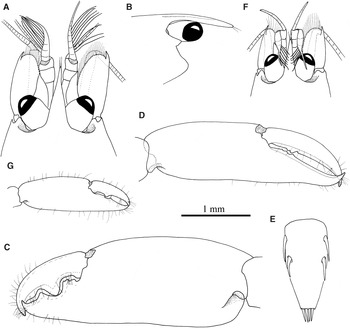
Ascidonia miserabilis (Holthuis, Reference Holthuis1951), male (pocl 1.9 mm), MZUSP 25232: (A) frontal region, dorsal view; (B) same, lateral view; (C) major second chela, lateral (ventral) view; (D) minor second chela, lateral (ventral) view; (E) telson, dorsal view; ovigerous female (pocl 1.5 mm), MZUSP 25232: (F) frontal region, dorsal view; (G) second chela, lateral (ventral) view.

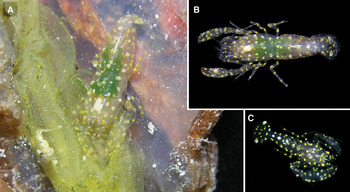
Ascidonia miserabilis (Holthuis, Reference Holthuis1951): (A, B) ovigerous female from Utila, Honduras [OUMNH.ZC. 2007-20-0162], in situ, in the open branchial basket of Ascidia sp. (A), and on black background (B); (C) female from San Blas Islands, Panama [OUMNH.ZC. 2011.02.0020]. Photographs by A. Anker.

Pontonia miserabilis Holthuis, Reference Holthuis1951: 148, pl 47, figures d–i; Chace, Reference Chace1972: 40, 41, figure 9.
(?) not Pontonia miserabilis—Criales, Reference Criales1984: 311.
Ascidonia miserabilis—Fransen, Reference Fransen2002: 227–236, figures 148–154; 2006: 715, figure 1; Wicksten, Reference Wicksten2005: 32, 34.
Pontonia grayi Rathbun, Reference Rathbun1901: 122 (part., not figure 25; see Fransen, Reference Fransen2002).
MATERIAL EXAMINED
Brazil: 1 male (cl 2.8 mm, pocl 1.9 mm), 1 ovigerous female (cl 2.1 mm, pocl 1.5 mm), Rio Grande do Norte, 260 km off Natal, Atol das Rocas, Piscina Barreta Falsa, shallow rocky pool, depth 1.5 m, rock crevices, in solitary ascidians, Ascidia aff. interrupta, leg. R.R. Oliveira Filho and S.V. Paiva, 11 December 2011 [MZUSP 25232]; 1 female (cl 2.0 mm, pocl 1.3 mm), same collection data [MOUFPE 15063].
Honduras: 1 ovigerous female (pocl 2.3 mm), Utila, House Reef, 16°05.236′N 086°54.652′W, depth ~1 m, in solitary ascidian, Ascidia sp., leg. A. Anker and S. De Grave, 8 July 2007 [OUMNH.ZC. 2007-20-0162]; 1 male (pocl 1.0 mm), same collection data (possible mate of previous female) [OUMNH.ZC. 2007-20-0161].
Panama: 1 male (pocl 2.4 mm), San Blas Islands, Isla Diablo (small uninhabited island near Cartí), reef flat with abundant rubble and some seagrass, depth 1–2 m, in Ascidia sp. attached under large rock, leg. A. Anker and I.N. Marin, 23 May 2007 [OUMNH.ZC. 2011.02.0020].
DESCRIPTION
For the original description see Holthuis (Reference Holthuis1951); for a more detailed description and illustrations see Fransen (Reference Fransen2002); for additional figures see Chace (Reference Chace1972) and Fransen (Reference Fransen2006). The Atol das Rocas material is illustrated in Figure 1.
COLOUR PATTERN
Semitransparent, with body and appendages covered with numerous yellow spots and a few white spots, including two conspicuous ones on the uropodal exopod; eyes golden-yellow; ovary olive-green (Figure 2).
DISTRIBUTION
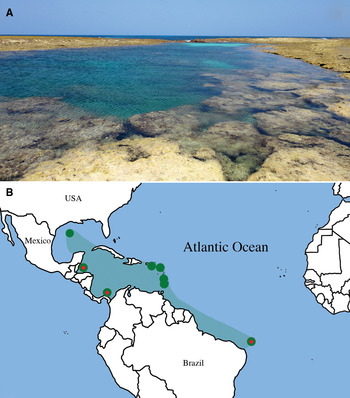
Western Atlantic: Caribbean Sea: Vieques, off Porto Rico (Holthuis, Reference Holthuis1951); Antigua (Chace, Reference Chace1972); Martinique (Fransen, Reference Fransen2002); Guadeloupe (Fransen, Reference Fransen2006); San Blas Islands, Panama; Utila, Honduras (present study); Gulf of Mexico: Flower Garden Banks, off Texas (Wicksten, Reference Wicksten2005); Brazil: Atol das Rocas (present study) (Figure 3B). The record from Santa Marta, Colombia (Criales, Reference Criales1984), is most probably erroneous considering the identification of the host (a bivalve of the genus Spondylus), and was attributed to Pontonia manningi Fransen, 2000 by Fransen (Reference Fransen2002).
(A) Large deep pools inside Atol das Rocas lagoon, habitat of Ascidia aff. interrupta (host of Ascidonia miserabilis); (B) geographical range of Ascidonia miserabilis: green circles, previously known localities; green circles with red dot, localities reported in the present study.

HABITAT
All specimens were found associated with ascidians of the genus Ascidia, dwelling inside their branchial baskets. The shrimps appear to be 'facultative commensals', using the host primarily as shelter and foraging for food mainly outside (see Millar, Reference Millar1971 for Ascidonia flavomaculata). The three Atol das Rocas specimens were found solitarily in Ascidia aff. interrupta living in rock crevices of large, relatively deep (4 m) pools inside the atoll lagoon (Figure 3A). The single Panamanian specimen was found in a solitary ascidian identified as Ascidia sp., which was attached to the underside of a large coral rock, at a depth of 1–2 m. The Honduran specimens were found in similar conditions (A. Anker, personal observation).
HOSTS
Ascidia aff. interrupta is a semitransparent, leathery, flat ascidian of about 4–5 cm body length and greyish colour, slightly darker towards the two yellow-spotted siphons. It is a very cryptic ascidian typically attached to the underside of the rocks or in rock fissures and crevices. Like other cryptic ascidians, Ascidia aff. interrupta is often covered with organic matter and/or epibionts and is therefore detectable only by the oral siphon. The absence of rounded projections on the tunic surface and trilobed papillae in the pharynx, as well as the presence of digitiform projections on the edges of the oral siphon lobes are characters that do not allow its identification as Ascidia interrupta. The identity of this species, as well as other ascidians from Atol das Rocas, is discussed elsewhere (Oliveira Filho & Paiva, unpublished data).
The host of the Panamanian specimen of Ascidonia miserabilis was identified only as Ascidia sp.; it appears to be similar in size, shape, and ecology to Ascidia aff. interrupta (A. Anker, personal observation). There are only three previous records of Ascidonia miserabilis where the host has been identified to species: two records from Martinique (Fransen, Reference Fransen2002) and one from Guadeloupe (Fransen, Reference Fransen2006); in both cases, the host has been identified as Ascidia interrupta. Thus, Ascidonia miserabilis seems to be always associated with Ascidia interrupta and perhaps closely related species, such as Ascidia aff. interrupta.
REMARKS
The Atol das Rocas specimens of Ascidonia miserabilis represent the first record of this species and of the genus Ascidonia for the Brazilian marine fauna, and also constitute the first record of Ascidonia for the south-western Atlantic. The San Blas and Utila specimens represent the first records for Panama and Honduras, respectively, and thus for the western Caribbean Sea (Figure 3B). In addition, the previously unknown colour pattern of A. miserabilis is illustrated for the first time (Figures 2A–C).
The Brazilian specimens of Ascidonia miserabilis match well the very detailed description of this species provided by Fransen (Reference Fransen2002). The only significant difference between our and Fransen's specimens is the shape and the length of the rostrum. In Fransen's (2002) specimens, the rostrum is broader and shorter, not reaching the second article of the antennular peduncles. In all three specimens from Atol das Rocas, and in the female from Utila, the rostrum is narrower and longer, reaching or almost reaching the third article of the antennular peduncle (Figure 1A, F), which is more similar to the rostra illustrated by Holthuis (Reference Holthuis1951) and Chace (Reference Chace1972). In the young male from Utila, the rostrum is more rounded than acuminate, resembling the rostrum illustrated by Fransen (Reference Fransen2002) (S. De Grave, personal communication). In view of these slight morphological differences, an independent molecular analysis of A. miserabilis across the western Atlantic (e.g. with COI or 16S gene fragments) should be attempted in order to confirm the present identifications.
The coloration of Ascidonia miserabilis differs from that of the only other western Atlantic species, A. quasipusilla (see Fransen, Reference Fransen2002, pls 9 & 10), by the conspicuous yellow spotting, which is more similar to that of the eastern Atlantic A. flavomaculata (see Fransen, Reference Fransen2002, pls 7 & 8).
Based on previous accounts (e.g. Chace, Reference Chace1972; Fransen, Reference Fransen2002), Ascidonia miserabilis does not appear to have sexually dimorphic second chelipeds. Nonetheless, in the Atol das Rocas material, the differences in the second chelipeds between the male and the female are very conspicuous. The male has unequal and asymmetrical chelipeds, with the major chela enlarged and with cutting edges armed with large teeth (Figure 1C), and the minor chela more slender, with cutting edges armed with a few feeble teeth (Figure 1D). The female has equal, symmetrical chelipeds that are much smaller compared to the male chelipeds; their finger armature is very similar to that of the male minor cheliped (Figure 1G). It is possible that at least one of the second chelipeds of this female is the result of regeneration.
Most known specimens of Ascidonia miserabilis, including the Atol das Rocas and the San Blas specimens, were found individually (i.e. solitarily) in their ascidian hosts (Fransen, Reference Fransen2002; present study). The two Utila specimens were found while processing a larger coral rubble sample. The female was found dwelling inside its ascidian host (Figure 2A), whereas the much smaller male was found later among pieces of coral rubble (S. De Grave, personal communication). Therefore, it remains unknown whether this male was the actual mate of the previous female, expelled from the host under stress, or a young male from a different host. Baeza & Días-Valdés (2011) studied a related species, Ascidonia flavomaculata, associated with Ascidia mentula Müller in the Mediterranean Sea. These authors found that Ascidonia flavomaculata lives solitarily in their hosts, due to competition for shelter and food resources. During the mating season, males move around searching for larger ascidians, which are usually occupied by females. Temporary mating couples form and apparently last until the hatching of the brooded embryos, suggesting that males also guard their females (Baeza & Días-Valdés, 2011). A similar mating system may also be present in Ascidonia miserabilis; this, however, remains to be investigated further.
ACKNOWLEDGEMENTS
We thank Dr Sammy De Grave (OUMNH) for providing additional data for some of the above reported specimens, and also for reviewing the manuscript. Fieldwork in Honduras was carried out under the auspices of Operation Wallacea, directed by Dr T. Coles. A.A. thanks CAPES (Coordenação de Aperfeiçoamento de Pessoal de Nível Superior) for providing funding in the form of a postdoctoral scholarship. S.V.P. and R.R.O.F. are grateful to Tito M.C. Lotufo and CNPq (Conselho Nacional de Desenvolvimento Científico e Tecnológico) for logistical support and funding of the Ascidiacea project at Labomar (UFC), and to the Instituto Chico Mendes de Conservação da Biodiversidade (ICMBio), especially to Maurizélia Brito, for collecting permits and logistical support during the Atol das Rocas expeditions. Darryl L. Felder (University of Louisiana, Lafayette, USA) provided one of the references.