Introduction
Strains of the bacterium, Wolbachia pipientis, have been introduced into natural populations of the dengue vector, Aedes aegypti, in order to reduce transmission of dengue virus (Hoffmann et al., Reference Hoffmann, Montgomery, Popovici, Iturbe-Ormaetxe, Johnson, Muzzi, Greenfield, Durkan, Leong, Dong, Cook, Axford, Callahan, Kenny, Omodei, McGraw, Ryan, Ritchie, Turelli and O'Neill2011; Walker et al., Reference Walker, Johnson, Moreira, Iturbe-Ormaetxe, Frentiu, McMeniman, Leong, Dong, Axford, Kriesner, Lloyd, Ritchie, O'Neill and Hoffmann2011). The effects of the Wolbachia infections on aspects of mosquito fitness, such as longevity, fecundity, egg desiccation resistance, locomotor ability and blood feeding, have been documented (Evans et al., Reference Evans, Caragata, McMeniman, Woolfit, Green, Williams, Franklin, O'Neill and McGraw2009; Turley et al., Reference Turley, Moreira, O'Neill and McGraw2009; Yeap et al., Reference Yeap, Mee, Walker, Weeks, O'Neill, Johnson, Ritchie, Richardson, Doig, Endersby and Hoffmann2011). Susceptibility to insecticides is an important trait which also needs to be understood in this context, particularly because chemicals are used routinely to reduce mosquito populations in areas of dengue infection and research goes on to improve applications and formulations (Oki et al., Reference Oki, Sunahara, Hashizume and Yamamoto2011; Paz-Soldan et al., Reference Paz-Soldan, Plasai, Morrison, Rios-Lopez, Guedez-Gonzales, Grieco, Mundal, Chareonviriyaphap and Achee2011; Harburguer et al., Reference Harburguer, Seccacini, Licastro, Zerba and Masuh2012). The possibility of Wolbachia infections influencing pesticide resistance was raised by the observation that there was a higher Wolbachia load in insecticide resistant Culex pipiens compared with insecticide susceptible individuals, possibly due to decreased control of Wolbachia load as a physiological cost of insecticide resistance (Berticat et al., Reference Berticat, Rousset, Raymond, Berthomieu and Weill2002; Duron et al., Reference Duron, Labbé, Berticat, Rousset, Guillot, Raymond and Weill2006). Similar results have been shown with another symbiont, Rickettsia, which increased susceptibility of Bemisia tabaci to some groups of insecticides, both singly and as a double infection with a second symbiont (Ghanim & Kontsedalov, Reference Ghanim and Kontsedalov2009).
The stable infections of Wolbachia which have been introduced to Ae. aegypti are the wMelPop and wMel strains (Hoffmann et al., Reference Hoffmann, Montgomery, Popovici, Iturbe-Ormaetxe, Johnson, Muzzi, Greenfield, Durkan, Leong, Dong, Cook, Axford, Callahan, Kenny, Omodei, McGraw, Ryan, Ritchie, Turelli and O'Neill2011; Walker et al., Reference Walker, Johnson, Moreira, Iturbe-Ormaetxe, Frentiu, McMeniman, Leong, Dong, Axford, Kriesner, Lloyd, Ritchie, O'Neill and Hoffmann2011). The wMelPop strain has a higher density of infection than the wMel strain, and the former infection is more widespread throughout the mosquito body and has greater negative effects on fitness (Walker et al., Reference Walker, Johnson, Moreira, Iturbe-Ormaetxe, Frentiu, McMeniman, Leong, Dong, Axford, Kriesner, Lloyd, Ritchie, O'Neill and Hoffmann2011). Duron et al. (Reference Duron, Labbé, Berticat, Rousset, Guillot, Raymond and Weill2006) showed that fitness cost of a Wolbachia infection increases with Wolbachia density in Cx. pipiens. Therefore, it is possible that mosquitoes containing Wolbachia could have different susceptibilities to the same insecticide if Wolbachia has any effect on this trait.
Insecticides for mosquito control cover a variety of modes of action and target different life stages. We looked at resistance to four different insecticides in this study. Bifenthrin, a pyrethroid, is a knockdown insecticide that targets adult mosquitoes. The bacterial insecticide, Bacillus thuringiensis var. israelensis, trade name VectoBac® WG, is toxic through ingestion and so targets the larval stage. Temephos is an organophosphate insecticide and is widely used as a mosquito larvicide throughout the world, particularly for control of Ae. aegypti. In Australia, temephos is sold in a slow-release granular formulation with trade name Abate™. Finally, s-methoprene is a juvenile hormone mimic sold as Prolink™ Liquid Larvicide. This insecticide kills mosquitoes as they undergo metamorphosis from fourth instar to pupa or at eclosion. The study undertook bioassays of Ae. aegypti to test for differences in response to insecticides between Wolbachia infected (wMelPop, wMel) and uninfected lines.
Methods
Mosquito lines
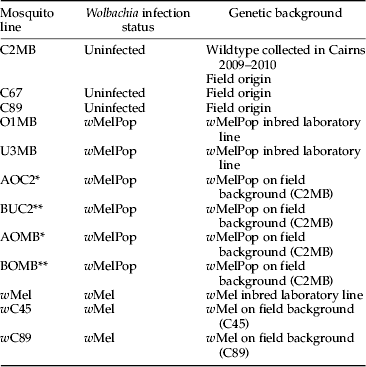
Lines of Ae. aegypti containing either the wMelPop (‘popcorn’) or wMel strain of Wolbachia pipientis were generated as described by Yeap et al. (Reference Yeap, Mee, Walker, Weeks, O'Neill, Johnson, Ritchie, Richardson, Doig, Endersby and Hoffmann2011) (wMelPop) and Walker et al. (Reference Walker, Johnson, Moreira, Iturbe-Ormaetxe, Frentiu, McMeniman, Leong, Dong, Axford, Kriesner, Lloyd, Ritchie, O'Neill and Hoffmann2011) (wMel) and were then maintained in discrete generations as mass bred populations (designated by MB in line name). The populations used in this study and their designation are given in table 1. Populations had been backcrossed for a minimum of four generations to a wild type Cairns strain of Ae. aegypti to ensure a homogeneous genetic background and were maintained at an adult size of several hundred mosquitoes to minimize any drift effects between infected and uninfected populations prior to testing for resistance (see Yeap et al., Reference Yeap, Mee, Walker, Weeks, O'Neill, Johnson, Ritchie, Richardson, Doig, Endersby and Hoffmann2011). Wolbachia infection status of the lines was confirmed through a Q-PCR assay described by Lee et al. (Reference Lee, White, Weeks, Hoffmann and Endersby2012). Larvae were maintained on TetraMin® Tropical Fish Food tablets Rich Mix (from here onwards referred to as TetraMin®) and adults were fed on human arms as described by Yeap et al. (Reference Yeap, Mee, Walker, Weeks, O'Neill, Johnson, Ritchie, Richardson, Doig, Endersby and Hoffmann2011).
Lines of Aedes aegypti (Wolbachia-infected and uninfected) used in insecticide bioassays.

* Crossed according to Scheme A; **crossed according to Scheme B of Yeap et al. (Reference Yeap, Mee, Walker, Weeks, O'Neill, Johnson, Ritchie, Richardson, Doig, Endersby and Hoffmann2011)
Bifenthrin (adults)
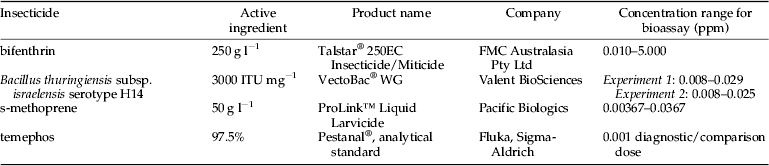
Glass vials were coated with formulated bifenthrin (Talstar® 250EC: bifenthrin 250 g l–1) (table 2) at a range of concentrations. Test insects were females less than 72 h old without blood feeding. Insects were exposed to insecticide in a treated vial for 1 h and then transferred to a clean vial. They were fed on 10% sucrose solution in cotton wool in the vial lid before and after exposure. Knockdown was scored at 1 h and 24 h using the absence of flight as the knockdown criterion, although this also includes mosquitoes that had died. Temperature throughout the bioassay was 26.5 ± 1 °C (no light). Data were subjected to probit analysis using PoloPlus Version 2 (© 2002–2011 LeOra Software, Petaluma, CA, USA).
Insecticides used to bioassay lines of Aedes aegypti.

Three comparisons involving wMelPop and two comparisons involving wMel were carried out. In the first, backcross populations (i.e. wMelPop on field background) AOC2 and BUC2 were compared with the non-Wolbachia population C2MB from which they were derived by backcrossing. The second comparison involved C67 (field origin), O1MB (wMelPop line), AOMB (wMelPop on field background) and BOMB (wMelPop on field background). The third comparison involved C67 (field origin), O1MB (wMelPop line), U3MB (wMelPop line), AOMB (wMelPop on field background) and BOMB (wMelPop on field background).
In the first wMel comparison, C89 mosquitoes (uninfected, field origin) were compared with mosquitoes from the wMel (original strain) and wC89G1 (wMel backcrossed on field background) strains. This comparison was then repeated.
Bacillus thuringiensis (larvae)
Eggs of Ae. aegypti laid on sandpaper were hatched by submersion in 3 l of reverse osmosis (RO) water containing one tablet of TetraMin®. Trays of larvae were maintained at 26 °C, 12L:12D. Two days after hatching, the density of larvae was reduced to 200 larvae per 4 l containing one tablet of TetraMin® in a new tray. Three to four days after hatching, larvae were collected with an eyedropper for use in the following bioassays:
Two experiments with slightly different procedures were undertaken to compare the strains. In the first, reverse osmosis (RO) water (5 ml) was dispensed into 30-ml centrifuge tubes (BD Falcon™). Four days after hatching, larvae of a standard size were collected with a dropper, taking a minimum amount of water. Five larvae were placed into each tube and the volume was made up to 10 ml with RO water; 20 ml of Bacillus thuringiensis (VectoBac® WG) solution (table 1) was dispensed into each Falcon™ tube using a 10-ml pipette to make the range of concentrations: 0, 0.008, 0.016, 0.019, 0.024, 0.026, 0.027, 0.028, 0.029 ppm). Eight replicates of each concentration were made. Lids were placed on tubes. Mortality was scored at 48 h. Temperature throughout the bioassay was 26.5 ± 1 °C (no light). Lines tested were C45 (field origin); wMel; U3MB, O1MB (wMelPop laboratory lines); AOMB, BOC2 (wMelPop outbred lines) and wC45 (wMel on field background).
In the second experiment, reverse osmosis (RO) water (190 ml) was dispensed into 250-ml glass jars (Cospak Pty Ltd, Minto, NSW, Australia). Three days after hatching, larvae of a standard size were collected with a dropper and placed in small medicine cups (Huhtamaki Australia Pty Ltd, Rhodes, NSW, Australia). Eight to 14 larvae were transferred from the medicine cups into each jar using a tea strainer; 10 ml of Bacillus thuringiensis (VectoBac® WG) solution to make final concentrations of 0, 0.008, 0.012, 0.016, 0.019 and 0.025 ppm were dispensed into each jar using a 10-ml pipette. Five replicates of each concentration were made. Lids were placed on jars. Mortality was scored at 24 and 48 h. Temperature throughout the bioassay was variable due to a cabinet program malfunction and ranged from 22–25 °C (no light). Data were subjected to probit analysis using PoloPlus Version 2 (© 2002–2011 LeOra Software). Lines tested were C67, C89 (field origin), O1MB, U3MB (wMelPop strain), AOMB, BOMB (wMelPop on field background), wMel and wC89 (wMel on field background).
s-methoprene (larvae)
In the first comparison of strains, reverse osmosis water (450 ml) was dispensed into 35 1-l rectangular plastic containers (Anchor Packaging, Rosebery, NSW, Australia) to which ¼ of a crushed TetraMin® tablet was added. Forty larvae of Ae. aegypti were placed into each container using a tea strainer. The s-methoprene solutions (50 ml) (table 1) were dispensed into each container (7 lines × 5 concentrations). Lines tested were C67 (field origin), O1MB (wMelPop line), AOMB (wMelPop on field background), BOMB (wMelPop on field background), C89 (field origin), wMel, and wC89G1 (wMel on field background). Forty larvae were tested per concentration for each line and for a RO water control. Temperature throughout the bioassay was 26.5 ± 1 °C (no light).
In the second comparison, reverse osmosis water (189 ml) was dispensed into 250-ml glass jars (Cospak Pty Ltd). Ten larvae of Ae. aegypti (three days since hatching) were placed into each jar using a tea strainer; 1 ml of a food solution comprising 12 TetraMin® tablets crushed and suspended in 240 ml RO water was added to each jar. Solutions of a range of concentrations of s-methoprene were dispensed into each jar in 10-ml aliquots to make final concentrations of (0.0037–0.0370 ppm). Lines tested were C67 (field origin), O1MB (wMelPop line), U3MB (wMelPop line), AOMB (wMelPop on field background), BOMB (wMelPop on field background), C89 (field origin), wMel, and wC89 (wMel on field background). Fifty larvae were tested per concentration for each line and for a RO water control. The jars were sealed with plastic screw-top lids. Temperature throughout the bioassay was 26.5 ± 1 °C (no light). Larvae were fed with Tetramin® crushed to a powder (approx. six tablets over 240 jars) at 72 h.
Temephos (larvae)
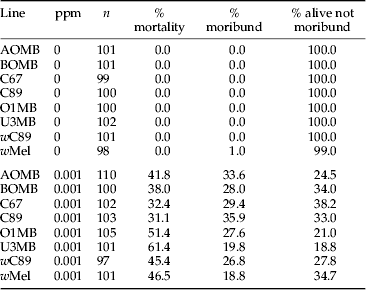
Reverse osmosis water (249 ml) was dispensed into 250-ml glass jars (Cospak Pty Ltd). Twenty larvae (three days after hatching) were placed in each jar using a tea strainer. A solution of temephos dissolved in absolute ethanol (1 ml) was dispensed into each jar. The control comprised 1 ml absolute ethanol in 249 ml RO water. One hundred larvae from each line were tested at 0 ppm and 0.001 ppm temephos. Lines tested were C67 (field origin), O1MB (wMelPop line), AOMB (wMelPop on field background), BOMB (wMelPop on field background), C89 (field origin), wMel, and wC89G1 (wMel on field background). The jars were sealed with plastic screw-top lids. Mortality was scored at 24 h. Temperature throughout the bioassay was 26.5 ± 1 °C (no light).
Results
Bifenthrin (adults)
Some insects knocked down at 1 h had recovered by 24 h after exposure. All insects that were still knocked down at 24 h appeared moribund. KDn is equal to the concentration required to knock down n% of the population (table 2).
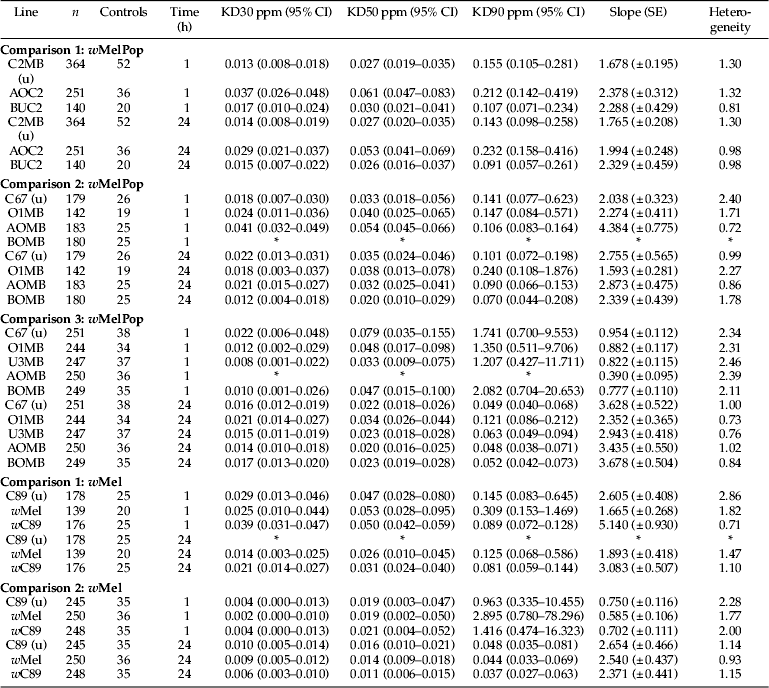
In the first comparison with wMelPop, a low number of individuals from each population was able to recover after being knocked down (AOC2: 7.8%, BUC2: 4.9% and C2MB: 4.8%). BUC2 and C2MB had a very similar response to bifenthrin. AOC2 mosquitoes were slightly more tolerant to bifenthrin than were those from BUC2 and C2MB at KD30 and KD50 with non-overlapping 95% confidence intervals with other lines as determined by Probit analysis (table 3). In the second wMelPop comparison, at 24 h (table 3), for KD30 and KD50, there were no differences between lines in response to bifenthrin (95% confidence intervals overlap). Finally, in the third comparison, O1MB, the laboratory wMelPop line, was more tolerant to bifenthrin than were mosquitoes from AOMB and BOMB, the outbred wMelPop lines, at 24 h at KD50 and KD90 (table 3).
Knockdown concentrations of bifenthrin (ppm) for Aedes aegypti at 1 and 24 h after exposure from lines infected with wMelPop or wMel compared with uninfected (u) lines – confidence intervals and heterogeneity factor were generated by Probit analysis.

For the first comparison with wMel, there was no difference in response to bifenthrin (i.e. 95% confidence intervals overlap) of C89 (uninfected line), wMel and wC89 at KD30, KD50 and KD90, with the exception of wC89 being more susceptible than C89 at KD90 (1 h) (table 3). For the second comparison, there was no difference in response to bifenthrin (i.e. 95% confidence intervals overlap) of C89 (uninfected line), wMel and wC89 at KD30, KD50 and KD90 at 1 h and 24 h (table 3). These data suggest no difference between infected and uninfected lines with respect to response to bifenthrin.
Bacillus thuringiensis (larvae)
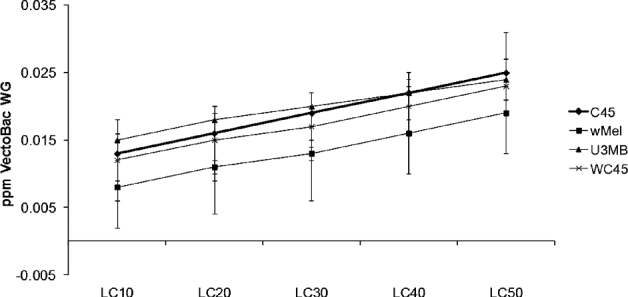
In the first comparison, after 48 h exposure to VectoBac® WG, there was no difference between lines C45, wC45, wMel and U3MB, for LC10, 20, 30, 40, and 50 (95% confidence intervals overlapped) (fig. 1). There was also no difference in response to VectoBac® WG between the AOMB and BOC2 lines (table 4). There was one incidence of the wMel, O1MB, AOMB and BOC2 lines showing greater susceptibility to VectoBac® WG than the C45 line, though this was across bioassay dates (table 4).
Susceptibility of lines of Aedes aegypti to Bacillus thuringiensis subsp. israelensis (VectoBac® WG) (48 h, 26 °C) −LC10 to LC50 with 95% confidence intervals (Comparison 1). Confidence intervals were generated by Probit analysis using PoloPlus.

Bioassays of Aedes aegypti with VectoBac® WG Aedes aegypti 48 h 26 °C (BC, backcrossed line: line backcrossed to field line) (Comparison 1) – confidence intervals and heterogeneity factor were generated by Probit analysis.

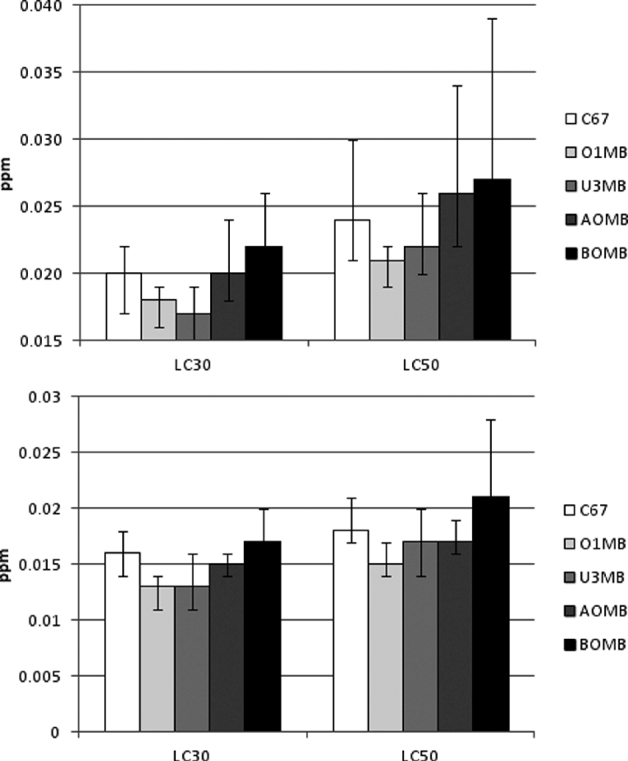
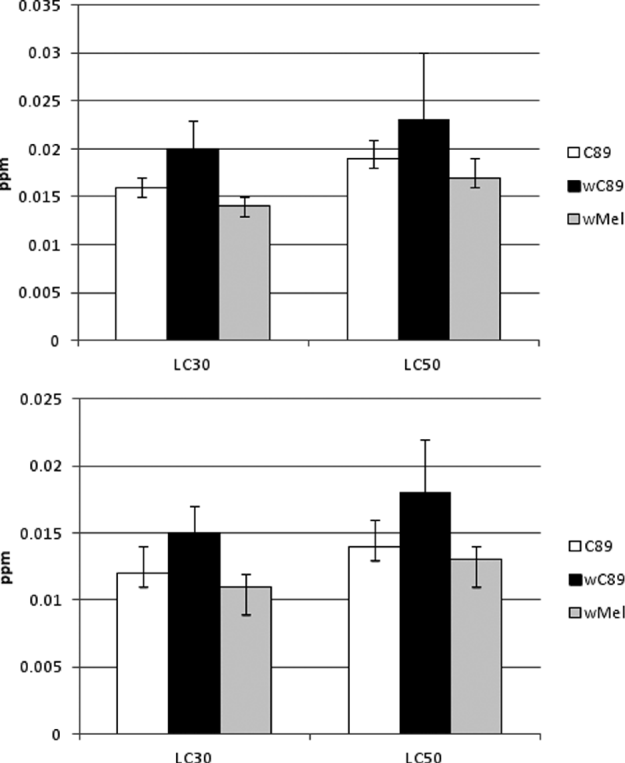
In the second comparison, there were no consistent differences between lines of Ae. aegypti infected with Wolbachia and uninfected lines with respect to toxicity of B. thuringiensis at 24 h and 48 h. There were some differences between infected lines; for example, the laboratory line infected with wMelPop, O1MB, appears to be more susceptible than BOMB, the wMelPop line backcrossed to the field line (24 h: LC30 and LC50, and at 48 h: LC50 only) (fig. 2). The outbred line, wC89, shows higher LC30 and LC50 than the wMel laboratory line (fig. 3).
LC30 and LC50 (with 95% confidence intervals) of VectoBac® WG for lines of Aedes aegypti infected with wMelPop (C67 is the uninfected line) at 24 h and 48 h. Confidence intervals were generated by Probit analysis using PoloPlus.

LC30 and LC50 (with 95% confidence intervals) of VectoBac® WG for lines of Aedes aegypti infected with wMel (C89 is the uninfected line) at 24 h and 48 h. Confidence intervals were generated by Probit analysis using PoloPlus.

s-methoprene (larvae)
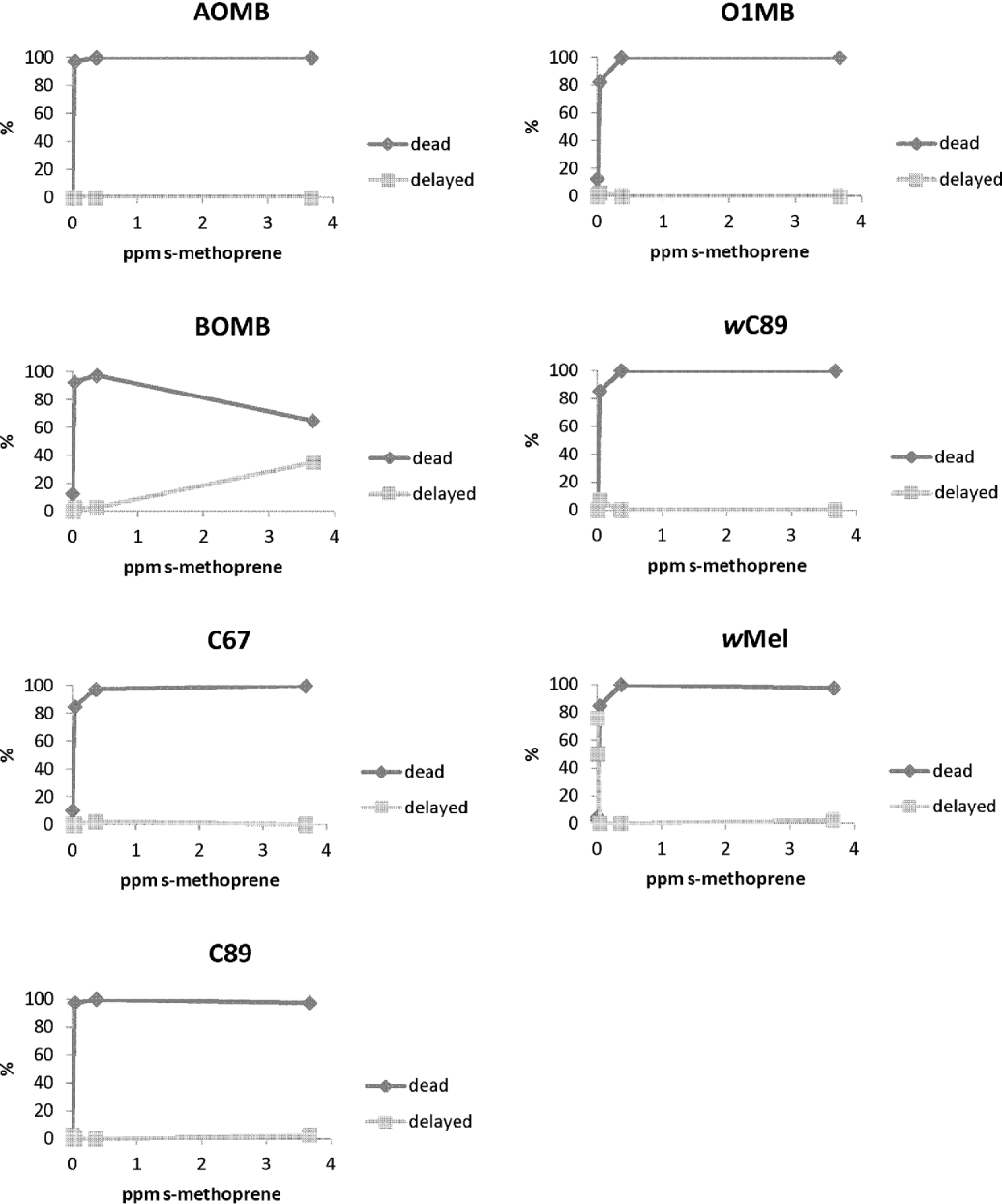
For the first comparison, a graph of percentage mortality and delayed development of the larvae from each line after 13 days (fig. 4) shows that there was very little control mortality (controls: RO water only) and that there were levels of delayed development (i.e. larvae that did not pupate) in some of the lines that were unrelated to treatment with s-methoprene (C89, AOMB, wMel, wC89). Overall, levels of mortality were high throughout the entire range of concentrations (0.000367 to 0.036700 ppm) for every line. A small number of adults eclosed successfully, but only from the lowest concentration and for the lines C89, O1MB and wMel (fig. 4). There were some incidences of delayed development at each concentration of s-methoprene, but this was most pronounced in wMel and cannot be attributed directly to s-methoprene because of the behaviour of this line in the control. With respect to final fate attributable to s-methoprene, there is no apparent distinction between Wolbachia or non-Wolbachia lines.
Percentage mortality and delayed development of Aedes aegypti larvae exposed to s-methoprene for 13 days (Comparison 1).

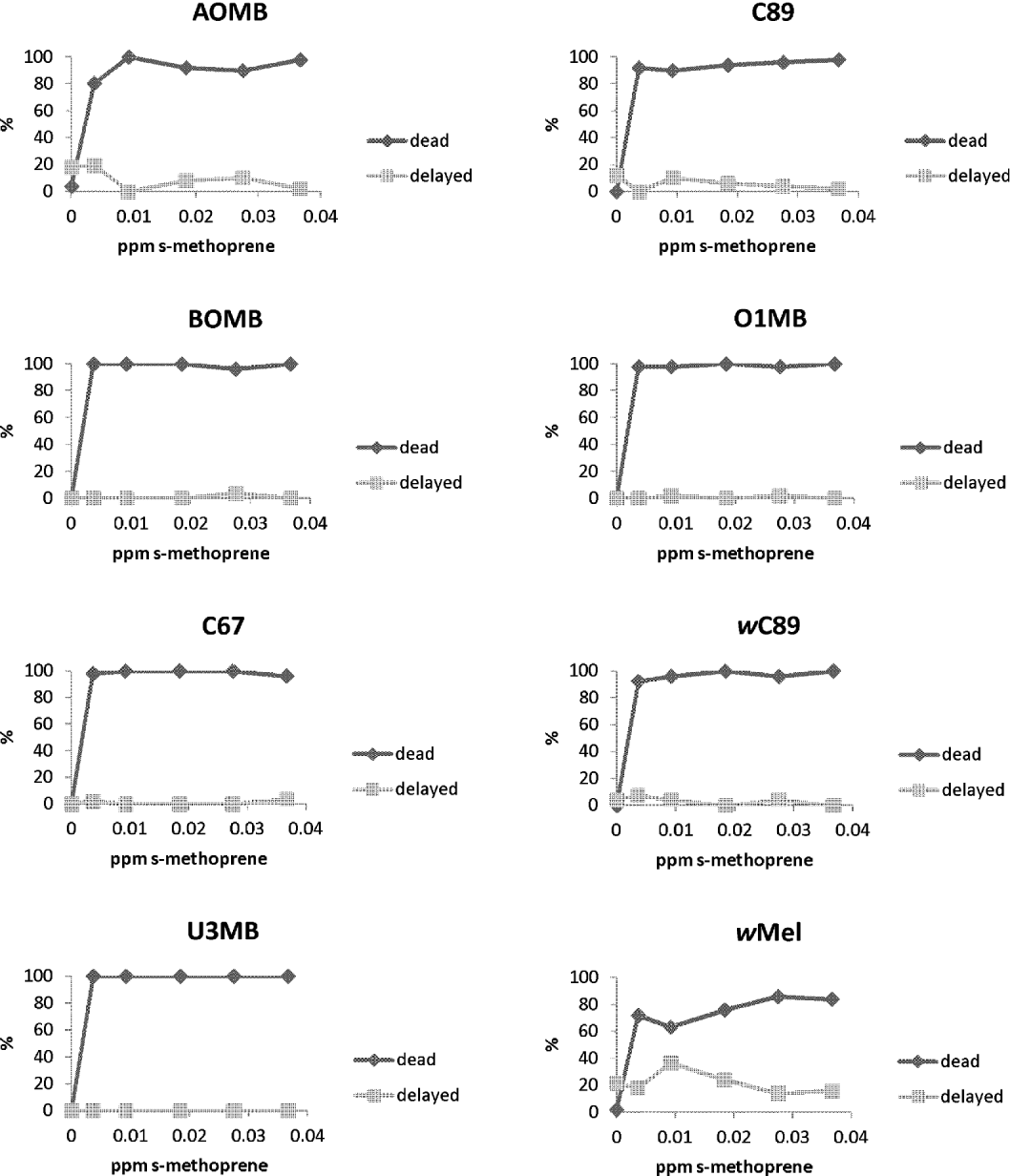
For the second comparison, at concentrations of 0.367 ppm and above, there was no successful emergence of adults (fig. 5). Very few adults emerged at 0.0367 ppm. Development of larvae from the wMel line was delayed in the control. At the highest concentration, the BOMB line showed a high percentage of larvae which did not pupate. These data do not suggest that there is any difference between Wolbachia-infected and uninfected lines with respect to response to s-methoprene.
Percentage mortality and delayed development of Aedes aegypti larvae exposed to s-methoprene for 13 days (Comparison 2).

Temephos (larvae)
A dose-response was not sought for this insecticide as a pilot assay was not able to differentiate between a series of concentrations lower than 0.001 ppm. Instead, larvae from each line were either tested at 0 ppm or 0.001 ppm (table 4). At these concentrations, there appear to be no differences in responses between Wolbachia-infected and uninfected lines of Ae. aegypti (Kruskal-Wallis Test P = 0.378 (mortality), P = 0.742 (moribund)) (table 5).
Effect of temephos (0 & 0.001 ppm, 24 h, 26 °C) on Aedes aegypti (Wolbachia-infected vs uninfected larvae).

Discussion
Differences between lines were present for some insecticides, suggesting genetic variation among the lines in responses to chemicals. However, there were no obvious or consistent differences between Wolbachia infected and uninfected lines. Of the ten comparisons completed overall, infected lines performed better on average than uninfected lines in only three of these. Mortality rates were also similar to those expected, based on other studies. Thus, there was no evidence of highly insecticide-resistant lines in this study and no evidence for an effect of Wolbachia infection on insecticide susceptibility.
These results suggest that Wolbachia introductions will not adversely influence chemical control of Ae. aegypti. In North Queensland where Wolbachia invasions are currently being undertaken, chemical applications are used following detection of dengue cases based on applications of the chemicals tested here (http://www.health.qld.gov.au/dengue/managing_outbreaks/mosquito.asps). Methoprene, Bt and pyrethroids, as well as organophosphates, continue to be used in other parts of the world for Aedes control, despite the emergence of resistance problems and potentially negative environmental effects (Ranson et al., Reference Ranson, Burhani, Lumjuan and Black2010).
The small differences in pesticide response between lines are unlikely to be important from a control perspective. Chemical resistance in Ae. aegypti typically involves much larger differences among populations than detected here, involving shifts in LD50 of 5–10 fold or more (Rodriguez et al., Reference Rodriguez, Bisset and Fernandez2007). The small effects we found are unlikely to contribute to control failures; they may reflect an effect of laboratory culture because in some cases (e.g. figs 1, 3) the infected laboratory population had a lower level of resistance. It has previously been noted that long-term infected laboratory lines can have a lower fitness than infected outcrossed lines (Yeap et al., Reference Yeap, Mee, Walker, Weeks, O'Neill, Johnson, Ritchie, Richardson, Doig, Endersby and Hoffmann2011), perhaps as a consequence of inbreeding depression. It is not likely that minor differences between lines are caused by differences in other symbionts or microbial communities within the lines, given the crossing schemes undertaken to create them.
Wolbachia infection confers some resistance to insect pathogens of Drosophila melanogaster (particularly the entomopathogenic fungus, Beauveria bassiana) (Panteleev et al., Reference Panteleev, Goryacheva, Andrianov, Reznik, Lazebny and Kulikov2007) and is also known to provide protection against RNA viruses in this species (Teixeira et al., Reference Teixeira, Ferreira and Ashburner2008). Wolbachia also provide some protection against bacteria, although this depends on the population tested (Wong et al., Reference Wong, Hedges, Brownlie and Johnson2011). However, the present results indicate that this does not translate into increased resistance to toxins from the bacterial insect pathogen, B. thuringiensis.
In conclusion, Wolbachia do not influence resistance to chemicals used to treat mosquito infestations including larvicides. This means that successful invasion of natural populations by Wolbachia is unlikely to adversely affect the potential of authorities to use other control methods. Wolbachia invasions may well reduce the need for chemical options, given its ability to suppress transmission of dengue and also potentially other disease agents.
Acknowledgements
We appreciate the technical assistance given by Vanessa White, Kelly Richardson, Jason Axford, Ashley Callahan, Alen Rako and Yeap Heng Lin. Thanks to Scott Ritchie, David Walker, Tim Hurst and Peter Ryan for insecticide samples and advice. The study was funded in part by a grant from the Foundation for the National Institutes of Health through the Vector-Based Transmission of Control: Discovery Research (VCTR) program of the Grand Challenges in Global Health Initiative of the Bill & Melinda Gates Foundation and also by the CSIRO Cluster Collaboration Fund ‘Urbanism, Climate Change and Health’ and the National Health and Medical Research Council.