Introduction
Financial welfare in later life is a prime concern of government, civil society and citizens as the funding of pensions and care rises up policy agendas in ageing societies. In this context, work and family histories are well known to impact on income in later life, generally reducing state and private pension income for women who combine family care with paid work through the lifecourse, although these associations are not straightforward (Ginn Reference Ginn2003; Glaser et al. Reference Glaser, Nicholls, Stuchbury, Price and Gjonca2009a ; Sefton, Evandrou and Falkingham Reference Sefton, Evandrou and Falkingham2011). Understanding links between life histories and poverty in late life is an even more complex question (Bennett and Daly Reference Bennett and Daly2014; Glaser et al. Reference Glaser, Nicholls, Stuchbury, Price and Gjonca2009a ). This is because state financial welfare systems, notably pension and benefit transfers, are designed to lessen poverty risks, and they therefore interact with life histories in determining outcomes. Furthermore, state pensions (in accrual) and disability benefits (in payment) are designed to compensate for the effects of poor health, and so it is also necessary to understand how poor health through the lifecourse and in later life interacts with state systems to determine poverty risks. Following the global economic crisis of 2008 and the subsequent introduction in the United Kingdom (UK) of ‘austerity’ policies in 2010, there has been a surge of academic and policy interest in these questions given the withdrawal or reduction of pensions and disability benefits as part of the retrenchment of the welfare state (Berthoud Reference Berthoud2009; Dilnot et al. Reference Dilnot, Warner and Williams2011; Ginn and MacIntyre Reference Ginn and MacIntyre2013; Hancock, Morciano and Pudney Reference Hancock, Morciano and Pudney2012; Hancock and Pudney Reference Hancock and Pudney2013; Price and Livsey Reference Price, Livsey, Ramia, Farmsworth and Irving2013).
This retrenchment is taking place within a global debate about the respective merits of universal benefits and services available to all; benefits and services distributed according to non-economic criteria such as demographic characteristics, specified needs or the meeting of conditions such as school or health clinic attendance; and those conditional on means or asset testing (Fiszbein et al. Reference Fiszbein, Schady, Ferreira, Grosh, Keleher, Olinto and Skoufias2009; Gugushvili and Hirsch Reference Gugushvili and Hirsch2014; Mkandawire Reference Mkandawire2005). The arguments on means-tested versus universal benefits at least are well rehearsed: means-tested benefits are stigmatised, often have low take-up, high administrative burden, and can create poverty traps and moral hazard (such as creating disincentives to save). It is also argued that means testing undermines social cohesion and social solidarity, entrenches dependencies and tackles outcomes rather than causes of poverty. The opposing argument is that universal benefits are poorly targeted, often benefiting the better-off the most, impose a high burden on taxpayers, are ineffective at encouraging politically desired behaviour and reduce global competitiveness. To date, empirical evidence largely shows that universal benefits are more effective at redistributing resources to the poor than means-tested benefits (Mkandawire Reference Mkandawire2005), but the evidence is mixed, with some more recent studies suggesting empirical support for means-tested approaches (Dethier, Pestieau and Ali Reference Dethier, Pestieau and Ali2010; Fiszbein et al. Reference Fiszbein, Schady, Ferreira, Grosh, Keleher, Olinto and Skoufias2009; Gugushvili and Hirsch Reference Gugushvili and Hirsch2014: 8–10; Tesluic et al. Reference Tesluic, Pop, Grosh and Yemtsov2014).
The issue of universalism versus means testing has been considered especially important in considering the financial position of women in later life, with research across countries suggesting that greater universalism is associated with less poverty for older women, and also with greater gender equality (Frericks et al. Reference Frericks, Maier and De Graaf2006; Ginn Reference Ginn2003; Leitner Reference Leitner2001). While feminist economists have pointed to the benefits of universalism in these respects, they have also shown that universal pensions tend to be associated with only modest incomes, with supplemental income needed to ensure adequacy (Jeffersona Reference Jeffersona2009).
However, very little of this work addresses the interaction of state pension income with disability benefits, since in policy terms these are seen as addressing different social problems requiring different solutions – the first addressing issues of poverty and income adequacy, and the second compensating for the additional costs of disability. The eligibility conditions can be quite different. However, given the significant association between disability and poverty, it is important to think clearly about these benefits. For example, Gugushvili and Hirsch (Reference Gugushvili and Hirsch2014: chap. 6) argue that because the disposable incomes of disabled people tend to be low, universal transfers compensating for the costs of disability tend to have a progressive effect on income even where this is not the policy intention.
In this article, we use data from the English Longitudinal Study of Ageing (ELSA) to test how closely work, family and health histories are associated with poverty in later life, and to estimate how far and in what ways different state transfers, in the form of pensions and benefits, play a mediating role. ELSA respondents are drawn from England, the most populous of the countries of the UK (comprising England, Scotland, Wales and Northern Ireland), with 84 per cent of the UK population (Office for National Statistics 2013). The policy context described here applies across the UK. The UK provides an excellent case study because theoretically and institutionally, disability benefits are for the most part treated separately from both the state pension system and the means-tested income support system. State transfers in later life in the UK include state pensions, income support through means-tested Pension Credit and disability-related benefits which are not means tested – mainly Disability Living Allowance (DLA) and Attendance Allowance (AA). More restrictive criteria are being introduced for disability benefits and they are increasingly under threat, as explained below, so it is timely in the midst of these debates to better understand their role in maintaining the incomes of older people.
In our analysis, we use the Organisation for Economic Co-operation and Development's (OECD) official poverty definition as having an income less than 60 per cent of median equivalised population income before housing costs. The poverty rate, using this measure, is higher for women than men in most OECD countries including the UK (Zaidi Reference Zaidi2006). For UK pensioners, the poverty rate has declined from a 1989 peak at 43 per cent to 17 per cent in 2011, converging to the rate for the working-age population and for children (Cribb et al. Reference Cribb, Hood, Joyce and Phillips2013: figure 6.1b). However, among pensioners, poverty is more likely to be persistent than for the rest of the population, and data from the 2000s suggest that the risk of poverty for a person aged over 65 was almost 1.5 times higher in the UK than in the European Union as a whole; only Cyprus, Greece, Spain, Portugal and Ireland had higher rates than the UK (Eurostat 2009; Zaidi Reference Zaidi2006). Moreover, in 2013 the OECD poverty line was about £177 per week in the UK for a single person (Department for Work and Pensions (DWP) 2014a ), just over £30 per week above the lone pensioner's threshold for means testing. This means that many UK pensioners who are living in poverty by international standards are nevertheless ineligible for means-tested benefits.
In this paper, we first set out the ways in which the pension and benefit system provide financial support for older people, before reviewing what is known about how work and family histories impact on income in later life, as well as what we know about which state transfers, particularly disability benefits, might reduce the risks of late-life poverty for some groups. We then present our analysis of ELSA data for the older population of England. We examine who has incomes below the poverty line, as well as, for those who are not in poverty, which sources of income keep them above the poverty line. We then consider in a series of multivariate analyses which current and lifecourse characteristics are associated with those who: (a) remain in poverty; (b) are maintained above the poverty line only by the receipt of state pensions and income support, (c) are kept above the poverty line only by the receipt of disability benefits, and (d) without any state transfers would not have enough income to keep them out of poverty. We end with a discussion of these findings.
Financial support from the state in later life: the UK pension and benefits system
The UK pension system encompasses a mix of state and private (occupational and personal) provision, with all elements playing a part in the prevention of later-life poverty (Pensions Commission 2005). Accrual of a basic (flat rate) state pension and additional state pension depends on National Insurance (NI) contributions from employee and employer, and on NI credits for periods of caring, sickness or unemployment. For married women, entitlement derived from their husband's NI record (spousal addition at 60% and widows pension at 100% of the husband's pension, divorced women can utilise their former husband's contributions) offers some protection in the current system against the effects of breaks in employment for caring and other domestic roles (Pensions Policy Institute 2014). This ‘inheritance’ of derived state pensions complicates and dilutes the effects of married women's family and employment histories on their state pension income. Although this article does not examine derived rights of widows and divorcees directly, it should be noted that derived rights for future retiring cohorts will be abolished in the UK state pension system with reforms anticipated in 2016 (Pensions Policy Institute 2014), even though we know almost nothing about their role in poverty prevention.
Successive reforms to the NI scheme to protect the entitlements of carers are increasing receipt of full state pensions for women, but there are still features of the NI scheme that may reduce women's state pensions. For example, those who are employed but on part-time earnings below the NI threshold for contributions are not eligible for NI credits, thus reducing their entitlement (Collins et al. Reference Collins, Neville, Thornby and Patel2009). Moreover, protection for carers was not available for the oldest women pensioners, those who reached state pension age before the relevant reforms. The viability and adequacy of state pensions have been in the spotlight, with reforms being implemented following the Pension Commission's five-year enquiry (Pensions Commission 2004, 2005). A new flat-rate Single Tier Pension is to be introduced from 2016 for future pensioners, set just above the threshold for means testing (but below the OECD poverty line) and requiring 35 years of NI contributions or credits for the full amount. As just noted, derived state pensions based on marital status will be abolished, but for several decades individuals will retire with a mix of state pensions acquired under old and new rules.
Accrual of private pensions depends on level of earnings-related contributions, usually from both employer and employee, and years of contributions, although the pension may be defined by a formula (defined benefit) or, for personal pensions and increasingly for occupational pensions, depend on stock market returns (defined contribution). Access to a good occupational pension scheme has been rare for those employed in small organisations and, until recent decades, pension schemes excluded part timers from membership and discriminated against early leavers, disproportionately disadvantaging women (Ginn Reference Ginn2003). However, as with state pensions, widows often ‘inherit’ pensions based on their late husband's private pension, diluting the effect of a short or part-time employment record on their later-life risk of poverty.
Pensioner income from the state also includes a means-tested income support element, Pension Credit. This is payable to those with only modest savings and income below the UK Government minimum income threshold (which is £148 per week for a lone pensioner, £227 for a couple in 2014). In 2014, 2.83 million pensioners were in receipt of Pension Credit (DWP 2014b ). However, more than a third of older people entitled to Pension Credit do not claim it (Barton and Riley Reference Barton and Riley2012; Radford, Taylor and Wilkie Reference Radford, Taylor and Wilkie2012).
In addition, several non-means-tested disability-related benefits are available to eligible individuals but these are under threat (Hancock and Pudney Reference Hancock and Pudney2013). DLA, claimed before age 65 to help with the cost of care or mobility needs, continues after age 65; the total amount, including a mobility component, ranges from £42 to £134 per week (in 2014). But DLA for those of working age currently in receipt and new claimants is being gradually replaced by the Personal Independence Payment (PIP) with tighter eligibility criteria and repeated assessments of ability to perform daily activities. Over 200,000 new claims had been made for PIP by early 2014; of the 34,000 assessed only 37 per cent were approved. AA, worth £53–79 per week (in 2014) may be claimed by those aged over 65 needing care or supervision, the amount depending on severity of physical or mental disability or long-term illness. Recipients of DLA and AA are free to spend the money as they wish; it is not dependent on actually getting the help they need. Receiving these benefits can trigger an assessment for eligibility for means-tested Pension Credit. In 2014, 1.47 million older people received AA, 970,000 of whom were women, and just over 1 million of whom were over 80 years old. Around 3.25 million in 2014 were still in receipt of DLA (in the transition phase to PIP), of whom just over a million were over state pension age (DWP 2014b). Thus, about 2.5 million people over state pension age are in receipt of non-means-tested disability benefits.
Reduction of disability benefits is part of a wider ideological project to shrink state and increase private provision, with individualisation of risk, reflecting a decrease in political commitment to universal benefits. The importance of AA and DLA for older people has recently acquired additional political salience since a series of policy reports from The King's Fund, a highly influential think tank, have suggested that it may be appropriate to abolish the main disability benefits for older people and absorb these into the system for financing social care in later life (Barker Reference Barker2014; Humphries Reference Humphries2013; Humphries, Forder and Fernandez Reference Humphries, Forder and Fernandez2010; Wanless, Forder and Fernandez Reference Wanless, Forder and Fernandez2006). The Conservative government elected in May 2015 has said that for the life of this Parliament they will not reduce these benefits (Dilnot et al. Reference Dilnot, Warner and Williams2011; HM Government 2012; The Conservative Party 2010) but the discussion remains live (Barker Reference Barker2014; Lloyd Reference Lloyd2013), especially in the face of widespread reforms and cuts to disability benefits for those of working age.
Given these trends, it is important to know how far each of the state transfer elements supports individuals who might otherwise have incomes below the OECD poverty line, especially for those population groups known to be most at risk of poverty, such as older women who are mothers and those who are widowed or divorced. Previous research has not addressed this question.
Employment and family histories: effects on later-life income
The current income and asset position of pensioners has been well-documented (Banks et al. Reference Banks, Lessof, Nazroo, Rogers, Stafford and Steptoe2010). Research has shown that employment histories (Ginn and Arber Reference Ginn and Arber1996), family roles (Evandrou and Glaser Reference Evandrou and Glaser2003) and gendered roles (Arber and Ginn Reference Arber and Ginn2004) adversely influence women's financial wellbeing in later life; through interrupted work histories, periods of part-time work, low pay and lack of access to occupational pension provision, especially affecting working-age mothers at all educational levels and women divorcees (Ginn Reference Ginn2003; Ginn and Arber Reference Ginn and Arber2002; Ginn and Price Reference Ginn and Price2002; Price Reference Price2006a ). On average, older women have much lower incomes than men in late life and are more likely than men to have incomes below the UK threshold for means testing (Ginn and Price Reference Ginn and Price2002; Glaser et al. Reference Glaser, Nicholls, Stuchbury, Price and Gjonca2009a ; Price Reference Price2006b , Reference Price2006c ).
Longitudinal research on how labour market participation, partnership formation/dissolution and child-rearing are associated with financial outcomes in later life is scarce, but there are some notable exceptions. Using longitudinal data, Walker, Heaver and McKay (Reference Walker, Heaver and McKay2000) showed that women who had children earlier or had more children, or longer periods out of employment, were less likely to have a private pension, reducing their retirement incomes. Evandrou and Glaser (Reference Evandrou and Glaser2003) reported that those with gaps in employment, low pay, or poor working terms and conditions, have a high risk of poverty in later life. Employment and maternal histories play an important role, especially in lowering women's private pension accumulation where no allowance is or was made for periods of caring (Bardasi, Jenkins and Rigg Reference Bardasi, Jenkins and Rigg2002; Ginn Reference Ginn2003; Meyer and Bridgen Reference Meyer and Bridgen2008).
Two longitudinal studies have illustrated, however, that this relationship is complex. Bardasi and Jenkins (Reference Bardasi and Jenkins2002), using nine waves of the British Household Panel Study, showed that years spent in full-time employment, type of occupation, earnings and continuity of employment are particularly important for pension provision. However, spending more years in employment between the ages of 20 and 60 did not necessarily reduce the risk of having a low income in later life when other factors were controlled for. Sefton, Evandrou and Falkingham (Reference Sefton, Evandrou and Falkingham2011) examined the impact of work and family histories (including duration and timing of events) on individual incomes of women aged 65 and older using British Household Panel Survey data from 1991 to 2005. After other factors were taken into account, the number of years in full-time work did have a significant effect on later-life income; however, those who worked part time for most of their working lives were no better off than women who had shorter part-time careers or who were not in the paid labour force. In addition, women who had shorter, full-time careers were better off than those with longer, part-time careers. Mostly the difference was for women who worked full time for most of their working lives, who accrued reasonable private pensions. The association between family histories and later-life income was weak, with divorce and widowhood having little effect, and motherhood causing only a small reduction in late-life incomes for women. The authors concluded that this was because pension returns to employment were generally low for women, and they surmise that public transfers were probably dampening work history-related differentials, especially for widows.
This suggests that it is important to examine the role of the state in ameliorating these impacts. It is especially important for our research, which is concerned specifically with the risk of poverty in later life, where the role of the state can be expected to be dominant. The studies above have been mainly concerned with effects on average income rather than poverty rates where much less is known. Some research suggests that employment histories, despite their known impact on private pension income, may have less effect on poverty (Bardasi, Jenkins and Rigg Reference Bardasi, Jenkins and Rigg2002; Glaser et al. Reference Glaser, Nicholls, Stuchbury, Price and Gjonca2009a ). Mitigating factors that have been suggested include features of state pensions that relax the link between lifetime earnings and individual state pension income (Ginn Reference Ginn2003; Sefton, Evandrou and Falkingham Reference Sefton, Evandrou and Falkingham2011), as well as means-tested benefits and disability-related benefits (Hancock and Pudney Reference Hancock and Pudney2013). Together, these state transfers potentially offset the effects of interrupted employment and low pay, due, for example, to poor health or caring commitments, and are likely to help prevent poverty, especially among women.
Despite its current political importance, very little is known about this issue. In recent work, Hancock, Morciano and Pudney (Reference Hancock, Morciano and Pudney2012) investigated the associations between work histories and disability benefits receipt in later life using data from the Family Resources Survey 2002–2005. They found that the size of the basic state pension is not very sensitive to the individual's number of years in employment. This means that the income penalty associated with interrupted work histories may not be very large for low-income pensioner households among whom disability benefit receipt is most common. They estimated that almost half of those in receipt of AA and 38 per cent of those over 65 in receipt of DLA had pre-benefit income levels below the government's threshold for means testing (compared with 22 per cent in the over 65 population), i.e. disability benefits are received disproportionately into low-income households. In further analysis of the same data, Hancock and Pudney (Reference Hancock and Pudney2013) estimated that a quarter of all pensioner households with one person over 65 is in receipt of DLA or AA. Using the government means-tested threshold for income – the Guarantee Credit level – as a poverty line, they estimated that between 9 and 11 per cent of pensioner households have incomes below that line currently, and that if DLA and AA were simply withdrawn, these proportions would rise to 23 per cent of all pensioner households. Furthermore, if a simple assumption is made that the additional cost of disability equals the government rates for DLA and AA, then on withdrawal of these benefits and taking into account those costs, over 50 per cent of pensioner households containing a person with three or more disabilities would have incomes below the Guarantee Credit threshold. This indicates how important it is to develop a good understanding of the role of state transfers in ameliorating poverty, and to know which people these transfers are helping.
Aims and methods
Our key aim, therefore, is to investigate the association between lifecourse factors and poverty in old age, taking into account the mediating role of the state. In this study, we ask:
-
1. How do employment, family and health histories together influence the risk of poverty in later life, once other factors are controlled?
-
2. To what extent do state transfers in the form of disability-related benefits (mainly DLA and AA), state pensions and Pension Credit prevent poverty in later life, and which groups would be most at risk of poverty from their reduction or withdrawal?
Sample
In order to relate poverty in old age to employment and family histories, data about current income and the pattern of past employment and family history is necessary. We used data from ELSA, the first longitudinal study of ageing in the UK. ELSA is a biennial nationally representative panel study of around 12,000 people aged 50 and over (and their younger partners) in private households in England in 2002 (wave 1). The sample was drawn from respondents to the Health Survey for England (HSE, an annual cross-sectional survey). Wave 3 (2006) included a refreshment sample from four years of the HSE and had a response rate of 73 per cent, giving a sample size of 9,771. It included a Life History Interview on partnerships and children, employment histories, current housing, health, and a range of economic, social and health variables. Our sample was restricted to those aged 65 and over with life histories, giving a sample size of 4,258 (1,873 men and 2,385 women). Separate weights for non-response were applied in the analysis as appropriate to the whole and to the life history sample.
Dependent variable
Poverty is defined here as having an income below 60 per cent of the median population income (adjusted for household size) following the method used by official OECD statistics on poverty trends (Blekesaune, Bryan and Taylor Reference Blekesaune, Bryan and Taylor2008). Individual income of married individuals is recorded as half the combined income of the couple (assuming equal sharing) and income is equivalised using the modified OECD equivalence scale. The income measure in ELSA is taken from the derived variable data-set and represents net income – state and private pensions, other private income (earnings, savings and investments), disability-related benefits and Pension Credit.
To understand how the state pension and benefit systems interact with lifecourse measures, the sample was divided into four mutually exclusive income categories:
-
1. Those with incomes below the OECD poverty line.
-
2. Those whose income would fall below that level if they had no disability-related benefits.
-
3. Those not in the above groups whose income would fall below the poverty line if they had no state pensions or Pension Credit.
-
4. Those whose private incomes would be sufficient to keep them above the poverty line without any current state transfers at all.
We grouped state pensions and Pension Credit together because we found evidence to suggest that pensioners may report means-tested benefits as state pension.
Independent variables
A range of variables capturing employment, family and health histories were created. Following previous studies, paid work histories were assessed by the percentage of working life (or partner's working life) defined as from 21 to state pension age (here 65 for men, 60 for women as it then was) spent in full-time paid employment; and an indicator of early exit from the labour market (defined as those who left the labour market before state pension age), categorised into voluntary and involuntary (forced) exit. Voluntary exit from the labour market typically covered reasons such as ‘took voluntary redundancy’, ‘could afford to stop working’, ‘to spend more time with family’, ‘to enjoy life while still young enough’, ‘fed up’ or ‘to stop working at same time as partner’. Involuntary exit from work typically covered reasons for stopping work such as ill health/disability, companies closing down, being made redundant and not being able to find another job. Respondents who answered ‘don't know’ to the series of questions about reasons for stopping work (N = 191) were included in the involuntary category. The reference group for these two categories of early exit from the labour market largely consisted of those who left work at state pension age or after including the few people who were still in work after state retirement age (N = 212). Sixty respondents (five men and 55 women) who had never worked were excluded.
Family histories were captured by (a) the percentage of working life spent in legal marital unions; and (b) total number of children (natural, adopted and step-children). Only legal marital unions were considered here as co-habiters are not legally entitled to their partner's pension benefits (only 18 individuals had never married and experienced co-habitation with no subsequent legal union – these individuals were categorised as never married in all analyses). Indicators of respondents' earlier health were derived from a series of questions on the health module in the Life History Interview. The following binary indicators were created: (a) a measure of good, very good or excellent health compared with less than good health (reported as fair or poor) as a child from a question on self-reported health during childhood; and (b) two or more periods of ill health/disability as an adult (periods lasting at least one year) derived from a question on the number of periods of ill health as an adult (with the reference group being those who stated none). In analyses of mothers, the occurrence and timing of additional family events were included, i.e. a first birth under the age of 20 and the experience of a divorce or widowhood before or after the age of 45, with the reference categories being those who had not experienced the event.
Other covariates included age, sex, marital status, housing tenure, social class, educational attainment and current health (measured using limiting long-term illness). These demographic and socio-economic characteristics have all been identified in previous studies as key determinants of financial wellbeing in later life (Glaser et al. Reference Glaser, Price, Willis, Stuchbury and Nicholls2009b ).
Analysis
The descriptive and bivariate analyses investigated differences in key socio-economic and lifecourse characteristics, using chi-square and F-tests as appropriate, across the four income categories listed above. We then used multinomial logistic regression models to examine the extent to which poverty in later life is associated with a range of lifecourse history measures and other individual characteristics once the state's role is taken into account. A multinomial logit model was fitted in order to examine the probability distribution across the four categories.
Separate analyses were conducted for unmarried men and women and married couples. Marital status was only used in analyses of unmarried men and women and referred to current legal status in 2006 (wave 3), distinguishing the never married (the reference group) from the widowed and the divorced/separated. For those who had ever been mothers, we fitted a multinomial model to examine the relative influence of key family events and their timing on later-life poverty.
Maintaining income above the official poverty line
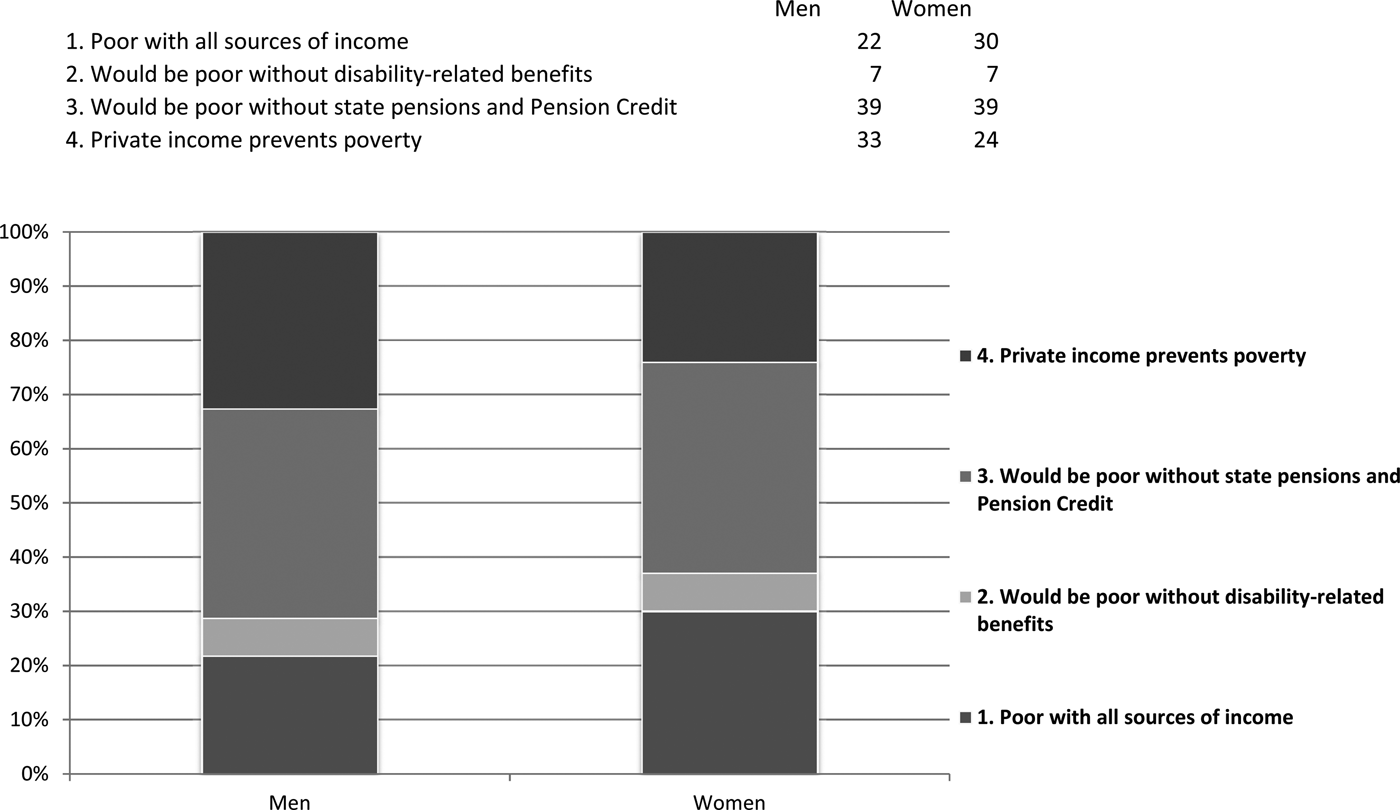
Figure 1 shows that among men and women over age 65 in wave 3, 30 per cent of women and 22 per cent of men had incomes below the official poverty line (category 1). As noted above, the official measure assumes equal sharing between partners.
Percentage who would be in poverty without each income source, men and women, 65+.

For approximately 7 per cent of men and women, their incomes were above the poverty line only because they or their partners were in receipt of disability-related benefits (mainly AA and/or DLA) (category 2). Without these benefits, intended to assist with the additional costs of disability, the proportion of older women and men with incomes below the official poverty line would have been 37 and 29 per cent, respectively – much higher than official statistics suggest. This is particularly important since research has shown that these disability-related cash allowances underestimate the additional costs of disability (Hancock and Pudney Reference Hancock and Pudney2013; Morciano and Hancock Reference Morciano and Hancock2014). While there is currently no consensus as to how to measure the additional costs of disability (Berthoud Reference Berthoud2009; Hancock and Pudney Reference Hancock and Pudney2013), Morciano and Hancock (Reference Morciano and Hancock2014) suggest that these extra costs are substantial and rise with severity, with highly disabled pensioners in 2007 requiring an average additional £180 a week to maintain an equivalent standard of living to a non-disabled person. Thus, although those in receipt of disability benefits may be kept out of official poverty statistics, many are almost certainly in poverty. This further raises the question of appropriate classification of those facing disability-related costs who are not in receipt of these benefits (Price Reference Price2008). Estimates vary widely: Morciano and Hancock (Reference Morciano and Hancock2014: 18) estimate that only about 27 per cent of those facing disability-related costs are in receipt of disability-related cash benefits, whereas Pudney (Reference Pudney2009) estimated 30 per cent of the over-65 population with unpursued but potentially successful claims.
Figure 1 shows that a further 39 per cent are maintained above the poverty line only by their receipt of other state transfers (state pensions and means-tested Pension Credit) (category 3). Only 24 per cent of women and 33 per cent of men over 65 would avoid poverty even if they received no state transfers at all (category 4).
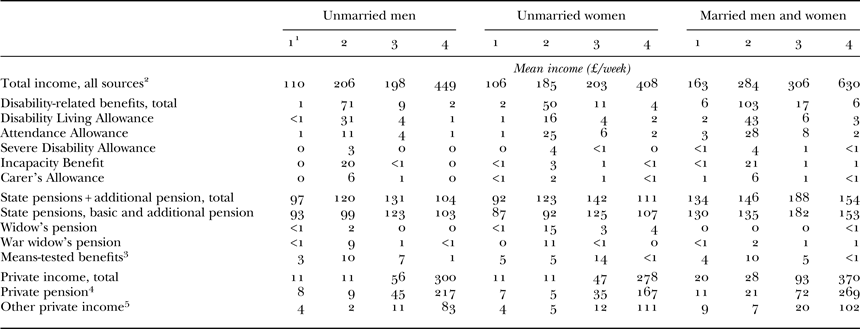
Table 1 shows the components of income for the men and women in each of the four income categories, according to their marital status. For those in poverty and those kept out of poverty by disability-related benefits (categories 1 and 2), the amounts of state transfers, private pensions and other private income were very low: unmarried men and women in these categories received on average less than £100 per week from state pensions and less than £10 per week from private pensions, while married couples in these two categories fared only slightly better. Average income from disability-related benefits (i.e. DLA and AA) for those in category 2 (kept out of poverty only by disability benefits) is about £42 per week for unmarried men and women and £71 for married individuals. For those who would not be in poverty even if they had no state transfers at all (category 4), private pensions form the largest source of income: four to five times higher than for those in category 3 (need state pensions/state income support), and about 25–30 times higher than for those in poverty, with mean private pension receipt for those in category 4 of £167 for unmarried women, £217 for unmarried men and £269 for married men and women.
Mean income according to income category and marital status, men and women 65+, 2006

Notes: All incomes are unequivalised, unweighted and rounded to the nearest pound. 1. Income categories: 1 = Poor with all sources of income; 2 = Would be poor without disability-related benefits; 3 = Would be poor without state pensions and Pension Credit; 4 = Private income prevents poverty. 2. Total income includes employment income, self-employment income and other income (e.g. maintenance and royalities) as well as some minor components of benefit income (e.g. other health benefits), all of which are not shown. 3. Means-tested benefits technically include Pension Credit, Minimum Income Guarantee and Working Families Tax Credit but only Pension Credit was received in this age group at this time. 4. Private pension includes survivor pensions. 5. Other private income includes earnings, interest from savings, return on investments and rental income.
Source: English Longitudinal Study of Ageing, wave 3, 2006.
We next examine how far state transfers compensate for lifecourse factors which might otherwise have led to later-life poverty.
Characteristics associated with later-life poverty
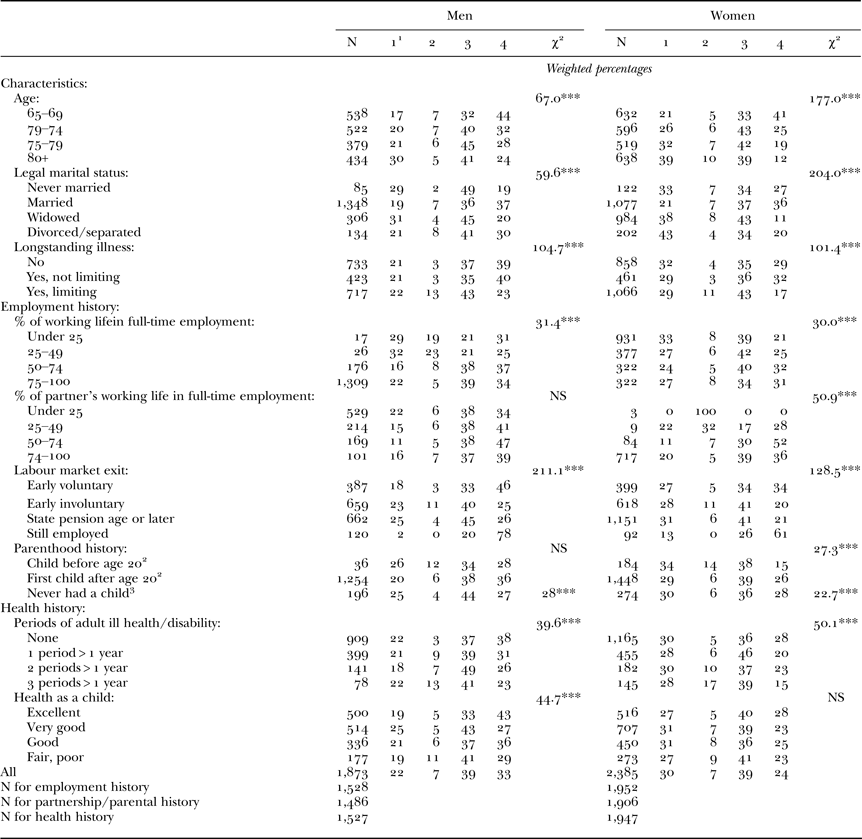
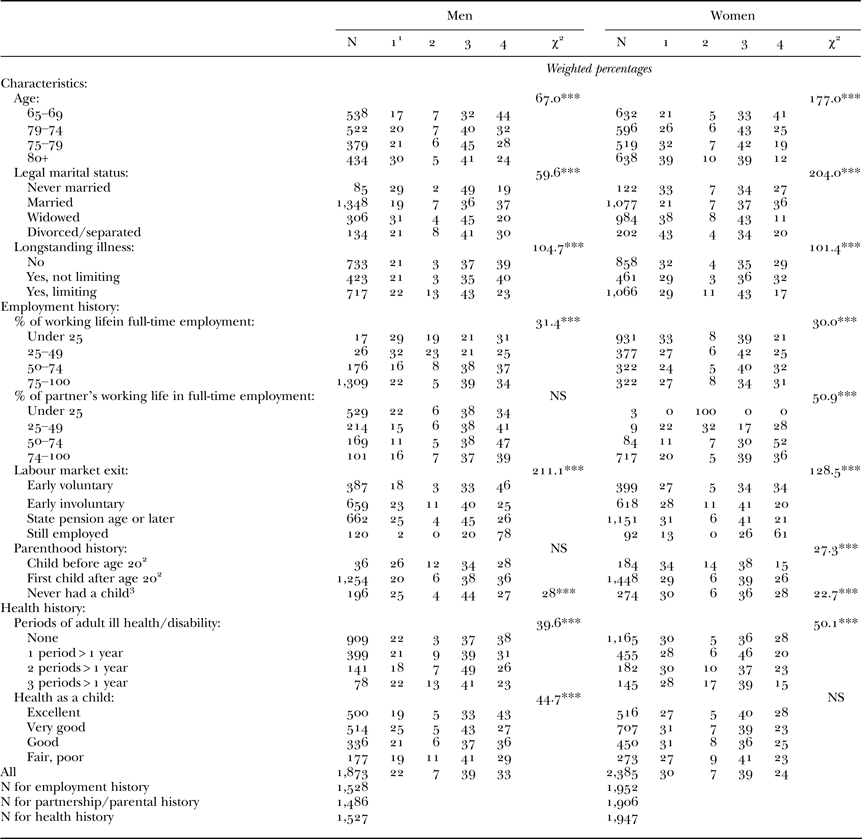
In Table 2, row percentages show the proportion of older men and women in each income category (1–4) according to family, employment and health history variables. The bivariate associations with poverty are consistent with previous findings (Banks et al. Reference Banks, Breeze, Lessof and Nazroo2008; DWP 2009). For those in category 1, poverty was, as expected, significantly associated with the older age group, as well as with socio-economic disadvantage such as renting a home, lower social class and no educational qualifications (data not shown). Among men, poverty was most likely for those who were widowed (31% of whom were in poverty) or never married (29%), but among women it was most likely for those who were divorced/separated (43% of whom were in poverty) or widowed (38%). Married individuals were least likely to be poor (about 20%), although for women this depends on assuming equal sharing between spouses. All the employment history variables (except partner's work history for men) showed a significant association with poverty, which was least likely for those with longer full-time employment histories and those still employed. Nearly half of women had spent less than 25 per cent of their working life in full-time employment and among these a third were poor.
Distribution across income categories by life history and current status, men and women 65+
Notes: 1. Income categories: 1 = Poor with all sources of income; 2 = Would be poor without disability-related benefits; 3 = Would be poor without state pensions and Pension Credit; 4 = Private income prevents poverty. 2. χ2 for those with children. 3. χ2 for table with 0, 1, 2, 3+ children.
Source: English Longitudinal Study of Ageing, wave 3, 2006.
Significance levels: NS: not significant, *** p < 0.001.
Avoiding poverty through receipt of disability-related benefits (category 2) was the case for 7 per cent of older people, but Table 2 shows that this was more likely among those who had a limiting longstanding illness (LLI) (13% of men with an LLI had incomes above the poverty line only because of receipt of disability benefits, 11% of women), those who had had several periods of ill health/disability as an adult (13% of men with histories of poor health depend on disability benefits to keep their incomes above the poverty line, 17% of women), those who had experienced early involuntary exit from the labour market (11% of both men and women) and those who were socio-economically disadvantaged (data not shown). Reliance on disability-related benefits for income above the poverty line was also more likely for men with less than ‘good’ health as a child (11% of these men were kept above the poverty line by disability benefits) or a short (less than half of the working life) record of full-time employment (about 21% of whom were in category 2). A third of women whose husbands had been in full-time work for less than half of their working life relied on disability benefits for maintaining income above the poverty line – suggesting the role that derived state and private pensions might be playing in the incomes of other women. Among women, 14 per cent who had a teen birth relied on disability-related benefits in later life for income above the poverty line.
For both men and women, 39 per cent avoided income below the poverty line only through receipt of state pensions and Pension Credit (category 3). The proportions varied across marital, maternal and illness characteristics but notably only one-fifth of men with a short full-time employment record were in this category, as were only 17 per cent of women whose partner had similarly short employment, since these groups were disproportionately in poverty or reliant on disability benefits for incomes above the poverty line.
For men, those who described their health as a child as ‘excellent’, those who had no periods of ill health as an adult and those with no current LLI were all disproportionately likely to be in the highest income category of those whose private incomes in later life were sufficient to lift them above the poverty line without state transfers (category 4). The women most likely to be in category 4 were those who had spent more than 50 per cent of their working lives in full-time employment, with just over 30 per cent of those with good full-time employment histories in category 4, compared with 24 per cent of all women.
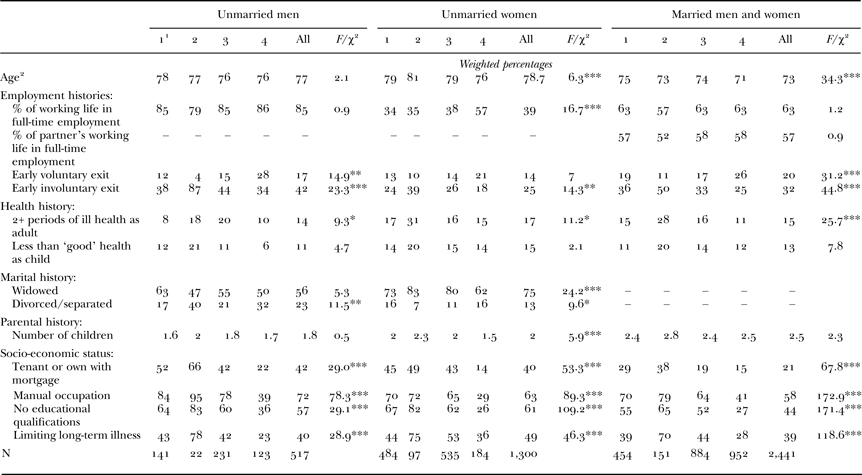
Table 3 shows the distribution of the key characteristics for unmarried men and women and for married men and women according to each dichotomised independent variable. There are few significant differences across the four categories in the amount of time spent in full-time employment, although unmarried women who have income above the poverty threshold without state transfers (category 4) had on average a much higher proportion of their working life spent in full-time work (57%) than other unmarried women (39%). For unmarried men, voluntary exit before state pension age was associated with being in category 4, the wealthiest category, that is not dependent on state transfers for income above the poverty threshold: 28 per cent of category 4 men had experienced an early voluntary exit, compared with 17 per cent of men overall. Involuntary early exit was in contrast strongly associated with reliance on disability-related benefits for maintaining income (category 2): 87 per cent of men in category 2 had experienced an involuntary exit from work, compared with 42 per cent of men overall. Widows were over-represented in categories 2 (disability benefits keep income above the poverty line) or 3 (state pensions and Pension Credit keep income above the poverty line) rather than category 4 (above the line regardless of state transfers), showing their reliance on partners and state transfers to avoid poverty; this was different for divorced women, who were disproportionately polarised between those who have incomes below the poverty line (category 1) and those who are above the poverty line regardless of state transfers (category 4). Divorced men were over-represented in category 2 (disability benefits), with 40 per cent of men reliant on disability benefits for being maintained above the poverty threshold being divorced, whereas overall 23 per cent of unmarried men over 65 are divorced. Reliance on disability-related benefits for income maintained above official poverty thresholds was also substantially and significantly associated with two or more periods of adult ill health/disability, having a current LLI and socio-economic disadvantage, for both men and women, married or not.
Distribution of characteristics within income categories, by marital status, men and women 65+, 2006
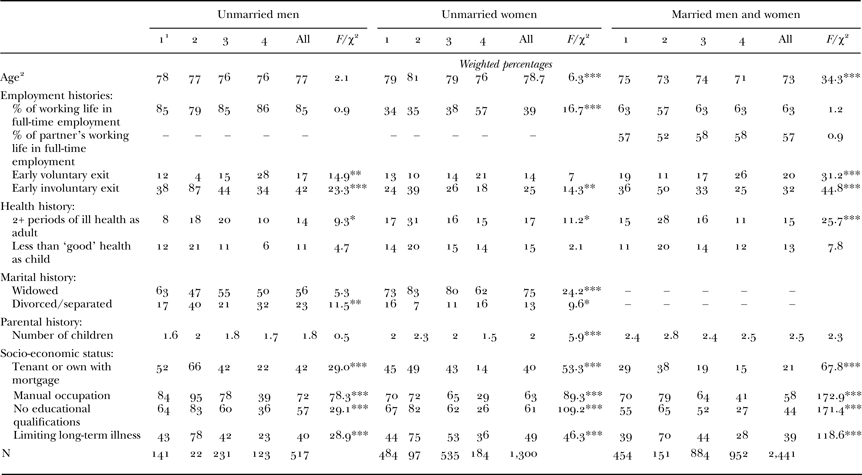
Notes: 1. Income categories: 1 = Poor with all sources of income; 2 = Would be poor without disability-related benefits; 3 = Would be poor without state pensions and Pension Credit; 4 = Private income prevents poverty. 2. Weighted means. Each categorical variable is analysed as one or more dichotomised dummy variables, e.g. early voluntary/involuntary exit where the reference category includes all respondents not in the chosen dummy (including retired at state pension age or still working, not shown); 2+ periods of ill health as adult where ‘other’ includes remaining respondents with one period of ill health or less; less than ‘good’ health as a child where the reference category includes respondents with good health or better as a child; widowed and divorced/separated where ‘other’ includes all respondents in the other categories (including never married, not shown); etc. Age, number of children, percentage of working life in full-time employment, percentage of partner's working life in full-time employment all treated as continuous variables.
Source: English Longitudinal Study of Ageing, Wave 3, 2006.
Significance levels: * p < 0.05, ** p < 0.01, *** p < 0.001. F-test for continuous variables and χ2 test for categorical variables.
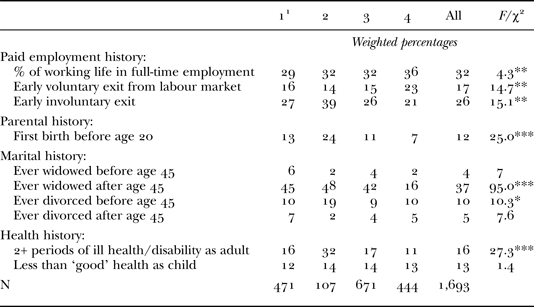
Table 4 shows results of distributional analysis for mothers (women who had had a child). Mothers had on average spent only a third of their working life in full-time employment, with those in poverty (category 1) having spent marginally less time in full-time work (29%) and those with sufficient private income to prevent poverty marginally more (36%). Those mothers forced to leave the labour market early (before state pension age) were significantly more likely than average to rely on disability-related benefits for incomes above the official poverty line (39% of mothers reliant on disability benefits had had a forced exit, compared with 26% of mothers overall), as were those who had a first birth before age 20 (24% of mothers reliant on disability benefits had had a first birth before age 20, compared with 12 per cent of mothers overall who had had a teenage birth) or who had had two or more periods of adult ill health/disability (32% of those reliant on disability benefits compared with 16% overall). Those widowed after age 45 (48% of women in category 2 were widowed, compared with 37% overall) or were divorced before age 45 (19% of women in category 2 were divorced, compared with 10% overall) were also substantially over-represented in category 2, relying on disability-related benefits to maintain their incomes above poverty lines. Widows who had been mothers were disproportionately excluded from category 4, those with sufficient private income to prevent poverty without state transfers: while about 40 per cent of mothers aged over 65 were widowed, only 16 per cent of those in category 4 were widows.
Distribution of characteristics within income categories, mothers aged 65+, 2006

Notes: 1. Income categories: 1 = Poor with all sources of income; 2 = Would be poor without disability-related benefits; 3 = Would be poor without state pensions and Pension Credit; 4 = Private income prevents poverty. F-test for continuous variables and χ2 test for categorical variables. Each categorical variable is analysed as one or more dichotomised dummy variables; e.g. widowed before age 45/other, first birth before age 20 where ‘other’ includes all respondents not in the chosen dummy; for other variables, see Table 3 notes.
Source: English Longitudinal Study of Ageing, Wave 3, 2006.
Significance levels: * p < 0.05, ** p < 0.01, *** p < 0.001.
Multivariate analyses: effect of lifecourse history on income category
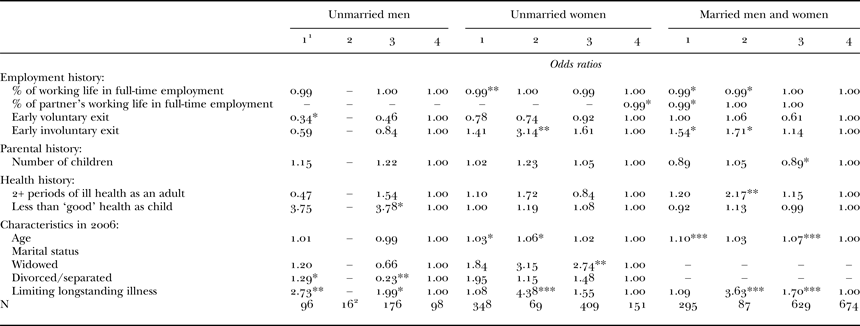
Since there are many important associations illustrated in Tables 1–4 with current and lifecourse factors, we used multinomial logistic regression to disentangle associations of lifecourse history variables with the four income categories. The results are shown in Table 5. The odds ratios represent the effect of the independent variables on the odds of being in each income category 1–3 relative to odds of 1.00 in the reference group (4) where private income is sufficient by itself to avoid income falling below the poverty threshold. We report results in Table 5 for three groups: unmarried men, unmarried women, and currently married men and women. The number of unmarried men in category 2 was too small for reliability (N = 16) so these results are omitted. Controls for socio-economic factors were included in all three models but are not shown.
Multinomial regression model for being in each income category 1–3, relative to category 4, by marital status, men and women 65+, 2006

Notes: 1. Income categories: 1 = Poor with all sources of income; 2 = Would be poor without disability-related benefits; 3 = Would be poor without state pensions and Pension Credit; 4 = Private income prevents poverty. 2. There were too few unmarried men in category 2 to analyse. The models adust for the following additional characteristics: (1) educational qualifications (reference group: none), i.e. degree, ‘A’ levels and higher, ‘O’ levels, clerical, commercial or trade qualifications; (2) occupational category (reference group: semi-routine workers) based on the five-category National Statistics Socio-economic Classification scheme according to respondent's current or last main job (i.e. professional/managerial professions, intermediate professions, small employers and own-account workers, lower supervisory and technical occupations); (3) housing tenure (reference group: those who owned their homes without a mortgage) distinguished those who were renting or still buying their home with the help of a mortgage or loan. Model also includes percentage of working life in a legal marriage as a continuous variable, not shown. Each categorical variable is analysed as one or more dichotomised dummy variables, see Table 3 notes.
Source: English Longitudinal Study of Ageing, wave 3, 2006.
Significance levels: * p < 0.05, ** p < 0.01, *** p < 0.001.
In terms of employment histories, a higher proportion of working life in full-time paid work reduced the likelihood of relying on disability-related benefits for married individuals and reduced the risk of poverty for married individuals and unmarried women. But although statistically significant, the effect was relatively small. Early forced exit from the labour market was associated with a higher risk of being in poverty or maintained above the poverty line only by disability-related benefits, consistent with those individuals suffering ill health or disability before state pension age. The association of early forced exit with being in category 2 (reliant on disability benefits for income above the poverty line) was strongest for unmarried women (relative odds of 3.14); for married individuals it was weaker. As expected, indicators of health problems were linked with reliance on state transfers (categories 2 and 3). Those who experienced two or more periods of ill health/disability as an adult had a raised risk of reliance on disability-related benefits in later life but this was significant only for married individuals, with an odds ratio of 2.17. Having ‘less than good’ health as a child was associated with being in categories 1 (in poverty) or 3 (reliant on state pension and Pension Credit) for unmarried men. Having a current LLI was significantly and strongly associated with reliance on disability-related benefits for unmarried women (odds ratio of 4.38) and for married men and women (odds ratio of 3.63) (numbers of unmarried men too small to analyse); it was also associated with raised odds of reliance on state pensions and Pension Credit, significantly for unmarried men and married individuals. Turning to marital history, widows had raised odds of being reliant on state transfers, significantly for state pensions and Pension Credit. Once other variables were controlled for, divorced/separated men had raised odds of being in poverty (odds ratio of 1.29) but reduced likelihood of being in category 3 (protected by state pensions and Pension Credit) relative to the highest income category 4.
These results illustrate how the lifecourse, including past and current health problems and marital history, can raise the probability of individuals requiring disability-related benefits and other state transfers to avoid poverty, independently of their socio-economic circumstances. Since the lifecourse factor that is most often discussed in the literature for women is having had children, we next focus particularly on mothers, especially exploring the effects of widowhood and divorce.
Multivariate analyses: effect of lifecourse history on later-life income category of mothers
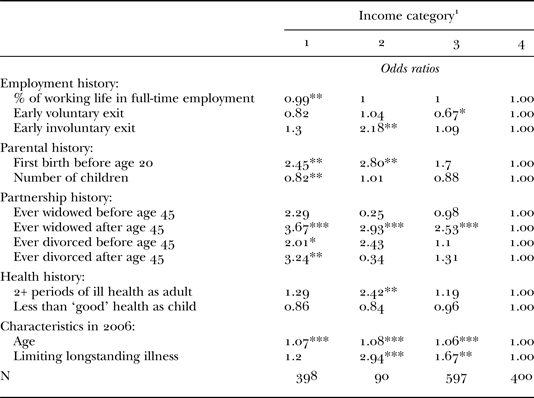
Much of the literature on income inequality in later life focuses on the cost of motherhood. Hence in this final section, we analyse how various lifecourse factors can influence mothers' income category, using a multinomial model (Table 6). This shows that older age, periods of ill health in adulthood and LLI were all associated with being in income categories 1–3, needing state transfers, as for all women, once other factors are controlled. Once other factors are controlled, spending a higher proportion of working life in full-time employment was significantly but only weakly associated with lower risk of poverty among mothers. As in Table 5, mothers who had to leave the labour force involuntarily before state pension age had raised odds of being dependent on disability-related benefits, even controlling for other health variables, suggesting a higher likelihood of disability benefit take up among those involuntarily retired. Turning to parental and marital histories, having a teen birth was associated with being in poverty, or avoiding it only through disability-related benefits. Experiencing widowhood after age 45 was strongly and significantly associated with being in categories 1–3, needing state transfers, with the odds of these widows being in poverty (category 1) almost four times higher than the odds of being in category 4 (having sufficient private income to avoid poverty without state transfers). Effects were not significant for those widowed before age 45, although there were small numbers in this category. Divorce raised the risk of poverty for all mothers but substantially more so when experienced over age 45, with those divorced before aged 45 having twice the odds of being in poverty, and those divorced after age 45 more than three times the odds of being in poverty, compared with the odds of being financially secure in category 4.
Multinomial model for being in each income category 1–3, relative to category 4, mothers 65+, 2006

Notes: 1. Income categories: 1 = Poor with all sources of income; 2 = Would be poor without disability-related benefits; 3 = Would be poor without state pensions and Pension Credit; 4 = Private income prevents poverty. The models also control for educational qualifications, social class status, housing tenure, percentage of working life in legal marriage, see Table 5 notes. Each categorical variable is analysed as one or more dichotomised dummy variables, see Table 4 notes.
Source: English Longitudinal Study of Ageing, wave 3, 2006.
Significance levels: * p < 0.05, ** p < 0.01, *** p < 0.001.
Discussion
Although pensioner poverty rates have reduced since the 1990s, in these data one in four pensioners in England had incomes below the official OECD relative poverty threshold. It is noticeable that the incomes of those identified here as below the OECD poverty threshold are also typically lower than the UK threshold for means-tested Pension Credit, supporting research that about one-third of those eligible for Pension Credit do not claim (Barton and Riley Reference Barton and Riley2012).
The data suggest that state pension and benefit receipt is often too low to ensure adequate income for older people without private pensions or other additional income. This, however, is shown to be unequally available, placing certain groups at a disadvantage. The analysis confirms the already well-known importance of age, occupational class, educational qualifications and home ownership for predicting poverty in later life. But further, multivariate modelling found evidence that family history such as teenage first birth and divorce or widowhood for mothers doubled, trebled or almost quadrupled the odds of being in poverty in later life, controlling for other relevant factors including lifecourse employment and health variables.
As has been suggested might be the case from recent research (Sefton, Evandrou and Falkingham Reference Sefton, Evandrou and Falkingham2011), the effect of longer full-time employment in reducing poverty risk once other factors were taken into account was relatively weak. Part of the explanation for this outcome lies in the way income is conventionally assumed to be shared equally between married couples, thus obscuring the effect of employment history on individual later-life income for many older married women, most of them mothers, whose income poverty will be ‘revealed’ on widowhood (Price Reference Price2006c ). A second contributory factor is that the state welfare system potentially dilutes the effect of adverse employment histories on poverty risk through credits in the state pension system for motherhood and illness, and derived rights for divorcees and widows. Widows may also have inherited private pension from their husbands.
For most of the population, receipt of state transfers in the form of state pension and Pension Credit remains necessary to escape poverty in old age. This analysis showed that only 24 per cent of women and 33 per cent of men over 65 have enough income to avoid poverty without any state transfers. At a time when state welfare provision is constantly revised and threatened and public- and private-sector pensions are reducing, it is important to recognise the role that the state plays in the financial lives of the substantial majority of older people, through a complex combination of contributory, credited, means-tested and non-means-tested benefits.
This analysis further showed that lifecourse factors are important in influencing trajectories to experiencing income poverty in old age but, more specifically, are critical for predicting which elements of state universal, contributory and means-tested pension and benefit systems keep people out of poverty in later life. In particular, considering the role of disability benefits reveals a complicated story. We find that non-means-tested disability benefit receipt in later life is key for maintaining the income of some especially high-risk groups above the official poverty line. These groups include (perhaps predictably) those with poor health histories in childhood or adulthood, current impaired health status or who had experienced forced early exit from employment. However, even after controlling for current and earlier health status and other factors, there is substantial social inequality in those who depend on non-means-tested disability benefits for income maintenance in later life. Those from manual occupations, those with no educational qualifications, women who are not married, who do not own their homes outright and who exited the workforce involuntarily, and mothers who have experienced two or more periods of ill health as an adult, had their first child before 20 or have been widowed, are all disproportionately dependent on non-means-tested disability benefits for income in later life.
Increases in poverty may be substantial if disability benefits are abolished and the funds absorbed into the care system, which targets a completely different and much smaller set of people (Dilnot et al. Reference Dilnot, Warner and Williams2011; House of Commons 2010: 172–7). Three things are important to note. First, the disability benefits that we have scrutinised here are non-means-tested benefits, and have been shown to play a very important role in keeping otherwise poor peoples' incomes above official poverty lines. The analysis suggests that it is important to maintain the value of disability benefits for older people, and not subject them to a means test. But second, this does not mean they are kept out of poverty, since these benefits are intended to compensate for the additional costs of disability, which have been estimated to be considerable (Morciano and Hancock Reference Morciano and Hancock2014). What it does mean is that the older people in this category – about 850,000 older people – have become invisible to policy makers, since they have been kept out of official poverty statistics (Hancock and Pudney Reference Hancock and Pudney2013; Morciano and Hancock Reference Morciano and Hancock2014; Price Reference Price2008). Our analysis has shown that abolishing DLA and AA for older people would see a substantial increase in the official poverty rates of older people, rising by 7 per cent for both men and women to 29 and 37 per cent, respectively. They would still have the additional costs of disability to absorb, and, as revealed by our models, are among the most vulnerable groups in society, some with long histories of disadvantage, stretching back to childhood and adult health problems, teenage pregnancies, low-grade occupations, little education and marital dissolution. The third point is that even though disability benefits are not means tested, their take-up remains low (Pudney Reference Pudney2009; Morciano and Hancock Reference Morciano and Hancock2014). This means that those older people who have disabilities, and therefore incur the additional associated costs, but are not in receipt of any compensating cash benefits, are largely invisible to policy makers (Morciano and Hancock Reference Morciano and Hancock2014). Many with incomes shown by our analysis to be above the poverty line will nevertheless be experiencing poverty due to the increased costs to their household of managing their disabilities. In these ways, the poverty of older people is consistently and institutionally underestimated.
This study reflects the experiences of a particular cohort of people, those born before 1941. Insofar as the lifecourse experiences of future generations of retirees are different, this is likely to affect the distribution of retirement incomes, although it is difficult to predict what impact this may have. Changes in the labour market participation of women over recent decades and improvements to the basic state pension for future cohorts, for example, are likely to mean that more women will have longer employment histories and better basic state pensions, albeit the employment of mothers and carers still being characterised by interruptions and periods in part-time employment that will reduce accumulation of private pensions, maintaining the gender gap in individual retirement income. Public-sector pensions on which many women have historically relied are reducing, and issues of low pay and poor, risky pension provision remain problematic. There has also been an increase in the incidence of divorce, co-habitation and lone motherhood in later generations which may adversely affect the build-up of retirement incomes; and derived pensions that have protected widows are being phased out in both state and private defined contribution pensions. Raising the state pension age in line with rising life expectancy may mean more people with health problems or caring commitments having to leave the labour market before they are eligible for the state pension.
With an ageing population and signs that increasing longevity is not necessarily matched by increased healthy life expectancy, disability-related benefits are likely to provide continued necessary support for those aged over 65 in future. Moreover, in the wider debate as between means-tested and universal pensions, benefits and social care systems, this analysis has shown how important it is to take an integrated approach to analysis. In the complex national systems for income maintenance in later life that mature welfare states now manage, with combinations of contributory, credited, conditional, means-tested and non-means-tested benefits, it is important in poverty research to consider how, and more particularly for whom, different components of state income may be ameliorating or mediating lifecourse influences on income poverty in later life.
Acknowledgements
The research reported here was supported by a grant from the Economic and Social Research Council, as part of its Understanding Population Trends and Processes (UPTAP) programme (RES-163-27-0014). We are grateful to the UK Data Archive for permission and access to the English Longitudinal Study of Ageing (ELSA). The authors alone bear responsibility for the analysis and interpretation of the data. No ethical approval was required as this is secondary data analysis of ELSA.