Immigration—the issue that Donald Trump says “wasn’t on anybody’s mind until I brought it up”—never remains out of the American political spotlight for long. Trump’s inflammatory comments about sanctuary cities and his widely execrated plan to halt the entry of Muslims into the United States punctuate decades of unresolved controversy over whom to admit, how many, and with what rights. Hundreds of bills in the last twenty-five years have sought to augment, scale back, or rebalance an admissions regime that, at present, allocates roughly one million green cards each year to relatives of U.S. citizens and legal permanent residents (about two-thirds of visas), skilled workers (15 percent), and refugees (15 percent).Footnote 1 Acrimonious debates have repeatedly played out at all levels of government over the fate of an estimated 12 million illegal immigrants, many of whom arrived in the United States as children, have family ties here, or are so integrated into American society that returning home is unthinkable to them. Should they be deported as “law-breakers?” Legalized as aspirants to the American dream? Tolerated in a policy of “salutary neglect?”
When push comes to shove, whose immigration policy priorities will politicians heed? The most widely circulated scholarly accounts of immigration policy-making in the United States and other liberal democracies see cosmopolitan elites and organized “clienteles” that benefit from immigrant labor and votes—human rights lobbies, co-ethnic advocacy organizations, and employers of immigrant labor in agribusiness, high-tech, and other industries—running roughshod over diffuse, unorganized public opposition to their expansionary agendas.Footnote 2 In this view, Donald Trump’s bravado about a second “Operation Wetback”Footnote 3 and recriminations between Senators Marco Rubio and Ted Cruz during the Republican pre-primary debates over who actually committed the mortal sin of supporting “amnesty” (for the record, it was Rubio) are mere posturing.Footnote 4 Paralleling the politics of the 1986 Immigration Reform and Control Act (IRCA),Footnote 5 we can expect a characteristically cross-ideological “strange bedfellow” coalition of ethnic organizations, rights groups, high-tech, and agribusinessFootnote 6 to promulgate a “grand bargain” that pairs a large-scale legalization program with expansions of temporary work visas for seasonal agricultural and STEM workers. Restrictionist groups such as the Federation for American Immigration Reform, NumbersUSA, and the Center for Immigration Studies will cry foul as enforcement provisions such as mandatory employment eligibility verification or enhanced border security are watered down, unimplemented, or fully ignored. Though pro-immigrant elites and clienteles will have to navigate a complex and sometimes uncongenial institutional landscape on the way to this outcome,Footnote 7 they will eventually get their way regardless of what the public wants.
Though plausibly consistent with key features of American immigration policy-making between 1965 and 1990, this dominant explanatory perspective seems unable to explain the more recent politics of immigration. If public opinion plays at most a marginal role in shaping or constraining policy, why did President Clinton acquiesce to widely-supported provisions barring many immigrants from receiving federal benefits over the vociferous objection of immigrant rights groups?Footnote 8 How have years of lobbying and court challenges by the Chamber of Commerce, the ACLU, rights groups, and co-ethnic lobbies failed to prevent more than twenty Republican-dominated states from fully or partially mandating the use of the popular E-Verify system or implementing programs that in effect deputize local law enforcement as immigration agents?Footnote 9 And why has pressure from mainstream elites, business lobbies, civil and human rights organizations, and religious leaders been insufficient to rescue two presidents’ efforts, backed by leaders in both major parties, to enact comprehensive immigration from backlash at the conservative grassroots?Footnote 10
We argue that taking stock of mass pressures on U.S. immigration policymaking helps make sense of developments (and non-developments) that standard clientelist models cannot explain. What, then, have these perspectives on immigration politics missed? We argue that they have unduly minimized the role of public opinion in contemporary policy-making, because they misconstrue what the public wants and what it will accept. Summaries of public opinion data commonly emphasize Americans’ widespread “negativity and ambivalence”Footnote 11 toward immigration and general preference for “less of it (or at least no more).”Footnote 12 This portrait of mass attitudes is interpreted as hostility toward the specific status quo policies that have for half a century admitted large and increasing volumes of immigrants legally while tolerating the presence of millions who circumvent immigration law.Footnote 13 Based on this portrayal, expositors of the standard elitist model of policymaking see a stark opinion-policy “disconnect”Footnote 14 and a profound “democratic deficit”Footnote 15 and infer that policy-makers in the United States and other liberal democracies “will respond to the organized pressure of groups favorable to immigration, ignoring the widespread but poorly articulated opposition of the general public.”Footnote 16
We conducted a simple survey experiment to show that Americans’ abstract desire to reduce immigration co-exists with broad-based support for the pillars of the expansionary status quo—family reunification, recruitment of skilled labor, and admitting refugees. This contradictory mix of opinions arises because the actual contours of visa preferences evoke humanitarian and sociotropic considerations that compete with the exclusionary impulses tapped by more abstract poll questions.Footnote 17 The point here is not that the public is more “pro-immigrant” than generally believed or that it will support large-scale immigration irrespective of the political context,Footnote 18 but that failing to take stock of divergence between abstract policy aims and specific means of achieving them makes one ignore the permissive consensusFootnote 19 supporting the status quo.
By undermining the linchpin of clientelist accounts’ evidence that elites and powerful lobbies simply override mass preferences over immigration policy, we re-open the possibility that public opinion exerts a much greater influence than standard models have allowed: were the public less accepting of the expansionary admissions-policy status quo, it is not clear whether pro-immigrant lobbies could have pushed it and sustained it anyway. But since mass and elite opinion over legal admissions policies align, the independent influence of each on policy clearly is difficult to ascertain.
We turn to the case of illegal immigration to illustrate how an elaborated portrait of the nuance in Americans’ immigration opinions can help make sense of aspects of immigration politics that the clientelist perspective finds puzzling. We look beyond general indicators of public attitudes that have paradoxically suggested both intense public animus toward illegal immigration in the abstractFootnote 20 and overwhelming support (widely reported in news media) for the general idea of earned citizenship.Footnote 21 Responses to more specific and concrete poll questions reveal that, while a large majority of the public rejects thoroughgoing Trump-style crackdowns, majorities also reject large-scale legalization programs and support encumbering even narrowly-tailored ones with stringent enforcement benchmarks. Such narrow programs and preconditions are unacceptable to key lobbies pushing for reform. Moreover, much of the opposition to large-scale legalization programs is intensely moralisticFootnote 22 and thus unlikely to be amenable to the sorts of “grand bargains” that have historically been critical to reforming immigration policy.Footnote 23 Caught between public opposition to ambitious reforms and interest groups’ unwillingness to settle for more modest steps with a promise of incremental change,Footnote 24 comprehensive immigration reform remains in limbo.
We must stop short of definitively asserting an opinion-policy causal chain, but our evidence about the nature of public preferences on immigration policy suggests serious reconsideration of the role of public preferences in contemporary immigration politics. If mass opinion does play the constraining role indicated by recent events, achieving comprehensive immigration reform will require persuading a skeptical public and not just bargaining between elites and entrenched pro-immigrant lobbies. Jennifer Merolla, Karthick Ramakrishnan, and Chris Haynes’Footnote 25 experimental research on framing effects in this domain suggests that “equivalence framing” and re-branding by elites may not do the trick. Our own study is consistent with their finding that “policy frames” hold persuasive potential, but what they see as frames strike us as substantive policy alternatives. When it comes to illegal-immigration policy, the alternatives capable of mustering public support and assuaging a large minority that opposes large-scale reform on rigid moralistic groundsFootnote 26 do not go far enough to satisfy key interest groups. In sum, the nuanced portrait of public opinion of immigration presented here indicates that client politics is not unchallenged and that democratic responsiveness is part of the policy-making process here and, arguably, in other domains of policy as well.Footnote 27
Models of U.S. Immigration Politics: Whither Mass Opinion?
The Standard Narrative
Prominent clientelist models of immigration policy trace weak responsiveness to the differential incentives of pro- and anti-immigrant groups to mobilize.Footnote 28 The benefits of immigration are concentrated among businesses that employ cheap immigrant labor and co-ethnic lobbies that benefit from immigrants’ political support.Footnote 29 By contrast, costs are widely diffused among the general public, and since the predominantly cultural threats associated with immigrantsFootnote 30 are not keenly felt until well after the onset of a large influx, those who eventually rally around such sentiments are at a fatal temporal disadvantage in the policy process.Footnote 31
These models’ institutionalist cousins, which emphasize the role of state structures in advantaging particular interests and ideologies at different historical junctures, have generally embraced this clientelist logic as an important underpinning of national-level policy-making in the post-1965 era in the United States.Footnote 32 Daniel Tichenor,Footnote 33 for example, writes that the key challenge in understanding post-1965 policy is to “account for the insulation of the policy process from mass publics long opposed to new immigration,”Footnote 34 and when it comes to the central explaining “why powerful pro-immigration groups sometimes have lost decisively in struggles over immigration control,” public opinion is not part of the answer. Institutional factors shape the structure of opportunity key lobbies and elites face, but for the past fifty years they have repeatedly advantaged pro-immigrant clienteles and limited mass influence. An active judiciary has to a considerable degree embraced universalistic principles of human rights that privilege pro-immigrant points of view.Footnote 35 Bureaucratic authority over the particulars of many policies leaves room for behind-the-scenes influence peddling by organized groups and elites.Footnote 36 And the opportunity for populist anti-immigrant parties one often sees in PR-based legislaturesFootnote 37 is confined in the United States to intraparty contests. Cross-ideological coalitions of “strange bedfellows” that span the major parties have challenged permissive immigration policy often emerge,Footnote 38 but since 1965 their efforts have not stemmed the expansionary tide.
In addition to these political economic and institutional forces, ideological pressures bolster this dynamic. Postwar elite cosmopolitan norms further circumscribe the immigration debate and bolster expansionary policies by denigrating restrictionist appeals. The wealthy, the academy, and the political establishment deride appeals to limit immigration as xenophobic, racist, selfish, or shortsighted and, with a sympathetic media in tow, stifle populist mobilization as contrary to universalist principles and economic imperatives.Footnote 39
Accordingly, the standard scholarly narrative of immigration policy-making since 1965 has focused squarely on the adoption of a slew of ever-more expansionary policies, mass opposition notwithstanding. Even legislative efforts ostensibly aimed at limiting immigration are either subsequently emasculated or morph into policies that admit more immigrants. The most dramatic change to immigration policy since 1965, IRCA, emerged from efforts to crack down on illegal immigration by imposing sanctions on employers who hired illegal immigrants and tightening border security. Though IRCA did include “watered down” provisions for sanctioning employers and stiffening border control,Footnote 40 President Reagan and his successors provided scant funding to the Immigration and Naturalization Service (later to the Department of Homeland Security, hereafter “DHS”) to enforce the sanctions, and concentrated border enforcement in some places in the ensuing decade deflected but did not deter almost a net ten million more illegal immigrants from coming to the United States.Footnote 41 Instead, by far the most important legacy of IRCA was the granting of legal permanent residency to nearly three million illegal immigrants, including over a million through a program that required only 90 days employment in U.S. agriculture in the previous year and appears to have been rife with fraud.Footnote 42 Similarly, Peter SchuckFootnote 43 notes that after gaining momentum as an effort to restrict immigration, efforts to reform immigration policy in 1990 wound up adding hundreds of thousands of visas per year and imposing no new restrictions of note.
Ordinary citizens seldom feature as actors in these accounts of immigration policy-making, and public opinion rarely is discussed except as a foil whose seeming impotence is a puzzle requiring explanation. A stronger role for mass preferences is usually found only in the distant past,Footnote 44 outside the United States,Footnote 45 or at the sub-national level.Footnote 46 And while legislative responses to public backlash undoubtedly exist (e.g., Arizona’s S.B. 1070), most have been aimed at illegal immigrants, many are not effectively implemented (e.g. English-only laws and the majority of E-Verify mandates), and most carry symbolic rather than substantive freight.Footnote 47
Challenged to explain more recent developments in U.S. immigration politics, and especially the failure of comprehensive immigration reform efforts, more recent work in the clientelist and institutionalist molds has seemed to allow a greater role for public opinion. Gary Freeman, Randall Hansen, and David Leal, for example, concede that “public opinion may not determine policy outcomes but rather set boundaries” that at some times, “as today … are relatively narrow, thereby limiting policy options to the status quo or more restrictive measures.”Footnote 48 This idea is not developed, however, and so crucial questions remain unresolved. Why, for example, does a public that appears to favor legalization programs constrain the emergence of these policies while failing to achieve the reductions in legal immigration it seems to prefer overwhelmingly? Daniel TichenorFootnote 49 discusses the fierce reaction of conservative opinion leaders to the Bush administration’s efforts at comprehensive immigration reform and notes polling data suggesting that the public was not supportive.Footnote 50 But it remains unclear why a public that had only recently supported legalization appeared to turn against it and why the politics of legal immigration seem to remain shielded as ever from a public that is portrayed as supporting reducing admissions—even when the Bush and Obama administrations’ comprehensive immigration reform proposals have both included provisions that would significantly increase legal immigration. The need to invoke public opinion to explain political developments that are puzzling to the elitist models strongly suggests re-examining what we think we have known about mass policy preferences in this domain and exploring anew the relationship of opinion and policy.
The Opinion/Policy “Disconnect” as Empirical Foundation for This Perspective
Ad hoc concessions to the influence of mass opinion notwithstanding, the standard narrative by and large continues to freely describe itself as one of “illegitimacy” and “democratic deficit.”Footnote 51 As justification for this emphasis, it invokes a “disconnect” between polls showing that the public prefers by 3:1 to reduce rather than increase the level of immigration and public policies since 1965 that have tended to increase not only the stock but also the flow of immigration.Footnote 52 The “disconnect” thesis, and the clientelist model it supports, rest on a particular interpretation of responses to a survey question asked first by Gallup just prior to the Hart-Celler Act’s passage in 1965 and posed regularly by several survey organizations since the late 1980s. The wording used by the American National Election Study (ANES) and the General Social Survey (GSS) is “Do you think the number of immigrants from foreign countries who are permitted to come to the United States to live should be increased a lot, increased a little, left the same as it is now, decreased a little, or decreased a lot?” Thus the current level of immigration is an anchoring point, and an opinion is solicited about whether and how this status quo should be changed. For convenience, we will refer to this poll question and its close variants as the “levels” question.Footnote 53
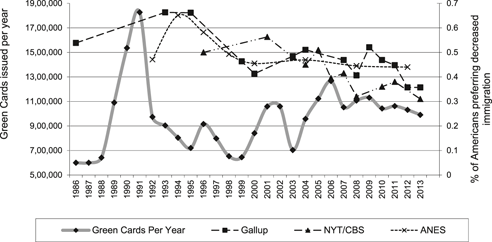
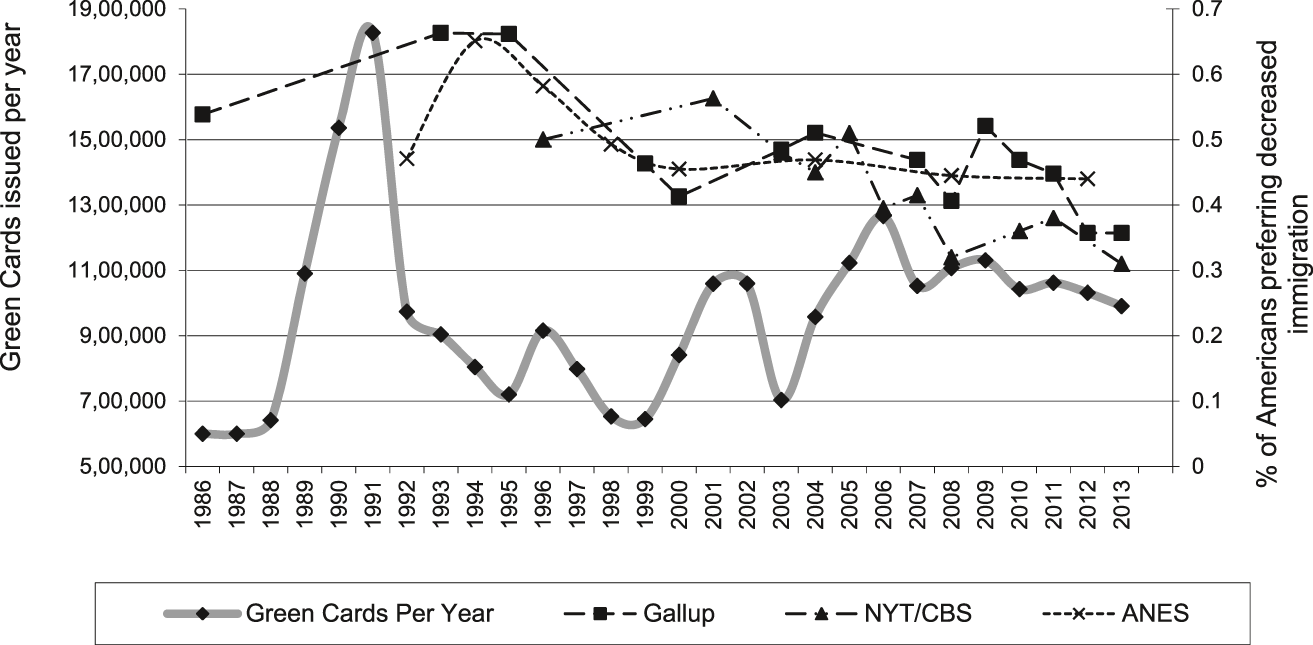
As shown in figure 1, using the level question as an indicator, the weight of popular opinion is plausibly regarded as restrictionist. But do responses to the level question really mean that the majority endorses severely restricting legal immigration to the United States? Some critics suggest that that the item’s wording elides the distinction between “legal” and “illegal” immigration,Footnote 54 although asking the question with an explicit reference to “legal” immigration does not much change the distribution of responses (again, refer to figure 1). Another concern with the item’s meaning centers on how to interpret the middle “remain about the same” response, given that it is anchored on what is in effect an expansionary policy.Footnote 55 In other words, once the status quo means a high level of immigration, does not the large number opting for the “remain about the same” response tilt the balance of opinion in a pro-immigration direction, weakening the “disconnect” interpretation.
Green cards issued annually in the U.S. and support for decreasing immigration as measured by standard “level” question
Note: Question wordings are as follows: ANES (General Social Survey has asked the same question in fewer years): “Do you think the number of immigrants from foreign countries who are permitted to come to the United States to live should be increased a lot, increased a little, left the same as it is now, decreased a little, or decreased a lot.” Gallup: “Thinking now about immigrants—that is, people who come from other countries to live here in the United States, in your view, should immigration be kept at its present level, increased, or decreased?” New York Times / CBS (Pew has the same question in fewer years): “Should LEGAL immigration into the United States be kept at its present level, increased, or decreased?”
Abstract versus Specific Policy Preferences and the Receive-Accept-Sample Model
A more fundamental problem than question wording is that while the response options appear to elicit a policy preference,Footnote 56 the level question does not in fact solicit views about concrete changes to policy. Most importantly, it does not probe beliefs about whether the pillars of current policy—that is, the preference categories upon which legal immigrants are admitted—should be changed. Visas are not handed out at random, so to say one wants fewer immigrants in the abstract may not mean that one is willing to cut the number admitted under the three largest status quo admissions preference categories—family reunification, high-skilled workers, and refugees—to bring this about. And if an unwillingness to cut the number admitted in these categories turns out not to be the case, standard accounts of immigration politics would seriously overstate the divergence of public opinion and public policy.
The possibility of a psychological disconnect between abstract beliefs about policy aims and concrete preferences over specific policy changes is of course not unique to immigration. Internal disconnects between preferred policy ends and support for commonly advanced means of achieving them appear in many domains of opinion, including taxing and spending, tolerance for “least liked groups,” support for procedural democracy, affirmative action, and preferences over the scope of government, to mention just a few.Footnote 57 In each case, there is inconsistency between abstract political principles or values, and opinions about the specific policies that have been proposed or implemented to realize them.
This circumstance is well explained by John Zaller’sFootnote 58 “Receive-Accept-Sample” (R-A-S) model of survey response. To Zaller, the traditional view that citizens have fixed and consistent public policy preferences is untenable in light of a widespread lack of political awareness and the over-time instability of individuals’ attitudes about most policy issues.Footnote 59 Instead, people formulate opinions by sampling from among the accessible “considerations” they have absorbed from elite debates and have not rejected as inconsistent with core predispositions.Footnote 60 Where considerations evoked by abstract questions about preferred policy ends differ in valence from those evoked by more concrete questions about specific policy means, a psychological disconnect will emerge. In the case of immigration policy, it would not be surprising if the U.S. public were considerably more favorable to the concrete elements of the (expansionist) status quo than the abstractly-worded level item would indicate. Immigration policy ostensibly has humanitarian and economic goals, both of which are reflected in the preference categories U.S. law establishes. Both justifications are prominent in elite discussions of immigration,Footnote 61 despite the frequent portrayal of culturally threatening images of immigrants in mainstream U.S. media.Footnote 62 And there is evidence that both considerations resonate in public opinion toward immigrants.Footnote 63 Benjamin Newman et al.Footnote 64 find that priming humanitarian concerns evokes more pro-immigrant responses to the standard level question, suggesting that even though there is a positive correlation between humanitarian values and pro-immigrant sentiment, the level question itself does not fully bring to mind the types of considerations that specific references to family unity or fleeing from plight in one’s country of origin might. Two recent studiesFootnote 65 both find that Americans prefer immigrants whose personal attributes indicate an ability to contribute to the nation’s economic well-being. Even if such sociotropic considerations are already tapped by the standard level question, it is reasonable to expect that they would be even more salient considerations when it comes to asking explicitly about the appropriate level of high-skilled immigration.
To the extent that the psychological predispositions underpinning the level question and questions about particular aspects of status quo admissions policy differ, there will be variation in the extent of inclusionary sentiment. References to the actual parameters of status quo admissions policies should prompt respondents either to (1) “self-prime” with considerations that would have been less accessible when answering the standard level questionFootnote 66 or (2) apply frames they might overlook when thinking about their preferred level of immigration in the abstract.Footnote 67 More concretely, humanitarian values should be a stronger predictor of support for retaining or expanding family and refugee immigration than of responses to the abstract level question or support for high-skilled immigration. By the same token, the salience of the federal deficit should be a stronger predictor of retaining or expanding the admission of taxpaying immigrants with skills U.S. employers say they need than of preferences over the level of immigration generally or over family or refugee admissions.Footnote 68
Reassessing the Opinion/Policy Disconnect on Legal Admissions
For evidence, we conducted an experiment in an Internet survey of 1,597 Americans fielded in December 2013 by SSI, which uses a matching-based methodology to approximate a representative sample of the public (for sample descriptive statistics, see Online Appendix). Despite a fairly typical underrepresentation of minority groups, and an overrepresentation of the highly educated, the distribution of opinion on our baseline immigration level question does not differ much from recent ANES, Gallup, and New York Times/CBS polling data (refer to figure 1). Unfortunately, small samples of minority group members preclude systematic comparisons across ethnic groups,Footnote 69 but the observed effects are consistent across education and partisan categories (refer to the Online Appendix).
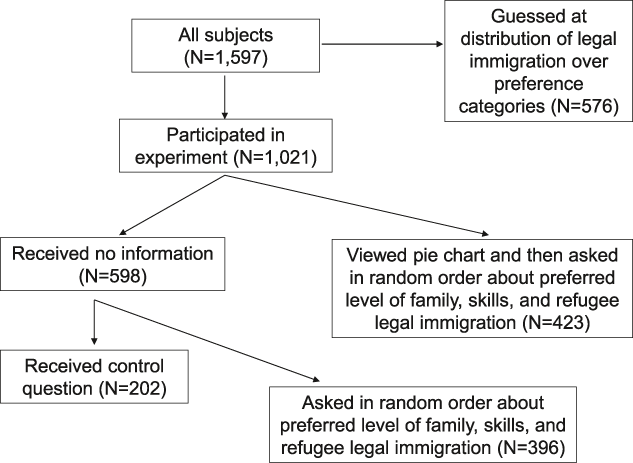
Respondents were randomly assigned different versions of the level question. Those in the baseline or “control” condition were simply asked the familiar, “Do you think the number of immigrants from foreign countries who are permitted to come to the U.S. to live should be increased a lot, increased a little, left the same as it is now, decreased a little, or decreased a lot.” A “treatment” group was asked, in random order, three variants of the levels question with the phrases “with skills U.S. employers say are needed” (“Skills”), “with family members living legally in the U.S.” (“Family”), or “fleeing violence or government oppression in their home countries” (“Refugees”) inserted after the reference to the number of immigrants.Footnote 70 Five hundred subjects were randomly assigned to view a pie chart detailing the breakdown of legal admissions by preference category in 2012 before being asked the specific questions about the level of immigration in each admissions category while others were not furnished this information. For a complete schematic diagram of the randomization protocol, refer to figure 2.
Research design, sequential mapping of random assignments

In addition to age, sex, educational attainment and standard measures of party identification, liberal-conservative ideology, and interest in politics, we measured respondents’ humanitarian values and their ranking of the importance of the following six problems facing the nation: the economy, the federal deficit, immigration, terrorism, Middle East policy, and health care. Prejudice was measured using feeling thermometers for whites, blacks, Hispanics, and Asian-Americans.Footnote 71 For detailed information on how we constructed all of these measures, refer to the Online Appendix.
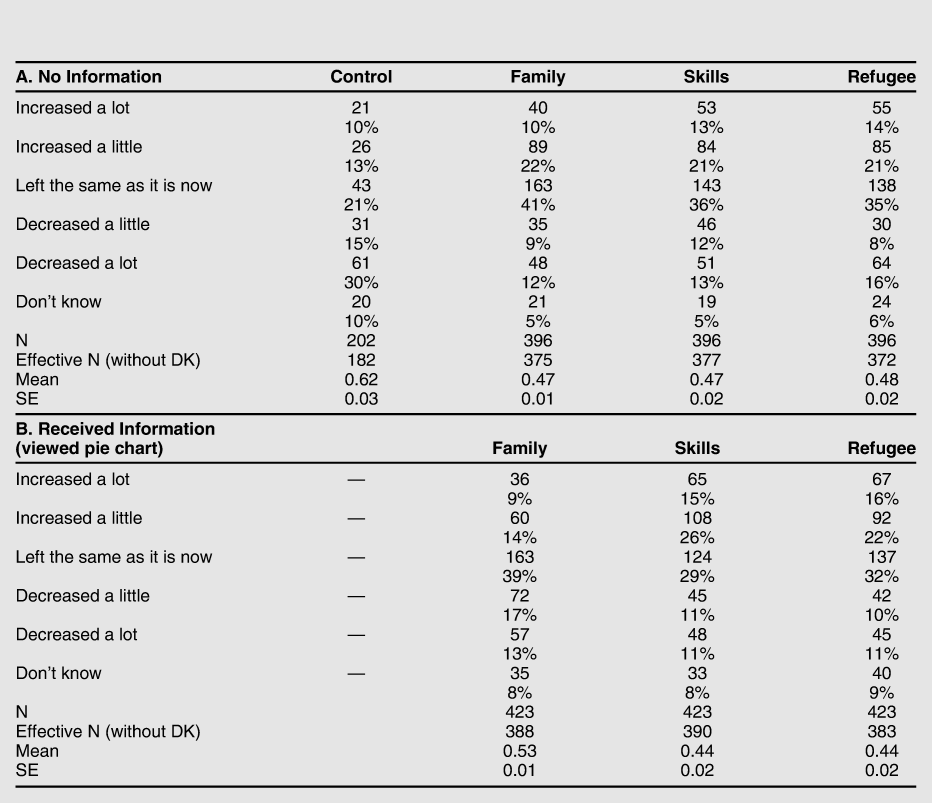
As summarized in table 1, a plurality of respondents (45 percent) who were asked the standard, abstractly-worded question favored reducing immigration levels (see panel A, column 1: “Control”), a result that is consistent with prior research. These respondents also formed a bare majority (51 percent) of those who provided a valid response to the question, and twice as many favored decreasing the level of immigration as increasing it (23 percent). However, this restrictionist portrait of public opinion changes dramatically when respondents were queried about the specific policy categories. Only 21 percent of our respondents favored decreasing the level of family-based immigration, 24 percent favored decreasing the level of skills-based immigration, and 24 percent wanted to lower the level of admissions for refugees. In each of these specific cases, the percentage of Americans who support increased admissions substantially exceeded the percentage favoring reductions (by margins of 12, 9, and 11 points for family, skills, and refugees respectively, compared to the opposite pattern (-22 points) in the control group asked about immigrants in general. In short, specifying actual preference categories (versus referencing “immigration” only in the abstract) while leaving the basic structure of the levels question intact produces a striking reversal of preference. Responses by experimental condition Note: The mean response in the baseline group differed significantly (t-test p<.05) from the mean response in the three treatment groups in both Panels A and B. There were no significant differences in the means response to the treatment conditions in Panel A. In Panel B, the mean response to Family was significantly higher (p<.05) than the mean response in the other two categories. Comparing Panels A and B within preference category, only Family showed a significant difference in means (p<.05).
A further indication of the sharpness of this distinction is that when responses to the category-specific questions are combined only 40 percent of subjects who answered all three questions supported reducing immigration in one or more of the three categories (that is, 60 percent preferred not to reduce it in even a single category). So even if we set a very low bar for classifying a respondent as preferring to change the status quo in a way that reduces immigration, this is clearly a minority preference. A less conservative but perhaps more sensible way of looking at the data is to average the three responses for each individual and observe the prevalence of subjects whose responses are on balance exclusionary, neutral, and expansionary. By this measure, 46 percent of the public prefers to increase immigration in these three categories more than decrease it, 24 percent prefers either no change or perfectly offsetting increases and decreases, and 24 percent prefers on balance to decrease immigration. And while there could be some concern that “decrease a lot” responses frequently imply a preference for dramatic reductions, only 27 percent of the public prefers to reduce even one of these categories “a lot.”
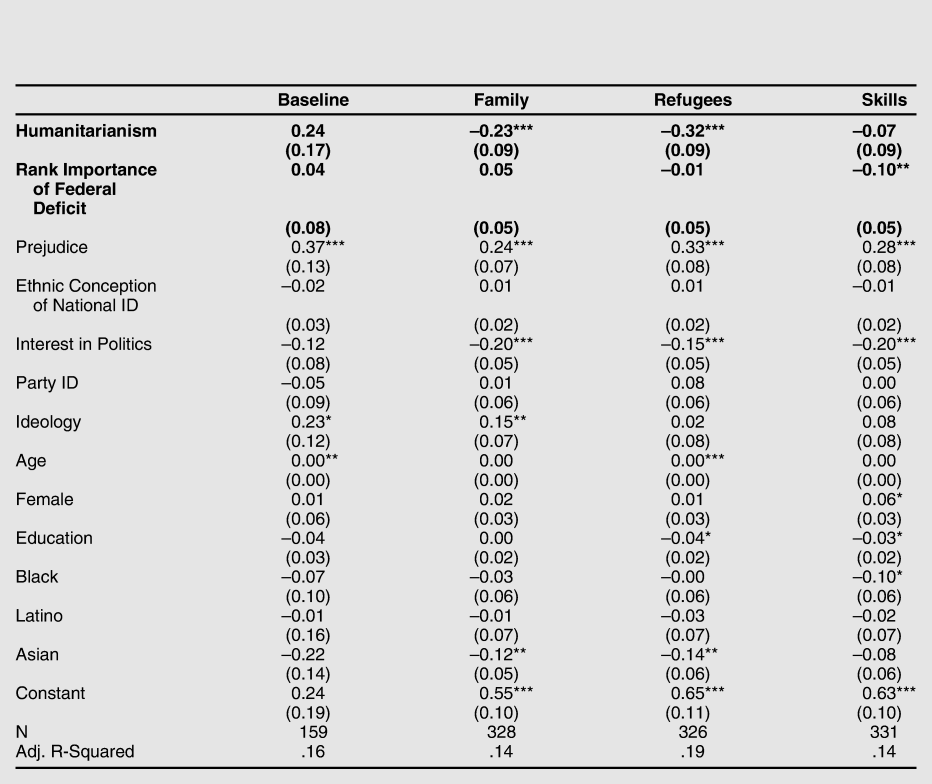
Multivariate OLS analyses within each condition (table 2) shows that, as expected, the correlates of preferences vary depending on what version of the question they received. In the baseline condition, humanitarian values are not associated with more support for immigration. Yet when we ask about family-based and refugee immigration, as predicted, humanitarianism is a significant and potent predictor of expansionist preferences. And the intuition that there is no relationship between a preference for more skills-based immigration and humanitarianism also is confirmed.Footnote 72 Thus the nature of these status quo policies evokes different sets of considerations that in turn change the distribution of support relative to the baseline. Along similar lines, concern about the federal deficit is associated only with greater support for skills-based immigration and not with preferences over the level of immigration in the abstract or with preferences over family and refugee immigration level. This suggests that respondents particularly concerned about the nation’s fiscal circumstances will be more supportive of immigration streams likely to contribute economically.
Correlates of preferences over the level of immigration generally and in each admissions category (OLS)

Note: Standard errors in parentheses.
* p<0.1 **p<0.05 ***p<0.01
Simply put, the evidence supports a psychological disconnect between relatively restrictionist preferences in the abstract, and relatively liberal ones in policy. General and concrete questions about legal admissions evoke different sets of considerations and hence generate very different public reactions and the standard view that clientelism trumps public opinion now seems misleading.
Not an Artifact of Public Ignorance
Is it possible that ignorance about status quo policies underlies this inconsistent pattern of responses?Footnote 73 For example, do people treat the admissions categories relatively liberally because, not knowing that they represent the bulk (approximately 95 percent) of all green cards awarded, they assume that substantial reductions could be made elsewhere? We find that this is not the case (refer to the bottom of table 1). The subset of respondents informed about the actual proportion of immigration in each preference category is as reluctant to make cuts as the uninformed. The only difference is that, made aware of the fact that most legal immigrants come via family reunification, some elect to reduce this category of admissions in favor of increasing those in the skilled and refugee categories. Even so, support for admissions on the family reunification track remains substantially higher than it is in the abstractly-worded level question control condition. It would have been easy for subjects to jointly realize the goals of redressing the balance across admissions categories and cutting back immigrant admissions as a whole simply by voting to reduce family-based immigration and leaving the other categories alone. That they do not take this opportunity suggests that they are not motivated to reduce legal immigration strongly enough to endorse the specific cutbacks this would require.
Not a Reflection of Elite Pro-Immigrant Framing
Nor are these results susceptible to the critique that the widespread acceptance of expansionary policy merely reflects heavily one-sided pro-immigrant framing by elites and entrenched interests.Footnote 74 Mass opinion toward immigration remains negative in the abstract. Successful pro-immigrant framing would have caused people to draw on favorable humanitarian and economic considerations when asked about the level of immigration generally. Instead, many more seem to do so only when policy specifics are invoked and tap these considerations in rather obvious ways. One cannot at once maintain that there is a substantial disconnect between exclusionary public opinion and expansionary policy and still insist that pro-immigrant framing by elites and interest groups has had an overpoweringly positive impact on mass attitudes.
To summarize, these results undermine the linchpin of the argument for downplaying mass influences on immigration politics in the United States—the supposedly strong divergence between public preferences and admissions policy. The poll question usually invoked to support the standard elitist view may tap generalized emotions about immigration, but this latent attitudeFootnote 75 is only one of the ingredients in the public’s preferences—a suitable dependent variable if the goal is to understand the sources and consequences of “anti-immigrant sentiment,”Footnote 76 but an inadequate gauge for studying opinion-policy congruence and for drawing conclusions about the influence of mass opinion on policy-making.
Where the public accepts the expansionary admissions policies elites and clienteles prefer, we must be especially cautious about claiming an independent influence of public opinion on policy. But our experiment raises the possibility that, were the public more willing to roll back the expansionary admissions status quo in order to realize general preferences for less immigration, it is not clear that efforts to cut admissions would repeatedly falter. This counterfactual is obviously unknown, but we can gain more purchase on the power of public opinion by examining other aspects of immigration policy where mass preferences and the agendas of key clienteles do not coincide. For example, the Clinton administration’s decision not to pursue the Jordan Commission’s recommendation to abolish the “Fourth Preference” for siblings of U.S. citizens is often credited to strong pressure from ethnic lobbies, but the strong entreaties of a similar coalition did not prevent it from acquiescing to publicly popular cuts in non-citizens’ access to public benefits.Footnote 77 The slogan “immigration yes, welfare no”Footnote 78 is not easy to interpret as a response to pressures from entrenched pro-immigrant lobbies but clearly intelligible as a reaction to public opinion that accepts an expansionist status quo but rejects many public benefits for non-citizens. More consequentially for the most acrimonious contemporary political debates over immigration policy, revising the misleading portrait of public opinion that standard accounts have rested on makes it reasonable to invoke mass influence over illegal immigration policy, where it seems to help explain outcomes that clientelist and institutionalist models alone find puzzling.
Mass Opinion and Illegal Immigration Politics
In the area of illegal immigration policy, the role of mass preferences as “opinion dikes”Footnote 79 that check and channel elite and interest group agendas is more visible because, as we will elaborate, majorities do not endorse the sorts of thoroughgoing “earned citizenship” programs that key lobbies demand, and large, intense minorities “categorically” reject all but very narrow reforms. Our analysis above paves the way for taking stock of popular pressures by dispelling the key evidence against mass influence over immigration politics. But recognizing the explanatory power of public opinion over illegal immigration policy again requires accounting for nuances of mass preferences that journalistic treatments have often overlooked. In stark contrast to the emphasis on restrictionist sentiment and support for get-tough measures in scholarly accounts,Footnote 80 widely-reported polling on legalization curiously suggests that large majorities of the U.S. public, and even a majority of Republicans, favor earned citizenship for illegal immigrants. Indeed, commercial polling repeatedly shows strong majority support for furnishing illegal immigrants currently in the United States who meet “certain conditions” with permanent legal status and eventually citizenship.Footnote 81 If these polls accurately portray public opinion, we can hardly invoke mass preferences as a reason that elite-backed “grand bargains” have faltered.
A closer look reveals considerable opposition to the key particulars of legalization programs of the sort included in the 2007 and 2013 comprehensive immigration reform bills—a great deal more than one would expect based on responses to poll questions that ask about support for legalization in general or on the condition that “certain conditions” be met.Footnote 82 Our own data show that a general preference for giving illegal immigrants some way of being incorporated into the polity runs up against widespread opposition to granting them anything that seems like special treatment relative to prospective legal immigrants. Any conceivable legalization program entails at least some such “inside track” to remaining in the country with the ability to work while awaiting status adjustment, an option obviously unavailable to most of those who seek to obtain a green card through normal channels. Moreover, both the 2007 and 2013 comprehensive immigration reform bills sought to offer legal status to most of the 11 to 12 million undocumented in the country, irrespective of the usual criteria that the vast majority of aspiring legal immigrants must meet (having a close relative living legally in the United States, labor market skills that are in demand, or refugee status).Footnote 83
In an Internet survey of California voters (for sample statistics, refer to the Online Appendix), which one would expect more supportive of such proposals than the U.S. public as a whole, 70 percent supported a path to citizenship, while only 22 percent were opposed (N=2,215). Most polling and punditry leaves it at that, but we followed up the broad question with items focusing on the specific measures that almost any “grand bargain” would have to include to satisfy the intense proponents of legalization. When the focus is on these specific policies, the strong majority in favor of a path to citizenship frays. When asked if those who qualify for legal status under the program should have to “return to their home countries” and apply for admission to the United States according to the same rules as other legal immigrants, 42 percent said yes compared to 40 percent saying no. Similarly, 51 percent said that illegal immigrants should not be eligible for legalization unless they meet the same criteria that legal immigrants do (having family in the United States, skills U.S. employers say they need, or a valid claim that their safety is in danger in their home countries), while just 31 percent thought they should be eligible regardless. When asked if U.S. employers should be allowed to hire illegal immigrants who qualified for the legalization program when U.S. citizens or legal immigrants had also applied for a job or whether they should have to hire citizens and legal immigrants first, only 25 percent said it should be permissible to hire those who qualified for legalization while 64 percent said it should not. As Jennifer Merolla, Karthick Ramakrishnan, and Chris HaynesFootnote 84 have argued, varying “issue frames” on these sorts of policies substantially alters public support, in this case chipping away at what superficially seemed nearly consensual backing for legalization.
Another poll of California registered voters conducted in spring 2013 (for sample statistics refer to the Online Appendix) found support for a legalization program for those who could pass a background check hovering at 58 percent (N=612). The question asked here included the status quo alternative of “no change in legal status” rather than following the common practice of pitting legalization against temporary work permits and deportation with no option to leave things unchanged. Democrats were heavily in favor of legalization (68 percent) and Republicans modestly opposed (42 percent). Follow-up questions were asked about three programmatic preconditions before legalization was undertaken—Department of Homeland Security certification that the border is fully secure, implementation of a system for tracking legal immigrants in the country to prevent visa overstays, and a mandating of E-Verify for all U.S. employers. The 2013 Gang of Eight bill included security “triggers.” Regardless of the low likelihood that these proposals would or could be implemented, all three garnered strong majority support among registered California voters, including Democrats.Footnote 85 In the same 2013 poll, three tough but more feasible preconditions for qualifying for legalization—paying a fine, passing an English test (as opposed to the requirement to enroll in English classes often appended to reform proposals), and demonstrating a record of steady work in the country (hard to document for the many who work under the table)—also received strong majority endorsement.
The same survey randomly assigned respondents to different conditions to compare support for legalization for “all” to more restricted policies of legalization but no citizenship, temporary legal status, or legalization only for the “Dreamers” who came to the United States as children. This more nuanced assessment of opinion found only 39 percent in support of a path to citizenship for all who could pass a background check and 39 percent for the more limited Dream Act. Among Republicans, support for a broad-based path to citizenship drops in this condition to a mere 18 percent.
While we were unable in these surveys to directly probe the different considerations evoked by the general and more-specific policy questions as we did earlier in the case of legal immigration, it seems plausible that the more targeted questions raised concerns about integration and economic contribution, the fairness of offering an “inside-track” to legal residency to those who had violated the law, and the wisdom of enacting a legalization program without robust changes to what most consider a “broken” system of regulating illegal immigration. The bottom line appears to be that the public favors some kind of legalization program in the abstract but does not on the whole support the range of actions that would bring this about. As such, policy stasis may mirror the dominant position in public opinion more closely than most widely-reported polling suggests.
Moreover, in contrast to the weak and highly-contingent majority supporting legalization, the large national minority that opposes it is rigid, intransigent, and professes deep concern about rewarding lawbreakers with “amnesty.” A recent review of media coverage of immigration debates related that by far the leading frame among opponents of comprehensive reform invokes concerns about law and order, portraying illegal immigrants as transgressors of rules or even criminals who should not be “rewarded.”Footnote 86 And when asked in a March 2014 Washington Post/ABC poll whether a congressional candidate’s support for a “path to citizenship for undocumented immigrants” (wording similar to other poll questions that elicit strong majorities favoring a path to citizenship), 30 percent said more, 38 percent said less, and 29 percent said it would make no difference (among registered voters, 27 percent, 39 percent, and 31 percent respectively). Among Republicans, the figures were a whopping 14 percent, 60 percent, and 24 percent respectively—a far cry from the narrow majority found to support a path to citizenship in poll questions that do not gauge intensity of feeling. Thus even abstractly-worded questions reveal considerably more preference intensity among opponents of legalization than supporters.Footnote 87
To better understand this large, rigid minority, weFootnote 88 presented subjects in a national Internet survey with five successive pairs of profiles constructed out of randomly-varied attributes that mark ability to contribute economically, cultural integration, and racial and ethnic identity. Subjects were randomly assigned to evaluate legal immigrants seeking admission, illegal immigrants seeking legalization, or “Dreamers” seeking legalization and asked, for each set of paired profiles, whether they would accept both, neither, or one but not the other. Attributes found to be correlated with acceptanceFootnote 89—both cultural factors and economic characteristics—were the same regardless of whether legal or illegal immigrants were being assessed. However, “categorical opposition,” or the rejection of every candidate a subject viewed, was far greater in the case of illegal immigration. Only 11 percent of those assigned to assess prospective legal immigrants responded in this way, while 33 percent categorically rejected every profile of illegal immigrants. These differences are at least partially attributable to differences in the set of positive and negative considerations each group evokes. Categorical opposition to illegal immigrants, but not to prospective legal immigrants, was strongly associated with views about whether a range of minor rule-breaking offenses unrelated to immigration were “serious.” Moreover, the rate of categorical opposition to Dreamers was one-third lower than to illegal immigrants generally (22 percent), arguably because Dreamers had no moral responsibility for the initial violation of immigration law.
In sum, this more nuanced look at majority opinion toward the sorts of reforms currently on the table provides an explanation for stagnation on comprehensive immigration reform that standard models of immigration politics would not predict. Every one of the pro-immigrant lobbies cast as dominant in these models—businesses employing low- and high-skilled immigrant labor alike, co-ethnic lobbies claiming to speak on behalf of the fastest-growing minority groups in the U.S. electorate, and immigrant and human rights organizations—has strongly backed the core elements of reform and endorsed both the Bush and Obama administrations’ comprehensive immigration reform bills.Footnote 90 In recent years, religious institutions such as the Evangelical Immigration Table have joined this potent coalition, casting reform in humanitarian terms and appealing to family values.Footnote 91
But the majority’s negativity toward the details of any politically-viable reform package weakens the incentive for politicians to press forward, and the large and intransigent minority of the public overall (almost half of the Republican electorate) categorically rejects any broad-based legalization program stands as a potential groupFootnote 92 lurking and ready to mobilize against elected officials who back legalization. To a degree, one could argue that rigid opposition to illegal immigration, be it motivated by concern over “freeloading” and fiscal burden, racial resentment, or moralistic rejection of tolerating violation of the law, has already organized and mobilized. Vanessa Williamson, Theda Skocpol, and John CogginFootnote 93 argue that opposition to illegal immigration is a leitmotif among supporters of the Tea Party, even that “immigration worries Tea Party activists almost as much as the avowed flagship issue, deficits and spending.”Footnote 94
Freed of the clientelist model’s assumption that organized interests can generally override the public’s immigration preferences, and armed with this more nuanced portrait of opinion toward legalization, it is easier to understand why many who at one time backed legalization often have quickly changed course, sensing that a severe electoral punishment would otherwise be imminent. Senator Marco Rubio’s obfuscation of his leading role in the Gang of Eight is only the latest example.Footnote 95 Among the list of those who have “come to their senses” are former Republican presidential nominees John McCain and Mitt Romney, the latter famously abandoning support for legalization in favor of policies that would pressure illegal immigrants to “self deport” and the former never explicitly disavowing legalization, but turning sharply rightward on enforcement measures to fend off a strong primary challenge from the conservative Arizona congressman J.D. Hayworth. Reinforcing the perceived threat from seeming to betray the base on immigration reform, House Majority Leader Eric Cantor’s stunning primary loss to David Brat in June 2014 has been widely interpreted as in part due to his openness to legalization.Footnote 96
While Republicans are probably most affected by such pressure, Democrats are not immune. In the run-up to the 2014 midterm elections, several marginal Democratic Congressional candidates lobbied the president to delay issuing his announcement of an executive action granting relief from deportation and temporary work permits to up to five million illegal immigrants with U.S.-born children (Deferred Action for Parents of Americans and Lawful Permanent Residents, or “DAPA”), presumably because they feared backlash in their districts. Even with a filibuster-proof majority in the Senate and strong control of the House, President Obama declined to pursue comprehensive immigration reform in the early stages of his administration. The rationale the administration offered—healthcare reform first, then immigration—suggests that even a Democratic majority so large that it encompassed the key veto point in the legislative process would at a minimum have encountered great difficulty in pressing for comprehensive immigration reform.
The nature of public opinion on these issues also helps explain why President Obama’s DAPA, announced in late November 2014, engendered so much greater resistance and opposition than Deferred Action for Childhood Arrivals (DACA), announced prior to the 2012 election, which limited this reprieve to “Dreamers” brought to the United States before the age of sixteen and who had a high school degree or the equivalent. Consistent with our California polling data, which finds much broader public support for a “Dream Act” than for a legalization program that applies to broader swathes of illegal immigrants, DACA enjoyed strong majority support (nearly 2:1) following its announcement while DAPA was widely opposed.Footnote 97 The much more expansive DAPA provoked a slew of rhetorical and symbolic gestures by Congressional Republicans to oppose the program, including a mid-January symbolic vote in the House of Representatives on the Aderholt-Mulvaney Amendment to tie the termination of DAPA (but not DACA) to a bill funding to DHS to carry it out, where only seven Republicans (all representing heavily Latino districts) joined Democrats in opposition. The House also passed a separate amendment to tie funding to DACA, but this passed by a narrower margin, with 29 Republicans defecting. The decision to decouple these amendments appears to reflect strategic calculation based on awareness that whereas attacking DAPA is politically expedient, attacking DACA would give Democrats an opening to “demagogue” Republicans and focus attention on their rejection of the more popular DACA.Footnote 98 While DACA proceeded without major impediment for two years, DAPA quickly became the target of a lawsuit by Republican governors and has been tied up in court, with its ultimate fate uncertain.
In short, it is difficult to make sense of the failure of comprehensive immigration reform, including a path to citizenship for illegal immigrants, without taking stock of public opinion—recognizing the softness of the widespread abstract support for large-scale legalization programs, the absolutism of much opposition. Republicans heed their base’s staunch opposition to programs that would legalize broad swathes of the illegal immigrant population and either reject any such move as “amnesty” or withhold support unless they are laden with enforcement “triggers” that are administratively infeasible. Democrats meanwhile back narrower legalization programs such as the Dream Act in isolation but have not coupled such programs with robust but achievable enforcement concessions because when these enforcement mechanisms are in place, there is little left to cede to Republicans and lure them into a broader immigration deal. Even modest illegal immigration policy reforms are thus caught in what Michael Olivas has termed “the ironic pincers of being too much (for conservative legislators who feared being tarred as supporting ‘amnesty’) and too little (enacting [the Dream Act] would torpedo the larger strategy of reforming overall immigration problems.”Footnote 99
The dynamics of electoral “capture”Footnote 100 thus also come into play. Pressure on the Democratic Party from pro-immigration activists to achieve comprehensive immigration reform may also be less influential than is often assumed because these Democratic coalition partners have nowhere to turn in a partisan duopoly where the other party’s base prevents it from making the sorts of overtures that would force Democrats to put immigration reform ahead of other priorities, expend significant political capital or take major risks to make progress. Bill Clinton’s “lethargy and defensive opportunism”Footnote 101 on the issue in part reflects this strategic calculation. So might the Obama administration’s decision to prioritize health care reform in his first term and to wait until his final two years in office to pursue DAPA. These calculations would only seem to be intelligible if elected officials are responsive to mass preferences in this domain.
Democratic Responsiveness in Immigration Politics and Beyond
Taking a firm stand against President Obama’s recently announced DAPA, Alabama Senator Jeff Sessions insisted that the opinions of ordinary citizens are a bulwark against elite-backed plans for comprehensive immigration reform: “America is not an oligarchy. ‘The Masters of the Universe’ don’t get to meet at the White House and decide how to run this country. When the American people learned what was in the Senate amnesty and guest worker bill … the people said: no, no, no. And the House stopped the plan.”Footnote 102
While there is of course ample reason to believe that organized interests and elite opinion do influence immigration policy and likely introduce some “expansionary bias”Footnote 103 relative to the median voter’s preferences,Footnote 104 our research suggests that Sessions’ rhetoric may portray the influence of public opinion in U.S. immigration politics more accurately than the most prominent scholarly accounts would suppose. On a practical level, this may allay concerns that a major populist backlash to the existing generous admissions policies is brewing just beneath the political surface.Footnote 105 At the same time, our evidence sounds a sobering note about the near-term prospects for addressing illegal immigration in a coherent—let alone comprehensive—way.
Moreover, since our analyses have shown that analyzing the antecedents of “opposition to the level of immigration” in general—the common practice of academic scholarshipFootnote 106—does not necessarily capture the multiple and often conflicting forces that generate positions on different facets of immigration policy. This approach calls for further consideration of why public divisions vary in valence, extremity, intensity, and flexibility across specific facets of immigration policy.
We must also acknowledge three limitations of our study. For one, it is fair to point out that there are different levels of abstractness in policy opinion, and our emphasis on the need to ask questions about specific policies doesn’t answer what is the proper level of specificity. Should we ask about refugees in general or about Syrian refugees, about skilled workers or Indian software engineers?Footnote 107 For another, while the more nuanced portrait of public opinion we offer indicates far less divergence between what masses want and what government does than the most widely accepted treatments of immigration politics allow, this study alone cannot firmly establish a causal link between the two.
Finally, we can only bring to bear evidence about public opinion and its relationship to immigration policy in the present and recent past, raising intriguing questions about whether, how, and why immigration politics has evolved in the United States since the early 1990s.Footnote 108 For example, while our research suggests that the public might have been more accepting of the 1990 Immigration Act’s increase in visas for highly skilled workers than some have suggested,Footnote 109 we have no way of knowing whether questions like the ones we ask would have revealed greater opposition to the policy at that time. And while we have argued that public opinion appears to play an important role in blocking comprehensive immigration reform proposals that include large-scale legalization programs, we can only speculate on why the 1986 IRCA’s legalization program did succeed. One possibility is that clientelism was a more apt description of immigration politics then. The polarization of politics may have lessened opportunities for bargaining behind closed doors, and the proliferation of talk radio and partisan cable news outlets increases the opportunity for conservative politicians to frame the issue and mobilize opposition. The Tea Party also contributes a ready-made source of grassroots mobilization, though it had obviously not yet formed when George W. Bush’s 2007 effort to achieve comprehensive immigration reform faltered. In a different era, in other words, Ronald Reagan may have been a great deal freer than Bush to act on his hunch that “Hispanics are already Republican. They just don’t know it yet” and take steps to challenge Democrats’ advantage among Latino elites and masses.Footnote 110
A second possibility, however, is that opposition to “amnesty” would have resonated with a much narrower subset of the public in 1986 than twenty years later and thus engendered much less intense opposition. In 1986, more than two-thirds of those 2.7 million immigrants who received legal status were in California, while Texas, California, and New York together accounted for almost the entire pool. Today, the most rapid growth of an illegal immigrant population now estimated at 11 to 12 million has been largely in “new destinations,” often in more conservative parts of the country.Footnote 111 Unanticipated, rapid growth in immigration is believed to evoke greater animosity in such locales,Footnote 112 especially when the issue is salient in national politics.Footnote 113 There is also the fact of experience with policy failure. Few, of course, will know anything about the IRCA or its widely acknowledged failure to curtail future illegal immigration, but our own research suggests that the sorts of reminders they are exposed to by opinion leaders who oppose legalization can significantly increase expectations among Democrats and Republicans alike that such a policy will lead to increases in illegal immigration, crime, social spending, economic difficulty, and “disuniting” of American identity.Footnote 114 Thus even if immigration politics was not more insulated from mass opinion during that era than it is now, there are a number of reasons to suppose that legalization would have engendered less intense public opposition.
These unresolved questions notwithstanding, our work speaks to broader debates about how American democracy really operates in the area of today’s immigration politics and beyond (see, for example, Martin Gilens and Benjamin Page in a previous issue of this journal.)Footnote 115 Immigration policies are not immune to Olson’s logic in which collective-action problems end up favoring organized interests over the diffuse public, but the portrait of public opinion presented here suggests that clientelist models underestimate the influence of the views of ordinary citizens. Given that immigration politics has long been viewed as a clear case for elitist models of American politics, we urge rethinking about when assignations of “democratic deficit” and “oligarchic control” are warranted. It is well known that differently focused questions can elicit quite different sets of considerations about the same issue, so alternative ways of gauging public support for the status quo or a given policy change can yield different conclusions about what the majority prefers and, derivatively, to quite different appraisals of policy-opinion congruence.
Thus beyond joining work on immigration politics at the state and local levels in seeking to “bring the public back in” to immigration politics in America,Footnote 116 our research emphasizes that discussions of democratic responsiveness must recognize the ways in which meanings of majority preference are often ambiguous and multiple. The guiding principle when one is asking about changes in policy should be to ask both about the status quo and the concrete alternatives proposed. Taking fuller measure of what Lippmann famously called the “pictures in our heads”Footnote 117 affects what we can infer about popular control over government policy.
Supplementary Materials
Annotated data files
STATA code needed to reproduce the results discussed in this paper
Appendix A. National U.S. Survey (SSI, 2013)
Appendix B. Experimental Results by Education and Partisanship
Appendix C. Surveys of California Voters (221)
Appendix D. Construction of Measures of Predispositions Analyzed in Table 2