Introduction
When Irish newspapers reported that the newly appointed Minister for Justice was planning to tackle the country's ‘drinking culture’ (Irish Independent, 30 July 2007), readers may well have responded sceptically since similar proposals for a root and branch reform of alcohol policy have been made frequently in recent decades. The Minister announced that he intended to appoint a commission to examine how the licensing laws might be amended so as to reduce the burden of alcohol-related problems within Irish society, but acknowledged that it was not long since a previous commission had reviewed this matter and also noted that not all alcohol policy issues fell within the purview of the justice sector (Irish Times, 1 August 2007). Alcohol policy, in the language of New Public Management, may be deemed a ‘cross-cutting’ issue; that is, one which cannot be satisfactorily managed by any single sector of government but which calls for a cross-cutting or ‘joined-up’ response from all of the central government and other public sector agencies upon which it impinges (Boyle, Reference Boyle1999; Bogdanor, Reference Bogdanor2005). In the absence of a joined-up governmental response to alcohol, one can expect to see a number of competing and contradictory policy lines emerging, the primary fault line lying between those sectors (mainly concerned with health, public order, and young people) which advocate greater use of alcohol control strategies and those (in the finance, business, tourism and consumer rights spheres) whose attitudes towards the drinks industry and its products are more liberal. This article is aimed at exploring how, for more than a quarter of a century and in an increasingly coherent way, public health advocates in Ireland have proposed the creation and implementation of an integrated, ‘evidence-based’, national alcohol policy. Although these proposals have taken on greater urgency because of the dramatic increases in alcohol consumption, which have accompanied Ireland's improved economic fortunes, they have to date not borne fruit, and no cross-cutting responses have been devised to deal with the well-documented problems stemming from increased alcohol consumption. The primary focus of the article's analysis will be on understanding how apparently discrete policy proposals of this kind can only be understood when considered within a broader social policy context. Specifically, it will be argued that regardless of their scientific merit and regardless of the apparent commitment to joined-up government, policy proposals which expect the state to maintain an adversarial stance towards the drinks industry, and to rely primarily on regulatory measures to reduce population consumption levels, have little prospect of implementation within broadly neo-liberal policy cultures. Given that the Irish experience is not unique and that Irish public health advocates draw heavily on World Health Organisation (WHO) research and guidelines on this topic, comparisons will be made with alcohol policy developments in other countries and the global implications of Irish policy events will also be considered here.
Proposals for a national alcohol policy in Ireland
Perhaps the simplest way to introduce the concept of a national alcohol policy, as it has been developed under the auspices of the WHO since the 1970s (Moser, Reference Moser and Glass1991), is to contrast it with the disease concept of alcoholism which had preceded it as a major influence on public policy on alcohol, both in Ireland and internationally, for 30 years prior to this. Historically, the disease concept had its origins in post-Prohibition America, where it purported to offer a scientifically valid and politically consensual basis for public policy in an arena previously characterised by intense moralism and social conflict (Beauchamp, Reference Beauchamp1980). The essence of this perspective was that for the vast bulk of its consumers alcohol was a harmless drug, and that it was only a minority of biologically vulnerable drinkers which succumbed to what was now being presented as a unitary disease referred to as alcoholism. The major policy implication of this concept was that state regulation, much less prohibition, of alcohol was neither justified nor necessary since the prevalence of alcoholism was unaffected by changes in population drinking habits. A lesser, but important, implication was that the state had a duty to provide adequate alcoholism treatment facilities within the wider healthcare system, while simultaneously persuading the public that alcoholism was a disease and challenging any residual, benighted attitudes on this subject. Throughout the 1950s and 1960s, the WHO was an enthusiastic promoter of the disease concept of alcoholism, but from the early 1970s it moved decisively away from this model, effectively repudiating it thereafter in a series of reports (Bruun et al., Reference Bruun, Edwards, Lumio, Mäkelä, Popham, Room, Schmidt, Skog, Sulkunen and Österberg1975; Edwards et al., Reference Edwards, Anderson, Babor, Casswell, Ferrence, Giesbrecht, Godfrey, Holder, Lemmens, Mäkelä, Midanik, Norström, Österberg, Romelsjö, Room, Simpura and Skog1994; Babor et al., Reference Babor, Caetano, Casswell, Edwards, Giesbrecht, Hill, Holder, Homel, Osterberg, Rehm, Room and Rossow2003) which espouse a model commonly referred to as the ‘public health’ or the ‘total consumption’ approach. This public health approach, which evolved from a range of empirical and theoretical research undertaken by social and biomedical scientists, began by arguing axiomatically that alcohol is a drug which is toxic, addictive and an intoxicant, and went on from this to argue that this drug puts all its consumers at risk of a spectrum of social and health problems (not just at risk of ‘alcoholism’). Policy underpinned by the disease concept was selectively aimed at those individuals deemed to have a specific biological predisposition to alcoholism; the public health approach, however, has a universal focus, arguing that the prevalence of alcohol-related problems can only be reduced by environmental strategies aimed at reducing levels and altering patterns of alcohol consumption in the population as a whole. What critics might term the paternalistic or ‘nanny state’ features of the public health perspective have come increasingly to the fore in formal statements of this perspective, and the most recent WHO synopsis (Babor et al., Reference Babor, Caetano, Casswell, Edwards, Giesbrecht, Hill, Holder, Homel, Osterberg, Rehm, Room and Rossow2003) reiterates that the most effective, evidence-based policies are those of a regulatory or control nature which include:
• raising the retail price of alcoholic drinks by means of tax increases;
• regulation of the physical availability of alcohol, both through restrictions on numbers of retail outlets and on hours of sale;
• controls on advertising and promotion of alcohol;
• strict enforcement of legislation on underage drinking, drunk-driving and the serving of alcohol to intoxicated customers.
This report also confirmed that more liberal policy measures, such as those aimed at creating awareness of alcohol problems among the public (or specific alcohol education of school children), were of little preventive value, and that treatment systems for problem drinkers made a relatively modest contribution to reducing the total societal burden of alcohol-related problems. Unlike the disease concept, which implied that only the health sector need concern itself with alcohol problems, the public health approach explicitly called for an integrated, cross-cutting policy response in which all sectors collaborate in the implementation of these evidence-based strategies.
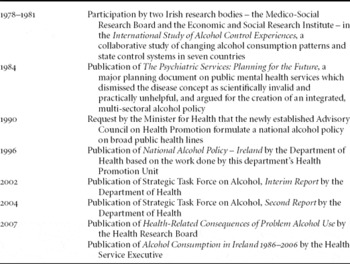
Table 1 presents a summarised chronology of the main occasions on which the public health perspective on alcohol was articulated in health policy discourse in Ireland. The first such occasion was when, in the wake of the WHO report Alcohol Control Policies in Public Health Perspective (Bruun et al., Reference Bruun, Edwards, Lumio, Mäkelä, Popham, Room, Schmidt, Skog, Sulkunen and Österberg1975), Irish researchers participated in a seven-nation collaborative study of changing patterns of alcohol consumption and alcohol control experiences. The two major publications (Makela et al., Reference Makela, Room, Single, Sulkunen and Walsh1981; Single et al., Reference Single, Morgan and de Lindt1981) from this project had limited circulation and little immediate impact in Ireland, but through the participation of the Irish researchers the concept of alcohol control policies was gradually introduced into health policy discourse here. One of these researchers, Dermot Walsh (a psychiatrist and epidemiologist), subsequently served on a committee which drew up a national mental health plan The Psychiatric Services: Planning for the Future (Department of Health, 1984), and it may be surmised that it was his ideas about alcohol control policies which were the dominant influence in that report's chapter on alcohol problems. This chapter, which was based upon the new WHO orthodoxy that the prevalence of alcohol-related problems was related to population consumption levels, was forthright in its dismissal of the disease concept and its insistence that priority should be given to prevention – rather than to expanding treatment systems for those already experiencing such problems. It concluded that ‘Because of the involvement of alcohol in many aspects of our society ranging from trade to health, a national policy can be instigated only by an inter-departmental body, representative of all Government departments concerned’ (Department of Health, 1984: 112), and argued specifically that consideration be given to the preventive value of raising alcohol taxes, restrictions on advertising and on retail availability and strict enforcement of existing legislation on drunk-driving and underage drinking.
Public health recommendations on alcohol in Irish health policy discourse – a chronological record

Despite the detailed rationale offered in support of these recommendations for a new approach to alcohol policy, no steps were taken to implement them and it was not until 1990 that, in the context of what was presented as a radical reorientation of health policy towards health promotion, the newly established Advisory Council on Health Promotion was asked by the Minister for Health to draft a comprehensive national alcohol policy (Kelleher, Reference Kelleher1992; Butler, Reference Butler2002). At this time, health policy discourse in Ireland was awash with the rhetoric of health promotion, with constant reference to the WHO's (1978) Health for All by the Year 2000 as well as its Ottawa Charter for Health Promotion (1986), which appeared to offer the ideal context for a national alcohol policy based upon public health principles. However, it was to be six years (and several changes of Minister) later before a policy document, National Alcohol Policy – Ireland (Department of Health, 1996) was approved by Cabinet and officially launched by the Minister for Health. The content of this document was broadly reflective of the public health approach, particularly in its recommendation of environmental alcohol strategies, but even a cursory reading of its ‘action plan’ made it clear that its authors had failed to set in place the intersectoral or cross-cutting structures necessary for the implementation of these recommendations. The political ambivalence surrounding the National Alcohol Policy was further highlighted at its launch when, in response to criticisms that it lacked ‘teeth’, the Minister expressed discomfort with the idea of alcohol control strategies, reverting to the more liberal ideal of consumer sovereignty:
It's very hard to legislate for virtue. It's even difficult enough to legislate for good behaviour. The kind of island I would like to see is where we would have what I would describe as sovereign individuals who are well-educated and mature and that when you give them information which is relevant to their own well-being they will make individual sovereign decisions in their own interest. I think that's the best approach. (Irish Times, 20 September 1996)
Given this Ministerial unease at the idea of paternalistic alcohol policy, it was not surprising that National Alcohol Policy – Ireland had little influence on ongoing policy events or, most significantly, that it made no impact on the policy debate leading to the enactment of the Intoxicating Liquor Act, 2000, legislation which increased the availability of alcohol to Irish consumers through its liberalisation of pub opening hours. The Minister for Justice, who had introduced this new licensing act, followed up immediately by appointing a Commission of Inquiry on Liquor Licensing, which was asked to review the entire licensing system and to make recommendations for ‘a system geared to meeting the needs of consumers, in a competitive market environment, while taking due account of the social, health and economic interests of a modern society’ (Commission of Inquiry on Liquor Licensing, 2001: 20). Membership of this commission was heavily tilted towards those who favoured further liberalisation, if not complete deregulation, of the licensing system, with just one shared place from the original membership of 21 going to the health and educational sectors. However, early in its deliberations it recommended that a separate committee be established to bring forward proposals for the prevention of alcohol-related problems (Hope, Reference Hope2006: 472); this recommendation was accepted by the Minister for Health when he established the Strategic Task Force on Alcohol, a committee dominated by public health advocates which went on to publish two reports (Strategic Task Force on Alcohol, 2002, 2004). These latter reports, which were launched and apparently endorsed by the Minister for Health, again reflected the WHO public health approach to alcohol policy. The first report provided detailed comparative data on Irish drinking habits and related problems, while also summarising international research on the effectiveness of various preventive strategies; the second report presented broad policy objectives (the first objective being the need ‘To reduce total per capita consumption to 9 litres per annum, the EU average. To reduce harmful consumption at the individual level, especially binge drinking and regular heavy drinking’), along with ten specific recommendations – with a heavy emphasis on regulating the availability of alcohol and putting in place statutory regulations governing its advertising and promotion. There was considerable media coverage of the work of the Strategic Task Force on Alcohol, and, in particular, of its detailed overview of how consumption had increased in this country during the 1990s, as the so-called ‘Celtic Tiger’ economy had gained momentum:
In the last decade, Ireland has seen many changes which have influenced the context and nature of drinking and increased alcohol related harm. Against the backdrop of the fastest growing economy in Europe, Ireland has had the highest increase in alcohol consumption among EU countries. Between 1989 and 1999, alcohol consumption per capita increased by 41%, while ten of the European Union Member States showed a decrease and three other countries showed a modest increase during the same period. (Strategic Task Force on Alcohol, 2002: 5)
The two reports of the Strategic Task Force on Alcohol explained increased alcohol consumption in Ireland as a function of: its relative affordability (in an economy where personal disposable incomes had never been higher); increased availability (by virtue of a greater number of retail outlets and longer opening hours); and cultural normalisation (especially through advertising and promotions which successfully presented alcohol as an everyday commodity). In analysing policy developments during these early years of the new millennium, perhaps what is most noteworthy is that despite the apparent commitment to cross-cutting management or joined-up government, this was a time when the Irish state was running two parallel alcohol policy processes: the Strategic Task Force on Alcohol argued that the public good demanded major state intervention into the alcohol market place, while, simultaneously, the Liquor Licensing Commission favoured free trade and consumer sovereignty. Finally, two reports – one from the Health Research Board and one from the Health Service Executive – were published in late 2007. The former (Mongan et al., Reference Mongan, Reynolds, Fanagan and Long2007) detailed the increases in alcohol-related health problems which had accompanied increased consumption, while the latter (Hope, Reference Hope2007) showed that alcohol consumption in Ireland (at 13.4 litres per adult) for the year 2003 was the third highest country – behind Luxembourg and Hungary – in a comparison of 26 countries within the expanded European Union.
The Intoxicating Liquor Act, 2008
In January 2008, in line with his promised alcohol policy initiative, the Minister for Justice appointed a committee known as the Government Alcohol Advisory Group, charging it with the task of making recommendations to guide new legislation on public order aspects of alcohol consumption. This committee reported at the end of March, leading to the enactment of the Intoxicating Liquor Act, 2008, which came into effect on 30 July 2008. From a public health perspective, this most recent policy initiative might be seen as something of a mixed blessing: not of all of the committee's recommendations were incorporated into the new legislation, and not all sections of the new legislation were given immediate legal effect. In particular, the committee's recommendation for ‘the development and implementation of an overall national strategy on alcohol in order to ensure a consistent and coherent approach to alcohol-related matters across Government departments and other public bodies’ (Government Alcohol Advisory Group, 2008: i) had a hollow, tokenistic ring to it and, not surprisingly, has not led to any legislative or administrative actions. On the other hand, the legislation curtailed the opening hours of off-licence outlets, set in place court procedures governing the granting of new wine-only off-licences and gave authority to the police to seize alcohol from minors or anybody whose possession of alcohol seemed likely to lead to public disorder. However, those provisions of the new legislation governing the structural separation of alcohol sales in supermarkets, convenience stores and filling stations were not implemented immediately, nor were the provisions relating to the test purchasing of alcohol under police surveillance by under-18 year-olds.
In short, depending on one's perspective, the Intoxicating Liquor Act, 2008, might be seen as incremental progress along the public health spectrum or, alternatively, as further evidence of governmental unwillingness to fully embrace the ideal of an integrated alcohol policy.
Failure to implement a national alcohol policy in Ireland: the broader social policy background
It is clear, therefore, that for almost 30 years the ideal of a national alcohol policy – in which control strategies aimed at reducing per capita alcohol consumption play a central role – has been presented repeatedly and with increasing coherence by public health advocates in Ireland. Although there is no evidence of any political attempt to censor any of these public health proposals, such as happened infamously when the newly elected Tory government in England suppressed the report of the Central Policy Review Staff in 1979 (Thom, Reference Thom1999: 118), neither, it should be added, is there any evidence of anything other than nominal political support for their implementation. In fact, as a general comparative comment, it seems fair to say that public health criticisms of the state response in England focus on the way in which English alcohol policy proposals ignore the research evidence and opt for strategies known to be ineffective (Room, Reference Room2004; Anderson, Reference Anderson2007), while criticisms of the state response in Ireland are more likely to make the point that evidence-based policy proposals are given nominal political acceptance but never subsequently implemented (Butler, Reference Butler2002; Hope, Reference Hope2006).
In order to understand this refusal on the part of the state to accede to the demands of the public health lobby, it is useful in the first instance to consider this issue in light of the broader social policy climate, with particular reference to the capacity of the Irish state to dictate lifestyle or impose a specific version of the good life on its citizens. Unlike the Nordic states of Finland, Norway and Sweden, which for much of the twentieth century operated comprehensive alcohol control policies, including state alcohol monopolies (Holder et al., Reference Holder, Kuhlhorn, Nordlund, Öusterberg, Romelsjö and Ugland1998; Sulkunen et al., Reference Sulkunen, Sutton, Tigerstedt and Warpenius2000), as part of their general welfare state regimes, the Irish state which emerged following independence from Britain in 1922 enjoyed considerably less freedom in this regard. While residual suspicion of and opposition to government in a post-colonial society may have played some part in curbing any latent tendencies towards the development of a highly interventionist state, social scientists and historians have primarily emphasised the role played by the Roman Catholic church in Ireland – and its fears about excessive state encroachment into the lives of individuals, families and communities – as a major restraining influence on social policy during the first half-century of self-government (Whyte, Reference Whyte1971). Cultural opposition to ‘big government’ during this period was driven not so much by an underlying belief in laissez faire economics as by Catholic social teaching on the importance of subsidiarity: that is, the avoidance of decision-making or regulation at high governmental level where such activity could be conducted at regional, local or familial levels. In any event, as a predominantly Catholic country, Ireland did not have what Levine (Reference Levine, Lader, Edwards and Drummond1992) has described as a ‘temperance culture’, a concept used to refer to Protestant societies in which much of the alcohol was drunk in the form of distilled spirits, and where religious-based temperance movements in the late nineteenth and early twentieth centuries continued to exert influence over state alcohol policy. The Pioneer Total Abstinence Association, which is the mainstream Catholic temperance movement in Ireland, had been founded in 1898 and continued to be highly successful until the 1960s, a success which is still reflected in the fact that in comparative terms Ireland has a higher proportion of total abstainers than is to be found in other European countries (Ramstedt and Hope, Reference Ramstedt and Hope2005). However, in ideological terms the Pioneer Association is a moderate movement which advocates voluntary abstinence for religious motives and does not primarily see itself as a Catholic lobby for a drier alcohol policy (Ferriter, Reference Ferriter1999). Against this background, therefore, it comes as no surprise to note that successive Irish governments did not implement highly interventionist alcohol policies comparable to those of the Nordic states. In considering the changes which took place within Irish social policy as the influence of the Catholic Church declined from the early 1990s onwards (Inglis, Reference Inglis1998), the main question to be addressed here is whether any of the newly emergent policy trends and events were likely to facilitate alcohol control strategies of the type proposed by public health advocates. There are two key policy trends which came to fruition during the 1990s – the first being the institutionalisation of the ‘social partnership’ approach to the negotiation of economic and social policy, and the second being the explicit concern with ‘cross-cutting’ management contained in the Strategic Management Initiative, Ireland's version of New Public Management – which will be briefly reviewed in terms of their relevance to Irish alcohol policy.
Social partnership and alcohol policy
Social partnership, as currently understood in Ireland (O'Donnell and Thomas, Reference O'Donnell, Thomas, Healy, Reynolds and Collins2006), had its origins in the decision of a newly elected government in 1987 to negotiate a three-year policy programme and wage agreement (the ‘Programme for National Recovery’) with trade unions, employers and farmers. This first social partnership programme was negotiated against a background of high unemployment, high inflation and national debt, and included agreement on a wide range of social and economic policy issues as well as agreement on wages and salaries. Over a period of 20 years and seven partnership agreements, the structures supporting this partnership approach to governance have become more complex, and the basic model has been altered to include the community/voluntary sector alongside the traditional business, labour and agriculture partners. While it is difficult to say precisely just how much the social partnership approach to governance has contributed to the extraordinary economic success, and the related improvement in quality of life which Ireland enjoyed from the mid-1990s until 2008 (Fahey et al., Reference Fahey, Russell and Whelan2007), most commentators (for example, Cassells, Reference Cassells, De Buitleir and Ruane2003) agree that it played an important role in bringing economic and political stability to the country, among other things, making it attractive to foreign capital. Not all commentators, however, have expressed satisfaction with the social and cultural consequences of the economic boom, and one of the recurring criticisms has been of the increased visibility of alcohol problems in Celtic Tiger Ireland. In addition to the careful compilation of epidemiological data, such as those presented in the two reports of the Strategic Task Force on Alcohol, there have been frequent, highly publicised expressions of disquiet by public figures at what they perceive to be the link between increased affluence and increased alcohol consumption. For instance, President Mary McAleese, in a much publicised speech to an American conference on how affluence had transformed Ireland, referred to money being badly spent ‘on bad old habits . . . the stupid wasteful abuse of alcohol’ (McAleese, Reference McAleese2003).
In exploring whether social partnership, which contributed to increased affluence, might also have a role to play in reducing the prevalence of alcohol-related problems, the views of Ó'Cinnéide (Reference Ó'Cinnéide1998/1999), one of its most trenchant critics, seem especially relevant. Ó'Cinnéide is generally critical of what he sees as the undemocratic and corporatist nature of social partnership, in which binding agreements are made ‘around committee tables behind closed doors’ (p. 46) rather than in the more transparent setting of the parliamentary process; specifically, he argues that the social partnership process has led to ‘such a smothering consensualism in politics that many public issues are not properly discussed at the political level’ (p. 42). This latter criticism seems especially apt in relation to the alcohol policy process in that, as will now be briefly discussed, the social partnership system has not facilitated open and robust debate in this contentious area but has instead glossed over ideological differences, emphasising the middle ground. As in other countries (Grant and O'Connor, Reference Grant and O'Connor2005), the drinks industry in Ireland has made explicit use of the partnership concept, arguing that there is no inevitable incompatibility between its commercial aims – to maximise sales of its products and shareholder profits – and its desire to demonstrate corporate social responsibility by working in collaboration with public health activists. In 1997, for example, one Irish third-level college hosted an international meeting on the theme of the drinks industry/public health partnership which was sponsored by the International Center for Alcohol Policies (a Washington-based centre which is funded by the multinational drinks industry); this led to the drafting of the so-called Dublin Principles (1997) – principles which, it is suggested, provide a global template for partnership in this area. The themes of partnership and corporate social responsibility were further promoted by the drinks industry in Ireland through its establishment in 2002 of MEAS (a word meaning ‘respect’ in Irish, as well as being an acronym for Mature Enjoyment of Alcohol in Society), an organisation along the lines of similar ‘social aspects organisations’ funded by the drinks industry internationally (Orley, Reference Orley, Grant and O'Connor2005). However, just as public health activists internationally (McCreanor et al., Reference McCreanor, Casswell and Hill2000; Anderson, Reference Anderson2004) were generally sceptical of social aspects organisations, seeing them as created to show the drinks industry in a good light rather than to benefit public health, Irish advocates of the public health approach to alcohol policy (Barry, Reference Barry2002; Hope, Reference Hope2006) have expressed similar reservations about MEAS and its activities in the Irish policy context. It is not surprising, therefore, that relationships between public health advocates and MEAS (and various other alcohol industry bodies) have been characterised by distrust and antagonism rather than by mutuality and collaboration. For instance, the Drinks Industry Group of Ireland representative on the Strategic Task Force on Alcohol (2002) published a minority report, disagreeing with the main thrust of that body's Interim Report. His fundamental argument in this minority view was that ‘the contention that a reduction in overall consumption will lead to a reduction in alcohol-related harm is an incorrect one’ (p. 23), but he also argued against the use of higher taxes to reduce consumption and the lowering of the permitted blood alcohol level for drivers; and, despite the presentation of research findings which showed that alcohol education had little or no preventive efficacy, he expressed disappointment that ‘greater emphasis had not been placed on substantially increasing educational programmes’ (p. 23). Similarly, public health activists were frustrated at what they saw as successful lobbying by the drinks industry and its advertisers, which persuaded the Minister for Health and Children to abandon plans for statutory control of alcohol advertising and promotion in favour of a voluntary code drawn up by the industry (Hope, Reference Hope2006).
However, the major test of how the social partnership process might cope with the country's alcohol policy issues came in 2003 when, in the course of negotiating Sustaining Progress (the sixth of the national social partnership agreements), alcohol misuse was nominated as one of ten Special Initiatives which were described as ‘major crosscutting issues, that require the mobilisation of a range of resources across sectors, organisations and individuals and at different levels of Government’ (Sustaining Progress: Social Partnership Agreement 2003–2005) (2003). A working group made up of the usual social partners and relevant governmental departments and agencies eventually produced a report: Working Together to Reduce the Harms Caused by Alcohol Misuse (2006). The agenda for this working group, which seems to have been set by the industry rather than the public health partners, precluded discussion of such politically controversial topics as lowering consumption levels by means of raising taxation or reducing the physical availability of alcohol, and the final report confined its attention to three specific areas: underage drinking, binge drinking and drink driving. The report received little publicity, set in place no new policy structures and generally was more reflective of Ó'Cinnéide's ‘smothering consensualism’ than the type of bare-knuckle encounter which public health advocates might have preferred. For the industry, however, the publication of this report within the social partnership framework was welcomed as ‘an important step in promoting the legitimacy of the alcohol manufacturing sector with key stakeholders’ (Food and Drink Industry Ireland, 2006: 21).
Alcohol and cross-cutting management
Proposals to reform public administration in Ireland, with a view to enhancing the coordination of policy-making and implementation while simultaneously doing away with the perceived evils of ‘departmentalism’, were similar to efforts of the Blair government to introduce ‘joined-up’ government in the United Kingdom (Kavanagh and Richards, Reference Kavanagh and Richards2001). In 1996, as part of the broader move to introduce strategic management innovations into the Irish public service, a report called Delivering Better Government (1996) made recommendations on how ‘vital national issues which can no longer be resolved from within the functional remit and skill base of a single Department or Agency’ (p.1 4) might best be managed. Specifically, it suggested that a more integrated policy response to such cross-cutting issues as poverty, drugs, child care and employment would result from the following structural changes:
• the establishment of Cabinet Sub-Committees with responsibility for such cross-cutting areas;
• the identification of ‘lead Departments’ with coordination functions for these areas;
• the nomination of either Ministers or Ministers of State with responsibility for particular cross-cutting policy issues;
• the creation, at various governmental levels, of cross-cutting teams which would bring together representatives of various governmental sectors and agencies to work on an ongoing basis on policy and service issues.
While these recommendations were followed quite closely in some policy areas, notably in relation to illicit drugs (Butler, Reference Butler2007), no attempt was made to apply this template to the alcohol policy area: no dedicated Ministerial or Departmental responsibilities were assigned, and no cross-cutting structures were established comparable to those created to manage illicit drugs. In short, no ‘joining-up’ of any kind was discernible in Irish alcohol policy.
Discussion
Although the increases in alcohol consumption which have occurred in Ireland in recent years are uniquely high, there is no reason to believe that the dynamics of the Irish alcohol policy process are radically different from those of other developed countries. Central to this process is a conflict between two main stakeholder groups or coalitions, characterised in this article as nannies and neo-liberals, arising from attempts to implement WHO proposals based upon public health or total consumption models of alcohol. What emerges most clearly from this detailed look at the Irish scene is the rather commonplace conclusion that, notwithstanding the rhetoric of evidence-based policy and joined-up government, alcohol policy-making is essentially a political rather than a rational process. The state, mediating uneasily between the public health sector and the drinks industry, has, in the main, not accepted the evidence carefully presented by the former as constituting a legitimate basis for introducing alcohol control policies. There have been occasional victories for public health, as for instance the introduction of random breath-testing for motorists in 2006 but, in terms of realpolitik, the state has shown no inclination to accept in its entirety the public health perspective.
Stevens (Reference Stevens2007), in a reflective piece on the selective way in which policy-makers use research evidence, has argued for the use of an evolutionary analogy referring to ‘survival of the ideas that fit’. Applying this evolutionary model, it may be argued that despite their rationality the paternalistic or ‘nanny state’ ideas at the heart of the public health approach were spectacularly unfitted for Celtic Tiger Ireland, a country characterised as never before by neo-liberal values. The economic success enjoyed by Ireland from the early 1990s was clearly built upon a willingness to engage fully with the global economy, not just through enthusiastic participation in the European Union but also through active pursuit of foreign direct investment from the USA; the days of economic isolationism and satisfaction with – in De Valera's (Reference De Valera and Lee1943) much-quoted phrase – ‘frugal comfort’ are long gone in a society committed to market values and consumer spending.
In autumn 2008, in common with other national economies, the Irish economy underwent dramatic change as the housing market collapsed, unemployment soared and the banking system had to be rescued by large-scale Government intervention; Ireland was now officially in recession and neo-liberal political and economic ideas had clearly lost credibility. References to the Celtic Tiger in media and popular discourse were largely replaced by references to the ‘bubble economy’, and a new social partnership agreement was negotiated with unprecedented difficulty and delay. It is to be expected that as disposable incomes drop, so too will alcohol consumption, but whether the public health perspective on alcohol proves to be a better fit for these more straitened economic circumstances remains to be seen.
Although survey research, such as that conducted by Alcohol Action Ireland (a national voluntary organisation for those committed to the public health perspective), indicates that a majority of Irish people express support for alcohol control policy (Alcohol Action Ireland, 2006), this support has not manifested itself practically through sustained grassroots campaigning for the implementation of such policy. Community mobilisation projects on alcohol, which have been espoused by the WHO (Babor et al., Reference Babor, Caetano, Casswell, Edwards, Giesbrecht, Hill, Holder, Homel, Osterberg, Rehm, Room and Rossow2003: 148–50) and which also form part of the ‘special initiative’ on alcohol created under Ireland's Sustaining Progress: Social Partnership Agreement (2003), have never attracted the same degree of support in Ireland as has been associated with community-based movements against illicit drugs (Lyder, Reference Lyder2005). Bearing in mind, therefore, that popular support for public health policy on alcohol is at best equivocal, it can reasonably be concluded that the refusal of the state to introduce alcohol control policies has a democratic basis and is not just reflective of the inordinate lobbying capacity of the drinks industry. In other words, successive governments seem to have concluded that the public – while aware of the negative consequences of drinking – is relatively tolerant of heavy drinking, and that the implementation of alcohol control policies would be electorally unpopular. For Irish politicians, alcohol policy would appear to be an especially contentious issue, and no senior politician has unequivocally supported the total consumption model proposed by public health activists. The Alcohol Harm Reduction Strategy for England (2004), generally criticised by public health advocates (for example, Babor, Reference Babor2004) as having conceded far too much to the drinks industry, was drafted within the Prime Minister's Strategy Unit. It is noteworthy that Bertie Ahern, who was Taoiseach (Prime Minister) from 1997 until 2008, kept alcohol policy at arm's length, neither taking the policy integration function into his own department nor saddling any other Minister with this poisoned chalice, but opting to have the matter dealt with through the social partnership process. From a public health perspective, as discussed above, social partnership management of alcohol policy is inherently unsatisfactory; the lobbying power of the drinks industry greatly exceeds that of public health, within a process which is conducted behind closed doors rather than in a transparent way.
The WHO ideal of an integrated and evidence-based alcohol policy has not been implemented in its entirety in any jurisdiction, and it is unlikely ever to be implemented fully anywhere. It has commonly (for example, Secker, Reference Secker1993) been suggested that alcohol researchers, while technically and scientifically proficient, are naive in their understanding of the research-policy interface, but the policy events reviewed here point towards increased sophistication on the part of Irish researchers in relation to use of media and lobbying. Grassroots movements supporting alcohol control policies do not, as already mentioned, have the same level of popular support as movements opposed to illicit drugs, but have in recent years become more organised both at national and European levels. EUROCARE, which is the umbrella body for national organisations that lobby for public health policy in this sphere, is an important stakeholder in the Alcohol and Health Forum recently established by the European Commission (2007), and one can expect to see the same issues debated and battles waged at this level as in Ireland. It is to be expected, therefore, that as in Ireland these tussles between nannies and neo-liberals will continue, perhaps without a decisive victory for either side.
Acknowledgements
I am grateful for the helpful comments of my colleague Marguerite Woods and also those of two anonymous referees, and for the administrative support of Pam Isaacson.