What explains variation in state strategies towards ethnic minorities after the collapse of the Soviet Union? Despite common historical and ideological legacies, minorities’ treatment across post-Soviet countries and within each country varied dramatically.
Why did states pursue such different policies with regards to their ethnic minorities, including ethnic cleansing, politically exclusionary institutions, assimilatory apparatuses and multi-ethnic accommodative designs?
This article builds on theories of ethnic relations, democratization and foreign policy to identify the demographic, economic, political and international conditions that structure the costs and benefits of states’ strategies towards their minorities. Despite a robust literature on nationalism and ethnic conflict, little theory accounts for the conditions under which a state is likely to repress, exclude, assimilate or accommodate its ethnic minority groups.Footnote 1
The existing scholarship tends to take institutions governing minority rights as given – that is, as independent rather than dependent variables. This article instead treats them as a phenomenon to be explained, and explores where these policies come from in the first place. While the scholarship to date focuses disproportionately on violent outcomes – ethnic cleansing and civil wars – this project examines a fuller spectrum of state strategies.Footnote 2 It disaggregates the non-violent state strategy choice set in order to account for the various nation-building policies that exist within this set: non-repressive exclusion, assimilation and accommodation. Existing explanations of ethnic war also centre foremost on the conditions that render rebellion and secession feasible; the role of the state, and the conditions that influence its choice of violence or accommodation, receive less attention.Footnote 3 The works that do study state repression, meanwhile, often inadequately recognize and address the endogeneity of minority group strategies to state strategies, and thus do not convincingly establish causal relationships. By exploiting a break in state–minority group relations, this article aims to minimize the cyclical nature of the state-ethnic group dynamic whereby state strategies dictate minority strategies (and vice-versa) in order to accurately estimate the impact of ethnic minority group behaviour on state policies. Accordingly, this research has implications for human rights, ethnic politics, democratization and political violence.
To gain analytic leverage on the conditions that influence nation-building choices, I examine the strategies of the states in the former Soviet Union and Eastern bloc, a region that holds certain features of the historical context fixed, including their communist past, Soviet legacy and experience of transition, and thus provides a quasi-experimental design. With the collapse of the Soviet Union, the twenty-seven successor states and governments were charged with drafting new constitutions and devising civil, political and cultural policies with respect to their ethnic minorities. Specifically, I propose that they chose between four strategies: Repression, Exclusion, Assimilation and Accommodation. This study quantitatively analyses a database of state policies towards ethnic minority groups to identify the factors that favour each of these strategies.
The analysis casts doubt on the conventional wisdom that states employ violence against the groups that are most likely to renege on their commitments, threaten the states’ territorial integrity and secede; instead, groups with few prospects or incentives for armed secession prove equally likely to experience state-sponsored repression. This implies that rebellion may not cause repression, as is commonly believed; rather, a broader set of incentives and constraints determines state strategies. The analysis suggests that minority groups’ demographics and states’ coercive capacities better account for variation in ethnic minority policies. Specifically, governments confronting sizeable minority populations prove more likely to grant these populations equal political rights, but are also more likely to assimilate them in order to maintain their monopolies over the nation-state. Additionally, a country that enjoys substantial coercive capabilities relative to those of its ethnic minorities tends to politically and culturally exclude its ethnic minorities without resorting to force. Unsurprisingly, states with formal democratic institutions tend to treat their minorities better. Finally, there is some evidence that countries closer to the heartland of multinational Soviet ideology prove, on average, less likely to exclude or repress their minority groups, and that groups with external lobbyists are subject to more favourable treatment.
Puzzle
With the collapse of communism, the ‘floodgates were opened for the revival of ethnic consciousness and a resurgence of national self-assertion’.Footnote 4 The post-Soviet states faced multinational populations. In the Commonwealth of Independent States, for example, sixty million people lived outside their nation-states or titular nationality regions.Footnote 5 Titular ethnic groups, meanwhile, formed a majority of the population in nearly all post-communist countries.Footnote 6 As a result, these groups tended to dominate the states and to seek to rectify ‘the disjuncture between the two concepts of nationality [ethno-cultural and political] by nationalizing the territory’;Footnote 7 that is, creating a state of (and for) the nation and extending the titular culture to the state's borders.Footnote 8 To do so required that the state minimize the ethnic minorities’ rights and share of the country's resources, identity, culture and political power. Accordingly, minorities across the post-Soviet region should have been subject to nationalizing policies as ‘unrealized’ nation-states sought to state build, remedy their incomplete nationalism and potentially compensate for perceived past discrimination by promoting the linguistic, cultural, demographic, economic and political hegemony of the titular ethno-cultural nation.
However, against this prediction of uniform treatment of ethnic minorities, states varied greatly in their minority policies, and individual governments strategized differently with respect to each of their minority groups. Take, for instance, the successor states’ treatment of the Russian diaspora.
After the disintegration of the Soviet Union, the Russian nation found itself spread across fourteen states, with twenty-five million Russians living outside of Russia.Footnote 9 In Azerbaijan, Belarus, Georgia, Lithuania and Ukraine, Russians enjoyed status equal to that of the titular majorities: their language and culture were not restricted; they exercised equal rights to political office, voting and citizenship; and they were equally likely to be targeted by (or immune to) state coercion as members of the ethnic majorities. They were accommodated. One may argue that these countries were somehow special: culturally more tolerant or historically free from ‘ancient hatreds’ and ethnic cleavages.Footnote 10 However, these countries treated other minorities within their borders with significantly less benevolence. Azerbaijan, as is well known, did not grant its Armenian population minority rights. Georgia sought to assimilate, deny political participation and physically repress its Ossetian and Abkhazian populations. One may therefore assert instead that the Russian diaspora was unique. This explanation, however, does not stand up to empirical scrutiny. The Estonian, Latvian, Turkmen and Uzbek governments denied their Russian minorities citizenship,Footnote 11 equal suffrage and political opportunity. The treatment of the Russians in Kazakhstan, Kyrgyzstan and Tajikistan further underscores the wide variation in states’ minority strategies. The Russians in these three countries enjoyed political rights, but could not speak their language, practice their religion or organize culturally; they were assimilated.
The experiences of the Russian diaspora illustrate the large variation in minority treatment across the former Soviet Union and Eastern bloc. We are therefore left with the puzzle of seemingly arbitrary diversity in institutions governing minority rights.Footnote 12 To solve this puzzle, it is necessary to unlock the constraints and incentives that states face in their initial decisions on ethnic minority policies.
Existing Scholarship
This article extends in important ways the well-developed literature on nationalism, ethnic politics, secessionism and post-Soviet politics.Footnote 13 It quantitatively evaluates several propositions of this literature at the cross-national level. Doing so ‘avoid[s] generalizing on the occasional “great event” ’Footnote 14 by focusing not on the most prominent ethnic relations or a selection of cases, but instead on all ethnic minority groups in the former Soviet Union and Eastern bloc. In this way, the article's approach sifts through the significant field of variation to highlight ‘less dramatic – but cumulative – historical trends’ and to reveal the internal inconsistencies in the proposed accounts of state strategies.Footnote 15 It also explores not only violent state policies towards minorities – those that have received the greatest scholarly attention – but also the important, but under-theorized, non-violent ones: political inclusion or exclusion and cultural assimilation or accommodation. This article further looks not at the effects, ensuing dynamics and success of the initial state strategies, but instead at how (and under what structuring conditions) new governments devise their minority policies. Finally, while most of the literature focuses on ethnic group strategies – secessionism and protest – this project focuses on state strategies.
The project informs the literatures on political violence and institutional engineering by offering one piece of the puzzle of ethnic war: the conditions under which states choose violent (repressive) strategies. Indeed, understanding the logic of these coercive policies can help us prevent human rights abuses and the wars that may result over minority treatment. Most past studies that have attempted to account for state coercion suffer simultaneous equation bias. For example, Cunningham and Beaulieu; Gartner and Regan; Goodwin; Gurr and Moore; and Poe, Tate and Keith contend either that rebellion causes repression or that repression causes rebellion.Footnote 16 However, none of these scholars recognizes or attempts to resolve the problem of cyclical causality.
Accordingly, the causal relationship between minority and state strategies remains unknown, and the other variables in their models likely become subject to bias, rendering their effects similarly uncertain. Studies that take into account the potential endogeneity problems in estimating the relationship between state policies and rebellion, such as Collier and Hoeffler and Fearon and Laitin, solve these problems by ignoring the role of the state and altogether excluding state policies from their explanatory variables.Footnote 17 Fearon and Laitin argue: ‘Grievances [such as those resulting from state minority policies of discrimination, repression and exclusion] are difficult to measure independently of our knowledge of the actions we are trying to explain (rebellions, civil war)’.Footnote 18 This approach, however, generates omitted variable bias. As a result, the measures of grievances they use (polity scores and ethnic and religious fractionalization) are extremely poor, and introduce measurement error and attenuation bias.Footnote 19 Thus, unsurprisingly, these grievance indicators are found to be largely insignificant.
Cederman, Wimmer and Min greatly improve upon these measures of grievances, collecting nuanced data on ethnic power configurations at the states’ centres.Footnote 20 On the basis of this data, they find that ethnic groups that are excluded from state power are much more likely to rebel. However, they too fail to address the endogeneity issue: what generates ethnic groups’ exclusion from power, and is this exclusion caused by the groups’ strategies and behaviour?
By predicting new governments’ ethnic policies using pre-existing conditions, this article has the potential to generate an instrumental variable for state strategies that could be included in future models of civil/ethnic war. In this way, the study can build on the work of Cederman, Wimmer and Min to effectively include grievances in the discussion and thereby potentially challenge the conventional correlates of ethnic violence. Additionally, whereas most of the existing studies described above – with the exception of Cederman, Wimmer and Min – examine country-level dynamics and thus assume that states strategize uniformly towards their multiple ethnic minorities, this article avoids this aggregation problem by using the government-minority dyad as the unit of analysis.
Finally, this project builds upon the literature on institutions and ethnic conflict. This body of scholarship takes institutions as exogenous, independent variables and analyses how specific designs such as consociationalism, alternative voting systems and federalism can structure ethnic groups’ strategies, alter their capabilities and generate group preferences in favour of peace.Footnote 21 However, these institutions are not exogenous, at least not in the short run; rather they are the outcome of the dominant groups’ strategies, which are structured by pre-existing demographic, economic and political conditions, alliances, and coercive capabilities. This article therefore offers a study of institutions and policies as the variables to be explained. It draws on the work of scholars such as Boix, who explains electoral institutional designs as strategic choices by groups to maximize their net benefits; Lipset and Rokkan, who show how actors design institutions to lock in their power; and Knight, who highlights the endogeneity of institutions with respect to distributional conflicts in society.Footnote 22
State Strategies Towards Ethnic Minorities
To gain analytic leverage over the conditions that favour divergent state-building policies, I propose a framework in which states choose between the following four strategies towards each of their ethnic minorities:Footnote 23
Strategy 1: Repression. The state explicitly targets the minority ethnic group with indiscriminate repression.Footnote 24 Its repressive policies include at least one of the following: unrestrained force against protesters; disappearance, detention or execution of group members; torture to intimidate or interrogate; systematic killings; interdiction of food supplies; population exchange or deportation; or ethnic cleansing.
Strategy 2: Exclusion. The state protects the group's ‘personal integrity’Footnote 25 rights to freedom from arbitrary arrest, torture or death – those violated by Strategy 1 – but does not grant the ethnic minority group political rights as enjoyed by other groups in the country. The group is subject to explicit public policies that selectively restrict or prohibit the group on one or more of the following: political organizing; voting rights; freedom of expression; rights in judicial proceedings; civil service access; and access to higher office.
Strategy 3: Assimilation. The state protects the minority group's political and ‘personal integrity’ freedoms, unlike Strategies 1 and 2, but restricts its cultural expression in one or more of the following arenas: observance of its religion; speaking, publishing and instructing in its language or dialect; cultural celebration of group holidays, ceremonies or events; freedom of dress, appearance, marriage or family life; and creation of cultural associations aimed at promoting the group's cultural interests. By suppressing the minority group's culture and pursuing policies aimed at incentivizing or pressuring the minority's adoption of the titular ethnicity's culture, the ethnic minority's identity is assimilated into that of the dominant group.
Strategy 4: Accommodation. The state institutes and protects all of the minority group's ‘personal integrity’, political and cultural rights, and restricts none of the freedoms violated by Strategies 1–3.Footnote 26 The group is not subject to repression. It is politically included, and enjoys political rights to organize, vote and run for office. And its separate cultural identity is recognized and respected.
How can we account for variation in these state strategies towards ethnic minorities? What are the conditions under which a state is likely to repress, exclude, assimilate or accommodate its ethnic minority groups?
Theoretical Apparatus
Minority Group's Strategy: Potential Separatism
The most intuitive explanation of state strategy is one built on a game theoretic logic: states and minority groups exist in an iterative game of strategic interactions. Accordingly, minority group strategy (armed resistance, non-violent protest or acquiescence) should determine state strategy (repression, exclusion, assimilation or accommodation). Toft, Gurr, Davenport and many others have posited this to be the case.Footnote 27 Buhaug, Cederman and Rød expect ‘the government to engage in repression to curb the power of … threatening contenders’.Footnote 28 Valentino finds that ethnic mass killing is more likely ‘the greater the threat that racist or nationalist leaders believe is posed by their ethnic, national, or religious adversaries’.Footnote 29 Accordingly, we should expect that if a government has reason to believe that a minority group will renege on its commitment to be loyal to the state and protect the state's territorial integrity, the government will pre-emptively act to deter the group.Footnote 30
The fall of empires has been likened to a period of ‘anarchy’ in which security dilemmas intensifyFootnote 31 and, with the balance of power between groups in flux, commitment problems emerge. Ethnic majority-dominated states may therefore wish to act preventively in order to ‘lock in a higher payoff while [they] still ha[ve] a chance’, before the minority groups mobilize and, in so doing, strengthen in the future.Footnote 32 They may also wish to do so to credibly signal resolve and reveal their capabilities, which are privately known.Footnote 33
We should expect that minority groups that are more likely to threaten the state will experience greater levels of state coercion, since the state will seek to raise the costs of rebellion and reduce the groups’ perception that they will gain more favourable terms through resistance.
HYPOTHESIS 1: The greater the probability that a group will secede, the more likely the state is to repress it.
Coercive Capacity
The above proposition, however, assumes that the state has the ability to repress prospectively secessionist minority groups. It is therefore necessary to also account for the state's coercive capabilities. In particular, a state that enjoys a large coercive apparatus relative to those it must coerce should perceive greater feasibility and lower costs of repression.Footnote 34 As Mann writes, repression is more likely when the ‘stronger side believes it has such overwhelming military power … that it can force through its own cleansed state at little physical or moral risk to itself’.Footnote 35 Conversely, a state that lacks an adequate repressive structure has no choice but to accommodate its minorities; it has a low probability of prevailing militarily and thus a strong incentive to cooperate.Footnote 36 It follows that:
HYPOTHESIS 2: States with higher coercive capacities should be more likely to choose strategies that rely on the threat or execution of force (Repression and Exclusion).
It merits mentioning that governments build up their coercive capacities in response to potential separatism, rendering coercive capabilities endogenous to minority group strategies. This, however, is only true in future periods. Successor states and new governments are born with certain capabilities, which can grow or shrink only over time.
I measure the coercive variable as a relative concept: the proportion of armed personnel to ethnic group members based on Correlates of War Project and Fearon data.Footnote 37 In addition to the key variables of potential separatism and coercive capacity, I also evaluate several additional hypotheses that centre on demographics and international constraints.
Demographics
In particular, we should expect the size of the minority group to matter not only with respect to the ease of its repression, but also with respect to the costs of its accommodation: the provision of political and ‘personal integrity’ liberties as well as the minority group's rights to practice its religion, speak its language and express its culture. Accommodating the identities of smaller minority groups can be realized without jeopardizing the ethno-national nature of the state or the dominant status of the titular group. In contrast, accommodating larger ethnic groups – recognizing their culture, status and differences – risks surrendering the titular ethnicity's monopoly over the ‘nation-state’ and requires institutionalizing a multinational state identity.Footnote 38
However if the minority group is large, its exclusion may prove unsustainable over time and its repression may generate rebellion.Footnote 39 A strategy of assimilation thus constitutes the state's best option among sub-optimal alternatives; it enables the state to address its sizable minority without sacrificing the dominance of the titular group. And while the state yields political rights, it maintains the country's ethno-national, monolithic character. Moreover, cultural restrictions, especially language restrictions, often operate as de facto barriers to the political and economic arenas. Such logic was likely at play with the Hungarians in Slovakia, for example. We should therefore expect:
HYPOTHESIS 3: Countries with large minority groups to be more likely to attempt to assimilate these groups and less likely to accommodate or repress them.
Holding group size constant, we should further anticipate ethnic groups’ growth rates to impact their treatment; that is, state strategies should be influenced by the minority groups’ current and anticipated future size. Under a pattern of demographic change generated by high minority growth rates, extending political rights would imply that a minority today could become the political majority tomorrow. Similarly, the language spoken by a minority today could be spoken by the majority tomorrow. To avert a surrender of political and cultural power, exclusion would appear preferable. In addition, high minority growth rates intensify the security dilemma by creating a ‘window of opportunity’ during which the offensive proves more effective than the defensive. In this case, the window of opportunity is created by the majority's numerical advantage, which is likely to wane over time.Footnote 40
HYPOTHESIS 4: States are more likely to exclude or repress groups with higher growth rates.
To capture these demographic variables, I use the ethnic minority group size as a proportion of the country's population and an ordinal variable, Birth Rate.Footnote 41
International Considerations
In addition to minority group strategy, coercive capabilities and demographic factors, it is also important to control for international constraints and the transborder dynamics of ethnic relations that defy a country-centric or sub-national approach.Footnote 42 Many scholars emphasize the impact of foreign powers on states’ minority policies.Footnote 43 Using sticks (sanctions, shaming campaigns, military interventions, instigation of conflict)Footnote 44 and carrots (aid, trade agreements, concessions), foreign states structure the costs and benefits associated with each potential strategy. Foreign powers, moreover, are more likely to intervene on behalf of their ethno-national kin and therefore provide credible commitments to their co-ethnics.Footnote 45 Greece, for example, is a lobby state for Greeks in Albania. Albania pursues ‘irredentist nationalism’, insisting on better treatment of Macedonian Albanians as a precondition for improvements in interstate ties.Footnote 46 In this way, a state's accommodation of an ethnic minority provides the additional benefit of improving international relations. Thus through diplomatic, economic and military means, lobby states raise the costs of state coercion and the benefits of accommodation.
HYPOTHESIS 5: Groups with a lobby state – that is, a foreign state in which its ethnic kin are in power – are more likely to be included and accommodated and less likely to be repressed.
To evaluate this hypothesis, I code and estimate a binary variable, Lobby State, which derives from qualitative data.Footnote 47 Finally, I include several control variables suggested by the literature. Distance from Europe – calculated as the logged distance (in kilometres) between Brussels and the country's capital city – captures the strength of Soviet legacies. Democracy and Per Capita Income control for the claim that minority inclusion and accommodation should be greater in wealthier countries and democracies.
Empirical Analysis
Design
To evaluate the conditions under which a state is likely to repress, exclude, assimilate or accommodate its ethnic minority groups, I examined the strategies of the states in the former Soviet Union and Eastern bloc. These states afford numerous natural controls due to their shared region, communist past, Soviet legacy and experience of transition. These controls, in addition to the variables included in the analysis, fill the inferential gap generated by the non-random assignment of minority groups. The cases thus provide a quasi-experimental environment.Footnote 48
The disintegration of the Soviet Union was not caused by past ethnic policies, and the political, demographic and international explanatory variables used in this article's models were not generated by ‘state strategy’ outcomes, as these strategies were executed only in 1992. In addition, ethnic minorities were not in a position to expect that previous ethnic policies would necessarily hold, as these were government policies that were to a large extent centralized and dictated from above during the Soviet period. The minority groups therefore did not necessarily know what the state strategies would be. Accordingly, there was a break in state–minority group relations, and I assume that the states made the first move; the states and governments that succeeded the Soviet bloc had to draft new constitutions and devise new policies governing minority treatment.Footnote 49 This research design is only quasi-experimental and does not resolve all of the potential problems: the conditions may not be entirely exogenous; ethnic dynamics existed prior to the period of investigation; and minority groups were not randomly assigned to different degrees of separatism potential. Still, this design has added value over existing approaches that either do not acknowledge or do not adequately address the simultaneous equation, measurement and omitted variable biases discussed above.
Model and Data
The study analyses the 135 minority ethnic groups that reside in the twenty-seven countries of the former Soviet Union and Eastern bloc. This list includes all minority groups from the FearonFootnote 50 and Ethnic Power Relations (EPR) datasets.Footnote 51 Fearon includes all ethnic groups that comprise at least 1 per cent of the country's population, whether they are ‘politically salient’ or not. EPR does not apply a size threshold, but looks only at ‘politically salient’ groups. I combine both lists and, as robustness checks, run the model on each of the separate datasets. As this article focuses on ethnic minorities, I exclude non-minorities, a straightforward process for the countries under examination, which have clear, dominant majority groups.Footnote 52
The model's unit of analysis is the dyadic relationship between the ethnic group and the government of the country in which it resides. Using the country as the unit of analysis would not capture the fact that a single government strategizes differently with respect to each of its minority groups. Using group-level analysis avoids the aggregation problems prevalent in country-level studies and enables me to examine variation in minorities’ treatment both across countries and within each country.Footnote 53 Accordingly, the explanatory variables are group specific, though several of the control factors – democracy scores, per capita income and distance from Europe – do vary only across countries.
It should be noted that I define ethnicity, in line with the EPR dataset, as an experienced sense of commonality based on a belief in common ancestry and shared culture: common language, similar phenotypical features, adherence to the same faith and so on. I treat ethnic groups as singular, fixed and separate for the period under examination,Footnote 54 as the groups that became institutionalized under Soviet rule. These ethnic groups were endogenous to Soviet and satellite state policies. However, once they were created and institutionalized, they became fixed in the short term. Specifically, in the aftermath of Sovietization, the ‘collective field of imaginable possibilities’ contained only one option.Footnote 55 The hegemonic Soviets divided the citizenry into ‘exhaustive and mutually exclusive ethnic nationalities’ based on origin, rather than a person's personal, linguistic and cultural identity.Footnote 56 Ethnic nationalities appeared on internal passports and in censuses, and were used to control access to employment, education and cultural promotion. These identities thus became sticky, assuming a commonsensical character, self-reinforcing mechanisms and exhibiting increasing returns.Footnote 57 Thus, it seems fair to assume that ‘ethnic groups’ were exogenous to the state strategies that went into effect at the end of the Cold War and are thus viable units of analysis for this study.
The outcome variable of the empirical models is ‘the state strategy to which ethnic minority X is subject’. I use governments’ coercive, political and cultural policies as a proxy for their strategies. I code the governments’ restrictions on minorities’ civil, political and cultural rights by combining the MAR data with extensive qualitative data to ensure proper coding of the sixty-one MAR cases and to provide information on restrictions for the remaining seventy-four cases in the Fearon and EPR datasets. I further rely on inter-coder reliability tests.Footnote 58
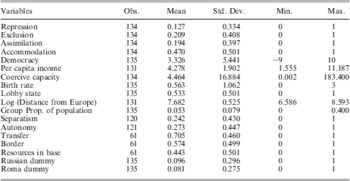
The four strategies are first treated as distinct categories rather than as ordinal variables because the strategies vary dichotomously on three dimensions: culture, politics and repression. In the first set of analyses, I therefore quantitatively treat them as separate, binary dependent variables (coded 1 for all groups subject to the strategy, 0 for all others). See Table 1.
Summary Statistics

Notes: The instrumental variables for Separatism are Border – group's regional base adjoins an international border (dummy), Transfer – group was transferred from another state (dummy) and Autonomy – the group was historically autonomous (dummy).
The analysis of Strategy 1 – Repression – may be thought of as probing why states engage in violent versus non-violent treatment of their minority groups. If an ethnic group is subject to repression, irrespective of its official rights in the political and cultural arenas, it is coded 1 for this strategy. This coding is used due to the logic that if a group is targeted with disappearance, execution, deportation or cleansing, it is highly unlikely that its political and cultural rights are being protected.
Strategy 2 – Exclusion – addresses the question, why do states politically exclude their minorities without resorting to force as opposed to excluding them with violence or politically including them? Thus if a group is not repressed, but is subject to restrictions on its political rights, status and participation, it is coded 1 for this strategy.
Meanwhile, the analyses of Strategy 3 – Assimilation – capture why states assimilate while politically including versus fully accommodating or excluding their ethnic minorities. These models thus emphasize restrictions on the pursuit or expression of the minority groups’ cultural interests and identities. Finally, the analyses of Strategy 4 – Accommodation – probe why states fully accommodate and protect the minority groups’ civil, political and cultural rights versus denying one of these types of rights.
Potential Separatism
The article's first set of models seeks to recognize the potential endogeneity problem: states’ treatment of minorities likely influences minorities’ propensities to secede, just as minorities’ propensities to secede may influence how states treat minorities. This problem implies that indicators of ‘groups’ probability of secessionism’ may suffer either very high measurement error, generating omitted variable bias (if separatism is latent and unobserved) or simultaneous equation bias, generating an identification problem (if separatism is simultaneously determined, and thus correlated with the error term of the state strategy equations).Footnote 59
To attempt to address these potential sources of bias, I use the shock of the Soviet collapseFootnote 60 and the fact that the successor states and governments had to devise new policies towards their ethnic minorities, and instrumental variables estimation. To estimate the system of equations, I identify several factors that predict minority group strategy but do not predict state strategy; that is, they are theoretically highly correlated with separatism, but are unrelated to unmeasured causes of state strategy. Moreover, they are measurable and not strongly correlated with the other explanatory variables in the model.Footnote 61 These instruments are geographic and demographic features that cannot be influenced by state policies in the short run, and are thus exogenous to the minority policies that came into effect after the collapse of communism. They include Transfer, which identifies whether a minority group was physically transferred or if the territory in which the group resides was transferred into the state's political jurisdiction in the past. Autonomy indicates whether the group historically enjoyed autonomy. Both capture incentives for secessionism. Previously autonomous groups are more likely to wish to secede due to a reversal of their status within their regions. Their prior institutions of autonomy may also provide them with the organizational capacity for independence.Footnote 62
Border – whether the group is concentrated on an international border – serves as a further proxy for the group's ability to secede. Being concentrated on a border facilitates the provision of cross-border support in the form of safe havens, arms, money, materiel, intelligence, training and organizational guidance.Footnote 63 It also renders the designation of a separate territory through partition possible. Brubaker and Toft point to the centrality of territorial concentration and Salehyan indicates the importance of cross-border sanctuaries in facilitating rebellion.Footnote 64 Buhaug, Cederman and Rød conclude that the probability of conflict increases with the distance between the excluded group and the capital, which may be correlated with the group's concentration in peripheral border zones.Footnote 65
There is little reason to believe that these variables – Transfer, Autonomy and Border – transmit their influence on the outcome (state's choice of minority policies) except through their effect on the likelihood of separatism. This instrumental variable method thus makes it possible to try to estimate the impact of minority group strategy on state strategy and to assert a causal, rather than correlative, association between separatism and repression.Footnote 66
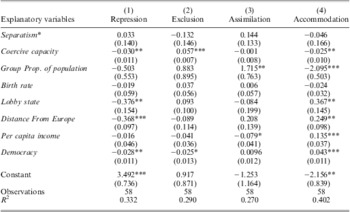
Accordingly, to identify the conditions that favour each of the state strategies – repression, exclusion, assimilation and accommodation – in Table 2 (Models 1–4), I obtain instrumental variables estimators by two-stage least squares.Footnote 67 In the first stage, I regress the endogenous variable, Separatism, on the instruments, Border, Transfer and Autonomy, while controlling for minority group and country characteristics (X′): coercive capacity, group population size, growth rate, lobby state, distance from Europe, per capita income and democracy.Footnote 68
 $$ Separatism\, = \, {{a}_1}\, + \, {{\beta }_{1,0}}X'\, + \, {{\beta }_{1,1}}Border\, + \, {{\beta }_{1,2}}Transfer\, + \, {{\beta }_{1,3}}Autonomy\, + \, {{e}_1} $$
Instrumental Variable Estimation SeparatismFootnote * and State Strategy, 1992 (Second Stage)

Notes: The dependent variable is coded 1 for cases that pursued the given strategy and 0 for all others. Huber robust standard errors are in brackets. Regression disturbance terms are clustered at the country level.
* Significantly different from zero at 90 per cent confidence.
** Significantly different from zero at 95 per cent confidence.
*** Significantly different from zero at 99 per cent confidence.
(The 1 subscript denotes the equation number). I then use the coefficients from this first-stage regression to generate predicted values of Separatism* and regress StateStrategy on the predicted values of Separatism* as well as the covariates. The second-stage equation thus estimates the impact of separatism* on state strategies along with the impact of the other explanatory factors (X′): coercive capacity, group population size, birth rate, lobby state, distance from Europe, per capita income and democracy.
 $$ StateStrategy\, = \, {{a}_2}\, + \, {{\beta }_{2,0}}X'\, + \, {{\beta }_{2,1}}Separatis{{m}^\ast} \, + \, {{e}_2} $$
The former Soviet Union and Eastern bloc provides the ideal environment for this identification strategy.Footnote 69 I find that being historically transferred, autonomous or located in a border area prior to the period of investigation is, in fact, closely associated with minority groups’ strategies, specifically their potential secessionism.Footnote 70 The first-stage least squares regression yields an R 2 value of 0.421 and Border and Transfer prove highly correlated with Separatism at the 1 per cent significance level (p = 0.010 and p = 0.006, respectively), Autonomy at the 10 per cent level. If a group is geographically concentrated on an international border, it is 8.2 times more likely to seek secession. If a group had previously been transferred from another state, its odds of separatism are 15.3 times higher, controlling for economic, political and demographic characteristics.Footnote 71 These instruments are thus empirically strong; they accord with the first requirement of instrumental variable estimation: that the covariance of the instruments and endogenous variable (after partialling out the covariance that each variable shares with the covariates) converge to some non-zero quantity.Footnote 72 These instruments must also satisfy the exclusion restriction. While fulfilment of the exclusion restriction cannot be established empirically, conceptually it seems plausible that being historically transferred, autonomous or concentrated in a border area affects state strategies only through minority groups’ potential secessionism.
In the second-stage regressions, in Table 2, the instrumented predicted Separatism* variable has no effect on the likelihood of any of the four state strategies. Contrary to conventional wisdom, groups’ ability and incentives to undermine the territorial integrity of the state appears not to impact leaders’ strategic decision making with respect to their minority policies when controlling for demographic, international, political and economic considerations. Ethnic minority groups that are more likely to secede are equally likely to experience repression, exclusion, assimilation and accommodation as those groups with few prospects for rebellion.Footnote 73
While the coefficients on Separatism* are entirely statistically insignificant, their signs suggest that non-repressive exclusion and accommodation are less likely strategies, and that repression and assimilation are more likely. While the theoretical basis for the effects of separatism on non-repressive strategies is less well established, the signs make intuitive sense. Faced with higher levels of latent secessionism, non-repressive exclusion likely only generates greater impetus to separatists by exacerbating grievances without deterring rebellion.Footnote 74 While accommodation serves to buy a potentially separatist minority's loyalty and hearts and minds, it also may encourage further minority demands and strengthen the legitimacy of those demands.Footnote 75 Accommodation may also bolster the minority's organizational capital and capacity for collective action, thereby enhancing its ability to seek separatism in the future and closing the state's window of opportunity to counter such a secessionist threat.
Assimilation, meanwhile, potentially serves to divide a minority group and weaken its mobilization capabilities by successfully integrating some of the minority group's members into the state or transforming the minority's identity from that of a rival into one that is consistent with the titular conception of the nation-state. This logic, however, likely depends on the costs and benefits of assimilation for the minority ethnic group: the ease of assimilation and whether adopting the titular group's language, customs and religion enables full participation in the country's political and cultural life and superior economic and social prospects for the minority.
It is possible that Separatism* proves statistically insignificant because states do not view all potentially separatist territories equally. Walter and Hale argue that if, for example, the minority group sits on a pot of gold, the state will behave differently than if the group occupies valueless land.Footnote 76 We should expect that if a minority group is concentrated in a region rich in natural or man-made resources, the state has an incentive to maintain control of the region and to reduce the risk of the group's secession. Indeed, examples from Aceh and Biafra give credence to this theory, though counter-cases such as Palestine and Kashmir also exist.
To evaluate this proposition, I use a dummy variable, coded 1 if the ethnic minority group's region contains natural or man-made resources; 0 otherwise. Toft provides this data for a restricted sample of cases. I therefore include the Resources in Base variable only in Table 4, Model 5 (see online appendix). In this analysis, the resource richness of a minority group's regional base is positively correlated with assimilation (p = 0.10), suggesting that minorities in valuable regions are 3.4 times more likely to be politically included and assimilated. While not highly robust, this accords with the proposition above that, in order to retain control over an economically critical territory, the state seeks not to repress or exclude, but instead to integrate the region's inhabitants and draw them into the state's nationalist ideology. I further experiment with instruments for the joint effects of separatism and resources by including in the analysis interaction terms that reflect the products of Resources in Base and the separatism instruments. The coefficient estimates on these interaction terms are positive, as expected, but only Transfer interacted with Resources is marginally statistically significant. Moreover, the first-stage results in these cases are much weaker than the specifications presented above, so I opt for the more parsimonious specifications.Footnote 77
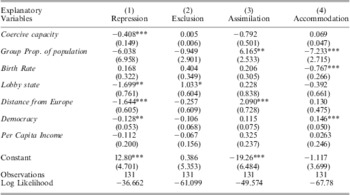
Given the results of the IV-2SLS method, which do not suggest that separatist potential drives responses, to identify the conditions that favour each of the state strategies, in Table 3 (Models 1–4), I drop the Separatism* variable and use logit estimation to ensure that the fitted probabilities are between zero and one.
Logit Analyses of State Strategies, 1992

Notes: The dependent variable is coded 1 for cases that pursued the given strategy and 0 for all others. Huber robust standard errors are in brackets. Regression disturbance terms are clustered at the country level.
*Significantly different from zero at 90 per cent confidence.
**Significantly different from zero at 95 per cent confidence.
***Significantly different from zero at 99 per cent confidence.
Coercive Capacity
Coercive capacity should be positively correlated with both repression and exclusion, but the analysis suggests a more nuanced relationship. In the multivariate regressions, coercive capacity proves positively and significantly correlated with non-violent exclusion and negatively correlated with repression, assimilation and accommodation across different specifications of the model, though the results are somewhat unstable. The repression result seems highly counterintuitive. Why would a country with an adequate repressive apparatus relative to its minorities be less likely to rely on force than one that lacked such coercive power?
Fearon and Laitin propose one explanation for this finding. They argue that a state will favour ‘brutal and indiscriminate retaliation’, which they characterize as police and counter-insurgent weakness, if it has low ‘overall financial, administrative, police and military capabilities’.Footnote 78 Similarly, Kalyvas argues that armed forces are more likely to engage in indiscriminate violence if they lack a strong security infrastructure.Footnote 79 Thus it may be the case that larger, more effective militaries are able to use their force for deterrence and thereby avert the use of repression.
The coefficients on coercive capacity may also be skewed by the Russian Federation cases. These groups are small; the Russian armed forces immense (approximately 2.7 million soldiers). Moreover, Russia accommodated many of its minorities, rendering its mean strategy higher than that of the sample. These findings suggest a potentially non-monotonic relationship between repressive capacity and likelihood of inclusion. Once the state's coercive apparatus reaches a certain capacity and outnumbers the ethnic group members by a large margin, the state need not repress. The underpinning logic would be: ‘If the group ever became a threat, it could easily be dealt with’.Footnote 80
Demographics: Ethnic Group Population
It is anticipated that sizeable minority populations will be included through assimilation. The analysis validates this hypothesis; states with a large minority population (as a proportion of the national population) prove much less likely to accommodate the group and more likely to assimilate it.
Holding the coercive apparatus constant, repression of a larger population is more costly than assimilation both in terms of the opportunity costs of using the security forces to terrorize the population and in terms of the state's international reputation and guarantees of sovereignty against humanitarian interference. Meanwhile, political inclusion of large groups has an additional benefit over exclusion: sizeable groups constitute larger voting blocs and can thus play a pivotal role in politics. Linz and Stepan, for example, predict that minorities are most likely to gain access to power sharing ‘if the national majority is fractioned and needs, either at the time of elections or in the process of forming a government, explicit or implicit coalitions with minorities and/or the support of the minority and/or its representatives’.Footnote 81 Writing on Macedonia, Roudometof recounts, ‘The strong polarization between the socialists and the nationalists revealed the extent to which the Albanian vote played an important role in domestic politics’.Footnote 82 Albanians, as a majority in 20 of 130 municipalities, could not be ignored. The Estonian Russians (in later years) also illustrate this dynamic.Footnote 83 As a counterfactual example, the Ossetian population, with an extreme numerical disadvantage relative to the ethnic Georgian population, proved unable to act as a critical constituency in Georgian politics at the Republican level.Footnote 84
At the same time, while large minority groups tend to be politically included, their size also prevents their full accommodation. Accommodation implies the protection of minorities’ linguistic, religious and cultural rights, which, for a sizeable population, means surrendering the states’ ethno-nationalism. Assimilation thus proves the most likely strategy.
Ethnic Group Growth Rate
High Birth Rate is significantly and positively correlated with Repression and negatively associated with Accommodation in the bivariate analyses. However, only the effect on accommodation remains when I control for other demographic, political, economic and external factors. Under a pattern of demographic change generated by high minority birth rates, the minority could become a majority tomorrow, and thus the costs of its accommodation increase over time, rendering these costs prohibitively expensive. These minority groups thus prove less likely to enjoy full political, ‘personal integrity’ and cultural rights, which accords with the demographic finding above. Both current and future minority population size seems to matter in states’ calculations.
International Considerations: Lobby State
It is expected that minority groups with lobby states – foreign countries willing to intervene on their behalf – are likely to be afforded more rights than groups lacking such ‘external national homelands’.Footnote 85 The signs of the Lobby State coefficients in the analyses of Repression and Accommodation are consistent with the stated hypothesis in all of the models, but having external lobbyists only proves a robustly significant determinant of state strategy in the Repression estimations.Footnote 86 The coefficients suggest that if a group has a lobby state, it is, on average, 82 per cent less likely to be repressed compared to any other strategy.
Contrary to the prediction of Horowitz, this finding indicates that fear of conflict contagion may not dissuade kin groups from helping transborder minorities.Footnote 87 Also, in contrast to Mylonas’ hypotheses, the evidence suggests that lobby states may pursue nationalist policies abroad only to avert their kin's brutal mistreatment, not to ensure them a full spectrum of cultural and political rights.Footnote 88 We may not observe Mylonas’ anticipated effects of external involvement on the non-repressive nation-building policies because, according to Mylonas, these effects may be conditioned on whether the host and external states are rivals or allies, and whether the host state's foreign policy goals are revisionist or status quo: variables that, due to data limitations, are not evaluated in this article's models. Lobby states may pursue nationalist policies abroad to protect their ethno-national kin's political and cultural rights only when doing so serves other (non-nationalist) geopolitical goals.Footnote 89 Finally, external states may lack the capacity to advocate for these more expansive political and cultural rights on behalf of their diaspora. They may therefore prove non-credible, and thus non-effective, lobbyists.
Distance from Europe
While employed as a control variable, Distance from Europe yields interesting results that merit mention. The empirics suggest Distance from Europe is negatively and significantly correlated with repression, and positively correlated with assimilation and accommodation.Footnote 90 The closer a state is to Western Europe, the more likely it is to politically exclude and coerce its ethnic minorities.
There are several reasons why distance from Europe may demonstrate these counterintuitive effects on state strategy. First, as Petersen observes: ‘Western theory and practice on ethnic and minority rights is filled with contradictions and incoherence’.Footnote 91 This ambiguity on the part of the West and the international community produces unclear incentives for state leaders; these leaders cannot predict which standards will apply to their cases. Accordingly, they may believe that an exclusionary strategy that nonetheless protects an ethnic group's language will earn them the benefits of international reputability without the costs of accommodation. Leaders will not risk giving up more than they deem necessary.
Secondly, while foreign pressures may influence leaders’ strategies, they will do so alongside domestic pressures. Politicians may prioritize the goal of power retention over the country's longer-term interests of international standing, especially if these goals are at variance. For example, if accommodating minorities in accordance with international standards implies large-scale redistribution (as captured by the ‘ethnic group size’ variable) and redistribution affects the interests of the leaders’ constituents, the government will be unlikely to choose accommodation because it is politically costly. Past domination by the non-titular minorities and vulnerability to ethnic outbidding may also intensify the government's reluctance to accommodate these groups.
Finally and importantly, Distance from Europe obviously also captures a state's distance from former Soviet influence. This variable thus serves as a proxy for the strength of Soviet legacies and ideologies. During the Soviet era, countries closer to Western Europe remained independent, satellite states rather than republics of the Soviet Union. As a result, the Soviet ideology of multinationalism may have been less cemented in Eastern Europe.Footnote 92 Additionally, popular sentiment for independence from the USSR proved especially intense in these countries. Consequently, these Eastern European states sought to rid themselves of the Soviet legacy. In part, this may have implied the destruction of multinational norms and the reassertion of the rights of the titular nationality.
Democracy
According to the modernization and democratic peace literatures, we should anticipate that minority inclusion and tolerant treatment will be higher, on average, in political democracies.Footnote 93 Democratic institutions (such as competitive elections, impeachments, and checks and balances) restrain decision makers, while democratic cultures encourage conflict resolution through peaceful channels (voting, negotiations, rational debate and compromise). Democracies also are more likely to exhibit cleavages crossing ethnic divides, trust, tolerance, social cohesion and ‘good’ social capital, all factors that are favourable to interethnic accommodation. Finally, as alluded to above, electoral politics generate intra-ethnic competition with incentives for minority inclusion.Footnote 94 These mechanisms render the accommodation of ethnic minorities more likely.Footnote 95
I use the Polity IV scores to test this hypothesis.Footnote 96 It should be noted that democracy, as it is generally conceived, is not synonymous with broad minority rights. The Polity Project codes according to the most common definition of democracy: the competitiveness of political participation, openness and competitiveness of executive recruitment, and constraints on the executives.Footnote 97 This definition of regime type makes no stipulations about minority rights, cultural rights, citizenship criteria or guarantees of civil liberties, all of which are integral dimensions of state strategies with respect to ethnic minority groups. While all citizens may enjoy democracy, citizenship may not extend to all peoples. Additionally, these measures of regime type only capture the extent of democracy at the bureaucratic centre of power. While democracy may function at the centre, it may not extend to all regions of the state's territory. Democracy can therefore be assumed to be independent of the outcome variable: state strategy.
The statistically significant coefficients on Polity IV measures of regime type across all specifications of the Repression and Accommodation models support the hypothesis. Controlling for other factors, if a state's polity score improves by one unit, it is 19 per cent more likely to politically include, rather than exclude, its minorities. Specifically, a one-unit change in polity score makes a state 12 per cent less likely to engage in repression than any other strategy, and 16 per cent more likely to accommodate.Footnote 98
Per Capita Income
Finally, we should expect higher levels of per capita income to render accommodation easier. If resources are more plentiful, distributional reforms are potentially positive-sum. In contrast, as Homer-Dixon observes: ‘scarcity can sharply increase demands on key institutions, such as the state, while it simultaneously reduces their capacity to meet those demands’.Footnote 99 Conditions of poverty also produce incentives for political leaders to deflect social frustrations away from the government and onto vulnerable scapegoat groups: ethnic minorities.Footnote 100 Eliminating these groups from resource competition proves an attractive way for governments to increase distribution to their ethnic constituents.Footnote 101 Moreover, according to modernization theorists, impoverished states exhibit higher levels of intolerance and political extremism, and fewer cross-cutting cleavages: conditions unfavourable to peaceful ethnic coexistence.Footnote 102 Finally, as mentioned above, states may favour repression if they are weak, a variable that Fearon and Laitin capture with per capita income.Footnote 103 Consistent with these predictions, the empirics in Table 2 suggest that the higher a country's per capita income, the more likely it is to include and accommodate its ethnic minorities.Footnote 104
Sensitivity Analysis
Table 4 presents robustness checks of the primary findings based on the models presented in Tables 2 and 3.Footnote 105
Russian and Roma Dummies
Of the sample of ethnic groups, eleven are Roma and thirteen are Russian. Thus, I run all regressions first without the Roma groups and then without the Russian ones to ensure that the results do not change. Excluding these cases does not alter the key results. I then include dummies for Roma and Russians respectively to ensure that these groups are not distorting the results (Table 4, Models 1–4).
The coefficients and standard errors of the other variables do not change significantly when I include these controls. Consistent with anecdotal evidence and qualitative scholarly accounts, the data offer strong evidence that the Roma are more likely to be subjected to state terror than to any of the remaining three strategies. Holding the other explanatory variables at their means, being Roma increases the odds of repression by 179. This makes sense theoretically. The Roma's demographics make accommodating them more expensive over time. At the same time, without a Roma-dominated state to lobby for them and little potential for collective action, the costs of repressing the Roma remain low. Finally, the Roma constitute a net drain on government resources. The state thus has strong incentives to encourage their exodus (through coercion).
Meanwhile, in Table 4, Russian minorities prove significantly less likely to be repressed or to experience restrictions on their rights. These results also make intuitive sense. Repression of the Russian diaspora proves costly for their ‘host’ countries for two reasons. First, the Russian minorities, on average, possess high human and financial capital and are consequently deemed important to the economic development of these successor states. To avert their emigration, the Russians’ host countries have incentives to treat them reasonably well. Second, the Russian Federation would likely pressure these states on its diaspora's behalf. Economic pressure would be damaging to many of these countries, which depend economically on Russia. Given the highly asymmetrical military balance between these states and Russia, military pressure would also be costly.
Conclusion
This article has sought to draw from diverse comparative politics and international relations literatures to generate explicit hypotheses about state strategies towards ethnic minorities. Specifically, it asked why some institutional arrangements assimilate minority groups while others exclude them from the country's political, economic and cultural arenas. It assessed why some designs protect minority groups’ ‘personal integrity’ rights while others target them with state repression. Understanding the conditions that structure these strategies is critical to preventing human rights abuses, mitigating ethnic conflict and deepening democratization.
Based on 1992 minority rights data, my findings cast doubt on the hypothesis that states resort to force in response to minority groups’ potential for separatism. Governments often justify the use of pre-emptive coercive force against their populations on grounds of ‘national security’; they must deter a brewing separatist threat from materializing. One would therefore anticipate that groups that are most ‘threatening’ to the state's territorial integrity and most likely to renege on their commitments would experience greater repression than those with few prospects of, or incentives for, secessionism. Indeed, a robust body of scholarship posits that minority group strategies and threats dictate state strategies, specifically states’ use of coercion. The analysis does not validate this expectation.
The study instead finds several alternative predictors of a state's policies towards its ethnic minorities. The empirics suggest that dominant groups with large minority populations seek to assimilate these populations so as to maintain their monopolies over the nation-state. It follows that constitutional engineering to implant accommodative institutions may have a better chance of survival where minorities are small. Where minority groups are large, a progression from assimilatory to accommodative inclusion may be necessary.Footnote 106 Meanwhile, substantial coercive capabilities with respect to an ethnic minority group enable a state to pursue its goal of ethno-nationalism through coercion. International reputability, alliances and external lobbyists, however, constrain this strategic logic. As a result, states that can minimize their minorities’ status without resorting to force – those that enjoy secure military dominance – choose to non-violently exclude the ethnic minority group (both politically and culturally). Finally, states with formal democratic institutions and more entrenched Soviet legacies tend to extend their minorities more expansive rights.
Future Research
The study has attempted to fill an important gap in the literature and to account for the conditions under which states repress, exclude, assimilate or accommodate their ethnic minority groups. It underscores the need for more research that treats the institutions governing minority rights as dependent (rather than independent) variables, examines not only violent outcomes but also the full spectrum of non-violent alternatives, and focuses on state rather than non-state actors’ strategies.
The findings suggest several specific avenues for future investigation. First, due to data limitations, this study has used rough indicators of several of the explanatory factors. Future research explaining nation-building policies could benefit from more nuanced measures of coercive capacity,Footnote 107 information on the nature of the lobby–host state relationships and data on alternative instruments for separatism.
Secondly, while it is useful to quantitatively consider the conditions that predict different starting points for new governments’ strategic games with regards to their minority groups, I intend to use qualitative methods to trace changes over time in how states and societies impact one another, embracing the endogenous relationships. Looking only at the restricted set of cases in Table 2, I find that 44 per cent of the sample became subject to a different strategy in 1998 than in 1992, suggesting the dynamic nature of state strategies. Most of the variables in the model, however, evolve only very slowly. Understanding longitudinal variation in nation-building policies therefore requires careful process tracing, potentially combined with game theoretic modelling, to determine how minorities and states interact over time. Qualitative sources can also help disentangle the deliberations and policy making behind the observed policy output used to code the strategies.
Thirdly, this article has focused on state strategies towards ethnic minorities in the former USSR. The implications of this research may potentially be applicable to contexts beyond the former Soviet Union in which states determine the policies that govern ethnic minority treatment. Locating the limits of the model's generalizability is a task for future research. States repress, exclude, assimilate and accommodate their minorities around the world, so the puzzle recurs in many settings. Additionally, in calculating the risks and benefits of different strategies, states likely consider their coercive capabilities, international relations and demographic advantages vis-à-vis their minorities. The model is most clearly applicable to contexts in which the state is dominated by the titular majority; while the methodology should apply beyond the former USSR, it should prove most effective where it can exploit a break in state–ethnic minority relations and viable exogenous predictors of minority group strategies.
Fourthly, this project has grouped together political, cultural and personal integrity rights without disaggregating the particular policies within these categories. Future research could seek to account for the specific means and policies by which governments coerce, exclude, assimilate or accommodate their ethnic minorities. For example, building on the work of Naimark and Valentino, within the category of repression, why is one group targeted with mass killing or ethnic cleansing while another is the object of detention or other less bloody policies?Footnote 108 How do states choose their tools of coercion from the wide repertoire of repressive means? Within the accommodative strategy choice, why do some minority groups enjoy autonomy while others do not? Or among policies governing minorities’ cultural rights, how do states opt between restricting language rights as opposed to religious freedoms?
Fifthly, the policies and strategies analysed herein are intimately related to, but not collinear with, states’ understandings of their nationhood, as nationalist ideology varies at the country level while strategies towards minorities often vary at the sub-national level. Unpacking the relationship between accommodation, assimilation, exclusion and repression and different conceptions of the nation-state could yield interesting findings.
Finally, ethnic wars between states and their minority groups occur only when both actors opt for violence. This study has sought to explain one piece of the puzzle: the conditions under which the state chooses violence. As this model becomes refined, it could be used to develop instruments for ‘state policies’ in models that predict minority group behaviour. It could thereby potentially provide insights into the relative conflict-inducing potential of different types of grievances: whether groups are equally likely to take up arms when denied rights to speak their language as when they are prevented from participating politically or subject to arbitrary repression.