Transcatheter balloon angioplasty is now accepted as a standard treatment for stenosis of the right and left pulmonary arteries in children with congenital vascular obstructions. For the past decade, conventional angioplasty techniques, including high-pressure balloon angioplasty, have been effective in nearly seven-tenths of procedures.1–7 Despite these successes, a subset of vessels remains resistant to conventional techniques, as evidenced by persistence of a waist in the balloon. Recently, dilation with Cutting Balloons has been used successfully in the treatment of peripheral pulmonary arterial stenosis resistant to conventional techniques.8–12 For these resistant lesions, use of Cutting Balloons appears acutely to enlarge the distal branches in nearly all procedures. Vascular trauma, and the need for rescue stenting, nonetheless, seems to be prevalent.10 Prior to initiating a multi-centre randomized trial comparing use of cutting balloons to high-pressure balloons, we needed to determine the rates of restenosis for the different techniques. In this study, therefore, we reviewed our own experience prior to initiation of the trial, and we report our results using Cutting Balloons for resistant peripheral pulmonary arterial stenosis, as well as complications, and determine the rate of restenosis at follow-up.
Methods
Subjects studied
The Cutting Balloon™ (Boston Scientific, San Diego, California) was first used at Children’s Hospital of Boston in June, 2001. We reviewed all uses of the balloon prior to September 15, 2003, for dilation of either native pulmonary arteries or unifocalized collateral arteries as identified in the departmental databases. These data include the initial findings at angioplasty in the cohort of patients described in January 2003,10 but also include results in an additional 17 patients, and new follow-up data in 14 patients.
Collection of data
We reviewed all catheterization reports and angiograms at the initial and follow-up procedures, focusing on identification of technical details, including the site within the pulmonary arterial tree of the stenoses, the sequence of balloon dilation, the type, size, and formation of a waist, the diameter of the vessels, and the presence of vascular trauma, as well as other adverse events. A simultaneous review performed by a single reviewer of the angiograms obtained at the initial procedure and follow-up allowed precise correlation of the measurements by site. Because of concerns regarding the impact of vascular trauma on late procedural success, vessels were subdivided into categories according to the angiographic appearance of the vessel and the need for placement of a stent. Assessment of clinical state during the period of follow-up was accomplished by a review of medical records, with specific attention on complications possibly related to the procedure.
Statistical analysis
Change in luminal diameter during the Cutting Balloon angioplasty was evaluated using the paired t test. For those vessels with data available at follow-up, we used repeated measures analysis of variance to examine differences between the initial and final minimal luminal diameter at the initial procedure, and the minimal luminal diameter at follow-up. We used generalized estimating equation models to explore the relationships between the changes in luminal diameter before and after Cutting Balloon angioplasty, the changes between the situation after the initial angioplasty to follow-up, and the characteristics of the patients, the procedures, and the vessels. These same models were used to account for the correlation among multiple vessels within the same patient, and to allow for an evaluation of the influence of the level of predictive variables for the patients on the outcomes concerning the vessels.
Results
Characteristics of the patients and the procedures
Over the period of our study, 29 patients were referred for elective pulmonary angioplasty, undergoing 41 procedures using Cutting Balloons, with a median of 1, and a range from 1 to 4, vessels treated in each patient. In most cases, obstruction occurred as a complicating feature of tetralogy of Fallot, which in many cases precluded definitive repair of intracardiac shunts (Table 1). Although we do not universally use general anaesthesia during our procedures, we commenced 18 of the procedures using general anaesthesia, and 5 patients required general anaesthesia after the case due to the serious nature of the underlying cardiac disease. The procedures lasted from 2.3 to 5.4 hours, with a median of 3.8 hours, with a median of 133 minutes of fluoroscopy and a range from 44 to 255 minutes. The procedures required injection of 7.3 millilitres per kilogram of contrast, with a range from 2.5 to 12.5 millilitres per kilogram. Following 17 of 41 procedures, 6 patients were admitted to the intensive care unit for monitoring, and 11 for continuation of mechanical ventilation during the immediate period of recovery after the procedure.
Table 1. Patient characteristics (n = 29).

Cutting Balloon angioplasty
We used Cutting Balloons to dilate 79 vessels, native pulmonary arteries accounting for 85% of the vessels, with unifocalized collateral arteries representing the remaining vessels. Cutting Balloons were used after standard angioplasty had failed to eliminate a waist subsequent to dilation of the balloons at pressures exceeding 15 atmospheres, and later in the series at pressures exceeding 8 atmospheres. We used the size of the persisting waist in the balloon to determine the size of the Cutting Balloon chosen. For the 65 vessels in which we used standard Cutting Balloons, the balloon measured 1.1 plus or minus 0.5 millimetres larger than the waist in the balloon. This resulted in a mean ratio of size of the balloon to the maximum diameter of the vessel of 1.8 plus or minus 1.2. For smaller vessels, however, the balloons used had a larger ratio to both the maximal and minimal diameter of the vessel (Figs 1 and 2). In the 14 vessels treated using a 4 to 7 French augmented catheter technique,10 the waist measured 3.7 plus or minus 1.1 millimetres. In most vessels, following inflation of the Cutting Balloon, a simple angioplasty balloon 0.5 to 1.0 millimetres larger than the Cutting Balloon was inflated across the region of formation of the waist.

Figure 1. Ratio of the diameter of the Cutting Balloon to the maximal diameter of the vessel plotted against the maximal diameter of the vessel.

Figure 2. Ratio of the diameter of the Cutting Balloon to the minimal diameter of the vessel plotted against the minimal diameter of the involved vessel.
Initial results of angioplasty
We achieved a significant increase in luminal diameter following dilation with the Cutting Balloons. Vessels with a mean minimal luminal diameter of 1.5 plus or minus 0.8 millimetres, and a range from 0.4 to 4.0 millimetres, were enlarged to 3.0 plus or minus 1.1 millimetres, the range then being 1.0 to 7.0 millimetres, p smaller than 0.001, representing a mean proportional change in minimal luminal diameter of 146 plus or minus 109% (Fig. 3). Following dilation, we characterized the angiographic appearance of the lumen as smooth, without filling defects, in 51 percent of vessels. Filling defects, including intimal flaps or an irregular lumen appearance of the vessel, were observed following 39 of 79 dilations. We placed a stent in 9 (11%) of these vessels, 4 of which had obstruction to distal flow. We observed 3 aneurysms, defined as an increase in diameter of the vessel greater than 100 percent of its diameter proximal and distal to the site of enlargement.

Figure 3. Distribution of proportional change in luminal diameter from the initial measurement to immediately following Cutting Balloon angioplasty as measured for 79 vessels.
Adverse events
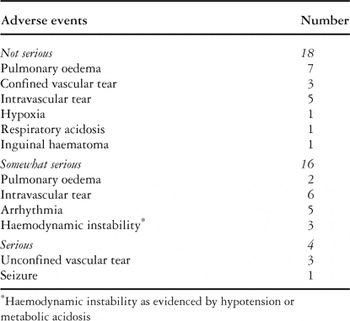
We identified 38 adverse events in 19 patients, the events occurring at the time of the procedure in most cases. Hypoxia occurred in 1 patient, nonetheless, during monitoring after catheterization, requiring supplemental oxygen, and another patient experienced a seizure of unclear aetiology 6 hours after the procedure. We needed to use coils to occlude 3 ruptured distal vessels, 2 following conventional high-pressure angioplasty and one following use of a Cutting Balloon augmented with a stiff catheter. In all these cases, the life-threatening pulmonary haemorrhage was managed successfully in the catheterization lab by occluding the effected segment of lung. In Table 2, we summarize the adverse events by seriousness. In some cases, such as pulmonary oedema evidenced by hypoxia or radiographic changes, the patient required only monitoring after the event. Many patients, nonetheless, required interventions such as intubation for pulmonary oedema, placement of a stent or coil for vascular trauma, medicines or cardioversion for arrhythmias, or ionotropic support for low cardiac output. It transpired that, by timing or physiologic features, 28 (74%) of the events could be related or attributed to balloon angioplasty. The remaining events were related to general aspects of the catheterization procedure or other interventions.
Table 2. Summary of adverse events.

Follow-up angiography
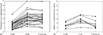
Follow-up angiography was available for 39 vessels dilated using Cutting Balloons during 20 catheterizations undertaken in 16 patients. The interval between the initial procedure and follow-up angiography ranged from 3 to 24 months, with a median of 6 months. The initial luminal diameter as measured at follow-up was 2.8 plus or minus 1.3 millimetres, with a range from 0.8 to 6.9 millimetres. This represented (Fig. 4) a mean loss in the gains made following treatment with the Cutting Balloon of 10 plus or minus 25% (p not significant). For 8 of the 39 vessels, diameters were within fifty percent of the measurement made prior to dilation, representing a rate of failure at follow-up of 21%, with 95% confidence intervals from 9% to 36% (Fig. 5). We proceeded to repeat the use of Cutting Balloons for 12 vessels at the follow-up procedures, and gained an additional mean of 60 plus or minus 41% in luminal diameter. Follow-up was available for 6 of the 9 stented vessels, and revealed a mean loss in luminal diameter of 0.7 millimetres, with a range of zero to 1.9 millimetres. In 4 cases, we redilated the stents with high-pressure balloons, one of these procedures also including further treatment with a Cutting Balloon. In the group of 16 patients in whom follow-up information was available, 11 had suffered adverse events at the time of the initial procedure. We did not identify any events during the intervening period, nor readmissions or symptoms related to the angioplasty procedure. All patients returned for elective catheterization to perform additional angioplasty. No vascular complications, such as new aneurysms or obstruction to flow in dilated segments, could be detected on follow-up angiography.

Figure 4. Distribution of proportional change in luminal diameter from final measurement after Cutting Balloon angioplasty to measurements of luminal diameter made at follow-up in 39 vessels.

Figure 5. Vessel diameters on initial angiogram, final diameter after Cutting Balloon angioplasty, and at follow-up; (a) shows 21 vessels with a follow-up diameter greater than 50% of the initial diameter, while (b) shows 8 vessels within 50% of the pre-dilation diameter at follow-up.
Predictors of changes in luminal diameter
We explored multiple characteristics of the patients, the procedures, and the vessels as potential predictors for any change in luminal diameter occurring before and after the initial dilation using the Cutting Balloon. Univariate analysis revealed no relationship between such change in luminal diameter with cardiac diagnosis, gender, year of procedure, presence of anatomic shunt, history of dilation, history of surgery, initial diameter of the vessel, or the ratio in size of the Cutting Balloon to either the maximal or minimal luminal diameter. Independent predictors of greater change in luminal diameter as determined by multivariate analysis were placement of stents (p smaller than 0.001), a larger maximal luminal diameter prior to dilation (p equal to 0.001), and younger age (p equal to 0.008). A similar analysis following assessment at follow-up revealed placement of stents (p equal to 0.01) and no history of surgery (p equal to 0.005) as independent predictors of greater loss in luminal diameter at follow-up. Presence of angiographic evidence of injury to the vessel wall failed to predict any loss in luminal diameter at follow-up (p equal to 0.38).
Predictors of injury to the wall of the dilated vessels
We explored any differences in the procedures undertaken for dilating vessels with and without angiographic evidence of injury following use of the Cutting Balloons. There was no statistically significant association found between the type of vessel, its initial size, the ratio of the Cutting Balloon to the initial diameter of the vessel, history of prior dilation, or year of procedure and injury to the vessel.
Discussion
In this report, we have described procedural characteristics, technique, and results, both early and at follow-up, for vessels with non-compliant obstructions resistant to conventional angioplasty therapy treated with Cutting Balloon angioplasty. These vessels demonstrated resistance to the tearing required for a successful procedure using conventional angioplasty, as evidenced by failure to eliminate the waist in the balloon used for dilation. Although placement of stents has proven useful for compliant lesions, such placement of stents in vessels resistant to balloon angioplasty is at best only partially successful. No further options for treatment were available for these resistant lesions, therefore, prior to the introduction of Cutting Balloons.
Because commercially available Cutting Balloons only measured 2 to 4 millimetres during the period of our study, the vessels we were able to dilate are limited to those small arteries supplying distal lobar and sub-lobar segments. Procedures such as these, requiring multiple dilations of congenitally acquired distal obstructions, frequently involve long procedural and screening times. In fact, many cases are limited by contrast count and procedural time rather than completion of therapy for all obstructed vessels. In regards to the high incidence of adverse events, the haemodynamic support and incidence of adverse events observed in these cases appears similar to equally complex cases requiring multiple pulmonary arterial dilations. We have reported pulmonary oedema as occurring in nearly half of the patients treated with Cutting balloons. This sign is associated with improvements in flow to distal vasculature as a result of successful angioplasty. It may require ventilatory support, but in most cases resolves in 72 hours.
As far as we are aware, our data comprises the largest series of pulmonary arteries dilated with Cutting Balloons, and the first series to include follow-up results after the initial procedure. Despite angiographic evidence of luminal disruption after angioplasty, gains in luminal diameter are preserved at follow-up, with rates of restenosis similar to those observed following simple angioplasty. When a stent was used to manage intravascular trauma, however, we observed a greater loss in luminal diameter. Some stented lesions became completely occluded between angioplasty procedures. It may be prudent, therefore, to limit the use of stents in small lobar pulmonary arteries to the treatment of vascular trauma requiring intervention, such as transmural tears or distal obstruction to flow of blood.
Use of Cutting Balloons, therefore, is effective for non-compliant obstructions resistant to simple angioplasty techniques, including high-pressure dilation. Our data show lasting benefits in the gains achieved in luminal diameter at the initial procedure. Our initial experience was limited to small vessels, but the availability of larger Cutting Balloons will allow treatment of larger pulmonary vessels, as well as other non-compliant vascular obstructions. Additional data in both small and larger pulmonary arteries will be necessary to make an accurate assessment of the safety of these balloons for pulmonary angioplasty.