Implications
These in vitro binding studies suggest that activated carbon (AC), cholestyramine and tween-60 (Tween) could be suitable candidates to test as feed additives in an in vivo trial to reduce levels of taint compounds in boars. Furthermore, AC and Tween are both inexpensive and already used in commercial applications. Using these compounds as feed additives, particularly in a finisher feed, might allow them to bind boar taint compounds in the gastrointestinal tract and decrease the levels of boar taint without castration. Any potential negative effects of these binding agents on growth performance should be evaluated in these in vivo feeding trials.
Introduction
Boar taint is a result of high levels of the indole derivative, skatole and 16-androstene steroids, primarily 5α-androstenone (AND) in pig meat. Owing to the potential of boar taint, pigs are castrated within the first week of birth in many countries; however, studies have demonstrated that castration elicits significant physiological and behavioral stress responses in young pigs (Prunier et al., Reference Prunier, Mounier and Hay2005). Owing to mounting animal welfare concerns with this practice, it has become increasingly important to investigate alternative methods of preventing boar taint.
Skatole is produced in the hindgut through microbial degradation of tryptophan from both dietary and endogenous protein; it is then absorbed from the intestine to be partially degraded by the liver (Yokoyama and Carlson, Reference Yokoyama and Carlson1979; Jensen et al., Reference Jensen, Cox and Jensen1995). Skatole metabolites are then excreted in the urine or feces (Spoelstra, Reference Spoelstra1977), whereas undegraded skatole is deposited partially in fatty tissues (Agergaard and Laue, Reference Agergaard and Laue1993). In recent years, a number of different nutritional manipulations to control skatole production have been investigated. Skatole production depends largely on available protein in the hindgut, specifically the presence of tryptophan (Jensen et al., Reference Jensen, Cox and Jensen1995). The most effective treatments for limiting the production of skatole have been the use of diets containing fermentable carbohydrates such as inulin and raw potato starch. These diets have been suggested to limit the amount of substrate for microbial fermentation and decrease the production of skatole (reviewed in Zamaratskaia and Squires, Reference Zamaratskaia and Squires2009). However, at present, there are no dietary methods that limit the concentration of androstenone in backfat.
Testicular steroid hormones, including androstenone, are produced in the Leydig cells of the testes, and are metabolized in the liver through phase I reactions, which are predominantly carried out by the cytochrome P450 (CYP450) superfamily of enzymes. CYP450s change the functional properties of compounds by introducing functional groups such as hydroxyls; compounds are then subsequently conjugated by phase II reactions and then excreted into the bile as steroid glucuronides and sulfates (Ruoff and Dziuk, Reference Ruoff and Dziuk1994; Guengerich and Shimada, Reference Guengerich and Shimada1998; Sinclair et al., Reference Sinclair, Hancock, Gilmore and Squires2005). Enterohepatic circulation refers to the biliary excretion of conjugated solutes from the liver into the small intestine where deconjugation occurs via microbial fermentation. Following deconjugation, free steroids are reabsorbed into the portal venous blood to increase their half-life as they are recycled (Roberts et al., Reference Roberts, Magnusson, Burczynski and Weiss2002). The excretion of a solute through the urine or feces interrupts the enterohepatic circulation. Steroid hormones such as estrone (E1) and estrone sulfate (E1S) are known to undergo enterohepatic recirculation. The details of androstenone metabolism are not completely established, but it has been shown to form sulphoconjugates and glucuronyl conjugates in porcine hepatocytes (Sinclair et al., Reference Sinclair, Hancock, Gilmore and Squires2005). If androstenone follows a similar route of metabolism and recycling as estrogens, it may be possible to decrease androstenone levels by interrupting the enterohepatic circulation.
Some mycotoxins, such as zearalenone, share similarities in chemical structure with steroid hormones, such as estrogens, allowing for them to bind and activate receptors (Miksicek, Reference Miksicek1994; Malekinejad et al., Reference Malekinejad, Maas-Bakker and Fink-Gremmels2006). In addition, the biotransformation and enterohepatic circulation of mycotoxins is similar to that of steroid hormones (Malekinejad et al., Reference Malekinejad, Maas-Bakker and Fink-Gremmels2006). Adsorbent materials that bind mycotoxins are used to detoxify feedstuffs by reducing the bioavailability of mycotoxins in the gastrointestinal tract (GIT) (Solfrizzo et al., Reference Solfrizzo, Visconti, Avantaggiato, Torres and Chulze2000; Döll et al., Reference Döll, Dänicke, Valenta and Flachowsky2004). Consequently, including adsorption agents in the diet before slaughter might also bind AND and skatole to prevent their absorption from the GIT and thereby reduce boar taint.
Cholestyramine (CH) is an anionic-exchange resin used to bind bile acids in the GIT and reduce levels of plasma cholesterol (Avantaggiato et al., Reference Avantaggiato, Havenaar and Visconti2003; McCrindle, Reference McCrindle2003). AC, or activated charcoal, is a form of processed carbon that is extremely porous and provides a large amount of available surface area for adsorption. It binds a wide variety of low molecular weight compounds and is used as a universal antidote in acute poisoning (Wilson and Cook, Reference Wilson and Cook1970). Tween-60 (Tween) belongs to a family of surfactants known as polysorbates, which are used extensively in the food, cosmetic and pharmaceutical industries to solubilize essential oils into water-based products (Oser and Oser, Reference Oser and Oser1956). Small quantities of bentonite (BNT) suspended in water form a viscous gel, which has applications in mining, winemaking and chemical industries by adsorbing a wide range of substances including large proteins (Ramos and Hernández, Reference Ramos and Hernández1996; Ramos et al., Reference Ramos, Hernández, Pla-Delfina and Merino1996). Lastly, polyvinylpolypyrrolidone (PVPP) is a polar amphoteric soluble polymer used in various industries as a carrier for the active ingredients, such as in medications (Ramos et al., Reference Ramos, Hernández, Pla-Delfina and Merino1996).
As an initial step in developing dietary manipulations to control boar taint, our objective was to determine the binding efficiency of non-nutritive adsorptive materials (CH, AC, Tween, BNT and PVPP) for boar taint compounds, AND and skatole, using an in vitro system. We also determined the binding efficiency of E1 and E1S, as estrogens are known to undergo enterohepatic recirculation.
Material and methods
Chemicals
Stock solutions (40 mg/ml) of CH, Tween, BNT, PVPP/crospovidone (Sigma-Aldrich, Oakville, ON, Canada) and AC (NORIT® SA 2, decolorizing, Fisher Scientific, Ottawa, ON, Canada) were prepared in phosphate buffer saline (PBS; 139 mM NaCl, 8.5 mM Na2HPO4, 1.5 mM KH2PO4 and 2.7 mM KCl, pH 7.4). Stock solutions (20 μg/ml) of E1, E1S, AND and skatole were prepared by dissolving crystalline standards (Steraloids Inc., Wilton, NH, USA) in 10% ethanol. E1, E1S and AND stock solutions were then diluted to 10 μg/ml with 0.01 μCi/ml of radiolabeled steroids in PBS; E1, (2,4,6,7-3H(N)), E1S, ammonium salt [6,7-3H(N)] in PBS (Perkin Elmer, Boston, MA, USA) or (2,4(n)-3H)-5-α-androst-16-ene-3-one (kindly donated by Øystein Andresen, Norwegian School of Veterinary Science, Oslo, Norway). Skatole was diluted to a stock solution of 400 ng/ml in PBS.
Dose–response and adsorption assays
In vitro experiments designed to simulate in vivo conditions (pH, incubation time, temperature) within the GIT were adapted from studies investigating mycotoxin detoxification by Solfrizzo et al. (Reference Solfrizzo, Visconti, Avantaggiato, Torres and Chulze2000) and Döll et al. (Reference Döll, Dänicke, Valenta and Flachowsky2004). Five non-nutritive adsorbent materials were tested for their ability to sequester radiolabeled steroid hormones and skatole in increasing concentrations of adsorbent (0.005 to 20 mg/ml), at pH 7.4 and pH 3.0. From stock solutions of 40 mg/ml, serial dilutions of the adsorbents were made to 1, 8, 16, 24, 32 and 40 mg/ml in PBS. Preliminary studies done with varying incubation times (15 min, 30 min, 1 h and 3 h) showed that maximum binding occurred between 15 and 30 min with little change thereafter (data not shown). Preliminary experiments also indicated that AC reached its maximum binding capacity at 0.5 mg/ml (data not shown). Thus, serial dilutions used for dose–response of AC were as follows: 0.005, 0.01, 0.025, 0.05, 0.125, 0.25 and 0.5 mg/ml. Owing to the non-polar nature of AND, and to prevent its adhesion to any working surface, the stock solution of 20 μg/ml AND in 10% ethanol was diluted 1 : 1 with PBS containing 0.05% Tween.
In general, 1.5 ml of adsorbents (CH, AC, BNT or PVPP) of a particular concentration were mixed with an equal volume of adsorbate (E1, E1S, AND or skatole) solution, yielding a final concentration of 5 μg/ml steroid hormone and 200 ng/ml skatole. The final concentrations of steroid hormones and skatole were well above the upper limit of plasma levels found in the developing boars. The mix was tightly capped in 16 ml glass tubes and vortexed for 10 s. The tubes were incubated at 37°C for 30 min in a shaking water bath, vortexed at 15 and 30 min and then centrifuged at 3000 r.p.m. for 30 min at room temperature. The supernatant, containing unbound adsorbate, was then transferred to a clean glass tube and a 1 ml aliquot from the incubations with labeled steroids was added to 4 ml of Ecolite (ICN Biomedicals Canada Ltd., Mississauga, ON, Canada) and counted under standard tritium conditions in a liquid scintillation counter (Beckman Coulter, LS6000SC, Mississauga, ON, Canada) and percent bound was calculated. Experiments were performed in quadruplicate for each pH and adsorbent concentration for each adsorbate, except for AND, which was conducted in duplicate and only at pH 7.4 because of limited amount of labeled androstenone.
Owing to the oily-liquid nature of Tween, the methodology for its use had to be adjusted. A stock solution of Tween at 40 mg/ml was prepared by heating 50 ml of PBS and 2 g of Tween to 50°C, until the solution was clear. Soybean oil (125 μl) was then added and homogenized for 15 s with a Polytron homogenizer (Brinkmann Instruments, Rexdale, ON, Canada) to create a homogeneous emulsion containing 0.25% soybean oil. The addition of fat was added to mimic conditions in vivo and to encourage the formation of micelles. Stock solutions of Tween were not kept for more than one week. Serial dilutions of Tween were prepared at 1, 8, 16, 24, 32 and 40 mg/ml in PBS. In glass tubes, 1 ml of Tween was added to 1 ml of each adsorbate, tubes were then homogenized for 10 s, vortexed for 10 s and incubated as previously described.
In order to separate the adsorbate bound to Tween from unbound adsorbate, dextran-coated carbon (DCC) was added to sample vials. Dextran has been used in the immunoassays of insulin to separate free from antibody-bound insulin (Herbert et al., Reference Herbert, Lau, Gottlieb and Bleicher1965) and to separate free steroid hormones from steroids bound to nuclear receptors (Tora et al., Reference Tora, Mullick, Metzger, Ponglikitmongkol, Park and Chambon1989). DCC was prepared by dissolving 0.05 g dextran (average molecular weight 80 kDal) in 100 ml of PBS, 0.5 g of AC was then added and the mixture stirred for at least 30 min. Preliminary experiments showed that adding 14% by volume of DCC to Tween incubations with AND, E1S and E1 and 1.5% (v/v) of DCC to Tween incubations with skatole, vortexing for 20 s and centrifugation at 3000 r.p.m. after 5 min, was sufficient to remove unbound adsorbate (data not shown). An aliquot of 1 ml of the supernatant containing radiolabeled steroid bound to Tween was then added to 4 ml of Ecolite and counted. Control tubes consisting of 1 : 1 (v/v) radiolabeled steroid hormone and the corresponding concentration of Tween with no added DCC were used to measure the total steroid hormone in solution. Quadruplicate experiments were performed at each concentration of Tween.
The concentration of unbound skatole was measured by HPLC analysis. A 100 μl aliquot of supernatant was analyzed by HPLC using a C18 reverse phase column (Luna, 3 μm, 10 × 4.6 mm, ODS-2) with a solvent system comprising buffer A: 80% of 0.01 M potassium dihydrogen phosphate (pH 3.9) and 20% acetonitrile (v/v) and buffer B: 100% acetonitrile with a flow rate of 1.2 ml/min. The gradient consisted of: 0 min – 80% A, 6 min – 100% B, 8 min – 100% B, 8.1 min – 80% A and 12 min – 80% A.
Effects of pH on binding
In order to evaluate the effects of pH on the efficacy of binding, stock solutions of adsorbents and E1, E1S and skatole were prepared similarly to the previous experiments with the exception that PBS was adjusted to pH 3.0; the incubations were also repeated in quadruplicate.
Statistics and data analysis
The adsorption of radiolabeled steroids and skatole by each binding agent at each concentration was calculated as the percentage of radiolabeled steroid hormone or skatole bound to adsorbent compared with a control sample without the binding agent. Control tubes were incubated alongside sample tubes.
Analyses of dose–response curves were performed using SigmaPlot 11.0 with the Enzyme Kinetics Module to fit data according to the Michaelis–Menten equation (Wood and Thakker, Reference Wood and Thakker1982). For this study, this is described as

where B represents the percentage adsorbate bound to the adsorbent, B max is the theoretical maximum of B and C is the adsorbent concentration. The concentration of adsorbent to bind 50% of B max, is the affinity constant K (mg/ml), which is analogous to K m in the Michaelis–Menten model. The intrinsic clearance (CLint) is the ratio of V max/K m that relates the rate of metabolism to the unbound concentration at the enzyme site. For the purposes of this study, the ratio of B max/K relates the adsorption of an adsorbate to the unbound adsorbate in solution, known as the intrinsic adsorption (Adint; Wood and Thakker, Reference Wood and Thakker1982). Kinetic parameters were compared by ANOVA using SAS (SAS Institute, Cary, NC, USA).
Results
Dose–response studies
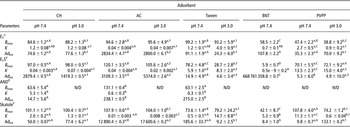
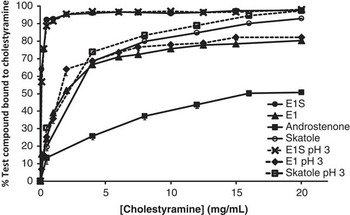
The dose–response binding curves of test compounds to the different adsorbents using the in vitro binding system were typical curves reaching a plateau, which could be explained by Michaelis–Menten-type kinetics (Figures 1–5, Table 1). To determine pH-dependent effects on binding, some incubations were performed at both pH 3.0 and 7.4. Binding of E1S by CH (Figure 1) was depicted by a sharp rise reaching a plateau or the maximum binding capacity (B max) of 97.0% with a K (the concentration of adsorbant at 50% of B max) of 0.04 mg/ml at pH 7.4, and similar binding kinetics at pH 3.0. The binding of E1 to CH was somewhat lower than E1S, with a B max of 84.6% and a K of 1.2 mg/ml at pH 7.4, whereas at pH 3.0, the B max was 88.2% with a K of 1.2 mg/ml. Binding of skatole to CH gave a B max of approximately 100%, with a K of 1.3 to 2.0 mg/ml, which was not affected by pH. The CH bound androstenone much less effectively than the other test compounds, with a calculated B max of 63.6% and a K of 5.3 mg/ml at pH 7.4.
Michaelis–Menten model kinetic parameters for the binding of adsorbents CH, AC, Tween, BNT and PVPP to E1, E1S, AND and skatole

CH = cholestyramine; AC = activated carbon; Tween = tween-60; BNT = bentonite; PVPP = polyvinylpolypyrrolidone; E1 = estrogen; E1S = estrogen sulfate; AND = androgen.
B max (maximum % of binding), K (the concentration of adsorbent in mg/ml to bind 50% of B max) and Adint (intrinsic adsorption; %ml/mg); values are represented as mean ± s.e. for independent replications.
€Independent replications n = 4.
¥Independent replications n = 2.
Superscript lower case letters represent significant differences (P < 0.05) between pH 7.4 and pH 3.0 within each adsorbent.
Superscript upper case letters represent significant differences (P < 0.05) among all treatment groups at pH 7.4 in rows.
Superscript numbers represent significant differences (P < 0.05) among all treatment groups at pH 3.0 in rows.
Percentage of estrogen sulfate (E1S; ●), estrogen (E1; ▴), androstenone (▪) and skatole (○) removed from buffer solution by cholestyramine (CH) at pH 7.4 and the percentage of E1S (-x-), E1 (-⧫-) and skatole (-□-) removed from the buffer solution by CH at pH 3.0.

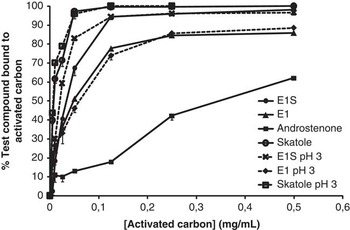
Preliminary studies showed that AC bound E1S close to 100% at 0.5 mg/ml AC; therefore, lower levels of AC were used to depict the ascending portion of the dose–response curve (Figure 2). Binding of E1S by AC gave a calculated B max of 120.1% and a K of 0.04 mg/ml at pH 7.4, with similar binding kinetics at pH 3.0. Binding of E1 by AC was somewhat lower than that of E1S, with a B max of 94.6% and a K of 0.04 mg/ml at pH 7.4 with similar binding kinetics at pH 3.0. AC bound the skatole very effectively, with a B max of approximately 100% and a K of about 0.01 mg/ml. Binding of androstenone did not reach a plateau under these experimental conditions (Figure 2), with the B max calculated to be 131.1% with a K of 0.6 mg/ml.
Percentage of estrogen sulfate (E1S; ●), estrogen (E1; ▴), androstenone (▪) and skatole (○) removed from buffer solution by activated carbon (AC) at pH 7.4 and the percentage of E1S (-x-), E1 (-⧫-) and skatole (-□-) removed from the buffer solution by AC at pH 3.0.

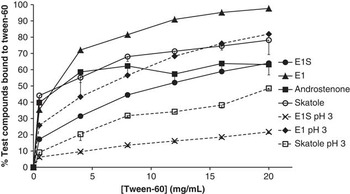
Figure 3 illustrates the binding curves for test compounds to Tween; the slopes of the ascending portion of the curves were generally not as steep as in either CH- or AC-binding curves. Binding of E1S by Tween gave a B max of 78.2%, with a K value of 5.9 mg/ml at pH 7.4; however, at pH 3.0, Tween bound E1S much less effectively with a B max of 28.7% and a K of 8.3 mg/ml. The binding of E1 was higher than that for E1S, with a B max of 99.2% and a K of 1.2 mg/ml at pH 7.4; similar binding kinetics were found at pH 3.0. The binding curves for androstenone and skatole gave B max values of 63.1% and 73.6%, respectively, with K values of 0.3 and 0.5 mg/ml, respectively, at pH 7.4.
Percentage of estrogen sulfate (E1S; ●), estrogen (E1; ▴), androstenone (▪) and skatole (○) removed from buffer solution by tween-60 (Tween) at pH 7.4 and the percentage of E1S (-x-), E1 (-⧫-) and skatole (-□-) removed from the buffer solution by Tween at pH 3.0.

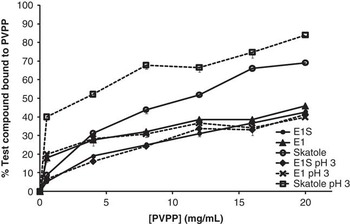
The binding curves with PVPP did not reach plateau for any test adsorbate (Figure 4). Binding of E1S and E1 at pH 7.4 gave calculated B max values of 70.1% and 47.4%, respectively, with K values of 13.5 and 2.7 mg/ml. The binding of E1S was similar at pH 3.0, whereas the B max value for E1 decreased to 38.8%. Binding of skatole at pH 7.4 resulted in a B max of 107.8% and K of 11.3 mg/ml; at pH 3.0, the B max and K decreased to 74.2% and 0.6 mg/ml.
Percentage of estrogen sulfate (E1S; ●), estrogen (E1; ▴) and skatole (○) removed from buffer solution by polyvinylpolypyrrolidone (PVPP) at pH 7.4 and the percentage of E1S (-⧫-), E1 (-x-) and skatole (-□-) removed from the buffer solution by PVPP at pH 3.0.

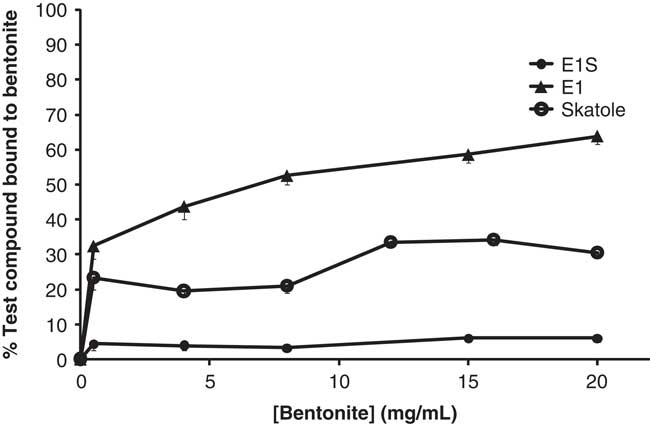
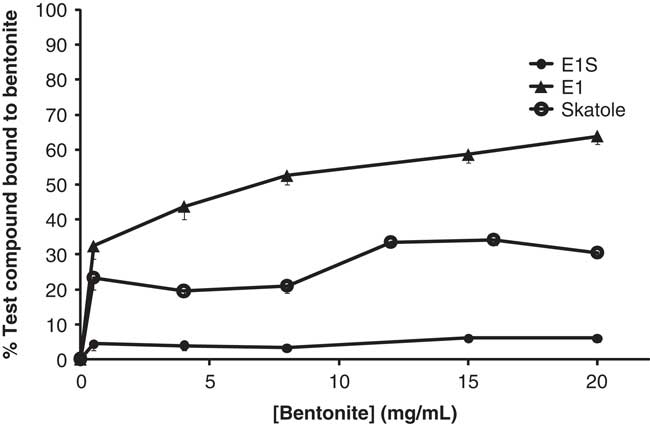
BNT gave the least effective binding kinetics (Figure 5), where the B max for E1S reached only 5.9% with a K value of 0.5 × 10⁻⁹ mg/ml. The binding of skatole by BNT gave a calculated B max of 42.1% and a K of 5.3 mg/ml. Binding of E1 was the highest of all adsorbates tested with BNT, with a B max of 58.5% and a K of 0.7 mg/ml. Owing to poor binding of E1 and E1S by both PVPP and BNT at pH 7.4, binding studies with AND for these two adsorbents were abandoned.
Percentage of estrogen sulfate (E1S; ●), estrogen (E1; ▴) and skatole (○) removed from the buffer solution by bentonite at pH 7.4.
The Michaelis–Menten kinetic parameters calculated from the binding curves for the adsorbents tested, including the B max, K, and the ratio of B max/K, known as the intrinsic adsorption (Adint), which is a measure of the efficiency of each adsorbent, are summarized in Table 1. At pH 7.4, AC had the highest B max values for both AND and E1S, whereas both Tween and AC had the greatest B max for E1 (P < 0.05). The B max for skatole was approximately 100% for CH, AC and PVPP at pH 7.4 (P > 0.05). Of the compounds tested for binding at pH 3.0, AC and CH had B max values of approximately 100% for E1S and skatole. B max values for E1 at pH 3.0 were similar for CH, AC and Tween and higher than PVPP (P < 0.05). The B max for binding of CH to E1 was significantly increased (P < 0.05) by 3.6 ± 1.8%, whereas the binding of PVPP to E1 decreased 8.6 ± 9.5%, at pH 3.0 compared with pH 7.4. The B max for binding of Tween to E1S and PVPP to skatole decreased by 49.5 ± 5.5% and 33.6 ± 7.4%, respectively, at pH 3.0 compared with pH 7.4 (P < 0.05).
At pH 7.4, the K for binding E1 by AC was similar to values for CH, Tween and BNT, but significantly lower than the K for PVPP (P < 0.05); AC also had the greatest (P < 0.05) binding efficiency (Adint) for E1. The K values for binding E1S by CH, AC and BNT were not significantly different from each other (P > 0.05) and were lower (P < 0.05) than the K values for binding E1S by Tween and PVPP. However, as the B max for BNT binding E1S was only about 5%, the very high Adint value has little impact because of the very low capacity for binding. AC and CH had the greatest capacity for binding E1S, as well as the highest efficiency as shown by the Adint values, which were significantly different (P < 0.05) from the Adint values for Tween and PVPP.
At pH 3.0, the K values for binding E1 were lowest (P < 0.05) with CH, AC and PVPP, and not significantly different from each other (P > 0.05); however, the Adint values for AC showed that it had the greatest efficiency for binding E1. The lowest K values for E1S at pH 3.0 were also for CH and AC, which were not significantly different from each other (P > 0.05); AC again showed the greatest efficiency for binding E1S at pH 3.0 (P < 0.05).
The lowest K values of adsorbents for binding AND at pH 7.4 were with AC and Tween, which were significantly different from the K value for AND binding to CH (P < 0.05). However, the B max for both CH and Tween binding AND was only 63%. Thus, as AC had a lower K and a greater B max value than Tween, and a higher B max than CH, it has the best efficiency of binding (Adint) for AND.
K values for the binding of skatole were the lowest for AC, Tween and CH and significantly different (P < 0.05) from the K for BNT and PVPP at pH 7.4. The highest B max for skatole at pH 7.4 was with CH, AC and PVPP, which were significantly different than Tween or BNT. At pH 3.0, K values for the binding of skatole were the lowest for CH, AC and PVPP and significantly different (P < 0.05) from Tween. The B max value for skatole decreased at pH 3.0 compared with pH 7.4. The highest Adint for skatole (P < 0.05) at pH 7.4 and pH 3.0 was found with AC.
Discussion
The objective of these in vitro experiments was to determine the efficacy of binding of non-nutritive adsorbent materials to the steroid hormones E1S and E1, which are known to undergo enterohepatic circulation, and to the boar taint compounds, AND and skatole. A simple in vitro system was used to simulate the pH, temperature and transit time of in vivo conditions. By comparing the effectiveness of the adsorbents in vitro, we can select the most effective adsorbents to use in future in vivo work. Some experiments were conducted at pH 7.4 and pH 3.0 and some differences in binding kinetics were observed at these two pH values. For example, CH responded to the decrease in pH with an increase in the maximum adsorption of E1, whereas the binding of PVPP to E1, and skatole and Tween to E1S decreased at the lower pH. The K values for skatole binding to PVPP also decreased at pH 3.0 compared with pH 7.4. Thus, changes in pH can affect the way in which adsorbents bind test compounds and this demonstrates the necessity to account for physiological conditions that could have an effect on binding in vivo. However, several studies have shown that results obtained in vitro do not always correlate with the efficacy of binding in vivo. In vitro studies by Galvano et al. (Reference Galvano, Pietri, Bertuzzi, Bognanno, Chies, Angelis and Galvano1997) show that AC has high affinity toward fumonisin B1; however, an inclusion rate of 20 mg/g diet of AC to fumonisin-contaminated diets showed no protection to rats against fumonisin B1 (Solfrizzo et al., Reference Solfrizzo, Carratu’, Avantaggiato, Galvano, Pietri and Visconti2001).
ACs are used as universal antidotes against acute toxicosis because of their high surface to mass ratio, which allows them to efficiently adsorb a variety of compounds in aqueous solutions (Avantaggiato et al., Reference Avantaggiato, Havenaar and Visconti2003; Dabrowski et al., Reference Dabrowski, Podkoscielny, Hubicki and Barczak2005). Several in vitro studies have shown that approximately 80% to 100% of mycotoxins in aqueous solutions were adsorbed by AC (Döll et al., Reference Döll, Dänicke, Valenta and Flachowsky2004). Of the adsorbents tested, AC had the highest B max for AND, E1S and E1 at pH 7.4 and pH 3.0, with B max values for skatole at approximately 100%. Together with corresponding low K and high Adint values, this suggests that AC was the most efficient adsorption agent tested. However, as a relatively unspecific adsorbent, AC could bind essential nutrients as well as the target compounds in an in vivo system.
CH is an insoluble quaternary ammonium anion exchange resin used to bind bile acids and reduce levels of low-density lipoproteins and cholesterol in the treatment of hyperlipidemia and hypercholesterolemia in humans (Avantaggiato et al., Reference Avantaggiato, Havenaar and Visconti2003; McCrindle, Reference McCrindle2003). CH effectively lowers plasma cholesterol by disrupting its enterohepatic circulation after sequestering bile acids in the small intestine, as they are excreted in the feces. In several in vivo and in vitro studies, CH has also proven to be an effective mycotoxin binding agent (Ramos et al., Reference Ramos, Hernández, Pla-Delfina and Merino1996; Solfrizzo et al., Reference Solfrizzo, Visconti, Avantaggiato, Torres and Chulze2000; Döll et al., Reference Döll, Dänicke, Valenta and Flachowsky2004). In the present study, CH had high B max values along with low K values, suggesting high binding efficiency toward E1S at pH 7.4 and pH 3.0. CH also bound AND and skatole, but much less effectively than E1S, and thus it would be of interest to determine its effectiveness in binding these boar taint compounds in vivo.
Polysorbates are a class of emulsifiers that are used as dough conditioners to enhance the softness-retention properties of baked goods, and tween-60 (polyoxyethylene sorbitan monostearate) is one type of polysorbate. They are similar in structure and function when compared to sucrose polyester (SPE), which has been shown to interrupt the enterohepatic circulation of persistent organic pollutants by competing with intestinal micelles for binding lipophilic compounds (Meijer et al., Reference Meijer, Hafkamp, Bosman, Havinga, Bergman, Sauer and Verkade2006). Lipophilic molecules partitioned into micelles formed by SPE and polysorbates are no longer incorporated into mixed micelles to be transported to the intestinal surface for reabsorption, and can be removed from the body tissues where they are stored, through the stimulation of fecal fat excretion (Cooper et al., Reference Cooper, Berry, Spendel, King, Kiorpes and Peters1997; Meijer et al., Reference Meijer, Hafkamp, Bosman, Havinga, Bergman, Sauer and Verkade2006). It is possible that AND may also be removed from the adipose tissue and be adsorbed by polysorbates into micelles to prevent its reabsorption by the enterocytes. In the present study, Tween bound E1 to the greatest extent at pH 7.4 and pH 3.0, whereas the B max for E1S decreased at pH 3.0. The B max values for AND and skatole with Tween were less than for E1 and E1S, but the Adint value indicated a higher binding efficiency toward AND and skatole than for E1 and E1S.
Clays such as BNT act by adsorbing organic compounds either on external surfaces or within interlaminar spaces through the exchange of cations (Dale et al., Reference Dale, Kowalska and Cocke1991). Mineral clays undergo various degrees of modification through purification and processing, which can introduce varying chemical properties and secondary physical attributes leading to varying results (Diaz et al., Reference Diaz, Hagler, Hopkins and Whitlow2003). Unlike clays, which adsorb compounds on their surfaces, PVPP is thought to form a hydration hull around its particles to attract polar molecules such as mycotoxins. However, both BNT and PVPP showed poor binding efficiency towards E1S and skatole in this study. Both BNT and PVPP have also produced inconsistent results in their efficacy with mycotoxin-contaminated feedstuffs (Friend et al., Reference Friend, Trenholm, Young, Thompson and Hartin1984; Kiran et al., 1998). Thus, with evidence of a poor binding efficiency in this study for both PVPP and BNT, it is unclear whether either compounds would have effective binding in an in vivo system.
Nutritional control of skatole production using fermentable carbohydrates has been investigated, but these methods have had little success in affecting levels of AND in boar fat (Zamaratskaia et al., Reference Zamaratskaia, Babol, Andersson, Andersson and Lundström2005). In this study, the ability to bind skatole and AND was adequate for CH, AC and Tween. Indole compounds such as skatole belong to a group of phenolic derivatives that are commonly seen as environmental contaminants, and AC has been shown to adsorb and remove phenolic compounds from aqueous solutions (Dabrowski et al., Reference Dabrowski, Podkoscielny, Hubicki and Barczak2005). It is not known whether androstenone undergoes enterohepatic circulation, but it is metabolized in the liver to sulphoconjugates and glucuronides, which are likely to be secreted into the bile (Sinclair et al., Reference Sinclair, Hancock, Gilmore and Squires2005). From the present study, the addition of the non-nutritive adsorption agents AC, CH and Tween, into feedstuffs has the potential to efficiently bind both skatole and AND in vivo. Adsorbent agents were tested in vitro with AND, skatole, E1 and E1S as a first step in screening for adsorbent agents with sufficient binding capacity for use in vivo. However, it is prudent to note that the efficacy of in vitro results may not predict the efficacy of adsorption in vivo. Moreover, the unintended risks of the addition of feed additives associated with adsorbents must be taken into consideration. For instance, possible interferences in the absorption of minerals and other essential nutrients could also occur to influence the growth and performance of an animal. In vivo studies are required to establish whether the complexes formed between boar taint compounds and adsorbents were effective, and impede the absorption of these compounds from the GIT.
Acknowledgements
This work was supported by grants from the Natural Sciences and Engineering Research Council of Canada and the Ontario Ministry of Agriculture, Food and Rural Affairs and was part of the MSc work of K. Jen. We thank Øystein Andresen, Norwegian School of Veterinary Science Oslo, Norway for the kind gift of radiolabelled androstenone.