Introduction
The increased international trade and human movement during the last century facilitated the biological invasions of several exotic pests in new areas with important ecological and economic consequences for agriculture and forestry. The Asian chestnut gall wasp, Dryocosmus kuriphilus Yasumatsu (Hymenoptera, Cynipidae), is one of the most dangerous pests of chestnuts (Castanea spp.) worldwide (e.g., Payne, Reference Payne, Macdonald, Cech, Luchok and Smith1978; Bernardo et al., Reference Bernardo, Iodice, Sasso, Tutore, Cascone and Guerrieri2013). During summer this univoltine species lays eggs in the buds of various chestnut species where it reproduces parthenogenetically producing only fertile females (males are still unknown or do not exist). As a consequence of this reproductive behaviour, even a single female is able to establish a new population (Nohara, Reference Nohara1956; Askew, Reference Askew and Ananthakrishnan1984; Avtzis & Matošević, Reference Avtzis and Matošević2013). Native to China, D. kuriphilus was accidentally introduced in several countries of Asia, North America and Europe (EFSA, 2010; CABI, 2016) causing substantial damage to chestnuts. The European chestnut, in particular, was strongly affected by the introduction of this new exotic pest with losses in nut production as high as 80% (Battisti et al., Reference Battisti, Benvegnù, Colombari and Haack2014; Kenis et al., Reference Kenis, Roques, Santini, Liebhold, Vilà and Hulme2017). In Europe, the chestnut gall wasp was first reported in north-west Italy in 2002 (Brussino et al., Reference Brussino, Bosio, Baudino, Giordano, Ramello and Melika2002), where it had been introduced with chestnut cuttings from China (Quacchia et al., Reference Quacchia, Moryia, Bosio, Scapin and Alma2008). Subsequently, through intra-national and intra-Europe trade, D. kuriphilus spread to Sicily, south-eastern France and Corsica in 2005 (Aebi et al., Reference Aebi, Schönrogge, Melika, Alma, Bosio, Quacchia, Picciau, Abe, Moriya, Yara, Seljak, Stone, Ozaki, Yukwa, Ohgushi and Price2006). During the following years, it spread rapidly across all of Europe, being currently reported in southern Europe (Spain (Pujade-Villar et al., Reference Pujade-Villar, Torrell and Rojo2013), Portugal (EPPO, 2014), Turkey (Çetgdot et al., Reference Çetgdot, Orman and Polat2014), Croatia (Matošević et al., Reference Matošević, Pernek and Hrašovec2010) and Greece (Michaelakis et al., Reference Michaelakis, Papachristos, Chytas, Antonopoulou, Milonas and Avtzis2016)) and several countries of Central Europe (Hungary (Csóka et al., Reference Csóka, Wittmann and Melika2009), Switzerland (Forster et al., Reference Forster, Castellazzi, Colombi, Fuerst, Marazzi, Meier and Tettamanti2009), Slovenia (Knapič et al., Reference Knapič, Seljak and Kolšek2010), the Netherlands and the Czech Republic (EPPO, 2012), Austria, Germany (EPPO, 2014), Belgium (EPPO, 2016), Romania (Radócz et al., Reference Radócz, Szilagyi, Nagy, Kovács and Melika2016), Bosnia and Herzegovina (Delalić, Reference Delalić2016), and Slovakia (Pástor et al., Reference Pástor, Juhásová, Juhás and Bakay2017)). It has also been reported in the UK (Malumphy, Reference Malumphy2015), and in the North Caucasus of Russia (Gninenko & Lyanguzov, Reference Gninenko and Lyanguzov2017).
The use of high-resolution DNA markers allows the genetic structure of insect populations to be examined, identifying haplotypes and providing information on expansion routes. This information could be useful for improving the knowledge concerning the invasive species, such as colonizing capacity, adaptability and behaviour (Brown et al., Reference Brown, Scholte, Dik, Den, Hartog, Beeuwkes and Powell2011; Simberloff et al., Reference Simberloff, Martin, Genovesi, Maris, Wardle, Aronson, Martin Courchamp, Galil, García-Berthou, Pascal, Pyšek, Sousa, Tabacchi and Vilà2013; Maynard et al., Reference Maynard, Ambrose, Cooper, Chow, Davis, Muzari, Hurk, Hall-Mendelin, Hasty, Burkot, Bangs, Reimer, Butafa, Loco, Syafruddin, Maung, Ahmad and Beebe2017), and consequently defining control strategies. It is, therefore, surprising that despite the wide presence of D. kuriphilus in Europe, to our knowledge only one study has attempted to resolve the genetic structure and origin of this recently invading species (Avtzis & Matošević, Reference Avtzis and Matošević2013). However, the use of a single marker, together with the small number of countries sampled by Avtzis & Matošević (Reference Avtzis and Matošević2013), substantially reduced the resolution capacity of their analysis. In this study, we used a combination of mitochondrial and nuclear markers, namely cytochrome c oxidase subunit 1 (COI) and internal transcribed spacer 2 (ITS2), respectively. These markers have both been widely used to study genetic diversity and the origin of invasive species (e.g., Collins & Paskewitz, Reference Collins and Paskewitz1996; Clarke et al., Reference Clarke, Armstrong, Carmichael, Milne, Raghu, Roderick and Yeates2005; Cognato et al., Reference Cognato, Sun, Anducho-Reyes and Owen2005; Farris et al., Reference Farris, Ruiz-Arce, Ciomperlik, Vasquez and DeLeón2010; Bray et al., Reference Bray, Bennett and Bloomer2011). In addition, Amplified Fragment Length Polymorphism (AFLP) markers were used to enhance the insight into the genetic structure of the species, as this approach was successfully applied to characterize the genetic structure of hymenoptera parthenogenetic species (Pannebakker et al., Reference Pannebakker, Zwaan, Beukeboom and Van Alphen2004; Samara et al., Reference Samara, Monje, Reineke and Zebitz2008), including cynipids (Kohnen et al., Reference Kohnen, Wissemann and Brandl2011), as well as other invertebrate species such as aphids (Traut et al., Reference Traut, Vorwerk and Forneck2007; Ruiz-Montoya et al., Reference Ruiz-Montoya, Zúñiga, Cisneros, Salinas-Moreno, Peña-Martínez and Machkour-M'Rabet2015; Medina et al., Reference Medina, Armstrong and Harrison2017), millipedes and earthworms (Jensen et al., Reference Jensen, Enghoff, Frydenberg and Davis Parker2002; Cunha et al., Reference Cunha, Montiel, Novo, Orozco-terWengel, Rodrigues, Morgan and Kille2014).
The aim of this study was to use the knowledge obtained through molecular studies to understand the origin of D. kuriphilus populations in Europe and the pathways of its dispersal across the continent. This could help in limiting its further expansion into new areas and potentially facilitate integrated pest management.
Material and methods
Sampling
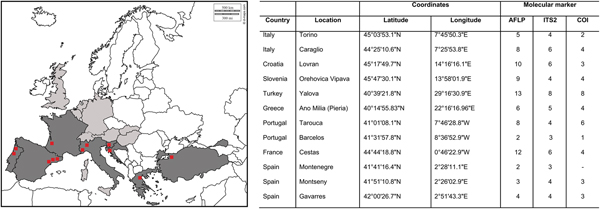
Fresh and newly formed Dryocosmus kuriphilus galls were manually collected during the spring of two successive years (2014 and 2015) from infested European chestnuts growing in natural forests at different locations in eight countries (Italy, France, Slovenia, Croatia, Spain, Portugal, Greece and Turkey) (fig. 1). In each location, galls were collected randomly from several lateral branches approximately 50 cm long and 2/3-year-old pruned from different chestnut trees. The branches were clipped with a telescopic shear from all sides of the trees up to a maximum height of 7 m. Galls were then taken to the laboratory and stored separately at room temperature, in rearing boxes waiting for adult emergence, then stored in 95% ethanol at −20°C until being processed. In total, 12 populations were sampled, with specimen numbers ranging from 6 to 13 per country (fig. 1) for a total of 95 insects. The genomic DNA was extracted from each individual separately according to a previously described salting-out protocol (Patwary et al., Reference Patwary, Kenchington, Bird and Zouros1994).
Geographical distribution and collection sites of Dryocosmus kuriphilus samples and number of specimens analyzed with the respective molecular markers used. Dark grey shade represents countries where D. kuriphilus was sampled; light grey shade represents countries where D. kuriphilus has been recovered but not sampled and white countries those where the species has not yet been recorded.

Mitochondrial DNA analysis
A region of mitochondrial DNA, corresponding to a fragment of the COI gene, was amplified using the universal primers LCO-1490/HCO-2198 (Folmer et al., Reference Folmer, Black, Hoeh, Lutz and Vrijenhoek1994). Amplifications were performed in 20 µl reactions (1 × polymerase chain reaction (PCR) Go Taq Flexi buffer – Promega, 2.5 mM MgCl2, 0.1 mM dNTPs, 0.5 µM for each primer, 0.5 U of Taq polymerase – Promega, 2 µl DNA template). Thermal cycling conditions for the fragment including the 5’ region of the COI were 5 min at 96°C followed by four cycles of 96°C for 1 min, 47°C for 1 min, and 72°C for 1 min, and other 35 cycles of 96°C for 1 min, 50°C for 1 min, and 72°C for 1 min, with a final extension of 72°C for 5 min.
PCR products were checked via electrophoresis on 1.0% agarose gels stained with SYBR® (Invitrogen), purified using Exonuclease and Antarctic Phosphatase (GE Healthcare) and sequenced at the BMR Genomics Service (Padova, Italy).
Sequences of COI were edited and aligned using MEGA 6.06 (Tamura et al., Reference Tamura, Stecher, Peterson, Filipski and Kumar2013). Sequences were translated with Transeq (EMBOSS: http://www.ebi.ac.uk/Tools/emboss/transeq/index.html) to confirm that absence of stop codons in the coding sequences. In order to assess the identity of the sequences, the integrated bioinformatics platform Barcode of Life Data (BOLD) System database (http://www.barcodinglife.org) was used and a GenBank BLAST analysis of the sequences obtained was run through the NCBI website (http://www.ncbi.nlm.nih.gov). The sequences of D. kuriphilus retrieved from both databases were added to our dataset. A haplotype parsimony network of this new COI dataset, with a probability cut-off at 95%, was reconstructed using the TCS 1.21 software (Clement et al., Reference Clement, Posada and Crandall2000).
Nuclear DNA analysis
ITS2
A nuclear region corresponding to ITS2 was amplified using the primer pairs ITS3 and ITS4 (White et al., Reference White, Bruns, Lee, Taylor, Innis, Gelfand, Shinsky and White1990). The cycling program of the PCR consisted of a first step at 95°C for 5 min followed by 35 cycles with a denaturation step of 95°C for 30 s, an annealing step of 50°C for 30 s, and an extension step of 72°C for 1 min, with a final extension of 72°C for 5 min. The amplicons obtained were purified and sequenced following the procedure described above for the COI region. Sequences were edited and aligned using MEGA 6.06. A GenBank BLAST analysis of the sequences obtained was run through the NCBI website in order to identify the sequences.
AFLP
The AFLP protocol (Vos et al., Reference Vos, Hogers, Bleeker, Reijans, Lee, Hornes, Frijters, Pot, Peleman and Kuiper1995) was used in order to study the genetic variability of D. kuriphilus populations of the newly invaded area. Initial DNA was digested with Eco RI and Mse I restriction enzymes and ligated to specific AFLP adapters. Each sample was subsequently diluted tenfold and used as a template for preselective and selective (Eco RI-AGC/Mse I-CAG) PCR amplifications. AFLP products were run at the BMR Genomics Service (Padova, Italy).
Presence or absence of each band was scored using GeneMapper v4.0 (Applied Biosystems) and only bands in the range 115–470 bp were considered. AFLP profiles were checked by hand for accurate scoring. The intensity of each individual peak was normalized on the basis of the total signal intensity and the peak was considered only if its intensity exceeded a fixed threshold of 50 fluorescent units. AFLP profiles were recorded in a matrix as the presence or absence of bands for each individual. The R script AFLPscore (Whitlock et al., Reference Whitlock, Hipperson, Mannarelli, Butlin and Burke2008) (R version 3.5.1; R Core Team, 2018) was used to assess the quality of runs and quality of loci of our AFLP dataset. All monomorphic loci were then removed from the dataset, which was subsequently evaluated with the SESim method (Medina et al., Reference Medina, Barbosa, Christman and Battisti2006) to determine whether sample size and a number of AFLP loci were enough to statistically support the resulting genetic structure. Nei's gene diversity was also estimated for each population using the AFLPdat program in R version 3.5.1. Confidence intervals (95%) for the diversities were also calculated by bootstrapping 100 times over the AFLP loci. In order to assess the number of rare markers, the rare fragments index and DW (frequency-down-weighted marker values) (Schonswetter & Tribsch, Reference Schonswetter and Tribsch2005) were calculated using the ratio of frequencies as implemented in the program AFLPdat (Ehrich, Reference Ehrich2006). DW is expected to be higher in populations with a high number of rare markers and to be independent of sample size.
Subsequently, individuals were assigned to clusters based on their multilocus genotypes using a Bayesian inference method implemented in STRUCTURE 2.3.4 (Pritchard et al., Reference Pritchard, Stephens and Donnelly2000). The correlated allele frequencies model was used for the analysis since this model is more conservative and provides greater power to detect distinct populations that are particularly closely related, not affecting the results if no correlation across populations exists (Porras-Hurtado et al., Reference Porras-Hurtado, Ruiz, Santos, Phillips, Carracedo and Lareu2013). In addition, the no-admixture model was chosen, and the locprior option was run for 20 replicates for each value of K (from 1 to 10) with a burn-in period of 20,000 MCMC steps followed by 80,000 iterations. The optimal number of clusters (K) represented by the data was determined with the Delta K method described in Evanno et al. (Reference Evanno, Regnaut and Goude2005), implemented in Structure Harvester (Earl & Vonholdt, Reference Earl and Vonholdt2012).
The software AFLPSURV (http://www.ulb.ac.be/sciences/lagev/aflp-surv.html) was used to calculate the genetic distance between populations following an approach for calculating Wright's Fst outlined by Lynch & Milligan (Reference Lynch and Milligan1994). The null hypothesis of no genetic differentiation was calculated by randomly permuting individuals among sites 1000 times.
In order to compare the partition of genetic variability among sampled populations, an analysis of molecular variance (AMOVA) (Excoffier et al., Reference Excoffier, Smouse and Quattro1992) was performed using GenAlEx 6.0 (Peakall & Smouse, Reference Peakall and Smouse2005). The graphical method principal component analysis (PCoA) was conducted to identify the relationship among the sampled populations using R version 3.5.1 including the packages ‘ade4’, ‘poppr’ and ggplot2’
Results
Mitochondrial DNA analysis
A fragment of the mitochondrial gene COI (the barcode region) of 42 samples including every sampled population was amplified and sequenced (fig. 1) resulting in an approximately 600 bp locus. Transeq excluded the presence of stop codons in the COI coding sequences and the final alignment of the 568 bp long locus did not show any polymorphic site. A comparison of these sequences with GenBank and BoldSystem databases showed a 100% similarity with D. kuriphilus DQ286810LZ from Italy (Ács et al., Reference Ács, Melika, Pénzes, Pujade-Villar and Stone2007), KF308606 retrieved in samples from Italy, Slovenia, and Croatia (Avtzis & Matošević, Reference Avtzis and Matošević2013) as well as with specimen JF411594 coming from China (Lu et al., Reference Lu, Zhu, Yang and Liu2012). The single haplotype retrieved was deposited in GenBank under the accession number MH801131.
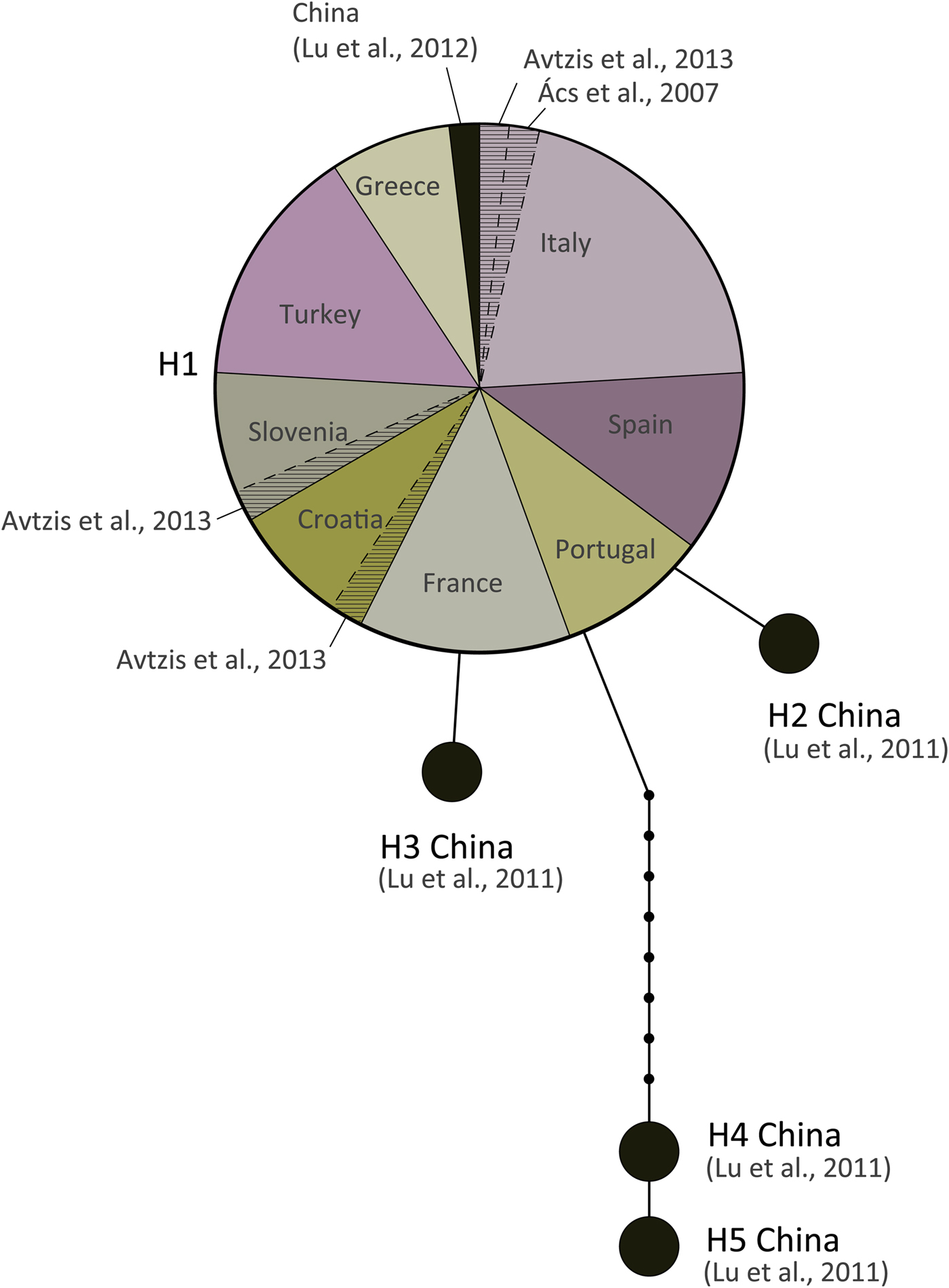
The TCS Network, obtained with sequences of this study and sequences from Bold System, showed the presence of five haplotypes (fig. 2). The haplotype H1 was dominant and grouped all European sequences of this study, sequences previously obtained from Italy, Slovenia and Croatia (DQ286810LZ and KF308606) and the Chinese sequence JF411594. The other four haplotypes corresponded to other Chinese sequences. Two of them, H2 (JF411595) and H3 (JF411598), were separated from H1 by only one mutational step, while haplotypes H4 (JF411597) and H5 (JF411596) were separated from H1 by several missing intermediate haplotypes (i.e., nine mutational steps separated the haplotype H1 from H4).
Haplotypes network realized by TCS 1.21, with the mitochondrial sequences obtained in this study and those present in GenBank. Each haplotype is represented by a circle, with the area of the circle proportional to its frequency. Numbers denote haplotype identifiers. Each line represents a single mutation while small black dots symbolize missing intermediate or unsampled haplotypes.

Nuclear DNA analysis
The analysis of the nuclear region (ITS2) of 57 samples (almost four samples per country) yielded identical sequences. A similarity of 100% with D. kuriphilus coming from Italy (JQ229194) and Japan (AB200276) (Nicholls et al., Reference Nicholls, Challis, Mutun and Stone2012 and Yara, Reference Yara2006, respectively) was found when blasting our sequences against the NCBI database. There was no other ITS sequence available for this species in the dataset showing different haplotypes. The haplotype retrieved was deposited in GenBank under the accession number MH794145. After the quality check by AFLPscore, the AFLP analysis produced a total of 189 polymorphic loci in 82 samples of D. kuriphilus. SESim simulations confirmed that the number of individuals and AFLP loci were sufficient to provide statistical support (SESim <0.03) for all the following analyses.
The values of observed diversity obtained by AFLPdat were highest in populations from Spain and Portugal and lowest in Greece and France. The highest value for rare fragment index (DW) was observed only in the Portugal population (Supplementary Fig. 2). Two private alleles were found in the populations of Greece and Spain, borne, respectively, by two individuals each.
Bayesian clustering by STRUCTURE revealed the presence of two main groups (K = 2) (Supplementary Fig. 1). Members of the two groups were spread over all of the countries from which populations were examined (fig. 3). AFLP-SURV results showed that the null hypothesis of no genetic differentiation (Fst = 0.051, P > 0.05) could not be rejected.
Genetic structure of the Dryocosmus kuriphilus samples estimated by structure analysis and grouped by population. The vertical bar represents a different individual and the relative proportions of the different colours indicate the probabilities of belonging to each population.

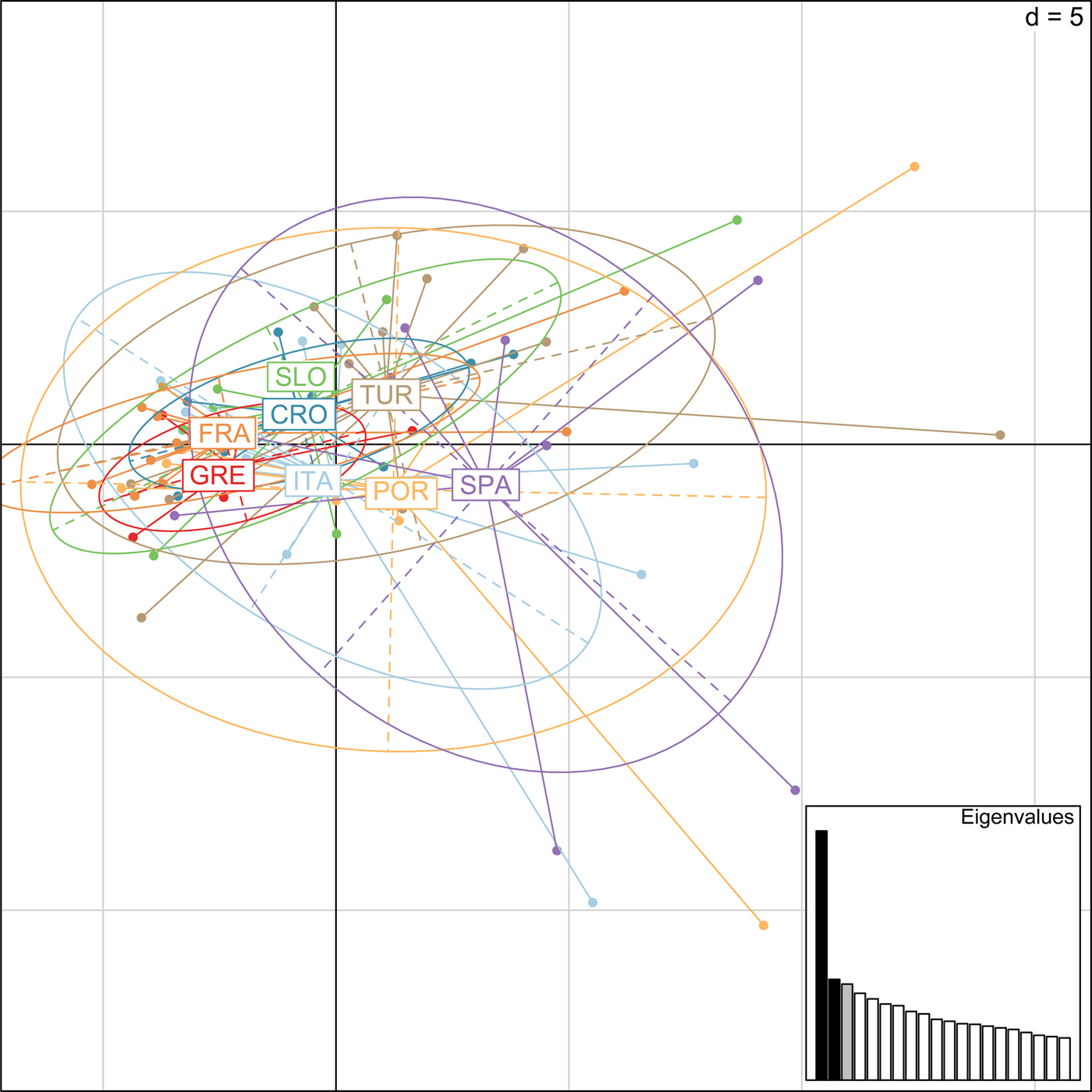
When AMOVA was used to compare genetic distances among D. kuriphilus genotypes grouped per collection site no geographic structure was observed (P > 0.05). Nor did PCoA show any separation of the populations in relation to the collection sites. Population specimens overlapped and none of them formed a distinct and coherent group separate from the others (fig. 4).
Principle coordinate analysis (PCoA) of Dryocosmus kuriphilus Amplified Fragment Length Polymorphism (AFLP) data, generated from genetic distance calculation in popR package of R. Points are colour coded and shaped by sampling country.

Discussion
The genetic structure of the exotic pest D. kuriphilus across invaded European areas is studied here for the first time considering both mitochondrial and nuclear markers. The molecular markers COI and ITS2 highlight the presence of a single haplotype in all the studied populations.
Interestingly, the only haplotype from the mitochondrial marker (COI) matches perfectly with sequences retrieved in previous studies from Italy, Slovenia, and Croatia (Ács et al., Reference Ács, Melika, Pénzes, Pujade-Villar and Stone2007; Avtzis & Matošević, Reference Avtzis and Matošević2013). Moreover, as shown in the network (fig. 2), this haplotype is identical to one of the most widespread haplotypes in China, the native area of D. kuriphilus (Lu et al., Reference Lu, Zhu, Yang and Liu2012). These results are congruent with the previous study by Avtzis & Matošević (Reference Avtzis and Matošević2013), which suggested that European populations of D. kuriphilus are likely the result of a unique introduction from China. However, the presence of some missing intermediate haplotypes observed in the TCS network can encourage a further study extending sampling across the distribution area of the insect pest.
The genetic homogeneity observed with COI and ITS2 markers is typical for invasive species, which usually present less genetic differentiation with respect to the native species (Barrett & Kohn, Reference Barrett, Kohn, Falk and Holsinger1991), probably due to a loss of genetic diversity occurring during the founding events. A reduction of genetic diversity in introduced populations has been found in important invasive pests such as the brown marmorated stink bug Halyomorpha halys (Stål) (Xu et al., Reference Xu, Fonseca, Hamilton, Hoelmer and Nielsen2014), spotted wing fruit fly Drosophila suzukii (Matsumura) (Bahder et al., Reference Bahder, Bahder, Hamby, Walsh and Zalom2015), Colorado potato beetle Leptinotarsa decemlineata (Say) (Grapputo et al., Reference Grapputo, Boman, Lindstroem, Lyytinen and Mappes2005), and medfly Ceratitis capitata (Wiedemann) (Malacrida et al., Reference Malacrida, Marinoni, Torti, Gomulski, Sebastiani, Bonvicini, Gasperi and Guglielmino1998) among others. Moreover, the reproductive strategy of D. kuriphilus probably contributes to reducing the molecular diversity, albeit it could have contributed to its dispersal success as previously suggested by Avtzis & Matošević (Reference Avtzis and Matošević2013). In addition, the introduction of the chestnut gall wasp in Europe is a relatively recent event, being reported for the first time only in 2002, and thus the time elapsed since its first introduction is probably not sufficient to fix mutations.
The AFLP results indicate that D. kuriphilus individuals belong to two genetically distinct clusters. However, individuals of these two groups are spread across all the sampled sites (12 locations in eight countries), and statistical analysis supports the absence of a geographic differentiation of these two clusters. The presence of some population exhibiting higher variability values (Spain and Portugal) and a high number of rare alleles (Portugal) (Supplementary Fig. 2) could suggest that Iberian populations are the result of diverse introductions. Another potential explanation of the high variability retrieved may be that these populations are the potential source for European introduction. Since the first records of D. kuriphilus were reported in Italy (Brussino et al., Reference Brussino, Bosio, Baudino, Giordano, Ramello and Melika2002) and date back 10 years before the first report of this pest in the Iberian peninsula (Pujade-Villar et al., Reference Pujade-Villar, Torrell and Rojo2013) the hypothesis can be rejected. In accordance with the presence of a single haplotype (with COI and ITS2 markers) and the absence of geographic clustering of the two nuclear lineages retrieved with the AFLP, we can hypothesize that D. kuriphilus populations occurring in Europe are the result of one main event of introduction of a Chinese founder population characterized by two genetically distinct lineages that subsequently spread across the continent. Since D. kuriphilus reproductive behaviour allows a single female to establish a new population, the European populations could have originated from an introduction event of very few specimens in Italy, serving as a source of subsequent colonists of other European territories. Moreover, the galls of D. kuriphilus are plurilocular and sometimes they may contain up to 25 eggs (Nakamura, Reference Nakamura1964), so descendants of the same gall are from the same female and this could also mean that the invasion was from a few genetically identical specimens. On the other hand, as some European populations show higher values of genetic nuclear variability and given that the mitochondrial haplotype retrieved was one of the most common across China (Lu et al., Reference Lu, Zhu, Yang and Liu2012; Avtzis & Matošević, Reference Avtzis and Matošević2013), we cannot exclude that European populations came from multiple introductions of this Chinese mitochondrial haplotype from different locations in the native area.
The lack of geographic clustering, pointed out by the spread of the two nuclear lineages in similar proportions over all the analyzed countries, could be attributed to the free trade of goods across Europe (Hulme, Reference Hulme2009; Manni et al., Reference Manni, Guglielmino, Scolari, Vega-Rua, Failloux, Somboon, Lisa, Savini, Bonizzoni, Gomulski, Malacrida and Gasperi2017; Tait et al., Reference Tait, Vezzulli, Sassù, Antonini, Biondi, Baser, Sollai, Cini, Tonina, Ometto and Anfora2017). D. kuriphilus was first recorded in Italy in infested plants coming from China (Quacchia et al., Reference Quacchia, Moryia, Bosio, Scapin and Alma2008). Several authors report that chestnut tree trade and barbed graft from infested areas represent the most common and rapid way of expansion of D. kuriphilus (Abe et al., Reference Abe, Melika and Stone2007; Quacchia et al., Reference Quacchia, Moryia, Bosio, Scapin and Alma2008; Bernardo et al., Reference Bernardo, Iodice, Sasso, Tutore, Cascone and Guerrieri2013; Pujade-Villar et al., Reference Pujade-Villar, Torrell and Rojo2013). So, as in other invasive species such as D. suzukii (Bahder et al., Reference Bahder, Bahder, Hamby, Walsh and Zalom2015) and H. halys (Xu et al., Reference Xu, Fonseca, Hamilton, Hoelmer and Nielsen2014), human-mediated transference can be considered the main cause of the rapid expansion of D. kuriphilus across large areas. However, other factors such as the nearly continuous distribution of the host plant (Castanea sativa Mill.), the landscape traits and prevailing winds may also have enhanced the expansion of adult females of D. kuriphilus across the invaded area (Graziosi & Rieske, Reference Graziosi and Rieske2012).
Moreover, the successful establishment of this invasive pest can be influenced by factors such as general-purpose genotypes, and lack of effective natural enemies (Avtzis & Matošević, Reference Avtzis and Matošević2013). Baker (Reference Baker, Baker and Stebbins1965) proposed that specimens harbouring general-purpose genotypes, namely those showing phenotypic plasticity to tolerate a broad range of environments, would be successful invaders. This hypothesis has been assessed in different invasive species such as the parthenogenetic Tetranychus evansi Baker & Pritchard (Migeon et al., Reference Migeon, Auger, Hufbauer and Navajas2015) and the ambrosia beetle Xylosandrus morigerus (Blandford) (Andersen et al., Reference Andersen, Jordal, Kambestad and Kirkendall2012) among others. Our main results support the presence in the sampled populations of a genetically homogeneous pattern, with individuals bearing one of the most widespread haplotypes in China. We could thus hypothesize the occurrence of a general purpose genotype as the main effective factor of successful colonization and quick diffusion of this species in Europe, making the insect extremely adaptable to many different environmental conditions. Moreover, although many native enemies, such as parasitoids of oak and rose gall wasps, have been reported on D. kuriphilus (Askew et al., Reference Askew, Melika, Pujade-Villar, Schoenrogge, Stone and Nieves-Aldrey2013; Ferracini et al., Reference Ferracini, Bertolino, Bernardo, Bonsignore, Faccoli, Ferrari, Lupi, Maini, Mazzone, Nugnes, Rocco, Santi and Tavella2018), their potential effect in the reduction of the population density of D. kuriphilus is extremely low and without significant effects on the insect reproduction performance (Quacchia et al., Reference Quacchia, Ferracini, Nicholls, Piazza, Saladini, Tota, Melika and Alma2013; Colombari & Battisti, Reference Colombari and Battisti2016). The possible phenological mismatch between native parasitoids and the univoltine development of galls on chestnut trees leads to very low parasitism rates (Quacchia et al., Reference Quacchia, Ferracini, Nicholls, Piazza, Saladini, Tota, Melika and Alma2013; Colombari & Battisti, Reference Colombari and Battisti2016) favouring the spread of this invasive pest.
Future studies aimed to compare genetic diversity and population structure of native and current invasive D. kuriphilus are of crucial importance to pinpoint the origin of the invasive populations and obtain a clear picture of their dispersal across Europe. Our characterization of the genetic structure of D. kuriphilus provides information that help to explain the spread of this pest across Europe. Although we cannot rule out that its presence in Europe is the result of multiple introductions over a short time, our results show that a single or few introductions may have been enough to allow colonizing of this large area of Europe in a few years. This study highlights the need for the coordination of specific monitoring programmes of C. sativa plant material trade between national and international authorities. The cryptic nature of D. kuriphilus spending most of its life cycle within host plant tissues, makes the detection of the insect difficult. Nevertheless, the inspection of plant material potentially infested becomes a crucial point to limit further pest expansion.
In conclusion, the current findings increase the knowledge of D. kuriphilus genetic diversity and its spread across Europe, helping in designing appropriate management strategies. Considering the impact that free trade across Europe exhibits on the rapid expansion of alien pests such as D. kuriphilus, a specific strategic plan should be developed to reduce the flow of exotic organisms among European countries.
Supplementary material
The supplementary material for this article can be found at https://doi.org/10.1017/S000748531800069X.
Acknowledgements
The authors would like to thank Chiara Ferracini, Hervé Jactel, Kahraman İpekdal and Manuela Branco for their help in collecting samples. This work was supported by the Italian national project ‘Insects and globalization: sustainable control of exotic species in agroforestry ecosystems (GEISCA-PRIN 2010)’, funded by the Italian Ministry for Education, University and Research and by the University project (DOR): ‘Effects of climate change and invasive alien species on native forest insects’. The authors would also like to thank the referees for their valuable comments which helped to improve the manuscript.