Most neonates with hypoplastic left heart syndrome undergo first-stage palliation with a Norwood Procedure.Reference Norwood, Lang and Hansen 1 A regulated source of pulmonary blood flow is achieved either with a modified Blalock–Taussig shunt – that is, Norwood–Blalock–TaussigReference Norwood, Lang and Hansen 1 – or with the Sano modification using a right ventricle to pulmonary artery shunt: that is, Norwood–Sano.Reference Sano, Kawada and Yoshida 2 , Reference Sano, Ishino and Kawada 3 The Norwood-Blalock–Taussig is associated with diastolic “coronary steal” and decreased myocardial perfusion of the systemic single ventricle. This may result in postoperative haemodynamic instability and interstage mortality.Reference Tabbutt, Dominguez and Ravishankar 4 – Reference Ohye, Sleeper and Mahony 6 The Sano modification has been adopted by many centres and has been shown to ameliorate some of these detrimental physiological effects of the Blalock–Taussig shunt.Reference Ohye, Sleeper and Mahony 6 – Reference Sano, Ishino and Kado 8 As part of the Norwood–Sano operation, the right ventricle to pulmonary artery conduit is usually performed with the use of a 5-mm polytetrafluoroethylene graft. Limitations of this graft include proximal and distal stenosis, thrombosis and distortion of the pulmonary arteries, leading to inadequate growth and decreased pulmonary blood flow. Interstage shunt interventions occur more frequently with the Sano modification compared with the use of a Blalock–Taussig shunt, leading to an increased morbidity related to catheterisation reinterventions.Reference Fischbach, Sinzobahamvya and Haun 9
Use of a biological right ventricle to pulmonary artery conduit such as a femoral vein homograft has some theoretical advantages over polytetrafluoroethylene. Femoral vein homograft has an endothelial lining, making it potentially less thrombogenic, more resistant to infection, and more haemostatic.Reference Tam, Murphy and Parks 10 Further, a vein homograft is more malleable than polytetrafluoroethylene, which may lead to less distortion of the pulmonary arteries, and possibly to better interstage pulmonary artery growth. Importantly, a competent valved right ventricle to pulmonary artery conduit may result in less of a regurgitant volume load on the systemic right ventricle and, hence, better preservation of ventricular function.
We hypothesised that inclusion of a valve in the right ventricle to pulmonary artery shunt would result not only in better pulmonary blood flow but also in improved diastolic pulmonary artery pressure, which could translate into better interstage growth of the pulmonary arteries.
Materials and methods
A retrospective analysis of all neonates with hypoplastic left heart syndrome or its variant who survived to second-stage palliation after undergoing the Norwood–Sano operation was performed. The study population was gathered from two institutions: Le Bonheur Children’s Hospital at Memphis, TN, between 2013 and 2015, when femoral vein homograft was introduced for the Sano shunt during the Norwood–Sano operation. These data were compared with data from the Advocate Christ Medical Center, Chicago, IL, during 2004–2009. The data from both institutions during these time frames were recorded and analysed by the same single cardiologist (S.S.). The Institutional Review Board approved this study.
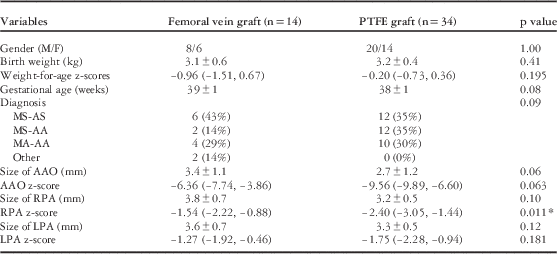
A total of fourteen patients (14/48, 29%) had a 5–6-mm diameter valved segment of femoral vein homograft as the right ventricle to pulmonary artery shunt: that is, Norwood– femoral vein homograft; these surgeries were all performed in Memphis. In all, thirty-four patients (34/48, 71%) had a 5-mm diameter polytetrafluoroethylene graft as their right ventricle to pulmonary artery shunt; these surgeries were all performed in Chicago (Table 1).
Demographics and baseline characteristics of Norwood patients according to graft type.

AAO=ascending aorta; LPA=left pulmonary artery; PTFE=polytetrafluoroethylene; RPA=right pulmonary artery
Continuous data are mean±SD or median and interquartile range
*Statistically significant, Student’s t-test and Mann–Whitney U-test for z-scores for weight-for-age, AAO, RPA, and LPA
All data were collected and analysed by a single cardiologist (S.S.). Initial measurement of pulmonary artery size was carried out using the preoperative echocardiogram at both institutions. The proximal branch pulmonary artery dimensions were measured from the parasternal short axis view. Subsequent measurements of the pulmonary artery size were carried out with pre-Glenn catheterisation using pulmonary artery angiography with the anterior posterior camera in a 30°–45° caudal projection with a 15° right anterior oblique or left anterior oblique tilt to line up the branch pulmonary arteries along the long axis and lateral camera in a 90° lateral projection. The Nakata index was calculated on the basis of the average pulmonary artery size measurements in two orthogonal planes.Reference Nakata, Imai and Takanashi 11 , Reference Sathanandam, Philip and Van Berger 12 The same methodology was used for all the patients. Although the time frames for the study and control subgroups were different, we elected to use this data because the pulmonary artery measurements were carried out by the same cardiologist (S.S.) when he was working at the two institutions at different time points. The measurements were performed prospectively as part of another study and, hence, the bias was minimised.
All patients underwent a cardiac catheterisation before the bidirectional Glenn procedure.
The procedure for the Norwood–Sano operation has been well described previously.Reference Sano, Kawada and Yoshida 2 , Reference Jonas, Lang, Hansen, Hickey and Castaneda 13 , Reference Sade, Crawford and Fyfe 14 Essentially, an identical approach was used in both institutions. The surgery was performed with the use of cardiopulmonary bypass under conditions of deep hypothermia. The goals were to augment the aortic arch as a composite arch of both the diminutive ascending aorta and the divided main pulmonary artery, to perform an atrial septectomy, and to create a regulated source of pulmonary blood flow by placing a shunt from the single right ventricle to the pulmonary artery confluence. This shunt comprised either a valved segment of femoral vein homograft or a non-ringed polytetrafluoroethylene graft. There was no interstage mortality in the femoral vein homograft subgroup, and no patients who had the femoral vein homograft as the right ventricle to pulmonary artery shunt were excluded from this analysis. Femoral vein homograft can be obtained from tissue cryopreservation manufacturers in the United States of America (CryoLife Inc., Kennesa, GA and LifeNet Inc., Virginia Beach, VA). They typically come in lengths of about 16–20 cm and their diameters vary from 6 to 12 mm depending on the product specifications. We generally have femoral vein homograft of a minimum diameter of 5–6 mm available on-site and select the smaller part of the conduit based on the size of the patient.
Statistical analysis
Continuous variables were reported as the mean and standard deviation for normally distributed data and as the median and interquartile range for skewed data. Categorical data are given as counts and percentages and compared between the two groups using Fisher’s exact test. Diagnosis was compared using the Pearson χ2 test. Student’s t-tests were used to compare normally distributed data. The non-parametric Mann–Whitney U-test was used for variables departing from a normal distribution including Nakata index and hospital and ICU stay. All statistical significance was defined by a two-tailed p<0.05. Statistical analysis was performed using IBM SPSS Statistics (version 23.0; IBM Corporation, Armonk, NY, United States of America). Freedom from catheterisation intervention was estimated using the Kaplan–Meier product-limit method with 95% confidence intervals constructed using Greenwood’s formula, and femoral vein homograft and polytetrafluoroethylene groups were compared using the log-rank test. Actuarial estimates for freedom from catheterisation intervention at 3 and 5 months for femoral vein homograft and polytetrafluoroethylene were calculated.
Results
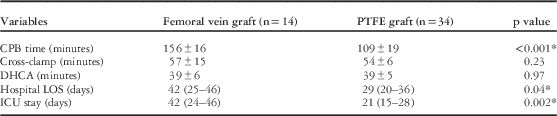
There were no significant demographic or anatomical differences between the two groups except for the size of right pulmonary artery at birth – based on the z-score – which was larger in the Norwood–Femoral vein homograft group compared with the Norwood–polytetrafluoroethylene group: [median z-score −1.54 (interquartile range (IQR): −2.22, −0.88) versus −2.4 (IQR: −3.05, −1.44), p=0.01] (Table 1). Compared with Norwood–polytetrafluoroethylene patients, the Norwood–femoral vein homograft patients had a longer cardiopulmonary bypass time (156±16 versus 109±19 minutes, p=0.001), longer hospital length of stay (42 versus 29 days, p=0.04), and longer ICU length of stay (42 versus 21days, p=0.002) (Table 2).
Norwood operative data.

CCT=cross clamp time; CPB=cardiopulmonary bypass; DHCA=deep hypothermic circulatory arrest; HLOS=hospital length of stay; LOS=length of stay; PTFE=polytetrafluoroethylene
Data are mean±SD for CPB, CCT, and DHCA times; median and interquartile range for HLOS and ICU stay.
*Statistically significant, Student’s t-test for CPB and Mann–Whitney U-test for HLOS and ICU stay
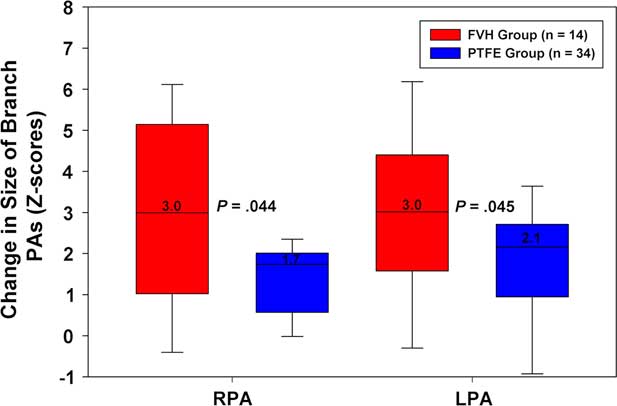
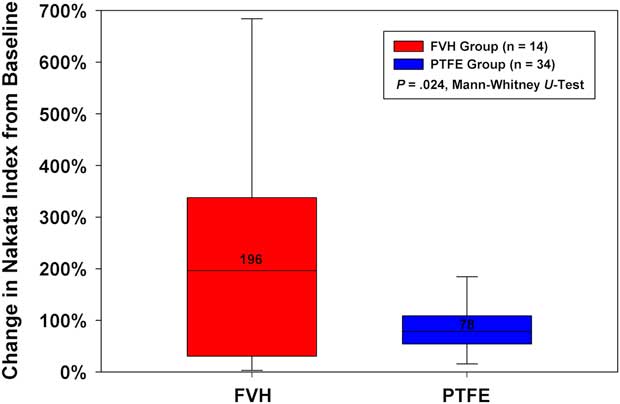
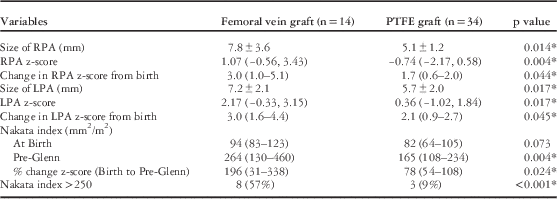
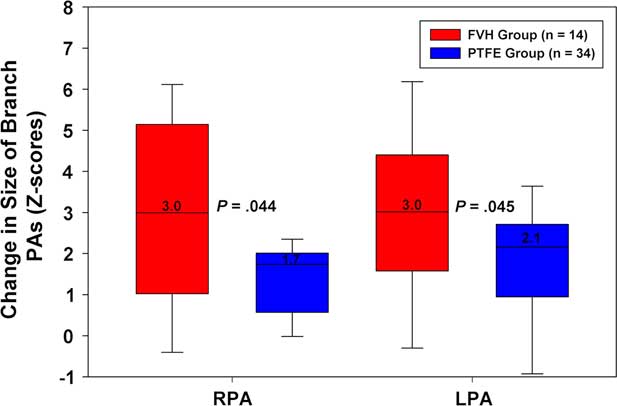
Compared with the Norwood–polytetrafluoroethylene group, the Norwood–femoral vein homograft group had a significantly larger size of the right pulmonary artery (mean of 7.8±3.6 versus 5.1±1.2 mm, p=0.01), larger size of the left pulmonary artery (mean of 7.2±2.1 versus 5.7±2, p=0.01), and a larger pre-Glenn Nakata index: [median of 264 (IQR: 130–460) versus 165 (IQR: 108–234) mm2/m2, p=0.004]. The right pulmonary artery size was smaller at birth in the Norwood–polytetrafluoroethylene group compared with the Norwood–femoral vein homograft group, and remained smaller at the time of the pre-Glenn catheterisation; however, the z-score change from birth to pre-Glenn was larger for the Norwood–femoral vein homograft compared with the Norwood–polytetrafluoroethylene group [median change in z-score 3.0 (1.0–5.1) versus 1.7 (0.6–2), p=0.044]. The z-score change for the left pulmonary artery was also greater in the Norwood–femoral vein homograft group [median change in left pulmonary artery z-score was 3.0 (1.6–4.4) versus 2.1 (0.9–2.7), p=0.045] (Fig 1). This group also showed a significant percentage change in the Nakata index from birth to pre-Glenn evaluation compared with the Norwood–polytetrafluoroethylene group [median z-score 196 (IQR: 31–338) versus 78 (IQR: 54–108), p=0.024] and the median increase in pulmonary artery size as reflected by the Nakata index was threefold greater for patients in the femoral vein homograft group (Fig 2). Significantly more patients in the Norwood–femoral vein homograft group had a Nakata index >250 mm2/m2 (8 of 14, 57% versus 3 of 34, 9%, p<0.001) (Table 3).
The box-and-whisker plots represent the change in size of branch pulmonary arteries (PAs) based on z-scores for both groups. The median change in z-score is shown inside the box for each group for both right (RPA) and left pulmonary arteries (LPAs). Note the median increase in z-score for RPA in the femoral vein homograft (FVH) group was almost double that of the polytetrafluoroethylene (PTFE) group (p=0.044). Similarly, the median increase in z-score for LPA in the FVH was also significantly greater than in the PTFE group (p=0.045).
The box-and-whisker plots represent the per cent change in Nakata index from birth to pre-Glenn cardiac catheterisation. The median increase in Nakata index is shown inside the box for each group. Note the median increase in pulmonary artery size as reflected by the Nakata index was threefold greater for patients in the femoral vein homograft (FVH) group, being statistically significant (p=0.024). PTFE=polytetrafluoroethylene.

Pre-Glenn pulmonary artery size and Nakata index.

LPA=left pulmonary artery; PTFE=polytetrafluoroethylene; RPA=right pulmonary artery
Data are mean±SD for size of pulmonary arteries and median values and interquartile range for Nakata index and z-scores. Nakata index >250 pertain to pre-Glenn.
* Statistically significant difference between the two groups
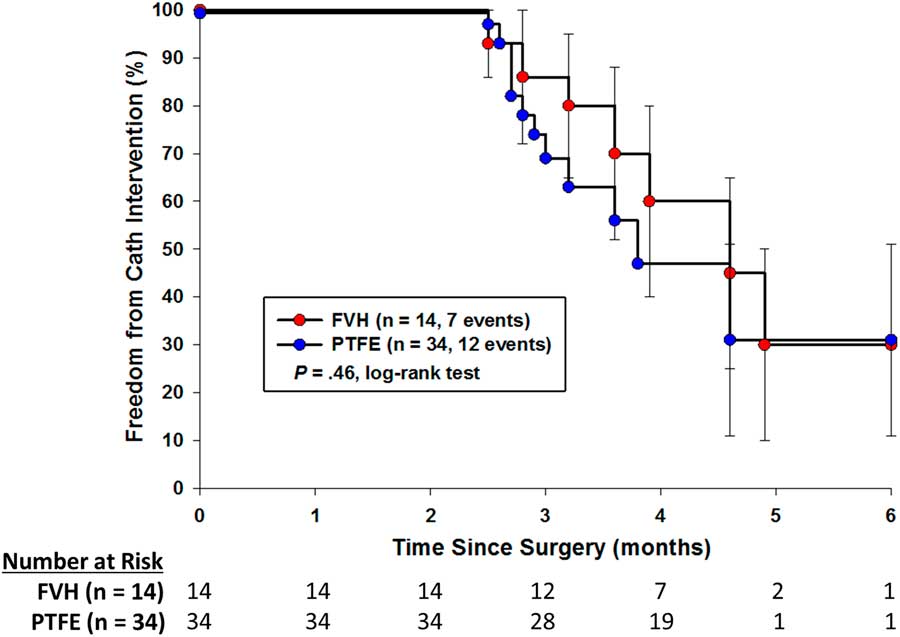
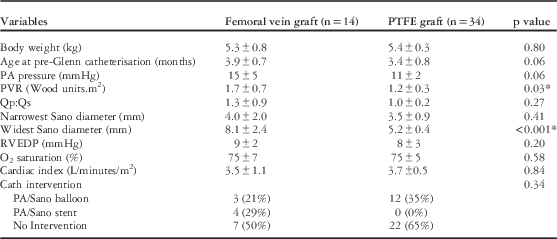
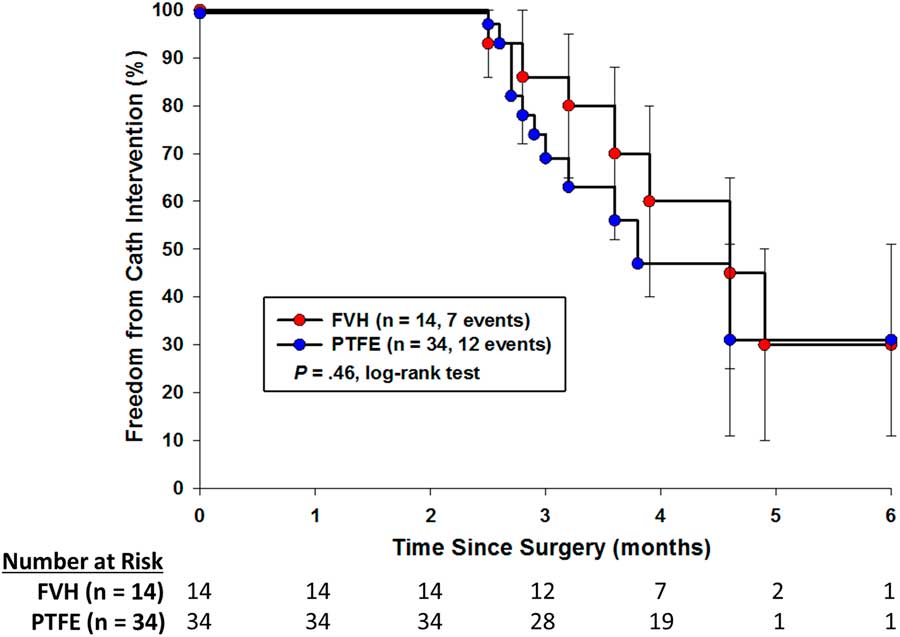
At the time of pre-Glenn catheterisation there was no significant difference between the groups in the age or weight at second stage, Qp:Qs, pulmonary artery pressure, right ventricular end-diastolic pressure, systemic arterial oxygen saturation, or cardiac index. The pulmonary vascular resistance was higher in the Norwood–femoral vein homograft group compared with the Norwood–polytetrafluoroethylene group, although still within normal limits (1.7±0.7 versus 1.2±0.3, p=0.03). There was no significant difference in the rate of reinterventions in the catheterisation laboratory between both groups (50 versus 35%, p=0.34) (Table 4). Figure 3 shows the freedom from catheter intervention using the Kaplan–Meier product-limit method between the femoral vein homograft and polytetrafluoroethylene groups. Actuarial estimates for freedom from catheterisation intervention at 3 months (95% CI) were 80% (65–95%) for femoral vein homograft and 69% (54–84%) for polytetrafluoroethylene. The estimates at 5 months were 30% (5–55%) for femoral vein homograft and 31% (9–53%) for polytetrafluoroethylene. Intervention on the femoral vein homograft conduit in the catheterisation laboratory was necessary for seven patients, with stent placement in four patients and only balloon angioplasty in three. Of those requiring stent placement, two were placed proximally – that is, at the ventricular end – one at the pulmonary end, and one in the centre of the femoral vein conduit. Of the seven interventions performed on the femoral vein homograft in the cardiac catheterisation laboratory, five were performed as unplanned procedures for low oxygen saturations and two interventions were performed during the pre-Glenn evaluation. The total number of catheterisations including the diagnostic pre-Glenn evaluation for the femoral vein homograft group was 20, or about 1.4 per patient. In all, six patients required aortic arch intervention – that is, balloon angioplasty – for coarctation of the neoaorta, including one performed before the pre-Glenn evaluation.
Freedom from catheter intervention assessed using Kaplan–Meier product-limit method with log-rank test for comparing the femoral vein homograft (FVH) and polytetrafluoroethylene (PTFE) groups.
Pre-Glenn haemodynamics and interventions.

PA=pulmonary artery; PTFE=polytetrafluoroethylene; PVR=pulmonary vascular resistance; RVEDP=right ventricular end-diastolic pressure
Continuous data are mean±SD
*Statistically significant, Student’s t-test; χ2 for intervention
Discussion
Hospital survival after the Norwood operation has steadily improved over the past 15 years and is currently 80–85% in experienced cardiac programmes.Reference Azakie, Merklinger and McCrindle 5 , Reference Pizarro, Malec and Maher 7 With the introduction of the Sano modification in 1998,Reference Sano, Kawada and Yoshida 2 the early survival has improved further to around 85–90%.Reference Ohye, Sleeper and Mahony 6 Concerns about the possible deleterious effect of a right ventriculotomy in the setting of single ventricle with hypoplastic left heart syndrome has proved unfoundedReference Raja, Atamanyuk, Kostolny and Tsang 15 and current data support improved outcomes for the Norwood–Sano compared with the Norwood–BT shunt patients.Reference Ohye, Sleeper and Mahony 6 , Reference Tweddell, Hoffman and Mussatto 16 , Reference Pizarro, Mroczek, Malec and Norwood 17 The Achilles heel of the Norwood–Sano operation is threefold: difficulty with haemostasis when suturing the rigid polytetrafluoroethylene graft to the contracting single right ventricle; early proximal, and distal, anastomotic stenosis of the polytetrafluoroethylene graft; and progressive distortion, particularly of the left pulmonary artery. These may require revision, catheter-based reinterventions, or early second-stage palliation.Reference Azakie, Merklinger and McCrindle 5 , Reference Sano, Ishino and Kado 8 , Reference Tweddell, Hoffman and Mussatto 16 Some of these issues have been adequately addressed with surgical modifications including “dunking” the graft into the single right ventricle, or moving the distal shunt anastomosis to the right pulmonary artery between the ascending aorta and the SVC.Reference Ohye, Sleeper and Mahony 6 , Reference Fischbach, Sinzobahamvya and Haun 9 , Reference Gist, Barrett and Graham 18 , Reference Bentham, Baird, Porras, Rathod and Marshall 19
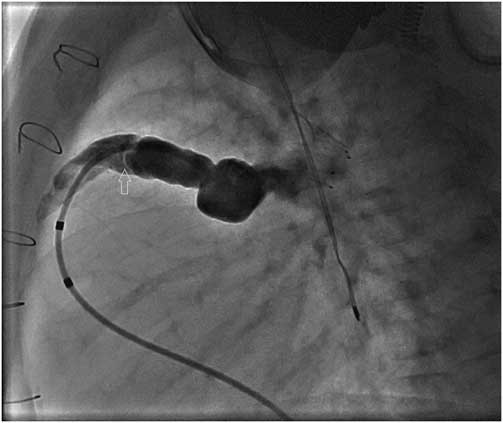
Seery et alReference Seery, Sinha, Zurakowski and Jonas 20 reported the use of femoral vein homograft for neoaortic arch reconstruction during stage-1 Norwood operation with good results. Schiller et alReference Schiller, Sinha, Zurakowski and Jonas 21 reported on the use of valved segment of femoral vein homograft as right ventricle to pulmonary artery shunt in biventricular repairs on neonates with satisfactory results. Initially, we used the femoral vein homograft because it seemed to be very haemostatic, was easy to suture to the right ventricular outflow tract, and was supplied in a length of about 16 cm and with diameters that started at about 5 mm and gradually increased to about 12 mm in diameter; this made it suitable for patients of all sizes. We soon came to the realisation, however, that the oxygen saturations were much better during the 1st week after surgery, and that our patients required even less inotropic support after surgery, typically only Dopamine at 3–5 μg/kg/minute. We also noticed that the segments of femoral vein homograft invariably included a valve in the segment that we had implanted (Fig 4); however, we were surprised that the branch pulmonary arteries were unquestionably larger than what we were accustomed to at the time of their pre-Glenn catheterisation (Fig 5), which prompted this formal analysis. We hypothesised that the inclusion of a valve in the right ventricle to pulmonary artery shunt resulted not only in better forward flow into the pulmonary arteries but also in improved diastolic pressure in the pulmonary vascular bed, resulting in better growth of the pulmonary arteries. All patients were followed up with periodic echocardiographies. We learnt that most of the valves in the femoral vein homograft remained competent in the 1st month following stage-1 procedure; however, by 3 months only a third of these remained competent with some valves developing stenosis, requiring stenting. This may explain why the Qp:Qs and pulmonary artery pressure were similar at the time of pre-Glenn catheterisation. We believe that most femoral vein valves undergo attrition over a period of 3 months; however, the early period of competence, although limited, provides an opportunity for the pulmonary artery to grow. Theoretically, having a valve in the right ventricle to pulmonary artery shunt should also result in improved single ventricular function, but this may require longer a follow-up time before it becomes apparent.
Angiogram of the right ventricle to pulmonary artery shunt in lateral projection during pre-Glenn catheterisation. Notice the valve in the femoral vein homograft shunt, indicated with an arrow.

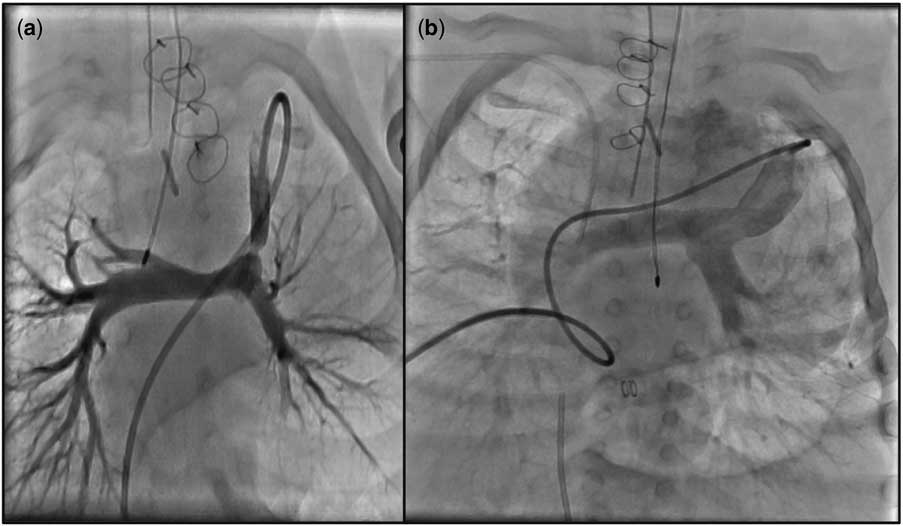
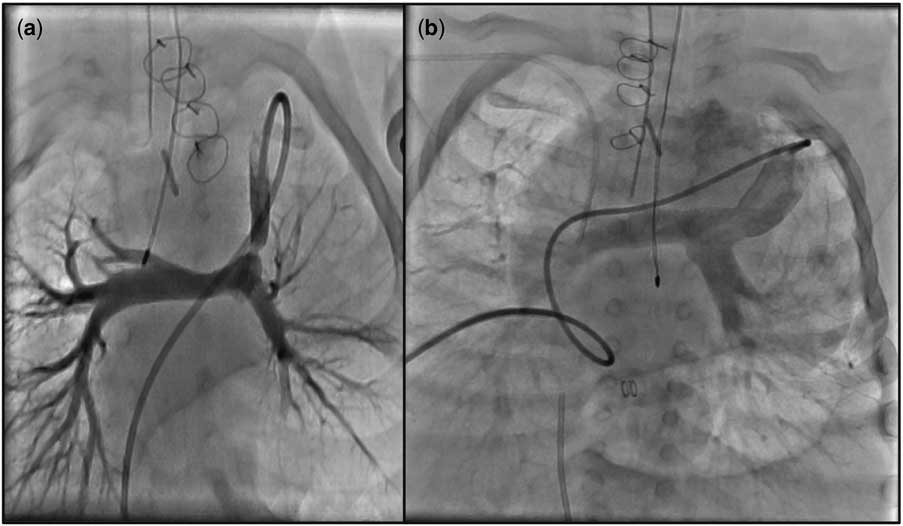
Right ventricle to pulmonary artery shunt angiograms during pre-Glenn catheterisations. Note the significant difference in size of the branch pulmonary arteries for both groups: ( a ) polytetrafluoroethylene graft, pulmonary arteries measure 4.6 mm – right pulmonary artery – and 4.7 mm – left pulmonary artery; ( b ) femoral vein homograft, pulmonary arteries measure 8 mm – right pulmonary artery – and 8.2 mm – left pulmonary artery.
From our analysis it seems that the femoral vein homograft as a right ventricle to pulmonary artery shunt resulted in superior growth of the pulmonary arteries. Following the Norwood operation the Nakata index increased significantly more in the femoral vein homograft group compared with the polytetrafluoroethylene group (median of 196 versus 78%). This growth advantage was apparent in both left and right pulmonary arteries. Although the ventricular function as assessed by the ejection fraction and ventricular end-diastolic pressure was similar between the two groups, the pulmonary vascular resistance was higher in the Norwood–femoral vein homograft group even though this remained within normal limits. The higher pulmonary artery pressures may be a reflection of the higher diastolic pressure in the pulmonary arteries with a valve in the right ventricle to pulmonary artery shunt compared with a non-valved polytetrafluoroethylene shunt. We have not encountered any particular difficulty in dissecting out these grafts at the time of second-stage surgery. The femoral vein homograft is transected between ligatures at the time of Glenn operation.
It is well recognised that exposure to allograft material stimulates development of human leucocyte antibody and that this persists for months after surgery. The addition of homograft material could potentially increase the antigenic burden on the patient.
The longer cardiopulmonary bypass times between the groups is a reflection of differences in institutional policy regarding duration of cooling and rewarming, as the aortic cross-clamp time and deep hypothermic circulatory arrest times were similar. Similarly, the longer ICU stay and hospital length of stay again reflect institutional differences: in the Norwood–femoral vein homograft group all patients were discharged to home from the ICU as a matter of policy.
Study limitations
The most obvious weakness of our study is the comparison of patients undergoing surgical procedures in two different institutions, time frames, and under different surgical teams, which may add unrecognisable variables that could account for the difference in our primary outcome. Variations in surgical technique could potentially contribute to better growth of branch pulmonary arteries. Our sample size is small, which could have resulted in larger variance in the Nakata index. Also, our analysis only followed up patients until time of the pre-Glenn catheterisation. It is currently unknown whether this improved growth of the branch pulmonary arteries would translate into a late survival advantage. With small sample sizes it is tough to tease out whether the results observed are due to the shunt type or merely to size.
Conclusions
The use of a valved segment of femoral vein homograft as material for the right ventricle to pulmonary artery conduit during the Norwood–Sano procedure confers better growth of the branch pulmonary arteries compared with the use of a polytetrafluoroethylene graft. No obvious adverse effects were identified. Further studies are needed to evaluate long-term effects of a valved right ventricle to pulmonary artery conduit on systemic ventricular function.
Acknowledgements
None.
Financial Support
This research received no specific grant from any funding agency, commercial or not-for-profit sectors.
Conflicts of Interest
None.