Introduction
Social functioning can be defined as the degree to which a person is able to fulfil various roles in different social environments such as at work, at home, in relationships or during leisure activities (Bosc, Reference Bosc2000). Patients with depression usually report deficits in social functioning in addition to depressive symptoms (Hirschfeld et al. Reference Hirschfeld, Montgomery, Keller, Kasper, Schatzberg, Möller, Healy, Baldwin, Humble, Versiani, Montenegro and Bourgeois2000). These impairments are often long-lasting and are equal to or exceed those of chronic medical illnesses such as myocardial infarction and diabetes (Hays et al. Reference Hays, Wells, Sherbourne, Rogers and Spritzer1995). Impairments in social functioning in depression contribute strongly to the increased burden of depression (Greenberg et al. Reference Greenberg, Kessler, Birnbaum, Leong, Lowe, Berglund and Corey-Lisle2003; Eaton et al. Reference Eaton, Martins, Nestadt, Bienvenu, Clarke and Alexandre2008) and predict depressive relapse and recurrences (e.g. Leon et al. Reference Leon, Solomon, Mueller, Turvey, Endicott and Keller1999; Judd et al. Reference Judd, Akiskal, Zeller, Paulus, Leon, Maser, Endicott, Coryell, Kunovac, Mueller, Rice and Keller2000; Solomon et al. Reference Solomon, Leon, Endicott, Mueller, Coryell, Shea and Keller2004; Vittengl et al. Reference Vittengl, Clark and Jarrett2009). Impairments in social functioning in depression are also related to high economic costs. The impact of depression on work functioning, which is one important aspect of the broader concept of social functioning, often exceeds that of other chronic illnesses. In 2011, about 13.3 million work days were lost due to depression and anxiety disorders in the UK (ONS, 2012). These findings stress the importance of including social functioning as an outcome measure in treatment studies of depression.
Treatment outcome studies in depression usually focus on the effects of treatment in improving depressive symptom severity rather than social functioning. For example, several meta-analyses have shown that different types of psychotherapy for depression are moderately effective in reducing depressive symptoms (e.g. Cuijpers et al. Reference Cuijpers, van Straten, Andersson and van Oppen2008a ; Barth et al. Reference Barth, Munder, Gerger, Nüesch, Trelle, Znoj, Jüni and Cuijpers2013) but no meta-analysis to date has quantified the effects of psychotherapy on social functioning in depression. Definitions of response and remission in depression outcome studies are exclusively based on relative and absolute improvements in symptom severity. Although measures of symptom severity tend to include aspects of social functioning, improvements in social functioning are not usually explicitly included in the definition of response, remission or recovery from depression. The World Health Organization (WHO, 1948) defines health as ‘a state of complete physical, mental and social well-being and not merely the absence of disease or infirmity’. Moreover, from a patient perspective, improvements in social functioning might be a preferred treatment outcome. For example, Zimmerman et al. (Reference Zimmerman, McGlinchey, Posternak, Friedman, Attiullah and Boerescu2006) found that, among 535 out-patients with major depressive disorder (MDD), a return to a normal level of functioning at work, home or school was rated among the three most important factors in determining whether a depression was in remission. Similarly, in a qualitative study on treatment goals of depressed out-patients, Battle et al. (Reference Battle, Uebelacker, Friedman, Cardemil, Beevers and Miller2010) found that patients with MDD commonly articulated improving their social and family relationships as desired treatment goals. Mintz et al. (Reference Mintz, Mintz, Arruda and Hwang1992) compiled data from 10 published treatment studies (psychotherapy and antidepressants) and found that one aspect of social functioning, work impairment, improved with symptom remission, although improvements in work functioning were slower than symptomatic improvements.
Given that no meta-analysis to date has estimated the effects of psychotherapy for depression on social functioning, it is not clear how large the effects of psychotherapy for depression on social functioning are, whether these effects are smaller, equal to, or exceed the effects of psychotherapy on symptom severity and whether these effects differ between different types of psychotherapy. The aim of this meta-analysis was to summarize the effects of psychotherapy for depression on improvements in social functioning. We hypothesized that psychotherapy for depression has positive effects on social functioning; that there are no differences between different types of psychotherapy for depression with regard to improvements in social functioning; and that the effects of psychotherapy for depression on social functioning are positively correlated with the effects of psychotherapy for depression on depressive symptom severity.
Method
Study selection
We used a database of 1476 papers on the psychological treatment for depression. A detailed description of the methods that were used to build the database is available elsewhere (Cuijpers et al. Reference Cuijpers, van Straten, Warmerdam and Andersson2008c ). This database is continuously updated, available to other researchers (www.evidencebasedpsychotherapies.com) and has been used previously in a series of meta-analyses.
For the current meta-analyses we included studies comparing the effects of psychological interventions for depression with a control condition [waiting list, care as usual (CAU) or placebo]. We further included only studies that classified depression according to a diagnostic interview or elevated depression levels on validated self-report questionnaires. Studies in children and adolescents (age < 18 years) were excluded, as were studies that did not provide post-treatment means and standard deviations (or other statistics from which these could be computed) of depression severity or social functioning. Studies on continuation or maintenance treatments were also excluded, as were studies on unguided self-help treatments. We defined instruments that assess social functioning as any instruments that have the aim to assess functioning in any of the following social domains: interpersonal contacts, partner relationship, work or study, and leisure or recreation activities. Studies specifically assessing marital or dyadic adjustment and studies assessing global functioning were not included. We included studies that assessed social functioning based on self-report, observer or clinician ratings.
Quality assessment
We used four criteria from the Cochrane risk of bias assessment tool (Higgins et al. Reference Higgins, Altman, Gøtzsche, Jüni, Moher, Oxman, Savović, Schulz, Weeks and Sterne2011) to assess the quality of the included studies: random sequence generation (rated positive if the randomization scheme was generated correctly); allocation concealment (rated positive if allocation to conditions was conducted by an independent party); blinding of outcome assessment (rated positive if assessors were blind to treatment condition); and handling of incomplete outcome data (rated positive if intention-to-treat analyses were conducted).
Statistical analyses
For the univariate analyses we used the program Comprehensive Meta-Analysis (Biostat Inc., USA). We calculated the effect size (Hedges' g) for each comparison between psychotherapy and a control group as an indicator of the difference between the two groups at post-test. To calculate the effect sizes, the average score of the experimental group at post-test was subtracted from the average score of the control group at post-test and the result was divided by the pooled standard deviation. To correct for small sample bias, we followed the procedures suggested by Hedges & Olkin (Reference Hedges and Olkin1985). We calculated separate effect sizes for social functioning and depression. Mean effect sizes were calculated using a random effects model to account for the heterogeneity among studies. The random effects model assumes that all included studies are estimating different (underlying) effect sizes. To test the homogeneity of effect sizes, we calculated I 2 and the Q statistic (Higgins et al. Reference Higgins, Thompson, Deeks and Altman2003). Publication bias was assessed by visual inspection of a funnel plot and by the trim-and-fill procedure, which provides an adjusted estimate of the overall effect size, after adjusting for publication bias (Duval & Tweedie, Reference Duval and Tweedie2000). A random effects model was used to look for missing studies.
We used meta-regression analyses to test whether there was a relationship between the effect sizes of social functioning and the effect sizes of depression severity. For categorical study characteristics, a series of subgroup or moderator analyses was conducted using a mixed effect model. Tests for significance between the different subgroups were conducted using a fixed effects model. For continuous variables, meta-regression analyses were used. Multivariate analyses were conducted using Stata/SE 12.0 for Windows (Stata Corporation, USA). In these analyses the weighted effect size in social functioning at post-treatment was the dependent variable and the effect size of depressive symptom severity at post-treatment along with potential confounding variables were entered as predictors.
Results
Selection and inclusion of studies
Three hundred and fifty-two randomized clinical trials (RCTs) were included in the database. Of these studies, 204 included a control group. The method and results sections of these 204 studies and the corresponding duplicate studies were checked to determine whether a measure of social functioning was included. Thirty-one studies met our inclusion criteria, reported social functioning at post-test, and were included in the meta-analyses comparing the effects of psychotherapy (versus control group) on social functioning.
Description of included studies
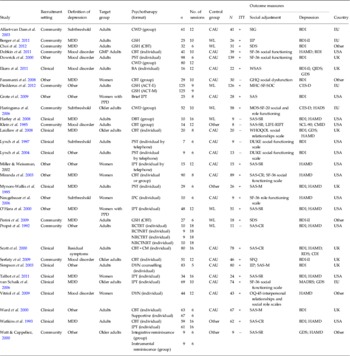
The characteristics of the included studies are presented in Table 1. The total number of participants in the 31 included studies was 2956 (1655 in the treatment condition and 1301 in the control condition). In 11 of the 31 studies, participants were recruited through the community, 13 used clinical referral and seven relied on other recruitment strategies. Seventeen studies focused on adults in general, eight studies only included women (two only women with postpartum depression, one only infertile women, one only women seeking care following miscarriage, one only women with a history of childhood trauma), five studies focused specifically on older adults, and one study included adults with a general medical condition. Some studies compared more than one type of psychotherapy to a control group, resulting in a total number of 39 comparisons between psychotherapy and a control group. In 18 of the 39 comparisons, cognitive behavioural therapy (CBT) (including three studies on coping with depression course) was compared to a control group; six comparisons were between interpersonal psychotherapy (IPT) and a control group; four comparisons were between problem solving therapy and a control group and the remaining 11 comparisons were between a control group and acceptance and commitment therapy, behavioural activation, dialectic behavioural therapy, guided self-help, integrative and instrumental reminiscence therapies, interpersonal counselling, psychodynamic therapy or supportive therapy. The control group consisted of CAU (19 studies), wait-list control (eight studies) or other control conditions (four studies; active socialization, meditation, pill placebo). Various instruments were used to assess social functioning: the Social Adjustment Scale (SAS; self-report or clinician rated or modified version; Weissman et al. Reference Weissman, Prusoff, Thompson, Harding and Myers1978) was used by 14 studies; the social functioning subscale of the Medical Outcomes Study (MOS) 36-item Short-Form Health Survey (SF-36; Ware & Sherbourne, Reference Ware and Sherbourne1992) was used by five studies; the Inventory of Interpersonal Problems (IIP; Horowitz et al. Reference Horowitz, Alden, Wiggins and Pincus2000) was used by two studies; two studies used the Sheehan Disability Scale (SDS; Sheehan, Reference Sheehan1983) to assess social functioning; and the remaining studies used other instruments to assess social functioning.
Selected characteristics of studies comparing psychotherapies with non-treatment control conditions in patients with depression

ACT-E, Acceptance and commitment therapy with extensive email support; ACT-M, acceptance and commitment therapy with minimal email support; BA, behavioural activation; BDI, Beck Depression Inventory; BDI-II, BDI Second Edition; CAU, care as usual; CBT, cognitive behavioural therapy; CDI, Children's Depression Inventory; CES-D, Center for Epidemiologic Studies Depression Scale; CM, contingency management; CMID, Cornell Medical Index Depression Scale; CWD, Coping With Depression; DBT, dialectical behaviour therapy skills training; DUKE, Duke health profile; DYN, psychodynamic counselling; EU, European Union; GDS, Geriatric Depression Scale; GHQ, General Health Questionnaire; GMP, general medical patients; GSH, guided self-help; HADS, Hospital Anxiety and Depression Scale; HAMD, Hamilton Rating Scale for Depression; IIP, Inventory of Interpersonal Problems; IPC, interpersonal counselling; IPT, interpersonal psychotherapy; ITT, intention-to-treat; LIFE-RIFT, Range of Impaired Functioning Tool; MADRS, Montgomery–Åsberg Depression Rating Scale; MDD, major depressive disorder; MHC-SF-SOC, Mental Health Continuum Short Form social functioning subscale; MOS-SF-20, Medical Outcomes Study 20-item Short-Form Health Survey; NRCTNRT, non-religious CBT, non-religious therapist; NRCTRT, non-religious CBT, religious therapist; OQ-45, Outcome Questionnaire; PPD, postpartum depression; PST, problem solving therapy; QIDS, Quick Inventory of Depressive Symptomatology; RCTNT, religious CBT, non-religious therapist; RCTRT, religious CBT, religious therapist; RDS, Raskin Depression Scale; SAS, Social Adjustment Scale; SAS-CR, Social Adjustment Scale clinician-rated; SAS-M, Social Adjustment Scale, Modified; SAS-SR, Social Adjustment Scale, Self-Report; SCL-90, Symptom Checklist-90; SDS, Sheehan Disability Scale; SF-36, 36-item Short-Form Health Survey; SFQ, Social Functioning Questionnaire; SIG, scale for interpersonal behaviour; WHOQOL, World Health Organization Quality of Life; WL, waiting list; WSAS, Work and Social Adjustment Scale.
Quality of included studies
Sixteen studies reported having used an adequate sequence generation (method to generate the random allocation sequence); in 18 studies random allocation to conditions was conducted by an independent researcher; in 24 studies assessors were blind to treatment condition; intention-to-treat analyses was conducted in 23 of the included studies. Eight studies met all four quality criteria.
Meta-analyses
Effects of psychotherapy on social functioning
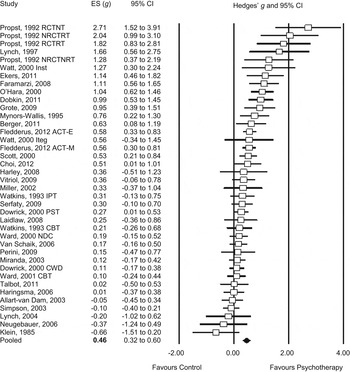
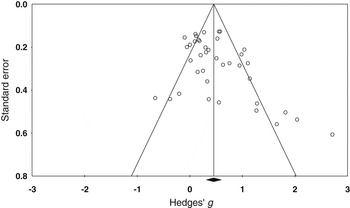
Between-study heterogeneity was large (Q = 129.22, p < 0.001, I 2 = 70.59) and therefore random effect models were used in subsequent analyses. Figure 1 provides an overview of the effect sizes of social functioning in each study. The mean effect of psychotherapy on social functioning was small to moderate (Hedges' g = 0.46, 95% CI 0.32–0.60) and significantly different from zero (z = 6.42, p < 0.001). The funnel plot and the trim-and-fill procedure suggested the presence of possible publication bias (Fig. 2). After adjusting for publication bias using the trim-and-fill procedure, the overall effect size for the random effects model was g = 0.40 (95% CI 0.25–0.55).
Standardized effect sizes (Hedges' g) of the effects of psychotherapy for depression on social functioning compared to control conditions. ACT-E, Acceptance and commitment therapy with extensive email support; ACT-M, acceptance and commitment therapy with minimal email support; CBT, cognitive behavioural therapy; CI, confidence interval; CWD, Coping With Depression course; Inst, instrumental reminiscence; Integ, integrative reminiscence therapy; IPT, interpersonal psychotherapy; NDC, non-directive counselling; NRCTNRT, non-religious CBT, non-religious therapist; NRCTRT, non-religious CBT, religious therapist; PST, problem solving therapy; RCTNT, religious CBT, non-religious therapist; RCTRT, religious CBT, religious therapist.

Funnel plot of standard error by Hedges' g.

We also computed the effect size of psychotherapy on depressive symptom severity in the included studies. The effect size of psychotherapy on depressive symptom severity was moderate (Hedges' g = 0.58, 95% CI 0.44–0.72) and significantly different from zero (z = 8.06, p < 0.001). After adjusting for publication bias using the trim-and-fill procedure, the overall effect size for the random effects model decreased to g = 0.43 (95% CI 0.28–0.58).
Sensitivity analyses
In six studies, more than one type of psychotherapy was compared with the same control group and therefore the effect sizes from these comparisons were not independent. We conducted two sensitivity meta-analyses by first including only the largest effect size for each study and then only including the smallest effect size for each study. When only including the largest effect sizes, the overall effect size was g = 0.43 (95% CI 0.27–0.58) and significantly different from zero (z = 5.43, p < 0.001). These estimates did not change after adjusting for publication bias. When only including the smallest effect sizes, the overall effect size was g = 0.38 (95% CI 0.24–0.53) and significantly different from zero (z = 5.16, p < 0.001). These estimates did not change after adjusting for publication bias.
One study was based on data from patients with residual depressive symptoms (Scott et al. Reference Scott, Teasdale, Paykel, Johnson, Abbott, Hayhurst, Moore and Garland2000). In a sensitivity analysis, excluding this study, the effect size remained the same (g = 0.46, 95% CI 0.31–0.60). To test whether one single individual study had a strong impact on the overall effect size, we conducted a several additional sensitivity analyses in which the effect size was computed after excluding one study. In these analyses, the effect size estimates ranged from 0.43 to 0.48, indicating that no individual study had a strong impact on the overall effect size.
Subgroup analyses
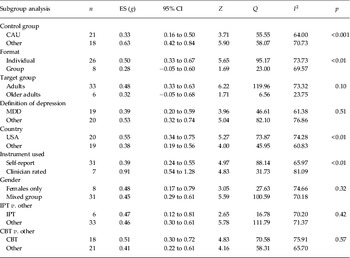
The results of the univariate subgroup analyses for studies comparing psychotherapies to a control group are shown in Table 2. Studies comparing psychotherapy to CAU resulted in smaller effect sizes (g = 0.33, 95% CI 0.16–0.50) than those of studies comparing psychotherapy to other control groups (g = 0.63, 95% CI 0.42–0.84, p < 0.001). Studies that used an individual treatment format resulted in larger effect sizes (g = 0.50, 95% CI 0.33–0.67) compared to studies that used a group format (g = 0.28, 95% CI −0.05 to 0.60, p < 0.01). Moreover, studies that were conducted in the USA resulted in larger effect sizes (g = 0.55, 95% CI 0.34–0.75) compared to studies that were conducted outside the USA (g = 0.38, 95% CI 0.19–0.56, p < 0.01). Finally, studies that used clinical rating scales to assess social functioning reported larger effect sizes (g = 0.91, 95% CI 0.54–1.28) compared to studies that relied on self-reported social functioning (g = 0.39, 95% CI 0.24–0.55, p < 0.01).
Meta-analyses of studies comparing psychotherapy versus control groups: subgroup analyses testing associations between effect sizes and study characteristics

CAU, Care as usual; CBT, cognitive behavioural therapy; CI, confidence interval; ES, effect size (Hedges' g); IPT, interpersonal psychotherapy; MDD, major depressive disorder.
Analyses were conducted according to the random effects model; p values of the differences between subgroups are based on fixed effects.
We also tested whether studies that compared IPT or CBT respectively to a control group resulted in differential effect sizes compared to studies comparing other types of treatment to a control group. No differences in effect size estimates emerged for studies comparing IPT to a control group versus studies comparing other types of treatment to a control group (p = 0.42) or studies comparing CBT to a control group versus studies comparing other types of treatment to a control group (p = 0.57). To further investigate whether one broader cluster of psychotherapies resulted in differential effect sizes, we pooled the different types of psychotherapies into two broad clusters: the cognitive-behavioural cluster (acceptance and commitment therapy, behavioural activation, CBT, coping with depression course, dialectical behaviour therapy, problem solving therapy) and a psychodynamic-interpersonal cluster (IPT, interpersonal counselling, psychodynamic counselling). Studies comparing treatments from the cognitive-behavioural cluster to control groups resulted in effect sizes (g = 0.50, 95% CI 0.32–0.68) comparable to those in studies comparing treatments from the psychodynamic-interpersonal cluster to control groups (g = 0.32, 95% CI 0.31–0.60, p = 0.14). The other study characteristics were unrelated to the effect size of social functioning.
Meta-regression analysis
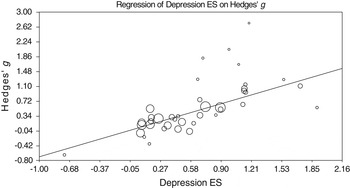
We conducted a series of meta-regression analyses to test whether selected study characteristic were related to the effect size of psychotherapy at post-treatment. There was a significant association between the effect size of social functioning and the effect size of depression (slope: 0.71, 95% CI 0.55–0.88, p < 0.001), suggesting that, with each increase in the effect size of depressive symptom severity by one, the effect size of social functioning increased by 0.71 (Fig. 3). The number of treatment sessions was also statistically significantly related to the effect size (slope: 0.03, 95% CI 0.01–0.05, p < 0.01), indicating that studies with more treatment sessions resulted in higher effect sizes. The slope of 0.03 indicates that, for each increase in five sessions, an increase in the effect size for social functioning of 0.15 was observed.
Relationship between effect size for depressive symptom severity and effect size for social functioning. Meta-regression analysis.

Multivariate analyses
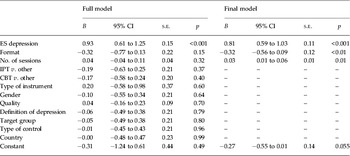
We conducted a series of multivariate meta-analyses with the effect size of social functioning as the dependent variable and the effect size of depression severity as the predictor. Additionally, we entered the same variables that were used in the univariate subgroup analyses as predictors. First, a full model, including all potential predictors, was computed. We then removed the least significant predictor from the model until a model with only significant predictors remained (backward deletion). The results of these analyses are presented in Table 3.
Regression coefficients of selected study characteristics predicting the effect size of social functioning: multivariate meta-regression analyses

CBT, Cognitive behavioural therapy; CI, confidence interval; ES, effect size; IPT, interpersonal psychotherapy; s.e., standard error.
To build the final model the least significant variable was dropped in a backwards regression analyses until only significant predictors remained.
Additional analyses that were entered in the full model were: type of control group, format (group v. individual), country where the trial was conducted, type of instrument used (self-report v. clinician rated), number of treatment sessions, type of diagnosis [DSM-IV-based major depressive disorder (MDD) v. cut-off on depression questionnaire], target group (older adults v. adults), gender (females only v. mixed groups), type of treatment (CBT v. other and IPT v. other), quality of the trial. None of these characteristics were significantly related to the effect size of change in social–interpersonal functioning in the multivariate analyses (all p values > 0.05).
In the full model, including all predictors, the effect size of depression severity was a significant predictor of the effect of psychotherapy on social functioning (b = 0.93, 95% CI 0.61–1.25, p < 0.001). The other predictors were not statistically significantly related to the effect size of psychotherapy for social functioning. In the model including all predictors, the effect of psychotherapy on social functioning (constant) was not significant (p = 0.49).
Next, non-significant predictors were removed step by step, until only significant predictors remained. After removing non-significant predictors step by step, the effect size of depressive symptom severity remained as a significant predictor of the effect size of social functioning (b = 0.81, 95% CI 0.59–1.03, p < 0.001), indicating that stronger effects of psychotherapy on depressive symptom severity were positively associated with stronger effects of psychotherapy on social functioning. Moreover, the treatment delivery format significantly predicted the effect size on social functioning (b = −0.32, 95% CI −0.56 to −0.09, p < 0.01), indicating that studies that used individual treatment settings reported stronger effects than studies that used a group psychotherapy format. The number of treatment sessions was also statistically significantly associated with the effect size of social functioning (b = 0.03, 95% CI 0.01–0.06, p = 0.01), indicating that the effect size increased by 0.03 with each additional treatment session. In the final model, the effect of psychotherapy on social functioning (constant) remained marginally significant (b = −0.27, 95% CI −0.55 to 0.01, p = 0.055), indicating that, on the one hand, improvements in social functioning in psychotherapy for depression are strongly related to improvements in depressive symptom severity whereas, on the other hand, social functioning improvements are, at least in part, independent of depressive symptoms.
Discussion
The aim of this meta-analysis was to summarize the effect of psychotherapy for depression on improvements in social functioning. We found 31 studies with a total of 2956 participants that compared psychotherapy for depression with a control group and assessed social functioning at post-treatment. Before and after adjusting for publication bias, the overall effect size was small to moderate. These findings suggest that depressed patients receiving psychotherapy for depression can benefit not only in terms of amelioration of depressive symptoms but also in terms of improved functioning in various social roles such as work, recreational and interpersonal relationships. This is important because impairments in these areas contribute strongly to the burden of disease in depression (Greenberg et al. Reference Greenberg, Kessler, Birnbaum, Leong, Lowe, Berglund and Corey-Lisle2003; Eaton et al. Reference Eaton, Martins, Nestadt, Bienvenu, Clarke and Alexandre2008). After controlling for the effects of psychotherapy on depressive symptom severity and selective study characteristic in multivariate meta-analyses, the effects of psychotherapy on social functioning remained marginally significant, indicating that changes in social functioning are not fully explained by changes in depressive symptom severity. In other words, our results suggest that social functioning improves as depressive symptoms improve, although the direction or nature of the presumed causal relationship remains unknown. These findings are in line with previous studies showing that changes in psychosocial functioning are intercorrelated with changes in depressive symptom severity (e.g. Vittengl et al. Reference Vittengl, Clark and Jarrett2004; Dunn et al. Reference Dunn, Vittengl, Clark, Carmody, Thase and Jarrett2012).
It should be noted that the current research design does not allow us to determine the temporal relationship of this association. It is not clear whether improvements in depressive symptom severity drive improvements in social functioning or vice versa. To determine the temporal relationship between these constructs it would be necessary to establish a timeline with repeated assessments of both constructs during treatment (Kazdin, Reference Kazdin2007). One previous process–outcome study on the effects of cognitive therapy on change in psychosocial adjustment found that improvements in psychosocial adjustment, assessed four times during treatment, predicted subsequent reductions in depressive symptoms rather than vice versa (Dunn et al. Reference Dunn, Vittengl, Clark, Carmody, Thase and Jarrett2012). Future RCT-based studies with control groups and repeated assessments of functioning and depressive symptoms throughout treatment should aim to determine the causal relationship between these variables.
Overall, the effect size of social functioning was smaller than the effect size of depressive symptom severity. This finding is in line with previous studies showing that impairments in social functioning often persist, even after symptomatic recovery (e.g. Coryell et al. Reference Coryell, Scheftner, Keller and Endicott1993). Different explanations might account for this finding. For example, it is possible that social functioning takes more time to improve compared to depressive symptom severity in psychotherapy for depression. This explanation is in line with the findings of a previous meta-analysis showing that recovery from work impairments in depression takes longer than symptom remission (Mintz et al. Reference Mintz, Mintz, Arruda and Hwang1992). However, impairments in social functioning might be more persistent even in the long run and additional treatment might be necessary to improve social functioning to a pre-morbid level. Our finding that social functioning improved less than depressive symptom severity might have important prognostic implications for the course of depression following treatment. For example, it has been shown that residual impairments in social functioning following treatment are related to relapse and recurrences (e.g. Leon et al. Reference Leon, Solomon, Mueller, Turvey, Endicott and Keller1999; Vittengl et al. Reference Vittengl, Clark and Jarrett2009). Such findings stress the importance of including social functioning as the main outcome in treatment studies and in current definitions of response and remission. It should be noted that, after adjusting for publication bias, the effect size of social functioning (g = 0.40) was comparable to the adjusted effect size of depressive symptoms (g = 0.43).
We conducted subgroup analyses to test whether selective study characteristics were differentially related to the effects of psychotherapy on social functioning. In interpreting the results of these analyses, significant associations should not be interpreted in terms of causal associations. Our univariate subgroup analyses indicated that studies that compared psychotherapy to CAU resulted in smaller effect sizes compared to studies comparing psychotherapy to other control conditions. This finding is in line with previous meta-analyses summarizing the effects of psychotherapy on depressive symptom severity (e.g. Cuijpers et al. Reference Cuijpers, van Straten, Warmerdam and Smits2008d ). In our subgroup analyses, studies with a CAU control condition were mainly compared to studies with a wait-list control condition and it is therefore not surprising that studies with CAU as the control condition resulted in smaller effect sizes. Our subgroup analyses further showed that studies that were conducted in the USA and studies that used clinician-rated scales to assess social functioning yielded higher effect sizes than studies that were conducted in other countries or studies that relied on self-reported instruments of social functioning. Although speculative, it is possible that studies based in the USA have a higher treatment delivery quality and therefore achieve higher effect sizes. The finding that clinician-rated instruments yielded higher effect sizes than self-reported instruments is in line with the results of an earlier meta-analysis showing that clinician-rated instruments were associated with higher effect-sizes of depressive symptom severity (Cuijpers et al. Reference Cuijpers, Li, Hofmann and Andersson2010). In the current meta-analysis, only three studies (seven comparisons) used a clinician-rated instrument of social functioning and hence this finding should be interpreted with caution. Based on our findings, it is not clear whether one type of assessment of social functioning is preferable over the other and therefore it is probably best to include both in future studies and clinical practice when assessing social functioning.
There were no differences in improvements in social functioning between different types of psychotherapeutic interventions (CBT v. others; IPT v. others). When interpreting these results it is important to keep in mind that these findings are based on separate sets of comparisons and not on direct comparisons of different types of psychotherapies. Such indirect comparisons might be confounded by differences in patient populations and other study characteristics and the results should therefore be interpreted with caution. Our findings are in line with previous meta-analyses reporting that different types of psychotherapy are approximately equally efficacious in reducing depressive symptoms (Cuijpers et al. Reference Cuijpers, van Straten, Andersson and van Oppen2008a ). IPT focuses specifically on social functioning (Weissman et al. Reference Weissman, Markowitz and Klerman2000) and we might therefore expect that studies that included IPT would result in larger effect sizes of improvements in social functioning compared to studies on other forms of psychotherapy. It is unclear how our finding that improvements in social functioning were not different between IPT studies and other studies relates to the literature on the mechanisms of change in depression. It is possible, for example, that IPT-based studies in this meta-analyses resulted in initially stronger improvements in social functioning but that these differences were no longer present at post-treatment. However, it is impossible to test this hypothesis in the current research design. Future RCT-based studies with repeated assessments throughout treatment should aim to determine the temporal pattern of improvements in social functioning in different types of psychotherapy for depression.
We found that the number of therapy sessions was positively associated with the effect size of social functioning, even after controlling for the effects on depressive symptom severity in multivariate analyses. This finding suggests that patients with depression might benefit from longer-term treatments or continuation treatments in terms of improvements in social functioning. The relationship between the number of therapy sessions and the effect size of social functioning was fairly small. Our analyses suggest that an increase of five therapy sessions is associated with an increase in the effect size of social functioning of 0.15. This is in line with the findings of a recent meta-analysis showing that there is a small association between the number of therapy sessions and the effect size of depressive symptom severity (Cuijpers et al. Reference Cuijpers, Huibers, Daniel Ebert, Koole and Andersson2013). In the current meta-analysis, studies on continuation and maintenance treatments were excluded and it therefore remains unclear whether continued treatment is related to further improvements in social functioning. In the univariate and multivariate meta-analyses, we found that the treatment delivery format was significantly associated with improvements in social functioning. Studies that used an individual treatment format resulted in higher effect sizes compared to studies that used a group format. On theoretical grounds it could be argued that group settings should result in stronger improvements in social functioning because group therapy, by definition, takes place in a social interpersonal context allowing, for example, social and interpersonal conflicts to be conducted in vivo in the group. Empirically, our finding that individual treatments resulted in higher effect sizes of social functioning is in line with the results of a previous meta-analysis showing that an individual treatment format for depression is associated with higher effect sizes of depressive symptom severity (Cuijpers et al. Reference Cuijpers, van Straten and Warmerdam2008b ).
Several important limitations should be mentioned. First, the number of studies was relatively small and accordingly it was not possible to compare effect sizes between specific types of treatment other than CBT and IPT. For example, it would be of interest to test whether psychotherapies for depression that focus on engagement in psychosocial activities (e.g. behavioural activation) are related to stronger improvements in psychosocial adjustments compared to other forms of psychotherapies. A related limitation of this meta-analysis is that comparisons between different types of psychotherapies were based on separate sets of comparisons and not on direct comparisons of different types of psychotherapies. The number of comparative outcome studies in the current meta-analysis was too small to allow for such a direct comparison. Second, the quality of included studies was, on average, fairly low. As quality was negatively associated with the effect size, it might be that the effect sizes in the current meta-analysis were overestimated. Third, we compared the effects of psychotherapy versus control groups at one assessment moment and hence we could not draw any conclusions regarding the temporal relationships between changes in social functioning and changes in depressive symptom severity. The current meta-analysis was based on study-level data. Another approach that might also allow for analyses of temporal relationships and a more fine-grained analysis of predictors would have been to conduct an individual patient-level meta-analysis based on the original datasets of included studies. Finally, we assessed overall improvements in social functioning rather than domain-specific improvements. It is possible, for example, that some aspects of functioning show stronger improvements (e.g. recreational functioning) than others (e.g. work functioning).
Despite these limitations, our findings have important implications for clinical practice and future research. First, the results of this meta-analysis suggest that psychotherapy for depression is associated with improvements in social functioning. This is an important finding because improvements in social functioning are a highly desirable outcome from a patient perspective. Second, future research should aim to determine the temporal relationship between social functioning and depressive symptom severity by assessing both depressive symptom severity and social functioning repeatedly throughout treatment. Finally, compared to the total number of RCTs on different types of psychotherapies for depression, the number of studies that included measures of social functioning as treatment outcome was relatively small, which reflects the current focus of treatment outcome studies on depressive symptom severity rather than functioning. Including social functioning as the main outcome, in addition to symptomatic improvements, in treatment studies for depression might add to a more complete definition of treatment effects.
In conclusion, psychotherapy for depression has small to moderate positive effects on the social functioning of depressed patients and no differences between different types of psychotherapies emerged.
Declaration of Interest
None.