INTRODUCTION
The genus Synalpheus Spence Bate, Reference Spence Bate1888 comprises over 150 species of small snapping shrimps (De Grave & Fransen, Reference De Grave and Fransen2011), which are abundant and diverse components of the cryptic fauna of shallow water in tropical marine ecosystems around the world. They can be found inhabiting crevices inside coral rubble, internal cavities of sponges, hard and soft corals, crinoids and ascidians (Pearse, Reference Pearse1950; Bruce, Reference Bruce1976; Duffy, Reference Duffy1992; Santos et al., Reference Santos, Soledade and Almeida2012). The genus harbours the only known eusocial marine species (Duffy, Reference Duffy1996a, Reference Duffyb; Macdonald et al., Reference Macdonald III, Ríos and Duffy2006) and comprises considerably cryptic and incompletely described biodiversity (Ríos & Duffy, Reference Ríos and Duffy2007; Anker & Tóth, Reference Anker and Tóth2008; Macdonald et al., Reference Macdonald III, Hultgren and Duffy2009; Hultgren et al., Reference Hultgren, MacDonald III and Duffy2010).
Synalpheus dardeaui (Ríos & Duffy, Reference Ríos and Duffy2007), a member of the Synalpheus gambarelloides (Nardo, Reference Nardo1847) group and of the Synalpheus pandionis Coutière, Reference Coutière1909 species complex, was described from Twin Cays, Belize (Ríos & Duffy, Reference Ríos and Duffy2007). Specimens are usually found in multiple heterosexual pairs inhabiting internal spaces of host sponges (Ríos & Duffy, Reference Ríos and Duffy2007; Anker et al., Reference Anker, Pachelle, De Grave and Hultgren2012). In the western Atlantic, Synalpheus dardeaui has been recorded in Florida and some localities in the Caribbean (Ríos & Duffy, Reference Ríos and Duffy2007; Hultgren et al., Reference Hultgren, MacDonald III and Duffy2010; Anker et al., Reference Anker, Pachelle, De Grave and Hultgren2012). As part of the activities of the project ‘Diversidade de Crustáceos Decápodos Marinhos e Estuarinos do Sul da Bahia, Brasil’, ongoing since 2003, specimens of Synalpheus dardeaui were retrieved from the sponge host Ircinia cf. strobilina (Lamarck, Reference Lamarck1816) in a locality in southern Bahia, Brazil, significantly extending its geographic range. Thus, the objective of this study is to report the occurrence of Synalpheus dardeaui for the first time in the south-western Atlantic and record an additional sponge host for the species.
MATERIAL AND METHODS
The material examined was collected indirectly during a sponge survey at the Parque Municipal Marinho do Recife de Fora, Porto Seguro, Bahia, in May 2013. One specimen of the sponge Ircinia cf. strobilina (Figure 1) was collected while scuba diving, at a depth of approximately 10 m. The host identification was based on external characters (morphology and colour) by comparison with photographs of living sponges provided by Muricy & Hajdu (Reference Muricy and Hajdu2006) and Muricy et al. (Reference Muricy, Esteves, Moraes, Santos, Silva, Klautau and Lanna2008). The specimen was detached from coralline substrate using a hammer and chisel and wrapped in cloth bags to prevent the associated animals from escaping. In the laboratory, the sponge was dissected to verify the presence of organisms in its internal cavities. The material retrieved was preserved in 70% ethanol and deposited in the crustacean collection of the Universidade Estadual de Santa Cruz, Ilhéus, Bahia, Brazil (UESC). Drawings were performed with the aid of a camera lucida. The carapace length (CL) was measured along the mid-dorsal line from the tip of the rostrum to the posterior margin of the carapace. The shrimps were sexed by the shape of their abdominal pleurae (see description and drawings in Ríos & Duffy, Reference Ríos and Duffy2007).
The sponge Ircinia cf. strobilina (Lamarck, Reference Lamarck1816) from Parque Municipal Marinho do Recife de Fora, Porto Seguro, state of Bahia, host of specimens of the snapping shrimp Synalpheus dardeaui (Ríos & Duffy, Reference Ríos and Duffy2007). (A) External view; (B) view of a section of sponge, showing internal cavities where the shrimp material was collected. Photographs: Patricia S. Santos.

RESULTS AND DISCUSSION
Superfamily alpheoidea Rafinesque, Reference Rafinesque1815
Family alpheidae Rafinesque, Reference Rafinesque1815
Genus Synalpheus Spence Bate, Reference Spence Bate1888
Synalpheus dardeaui (Ríos & Duffy, Reference Ríos and Duffy2007)
(Figure 2)
Synalpheus ‘pandionis giant’ – Morrison et al., Reference Morrison, Ríos and Duffy2004, p. 568; Macdonald et al., Reference Macdonald III, Ríos and Duffy2006, p. 170.
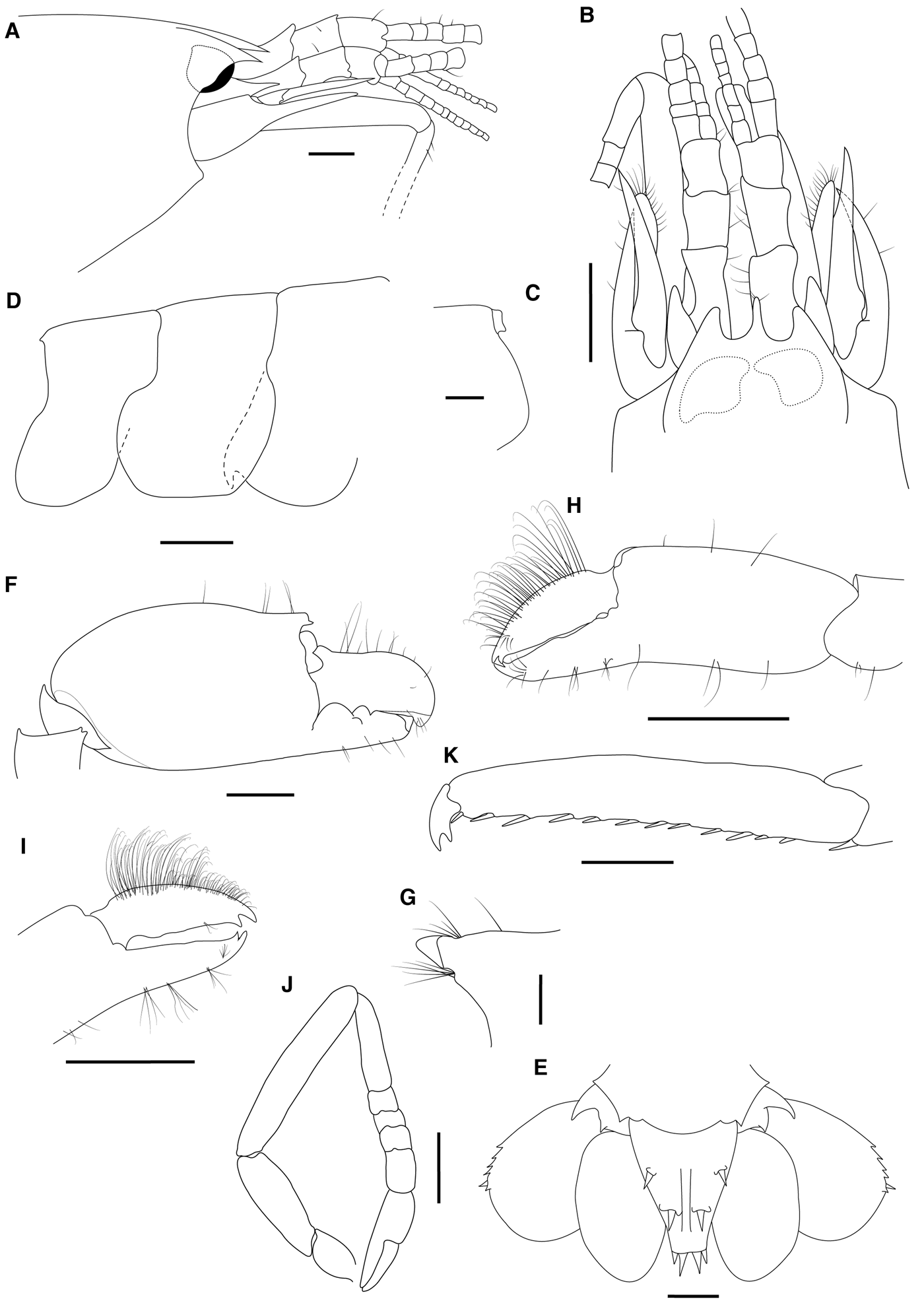
Synalpheus dardeaui (Ríos & Duffy, Reference Ríos and Duffy2007), non-ovigerous female from Parque Municipal Marinho do Recife de Fora, Porto Seguro, state of Bahia, UESC 1567. (A) frontal region and cephalic appendages, lateral view; (B) frontal region and cephalic appendages, dorsal view; (C) posterolateral margin of carapace, lateral view; (D) detail of abdominal pleurae 1–3; (E) telson and uropods, dorsal view; (F) major cheliped, mesial view; (G) detail of pollex of major cheliped, ventral view; (H) minor cheliped, mesial view; (I) detail of minor chela, lateral view; (J) second pereiopod, lateral view; (K) third pereiopod, dactylus and propodus, lateral view. A, B, F, H: specimen with 6.5 mm in CL; C–E, G, I–K: specimen with 8.5 mm in CL. E, K: setae partially omitted; J: setae omitted. Scale bars: A–F, H–K: 1 mm; G: 0.5 mm.
Zuzalpheus dardeaui – Ríos & Duffy, Reference Ríos and Duffy2007. p. 18, Figures 3–6, pl. 2.
Synalpheus dardeaui – Anker & Tóth, Reference Anker and Tóth2008, p. 17; Duffy & Macdonald, Reference Duffy and Macdonald III2010, p. 579; Hultgren et al., Reference Hultgren, MacDonald III and Duffy2010, p. 229; De Grave & Fransen, Reference De Grave and Fransen2011, p. 405; Anker et al., Reference Anker, Pachelle, De Grave and Hultgren2012, p. 34, Figures 22 & 23.
MATERIAL EXAMINED
Two non-ovigerous females (CL 6.5 and 8.5 mm), Brazil, state of Bahia, Porto Seguro, Parque Municipal Marinho do Recife de Fora (16°23′0″S 38°59′0″W), water depth 10 m, UESC 1567, coll. by P.S. Santos, G.O. Soledade, L.M. Fernandes, J.C. Viaggi, G.M. Reuss-Strenzel, 6 May 2013.
DISTRIBUTION
Western Atlantic–North Carolina (?), Florida (Florida Keys), Belize (Carrie Bow Cay), Panama (Bocas del Toro), Curaçao and Brazil (Bahia: Porto Seguro) (Ríos & Duffy, Reference Ríos and Duffy2007; Hultgren et al., Reference Hultgren, MacDonald III and Duffy2010; Anker et al., Reference Anker, Pachelle, De Grave and Hultgren2012; present study).
ECOLOGICAL NOTES
Synalpheus dardeaui has been found in habitats such as shallow reefs, rubble-seagrass flats and mangrove roots with an abundance of sponges. The known depth range for this shrimp varies between 0.5 and 65 m (more common up to 10 m) (Hultgren et al., Reference Hultgren, MacDonald III and Duffy2010; Anker et al., Reference Anker, Pachelle, De Grave and Hultgren2012). Synalpheus dardeaui is considered an obligate symbiont of demosponges, such as Spheciospongia vesparium (Lamarck, Reference Lamarck1815), Lissodendoryx colombiensis Zea & van Soest, Reference Zea and van Soest1986 and Ircinia cf. strobilina (Ríos & Duffy Reference Ríos and Duffy2007; Hultgren et al., Reference Hultgren, MacDonald III and Duffy2010; Anker et al., Reference Anker, Pachelle, De Grave and Hultgren2012; present study).
REMARKS
The southern known distribution limit of Synalpheus dardeaui in the western Atlantic is extended by approximately 28° of latitude, from Curaçao (12°N) to Porto Seguro, Bahia, Brazil (16°S). According to Ríos & Duffy (Reference Ríos and Duffy2007), Synalpheus dardeaui is defined by the combination of characters such as slender, mesially directed orbital teeth, telson with strong dorsal spines and fingers of minor chela with strong subequal teeth and a well-defined cardiac notch on the carapace. All these characters were observed in our material (see Figure 2B, C, E, I), although the orbital teeth are not so elongated and mesially directed as in the paratype illustrated by Ríos & Duffy (Reference Ríos and Duffy2007) (for comparison, see Figure 2B and Ríos & Duffy, Reference Ríos and Duffy2007, p. 19, Figure 3A). The fingertips of the minor chela in our material are strongly bidentate (Figure 2H, I), as is typically found in this species (Ríos & Duffy, Reference Ríos and Duffy2007, p. 20, Figure 4E; Anker et al., Reference Anker, Pachelle, De Grave and Hultgren2012). Another difference observed regarding the original description and illustrations provided by Ríos & Duffy (Reference Ríos and Duffy2007) was in the degree of development of the scaphocerite blade (reduced, approximately half the length of distolateral tooth of scaphocerite in the type material vs more developed, conspicuously longer than half the length of distolateral tooth in our material) (for comparison, see Figure 2B and Ríos & Duffy, Reference Ríos and Duffy2007, p. 19, Figure 3A). Anker et al. (Reference Anker, Pachelle, De Grave and Hultgren2012) reported a parasitized ovigerous female from Panama with vestigial blade, indicating that this character might be variable. The uropodal exopod in our material is armed with four distolateral teeth adjacent to spiniform seta (Figure 2E), falling within the range (4–6) observed in the type material (see Ríos & Duffy, Reference Ríos and Duffy2007). For now, the differences observed by us are interpreted as intraspecific variation. Synalpheus dardeaui is the largest species within the Synalpheus gambarelloides group and has been found mainly in Spheciospongia vesparium and Lissodendoryx colombiensis, both sponges with broad aquiferous canals and, occasionally, in Xestospongia rosariensis (Zea & Rützler, Reference Zea and Rützler1983) (presently Neopetrosia rosariensis) (Ríos & Duffy Reference Ríos and Duffy2007; Anker et al., Reference Anker, Pachelle, De Grave and Hultgren2012). The material of Synalpheus dardeaui from Curaçao (Hultgren et al., Reference Hultgren, MacDonald III and Duffy2010) was collected in a host probably erroneously identified as Spongia sp. (see Anker et al., Reference Anker, Pachelle, De Grave and Hultgren2012). Our material was obtained from a specimen of Ircinia cf. strobilina, extending the host usage known for this species.
ACKNOWLEDGEMENTS
The authors would like to thank the ‘Rede de Pesquisa Coral Vivo’ (supported by ‘Petrobras’ – ‘Programm Petrobras Ambiental’ and ‘Arraial d'Ajuda Eco Parque’), for logistic support during field work and the ‘Secretaria do Meio Ambiente, Prefeitura Municipal de Porto Seguro’ for collection permits in the ‘Parque Municipal Marinho do Recife de Fora’. We thank the Fundação de Amparo à Pesquisa do Estado da Bahia (FAPESB) (PPP0073/2010) and the Universidade Estadual de Santa Cruz (UESC) (00220.1100.590) for providing financial support for the project ‘Diversity of Marine and Estuarine Decapod Crustaceans in Southern Bahia, Brazil’. We are grateful to Letícia Magalhães Fernandes, Irlanda Matos, Jemilli Castiglioni Viaggi and Gil Marcelo Reuss-Strenzel for the support provided during sampling, and Paulo Pachelle and an anonymous reviewer who provided criticisms that greatly improved the manuscript. P.S. Santos would like to thank the Coordenação de Aperfeiçoamento de Pessoal de Nível Superior (CAPES) for providing funding in the form of M.Sc. scholarships. The collecting of specimens for the present study complied with the current applicable state and federal laws of Brazil (permanent license for collection of Zoological Material No. 24408-1 MMA/IBAMA/SISBIO to AOA).