Introduction
Mild cognitive impairment (MCI), which is defined as a state of transition between normal aging and dementia (Petersen, Reference Petersen2000), is estimated to afflict up to 20% of older adults (Busse et al., Reference Busse, Bischkopf, Riedel-Heller and Angermeyer2003). Patients diagnosed with both MCI and lifetime history of depression have more than double the risk of progression to Alzheimer’s disease (AD) dementia than those with MCI but no lifetime history of depression (Modrego and Ferrández, Reference Modrego and Ferrández2004). Some studies have related cognitive impairment associated with depression to AD pathology (Byun et al., Reference Byun2016) and the deposition of beta amyloid and hippocampal atrophy (Byun et al., Reference Byun2016; Hou et al., Reference Hou, Yuan, Zhang, Bai, Hou and You2012), while other studies related it to vascular burden mainly represented by white matter hyper-intensities (WMHs) (Hickie et al., Reference Hickie, Scott, Wilhelm and Brodaty1997; Murata et al., Reference Murata2001). In one study, Diniz et al. found that patients suffering from late-life depression (LLD) associated with MCI have higher WMH burden than those having depression with normal cognition which suggests that cognitive impairment associated with LLD may be mediated by vascular pathology (Diniz et al., Reference Diniz2015).
Both MCI and major depressive disorder (MDD) are known to be associated with cardiovascular risk factors (CVRFs) (Picano et al., Reference Picano, Bruno, Ferrari and Bonuccelli2014; Valkanova and Ebmeier, Reference Valkanova and Ebmeier2013; Yaffe et al., Reference Yaffe, Hoang, Byers, Barnes and Friedl2014; Ye et al., Reference Ye2017). Previous studies showed that lifetime history of depression may be considered as a risk factor for MCI and later for AD (Ownby et al., Reference Ownby, Crocco, Acevedo, John and Loewenstein2006). A recent study by Heser et al. showed that orientation and learning deficits noted in some patients with lifetime history of depression could predict dementia risk (Heser et al., Reference Heser2016). Most studies looking at MCI and cardiovascular disease burden have not controlled for the presence of lifetime history of MDD (Ettorre et al., Reference Ettorre2012; Lara et al., Reference Lara2016), so it is unclear whether history of MDD modifies the association between CVRFs and MCI. Examining CVRFs is essential as these factors are modifiable, and controlling them is an important step in preventing cognitive decline (Modrego and Ferrández, Reference Modrego and Ferrández2004).
The Prevention of Alzheimer’s Dementia with Cognitive Remediation plus Transcranial Direct Current Stimulation (PACt-MD) study is a randomized controlled intervention trial to compare non-invasive brain stimulation (trans-cranial Direct Current Stimulation – tDCS) combined with cognitive remediation (CR) to placebo in preventing cognitive decline in patients with MCI, and lifetime history of MDD with and without MCI. The purpose of this paper is to compare the prevalence of select CVRFs in patients with history of MDD, MCI with and without history of MDD and a normal comparison group in a baseline cohort of patients from the PACt-MD study. As CVRFs have been associated with both MCI and MDD (Barch et al., Reference Barch2012; Valkanova and Ebmeier, Reference Valkanova and Ebmeier2013), we predicted that select CVRFs would be more prevalent in all groups relative to healthy controls and more prevalent in MCI with concomitant MDD. In addition, our study examined the link between select CVRFs and neuropsychological test performance in a pooled sample. We predicted that select CVRF scores would be negatively associated with cognitive performance.
Methods
Study design and participants
Participants for this study were selected from the PACt-MD study. In this double-blind randomized clinical trial, patients with MCI (aged 60+), lifetime history of MDD (aged 65+), or both are randomized to receive tDCS combined with CR or sham (“placebo”) tDCS combined with sham CR to prevent cognitive decline. As this is an ongoing intervention trial, only baseline data collected up until September 2019 were analyzed. Three hundred seventy-three PACt-MD participants with MCI and/or history of MDD had available information regarding cardiovascular burden (outlined below) and were therefore selected for the purposes of this study. In addition, a normal comparison group consisting of healthy control participants was also recruited for PACt-MD at the same time as the disease sample and the data from 81 of these participants were used as normal controls for the purpose of this study.
Demographics and clinical characteristics
Participants in the PACt-MD study are closely monitored for a period of up to 5 years. A diagnosis of MDD and MCI is made clinically by a geriatric psychiatrist, in addition to a consensus conference supplemented by neuropsychological data where appropriate. A diagnosis of MDD is made in accordance with DSM-5 criteria, while MCI is diagnosed in accordance with current NIA criteria (American Psychiatric Association, 2013). Participants with active symptoms of depression are excluded. Normal controls have been recruited along with other participants and also undergo detailed neuropsychological testing to ensure they are not cognitively impaired. Baseline demographics included age, sex, diagnosis, medical history, Mini-Mental State Examination (MMSE), Montreal Cognitive Assessment (MoCA), and Montgomery-Åsberg Depression Rating Scale (MADRS) where available.
Measures
CVRFs including history of hypertension, diabetes, and smoking status as well as measures of global cognition (MMSE, MoCA) and depression (MADRS) were obtained from the PACt-MD database. Neuropsychological composite test scores were generated and grouped into domains for both cases and controls from raw data of the California Verbal Learning Test, Brief Visuospatial Memory Test Revised, Continuous Performance Test – Identical Pairs, and Paced Auditory Serial Addition Task. The composite scores were generated from grouping the aforementioned test variables into domains (verbal memory, visuospatial memory, processing speed, language, executive, and working memory) and averaging the Z-scores (Z Score = [Score − x̄ (Controls)]/[SD (Controls)]) calculated from raw scores of each test within that domain (see Supplementary Table 1 for individual test scores included in each domain). The overall composite score is an average of the six domains. For the purposes of this study, we focused on only two composite scores: executive function and overall score.
Statistical analyses
Participants were divided into two diagnostic groups: MCI (which includes MCI + history of MDD) and MDD only, as well as a healthy control group. We compared the prevalence of history of hypertension, diabetes, and smoking between the diagnostic groups and healthy controls using the Pearson Chi-Square test. Participants were also compared in terms of neuropsychological composite scores for the executive domain and overall score according to their history of hypertension, using the Wilcoxon rank sum test. Using generalized linear models, we examined the unadjusted effect of CVRFs on disease status. Models were fitted separately for MCI (Yes vs. Control) and MDD (Yes vs. Control) as dependent variables using maximum likelihood optimization, specifying logit as link function and assuming a binomial distribution. Multivariable analysis was further performed if results of univariable regression were statistically significant. Similarly, generalized linear models were fitted to examine the association between hypertension and the neuropsychological composite scores, with adjustment for age, sex, and educational status as appropriate. Results of regression analysis are reported as odds ratios with associated 95% confidence intervals. For all tests, the statistical significance threshold was determined at the 0.05 level. The statistical software used was IBM SPSS Statistics version 26 (IBM Corp, Armonk, NY, USA).
Results
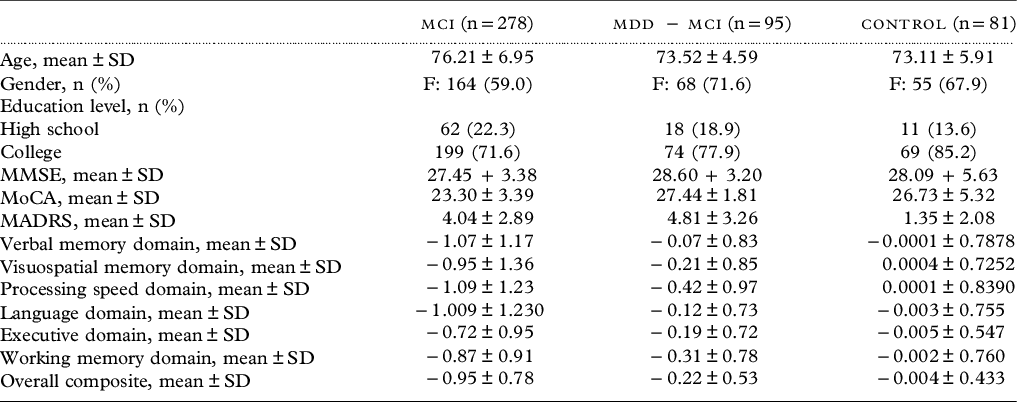
The study sample consisted of 454 participants among whom 199 participants had MCI, 95 had history of MDD and were cognitively normal, 79 had combined MCI plus history of MDD, and 81 participants constituted the normal comparison group. Demographic and clinical characteristics by diagnostic group are shown in Table 1. The mean age of the cohort was 75.09 ± 6.49 years. Of note, 287 subjects (63%) were female and 433 subjects (95%) had finished high school education or greater. The mean MMSE score was 27.80 ± 3.86, the mean MoCA score was 24.78 ± 4.03, and the mean MADRS was 3.72 ± 3.07. Forty-six cases (12.3%) were missing information regarding hypertension and/or diabetes status.
Demographics and cognitive scores of diagnostic groups and healthy controls

Effect of CVRFs on disease status
For analysis purposes, we combined the MCI and MCI + history of MDD groups into a single group of 278 participants and compared this group to those with MDD but no history of MCI to the control group. We chose to define the groups in this manner to determine whether or not the presence of MDD in MCI had any effect on our results. On comparing CVRFs between these three groups, we noted a higher prevalence of history of hypertension among the group with MCI (41.7%, n = 116) than the group with MDD only (32.6%, n = 31) and the control group (25.9%, n = 21). This difference was statistically significant (Chi-square = 7.284, p = 0.026, df = 2). Similarly, the group with MCI had a higher prevalence of diabetes when compared to the group with MDD or normal comparison group (10.8% versus 5.3% versus 1.2%; Chi-square = 7.306, p = 0.026, df = 2). In contrast, the three groups did not differ statistically in the prevalence of smoking history (Chi-square likelihood ratio = 1.096, p = 0.55). The diagnostic groups were further divided into MCI only (199), MDD only (95), and MCI + MDD (79) to consider the effect of MDD within the MCI group. We found that the four groups did not differ statistically in the prevalence of diabetes, history of hypertension, and smoking (Chi-square = 7.737, 7.452, 1.198 and p = 0.052, 0.059 and 0.730, respectively, df = 3) indicating that the presence MDD is not contributing to cardiovascular burden within the MCI group.
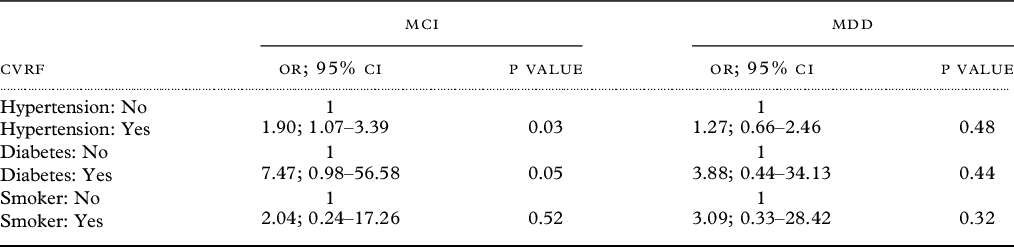
Results of unadjusted analysis from fitting generalized linear models are shown in Table 2. We noted 90% higher odds of a history of hypertension among the MCI cohort compared to healthy controls (OR, 1.90, 95% CI: 1.07–3.39, p = 0.03). In analysis adjusting for age, sex, and educational status, the association between hypertension and MCI was no longer statistically significant (OR, 1.39, 95% CI: 0.75–2.56, p = 0.29). Significance was not noted for smoking or diabetes among participants who had MCI compared to healthy controls (see Table 2). Similarly, compared to healthy controls, the MDD participants did not demonstrate higher odds of hypertension, diabetes, and smoking history.
Results of unadjusted analysis of the relation between CVRS and Diagnosis

CVRF, cardiovascular risk factors; MCI, mild cognitive impairment; MDD, major depressive disorder; OR, odds ratio; CI, confidence intervals.
Effect of CVRFs on neuropsychological composite scores
Among the pooled cohort with MCI or MDD (n = 373), participants with a history of hypertension had a lower average composite score for the executive domain and overall composite score compared with participants without hypertension (see Table 3). There was an inverse association between history of hypertension and neuropsychological performance for the composite score for the executive domain in unadjusted analysis (OR, 0.90, 95% CI: 0.85–0.95; p < 0.001) and analysis adjusting for age, sex, and educational level (OR, 0.95, 95% CI: 0.89–0.99, p = 0.035). A similar inverse association was also noted between hypertension and the overall composite score in unadjusted analysis (OR, 0.85, 95% CI: 0.79 – 0.90, p ≤ 0.001) and adjusted analysis accounting for age, sex, and educational level (OR, 0.90, 95% CI: 0.84–0.96, p = 0.002). Among the control group, there was no difference in composite scores for executive domain or overall score on comparing participants with hypertension against those without hypertension (data not included).
Average cognitive performance scores for executive domain and overall on comparing participants with a history of hypertension to those with no history of hypertension

Discussion
Our analysis demonstrated a relationship between history of hypertension and MCI. We found no significant association with diabetes and smoking history or between the CVRFs and MDD. According to prior studies, CVRFs in particular during midlife contribute to both MDD (Zuidersma et al., Reference Zuidersma, Izaks, Naarding, Comijs and Oude Voshaar2015) and MCI (Knopman et al., Reference Knopman2018). Few studies to date have compared older patients with lifetime history of depression to patients with MCI in terms of cardiovascular risk. While our study corroborates those of prior studies, we further demonstrated that certain modifiable CVRFs were more prevalent among patients with MCI relative to patients with lifetime history of MDD and healthy controls, specifically history of hypertension. One potential explanation for our findings which diverge from the literature is that our cohort was composed of patients with both early and LLD, while most of the literature has shown a link between CVRFs and LLD (Valkanova and Ebmeier, Reference Valkanova and Ebmeier2013). This might also explain why CVRFs were not increased among patients with MCI and concomitant lifetime history of MDD.
CVRFs including history of hypertension, smoking, dyslipidemia, diabetes mellitus, and obesity have been shown in multiple studies to be associated with increased risk of cognitive decline and dementia in older adults (Kivipelto et al., Reference Kivipelto2001; Kloppenborg et al., Reference Kloppenborg, van den Berg, Kappelle and Biessels2008). Importantly, the Lancet commission report in 2017 emphasized the importance of control of modifiable risk factors to prevent or postpone cognitive decline and dementia, including diabetes, midlife hypertension, midlife obesity, physical inactivity, smoking, depression, and low education (Livingston et al., Reference Livingston2017). History of hypertension and diabetes have both been identified as important modifiable risk factors associated with both MCI and conversion of MCI to AD (Kloppenborg et al., Reference Kloppenborg, van den Berg, Kappelle and Biessels2008; Knopman et al., Reference Knopman2018). Both risk factors may be associated with increased white matter lesions which may interact with AD pathology to hasten progression to dementia. Prior studies suggest that when risk factors develop may be an important consideration, with history of hypertension in midlife being associated more strongly associated with dementia and diabetes being a stronger risk factor later in life (Kloppenborg et al., Reference Kloppenborg, van den Berg, Kappelle and Biessels2008).
With respect to neuropsychological performance, our analysis indicated a clear association between a history of hypertension with reduced performance across the executive domain, and overall cognitive performance including all domains. The results of our study are consistent with prior studies that have shown a link with reduced cognitive performance in older adults and CVRFs (Ettorre et al., Reference Ettorre2012; Picano et al., Reference Picano, Bruno, Ferrari and Bonuccelli2014). Among patients with depression, CVRFs have been demonstrated to be associated with deficits in executive domains (Zuidersma et al., Reference Zuidersma, Izaks, Naarding, Comijs and Oude Voshaar2015). Reduced executive functioning has also been shown to correlate with CVRFs among patients with MCI (Villeneuve et al., Reference Villeneuve, Belleville, Massoud, Bocti and Gauthier2009). It would seem that a history of hypertension overall appeared to be a robust risk factor affecting global cognitive scores and specifically for executive functioning (Aronow, Reference Aronow2017).
The strength of this study is the use of high fidelity data obtained from a prospective study involving multiple institutions and including a large cohort of the diseases under study. Unlike most prior studies, we compared the effect of CVRFs between MCI and MDD using multivariable analysis as appropriate. Some limitations to this study should be mentioned. First, it is hard to know how generalizable our findings are to the population given it was conducted in a research cohort which tends to favor healthy subjects. Second, it is a cross-sectional study that analyzed baseline data, and for this reason, we were not able to study the longitudinal change in cognition in relation to different variables analyzed. Third, some of the data were missing, and we only had data on a sub-set of patients. Fourth, we did not have detailed information regarding CVRFs including laboratory values, duration, and treatments utilized. Finally, imaging was only available for a small sub-set of patients which could have added some value on the link between vascular burden and structural and functional changes in the brain.
In conclusion, our study demonstrated that CVRFs including history of hypertension are more common among patients with MCI relative to patients with lifetime history of MDD. Moreover, MCI patients with concomitant history of MDD did not have a higher burden of CVRFs. Furthermore, a history of hypertension was associated with lower cognitive performance in executive function and overall neuropsychological test performance among patients with MCI or MDD. Our findings reinforce the baseline prevalence of CVRFs in older persons and the importance of controlling CVRFs, especially hypertension, as a way of mitigating cognitive decline and preventing the onset of dementia.
Acknowledgements
This project has been made possible by Brain Canada through the Canada Brain Research Fund, with the financial support of Health Canada and the Chagnon Family. The authors would also like to acknowledge the contributions of Blessing Jaja to the statistical analyses conducted in this paper.
Conflict of interest
This project was funded by Brain Canada through the Canada Brain Research Fund, with the financial support of Health Canada and the Chagnon Family. The sponsor played no role in the execution or design of the research. None of the authors had any affiliation with organizations with a vested interest in the outcome of the research.
Description of authors’ roles
WKK participated in the writing of the manuscript. IK carried out the statistical analyses and assisted with writing the article. SK participated in participant recruitment and reviewed the manuscript. DG participated in patient recruitment and reviewed the manuscript. AG participated in patient recruitment and critically reviewed the manuscript. KLL participated in patient recruitment and critically reviewed the manuscript. MAB developed and interpreted the neuropsychological test battery and reviewed the manuscript. CRB designed the cognitive stimulation paradigm and reviewed the manuscript. AF was a site PI and reviewed the manuscript. TR assisted with the study design as co-PI and reviewed the manuscript. NH assisted with study design as co-PI and reviewed the manuscript. BGP assisted with the study as co-PI and reviewed the manuscript. BM was responsible for the design and execution of the study as PI and reviewed the manuscript. LM was a site PI and reviewed the manuscript. DGM reviewed and provided input into the manuscript. TAS reviewed and provided input into the manuscript. CEF was the senior author, conceptualizing the paper and approving the manuscript.
Supplementary material
To view supplementary material for this article, please visit https://doi.org/10.1017/S1041610221000259