Pulmonary hypertension due to CHD is commonly associated with left-to-right shunt defects, or left heart obstructive disease, causing post-capillary pulmonary hypertension.Reference Simonneau, Gatzoulis and Adatia1
In pulmonary hypertension, small pulmonary arteries are subjected to vasoconstriction and vascular remodelling. Patients with pulmonary hypertension suffer from dyspnoea, fatigue, oedema, and eventually syncope as right ventricular failure ensues.Reference Galie, Humbert and Vachiery2
Adrenomedullin is a vasodilator and a natriuretic peptide involved in angiogenesis and inflammatory regulation, and it acts as autocrine or paracrine substance.Reference Kitamura, Kangawa and Kawamoto3 Adrenomedullin is produced by different tissues and organs, including vessels, lungs, and heart.Reference Ichiki, Kitamura and Kangawa4–Reference Owji, Smith and Coppock6
Adrenomedullin is overexpressed in many cardiovascular diseases, including pulmonary hypertension.Reference Kakishita, Nishikimi and Okano7,Reference Wong, Cheung and Cheung8 It has been shown to inhibit proliferation in pulmonary artery smooth muscle cells and to alleviate pulmonary artery collagen accumulation in pulmonary hypertension.Reference Upton, Wharton and Coppock9–Reference Pang, Qi and Gao11
As adrenomedullin is unstable in vitro, it is necessary and more accurate to measure its mid-regional prohormone fragment.Reference Morgenthaler, Struck and Alonso12 In this manner, measurement of mid-regional proadrenomedullin plasma levels accurately reflect that of adrenomedullin and have allowed the production of functional clinical assays to determine adrenomedullin concentrations.Reference Morgenthaler, Struck and Alonso12–Reference Struck, Tao and Morgenthaler15
Evaluation of mid-regional adrenomedullin in paediatric population with different cardiovascular diseases is limited in literature. If present, it could be a promising and novel biomarker in children with such diseases and may be used in follow-up. Thus, we set out to determine its presence in the plasma of children with pulmonary hypertension complicated by CHDs.
Method
This was a cohort prospective study, conducted on (50) children with CHDs, who were admitted in Pediatric Cardiology Unit, Pediatric Department, Tanta University Hospital, from May 2021 to May 2022.
Patients were classified into two groups: 25 children complicated with pulmonary hypertension (mean pulmonary artery pressure (mPAP) ≥ 25 mmHg), and 25 children with CHDs but without pulmonary hypertension. (mPAP < 25 mmHg).
We excluded children with lung diseases, renal diseases, acute or chronic illness or inflammation, any type of cancer, and systemic hypertension.
Twenty-five healthy children of matched age and sex were enrolled as a control group.
All children included in the study were subjected to complete history taking, clinical examination, X-ray chest and heart, electrocardiogram.
Echocardiographic assessment was done using Vivid 7 ultrasound machine (GE Medical System, Horten, Norway) with 7 and 4s MHz multi-frequency transducers. Two-dimensional, tissue Doppler, and M-mode echocardiography were done. Type of CHD and cardiac dimensions were evaluated.
The mean pulmonary artery pressure was approximated from the peak pulmonary regurge Doppler signal using the following formula: mPAP = 4(pulmonary regurge peak velocity) + right atrial pressure.
According to the guidelines, transthoracic echocardiography is used to image the effects of pulmonary hypertension on the heart and to estimate pulmonary artery pressure. Echocardiography should always be performed when pulmonary hypertension is suspected, and it has a good diagnostic value.Reference Galie, Humbert and Vachiery2
To assess right ventricular systolic function; right ventricular fractional area change was measured. For the right ventricular diastolic function, it was measured through pulsed trans-tricuspid Doppler in the form of tricuspid E/A ratio, where E wave is the peak early filling velocity and A wave is the peak late filling velocity. Left ventricular systolic function was evaluated by using fraction shortening. Left ventricular diastolic function was measured through pulsed trans-mitral Doppler in the form of mitral E/A ratio.
Plasma level of mid-regional proadrenomedullin was measured using a sandwich enzyme-linked immunosorbent assay Kits from Sun Red Biological Technology Co., Ltd (Catalogue No 201–12–7275, Shanghai, China).
Both echocardiography and plasma levels of mid-regional proadrenomedullin were done approximately at the same time. The tests were done for the patients whose cardiac condition was unstable, while they were admitted in our Pediatric Cardiology Unit.
We followed up the patients during their hospital course and six months later regarding morbidity and mortality.
The primary outcome of this study is to evaluate the plasma levels of mid-regional proadrenomedullin in children with pulmonary hypertension complicated by CHD. The secondary outcome is to evaluate the diagnostic and prognostic value of mid-regional proadrenomedullin in these patients, by correlation of its levels with clinical and echocardiographic data.
Statistical analysis of the data
It was done by using IBM SPSS software package version 20.0 (Armonk, NY: IBM Corp). Qualitative data were described using numbers and percentages. Quantitative data were described using mean and standard deviation for normally distributed data, while median and interquartile range were used for abnormal distributed data. Significance of the obtained results was judged at the 5% level.
To compare between different groups, we used chi-square test, Fisher’s exact or Monte Carlo correction tests for categorical variables. For normally distributed quantitative variables, F-test (ANOVA) was used to compare between more than two groups and post hoc test (Tukey) for pairwise comparisons. While for abnormally distributed quantitative variables, Mann–Whitney test was used to compare between two studied groups, Kruskal–Wallis test to compare between more than two studied groups, and post hoc (Dunn’s multiple comparison test) for pairwise comparison.
We used Spearman’s coefficient test to correlate between two quantitative variables. Receiver operating characteristic curve was generated by plotting sensitivity (TP) on Y-axis versus 1-specificity (FP) on X-axis at different cut-off values. The area under the receiver operating characteristic curve denotes the diagnostic performance of the test. Area more than 50% gives acceptable performance, and area of about 100% is the best performance for the test.
Results
Our results showed there were 50 patients with different CHDs, 25 of them were complicated with pulmonary hypertension (Pulmonary hypertension group) and other 25 patients without pulmonary hypertension (CHD group). Patients were 23 males and 27 females, and their ages ranged from 1 month to 24 months. There were 25 normal children without CHD as a control group. There was no statistically significant difference between the three groups as regards age and gender. There was significant decrease in weight and body surface area in children with CHDs either with or without pulmonary hypertension as compared to control group. There was significant family history of CHDs in patients as compared to control group (Table 1).
Comparison between the three studied groups according to demographic and clinical data

χ2: Chi-square test.
H: H for Kruskal–Wallis test, Pairwise comparison between every 2 groups was done using post hoc test (Dunn’s for multiple comparisons test).
p: p value for comparing the studied groups.
p1: p value for comparing CHD-PH and CHD.
p2: p value for comparing CHD-PH and Control.
p3: p value for comparing CHD and Control.
*: Statistically significant at p ≤ 0.05.
The commonest CHDs in patients with pulmonary hypertension group were ventricular septal defect, either alone or combined with other CHDs (60%), and patent ductus arteriosus was found in 48% of patients with pulmonary hypertension, alone or combined with other CHDs. Atrial septal defects were found combined with other congenital cardiac problems such as ventricular septal defects or patent ductus arteriosus in 24% of patients with pulmonary hypertension. There was one patient with transposition of great vessels and another one with common atrioventricular canal defect .
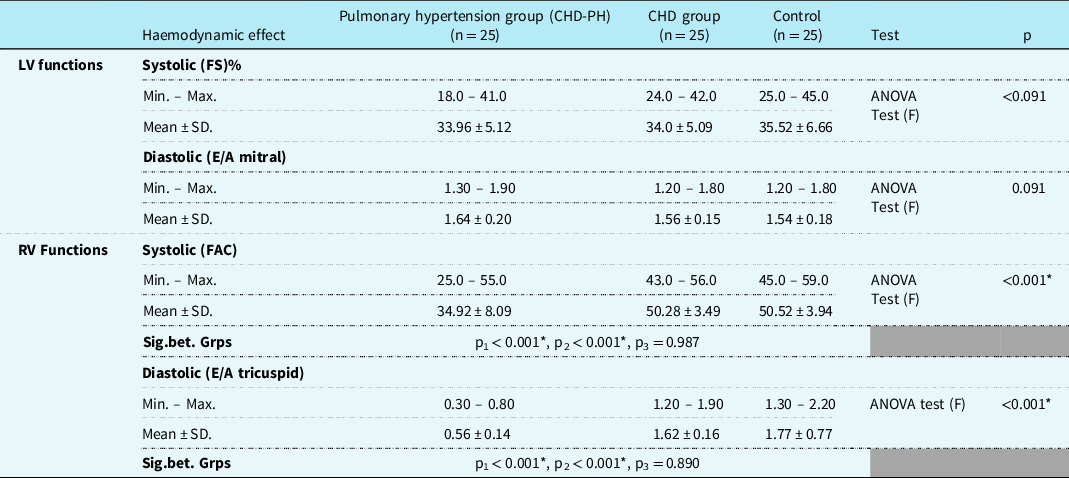
We found percentage of patients with dilated right atrium and right ventricles was significantly higher in patients with pulmonary hypertension group, and there was significant decrease in right ventricular fractional area change and (E/A ratio) on the tricuspid valve in the pulmonary hypertension group as compared to the CHDs and the control groups (Table 2).
Comparison between the three studied groups according to haemodynamic data by echocardiography

F: F for ANOVA test, pairwise comparison between every 2 groups was done using post hoc test (Tukey).
p: p value for comparing the studied groups.
p1: p value for comparing CHD-PH and CHD.
p2: p value for comparing CHD-PH and Control.
p3: p value for comparing CHD and Control.
*: Statistically significant at p ≤ 0.05.
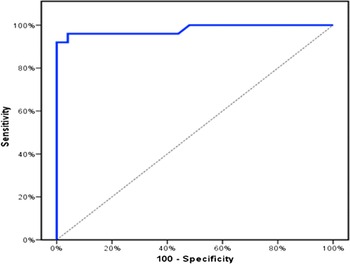
The mean plasma level of mid-regional proadrenomedullin significantly increased in the pulmonary hypertension group as compared to the CHDs and the control groups (Table 3). The best cut-off point of mid-regional proadrenomedullin as a diagnostic biomarker to discriminate pulmonary hypertension group from patients without pulmonary hypertension in CHD group was 199.22 nmol/l, with 92% sensitivity, 96% specificity, 95.8% positive predictive value, 92.3% negative predictive value, and area under the curve 0.980 (Fig 1).
ROC curve for mid-regional pro-adrenomedullin (MR-pro ADM) as a diagnostic biomarker to discriminate patients with pulmonary hypertension from patients without pulmonary hypertension.

Comparison between the three studied groups according to plasma mid-regional proadrenomedullin (MR-proADM)

IQR: Interquartile range.
H: H for Kruskal–Wallis test, pairwise comparison between every 2 groups was done using post hoc test (Dunn’s for multiple comparisons test).
p: p value for comparing the studied groups.
p1: p value for comparing CHD-PH and CHD.
p2: p value for comparing CHD-PH and Control.
p3: p value for comparing CHD and Control.
*: Statistically significant at p ≤ 0.05.
In our results, 10 patients died in pulmonary hypertension group, while there was no death among the CHD or the control group. Four patients died due to right side heart failure, while 6 patients developed severe pneumonia and sepsis which did not respond to treatment, and the patients died later.
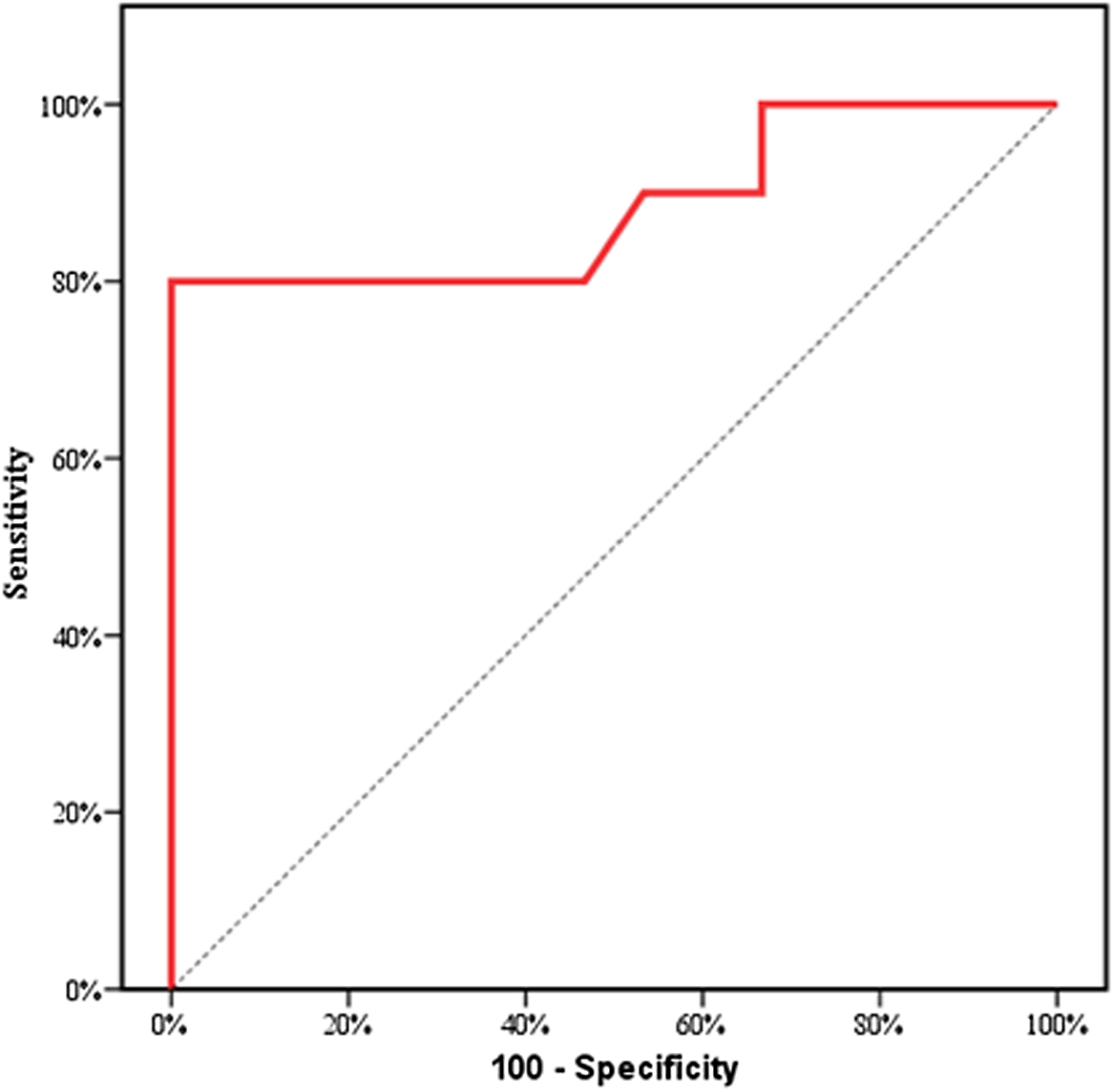
Mid-regional proadrenomedullin was significantly higher in patients who died (620.96 ± 185.52nmol/l) as compared to patients who survived (332.19 ± 103.61nmol/l) (p < 0.05). The best cut-off point of mid-regional proadrenomedullin to discriminate died from survived patients was 428,8 nmol/l, with 80% sensitivity, 86.67% specificity, 80% positive predictive value, 86.7% negative predictive value, and area under the curve 0.883 (Fig 2).
ROC curve for mid-regional pro-adrenomedullin (MR-pro ADM) to predict mortality.

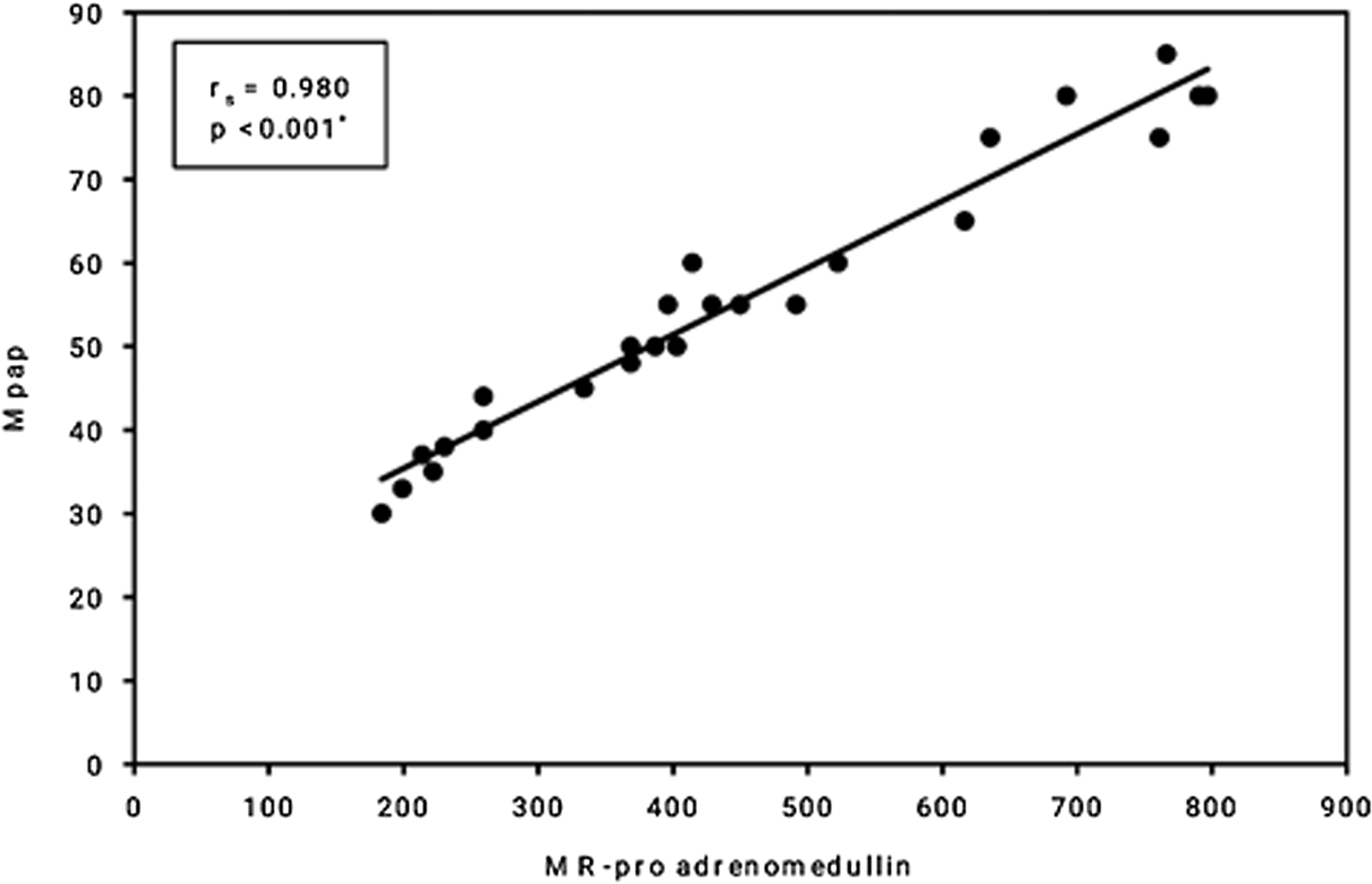
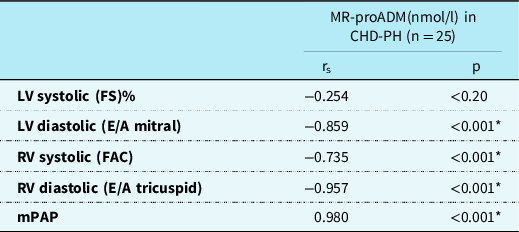
The correlation between mid-regional proadrenomedullin and different echocardiographic parameters in patients with pulmonary hypertension showed significant positive correlation with the mean pulmonary artery pressure, whereas there was significant negative correlation with right ventricular fractional area change, (E/A ratio) on the tricuspid valve, and E/A ratio on the mitral valve (Table 4, Fig 3).
Correlation between mid-regional pro-adrenomedullin and mean pulmonary artery pressure in patients with pulmonary hypertension.

Correlation between mid-regional proadrenomedullin (MR-proADM) and different parameters in patients with pulmonary hypertension (CHD-PH)

rs: Spearman’s coefficient, mPAP: mean pulmonary artery pressure.
*: Statistically significant at p ≤ 0.05.
Discussion
Pulmonary arterial hypertension is a progressive disease in which increase in the pulmonary vascular resistance due to vasoconstriction and remodelling leads to increased pulmonary arterial pressure, right ventricular failure, and ultimately death.Reference Simonneau, Galiè and Rubin16
Adrenomedullin is involved in the physiology of pulmonary circulation and the pathophysiology of pulmonary hypertension.Reference Yoshibayashi, Kamiya and Kitamura17
Clinical use of adrenomedullin was limited for some time because of the in vitro instability of this biomarker, its half-life is short, and it is quickly removed from the circulation. This problem was solved by the use of mid-regional proadrenomedullin, a stable fragment whose concentrations reflect those of adrenomedullin.Reference Potocki, Ziller and Mueller18
In the present study, there was significant decrease in the weight and the body surface area in children with CHDs either with or without pulmonary hypertension as compared to the control group. This comes in agreement with Li et alReference Li, Li and Tan19 and Azakie et alReference Azakie, Johnson and Anagnostopoulos20 who reported significant decrease in the body weight in children with CHDs with or without pulmonary hypertension. This could be explained by inadequate caloric intake, feeding difficulties, and increased metabolic demands as a result of their cardiac lesions with increased sympathetic activity. Furthermore, repeated infection associated with some CHDs is another contributing factor.
The current study showed that, using echocardiography, dilated right atrium and dilated right ventricle were significantly higher in pulmonary hypertension group. The right ventricular systolic and diastolic functions were significantly decreased in patients with pulmonary hypertension. These results come in agreement with the conclusions obtained by Elnoamany et alReference Elnoamany, Ahmed and Ragab21 who reported that the rate of right ventricular dysfunctions, systolic and diastolic, was significantly higher in patients with pulmonary hypertension, using strain imaging echocardiography. Similar results were also reported by Bréchot et alReference Bréchot, Gambotti and Lafitte22 and Vorhies et al.Reference Vorhies, Gajarski and Yu23
The present study showed that the mean plasma level of mid-regional proadrenomedullin significantly increased in the pulmonary hypertension group as compared to the CHDs and the control groups. This comes in agreement with Bouzina and Radegran,Reference Bouzina and Radegran24 who studied adrenomedullin as cardiac biomarkers in adult patients in relation to pulmonary arterial hypertension haemodynamics, risk assessment, prognosis, treatment response, and differentiation. They found that plasma adrenomedullin levels were higher in pulmonary arterial hypertension patients than in healthy controls, similar to that in chronic thromboembolic pulmonary hypertension patients, but lower as compared to pulmonary hypertension due to left-sided heart failure.
Kakishita et alReference Kakishita, Nishikimi and Okano7 also reported increased adrenomedullin in adult patients with pulmonary hypertension due to different aetiology. They studied the effect of treatment with nitric oxide and found that plasma levels of adrenomedullin did not change significantly after nitric oxide inhalation.
In comparison with our study, Zamzam et alReference Zamzam, Shedeed and Mohammed25 and Salem et alReference Salem, Saleh and Soliman26 reported significant increase in mid-regional proadrenomedullin levels among children with heart failure compared to the healthy control groups.
We searched for the best cut-off point of mid-regional proadrenomedullin as diagnostic marker to discriminate patients with pulmonary hypertension as a complication of CHD. It was 199.22 nmol/l with 92% sensitivity and 96% specificity.
While in the study of Zamzam et al,Reference Zamzam, Shedeed and Mohammed25 validity of mid-regional proadrenomedullin level as diagnostic biomarker among the studied cases group showed that, at cut-off 219.29, mid-regional proadrenomedullin had sensitivity 70%, specificity 62.5%, and accuracy 66.3%. Moreover, Salem et alReference Salem, Saleh and Soliman26 said that mid-regional proadrenomedullin at cut-off point (126.055) had sensitivity (60%), specificity (76%), positive predictive value (71.43%), and negative predictive value (65.25%) to predict children with heart failure.
Also, Khan et alReference Khan, O’Brien and Struck27 found that in adult patients with heart failure due to acute myocardial infarction, mid-regional proadrenomedullin was identified as an independent predictor of diagnosis.
Our results also showed that mid-regional proadrenomedullin significantly increased in patients who died as compared to patients who survived. This may indicate the role of mid-regional proadrenomedullin in prediction of poor prognosis and mortality. This is in agreement with Gegenhuber et alReference Gegenhuber, Struck and Dieplinger28 and Salem et alReference Salem, Saleh and Soliman26 who reported that there was a statistical significance between the elevated serum levels of mid-regional proadrenomedullin and the in-hospital mortality in their studied groups.
In the present study, as regards correlation between mid-regional proadrenomedullin and different echocardiographic parameters in pulmonary hypertension group, there was significant positive correlation with the mean pulmonary artery pressure, while there were significant negative correlations with the right ventricular systolic and diastolic functions and the left ventricular diastolic function. These results are supported by the study of Kakishita et alReference Kakishita, Nishikimi and Okano7 as they demonstrated that plasma levels of adrenomedullin were significantly correlated with mean right atrial pressure, stroke volume, total pulmonary resistance, and mean pulmonary arterial pressure.
Bouzina and RadegranReference Bouzina and Radegran24 found that plasma adrenomedullin levels were significantly correlated to the mean right atrial pressure and N-terminal prohormone of brain natriuretic peptide and to the mortality risk scores of the European Society of Cardiology/European Respiratory SocietyReference Galie, Humbert and Vachiery2 and the REVEAL risk score.Reference Benza, Gomberg-Maitland and Miller29
In our study, we had some limitations including small sample size of included children; follow-up of the cases and predictive value of serum mid-regional proadrenomedullin level in response to the treatment of pulmonary hypertension were not performed.
Conclusion
Plasma levels of mid-regional proadrenomedullin were significantly elevated in children with CHDs complicated with pulmonary hypertension, and these levels were correlated to the severity of pulmonary hypertension and echocardiographic parameters of its assessment. Mid-regional proadrenomedullin could be used as a cardiac biomarker in pulmonary hypertension due to CHDs, with good diagnostic and prognostic value and high sensitivity and specificity.
Acknowledgements
We would like to thank the stuff members of Pediatric Cardiology Unit, Pediatric Department, Tanta University for their methodological support throughout the research.
Financial support
None.
Conflicts of interest
All authors have no potential conflict of interest to disclose.
Ethical approval
The study is in accordance with the ethical standards of institutional research committee and with the 1964 Helsinki declaration and its later amendments. The research protocal was presented to the ethical committee of the Faculty of medicine, Tanta University and it was accepted. Consents were taken from the parents or caregivers of the patients and we explained that results will be used for scientific research only.