Introduction
The occurrence of infectious diseases in natural populations is a consequence of interaction between pathogens, their hosts and the environment in which they live (Snieszko, Reference Snieszko, Brandly and Cornelius1973; Hedrick, Reference Hedrick1998; Reno, Reference Reno1998). Several studies have appreciated the importance of fish parasites as a biological tag (MacKenzie, Reference MacKenzie1990, Reference MacKenzie1999; Lafferty, Reference Lafferty1997), and many authors have attempted to analyse parasite–contaminant associations (Overstreet & Howse, Reference Overstreet and Howse1977; Khan, Reference Khan1987; Lehtinen, Reference Lehtinen1989; Axelsson & Norrgren, Reference Axelsson and Norrgren1991; Khan & Thulin, Reference Khan and Thulin1991; Poulin, Reference Poulin1992; Khan et al., Reference Khan, Barker, Williams-Ryan and Hooper1994; Lafferty, Reference Lafferty1997). Under eutrophic conditions, parasites tend to be host generalists, although favouring trematodes in particular (Marcogliese, Reference Marcogliese2001). A positive relationship has been reported between eutrophication and fish parasitism (Dogiel et al., Reference Dogiel, Pertrushevski and Polyanski1961; Dechtiar, Reference Dechtiar1972; Snieszko, Reference Snieszko1974; Hartmann & Nümann, Reference Hartmann and Nümann1977; Rumyantsev, Reference Rumyantsev, Nauer and Drozdov1988).
Numerous studies on the parasitic diseases in fish of the Kashmir Himalayas have been carried out previously, but the majority dealt with the systematics (Kaw, Reference Kaw1950, Reference Kaw1951; Raina & Dhar, Reference Raina and Dhar1972; Dhar & Kharoo, Reference Dhar and Kharoo1984, Reference Dhar and Kharoo1986; Chishti & Peerzada, Reference Chishti and Peerzada1998; Ara, Reference Ara2000; Fayaz & Chishti, Reference Fayaz and Chishti2000; Bashir & Yousuf, Reference Bashir and Yousuf2007) and the effect of water quality on fish parasites has not received due attention. Aquatic habitats, especially lentic water bodies, of the Kashmir Himalayas are under intense anthropogenic pressure and display significant changes in their biotic composition. Therefore, we thought it worthwhile to determine if a relationship exists between cultural eutrophication and occurrence and abundance of parasitic infection in the fish of these water bodies. Accordingly, an investigation was carried out on helminth infections in Schizothorax niger Heckel, 1838, which is an endemic cyprinid fish of Kashmir, found in the Anchar, Dal and Manasbal lakes, during September 2008–July 2009. The fish was selected because of its restricted home range, ease of sampling and ability to serve as a host for a relatively large number of parasite species (Overstreet, Reference Overstreet1997). The aim of the present study was to identify a relationship between environmental variables and the occurrence of helminth parasites in S. niger, and to assess the effect of changed water quality vis-á-vis nutrient enrichment on monoxenous and heteroxenous parasites in order to determine whether helminth parasites of fish could be used as a biological tag for environmental monitoring.
Materials and methods
Study sites
The valley of Kashmir is situated in the middle of the Himalayas between the north-west and south-east (33°01′–35°00′N latitude and 73°48′–75°30′E longitude) at an altitude ≥ 1500 m above sea level. The study was carried out in three valley lakes, namely Anchar Lake (34°01′N, 74°02′E), Dal Lake (34°07′N, 74°52′E) and Manasbal Lake (34°15′N, 74°40′E). Anchar Lake is at the north-west of Srinagar city at an elevation of 1583 m (5194 ft) with a maximum depth of 3 m. The lake basin is dominated by submerged and free-floating macrophytes. Three sites were selected for the present study: Anchar ghat, Anchar centre and Anchar inlet. Dal Lake is an urban lake that lies to the east of Srinagar city, at the foot of the Zabarwan Hills, and is situated at an average elevation of 1583 m (5194 ft) above sea level with a maximum depth of 6 m (20 ft). Four sites were selected at Dal Lake, namely Hazratbal basin, Gagribal basin, Nagin and Bud Dal. Manasbal Lake is a rural lake situated at a distance of 32 km from Srinagar city. Its length and breadth are approximately 3.2 and 1 km, respectively. The lake is situated at the altitudinal zone of 1585–1600 m (5200–5249 ft) with a maximum depth of 13 m (43 ft). Four sites were selected at this lake, one at the centre and three at the periphery.
The present investigation was carried out between September 2008 and July 2009. Fish and water samples were collected on monthly basis at different sites of three lakes.
Physico-chemical characteristics of the water
The physico-chemical characteristics of water were analysed as per the methods described by the Council for Scientific and Industrial Research (CSIR, 1974), Mackereth et al. (Reference Mackereth, Heron and Talling1978) and the American Public Health Association (APHA, 1998). Water temperature, conductivity and _transparency were recorded on the spot, whereas samples were fixed at the sampling site in accordance with the azide modification of the Winkler method (APHA, 1998) for the estimation of dissolved oxygen. Measurements were made using the following equipment/method(s): water temperature, Celsius mercury thermometer calibrated up to 0.1°C; transparency, Secchi disc; hydrogen ion concentration, digital pH meter (Microprocessor pH System-1011E, Environmental & Scientific Instrument Co., Harayana, India); conductivity, Systronics model 304 conductivity meter (Systronic Ahmedabad, Gujarat, India); total hardness, EDTA method (CSIR, 1974); total alkalinity and chloride, as per Mackereth et al. (Reference Mackereth, Heron and Talling1978); ammoniacal nitrogen, phenate method (APHA, 1998); and nitrate-nitrogen, salicylate method (CSIR, 1974). The data obtained for different parameters at various study sites of a water body over the entire study period were pooled in order to calculate the average values.
Collection and examination of fish
Live S. niger specimens were collected either directly from the selected sampling sites with a cast net or procured from local fishermen as soon as they brought their catch to the landing centre. The fish were kept fresh on ice in the field to prevent decomposition and transported to the laboratory, where total length (TL), standard length (SL), body weight (BW), sex and age for each specimen were determined. The length–weight relationship was calculated with the Le Cren's (Reference Le Cren1951) method (W = aL b), while the condition factor was calculated with Fulton's index (K = W/L 3 × 10⁵). After biometric studies, the occurrence of helminth parasites in the specimens was investigated. In total, 329 specimens (147 males and 182 females) were collected throughout the sampling period. Of these, 100 were from Anchar Lake, 132 from Dal Lake and 97 from Manasbal Lake.
Data analysis
Parasitic specimens were identified using reference keys described by Yamaguti (Reference Yamaguti1971), Bauer (Reference Bauer1987), Chubb et al. (Reference Chubb, Pool and Veltkamp1987) and Hoffman (Reference Hoffman1999). The level of parasite infection was quantified using prevalence, mean intensity and mean abundance as per Margolis et al. (Reference Margolis, Esch, Holmes, Kuris and Schad1982) and Bush et al. (Reference Bush, Lafferty, Lotz and Shostak1997). The scale of helminth infection was described as per Zander et al. (Reference Zander, Reimer and Barz1999), i.e. 1–1.9 parasites (low infection), 2–4.9 parasites (moderate infection), 5–19.9 parasites (strong infection) and ≥ 20 parasites (mass infection).
Pearson's correlation was used to detect correlations between different physico-chemical features and parasitic infections. Correlation analysis of data was carried out with SPSS 11.5 (SPSS Inc., Chicago, Illinois, USA). Scatter plots and trend lines were also used to demonstrate the relationship between water temperature and the prevalence of helminth parasites in different months. Student's t-test was used to test for differences in intensity and abundance of infection between the three lakes.
Results
Water quality
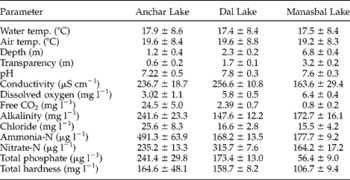
The mean values of various physico-chemical features, calculated from data collected monthly over a span of 11 months at 3–4 study sites at each lake are presented in table 1. Based on physico-chemical features, the three lakes belong in the eutrophic category, albeit at varying stages, with Manasbal Lake being the least eutrophic and Anchar Lake being the most eutrophic (or hypertrophic) type. According to the loading concept of Rawson (Reference Rawson1939), Ohle (Reference Ohle1956), Edmondson (Reference Edmondson1961) and the Organisation for Economic Cooperation and Development (OECD, 1982), Anchar Lake was considered a highly eutrophic, or hypertrophic, lake and Manasbal Lake was the least eutrophic lake (Pandit & Yousuf, Reference Pandit and Yousuf2002).
Average physico-chemical characteristics of water in three lakes*.

* The data procured for different parameters at various study sites of a water body for the whole period of study were pooled and the average values determined.
Composition and levels of infection of helminth species
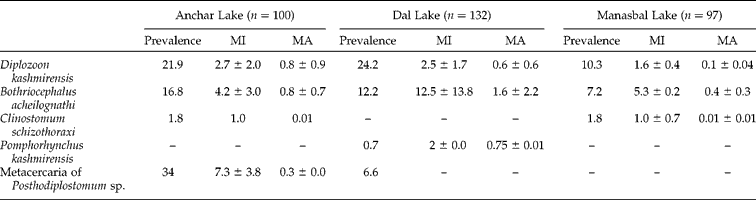
Five species of helminth parasites were detected in the three valley lakes: a monogenean gill parasite, Diplozoon kashmirensis; an intestinal cestode (Asian tapeworm), Bothriocephalus acheilognathi; metacercaria of Clinostomum schizothoraxi; an acanthocephalan parasite, Pomphorhynchus kashmirensis; and metacercaria of Posthodiplostomum sp. The prevalence of each of these parasites in the three lakes is shown in table 2. The overall prevalence of helminth infections was generally greater in Anchar Lake (prevalence = 18.6%) as compared to Manasbal Lake (prevalence = 6.4%). Comparison of mean intensity and mean abundance of fish helminth infections in the three lakes demonstrated a significant relationship with respect to mean intensity (t-test = 4.7, P = 0.04) and an insignificant relationship with respect to mean abundance (t-test = 2.2, P = 0.16).
Prevalence, mean intensity (MI; mean ± SD) and mean abundance (MA; mean ± SD) of helminth parasites in Schizothorax niger; n=number of hosts.
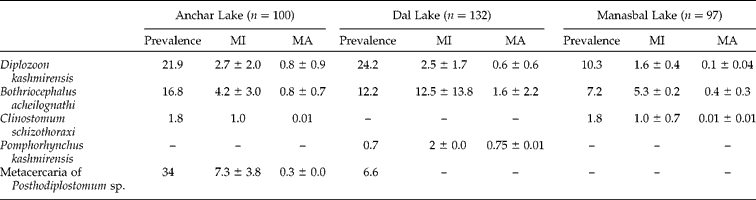
SD, standard deviation.
The overall prevalence of monoxenous and heteroxenous parasites tended to be higher in fish from lakes experiencing more degradation of water quality (i.e. Anchar and Dal). A comparison of prevalence between monoxenous parasites in the three lakes demonstrated a significant relationship with respect to prevalence (t-test = 4.4, P = 0.05). Interestingly, the highest infection level of monoxenous parasites was recorded from Dal Lake (prevalence = 24.2%), whereas the highest infection level for heteroxenous parasites was recorded from Anchar Lake (prevalence = 17.5%). The monogenean gill parasite D. kashmirensis was the most abundant and most prevalent specimen in all lakes except in Anchar Lake, where the metacercaria of Posthodiplostomum sp. were the dominant parasite.
Diversity characteristics of the infra-community are presented in table 3. The overall species diversity of S. niger helminth parasites was the highest in Anchar Lake (1.3 ± 0.3) and lowest in Manasbal Lake (0.2 ± 1.5). Similarly, the maximum number of helminth parasite species per fish was slightly higher in the hypertrophic lake (1.6) in comparison to the least eutrophic lake (1.5).
Overall diversity profile of the infra-community of helminth parasites of S. niger from three lakes.

Water quality and prevalence of infection
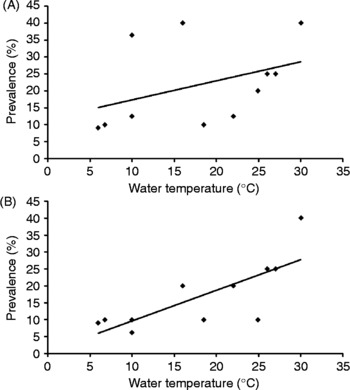
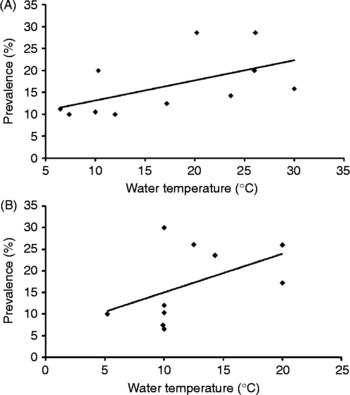
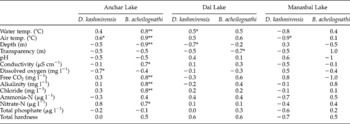
For Anchar Lake, prevalence of B. acheilognathi demonstrated a significantly positive correlation with water temperature (r = 0.8, P < 0.01; fig. 1B) and air temperature (r = 0.9, P < 0.01). Similarly, for Dal Lake, D. kashmirensis demonstrated a significantly positive correlation with water temperature (r = 0.5, P < 0.05; fig. 2A). In addition, depth was related to a significantly negative correlation in prevalence between Anchar and Dal lakes (r = − 0.7, P < 0.05 for D. kashmirensis in Dal Lake and r = − 0.9, P < 0.01 for B. acheilognathi in Anchar Lake). Dissolved oxygen demonstrated a significantly negative correlation to the prevalence of D. kashmirensis in Anchar Lake (r = − 0.7, P < 0.05). The correlation between prevalence of some of the helminth parasites and environmental variables is given in table 4.
(A) Prevalence of Diplozoon kashmirensis in Schizothorax niger collected from Anchar Lake in 2008–2009 plotted against water temperature in different months. The relationship is insignificant (r 2 = 0.15, P>0.05; y = 0.6x+11.8). (B) Prevalence of Bothriocephalus acheilognathi in S. niger collected from Anchar Lake in 2008–2009 plotted against water temperature in different months. The relationship is significant (r 2 = 0.586, P < 0.01; y = 0.9x+0.6).

(A) Prevalence of Diplozoon kashmirensis in Schizothorax niger collected from Dal Lake in 2008–2009 plotted against water temperature in different months. The relationship is significant (r 2 = 0.3, P < 0.05; y = 0.4x+8.6). (B) Prevalence of Bothriocephalus acheilognathi in S. niger collected from Dal Lake in 2008–2009 plotted against water temperature in different months. The relationship is insignificant (r 2 = 0.23, P>0.05; y = 0.9x+5.9).

Correlation between prevalence of some helminth parasites and environmental variables in three lakes.

** Correlation significant at 0.01 (two-tailed).
* Correlation significant at 0.05 (two-tailed).
Discussion
A number of researchers (Dogiel et al., Reference Dogiel, Pertrushevski and Polyanski1961; Snieszko, Reference Snieszko1974; Chubb, Reference Chubb1980; Beer & German, Reference Beer and German1993; Kennedy & Watt, Reference Kennedy, Watt and Cowx1994; Marcogliese, Reference Marcogliese2001; Lafferty & Kuris, Reference Lafferty, Kuris, Thomas, Guégan and Renaud2005) have suggested that natural abiotic factors such as temperature, oxygen, salinity, hydrogen ion concentration and eutrophication have a positive influence on the occurrence of parasitic populations and communities. The present data also support this observation. Evidence from the present study suggests that water temperature plays an important role in the progression of helminth parasites. Temperature increases the growth period of parasites and shortens the generation time (Chubb, Reference Chubb1980; Ernst et al., Reference Ernst, Whittington, Corneillie and Talbot2005). Under these conditions, parasites are in a position to complete their life cycle rapidly. However, not all parasites respond to the rise in temperature in the same way, as the tolerance range varies between species (Chubb, Reference Chubb1979, Reference Chubb1980). The significant positive correlation between helminth parasites and the temperature in the hypertrophic Anchar Lake could be due to the combined effect of nutrient enrichment and rise in average temperatures of the lake.
Harsh environmental conditions may reduce the immunological capabilities of parasite hosts, rendering them more susceptible to some parasites (Khan, Reference Khan1990; Khan & Thulin, Reference Khan and Thulin1991; Overstreet, Reference Overstreet, Couch and Fournie1993; MacKenzie et al., Reference MacKenzie, Williams, Williams, McVicar and Siddall1995; Rigby & Moret, Reference Rigby, Moret, Poulin, Morand and Skorping2000). However, it is rather difficult to attribute an increase in helminth infection directly to deteriorating environment quality, as the exact effect of any stress is likely to vary based on genetic constitution within a species (Blanford et al., Reference Blanford, Thomas, Pugh and Pell2003). The high prevalence of helminth parasites in Anchar Lake may be due to the negative effect that increased environmental stress conditions may have on the host. The high infection level of helminth parasites in Anchar Lake supports the notion that eutrophication increases the susceptibility of intermediate hosts (Beer & German, Reference Beer and German1993; Kennedy & Watt, Reference Kennedy, Watt and Cowx1994). The high prevalence of external parasites in specimens from Anchar Lake and their low prevalence in specimens from Manasbal Lake are in agreement with previous reports stating that fish hosts living in degraded habitats tend to have more external parasites than those in uncontaminated habitats. The increased prevalence of the Asian tapeworm in Anchar Lake could be due to the lake's features such as shallow depth, small size and distribution of macrophytes (Mackie et al., Reference Mackie, Morton and Ferguson1983; Sandland & Goater, Reference Sandland and Goater2000; Morley et al., Reference Morley, Irwin and Lewis2003), which are characteristics of a eutrophic water body.
Mean intensity and mean abundance of helminth infections in fish were greater in Dal Lake as compared to the other two lakes. These differences could be because diet/feeding behaviour of hosts may have a positive effect on the infection intensity of helminths. Other biotic factors, such as host–parasite interaction, host species, schooling behaviour, age and length of host, and host condition can affect the abundance and prevalence of parasites (Williams & Jones, Reference Williams and Jones1994).
The increased level of both monoxenous and heteroxenous helminth parasites in eutrophic conditions depict the parasites' positive response to the overall increase in nutrient enrichment. The dominance of the heteroxenous parasite, Posthodiplostomum sp. in Anchar Lake (the hypertrophic lake) indicates that this parasite probably enjoys local recruitment and is favoured by hypertrophic conditions (Marcogliese, Reference Marcogliese2001). However, compared to the heteroxenous types, monoxenous parasites are more affected by environmental degradation as they are more susceptible to a wide range of pollutants (Blanar et al., Reference Blanar, Munkittrick, Houlahan, MacLatchy and Marcogliese2009). The present investigation revealed more parasite species in Anchar and Dal lakes (four species) and fewer in Manasbal Lake (three species). The high diversity profile in Anchar Lake is consistent with earlier reports stating that nutrient enrichment is correlated with positive trends in parasite species richness (Valtonen et al., Reference Valtonen, Holmes and Koskivaara1997; Galli et al., Reference Galli, Grosa, Berloglio, Mariniella, Ortis and D'Amelio2001). However, our results do not correspond with the findings of Nachev & Sures (Reference Nachev and Sures2009) who reported that parasite diversity was highest in Silistra (which had low levels of pollution and eutrophication) as compared to that in Vidin (high levels of pollution and eutrophication).
The present study conclusively demonstrates that deteriorating water quality and trophic status influence the level of helminth infection of fish in a lake's ecosystem. This study is expected to provide a platform for further investigations to explore the possible role of parasites as indicators of pollution. Accordingly, it is suggested that studies on population dynamics of helminth parasites of fish should also be integrated with bio-monitoring programmes to provide supplementary information on the pollution status of a water body.
Acknowledgements
Financial assistance by the University Grants Commission (UGC) to U.R.Z. in the form of a fellowship is acknowledged.