Mental health is the state of wellness that allows individuals to practice their skills, cope with daily stress, work successfully and contribute significantly to their environment (Bones, Pérez, Rodríguez-Sanz, Borrel, & Obiols, Reference Bones, Pérez, Rodríguez-Sanz, Borrel and Obiols2010). This definition, according to the recommendation of the World Health Organization (WHO), focuses on the positive physical, mental and social dimensions of mental health rather than simply the absence of disease. The first studies examining mental health in educators were published in the mid-twentieth century, and this work continues today. A pioneer in the field, Cruze, has proposed training courses to help teachers overcome feelings of inferiority and insecurity. Health problems related to adaptation to work have been noted since the 1960s, and several solutions have been proposed, including administrative changes, training courses and improving relationships between parents and teachers. In the 1970s, a shift occurred such that mental health problems became linked to individual rather than socio-labor variables. During the 1980s, mental health problems were associated with job stress and workplace conditions, with the phenomenon of burnout gaining special importance. Currently, in the twenty-first century, teachers´ mental health problems are attributed to work environment, teacher-pupil relations, or teachers´ dispositional variables, among others (Pishghadam & Sahebjam, Reference Pishghadam and Sahebjam2012).
Stress at work, Mental Health and Emotions
Sources of stress in teaching remains a topic of interest in all educational settings and several levels may be distinguished (Schaufeli, Reference Schaufeli2005): the organizational level (conflict among colleagues, scarcity of material, spatial or personal resources); the task level (role ambiguity and conflict, time pressure); the interpersonal level (lack of student motivation, disruptive behavior) and the personal level (unmet job expectations, self-esteem). Teachers’ health problems include mental health (anxiety, depression), physical health (headaches, cardiovascular reactivity) and behavioral symptoms (sick leave, absenteeism; Extremera, Fernández-Berrocal, & Durán, Reference Extremera, Fernández-Berrocal and Durán2003). Several studies have shown that individual variables minimize the effects of stress on physical and mental health in teachers (Klag & Graham, Reference Klag and Graham2004; Shen, Reference Shen2009), and in organizational contexts, increasing attention is being given to the study of individual differences and resources as protective factors against work stress (Brouwers & Tomic, Reference Brouwers and Tomic2000; Friedman, Reference Friedman2003).
Human strength against adversity and traumatic experiences is central to Positive Psychology (PP). A central theme of PP is the study of positive individual traits (Seligman & Csikszentmihalyi, Reference Seligman and Csikszentmihalyi2000). Among these positive traits, Peterson and Seligman (Reference Peterson and Seligman2004), highlight the importance of Emotional Intelligence (EI), as a character strength that contributes to the virtue of humanity. EI as an individual skill acts as a protective factor against stress affecting mental, social and physical health (Martins, Ramalho, & Morin, Reference Martins, Ramalho and Morin2010). Two models of EI coexist (Cherniss, Reference Cherniss2010), grouped into ability models and mixed models (Lopez-Zafra, Pulido-Martos, & Augusto-Landa, Reference Lopez-Zafra, Pulido-Martos and Augusto-Landa2013; Mayer, Caruso, & Salovey, Reference Mayer, Caruso, Salovey, Bar-On and Parker2000). From the ability model (Mayer & Salovey, Reference Mayer, Salovey, Salovey and Sluyter1997; Salovey & Mayer, Reference Salovey and Mayer1990), EI is observed as a pyramidal structure composed of four basic skills: (1) the ability to perceive, appraise and express emotions accurately (emotional perception), (2) the ability to access and/or generate feelings when they facilitate thought (emotional integration), (3) the ability to understand emotions, emotional knowledge and emotional reasoning (emotional understanding), and (4) the ability to regulate one’s own and others' emotions to promote emotional and intellectual growth (emotional regulation). The ability model recommends the use of performance measures to assess EI. In these instruments, people face emotional situations that have a more suitable solution than other. An example of these instruments is the Mayer-Salovey-Caruso Emotional lntelligence Test (MSCEIT; Mayer, Salovey, & Caruso, Reference Mayer, Salovey and Caruso2002). Mixed models (i.e. the Bar-On model of emotional-social intelligence, Bar-On, Reference Bar-On2006; and the Boyatzis- Goleman model, Boyatzis & Sala, Reference Boyatzis, Sala and Geher2004), consider El as a combination of personality traits and dispositional (motivation, optimism ...) and cognitive skills, evaluated with the use of self-report measures.
An alternative to the above models is the trait El model (Petrides & Furnham, Reference Petrides and Furnham2003) which integrates personality traits associated to affect (Mikolajczak, Luminet, Leroy, & Roy, Reference Mikolajczak, Luminet, Leroy and Roy2007). This approach also uses self-report measures to assess EI, such as the Trait Emotional Intelligence Questionnaire (TEIQue; Petrides, Reference Petrides2009).
One of the most widely used self-report measures of EI is the meta-knowledge of emotional states scale (Trait Meta-Mood Scale, TMMS; Salovey, Mayer, Goldman, Turvey, & Palfai, Reference Salovey, Mayer, Goldman, Turvey, Palfai and Pennebaker1995). This scale addresses Perceived Emotional Intelligence (PEI), or the knowledge possessed by individuals about their own emotional skills, as opposed to real capacity (Salovey, Stroud, Woolery, & Epel, Reference Salovey, Stroud, Woolery and Epel2002). The dimensions of this scale, which correspond with theoretical content of PEI, are: emotional attention that refers to the perceived ability to focus on the moods and emotions; emotional clarity regarding the perceived ability to discriminate between feelings; and emotional repair referred to perceived ability to repair or reverse the negative emotions.
Relationship between EI and Mental Health
PEI is correlated with the level of stress experienced. Thus, high PEI (specifically low levels of emotional attention and high levels of emotional clarity) is related to low levels of general symptoms associated with stress (Extremera, Durán, & Rey, Reference Extremera, Durán and Rey2010). Moreover, high levels of emotional repair relate to the use of adaptive coping strategies (Salovey et al., Reference Salovey, Stroud, Woolery and Epel2002). Furthermore, it has been shown that high emotional attention and low emotional clarity and repair increase the presence of depressive and anxious symptoms (Extremera & Fernández-Berrocal, Reference Extremera and Fernández-Berrocal2006). Furthermore, relations among general health and PEI dimensions emerge when the health status is assessed with self-report measures, such as the SF-36. Specifically, emotional attention was associated with low levels of Emotional Role (the extent of problems at work or in the development of daily activities due to emotional problems), Social Functioning (degree to which the frequency of usual social activities decreases due to physical and emotional problems) and Mental Health (assessment of the general mental health when considering depression, anxiety, self-control and general well-being), whereas emotional clarity and emotional repair were associated with high scores in Physical Role (degree of problems with work or other daily activities due to physical health), Social Functioning, Mental Health, Vitality (feeling of energy and vitality) and General Health (assessment of health status, including the current situation, future prospects and resistance to illness). An additional explanation for the SF-36 dimensions can be seen on Ware, Snow, Kosinski, & Gandek (Reference Ware, Snow, Kosinski and Gandek1993) and Ware & Sherbourne (Reference Ware and Sherbourne1992). Similarly, a recent longitudinal study with adolescents (Salguero, Palomera, & Fernández-Berrocal, Reference Salguero, Palomera and Fernández-Berrocal2012) showed that individuals with high emotional attention and low clarity and repair had poor psychological adjustment (increased anxiety, depression, social stress and low levels of mental health). Additionally, unhealthy behaviors, such as consumption of tobacco, alcohol and drugs, have also been associated with low levels of EI (Limonero, Tomás-Sábato, & Fernández Castro, Reference Limonero, Tomás-Sábato and Fernández Castro2006).
EI and teachers´ coping strategies
Several studies have examined the role of EI and psychological adjustment in teachers. The results show that teachers who perceive themselves with the ability to understand and regulate their emotional states use active and adaptive strategies to cope with stressful academic environments (Augusto-Landa, Lopez-Zafra, & Pulido-Martos, Reference Augusto-Landa, Lopez-Zafra and Pulido-Martos2011; Mearns & Cain, Reference Mearns and Cain2003). These results were also confirmed in basic level research. For example, Salovey et al. (Reference Salovey, Stroud, Woolery and Epel2002) found in lab research that emotional repair associates to an increased use of active coping strategies (actions to reverse the perception of a stressful situation or alleviate its effects) and a lower use of passive coping strategies (avoidance or active inhibition response) with the exception of the strategies of distraction that are positively associated to emotional repair. Additionally, EI has several benefits for teachers. For instance, teachers with enhanced EI experience higher levels of engagement and life satisfaction, lower levels of perceived stress (Pena & Extremera, Reference Pena Garrido and Extremera Pacheco2012), and cope better with occupational stress (Brackett, Palomera, Mojsa-Kaja, Reyes, & Salovey, Reference Brackett, Palomera, Mojsa-Kaja, Reyes and Salovey2010) than those with decreased EI. These results corroborate similar findings in other populations in which high EI enhances psychological adjustment (Martins et al., Reference Martins, Ramalho and Morin2010).
The main objective of this study is to show the importance that the ability of managing perceived emotions has in the relation between the perception of occupational stress sources and levels of mental health. This relation has been clearly established in scientific literature but further research is needed to clarify which is the role of PEI in this relation and specifically which of the PEI dimensions has a particular importance in this hypothesized relation. In analyzing this we go one step further in the research. In sum, the aim of the current study was two-fold: (1) to analyze the associations between PEI, sources of occupational stress and mental health; and (2) to determine whether PEI moderates the relationship between sources of occupational stress and mental health.
We present the following hypotheses
H1: There will be a relationship between the components of PEI and the dimensions of occupational stressors and mental health. Specifically, we expect that high emotional attention will be associated with high sources of occupational stress and low mental health. Additionally, we also expect that high clarity and emotional repair will be associated with decreased occupational stressors and enhanced mental health.
H2: PEI is expected to have a moderating role between sources of occupational stress and mental health. Specifically, the relationship between sources of stress and mental health components will be moderated by the components of the PEI.
Method
Participants
Two hundred and fifty elementary school teachers (89 men: 35.5% and 161 women: 64.5%) with age ranging from 22 to 60 years old (M = 39.0; SD = 11.3) from different schools in Jaén (Spain) participated in this study. Of them, 140 were married, 103 single and 7 separated. A total of 126 individuals did not have children, 27 had one child, 67 had 2 children and 30 individuals had three or more children. With regard to their educational level, 208 were graduated in Teaching and 42 were further graduated in Psychopedagogy.
Regarding the length of service, 124 had 9 years or less experience, 50 between 10 and 20 years of experience, 50 between 21 and 30 years of experience and 26 participants had over 30 years of experience.
Instruments
Work and socio-demographic data.
We designed an ad hoc questionnaire for this study that included questions to obtain information on socio-demographic and work variables (participant's age, sex, marital status, number of children, educational level, role in the school, length of service, employment status and grade level received).
Perceived Emotional Intelligence.
To assess PEI, we used the Spanish version (Fernández-Berrocal, Extremera, & Ramos, Reference Fernández-Berrocal, Extremera and Ramos2004) of the Trait Meta-Mood Scale (TMMS) (Salovey et al., Reference Salovey, Mayer, Goldman, Turvey, Palfai and Pennebaker1995) that includes a 24-item Likert scale ranging from 1 to 5. The scale consists of three dimensions of intrapersonal type compounded by eight items each: emotional attention (e.g., "I think about my mood constantly", “I usually spend time in thinking about my emotions”), emotional clarity (e.g., "I am usually very clear about my feelings", “I usually can define my feelings”) and emotional repair (e.g., "Although I sometimes feel sad, I usually take an optimistic view", “Although I feel bad, I try to think of nice things”). Following the original authors’ suggestion (Salovey et al., Reference Salovey, Mayer, Goldman, Turvey, Palfai and Pennebaker1995), the raw scores of the TMMS scales were transformed into a scale that ranges from 8 to 40, and higher scores reflect greater attention, clarity, and repair.
Sources of occupational stress.
We used an adaptation of the Sources of Stress Scale in Teachers (SSST; Nogareda Cuixart, Reference Nogareda Cuixart2001) developed in Spanish by the National Institute for Occupational Safety and Health at Work (NIOSHW). The original scale includes 56 items that are rated on a scale from 1 to 5, with 1 indicating a minimum level of stress and 5 indicating a maximum level of stress. The seven dimensions this instrument cover are: supervision by the hierarchical structure (monitoring), shortages for labor development (deficiencies), lack of participation, communication (cooperation), related to students´ behavior (students), adapting to change (adaptation), the valuation of work by others (valuation) and the improvements to be gained from the professional point of view (improvements).
Our idea was, from a preventive approach, to select the factors associated with a level of intervention on the organization and the work environment (Quick, Reference Quick1999). Thus, we selected 13 items corresponding to the four dimensions more directly related to primary prevention strategies tending to reduce or eliminate negative consequences of work stress (Cooper, Quick, & Schabracq, Reference Cooper, Quick and Schabracq2009). The content of these items were related to intrinsic aspects of work, the performance of work roles, the development of professional career or the organizational structure. For the selection we used the greater factor loadings value as criteria and the selection was as follow: 4 items from the monitoring dimension (i.e., "A hierarchical structure inadequate in my center", “Lack of support from management team”), 3 items from the deficiencies dimension, (i.e., "Undefined of my responsibilities", “Too much contents to deliver within the time available” and “Unfamiliarity with many of the exigencies to which I face”), 2 items from the adaptation dimension, (i.e. "Tutoring in areas that are not my specialty" and “Having to replace absent colleagues”) and 4 items from the improvements dimension (i.e., "Lack of opportunities to apply for center transfers”; “The fact that being a good teacher does not necessarily imply promotion").
Mental health.
We used the Spanish version (Alonso, Prieto, & Antó, Reference Alonso, Prieto and Antó1995) of the Medical Outcomes Study 36-item Short Form Health Survey (SF-36; Ware & Sherbourne, Reference Ware and Sherbourne1992). The SF-36 comprises a series of items that report positive and negative states of physical health and emotional well-being. The questionnaire identifies eight dimensions of health: physical function, physical role, physical pain, general health, vitality, social function, emotional role and mental health. The authors’ factor analysis of the SF-36 identified two factors: Physical Health (including physical function, physical role and physical pain) and Mental Health (including mental health, emotional role and social function). In the present study, only the three Mental Health dimensions were used. The mental health scale is composed by 5 items assessing how the person has felt over the last 4 weeks, two sample items are: over the last 4 weeks, how often: “Have you felt so down in the dumps that nothing could cheer you up?” or “Have you been a happy person?” The emotional role scale assess whether the person had any emotional problem impacting on his/her work or other regular activities through the following questions: “Have you cut down the amount of time you spent on work or other activities?”, “Accomplished less than you would like?”, and “Didn’t do work or other activities as carefully as usual?”. The social function scale consists on the following two items: “During the past 4 weeks, to what extent has your physical health or emotional problems interfered with your normal social activities with family, friends, neighbours, or groups?” and “During the past 4 weeks, how much of the time has your physical health or emotional problems interfered with your social activities (like visiting with friends, relatives etc.)”. The raw scores of SF-36 scales were transformed into a scale from 0 (worst possible) to 100 (best possible) following the original authors’ suggestions (Ware & Sherbourne, Reference Ware and Sherbourne1992).
Procedure
Schools were selected via stratified random sampling. After selection, the centers were contacted, informed about the research and asked to participate. Participation was voluntary for schools and teachers. Teachers completed the questionnaires in their staff room. Relevant instructions were given to all participants before beginning to ensure the anonymity of their data. The mean time participants spent in completing questionnaires was about 50 minutes.
Statistical analyses
To test H1, partial correlations adjusted for age were performed to explore the relationships between the different variables of the study. In addition, partial correlations were also computed regarding to sex. To test H2, we performed hierarchical linear regression analyses adjusted for age and sex to determine if EI moderates the relationship between teachers´ sources of stress (monitoring, deficiencies, adaptation, and improvements) and PEI (attention, clarity, and repair) with mental health (social function, emotional role, and mental health). The criterion for inclusion of predictor variables in the model was a significance level alpha of .25 in bivariate exploratory analyses. This criterion avoids discarding important variables when considered with other variables in multivariate models. Before carrying out the regression analyses, each predictor variable was centered by subtracting its mean and the product terms of components of PEI and components of sources of occupational stress were calculated to represent the interactions. Then, predictor variables were introduced in three steps: sources of occupational stress in the first step, PEI in the second and the interactions terms in the third step (Table 3). In this way, effects of the predictors may be more easily distinguished from the effects of the interactions. Additionally, to illustrate the significant interactions, regression lines for individuals with low (–1 SD) and high (+1 SD) components of sources of occupational stress were plotted for low (–1 SD) and high (+1 SD) levels of PEI components. The squared semi partial correlation (sr 2 ) of each significant interaction was compute as an effect size statistic. The sr 2 indicates the unique amount of variance accounted for in the criterion by a specific predictor in the model. Squared semi partial correlation values of .01, .09, and .25 representing small, medium, and large effect sizes, respectively.
Descriptive, correlation and regression analyses were performed with Statistical Package for Social Sciences (IBM SPSS Statistics for Windows, version 20.0; Armonk, NY). Additionally, EQS 6.1 was used for the analysis of the structure of the sources of stress instrument through a confirmatory factor analysis. Significance level was set up p < .05 (two-tailed) for all the analyses.
Results
Validity of the instrument for assessing sources of stress in teachers
As we only used 13 items, we analyzed our short version using a confirmatory factor analysis (CFA) to determine if this short-version of the SSST comprises the four selected dimensions. Data showed a lack of multivariate normality, and thus, corrected indices were used. Specifically, we used the corrected Satorra-Bentler χ2 statistic (S-B χ2), the Comparative Fix Index (CFI), the rate of non-normative fit (NNFI, Non-Normed Fit Index) and the mean square error of approximation (RMSEA, Root Mean Square Error of Approximation) with confidence intervals at 90% (90% CI).
For all estimates we used the maximum likelihood method (ML) and the ROBUST option. As the significance of S-B χ2 may be affected by sample size, we considered the ratio of the statistic and the degrees of freedom. The values of the indices of fit are shown in Table 1. All rates are in the recommended range, indicating an adequate fit of the measurement model. Pearson correlation coefficients among dimensions with the selected items and the original ranged from .74 and .91. Regarding reliability, all Cronbach alphas´ values were acceptable (Table 2).
Indices of adjustment values of the model (n = 250)

Note: χ2 S-B: χ2 Satorra-Bentler; df: Degrees of freedom; CFI: Comparative Fix Index; NNFI: Non-Normed Fit Index; RMSEA: Root Mean Square Error of Approximation.
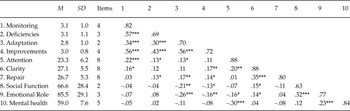
Descriptives and correlations among variables (n = 250)

Note: *p < .05; **p < .01; ***p < .001. Analyses controlled for age.
Reliability of the variables of the study is shown at the diagonal. We report correlation coefficient for scales of two items and Cronbach's alpha for more than two items scales.
Correlation Analyses
Table 2 shows significant correlations between PEI and sources of occupational stress were observed. Attention was positively correlated with monitoring, deficiencies, and adaptation (r = .22, .13, and .13; respectively). Positive associations of clarity with monitoring, and improvements were also found (r = .16, and .17; respectively). Additionally, emotional repair was positively correlated with deficiencies, adaptation, and improvements (r = .13, .17, and .14; respectively).
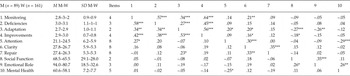
Our findings also indicated significant correlations between PEI and mental health. Attention was negatively associated to emotional role and mental health (r = –.16, and –.30; respectively). A positive association between clarity and social function and emotional role was found (r = .15, and .14; respectively). Table 3 provides values of semi partial correlations by gender.
Descriptives and partial correlations among variables after adjusting by age for men (lower diagonal) and women (upper diagonal)

Note: M = Men; W = Women; *p < .05; **p < .01; ***p < .001.
Hierarchical multiple steps regression analysis
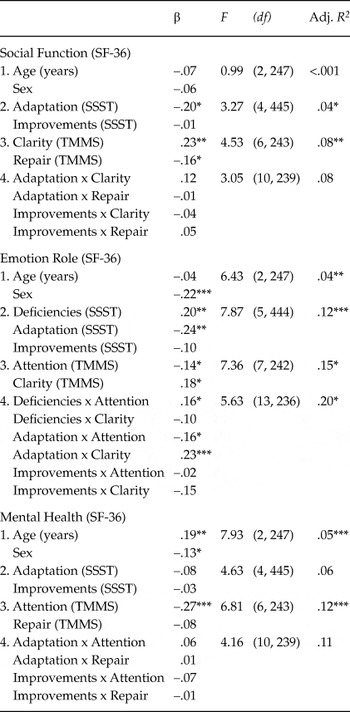
As Table 4 (top) illustrates, PEI components did not moderate the relationship between sources of occupational stress and social function. Additionally, the second step accounted for a ∼4% of the variance in social function with only stress by adaptation significantly associated with the criterion variable (β = –.20, p < .05). The third step shows significant associations of both clarity and repair with social function (β = .23, p < .01; β = –.16, p < .05; respectively), accounting for an additional 4% of the variance in the outcome variable.
Hierarchical multiple regression examining the associations of sources of job stress (monitoring, deficiencies, adaptation, and improvements) and perceived emotional intelligence (attention, clarity, and repair) with mental health (social function, emotional role, and mental health); (n = 250)

Note: *p < .05; **p < .01; ***p < .001. Analyses controlled for age and sex.
β: Standardized Regression Coefficient; df: Degree of freedom; Adj. R 2: adjusted R 2 with significance levels of F-change; SF-36: Medical Outcomes Study 36-item Short Form Health Survey; SSST: Sources of Stress in Teachers’ scale; TMMS: Trait Meta-Mood Scale.
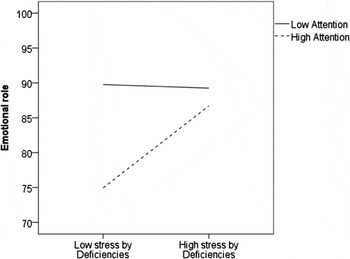
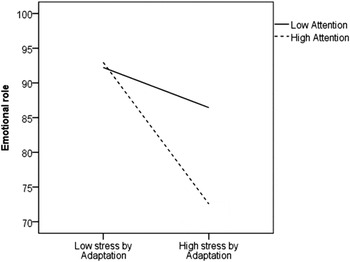
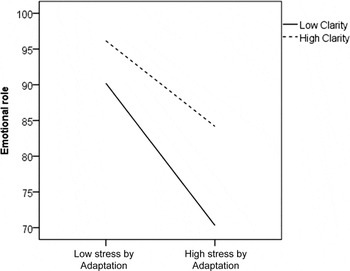
Table 4 (middle) shows that PEI components moderate the relationship between sources of occupational stress and emotional role. Specifically, each significant interaction (i.e., deficiencies x attention, adaptation x attention, and adaptation x clarity) made a small and unique contribution of ∼2% in the explanation of emotional role (all p < .05, all sr 2 ∼ .02). Figure 1 illustrates that in situations where stress by deficiencies is low, teachers with high levels of emotional attention have their emotional role affected, but this is not the case for teachers with low levels of emotional attention. Figure 2 shows that in situations of high levels of adaptation stress, teachers high in emotional attention have their emotional role negatively affected, but this is not the case in teachers with low levels of emotional attention. Finally, Figure 3 illustrates that situations with high levels of stress mildly affect the emotional role of individuals with low levels of emotional clarity.
Deficiencies x Emotional Attention interaction.

Adaptation x Emotional Attention interaction.

Adaptation x Emotional Clarity interaction.

Table 4 (middle) also shows significant associations of sources of occupational job and PEI components with emotional role. Step 2 indicates that both stress by deficiencies and adaptation were significantly associated with emotional role (β = .20, p < .01; β = –.24, p < .01) accounting for the ∼8% of the variance in the outcome variable. Step 3 demonstrated that attention and clarity significantly accounted the ∼3% of the variance in emotional role (β = –.14, p < .05; β = .18, p < .05).
Table 4 (bottom) indicates that PEI components did not moderate the association between sources of occupational stress and mental health. Additionally, the second set of variables, with adaptation and improvements as sources of stress, was not significant. The third set of variables was significant, driven by the negatively related emotional attention (β = –.27; p < .001) and accounting for the ∼6% of the mental health variance.
Discussion
The aim of this study was to explore the moderator role for the PEI´s components emotional attention, emotional clarity and emotional repair on work stressors and mental health components in a sample of elementary school teachers.
Regarding H1 and H2, our results show that individuals with a low ability to identify, distinguish and describe emotions in daily life, but that are able to prolong positive emotional states and reduce negative ones, report that emotional or physical problems derived from their lack of health scarcely interfere with their social function. The interactions with emotional role show that in situations of low levels of stress by deficiencies, the health of teachers with high levels of emotional attention is affected. Thus, emotionally attentive individuals may understand their emotions but be negatively impacted nonetheless if they lack the ability to differentiate motives, causes and consequences (Thayer, Rossy, Ruiz-Padial, & Johnsen, Reference Thayer, Rossy, Ruiz-Padial and Johnsen2003). For these individuals with high emotional attention and low emotional clarity and repair, emotional role may be affected even when work stress levels are low. This finding may be due to an emotional spiral that leads to the development of ruminative thoughts out of control of the individuals, thus maintaining a negative mood rather than providing relief (Fernández-Berrocal, Ramos, & Extremera, Reference Fernández-Berrocal, Ramos and Extremera2001). Other studies show that individuals with high levels of emotional attention report a higher number of somatic (Augusto-Landa & Montes-Berges, Reference Augusto-Landa and Montes-Berges2009) and depressive symptoms and anxiety (Augusto-Landa, Berrios-Martos, Lopez-Zafra, & Aguilar-Luzón, Reference Augusto-Landa, Berrios-Martos, Lopez-Zafra and Aguilar-Luzón2006; Segarra et al., Reference Segarra, Rodriguez, Lizeretti, Castell, Segura, Farriols, Palma, Fernández-Berrocal, Extremera, Palomera, Ruiz-Aranda, Salguero and Cabello2011). In any case, low levels of emotional clarity and repair are can explain the positive association between high attention to emotions and negative mood (Extremera & Fernández-Berrocal Reference Extremera and Fernández-Berrocal2006; Salguero & Iruarrizaga Reference Salguero and Iruarrizaga2006; Salovey et al., Reference Salovey, Mayer, Goldman, Turvey, Palfai and Pennebaker1995; Thayer et al., Reference Thayer, Rossy, Ruiz-Padial and Johnsen2003). Additionally, the results demonstrate that emotional clarity moderates the influence of adaptation stress. Specifically, in high stress situations, individuals with low levels of emotional clarity are less affected in emotional role. These results are contrary to previous studies (Augusto-Landa et al., Reference Augusto-Landa, Berrios-Martos, Lopez-Zafra and Aguilar-Luzón2006; Extremera et al., Reference Extremera, Durán and Rey2010) that show that these individuals are better able to know how to respond to work demands before stress affects their mental health. However, if we consider that emotional role refers to the grade of emotional problems affecting daily activities and that individuals low in emotional clarity are less able to identify, distinguish and describe their daily emotions, then it is possible that they do not perceive emotional problems. Thus, stress for adaptation would scarcely influence emotional role.
The results point out that the interaction of emotional repair with occupational stress sources adds nothing in explaining levels of mental health. Moreover, regression analyses show that emotional repair, along with clarity, account for a small percentage of additional variance in social function (but not other dimensions of mental health). However, research on the relationship emotion-Mental Health highlights the importance of managing emotional experiences in the issuance of adaptive responses to the point of considering emotional regulation as an intrinsic element of mental health (Berking & Wupperman, Reference Berking and Wupperman2012; Gross & Muñoz, Reference Gross and Muñoz1995).
In our analysis, the amount of additional variance accounted for by considering the emotional role interactions between sources of occupational stress and PEI dimensions was only 5%. However, in psychosocial science, small changes in r 2 not always indicate a lack of contribution in explaining the criterion variable, provided that a large number of predictors have been included in the previous steps. In fact, Hunsley and Meyer (Reference Hunsley and Meyer2003) consider that a sr 2 of .15– .20, in the third step of the regression analysis, highly contributes to the prediction of the criterion variable and, moreover, it takes into account the shared variance between all the predictor variables. Thus, the introduction of interactions between sources of occupational stress and size of PEI in the third step, and sr 2 obtained for relations with the emotional role (.02) can be interpreted as significant and substantial (Rossen & Kranzler, Reference Rossen and Kranzler2009).
Regarding mental health, our results indicate that participants who pay close attention to their emotions report poorer health. These results are in agreement with those found in other studies (Augusto-Landa et al., Reference Augusto-Landa, Berrios-Martos, Lopez-Zafra and Aguilar-Luzón2006; Extremera & Fernández-Berrocal, Reference Extremera and Fernández-Berrocal2006). These studies show that the ability to discern between emotional states, understand, and correctly regulate them is essential to protect physical and mental health. Moreover, it is necessary to have a moderate level of emotional attention, as high and low levels in this PEI dimension impede access to emotional information, which would be detrimental to clarify and repair emotional states (Joseph & Newman, Reference Joseph and Newman2010), provoking a poor psychological adjustment (Salguero & Iruarrizaga, Reference Salguero and Iruarrizaga2006).
Regarding limitations, it should be noted that all measures used in this study come from the same source. Thus, the relationships found among variables may have been increased by the introduction of a common response bias of participants, related to common method variance. In future studies, the use of additional converging measures with different formats could help solving this problem. Moreover, the type of cross-sectional design prevents us from establishing causal relationships between the variables analyzed. Thus, future research should employ longitudinal designs to examine the benefits of training teachers in emotional competences and to analyze its impact on stress and mental health. It would also be of interest to use performance tests of EI to analyze interpersonal emotional abilities.
FE-L was supported by a grant from the Spanish Ministry of Economy and Competitiveness [BES-2014-067612].