Does the promotion of women to high political office increase the voice of other women in politics? The factors that determine the appointment of women to political leadership roles have been the subject of increasing study in recent years (Barnes and O'Brien Reference Barnes and O'Brien2018; Escobar-Lemmon and Taylor-Robinson Reference Escobar-Lemmon and Taylor-Robinson2009; Heath, Schwindt-Bayer and Taylor-Robinson Reference Heath, Schwindt-Bayer and Taylor-Robinson2005; Krook and O'Brien Reference Krook and O'Brien2012; O'Brien Reference O'Brien2015), but we know considerably less about the implications of these appointments for the behaviour of other politicians. This is surprising, as the idea that female leaders can have important effects on the experiences of other women is well established in electoral politics (Beaman et al. Reference Beaman2009; Gilardi Reference Gilardi2015; Wolbrecht and Campbell Reference Wolbrecht and Campbell2007), education (Beaman et al. Reference Beaman2012; Bettinger and Long Reference Bettinger and Long2005; Brajer and Gill Reference Brajer and Gill2010; Nixon and Robinson Reference Nixon and Robinson1999) and business (Bertrand et al. Reference Bertrand2019; Wang and Kelan Reference Wang and Kelan2013). In this article, I evaluate the effects of female leadership in a legislative setting by studying whether the appointment of female cabinet ministers in the UK increases the participation and influence of other female members of parliament (MPs) in House of Commons debates.
Political debate is an important setting for evaluating female leadership effects. The ways in which individuals interact in group discussions can provide important insights into relative distributions of power, particularly with regard to gender (Karakowsky, McBey and Miller Reference Karakowsky, McBey and Miller2004), and when speaking is a mechanism for collective decision making, inequalities in participation and influence may reflect deeper inequalities between groups (Karpowitz and Mendelberg Reference Karpowitz and Mendelberg2014, 115). Gender-based inequalities are present in British political debate: in the period I study, although women occupied approximately one-fifth of the seats in parliament, they accounted for only one-tenth of the speaking time in the typical parliamentary debate (see Appendix Section 1). Such descriptive evidence is concerning because if ‘some kinds of people routinely speak more than others in deliberative settings…then participation isn't equal, and one democratic standard has fallen’ (Sanders Reference Sanders1997, 365). Understanding the conditions under which female legislators participate and hold influence in political debates is therefore important for evaluating the representation of women's interests in politics more broadly.
There is growing evidence that increasing the number of women in a group has important consequences not only for gender participation gaps in political discussion (Ban et al. Reference Ban2018; Karpowitz, Mendelberg and Shaker Reference Karpowitz, Mendelberg and Shaker2012), but also for the set of issues that discussion addresses (Mendelberg, Karpowitz and Goedert Reference Mendelberg, Karpowitz and Goedert2014), and how often female discussants are interrupted (Mendelberg, Karpowitz and Oliphant Reference Mendelberg, Karpowitz and Oliphant2014). However, this study is the first to consider whether female leadership also affects the processes or outcomes of political debate. Cabinet ministers – the leaders I study – are key figures in the UK legislative process who play the central role in parliamentary business, including debate, that relates to their ministries. I argue that the appointment of a female cabinet minister has the potential to affect the behaviour of other women in two ways.
First, the appointment of women to cabinet minister positions may help to break down historically constructed stereotypes about the policy domains to which women are well suited to contribute. By undermining these stereotypes, female cabinet ministers may act as role models to other female parliamentarians. Secondly, female ministers may also behave differently from their male colleagues, and in so doing may promote a debating culture that is more conducive to, and encouraging of, the participation and influence of other female MPs than that which has traditionally existed in the UK. Taken together, these arguments suggest that appointing a female minister will lead to higher levels of female participation and influence in debates over which she presides.
However, causal identification of leadership effects presents an empirical challenge. Women are more likely to be appointed to lead traditionally ‘feminine’ cabinet posts (Escobar-Lemmon and Taylor-Robinson Reference Escobar-Lemmon and Taylor-Robinson2009; Krook and O'Brien Reference Krook and O'Brien2012), and disproportionately contribute to debates that deal with traditionally ‘feminine’ policy areas (Bird Reference Bird2005; Catalano Reference Catalano2009). Therefore, simple estimates of the relationship between cabinet minister gender and female debate participation will be upwardly biased. To make progress, I focus on within-ministry variation in the gender of the cabinet minister over time. I compare female debate participation in ministries before and after a switch in the minister's gender, and compare this difference to changes in female participation in other ministries where the gender of the minister remains constant. This approach allows me to rule out any omitted variable bias that could be attributed to any fixed tendencies of women to engage with the work of particular ministries and not others. Using this framework to analyse almost half a million speeches between 1997 and 2017, I demonstrate that female ministers increase the participation of female MPs in relevant debates by approximately 20 per cent over the level of female participation under male ministers.
However, if other parliamentarians ignore the issues women raise in their speeches, then the substantive importance of this effect may be negligible. I address this issue by building on new techniques for identifying important speakers in political debate (Erkan and Radev Reference Erkan and Radev2004; Fader et al. Reference Fader2007), which I use to examine the relative influence of male and female MPs' speeches. The measurement strategy is based on the assumption that the more that an MP's language is adopted by other MPs in subsequent speeches, the more influential is the MP. Using this measure, I show that women are also more influential in debate when their female colleagues are elevated to high office, but men's influence in debate remains constant regardless of minister gender.
Turning to mechanisms, I provide evidence that female ministers behave systematically differently in debate towards female MPs than do male ministers. I introduce a new quantitative measure of ministerial responsiveness which assumes that a minister is more responsive when the language they use to reply to a backbencher is more similar to the words the backbencher uses. I show that female ministers are substantially more responsive than their male counterparts to the speeches made by female MPs, but that there is no gendered difference in ministerial responses to the speeches made by male MPs. These findings do not rule out the possibility of purely symbolic ‘role model’ effects, but they do suggest that the ways in which these women behave towards their female colleagues is a potentially important mechanism through which they can increase the prominence of other women in parliament.
A central focus of legislative scholars studying gender issues has concerned the link between descriptive representation – the number of women elected to parliament – and substantive representation – the incorporation of women's interests into policy outcomes (Wängnerud Reference Wängnerud2009). This article contributes to a growing literature which argues that, in addition to their numerical strength, the heights to which female politicians rise also matters for the incorporation of women's preferences in the policy process (Chattopadhyay and Duflo Reference Chattopadhyay and Duflo2004; Childs and Krook Reference Childs and Krook2009; Humphreys, Masters and Sandbu Reference Humphreys, Masters and Sandbu2006). These findings also suggest that female political leaders matter for women's representation, though through an underappreciated mechanism: their presence amplifies the voice of other women in politics.
Female leadership and voice in parliamentary debate
Why might the appointment of women to positions of high office affect the participation and influence of other women in political debate? I consider two potential mechanisms through which gendered leadership effects might operate in the parliamentary setting.
First, female leaders are often thought to be role models who provide examples of success for other women, and in so doing help to undermine stereotypic beliefs (Asgari, Dasgupta and Cote Reference Asgari, Dasgupta and Cote2010; Dasgupta and Asgari Reference Dasgupta and Asgari2004) that are often the source of negative evaluations of women's capabilities (Eagly and Johnson Reference Eagly and Johnson1990). An extensive literature argues that female role models in politics can have inspirational effects, because seeing other people ‘like them’ being active and successful in political life encourages women to increase their rates of political participation. In electoral politics, for example, where countries have higher proportions of female representatives, women are more likely to discuss politics, and to participate in political activities (Campbell and Wolbrecht Reference Campbell and Wolbrecht2006; Wolbrecht and Campbell Reference Wolbrecht and Campbell2007). The election of female politicians also affects the career aspirations of adolescent girls (Beaman et al. Reference Beaman2012) and increases the propensity for other women to stand for elections (Beaman et al. Reference Beaman2009; Gilardi Reference Gilardi2015). Similarly, in education, assignment to same-sex teachers can significantly improve students' educational achievements (Nixon and Robinson Reference Nixon and Robinson1999), influence course choices (Bettinger and Long Reference Bettinger and Long2005), and improve communication between students and teachers (Brajer and Gill Reference Brajer and Gill2010). Appointing women to corporate boards can also increase the number of women occupying other leadership positions within business (Bertrand et al. Reference Bertrand2019; Wang and Kelan Reference Wang and Kelan2013).
In the parliamentary setting, the historical under-representation of women in leadership roles is one factor that makes the role-model mechanism plausible. Women are systematically under-represented in leadership positions cross-nationally (Heath, Schwindt-Bayer and Taylor-Robinson Reference Heath, Schwindt-Bayer and Taylor-Robinson2005; Krook and O'Brien Reference Krook and O'Brien2012), are appointed to leadership roles in unfavourable circumstances (O'Brien Reference O'Brien2015), and tend to control low-prestige and ‘feminine’ portfolios (Escobar-Lemmon and Taylor-Robinson Reference Escobar-Lemmon and Taylor-Robinson2009; Studlar and Moncrief Reference Studlar and Moncrief1999). The historical marginalization of women in high-power roles may therefore create perceptions that certain policy areas, and even politics in general, represent distinctly ‘male domains’ (Sapiro Reference Sapiro1981, 712). Therefore, by breaking with historical patterns, the appointment of women to powerful cabinet positions may reverse the impression that women are unsuitable for participation in politics (Mansbridge Reference Mansbridge1999). Observing the success of one woman in a policy area may therefore send a signal that women in general are qualified to contribute to that domain.
However, while there is anecdotal evidence that some female MPs in the UK do perceive women with cabinet appointments as role models,Footnote 1 these effects are likely to be less powerful for women in parliament than elsewhere in politics. Female politicians may inspire other women to participate actively in electoral politics, but women in the legislature already have extensive political experience, and are less likely to be affected by seeing other people like them in positions of power. As Karpowitz and Mendelberg (Reference Karpowitz and Mendelberg2014, 334) argue, many well-known gendered behaviours may not apply to elite women, because elites are different: ‘it takes an unusual woman to seek…office…and an even more unusual woman to do what it takes to obtain it’. Because of this, we should not expect role modelling to be as strong a determinant of behaviour for elite women as for women in the population at large.
Beyond simple role-model effects, however, female leaders may also behave differently from their male counterparts, and do so in ways that is conducive to the participation and influence of other women. Theorists argue that the ‘deeply embedded culture of masculinity’ (Lovenduski Reference Lovenduski2005, 48) that pervades parliament is contra-indicated to female influence in political discussion. Legislatures are marked by highly gendered conversational dynamics in which male contributions to policy making are ‘heard’ more than female contributions (Hawkesworth Reference Hawkesworth2003; Kathlene Reference Kathlene1994). In the UK, the declamatory and adversarial style of Westminster debate (Childs Reference Childs2004, 10; Lovenduski Reference Lovenduski2005, 54) is seen as particularly antithetical to the participation and influence of women in the policy process. More broadly, women frequently face speaking environments that are less conducive to their participation than men, even in highly professionalized settings. For example, female Supreme Court justices and lawyers in the United States are more likely to be interrupted and ‘talked over’ than men, and these experiences are associated with them speaking less in deliberations (Dietrich, Enos and Sen Reference Dietrich, Enos and Sen2017). Similarly, experimental evidence suggests that in male-dominated groups women are likely to be interrupted more often by men (Mendelberg, Karpowitz and Oliphant Reference Mendelberg, Karpowitz and Oliphant2014); discussion will focus less on traditional ‘women's issues’ (Mendelberg, Karpowitz and Goedert Reference Mendelberg, Karpowitz and Goedert2014); and each individual woman will speak less (Karpowitz, Mendelberg and Shaker Reference Karpowitz, Mendelberg and Shaker2012).
Female leadership has the potential to alter these dynamics. For example, women tend to be more democratic in their approach to leadership (Eagly and Johnson Reference Eagly and Johnson1990). In the legislative setting, female committee chairs act more as facilitators, rather than directors, of committee discussions, speaking less and making fewer interruptions than their male counterparts (Kathlene Reference Kathlene1994). In the UK, female politicians employ a distinct form of language and debating style that is more cooperative, approachable and practical than that of their male colleagues (Childs Reference Childs2000, 68). In general, female rhetorical styles are less aggressive, more inclusive and more cooperative than male speech patterns (Karpowitz, Mendelberg and Shaker Reference Karpowitz, Mendelberg and Shaker2012, 534). Women also tend to be characterized by facilitative styles of speech, marked by high levels of politeness and responsiveness, while male speech is seen as less facilitative (Hannah and Murachver Reference Hannah and Murachver1999, Reference Hannah and Murachver2007) and these styles are strongly predictive of the speaking time of conversational partners (Thomson, Murachver and Green Reference Thomson, Murachver and Green2001). An important component of these styles is the degree to which participants acknowledge and respond to an individual's contributions to a discussion (Hannah and Murachver Reference Hannah and Murachver2007). Accordingly, one way in which female parliamentary leaders may affect the behaviour of other female parliamentarians is if there is differential responsiveness of male and female high-office holders. If female cabinet ministers provide higher-quality responses to the speeches of female legislators than do their male counterparts, the status of women in legislative debate is likely to increase when a woman is appointed. Such an increase in status could increase the degree of influence that women enjoy, and thus their willingness to participate in plenary debate.
Female leaders may affect the behaviour of other women in debate both by acting as role models and by changing debate dynamics. Although I do not directly measure the relative importance of these two mechanisms, I do provide evidence that is consistent with the idea that female cabinet ministers behave differently from male cabinet ministers during parliamentary debates. Nevertheless, both mechanisms imply the same reduced-form relationship between the appointment of a female cabinet minister and the behaviour of other women. Specifically, when a female MP is appointed to lead a ministry previously led by a man, I expect other female MPs will be more likely to participate in debates that pertain to that ministry than they would have been previously. In addition, as participation and influence in debate are closely related concepts (Karpowitz, Mendelberg and Shaker Reference Karpowitz, Mendelberg and Shaker2012; Kathlene Reference Kathlene1994, 573), I also expect that the influence of women in political discussion will increase when debates are presided over by a high-ranking woman.
Data and methodology
House of Commons Debates
I study House of Commons debates between May 1997 and February 2017. The full sample contains 53,398 debates and just over a million individual speeches.Footnote 2 These debates cover a wide variety of parliamentary business, the most important (and most common) of which relate to substantive motions, in which MPs express an opinion on some policy matter, and ministerial Question Time where MPs question government ministers on matters that pertain to their department's jurisdiction. Cabinet ministers play a central role in both substantive debates, where they speak to propose legislation for consideration, and in Question Time, where they answer questions from backbenchers.
The analysis requires mapping each debate to an individual government ministry. To assign debates to ministries, I note whether a current cabinet minister speaks in a given debate, and assign the debate to the ministry for which that cabinet minister is responsible. Where more than one cabinet minister speaks, I assign the debate to the ministry of the most frequently appearing cabinet minister. As some debates do not contain speeches from any cabinet ministers, the final sample for analysis contains 14,320 debates consisting of approximately 460,000 speeches.
The rules of debate participation in the Commons are permissive relative to other legislative settings. Party leaders have no control over which MPs participate as the non-partisan Speaker of the House allocates speaking time among members. MPs can register their interest to speak in a particular debate by writing to the Speaker, or can ‘catch the eye’ of the Speaker during debate by standing up in the chamber. An MP can also ‘intervene’ on the speech of another MP. Interventions are shorter impromptu remarks normally seeking to ask a question or make a point related to the current speech, and are granted only if the MP currently speaking ‘gives way’. MPs almost always grant interventions to both co-partisans and to MPs from opposing parties. Overall, although the Speaker has formal powers to select speakers, this power is used impartially, and restrictions are placed on MPs' speeches only in the most popular debates. In addition, interventions are completely beyond the Speaker's control. As a consequence, observed patterns of participation in debate are highly likely to reflect MPs' desires to participate in debate.Footnote 3
Methodology
The key independent variable throughout the analyses, FemaleMinister mt, is equal to 1 when the minister responsible for a given ministry m in time t is a woman, and 0 otherwise. Appendix Figure S3 shows the variation in this variable over time for all thirty-two ministries included in the sample.Footnote 4 During the study period, there are several ministries for which the responsible minister is never a woman – including the Defence Ministry and the position of Chancellor of the Exchequer – but no ministry is always controlled by a female minister. While I include all ministries in the analysis, identification relies only on ministries that experience a change in the gender of the cabinet minister over time.
The outcome variable in this section is the proportion of words spoken by female legislators in a debate, d, with each debate pertaining to ministry m and year-month t:
 $$Prop\;Words\;Women_{d(mt)} = \displaystyle{{\# \;{\rm words}\;{\rm spoken}\;{\rm by}\;{\rm wome}{\rm n}_{d(mt)}} \over {\# \;{\rm words}\;{\rm spoken}\;{\rm by}\;{\rm men}\;{\rm and}\;{\rm wome}{\rm n}_{d(mt)}}}$$
I exclude speeches made by ministers themselves (whether they are male or female) to ensure that the figures are not artificially inflated by female ministers speaking more after they are appointed. I also remove speeches made by the Speaker of the House, which are almost exclusively procedural. The measure defined in Equation 1 is clearly sensitive to the number of women in parliament – a quantity that varies over time – and so in Appendix Section S3 I replicate the analysis with alternative specifications of the dependent variable.Footnote 5
Simple comparisons between debates held under male and female ministers are likely to result in biased estimates of the effect of minister gender. There are two main identification concerns. First, systematic differences between ministries will likely affect the degree to which female legislators choose to participate in legislative debate, as well as the likelihood that women will be appointed to lead particular ministries. For example, previous research shows that women are significantly more likely to participate in legislative debates that relate to areas of traditional concern to women, including health care, children and family issues (Catalano Reference Catalano2009; Pearson and Dancey Reference Pearson and Dancey2011). Appendix Figure S2 suggests that such unobserved ministry characteristics are clearly influential in the data here. Women speak significantly more in ministries such as Education; Health; and Children, Schools and Families, and significantly less in debates pertaining to the Defence, Foreign and Justice ministries. In addition, cross-nationally, women are more likely to be appointed to ministerial portfolios that address ‘feminine’ issue areas (Barnes and O'Brien Reference Barnes and O'Brien2018; Escobar-Lemmon and Taylor-Robinson Reference Escobar-Lemmon and Taylor-Robinson2009; Krook and O'Brien Reference Krook and O'Brien2012). If the ministries to which women are appointed are those for which the rate of female participation is already high, then naive comparisons between debates presided over by female and male ministers are likely to be upwardly biased.
Secondly, the proportion of women holding seats in parliament changes over time, and in periods with more female legislators, women are clearly likely to contribute a greater proportion of words in parliamentary debates and will also be more likely to be selected for ministerial office. Again, if parliamentary turnover increases the number of women in parliament, then naive comparisons of female participation between male- and female-led ministries will be upwardly biased.Footnote 6
To overcome these problems, I estimate linear fixed-effects regressions of the following form:
 $$Prop\;Words\;Women_{d(mt)} = \beta _1 \times Female\;Minister_{mt} + {\rm \lambda} _m + \delta _t + \epsilon _{d(mt)}$$
where λm is a ministry fixed effect that washes out any omitted variable bias from unobserved ministry characteristics that are fixed over time (such as the degree to which a ministry deals with policies that are traditionally of greater concern to women), δ t is a year-month fixed effect to control for common shocks across ministries in a given month (such as the number of women in parliament), and ε d(mt) is the error term. β 1 is the coefficient of interest, and captures the reduced-form causal effect of the appointment of a female minister on the participation of women in debates for those ministries that experienced a change in minister gender over time.
This fixed-effect design is equivalent to a multi-period difference-in-differences analysis in the style of Angrist and Pischke (Reference Angrist and Pischke2009, 234). β 1 identifies the effect of switching from a male to female minister based on the within-ministry variation in the outcome variable among ministries that experience changes in the gender of the minister over time. By accounting for fixed characteristics of ministries that might predict both female debate participation and the appointment of a female minister, the model compares changes in female debate participation in ministries that experience a switch in minister gender to those in which the gender of the minister remains constant, while differencing out the general trends across ministries in a given month.
Identification of the causal effect relies on changes in minister gender being exogenous to the level of female debate participation, conditional on time and ministry fixed effects. The key identifying assumption is that treated ministries would have followed the same trend as non-treated ministries in the absence of treatment. I relax this assumption by estimating further models which include ministry-specific linear (λm1) and quadratic (λm2) time trends:
 $$\eqalign{Prop\;Words\;Women_{d(mt)} & = \beta _1 \times Female\;Minister_{mt} + \lambda _{m0} + \delta _t \cr & \hskip1pc + \lambda _{m1}t + \lambda _{m2}t^2 + {\rm \epsilon }_{d(mt)}} $$
where t is a time variable. Furthermore, in contrast to the typical multi-period difference-in-differences model, in this setting the treatment (the presence of a female minister) switches on and off over time. That is, once appointed, a female minister might leave office, and ministries often have multiple female ministers (appointed at different times) over the study period.Footnote 7 To account for the possibility that differential local trends within ministries might confound the causal effect, I also estimate generalized additive models (GAM) which include non-parametric ministry-specific time trends:
 $$\eqalign{Prop\;Words\;Women_{d(mt)} & = \beta _1 \times Female\;Minister_{mt} + \lambda _{m0} + \delta _t \cr & \hskip1pc+ \lambda _{m1}f\,(t) + {\rm \epsilon }_{d(mt)}} $$
These models represent extremely conservative specifications, as the addition of the ministry-specific trends means that all unobserved and smoothly varying confounding differences are removed from the estimate of β 1, and that only sharp changes to the trend in the outcome variable that occur at the same time as the change in minister gender contribute to this estimate. As none of the substantive or statistical results noticeably change when this crucial identifying assumption is relaxed, this lends significant support to the empirical design. I also provide further evidence of the validity of the identification assumption by estimating a dynamic panel model that estimates the treatment effect in the time periods before and after the actual change in minister gender, which I describe in more detail below. Finally, as there are only thirty-two ministries in the data, I construct bootstrapped standard errors, clustering at the ministry level (Cameron and Miller Reference Cameron and Miller2015).Footnote 8
Female ministers and debate participation
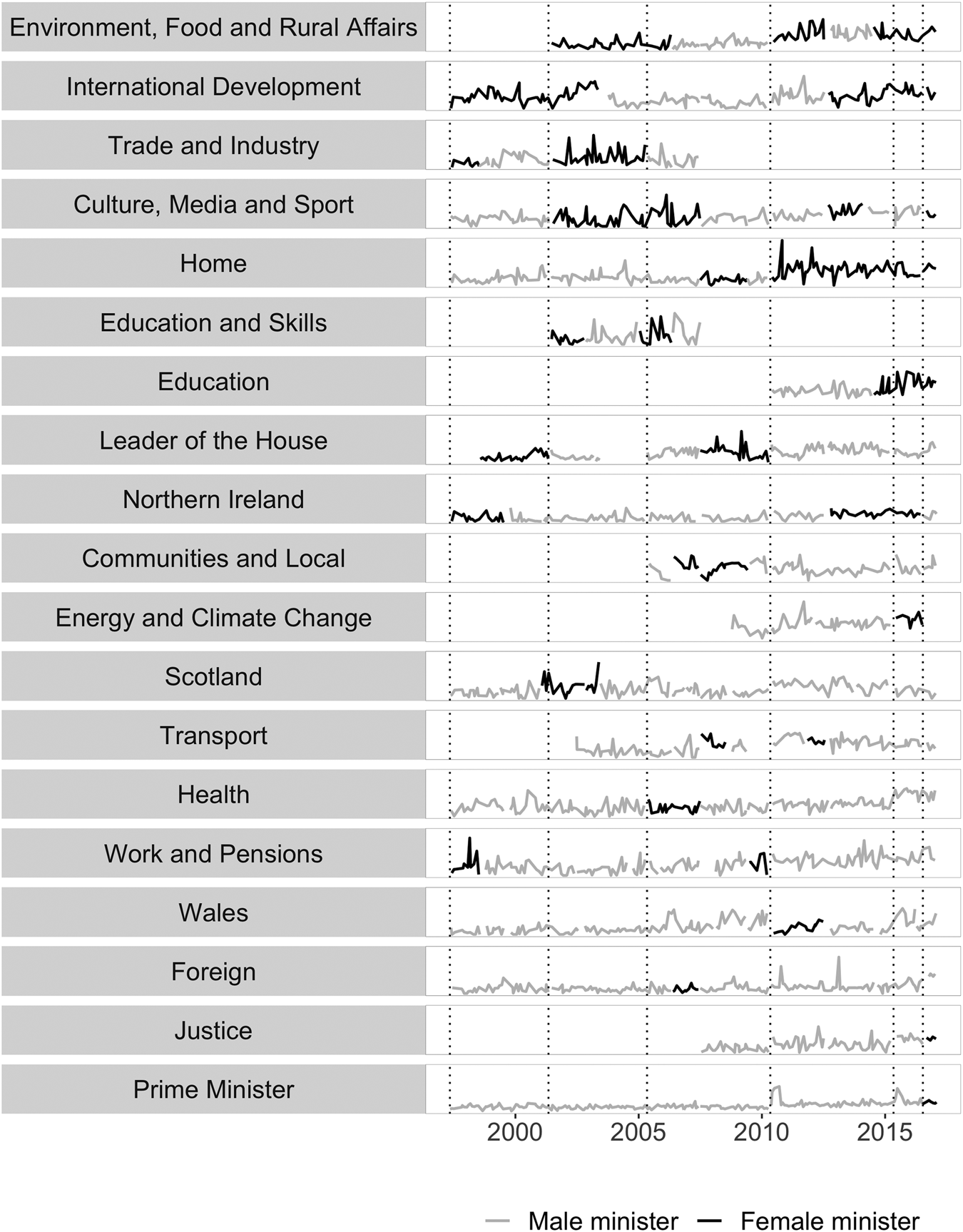
Before turning to the main results, I present a simple graphical analysis. Figure 1 shows, on the y-axis, the proportion of words spoken by female MPs in each month in each ministry that experienced a change in the gender of the minister, and the x-axis gives the date. Black line segments denote periods in which the presiding minister is female, and grey segments represent male ministers. The plot provides clear evidence of a female leadership effect while also revealing heterogeneity across ministries. In many cases, the appointment of a female minister is accompanied by an increase in the proportion of words spoken by other female MPs. The effect appears to be particularly pronounced in the Trade and Industry; Home; Culture, Media and Sport; and International Development ministries. By contrast, there is less evidence of an effect in some other ministries, though in no cases does the appointment of a female minister appear to decrease the participation of other female MPs.Footnote 9
Proportion of words spoken by women in treated ministries, over time
Note: the plot shows the proportion of words spoken by women in each calendar month in each ministry that experienced a change in the gender of the presiding minister.

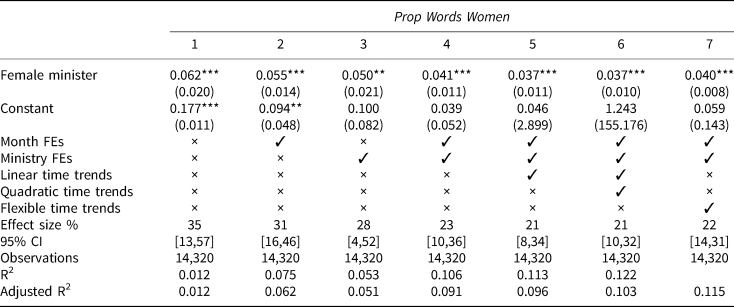
Table 1 presents the results of the regression analyses. Model 1 presents the naive estimate of the effect of a female minister, without controlling for ministry or year-month fixed effects. Models 2 and 3 introduce these fixed effects separately, and Model 4 presents the results of the difference-in-differences model which includes both fixed effects. The coefficient of the main variable of interest, Female Minister, is positive and significant in all four models, but it decreases noticeably when accounting for ministry. This suggests that female ministers are indeed appointed to lead ministries where the level of debate participation of other female MPs is already high. Nevertheless, the effect remains significant in Model 4, implying that the appointment of a female minister leads to an increase in debate participation of other female MPs. The size of the effect is also substantial. Based on Model 4, the appointment of a female minister increases the proportion of words used by women by 4.1 percentage points of total words. This corresponds to an increase of approximately 23 per cent [10 per cent, 36 per cent] over the average speech rate of women in debates under male ministers.
Effect of appointing a female minister on female debate participation

Note: regression coefficients are shown with bootstrapped standard errors (clustered by ministry) shown in parentheses. The ‘Effect Size’ row indicates the percentage change in female participation relative to the average under male ministers. *p < 0.1; **p < 0.05; ***p < 0.01
These results are robust to the introduction of linear, quadratic and non-parametric ministry-specific time trends in Models 5, 6 and 7. Based on Model 6, the appointment of a female minister increases the proportion of words spoken by other female MPs by 10–32 per cent. That the inclusion of ministry-specific time trends changes the estimates so little is encouraging, as it rules out the possibility that the effect is driven by either global or local trends in unobserved confounding variables.Footnote 10
An additional robustness check is presented in Appendix Figure S5, where I plot the estimates and 95 per cent bootstrapped confidence intervals (clustered by ministry) from a dynamic panel model. The coefficients from this model represent the estimated difference in the outcome between treated and untreated ministries in the periods before and after the treatment occurs. The results strongly support the identifying assumption, as I find no significant ‘placebo’ effects in the two years prior to the change in minister gender. This strengthens the plausibility of the design, as it suggests that there are no unobserved variables leading to differential trends in the outcome between the treatment and control ministries prior to the appointment of a female minister.
Finally, in Appendix Section S4 I report results from a series of analyses in which I re-estimate the main model (Equation 3) for different subsets of the data. First, leadership effects may be more likely to manifest for MPs who belong to the same party as the newly appointed cabinet minister, and may be less pronounced for MPs from opposition parties. I therefore subset to focus only on the effects for opposition MPs (all MPs whose party is not in government). Secondly, in the UK, the Labour Party has historically had more female MPs than other parties and it is possible that these pre-existing gender differences across parties also influence the strength of the effects. I therefore also rerun the main analysis focussing on the MPs of each party in turn. Thirdly, I investigate whether the Question Time debate format drives the main results here, by subsetting to Question Time and non-Question Time debates. Figure S4 summarizes the results of these analyses, and shows that there is very little heterogeneity in the effect across the different subsets.Footnote 11 In all cases, the main effect is positive and falls within the confidence intervals for Model 4 in Table 1, though in some cases the smaller sample size decreases the precision of these subset estimates.
Overall, the results presented in the graphical analyses, the main specifications, and in robustness checks provide strong support for the main claim of this article: when a female minister is appointed, other women speak approximately 20 per cent more in debates pertaining to that ministry than when the responsible minister is male.
Female ministers and influence
Changes in participation tell us little about how debate contributions are received by others in the House. If women speak at an increasing rate, but other parliamentarians ignore the issues and concerns they raise, then the substantive importance of the effects documented above may be limited. In this section, I use the texts of the parliamentary speeches to explore whether female backbenchers also play a more influential role in political debate under female ministers than under male ministers.
How might we identify ‘influential’ speakers? I consider an MP to be influential when the issues and concerns she raises in her speeches are adopted and discussed by other members in subsequent speeches. Having other people pick up on your framing of an issue is a way of controlling how the debate proceeds: it means other people are taking up your perspective, whether or not they agree with it. Influential MPs are therefore literally ‘shaping the debate’. The intuition behind the measurement strategy is to identify distinctive language that first appears in the statement of one MP, but then gets used subsequently by later MPs.
Building on methods for detecting influence in text corpora (Erkan and Radev Reference Erkan and Radev2004; Fader et al. Reference Fader2007; Mihalcea Reference Mihalcea2004), I assess the influence of a speech, i, by calculating how many ‘references’ i receives from other speeches within the debate. One speech, j, can be understood to ‘reference’ another, i, when it occurs after i in the debate and when it comprises language which is sufficiently similar to that used by i. By using similar language to i, j is implicitly indicating that i is relevant and important for the discussion at hand. There are myriad reasons why one speech may use similar language to another (direct quotation, expression of criticism, statement of support) but the goal here is not to assess the substantive meaning of each link. Rather, I assume that a speech that shares language with many other speeches is being collectively referenced and thus can be considered an important and influential speech within the debate. A simple way of assessing influence would therefore be to simply count the number of references each speech receives. I consider not only the number of references, but also incorporate information about the influence of the referencing speeches. Thus the more references i receives, and the greater the influence of the referencing speeches, the greater i’s influence within the debate.
The basic steps of the measurement procedure are as follows.Footnote 12 First, I construct debate-specific similarity matrices which measure the cosine similarity between all speeches in each debate, where speeches are represented as term-frequency-inverse-document-frequency (tf-idf) vectors.Footnote 13 Secondly, these matrices are converted into directed graphs (again, one for each debate) where the nodes represent speeches, and edges are placed between nodes for the speech pairs with a cosine similarity greater than the threshold value.Footnote 14 The edges are then weighted by the similarity scores. Thirdly, I analyse these matrices using an iterative ranking algorithm (Page et al. Reference Page1999) to calculate a vector of centrality scores, P, which corresponds to the influence of each speech in each debate.Footnote 15 Finally, an MP's influence score in a given debate is the sum of the influence scores of the speeches given by that MP in that debate.
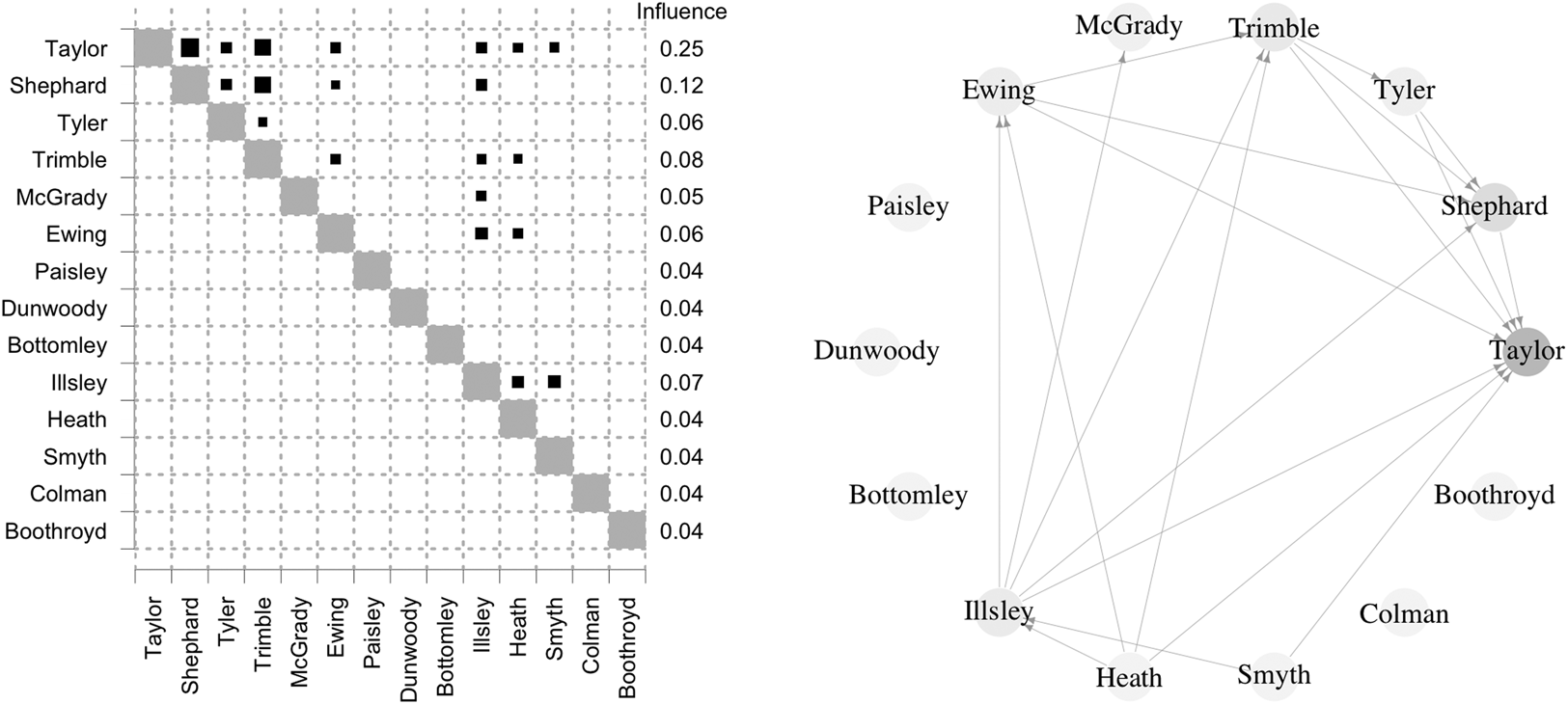
In Figure 2, the left-hand plot depicts the similarity matrix for an example debate with fourteen separate speeches. Speakers are sorted according to the order in which they participated in the debate, such that Taylor is the first speaker and Boothroyd is the last speaker. As I only allow one speech to reference another when it occurs later in the debate than the speech it is referencing, the bottom triangle of the matrix is empty. I also exclude the possibility that a speaker can reference herself (grey shaded boxes). The black squares indicate the cosine similarity between two speeches; they are scaled such that when the similarity between a pair of speeches is 1 (that is, when the tf-idf vectors are identical) the black square will fill the dashed box that contains it. The empty elements of the upper triangle correspond to speech pairs where the similarity between the speeches is lower than the minimum threshold. The left panel shows, for example, that Taylor's speech is referenced by many subsequent speeches, while Tyler's speech is referenced only by Trimble. The right margin of the plot gives the vector of influence scores for this debate. Taylor's speech has an influence score of 0.25 and Tyler's speech has an influence score of just 0.06.
Example of ‘influence’ in a debate
Note: the left panel shows the ‘reference’ patterns for an example debate. The right panel depicts the similarity matrix as a network graph.

The right-hand panel depicts the same similarity matrix as a directed network graph, with speeches as nodes (shaded proportionally to the influence scores) and edges as the ‘references’ flowing from one speech to another. Taylor's speech is referenced by many other members, while Bottomley, Colman, Dunwoody and Paisley's speeches are not sufficiently similar to any subsequent speeches to be attributed with any references.
Validation is essential for text-based measures of political concepts (Grimmer and Stewart Reference Grimmer and Stewart2013) and closely related measurement strategies have been subjected to validity checks in previous work (Erkan and Radev Reference Erkan and Radev2004; Fader et al. Reference Fader2007). In the online appendix, I test two relatively unambiguous intuitions about which actors in the House of Commons we expect to be influential in parliamentary debate. First, in Appendix Table S16 I show that cabinet ministers (who have agenda-setting privileges in debate) are on average five times more influential than backbench MPs, while the Speaker of the House (whose speeches are almost exclusively procedural) is less than half as influential as backbenchers. Secondly, in Appendix Figure S7 I show that the influence scores estimated using the procedure above correlate strongly and positively with the number of times an MP is directly mentioned by other MPs in debate. These comparisons provide reassuring evidence regarding the face validity of the measure of influence described above.
One potential concern is that this measure is simply proxying for either speech length or, because references only flow from later speeches to earlier ones, the position that a speech occurs in a debate. In Appendix Figure S8 I show there is a very weak relationship between length and influence (the average correlation across all debates is −0.05), and although there is a stronger negative association between influence and debate position, the influence measure is clearly picking up information above and beyond simple debate ordering (the average correlation is −0.45).
With this measure in hand, I now analyse the effect of appointing a female cabinet minister on the influence of female MPs. In contrast to the previous analysis, here I concentrate on effects at the individual – rather than debate – level.Footnote 16 As before, I exclude all speeches made by cabinet ministers and by the Speaker of the House and estimate models of the form:
 $$\eqalign{influence_{id(mt)} & = \beta _1 \times Female\;MP_i + \beta _2 \times Female\;Minister_{mt} \cr & \hskip10pt + \beta _3 \times (Female\;MP_i \times Female\;Minister_{mt}) \cr & \hskip9pt + \sum\limits_{\,p = 1}^P {\beta _{{\rm part}{\rm y}_p}} \times Party_i + \lambda _{m0} + \delta _t + {\rm \epsilon }_{id(mt)}} $$
where influence id(mt) represents the influence of member i in debate d pertaining to ministry m at time t. β 1 captures the average difference in influence between male and female MPs when the minister is male. β 2 represents the marginal effect of a female minister on the influence of male MPs, and the equivalent effect for female MPs – and the main quantity of interest – is given by β 2 + β 3. If β 2 + β 3 >0, this implies that female MPs' influence increases after the appointment of a female minister.Footnote 17 As previously, in addition to ministry and time fixed effects (λm0 and δt, respectively), in some specifications I also relax the common trend assumption with the addition of ministry-specific linear, quadratic and non-parametric time trends. In these individual-level models, I also control for the party of each MP (Party i). Errors are again clustered at the ministry level,Footnote 18 and Table 2 presents the results.
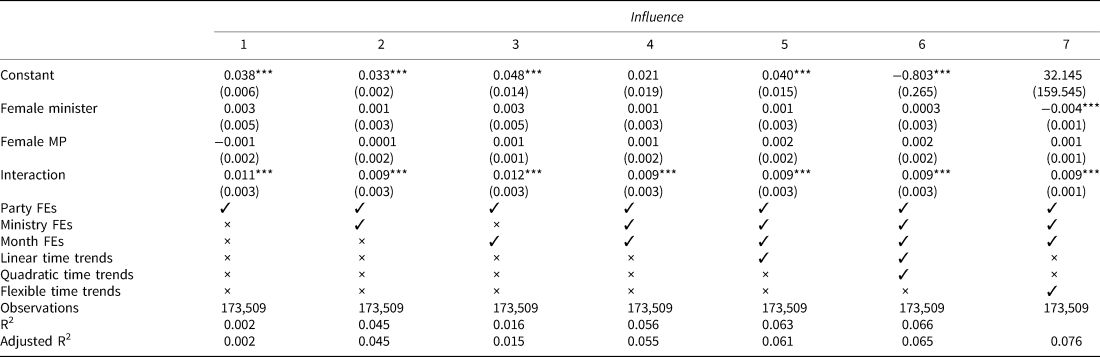
Effect of appointing a female minister on MPs' debate influence

Note: regression coefficients are shown with cluster-robust standard errors (clustered by ministry) shown in parentheses. *p < 0.1; **p < 0.05; ***p < 0.01
Model 1 gives the results of a naive specification without controlling for ministry or time fixed effects, and indicates that while the appointment of a female minister has no effect on the influence of male MPs in parliamentary debates, female MPs' influence does increase when a female minister is appointed.Footnote 19 The introduction of ministry and time fixed effects in Models 2, 3 and 4 does not change the estimate dramatically: the appointment of a female minister is significantly related to an increase in the influence of female MPs in parliamentary debate, but has no effect on the influence of male MPs. Models 5, 6 and 7 include ministry-specific linear, quadratic and non-parametric time trends. As before, that the effect does not disappear after controlling for these trends gives additional support to the design-based identification strategy.
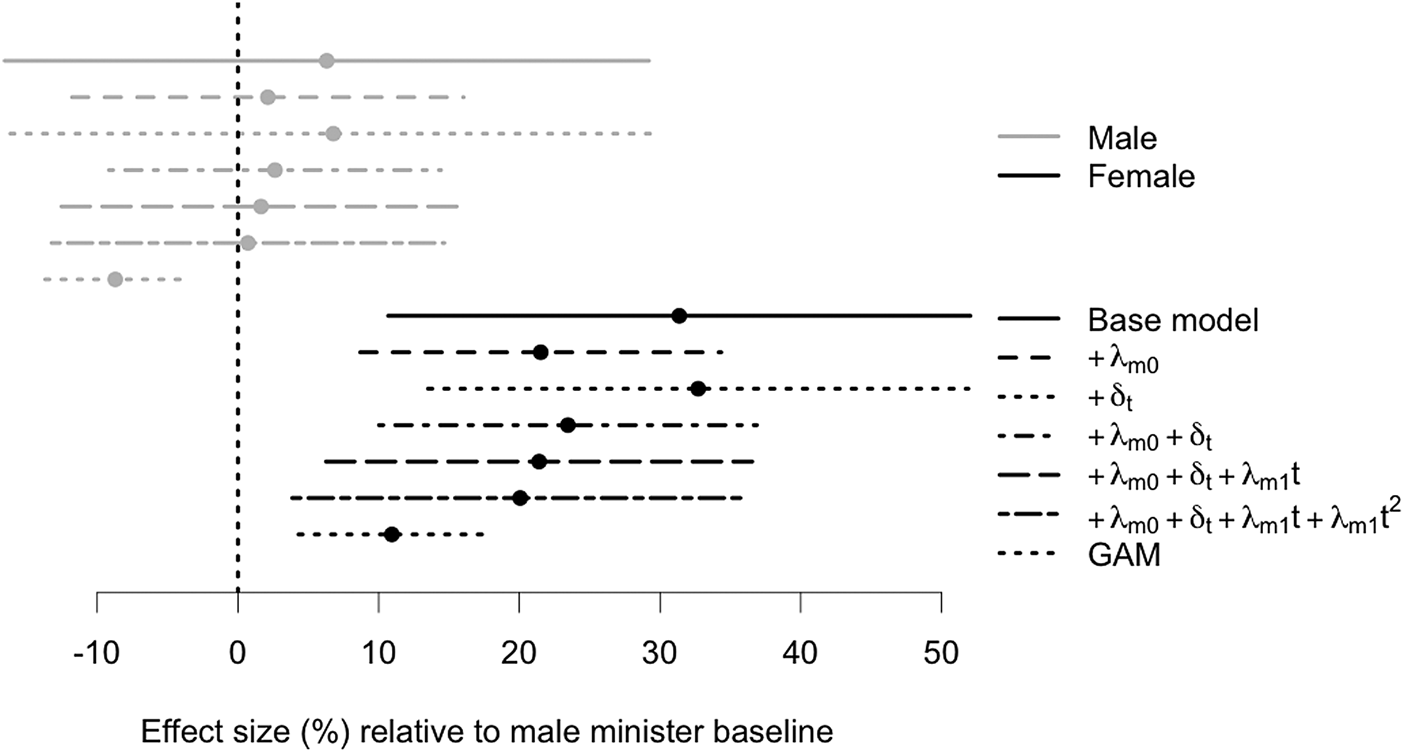
Figure 3 shows the percentage change in influence for male (grey lines) and female (black lines) MPs after the appointment of a female minister, relative to a baseline in which the minister is male. The marginal effect for male MPs is close to zero, varying in sign, and statistically insignificant for all models except for the GAM. For female MPs, the effect is always positive and significant, and the magnitude is non-trivial: based on Model 6, female MPs are 20 per cent [4 per cent, 36 per cent] more influential under a female minister than when the minister is male.Footnote 20 In sum, the results indicate that the appointment of a female minister leads to an increase not only in the degree to which female MPs participate in plenary debates, but also in the level of influence that female MPs enjoy when debating their fellow parliamentarians.
Marginal effect of female minister on influence
Note: the plot shows the marginal effect of the appointment of a female cabinet minister on the debate influence of male (grey lines) and female (black lines) MPs, relative to the average level of influence when the minister is male.

Ministerial responsiveness
The results discussed above clearly indicate that female leadership has important effects on the experiences of female MPs in political debate. How might we account for these reduced-form effects? The processes underpinning these findings are likely to be many and varied, and isolating the mechanisms behind the causal effects is notoriously difficult (Bullock, Green and Ha Reference Bullock, Green and Ha2010; Imai et al. Reference Imai2011). In this section, I investigate the plausibility of one particular mechanism – that female leaders behave differently in debate towards female MPs than male ministers do – and in the subsequent section I report results that rule out some potential alternative mechanisms.
One explanation for these findings might be that female cabinet ministers behave in a systematically different manner towards female MPs than do male ministers. In particular, female ministers may be more responsive to the speeches of female MPs. Such a hypothesis is consistent with findings in the literature on social linguistics: ‘conversational partners who offer encouragement and are attentive and responsive are more likely to elicit frequent and active participation from speakers in the conversation’ (Hannah and Murachver Reference Hannah and Murachver1999, 157). Similarly, qualitative evidence from the UK suggests male MPs are often unresponsive to speeches made by female MPs (Childs Reference Childs2004, 6). If female ministers give other female MPs higher-quality responses to their speeches, this is likely to signal that other women's contributions are more influential in discussion, and may motivate higher levels of participation in future debates.
What are the important properties of responsiveness? I assume that a speech, j, responds to another speech, i, when it occurs directly after i and when it engages with the same thematic content as i. I also consider one speech to be more responsive to another when that speech is longer, based on the assumption that longer responses give a greater impression of attentiveness and fullness of reply than shorter responses. I define a metric which measures how similar two (consecutive) speeches are in terms of the words they use. Making use of the same tf-idf representation of speeches as employed above (described in detail in Equation S4), the responsiveness of speech j to speech i is given by:
 $$res_{\,j\to i} = sim\,(v_i,v_j) \times n_j$$
where the first term on the right-hand side of the equation is the cosine similarity between the two tf-idf vectors, and n j is the number of words in speech j. When all elements of v i and v j are positive, as they are here, the cosine similarity of two documents is bounded between 0 and 1. An intuitive interpretation of res j→i is therefore the (weighted) number of words in speech j that are responding to speech i.Footnote 21
I provide two types of validation for this measure in Appendix Section S12. First, I show that Equation 8 captures something distinct from topicality, as comparing pairs of speeches within the same debate, those speeches that follow directly after each other are more responsive than non-adjacent speeches. Secondly, I demonstrate that patterns of responsiveness conform with basic intuitions of behaviour in the Commons by leveraging the particular structure of minister–backbencher interactions in Question Time debates.
I now turn to the main analysis. To reiterate, if female MPs speak more and become more influential because they receive higher-quality responses from female ministers than male ministers, then ministerial speeches subsequent to female speeches should be marked by higher levels of res when the presiding minister is female. I therefore subset the data to those speeches made by backbench MPs which are immediately followed by speeches made by ministers, and estimate models of the following form:Footnote 22
 $$\eqalign{res_{s(i)d(mt)} & = \beta _1 \times Female\;MP_i + \beta _2 \times Female\;Minister_{mt} \cr & \hskip8pt + \beta _3 \times (Female\;MP_i \times Female\;Minister_{mt}{\rm )} \cr & \hskip8pt + \beta _4 \times Minister\;Same\;Party_s + \lambda _{m0} + \delta _t + \lambda _{m1}t + \lambda _{m2}t^2 + {\rm \epsilon }_{s(i)d(mt)}} $$
The unit of analysis in these models is a speech made by a backbencher that is immediately followed by a speech made by a minister. Thus res s(i)d(mt) is the response received by a speech s made by MP i in debate d pertaining to ministry m at month t. β 1 indicates the difference in responsiveness received by male and female MPs when the minister is male. β 2 captures the effect of appointing a female minister on the responses received by male MPs. β 3 therefore captures the interaction between the gender of the MP speaking and the gender of the minister responding. A positive value for β 2 + β 3 would indicate that the appointment of a female minister leads to an increase in ministerial responsiveness to speeches by female MPs.Footnote 23 As before, I include ministry and time fixed effects and the various ministry-specific time trends. Additionally, in order to account for the possibility that responsiveness might differ between ministers responding to speeches by members of their own party (rather than an opposition party), I also include a dummy that indicates whether the minister is from the same party as the speaker of speech s. Errors are again clustered at the ministry level.
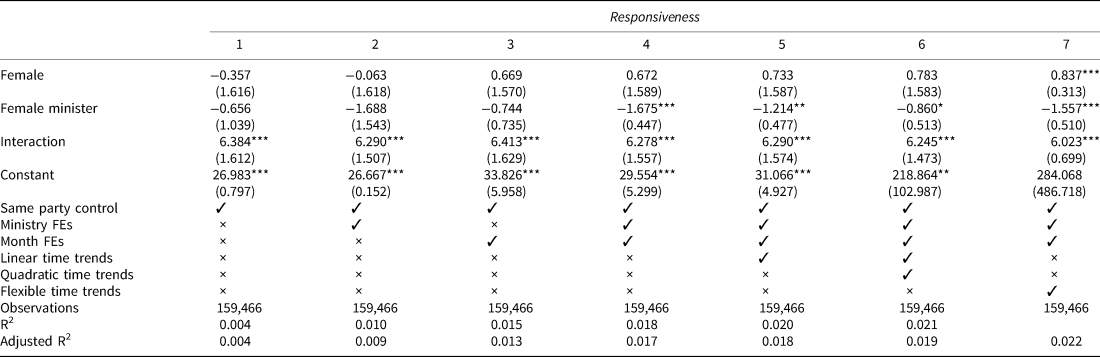
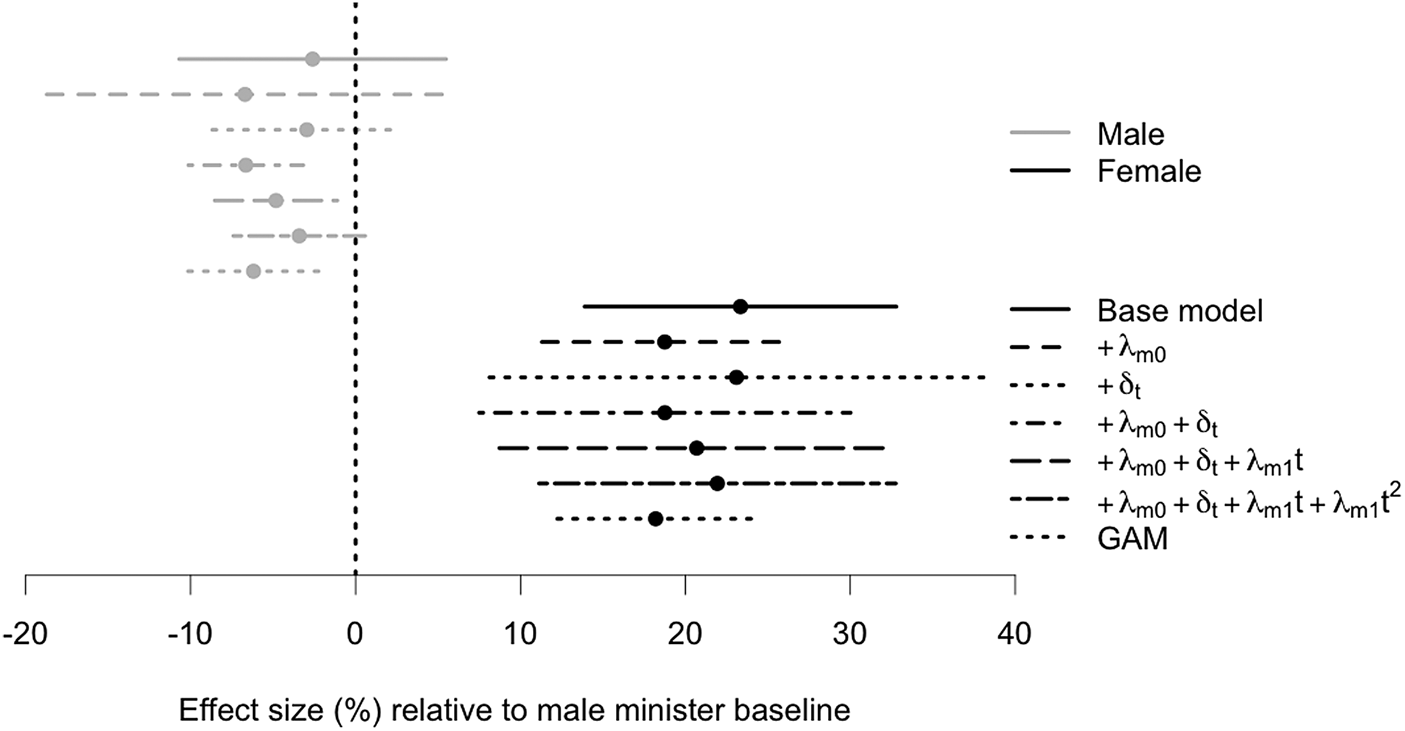
Table 3 presents the results. The interaction effect of interest, β 3, is positive, significant and sizeable in magnitude across all model specifications. I plot the substantive magnitude of these effects in Figure 4, where the baseline is the average responsiveness of male ministers to male and female speeches. Based on the estimates in Model 6, the appointment of a female minister increases the responsiveness to female speeches by 22 per cent [11 per cent, 33 per cent]. By contrast, the appointment of a female minister has no consistent effect on responsiveness to male speeches: across all models in Table 3, β 2 is small in magnitude and in many cases statistically indistinguishable from zero. However, when the first speaker is a woman, then the gender of the responding minister matters.Footnote 24
Effect of appointing a female minister on the responsiveness to MPs' speeches

Note: Models 1–6 present OLS regressions for ministerial responses, and Model 7 presents the results of the GAM. Regression coefficients are shown with cluster-robust standard errors in parentheses (clustered on ministry). *p < 0.1; **p < 0.05; ***p < 0.01
Marginal effect of a female minister on responsiveness
Note: the plot shows the marginal effect of the appointment of a female minister on the responsiveness to speeches by male (grey lines) and female (black lines) MPs, relative to the average level of responsiveness when the minister is male.

That female MPs receive systematically different responses from male and female ministers helps to explain the increase in influence of female MPs detailed in the previous section. Female MPs become more influential in parliamentary debates (the language they use in debate is adopted more often in subsequent speeches) after the appointment of a female minister, and this effect is at least partially driven by higher levels of responsiveness of the female minister. This may also explain the increase in the participation of female MPs in debates, as higher levels of ministerial responsiveness indicate that the concerns of female MPs are receiving more attention from powerful government figures, and send a signal that the issues that female MPs raise are worthy of governmental concern.
Alternative explanations
Differential responsiveness is not the only mechanism through which leadership effects might operate. Female ministers may also have purely symbolic ‘role-model’ effects which impact the behaviour of other women. Such effects are very difficult to study empirically as they rely on essentially unobservable signals that result from the promotion of a woman to high office. Definitively adjudicating between the role-model and responsiveness mechanisms is therefore difficult. Nevertheless, in Appendix Section S6, I show that the effects of female leadership on the participation of other female MPs seem to be confined to the periods in which the female minister holds office. There is little evidence that – at least in the first six months after a female cabinet minister leaves office – the increased participation of female MPs persists in future debates led by male ministers.
These findings seem more consistent with the responsiveness mechanism that I articulate above, and less so with a role-model effect. If female leaders weaken historically constructed stereotypes about women in politics, then such effects should not be expected to disappear once the female leader leaves office. However, if increased participation is due to female ministers behaving differently from their male colleagues, then the effects of female leadership are more likely to be closely tied to the exact time periods in which the female leaders hold office. The findings in Appendix Section S6 therefore provide some additional support to the argument that female ministers' responsiveness may be key to affecting the participation and influence of female MPs in debates. However, these mechanisms are not mutually exclusive, and whether the results above stem purely from the ‘responsiveness’ mechanism I outline, or are partly attributable to female cabinet ministers acting as role models for other female MPs, they remain consistent with the idea that female leadership amplifies the voices of other women within policy making.
More concerning is the possibility that the reasons for the increase in female participation and influence are completely distinct from the hypothesized leadership effects. I consider two alternative explanations here.
First, if appointing women to visible positions confers a political advantage to the governing party, opposition parties may respond by strategically appointing a woman to lead the competing shadow ministry. If this is the case, the documented effects may be due to the fact that institutional rules give both ministers and shadow ministers more time to speak on the House floor than other MPs. I investigate this hypothesis in Appendix Section S6 by analysing whether appointing a female shadow minister is positively associated with the presence of a female cabinet minister. I find little empirical support for such an argument. In addition, Appendix Table S8 re-runs the main analysis excluding speeches made by shadow ministers. The results are very similar to those from the full sample. In combination, these tests suggest that it is unlikely that the effects described above are driven by the strategic appointment of female shadow ministers.Footnote 25
Secondly, ministerial positions come with significant agenda-setting powers, and ministers determine the substance of legislation deriving from their ministries. One possible explanation for the increase in female participation and influence is that female ministers may propose legislation that focuses on topics which are traditionally of greater interest to women. In Appendix Section S14, I examine whether topics that are typically associated with high levels of female participation become more prevalent when a female minister is appointed. I use statistical topic models to estimate which legislative topics are associated with high levels of female participation under male ministers, and then assess the degree to which these topics increase when a female minister takes office. I find no evidence that female ministers are disproportionately introducing legislation that is traditionally associated with high levels of female participation. While the analysis in Appendix Section S14 does not rule out the possibility that female cabinet ministers frame certain topics differently to men, it does indicate that the appointment of a female minister is not associated with an overall shift in a ministry's policy focus.
Conclusion
Legislatures are hierarchical institutions in which some actors have access to positions which confer important powers to the office holder. While the general consequences of these institutional powers have been well studied, less has been written about the implications of female occupation of such roles for the representation of women. Cabinet posts, committee chairs and other high-profile legislative offices are normally characterized by high levels of visibility and prestige, and make the politicians who hold these posts natural focal points for the public, but also for other members of the legislature. My results suggest that when women hold high-profile offices, they have significant effects on legislative behaviour, and, crucially, that their appointment can increase the voice of other women in the policy process.
In particular, I show that in the UK House of Commons, when a female cabinet minister is appointed, other female legislators become more active and central participants in parliamentary debate than is the case under male ministers. One interpretation of the findings presented here is that they provide evidence of a female ‘role-model’ effect in a legislative setting. It is plausible that, given that women have been under-represented in cabinet minister positions both in the UK and cross-nationally, the women who are promoted to these positions are seen as exemplars of success, and that their presence acts as a motivation and inspiration to their junior female colleagues. However, I also demonstrate that, beyond their mere presence, female leaders display distinctive communicative styles in debates, suggesting that the effects that such leaders have on other women may in part be driven by the ways in which they interact with MPs during political exchanges.
While there is growing empirical evidence of the link between descriptive and substantive representation (Wängnerud Reference Wängnerud2009), the mechanisms that connect increasing numbers of women in parliament to qualitative changes in political outcomes have not been fully articulated (Beckwith and Cowell-Meyers Reference Beckwith and Cowell-Meyers2007). One possibility is that it is not merely the number of women elected to office that matters for substantive representation, but also the heights to which those women rise once they have been elected. The findings presented here indicate a possible mechanism through which policy change may occur: female leaders promote increased participation and influence of other women in policy making. Tracing the complete causal relationship between female leadership and policy outcomes that enhance the substantive representation of women is a difficult empirical task. However, my results suggest that the appointment of women to high office can have non-negligible effects on the behaviour of other legislators, and therefore provide empirical support for recent recommendations to extend the study of women's legislative representation ‘from critical mass to critical actors’ (Childs and Krook Reference Childs and Krook2009, 125).
The structure of political debate in Westminster is different from other legislatures, and so further study is required to establish whether these gender-based leadership effects hold elsewhere. Future work should also consider the potential for legislative leadership effects for other disadvantaged groups. Historically, political elites have disproportionately shared characteristics of the dominant groups in society, and several groups remain significantly under-represented in the policy process. It would be profitable in the US case, for example, to examine whether the elevation of African-American members to senior positions in the Congressional hierarchy is associated with a concomitant increase in the participation and influence of black legislators in policy making.
Finally, a growing formal literature examines the consequences of leaders' communication strategies in collective decision making, but the empirical literature on communication and leadership has lagged behind (Ahlquist and Levi Reference Ahlquist and Levi2011). In part, this is due to the difficulty of operationalizing reliable measures of spoken communication and establishing credible identification strategies that isolate the effects of leaders in observational settings. This article makes progress on both fronts. First, the identification strategy I employ suggests that by exploiting variation over time in the identity of political leaders, it is possible to estimate causal effects of leadership on parliamentary outcomes. Secondly, the measures of influence and responsiveness introduced here could be profitably applied to other questions of rhetoric and parliamentary leadership. I leave such endeavours for future work.
Supplementary material
Data replication sets are available in Harvard Dataverse at: https://doi.org/10.7910/DVN/2HXTR8 and online appendices at: https://doi.org/10.1017/S0007123419000334
Acknowledgements
I thank Laura Bronner, Alexandra Cirone, Andy Eggers, Guy Grossman, Simon Hix, Sara Hobolt, Benjamin Lauderdale, Nicola Mastrorocco, Øyvind Skorge and Dawn Langan Teele for helpful conversations. I also thank seminar participants at the European Bank for Reconstruction and Development, the University of Pennsylvania, the London School of Economics, EPSA and MPSA. This work was supported by the Economic and Social Research Council (grant number: ES/N016297/1).