Introduction
Neuropsychiatric symptoms (NPS) are highly prevalent in AD (Steinberg et al., Reference Steinberg2008; Gonfrier et al., Reference Gonfrier, Andrieu, Renaud, Vellas and Robert2012). Agitation and aggression are among the most common and distressing NPS in AD (Lyketsos et al., Reference Lyketsos, Steinberg, Tschanz, Norton, Steffens and Breitner2000; Reference Lyketsos, Lopez, Jones, Fitzpatrick, Breitner and DeKosky2002; Reference Lyketsos2011). Current recommendations for management are to start with non-pharmacologic strategies (APA Work Group on Alzheimer's Disease and other Dementias et al., 2007; Gauthier et al., Reference Gauthier2010; Kales et al., Reference Kales, Gitlin, Lyketsos and Lyketsos2014), but many patients do not respond sufficiently to these strategies. Clinicians frequently prescribe psychotropic medications off-label as there are no medications with FDA-approved indications for agitation in AD. Antipsychotics are widely used and there is some evidence for efficacy (Pollock et al., 2002; 2007), but there are concerns about their side effect profiles, particularly their increased mortality risk (Schneider et al., Reference Schneider, Dagerman and Insel2005; Kales et al., Reference Kales2007; Kales et al., Reference Kales2012). We recently reported improved agitation outcomes with use of the selective serotonin reuptake inhibitor citalopram when compared with placebo in the CitAD trial (Porsteinsson et al., Reference Porsteinsson2014)
Placebo responses are common in neuropsychiatric trials and it is essential to understand factors affecting placebo in order to detect specific drug effects. Several recent trials for agitation in AD report clinical improvement on placebo (Sommer et al., Reference Sommer, Aga, Cvancarova, Olsen, Selbaek and Engedal2009; Fox et al., Reference Fox2012; Herrmann et al., Reference Herrmann, Gauthier, Boneva, Lemming and Lemming2013; Trzepacz et al., Reference Trzepacz2013) consistent with a meta-analysis of antipsychotic trials (Schneider et al., Reference Schneider2006), but there are few data on predictors of placebo response. To compare agitation in AD with another diagnosis, placebo responses in trials of major depressive episode are substantial and in the range of 40%–50% (Khan et al., Reference Khan, Faucett, Lichtenberg, Kirsch and Brown2012). Understanding the magnitude and inherent variance of placebo response is crucial to planning future intervention trials, particularly for sample size estimation and understanding clinical covariates of response.
To this end we examined outcomes in the placebo arm of CitAD, hypothesizing that there we would observe decreased agitation and improved functional outcomes over the nine-week observation period. All CitAD participants, regardless of treatment assignment received a standardized psychosocial intervention adapted from prior trials for NPS (Martin et al., Reference Martin2006; Drye et al., Reference Drye2012) to provide standard of care for non-pharmacologic interventions. Thus, any changes in outcomes observed in the placebo arm might (or might not) be due to the effects of this psychosocial intervention.
Methods
The CitAD study design and results have been published (Drye et al., Reference Drye2012; (Porsteinsson et al., Reference Porsteinsson2014). Briefly, CitAD was a randomized, double-blind, placebo-controlled trial comparing nine weeks of citalopram (target dose 30 mg) to placebo in participants with AD and agitation. CitAD is listed on clinicaltrials.gov with the identifier: NCT00898807. Participants were eligible for inclusion if they had a diagnosis of AD (McKhann et al., Reference McKhann, Drachman, Folstein, Katzman, Price and Stadlan1984), Mini-Mental State Exam (MMSE) 5–26 (Folstein et al., Reference Folstein, Folstein and McHugh1975), with NPI A/A rated as occurring (1) very frequently, or (2) frequently with moderate or marked severity (Cummings et al., Reference Cummings, Mega, Gray, Rosenberg-Thompson, Carusi and Gornbein1994). Primary outcome measures were nine-week change in the NBRS-A (Levin et al., Reference Levin1987) and the ratings at nine weeks on the modified Alzheimer disease Cooperative Study-Clinical Global Impression of Change (mADCS-CGIC) (Schneider et al., Reference Schneider1997). Secondary outcomes included CMAI (14-item short form)(CMAI) (Cohen-Mansfield, Reference Cohen-Mansfield1996), NPI-Total and NPI-A/A subscale, Alzheimer's disease Cooperative Study-Activities of Daily Living (ADCS-ADL) (Galasko et al., Reference Galasko1997), and MMSE. Participants assigned to placebo received pills containing inert material with identical appearance to active drug, with a target dose of three pills daily (equivalent to target dose of citalopram 30 mg daily). All participants and caregivers received a standardized psychosocial intervention as previously described (Drye et al., Reference Drye2012). Outcomes were assessed at baseline and after three, six, and nine weeks of study treatment. If agitation could not be adequately controlled with psychosocial intervention (see below) up to 0.5 mg daily of lorazepam and/or 50 mg of trazodone nightly were allowed as rescue medications. Antipsychotics and other antidepressants were not allowed in the trial, but due to protocol deviations two participants received antipsychotics and one received a trazodone dose higher than 50 mg nightly.
Psychosocial intervention
We used a psychosocial intervention in this trial to ensure a high standard of dementia care and to reduce the variability of dementia care between sites. Study caregivers and patients regardless of treatment assignment received the CitAD standardized psychosocial intervention, which consisted of three components: a 20–30 minute counseling session at each of the scheduled study visits, provision of educational materials, and 24 h availability for crisis management assistance.
The counseling sessions were conducted by a trained study clinician and include design of a supportive care plan during the randomization visit. Counseling sessions included development and review of support care plans, emotional support, counseling regarding caregiving skills and problem-solving, as well as referrals and educational materials where appropriate. This intervention has been used for a similar purpose in two prior multi-center trials, one for depression in AD (Rosenberg et al., Reference Rosenberg2010) and the other for apathy in AD (Rosenberg et al., Reference Rosenberg2013). The only outcome data on the intervention is indirect, as it has not been formally tested versus a comparator intervention in any trial.
Data analysis
These analyses are exclusive to participants randomized to placebo. For continuous outcomes, mean weekly slope was estimated using mixed-effects regression, with a random intercept for participant. All available data were included in the model; likelihood based models do not require complete data and are one of the preferred analysis methods for longitudinal data with missing values that are assumed to be missing at random (National Research Council, 2010). Approximately, 10% of the enrolled participants did not complete the study. Negative slope values indicate improvement on the agitation or NPI outcomes, but worsening on the MMSE and ADCS-ADL. The p-values tested the hypothesis that the mean slope is zero (i.e. no change over time). For CGIC, the p-values were for z-tests that the proportion of responders at week 9 was zero. Potential covariates included baseline clinical covariates and demographics, NBRS, CGIC, CMAI, NPI, ADLs, and psychosis (presence of delusions or hallucinations). Continuous risk factors were categorized into tertiles at baseline. For continuous outcomes, the effect of baseline covariates on rate of change for the outcome variable was assessed by adding an interaction of time X risk factor into the mixed model and estimating the F-statistic, comparing the model with the interaction term (time by risk factor) to a model without the interaction term. For the CGIC, response was defined as moderate or marked improvement, and potential predictors of response were tested using logistic regression. The adjusted mixed and logistic models controlled for gender, race, years of education, and the baseline scale score (not applicable for CGIC) based on prior reports that demographic variables are associated with NPI scores in observational studies (Steinberg et al., 2006). No other adjustment variables were included because of the small sample size. We chose to adjust for the baseline scale score because it was the risk factor that was consistently associated with response across the unadjusted models for the different outcome variables. Unadjusted models are presented in supplementary material. Sensitivity analyses for the CGIC outcome were performed using multiple imputation of missing outcome values. In order to compare the magnitude of changes on placebo in CitAD to comparable trials, we calculated the standardized mean change for selected outcomes as: (post-treatment value – pre-treatment value)/(pre-treatment standard deviation) (Morris, Reference Morris2000).
Results
92 CitAD participants were assigned to placebo and had evaluable data over nine weeks. Baseline clinical characteristics have been previously published {Porsteinsson: 2014ks}; mean age (SD) was 79 (8) years, 41% were female, just under half had education beyond high school, mean (SD) MMSE score was 14.4 (6.9), and mean (SD) dementia duration was 5 (4) years.
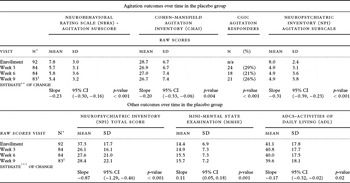
Table 1 shows changes in agitation and functional outcomes over nine weeks of study treatment. There were significant improvements in agitation outcomes: NBRS-A decreased 31%, NPI-Total decreased 24%, and NPI-Agitation decreased 39%, and CMAI 7%. MMSE increased (indicating improvement) and ADCS-ADL scores decreased (indicating worsening) as well. mADCS-CGIC response varied from 21% to 29% and was significantly different from zero (indicating improvement) at all time points. The largest decline in NBRS-agitation scores was between baseline and week 3 (change of −2.0 points, 95% CI: −2.7, −1.4, p < 0.0001). There was no difference in NBRS-agitation scores between weeks 3 and 6 (change of 0.1 points, 95% CI: −0.6, 0.8, p = 0.71) or between weeks 6 and 9 (change of −0.4 points, 95% CI: −1.1, 0.3, p = 0.27).
Outcomes

*Number of participants in the placebo group with data.
†Two participants were missing week 9 NBRS agitation and CGIC agitation. The N for these two outcomes is 81.
**For continuous outcomes, mean weekly slope is estimated using mixed-effects regression with a random intercept for participant. Negative slope values indicate improvement for NBRS, CMAI, and NPI agitation. The p-value is for the test of the hypothesis that the slope is zero (i.e. no change over time). For CGIC, the p-value is for a Z test that the proportion of responders at week 9 is zero.
***Mean weekly slope is estimated using mixed-effects regression with a random intercept for participant. Negative slope values indicate improvement for NPI. Positive slope values indicate improvement for MMSE and ADCS-ADL. The p-value is for the test of the hypothesis that the slope is zero (i.e. no change over time).
The effects of baseline clinical characteristics on agitation outcomes after adjustment for baseline covariates are presented in Supplementary (Table S1, available as supplementary material attached to the electronic version of this paper at www.journals.cambridge.org/jid_IPG); the results were similar in unadjusted models (data not shown). NBRS-A decreased more in participants who were female, non-white, non-Hispanic, and in the highest tertile of baseline NBRS-A. CMAI decreased more in participants who were female, in the highest tertile of baseline CMAI, and with baseline delusions. CGIC response was more likely in participants in the highest tertile of baseline NBRS-A. Sensitivity analyses of the CGIC outcome using multiple imputation led to the same conclusions (data not shown). NPI A/A decreased more in participants in the highest tertile of baseline NPI A/A.
Supplementary (Table S2, available as supplementary material attached to the electronic version of this paper at www.journals.cambridge.org/jid_IPG) shows the effect of baseline clinical characteristics on other outcomes after adjustment for covariates. NPI-Total decreased more in participants who were in the highest baseline tertile of NPI-Total and lowest baseline tertile of MMSE. There were no baseline clinical factors affecting MMSE outcome. ADCS-ADL declined more in participants who were in the middle tertile of baseline ADCS-ADL.
Discussion
We observed decreased severity of three agitation measures and improvement in MMSE over nine weeks placebo group of the CitAD trial. The effect was evident at three weeks and remained stable at weeks 6 and 9. For all agitation measures, the greatest improvement was in participants most symptomatic at baseline. This observation combined with the above, that the improvement leveled by week 3, suggests that the improvement was largely due regression to the mean. This is supported by the finding that improvement in each agitation measure was not predicted by baseline severity in other measures, suggesting that these measures target different characteristics of agitation. Alternatively, these improvements could be due to benefits of the psychosocial intervention, nonspecific benefit from participating in a trial, or represent the natural clinical course of these symptoms. The relatively rapid response argues against these explanations, however, as one would expect the benefit of a psychosocial intervention to increase with repetition and therefore over the course of the trial. The improvement in MMSE may have been due to practice effects or to improvement in ability to focus as agitation decreased, since a disease-modifying effect on AD itself is unlikely in a short nine-week timeframe. Regardless of mechanism, these observations of short-term improvement in agitation may help inform future study of interventions in this field.
We observed a decline in ADLs on placebo. The magnitude appears relatively small, with the mean ADL score declining from 41.1 to 39.6. While we cannot ascribe causality, this may have been due to changes in rater bias (whether research staff or caregivers), with raters becoming less optimistic over repeated ratings. There is evidence for bias in caregiver ratings of depression in AD decreasing over the course of a 12-week trial (Rosenberg et al., Reference Rosenberg, Mielke and Lyketsos2005), suggesting that caregivers become more objective in mood ratings with repetition or over time; we may have observed a similar effect on ADL ratings.
The reduction in agitation varied by measure, and was considerably larger for NBRS-A, NPI-A/A, and NPI-Total than CMAI. Over the nine weeks of observation of CitAD participants on placebo, we observed standardized mean changes in NBRS-A of 0.80, NPI-A/A of 1.38, NPI-Total of 0.73, and CMAI of 0.30. These changes are comparable to prior trials: we calculate standardized mean changes of 0.57 for CMAI and 0.43 for NPI-Total in the placebo arm of a 12-week controlled trial of memantine in nursing home residents by Fox et al., Reference Fox2012, 0.36 for NPI-NH (total) in the placebo arm of a 24-week trial controlled trial of memantine in outpatients by Herrmann et al., Reference Herrmann, Gauthier, Boneva, Lemming and Lemming2013, 1.40 for NPI-NH (total) in the placebo arm of an eight-week trial of oxcarbazepine by Sommer et al., Reference Sommer, Aga, Cvancarova, Olsen, Selbaek and Engedal2009), and 0.73 for the NPI-4-A/A factor in a 12 week trial of mibamptor by Trzepacz et al. (Trzepacz et al., Reference Trzepacz2013). Overall CMAI appears to have a smaller placebo response than the other agitation measures which is a desirable attribute. The differences between the standardized mean changes between trials appear to be driven more by differences in variance rather than mean change of measures. Another reason for this observation may be the relatively low baseline CMAI scores, leaving less range for improvement than the other measures. The standardized mean changes we observed are similar to results from prior trials, reinforcing the reliability of estimates of placebo response of agitation in AD with a relatively large dataset. These data can be used to inform sample size estimates for future trials in this field.
We report that the placebo response in several neuropsychiatric, cognitive, and functional measures was statistically significant. Given the substantial standardized mean changes noted above, we believe this is likely to be clinically significant. Additionally, we found that baseline agitation severity for each agitation measure predicted response of that measure alone, and that most of the response was present by week 3. Taken together, these observations suggest that future trials of interventions for agitation in AD will need to account for this magnitude of response in estimates of sample size. Given the challenges of providing sufficient statistical power for hypothesis-testing, the design of future trials may need to involve innovative study designs such as sequential parallel comparison or other adaptive trial designs (Baer and Ivanova, Reference Baer and Ivanova2013) that offer the possibility of improving statistical power. There is a need for further development and validation of agitation measures with the objective of reducing possible regression to the mean (Gitlin et al., Reference Gitlin, Marx, Stanley, Hansen and Van Haitsma2014). The effect of non-pharmacologic interventions needs to be systematically studied (Gitlin et al., Reference Gitlin, Kales and Lyketsos2012)
Among this study's strengths are its rigorous methods, use of a psychosocial intervention to enhance “usual care,” and most importantly observation of outcomes within a clinical trial setting which is most relevant to future trials. The most significant limitation is its inability to distinguish the effects of regression to the mean from improvements due to psychosocial intervention, the course of illness, or the nonspecific benefit or time effect of being enrolled in a trial, because there these are observational data of participants assigned to placebo. The psychosocial intervention has not been formally studied and it is possible that we are reporting on its effect rather than a pure “placebo” effect. Another limitation is the relatively short-term assessment of outcomes, although the nine-week duration of this trial is similar to comparable trials in the field. It is possible that with a longer observation period we might observe cycles of agitation in AD that would need to be better characterized to observe change.
These observations indicate that within an RCT context with masked treatment allocation, an environment with high expectations for improvement, agitation in AD improves significantly (both clinically and statistically) in the placebo group over nine weeks of observation, typically by three weeks after baseline, likely due to regression toward the mean. Given the relatively good agreement between these and prior results, these estimates of placebo response can be used to inform the design of future trials of agitation in AD including novel trial designs (Baer and Ivanova, Reference Baer and Ivanova2013).
Conflict of interest
None.
Description of author's roles
Author Contributions: Dr. Rosenberg had full access to all of the data in the study and takes responsibility for the integrity of the data and the accuracy of the data analysis.
Study concept and design: Porsteinsson, Drye, Pollock, Devanand, Frangakis, Meinert, Mintzer, Munro, Rabins, Rosenberg, Schneider, Shade, Weintraub, Yesavage, Lyketsos.
Acquisition of data: Porsteinsson, Pollock, Devanand, Ismail, Marano, Mintzer, Pelton, Rosenberg, Schneider, Weintraub, Yesavage.
Analysis and interpretation of data: Porsteinsson, Drye, Pollock, Devanand, Frangakis, Ismail, Marano, Meinert, Mintzer, Munro, Newell, Pelton, Rabins, Rosenberg, Schneider, Shade, Weintraub, Lyketsos.
Drafting of the manuscript: Rosenberg, Lyketsos, Devanand, Porsteinsson, Schneider, Mintzer, Weintraub, Drye.
Statistical analysis: Drye, Frangakis, Meinert, Shade.
Obtained funding: Porsteinsson, Drye, Pollock, Devanand, Frangakis, Meinert, Mintzer, Munro, Rabins, Rosenberg, Schneider, Weintraub, Yesavage, Lyketsos.
Administrative, technical, and material support: Porsteinsson, Drye, Rabins, Shade, Lyketsos.
Study supervision: Porsteinsson, Drye, Pollock, Devanand, Frangakis, Meinert, Mintzer, Rosenberg, Pelton, Schneider, Shade, Weintraub, Yesavage, Lyketsos.
Acknowledgments
Funding/Support: This work was supported by NIA and NIMH, R01AG031348 and in part by NIH P50, AG05142 (USC, LSS).
Role of the Sponsors: The NIA and NIMH had no role in the design and conduct of the study; collection, management, analysis, and interpretation of the data; preparation, review, or approval of the manuscript; and decision to submit the manuscript for publication.
Supplementary material
To view supplementary material for this article, please visit http://dx.doi.org/10.1017/S1041610215001106.
Steering committee voting members (responsibilities: study design and conduct)
Resource center representatives: Constantine Lyketsos, MD, MHS (chair) Dave Shade, JD (vice chair)
Clinical center directors:
D.P. Devanand, MD Jacobo Mintzer, MD, MBA Paul Rosenberg, MD
Bruce G. Pollock, MD, PhD Anton Porsteinsson, MD Lon S. Schneider, MD Jerome Yesavage, MD Daniel Weintraub, MD
Research group
Resource centers (responsibility: study administration)
Chair's Office, Johns Hopkins Bayview and Johns Hopkins School of Medicine, Baltimore:
Constantine Lyketsos, MD, MHS (chair) Allison Carlson (lead coordinator)
Dimitri Avramopoulos, MD, PhD (study geneticist) Cynthia Munro, PhD (study neuropsychologist) Peter Rabins, MD, MPH (conflict of interest officer) Annie Roche
Coordinating Center, Johns Hopkins Bloomberg School of Public Health, Baltimore:
Dave Shade, JD (director)
Anne Shanklin Casper, MA, CCRP (lead coordinator) Lea Drye, PhD
Constantine Frangakis, PhD Gabrielle Jenkin
Curtis Meinert, PhD Hao-Min Pan
Susan Tonascia, ScM Ozlem Topaloglu, PhD Matthew Toepfner
Vijay Vaidya, MSc, MPH
Project office, national institute on aging, bethesda:
Laurie Ryan, PhD (project officer)
Clinical centers (responsibility: data collection)
Johns Hopkins Bayview and Johns Hopkins School of Medicine, Baltimore:
Paul Rosenberg, MD (director)
Julia Pedroso, RN, MA (lead coordinator) Alyssa Bergey, MA
Allison Carlson Carol Gogel, RN
Christopher Marano, MD Jamie Pollutra, RN
Lynn Smith, MA Martin Steinberg, MD
Columbia University Medical Center, Columbia:
D.P. Devanand, MD (director) Corazon de la Pena (lead coordinator) Gregory H. Pelton, MD
Medical University of South Carolina, Charleston:
Jacobo Mintzer, MD, MBA (director) Nicholas Gregory (lead coordinator) Olga Brawman-Mintzer, MD
Allison Moroni Amanda Watts Shenequia Lucas Marilyn Stuckey, RN Amy Gandy
Markeeta Hatchell, RN
University of Pennsylvania School of Medicine, Philadelphia:
Daniel Weintraub, MD (director)
Jamie Czerniakowski (lead coordinator) Suzanne DiFilippo, RN
Eugenia Mamikonyan Joel Streim, MD
University of Rochester School of Medicine, Rochester:
Anton Porsteinsson, MD (director) Bonnie Goldstein, MS, NP (coordinator)
Susan Salem-Spencer, RN, MSN (coordinator) Nancy Kowalski, MS, RNC
Kimberly S. Martin, RN Jeanne LaFountain, RN Kelly Makino
Kelly Stear Andrew Porter Asa Widman
Stanford University School of Medicine
Jerome Yesavage, MD (director) Jeff Newell (lead coordinator) Wes Ashford, MD
Karen Bratcher, RN Steven Chao, MD
Jennifer Kaci Fairchild, PhD Leah Friedman, PhD
Gerald Georgette, RN Emily Gere
Ellen Kim
Vyjeyanthi Periyakoil, MD Arthur Traum, MD
Alda Vicencio, RN Deryl Wicks
University of Toronto
Bruce G. Pollock, MD, PhD, FRCPC (director) Dielle Miranda (lead coordinator)
Robert Bies, PhD Amer Burhan, MD Phil Gerretsen, MD Zahinoor Ismail, MD
Benoit H. Mulsant, MD, MS Minh-Quan Nguyen, HBsc Tarek Rajji, MD
David Tang-Wai, MD
University of Southern California Keck School of Medicine
Lon S. Schneider, MD (director) Maurcio Becerra (lead coordinator) Karen Dagerman, MS
Sonia Pawluczyk, MD Bryan Spann, DO, PhD Liberty Teodoro, RN
Data Safety and Monitoring Board members (responsibility: review of accumulating data on safety and efficacy)
Voting
Kristine Yaffe, MD (chair) Stephan Arndt, PhD Jeffrey Cummings, MD
Non-voting
Lea Drye, PhD Constantine Lyketsos, MD Laurie Ryan, MD
Dave Shade, JD