Introduction
Modern integrated pest management (IPM) programmes encourage sustainable farming practices that optimise the use of pesticides in cropping systems. An accurate pest monitoring programme is an essential part of such an IPM strategy because it facilitates a more targeted spray schedule, allowing growers to target pests when and where they appear in crop fields. Pest monitoring programmes are also an essential component in the development of economic damage thresholds (e.g., Kovanci et al. Reference Kovanci, Kovanci and Gencer2005) and can provide detailed information on pest population dynamics across multiple sampling years. One key component of pest monitoring programmes is a standardised sampling method, which allows data to be collected in a consistent, efficient way across sampling sites and events.
Highbush blueberry, Vaccinium corymbosum Linnaeus (Ericaceae), generates the highest farm-gate value of all fruit crops in British Columbia, Canada ($CAD 157 million in 2021; Statistics Canada 2022). The aphid Ericaphis fimbriata Richards (Hemiptera: Aphididae) is a pest of economic concern in highbush blueberry in British Columbia because of its ability to stunt growth and transmit blueberry scorch virus (BlScV; BC Ministry of Agriculture and Food 2023). “Ericaphis fimbriata” refers to a complex of species, possibly including Ericaphis scammelli Mason, that are similar in their morphology (Foottit et al. Reference Foottit, Maw, Von Dohlen and Hebert2008). Aphids in this complex are the most common aphid found on highbush blueberry in the Fraser Valley region of British Columbia (Raworth Reference Raworth2004) and are the primary vector for BlScV in this crop, although other aphids are capable of transmitting the virus (Lowery et al. Reference Lowery, Bernardy, DeYoung and French2008). Blueberry scorch virus is a carlavirus that is exclusively transmitted by aphids, which carry it nonpersistently (Bristow et al. Reference Bristow, Martin and Windom2000). The virus causes blight in shoots, leaves, and flowers and can kill entire plants within two years of infection (Wegener et al. Reference Wegener, Punja, Martin, Bernardy and MacDonald2006). Unchecked infections of BlScV can lead to exponential spread of the virus within blueberry fields (Bristow et al. Reference Bristow, Martin and Windom2000); however, removal of infected plants can reduce the rate of BlScV spread (Wegener et al. Reference Wegener, Punja, Martin, Bernardy and MacDonald2006). In British Columbia, prebloom and postbloom aphidicide sprays are recommended if BIScV and aphids are present in a field and if aphids are present on more than 30% of growing tips on the top 30 cm on 10 branches per plant (BC Ministry of Agriculture and Food 2023). Detection of aphids in the prebloom period may be crucial to limiting the spread of BlScV because undetected aphids may proliferate during the bloom period. Early detection may thus enable more efficient spray schedules in cultivated highbush blueberry.
There are currently no standardised sampling plans or economic injury thresholds recommended for aphids on highbush blueberry in British Columbia. Sampling aphids by enumeration (counting) is time consuming and labour intensive. Aphid loads on individual plants may number into the thousands (Raworth Reference Raworth2004), and aphids often feed inside unopened leaves at the growing tips, so an accurate count requires dissection of the leaves. Binomial sampling is a common alternative method for estimating aphid density in a variety of crops (Hodgson et al. Reference Hodgson, Burkness, Hutchison and Ragsdale2004; Hummel et al. Reference Hummel, Zalom, Miyao, Underwood and Villalobos2004; Stokes et al. Reference Stokes, Bechinski and Eigenbroke2013; Lara and Hoddle Reference Lara and Hoddle2015; Lindenmayer et al. Reference Lindenmayer, Giles, Elliott, Knutson, Bowling and Brewer2020). In one study from Argentina, a binomial sampling plan was developed for the aphids, Aphis gossypii Glover and Aphis spiraecola Patch, in highbush blueberry (Rocca and Grecco Reference Rocca and Grecco2012). In a binomial sampling scheme, the presence:absence of aphids on a sampling unit – e.g., a growing tip or an entire plant – is used as a proxy measure for the density of aphids within the sample environment. By developing a binomial sampling scheme based on presence:absence of aphids on growing tips of highbush blueberry grown in British Columbia, we aim to provide a simple, nondestructive method of assessing aphid loads as a basis for informing the development of improved IPM programmes for this pest in this important Canadian berry growing region.
We conducted annual aphid surveys in three highbush blueberry fields in the Fraser Valley region, British Columbia from 2019 to 2021. Surveys were conducted from the prebloom stage (April–May) until aphid numbers began to decline in the early fall (August–September). The field sites were the Agriculture and Agri-Food Canada Clearbrook substation (49.012, –122.333), SkyBlue Farms (49.088, –122.076), and the Agriculture and Agri-Food Canada Agassiz Research and Development Center (49.242, –121.756). These relatively small fields (approximately 1 ha) were maintained as part of the BC Blueberry Council blueberry breeding programme. Plants from six varieties (“Duke”, “Bluecrop”, and four noncommercial test varieties) were represented at each site (Table 1). We sampled each field once per month during the sampling window. We chose to sample growing tips because this is where aphids typically aggregate at the early stages of infestation (Jason Thiessen and Paul Abram, unpublished data), although they will also feed on mature leaves throughout the plant. Due to the high cost of BlScV infection, future sampling efforts should also focus on growing tips to better catch aphid infestations as early as possible. At each site, we randomly selected 10 growing tips per plant: we noted whether aphids were present or absent on these tips, collected the tips, and stored them on ice in a cooler until they were dissected. Plants were not included in the final analysis if they had fewer than 10 growing tips. Within 24 hours, we dissected all tips under magnification in a laboratory and counted all aphids present on the tips. A subset of aphids from each tip was stored in 70% ethanol and sent to the Canadian National Collection of Insects, Arachnids, and Nematodes (Ottawa, Ontario, Canada) for taxonomic identification. All aphids were identified as E. fimbriata.
Mean (± standard error) aphids and proportion of infested growing tips from a sample of 10 tips per plant for each variety in the data set, separated by sampling year.

For the purpose of data analysis, one sample unit consists of all plants of a given variety sampled on a given day at one field site; each sample unit thus consists of 1–5 plants (10–50 growing tips). Highbush blueberry varieties vary in their resistance to aphids (Hancock et al. Reference Hancock, Schulte, Siefker, Pritts and Roueche1982; Raworth and Schade Reference Raworth and Schade2006). By pooling data within a given variety, we aimed to reduce variance within the data set caused by variety-specific effects on aphid fecundity and mortality. In total, our data set contained 206 sample units. For each sample unit, we calculated the aphid density ([total number of aphids]/[number of growing tips]) and the proportion of infested tips. All analysis was completed using R for Windows (version 4.2.1; R Core Team 2022).
We adopted a nonlinear equation to describe the relationship between the proportion of infested tips (y) and aphid density (x) per sample unit:
 $$y = 1 - {e^{ - {e^{\alpha + \beta \ln x\;}}}}$$
where α and β are parameter coefficients estimated by nonlinear least-squares regression. This model was adopted from the work of Lara and Hoddle (Reference Lara and Hoddle2015), in which the equation was determined using an empirical approach (Gerrard and Chiang Reference Gerrard and Chiang1970). We ran alternate models with the same form for y ≥ 0 aphids, y ≥ 3 aphids, y ≥ 5 aphids, and y ≥ 10 aphids. All model construction was conducted using functions in the R package “nlstools” (Baty et al. Reference Baty, Ritz, Charles, Brutsche, Flandrois and Delignette-Muller2015). We generated 95% and 99% confidence intervals for the models using a nonparametric bootstrapping algorithm to bootstrap mean-centred residuals over 999 iterations (function nlsBoot).
Aphid density ranged from 0 to 23.7 aphids per growing tip across all sample units, and the proportion of infested tips per sampling unit ranged from 0 to 92%. Table 1 shows the distributions of aphid density and proportion of infested tips across all the survey varieties, separated by sampling year.
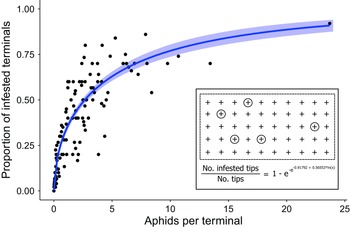
A comparison of standard error of regression (S) of the four models showed that y≥0 aphids has the best fit to our data (S ≥ 0 aphids = 0.094; S ≥ 3 aphids = 0.127; S ≥ 5 aphids = 0.130; S ≥ 10 aphids = 0.138); thus, all further analysis was conducted on this model. Nonlinear least-squares regression produced the model coefficients α = –0.91792 (95% confidence interval: –0.9992822 to –0.8365626; 99% confidence interval: –1.0252163 to –0.8106286; P < 0.0001) and β = 0.56553 (95% confidence interval: 0.5019661 to 0.6290995; 99% confidence interval: 0.4817037 to 0.6493619; P < 0.0001). A Runs test suggested that model residuals deviate systematically below the predicted mean (Z = –3.8094, P = 0.0001); this is likely due to a cluster of samples with a proportion of infested tips that was less than 0.1 (Supplementary material, Fig. S1). The fitted model and 95% confidence intervals are shown in Figure 1. In this way, this study provides a model that can be used to estimate the density of aphids in highbush blueberry given data on the proportion of infested growing tips, based on data gathered from highbush blueberry in the Fraser Valley growing region of British Columbia.
Proportion of infested terminals plotted against aphid density (number of aphids per terminal for each sample unit) fitted to the equation
 $y = 1 - {e^{ - {e^{ - 0.91792 \, +\, 0.56553\ln x\;}}}}$
. The shaded area represents 95% confidence intervals for the model, calculated by bootstrap analysis of mean-centred data residuals. Inset: An example sampling plan in a field with five rows of 10 plants; five plants are selected randomly from the field to act as a representative sample, 10 tips per plant are sampled, and the proportion of infested tips in the sample is used to calculate an estimate of aphid density in the field.

Binomial sampling plans and other model-based sampling tools rely on the assumption that the target pest population dynamics remain predictable within a given cropping system. The applicability of these tools across different growing regions and different pest–crop systems is therefore not guaranteed. For example, let us consider the work of Rocca and Grecco (Reference Rocca and Grecco2012) on A. gossypii and A. spiraecola in highbush blueberry in Argentina. Their study develops a series of empirical models that estimate the density/proportion relationships of aphids or aphid mummies when sampling only vegetative tips or vegetative tips and flowers using the same distribution-free equation from Gerrard and Chiang (Reference Gerrard and Chiang1970). When considering aphids on vegetative tips, the model coefficients are α = 2.87 and β = 1.27. These coefficients are well outside the 95% confidence intervals for our model coefficients, and we can therefore assume that our two models have no cross-compatibility. This is likely due to differences in the specific life histories of the aphids in question and differences in abiotic factors between the sampled regions.
An important feature of a reliable binomial sampling model is that the variation in observed data around the model mean should be relatively narrow (i.e., there is a low risk of a given sample having a higher mean number of aphids than expected based on the proportion of infested terminals). Although the confidence intervals on our model are narrow relative to the spread of the fitted data, the uncertainty of the model increases with increasing proportion of infested tips (Fig. 1). Given the high cost of BlScV infection and the rapid rate at which infection spreads within affected fields (Bristow et al. Reference Bristow, Martin and Windom2000; Wegener et al. Reference Wegener, Punja, Martin, Bernardy and MacDonald2006), spray thresholds are likely to be set at very low aphid densities, so this relative insensitivity at high aphid densities is unlikely to be relevant in an IPM context. Further validation of the model with field-collected data was not feasible within the present study’s timeframe but could lead to a more refined model with more predictive power at higher aphid densities.
To make effective use of our model, careful consideration must be given to the way in which data are pooled before analysis. When designing our model, we considered a sample unit to be all plants within a given variety at a given field site. Grouping data from several plants reduced the variance of the data; the mean number of aphids per terminal (± standard deviation) on individual plants within our survey was 16.1 ± 34.9, whereas the mean ± standard deviation between sample units (10–50 terminals) was 1.46 ± 2.70. When designing a sampling plan for aphids that incorporates our model, data should be pooled in a similar way (e.g., Fig. 1 inset). This will reduce the occurrence of outlier data and produce a more accurate estimate of aphid density.
Currently, no spray thresholds are recommended for aphids in highbush blueberries in Canada. A scientific approach to the development of spray thresholds requires an understanding of the relationship between the density/occurrence of a pest and the damage caused by that pest – in the case of E. fimbriata, this includes both primary damage from feeding and secondary damage from BlScV infection. Minimal work has been done to relate the density of aphids in a given field and the amount of yield loss in that field relating to aphid primary damage (stunted shoots due to feeding) or to the rate of BlScV spread within that field. Our model provides a standardised way to estimate aphid density in highbush blueberry fields, but further work is required to correlate this with aphid-induced damage and the spread of BlScV.
Supplementary material
To view supplementary material for this article, please visit https://doi.org/10.4039/tce.2023.14.
Acknowledgements
The authors would like to thank Eric Gerbrandt for access to his property, SkyBlue Farms, where some of the data for this study were collected. They would also like to thank Dr. Bryan Brunet at the Canadian National Collection of Insects, Arachnids, and Nematodes for identifying the field-collected aphids. The authors acknowledge that these data were collected on the traditional, unceded territory of the Coast Salish people, who have inhabited this land since time immemorial.
Competing interests
The authors have no competing interests to declare.