Reading comprehension cannot succeed unless the reader appreciates morphological word formation, that is, how differences in word forms relate to differences in meaning (Carlisle, Reference Carlisle2003). The explicit understanding of morphological processes, termed morphological awareness, is closely related not only to reading comprehension (Deacon, Kieffer, & Laroche, Reference Deacon, Kieffer and Laroche2014; Deacon & Kirby, Reference Deacon and Kirby2004; Kirby et al., Reference Kirby, Deacon, Bowers, Izenberg, Wade-Woolley and Parrila2012; Kuo & Anderson, Reference Kuo and Anderson2006; Tong, Deacon, Kirby, Cain, & Parrila, Reference Tong, Deacon, Kirby, Cain and Parrila2011) but also to spelling (e.g., Deacon & Bryant, Reference Deacon and Bryant2005, Reference Deacon and Bryant2006b; across orthographic systems varying in consistency, Desrochers, Manolitsis, Gaudreau, & Georgiou, Reference Desrochers, Manolitsis, Gaudreau and Georgiou2017; and surviving control for phonological awareness, e.g., Deacon & Kirby, Reference Deacon and Kirby2004), vocabulary (McBride-Chang, Wagner, Muse, Chow, & Shu, 2005; Sparks & Deacon, Reference Sparks and Deacon2015), and word and pseudoword reading (Deacon & Kirby, Reference Deacon and Kirby2004; Kirby et al., Reference Kirby, Deacon, Bowers, Izenberg, Wade-Woolley and Parrila2012; Tibi & Kirby, 2017). In particular, the contribution of morphological awareness to spelling is robust to a multitude of control variables (Deacon, Kirby, & Casselman-Bell, Reference Deacon, Kirby and Casselman-Bell2009) and includes both inflected and derived forms (Deacon, Campbell, Tamminga, & Kirby, Reference Deacon, Campbell, Tamminga and Kirby2010), going beyond the spelling of specific morphemes (Casalis, Deacon, & Pacton, Reference Casalis, Deacon and Pacton2011). Moreover, instruction in morphological awareness results in benefits across literacy domains, especially when combined with phonological awareness training (e.g., Lyster, Reference Lyster2002; Lyster, Lervåg, & Hulme, Reference Lyster, Lervåg and Hulme2016; Manolitsis, Reference Manolitsis, MacLachlan and Arrow2017; see meta-analyses and systematic reviews in Bowers, Kirby, & Deacon, Reference Bowers, Kirby and Deacon2010; Carlisle, Reference Carlisle2010; Goodwin & Ahn, Reference Goodwin and Ahn2010, Reference Goodwin and Ahn2013; Reed, Reference Reed2008).
The term morphology includes a variety of systematic word-formation processes, such as inflection, derivation, and compounding, which operate on morphemes, that is, the minimal language units that bear meaning (Nagy, Carlisle, & Goodwin, Reference Nagy, Carlisle and Goodwin2014). Implicit knowledge of such processes is evident in native speakers’ language use. Beyond implicit language use, which demonstrates basic language competence, the term morphological awareness denotes the individual's ability to reflect upon and consciously manipulate morphemes, as well as the ability to deliberately apply word formation rules. In other words, it concerns the ability to analyze words into smaller meaning-bearing units, including prefixes, suffixes, and roots (Kuo & Anderson, Reference Kuo and Anderson2006), and to synthesize words from such constituent morphemes. Because awareness focuses on conscious manipulation of language concepts, it is considered to operate at a metalinguistic level, distinct from implicit language use, which concerns the linguistic level. However, there is no clear binary distinction between complete lack of conscious awareness and deliberate, explicit manipulation. Thus, more nuanced approaches are needed.
LEVELS OF AWARENESS
The development of metalinguistic awareness has been studied for decades (Cazden, Reference Cazden, Bruner, Jolly and Silva1976; Van Kleeck, Reference Van Kleeck1982). Early views based on observations that children make spontaneous repairs to their speech at a very young age (Clark, Reference Clark, Sinclair, Jarvella and Levelt1978; Clark & Andersen, Reference Clark and Andersen1979) suggested that metalinguistic awareness develops in tempo with language acquisition. Others held that it is a kind of linguistic functioning that develops in middle childhood (Tunmer, Pratt, & Herriman, Reference Tunmer, Pratt and Herriman1984). Later on, metalinguistic awareness development was thought to concern the growth of skill components, namely, the analysis of linguistic knowledge into structured categories and the cognitive control of attentional procedures to select and coordinate specific linguistic information, usually with time constraints (Bialystock, & Ryan, Reference Bialystok and Ryan1985). Alternatively, it was conceptualized as macrodevelopmental representational relations between the processes underlying both children's spontaneous repairs and metalinguistic awareness occurring in a phaselike manner, described as cycles of processes that reoccur as different aspects of the linguistic system develop (Karmiloff-Smith, Reference Karmiloff-Smith and Levin1986).
Following Karmiloff-Smith (Reference Karmiloff-Smith and Levin1986), the term “meta” is not limited to conscious access but can be applied to certain unconscious operations as well. Nevertheless, a differentiation should be made between morphological awareness and children's unconscious knowledge of morphological word formation processes (Gombert, Reference Gombert1992; Karmiloff-Smith, Reference Karmiloff-Smith and Levin1986; Nagy et al., Reference Nagy, Carlisle and Goodwin2014) evidenced in normal communicative language use. Unconscious use of morphology is considered to be typical of language development and can be observed through overgeneralizations produced by young children, such as “buyed” (instead of “bought”). The production of these errors suggests a gradual development in understanding the rules of inflectional morphology. In contrast, full-blown metalinguistic awareness is evidenced in noncommunicative situations calling for conscious reflection upon language elements (e.g., morphemes), which are treated as objects that can be attended to and manipulated.
Nonetheless, the distinction between tacit knowledge of morphological processes and conscious morphological awareness has not been sufficiently investigated. In many cases it is not clear whether differences in measures of morphological awareness reflect differences in metalinguistic awareness or in implicit morphological knowledge (Nagy et al., Reference Nagy, Carlisle and Goodwin2014). Although linguistic competence is a prerequisite to metalinguistic awareness skills, development of the latter is by no means guaranteed by attainment of the former. Moreover, attainment of metalinguistic awareness may not constitute an “all or none” phenomenon but, rather, a gradual progression of skill development and maturation. Thus, a more nuanced approach has been proposed whereby an intermediate epilinguistic level is posited to intervene developmentally between the two. Specifically, Gombert (Reference Gombert1992) postulated a model in which metalinguistic development occurs in four successive phases: (a) acquisition of the first linguistic skills, (b) acquisition of epilinguistic control, (c) acquisition of metalinguistic awareness, and (d) automation of the metaprocesses.
Deacon, Parrila, and Kirby (Reference Deacon, Parrila, Kirby, Reid, Fawcett, Manis and Siegel2008) taxonomized morphological awareness tasks according to, among others, the cognitive processes that underlie task performance, which may operate at either an implicit or an explicit level. Researchers have traditionally used lexical judgment tasks, which require children to decide whether two words are related or not, to tap implicit morphological skills (e.g., Duncan, Casalis, & Colé, Reference Duncan, Casalis and Colé2009; Mahony, Singson, & Mann, Reference Mahony, Singson and Mann2000), and analogy and production tasks to assess explicit skills (e.g., Berko, Reference Berko1958; Carlisle, Reference Casalis and Louis-Alexandre2000; Derwing, Reference Derwing1976; Kirby et al., Reference Kirby, Deacon, Bowers, Izenberg, Wade-Woolley and Parrila2012; Nunes, Bryant, & Bindman, Reference Nunes, Bryant and Bindman1997). However, production tasks have also been differentiated between implicit and explicit (Casalis & Louis-Alexandre, Reference Casalis and Louis-Alexandre2000). Thus, there is at present no consensus as to which types of tasks best assess the different purported levels or phases of metalinguistic development.
In the present study, we followed the operationalization of Carlisle (Reference Carlisle and Feldman1995), who made a distinction between different levels of metalinguistic knowledge of morphology by using a judgment task of related spoken words to tap epilinguistic skills and a production task to tap metalinguistic skills. By definition, this design aligns levels of awareness with the types of tasks they can support, thereby inherently conflating essential task requirements with metalinguistic representational flexibility. Far from being a methodological limitation, this conceptualization reflects the notion that intermediate levels suffice for certain types of operations but not for others.
In particular, judgment tasks are appropriate for the assessment of intermediate (epilinguistic) levels of awareness, because they combine (a) noncommunicative use of language objects, which are to be consciously attended to and judged, with (b) reduced or negligible demands on metalinguistic manipulation and retrieval, because the elements to be judged are provided by the examiner and need not be produced by the participant. In this sense, a judgment task can be said to occupy an intermediate level of awareness. In comparison, production tasks are more demanding, because they require both (a) noncommunicative use of language objects, in the context of an artificial test interaction, and (b) increased retrieval demands, because the participant is required to spontaneously produce a desired form based on indirect information provided by the experimenter. Therefore, it is reasonable to consider high performance in production tasks as strong evidence of full-blown metalinguistic awareness.
DOMAINS OF MORPHOLOGICAL PROCESSES
A further complicating factor concerns the different domains of word formation insofar as the morphological processes of grammatical inflection and productive derivation may not be equally accessible to children's awareness. Specifically, awareness of inflectional morphology tends to be detected earlier than awareness of derivational morphology. There is evidence that the former is acquired in the first school years (Diakogiorgi, Baris, & Valmas, Reference Diakogiorgi, Baris and Valmas2005; Kuo & Anderson, Reference Kuo and Anderson2006), whereas the latter develops toward the fourth year (Anglin, Reference Anglin1993; Carlisle, Reference Casalis and Louis-Alexandre2000) and continues to grow thereafter (Berninger, Abbott, Nagy, & Carlisle, Reference Berninger, Abbott, Nagy and Carlisle2010). The acquisition of morphology, as well as the assessment of morphological development with tasks tapping either inflectional or derivational morphology (McBride-Chang, Reference McBride-Chang2016), was first systematically investigated by Berko (Reference Berko1958). In her study, she created pseudowords that followed the phonological rules of English and presented them to children 4–7 years old, asking them to provide the plural form, verb past tense, or possessive of the pseudoword. Her findings indicated that preschool children had already acquired some morphological knowledge that enabled them to manipulate made-up words. There was a difference in the performance of preschoolers and school-aged children, underlining the developmental change of morphological processing. Additional evidence for progressive development was seen in the lack of comparative suffixes by both preschool and early school-aged children (Anisfeld & Tucker, Reference Anisfeld and Tucker1967; Berko, Reference Berko1958).
In comparison, knowledge of derivational morphology does not seem to emerge so early. Appreciation of derivations is observed later than appreciation of inflections, and it is connected to ongoing development extending throughout the school years (Anglin, Reference Anglin1993; Berko, Reference Berko1958). Children in first grade have a rudimentary knowledge of derived forms that is not on par with their knowledge of stems and inflected forms (Anglin, Reference Anglin1993; Kuo & Anderson, Reference Kuo and Anderson2006). Carlisle (Reference Carlisle and Feldman1995) suggested that children's awareness of derivational morphology makes a transition from an implicit to an explicit level at the ages of kindergarten and first grade. In comparison, Casalis and Louis-Alexandre (Reference Casalis and Louis-Alexandre2000) found that French-speaking children can apply derivational rules with only moderate success after the first 2 years of schooling, as indicated by their performance on an implicit-level task. The transition from implicit to explicit awareness of derivational morphology was found to emerge as early as first grade among French-speaking children, but not among English-speaking children, whose ability to produce novel derivations from word roots improved at a slow pace during the first three grades (Duncan et al., Reference Duncan, Casalis and Colé2009). It seems that explicit awareness of the structure and meaning of derived forms emerges around Grades 3–4 (Anglin, Reference Anglin1993; Kuo & Anderson, Reference Kuo and Anderson2006).
Deacon et al. (Reference Deacon, Campbell, Tamminga and Kirby2010) examined morphological priming in fragment completion and found no difference between inflected and derived primes across Grades 4–8, suggesting that implicit knowledge of derivational morphology may have largely caught up with inflectional morphology by these ages. However, this does not imply that they emerge concurrently at earlier ages or that they are comparably mastered explicitly (i.e., metalinguistically) as well. Consistent with the view of late emergence of knowledge about derivational morphology, children at around 9 years of age were found to be sensitive to derivational suffixes when spelling, whereas younger children (around 7 years) were not (Sangster & Deacon, Reference Sangster and Deacon2011). In comparison, children in the 5- to 8-year-old range spontaneously demonstrated awareness of inflections, but not of derivations, in spelling (Deacon & Bryant, Reference Deacon and Bryant2005). However, children at these ages could use cues from related words to read pseudowords (Colé, Bouton, Leuwers, Casalis, & Sprenger-Charolles, 2012) or to spell root morphemes or derivational suffixes when provided specifically (Deacon & Bryant, Reference Deacon and Bryant2005, Reference Deacon and Bryant2006a), demonstrating some basic understanding of the morphological structure of written words.
OUTSTANDING ISSUES
Overall, and despite much research attention on the relationship between morphological awareness and literacy (see, e.g., Carlisle, Reference Carlisle2003, Reference Carlisle2010, for reviews), the developmental progression of both inflectional and derivational morphological awareness itself requires further examination. If a distinction between epi- and metamorphological awareness concerning the morphological domains of inflectional and derivational morphology can be established, it may be possible to increase the reliability in early detection of children at risk for difficulties and to provide early intervention. Moreover, most existing studies have examined English- and French-speaking groups, leaving open the question of generalization to languages with richer inflectional morphology than English or with more graphophonemically consistent relations across morphemes. The course of development that has been suggested for English may be partially due to peculiarities of English orthography or morphology that may not apply cross-linguistically (cf. Share, Reference Share2008). Finally, most studies have focused directly on the concurrent predictive power of morphological awareness for reading skills, necessarily testing children at the ages of elementary school grades, rather than examining the development of morphological awareness itself, which is expected to emerge, at least to some extent, prior to the onset of literacy instruction.
Thus, a theoretically interesting question concerns the development of metalinguistic awareness, across levels and morphological domains, in preschool ages. According to the aforementioned findings, we would expect to observe two distinct progressions through epi- and metalevels of morphological awareness: one regarding inflectional morphology, progressing earlier, and another regarding derivational morphology, following in later years. However, it is also possible that epimorphological awareness, which puts less of a strain on attentional and linguistic processes, may develop early and in sync for both inflectional and derivational morphology. In contrast, the transition to the metalevel, which makes heavier demands on conscious manipulation and attentional control, may follow diverging developmental paths for the two morphological domains.
Therefore, this study aims to explore the developing progression of inflectional and derivational morphological awareness skills. Following Carlisle (Reference Carlisle and Feldman1995), we assessed epilinguistic skill using a judgment task and metalinguistic skill using a production task. In this way, we operationalized different levels of awareness with tasks posing corresponding challenges, while avoiding more cognitively demanding tasks, such as analogies, which may cause difficulties for reasons not closely related to linguistic and metalinguistic skill. The acquisition of epilinguistic control versus metalinguistic awareness was examined in children attending prekindergarten, kindergarten, and first grade, to determine whether epimorphological abilities are acquired earlier than metamorphological awareness. This would be expected on the assumption that children's sensitivity to the morphological aspects of the language gradually becomes more explicit, culminating in the development of metamorphological skills.
RELEVANT PROPERTIES OF GREEK
We worked in Greek, a language with rich inflectional and derivational morphology (see Ralli, Reference Ralli2003) and relatively consistent orthography (Protopapas & Vlahou, Reference Protopapas and Vlahou2009). Nouns and adjectives are obligatorily inflected for gender, number, and case via fusional suffixation. For example, the noun χορός (/xoros/ “dance”) is composed of the stem χορ– (/xor/ expressing the core semantics) and the inflectional suffix –ος (/os/ signifying masculine singular nominative case). Verb forms also include a stem and an obligatory inflectional ending, both of which may be simple or complex. Verbs are inflected for voice, aspect, tense, number, and person (Ralli, Reference Ralli2003; see Holton, Mackridge, Philippaki-Warburton, & Spyropoulos, Reference Holton, Mackridge, Philippaki-Warburton and Spyropoulos2012; Klairis & Babiniotis, Reference Klairis and Babiniotis2004, for comprehensive descriptions). For example, the verb χορεύω (/xorevo/ “I dance”) is composed of the same stem χορ– (/xor/), the derivational affix –εύ– (/ev/ forming a verb from a noun), and the inflectional suffix –ω (/o/ signifying first person singular). Distinct inflectional classes are recognized for both nouns/adjectives and verbs, each with its own set of suffixation and stem alternation rules (Holton et al., Reference Holton, Mackridge, Philippaki-Warburton and Spyropoulos2012; Ralli, Reference Ralli2003, Reference Ralli2005). Word formation in Greek also includes systematic derivational processes, especially for nouns (based on verb stems) and adjectives (based on verb and noun stems). Compounding is also highly productive, as new adjectives, nouns, and verbs can be created from existing stems and words (see Ralli, Reference Ralli2003, Reference Ralli2005, for more information).
Morphology has extensive orthographic consequences in Greek, insofar as derivational and grammatical suffixes are associated with specific spellings, which also serve to disambiguate homonyms. Knowledge of the inflectional type is often required for correct spelling of adjective, noun, and verb suffixes (for more information and references, see Protopapas, Reference Protopapas, Verhoeven and Perfetti2017). Instructional activity related to morphological awareness takes place informally in the kindergarten curriculum only as part of vocabulary instruction, in the context of shared book reading and retelling, including activities with words (nouns and verbs) differing in number inflection, along with phonological awareness activities such as letter–sound association and identification. Systematic decoding is taught in Grade 1, so that most children are able to read by midgrade, as well as systematic teaching of distinct spellings of noun and verb vowel endings (i.e., inflectional suffixes).
Most Greek children have mastered the inflectional paradigms of the language to a large extent by the age of entering elementary education, at least as far as the suffixes with orthographic consequences are concerned (i.e., case, gender, and number, for adjectives and nouns, and person and number, for verbs). Normally developing kindergarten children approach ceiling performance in the production of verb past tense and noun gender, number, and case (Mastropavlou, Reference Mastropavlou2006) although persistent difficulties with verb aspectual formation and noun gender are observed in certain word classes with unusual properties (Stavrakaki & Clahsen, Reference Stavrakaki and Clahsen2009; Varlokosta & Nerantzini, Reference Varlokosta and Nerantzini2013, Reference Varlokosta, Nerantzini and Stavrakaki2015). Thus morphological acquisition is largely but not entirely completed by Grade 1.
METHOD
Participants
The participants in this study were 236 children (139 girls) who were 4–7 years old (M = 67.8 months, SD = 11.5, range = 49–86) and native speakers of Greek, without any diagnosed developmental delay or sensory deficits. They were sampled from schools in rural (17%), semiurban (19%), and urban (63%) areas of four geographically dispersed provinces of Greece, including a variety of socioeconomic and ethnic backgrounds. Seventy-nine children attended prekindergarten, 58 children attended kindergarten, and 99 attended first grade.
Procedure
Participants were randomly selected from each school. After obtaining parental approval and the child's oral assent, the examiner administered the tests in two to three sessions within 2 weeks (in the context of a variety of other tasks not reported here). Examiners were undergraduate and postgraduate students of psychology or education who were extensively trained and evaluated to ensure uniform administration. Assessments were conducted in a quiet room at the school. Breaks were provided as needed.
Materials
Morphological awareness was assessed using four different tasks, including two epimorphological and two metamorphological ones. Each pair included one task assessing inflectional and one assessing derivational morpheme awareness. The design and content of the tasks was targeted specifically for the age groups under study, aiming to avoid floor and ceiling effects in assessing the various morphological domains. Because of the relative ease of the inflectional domain, determined in pilot testing, both inflectional morphology tasks used pseudowords. Pseudowords were formed based on the depicted words, by replacing vowels and consonants in the stem while retaining the phonological structure, stress pattern, and inflectional suffix intact, for example, /ˈskeno/ was derived from /ˈvγazo/ “βγάζω” (take out); /ˈserapas/ was derived from /ˈxarakas/ “χάρακας” (ruler). In contrast, use of pseudowords was deemed potentially too challenging for the derivational morphology tasks, which are by nature more based on meaning. The implications of this difference between tasks are taken up in the Discussion section. Internal reliabilities of the tasks are reported as Revelle's omega total (ωRT), calculated using polychoric covariance matrices and maximum-likelihood factor extraction using R package psych (Revelle, Reference Revelle2016), because of its superior performance compared to the commonly used Cronbach α (McNeish, in press).
Inflectional morphemes judgment task (epimorphological)
In this task, children were presented with a booklet of 30 pictures displaying either one or two turtles performing an action. For each picture, two sentences were spoken by two finger puppets for the child to choose the one matching the picture. Each pair of sentences contained one pseudoword (17 pseudoverbs and 13 pseudonouns) differing in the inflectional suffix in the pseudoword, which was either singular or plural. For example, given a picture of two turtles taking photographs, the two sentences were “the turtles skeni 3rd.sg photos” and “the turtles skenoun 3rd.pl photos”; given a picture of a turtle holding two rulers, the two sentences were “the turtle is holding theacc.sg serapa acc.sg” and “the turtle is holding theacc.pl serapes acc.pl” (the critical pseudoword is denoted in italic). The number of correct answers was noted. The ωRT value was 0.94.
Derivational morphemes judgment task (epimorphological)
Children were presented with a booklet of 14 pictures. For each picture, two sentences were spoken by two finger puppets for the child to choose the correct one. Each pair of sentences contained a different derived adjective or noun differing in the derivational suffix and thereby matching or mismatching the sentence context. For example, given a picture of a lion, the two sentences were “the lion is the king of the animal/animistic kingdom” (Greek: /zoiˈko/ vs. /zoˈoðes/, respectively; both are real adjectives with transparent semantics derived from the same stem but only the first fits the specific context). The task targeted a variety of derivational morphemes, denoting property, profession, establishment/institution, material, collection, comparatives, action, device, nationality/origin, and so on. The number of correct answers was noted. The ωRT value was 0.87.
Inflectional morphemes production task (metamorphological)
Children were provided with a booklet of 29 pairs of pictures, each pair illustrating actions performed by turtles differing in the number of agents or patients of the depicted action. The examiner presented one picture along with a verbal description including a pseudoword (a pseudoverb in 17 sentences for the action, and a pseudonoun in 12 sentences for the object). Children were then provided with the beginning of a second sentence, matching the second picture, up to the subject of the verb, and were asked to change the pseudoword number (from singular to plural or from plural to singular) accordingly. For example, given a picture of two turtles with sunglasses and a picture of one turtle with sunglasses, the examiner would say “The turtles menane 3rd.pl glasses. The turtle . . .” and the child should say “menaei 3rd.sg glasses”; given a picture of a turtle waving at a monkey and a picture of a turtle waving at two monkeys, the examiner would say “The turtle is greeting theacc.sg reipou acc.sg. The turtle is greeting theacc.pl” and the child should say “reipoudes acc.pl” (the critical pseudoword is denoted by italics). The number of correct answers was noted. The ωRT value was 0.98.
Derivational morphemes production task (metamorphological)
Children were presented with a booklet of 23 pictures. For each picture, the examiner provided one sentence with a critical word (a different one for each sentence) and the beginning of a second sentence that was syntactically altered and required manipulation of a derivational morpheme on the critical word to be completed correctly (e.g., “The sea deepens. The sea is . . .” requiring “deep”; “Miriam always teases her friends. Miriam is a . . .” requiring “teaser” /piraxtiri/, derived from /pirazo/). The task targeted a variety of derivational morphemes, similar to the derivational morphemes judgment task. The number of correct answers was noted. The ωRT value was 0.91.
RESULTS
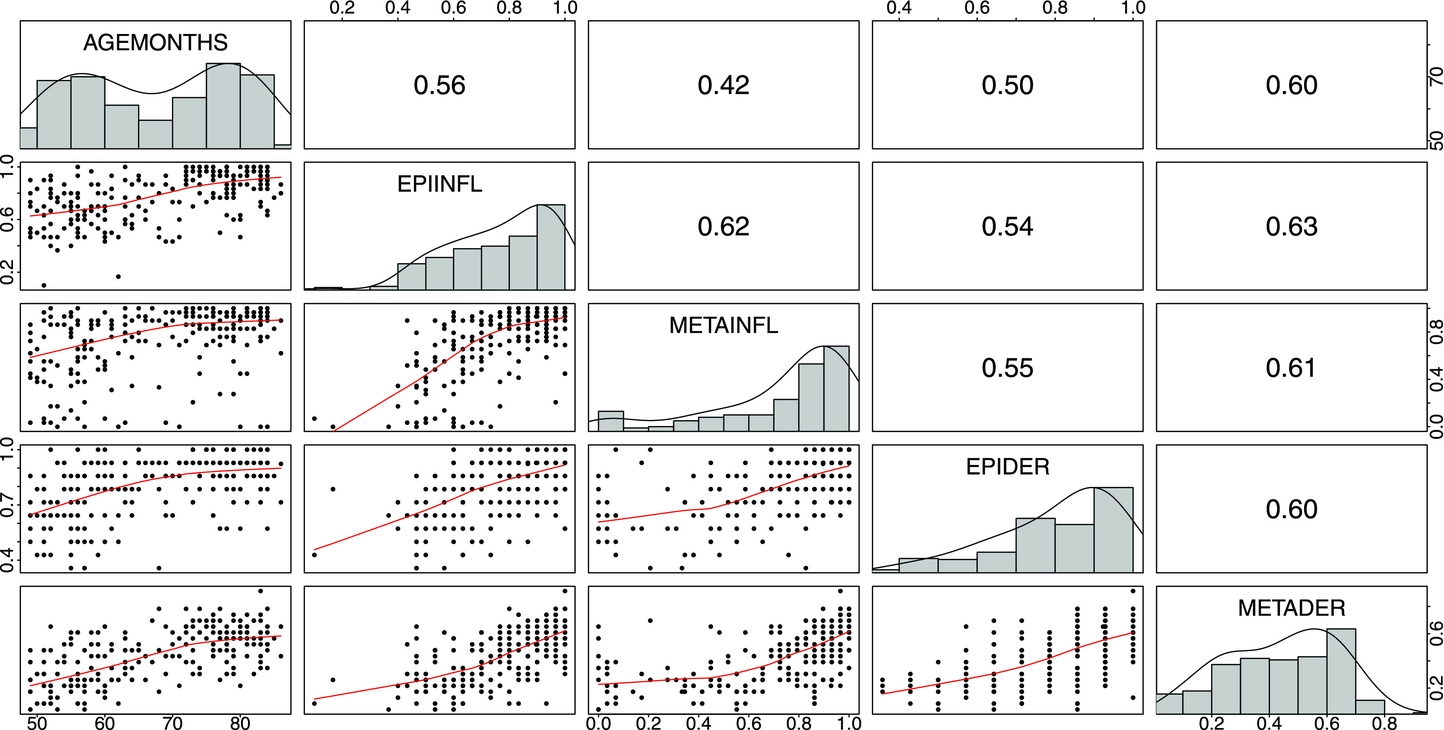
All analyses were carried out in R Version 3.3.1 (R Core Team, 2016). Total accuracy per task (in the 0–1 range) was calculated by dividing the number of correct responses by the total number of corresponding items, for illustration purposes only. Figure 1, produced using R package psych (Revelle, Reference Revelle2016), displays the scatterplots among age and morphological awareness tasks along with the corresponding Spearman ρ (nonparametric correlation) coefficients and individual variable histograms. A locally weighted scatterplot smoother (loess) has been added to the scatterplots to facilitate visualization of their continuous relations. The correlation coefficients are sizable, generally in the 0.5–0.6 range, not only among tasks but also with age. Application of factoring criteria (parallel analysis: Horn, Reference Horn1965; very simple structure: Revelle & Rocklin, Reference Revelle and Rocklin1979; minimum average partial: Velicer, Reference Velicer1976) and exploratory factor analysis indicated that a single factor suffices (cf. Tibi & Kirby, 2017) and accounts for 59% of the variance in the four tasks, achieving a root mean square error of approximation index of 0.096, 95% confidence interval (CI) [0.015, 0.184], and multiple R 2 with scores of .86.Footnote 1 This suggests that a common developmental path may account for much of the reliable variance and calls for an analytical approach that can tease apart differences between tasks beyond the common effects of age.
Raw data display including scatterplots among age (months) and accuracy (proportion of correct responses) in the four morphological awareness tasks (EPI, epimorphological level; META, metamorphological level; INFL, inflectional morphology; and DER, derivational morphology) and corresponding (nonparametric) correlation coefficients and individual variable histograms. In each panel, each point corresponds to one child. The red lines over the scatterplots show locally weighted smooth curves fit to the data points using the loess method.

Further analysis of the data was conducted by fitting generalized additive models (GAM; Baayen, Reference Baayen, Podesva and Sharma2013) to trial-level individual responses using package mgcv (Wood, Reference Wood2011). GAMs are regression models that include “smooth” terms to model curvilinear relations among continuous variables, thus providing better fit in cases of nonlinear relations (at the expense of additional model parameters, which are penalized for parsimony). As indicated by the scatterplots in Figure 1, the developmental progression (i.e., accuracy as a function of age) of at least some morphological awareness tasks appears to be nonlinear, potentially invalidating analytic approaches relying on linear relationships (such as analysis of variance or linear regression). GAMs can track these nonlinearities by fitting as smooth curves as possible to reduce residual error while keeping the number of additional parameters low. Moreover, GAMs can include random effects (both intercepts and slopes) to appropriately model the grouping structure of the data and, hence, the correlations among subsets. In this way, the correlations among responses by the same child to different items, and the correlations among responses to the same item by different children, are simultaneously accounted for (as in linear mixed-effects models, but unlike analyses of variance, in which only nested, not crossed, grouping structures can be defined in “repeated-measures” designs).
For our data, age (months) was a continuous predictor for morphological awareness performance in each of the tasks, and its effect was allowed to vary between the four tasks. The dependent variable was response accuracy for each individual trial, coded as a binomial variable and analyzed via a logit link function. In this way, variations in accuracy were modeled as differences in log odds, which do not suffer from the limited scale of 0–1 and are therefore relatively robust to the unavoidable floor and ceiling effects observed near the endpoints of accuracy scales (Dixon, Reference Dixon2008).
The random effects structure included random intercepts for participants (i.e., an average performance for each child) and for items (modeling the overall difficulty of each item within each task), as well as random slopes of task per participant (i.e., differences between tasks were allowed to vary between participants, specifically modeling their variance at the participant level) and random slopes of age per item (i.e., differences between items in the rate of increasing accuracy with age were specifically modeled as variance at the item level). Each of the aforementioned effects was retained in the model after being determined significant (by a χ2 test and the Akaike information criterion) in comparison against an alternative model that excluded it, using function compareML from R package itsadug Version 2.2 (van Rij, Wieling, Baayen, & Van Rijn, Reference van Rij, Wieling, Baayen and van Rijn2016). The resulting formula in R mgcv notation was the following:
accuracy ~ task + s(age, by = task) + s(sID, bs = “re”) + s(sID, task, bs = “re”) + s(item, bs = “re”) + s(item, age, bs = “re”).
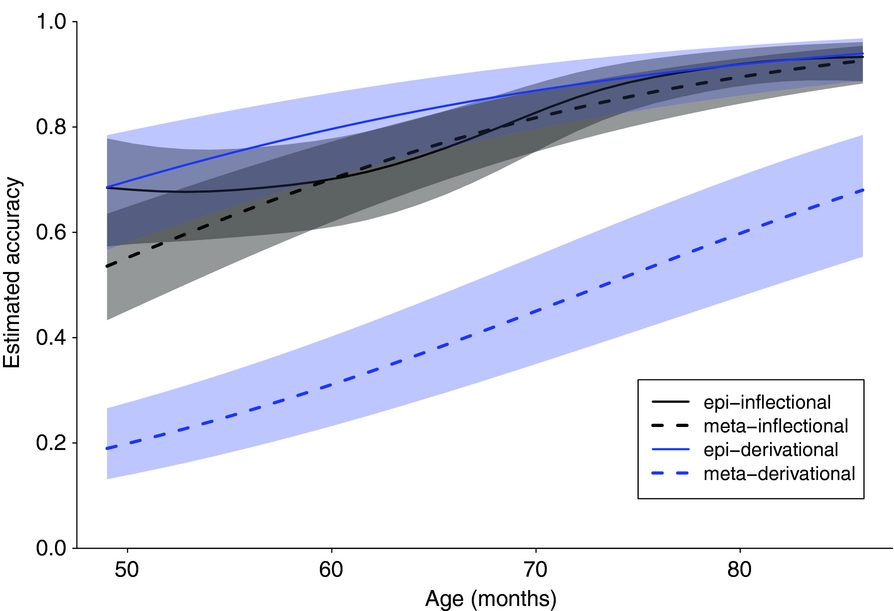
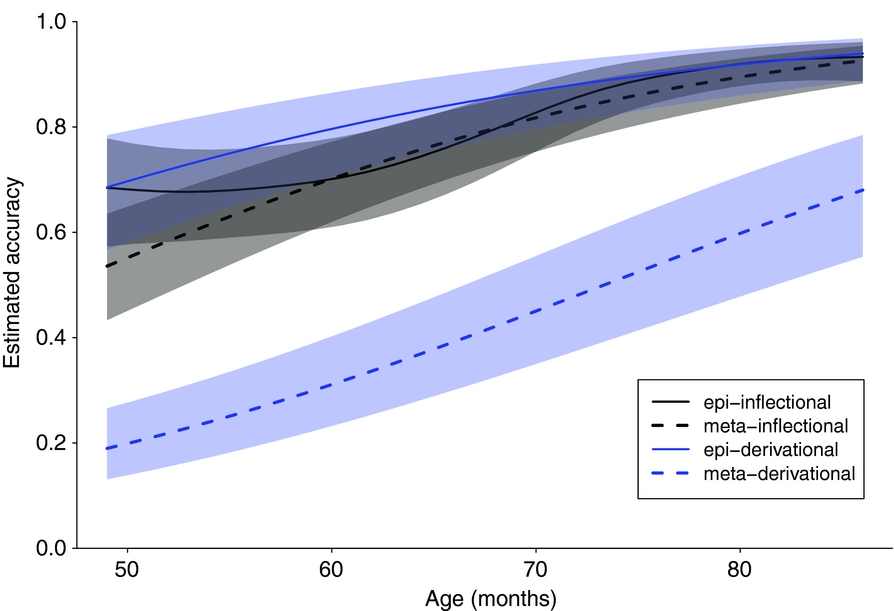
In this formula, the binomial dependent variable (accuracy, coded as 0 or 1) is modeled as a function of task (a four-level factor), a smooth continuous curvilinear effect of age (months) allowed to vary between tasks, plus random effects for participants (sID) and items (item), as noted above. Figure 2 plots the estimated accuracy as a function of age, with associated 95% CIs, based on the model parameters, after canceling all random effects. It is clear that the derivational production task (meta-der) stands out as being more difficult across the age range examined, whereas the other three tasks follow very similar paths. This model accounted for 37.4% (adjusted R 2; cf. 34.7% deviance explained) of the total item-level response accuracy variance.
Generalized additive model smooths for age fitted to the data for the four morphological awareness tasks and associated 95% confidence intervals after canceling all random effects.
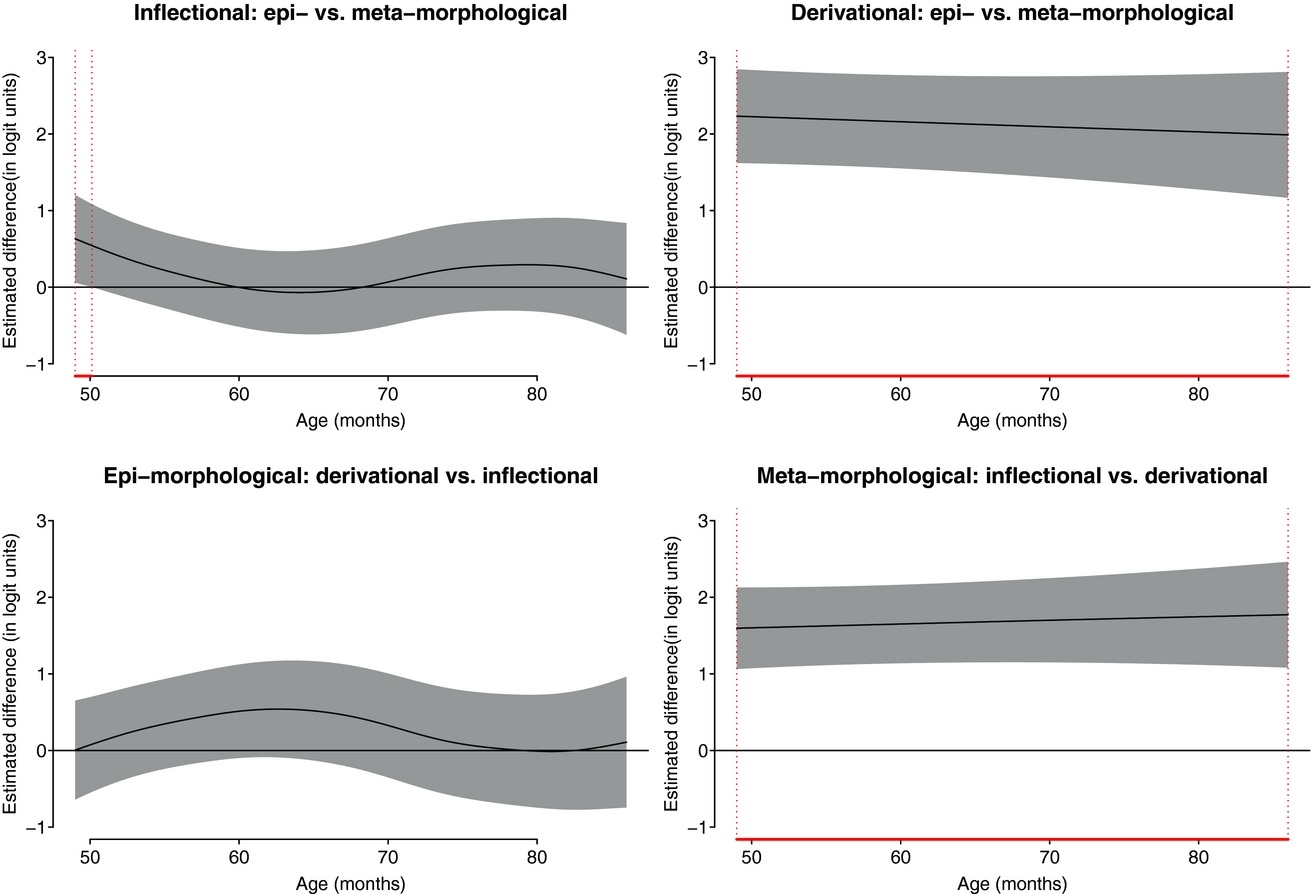
To examine differences among tasks in more detail, including age ranges in which they may significantly differ, we can compare pairs of these curves, in effect by subtracting them at each age point and plotting their continuous difference as a function of age. In this way, we can visualize the differences over time. In addition, GAM can provide estimates of CIs for the differences between curves, which permits evaluation of differences as significant or not. Figure 3 plots pairwise differences between pairs of curves, separately for comparisons between levels of awareness (epi- vs. metamorphological; top row) and for comparisons between morphological domains (inflectional vs. derivational; bottom row). The order between the two curves in each comparison was set to result in positive differences, for display purposes. In effect, these graphs plot the difference between pairs of curves seen in Figure 2, with associated 95% CIs for the difference, in the analysis scale (i.e., logits, not proportion correct). Therefore, any regions in which the CIs (shaded bands) do not straddle the horizontal zero line indicate significant differences in performance between the two tasks. These statistical comparisons confirmed that performance in production of derivational morphemes was lower than production of inflectional morphemes and than judgment of derivational morphemes. These differences fully spanned the age range examined, confirming that metalinguistic awareness of derivational morphology is most demanding and therefore attained last.
Differences between age smooths for different tasks. The top row provides comparisons between levels of awareness, and the bottom row shows comparisons between morphological domains. The vertical axis is scaled in logits and is not directly interpretable in terms of task accuracy (see Figure 2 for the scaled smooths). Ranges of significant differences between the two contrasted smooths are indicated by a red horizontal axis (online only), with vertical dotted lines marking their extent.

There was also a minor, transient, and small difference between epimorphological control and metamorphological awareness of inflections at 49–50 months of age (top left panel in Figure 3). This may constitute the trail of an earlier difference between these levels in the inflectional domain, which would be discernible in younger ages. Alternatively, it may be an artifact arising from penalizing the curvature of the performance–age relationship, evident at the edge of the modeling range, which is not bilaterally constrained and is therefore less reliable. For this reason, we will refrain from further interpreting this minor finding. Finally, we note that additional analyses (available from the authors) including measures of expressive and receptive vocabulary did not reveal any differential effects of vocabulary on the pattern of differences among morphological awareness tasks as a function of age and were therefore omitted for the sake of simplicity in the presentation of statistical analysis.
DISCUSSION
In this study, we examined the early stages of the development of morphological awareness in a cross-sectional sample of Greek children spanning prekindergarten to first grade. Therefore, whatever attainment of morphological awareness is documented in the early parts of the age range is unlikely to be influenced by reading experience and thus can be considered a marker of metalinguistic skill acquisition based on spoken language experience. In this sense, our study differs from most other studies examining morphological awareness in that we have targeted earlier, and arguably somewhat purer, stages of morphological awareness development than typically examined in the context of literacy-related studies, in which the reciprocal effects between reading comprehension and morphological processing, or the effects of morphological instruction on literacy, are often of focal interest.
The data have revealed a nuanced picture that calls for both hypothesized distinctions in order to be interpreted, to the extent that our limited range of tests constitutes an acceptable index of the corresponding domains (an issue considered further below). On the one hand, there is some evidence that inflectional awareness precedes derivational awareness, at least for the specific sample and materials tested, but this is only true for the more demanding metalinguistic level. On the other hand, there was also evidence for the differentiation between epilinguistic control, evidenced in less challenging tasks that do not require production or conscious manipulation, and full-blown metalinguistic awareness, evidenced in more demanding tasks, but this was only true for the domain of derivational morphology. This distinction parallels the corresponding distinction between epiphonological and metaphonological levels, which has been discussed in the phonological awareness literature (Duncan, Seymour, & Hill, Reference Duncan, Seymour and Hill1997, Reference Duncan, Seymour and Hill2000; Goswami & East, Reference Goswami and East2000) and can be used to interpret the progression of performance through different kinds of phonological awareness tasks with increasing age. For example, Carroll, Snowling, Hulme, and Stevenson (Reference Carroll, Snowling, Hulme and Stevenson2003) used a longitudinal design to document a developmental progression from implicit phonological awareness of large units, such as syllables and rimes, to explicit awareness of small units, namely, phonemes.
As noted, our findings indicated that the acquisition of epilinguistic control precedes the acquisition of metalinguisitic awareness for the domain of derivational morphology, as assessed with these particular tasks. It cannot be ruled out that a similar progression might be evident for inflectional morphology at ages younger than the range examined here, or using tasks addressing more demanding inflections. Still, the observed distinction between levels of morphological awareness is consistent with Gombert's (Reference Gombert1992) model of metalinguistic development, as we found that Greek children as young as 4 years old exhibit adequate epilinguistic control over both inflectional and derivational morphology. However, our results depart slightly from the phonological awareness literature, in which acquisition of epilinguistic control of phonological awareness is reported at around 5 years of age (for a review, see Gombert, Reference Gombert1992). It seems that the richness of Greek in inflectional and derivational morphology, compared to English, facilitates the development of morphological awareness at the implicit/epilinguistic level well before the onset of formal literacy instruction. Similarly, the onset of metalinguistic morphological awareness in the domain of inflection in our study seems to occur earlier than the reported onset of metaphonological awareness among English-speaking children, which has been identified at the age of 6 to 7 years (Calfee, Lindamood, & Lindamood, Reference Calfee, Lindamood and Lindamood1973; Fox & Ruth, Reference Fox and Routh1975; Rosner & Simon, Reference Rosner and Simon1971).
It should be noted that our task only tested manipulation of the number inflection. It is possible that inclusion of a wider variety of inflectional morphemes might have produced somewhat different results, perhaps exhibiting a range of initial attainment extending to older ages. This issue ought to be examined in follow-up research. However, it must also be clarified that the number inflection in Greek is quite unlike the one in English, in which a fixed single-phoneme morpheme applies uniformly to almost every noun and verb, and is only subject to minor phonological assimilation. In Greek there are several distinct inflectional classes (both verb conjugations and nominal declensions), each with its own set of suffixes. Ralli (Reference Ralli2003, Reference Ralli2005) postulates 8 general noun declensions, not distinguished by gender, whereas Holton et al. (Reference Holton, Mackridge, Philippaki-Warburton and Spyropoulos2012) list more than 20 noun classes, classified by gender, and 12 adjective classes, plus variants and exceptions. Two major verb conjugations are also generally recognized, with additional suffix variants. Stem variation is present in both verbs and nouns/adjectives, with different allomorph stems used in different contexts (Ralli, Reference Ralli2003). As nouns and verbs are inflected by fusional suffixation, children have to judge or produce the singular or plural form while taking into account the gender, case, and class of the noun, or the person, tense, and class of the verb. In our task, there were items from 6 different noun classes and 2 verb classes. Therefore, even though our tasks addressed only one inflectional domain, which is likely to have been attained in language use by this age, it cannot be said that they posed negligible epi- and metalinguistic requirements, as might be the case for a plural task in English.
Our findings on early inflectional morphological awareness are in line with previous reports suggesting that English-speaking children can apply knowledge about inflectional morphology from the age of 4 years (Berko, Reference Berko1958; Selby, Reference Selby1972). Our findings establish that preschool children can manipulate the inflectional morphemes encoding the plural form of nouns, and of verbs in active voice present tense, indicating that they have at least partially progressed to the level of metalinguistic functioning prior to learning to read and write. Of particular interest in this regard is the finding regarding the early emergence of derivational morphological awareness at the epilinguistic level, as measured with our particular judgment task, standing in contrast to findings from other studies that have provided evidence for a later emergence of morphological awareness of derivational morphemes at the implicit level, both in English (Duncan et al., Reference Duncan, Casalis and Colé2009) and in French (Casalis & Louis-Alexandre, Reference Casalis and Louis-Alexandre2000). This discrepancy cannot be attributed to particularly narrow assessment in this study because our derivational tasks included a wide variety of morphemes and associated meanings.
It remains to be determined in future studies whether the overall morphological richness of Greek makes both inflectional and derivational suffixes more salient, supporting earlier acquisition of epilinguistic control, or whether other task-related factors may account for the difference. Given that overall task demands depend on both the materials tested (e.g., words vs. pseudowords, particular lexical choices) and the procedures used (e.g., analogy, elicitation, judgment, production, with or without picture support, etc.), it seems possible to construct assessments purportedly addressing the same construct that differ greatly in how, and how much, they challenge the budding linguistic and metalinguistic skills of young children. Therefore, it is important to qualify the present findings on the basis of the properties of the tasks used, and to defer final conclusions until a wider range of tasks has been explored.
In sum, the significant difference between the derivational morphology judgment and production tasks, both of which included words with a variety of derivational morphemes, attests to the importance of drawing distinctions among levels of awareness and associated tasks to assess them. It seems clear that there is not a single level of metalinguistic competence in the domain of morphology, and that different kinds of structured interactions can produce quite divergent results even if they rely on the same kinds of materials and the same range of morphological distinctions. The differences are quite pronounced: in our data, the level of performance achieved by 4-year-olds in the judgment task was higher than that achieved by 7-year-olds in the production task (see blue lines in Figure 2). This should be taken into account when comparing across studies that have employed different tasks to examine morphological awareness.
Based on pilot work, we chose to use pseudowords for the inflectional morphology tasks but real words for derivational morphology. Given that pseudowords are generally more demanding, and often seem to be especially challenging for young children, the results attest to the high attainment in inflectional morphology, both at the level of epilinguistic control and at the level of metalinguistic awareness. Most children were evidently able to meet the demands of these tasks, perhaps in part due to related instructional activities (with real words) taking place already in kindergarten, and probably also due to the child-friendly design and administration, demonstrating adequate control as well as awareness of grammatical number. Thus, our findings are consistent with the suggestion that Greek children can manipulate inflectional morphemes by the time formal literacy instruction commences (Rothou & Padeliadu, Reference Rothou and Padeliadu2015). Future studies focusing on older children will likely have to rely on more challenging components of inflectional morphology, as normally developing kindergarten children approach ceiling performance in the production of not only number but also verb past tense and noun gender and case (Mastropavlou, Reference Mastropavlou2006), and our data suggest that this attainment largely translates to awareness performance as well.
The derivational morphology tasks were designed based on words, rather than pseudowords, because it was judged that they may be too challenging for the age range examined if based on pseudowords. This has proven to be an appropriate choice, especially taking into account preschool performance in the production task used to tap the metamorphological level. However, this choice has also resulted in a confound between lexicality and level of awareness that somewhat limits the interpretability of our findings. We claim that this limitation is not too severe because the word-based task requiring production of derivations proved more difficult than the pseudoword-based task requiring production of inflections. Therefore, using words has not unduly facilitated participants, and can be used to argue even more forcefully that conscious manipulation of derivations is more demanding than that of inflections. No corresponding difference was observed between judgment of inflections and derivations; therefore, it cannot be precluded that using words in the judgment of derivations might have critically facilitated the task to allow performance to rise up to the level observed with judgment of inflections (on pseudowords). Thus, the claim of uniformity regarding epilinguistic control is vulnerable to this confound; future studies aiming to chart the variability in performance attributable to task factors (such as lexicality, grammatical type, and mode of administration) should address this issue in more detail. However, the confound does not affect the interpretation of within-domain performance comparisons, as both inflectional tasks were based on pseudowords and both derivational tasks were based on real words.
Our findings have revealed a gradual improvement in performance, in both judgment and production tasks, across the age range examined. This general picture must be interpreted in the context of great individual variability, revealed in the scatterplots of Figure 1, indicating early attainment for some children and very low performance for others, including some in the relatively higher ages within the examined range. It is presently unknown whether the early gains may be beneficial (and whether trailing behind proves detrimental) to the eventual development of reading competence, including future fluency and comprehension. Regarding the children with low performance in the morphological awareness tasks, one may speculate that earlier difficulties with linguistic and metalinguistic skills, including phonological processing and phonological awareness, may be related to the relatively poor progress in morphological awareness (Cunningham & Carroll, Reference Cunningham and Carroll2015).
Our data do not indicate any abrupt increase in morphological awareness in first grade that might be associated with early reading experience. However, this cannot be unambiguously interpreted, as it may be due to the difficulty level of the tasks, which were designed to be achievable by our young participants. Moreover, it may be due to the limited reading experience that can possibly be accumulated during first grade, in which efforts are primarily concentrated on successful decoding. Thus, it is after first grade, and with somewhat more demanding (and perhaps time-pressured) tasks, that we would expect to see effects of reading experience on morphological awareness performance.
Finally, we acknowledge limitations arising from the operationalization of epilinguistic control versus metalinguistic awareness as a distinction between judgment and production tasks. We contend that this methodological approach is well grounded theoretically and can help reveal informative differences between tasks differing in demands that are relevant for the study of the gradual emergence of metalinguistic skills, as revealed in our study. Still, reasonable reservations may be expressed regarding (a) the extent to which the relevant domains are well captured by single tasks, rather than groups of related tasks (a measurement issue, that can be addressed with multiply indexed latent variable approaches in future studies); (b) whether the epi- versus meta- distinction provides a sufficiently rich framework to evaluate the emergence of metalinguistic skill, in comparison to more complex taxonomies (e.g., Deacon et al., Reference Deacon, Parrila, Kirby, Reid, Fawcett, Manis and Siegel2008; but see Tibi & Kirby, in press, for a finding of near unidimensionality); and (c) whether the chosen tasks do reflect the desired constructs (a core validity issue). For example, one might argue that repeated exposure to a certain feature (grammatical number) during the judgment task might result in a more conscious operation underlying task performance than supposed under the “epi” operationalization. Such criticisms can only be resolved empirically in future studies including a larger variety of theoretically grounded measures aiming to document systematic differences in the longitudinal development of skills indexed by partly dissociable sets of tasks.
In conclusion, morphological awareness of Greek inflections and derivations follows a developmental progression during the age range of 4 to 7 years. Epimorphological awareness, which puts less of a strain on attentional and linguistic processes, appears to develop earlier than metamorphological awareness, but in sync for both inflectional and derivational morphology. In contrast, metamorphological awareness of derivational morphology appears to follow. Children as young as 4 years of age have some awareness of derivational morphology at the explicit level, but this ability reaches moderate levels of competence much later, around the age of 6 years. These conclusions must be tempered due to the limitation imposed by the small number of tasks and the restricted range of morphemes assessed. Further research is required to investigate whether these findings generalize to other inflectional morphemes in Greek and to other languages with similar or more transparent orthographies. In particular, it will be important to assess each domain and level with a set of tasks, sampling wider ranges of morphemes, difficulty levels, and associated nonlinguistic task demands. Moreover it seems that assessment of children younger than 4 years will be necessary for determining the developmental onset of both implicit and explicit morphological awareness of inflectional morphology and of implicit awareness of derivational morphology.
Our findings have both theoretical and practical implications. Although based on a small range of tasks, they highlight the need for making finer distinctions within the domain of morphological awareness. Distinguishing between implicit/epilinguistic and explicit/metalinguistic levels of morphological awareness, in conjunction with different domains of morphological knowledge (inflectional vs. derivational), will enable us to fully appreciate the onset of development and progression of the critical skills related to the development of vocabulary and reading comprehension. Moreover, it may allow early identification of risk factors related to reading and spelling difficulties and enable educators to enhance those skills at a very young age.
ACKNOWLEDGMENTS
This research was partially supported by a postdoctoral research fellowship to Vassiliki Diamanti in the context of the research program of The Foundation of Reading and Writing in a Transparent Orthography: Oral Language Development and Early Literacy Skills funded by the University of Crete Special Account (Angeliki Mouzaki, Principal Investigator). We are grateful to George Manolitsis and Argyro Kapoutsi for help with the literature and information on Greek school instructional practice.